Game Sense Teaching
Approach
Renee White
Game Sense
• Game Sense challenges the traditional methods coaching. This new approach,
game sense, was first introduced into Australian Sports and Health facilities in
the mid 1990’s (Pill, 2011).
• The Games Sense teaching and coaching is very similar to the pedagogy
Teaching Games for Understanding (TGfU). Both approaches place the belief
that the learning and development of a sport or skills associated with a sport is
made through the practicing and playing of modified games of a particular or
selected sport (Light, 2013).
• In addition to the teaching through modified games questioning is used. These
two elements cause the student to be at the center of their own learning.
Game Sense is player centered (Light, 2013).
• Games Sense teaches students that learning a sport or skill is not just about
learning the physical aspects and particular movement, rather it teaches the
student that sports and physical education also requires conceptual awareness
and decision making (Pill, 2011).
Game Sense
• As recognises games sense and TGfU is a contemporary and alternative
approach to the traditional coaching and teaching of physical education
and sports. Unlike the tradition approach where the analysis of skills is
placed on techniques, Game Sense is does not place significance on the
physical skills. Rather tactical understanding and decision making is also
deemed to be important (Light, 2004).
• There are two approached that can be implementing to teach this games
sense style.
– The first practice, the small sided approach involves playing games that
gradually build the amount of players, eg. 1 vs1, 1 vs 2, 2 vs 2 ect. The small
sided approach takes into account training regarding play and practice,
designers games and smart challenges.
– The second type of game sense application is known as the mid size approach.
This form of application starts with a minimal number or players and rules and
as the players understanding develops the complexity of the game is gradually
built. The graduation of complexity is a result of further rules, concepts and
techniques being included and implemented.
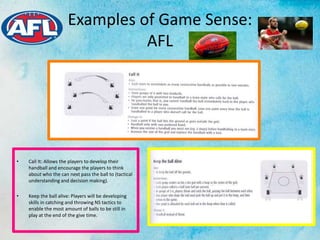
Examples of Game Sense:
AFL
• Call It: Allows the players to develop their
handball and encourage the players to think
about who the can next pass the ball to (tactical
understanding and decision making).
• Keep the ball alive: Players will be developing
skills in catching and throwing NS tactics to
enable the most amount of balls to be still in
play at the end of the give time.
Examples of Game Sense:
Netball
Students are learning basic
fundamental skills of netball
Rationale
• The overall purpose of implementing Game Sense and Teaching
Games for Understanding (TGfU) is to encourage and increase
the student’s participation in physical education and the playing
of sports. Through Game Sense, the designated games enable
physical skills and techniques to be gain, while also teaching
individuals that sport is not just about the physicalities. The
games and questioning aim to teach and enable reflection thus
resulting in thinking, reasoning and decision making skills to be
gained. In playing games and teaching games for understanding
students are learning to understand what to do rather than
how to do it which is identified by Pill (2011) to be a more
substantial way. Game Sense and Teaching Games for
Understanding will further and ensure the require outcomes to
be achieved. Through this approach the aim is to
provide positive learning experiences.
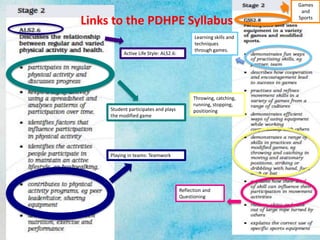
Links to the PDHPE Syllabus
• It is the PDHPE syllabus objective to provide set programs and experiences to ensure all
students are provided with an opportunity to participate in regular and varied physical
education lesson (SYLLABUS).
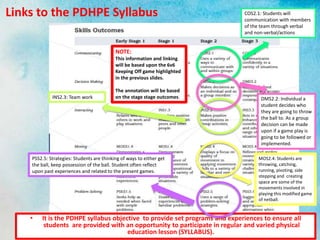
NOTE:
This information and linking
will be based upon the 6v6
Keeping Off game highlighted
in the previous slides.
The annotation will be based
on the stage stage outcomes.
COS2.1: Students will
communication with members
of the team through verbal
and non-verbal/actions
DMS2.2: Individual a
student decides who
they are going to throw
the ball to. As a group
decision can be made
upon if a game play is
going to be followed or
implemented.
INS2.3: Team work
MOS2.4: Students are
throwing, catching,
running, pivoting, side
stepping and creating
space are some of the
movements involved in
playing this modified game
of netball.
PSS2.5: Strategies: Students are thinking of ways to either get
the ball, keep possession of the ball. Student often reflect
upon past experiences and related to the present games.
Links to the PDHPE Syllabus
Active Life Style: ALS2.6:
Student participates and plays
the modified game
Playing in teams: Teamwork
Learning skills and
techniques
through games.
Reflection and
Questioning
Throwing, catching,
running, stopping,
positioning
Games
and
Sports
References:
• Board of Studies, NSW. (2007). Personal Development Health and Physical Education. Sydney,
Australia: Board of Studies.
• Light, R. (2004). Coaches’ experiences of Game Sense: opportunities and challenges. Physical
Education and Sport Pedagogy, 9(2), 115-131.
• Light, R. (2013). Game Sense: Pedagogy for performance, participation and enjoyment. New
York: Routledge.
• Pill, S. (2011). Teacher engagement with teaching games for understanding- game sense in
physical education. Journal of Physical Education and Sport, 11(2), 115-123.
• Pill, S. (2012). Play with purpose: developing game sense in AFL footballers. Hindmarsh, South
Australia: Australian Council for health, physical education and recreation.
• Pill, S. (2014). Developing Netball Game Sense: teaching movement skills and tactical skills.
Hindmarsh, South Australia: Australian Council for health, physical education and recreation.

Game Sense

  • 1.
  • 2.
    Game Sense • GameSense challenges the traditional methods coaching. This new approach, game sense, was first introduced into Australian Sports and Health facilities in the mid 1990’s (Pill, 2011). • The Games Sense teaching and coaching is very similar to the pedagogy Teaching Games for Understanding (TGfU). Both approaches place the belief that the learning and development of a sport or skills associated with a sport is made through the practicing and playing of modified games of a particular or selected sport (Light, 2013). • In addition to the teaching through modified games questioning is used. These two elements cause the student to be at the center of their own learning. Game Sense is player centered (Light, 2013). • Games Sense teaches students that learning a sport or skill is not just about learning the physical aspects and particular movement, rather it teaches the student that sports and physical education also requires conceptual awareness and decision making (Pill, 2011).
  • 3.
    Game Sense • Asrecognises games sense and TGfU is a contemporary and alternative approach to the traditional coaching and teaching of physical education and sports. Unlike the tradition approach where the analysis of skills is placed on techniques, Game Sense is does not place significance on the physical skills. Rather tactical understanding and decision making is also deemed to be important (Light, 2004). • There are two approached that can be implementing to teach this games sense style. – The first practice, the small sided approach involves playing games that gradually build the amount of players, eg. 1 vs1, 1 vs 2, 2 vs 2 ect. The small sided approach takes into account training regarding play and practice, designers games and smart challenges. – The second type of game sense application is known as the mid size approach. This form of application starts with a minimal number or players and rules and as the players understanding develops the complexity of the game is gradually built. The graduation of complexity is a result of further rules, concepts and techniques being included and implemented.
  • 4.
    Examples of GameSense: AFL • Call It: Allows the players to develop their handball and encourage the players to think about who the can next pass the ball to (tactical understanding and decision making). • Keep the ball alive: Players will be developing skills in catching and throwing NS tactics to enable the most amount of balls to be still in play at the end of the give time.
  • 5.
    Examples of GameSense: Netball Students are learning basic fundamental skills of netball
  • 6.
    Rationale • The overallpurpose of implementing Game Sense and Teaching Games for Understanding (TGfU) is to encourage and increase the student’s participation in physical education and the playing of sports. Through Game Sense, the designated games enable physical skills and techniques to be gain, while also teaching individuals that sport is not just about the physicalities. The games and questioning aim to teach and enable reflection thus resulting in thinking, reasoning and decision making skills to be gained. In playing games and teaching games for understanding students are learning to understand what to do rather than how to do it which is identified by Pill (2011) to be a more substantial way. Game Sense and Teaching Games for Understanding will further and ensure the require outcomes to be achieved. Through this approach the aim is to provide positive learning experiences.
  • 7.
    Links to thePDHPE Syllabus • It is the PDHPE syllabus objective to provide set programs and experiences to ensure all students are provided with an opportunity to participate in regular and varied physical education lesson (SYLLABUS). NOTE: This information and linking will be based upon the 6v6 Keeping Off game highlighted in the previous slides. The annotation will be based on the stage stage outcomes. COS2.1: Students will communication with members of the team through verbal and non-verbal/actions DMS2.2: Individual a student decides who they are going to throw the ball to. As a group decision can be made upon if a game play is going to be followed or implemented. INS2.3: Team work MOS2.4: Students are throwing, catching, running, pivoting, side stepping and creating space are some of the movements involved in playing this modified game of netball. PSS2.5: Strategies: Students are thinking of ways to either get the ball, keep possession of the ball. Student often reflect upon past experiences and related to the present games.
  • 8.
    Links to thePDHPE Syllabus Active Life Style: ALS2.6: Student participates and plays the modified game Playing in teams: Teamwork Learning skills and techniques through games. Reflection and Questioning Throwing, catching, running, stopping, positioning Games and Sports
  • 9.
    References: • Board ofStudies, NSW. (2007). Personal Development Health and Physical Education. Sydney, Australia: Board of Studies. • Light, R. (2004). Coaches’ experiences of Game Sense: opportunities and challenges. Physical Education and Sport Pedagogy, 9(2), 115-131. • Light, R. (2013). Game Sense: Pedagogy for performance, participation and enjoyment. New York: Routledge. • Pill, S. (2011). Teacher engagement with teaching games for understanding- game sense in physical education. Journal of Physical Education and Sport, 11(2), 115-123. • Pill, S. (2012). Play with purpose: developing game sense in AFL footballers. Hindmarsh, South Australia: Australian Council for health, physical education and recreation. • Pill, S. (2014). Developing Netball Game Sense: teaching movement skills and tactical skills. Hindmarsh, South Australia: Australian Council for health, physical education and recreation.