خ
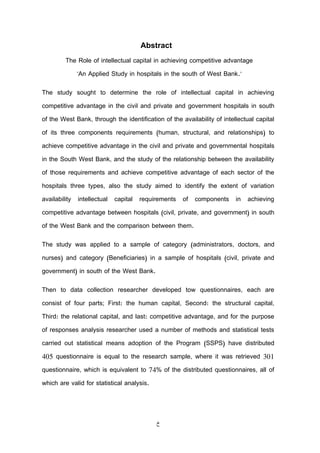
Abstract
The Role ofintellectual capital in achieving competitive advantage
"An Applied Study in hospitals in the south of West Bank."
The study sought to determine the role of intellectual capital in achieving
competitive advantage in the civil and private and government hospitals in south
of the West Bank, through the identification of the availability of intellectual capital
of its three components requirements (human, structural, and relationships) to
achieve competitive advantage in the civil and private and governmental hospitals
in the South West Bank, and the study of the relationship between the availability
of those requirements and achieve competitive advantage of each sector of the
hospitals three types, also the study aimed to identify the extent of variation
availability intellectual capital requirements of components in achieving
competitive advantage between hospitals (civil, private, and government) in south
of the West Bank and the comparison between them.
The study was applied to a sample of category (administrators, doctors, and
nurses) and category (Beneficiaries) in a sample of hospitals (civil, private and
government) in south of the West Bank.
Then to data collection researcher developed tow questionnaires, each are
consist of four parts; First: the human capital, Second: the structural capital,
Third: the relational capital, and last: competitive advantage, and for the purpose
of responses analysis researcher used a number of methods and statistical tests
carried out statistical means adoption of the Program (SSPS) have distributed
405 questionnaire is equal to the research sample, where it was retrieved 301
questionnaire, which is equivalent to 74% of the distributed questionnaires, all of
which are valid for statistical analysis.
9.
د
The study concludedseveral results of the most important: the existence of a
Positive statistical relationship between the availability of the intellectual capital of
its three components requirements (human, structural and relationships) and to
achieve competitive advantage in hospitals in south of the West Bank, where
intellectual capital is the product of elements and components combined,
interaction does not produce any of them individually, and the more this
interaction whenever had a positive impact on the realized value of the capital, as
the study showed a variance in the role of intellectual capital components in
achieving competitive advantage between hospitals three types, showing that
relational capital is the most influential in achieving competitive advantage
component, The study also showed superiority of private hospitals higher than
the (civil and governmental) hospitals in south of the West Bank of an availability
an intellectual capital requirements (for its three components) and achieve
competitive advantage, and least availability in government hospitals.
The most important recommended by the study: the need to deal with intellectual
capital as a key and strategic resource among the various resources owned by
the hospital, and keep it and develop it on an ongoing basis, and to emphasize
the importance and its role in the hospital's success and achieve the competitive
advantage, also the study recommended to work up financial allocations for the
health sector in general, and the allocation of sufficient budget of the hospitals of
the study sample in particular, addition need for the hospital management is
aware of the role of knowledge in the hospital, and how it contributes to the
transmission of knowledge and participation among employees in the
development of their performance, as reflected for the hospital to possession
human capital distinct, Add to focus efforts to attention to the head of intellectual
capital and its components, more than physical capital in the modern period.
135
4. Bontis, N.(2001). Assessing knowledge assets: a review of the models
used to measure intellectual capital. International Journal of Management
Reviews 3(1): 41-60.
5. Bontis, N. et. al., (2000). "Intellectual Capital and Business Performance
in Malaysian Industries", Journal of Intellectual Capital, vol. 1.No. 2.
6. Brooking, A. (1997). Intellectual capital: core asset for the third millennium
enterprise London; New York, International Thomson Business Press.
7. Carmines, E. G., & Zeller, R. A. (1991). Reliability and validity
assessment. Newbury Park; London [etc.]: Sage.
8. Certified Institute of Management Accounting (CIMA), - Understanding
Corporate Value, Meaning, Reporting Intellectual Capital, 2003.
http://www.cimaglobal.com.
9. Daft, R. L. (2001). Organization theory and design. Cincinnati, Ohio,
South-Western College Pub.
10.Davis, k, New storm, B, (1996). Human Behavior at Work, McGraw-Hill,
New York.
11.Day, G and Wensly,R, (1988). Assessing Advantage: Aframework for
Diagnosing Competitive Superiorty, Journal Of Marketing VOL 52 April.
12.Donnell, D, Regan, P, and Coates, B, (2000). Intellectual Capital: A
Habermasian Introduction. Journal of Intellectual Capital 1(2): 187-200.
13.Drucker, P. F. (1985). Innovation and entrepreneurship: practice and
principles. New York, Harper & Row.
14.Drucker, P., F., (1999). Knowledge worker productivity: The biggest
challenge. California Management Review, Vol. 41, No. 2.
15.Edvinson, L., & Malone, M. (1997). Intellectual Capital, Harper Colins,
New York, p147-160.
16.Edvinsson. L., & Stenfelt, C. (1999). Intellectual Capital of Nations for
Future Wealth Creation. Journal of Human Resource Costing and
Accounting. Vol. (4), No. (1).
17.Firer, S. and Stainbank, L. (2003). "Testing the Relationship Between
Intellectual Capital and Company's Performance: Evidence from South
151.
136
Africa", Meditari Accountiancy:Research Journal of the School of
Accounting Sciences, Vol. 11: 25-44.
18.Ghen, J., & Yuanxie, Z. (2004). Measuring Intellectual Capital Anew
Model and Empirical Study, Journal of Intellectual Capital, Vol., 5, No., 1.
19.Gibbert, M., Leibold, M. and Voelpel, S. (2001). Rejuvenating Corporate
Intellectual Capital by Co–Opting Customer Competence. Journal of
Intellectual Capital, Vol. 2, No. 3.
20.Green, p. (1998). The Management of Intellectual Capitl: The Issues And
The Practice, Business & Industry: 1-15.
21.Hamel, G. and Heene, A. (1994). Competence-based competition.
Chichester [England]; New York, Wiley.
22.Santos‐Rodrigues, H. F., Morais, C., Cranfield, D. (2013). Intellectual
Capital and Innovation: A Hospital Case Study. Paper presented at the
Proceedings of the 5th European Conference on Intellectual Capital: ECIC
2013.
23. Ipek, D and Zeki, S. (2009). "The relationship between firm intellectual
capital and the competitive advantage. Gebze Institute of Technology,
Journal of Global Strategic Management, 06, December.
24.Jones, G. R. (2001). Organizational theory: text and cases. Upper Saddle
River, N.J., Prentice Hall.
25.Kate, G., and Stellesun, E. (2004). The Importance of Intellectual Capital
and ILS effects on performance Measurement systems: www.ssrn.com.,
p3
26.Kawatra, p. (1995). cames managers play,Business Today, Vol. 70,No.3;
68
27.Kotler,P. (1997). Marketing Management: Analysis Planning
implementation, and control. Upper Saddle River, NJ, Prentice Hall.
28.Koulopowlos, T. M., & Frappaolo, C. (1999). Smart things to know about
knowledge management. T. J. International Ltd, Padstow, Cornwall.
29.Krajewski, L. J., and Ritzman, L. P., (1999). Operations Management
Strategy and Analysis. 5th ed., Addison- Wesley Publishing Company,
Inc., New York.
152.
137
30.Krugman, P. R.(1994). "Competitiveness: a dangerous obsession."
Foreign affairs 73(2): 28-44.
31.Luthy, D.H. (1998). Intellectual Capital and its measurement. Proceedings
of the Asian pacific interdisciplinary research in Accounting conference
(APIRA) Utah State University, Logan, Utah USA. .
32.Malhotra, Y., et al. (2003). Measuring knowledge assets of a nation:
knowledge systems for development, New York.
33.Mazlan, I., (2005). “The Influence of Intellectual Capital on the
Performance of Telecom Malaysia”, PhD, Thesis, Engineering Business
Management, Business & Advanced Technology Centre, University
Technology Malaysia.
34.McGregor, J, Tweed, D, and Pech, R,.( 2004). "Human capital in the new
economy: devil's bargain?" Journal of Intellectual Capital 5(1): 153-164.
35.Michel, S., C., And Nouri, M.B.,(2007). Developing Competitive
Advantage through Knowledge Management and Intellectual Capital.Arab
journal Of Administrative Sciences, University Of Kuwait, Vol. 14, No.3,
p135.
36. OECD, the Organization for Economic Co-operation and Development
(1999). Measuring and Reporting Intellectual Capital: Experience, Issues
and Prospect Programme Notes and Background to Technical Meeting
and policy and Strategy Forum. Paris.
37.Passetti, E., Tenucci,A., Cinquini,L., and Frey,M. (2009). Intellectual
capital communication: evidence from social and sustainability reporting.
Journal of Intellectual Capital 13(4): 531-561.
38.Pefelfer, J. & Sutton, R. L, (1999). Knowing "what" to do is not enough:
turning knowledge into action. California management review, Vol, 42, No
(1).
39.Porter, M. E. (2000). Location, competition and economic development:
Local clusters in a global economy, Economic Development Quarterly,
14(1), 15-34.
40.Porter, M., (1985). Competitive Advantage: Creating & Sustaining
Superior Performance. Free Press, New York, Available Online.
153.
138
41.Puhakka, V. (2009).Versatile and flexible use of intellectual capital in
entrepreneurial opportunity discovery. jmr Journal of Management
Research, Vol. 2, No. 1,p21
42.Quinn, J. B; Andreson, P ; Finkelstein, S. (1996). managing professional
intellect: making the most of the best. Harvard business review 74(2).
43.Robbins, S. (2004). Organizational Behavior, 7th Ed, Prentic- Hall India,
New Delhi.
44.Roos, G., Bainbridge, A. & Jacobsen, K. (2001). Intellectual Capital
analysis as a strategic tool. Strategy and Leadership, Vol. (29), No. (4).
45.Saint-Onge, H. (1996). Tacit knowledge the key to the strategic alignment
of intellectual capital. Planning Review Planning Review 24(2): 10-16.
46.Scott, W.G., and Mitchell, T.R., (1994). Organization theory: A structural
and Behavioral Analysis, Homewood, Ill., R.D. Irwin.
47.Sekaran, U. (2003). Research methods for business: a skill-building
approach. New York: John Wiley & Sons.
48.Sharabati, A.-A. A., Jawad, Sh.N, Bontis, N,. (2010). "Intellectual capital
and business performance in the pharmaceutical sector of Jordan."
Management Decision 48(1): 105-131.
49.Solitander, M. (2006). Balancing the Flows: Managing the Intellectual
Capital Flows in Inter Organisational Projects, The Electronic Journal of
Knowledge Management, Vol. 4, No. 2.
50.Stewart, T. A. (1997). Intellectual capital: the new wealth of organizations.
New York, Doubleday / Currency.
51.Sullivan, P. (2010). Profiting From Intellectual Capital Learning from
Leading Companies, Journal of Intellectual Capital, Vol. (1), and No. (1).
52.Sveiby, K.-E. (2001). Intellectual Capital and Knowledge Management.
Copenhagen Business School.
53.Tsan, W. and Chang, Ch. (2005). Intellectual capital system interaction in
Taiwan. Journal of Intellectual Capital 6(2): 285-298.
54.Urlich, D., (1998). Intellectual Capital Competence Commitment. Sloan
Management Review, No. (39).
154.
139
55.Wiig, K. M.(1993). Knowledge management foundations: thinking about
thinking: how people and organizations create, represent, and use
knowledge. Arlington, Tex., Schema Press.
56.World Competitiveness Report, World Economic Forum (1999). Oxford
University Press, Inc.
57.Yakhelf, A. and Morling, S. M. (2000). Intellectual capital: managing by
numbers. In C.Pritchard, R. Hull, M.Chumar and H. Willmott (Eds):
Managing Knowledge, Basingstoke: Macmillan Press.
58.Yang, ch., Liao, Y., Lee, y., Lin, H. (2013). A Study of the Relationship
between Intellectual Capital and Organizational Innovation in Hospitals.
CHENG CHING MEDICAL JOURNAL, 9(1).



























![135
4. Bontis, N. (2001). Assessing knowledge assets: a review of the models
used to measure intellectual capital. International Journal of Management
Reviews 3(1): 41-60.
5. Bontis, N. et. al., (2000). "Intellectual Capital and Business Performance
in Malaysian Industries", Journal of Intellectual Capital, vol. 1.No. 2.
6. Brooking, A. (1997). Intellectual capital: core asset for the third millennium
enterprise London; New York, International Thomson Business Press.
7. Carmines, E. G., & Zeller, R. A. (1991). Reliability and validity
assessment. Newbury Park; London [etc.]: Sage.
8. Certified Institute of Management Accounting (CIMA), - Understanding
Corporate Value, Meaning, Reporting Intellectual Capital, 2003.
http://www.cimaglobal.com.
9. Daft, R. L. (2001). Organization theory and design. Cincinnati, Ohio,
South-Western College Pub.
10.Davis, k, New storm, B, (1996). Human Behavior at Work, McGraw-Hill,
New York.
11.Day, G and Wensly,R, (1988). Assessing Advantage: Aframework for
Diagnosing Competitive Superiorty, Journal Of Marketing VOL 52 April.
12.Donnell, D, Regan, P, and Coates, B, (2000). Intellectual Capital: A
Habermasian Introduction. Journal of Intellectual Capital 1(2): 187-200.
13.Drucker, P. F. (1985). Innovation and entrepreneurship: practice and
principles. New York, Harper & Row.
14.Drucker, P., F., (1999). Knowledge worker productivity: The biggest
challenge. California Management Review, Vol. 41, No. 2.
15.Edvinson, L., & Malone, M. (1997). Intellectual Capital, Harper Colins,
New York, p147-160.
16.Edvinsson. L., & Stenfelt, C. (1999). Intellectual Capital of Nations for
Future Wealth Creation. Journal of Human Resource Costing and
Accounting. Vol. (4), No. (1).
17.Firer, S. and Stainbank, L. (2003). "Testing the Relationship Between
Intellectual Capital and Company's Performance: Evidence from South](https://image.slidesharecdn.com/random-230630134822-5a0e022b/85/pdf-150-320.jpg)
![136
Africa", Meditari Accountiancy: Research Journal of the School of
Accounting Sciences, Vol. 11: 25-44.
18.Ghen, J., & Yuanxie, Z. (2004). Measuring Intellectual Capital Anew
Model and Empirical Study, Journal of Intellectual Capital, Vol., 5, No., 1.
19.Gibbert, M., Leibold, M. and Voelpel, S. (2001). Rejuvenating Corporate
Intellectual Capital by Co–Opting Customer Competence. Journal of
Intellectual Capital, Vol. 2, No. 3.
20.Green, p. (1998). The Management of Intellectual Capitl: The Issues And
The Practice, Business & Industry: 1-15.
21.Hamel, G. and Heene, A. (1994). Competence-based competition.
Chichester [England]; New York, Wiley.
22.Santos‐Rodrigues, H. F., Morais, C., Cranfield, D. (2013). Intellectual
Capital and Innovation: A Hospital Case Study. Paper presented at the
Proceedings of the 5th European Conference on Intellectual Capital: ECIC
2013.
23. Ipek, D and Zeki, S. (2009). "The relationship between firm intellectual
capital and the competitive advantage. Gebze Institute of Technology,
Journal of Global Strategic Management, 06, December.
24.Jones, G. R. (2001). Organizational theory: text and cases. Upper Saddle
River, N.J., Prentice Hall.
25.Kate, G., and Stellesun, E. (2004). The Importance of Intellectual Capital
and ILS effects on performance Measurement systems: www.ssrn.com.,
p3
26.Kawatra, p. (1995). cames managers play,Business Today, Vol. 70,No.3;
68
27.Kotler,P. (1997). Marketing Management: Analysis Planning
implementation, and control. Upper Saddle River, NJ, Prentice Hall.
28.Koulopowlos, T. M., & Frappaolo, C. (1999). Smart things to know about
knowledge management. T. J. International Ltd, Padstow, Cornwall.
29.Krajewski, L. J., and Ritzman, L. P., (1999). Operations Management
Strategy and Analysis. 5th ed., Addison- Wesley Publishing Company,
Inc., New York.](https://image.slidesharecdn.com/random-230630134822-5a0e022b/85/pdf-151-320.jpg)