Digital Inclusion Building Blocks
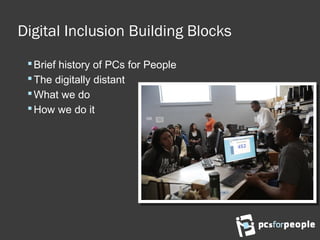
Brief history of PCs for People
The digitally distant
What we do
How we do it
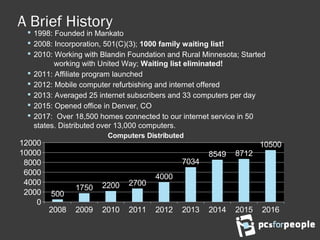
A Brief History
 1998: Founded in Mankato
 2008: Incorporation, 501(C)(3); 1000 family waiting list!
 2010: Working with Blandin Foundation and Rural Minnesota; Started
working with United Way; Waiting list eliminated!
 2011: Affiliate program launched
 2012: Mobile computer refurbishing and internet offered
 2013: Averaged 25 internet subscribers and 33 computers per day
 2015: Opened office in Denver, CO
 2017: Over 18,500 homes connected to our internet service in 50
states. Distributed over 13,000 computers.
2008 2009 2010 2011 2012 2013 2014 2015 2016
0
2000
4000
6000
8000
10000
12000
500
1750 2200 2700
4000
7034
8549 8712
10500
Computers Distributed
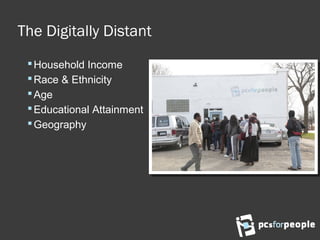
The Digitally Distant
Household Income
Race & Ethnicity
Age
Educational Attainment
Geography
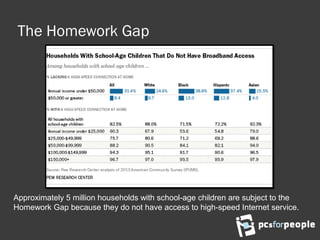
The Homework Gap
Approximately 5 million households with school-age children are subject to the
Homework Gap because they do not have access to high-speed Internet service.
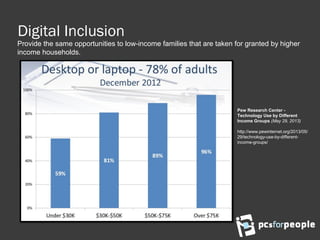
Digital Inclusion
Provide the same opportunities to low-income families that are taken for granted by higher
income households.
Pew Research Center -
Technology Use by Different
Income Groups (May 29, 2013)
http://www.pewinternet.org/2013/05/
29/technology-use-by-different-
income-groups/
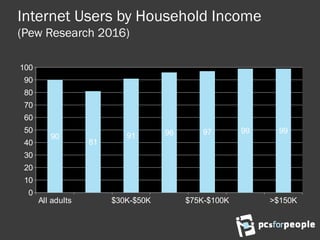
Internet Users by Household Income
(Pew Research 2016)
All adults $30K-$50K $75K-$100K >$150K
0
10
20
30
40
50
60
70
80
90
100
90
81
91 96 97 99 99
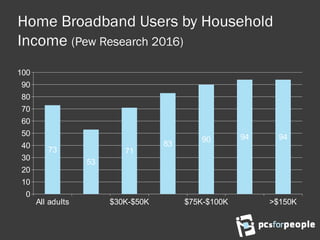
Home Broadband Users by Household
Income (Pew Research 2016)
All adults $30K-$50K $75K-$100K >$150K
0
10
20
30
40
50
60
70
80
90
100
73
53
71
83
90 94 94
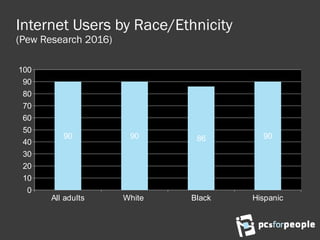
Internet Users by Race/Ethnicity
(Pew Research 2016)
All adults White Black Hispanic
0
10
20
30
40
50
60
70
80
90
100
90 90 86 90
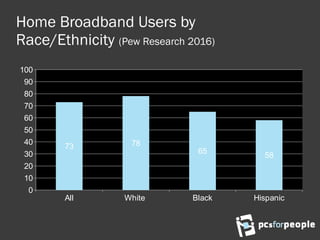
Home Broadband Users by
Race/Ethnicity (Pew Research 2016)
All White Black Hispanic
0
10
20
30
40
50
60
70
80
90
100
73 78
65
58
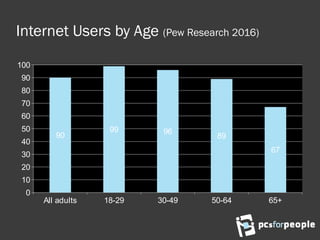
Internet Users by Age (Pew Research 2016)
All adults 18-29 30-49 50-64 65+
0
10
20
30
40
50
60
70
80
90
100
90
99 96
89
67
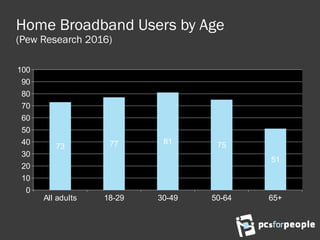
Home Broadband Users by Age
(Pew Research 2016)
All adults 18-29 30-49 50-64 65+
0
10
20
30
40
50
60
70
80
90
100
73 77 81 75
51
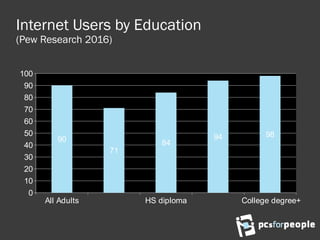
Internet Users by Education
(Pew Research 2016)
All Adults HS diploma College degree+
0
10
20
30
40
50
60
70
80
90
100
90
71
84
94 98
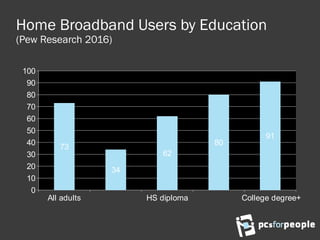
Home Broadband Users by Education
(Pew Research 2016)
All adults HS diploma College degree+
0
10
20
30
40
50
60
70
80
90
100
73
34
62
80
91
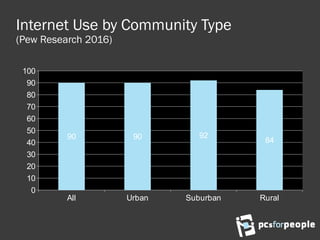
Internet Use by Community Type
(Pew Research 2016)
All Urban Suburban Rural
0
10
20
30
40
50
60
70
80
90
100
90 90 92
84
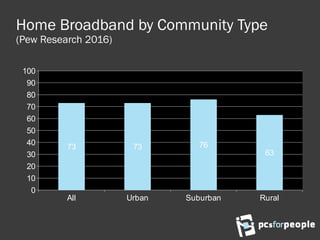
Home Broadband by Community Type
(Pew Research 2016)
All Urban Suburban Rural
0
10
20
30
40
50
60
70
80
90
100
73 73 76
63
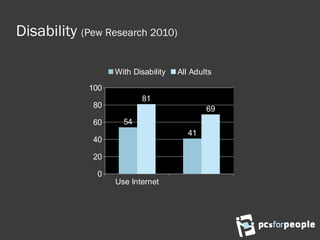
Disability (Pew Research 2010)
Use Internet
0
20
40
60
80
100
54
41
81
69
With Disability All Adults
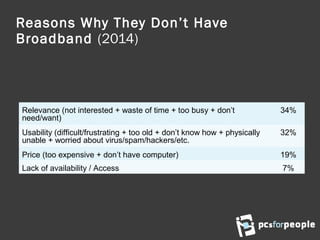
Reasons Why They Don’t Have
Broadband (2014)
Relevance (not interested + waste of time + too busy + don’t
need/want)
34%
Usability (difficult/frustrating + too old + don’t know how + physically
unable + worried about virus/spam/hackers/etc.
32%
Price (too expensive + don’t have computer) 19%
Lack of availability / Access 7%
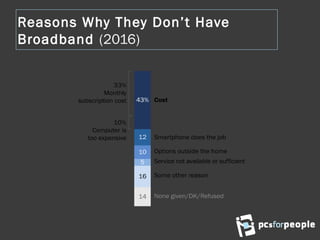
Reasons Why They Don’t Have
Broadband (2016)
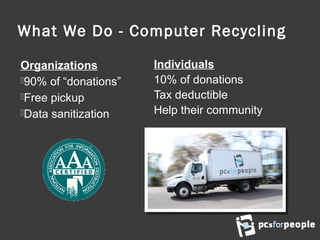
What We Do - Computer Recycling
Organizations
90% of “donations”
Free pickup
Data sanitization
Individuals
10% of donations
Tax deductible
Help their community
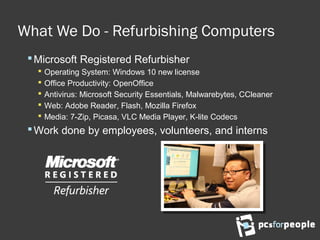
What We Do - Refurbishing Computers
Microsoft Registered Refurbisher
 Operating System: Windows 10 new license
 Office Productivity: OpenOffice
 Antivirus: Microsoft Security Essentials, Malwarebytes, CCleaner
 Web: Adobe Reader, Flash, Mozilla Firefox
 Media: 7-Zip, Picasa, VLC Media Player, K-lite Codecs
Work done by employees, volunteers, and interns
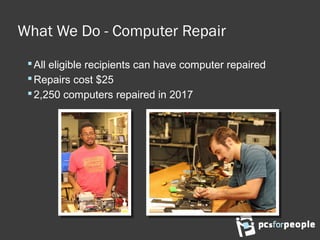
What We Do - Computer Repair
All eligible recipients can have computer repaired
Repairs cost $25
2,250 computers repaired in 2017
What We Do - Internet Sales
Available anywhere Sprint has 4G LTE Service
Recipient purchases device $80
Pay as you go ($10-$13/month)
8,600 new subscribers in 2017
25,333 total subscribers since Jan 2016
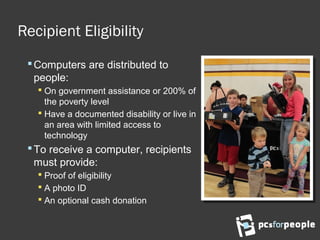
Recipient Eligibility
Computers are distributed to
people:
 On government assistance or 200% of
the poverty level
 Have a documented disability or live in
an area with limited access to
technology
To receive a computer, recipients
must provide:
 Proof of eligibility
 A photo ID
 An optional cash donation
Become a Partner- Bridging the Gap
Free digital inclusion platform created in
partnership with Mobile Beacon.
Open to 501(c)3 nonprofit, schools and
government entities to distribute our services
eligible recipients.
No administrative burden
Allows you to measure the impact you are having
in the community
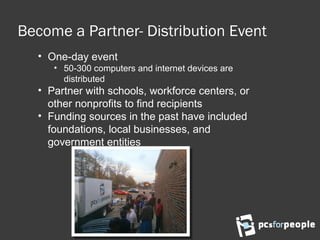
Become a Partner- Distribution Event
• One-day event
• 50-300 computers and internet devices are
distributed
• Partner with schools, workforce centers, or
other nonprofits to find recipients
• Funding sources in the past have included
foundations, local businesses, and
government entities
Become a Partner- Hotspot Checkout
Library Lending Program
 Denver Public Libraries
 Oklahoma State University
Check-out
 Library Card
 2 week loan period
Management
 Block/unblock data for devices
 Provide data usage numbers monthly
Oklahoma State University Pilot
Started May/June of 2017
4 rural libraries, 4 hotspots each
 1 week checkouts
 Participating libraries:
 Thomas-Wilhite Memorial (Perkins)
 Rieger Memorial (Haskell)
 Elgin Community Library
 Seminole Public Library
 1 week checkouts
Questions?
pcsforpeople.org
@pcsforpeople
facebook.com/pcsforpeople
linkedin.com/company/pcs-for-people
mtate@pcsforpeople.org
Citations
• Homework Gap - http://www.pewresearch.org/fact-tank/2015/04/20/the-numbers-behind-the-
broadband-homework-gap/
• Desktop & Laptop Use - http://www.pewinternet.org/2013/05/29/technology-use-by-different-
income-groups/
• General Digital Divide Statistics - http://www.pewinternet.org/2016/07/14/digital-divides-2016/

PCs for people Digital Divide

  • 2.
    Digital Inclusion BuildingBlocks Brief history of PCs for People The digitally distant What we do How we do it
  • 3.
    A Brief History 1998: Founded in Mankato  2008: Incorporation, 501(C)(3); 1000 family waiting list!  2010: Working with Blandin Foundation and Rural Minnesota; Started working with United Way; Waiting list eliminated!  2011: Affiliate program launched  2012: Mobile computer refurbishing and internet offered  2013: Averaged 25 internet subscribers and 33 computers per day  2015: Opened office in Denver, CO  2017: Over 18,500 homes connected to our internet service in 50 states. Distributed over 13,000 computers. 2008 2009 2010 2011 2012 2013 2014 2015 2016 0 2000 4000 6000 8000 10000 12000 500 1750 2200 2700 4000 7034 8549 8712 10500 Computers Distributed
  • 4.
    The Digitally Distant HouseholdIncome Race & Ethnicity Age Educational Attainment Geography
  • 5.
    The Homework Gap Approximately5 million households with school-age children are subject to the Homework Gap because they do not have access to high-speed Internet service.
  • 6.
    Digital Inclusion Provide thesame opportunities to low-income families that are taken for granted by higher income households. Pew Research Center - Technology Use by Different Income Groups (May 29, 2013) http://www.pewinternet.org/2013/05/ 29/technology-use-by-different- income-groups/
  • 7.
    Internet Users byHousehold Income (Pew Research 2016) All adults $30K-$50K $75K-$100K >$150K 0 10 20 30 40 50 60 70 80 90 100 90 81 91 96 97 99 99
  • 8.
    Home Broadband Usersby Household Income (Pew Research 2016) All adults $30K-$50K $75K-$100K >$150K 0 10 20 30 40 50 60 70 80 90 100 73 53 71 83 90 94 94
  • 9.
    Internet Users byRace/Ethnicity (Pew Research 2016) All adults White Black Hispanic 0 10 20 30 40 50 60 70 80 90 100 90 90 86 90
  • 10.
    Home Broadband Usersby Race/Ethnicity (Pew Research 2016) All White Black Hispanic 0 10 20 30 40 50 60 70 80 90 100 73 78 65 58
  • 11.
    Internet Users byAge (Pew Research 2016) All adults 18-29 30-49 50-64 65+ 0 10 20 30 40 50 60 70 80 90 100 90 99 96 89 67
  • 12.
    Home Broadband Usersby Age (Pew Research 2016) All adults 18-29 30-49 50-64 65+ 0 10 20 30 40 50 60 70 80 90 100 73 77 81 75 51
  • 13.
    Internet Users byEducation (Pew Research 2016) All Adults HS diploma College degree+ 0 10 20 30 40 50 60 70 80 90 100 90 71 84 94 98
  • 14.
    Home Broadband Usersby Education (Pew Research 2016) All adults HS diploma College degree+ 0 10 20 30 40 50 60 70 80 90 100 73 34 62 80 91
  • 15.
    Internet Use byCommunity Type (Pew Research 2016) All Urban Suburban Rural 0 10 20 30 40 50 60 70 80 90 100 90 90 92 84
  • 16.
    Home Broadband byCommunity Type (Pew Research 2016) All Urban Suburban Rural 0 10 20 30 40 50 60 70 80 90 100 73 73 76 63
  • 17.
    Disability (Pew Research2010) Use Internet 0 20 40 60 80 100 54 41 81 69 With Disability All Adults
  • 18.
    Reasons Why TheyDon’t Have Broadband (2014) Relevance (not interested + waste of time + too busy + don’t need/want) 34% Usability (difficult/frustrating + too old + don’t know how + physically unable + worried about virus/spam/hackers/etc. 32% Price (too expensive + don’t have computer) 19% Lack of availability / Access 7%
  • 19.
    Reasons Why TheyDon’t Have Broadband (2016)
  • 20.
    What We Do- Computer Recycling Organizations 90% of “donations” Free pickup Data sanitization Individuals 10% of donations Tax deductible Help their community
  • 21.
    What We Do- Refurbishing Computers Microsoft Registered Refurbisher  Operating System: Windows 10 new license  Office Productivity: OpenOffice  Antivirus: Microsoft Security Essentials, Malwarebytes, CCleaner  Web: Adobe Reader, Flash, Mozilla Firefox  Media: 7-Zip, Picasa, VLC Media Player, K-lite Codecs Work done by employees, volunteers, and interns
  • 22.
    What We Do- Computer Repair All eligible recipients can have computer repaired Repairs cost $25 2,250 computers repaired in 2017
  • 23.
    What We Do- Internet Sales Available anywhere Sprint has 4G LTE Service Recipient purchases device $80 Pay as you go ($10-$13/month) 8,600 new subscribers in 2017 25,333 total subscribers since Jan 2016
  • 24.
    Recipient Eligibility Computers aredistributed to people:  On government assistance or 200% of the poverty level  Have a documented disability or live in an area with limited access to technology To receive a computer, recipients must provide:  Proof of eligibility  A photo ID  An optional cash donation
  • 25.
    Become a Partner-Bridging the Gap Free digital inclusion platform created in partnership with Mobile Beacon. Open to 501(c)3 nonprofit, schools and government entities to distribute our services eligible recipients. No administrative burden Allows you to measure the impact you are having in the community
  • 26.
    Become a Partner-Distribution Event • One-day event • 50-300 computers and internet devices are distributed • Partner with schools, workforce centers, or other nonprofits to find recipients • Funding sources in the past have included foundations, local businesses, and government entities
  • 27.
    Become a Partner-Hotspot Checkout Library Lending Program  Denver Public Libraries  Oklahoma State University Check-out  Library Card  2 week loan period Management  Block/unblock data for devices  Provide data usage numbers monthly
  • 28.
    Oklahoma State UniversityPilot Started May/June of 2017 4 rural libraries, 4 hotspots each  1 week checkouts  Participating libraries:  Thomas-Wilhite Memorial (Perkins)  Rieger Memorial (Haskell)  Elgin Community Library  Seminole Public Library  1 week checkouts
  • 29.
    Questions? pcsforpeople.org @pcsforpeople facebook.com/pcsforpeople linkedin.com/company/pcs-for-people mtate@pcsforpeople.org Citations • Homework Gap- http://www.pewresearch.org/fact-tank/2015/04/20/the-numbers-behind-the- broadband-homework-gap/ • Desktop & Laptop Use - http://www.pewinternet.org/2013/05/29/technology-use-by-different- income-groups/ • General Digital Divide Statistics - http://www.pewinternet.org/2016/07/14/digital-divides-2016/