Presented by -Kumari Jyoti
Msc in biotechnology and
diploma in forensic science
Vinoba bhave university
Topics- PCR(polymerase chain
reaction )
Polymerase chain reaction
What is PCR?
Materials and method
Applications of PCR
Important formula's used in PCR
Traditional pcr disadvantage.
Important of different types of PCR
PCR(polymerase chain
reaction)
PCR is in techniques used to make many copies of
small section of DNA or gene.
It is very rapid method for amplification of
desired segment of DNA or RNA.
Using pcr it is possible to generate thousands to
millions of copies of particular segment.
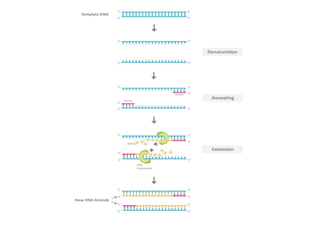
Generally PCR works in three main steps -
1. Denaturation
2. Annealing
3. Extinction
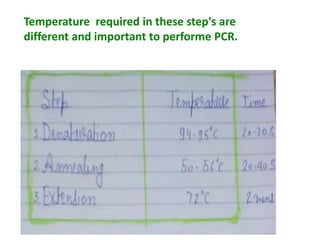
Temperature required in these step's are
different and important to performe PCR.
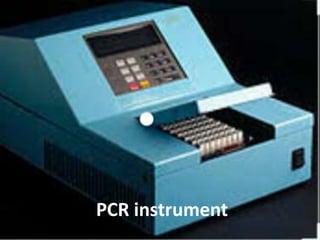
PCR instrument
Taq polymerase enzyme add the
ntdes.
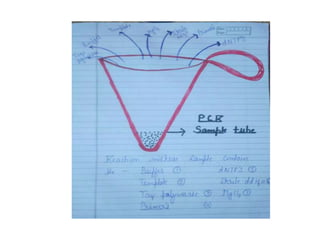
Material used in polymerase chain
reaction are-
Taq polymrase
• Source-Thermus aquaticus
• Activity-5'-3' polymerase activity(lacks 3'-5'
exonuclease activitiy).
• Stability-half life <5min at 100°C but retain activity
up to 40min at 95°C .
• Function- The enzyme responsible for performing
the amplification
• Disadvantage of Taq polymerase-
• Error rate-2×10⁻⁴ errors/base
• It also lacks the proofreading activity
• Taq polymerase is unstable above 90°C.
• The DNA template is starting material.
• It contains the region which is amplified.
• Genomic DNA-5-50ng is sufficient.
• Plasmid DNA template - 0.1 to1ng is sufficient
amount.
DNA Template
Buffer
• Buffer provide a suitable environment for DNA pol
enzyme.
• The pH of buffer i.e 8.0 to 9.5 stabilized by tris -HCl.
MgCl2
• Function as a cofactor for activity of DNA polymerase
enzyme.
• Mg2+ facilitates formation of the complex between the
primer and DNA template by stabilizing negative charge
on their phosphate backbone.
Primers
• Primers are short pieces usually 20-25bp in length.
• Tm- 55 to70°C.
• 40to 60℅ GC(uniform distribution).
• One C and G at 3'end.
• It is made as a pair -reverse and forward primer.
• Which are bind to the complementary .sequence.
dNTP'S
• dNTPs consists -dATP,dCTP,dGTP,dTTP (four basic
nucleotides).
• These all are added to pcr reaction in equimolar
amount for optimal base incorporation.
• 0.2mM is genreally used as final concentration.
• dNTps exceeding optimal concentration promote
misincorporation by non-proofreading DNA
polymerase enzyme.
Sterile distilled water
• Pcr grade water is pure water.
• It is free from DNase and RNase enzymes.
• Distilled water is used to normalise the total
sample volume.
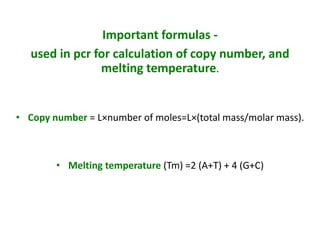
Important formulas -
used in pcr for calculation of copy number, and
melting temperature.
• Copy number = L×number of moles=L×(total mass/molar mass).
• Melting temperature (Tm) =2 (A+T) + 4 (G+C)
Applications of PCR
• Molecular identification-
• Genetic matching
• Mutation screening
• Pathogen detection
• Molecular Arachaelogy
• Sequencing-
• Bioinformatics
• Genomic cloning
• Human genome project
• Genetic engineering.
• Gene expressions study
• Forensic science.
• Paternity testing
• DNA sample analysis for
crime scene
investigation.
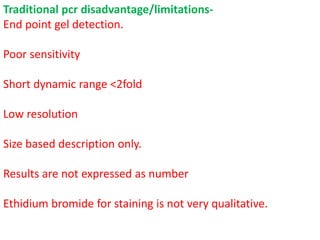
Traditional pcr disadvantage/limitations-
End point gel detection.
Poor sensitivity
Short dynamic range <2fold
Low resolution
Size based description only.
Results are not expressed as number
Ethidium bromide for staining is not very qualitative.
Hard to differentiate between the 10 copies
or 50 copies of DNA sample in gel
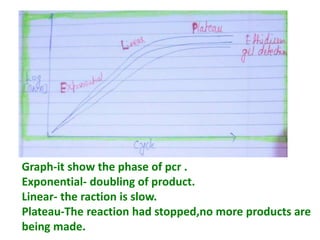
Graph-it show the phase of pcr .
Exponential- doubling of product.
Linear- the raction is slow.
Plateau-The reaction had stopped,no more products are
being made.
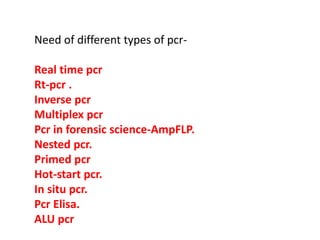
Need of different types of pcr-
Real time pcr
Rt-pcr .
Inverse pcr
Multiplex pcr
Pcr in forensic science-AmpFLP.
Nested pcr.
Primed pcr
Hot-start pcr.
In situ pcr.
Pcr Elisa.
ALU pcr
https://youtu.be/y3egwMexSTI
Video link for PCR
Thankyou

Pcr ppt

  • 1.
    Presented by -KumariJyoti Msc in biotechnology and diploma in forensic science Vinoba bhave university Topics- PCR(polymerase chain reaction )
  • 2.
    Polymerase chain reaction Whatis PCR? Materials and method Applications of PCR Important formula's used in PCR Traditional pcr disadvantage. Important of different types of PCR
  • 3.
    PCR(polymerase chain reaction) PCR isin techniques used to make many copies of small section of DNA or gene. It is very rapid method for amplification of desired segment of DNA or RNA. Using pcr it is possible to generate thousands to millions of copies of particular segment.
  • 4.
    Generally PCR worksin three main steps - 1. Denaturation 2. Annealing 3. Extinction
  • 5.
    Temperature required inthese step's are different and important to performe PCR.
  • 7.
  • 9.
    Taq polymerase enzymeadd the ntdes.
  • 11.
    Material used inpolymerase chain reaction are-
  • 12.
    Taq polymrase • Source-Thermusaquaticus • Activity-5'-3' polymerase activity(lacks 3'-5' exonuclease activitiy). • Stability-half life <5min at 100°C but retain activity up to 40min at 95°C . • Function- The enzyme responsible for performing the amplification
  • 13.
    • Disadvantage ofTaq polymerase- • Error rate-2×10⁻⁴ errors/base • It also lacks the proofreading activity • Taq polymerase is unstable above 90°C.
  • 14.
    • The DNAtemplate is starting material. • It contains the region which is amplified. • Genomic DNA-5-50ng is sufficient. • Plasmid DNA template - 0.1 to1ng is sufficient amount. DNA Template
  • 15.
    Buffer • Buffer providea suitable environment for DNA pol enzyme. • The pH of buffer i.e 8.0 to 9.5 stabilized by tris -HCl. MgCl2 • Function as a cofactor for activity of DNA polymerase enzyme. • Mg2+ facilitates formation of the complex between the primer and DNA template by stabilizing negative charge on their phosphate backbone.
  • 16.
    Primers • Primers areshort pieces usually 20-25bp in length. • Tm- 55 to70°C. • 40to 60℅ GC(uniform distribution). • One C and G at 3'end. • It is made as a pair -reverse and forward primer. • Which are bind to the complementary .sequence.
  • 17.
    dNTP'S • dNTPs consists-dATP,dCTP,dGTP,dTTP (four basic nucleotides). • These all are added to pcr reaction in equimolar amount for optimal base incorporation. • 0.2mM is genreally used as final concentration. • dNTps exceeding optimal concentration promote misincorporation by non-proofreading DNA polymerase enzyme.
  • 18.
    Sterile distilled water •Pcr grade water is pure water. • It is free from DNase and RNase enzymes. • Distilled water is used to normalise the total sample volume.
  • 19.
    Important formulas - usedin pcr for calculation of copy number, and melting temperature. • Copy number = L×number of moles=L×(total mass/molar mass). • Melting temperature (Tm) =2 (A+T) + 4 (G+C)
  • 20.
    Applications of PCR •Molecular identification- • Genetic matching • Mutation screening • Pathogen detection • Molecular Arachaelogy • Sequencing- • Bioinformatics • Genomic cloning • Human genome project • Genetic engineering. • Gene expressions study • Forensic science. • Paternity testing • DNA sample analysis for crime scene investigation.
  • 21.
    Traditional pcr disadvantage/limitations- Endpoint gel detection. Poor sensitivity Short dynamic range <2fold Low resolution Size based description only. Results are not expressed as number Ethidium bromide for staining is not very qualitative.
  • 22.
    Hard to differentiatebetween the 10 copies or 50 copies of DNA sample in gel
  • 23.
    Graph-it show thephase of pcr . Exponential- doubling of product. Linear- the raction is slow. Plateau-The reaction had stopped,no more products are being made.
  • 24.
    Need of differenttypes of pcr- Real time pcr Rt-pcr . Inverse pcr Multiplex pcr Pcr in forensic science-AmpFLP. Nested pcr. Primed pcr Hot-start pcr. In situ pcr. Pcr Elisa. ALU pcr
  • 25.
  • 26.