LIBRARY
MANAGEMENT
SYSTEM
Savitribai Phule Pune University,
Pune Academic Year2023-24
S.B Patil college of Engineering, Indapur-Pune
Department of AIDS
 SUBMITED BY :
 Shaikh Shahid_25
 Shendage Nikita_26
 Shinde Jotiram_27
 Shirkande Chaitanaya_28
 Sutar Manish_29
 Tarange Dnyaneshwari_30
 Thombare Rushikesh_31
GUIDED BY
– Prof K N AAGLAVE
CONTENTS
 Introduction
 Purpose
 Project timeline
 Product scope
 Solution of The Problem
 Product function
 Software design
 Analysis the model
 FUTURE ENHANCEMENT
 Conclusion
 Q&A
INTRODUCTION
 Key
Components:
 User Management
 Catalog Management
 Borrowing and Returning
 Reservation and Request
Management
 Reporting and Analytics
 Administrative Tools
 Integration
 Functionalitie
s:  Authentication and Authorization
 Cataloging and Classification
 Fine Management
 Accessibility and Multilingual
Support
 Data Backup and Security
 Purpose
 Efficient Resource Management
 User Services Enhancement
 Streamlined Circulation Processes
 Access to Digital Resources
 Interlibrary Cooperation
 Promotion of Literacy and Lifelong Learning
 Adaptation to Technological Advances
 Learn the Languages like – HTML,CSS
BOOTSTRAP
 BACKEND – PHP
 Database - SQL
We make communicaton with
each group member & find out
the problem
Communication
Our group make plan about the
project outline as well as make
the estimations for time,cost
required knowledge
Planning
We make the design of the our
project according to the
requirment
Design
The actual working construction
of the project start in this phase
Construction
Deleviry to the customer &
taking feedback as well a
provides the updates as per
requirement
Deployment
OUR TIMELINE
LIBRARY AT A GLANCE
Print journals Ph.D Thesis
00
M.Tech Dissertation Print Magazines
Print Books E-Books E-Journals E-Databases
462 48 00 1
00 30
00
9am to 4 pm
No working
Regular Working Days Monday to Friday
During the examination
During vacation
Working hour on holidays No working
LIBRARY TIMING
 scope of project
• Many libraries are operated manually by a group of people.
These people keep records regarding the books & students
(borrowers), check the books manually and keep records on
issued books.
• All these things have to be carried out manually and if the
library is very large, proper record keeping will become a major
problem as manual record keeping has never been a reliable
method because people tend to forget things.
•The solution to the problem of the
manual library management is to develop
a computerized library management
system. Before developing the proposed
system, there is need to identify:
 The design of the proposed system
 The main users of the library
management system
 The activities of the main users
Product function
A Activities of
thte Borrower
Activities of
the Administrator
Activities of
the librarian
• Search for a book Add/Delete books Issue books
• Borrow a book Maintain the
database
Return books
• View user details View user details Add/delete
books
• Modify user details Maintain user
details
SOFTWARE DESIGN
Home Page and Admin Login
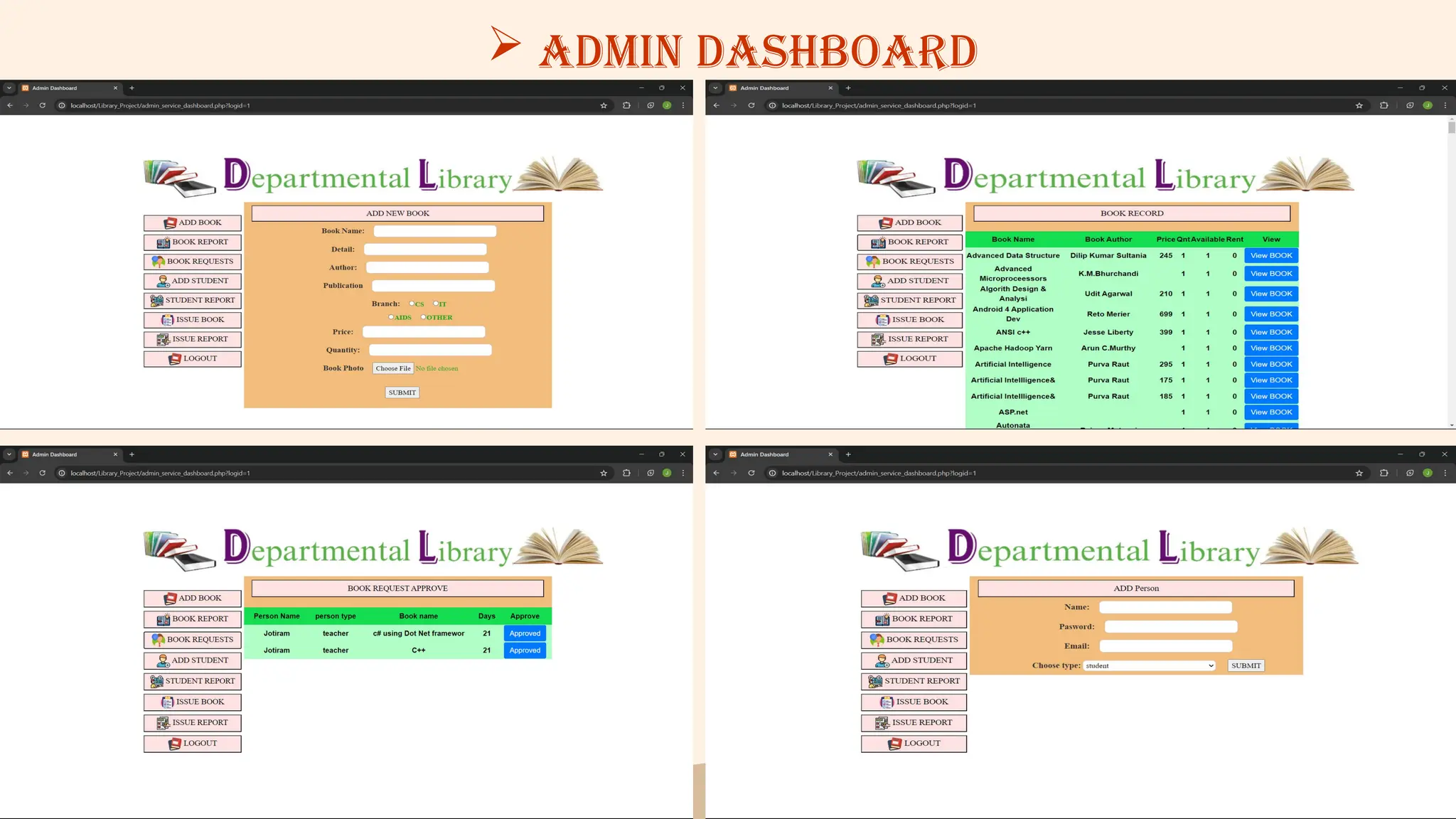
 Admin Dashboard
 Student dashboard
“The only thing that you
absolutely have to
know, is the location of
the library.”
ALBERT EINSTEIN
Analysis of the model
•Library management System provides a simple GUI (Graphical User
Interface) for the Library Staff to manage the functions of the library
effectively. The Library Management System is designed & developed for
the receipt and Issuance of books in the library.
•In a non-computerized Library management system, when a book is
issued or returned, it is noted down in a register after which data entry is
done to update the status of the books. This process takes some time
and proper update of this information cannot be guaranteed. Anomalies
in the update process can cause loss of books. So a more user friendly
interface which could update the database instantly has a great
demand in libraries, hence the need for this project.
FUTURE ENHANCEMENT
• SEARCH FEATURE
• FORM FILLUP PROCEDURE
• GIVING NOTIFICATION TO USER
conclusion
I. Automation: The library management system automates tasks like
book borrowing, returning, and cataloging, enhancing efficiency and
reducing not only error but also efforts
II. User-Friendly: It offers a user-friendly interface for patrons to search
and access library resources easily, while providing librarians with
tools for efficient inventory management.
III. Efficiency: By streamlining operations and improving accessibility to
library resources, the system boosts efficiency for both users and
library staff.
IV. Technology: Developed using programming languages and
databases, the system leverages technology to modernize library
services and adapt to digital trends.
V. Impact: The system improves service quality, supports educational
goals, and aligns with the digital transformation of library services,
benefiting both patrons and the institution.
-Q&A
- SE (AI&DS) PBL Group

PBL_LMS_PPT for the library management.pptx

  • 1.
  • 2.
    Savitribai Phule PuneUniversity, Pune Academic Year2023-24 S.B Patil college of Engineering, Indapur-Pune Department of AIDS  SUBMITED BY :  Shaikh Shahid_25  Shendage Nikita_26  Shinde Jotiram_27  Shirkande Chaitanaya_28  Sutar Manish_29  Tarange Dnyaneshwari_30  Thombare Rushikesh_31 GUIDED BY – Prof K N AAGLAVE
  • 3.
    CONTENTS  Introduction  Purpose Project timeline  Product scope  Solution of The Problem  Product function  Software design  Analysis the model  FUTURE ENHANCEMENT  Conclusion  Q&A
  • 4.
    INTRODUCTION  Key Components:  UserManagement  Catalog Management  Borrowing and Returning  Reservation and Request Management  Reporting and Analytics  Administrative Tools  Integration  Functionalitie s:  Authentication and Authorization  Cataloging and Classification  Fine Management  Accessibility and Multilingual Support  Data Backup and Security
  • 5.
     Purpose  EfficientResource Management  User Services Enhancement  Streamlined Circulation Processes  Access to Digital Resources  Interlibrary Cooperation  Promotion of Literacy and Lifelong Learning  Adaptation to Technological Advances  Learn the Languages like – HTML,CSS BOOTSTRAP  BACKEND – PHP  Database - SQL
  • 6.
    We make communicatonwith each group member & find out the problem Communication Our group make plan about the project outline as well as make the estimations for time,cost required knowledge Planning We make the design of the our project according to the requirment Design The actual working construction of the project start in this phase Construction Deleviry to the customer & taking feedback as well a provides the updates as per requirement Deployment OUR TIMELINE
  • 7.
    LIBRARY AT AGLANCE Print journals Ph.D Thesis 00 M.Tech Dissertation Print Magazines Print Books E-Books E-Journals E-Databases 462 48 00 1 00 30 00
  • 8.
    9am to 4pm No working Regular Working Days Monday to Friday During the examination During vacation Working hour on holidays No working LIBRARY TIMING
  • 9.
     scope ofproject • Many libraries are operated manually by a group of people. These people keep records regarding the books & students (borrowers), check the books manually and keep records on issued books. • All these things have to be carried out manually and if the library is very large, proper record keeping will become a major problem as manual record keeping has never been a reliable method because people tend to forget things.
  • 10.
    •The solution tothe problem of the manual library management is to develop a computerized library management system. Before developing the proposed system, there is need to identify:  The design of the proposed system  The main users of the library management system  The activities of the main users
  • 11.
    Product function A Activitiesof thte Borrower Activities of the Administrator Activities of the librarian • Search for a book Add/Delete books Issue books • Borrow a book Maintain the database Return books • View user details View user details Add/delete books • Modify user details Maintain user details
  • 12.
  • 13.
  • 15.
  • 16.
    “The only thingthat you absolutely have to know, is the location of the library.” ALBERT EINSTEIN
  • 17.
    Analysis of themodel •Library management System provides a simple GUI (Graphical User Interface) for the Library Staff to manage the functions of the library effectively. The Library Management System is designed & developed for the receipt and Issuance of books in the library. •In a non-computerized Library management system, when a book is issued or returned, it is noted down in a register after which data entry is done to update the status of the books. This process takes some time and proper update of this information cannot be guaranteed. Anomalies in the update process can cause loss of books. So a more user friendly interface which could update the database instantly has a great demand in libraries, hence the need for this project.
  • 18.
    FUTURE ENHANCEMENT • SEARCHFEATURE • FORM FILLUP PROCEDURE • GIVING NOTIFICATION TO USER
  • 19.
    conclusion I. Automation: Thelibrary management system automates tasks like book borrowing, returning, and cataloging, enhancing efficiency and reducing not only error but also efforts II. User-Friendly: It offers a user-friendly interface for patrons to search and access library resources easily, while providing librarians with tools for efficient inventory management. III. Efficiency: By streamlining operations and improving accessibility to library resources, the system boosts efficiency for both users and library staff. IV. Technology: Developed using programming languages and databases, the system leverages technology to modernize library services and adapt to digital trends. V. Impact: The system improves service quality, supports educational goals, and aligns with the digital transformation of library services, benefiting both patrons and the institution.
  • 20.
  • 21.
    - SE (AI&DS)PBL Group