SlideShare Explore Search You
Upload
Login
Signup
header Submit Search
Home
Explore
Successfully reported this slideshow.
We use your LinkedIn profile and activity data to personalize ads and to show you more relevant ads.
You can change your ad preferences anytime.
Upcoming SlideShare
Loading in …5
×
2 of 91
Library Management System Project in PHP
with BlackBook & Source Code
11,744 views
Share
Like
...
RadikhaSharma
Follow
Published on Jan 2, 2018
Library Management System in PHP & AngularJS source code &
...
Published in: Education
13 Comments
47 Likes
Statistics
Notes
Full Name
Comment goes here.
12 hours ago Delete Reply Block
Are you sure you want to Yes No
Your message goes here
Post
Login to see the comments
Mohammed Huzaif
2 weeks ago
SakshiJain541
1 month ago
Savan Jivani
1 month ago
Devanshi Mhatre
2 months ago
Moslem Uddin , Librarian at Librarian, Military Institute of Science and Technology (MIST)
3 months ago
Show More
No Downloads
Views
Total views
11,744
On SlideShare
0
From Embeds
0
Number of Embeds
4
Actions
Shares
0
Downloads
8
Comments
13
Likes
47
Embeds 0
No embeds
No notes for slide
Library Management System Project in PHP with BlackBook & Source Code
1. 1. Library Management System 1 A PROJECT ON LIBRARY MANAGEMENT SYSTEM
Submitted by Mr. Random Name (0000000) Year 2016-2017 DATE OF SUBMISSION 06-06-2017
Under the guidance of Mr.Random Sir Name Submitted in partial fulfillment of the requirements
1. for qualifying M.C.A Semester VI Examination INSTITUTE OF DISTANCE AND OPEN
LEARNING UNIVERSITY OF MUMBAI DR. SHANKAR DAYAL SHRAMA BHAVAN,
VIDYANAGARI, SANTACRUZ (E), MUMBAI-98
2. 2. Library Management System 2 A PROJECT ON LIBRARY MANAGEMENT SYSTEM
Submitted by Mr. Random Name (0000000) Year 2016-2017 DATE OF SUBMISSION 06-06-2017
Under the guidance of Mr.Random Sir Name Submitted in partial fulfillment of the requirements
for qualifying M.C.A Semester VI Examination INSTITUTE OF DISTANCE AND OPEN
LEARNING UNIVERSITY OF MUMBAI DR. SHANKAR DAYAL SHRAMA BHAVAN,
VIDYANAGARI, SANTACRUZ (E), MUMBAI-98
3. 3. Library Management System 3 INSTITUTE OF DISTANCE AND OPEN LEARNING
UNIVERSITY OF MUMBAI, IDE BUILDING, VIDYANAGARI, MUMBAI-98
PROJECTCERTIFICATE This is to certify that the Project titled Library Management System_ by
Mr. Random Name Seat No 00000000 in partial fulfillment for M.C.A Degree Examination in
Semester VI for the academic year 2016-2017 has been found satisfactory. This report had not
been submitted for any other examination and does not form part of any other course undergone
by the candidate. Signature Signature Signature Faculty in charge External Examiner Coordinator
– M.C.A (IDOL) Guided by Examined By Certified By
4. 4. Library Management System 4 DECLARATION I declare that this written submission
represents my ideas in my own words and where others' ideas or words have been included, I
have adequately cited and referenced the original sources. I also declare that I have adhered to
all principles of academic honesty and integrity and have not misrepresented or fabricated or falsi
ed any idea/data/fact/source in my submission. I understand that any violation of the above will be
cause for disciplinary action by the Institute and can also evoke penal action from the sources
which have thus not been properly cited or from whom proper permission has not been taken
when needed. (Signature) Random Name Date :
5. 5. Library Management System 5 ACKNOWLEDGEMENT I the undersigned have great pleasure
in giving our sincere thanks to those who have contributed their valuable time in helping us to
achieve the success in our project work. I would like to express our gratitude to all those gave us
the possibility to complete this project. I want to thank St Stefen High School for giving us the

opportunity for doing this project. I am indebted and thankful to our Project Guide Prof.

Mr.Random Sir Name to whom I owe his piece of knowledge for his valuable and timely guidance,
co- operation, encouragement & time spent for doing this project work. My sincere thanks to the IT
staff for providing us sufficient information which helped us to complete our project successfully.
6. 6. Library Management System 6 PREFACE Computers are now becoming part of almost every
activity in organization. The developments made on the fields of information and computer
technology have vastly blown up and have changed the face of the present world rapidly. The use
of IT has gradually and now computers are increasingly used for everyday activities organizations.
The Library Management System is full of feeling to provide better services to its users. The main
objective of the program is too serve the library to handle day to day books transaction and
maintain sound information about the books as well as the members. I want to express my
gratitude to Mr.Random Friend Name for his valuable guidance for accomplishing this project
entitled “LIBRARY MANAGEMENT SYSTEM”. My sincere thanks also goes to the friends who
have suggest the flow of the system and gave reliable ideas to work on. I have worked with
commitment right from the initialization of the project and continuing all the way till its compilation.
Review of the project is an unending process and it may contain errors as there is always a scope
for improvements.
7. 7. Library Management System 7 SYNOPSIS
8. 8. Library Management System 8 Introduction: The project entitled Library Management System is
8. a pilot project for small school to manage their library administration process. Project: The Library
Management System is the software to keep the transaction records that happens in the library. It
avoids tedious and time-consuming manual system of the library. It provides the features such as
to keep the records of books, issue books and so on. Methodology: Library is the place where
information and books are stored. It is the place where people from all fields uses the books and
information required for them. But for that purpose since long time the manual system was
followed during operation using the library card. But with the increasing demands of technology in
various fields are forcing to stop the manual system in library operation. So to fulfill the increasing
demands of the library management software has been developed. Objective: The main objective
of the application is to automate the existing system of manually maintaining the records of the
transaction that happens in the system. Scope: This application can be used by any library to
maintain the student records, daily transactions of books etc. Problem Definition: The existing
system was a manual system to keep the transaction happened in the library. All the transaction
was manually recorded which was time consuming and tedious. It was also not reliable. The
current system was using the traditional method for daily activities, where the librarian had to
handle most of the activities manually as it was taking a long time. Here we have tried to
implement the manual system into the computer based system as it overcomes most of the flow of
the manual system.
9. 9. Library Management System 9 Proposed System: In the proposed system, we assume that
each member will be having a identity card which can be used for the library book issue, fine
payment etc. whenever library member wish to take a book, the book issued by the library
authority will be check both the book details as well as the student details and store it in library
database. In case of retrieval of book much of human intervention can be eliminated. Limitations
There are not many limitations of the project but any of these limitations are not affection the
whole system. But anyhow it includes some limitations, which are listed below: Followings are the
limitations in this system: Book order processing is not implemented. Library members cannot
book issue in advance if book is unavailable. Fine Management Process is not implemented.
Hardware Requirement Operating System Windows / Linux Hard Disk 120MB RAM 100MB
Software Requirement : Apache Server WAAMP / XAAMP Wordpress 4.3+ MySql 5.7 Language
And Software Tool Used Front End Angular JS , Jquery , Css & HTML Operating System
Windows or Linux Back End Wordpress [Php Framework] & MY SQL Server [DB
10. 10. Library Management System 10 INDEX SR NO. CONTENT Page. No 1 Objective & Scope of
the Project 2 Definition of Problem / Proposed Solution 14 3 System Analysis & Design 17 4
Methodology adopted, System Implementation & Details of Hardware & Software 29 5 Feasibility
Analysis 1. Operational Feasibility 2. Technical Feasibility 3. Schedule Feasibility 4. Economic
Feasibility 37 6 Sytem Planning (PERT CHART) 47 7 System Flow Charts (DFD & ERD) 51 8
Screen Layouts 64 9 Coding 87 10 Testing 127 11 Conclusion 131 13 Bioliography 132
11. 11. Library Management System 11 OBJECTIVE & SCOPE OF THE PROJECT
12. 12. Library Management System 12 OBJECTIVE & SCOPE OF THE PROJECT The library
management system is the software to keep the transaction happened in the library. It avoids
tedious and time-consuming manual system of the library. It provides the features such as to keep
the records of books, issue books and so on. Library is the place where information and books are
stored. It is the place where people from all fields uses the books and information required for
them. But for that purpose since long time the manual system was followed during operation using
the library card. But with the increasing demands of technology in various fields are forcing to stop
the manual system in library operation. So to fulfill the increasing demands of the people library
management software has been developed. EXISTING SYSTEM OVERVIEW The existing
system was manual system to keep the transaction happened in the library. All the transaction
12. must be manually recorded which was time consuming and tedious. It was also not reliable. The
current system is using the traditional method for daily activities, where the librarian had to handle
most of the activities manually as it takes a long time. In the real world the data are stored in the
register books they categorized data as static & dynamic data. The data that are updated
frequently falls under dynamic and the one which is stable falls under the static one. Here we
have tried to implement the manual system into the computer based system as it overcomes most
of the flow of the manual system. STRUCTURE OF THE PROJECT Proposed System: In the
proposed system, we assume that each member will be having a identity card which can be used
for the library book issue, fine payment etc. whenever library member wish to take a book, the
book issued by the library authority will be check both the book details as well as the student
details and store it in library database. In case of retrieval of book much of human intervention can
be eliminated.
13. 13. Library Management System 13 Module Description: Administrator Module: This is the main
module in the proposed project. The administrator can read and write information about any

students. The administrator can also update, create and delete the record of students as per
requirement and implementation plans. The Admin can generate Library Cards. Issuing of book
and Retrieving of book is done easier than before. The following are the sub module in the
administrator module. Register student: Allow the administrator to register new student and
update the student records. Book management: Allow administrator to manage book details.
Book issue: Here administrator issues the books to the student from library. Book retrieve: Here
administrator retrieves the books from the student to library. Future Scope Of The Project 1) User
Module [Android App End]: In this module student can check availability of the book from the app.
The following are the sub module in the user module. Student can search for book from his app
if it is available or not. Student can chat with the other person holding the book. Reminder for
the user to return book before the collection date on his phone. 2) Online use of the library can be
good feature for the Library Management system. 3) Advanced fine payment system can be
added. Hardware Requirement Operating system: Windows or Linux Hard disks: ~ 120 MB
RAM: ~100 MB
14. 14. Library Management System 14 Software Requirement : Apache Server [WAAMP]
Wordpress 4.3 + My SQL CHARACTERISTICS OF THE SYSTEM The system allows us to
know the total no. of different subject and authors presents and initially available in the library. The
main features of the system are: 1) User login/logout, user Administration. 2) Add, edit and delete
the books information. 3) Search and view the books information. 4) Define Student. 5) Add, edit
and delete Student information. 6) Search and view the Student, and return book from Student to
Library. 7) Issue a book to Student, and return book from Member to Library. 8) Reports based on
existing records. 9) The databases can be backed up with OS backup utility. LIMITATIONS There
are not many limitations of the project but any of these limitations are not affection the whole
system. But anyhow it includes some limitations, which are listed below: Followings are the
limitations in this system: Book order processing is not implemented. Library members cannot
book issue in advance if book is unavailable.
15. 15. Library Management System 15 DEFINITION OF PROBLEM & PROPOSED SOLUTION
16. 16. Library Management System 16 DEFINITION OF PROBLEM Previous System was time
wasting because of providing the features to students like only one bookper student There is no
search engine facility, sometimes user might be searching for a bookthat is not available in the
library such inefficient situations people get irritated and waste their time. In manual system we
generally use the issue cards for issuing the bookor if the card has been lost then we have to
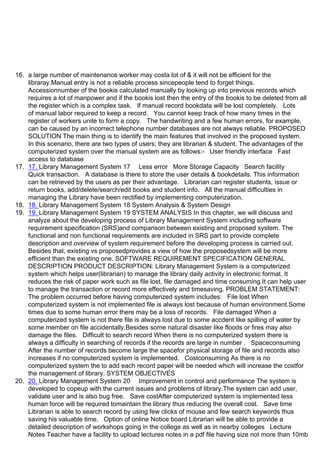
make a new card again which take time and till then student have to wait and we have to search
the database again for the student information which is complicated. On the other hand keeping
16. a large number of maintenance worker may costa lot of & it will not be efficient for the
libraray.Manual entry is not a reliable process sincepeople tend to forget things.
Accessionnumber of the bookis calculated manually by looking up into previous records which
requires a lot of manpower and if the bookis lost then the entry of the bookis to be deleted from all
the register which is a complex task. If manual record bookdata will be lost completely. Lots
of manual labor required to keep a record. You cannot keep track of how many times in the
register of workers unite to form a copy. The handwriting and a few human errors, for example,
can be caused by an incorrect telephone number databases are not always reliable. PROPOSED
SOLUTION The main thing is to identify the main features that involved in the proposed system.
In this scenario, there are two types of users; they are librarian & student. The advantages of the
computerized system over the manual system are as follows:- User friendly interface Fast
access to database
17. 17. Library Management System 17 Less error More Storage Capacity Search facility
Quick transaction. A database is there to store the user details & bookdetails. This information
can be retrieved by the users as per their advantage. Librarian can register students, issue or
return books, add/delete/search/edit books and student info. All the manual difficulties in
managing the Library have been rectified by implementing computerization.
18. 18. Library Management System 18 System Analysis & System Design
19. 19. Library Management System 19 SYSTEM ANALYSIS In this chapter, we will discuss and
analyze about the developing process of Library Management System including software
requirement specification (SRS)and comparison between existing and proposed system. The
functional and non functional requirements are included in SRS part to provide complete
description and overview of system requirement before the developing process is carried out.
Besides that, existing vs proposedprovides a view of how the proposedsystem will be more
efficient than the existing one. SOFTWARE REQUIREMENT SPECIFICATION GENERAL
DESCRIPTION PRODUCT DESCRIPTION: Library Management System is a computerized
system which helps user(librarian) to manage the library daily activity in electronic format. It
reduces the risk of paper work such as file lost, file damaged and time consuming.It can help user
to manage the transaction or record more effectively and timesaving. PROBLEM STATEMENT:
The problem occurred before having computerized system includes: File lost When
computerized system is not implemented file is always lost because of human environment.Some
times due to some human error there may be a loss of records. File damaged When a
computerized system is not there file is always lost due to some accdent like spilling of water by
some member on file accidentally.Besides some natural disaster like floods or fires may also
damage the files. Difficult to search record When there is no computerized system there is
always a difficulty in searching of records if the records are large in number . Spaceconsuming
After the number of records become large the spacefor physical storage of file and records also
increases if no computerized system is implemented. Costconsuming As there is no
computerized system the to add each record paper will be needed which will increase the costfor
the management of library. SYSTEM OBJECTIVES
20. 20. Library Management System 20 Improvement in control and performance The system is
developed to copeup with the current issues and problems of library.The system can add user,
validate user and is also bug free. Save costAfter computerized system is implemented less
human force will be required tomaintain the library thus reducing the overall cost. Save time
Librarian is able to search record by using few clicks of mouse and few search keywords thus
saving his valuable time. Option of online Notice board Librarian will be able to provide a
detailed description of workshops going in the college as well as in nearby colleges Lecture
Notes Teacher have a facility to upload lectures notes in a pdf file having size not more than 10mb
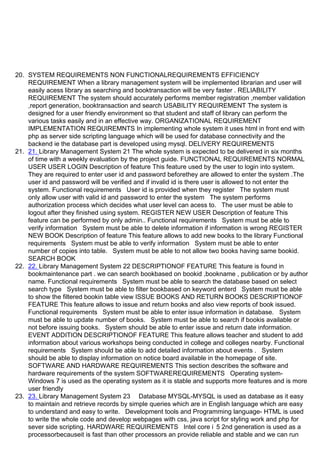
20. SYSTEM REQUIREMENTS NON FUNCTIONALREQUIREMENTS EFFICIENCY
REQUIREMENT When a library management system will be implemented librarian and user will
easily acess library as searching and booktransaction will be very faster . RELIABILITY
REQUIREMENT The system should accurately performs member registration ,member validation
,report generation, booktransaction and search USABILITY REQUIREMENT The system is
designed for a user friendly environment so that student and staff of library can perform the
various tasks easily and in an effective way. ORGANIZATIONAL REQUIREMENT
IMPLEMENTATION REQUIREMNTS In implementing whole system it uses html in front end with
php as server side scripting language which will be used for database connectivity and the
backend ie the database part is developed using mysql. DELIVERY REQUIREMENTS
21. 21. Library Management System 21 The whole system is expected to be delivered in six months
of time with a weekly evaluation by the project guide. FUNCTIONAL REQUIREMENTS NORMAL
USER USER LOGIN Description of feature This feature used by the user to login into system.
They are required to enter user id and password beforethey are allowed to enter the system .The
user id and password will be verified and if invalid id is there user is allowed to not enter the
system. Functional requirements User id is provided when they register The system must
only allow user with valid id and password to enter the system The system performs
authorization process which decides what user level can acess to. The user must be able to
logout after they finished using system. REGISTER NEW USER Description of feature This
feature can be performed by only admin.. Functional requirements System must be able to
verify information System must be able to delete information if information is wrong REGISTER
NEW BOOK Description of feature This feature allows to add new books to the library Functional
requirements System must be able to verify information System must be able to enter
number of copies into table. System must be able to not allow two books having same bookid.
SEARCH BOOK
22. 22. Library Management System 22 DESCRIPTIONOF FEATURE This feature is found in
bookmaintenance part . we can search bookbased on bookid ,bookname , publication or by author
name. Functional requirements System must be able to search the database based on select
search type System must be able to filter bookbased on keyword enterd System must be able
to show the filtered bookin table view ISSUE BOOKS AND RETURN BOOKS DESCRIPTIONOF
FEATURE This feature allows to issue and return books and also view reports of book issued.
Functional requirements System must be able to enter issue information in database. System
must be able to update number of books. System must be able to search if bookis available or
not before issuing books. System should be able to enter issue and return date information.
EVENT ADDITION DESCRIPTIONOF FEATURE This feature allows teacher and student to add
information about various workshops being conducted in college and colleges nearby. Functional
requirements System should be able to add detailed information about events . System
should be able to display information on notice board available in the homepage of site.
SOFTWARE AND HARDWARE REQUIREMENTS This section describes the software and
hardware requirements of the system SOFTWAREREQUIREMENTS Operating system-
Windows 7 is used as the operating system as it is stable and supports more features and is more
user friendly
23. 23. Library Management System 23 Database MYSQL-MYSQL is used as database as it easy
to maintain and retrieve records by simple queries which are in English language which are easy
to understand and easy to write. Development tools and Programming language- HTML is used
to write the whole code and develop webpages with css, java script for styling work and php for
sever side scripting. HARDWARE REQUIREMENTS Intel core i 5 2nd generation is used as a
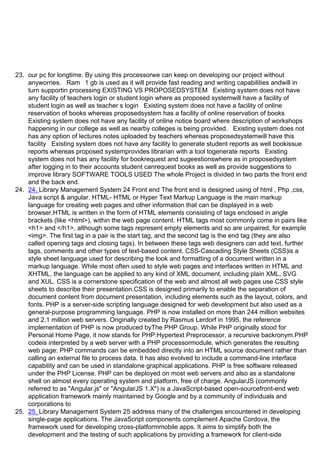
processorbecauseit is fast than other processors an provide reliable and stable and we can run
23. our pc for longtime. By using this processorwe can keep on developing our project without
anyworries. Ram 1 gb is used as it will provide fast reading and writing capabilities andwill in
turn supportin processing EXISTING VS PROPOSEDSYSTEM Existing system does not have
any facility of teachers login or student login where as proposed systemwill have a facility of
student login as well as teacherᶨs login Existing system does not have a facility of online
reservation of books whereas proposedsystem has a facility of online reservation of books
Existing system does not have any facility of online notice board where description of workshops
happening in our college as well as nearby colleges is being provided. Existing system does not
has any option of lectures notes uploaded by teachers whereas proposedsystemwill have this
facility Existing system does not have any facility to generate student reports as well bookissue
reports whereas proposed systemprovides librarian with a tool togenerate reports Existing
system does not has any facility for bookrequest and sugeestionswhere as in proposedsystem
after logging in to their accounts student canrequest books as well as provide suggestions to
improve library SOFTWARE TOOLS USED The whole Project is divided in two parts the front end
and the back end.
24. 24. Library Management System 24 Front end The front end is designed using of html , Php ,css,
Java script & angular. HTML- HTML or Hyper Text Markup Language is the main markup
language for creating web pages and other information that can be displayed in a web
browser.HTML is written in the form of HTML elements consisting of tags enclosed in angle
brackets (like <html>), within the web page content. HTML tags most commonly come in pairs like
<h1> and </h1>, although some tags represent empty elements and so are unpaired, for example
<img>. The first tag in a pair is the start tag, and the second tag is the end tag (they are also
called opening tags and closing tags). In between these tags web designers can add text, further
tags, comments and other types of text-based content. CSS-Cascading Style Sheets (CSS)is a
style sheet language used for describing the look and formatting of a document written in a
markup language. While most often used to style web pages and interfaces written in HTML and
XHTML, the language can be applied to any kind of XML document, including plain XML, SVG
and XUL. CSS is a cornerstone specification of the web and almost all web pages use CSS style
sheets to describe their presentation.CSS is designed primarily to enable the separation of
document content from document presentation, including elements such as the layout, colors, and
fonts. PHP is a server-side scripting language designed for web development but also used as a
general-purpose programming language. PHP is now installed on more than 244 million websites
and 2.1 million web servers. Originally created by Rasmus Lerdorf in 1995, the reference
implementation of PHP is now produced byThe PHP Group. While PHP originally stood for
Personal Home Page, it now stands for PHP:Hypertext Preprocessor, a recursive backronym.PHP
codeis interpreted by a web server with a PHP processormodule, which generates the resulting
web page: PHP commands can be embedded directly into an HTML source document rather than
calling an external file to process data. It has also evolved to include a command-line interface
capability and can be used in standalone graphical applications. PHP is free software released
under the PHP License. PHP can be deployed on most web servers and also as a standalone
shell on almost every operating system and platform, free of charge. AngularJS (commonly
referred to as "Angular.js" or "AngularJS 1.X") is a JavaScript-based open-sourcefront-end web
application framework mainly maintained by Google and by a community of individuals and
corporations to
25. 25. Library Management System 25 address many of the challenges encountered in developing
single-page applications. The JavaScript components complement Apache Cordova, the
framework used for developing cross-platformmobile apps. It aims to simplify both the
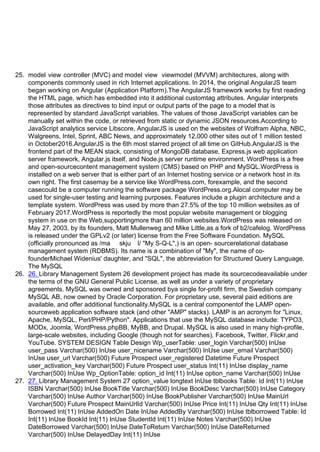
development and the testing of such applications by providing a framework for client-side
25. modelᶢviewᶢcontroller (MVC) and modelᶢviewᶢ viewmodel (MVVM) architectures, along with
components commonly used in rich Internet applications. In 2014, the original AngularJS team
began working on Angular (Application Platform).The AngularJS framework works by first reading
the HTML page, which has embedded into it additional customtag attributes. Angular interprets
those attributes as directives to bind input or output parts of the page to a model that is
represented by standard JavaScript variables. The values of those JavaScript variables can be
manually set within the code, or retrieved from static or dynamic JSON resources.According to
JavaScript analytics service Libscore, AngularJS is used on the websites of Wolfram Alpha, NBC,
Walgreens, Intel, Sprint, ABC News, and approximately 12,000 other sites out of 1 million tested
in October2016.AngularJS is the 6th most starred project of all time on GitHub.AngularJS is the
frontend part of the MEAN stack, consisting of MongoDB database, Express.js web application
server framework, Angular.js itself, and Node.js server runtime environment. WordPress is a free
and open-sourcecontent management system (CMS) based on PHP and MySQL.WordPress is
installed on a web server that is either part of an Internet hosting service or a network host in its
own right. The first casemay be a service like WordPress.com, forexample, and the second
casecould be a computer running the software package WordPress.org.Alocal computer may be
used for single-user testing and learning purposes. Features include a plugin architecture and a
template system. WordPress was used by more than 27.5% of the top 10 million websites as of
February 2017.WordPress is reportedly the most popular website management or blogging
system in use on the Web,supportingmore than 60 million websites.WordPress was released on
May 27, 2003, by its founders, Matt Mullenweg and Mike Little,as a fork of b2/cafelog. WordPress
is released under the GPLv2 (or later) license from the Free Software Foundation. MySQL
(officially pronounced as /maɪ ˌɛskjuːˈɛl/ "My S-Q-L",) is an open- sourcerelational database
management system (RDBMS). Its name is a combination of "My", the name of co-
founderMichael Widenius' daughter, and "SQL", the abbreviation for Structured Query Language.
The MySQL
26. 26. Library Management System 26 development project has made its sourcecodeavailable under
the terms of the GNU General Public License, as well as under a variety of proprietary
agreements. MySQL was owned and sponsored bya single for-profit firm, the Swedish company
MySQL AB, now owned by Oracle Corporation. For proprietary use, several paid editions are
available, and offer additional functionality.MySQL is a central componentof the LAMP open-
sourceweb application software stack (and other "AMP" stacks). LAMP is an acronym for "Linux,
Apache, MySQL, Perl/PHP/Python". Applications that use the MySQL database include: TYPO3,
MODx, Joomla, WordPress,phpBB, MyBB, and Drupal. MySQL is also used in many high-profile,
large-scale websites, including Google (though not for searches), Facebook, Twitter, Flickr,and
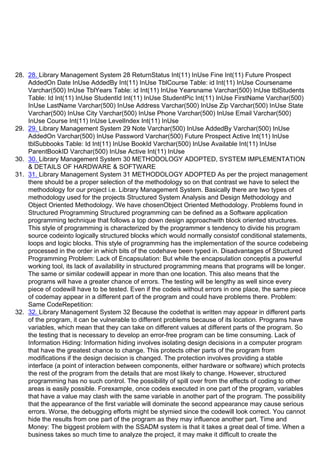
YouTube. SYSTEM DESIGN Table Design Wp_userTable: user_login Varchar(500) InUse
user_pass Varchar(500) InUse user_nicename Varchar(500) InUse user_email Varchar(500)
InUse user_url Varchar(500) Future Prospect user_registered Datetime Future Prospect
user_activation_key Varchar(500) Future Prospect user_status Int(11) InUse display_name
Varchar(500) InUse Wp_OptionTable: option_id Int(11) InUse option_name Varchar(500) InUse
27. 27. Library Management System 27 option_value longtext InUse tblbooks Table: Id Int(11) InUse
ISBN Varchar(500) InUse BookTitle Varchar(500) InUse BookDesc Varchar(500) InUse Category
Varchar(500) InUse Author Varchar(500) InUse BookPublisher Varchar(500) InUse MainUrl
Varchar(500) Future Prospect MainUrlId Varchar(500) InUse Price Int(11) InUse Qty Int(11) InUse
Borrowed Int(11) InUse AddedOn Date InUse AddedBy Varchar(500) InUse tblborrowed Table: Id
Int(11) InUse BookId Int(11) InUse StudentId Int(11) InUse Notes Varchar(500) InUse
DateBorrowed Varchar(500) InUse DateToReturn Varchar(500) InUse DateReturned
Varchar(500) InUse DelayedDay Int(11) InUse
28. 28. Library Management System 28 ReturnStatus Int(11) InUse Fine Int(11) Future Prospect
AddedOn Date InUse AddedBy Int(11) InUse TblCourse Table: id Int(11) InUse Coursename
Varchar(500) InUse TblYears Table: id Int(11) InUse Yearsname Varchar(500) InUse tblStudents
Table: Id Int(11) InUse StudentId Int(11) InUse StudentPic Int(11) InUse FirstName Varchar(500)
InUse LastName Varchar(500) InUse Address Varchar(500) InUse Zip Varchar(500) InUse State
Varchar(500) InUse City Varchar(500) InUse Phone Varchar(500) InUse Email Varchar(500)
InUse Course Int(11) InUse LevelIndex Int(11) InUse
29. 29. Library Management System 29 Note Varchar(500) InUse AddedBy Varchar(500) InUse
AddedOn Varchar(500) InUse Password Varchar(500) Future Prospect Active Int(11) InUse
tblSubbooks Table: Id Int(11) InUse BookId Varchar(500) InUse Available Int(11) InUse
ParentBookID Varchar(500) InUse Active Int(11) InUse
30. 30. Library Management System 30 METHODOLOGY ADOPTED, SYSTEM IMPLEMENTATION
& DETAILS OF HARDWARE & SOFTWARE
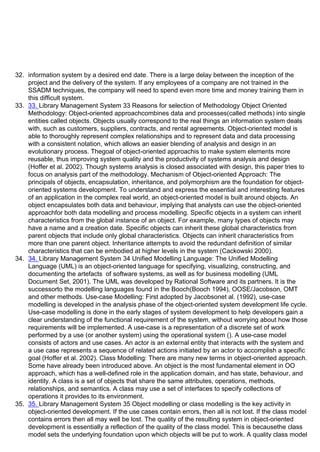
31. 31. Library Management System 31 METHODOLOGY ADOPTED As per the project management
there should be a proper selection of the methodology so on that contrast we have to select the
methodology for our project i.e. Library Management System. Basically there are two types of
methodology used for the projects Structured System Analysis and Design Methodology and
Object Oriented Methodology. We have chosenObject Oriented Methodology. Problems found in
Structured Programming Structured programming can be defined as a Software application
programming technique that follows a top down design approachwith block oriented structures.
This style of programming is characterized by the programmerᶨs tendency to divide his program
source codeinto logically structured blocks which would normally consistof conditional statements,
loops and logic blocks. This style of programming has the implementation of the source codebeing
processed in the order in which bits of the codehave been typed in. Disadvantages of Structured
Programming Problem: Lack of Encapsulation: But while the encapsulation conceptis a powerful
working tool, its lack of availability in structured programming means that programs will be longer.
The same or similar codewill appear in more than one location. This also means that the
programs will have a greater chance of errors. The testing will be lengthy as well since every
piece of codewill have to be tested. Even if the codeis without errors in one place, the same piece
of codemay appear in a different part of the program and could have problems there. Problem:
Same CodeRepetition:
32. 32. Library Management System 32 Because the codethat is written may appear in different parts
of the program, it can be vulnerable to different problems because of its location. Programs have
variables, which mean that they can take on different values at different parts of the program. So
the testing that is necessary to develop an error-free program can be time consuming. Lack of
Information Hiding: Information hiding involves isolating design decisions in a computer program
that have the greatest chance to change. This protects other parts of the program from
modifications if the design decision is changed. The protection involves providing a stable
interface (a point of interaction between components, either hardware or software) which protects
the rest of the program from the details that are most likely to change. However, structured
programming has no such control. The possibility of spill over from the effects of coding to other
areas is easily possible. Forexample, once codeis executed in one part of the program, variables
that have a value may clash with the same variable in another part of the program. The possibility
that the appearance of the first variable will dominate the second appearance may cause serious
errors. Worse, the debugging efforts might be stymied since the codewill look correct. You cannot
hide the results from one part of the program as they may influence another part. Time and
Money: The biggest problem with the SSADM system is that it takes a great deal of time. When a
business takes so much time to analyze the project, it may make it difficult to create the
32. information system by a desired end date. There is a large delay between the inception of the
project and the delivery of the system. If any employees of a company are not trained in the
SSADM techniques, the company will need to spend even more time and money training them in
this difficult system.
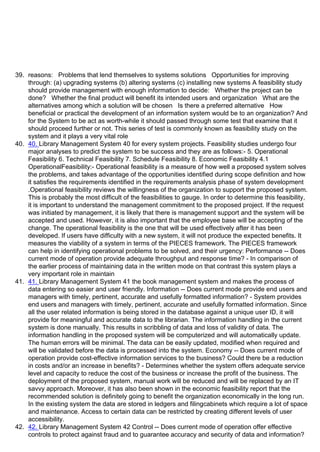
33. 33. Library Management System 33 Reasons for selection of Methodology Object Oriented
Methodology: Object-oriented approachcombines data and processes(called methods) into single
entities called objects. Objects usually correspond to the real things an information system deals
with, such as customers, suppliers, contracts, and rental agreements. Object-oriented model is
able to thoroughly represent complex relationships and to represent data and data processing
with a consistent notation, which allows an easier blending of analysis and design in an
evolutionary process. Thegoal of object-oriented approachis to make system elements more
reusable, thus improving system quality and the productivity of systems analysis and design
(Hoffer et al. 2002). Though systems analysis is closed associated with design, this paper tries to
focus on analysis part of the methodology. Mechanism of Object-oriented Approach: The
principals of objects, encapsulation, inheritance, and polymorphism are the foundation for object-
oriented systems development. To understand and express the essential and interesting features
of an application in the complex real world, an object-oriented model is built around objects. An
object encapsulates both data and behaviour, implying that analysts can use the object-oriented
approachfor both data modelling and process modelling. Specific objects in a system can inherit
characteristics from the global instance of an object. For example, many types of objects may
have a name and a creation date. Specific objects can inherit these global characteristics from
parent objects that include only global characteristics. Objects can inherit characteristics from
more than one parent object. Inheritance attempts to avoid the redundant definition of similar
characteristics that can be embodied at higher levels in the system (Cackowski 2000).
34. 34. Library Management System 34 Unified Modelling Language: The Unified Modelling
Language (UML) is an object-oriented language for specifying, visualizing, constructing, and
documenting the artefactsᶨ of software systems, as well as for business modelling (UML
Document Set, 2001). The UML was developed by Rational Software and its partners. It is the
successorto the modelling languages found in the Booch(Booch 1994), OOSE/Jacobson, OMT
and other methods. Use-case Modelling: First adopted by Jacobsonet al. (1992), use-case
modelling is developed in the analysis phase of the object-oriented system development life cycle.
Use-case modelling is done in the early stages of system development to help developers gain a
clear understanding of the functional requirement of the system, without worrying about how those
requirements will be implemented. A use-case is a representation of a discrete set of work
performed by a use (or another system) using the operational system (). A use-case model
consists of actors and use cases. An actor is an external entity that interacts with the system and
a use case represents a sequence of related actions initiated by an actor to accomplish a specific
goal (Hoffer et al. 2002). Class Modelling: There are many new terms in object-oriented approach.
Some have already been introduced above. An object is the most fundamental element in OO
approach, which has a well-defined role in the application domain, and has state, behaviour, and
identity. A class is a set of objects that share the same attributes, operations, methods,
relationships, and semantics. A class may use a set of interfaces to specify collections of
operations it provides to its environment.
35. 35. Library Management System 35 Object modelling or class modelling is the key activity in
object-oriented development. If the use cases contain errors, then all is not lost. If the class model
contains errors then all may well be lost. The quality of the resulting system in object-oriented
development is essentially a reflection of the quality of the class model. This is becausethe class
model sets the underlying foundation upon which objects will be put to work. A quality class model
35. should provide a flexible foundation upon which systems can be assembled in component-like
fashion. A poorclass model results in a shaky foundation upon which systems will grind to a halt
and buckle under the threat of change (Artisan 2001). Benefits of Object-Oriented Approach:
Object-oriented databases make the promise of reduced maintenance, codereusability, real world
modelling, and improved reliability and flexibility. However, these are just promises and in the real
world some users find that the object-oriented benefits are not as compelling as they originally
believed. For example, what is codereusability? Some will say that they can reuse much of the
object-oriented codethat is created for a system, but many say there is no more codereusability in
object-oriented systems than in traditional systems. Codereusability is a subjective thing, and
depends heavily on how the system is defined. The object-oriented approachdoes give the ability
to reduce some of the major expenses associated with systems, such as maintenance and
development of programming code. Here are some of the benefits of the object-oriented
approach: Easy Debugging If a particular object turns out to be a problem, you can simply remove
it from your application and plug in a different object as its replacement. This is analogous to fixing
mechanical problems in the real world. If a bolt breaks, you replace it, not the entire machine.
Investigation Techniques
36. 36. Library Management System 36 Only making the project is not only the task it requires
removing the errors and making the project more efficient and flexible. After throwing the project
to the market the information about the updation is only be retrieved by following some
investigation technique. Basically there are Four techniques by which information can be gathered
they are as follows:- Observation Interview Document Analysis Questionnaire Out of
these four techniques, we had chosen the technique of interview and questionnaire for the
development of our project. Since this all activity has its own features of finding the development

facts but we have selected the technique i.e. Interview and Questionnaire that favours the
economical and projects scheduled time. Following are reasons with advantage for selecting
these techniques. We had selected Interview and questionnaire as an investigation technique
because it has more advantage over other techniques. Some of them are follows:- Disadvantages
of Observation Method 1.The most limiting factor in the use of observation method is the inability
to observe such things such as attitudes, motivations, customers/consumers state of mind, their
buying motives and their images. 2.It also takes time for the investigator to wait for a particular
action to take place. 3.Personal and intimate activities, such as watching television late at night,
are more easily discussed with questionnaires than they are observed. 4.Costis the final
disadvantage of observation method. Under most circumstances, observational data are more
expensive to obtain than other
37. 37. Library Management System 37 survey data. The observer has to wait doing nothing, between
events to be observed. The unproductive time is an increased cost. HARDWARE & SOFTWARE
USED Hardware Requirement Operating System Windows / Linux Hard Disk 120MB RAM 100MB
Software Requirement : Apache Server WAAMP / XAAMP Wordpress 4.3+ MySql 5.7 Language
And Software Tool Used: Front End Angular JS , Jquery , Css & HTML Operating System
Windows or Linux Back End Wordpress [Php Framework] & MY SQL Server [DB
38. 38. Library Management System 38 FEASIBILITY ANALYSIS
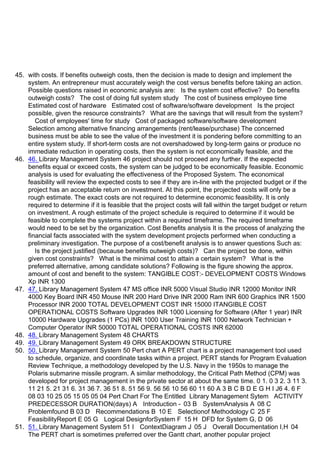
39. 39. Library Management System 39 A feasibility study assesses the operational, technical and
economic merits of the proposed project. The feasibility study is intended to be a preliminary

review of the facts to see if it is worthy of proceeding to the analysis phase. From the systems
analyst perspective, the feasibility analysis is the primary tool for recommending whether to
proceed to the next phase or to discontinue the project. The feasibility study is a management-

oriented activity. The objective of a feasibility study is to find out if an information system project
can be done and to suggest possible alternative solutions. Projects are initiated for two broad
39. reasons: Problems that lend themselves to systems solutions Opportunities for improving
through: (a) upgrading systems (b) altering systems (c) installing new systems A feasibility study
should provide management with enough information to decide: Whether the project can be
done? Whether the final product will benefit its intended users and organization What are the
alternatives among which a solution will be chosen Is there a preferred alternative How
beneficial or practical the development of an information system would be to an organization? And
for the System to be act as worth-while it should passed through some test that examine that it
should proceed further or not. This series of test is commonly known as feasibility study on the
system and it plays a very vital role
40. 40. Library Management System 40 for every system projects. Feasibility studies undergo four
major analyses to predict the system to be success and they are as follows:- 5. Operational
Feasibility 6. Technical Feasibility 7. Schedule Feasibility 8. Economic Feasibility 4.1
OperationalFeasibility:- Operational feasibility is a measure of how well a proposed system solves
the problems, and takes advantage of the opportunities identified during scope definition and how
it satisfies the requirements identified in the requirements analysis phase of system development
.Operational feasibility reviews the willingness of the organization to support the proposed system.
This is probably the most difficult of the feasibilities to gauge. In order to determine this feasibility,
it is important to understand the management commitment to the proposed project. If the request

was initiated by management, it is likely that there is management support and the system will be
accepted and used. However, it is also important that the employee base will be accepting of the
change. The operational feasibility is the one that will be used effectively after it has been
developed. If users have difficulty with a new system, it will not produce the expected benefits. It
measures the viability of a system in terms of the PIECES framework. The PIECES framework
can help in identifying operational problems to be solved, and their urgency: Performance -- Does
current mode of operation provide adequate throughput and response time? - In comparison of
the earlier process of maintaining data in the written mode on that contrast this system plays a
very important role in maintain
41. 41. Library Management System 41 the book management system and makes the process of
data entering so easier and user friendly. Information -- Does current mode provide end users and
managers with timely, pertinent, accurate and usefully formatted information? - System provides
end users and managers with timely, pertinent, accurate and usefully formatted information. Since
all the user related information is being stored in the database against a unique user ID, it will
provide for meaningful and accurate data to the librarian. The information handling in the current
system is done manually. This results in scribbling of data and loss of validity of data. The
information handling in the proposed system will be computerized and will automatically update.
The human errors will be minimal. The data can be easily updated, modified when required and
will be validated before the data is processed into the system. Economy -- Does current mode of
operation provide cost-effective information services to the business? Could there be a reduction
in costs and/or an increase in benefits? - Determines whether the system offers adequate service
level and capacity to reduce the cost of the business or increase the profit of the business. The
deployment of the proposed system, manual work will be reduced and will be replaced by an IT
savvy approach. Moreover, it has also been shown in the economic feasibility report that the
recommended solution is definitely going to benefit the organization economically in the long run.
In the existing system the data are stored in ledgers and filingcabinets which require a lot of space
and maintenance. Access to certain data can be restricted by creating different levels of user
accessibility.
42. 42. Library Management System 42 Control -- Does current mode of operation offer effective
controls to protect against fraud and to guarantee accuracy and security of data and information?
42. - As its database does not contain any confidential information which can be misused so on that
contrast there should no use of any security corner for this system. Efficiency -- Does current
mode of operation makes maximum use of available resources, including people, time, and flow of
forms? - Efficiency work is to ensure a proper workflow structure to store patient data; we can
ensure the proper utilization of all the resources. It determines whether the system make
maximum use of available resources including time, people, flow of forms, minimum processing
delay. In the current system a lot of time is wasted on paper work like making new records,
updating records. The proposed system will be a lot efficient in maintaining the record and easily
fetching out the required data. Services -- Does current mode of operation provide reliable
service? Is it flexible and expandable? - The system is desirable and reliable services to those
who need it and also whether the system is flexible and expandable or not. The proposed system

is very much flexible for better efficiency and performance of the organization. The existing

system can provide service only to a limited number of users. There is very little room for change
and hardly any scope for expansion. The scalability of the proposed system will be inexhaustible
as the storage capacity of the system can be increased as per requirement. This will provide a
strong base for expansion. The new system will provide a high level of flexibility.
43. 43. Library Management System 43 4.2 TechnicalFeasibility:- A large part of determining
resources has to do with assessing technical feasibility. It considers the technical requirements of
the proposed project. The technical requirements are then compared to the technical capability of
the organization. The systems project is considered technically feasible if the internal technical
capability is sufficient to support the project requirements. The analyst must find out whether
current technical resources can be upgraded or added to in a manner that fulfils the request under
consideration. This is where the expertise of system analysts is beneficial, since using their own
experience and their contact with vendors they will be able to answer the question of technical
feasibility. The essential questions that help in testing the operational feasibility of a system
include the following: Is the project feasible within the limits of current technology? Does the
technology exist at all? Is it available within given resource constraints? Is it a practical
proposition? Manpower- programmers, testers & debuggers Software and hardware Are
the current technical resources sufficient for the new system? Can they be upgraded to provide
to provide the level of technology necessary for the new system? Do we possess the necessary
technical expertise, and is the schedule reasonable? Can the technology be easily applied to
current problems? Does the technology have the capacity to handle the solution? Do we
currently possess the necessary technology?
44. 44. Library Management System 44 Automated library system deals with the modern technology
system that needs the well efficient technical system to run this project. All the resource
constrains must be in the favour of the better influence of the system. Keeping all this facts in
mind we had selected the favourable hardware and software utilities to make it more feasible.
Recommending the Hardware Part:- Sr no. Hardware used Specification 1. Monitor LCD !5ᶬ
screen (HP) 2. Keyboard Intex Wired 3. Mouse Intex Wired 4. Hard drive 40GB(gigabyte) hard
drive 5. Bar Code Reader Iball 6. Ram 512 MB(mega byte) 7. Processor Pentium
3,665MHZ(mega hertz) 8. Graphics: On board graphics card,8MB(Megabyte of memory) 9.
System type 1GHZ(gigahertz)32-bit(x86) Recommended Software:- The Following software is
used for the development of the System:- 1. Sublime Text Editor 2. MY Sql 3. Apache [WAAMP]
45. 45. Library Management System 45 And Windows 7 is used as an Operating System as it is more
reliable and faster as compared to the other operating system. Economic Feasibility:- Economic
analysis could also be referred to as cost/benefit analysis. It is the most frequently used method
for evaluating the effectiveness of a new system. In economic analysis the procedure is to
determine the benefits and savings that are expected from a candidate system and compare them
45. with costs. If benefits outweigh costs, then the decision is made to design and implement the
system. An entrepreneur must accurately weigh the cost versus benefits before taking an action.
Possible questions raised in economic analysis are: Is the system cost effective? Do benefits
outweigh costs? The cost of doing full system study The cost of business employee time
Estimated cost of hardware Estimated cost of software/software development Is the project
possible, given the resource constraints? What are the savings that will result from the system?
Cost of employees' time for study Cost of packaged software/software development
Selection among alternative financing arrangements (rent/lease/purchase) The concerned
business must be able to see the value of the investment it is pondering before committing to an
entire system study. If short-term costs are not overshadowed by long-term gains or produce no
immediate reduction in operating costs, then the system is not economically feasible, and the
46. 46. Library Management System 46 project should not proceed any further. If the expected
benefits equal or exceed costs, the system can be judged to be economically feasible. Economic
analysis is used for evaluating the effectiveness of the Proposed System. The economical
feasibility will review the expected costs to see if they are in-line with the projected budget or if the
project has an acceptable return on investment. At this point, the projected costs will only be a
rough estimate. The exact costs are not required to determine economic feasibility. It is only
required to determine if it is feasible that the project costs will fall within the target budget or return
on investment. A rough estimate of the project schedule is required to determine if it would be
feasible to complete the systems project within a required timeframe. The required timeframe
would need to be set by the organization. Cost Benefits analysis It is the process of analyzing the
financial facts associated with the system development projects performed when conducting a
preliminary investigation. The purpose of a cost/benefit analysis is to answer questions Such as:
Is the project justified (because benefits outweigh costs)? Can the project be done, within
given cost constraints? What is the minimal cost to attain a certain system? What is the
preferred alternative, among candidate solutions? Following is the figure showing the approx.
amount of cost and benefit to the system: TANGIBLE COST:- DEVELOPMENT COSTS Windows
Xp INR 1300
47. 47. Library Management System 47 MS office INR 5000 Visual Studio INR 12000 Monitor INR
4000 Key Board INR 450 Mouse INR 200 Hard Drive INR 2000 Ram INR 600 Graphics INR 1500
Processor INR 2000 TOTAL DEVELOPMENT COST INR 15000 ITANGIBLE COST
OPERATIONAL COSTS Software Upgrades INR 1000 Licensing for Software (After 1 year) INR
10000 Hardware Upgrades (1 PCs) INR 1000 User Training INR 1000 Network Technician +
Computer Operator INR 50000 TOTAL OPERATIONAL COSTS INR 62000
48. 48. Library Management System 48 CHARTS
49. 49. Library Management System 49 ORK BREAKDOWN STRUCTURE
50. 50. Library Management System 50 Pert chart A PERT chart is a project management tool used
to schedule, organize, and coordinate tasks within a project. PERT stands for Program Evaluation
Review Technique, a methodology developed by the U.S. Navy in the 1950s to manage the
Polaris submarine missile program. A similar methodology, the Critical Path Method (CPM) was
developed for project management in the private sector at about the same time. 0 1. 0 3 2. 3 11 3.
11 21 5. 21 31 6. 31 36 7. 36 51 8. 51 56 9. 56 56 10 56 60 11 60 A 3 B C B D E G H I J6 4. 6 F
08 03 10 25 05 15 05 05 04 Pert Chart For The Entitled ᶫLibrary Management Sytemᶬ ACTIVITY
PREDECESSOR DURATION(days) A ᶢ Introduction - 03 B ᶢ SystemAnalysis A 08 C ᶢ
Problemfound B 03 D ᶢ Recommendations B 10 E ᶢ Selectionof Methodology C 25 F ᶢ
FeasibilityReport E 05 G ᶢ Logical DesignforSystem F 15 H ᶢDFD for System G, D 06
51. 51. Library Management System 51 I ᶢ ContextDiagram J 05 J ᶢ Overall Documentation I,H 04
The PERT chart is sometimes preferred over the Gantt chart, another popular project
51. management charting method, because it clearly illustrates task dependencies. On the other
hand, the PERT chart can be much more difficult to interpret, especially on complex projects.
Frequently, project managers use both techniques. FISHBONE / ISHIKAWA DIAGRAM
PROBLEM WITH MANUAL SYSTEM MUST FILL UP MORE FORM DOCUMENTATION
PROBLEM SECURITY PROBLEM TAKE TIME ANY OWN MUST FILL UP FORM TO PURPOSE
BOOKCOMPILATED TO CHECK BACK THE BOOK ORDER NEED MOREFILE FOR
DOCUMENTATION COMPLICATED TO CREAT THE SLOW PROCESS TO BOOKING BOOK
MUST DIRECT TO THE COUNTER ONLY SYSTEM TRADITIONAL MUST FILL FORM WAIT
FOR QUEUE SYSTEM SLOW BECAUSE MUSH FILL UP FROM SLOW RETRIEVAL OF
NEEDEDBOOK. BACKUP AND RECOVERY PROBLEM SECURITY AND INTEGRITY
PROBLEM.
52. 52. Library Management System 52 DFD & CLASS DIAGRAM
53. 53. Library Management System 53 Data Flow Diagram Context Diagram 0. LIBRARY
MANAGEMENT SYSTEM LIBRARIAN STUDENT Book Details Student Details Course Details
Login Details (Username + Password) Confirmation/ Rejection Requesting Book Issue/Return
Login Details (Username + Password) Book Report Confirmation/ Rejection Updating & Initializing
All books/Student details
54. 54. Library Management System 54 Level 0 DFD Student 1.0 Login 6.0 Fine Calculation 3.0
Manage Books 4.0 Issue book 2.0 Manage Students 1. Admin_Table 2. User Login Login details
(Username + Password) Sends information Confirmation Acknowledgment Librarian Student
Details Login details Book 3. Student_Table 4. Book_Table 5. Issue_Table 6. Return_Table Book
details Student details Updated Book details Updated Sends information Login Approval
Confirmation/ Rejection 5.0 Return Book Book details+ Student details Book details+ Student
details Status update Status update Overdue Fine amount Report Report Report Student
information Student id +book title Book Details updated Student details updated Receives Book
55. 55. Library Management System 55 Level 1 DFD (Book) LIBRARIAN Book details Confirmation
/Reord added successfully Book details Book ID Delete Request Confirm Request Book code
Search Request Book Information Student ID Update Request Information updated Save Book
Delete book Search book Update Book Book information Book information Book Information
STUDENT
56. 56. Library Management System 56 Level 1 DFD (Student) Librarian Student details Confirmation
/Reord added successfully Student details Student ID Delete Request Confirm Request Student
code Student Information Student ID Update Request Information updated Save Student Details
Delete Student Details Search Student Details Update Student Details Student information
Student information Student information Register Student Details Username + Password Student
Details Confirmation/ Rejection User Login Details Student table Search Request
57. 57. Library Management System 57 Level 2 DFD LIBRARIAN Registerstudent STUDENT Details
verification LibraryManagement System Requestforregistration Request Forwarded
FillUserDetails Forwarddetails Askforverification details Checkdetails Confirmdetails
Registrationconfirmation Confirmrequest Student
58. 58. Library Management System 58 Class Diagram +display Books() +update status() Book
+Book Id +Autor name +Publisher name +Status +Edition +date of purchase +search book()
+werify member() +issue book() +calculate fine() +create bill() +return book() Librarian +name
+password +make transfer() +deletetransfer() +retrieve transfer() Transaction -transaction id -
member id -book id -date of issue -due date +request for book() +return book() +pay bill() +update
book issue() Students +member id +member name +date of membership -no of book issued -
book limit student issue creates request
59. 59. Library Management System 59 7.7 Activity Diagram Search for Book else Enter member
59. code avialable check for no of book issued Validate Successfully display "not a memeber" Not
Valid make transaction Update Record book not issue start by book id book no available validate
details Crossed max quotaelse by autor name by publishe rname
60. 60. Library Management System 60 7.8 Sequence Diagram member Librarian Lms Request for
Book Search Book Check Avaliability validate member Issue Book acknowledge avalibility
member deatils request member details succesfully validated update issue record due date issue
book with due date
61. 61. Library Management System 61 Use Case Diagram Librarian login Maintain Student Detials
Search Book Maintain Catalogue Return Book Issue book System Calculate Fine add book -End1
* -End2 * -End3 * -End4 * check and update database «uses» «uses» create fine-End5 * -End6 * -
End7 * -End8 * -End9 * -End10 * -End13 * -End14 * -End15 * -End16 * -End17 * -End18 *
62. 62. Library Management System 62 Entity Relationship Diagram There are basically 3 things
which we consider while making ERD. ENTITY An entity is something, real or abstract, about
which we store information. For our system there are basically these 3 entities: 1. Librarian 2.
Student 3. Book RELATIONSHIP A relationship is an association that exists among entities. For
our system we have following relationships among 3 specified entities: One Librarian can
register many Students (0:N) One Librarian can add many Students ( 0:N) One Librarian can
search many Students (0:N) One Librarian can delete many Students ( 0:N) One Librarian can
edit information of many Students (0:N) One Student can search many books( 1:N) One
Librarian can add many books (0:N) One Librarian can search many books ( 0:N) One
Librarian can delete many Students (0:N) One Librarian can edit information of many Students
(1:N) ATTRIBUTES A property of an entity or a relationship type, for our system we have following
attributes of 3 specified entities: Student: Id of Student, Name of Student, Course, Code of Book
Issued, Issue date, Return date, Fine Librarian: Username and password. Book: Book code no,
Book title, Author of book, No of copies/quantity of books, book status, book price
63. 63. Library Management System 63 . Student Admission Student life Leave Book title Books View
Book search * * * Issues/returns book * Register Delete ** ER-diagram of Library Management
System.
64. 64. Library Management System 64 Data Dictionary A data dictionary, or metadata repository, as
defined in the IBM Dictionary of Computing, is a "centralized repository of information about data
such as meaning, relationships to other data, origin, usage, and format".[1] Oracle defines it as a
collection of tables with metadata. The term can have one of several closely related meanings
pertaining to databases and database management systems (DBMS): A document describing a
database or collection of databases An integral component of a DBMS that is required to
determine its structure A piece of middleware that extends or supplants the native data
dictionary of a DBMS System : Library Search Online Date : October Label : Social Security
Number Order : Online Booking Book Type and Length : 9N Default Value : None Source :
Employee Acceptable Value : Any Positive Number Security : IT Department User Responsibility :
IT Department
65. 65. Library Management System 65 SCREEN LAYOUT
66. 66. Library Management System 66 Login Form
67. 67. Library Management System 67 DashBoard Form
68. 68. Library Management System 68 Change Password Form
69. 69. Library Management System 69 Librarian Profile Update
70. 70. Library Management System 70 Add Book Form
71. 71. Library Management System 71 Book Management Form (a)
72. 72. Library Management System 72 Book Management Form (b)
73. 73. Library Management System 73 Issue Book Form
74. 74. Library Management System 74 View All Issued Book Form
75. 75. Library Management System 75 Return Book Form
76. 76. Library Management System 76 SMS Sending Form
77. 77. Library Management System 77 Archive Book History
78. 78. Library Management System 78 View All Student Form
79. 79. Library Management System 79 Library Card Print Form
80. 80. Library Management System 80 Manage Course Form
81. 81. Library Management System 81 Manage Years Form
82. 82. Library Management System 82 Student DashBoard
83. 83. Library Management System 83 Student Issued Book
84. 84. Library Management System 84 CODING
85. 85. Library Management System 85 Add Some Source Code
86. 86. Library Management System 86 TESTING
87. 87. Library Management System 87 SYSTEM TESTING The aim of the system testing process
was to determine all defects in our project .The program was subjected to a set of test inputs and
various observations were made and based on these observations it will be decided whether the
program behaves as expected or not. Our Project went through two levels of testing 1. Unit testing
2. Integration testing INTEGRATION TESTING In this type of testing we test various integration of
the project module by providing the input .The primary objective is to test the module interfaces in
order to ensure that no errors are occurring when one module invokes the other module. UNIT
TESTING Unit testing is undertaken when a module has been created and succesfully reviewed
.In order to test a single module we need to provide a complete environment ie besides the
module we would require The procedures belonging to other modules that the module under
test calls Non local data structures that module accesses A procedureto call the functions of
the module under test with appropriate parameters Unit testing was done on each and every
module that is described under module description of TestFor the Admin/Librarian module:
Testing admin login form-This form is used for log in of administrator of the system.In this we
enter the username and password if both are correctadministration page will open other
88. 88. Library Management System 88 wise if any of data is wrong it will get redirected back to the
login page and again ask for username and password. Student accountaddition- In this section
the admin can verify student details from student academinc info and then only add student
details to main library database it contains add and delete buttons if user click add button data will
be added to student database and if he clicks delete button the student data will be deleted.
Book Addition- Admin can enter details of bookand can add the details to the main booktable also
he can view the books requests. Login Screen Step No Test Step Expected Result Actual Result
Test Result1 Enter a username and password (a correct password but wrong username An error
showing ᶫUsername & password mismatch Nothing actually popped up and the authentication
seemed succesful. FAIL
89. 89. Library Management System 89 2 Click on the Add book button. A pop up should appear book
added succefull yy PASS
90. 90. Library Management System 90 CONCLUSION This website provides a computerized version
of library management system which will benefit the students as well as the staff of the library. It
makes entire process online where student can search books, staff can generate library cards and
do booktransactions. It also has a facility for student login where student can login and can see
status of books issued. This system has been developed in a way to make it very user
friendly.Any personhaving a basic understanding of computer can run this system without any
pain. The system is strong enough to withstand regressive yearly operations under conditions
where the database is maintained and cleared over a certain time of span. The implementation of
90. the system in the organization will considerably reduce data entry, time and also provide readily
calculated reports. The problems, which existed in the earlier system, have been removed to a
large extent. And it is expected that this project will go a long way in satisfying users
requirements. The computerization of the Library Management will not only improves the
efficiency but will also reduce human stress thereby indirectly improving human recourses. This
project is very useful in managing the record and other operation of library. Moreover this project
can be upgraded and changed according to the need of user. Thank you ! Contact Us: Random
Name @gmail.com
91. 91. Library Management System 91 BIBLIOGRAPHY This refers to the books/websites which
were gone throught for completion of this project reports. SOME BOOKS REFERED System
Analysis & Design ᶢ Senn Software Enginneering ᶢ Pressman System Analysis & Design ᶢ
Elias Award Angular Js Complete Reference SOME WESBITES REFERED
http://www.gobookee.com/library-management-system-er-diagram-and- dfd/
http://www.gobookee.com/get_book.php?u=aHR0cDovL3d3dy5rZGQud
W5jYy5lZHUvQ3ludGhpYS8zMTYwUHJvai9SZXBvcnRfRmluYWwu
cGRmCkxJQlJBUlkgTUFOQUdFTUVOVCBTWVNURU06IERFU0lH
TiBBTkQgSU1QTEVNRU5UQVRJT04= http://www.scribd.com/doc/24051771/UML-DIAGRAM-
OF-LIBRARY- MANAGEMENT-SYSTEM http://www.evalued.bcu.ac.uk/tutorial/ 4c.htm
http://wiki.answers.com/Q/What_are_the_advantages_and_disadvantages _of_observations
http://www.softaiminnovations.com/web/index.php?option=com_content
&view=article&id=8&Itemid=9 http://www.umsl.edu/~sauterv/analysis/488_f01_papers/wang.htm
http://www.dba-oracle.com/t_object_oriented_approach.htm http://coursesweb.net
/actionscript/oop-object-oriented-programming http://www.brighthub.com/internet/web-
development/articles/73920.aspx?cid=parsely_rec http://www.ehow.com
/list_6781448_advantages-disadvantages- ssadm.html
Recommended
What to Upload to SlideShare
SlideShare
Customer Code: Creating a Company Customers Love
HubSpot
Be A Great Product Leader (Amplify, Oct 2019)
Adam Nash
Trillion Dollar Coach Book (Bill Campbell)
Eric Schmidt
APIdays Paris 2019 - Innovation @ scale, APIs as Digital Factories' New Machi...
apidays
A few thoughts on work life-balance
Wim Vanderbauwhede
Is vc still a thing final
Mark Suster
English
Español
Português
Français
Deutsch
About
Dev & API
Blog
Terms
Privacy
Copyright
Support
×
Share Clipboard
×
Facebook
Twitter
LinkedIn
Link
Public clipboards featuring this slide
×
No public clipboards found for this slide
Select another clipboard
×
Looks like youᶨve clipped this slide to already.
Create a clipboard
You just clipped your first slide!
Clipping is a handy way to collect important slides you want to go back to later. Now customize the
name of a clipboard to store your clips.
Name*
Description
Visibility
Others can see my Clipboard
Cancel Save
{"privacyEnabled":"Clipboardisvisibleonlytome.","privacyDisabled":"OtherscanseemyClipboard","formTitleCreate":"Createaclipboard","formTitleEdit":"EditClipboard"}
Save this document

Braaa(1)

  • 1.
    SlideShare Explore SearchYou Upload Login Signup header Submit Search Home Explore Successfully reported this slideshow. We use your LinkedIn profile and activity data to personalize ads and to show you more relevant ads. You can change your ad preferences anytime.
  • 45.
    Upcoming SlideShare Loading in…5 × 2 of 91 Library Management System Project in PHP with BlackBook & Source Code 11,744 views Share Like ... RadikhaSharma Follow Published on Jan 2, 2018 Library Management System in PHP & AngularJS source code & ... Published in: Education 13 Comments 47 Likes Statistics Notes Full Name Comment goes here. 12 hours ago Delete Reply Block Are you sure you want to Yes No Your message goes here Post
  • 46.
    Login to seethe comments Mohammed Huzaif 2 weeks ago SakshiJain541 1 month ago Savan Jivani 1 month ago Devanshi Mhatre 2 months ago Moslem Uddin , Librarian at Librarian, Military Institute of Science and Technology (MIST) 3 months ago Show More No Downloads Views Total views 11,744 On SlideShare 0 From Embeds 0 Number of Embeds 4 Actions Shares 0 Downloads 8 Comments 13 Likes 47 Embeds 0 No embeds No notes for slide Library Management System Project in PHP with BlackBook & Source Code 1. 1. Library Management System 1 A PROJECT ON LIBRARY MANAGEMENT SYSTEM Submitted by Mr. Random Name (0000000) Year 2016-2017 DATE OF SUBMISSION 06-06-2017 Under the guidance of Mr.Random Sir Name Submitted in partial fulfillment of the requirements
  • 47.
    1. for qualifyingM.C.A Semester VI Examination INSTITUTE OF DISTANCE AND OPEN LEARNING UNIVERSITY OF MUMBAI DR. SHANKAR DAYAL SHRAMA BHAVAN, VIDYANAGARI, SANTACRUZ (E), MUMBAI-98 2. 2. Library Management System 2 A PROJECT ON LIBRARY MANAGEMENT SYSTEM Submitted by Mr. Random Name (0000000) Year 2016-2017 DATE OF SUBMISSION 06-06-2017 Under the guidance of Mr.Random Sir Name Submitted in partial fulfillment of the requirements for qualifying M.C.A Semester VI Examination INSTITUTE OF DISTANCE AND OPEN LEARNING UNIVERSITY OF MUMBAI DR. SHANKAR DAYAL SHRAMA BHAVAN, VIDYANAGARI, SANTACRUZ (E), MUMBAI-98 3. 3. Library Management System 3 INSTITUTE OF DISTANCE AND OPEN LEARNING UNIVERSITY OF MUMBAI, IDE BUILDING, VIDYANAGARI, MUMBAI-98 PROJECTCERTIFICATE This is to certify that the Project titled Library Management System_ by Mr. Random Name Seat No 00000000 in partial fulfillment for M.C.A Degree Examination in Semester VI for the academic year 2016-2017 has been found satisfactory. This report had not been submitted for any other examination and does not form part of any other course undergone by the candidate. Signature Signature Signature Faculty in charge External Examiner Coordinator – M.C.A (IDOL) Guided by Examined By Certified By 4. 4. Library Management System 4 DECLARATION I declare that this written submission represents my ideas in my own words and where others' ideas or words have been included, I have adequately cited and referenced the original sources. I also declare that I have adhered to all principles of academic honesty and integrity and have not misrepresented or fabricated or falsi ed any idea/data/fact/source in my submission. I understand that any violation of the above will be cause for disciplinary action by the Institute and can also evoke penal action from the sources which have thus not been properly cited or from whom proper permission has not been taken when needed. (Signature) Random Name Date : 5. 5. Library Management System 5 ACKNOWLEDGEMENT I the undersigned have great pleasure in giving our sincere thanks to those who have contributed their valuable time in helping us to achieve the success in our project work. I would like to express our gratitude to all those gave us the possibility to complete this project. I want to thank St Stefen High School for giving us the opportunity for doing this project. I am indebted and thankful to our Project Guide Prof. Mr.Random Sir Name to whom I owe his piece of knowledge for his valuable and timely guidance, co- operation, encouragement & time spent for doing this project work. My sincere thanks to the IT staff for providing us sufficient information which helped us to complete our project successfully. 6. 6. Library Management System 6 PREFACE Computers are now becoming part of almost every activity in organization. The developments made on the fields of information and computer technology have vastly blown up and have changed the face of the present world rapidly. The use of IT has gradually and now computers are increasingly used for everyday activities organizations. The Library Management System is full of feeling to provide better services to its users. The main objective of the program is too serve the library to handle day to day books transaction and maintain sound information about the books as well as the members. I want to express my gratitude to Mr.Random Friend Name for his valuable guidance for accomplishing this project entitled “LIBRARY MANAGEMENT SYSTEM”. My sincere thanks also goes to the friends who have suggest the flow of the system and gave reliable ideas to work on. I have worked with commitment right from the initialization of the project and continuing all the way till its compilation. Review of the project is an unending process and it may contain errors as there is always a scope for improvements. 7. 7. Library Management System 7 SYNOPSIS 8. 8. Library Management System 8 Introduction: The project entitled Library Management System is
  • 48.
    8. a pilotproject for small school to manage their library administration process. Project: The Library Management System is the software to keep the transaction records that happens in the library. It avoids tedious and time-consuming manual system of the library. It provides the features such as to keep the records of books, issue books and so on. Methodology: Library is the place where information and books are stored. It is the place where people from all fields uses the books and information required for them. But for that purpose since long time the manual system was followed during operation using the library card. But with the increasing demands of technology in various fields are forcing to stop the manual system in library operation. So to fulfill the increasing demands of the library management software has been developed. Objective: The main objective of the application is to automate the existing system of manually maintaining the records of the transaction that happens in the system. Scope: This application can be used by any library to maintain the student records, daily transactions of books etc. Problem Definition: The existing system was a manual system to keep the transaction happened in the library. All the transaction was manually recorded which was time consuming and tedious. It was also not reliable. The current system was using the traditional method for daily activities, where the librarian had to handle most of the activities manually as it was taking a long time. Here we have tried to implement the manual system into the computer based system as it overcomes most of the flow of the manual system. 9. 9. Library Management System 9 Proposed System: In the proposed system, we assume that each member will be having a identity card which can be used for the library book issue, fine payment etc. whenever library member wish to take a book, the book issued by the library authority will be check both the book details as well as the student details and store it in library database. In case of retrieval of book much of human intervention can be eliminated. Limitations There are not many limitations of the project but any of these limitations are not affection the whole system. But anyhow it includes some limitations, which are listed below: Followings are the limitations in this system: Book order processing is not implemented. Library members cannot book issue in advance if book is unavailable. Fine Management Process is not implemented. Hardware Requirement Operating System Windows / Linux Hard Disk 120MB RAM 100MB Software Requirement : Apache Server WAAMP / XAAMP Wordpress 4.3+ MySql 5.7 Language And Software Tool Used Front End Angular JS , Jquery , Css & HTML Operating System Windows or Linux Back End Wordpress [Php Framework] & MY SQL Server [DB 10. 10. Library Management System 10 INDEX SR NO. CONTENT Page. No 1 Objective & Scope of the Project 2 Definition of Problem / Proposed Solution 14 3 System Analysis & Design 17 4 Methodology adopted, System Implementation & Details of Hardware & Software 29 5 Feasibility Analysis 1. Operational Feasibility 2. Technical Feasibility 3. Schedule Feasibility 4. Economic Feasibility 37 6 Sytem Planning (PERT CHART) 47 7 System Flow Charts (DFD & ERD) 51 8 Screen Layouts 64 9 Coding 87 10 Testing 127 11 Conclusion 131 13 Bioliography 132 11. 11. Library Management System 11 OBJECTIVE & SCOPE OF THE PROJECT 12. 12. Library Management System 12 OBJECTIVE & SCOPE OF THE PROJECT The library management system is the software to keep the transaction happened in the library. It avoids tedious and time-consuming manual system of the library. It provides the features such as to keep the records of books, issue books and so on. Library is the place where information and books are stored. It is the place where people from all fields uses the books and information required for them. But for that purpose since long time the manual system was followed during operation using the library card. But with the increasing demands of technology in various fields are forcing to stop the manual system in library operation. So to fulfill the increasing demands of the people library management software has been developed. EXISTING SYSTEM OVERVIEW The existing system was manual system to keep the transaction happened in the library. All the transaction
  • 49.
    12. must bemanually recorded which was time consuming and tedious. It was also not reliable. The current system is using the traditional method for daily activities, where the librarian had to handle most of the activities manually as it takes a long time. In the real world the data are stored in the register books they categorized data as static & dynamic data. The data that are updated frequently falls under dynamic and the one which is stable falls under the static one. Here we have tried to implement the manual system into the computer based system as it overcomes most of the flow of the manual system. STRUCTURE OF THE PROJECT Proposed System: In the proposed system, we assume that each member will be having a identity card which can be used for the library book issue, fine payment etc. whenever library member wish to take a book, the book issued by the library authority will be check both the book details as well as the student details and store it in library database. In case of retrieval of book much of human intervention can be eliminated. 13. 13. Library Management System 13 Module Description: Administrator Module: This is the main module in the proposed project. The administrator can read and write information about any students. The administrator can also update, create and delete the record of students as per requirement and implementation plans. The Admin can generate Library Cards. Issuing of book and Retrieving of book is done easier than before. The following are the sub module in the administrator module. Register student: Allow the administrator to register new student and update the student records. Book management: Allow administrator to manage book details. Book issue: Here administrator issues the books to the student from library. Book retrieve: Here administrator retrieves the books from the student to library. Future Scope Of The Project 1) User Module [Android App End]: In this module student can check availability of the book from the app. The following are the sub module in the user module. Student can search for book from his app if it is available or not. Student can chat with the other person holding the book. Reminder for the user to return book before the collection date on his phone. 2) Online use of the library can be good feature for the Library Management system. 3) Advanced fine payment system can be added. Hardware Requirement Operating system: Windows or Linux Hard disks: ~ 120 MB RAM: ~100 MB 14. 14. Library Management System 14 Software Requirement : Apache Server [WAAMP] Wordpress 4.3 + My SQL CHARACTERISTICS OF THE SYSTEM The system allows us to know the total no. of different subject and authors presents and initially available in the library. The main features of the system are: 1) User login/logout, user Administration. 2) Add, edit and delete the books information. 3) Search and view the books information. 4) Define Student. 5) Add, edit and delete Student information. 6) Search and view the Student, and return book from Student to Library. 7) Issue a book to Student, and return book from Member to Library. 8) Reports based on existing records. 9) The databases can be backed up with OS backup utility. LIMITATIONS There are not many limitations of the project but any of these limitations are not affection the whole system. But anyhow it includes some limitations, which are listed below: Followings are the limitations in this system: Book order processing is not implemented. Library members cannot book issue in advance if book is unavailable. 15. 15. Library Management System 15 DEFINITION OF PROBLEM & PROPOSED SOLUTION 16. 16. Library Management System 16 DEFINITION OF PROBLEM Previous System was time wasting because of providing the features to students like only one bookper student There is no search engine facility, sometimes user might be searching for a bookthat is not available in the library such inefficient situations people get irritated and waste their time. In manual system we generally use the issue cards for issuing the bookor if the card has been lost then we have to make a new card again which take time and till then student have to wait and we have to search the database again for the student information which is complicated. On the other hand keeping
  • 50.
    16. a largenumber of maintenance worker may costa lot of & it will not be efficient for the libraray.Manual entry is not a reliable process sincepeople tend to forget things. Accessionnumber of the bookis calculated manually by looking up into previous records which requires a lot of manpower and if the bookis lost then the entry of the bookis to be deleted from all the register which is a complex task. If manual record bookdata will be lost completely. Lots of manual labor required to keep a record. You cannot keep track of how many times in the register of workers unite to form a copy. The handwriting and a few human errors, for example, can be caused by an incorrect telephone number databases are not always reliable. PROPOSED SOLUTION The main thing is to identify the main features that involved in the proposed system. In this scenario, there are two types of users; they are librarian & student. The advantages of the computerized system over the manual system are as follows:- User friendly interface Fast access to database 17. 17. Library Management System 17 Less error More Storage Capacity Search facility Quick transaction. A database is there to store the user details & bookdetails. This information can be retrieved by the users as per their advantage. Librarian can register students, issue or return books, add/delete/search/edit books and student info. All the manual difficulties in managing the Library have been rectified by implementing computerization. 18. 18. Library Management System 18 System Analysis & System Design 19. 19. Library Management System 19 SYSTEM ANALYSIS In this chapter, we will discuss and analyze about the developing process of Library Management System including software requirement specification (SRS)and comparison between existing and proposed system. The functional and non functional requirements are included in SRS part to provide complete description and overview of system requirement before the developing process is carried out. Besides that, existing vs proposedprovides a view of how the proposedsystem will be more efficient than the existing one. SOFTWARE REQUIREMENT SPECIFICATION GENERAL DESCRIPTION PRODUCT DESCRIPTION: Library Management System is a computerized system which helps user(librarian) to manage the library daily activity in electronic format. It reduces the risk of paper work such as file lost, file damaged and time consuming.It can help user to manage the transaction or record more effectively and timesaving. PROBLEM STATEMENT: The problem occurred before having computerized system includes: File lost When computerized system is not implemented file is always lost because of human environment.Some times due to some human error there may be a loss of records. File damaged When a computerized system is not there file is always lost due to some accdent like spilling of water by some member on file accidentally.Besides some natural disaster like floods or fires may also damage the files. Difficult to search record When there is no computerized system there is always a difficulty in searching of records if the records are large in number . Spaceconsuming After the number of records become large the spacefor physical storage of file and records also increases if no computerized system is implemented. Costconsuming As there is no computerized system the to add each record paper will be needed which will increase the costfor the management of library. SYSTEM OBJECTIVES 20. 20. Library Management System 20 Improvement in control and performance The system is developed to copeup with the current issues and problems of library.The system can add user, validate user and is also bug free. Save costAfter computerized system is implemented less human force will be required tomaintain the library thus reducing the overall cost. Save time Librarian is able to search record by using few clicks of mouse and few search keywords thus saving his valuable time. Option of online Notice board Librarian will be able to provide a detailed description of workshops going in the college as well as in nearby colleges Lecture Notes Teacher have a facility to upload lectures notes in a pdf file having size not more than 10mb
  • 51.
    20. SYSTEM REQUIREMENTSNON FUNCTIONALREQUIREMENTS EFFICIENCY REQUIREMENT When a library management system will be implemented librarian and user will easily acess library as searching and booktransaction will be very faster . RELIABILITY REQUIREMENT The system should accurately performs member registration ,member validation ,report generation, booktransaction and search USABILITY REQUIREMENT The system is designed for a user friendly environment so that student and staff of library can perform the various tasks easily and in an effective way. ORGANIZATIONAL REQUIREMENT IMPLEMENTATION REQUIREMNTS In implementing whole system it uses html in front end with php as server side scripting language which will be used for database connectivity and the backend ie the database part is developed using mysql. DELIVERY REQUIREMENTS 21. 21. Library Management System 21 The whole system is expected to be delivered in six months of time with a weekly evaluation by the project guide. FUNCTIONAL REQUIREMENTS NORMAL USER USER LOGIN Description of feature This feature used by the user to login into system. They are required to enter user id and password beforethey are allowed to enter the system .The user id and password will be verified and if invalid id is there user is allowed to not enter the system. Functional requirements User id is provided when they register The system must only allow user with valid id and password to enter the system The system performs authorization process which decides what user level can acess to. The user must be able to logout after they finished using system. REGISTER NEW USER Description of feature This feature can be performed by only admin.. Functional requirements System must be able to verify information System must be able to delete information if information is wrong REGISTER NEW BOOK Description of feature This feature allows to add new books to the library Functional requirements System must be able to verify information System must be able to enter number of copies into table. System must be able to not allow two books having same bookid. SEARCH BOOK 22. 22. Library Management System 22 DESCRIPTIONOF FEATURE This feature is found in bookmaintenance part . we can search bookbased on bookid ,bookname , publication or by author name. Functional requirements System must be able to search the database based on select search type System must be able to filter bookbased on keyword enterd System must be able to show the filtered bookin table view ISSUE BOOKS AND RETURN BOOKS DESCRIPTIONOF FEATURE This feature allows to issue and return books and also view reports of book issued. Functional requirements System must be able to enter issue information in database. System must be able to update number of books. System must be able to search if bookis available or not before issuing books. System should be able to enter issue and return date information. EVENT ADDITION DESCRIPTIONOF FEATURE This feature allows teacher and student to add information about various workshops being conducted in college and colleges nearby. Functional requirements System should be able to add detailed information about events . System should be able to display information on notice board available in the homepage of site. SOFTWARE AND HARDWARE REQUIREMENTS This section describes the software and hardware requirements of the system SOFTWAREREQUIREMENTS Operating system- Windows 7 is used as the operating system as it is stable and supports more features and is more user friendly 23. 23. Library Management System 23 Database MYSQL-MYSQL is used as database as it easy to maintain and retrieve records by simple queries which are in English language which are easy to understand and easy to write. Development tools and Programming language- HTML is used to write the whole code and develop webpages with css, java script for styling work and php for sever side scripting. HARDWARE REQUIREMENTS Intel core i 5 2nd generation is used as a processorbecauseit is fast than other processors an provide reliable and stable and we can run
  • 52.
    23. our pcfor longtime. By using this processorwe can keep on developing our project without anyworries. Ram 1 gb is used as it will provide fast reading and writing capabilities andwill in turn supportin processing EXISTING VS PROPOSEDSYSTEM Existing system does not have any facility of teachers login or student login where as proposed systemwill have a facility of student login as well as teacherᶨs login Existing system does not have a facility of online reservation of books whereas proposedsystem has a facility of online reservation of books Existing system does not have any facility of online notice board where description of workshops happening in our college as well as nearby colleges is being provided. Existing system does not has any option of lectures notes uploaded by teachers whereas proposedsystemwill have this facility Existing system does not have any facility to generate student reports as well bookissue reports whereas proposed systemprovides librarian with a tool togenerate reports Existing system does not has any facility for bookrequest and sugeestionswhere as in proposedsystem after logging in to their accounts student canrequest books as well as provide suggestions to improve library SOFTWARE TOOLS USED The whole Project is divided in two parts the front end and the back end. 24. 24. Library Management System 24 Front end The front end is designed using of html , Php ,css, Java script & angular. HTML- HTML or Hyper Text Markup Language is the main markup language for creating web pages and other information that can be displayed in a web browser.HTML is written in the form of HTML elements consisting of tags enclosed in angle brackets (like <html>), within the web page content. HTML tags most commonly come in pairs like <h1> and </h1>, although some tags represent empty elements and so are unpaired, for example <img>. The first tag in a pair is the start tag, and the second tag is the end tag (they are also called opening tags and closing tags). In between these tags web designers can add text, further tags, comments and other types of text-based content. CSS-Cascading Style Sheets (CSS)is a style sheet language used for describing the look and formatting of a document written in a markup language. While most often used to style web pages and interfaces written in HTML and XHTML, the language can be applied to any kind of XML document, including plain XML, SVG and XUL. CSS is a cornerstone specification of the web and almost all web pages use CSS style sheets to describe their presentation.CSS is designed primarily to enable the separation of document content from document presentation, including elements such as the layout, colors, and fonts. PHP is a server-side scripting language designed for web development but also used as a general-purpose programming language. PHP is now installed on more than 244 million websites and 2.1 million web servers. Originally created by Rasmus Lerdorf in 1995, the reference implementation of PHP is now produced byThe PHP Group. While PHP originally stood for Personal Home Page, it now stands for PHP:Hypertext Preprocessor, a recursive backronym.PHP codeis interpreted by a web server with a PHP processormodule, which generates the resulting web page: PHP commands can be embedded directly into an HTML source document rather than calling an external file to process data. It has also evolved to include a command-line interface capability and can be used in standalone graphical applications. PHP is free software released under the PHP License. PHP can be deployed on most web servers and also as a standalone shell on almost every operating system and platform, free of charge. AngularJS (commonly referred to as "Angular.js" or "AngularJS 1.X") is a JavaScript-based open-sourcefront-end web application framework mainly maintained by Google and by a community of individuals and corporations to 25. 25. Library Management System 25 address many of the challenges encountered in developing single-page applications. The JavaScript components complement Apache Cordova, the framework used for developing cross-platformmobile apps. It aims to simplify both the development and the testing of such applications by providing a framework for client-side
  • 53.
    25. modelᶢviewᶢcontroller (MVC)and modelᶢviewᶢ viewmodel (MVVM) architectures, along with components commonly used in rich Internet applications. In 2014, the original AngularJS team began working on Angular (Application Platform).The AngularJS framework works by first reading the HTML page, which has embedded into it additional customtag attributes. Angular interprets those attributes as directives to bind input or output parts of the page to a model that is represented by standard JavaScript variables. The values of those JavaScript variables can be manually set within the code, or retrieved from static or dynamic JSON resources.According to JavaScript analytics service Libscore, AngularJS is used on the websites of Wolfram Alpha, NBC, Walgreens, Intel, Sprint, ABC News, and approximately 12,000 other sites out of 1 million tested in October2016.AngularJS is the 6th most starred project of all time on GitHub.AngularJS is the frontend part of the MEAN stack, consisting of MongoDB database, Express.js web application server framework, Angular.js itself, and Node.js server runtime environment. WordPress is a free and open-sourcecontent management system (CMS) based on PHP and MySQL.WordPress is installed on a web server that is either part of an Internet hosting service or a network host in its own right. The first casemay be a service like WordPress.com, forexample, and the second casecould be a computer running the software package WordPress.org.Alocal computer may be used for single-user testing and learning purposes. Features include a plugin architecture and a template system. WordPress was used by more than 27.5% of the top 10 million websites as of February 2017.WordPress is reportedly the most popular website management or blogging system in use on the Web,supportingmore than 60 million websites.WordPress was released on May 27, 2003, by its founders, Matt Mullenweg and Mike Little,as a fork of b2/cafelog. WordPress is released under the GPLv2 (or later) license from the Free Software Foundation. MySQL (officially pronounced as /maɪ ˌɛskjuːˈɛl/ "My S-Q-L",) is an open- sourcerelational database management system (RDBMS). Its name is a combination of "My", the name of co- founderMichael Widenius' daughter, and "SQL", the abbreviation for Structured Query Language. The MySQL 26. 26. Library Management System 26 development project has made its sourcecodeavailable under the terms of the GNU General Public License, as well as under a variety of proprietary agreements. MySQL was owned and sponsored bya single for-profit firm, the Swedish company MySQL AB, now owned by Oracle Corporation. For proprietary use, several paid editions are available, and offer additional functionality.MySQL is a central componentof the LAMP open- sourceweb application software stack (and other "AMP" stacks). LAMP is an acronym for "Linux, Apache, MySQL, Perl/PHP/Python". Applications that use the MySQL database include: TYPO3, MODx, Joomla, WordPress,phpBB, MyBB, and Drupal. MySQL is also used in many high-profile, large-scale websites, including Google (though not for searches), Facebook, Twitter, Flickr,and YouTube. SYSTEM DESIGN Table Design Wp_userTable: user_login Varchar(500) InUse user_pass Varchar(500) InUse user_nicename Varchar(500) InUse user_email Varchar(500) InUse user_url Varchar(500) Future Prospect user_registered Datetime Future Prospect user_activation_key Varchar(500) Future Prospect user_status Int(11) InUse display_name Varchar(500) InUse Wp_OptionTable: option_id Int(11) InUse option_name Varchar(500) InUse 27. 27. Library Management System 27 option_value longtext InUse tblbooks Table: Id Int(11) InUse ISBN Varchar(500) InUse BookTitle Varchar(500) InUse BookDesc Varchar(500) InUse Category Varchar(500) InUse Author Varchar(500) InUse BookPublisher Varchar(500) InUse MainUrl Varchar(500) Future Prospect MainUrlId Varchar(500) InUse Price Int(11) InUse Qty Int(11) InUse Borrowed Int(11) InUse AddedOn Date InUse AddedBy Varchar(500) InUse tblborrowed Table: Id Int(11) InUse BookId Int(11) InUse StudentId Int(11) InUse Notes Varchar(500) InUse DateBorrowed Varchar(500) InUse DateToReturn Varchar(500) InUse DateReturned Varchar(500) InUse DelayedDay Int(11) InUse
  • 54.
    28. 28. LibraryManagement System 28 ReturnStatus Int(11) InUse Fine Int(11) Future Prospect AddedOn Date InUse AddedBy Int(11) InUse TblCourse Table: id Int(11) InUse Coursename Varchar(500) InUse TblYears Table: id Int(11) InUse Yearsname Varchar(500) InUse tblStudents Table: Id Int(11) InUse StudentId Int(11) InUse StudentPic Int(11) InUse FirstName Varchar(500) InUse LastName Varchar(500) InUse Address Varchar(500) InUse Zip Varchar(500) InUse State Varchar(500) InUse City Varchar(500) InUse Phone Varchar(500) InUse Email Varchar(500) InUse Course Int(11) InUse LevelIndex Int(11) InUse 29. 29. Library Management System 29 Note Varchar(500) InUse AddedBy Varchar(500) InUse AddedOn Varchar(500) InUse Password Varchar(500) Future Prospect Active Int(11) InUse tblSubbooks Table: Id Int(11) InUse BookId Varchar(500) InUse Available Int(11) InUse ParentBookID Varchar(500) InUse Active Int(11) InUse 30. 30. Library Management System 30 METHODOLOGY ADOPTED, SYSTEM IMPLEMENTATION & DETAILS OF HARDWARE & SOFTWARE 31. 31. Library Management System 31 METHODOLOGY ADOPTED As per the project management there should be a proper selection of the methodology so on that contrast we have to select the methodology for our project i.e. Library Management System. Basically there are two types of methodology used for the projects Structured System Analysis and Design Methodology and Object Oriented Methodology. We have chosenObject Oriented Methodology. Problems found in Structured Programming Structured programming can be defined as a Software application programming technique that follows a top down design approachwith block oriented structures. This style of programming is characterized by the programmerᶨs tendency to divide his program source codeinto logically structured blocks which would normally consistof conditional statements, loops and logic blocks. This style of programming has the implementation of the source codebeing processed in the order in which bits of the codehave been typed in. Disadvantages of Structured Programming Problem: Lack of Encapsulation: But while the encapsulation conceptis a powerful working tool, its lack of availability in structured programming means that programs will be longer. The same or similar codewill appear in more than one location. This also means that the programs will have a greater chance of errors. The testing will be lengthy as well since every piece of codewill have to be tested. Even if the codeis without errors in one place, the same piece of codemay appear in a different part of the program and could have problems there. Problem: Same CodeRepetition: 32. 32. Library Management System 32 Because the codethat is written may appear in different parts of the program, it can be vulnerable to different problems because of its location. Programs have variables, which mean that they can take on different values at different parts of the program. So the testing that is necessary to develop an error-free program can be time consuming. Lack of Information Hiding: Information hiding involves isolating design decisions in a computer program that have the greatest chance to change. This protects other parts of the program from modifications if the design decision is changed. The protection involves providing a stable interface (a point of interaction between components, either hardware or software) which protects the rest of the program from the details that are most likely to change. However, structured programming has no such control. The possibility of spill over from the effects of coding to other areas is easily possible. Forexample, once codeis executed in one part of the program, variables that have a value may clash with the same variable in another part of the program. The possibility that the appearance of the first variable will dominate the second appearance may cause serious errors. Worse, the debugging efforts might be stymied since the codewill look correct. You cannot hide the results from one part of the program as they may influence another part. Time and Money: The biggest problem with the SSADM system is that it takes a great deal of time. When a business takes so much time to analyze the project, it may make it difficult to create the
  • 55.
    32. information systemby a desired end date. There is a large delay between the inception of the project and the delivery of the system. If any employees of a company are not trained in the SSADM techniques, the company will need to spend even more time and money training them in this difficult system. 33. 33. Library Management System 33 Reasons for selection of Methodology Object Oriented Methodology: Object-oriented approachcombines data and processes(called methods) into single entities called objects. Objects usually correspond to the real things an information system deals with, such as customers, suppliers, contracts, and rental agreements. Object-oriented model is able to thoroughly represent complex relationships and to represent data and data processing with a consistent notation, which allows an easier blending of analysis and design in an evolutionary process. Thegoal of object-oriented approachis to make system elements more reusable, thus improving system quality and the productivity of systems analysis and design (Hoffer et al. 2002). Though systems analysis is closed associated with design, this paper tries to focus on analysis part of the methodology. Mechanism of Object-oriented Approach: The principals of objects, encapsulation, inheritance, and polymorphism are the foundation for object- oriented systems development. To understand and express the essential and interesting features of an application in the complex real world, an object-oriented model is built around objects. An object encapsulates both data and behaviour, implying that analysts can use the object-oriented approachfor both data modelling and process modelling. Specific objects in a system can inherit characteristics from the global instance of an object. For example, many types of objects may have a name and a creation date. Specific objects can inherit these global characteristics from parent objects that include only global characteristics. Objects can inherit characteristics from more than one parent object. Inheritance attempts to avoid the redundant definition of similar characteristics that can be embodied at higher levels in the system (Cackowski 2000). 34. 34. Library Management System 34 Unified Modelling Language: The Unified Modelling Language (UML) is an object-oriented language for specifying, visualizing, constructing, and documenting the artefactsᶨ of software systems, as well as for business modelling (UML Document Set, 2001). The UML was developed by Rational Software and its partners. It is the successorto the modelling languages found in the Booch(Booch 1994), OOSE/Jacobson, OMT and other methods. Use-case Modelling: First adopted by Jacobsonet al. (1992), use-case modelling is developed in the analysis phase of the object-oriented system development life cycle. Use-case modelling is done in the early stages of system development to help developers gain a clear understanding of the functional requirement of the system, without worrying about how those requirements will be implemented. A use-case is a representation of a discrete set of work performed by a use (or another system) using the operational system (). A use-case model consists of actors and use cases. An actor is an external entity that interacts with the system and a use case represents a sequence of related actions initiated by an actor to accomplish a specific goal (Hoffer et al. 2002). Class Modelling: There are many new terms in object-oriented approach. Some have already been introduced above. An object is the most fundamental element in OO approach, which has a well-defined role in the application domain, and has state, behaviour, and identity. A class is a set of objects that share the same attributes, operations, methods, relationships, and semantics. A class may use a set of interfaces to specify collections of operations it provides to its environment. 35. 35. Library Management System 35 Object modelling or class modelling is the key activity in object-oriented development. If the use cases contain errors, then all is not lost. If the class model contains errors then all may well be lost. The quality of the resulting system in object-oriented development is essentially a reflection of the quality of the class model. This is becausethe class model sets the underlying foundation upon which objects will be put to work. A quality class model
  • 56.
    35. should providea flexible foundation upon which systems can be assembled in component-like fashion. A poorclass model results in a shaky foundation upon which systems will grind to a halt and buckle under the threat of change (Artisan 2001). Benefits of Object-Oriented Approach: Object-oriented databases make the promise of reduced maintenance, codereusability, real world modelling, and improved reliability and flexibility. However, these are just promises and in the real world some users find that the object-oriented benefits are not as compelling as they originally believed. For example, what is codereusability? Some will say that they can reuse much of the object-oriented codethat is created for a system, but many say there is no more codereusability in object-oriented systems than in traditional systems. Codereusability is a subjective thing, and depends heavily on how the system is defined. The object-oriented approachdoes give the ability to reduce some of the major expenses associated with systems, such as maintenance and development of programming code. Here are some of the benefits of the object-oriented approach: Easy Debugging If a particular object turns out to be a problem, you can simply remove it from your application and plug in a different object as its replacement. This is analogous to fixing mechanical problems in the real world. If a bolt breaks, you replace it, not the entire machine. Investigation Techniques 36. 36. Library Management System 36 Only making the project is not only the task it requires removing the errors and making the project more efficient and flexible. After throwing the project to the market the information about the updation is only be retrieved by following some investigation technique. Basically there are Four techniques by which information can be gathered they are as follows:- Observation Interview Document Analysis Questionnaire Out of these four techniques, we had chosen the technique of interview and questionnaire for the development of our project. Since this all activity has its own features of finding the development facts but we have selected the technique i.e. Interview and Questionnaire that favours the economical and projects scheduled time. Following are reasons with advantage for selecting these techniques. We had selected Interview and questionnaire as an investigation technique because it has more advantage over other techniques. Some of them are follows:- Disadvantages of Observation Method 1.The most limiting factor in the use of observation method is the inability to observe such things such as attitudes, motivations, customers/consumers state of mind, their buying motives and their images. 2.It also takes time for the investigator to wait for a particular action to take place. 3.Personal and intimate activities, such as watching television late at night, are more easily discussed with questionnaires than they are observed. 4.Costis the final disadvantage of observation method. Under most circumstances, observational data are more expensive to obtain than other 37. 37. Library Management System 37 survey data. The observer has to wait doing nothing, between events to be observed. The unproductive time is an increased cost. HARDWARE & SOFTWARE USED Hardware Requirement Operating System Windows / Linux Hard Disk 120MB RAM 100MB Software Requirement : Apache Server WAAMP / XAAMP Wordpress 4.3+ MySql 5.7 Language And Software Tool Used: Front End Angular JS , Jquery , Css & HTML Operating System Windows or Linux Back End Wordpress [Php Framework] & MY SQL Server [DB 38. 38. Library Management System 38 FEASIBILITY ANALYSIS 39. 39. Library Management System 39 A feasibility study assesses the operational, technical and economic merits of the proposed project. The feasibility study is intended to be a preliminary review of the facts to see if it is worthy of proceeding to the analysis phase. From the systems analyst perspective, the feasibility analysis is the primary tool for recommending whether to proceed to the next phase or to discontinue the project. The feasibility study is a management- oriented activity. The objective of a feasibility study is to find out if an information system project can be done and to suggest possible alternative solutions. Projects are initiated for two broad
  • 57.
    39. reasons: Problemsthat lend themselves to systems solutions Opportunities for improving through: (a) upgrading systems (b) altering systems (c) installing new systems A feasibility study should provide management with enough information to decide: Whether the project can be done? Whether the final product will benefit its intended users and organization What are the alternatives among which a solution will be chosen Is there a preferred alternative How beneficial or practical the development of an information system would be to an organization? And for the System to be act as worth-while it should passed through some test that examine that it should proceed further or not. This series of test is commonly known as feasibility study on the system and it plays a very vital role 40. 40. Library Management System 40 for every system projects. Feasibility studies undergo four major analyses to predict the system to be success and they are as follows:- 5. Operational Feasibility 6. Technical Feasibility 7. Schedule Feasibility 8. Economic Feasibility 4.1 OperationalFeasibility:- Operational feasibility is a measure of how well a proposed system solves the problems, and takes advantage of the opportunities identified during scope definition and how it satisfies the requirements identified in the requirements analysis phase of system development .Operational feasibility reviews the willingness of the organization to support the proposed system. This is probably the most difficult of the feasibilities to gauge. In order to determine this feasibility, it is important to understand the management commitment to the proposed project. If the request was initiated by management, it is likely that there is management support and the system will be accepted and used. However, it is also important that the employee base will be accepting of the change. The operational feasibility is the one that will be used effectively after it has been developed. If users have difficulty with a new system, it will not produce the expected benefits. It measures the viability of a system in terms of the PIECES framework. The PIECES framework can help in identifying operational problems to be solved, and their urgency: Performance -- Does current mode of operation provide adequate throughput and response time? - In comparison of the earlier process of maintaining data in the written mode on that contrast this system plays a very important role in maintain 41. 41. Library Management System 41 the book management system and makes the process of data entering so easier and user friendly. Information -- Does current mode provide end users and managers with timely, pertinent, accurate and usefully formatted information? - System provides end users and managers with timely, pertinent, accurate and usefully formatted information. Since all the user related information is being stored in the database against a unique user ID, it will provide for meaningful and accurate data to the librarian. The information handling in the current system is done manually. This results in scribbling of data and loss of validity of data. The information handling in the proposed system will be computerized and will automatically update. The human errors will be minimal. The data can be easily updated, modified when required and will be validated before the data is processed into the system. Economy -- Does current mode of operation provide cost-effective information services to the business? Could there be a reduction in costs and/or an increase in benefits? - Determines whether the system offers adequate service level and capacity to reduce the cost of the business or increase the profit of the business. The deployment of the proposed system, manual work will be reduced and will be replaced by an IT savvy approach. Moreover, it has also been shown in the economic feasibility report that the recommended solution is definitely going to benefit the organization economically in the long run. In the existing system the data are stored in ledgers and filingcabinets which require a lot of space and maintenance. Access to certain data can be restricted by creating different levels of user accessibility. 42. 42. Library Management System 42 Control -- Does current mode of operation offer effective controls to protect against fraud and to guarantee accuracy and security of data and information?
  • 58.
    42. - Asits database does not contain any confidential information which can be misused so on that contrast there should no use of any security corner for this system. Efficiency -- Does current mode of operation makes maximum use of available resources, including people, time, and flow of forms? - Efficiency work is to ensure a proper workflow structure to store patient data; we can ensure the proper utilization of all the resources. It determines whether the system make maximum use of available resources including time, people, flow of forms, minimum processing delay. In the current system a lot of time is wasted on paper work like making new records, updating records. The proposed system will be a lot efficient in maintaining the record and easily fetching out the required data. Services -- Does current mode of operation provide reliable service? Is it flexible and expandable? - The system is desirable and reliable services to those who need it and also whether the system is flexible and expandable or not. The proposed system is very much flexible for better efficiency and performance of the organization. The existing system can provide service only to a limited number of users. There is very little room for change and hardly any scope for expansion. The scalability of the proposed system will be inexhaustible as the storage capacity of the system can be increased as per requirement. This will provide a strong base for expansion. The new system will provide a high level of flexibility. 43. 43. Library Management System 43 4.2 TechnicalFeasibility:- A large part of determining resources has to do with assessing technical feasibility. It considers the technical requirements of the proposed project. The technical requirements are then compared to the technical capability of the organization. The systems project is considered technically feasible if the internal technical capability is sufficient to support the project requirements. The analyst must find out whether current technical resources can be upgraded or added to in a manner that fulfils the request under consideration. This is where the expertise of system analysts is beneficial, since using their own experience and their contact with vendors they will be able to answer the question of technical feasibility. The essential questions that help in testing the operational feasibility of a system include the following: Is the project feasible within the limits of current technology? Does the technology exist at all? Is it available within given resource constraints? Is it a practical proposition? Manpower- programmers, testers & debuggers Software and hardware Are the current technical resources sufficient for the new system? Can they be upgraded to provide to provide the level of technology necessary for the new system? Do we possess the necessary technical expertise, and is the schedule reasonable? Can the technology be easily applied to current problems? Does the technology have the capacity to handle the solution? Do we currently possess the necessary technology? 44. 44. Library Management System 44 Automated library system deals with the modern technology system that needs the well efficient technical system to run this project. All the resource constrains must be in the favour of the better influence of the system. Keeping all this facts in mind we had selected the favourable hardware and software utilities to make it more feasible. Recommending the Hardware Part:- Sr no. Hardware used Specification 1. Monitor LCD !5ᶬ screen (HP) 2. Keyboard Intex Wired 3. Mouse Intex Wired 4. Hard drive 40GB(gigabyte) hard drive 5. Bar Code Reader Iball 6. Ram 512 MB(mega byte) 7. Processor Pentium 3,665MHZ(mega hertz) 8. Graphics: On board graphics card,8MB(Megabyte of memory) 9. System type 1GHZ(gigahertz)32-bit(x86) Recommended Software:- The Following software is used for the development of the System:- 1. Sublime Text Editor 2. MY Sql 3. Apache [WAAMP] 45. 45. Library Management System 45 And Windows 7 is used as an Operating System as it is more reliable and faster as compared to the other operating system. Economic Feasibility:- Economic analysis could also be referred to as cost/benefit analysis. It is the most frequently used method for evaluating the effectiveness of a new system. In economic analysis the procedure is to determine the benefits and savings that are expected from a candidate system and compare them
  • 59.
    45. with costs.If benefits outweigh costs, then the decision is made to design and implement the system. An entrepreneur must accurately weigh the cost versus benefits before taking an action. Possible questions raised in economic analysis are: Is the system cost effective? Do benefits outweigh costs? The cost of doing full system study The cost of business employee time Estimated cost of hardware Estimated cost of software/software development Is the project possible, given the resource constraints? What are the savings that will result from the system? Cost of employees' time for study Cost of packaged software/software development Selection among alternative financing arrangements (rent/lease/purchase) The concerned business must be able to see the value of the investment it is pondering before committing to an entire system study. If short-term costs are not overshadowed by long-term gains or produce no immediate reduction in operating costs, then the system is not economically feasible, and the 46. 46. Library Management System 46 project should not proceed any further. If the expected benefits equal or exceed costs, the system can be judged to be economically feasible. Economic analysis is used for evaluating the effectiveness of the Proposed System. The economical feasibility will review the expected costs to see if they are in-line with the projected budget or if the project has an acceptable return on investment. At this point, the projected costs will only be a rough estimate. The exact costs are not required to determine economic feasibility. It is only required to determine if it is feasible that the project costs will fall within the target budget or return on investment. A rough estimate of the project schedule is required to determine if it would be feasible to complete the systems project within a required timeframe. The required timeframe would need to be set by the organization. Cost Benefits analysis It is the process of analyzing the financial facts associated with the system development projects performed when conducting a preliminary investigation. The purpose of a cost/benefit analysis is to answer questions Such as: Is the project justified (because benefits outweigh costs)? Can the project be done, within given cost constraints? What is the minimal cost to attain a certain system? What is the preferred alternative, among candidate solutions? Following is the figure showing the approx. amount of cost and benefit to the system: TANGIBLE COST:- DEVELOPMENT COSTS Windows Xp INR 1300 47. 47. Library Management System 47 MS office INR 5000 Visual Studio INR 12000 Monitor INR 4000 Key Board INR 450 Mouse INR 200 Hard Drive INR 2000 Ram INR 600 Graphics INR 1500 Processor INR 2000 TOTAL DEVELOPMENT COST INR 15000 ITANGIBLE COST OPERATIONAL COSTS Software Upgrades INR 1000 Licensing for Software (After 1 year) INR 10000 Hardware Upgrades (1 PCs) INR 1000 User Training INR 1000 Network Technician + Computer Operator INR 50000 TOTAL OPERATIONAL COSTS INR 62000 48. 48. Library Management System 48 CHARTS 49. 49. Library Management System 49 ORK BREAKDOWN STRUCTURE 50. 50. Library Management System 50 Pert chart A PERT chart is a project management tool used to schedule, organize, and coordinate tasks within a project. PERT stands for Program Evaluation Review Technique, a methodology developed by the U.S. Navy in the 1950s to manage the Polaris submarine missile program. A similar methodology, the Critical Path Method (CPM) was developed for project management in the private sector at about the same time. 0 1. 0 3 2. 3 11 3. 11 21 5. 21 31 6. 31 36 7. 36 51 8. 51 56 9. 56 56 10 56 60 11 60 A 3 B C B D E G H I J6 4. 6 F 08 03 10 25 05 15 05 05 04 Pert Chart For The Entitled ᶫLibrary Management Sytemᶬ ACTIVITY PREDECESSOR DURATION(days) A ᶢ Introduction - 03 B ᶢ SystemAnalysis A 08 C ᶢ Problemfound B 03 D ᶢ Recommendations B 10 E ᶢ Selectionof Methodology C 25 F ᶢ FeasibilityReport E 05 G ᶢ Logical DesignforSystem F 15 H ᶢDFD for System G, D 06 51. 51. Library Management System 51 I ᶢ ContextDiagram J 05 J ᶢ Overall Documentation I,H 04 The PERT chart is sometimes preferred over the Gantt chart, another popular project
  • 60.
    51. management chartingmethod, because it clearly illustrates task dependencies. On the other hand, the PERT chart can be much more difficult to interpret, especially on complex projects. Frequently, project managers use both techniques. FISHBONE / ISHIKAWA DIAGRAM PROBLEM WITH MANUAL SYSTEM MUST FILL UP MORE FORM DOCUMENTATION PROBLEM SECURITY PROBLEM TAKE TIME ANY OWN MUST FILL UP FORM TO PURPOSE BOOKCOMPILATED TO CHECK BACK THE BOOK ORDER NEED MOREFILE FOR DOCUMENTATION COMPLICATED TO CREAT THE SLOW PROCESS TO BOOKING BOOK MUST DIRECT TO THE COUNTER ONLY SYSTEM TRADITIONAL MUST FILL FORM WAIT FOR QUEUE SYSTEM SLOW BECAUSE MUSH FILL UP FROM SLOW RETRIEVAL OF NEEDEDBOOK. BACKUP AND RECOVERY PROBLEM SECURITY AND INTEGRITY PROBLEM. 52. 52. Library Management System 52 DFD & CLASS DIAGRAM 53. 53. Library Management System 53 Data Flow Diagram Context Diagram 0. LIBRARY MANAGEMENT SYSTEM LIBRARIAN STUDENT Book Details Student Details Course Details Login Details (Username + Password) Confirmation/ Rejection Requesting Book Issue/Return Login Details (Username + Password) Book Report Confirmation/ Rejection Updating & Initializing All books/Student details 54. 54. Library Management System 54 Level 0 DFD Student 1.0 Login 6.0 Fine Calculation 3.0 Manage Books 4.0 Issue book 2.0 Manage Students 1. Admin_Table 2. User Login Login details (Username + Password) Sends information Confirmation Acknowledgment Librarian Student Details Login details Book 3. Student_Table 4. Book_Table 5. Issue_Table 6. Return_Table Book details Student details Updated Book details Updated Sends information Login Approval Confirmation/ Rejection 5.0 Return Book Book details+ Student details Book details+ Student details Status update Status update Overdue Fine amount Report Report Report Student information Student id +book title Book Details updated Student details updated Receives Book 55. 55. Library Management System 55 Level 1 DFD (Book) LIBRARIAN Book details Confirmation /Reord added successfully Book details Book ID Delete Request Confirm Request Book code Search Request Book Information Student ID Update Request Information updated Save Book Delete book Search book Update Book Book information Book information Book Information STUDENT 56. 56. Library Management System 56 Level 1 DFD (Student) Librarian Student details Confirmation /Reord added successfully Student details Student ID Delete Request Confirm Request Student code Student Information Student ID Update Request Information updated Save Student Details Delete Student Details Search Student Details Update Student Details Student information Student information Student information Register Student Details Username + Password Student Details Confirmation/ Rejection User Login Details Student table Search Request 57. 57. Library Management System 57 Level 2 DFD LIBRARIAN Registerstudent STUDENT Details verification LibraryManagement System Requestforregistration Request Forwarded FillUserDetails Forwarddetails Askforverification details Checkdetails Confirmdetails Registrationconfirmation Confirmrequest Student 58. 58. Library Management System 58 Class Diagram +display Books() +update status() Book +Book Id +Autor name +Publisher name +Status +Edition +date of purchase +search book() +werify member() +issue book() +calculate fine() +create bill() +return book() Librarian +name +password +make transfer() +deletetransfer() +retrieve transfer() Transaction -transaction id - member id -book id -date of issue -due date +request for book() +return book() +pay bill() +update book issue() Students +member id +member name +date of membership -no of book issued - book limit student issue creates request 59. 59. Library Management System 59 7.7 Activity Diagram Search for Book else Enter member
  • 61.
    59. code avialablecheck for no of book issued Validate Successfully display "not a memeber" Not Valid make transaction Update Record book not issue start by book id book no available validate details Crossed max quotaelse by autor name by publishe rname 60. 60. Library Management System 60 7.8 Sequence Diagram member Librarian Lms Request for Book Search Book Check Avaliability validate member Issue Book acknowledge avalibility member deatils request member details succesfully validated update issue record due date issue book with due date 61. 61. Library Management System 61 Use Case Diagram Librarian login Maintain Student Detials Search Book Maintain Catalogue Return Book Issue book System Calculate Fine add book -End1 * -End2 * -End3 * -End4 * check and update database «uses» «uses» create fine-End5 * -End6 * - End7 * -End8 * -End9 * -End10 * -End13 * -End14 * -End15 * -End16 * -End17 * -End18 * 62. 62. Library Management System 62 Entity Relationship Diagram There are basically 3 things which we consider while making ERD. ENTITY An entity is something, real or abstract, about which we store information. For our system there are basically these 3 entities: 1. Librarian 2. Student 3. Book RELATIONSHIP A relationship is an association that exists among entities. For our system we have following relationships among 3 specified entities: One Librarian can register many Students (0:N) One Librarian can add many Students ( 0:N) One Librarian can search many Students (0:N) One Librarian can delete many Students ( 0:N) One Librarian can edit information of many Students (0:N) One Student can search many books( 1:N) One Librarian can add many books (0:N) One Librarian can search many books ( 0:N) One Librarian can delete many Students (0:N) One Librarian can edit information of many Students (1:N) ATTRIBUTES A property of an entity or a relationship type, for our system we have following attributes of 3 specified entities: Student: Id of Student, Name of Student, Course, Code of Book Issued, Issue date, Return date, Fine Librarian: Username and password. Book: Book code no, Book title, Author of book, No of copies/quantity of books, book status, book price 63. 63. Library Management System 63 . Student Admission Student life Leave Book title Books View Book search * * * Issues/returns book * Register Delete ** ER-diagram of Library Management System. 64. 64. Library Management System 64 Data Dictionary A data dictionary, or metadata repository, as defined in the IBM Dictionary of Computing, is a "centralized repository of information about data such as meaning, relationships to other data, origin, usage, and format".[1] Oracle defines it as a collection of tables with metadata. The term can have one of several closely related meanings pertaining to databases and database management systems (DBMS): A document describing a database or collection of databases An integral component of a DBMS that is required to determine its structure A piece of middleware that extends or supplants the native data dictionary of a DBMS System : Library Search Online Date : October Label : Social Security Number Order : Online Booking Book Type and Length : 9N Default Value : None Source : Employee Acceptable Value : Any Positive Number Security : IT Department User Responsibility : IT Department 65. 65. Library Management System 65 SCREEN LAYOUT 66. 66. Library Management System 66 Login Form 67. 67. Library Management System 67 DashBoard Form 68. 68. Library Management System 68 Change Password Form 69. 69. Library Management System 69 Librarian Profile Update 70. 70. Library Management System 70 Add Book Form 71. 71. Library Management System 71 Book Management Form (a) 72. 72. Library Management System 72 Book Management Form (b) 73. 73. Library Management System 73 Issue Book Form
  • 62.
    74. 74. LibraryManagement System 74 View All Issued Book Form 75. 75. Library Management System 75 Return Book Form 76. 76. Library Management System 76 SMS Sending Form 77. 77. Library Management System 77 Archive Book History 78. 78. Library Management System 78 View All Student Form 79. 79. Library Management System 79 Library Card Print Form 80. 80. Library Management System 80 Manage Course Form 81. 81. Library Management System 81 Manage Years Form 82. 82. Library Management System 82 Student DashBoard 83. 83. Library Management System 83 Student Issued Book 84. 84. Library Management System 84 CODING 85. 85. Library Management System 85 Add Some Source Code 86. 86. Library Management System 86 TESTING 87. 87. Library Management System 87 SYSTEM TESTING The aim of the system testing process was to determine all defects in our project .The program was subjected to a set of test inputs and various observations were made and based on these observations it will be decided whether the program behaves as expected or not. Our Project went through two levels of testing 1. Unit testing 2. Integration testing INTEGRATION TESTING In this type of testing we test various integration of the project module by providing the input .The primary objective is to test the module interfaces in order to ensure that no errors are occurring when one module invokes the other module. UNIT TESTING Unit testing is undertaken when a module has been created and succesfully reviewed .In order to test a single module we need to provide a complete environment ie besides the module we would require The procedures belonging to other modules that the module under test calls Non local data structures that module accesses A procedureto call the functions of the module under test with appropriate parameters Unit testing was done on each and every module that is described under module description of TestFor the Admin/Librarian module: Testing admin login form-This form is used for log in of administrator of the system.In this we enter the username and password if both are correctadministration page will open other 88. 88. Library Management System 88 wise if any of data is wrong it will get redirected back to the login page and again ask for username and password. Student accountaddition- In this section the admin can verify student details from student academinc info and then only add student details to main library database it contains add and delete buttons if user click add button data will be added to student database and if he clicks delete button the student data will be deleted. Book Addition- Admin can enter details of bookand can add the details to the main booktable also he can view the books requests. Login Screen Step No Test Step Expected Result Actual Result Test Result1 Enter a username and password (a correct password but wrong username An error showing ᶫUsername & password mismatch Nothing actually popped up and the authentication seemed succesful. FAIL 89. 89. Library Management System 89 2 Click on the Add book button. A pop up should appear book added succefull yy PASS 90. 90. Library Management System 90 CONCLUSION This website provides a computerized version of library management system which will benefit the students as well as the staff of the library. It makes entire process online where student can search books, staff can generate library cards and do booktransactions. It also has a facility for student login where student can login and can see status of books issued. This system has been developed in a way to make it very user friendly.Any personhaving a basic understanding of computer can run this system without any pain. The system is strong enough to withstand regressive yearly operations under conditions where the database is maintained and cleared over a certain time of span. The implementation of
  • 63.
    90. the systemin the organization will considerably reduce data entry, time and also provide readily calculated reports. The problems, which existed in the earlier system, have been removed to a large extent. And it is expected that this project will go a long way in satisfying users requirements. The computerization of the Library Management will not only improves the efficiency but will also reduce human stress thereby indirectly improving human recourses. This project is very useful in managing the record and other operation of library. Moreover this project can be upgraded and changed according to the need of user. Thank you ! Contact Us: Random Name @gmail.com 91. 91. Library Management System 91 BIBLIOGRAPHY This refers to the books/websites which were gone throught for completion of this project reports. SOME BOOKS REFERED System Analysis & Design ᶢ Senn Software Enginneering ᶢ Pressman System Analysis & Design ᶢ Elias Award Angular Js Complete Reference SOME WESBITES REFERED http://www.gobookee.com/library-management-system-er-diagram-and- dfd/ http://www.gobookee.com/get_book.php?u=aHR0cDovL3d3dy5rZGQud W5jYy5lZHUvQ3ludGhpYS8zMTYwUHJvai9SZXBvcnRfRmluYWwu cGRmCkxJQlJBUlkgTUFOQUdFTUVOVCBTWVNURU06IERFU0lH TiBBTkQgSU1QTEVNRU5UQVRJT04= http://www.scribd.com/doc/24051771/UML-DIAGRAM- OF-LIBRARY- MANAGEMENT-SYSTEM http://www.evalued.bcu.ac.uk/tutorial/ 4c.htm http://wiki.answers.com/Q/What_are_the_advantages_and_disadvantages _of_observations http://www.softaiminnovations.com/web/index.php?option=com_content &view=article&id=8&Itemid=9 http://www.umsl.edu/~sauterv/analysis/488_f01_papers/wang.htm http://www.dba-oracle.com/t_object_oriented_approach.htm http://coursesweb.net /actionscript/oop-object-oriented-programming http://www.brighthub.com/internet/web- development/articles/73920.aspx?cid=parsely_rec http://www.ehow.com /list_6781448_advantages-disadvantages- ssadm.html Recommended What to Upload to SlideShare SlideShare Customer Code: Creating a Company Customers Love HubSpot Be A Great Product Leader (Amplify, Oct 2019) Adam Nash Trillion Dollar Coach Book (Bill Campbell) Eric Schmidt APIdays Paris 2019 - Innovation @ scale, APIs as Digital Factories' New Machi... apidays A few thoughts on work life-balance Wim Vanderbauwhede
  • 64.
    Is vc stilla thing final Mark Suster English Español Português Français Deutsch About Dev & API Blog Terms Privacy Copyright Support × Share Clipboard × Facebook Twitter LinkedIn Link Public clipboards featuring this slide × No public clipboards found for this slide
  • 65.
    Select another clipboard × Lookslike youᶨve clipped this slide to already. Create a clipboard You just clipped your first slide! Clipping is a handy way to collect important slides you want to go back to later. Now customize the name of a clipboard to store your clips. Name* Description Visibility Others can see my Clipboard Cancel Save {"privacyEnabled":"Clipboardisvisibleonlytome.","privacyDisabled":"OtherscanseemyClipboard","formTitleCreate":"Createaclipboard","formTitleEdit":"EditClipboard"} Save this document