HANDBOOK OF
BIOLOGICAL
CONFOCAL MICROSCOPY
THIRD EDITION
Editor
James B. Pawley
Department of Zoology
University of Wisconsin
Madison, Wisconsin
Nyquist Reconstruction: “Deconvolution Lite” . . . . . 68
Some Special Cases . . . . . . . . . . . . . . . . . . . . . . . . . 70
Gray Levels, “Noise,” and Photodetector
Performance . . . . . . . . . . . . . . . . . . . . . . . . . . . . . . 71
Optical Density . . . . . . . . . . . . . . . . . . . . . . . . . . . . . 71
The Zone System: Quantified Photography . . . . . . . . . 71
Linearity: Do We Need It? . . . . . . . . . . . . . . . . . . . . 72
Gray Levels in Images Recorded Using
Charge-Coupled Devices: The Intensity Spread
Function . . . . . . . . . . . . . . . . . . . . . . . . . . . . . . . . . 74
What Counts as Noise? . . . . . . . . . . . . . . . . . . . . . . . 74
Measuring the Intensity Spread Function . . . . . . . . . 75
Calibrating a Charge-Coupled Device to Measure
the ISF . . . . . . . . . . . . . . . . . . . . . . . . . . . . . . . . . 75
“Fixed-Pattern” Noise . . . . . . . . . . . . . . . . . . . . . . . . 76
Gain-Register Charge-Coupled Devices . . . . . . . . . . 76
Multiplicative Noise . . . . . . . . . . . . . . . . . . . . . . . . . 77
Trade-Offs . . . . . . . . . . . . . . . . . . . . . . . . . . . . . . . . . 79
CHAPTER 5: LASER SOURCES FOR
CONFOCAL MICROSCOPY
Enrico Gratton and Martin J. vandeVen
Introduction . . . . . . . . . . . . . . . . . . . . . . . . . . . . . . . . 80
Laser Power Requirements . . . . . . . . . . . . . . . . . . . . 80
The Basic Laser . . . . . . . . . . . . . . . . . . . . . . . . . . . . . . 81
Principle of Operation . . . . . . . . . . . . . . . . . . . . . . . . 82
Pumping Power Requirements . . . . . . . . . . . . . . . . . . 82
Laser Modes: Longitudinal (Axial) and
Transverse . . . . . . . . . . . . . . . . . . . . . . . . . . . . . . 82
Polarization . . . . . . . . . . . . . . . . . . . . . . . . . . . . . . . 83
Coherent Properties of Laser Light . . . . . . . . . . . . . . 83
Phase Randomization: Scrambling the Coherence
Properties of Laser Light . . . . . . . . . . . . . . . . . . . . 84
Measures to Reduce the Coherence Length of
Laser Light . . . . . . . . . . . . . . . . . . . . . . . . . . . . . . 84
Heat Removal . . . . . . . . . . . . . . . . . . . . . . . . . . . . . . 84
Other Installation Requirements . . . . . . . . . . . . . . . . . 85
Attenuation of Laser Beams . . . . . . . . . . . . . . . . . . . 85
Stabilization of Intensity, Wavelength, and Beam
Position in Lasers . . . . . . . . . . . . . . . . . . . . . . . . . . 85
Sources of Noise in Lasers . . . . . . . . . . . . . . . . . . . . 85
Spatial Beam Characteristics . . . . . . . . . . . . . . . . . . . 89
Laser Requirements for Biological Confocal Laser
Scanning Microscopy-Related Techniques . . . . . . 89
Optical Tweezers . . . . . . . . . . . . . . . . . . . . . . . . . . . 89
Total Internal Reflection Microscopy . . . . . . . . . . . . . 89
Confocal Raman Confocal Laser Scanning Microscopy
for Chemical Imaging . . . . . . . . . . . . . . . . . . . . . . 90
Non-Linear Confocal Microscopy . . . . . . . . . . . . . . . 90
Nanosurgery and Microdissection . . . . . . . . . . . . . . . 90
Types of Lasers . . . . . . . . . . . . . . . . . . . . . . . . . . . . . . 90
Continuous Wave Lasers . . . . . . . . . . . . . . . . . . . . . . 90
Gas Lasers . . . . . . . . . . . . . . . . . . . . . . . . . . . . . . . . 90
Dye Lasers . . . . . . . . . . . . . . . . . . . . . . . . . . . . . . . . 103
Solid-State Lasers . . . . . . . . . . . . . . . . . . . . . . . . . . . 103
Thin Disk Lasers . . . . . . . . . . . . . . . . . . . . . . . . . . . 109
Pulsed Lasers . . . . . . . . . . . . . . . . . . . . . . . . . . . . . . . 110
Classification of Pulsed Laser Systems . . . . . . . . . . . . 111
Nitrogen Lasers . . . . . . . . . . . . . . . . . . . . . . . . . . . . 112
Excimer Lasers . . . . . . . . . . . . . . . . . . . . . . . . . . . . . 112
Metal Vapor Lasers . . . . . . . . . . . . . . . . . . . . . . . . . . 112
Dye Lasers . . . . . . . . . . . . . . . . . . . . . . . . . . . . . . . . 112
Modulated Diode Lasers . . . . . . . . . . . . . . . . . . . . . . 112
Diode Pumped Solid State Laser in Pulsed Mode . . . . 112
Ultrafast Diode Pumped Solid State Lasers . . . . . . . . 112
Titanium-Sapphire and Related Ultrafast Lasers . . . . . 112
White Light Continuum Lasers . . . . . . . . . . . . . . . . . 113
Ultrafast Fiber Lasers . . . . . . . . . . . . . . . . . . . . . . . . 113
Wavelength Expansion Through Non-Linear
Techniques . . . . . . . . . . . . . . . . . . . . . . . . . . . . . . . 114
Second and Higher Harmonic Generation: SHG,
THG, FHG Label-Free Microscopy . . . . . . . . . . . . 114
Sum or Difference Mixing . . . . . . . . . . . . . . . . . . . . . 114
Optical Parametric Oscillators and Optical Parametric
Amplifiers . . . . . . . . . . . . . . . . . . . . . . . . . . . . . . . 114
Pulse Length Measurement . . . . . . . . . . . . . . . . . . . . 115
Maintenance . . . . . . . . . . . . . . . . . . . . . . . . . . . . . . . 115
Maintenance of Active Laser Media . . . . . . . . . . . . . . 115
Maintenance of Pumping Media . . . . . . . . . . . . . . . . 116
Maintenance of the Optical Resonator . . . . . . . . . . . . 116
Maintenance of Other System Components . . . . . . . . 116
Troubleshooting . . . . . . . . . . . . . . . . . . . . . . . . . . . . . 117
Safety Precautions . . . . . . . . . . . . . . . . . . . . . . . . . . . 117
Beam Stops . . . . . . . . . . . . . . . . . . . . . . . . . . . . . . . 118
Curtains . . . . . . . . . . . . . . . . . . . . . . . . . . . . . . . . . . 118
Laser Goggles . . . . . . . . . . . . . . . . . . . . . . . . . . . . . . 118
Screens . . . . . . . . . . . . . . . . . . . . . . . . . . . . . . . . . . . 118
Exposure Effects, Warning Signs, and Interlocks . . . . 118
Infrared Paper . . . . . . . . . . . . . . . . . . . . . . . . . . . . . . 118
Conclusion . . . . . . . . . . . . . . . . . . . . . . . . . . . . . . . . . 118
CHAPTER 6: NON-LASER LIGHT SOURCES
FOR THREE-DIMENSIONAL MICROSCOPY
Andreas Nolte, James B. Pawley, and Lutz Höring
Introduction . . . . . . . . . . . . . . . . . . . . . . . . . . . . . . . . 126
General Remarks on Choice of Excitation Light
Sources . . . . . . . . . . . . . . . . . . . . . . . . . . . . . . . . . 126
Scrambling and Filtering the Light . . . . . . . . . . . . . . . 131
Types of Sources and Their Features . . . . . . . . . . . . . 132
Structure . . . . . . . . . . . . . . . . . . . . . . . . . . . . . . . . . . 132
Wavelength . . . . . . . . . . . . . . . . . . . . . . . . . . . . . . . . 135
Stability in Time and Wavelength . . . . . . . . . . . . . . . 136
Radiance . . . . . . . . . . . . . . . . . . . . . . . . . . . . . . . . . 137
Control . . . . . . . . . . . . . . . . . . . . . . . . . . . . . . . . . . . 138
Measuring What Comes Through the
Illumination System . . . . . . . . . . . . . . . . . . . . . . . . 139
The Bare Minimum . . . . . . . . . . . . . . . . . . . . . . . . . . 139
Types of Confocal Microscopes That Can Use
Non-Laser Light Sources . . . . . . . . . . . . . . . . . . . . 141
Tandem Scanning: Basic Description . . . . . . . . . . . . . 141
Single-Sided Disk Scanning: Basic Description . . . . . 141
Exposure Time and Source Brightness . . . . . . . . . . . 141
Future Trends . . . . . . . . . . . . . . . . . . . . . . . . . . . . . . . 143
CHAPTER 7: OBJECTIVE LENSES FOR
CONFOCAL MICROSCOPY
H. Ernst Keller
Introduction . . . . . . . . . . . . . . . . . . . . . . . . . . . . . . . . 145
Aberrations of Refractive Systems . . . . . . . . . . . . . . . 146
Defocusing . . . . . . . . . . . . . . . . . . . . . . . . . . . . . . . . 146
Monochromatic Aberrations . . . . . . . . . . . . . . . . . . . . 147
Chromatic Aberrations . . . . . . . . . . . . . . . . . . . . . . . 152
xii Contents
INTRODUCTION
Laser assisted confocal microscopy has made a lot of progress over
the past few years. Laser systems have become more modular and
compact. There is an ever-increasing number of available laser
excitation lines as well as an improvement in user friendliness
and ease of use. At the same time, expansion of Web resources
has provided easy access to a wealth of information. Our goal is
both to aid the experienced and novice microscopist in quickly
locating and sorting through the relevant laser information and to
provide a means of avoiding common problems and pitfalls in the
use of laser excitation in the various fluorescence techniques
such as fluorescence correlation spectroscopy (FCS), fluorescence
lifetime imaging microscopy (FLIM), fluorescence loss in photo-
bleaching (FLIP), fluorescence recovery after photobleaching
(FRAP), optical coherence tomography (OCT), second harmonic
generation (SHG), single molecule detection (SMD), and single
particle tracking (SPT). In this chapter we describe the character-
istic properties of a number of lasers commonly used in fluores-
cence microscopy. We concentrate on the characteristics of lasers
in relation to their use as an illumination source for microscopy.
Compared to other sources emitting electro-magnetic radiation,
such as hot filaments, arc lamps, and light-emitting diodes (LEDs),
lasers have a number of unique properties, which make them an
almost ideal light source for use in confocal microscopy. These
properties are:
• high degree of monochromaticity
• small divergence angle
• high brightness
• high degree of spatial and temporal coherence
• plane polarized emission (for many types)
• a Gaussian beam profile (in some cases this requires special
optics).
In the 40 years since the realization of the first experimental
laser, a wide and still rapidly expanding variety of lasers has been
developed. Currently very rapid development of miniaturized,
easy-to-use, tunable “pocket” lasers is taking place. These small
convenient lasers are in the process of replacing many of the large
laser systems still in use.
Available laser systems cover an extremely wide range, dif-
fering from each other in physical size, principle of operation, and
optical, temporal, and mechanical properties, such as beam diver-
gence, output power, polarization properties, duty cycle, stability
of the beam, and vibration sensitivity. These characteristics are
related to the mechanical design, emission wavelengths and tun-
ability, ease of operation, maintenance costs, reliability, and safety
aspects. This chapter introduces the microscopist to the operation
of the laser, the most important laser parameters, their influence
on the quality of the confocal image, and methods to create wave-
length-tunable light sources. In addition, laser systems for second
harmonic generation and optical tweezers are described.
LASER POWER REQUIREMENTS
First, we need an order of magnitude estimate of the emission
intensity that can be obtained in fluorescence microscopy using
1mW of input light. The amount of laser power needed depends
crucially on the quantum efficiency of the contrast medium being
studied. The most common contrast factors are sample fluores-
cence and backscatter.
It is convenient to express the quantities in terms of photons/
(s * pixel * mW) of incident light at a given wavelength because
the intrinsic dark noise of modern detectors is often specified in
similar units. Also, expressing the flux per pixel provides a quan-
tity that is independent of the illuminated area. The following are
useful relationships:
• Energy of one photon: hn = hc/l = 4 ¥ 10-19
J at l = 500nm
• 1mW of light intensity at 500nm represents 2 ¥ 10+15
photons/s
On a widefield image of 1000 ¥ 1000 pixels, 1mW of incident
light, uniformly distributed, is equivalent to
• flux per pixel = 2 ¥ 109
photons/(s * pixel * mW) at 500nm
There are two considerations. First, how many photons will
be emitted per pixel? Secondly, how many photons can be toler-
ated per pixel before saturation of the fluorescent molecules
occurs?
Let us analyze the first question. Using fluorescein, one of the
most common probes, the molar extinction coefficient is about
100,000/cm of optical path. Assuming an effective optical path of
about 1mm (the depth of field), the molar extinction is about 10.
The local concentration of fluorescein can vary, depending on the
spatial location and the degree of labeling. Assuming that a
5
Laser Sources for Confocal Microscopy
Enrico Gratton and Martin J. vandeVen
80 Handbook of Biological Confocal Microscopy, Third Edition, edited by James B. Pawley, Springer Science+Business Media, LLC, New York, 2006.
Enrico Gratton • University of Illinois at Urbana-Champaign, Department of Physics, Laboratory for Fluorescence Dynamics, Urbana, Illinois
Martin J. vandeVen • Department of Cell Physiology, Microfluorimetry Section, Biomedical Institute, Hasselt University and Trans National Univer-
sity Limburg, and Institute for Materials Research IMO/IMOMEC, Diepenbeek, Belgium
concentration of 10-5
M is reasonable, the optical density (OD) of
a 1mm path length is ª 10-4
. The number of photons absorbed is
then
Assuming a quantum yield of 0.8 and a collection efficiency
of 10%, the detector receives
Given the quantum efficiency for a good detector (10% at
500nm), the final detected photon flux should be about
This flux should be compared with the dark noise of most
detectors, which can vary between 10 and 100 equivalent
photons/(s * pixel). In our estimation, the only quantities that can
vary over a wide range are the power of the laser and the effective
concentration of the probe. Lasers can have up to watts of power
and the concentration of the probe can be higher than we have
assumed. The efficiency of detection is usually smaller than we
estimate and the noise can be larger. The purpose of our calcula-
tion is to give a rough idea of the kind of power that a laser must
furnish to be usable for fluorescence detection in confocal laser
scanning microscopy (CLSM). Tsien and Waggoner (Chapter 16,
this volume) find an optimal power with the best signal-to-noise
ratio (S/N) with respect to autofluorescence and elastic and inelas-
tic scattering of 76mW at 488nm and 590mW, as long as triplet
formation is neglected. Therefore, a laser power of 1 to 2mW
spread over 106
pixels at the specimen position should be more
than sufficient for most applications. Effectively, 10 to 100mW is
common in confocal. Assuming a 10% optical path efficiency a
laserhead output power of >~1mW suffices.
There are two different types of saturation effects. One is
related to the number of molecules that can absorb light in a given
area for a certain incident flux. In a given pixel, assuming a volume
of 1mm3
, the volume is 10-15
L. At a molar concentration of 10-5
,
we should have approximately 6000 molecules/pixel. Since the
number of photons absorbed per milliwatt of incident light is about
2.5 ¥ 10+5
/s on a single pixel in widefield, each molecule is excited
about 40 times per second. From the photophysical point of view,
the decay of fluorescein (and in general any singlet single state
decay) is very fast (4 ¥ 10-9
s), so that the ground state should be
repopulated very rapidly. However, in the confocal microscope for
a pixel dwell time of about 1ms, the 40 ¥ 4ns = 160ns dead time
represents 16% of the pixel period.
There are many possible photochemical processes that are
either irreversible or have a cycle time of several milliseconds to
seconds. In this latter case, even if the quantum yield for these
effects is very low (below 0.001), and the exposure time is on the
order of seconds, molecules lost to the long-lived state will
severely limit the overall peak excitation intensity that can be used
before the output loses its linear relationship with the input.
For quantitative microscopy this is the most important limitation.
Hess and Webb (2002) found that their FCS data implied a non-
Gaussian three-dimensional (3D) volume and distortion of the
calibration of the excitation volume at a power level of 10 to 100
mW at 488nm, for one photon Rhodamine Green excitation and
5 to 10mW at 980nm, for the two-photon case (Rhodamine Green
or Alexa 488, Molecular Probes).
Having discussed the power requirements, we continue with
a concise description of the basic elements of a laser, its principle
flux photons s pixel mW of lightdetected = * *( )1600 .
photons at the
s pixel mW of incident light
detector = ¥
* *( )
1 6 104
.
.
photons absorbed flux per pixel OD
2 10 s pixel mW at 500nm.5
= ( ) ¥ ( ) =
¥ * *( )
Laser Sources for Confocal Microscopy • Chapter 5 81
of operation, and other important practical aspects, such as heat
removal and mechanical and optical stability.
In general, confocal microscopes work best at <1mW of con-
tinuous wave (CW) beam power at the specimen and useful images
of living cells have been made with <100nW (see Chapter 19, this
volume). When pulsed lasers are used for two-photon excitation
it is important for the pulse frequency to be high enough (80–
100MHz) so that many pulses occur during the 1- to 4-ms pixel
dwell time. The intensity instability of this light when it reaches
the specimen must be small compared to the statistical uncertainty
that will occur when the signal photons are detected; if the signal
level is only 100 photons/pixel, then Poisson statistics will limit
accuracy to 10%, while 104
detected photons will yield 1%
accuracy.
THE BASIC LASER
The acronym laser stands for light amplification by stimulated
emission of radiation. Laser action, that is, the emission of coher-
ent radiation, has been observed for a large number of different
media, but all lasers have several features in common (see
Fig. 5.1).
• Active laser medium: Atoms, molecules, and atomic ions in
pure or mixed gases, vapors, liquids, or solids, confined to the
gain medium volume where they can be excited by an exter-
nal source of energy.
• Excitation source: An external source of energy used to pump
the laser medium. This can be another laser, arc lamp or flash
lamp, electron beam, proton beam, electrical current, electri-
cal discharge or radio frequency (RF) excitation, etc. The
choice of pump source is determined by the optical, thermal,
and mechanical properties of the active medium and the wave-
length region of interest.
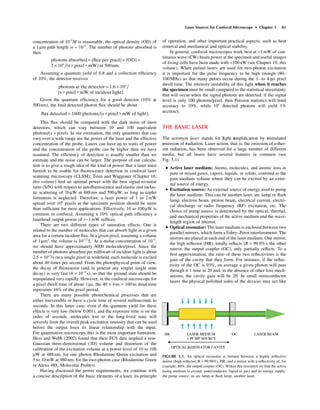
• Optical resonator: The laser medium is enclosed between two
parallel mirrors, which form a Fabry–Perot interferometer. The
mirrors are placed at each end of the laser medium. One mirror,
the high reflector (HR), totally reflects (R = 99.9%); the other
mirror, the output coupler (OC), only partially reflects. To a
first approximation, the ratio of these two reflectivities is the
gain of the cavity that they form. For instance, if the reflec-
tivity of the OC is 95%, on average a given photon will pass
through it 1 time in 20 and, in the absence of other loss mech-
anisms, the cavity gain will be 20. In small semiconductor
lasers the physical polished sides of the devices may act like
FIGURE 5.1. An optical resonator is formed between a highly reflective
mirror (high reflector, R = 99.99%), HR, and a mirror with a reflectivity of, for
example, 80%, the output coupler (OC). Within this resonator we find the active
lasing medium (a crystal, semiconductor, liquid or gas) and its energy supply:
the pump source, an arc lamp or flash lamp, another laser.
82 Chapter 5 • E. Gratton and M.J. vandeVen
effective mirrors. Laser emission generated by electronic tran-
sitions that are relatively rare require cavities with higher gain.
Principle of Operation
A particle of the active laser gain medium becomes excited when
it absorbs pump energy and goes to an excited level [Fig. 5.2(A)].
It then returns to the ground state via non-radiative relaxation
processes and also by emission of radiation [Fig. 5.2(B)]. Under
normal conditions, a Boltzmann equilibrium describes the popula-
tion of the various energy levels: the higher the energy level the
lower the population of that level. When an excited, metastable
level with a long lifetime exists in the laser medium, energy will
accumulate in this level. If the excitation is intense enough, the
Boltzmann distribution normally present will “invert” for the pop-
ulation of this metastable state (i.e., there will be many more elec-
tons in the excited state than Boltzmann would predict). In the laser
cavity, photons emitted from this energy level will strongly inter-
act with the population of the metastable level [Fig. 5.2(C)],
forcing it to release energy and return back to the lower level [Fig.
5.2(D)]. This process is called stimulated emission of radiation,
that is, the interaction of the light with the excited particle
increases the likelihood that the particle will return to the ground
state. The stimulated emitted light has a high degree of mono-
chromaticity, because emission occurs from a well-defined transi-
tion. In addition, the photon that results from this stimulated
de-excitation process is in phase with the electromagnetic wave
traveling in the laser medium. As a result, the emitted radiation has
excellent spatial and temporal coherence and is highly directional.
A convenient way to let the electromagnetic radiation interact
with the laser medium is a resonant cavity (Fig. 5.1). At optical
wavelengths, this is achieved by a Fabry–Perot type interferome-
ter. Two plane-parallel mirrors, one highly reflective, the other
semi-transparent, are separated by a distance equal to an integral
multiple of half the lasing wavelength. Because the electro-
magnetic radiation interacts repeatedly with the laser medium, this
resonant cavity increases the probability of stimulating de-
excitation. It also provides the necessary feedback to make the
emission grow coherently. Because the emission of the first photon
going in precisely the correct direction to reflect back and forth in
the cavity is a low probability event, getting the laser to fire is a
chaotic phenomenon that exhibits a threshold effect; lasers won’t
start or work stably below a certain output power level.
So far we have only discussed a three-level laser, that is,
ground-state, upper excited-state, and lower excited-state [Fig.
5.3(A)]. In a four-level laser [Fig 5.3(B)], as in the helium-neon
(He-Ne) laser, the population inversion can be obtained more
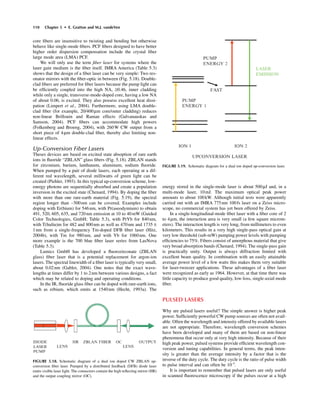
easily (Arecchi and Schultz-Dubois, 1972). The titanium–sapphire
(Ti:Sa) vibronic laser is effectively also a four-level laser due to
its broad energy bands (see later section). Other improvements
relate to the replacement of the Fabry–Perot mirrors by corner cube
reflectors or crossed-roof prisms to increase mechanical and
thermal stability. For further information, see Arecchi and Schultz-
Dubois, 1972; Stitch, 1979; Bertolotti, 1983; Bass and Stitch,
1985; Kudryashov and Weber, 1999; Webb and Jones, 2004;
Hodgson and Weber, 2005.
An interesting approach is the increasing use of optical fibers
that act as both lasing medium and cavity at the same time; a very
compact design is described later in this chapter.
Pumping Power Requirements
In order to sustain laser action, the gain of the optical resonator
needs to be larger than the losses due to resonator walls and other
optical elements. The minimum necessary pumping power, P, is
proportional to n3
. This means that, as one shifts from the infrared
(IR) through the visible (VIS) towards the ultraviolet (UV), an ever
increasing amount of energy is needed to obtain laser action. This
limits the possible pumping mechanisms.
Laser Modes: Longitudinal (Axial) and Transverse
• Axial or longitudinal modes: Separated by a distance, L, the
two plane-parallel mirrors of the Fabry–Perot interferometer
cavity form an optical resonator. This separation distance can
be long (meters, as in big frame ion lasers) or very small
(micrometers, as in very compact diode lasers). A number of
standing wave patterns each consisting of an integer multiple,
m, of half wavelengths, l/2, exists in an optical cavity of length
L: m = L/(l/2). The frequency, n, for the mth vibration along
the long axis of the laser is, therefore, n = mc/2L, where c is
the speed of light in the laser cavity. The frequency spacing
between adjacent longitudinal modes is c/2L, that is, the
inverse of the laser cavity round-trip time. A very large number
of longitudinal modes can exist in the laser cavity unless
bandwidth-limiting devices such as Fabry–Perot etalons are
installed in the cavity.
FIGURE 5.2. Optical (de)excitation processes. (A) Transition from ground
state to excitated state upon absorption of a photon, an electron moves to a
more outward shell, timescale < femtoseconds. (B) Relaxation to a lower level,
for example, ground state under spontaneous emission of a photon, electron
returns to a lower level, timescale nanoseconds. (C) Light driven interaction
inside laser gain medium of a photon with electrons in excited metastable state
with a long lifetime. (D) Stimulated coherent emission and light amplification.
FIGURE 5.3. Fast non-radiative relaxation processes couple an excited state
with a lower metastable energy level. Laser emission occurs in the gain medium
from the metastable state. Dependent on the gain medium properties this laser
process is described by a three-level or four-level lasing scheme.
Laser Sources for Confocal Microscopy • Chapter 5 83
• Transverse modes: These modes vibrate perpendicular to the
long axis of the laser and are known as transverse electro-
magnetic modes, TEMmn, where m and n are integers describ-
ing the nodal points in the two directions perpendicular to the
laser axis. For each transverse mode, many longitudinal modes
can exist. (For an in-depth derivation, see laser handbooks by
Arecchi and Schultz-Dubois, 1972; Stitch, 1979; Demtröder;
1996; Bass and Stitch; 1985; Hecht and Zajac, 2003; Silfvast,
2004). An adjustable diaphragm or pinhole inside the laser
cavity is sometimes used to select the TEM00 lasing mode and
control its intensity. No transverse modes exist in single (lon-
gitudinal) mode fiber lasers.
The TEM00 mode is desired for most light microscopy exper-
iments. It has a Gaussian beam profile with no phase shifts across
the beam. The maximum intensity is in the center of the beam, it
has complete spatial coherence, and the smallest possible beam
divergence. Only this mode can be focused to a diffraction-limited
spot. Doughnut-shaped transverse modes TEM*01 (TEM10 in
overlap with TEM01), such as produced by some helium–cadmium
(He-Cd) lasers operating at 325nm, are not desirable because they
possess no intensity in the center of the beam. In this case, spatial
filtering is necessary (see later section).
Polarization
The output of many lasers is linearly polarized with the polariza-
tion vector vertical.
• Lasers with Brewster surfaces: A convenient and inexpen-
sive way to minimize reflection losses and to generate linearly
polarized light is the installation of a Brewster surface (i.e.,
one that is tilted so that the normal of the plane and the incom-
ing beam form a specific angle, qBrewster) at the end of the res-
onator. Horizontally polarized light incident on such a
plane-parallel plate will be completely reflected. Vertically
polarized light will be completely transmitted without any
reflection losses (Fig. 5.4). In laser resonator cavities, this plate
is usually a quartz or a fused-silica plate. In solid-state lasers,
the semiconductor rod itself is sometimes cut at the Brewster
angle to minimize reflection losses. In gas lasers, the exit
HR GAIN MEDIUM OC LASER
ION LASER BEAM
BREWSTER BREWSTER
WINDOW WINDOW
BB
FIGURE 5.4. Emission of linearly (vertically) polarized laser light from an
ion laser resonator cavity equipped with Brewster angle plasma-tube windows.
Only vertically polarized light is amplified. It experiences no reflection losses
at the Brewster angle: BBrewster = tan-1
n, with n the refractive index of the pure
crystalline quartz window. Horizontally polarized light suffers reflection losses
and stays below the lasing threshold. Windows normal to the optical axis of
the laser would introduce reflection losses and could prevent the laser from
operating at all or introduce a set of reduced length resonator cavities. Tung-
sten disks or BeO tubes with a central bore with or without focusing magnetic
fields keep the lasing plasma volume centered in the cavity. Gas return paths
are also provided in the disks. HR, highly reflecting mirror; OC, output cou-
pling mirror.
windows are usually oriented at the Brewster angle to obtain
vertically polarized light. Dust often collects on Brewster
windows that point upward, damaging the coating. To operate
properly, they must be kept absolutely clean using a dust cover
and a slightly positive dry air or nitrogen pressure in the laser
head. In the jet-stream dye laser, the jet is placed at Brewster
angle in order to minimize losses due to reflection of the
pumping beam, thereby maximizing the pumping efficiency.
For the same reason, the tuning element of the dye laser is also
placed at Brewster angle. Brewster surfaces can also be the
origin of very dangerous reflections. Eye protection should
always be worn when protective covers are removed from a
laser.
• Lasers built without Brewster windows will still show some
polarized output due to birefringence within several optical
components. However, the plane of polarization may change
with time and, even though the total intensity stays constant,
should this light pass through a polarizer, large output inten-
sity fluctuations may be observed.
Randomly polarized beams contain two orthogonal compo-
nents but the phase and ratio of the two components vary rapidly
in time, creating polarization noise. Dichroic mirrors, and, in fact,
any mirror or lens surface, not at right angles with the incoming
radiation will reflect vertically and horizontally polarized light dif-
ferently (directions are taken with respect to the plane of incidence
formed by the reflected and transmitted beams).
A convenient way to depolarize laser emission is to install a
polarizer or polarizing beam-splitter and a l/4-wave plate. When
placed at an angle of 45° with respect to the incoming linear polar-
ization, this 1/4-wave plate converts linearly polarized light into
circularly polarized light. These waveplates are usually designed
for a specific wavelength. Achromatic retarders, such as Fresnel
rhombs, are sometimes preferred, but are quite expensive (Driscoll
and Vaughan, 1977; Hecht and Zajac, 2003). Another advantage
of this arrangement in optical microscopy is that it prevents
reflected or backscattered light from reaching the detector. The
reflected light passes through the 1/4-wave plate in such a way that,
on return, it is blocked by the input polarizer because its plane
polarization is now orthogonal to the main transmission direction
of the input polarizer. Phase randomizing will briefly be discussed
in a later section. For an in-depth treatment see Chapter 31 by
Harris and Delaney. In fiber lasers, optical isolators are inserted
for the same reason, that is, to prevent backreflections. The
polarization-independent isolator consists of a small cylindrical
package containing a fiber pigtail, non-spherical collimating
lenslet, a slightly wedged birefringent platelet, a magneto-optic
Faraday rotator at 45°, exit birefringent platelet also at 45°, and
refocusing lenslet followed by another fiber pigtail.
Coherent Properties of Laser Light
Laser beams illuminate objects coherently. The process of
stimulated emission imposes coherence effects on the emitted laser
light waves. All parts of the electromagnetic wave reach a crest,
that is, are in phase, at a given point in space at the same time.
Spatial and temporal coherence is present. This coherence
stretches for a certain distance and time and depends on the spec-
tral width or pulse duration of the laser light. Beyond a certain dis-
tance or time interval synchronization differences arise. When a
choice exists, a short coherence length laser should be used for
CLSM or scrambling devices should be inserted into the optical
path.
• Temporal coherence: The coherence time is the time interval
during which light traveling over a certain distance maintains
a phase difference of less than p (or 180°), tcoh. = 1/Dn.
• Coherence length: The path traveled by the wave during the
coherence time is called the coherence length, Lc ~ c/Dw, where
Dw is the spectral width of the laser. Longitudinal coherence
length Lcoh. = c/Dn. Lateral coherence length, lcoh. = l/f, with f
the beam divergence. For a typical gas laser, for example, a
He-Ne laser with a bandwidth of 1.5GHz, leads to Lcoh of
~20cm. In single-mode operation with Dw ~ 1MHz, Lcoh is
~50m. A diode laser with a spectral width of 0.1nm at 780nm
possesses a coherence length of 1mm. Dye lasers equipped
with tuning elements, diode lasers, and other lasers such as the
Ti:Sa systems, usually have bandwidths on the order of tens
of gigahertz and an Lcoh of a few millimeters or less. Depend-
ing on the type of line narrowing element installed, Lcoh can
be increased by a factor of 103
to 106
. For practical confocal
microscopy, a shorter coherence length is preferred to elimi-
nate the influence from out-of-focus defects. For example, dust
on semi-transparent surfaces, lenses and mirrors creates inter-
ference fringes when a laser with long coherence length is used
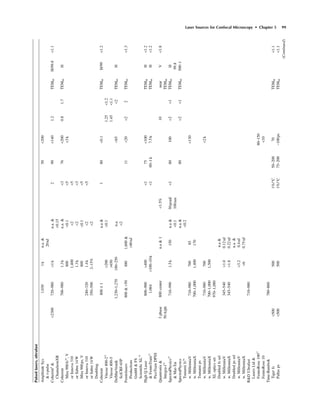
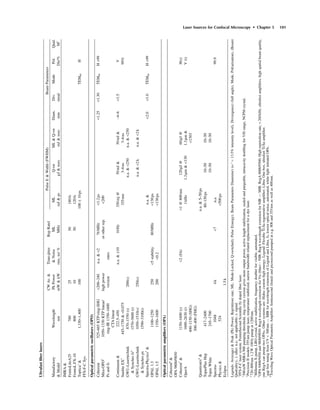
(Hell et al., 1991). (See Tables 6.1 and 6.2 which contain
columns with spectral width and pulse length, from which the
coherence length follows.)
• Spatial coherence: Spatial coherence occurs when a constant,
time-independent, phase difference exists for the optical field
amplitude over a given distance at two different points in
space.
• Coherence surface: The coherence surface is the region of
space for which the absolute phase difference of the optical
field is less than p. The well-known “speckle” pattern consist-
ing of a pattern of darker and brighter light spots is visible
when a matte wall surface is illuminated by a distant He-Ne
laser. The interference effects caused by irregularities in the
surface will be noticeable.
• Coherence volume: The coherence volume is the product of
coherence length and the coherence surface. Interference
between superimposed coherent waves will only be visible
within this volume.
Phase Randomization: Scrambling
the Coherence Properties of Laser Light
A long coherence length of lasers will cause laser speckles (i.e.,
interference effects) and scatter from out-of-focus particles and
these will interfere with the image. Normally in a fluorescence
CLSM, this scattered light is removed by the dichroic mirror as
the emitted fluorescence has a different wavelength from the illu-
minating light source. However, a polarizing beam-splitter and l/4-
wave retardation plate can be equally effective for the removal of
light backscattered by dust or optical surfaces. The angular posi-
tion of this 1/4-wave plate and the polarizer is important
(Szarowski et al., 1992). For generating circularly polarized light,
it is only necessary that the incoming plane of polarization and the
principal axis of the 1/4-wave plate be at a 45° angle. Light
reflected or scattered from an illuminated dielectric surface has its
direction of rotation reversed. On its return passage through the
plate, the light becomes linearly polarized again, but its plane of
polarization is now rotated by 90° and it is removed from the
optical path by the polarizing beam-splitter.
Another method to reduce speckle comes from color confocal
microscopy where one uses several lasers. As the coherence prop-
erties of the various laser light sources are not the same, averag-
ing over the three wavelengths and over several planes will reduce
the effect of the laser speckle (Cogwell et al., 1992b).
Measures to Reduce the Coherence Length of
Laser Light
Many applications work better and image quality improves if the
coherence of the laser light is reduced. One way to achieve this is
to place a rotating diffuser wedge in front of the beam expander
(Hard et al., 1977). Rotation or vibration of this wedge is essen-
tial to average out local diffuser properties. Alternatively, focusing
the laser beam into a multi-mode optical fiber bounces the light
around inside the fiber and mixes the various propagation modes
to scramble the Gaussian intensity pattern (TEM00) to a multi-
mode pattern with a homogeneous spot intensity. This eliminates
or reduces the coherence surface. A short focal length lens or
graded index lens (GRIN) recollimates the light at the fiber
exit.
To eliminate the speckle pattern due to temporal coherence
properties, a piezoelectric driver can be used to induce vibrations
in a section of the fiber (Ellis, 1979). In the context of medical
imaging, Connor, Davenport and Gmitro (1992) used a rotating
diffuser to eliminate the speckle pattern by coupling the laser beam
into a bundle of small, multi-mode fibers. The latest method in this
area is the introduction of ultra-thin single-mode image fibers. A
fiber-optic bundle with a total diameter of 200 to 500mm consist-
ing of 2000 to 5000 micro image fibers, each with a core size of
1.0 to 1.4mm (Kiat et al., 1992), can be used as a phase random-
izer in conjunction with a rotating diffuser. Although these ultra-
thin fiber bundles propagate shorter wavelengths much more
strongly than longer, leaky ones, this is not a problem as long as
monochromatic laser light is used.
As light is scattered in all directions by most diffusers, they
reduce the intensity of the laser light. However, holographic dif-
fusers have been designed to carry strong forward intensity lobes.
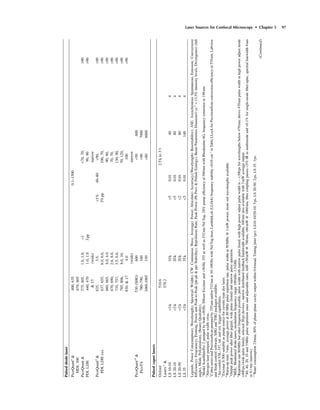
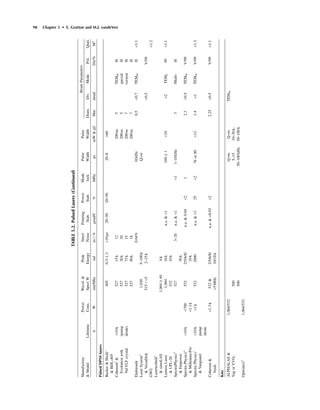
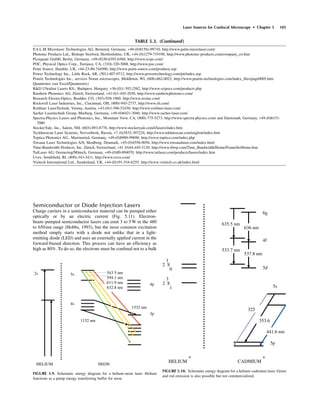
Among others, Lasiris, Inc. and Physical Optics Corp. (see Table
5.3) produce holographic laser beam homogenizers, having a
conversion efficiency of 80% to 90% and low backscatter (Bains,
1993).
Laser coherence effects can also be eliminated by spot scan-
ning the field of view with a tiny, focused, single-mode laser beam.
Alternatively, the condenser plane can be scanned with the same
tiny, focused, single-mode laser beam while illuminating the whole
field of view. Coherence scrambling occurs because the laser spot
rapidly scans the back-focal plane and the field is continuously
illuminated with a mix of beam angles (Ellis, 1988).
Heat Removal
Most of the laser excitation energy is converted into heat. This
must be removed to prevent thermal destruction of the active laser
medium. Small laser systems can use convective air cooling, but
larger laser systems need forced-air or water cooling. Especially
for the largest systems, fans and turbulent water-flows may intro-
duce vibrations in the system (microphonics). These unwanted
mechanical vibrations are inevitably coupled to the mirror mounts
of the resonator cavity, causing increased noise in the optical
output. Pumps that recycle liquid laser-media are another source
for vibration. In this case, the vibration is transferred via hoses to
the active medium in the resonator. To minimize these effects, the
hoses should be clamped or fastened to the support table as near
as possible to the laser head.
84 Chapter 5 • E. Gratton and M.J. vandeVen
The heat generated will also put thermal stress on the mechan-
ical parts of the resonator. Poorly designed laser systems quickly
lose their proper alignment or may need an unacceptably long
warm-up time. The installation of a laser system in a room with
large daily or annual temperature fluctuations or a ceiling fan con-
tinuously blowing cold, dusty, air directly onto a laser will also
hamper operation and cause performance to deteriorate. The use
of thermo-electrically (TEC) cooled diode lasers that are in
thermal contact with their enclosures may create hot surfaces
that should be labeled as such. Diode arrays may require water
cooling. Because of their monolithic design, they are less suscep-
tible to mechanical instabilities but thermal stress has to be avoided
at all cost. The same is true for fiber lasers, which, due to the fiber
length, are sensitive to temperature fluctuations unless counter-
measures such as negeative temperature coefficient materials are
used.
Other Installation Requirements
Manufacturers usually describe the electrical power requirements
and flow rates for cooling water (Gibson, 1988, 1989; Rapp, 1988).
Before installation of a laser system, adequate control of room tem-
perature and air conditioning should be available. Walls should be
painted to eliminate concrete dust from settling on delicate optical
surfaces. For emergency situations, a master switch for the laser
power should be installed with easy access at eye height and
labeled as such. Heat from large fan-cooled laser power supplies
can sometimes be plumbed directly into the intake of the air con-
ditioning system, with backflow protection, if this is allowed. Sim-
ilarly, acoustic noise can be very tiring and noisy power supplies
should be placed outside the experiment room.
An exhaust for noxious fumes such as ozone or dye vapor
should exist and backup systems should be established to prevent
interruptions of power or coolant flow. Mechanical vibrations due
to nearby traffic can be eliminated by installing the system on com-
mercially available vibration-free, air-cushioned laser tables or on
tables isolated using sand-filled containers, tennis balls, or motor-
cycle inner tubes. When equipment used for radio-frequency
crystal-growth, nuclear magnetic resonance (NMR) equipment,
building air-conditioning machines, large elevators, or other large
laser systems are present, it is often wise to equip each laser with
its own stabilized power line to prevent large voltage spikes from
reaching laser power supplies. Hidden cables drawing a large
current (for elevators, for example) in ducts near your facility may
ruin a carefully planned sensitive system by disruptive induction
currents. Stray magnetic fields may affect the flow of ions in gas
lasers.
Movement of fiber-optic components changes the beam prop-
agation properties of the fiber (bundle) and should be prevented
for best stability (unless the device is used intentionally to
scramble the laser light polarization and reduce the coherence
length).
Attenuation of Laser Beams
Laser damage levels for materials are usually given in mW/cm2
while laser output is given as total average power (mW) for a
small, for example, 2-mm diameter beam. Although intensities in
the milliwatt range can be attenuated with neutral density filters,
high-power lasers will easily destroy this type of filter. The
absorbed light may even bleach or heat them so much that they
fracture or explode. Polaroid material can be used only for low
light intensities but this material usually has a peak transmission
of only 30% to 50%. For intensities above about 10mW, better
attenuators are Glan–Thompson polarizers. When a laser emits
only polarized light, one rotatable polarizer, set at a proper angle
will suffice. For randomly polarized lasers a set of two polarizers
can be used. The first one passes 50% of the total intensity. The
second polarizing analyzer transmits a continuously adjustable
amount of light depending on its orientation angle. In all these
cases one must be careful to ensure that light reflected from the
various crystal surfaces is also absorbed by beam stops. Initial
alignment should be done with only the lowest laser power avail-
able. If a polarizer is used to attenuate an initially randomly
polarized laser beam, fluctuations in the intensity may be observed.
These are due to the varying nature of the interaction between
the cavity modes and therefore the polarization state inside the
laser.
Glan–Thompson polarizers contain Canada balsam to hold
them together. This material may absorb slightly, especially in the
UV. Power levels above several watts (power = energy/time = area
of pulse) will destroy this type of polarizer. For the highest
expected power levels, air-spaced Glan–Taylor polarizers are
strongly recommended. A new type of polarizing element is
the Microwire polarizer commercialized by Moxtek Inc. (see
Table 5.3). It fits in very tight spaces but is somewhat more
fragile.
STABILIZATION OF INTENSITY, WAVELENGTH,
AND BEAM POSITION IN LASERS
Sources of Noise in Lasers
Stability, both temporal and positional (beam pointing), is a very
important aspect of any CLSM laser light source. As beam point-
ing affects the amount of light coupled into the delivery fiber,
pointing instability can cause intensity instability. Other intensity
instabilities are related to backreflections from the fiber that can
be avoided (Cogwell et al., 1992a) by employing a wedged fiber
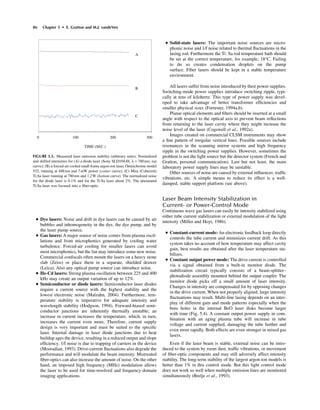
input (e.g., Point Source, see Table 5.3). Figure 5.5 gives examples
of noise in the output of several laser systems. The most stable are
the diode laser and the forced-air cooled (fan) small-frame
argon-ion laser. The argon-ion laser-pumped titanium:sapphire
laser output was coupled into a fiber-optic attached to the detec-
tor. The average relative intensity fluctuations are defined as
N-1
Si(|Ii - ·IÒ|/·IÒ), where N is the number of points. For the diode
laser this quantity is about 0.1% (Franceschini et al., 1994), and
for the Ti:Sapphire laser at the fiber output, about 2%. Both would
be acceptable for microcopical applications in which fewer than
50 photons were detected per pixel.
It is imperative to keep lasers well-aligned with very clean
windows. Misaligned mirrors, a half-illuminated reference monitor
diode, or a dust speck may create a very unstable output. As mis-
alignment can cause unusual modes to appear, these laser lines will
fluctuate independently, and the total output becomes unstable. For
instance, the two UV lines of an old water-cooled argon-ion laser
were observed to alternate between bright and dim with a period
of a few seconds to a minute. Realignment helped but the tube had
to be replaced. Transverse mode swapping is seen in He-Cd tubes
that need replacement.
Noise in the optical output of a laser can be created by a variety
of phenomena. Several factors produce high-frequency (noise) or
slow variations (drift) in beam power. These include power-supply
variations, thermal drift of the cavity, and mode competition.
Examples include:
Laser Sources for Confocal Microscopy • Chapter 5 85
86 Chapter 5 • E. Gratton and M.J. vandeVen
• Dye lasers: Noise and drift in dye lasers can be caused by air
bubbles and inhomogeneity in the dye, the dye pump, and by
the laser pump source.
• Gas lasers: A major source of noise comes from plasma oscil-
lations and from microphonics generated by cooling water
turbulence. Forced-air cooling for smaller lasers can avoid
most microphonics, but the fan may introduce some new noise.
Commercial confocals often mount the lasers on a heavy stone
slab (Zeiss) or place them in a separate, shielded drawer
(Leica). Also any optical pump source can introduce noise.
• He-Cd lasers: Strong plasma oscillation between 225 and 400
kHz may create an output variation of up to 12%.
• Semiconductor or diode lasers: Semiconductor laser diodes
require a current source with the highest stability and the
lowest electronic noise (Malzahn, 2004). Furthermore, tem-
perature stability is imperative for adequate intensity and
wavelength stability (Hodgson, 1994). Forward-biased semi-
conductor junctions are inherently thermally unstable; an
increase in current increases the temperature, which, in turn,
increases the current even more. Therefore, current supply
design is very important and must be suited to the specific
laser. Internal damage in laser diode junctions due to heat
buildup ages the device, resulting in a reduced output and slope
efficiency. 1/f noise is due to trapping of carriers in the device
(Mooradian, 1993). Drive-current fluctuations also degrade the
performance and will modulate the beam intensity. Mistreated
fiber-optics can also increase the amount of noise. On the other
hand, an imposed high frequency (MHz) modulation allows
the laser to be used for time-resolved and frequency-domain
imaging applications.
• Solid-state lasers: The important noise sources are micro-
phonic noise and 1/f noise related to thermal fluctuations in the
lasing rod. Furthermore the Ti:Sa rod temperature bath should
be set at the correct temperature, for example, 18°C. Failing
to do so creates condensation droplets on the pump
surface. Fiber lasers should be kept in a stable temperature
environment.
All lasers suffer from noise introduced by their power supplies.
Switching-mode power supplies introduce switching ripple, typi-
cally at tens of kilohertz. This type of power supply was devel-
oped to take advantage of better transformer efficiencies and
smaller physical sizes (Forrester, 1994a,b).
Planar optical elements and filters should be inserted at a small
angle with respect to the optical axis to prevent beam reflections
from returning to the laser cavity where they might increase the
noise level of the laser (Cogswell et al., 1992a).
Images created on commercial CLSM instruments may show
a fine pattern of irregular vertical lines. Possible sources include
resonances in the scanning mirror systems and high frequency
ripple in the switching power supplies. However, sometimes the
problem is not the light source but the detector system (French and
Gratton, personal communication). Last but not least, the main
laboratory power supply lines may be unstable.
Other sources of noise are caused by external influences: traffic
vibrations, etc. A simple means to reduce its effect is a well-
damped, stable support platform (see above).
Laser Beam Intensity Stabilization in
Current- or Power-Control Mode
Continuous wave gas lasers can easily be intensity stabilized using
either tube current stabilization or external modulation of the light
intensity (Miller and Hoyt, 1986).
• Constant-current mode: An electronic feedback loop directly
controls the tube current and minimizes current drift. As this
system takes no account of how temperature may affect cavity
gain, best results are obtained after the laser temperature sta-
bilizes.
• Constant output power mode: The drive current is controlled
via a signal obtained from a built-in monitor diode. The
stabilization circuit typically consists of a beam-splitter–
photodiode assembly mounted behind the output coupler. The
monitor diode picks off a small amount of laser intensity.
Changes in intensity are compensated for by opposing changes
in the drive current. When not properly aligned, large intensity
fluctuations may result. Multi-line lasing depends on an inter-
play of different gain and mode patterns especially when the
bore holes in the internal BeO laser disks become larger
with time (Fig. 5.4). A constant output power supply in com-
bination with an aging plasma tube will increase in tube
voltage and current supplied, damaging the tube further and
even more rapidly. Both effects are even stronger in mixed gas
lasers.
Even if the laser beam is stable, external noise can be intro-
duced to the system by room dust, traffic vibrations, or movement
of fiber-optic components and may still adversely affect intensity
stability. The long-term stability of the largest argon-ion models is
better than 1% in this control mode. But this light control mode
does not work so well when multiple emission lines are monitored
simultaneously (Brelje et al., 1993).
A
B
C
0 100 200 300
TIME (SEC.)
FIGURE 5.5. Measured laser emission stability (arbitrary units). Normalized
and shifted intensities for (A) a diode laser (Sony SLD104AV, l = 780nm; top
curve); (B) a forced-air cooled small frame argon-ion laser, Omnichrome model
532, running at 488nm and 7mW power (center curve); (C) Mira (Coherent)
Ti:Sa laser running at 780nm and 1.2W (bottom curve). The normalized noise
for the diode laser is 0.1% and for the Ti:Sa laser about 2%. The attenuated
Ti:Sa laser was focused into a fiber-optic.
Laser Sources for Confocal Microscopy • Chapter 5 87
Laser Beam Intensity Stabilization with External
Pockels Cell Modulator
Some manufacturers provide special accessories to improve the
intensity stability of CW lasers. These devices are external modu-
lators incorporating a fast feedback system (Miller and Hoyt, 1986;
Miller, 1991; see Fig. 5.6), and, of course, they reduce the total
output power. Intensity fluctuations of up to 50% of the maximum
power can be corrected in this way, but only with a 50% reduction
in the total available power. Laser intensity stabilizers can regu-
late the output of CW and mode-locked lasers to within 0.025%,
with a noise attenuation of 400:1 and a bandwidth from direct
current (DC) to several megahertz in some systems.
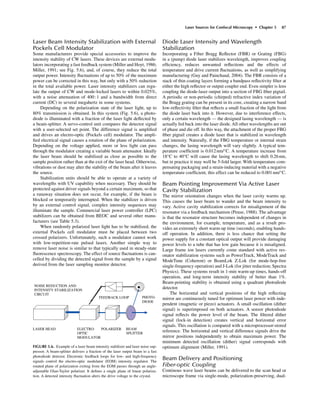
Depending on the polarization state of the laser light, up to
80% transmission is obtained. In this system (Fig. 5.6), a photo-
diode is illuminated with a fraction of the laser light deflected by
a beam-splitter. A servo-control unit compares the detector signal
with a user-selected set point. The difference signal is amplified
and drives an electro-optic (Pockels cell) modulator. The ampli-
fied electrical signal causes a rotation of the plane of polarization.
Depending on the voltage applied, more or less light can pass
through the modulator creating a variable beam attenuator. Ideally
the laser beam should be stabilized as close as possible to the
sample position rather than at the exit of the laser head. Otherwise,
vibrations or dust may alter the stability of the beam after it leaves
the source.
Stabilization units should be able to operate at a variety of
wavelengths with UV capability when necessary. They should be
protected against driver signals beyond a certain maximum, so that
a runaway situation does not occur, for example, if the beam is
blocked or temporarily interrupted. When the stabilizer is driven
by an external control signal, complex intensity sequences may
illuminate the sample. Commercial laser power controller (LPC)
stabilizers can be obtained from BEOC and several other manu-
facturers (see Table 5.3).
When randomly polarized laser light has to be stabilized, the
external Pockels cell modulator must be placed between two
crossed polarizers. Unfortunately, such a modulator cannot work
with low-repetition-rate pulsed lasers. Another simple way to
remove laser noise is similar to that typically used in steady-state
fluorescence spectroscopy. The effect of source fluctuations is can-
celled by dividing the detected signal from the sample by a signal
derived from the laser sampling monitor detector.
Diode Laser Intensity and Wavelength
Stabilization
Incorporating a Fiber Bragg Reflector (FBR) or Grating (FBG)
in a (pump) diode laser stabilizes wavelength, improves coupling
efficiency, reduces unwanted reflections and the effects of
temperature and drive current fluctuations, as well as simplifying
manufacturing (Guy and Painchaud, 2004). The FBR consists of a
stack of thin coating layers forming a bandpass reflectivity filter at
either the high reflector or output coupler end. Even simpler is lens
coupling the diode-laser output into a section of FBG fiber pigtail.
A periodic or non-periodic (chirped) refractive index variation of
the Bragg grating can be present in its core, creating a narrow band
low-reflectivity filter that reflects a small fraction of the light from
the diode laser back into it. However, due to interference effects,
only a certain wavelength — the designed lasing wavelength — is
actually fed back into the laser diode. All other wavelengths are out
of phase and die off. In this way, the attachment of the proper FBG
fiber pigtail creates a diode laser that is stabilized in wavelength
and intensity. Naturally, if the FBG temperature or internal strain
changes, the lasing wavelength will vary slightly. A typical tem-
perature coefficient is 0.012nm/°C. A temperature increase from
18°C to 40°C will cause the lasing wavelength to shift 0.26nm,
but in practice it may well be 5-fold larger. With temperature com-
pensating packaging and a strain-inducing material with a negative
temperature coefficient, this effect can be reduced to 0.001nm/°C.
Beam Pointing Improvement Via Active Laser
Cavity Stabilization
The mirror orientation changes when the laser cavity warms up.
This causes the laser beam to wander and the beam intensity to
vary. Active cavity stabilization corrects for misalignment of the
resonator via a feedback mechanism (Peuse, 1988). The advantage
is that the resonator structure becomes independent of changes in
the environment, for example, temperature, and as a result pro-
vides an extremely short warm-up time (seconds), enabling hands-
off operation. In addition, there is less chance that setting the
power supply for a constant optical output will provide damaging
power levels to a tube that has low gain because it is misaligned.
Large frame ion lasers currently come standard with active res-
onator stabilization systems such as PowerTrack, ModeTrack and
ModeTune (Coherent) or BeamLok Z-Lok (for mode-hop-free
single-frequency operation) and J-Lok (for jitter reduction; Spectra
Physics). These systems result in 1-min warm-up times, hands-off
operation, and long-term intensity stability of better than 1%.
Beam-pointing stability is obtained using a quadrant photodiode
detector.
The horizontal and vertical positions of the high reflecting
mirror are continuously tuned for optimum laser power with inde-
pendent (magnetic or piezo) actuators. A small oscillation (dither
signal) is superimposed on both actuators. A sensor photodiode
signal reflects the power level of the beam. The filtered dither
signal (lock-in detection) creates vertical and horizontal error
signals. This oscillation is compared with a microprocessor-stored
reference. The horizontal and vertical difference signals drive the
mirror positions independently to obtain maximum power. The
minimum detected oscillation (dither) signal corresponds with
optimum alignment (Miller, 1991).
Beam Delivery and Positioning
Fiber-optic Coupling
Continous wave laser beams can be delivered to the scan head or
microscope frame via single-mode, polarization-preserving, dual-
LASER HEAD ELECTRO- POLARIZER BEAM
OPTIC SPLITTER
MODULATOR
FEEDBACK LOOP PHOTO-
DIODE
NOISE REDUCTION AND
INTENSITY STABILIZATION
CIRCUIT
FIGURE 5.6. Example of a laser beam intensity stabilizer and laser noise sup-
pressor. A beam-splitter delivers a fraction of the laser output beam to a fast
photodiode detector. Electronic feedback loops for low- and high-frequency
signals control the electro-optic modulator (EOM) intensity regulator. The
rotated plane of polarization exiting from the EOM passes through an angle-
adjustable Glan-Taylor polarizer. It defines a single plane of linear polariza-
tion. A detected intensity fluctuation alters the drive voltage to the crystal.
circular stress-rod design, fiber-optic (the so-called “Panda-eye
pattern type,” see Chapter 26, this volume). One should use fiber-
optics whenever laser light has to be transported, eye-safe, over
large distances, especially when the laser is located in a dusty envi-
ronment (i.e., not a clean room). A single-mode fiber core typically
has a diameter of 3 to 6mm for VIS wavelengths. This creates a
point-like excitation spot for confocal microscopy. Multi-mode
fibers with core diameters ranging from 0.1 to 1mm may also be
used at times but beam characteristics such as beam width and
polarization state are altered. However, fibers have been found less
suitable for carrying UV light or for preserving the pulse width of
femtosecond pulsed lasers. For femtosecond pulse lasers, the beam
should be enclosed in a dust-free tube and reflected from disper-
sion controlling mirrors (e.g., from Newport Corp.). Picosecond
systems are less affected (see Chapter 26, this volume). Handy
beam couplers are available from many suppliers (OZ Optics Ltd.,
see Table 5.3). The Cell-viZio from Mauna Kea Technologies (see
Table 5.3) uses a bundle of 30,000 fibers of 2mm each.
Ultrafast pulses can currently be delivered by fiber-optic
without dispersion using two methods: by pre-compensation or by
photonic-bandgap fibers. Ultrafast pulses create non-linear effects
in glass fibers and the fibers suffer from dispersion effects. Even
at low pulse energies, a non-linear Brillouin and Raman back-
ground is generated. Pulse trains can only be transported without
detrimental effects from chromatic dispersion under special con-
ditions. By precompensating for the expected fiber pulse chirp with
a dual prism or grating configuration (Fork et al., 1984; Zeek
et al., 1999), the initial shape of the pulse can be preserved after
it exits the fiber, but this adds to the complexity of the system and
creates power loss. This precompensation uses the fact that a short
pulse consists of many frequencies described by a Fourier sum,
with proper amplitudes and phases.
In holey fiber coupling, single-mode, hollow-core (= air-filled)
photonic-bandgap or crystal fibers (PCF), non-linear effects occur
at a much higher threshold than in glass. As long as the zero-
dispersion region of ~812nm for the waveguide matches the laser
wavelength, a perfect femtosecond pulse is transmitted without
distortion (Tai et al., 2004). Tuning outside this range gives pulse
broadening again (Hitz, 2004c). The spectral width of the 0 to
350mW Ti:Sa laser stays unchanged at 812nm after passing
through a 1.5-m length of HC-800-01 bandgap fiber (Crystal Fibre
A/S, see Table 5.3). Dunsby and colleagues (2004) describe an
electronically tunable white light continuum, 435 to 1150nm,
generated by injecting 80MHz 120 femtosecond light into a
micro-structured fiber.
Direct Mirror Coupling and Pulse Width and
Pulse Shape Control
Combinations of CW Lasers All commercial confocal systems
these days offer facilities to combine the output of several lasers
using dichroic mirrors and intensity-balancing neutral-density
filters. A device for selecting wavelength and intensity, such as an
acousto-optic tuning filter (AOTF) or acousto-optic beam splitter
(AOBS), is then added. One of the advantages of having many
separate lasers is that the intensity of each line is servo-controlled
independently. In the competing Kr/Ar ion laser, it is only the total
optical output that is stabilized. The portion of this total associated
with each individual line can vary widely with time. For example,
Cogswell and colleagues (1992a,b) combined a 632.8nm He-Ne
with a 532nm frequency-doubled Nd-YAG laser and the 442-nm
line from a He-Cd laser for true-color confocal reflection
microscopy. Issues that may arise are spectral purity and polariza-
tion of the excitation.
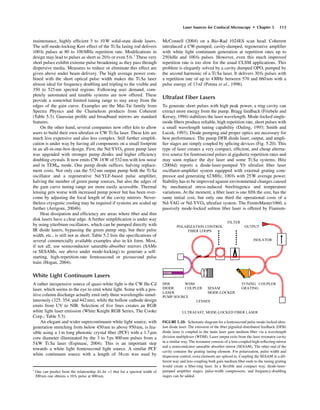
Ultrafast Lasers Assuming the proper coatings, direct mirror
coupling into the scan head can maintain the femtosecond pulse
width and multi-photon intensity for ultrafast lasers such as Ti:Sa
systems (Fermann et al., 2002). On the other hand the dispersion
material used in acousto-optic modulator (AOM) or acousto-optic
deflector (AOD) devices or the glass in thick objectives may cause
inappropriate pulse broadening due to group velocity dispersion
(GVD). A GVD compensating prism or grating pair or a
Gires–Tournois interferometer (GTI) can control the GVD and
compensate the widening to some extent. Instead of prism and
grating pairs, chirped mirrors could be used. These limit tunabil-
ity but improve stability against environmental effects such as
temperature changes and reduce high-frequency noise. In a chirped
mirror, the Bragg wavelength increases with increasing penetra-
tion depth. Double-chirped mirrors that produce an additional
chirp in the coupling of the incoming and reflected wave reach
almost perfect dispersion compensation.
Multi-photon ultrafast (100fs) lasers possess a phase that
depends on the spectral region. To match the slightly different two-
photon absorption properties of fluorophores in different environ-
ments one could tune the laser but this changes the beam properties
such as intensity, phase distortions, etc. A better approach is to use
a charge-coupled device (CCD) computer-assisted pulse shaper
either to create a transform-limited flat phase across the spectrum
or to modify the phases within the pulse via multi-photon intra-
pulse interference (MII), making selective excitation possible
(Dantus, 2003; Dela Cruz, 2004). MII can also limit the amount
of three-photon processes, thereby limiting deep UV damage to
living cells.
Wavelength Selection and Intensity Control
Wavelength Selection
In commercial confocal systems, several laser beams are often
combined via dichroic mirrors onto the same optical path leading
towards an AOTF or AOBS (Chapter 3, this volume). Both allow
very fast wavelength and intensity control on a microsecond
timescale. We found, however, that the spectral purity of the
AOTF–fiber combination is sometimes insufficient. When viewing
mirror-like solid surfaces covered with labeled biosensor mole-
cules excited at 488nm, a little bit of 514-nm laser light was
observed passing through the fiber-optic and masquerading as flu-
oroscein isothiocyanate (FITC) 509nm emission. A thin 488nm
interference filter placed in front of the fiber-optic entrance in the
AOTF module remedies this problem.
Intensity Control
Continuous wave laser beams can be deflected with acousto-optic
devices/deflectors/modulators (AOD, AOM) for intensity and
position control. The functioning and practical use of these devices
has been discussed in great detail in Art and Goodman (1993).
Draaijer and Houpt (1988) used these devices for video-rate
scanning in confocal microscopy and their system was commer-
cially available through Noran and still is supported by Visitech
Intl. Ltd. and by Prairie Technologies, Inc. (see Table 5.3). Inten-
sity control via an electro-optic modulator is described in Chapter
3. For use of polarizers to control laser intensity, see above under
Attenuation of Laser Beams.
Polarization of the Laser Light
We measured a degree of polarization of the light entering the
Zeiss AOFT at better than 1000:1. Using a compact home-built
polarization sensitive power meter at the sample position the laser
light was still very well polarized, better than 200:1 with the prin-
88 Chapter 5 • E. Gratton and M.J. vandeVen
Laser Sources for Confocal Microscopy • Chapter 5 89
cipal axis 5° counterclockwise from the positive x-axis of the stage
(i.e., left to right direction).
SPATIAL BEAM CHARACTERISTICS
Although lasers provide very small beam divergence, the unifor-
mity of the intensity across the beam may be relatively poor.
Fortunately, this is generally not a serious problem because the uni-
formity of illumination can be easily improved by spatial filtering.
Filtering is very efficient when there is good spatial coherence of
the beam.
Several devices are available for spatial filtering; the most
common is the Gaussian spatial filter (Melles Griot, see Table 5.3),
which consists of a focusing lens that converges the beam toward
a very small pinhole. After this pinhole, a second lens, one focal
length away, is used to regenerate a parallel beam. By choosing
the focal lengths of the two lenses carefully, this configuration can
also be used to expand or decrease the beam diameter but a pinhole
is always essential for spatial filtering. Spatial filtering takes place
because diffraction effects at the pinhole produce an out-going
wavefront, which is the Fourier transform of the pinhole and is not
affected by the spatial properties of the light impinging on the
pinhole (Fig. 5.7). It should be noted that dust particles moving in
the vicinity of the pinhole can modulate the transmitted intensity,
so great care must be taken to ensure that this does not occur. For
most practical purposes, a single-mode optical fiber functions as a
spatial filter.
For large size beams from, for example, excimer lasers, an
external beam homogenizer consisting of a prism/lens combina-
tion can be used. The optics recombine sections of the beam to
produce a homogeneous rectangular shape (Austin et al., 1989).
Edge-emitting diode lasers typically require extensive astig-
matic and anamorphic corrective optics to obtain a circular, paral-
lel beam. Commercial packages are available to implement this
(Ingeneric GmbH, see Table 5.3). However, the use of a spatial
filter, a single-mode fiber-optic, or an overfilled back aperture
plane can also produce a symmetric beam.
LASER REQUIREMENTS FOR BIOLOGICAL
CONFOCAL LASER SCANNING
MICROSCOPY-RELATED TECHNIQUES
Optical Tweezers
Single-cell manipulation is feasible by trapping the cell in an
optical box formed by one or more focused laser beams. Each focal
INCOMING LENS SPATIAL LENS CLEANED-UP
BEAM FILTER LASER BEAM
FIGURE 5.7. Diagram of a spatial filter by a pair of lenses and a small pinhole.
High frequency noise is removed form the laser beam. The spatial intensity is
cleaned up.
spot has a diameter of about 1mm. Taken to the extreme, optical
trapping can take place in a completely enclosed environment.
Ashkin and colleagues (1987) reported the optical trapping of
particles and viruses although the technique was also used decades
earlier for levitation of particles in light-scattering experiments. A
simple design is given, for example, in Smith and colleagues
(1999). A beam power of 20 to 100mW TEM00 at the specimen is
sufficient. For biological specimens infrared light should be used.
A careful choice of the trapping wavelength is essential to reduce
optical damage to biological samples as much as possible. Shorter
wavelengths are absorbed by the specimen, longer wavelengths by
water. Therefore, traps commonly use a Nd-YAG (Hoffmann et al.,
2000; Reichle et al., 2001) or a Nd-YLF 100mW laser operating
at 1064nm. Other useful lasers may be a 632.8nm, 25mW He-Ne
laser, or a diode laser beam. An improved design is given by
Bechhoefer and Wilson (2002). Fiber lasers with their diffraction-
limited output and excellent beam quality are also very suitable for
laser tweezers applications (Woods, 2003).
Optical trapping of particles larger than the illumination wave-
length can be explained with geometric optics. When a trans-
parent spherical particle, having a refractive index larger than the
surrounding medium, refracts a ray of light, a change in momen-
tum of the refracted photon occurs. Due to the principle of con-
servation of momentum, the particle receives an equal but opposite
change in momentum. This force pushes the particle away from
the direction of the refracted photon.
When a particle, somewhat smaller than the focal spot of the
laser beam, is suspended in the intensity gradient of a Gaussian
beam profile, then the intensity of the light on one side of the par-
ticle is larger than on its opposite side. This makes the particle
move to the side with the higher intensity (i.e., the center of the
laser beam) and it seems as if the laser beam attracts the particle.
Heating and Damage Effects in
the Cellular Environment
Cells attached to biosensor surfaces may suffer additional heating
effects because of one-sided contact with a buffer solution and
close contact with coated or absorbing semiconductor surfaces.
Objects caught in an optical trap are also subjected to more severe
heat stress. For instance, a 100mW Nd-YVO4 laser focused into
watery media heats it by 0.8K/100mW, but, add a polystyrene
bead in glycerol, and it jumps to 4K/100mW. Even when this
amount of heat is not damaging to the cell, it influences the cali-
bration of the trap, that is, the force–displacement relationship
(Boas, 2003; Peterman, 2003). Several studies report cell damage
conditions (König et al., 1996) of NIR multi-mode optical traps.
Neumann (1999) shows that for the spectral region from 790 to
1064nm, an oxygen-mediated, one-photon process is causing the
damage. Wavelength and power level effects monitored over time
by Leitz and colleagues (2002), indicate that the 700 to 760nm
spectral region is unsuitable due to induced photochemical effects,
but that 810nm is better because only photothermal effects occur.
These can be controlled by reducing the trap energy to 36mW. Cel-
lular response to NIR light with varying pulse length is reported
by König and colleagues (1999 and Chapter 38, this volume).
Zhang and colleagues (1999) look at cell viability in CW Al:GaAs
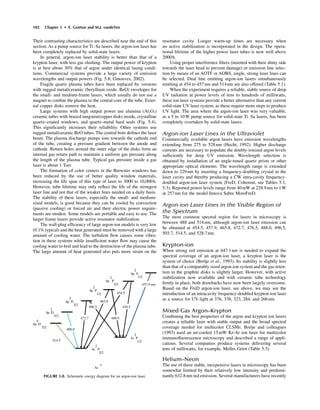
diode laser traps.
Total Internal Reflection Microscopy
For imaging cell adhesion and other biological processes such
as vesicle transport and observing thin self-assembled layers
for biosensor applications, total internal reflection provides a
background-free fluorescent imaging technique. Penetration of the
evanescent wave beyond the boundary plane is limited to roughly
100nm. Objects farther from the interface are not excited and stay
dark. Two methods exist to create total internation reflection fluo-
rescence (TIRF) conditions. One is to inject the light through a
very high, ≥1.45, numerical aperture (NA) objective lens and the
other utilizes an external prism coupling to the slide on the far side
of the specimen. The through-the-objective lens method requires
only 40mW CW at 488nm for green fluorescent protein (GFP)
imaging with reduced bleaching effects. For the prism coupling
technique, 20mW CW was barely sufficient and would have
benefitted from higher power. Other suitable lasers include 50mW
green 532nm; 70mW He-Ne laser, or 200mW 488 water-cooled
argon-ion lasers. It must be noted that, at these power levels, some
published configurations of the external-beam prism method can
be very hazardous to the eye.
Confocal Raman Confocal Laser Scanning
Microscopy for Chemical Imaging
Raman spectroscopy and imaging is used in research on immobi-
lized molecules and biosensor interfaces. It requires a mode-
hop-free tuning range of several gigahertz, a narrow line width of
1MHz, and output power of several hundred milliwatts. Cellular
autofluorescence can present a large background. In order to
reduce its influence, red excitation from a diode laser is a good
choice. Stry and colleagues (2004) utilized a Tiger ECDL laser
system (see Table 5.2), with grating tuning from 775 to 785nm,
and also from 730 to 1085nm with 1W output power.
Coherent anti-Stokes Raman scattering (CARS), complemen-
tary to CLSM, maps via vibrational contrast the intracellular water
distribution. It uses the beat frequency of two lasers, preferably
operating in the IR to avoid damage to cells as much as possible.
Multi-photon lasers emitting picosecond pulses with widths of 2
to 5ps are better for CARS because their spectral linewidth
matches the typical Raman bandwidth of ~20cm-1
much better
than femtosecond pulses (Nan et al., 2004). They were able to
visualize the CH2 stretch vibrations from lipid tails (see also
Chapter 33, this volume).
Non-Linear Confocal Microscopy
Second harmonic imaging is a very good method to probe exter-
nal membranes of living cells. Laser system considerations and
characteristics are given below under Wavelength Expansion Tech-
niques. The SHG images show little speckle background and can
be created with about the same laser intensity as used for fluores-
cence imaging. One can track microtubules with SHG and intra-
cellular inhomogeneities with third harmonic generation (THG)
(Hogan, 2004). Yang and Mertz (2002) used, for example, a mode-
locked 860nm Ti:Sa laser (see below) with a ~100fs., 82MHz
optical pulse train that delivered 10mW at the sample (see also
Chapter 40, this volume).
Nanosurgery and Microdissection
Multi-photon imaging systems can be used for multi-photon abla-
tion of cellular structures and tissue. It requires high (kHz) repeti-
tion rate lasers with 1 to 10mJ pulse energies (Arrigoni, 2004a;
also see Chapter 38, this volume).
TYPES OF LASERS
The earliest lasers were solid-state lasers using ruby as the active
laser medium (Bertolotti, 1983). Subsequently, a wide variety of
lasers were developed (Weast and Tuve, 1971; Arecchi, 1972;
Brown, 1981; Bass and Stitch, 1985; Eden, 1988; Fermann et al.,
2002; Silfvast, 2004; Webb and Jones, 2004). Essentially, all CW
gas lasers (Bloom, 1968) and some solid-state lasers with emis-
sion in the visible part of the electromagnetic spectrum, meet the
minimum intensity requirements estimated above for fluorescence
microscopy. The list of available wavelengths continues to expand
(Weber, 1999). For trapping and label-free SHG microscopy, IR
wavelengths are the most suitable. Some other important parame-
ters are the output power at each wavelength, efficiency, and sta-
bility. Table 5.1 lists the major types of CW lasers. Table 5.2 lists
the major options for pulsed-laser systems.
CONTINUOUS WAVE LASERS
Continuous wave (CW) lasers can be divided into several classes:
• gas lasers
• dye lasers
• solid-state lasers.
Gas Lasers
Three major types of CW gas lasers are available (Bloom, 1968):
• argon-ion, krypton-ion, and a mixture of argon and krypton
(mixed gas)
• helium–neon
• helium–cadmium
• alkali metallic vapor lasers.
The CO and CO2 lasers that emit around 5mm and at 10.6mm
are not discussed here. Commercially available, but not widely
used and therefore also omitted from further discussion, are the
neon laser that can emit 1W of multi-line UV (CW) at 339.2
(0.3W), 337.8 (0.2W), and 332.4nm (0.5W) and the xenon
laser emitting between 488 and 540nm but usually only operated
in pulsed mode. In general, krypton and helium–neon lasers
are used only if red excitation is necessary, but the latter also
now provide lines in yellow, green (GreNe), and orange (594nm).
With the increasing availability of red-absorbing dyes, their
importance is growing. Several leading confocal microscope
manufacturers still equip their systems with red and green
helium–neon lasers emitting a few milliwatts and air-cooled
argon-ion lasers. Argon–krypton mixed-gas ion lasers often
form a cheaper alternative to the purchase of separate argon and
krypton systems plus the additional requirements for power and
beam-steering optics. It is worth realizing however, that the
lifetime of a specific red laser line in a mixed gas laser may be
much less than the stated lifetime of the strongest laser line (green,
514nm).
Argon-ion
Because its emission wavelength matches the absorption peak of
fluorescein and other popular dyes, the argon-ion laser is still by
far the most common laser in microscopy. Lately, however, highly
efficient 488nm small-footprint, solid-state lasers have appeared.
90 Chapter 5 • E. Gratton and M.J. vandeVen
Laser Sources for Confocal Microscopy • Chapter 5 91
TABLE5.1.ContinuousWaveLasers
TunableCWDyelasers
ManufactoryPumpWavel.SpectralCWAv.NoiseAbs.Wavel.ASEConv.Freq.BeamParameters
&ModelPowerRangeWidthPowerAcc.Reset.Eff.Stab.Diam.Div.ModePol.
mJnmmWrms,%nmnm%%MHz/bmmmrad%
Coherent5991
390–93020–40l200–12001/3-day0.61.5TEM00V
60–100
500GHz
RadiantDyes560–6502/h<25<1.3<1.5
&CWDyeL.
Coherent8992
5–15W370–110040–200GHz10–20000.10.1
RadiantDyes3
&Dye400–8501/20MHz2.5<0.03<0.005<0.512–32100Mhz/h<0.5TEM00V,>98
Ti:Sa700–9502GHz
Legends:Wavel(ength);CW:ContinuousWave;Av(erage),Power;Abs(olute)Acc(uracy);Wavel(ength)Reset(tability);ASE:AmplifiedSpontaneousEmission;Conv(ersion)Eff(iciency);Freq(uency)Stab(ility);Reset(ability);
BeamParametersDiam(eter)(e-2
=13.5%intensitylevel),Div(ergence)(fullangle),Mode,Pol(arization).
1
Standingwave3mirrorcavitydyelaser,Invarbartemperaturestabilized,Argon-ionandVerdiDPSSpumppower5WUVorR,B,G,pumpwavelengthandoutputpowerdependondye.20–40,60–100and500GHz1,2and
3platebirefringenttuning,noiseratedbetween10Hzand100kHz.
2
Combineddye+TI:Saresonatordesign,singlefrequencyringdyelaser,accommodatesbothlow(<8W)andhighpower(>10W)pumplasers,LiO2andKTPfrequencydoublingextendsrangedownto270nm,AutoscanII
completeautomation.Exampleofcostsforasecondhand899system,withoutTi:Sa:~12,000USD.
3
Ti:Sa/Dyeringlaser:Pumpedwith308nmexcimeror532nmNd:YAG;invarbarresonator,Linewidthforactive/passivesinglefrequencyoperation1/20MHz,broadband3platebirefringentfilter2GHz,noisebetween10Hz
and1MHz,LabviewandC++softwarecontrol.
(Continued)
92 Chapter 5 • E. Gratton and M.J. vandeVen
TABLE5.1.ContinuousWaveLasers(Continued)
ManufactoryLife&CWCWCWCWCWNoise&BeamParameters
&ModelPowerCons.Wave-lengthAv.PwrAv.PwrAv.PwrWave-lengthAv.PwrWave-lengthAv.PwrStabil.Diam.Div.ModePol.Qual.
(h)&(W)(nm)(mW)(mW)(mW)(nm)(mW)(nm)(mW)(rms,%)mmmradM2
Gaslasers:Argon-andKrypton-IonPureGasandMixedLaserSystems
Coherent70C-570C-K70C-300C-Sabre
Ionlasers1
ArgonKryptonSpectral308
Smallframe>5,000&MLUV5050351.1250275.4180
Water-cooled363.8250302.4380
70CInnova2
<40A/ph.MLB.G5,000MLUV750334.55000.5light1.50.5(Ar)TEM0
Series3phaseMMB.G6,000454.5140275.4–reg.0.8(Kr)
457.9300457.9560305.51,600
465.87030465.8180300.3–(3long
472.2100472.2240335.83,000term)
476.5600100476.5950351.11,800current
488.01,500250488.02,400363.81,700reg.
496.5600496.5950333.6–363.8
501.7350501.74807,000
300C-308<55A/ph514.52,000250514.53,2000.21.8@*0.4@TEM0
Smallframe3phase520.8130520.8454.5800514.5514.5
Water-cooled528.7300528.7550457.91,500
530.9130465.8800<2.6<0.8
Largeframe<70A/ph568.2150ML-VIS8,000472.21,300
Water-cooled3phaseML-VIS8,000476.53,000
SabreDBW253
B488.08,000
DualBrewsterMLRed750496.53,000
Window(DBW)MLwhite2,500501.71,800
orTunable647.1500250514.510,000
SealedMirrors676.4120528.71,800
(TBM)752.530ML
VIS25,000
Coherent&>5,000h457.980<0.75<1.3<0.8TEM0V<1.2
EnterpriseII<31A488200]6pp100:1
–6104
1phase514.5350
Water-cooledMLVIS1,000
LASOSLaser454.5–40<10.66<1.05TEM00V<1.3
&Argon-ion5
514.5500:1
SpectraPhysics<20A45840mW<0.10.69<0.95TEM00V<1.2
&Advantage6
488alllines<1pp100:1
163Caircooled514
Laser Sources for Confocal Microscopy • Chapter 5 93
Gaslasers:Helium–Cadmium(He-Cd),Green/Yellow/Oramge/RedHelium–Neon(He–Ne)7
CookeCorp.&n.a.&H
He–Cd,White+<600–700RGB20–50<0.51–20.5–1Single/100:1
BlackKnight8
325,441.620–50<0.5Multi
RG,UV30
MellesGriot&>50,000V
GreenHeNe543.510.880.81500:1
YellowHeNe591.110.750.92random
OrangeHeNe611.910.882.2
LasosLasert&>20,000
RedHeNe632.8>100.5%0.7<1.4TEM00500:1<1.2
Legends:Lftm.(Lifetime);Pwr=Power;Cons(umption);FWHM(FullWidthHalfMaximum);BeamParametersDiam(eter)(e-2
=13.5%intensitylevel),Div(ergence)(fullangle),Mode,Pol(arization);Qual(ity);ph(ase);ML
Multiline;MM=MultiMode;pp:peak-to-peak;reg(ulation),RGB:RedGreenBlue,TBM:TunableBraggMirror.
1
Spectra-Physicsproducessimilarwater-cooledonlasersbothinpureandmixedArgon/KryptonwithZ-LokautomaticsinglefrequencystabilizationandJ-Lokjitterreduction.ExamplesaretheBeamLok2060and2080pure
gasmodelsandtheStabilitemodels2017and2018-RM,aswellasBeamLok2060mixedgaslasers.
2
InnovaSeriesVplasmatube,SuperInvarresonator,Model70C:3phasewith<40A/phase,8.5lcoolingwaterflowrate/min.,Model300C:3phasewith<55A/phase,9.6l/min.coolingwater,sealedmirrors,withPowerTrack,
ModeTrack,ModeTune,modehop-freeoperationwithetalon.
3
3phasewith<70A/phase,SuperInvarstableresonator,withSentrysystemmanagementcompleteautomationforwavelengthselection,mode-control,searchandtune,5minwarm-up,NuTrackactivecavitylengthstabilization
forsinglefrequencyoperation,SabrePurelightLowDivergencebeamdiameterandbeamdivergence,noiselevelbetween10Hzand2MHz.
4
Singlephaseand<31A,SuperInvarresonator,8l/min.coolingwater,SeriesVplasmatube,SinglelineandUVemittingsystemsalso,Innova:SeriesVplasmatube,SuperInvarresonator,Model70C:3phasewith<40A/phase,
8.5lcoolingwaterflowrate/min.,Model300C:3phasewith<55A/phase,9.6l/min.coolingwater,sealedmirrors,noiselevelwithPowerTrack,ModeTrack,ModeTune;mode-hop-freewithetalon.
5
Warm-uptime15min.,stability<1%over2h.,noisebetween20Hzand2MHz,beampointingstability<30mrad/3K.
6
AdvantageModel163C–A02,Noiselevelfrom10Hz–3kHz,0.3%from10Hzto2MHz.
7
ManyHe-Nesuppliersexist.He-CdaremadebyTheCookeCorporation,MellesGriotandKimmonElectric,Vaporlasers.HeNe:Green543nm;Orange594nm;Red633nmModelLGK-7654-820minwarm-uptime,noise
between30Hzand10MHz,5%powerstabilityover8h.
8
Black+WhiteKnightRGB-450M,RGB441.5/537.8/635.5nm,othernon-RGBversionasindicated.Warm-uptime20min.,noisebetween10Hzand10MHz,stability3%/2h.
(Continued)
94 Chapter 5 • E. Gratton and M.J. vandeVen
TABLE5.1.ContinuousWaveLasers(Continued)
Diodelasers:ContinuousWave
ManufactoryPowerWavel.&CWPointingPowerMod.PulseRiseBeamParameters
&ModelLifetimeCons.SpectrW.Av.PowerNoiseStabStab.Freq.ModtimeDiam.Div.ModePol.Qual.
hWnmmWrms,%mrad/°C%MHzMHzmsecmmmradM2
BlueSkyRes<12488±25<1%<4<20.7<1H
&Chroma-0.5&100:1
Lase4881
0.1
Coherent2
&375±58<1<0.6<5<5Hz<2001¥30.6¥1TEM00100:1
Radius375-8<15405±550<0.6<5<5Hz<2004.7¥1.60.7¥0.3TEM00100:1
Radius405-50>10k40825
Sapphire460460±2200<0.5<30<20.7<1.2TEM00V100:1<1.1
488-2003
488±2200<0.5<30<20.7<1.2TEM00V100:1<1.1
Radius440-16>20k<15440±516<0.5<0.6<5<5Hz<2001¥30.7¥0.3TEM00100.1
Radius635-25635±725<0.5<0.6<2<100Hz<510.7¥0.3TEM00100:1
Microlaser&375±566stand.<0.7TEM00>100:1
Leptonseries408±1036or<0.7TEM00>100:1
L4xxx–xx–TE/440±10121/2/4/<0.7TEM00>100:1
473±103<0.7TEM00>100:1
NovaluxInc.4
Twicethat<20460±25<0.2<30<20.7<1TEM00V100:1<1.2
&Proteraofargonion<20488±25–20<0.2<300.7<1.2TEM00V100:1<1.2
xxx–x<20532±250.2<30<20.7<0.8TEM00V100:1<1.2
Power375±5820–100100MHz2.5¥4<0.5
Technology405±1050dig.TTL1.3<0.5
Inc.5
&440±10162.5¥4<0.5
IQseries473±542.5¥4<0.5
Toptica&405±10TEM00100:1
PVLS500>50003.52.1–4.3<0.2
PVLS3000>500050<0.2
FiberLasers
GuidedColor6
49110<1<2550:1or<1.3
&Fiberlaserrandom
LumicsGmbH7
490±3>5<0.5<2TEM00<1.1
NationalLaser<1549010<0.5<30<20.7<1.2TEM00random<1.4
&LasNOVA8
Unique-m.o.d.e>10,0005491.5&5–10<20.75<1.2TEM00random<1.1
AG9
&<1V1
UMFL491<0.3
Laser Sources for Confocal Microscopy • Chapter 5 95
ContinuousWaveDPSSLasers
CoboltAB&
Blues10
<2047350<0.53(3h)0.1<6TEM00100:1<1.2
Samba<20532100<0.53(3h)0.1<6TEM00
INNOLIGHT11
&MephistoQTL947500<0.1TEM00<1.1
MephistoMephisto10642000<0.1TEM00<1.1
YLFMephistoE1319500<0.1TEM00<1.1
1444&200<0.1TEM00<1.1
1kHz
LaserQuantum53250–300<1<5<12.50.5TEM00V100:1<1.1
&Torus532
MellesGriot12
&
85BTA442±35/8/10<2pp~2.50.65<1.1TEM00V100:1<1.2
85BTC44245
85BCA13
<100473±55/10/15<10/h~2.50.67TEM00V100:1<1.2
85YCA<60561>10<2pp0.67<1.2TEM00<1.2
<0.5
<3pp
RainbowPh.14
&
BluePoint430<60430±110<0.5<30<20.4¥0.3<0.8TEM00V100:1<1.1
473laser<154735–40<1<20<20.253TEM00<1.2
BluePoint488<60488±15<0.5<30<20.4¥0.3<0.8TEM00<1.1
Toptica15
&60550
Eksel110evaluation
TorsanaLas.16
&>10,000<40488±<0.75<400.7V
Starbright4880.3&0.1
DPSSKits
ALPHALAS1064350Q-SwTEM00
DPSS–17
53215IR+532
Legends:Pwr=power;Cons(umption);Wavel(ength);Spectr(al)W(idth)givenasFWHM(FullWidthHalfMaximum);CW:ContinuousWave;Av(erage)Power;Pointing&PowerStab(ility);Mod(ulation)Freq(uency);Beam
ParametersDiam(eter)(e-2
=13.5%intensitylevel),Div(ergence)(fullangle),Mode,Pol(arization),BeamQual(ity).DPSS:DiodePumpedSolidStatelasers.
1
Noisebetween20Hzand20MHz,powerstabilityover8h.
2
Severalmodelswithvaryingoutputavailable,Model375-8CDRH;Model405,noisebetween210Hzand10MHz,modulationmaysavetubelife.
3
Noisebetween20Hzand2MHz,powerstabilityafter2hoursand±3°C.
4
Model460-5;Model488-15:Warm-uptime<5min,Spectralwidth<<0.01nm,Noisebetween20Hzand2MHztypicallyonly0.03%,IRemission<0.1mW,warm-uptime2min.
5
IQseries:InstrumentQuality,beamcirculizationavailableaswellasanaloganddigitalmodulation.
6
FiberLaser(GuidedColorTechnologiesGmbH):noiselevelwhenstabilizedotherwise>10%.
7
LumicsLU0490F005.
8
Noiselevelbetween30Hzand100MHz.
9
Warm-uptime<10min,noisebetween10Hzand10MHz,optionalsingle-modefibercoupling.
10
Noiselevelbetween10Hz–100kHzpp,<3%between100kHz–5MHz,<0.5%between5–100MHz,3%longterm(3h)stability.
11
RinggeometryDPSS,singlefrequency(1kHz)withPZTover20GHztuningrange,noiseeateroption.
12
Warm-uptime3min,tobeam-pointingstability10–15min,noisebetween20Hzand10MHz,TECcooled.
13
Warm-uptime<3min,Noisebetween20Hzand10MHz,pointingstabilityfor±2°C.
14
Noisebetween10Hzand10MHz,powerandpointingstabilityafter2h,473nmlaserdatafromCrystaLaserInc.,warm-uptime1min.
15
EvaluationkitforGaAsSb5W808nmpumpedDPSSlaser.
16
Warm-uptime<1min,noiselevelbetween20Hzand20kHz.
17
KitcomescompletewithNd:YVO4orNd:YAGcrystal,pumpdiode,mirrorsets,KTPdoublingcrystal,670nmalignmentlaserdiode,IR—VISconverter.
96 Chapter 5 • E. Gratton and M.J. vandeVen
TABLE5.2.PulsedLasers
ManufactoryPumpWavel.SpectralCWAbs.Wavel.Conv.Freq.BeamParameters
&ModelPowerRangeWidthAv.PowerNoiseAccur.Reset.ASEEff.Stab.Diam.Div.ModePol.Qual.
mJnmmWnmnm%%cm-1
/°CmmmradM2
Pulseddyelasers
LambdaPhysik<65@355198–3200.03,0.07(rms)<0.5280.5
&<150@53850-0.15cm-1
(%)
ScanMatePro1
2@40Hz
SpectraPhys.2
@1–30Hz360–9501.56pp2¥34<1.1
&Duo
SpectraPhys.3
5–35(gr)330–7804/0.04<0.5<0.03<0.005<0.5<20<0.01<1.5>98
&Cobra5–80(pr)and<0.05
CobraStretch8–150(gr)0.02cm-1
<0.5<0.03<0.005<0.5<28<0.01<1>98
8–230(pr)<0.05
PrecisionScan50–650(gr)<0.5<0.03<0.005<0.5<28<0.01<0.5>98
@<100Hz<0.05
Pulsednitrogenlasers
PowerWavel.&CWPointingPk-PkRep.PulsePkPwrBeamParameters
ManufactoryLifetimeCons.SpectrWAv.PowerNoiseStab.Stab.RateWidth&PkE.Diam.Div.ModePol.Qual.
&ModelhWnm&MhzmWrms,%mrad/C%MHzpsmW&mJmmmrad%M2
SpectraPhysics4
337.10.1<4pp1–20Hz4k30kW3¥73¥8
&VSL337&>120
Pulsedexcimerlasers
Lambda-30838k<0.0001n.a.&400
Physik&35128k<0.0001320
LPXPro
TuiLaserAG3083.5k<2<0.000510,000n.a&83¥6<1¥2
&Excistar5
3513.5k<2<0.000510,00083¥6<1¥2
Pulseddiodelasers
Becker-Hickl6
375,405,0.8,2.4<22060,60,100–500
&BDHseries475,635,0.9,0.5,5050,50,
680,7801080
Hamamatsu7
&90375,405,70,50,2Hz–10010015–34,
PLP-10440,470,20,20,13–22,
635,650,30,30,10–35,
670,780,30,30,10–30,
850All50pk12–32
±10power
Laser Sources for Confocal Microscopy • Chapter 5 97
Pulseddiodelaser
PicoQuant8
&400,6350.1–1500
MDL300670,805
PicoQuant&375,405,1.0,1.0,<1<70,70,>90
PDLLDH440,4701.0,1.03pp90,90>90
&±3(wide)narrow
PicoQuant9
&635,3.5,<1%40–80<90,>90
PDLLDHxxx637,655,8.0,6.0,3%pp100,70,>90
660,665,8.0,4.090,90,>90
670,690,2.0,8.0,70,70,>90
735,757,3.5,6.0,130,90,>90
785,806,8.0,10,70,120,>90
830,&±74.0100>90
(wide)narrow
PicoQuant10
&530(SHG)600<50600
PicoTA780–790,160<907000
1060.1065150<806000
Pulsedvaporlasers
Oxford510.62.5kto33
Lasers11
&578.2
LS10-10<3k10k<50.01404
LS20-10<3k20k<50.01804
LS20-50<3k20k<20.01804
LS35<3k35k<30.011404
Legends:PowerCons(umption);Wavel(ength);Spectr(al)W(idth);CW:ContinuousWave;Av(erage)Power;Abs(olute)Accur(acy);Wavel(ength)Reset(tability);ASE:AsynchronousSpontaneousEmission;Conv(ersion)
Eff(iciency);Freq(uency),Pointing,PowerandPeak-to-Peak(pk-pk&pp)Stab(ility);Rep(itition)Rate;PeakPower(PkPwr)&PulsekE(nergy);BeamParametersDiam(eter)(e-2
=13.5%intensitylevel),Div(ergence)(full
angle),Mode,Pol(arization),(Beam)Qual(ality).
1
ModelScanMatePro2pumpedbyboth<40Hz308nmExcimerand<50Hz355aswellas532nmNd-Yag,28%pumpefficiencyat560nmwithRhodamine6G,frequencyextensionto198nm.
2
Nitrogenlaserpumped,pulsewidth>4ns.
3
CobraseriesandPrecisionScanpumpedby355nmand/or532nmat10–100HzwithNd-Yaglaser,LambdaLok(LLOck)frequencystability<0.01cm-1
inTableLLockforPrecisionScanconversionefficiencyat570nm,Labview
andSirahcontrolsoftware,SHGandTHGpackagesavailable.
4
Air-cooledVSL-337,int.andext.triggercapabilities.
5
ExcistarS-500suitableaspumpsourceforcuvettetypedyelaser.
6
Warm-uptime3min.,averagepowerat80MHzpulserepetitionrate,pulsewidthat50MHz@1mWpower,moreredwavelengthsavailable.
7
Outputpeakpowerafterfiberpigtail,widepulse(listed)andnarrowpulseoperation.
8
MDL:Modulateddiodelasers,modulationfrequencyrange100kHz–1.5GHz.
9
Repetitionrate80MHzbutotherfrequenciespossible,pulsewidthwithnarrowpulselisted;withhighpoweradjustpulsewidthis~<300psforwavelengthsbelow470nm;above470nmpulsewidthinhighpoweradjustmode
<400ps.(widepulselisted),selected50psdevices,narrowdistributedfeedbackbandwidthavailable,440nmalsoavailablewith3mWaverageoutput.
10
80,40,20,10and5MHzpulserepetitionratesandadjustablerates,ASE<50mW@780nm,<60mW@1060nm,fibercouplingpasses<5%IRinmultimodeand<0.1%forsingle-modefiber-optic,spectrallinewidth4nm
or0.1nm(narrow).
11
Waterconsumption2l/min,80%ofplane-planecavityoutputwithin0.6mrad,Timingjitter(ps):LS10-10/20-10:5ps,LS20-50:2ps,LS35:3ps.
(Continued)
98 Chapter 5 • E. Gratton and M.J. vandeVen
TABLE5.2.PulsedLasers(Continued)
ManufactoryPowerWavel.&PeakJitter/PointingPowerModePulsePulseBeamParameters
&ModelLifetimeCons.SpectWEnergyNoiseStab.Stab.lockWidthWidthDiam.Div.ModePol.Qual.
hWnm/MhzmJns/%mrad/C%MHzpsmW&mJMmmradDir/%M2
PulsedDPSSlasers
Becker&Hickl1
4050.3–1.3<10ps20–5020–5020–8>60
&BDL-405
Coherent2
&>10k52715k12200ns5TEM00H
Evolutionwith(pump52730k20200ns5specialH
Nd:YLFcrystaldiode)52775k15200ns7versionH
52790k18200ns7H
Elektronik0.04%10kHz0.5<0.7TEM00H<1.1
LaserSystem3
1,0305–100kQ-sw
&VersaDisk515/<52–15k<0.5V/99
GWU<1.2
Lasertechnik4
&simoLAS1,064±406k
LumeraLaser1,06416kn.a.&<1160±1<10<2TEM099<1.1
&UPL-2053210k
SpectraPhysics5
5273–20n.a.&<1<11–10kHz3Multi-H
&Empower30k
SpectraPhysics6
>10k<7005322/5/6/8/n.a.&0.04<212.3<0.5TEM00V/99
&Millennia-Pro<1.1k10k
SpectraPhysics7
>10k<1k5322000n.a.&<125<276or80<121.4<1TEM00V/99<1.3
&Vanguardpump
diode
Coherent&<1.3k532&2/5/6/8/n.a.&<0.03<22.25<0.5V/99<1.1
Verdi<5MHz10/18k
Kits
ALPHALAS&1,064/532Q-sw.Q-sw.TEM00
YagorYVO45005–1510–30k,
50050–100kHz50–100k
Optronics8
1,064/532
Laser Sources for Confocal Microscopy • Chapter 5 99
Pulsedlasers,ultrafast
AmplitudeSys1,0301kn.a.&50<200
&t-pulse20nJ
Coherent9
&<2300720–980>1kn.a.&290<1401.2TEM00H/99.8<1.1
ChameleonXR<0.15
Coherent700–9801.3kn.a.&<376<2000.81.7TEM00H
Mira900fs10
,V800<0.1<5<3k
orInnova3101,400<2<5
orSabre14W1.3k<2<3
Mira900ps,V800<0.1<5
orInnova310240–3201.4k<2<5
orSabre14W350–5002–15%<2
Doubling
Coherent800±1n.a&180<0.1TEM00H/99<1.2
Vitesse800-211
>200<0.11.25<1.2
Vitesse800-5>6501.45<1.1
DelMarVent&1,230–1,270180–250n.a.<65<2TEM00H
SciCRF-65P<2
Femtolasers800&>508801,600&11<20<22TEM00<1.3
Productions>80nJ
GmbH&FS
ScientificXL12
HighQLaser800–900>400<175<100TEM00H<1.2
&FemtoTrain13
1,064>100–10k<160–1k7.5kTEM00H<1.2
PicoTrainDPSS
Quantronix&3phase800centern.a&1<1.5%10nearV<1.8
Integra-i14
50A/phTEM00
SpectraPhysics15
710–9901.5k150n.a&30mrad/<180100<2<1TEM00H
&Mai-Tai<0.1100nm99.8
SpectraPhysicsn.a&80<2<1TEM00500:1
Tsunamifs16
<0.2
w.MillenniaV710–98070085<130
w.MillenniaX700–1,0001,400170
Tsunamips
w.MillenniaV710–980700<2k
w.MillenniaX700–1,0001,500
XLopticsset970–1,080
Doubledfsseln.a&
w.MillenniaV345–540>1.00.12nJ
w.MillenniaX345–540>1.80.22nJ
Doubledpsseln.a.&
w.MillenniaV>3.20.4nJ
w.MillenniaX>60.75nJ
R&DUltrafast710–980
LasersLtd&
FemtoRose10017
80–150
FemtoRose10<10
Time-Bandw&780–860
Tigerfs<5005001%/°C50–20070TEM00<1.1
Pallasps<5005001%/°C75–200–100psTEM00<1.1
(Continued)
100 Chapter 5 • E. Gratton and M.J. vandeVen
TABLE5.2.PulsedLasers(Continued)
ManufactoryPowerWavel.&PeakJitter/PointingPowerModePulsePulseBeamParameters
&ModelLifetimeCons.SpectWEnergyNoise,rmsStab.Stab.lockFreq.WidthWidthDiam.Div.ModePol.Qual.
hWnm/MhzmJns/%mrad/C%MHzpsmW&mJMmmradDir/%M2
Pulselasers:Ultrafastkits
AvestaProject&n.a.&<2<2TEM00H
TIF-kit-xx740–840<250<20
720–980<1k<100
CrF-kit-65P1,240–1,270<250<65s
DelMarVentures780–840,250–1k<570–1402–3<2TEM00H
FemtoStart18
740–950,20–200
TISSA-20-10019
710–950
Kapteyn-780–810400–450n.a&80–100<15fs~1~1~H
MurnaneLabs.750–8404.4–6.1<25fsTEM00
&TS20
&>60nm
Legends:PowerCons(umption);Wavel(ength);Spectr(al)W(idth)atFullWidthatHalfmaximum(FWHM);Av(erage)Power;T(iming)Jitter;PointingandEnergyStab(ility);Rep(itition)Rate;PeakPower(PkPwr)&Pulsek
E(nergy);BeamParametersDiam(eter)(e-2
=13.5%intensitylevel),Div(ergence)(fullangle),Mode,Pol(arization),(Beam)Qual(ality).;fs:femtosecond,ps:picosecond,stabil(ity),V(erdi).
1
Warm-uptime3min.,averagepowerat80MHzpulserepetitionrate,pulsewidthat50MHz@0.5mWpower,moreredwavelengthsavailable.
2
Ti:Sapumplaser,pulserepetitionrate1–10kHz,.Peakenergyat1kHzpulserepetitionrate,noiseover8hours<1%(rms).
3
Noiseleveldefinedbetween10Hzto1GHz,consumes600W,linewidthwithoutetalon<1GHz,,birefringenttunerfor1000–1060nmregion.
4
Single-modeNd:YVO4ringlaser.
5
Nd:YLFpumplaserforultrafastamplifiers.
6
Ti:Sapumplaser,noisebetween10Hzand100MHz,QuietMultiAxialModedoubling(QMAD),laserheadclosedchillercooledfor5,6,8an10Wversions.
7
ModelVanguard2000-HM-32,Nd:YVO4lasingcrystal,warm-uptime30min,tofullspecifications1h.,coolingairflow300cfm.
8
Nd:YVO4crystal,non-linearcrystal,setofmirrors,Cr:YAGpassiveQ-switch,Glan-Taylorprism.
9
PumpedbyVerdilasers,withPowerPulseautomaticpulsewidthoptimization,andPowerTrackactivealignment,withMRUminiatureairre-circulatorunitforeasyaccesstoredwavelengths.
10
V(erdi)modelV8,InnovaArgon-ionmodel310-8orV10pumporSabreionlaser14Wpumplaser,Optimaversionprovidescompleteautomatedoptimization,versionS(imple)hasmanualstarter,externalMiramodel9300har-
monicgeneratorwithLBOcrystaldoublerwithBBOfrequencymixingcrystal.
11
Ti:Saoscillatorwithbuilt-inVerdipumplaser,noisebetween10Hzand10Mhz.
12
(FemtoSource)ScientificSL.
13
Ti:SamodelIC-xxx-400manyoptionsw.r.t.crystals,pulsewidth,repetitionrate,andPicoTrain,Nd:YVO4crystal,outputstabilityover24h.
14
PumpsourceforOPA,includesNd:YLFpumplaser,stretcher,seedoscillatorwithmulti-passregenerativeamplifier,compressor.
15
Peakpowerat800nm,closedloopchiller,StabiLokbeampointingstability.
16
MillenniaVandXpumplasers,broadbandoptics,extramirrorsetforwavelengthrange970–1080nm,averagepowerat970nm,noisebetween10Hzand2MHz.
17
Birefringenttuner.
18
5WDPSSpumprecommended,KLMmode-locking.
19
3–10WDPSSorionlaserpumppower.
20
Pumppower6–10WYtterbiumfiberpump,optionsavailablew.r.t.emissioncenter,bandwidthandaveragepower,FemtoRainbow100OPOKTPbaseddelivers~100fspulses.
Laser Sources for Confocal Microscopy • Chapter 5 101
Ultrafastfiberlasers
CWAv.&Time-jitterRepRatelPulseE&Width(FWHM)BeamParameters
ManufactoryWavelengthPkPower&NoiseMLMLQ-swML&Q-swDiam.Div.ModePol.Qual.
&ModelnmmW&kWrms,ns/%MHzmJ&psmJ&nsecmJ&nsecmmmradDir/%M2
IMRA&
FemtoLiteA257802550180fs
FemtoL.FX-108001050120fs
Toptica1
&1,150–1,400100100±10psTEM00H
FFS-F-CSys
Opticalparametricoscillators(OPO)
Coherent525–665KTP-ring-SHG>200–240n.a.&<276MHz<1.2ps<1.25<1.30TEM00H>99
Mira-OPO2
1050–1330KTPlinear/highpowerorotherrep.<200
Psandfsring-IR1350–1600versionrates
CTAlinear
Continuum&222.5–450n.a.&±1010Hz350mj@50mJ&50mJ&~4–6<1.5V
SunliteEX3
445–1750&<0.075355nm3–6ns3–6ns99%
GWU-Lasertechnik870–1550(s)200(s)n.a.&<250n.a.&<250
&Synchrofs4
1570–5600(i)
GWU-Lasertechnik1050–1510(s)250(s)n.a.&<2kn.a.&<2k
&Synchrops1590–3100(i)
Spectra-Physics5
&n.a.&<2.0<1.0TEM00H>99
OPAL1.31100–1250250<5stability80MHz<130ps
OPAL1.51350–1600200<0.2<130ps
Opticalparametricamplifiers(OPA)
Coherent6
&
OPA9800/9850
Coherent7
&1150–1600(s)<2(8h)>1@800nm120mJ@60mJ@H(s)
OperA1600–2630(i)1kHz1.3mm&<1301.3mm&V(i)
400–1150(SHG)<130f
300–400(FHG)
Quantronix8
&n.a.&5–50ps
TopasPlusHep417–240080–150ps10–5010–50
TopasWhite245–170010–5010–50
Spectra-10484k<7n.a.99.9
Physics&524<500ps
Eclipse1.5k
Legends:Av(erage)&Peak(Pk)Power;Rep(itition)rate;ML:Mode-Locked;Q-switched);PulseE(nergy);BeamParametersDiam(eter)(e-2
=13.5%intensitylevel),Div(ergence)(fullangle),Mode,Pol(arization),(Beam)
Qual(ality);.i:idler;n.a.:notapplicable;s:signal.
1
FFS-F-Clasersystem:FemtoSecondScientificErdopedfiberlaser.
2
500mWMIRA900pumpingthreshold,ringcavityversiongivesmoreoutputpower,activelengthstabilization,sealedandpurgeable,intracavitydoublingforVISrange,NCPMcrystal.
3
PrecisionIImodels355nmpumplaser,temperaturestabilized,narrowbandwidthrelatedreplacementforadyelaser.
4
720–800nm1.2W100fspumpat1200nm.
5
MillenniaXpump,LBOcrystal,activestabilization,frequencydoublerforvisible,automated.
6
OPA9400/9450and9800/9850:RegAwavelengthextensionforVis(blue)–NIR;RegAwavelengthextensionforNIR—MIR.RegA9000/9500:Highrepetoitionrate,<260kHz,ultrafastamplifiers,highspatialbeamquality,
oneRegAcanpumptwoOPAs.Othersystemsare:Hidra:customhighenergy;Legend:FlexibleTi:Saregenerativeamplifier;Libra:Onebox,ultrafastTi:Saamplifier.
7
gapfreetuningfromUV<300nm—MIRforwavelengthextensionofLegendandLibra,fs,lowestopticalnoise,automated,whitelightinitiatedOPA.
8
TravelingWaveOpticalParametricAmplifier:femtesecond(listed)andpicosecondpumpedate.g.800and355nmaswellas400nm.
102 Chapter 5 • E. Gratton and M.J. vandeVen
Their contrasting characteristics are described near the end of this
section. As a pump source for Ti:Sa lasers, the argon-ion laser has
been completely replaced by solid-state lasers.
In general, argon-ion laser stability is better than that of a
krypton laser, with less gas slushing. The output power of krypton
is at best about 30% that of argon under identical lasing condi-
tions. Commercial systems provide a large variety of emission
wavelengths and output powers (Fig. 5.8; Ginouves, 2002).
Fragile quartz plasma tubes have been replaced by versions
with rugged metal/ceramic (beryllium oxide, BeO) envelopes for
the small- and medium-frame lasers, which usually do not use a
magnet to confine the plasma to the central core of the tube. Exter-
nal copper disks remove the heat.
Large systems with high output power use alumina (Al2O3)
ceramic tubes with brazed tungsten/copper disks inside, crystalline
quartz–coated windows, and quartz–metal hard seals (Fig. 5.4).
This significantly increases their reliability. Other systems use
rugged metal/ceramic BeO tubes. The central bore defines the laser
beam. The plasma discharge pumps ions towards the cathode end
of the tube, creating a pressure gradient between the anode and
cathode. Return holes around the outer edge of the disks form an
internal gas return path to maintain a uniform gas pressure along
the length of the plasma tube. Typical gas pressure inside a gas
laser is about 1 Torr.
The formation of color centers in the Brewster windows has
been reduced by the use of better quality window materials,
increasing the life span of this type of laser to 3000 to 10,000h.
However, tube lifetime may only reflect the life of the strongest
laser line and not that of the weaker lines needed on a daily basis.
The stability of these lasers, especially the small- and medium-
sized models, is good because they can be cooled by convection
(passive cooling) or forced air and their electric power require-
ments are modest. Some models are portable and easy to use. The
larger frame lasers provide active resonator stabilization.
The wall-plug efficiency of large argon-ion models is very low
(0.1% typical) and the heat generated must be removed with a large
amount of cooling water. The turbulent flow causes some vibra-
tion in these systems while insufficient water flow may cause the
cooling water to boil and lead to the destruction of the plasma tube.
The large amount of heat generated also puts more strain on the
4
4p D
5/2
2
4p D
5/2
2
4p D
3/2
2
4p P
1/2
2
4p P
3/2
2
4s P
3/2
2
4s P
1/2514.5
488.0
472.7
496.5
465.8
454.5
457.9 nm
476.5
488.9
2
4p S
1/2
+
Ar
FIGURE 5.8. Schematic energy diagram for an argon-ion laser.
resonator cavity. Longer warm-up times are necessary when
no active stabilization is incorporated in the design. The opera-
tional lifetime of the higher power laser tubes is now well above
2000h.
Using proper interference filters (inserted with their shiny side
towards the laser head to prevent damage) or emission line selec-
tion by means of an AOTF or AOBS, single, strong laser lines can
be selected. Dual line emitting argon-ion lasers simultaneously
emitting at 454 to 457nm and 514nm are also offered (Table 5.1).
When the experiment requires a reliable, stable source of deep
UV radiation at power levels of tens to hundreds of milliwatts,
these ion laser systems provide a better alternative than any current
solid-state UV laser system, as these require more steps to produce
UV light. The area where the argon-ion laser was very valuable,
as a 5 to 10W pump source for solid-state Ti:Sa lasers, has been
completely overtaken by solid-state lasers.
Argon-ion Laser Lines in the Ultraviolet
Commercially available argon lasers have emission wavelengths
extending from 275 to 528nm (Hecht, 1992). Higher discharge
currents are necessary to populate the doubly-ionized argon levels
sufficiently for deep UV emission. Wavelength selection is
obtained by installation of an angle-tuned quartz prism or other
appropriate optical elements. The wavelength range is extended
down to 229nm by inserting a frequency-doubling crystal in the
laser cavity and thereby producing a CW intra-cavity frequency-
doubled argon-ion laser system (FreD, Coherent, see Tables 5.1,
5.3). Reported power levels range from 40mW at 228.9nm to 1W
at 257nm for the model Innova Sabre MotoFreD.
Argon-ion Laser Lines in the Visible Region of
the Spectrum
The most common spectral region for lasers in microscopy is
between 488 and 514nm, although argon-ion laser emission can
be obtained at 454.5, 457.9, 465.8, 472.7, 476.5, 488.0, 496.5,
503.7, 514.5, and 528.7nm.
Krypton-ion
When strong red emission at 647.1nm is needed to expand the
spectral coverage of an argon-ion laser, a krypton laser is the
system of choice (Brelje et al., 1993). Its stability is slightly less
than that of a comparably sized argon-ion system and the gas reten-
tion in the graphite disks is slightly larger. However, with active
stabilization now available and with ceramic tube technology
firmly in place, both drawbacks have now been largely overcome.
Based on the FreD argon-ion laser, see above, we may see the
introduction of an intracavity frequency-doubled krypton-ion laser
as a source for UV light at 376, 338, 323, 284, and 266nm.
Mixed Gas Argon–Krypton
Combining the best properties of the argon and krypton ion lasers
creates a reliable laser with stable output and the broad spectral
coverage needed for multicolor CLSMs. Brelje and colleagues
(1993) used an air-cooled 15mW Kr-Ar ion laser for multicolor
immunofluorescence microscopy and described a range of appli-
cations. Several companies produce systems delivering several
tens of milliwatts, for example, Melles Griot (Table 5.3).
Helium–Neon
The use of these stable, inexpensive lasers in microscopy has been
somewhat limited by their relatively low intensity and predomi-
nantly 632.8nm red emission. Several manufacturers have recently
Laser Sources for Confocal Microscopy • Chapter 5 103
introduced He-Ne lasers with emission at 534, 594, 612, and
632.8nm and lines in the infrared, for example, 1152nm (Fig. 5.9).
To better excite Texas Red, Alexa 594, and several other dyes, the
red He-Ne at 632.8nm and the green He-Ne (GreNe) at 543nm
have been joined by the orange He-Ne at 594nm. Typical powers
for the 632.8nm line range from 0.5 to 10mW with a maximum of
75mW. Although increased competition is expected from solid-
state, semiconductor, and diode lasers, the He-Ne laser still com-
petes well thanks to its good beam quality, shorter wavelengths,
and long lifetime. Invar-stabilized He-Ne frames are now available
from Research Electro-Optics Inc. (Table 5.3). The 632.8nm can
be used to create an autofocus feedback circuitry that automatically
adjusts for specimen vertical movement (ASI, Zeiss, Table 5.3).
Helium–Cadmium
Helium–cadmium (He-Cd) lasers have found several applications
in microscopy. Usually they operate at three emission wave-
lengths: 325, 354, and 442nm (Fig. 5.10), with power levels up to
several hundred milliwatts (Hecht, 1993c). The shortest wave-
length requires special optics and is very rarely used in fluores-
cence microscopy. Membrane probes such as Indo-1 and Fura-2
can be conveniently excited with the 354nm line. The emission at
442nm is ideal for excitation of cyan fluorescent protein, flavins,
and other fluorescent molecules. The power available at 325 and
354nm is generally on the order of a few to tens of milliwatts,
while at 442nm up to 150mW is now available.
The stability of these lasers is substantially less than that of the
argon-ion lasers. In the 325nm region, intensity fluctuations of 10%
to 20% are not uncommon but the emission tends to be more stable
at 442nm. Although most He-Cd systems had an operational life
of 1 to 1.5 years (1000 to 2000h), a new mirror technology has
increased the lifetime of the coatings to >5000h for 325nm
mirrors. The less powerful, smaller frame lasers, operating at
325nm, may still have a limited life span. One manufacturer now
supplies a sealed, multiple-wavelength version with up to 10,000h
lifetime (see Table 5.2).
The He-Cd laser experiences heavy competition from the
numerous blue diode lasers coming to market in the wavelength
region spanning roughly 400 to 450nm.
Alkali Vapor Lasers
Diode–pumped, alkali lasers (DPAL) can generate blue laser
emission by a two step up-conversion scheme (Beach et al., 2004;
Krupke, 2004). Cesium and rubidium vapor CW lasers pumped by
diode lasers either at 852 or 859 or with 876 or 921nm (Cs) or at
780 or 795 or with 761 or 776nm (Rb), emit at 455 or 459 (Cs)
and 420 or 422nm (Rb). With their low cost and compact design,
potential 50% efficiency, high average power (>100mW), easy
scalability, and good beam quality, they will be competition for
thin disk and fiber lasers and show a great potential.
Dye Lasers
As all dye lasers for confocal microscopy are optically pumped by
other powerful lasers, they are not so much lasers as wavelength
shifters. Suitable pump sources are excimer, ion, neodymium–
yttrium aluminum garnet (Nd-YAG), neodymium–yttrium lithium
fluoride (Nd-YLF), and metal vapor lasers. For CW operation, the
dye is circulated to prevent heating and bleaching, to reduce the
competing triplet-state population, and to remove dye molecule
aggregates. Compared with gas lasers, the emission spectra are
quite broad and this permits them to be tuned to lase over a fairly
broad wavelength band. This band can be extended by changing
dyes. Tuning of the laser is accomplished by a prism, a diffraction
grating, and a stack of birefringent plates inserted at the Brewster
angle or by etalons (Demtröder, 1996; Mollenauer and White,
1987). The laser medium is easy to handle, inexpensive, and con-
sists of a fluorescent dye dissolved in a solvent. Because of so-
called “forbidden transitions,” the molecules tend to pile up in the
first excited triplet state and thereby become unavailable for lasing.
Rapid pumping or the use of a dye-jet stream reduces the popula-
tion of this triplet state. In order to keep the quantum yield high,
the dye is usually cooled to minimize competing processes, such
as collisional and vibrational de-excitation. Intrinsic optical effi-
ciencies as high as 20% or 30% can be obtained (not counting the
efficiency of the pump laser) reaching an output power of several
hundred milliwatts.
Operating a dye laser is sometimes rather cumbersome, involv-
ing bottles of spent laser dye and waste materials, dye spillage, and
often large quantities of dye solvent that must be stored in a safe
storage area. Cuvettes holding laser dye have to be cleaned regu-
larly because the pumping beam bakes dye molecules onto the
optical surfaces. Although solid-state lasers have largely replaced
the dye laser, they still can fill several spectral gaps between
390nm and the IR.
The intensity stability of dye lasers is lower than that of its
lamp or laser pump source. Two percent to 5% intensity stability
is considered good. Beam pointing stability is heavily influenced
by the regular tuning done on these systems. Distances should be
kept as short as possible or fiber-optic beam transport should be
considered.
The spectral regions covered, tuning curves, and the output
power offered can be found in the manufacturer’s documentation.
Solid-State Lasers
An ever-growing number of power-efficient solid-state lasers is
being offered for use in confocal microscopy. They are particularly
successful in replacing inherently inefficient gas lasers. Their ver-
satility and ease of operation either for use as CW or pulsed direct
light sources or for use as pump sources for other lasers guaran-
tees continued rapid development. There is a trend towards smaller
more efficient all-in-one-box designs and a drive to increase total
average power by creating laser arrays.
• Semiconductor lasers: Most are based on gallium mixtures,
emit a single line in the red or NIR and can be pumped elec-
trically with very high efficiency. SHG generation in an appro-
priate crystal creates UV, blue, and green emission. The
number and versatility of these lasers increases daily.
• Non-tunable solid-state laser: Another class of laser is
formed by the Nd-YAG, Nd-YLF, and neodymium–yttrium
orthovanadate (Nd-YVO4) systems operating at 1064, 1047,
and 1064nm, respectively. These can be used as a stand-alone
light source or serve as a pump for dye-lasers and titanium:
sapphire amplifier systems.
• Tunable solid-state ultrafast lasers: These are epitomized by
the titanium:sapphire laser systems generating very short
pulses down to a few to tens of femtosecond. They provide a
very broad tuning range, comparable with that of dye lasers,
but they are much easier to operate, generate a comparable or
higher output, provide significantly better stability, and can be
built in a range of configurations. They can also generate
stable, high-power picosecond and femtosecond pulses as we
will discuss later.
104 Chapter 5 • E. Gratton and M.J. vandeVen
TABLE 5.3. Sample Listing of Manufacturers
ALPHALAS GmbH, Göttingen, Germany, +49-(0)551-770-6146, http://www.alphalas.com/
Amplitude Systemes, Talenc, France, +33-(0)5-4000-3447, http://www.amplitude-systemes.com
AVESTA PROJECTS Ltd., Troitsk/Moscow region, Russia, +7-(0)95-334-0078, http://www.avesta.ru/
ASI, Applied Scientific Instrum., Eugene, OR, (800)-706-2284, http://www.ASIimaging.com
BATOP GmbH, Weimar, Germany, +49-(0)172-3520029, http://www.batop.com/index.html
BEOC, Brocton Electro-Optics Corp., Brockton, MA, (508)-559-9958, http://www.brocktoneo.com/services.htm
Blue Sky Research, Miltipas, CA, (408) 941-6068, http://www.blueskyresearch.com/index.htm
Bromba GmbH, Münich, Germany, +49-(0)89-3266-8930, http://www.bromba.com/indicard.htm
Cambridge Laser Laboratories, Fremont, CA, (510)-651-0110, http://www.cambridgelasers.com/
CDP Inc. or Systems, represented by Edinburgh Instrum. Ltd. Inc, http://www.edinst.com/agencylaser.htm and PicoQuant GmbH.
Clark-MXR, Inc., Dexter, MI, (734)-426-2803, http://www.cmxr.com/gate.htm
Cobolt AB, Stockholm, Sweden, +46-(0)8-545-91-230, http://www.cobolt.se/
Coherent Inc., Laser Group, Santa Clara, CA, (800)-527-3786, http://www.cohr.com/ and http://search.coherentinc.com/
cgi-bin/MsmFind.exe?RESMASK=MssRes.msk&CFGNAME=MssFind.cfg&QUERY=brochures
Continuum, Santa Clara, CA, A division of Excel Technology Comp., (888)-532-1064 http://www.continuumlasers.com/mainswf.html
The Cooke Corp., Auburn Hills, MI, (248)-276-8820, http://www.cookecorp.com/
CSK Optronics, Torrance, CA, (310)-574-8181, csk@usa.com
Crystal Fibre, A/S, Birkerød, Denmark, +45-(0)4348-2820, http://www.crystal-fibre.com/
CrystaLaser Inc., Reno, NV, (775)-348-4820, http://www.crystalaser.com/homenew.html
Del Mar Ventures, San Diego, CA, (858)-481-9523, http://www.femtosecondsystems.com/index.php
Edmund Optics Inc., Barrington, NJ, (800)-363-1992, http://www.edmundoptics.com/
Edmund Scientific, Tonawanda, NY, (800)-728-6999, http://scientificsonline.com/Default.asp?bhcd2=1099033491
Electronik Laser Systems GmbH, http://www.els.de/Products/vdisk.html
Electroi Optical Components, Inc., Santa Rosa, CA, (707)-568-1642, http://www.eoc-inc.com/ir_sensor_cards.htm
Evergreen Laser Corp., Durham, CT, (860)-349-1797, http://www.evergreenlaser.com/Default.htm
Excel/Quantronix Corp., East Setauket, NY, (631)-784-6100, http://www.quantron.com/
Femtolasers Productions GmbH, Vienna, Austria, +43-(0)1-503-70020, and Femtolasers Inc., Harvard, MA, (978)-456-9920, http://www.femtolasers.com/
Fianium Ltd., Southampton, UK, +44-(0)2380-458776, http://www.fianium.com
Guided Color Technologies GmbH, Jena, Germany, +49-(0)3641-675350, http://www.gc-tec.com/
GWU-Lasertechnik GmbH, Erftstadt, Germany, +49-(0)2235-955220, http://www.gwu-group.de/laser/index.html
High Q Laser, Hohenems, Austria, +43 (0)5576-43040, and High Q Laser (US) Inc., Watertown, MA, (617)-924-1441, http://www.highqlaser.at/ and
http://www.HIGHQ-US.com/
Holo-Spectra Inc., Van Nuys, CA, (818)-994-9577, http://www.lasershs.com/index.html
IMRA America, Inc. (IMRA: Institut Minoru de Recherche Avancee, now IMRA Europe S.A.), Ann Arbor, MI, (734)-930-2590, http://www.imra.com/
Ingeneric Gmbh, Aachen, Germany, +49-(0)241-963-1343, http://www.ingeneric.com/
INNOLIGHT GmbH, Hannover, Germany, +49-(0)511-760-7270, http://www.innolight.de/products/start.htm
Kapteyn-Murnane Laboratories, Inc., Boulder, CO, (303)-544-9068, http://www.kmlabs.com/
Kimmon Electric USA., Englewood, CO, (303)-754-0401, Edinburgh Instrum. Ltd. rep http://www.edinst.com/agencylaser.htm
Lambda Physik AG (sub. of Coherent Inc.), Göttingen, Germany, +49-(0)551-69380, http://www.lambdaphysik.com/
Laser Diode, Inc. (part of Tyco Electronics Co.), Edison, NJ, (732)-549-9001, http://www.laserdiode.com/
Laser Innovations, Santa Paula, CA, (805)-933-0015, http://www.laserinnovations.com/coherent_lasers.htm
Laser Quantum Ltd, Stockport, Cheshire, UK, +44-(0)161-975-5300, http://www.laserquantum.com/
Laser Resale Inc., Sudbury, MA, (978)-443-8484, http://www.laserresale.com/
LaserMax Inc., Rochester, NY, (585)-272-5420, http://www.lasermax-inc.com/
Lasermet Ltd., Laser Safety Solutions, Bournemouth, UK, +44-(0)1202-770740, http://www.lasermet.com/
Lasiris Inc. (Div. of StockerYale), StockerYale Canada, Montreal, Quebec, Canada, (800)-814-9552
National Laser Corp., Salt Lake City, UT, (801)-467-3391, http://www.nationallaser.com
Lasos LaserTechnik GmbH, Jena, Germany, +49-(0)3641-29440, http://www.lasos.com/index.htm
Lexel Laser Inc. (div. of Cambridge Laser Laboratories), Fremont, CA, (510)-651-0110, http://www.lexellaser.com/
LFW, Laser Focus World Buyers Guide, PennWell Corp., 2004, Nashua, NH, (603)-819-0123, http://lfw.pennnet.com/home.cfm
LG Laser Technologies GmbH, Kleinostheim, Germany, +49-(0)6027-46620, http://www.lg-lasertechnologies.com/
LIA, Laser Institute of America, Orlando, FL, (800)-345-2737, http://www.laserinstitute.org/
Limo Lissotschenko Mikrooptik GmbH, Dortmund, Germany, +49-(0)231-222410, http://www.limo.de/
LUMERA LASER GmbH, Kaiserslautern, Germany, +49-(0)6301-703-181, http://www.lumera-laser.de/index2.html
Lumics GmbH, Berlin, Germany, +49-(0)30-6780-6760, http://www.lumics.de/
Lumitek Intl. Inc., Ijamsville, MD, (301)-831-1001, http://www.lumitek.com/Sensorcatalog.PDF
Mauna Kea Technologies, Paris, France, +33-(0)1-4824-0345, http://www.maunakeatech.com/
Melles Griot, Laser Div., Carlsbad, CA, (800)-645-2737, http://www.mellesgriot.com/contactus/default.asp
Micro Laser Systems, Garden Grove, CA, (714)-898-6001, http://www.microlaser.com/blueConfocal.html
MWK Industries, Corona, CA, (909)-278-0563, http://www.mwkindustries.com/
Newport Corp., Irvine, CA, (800)-222-6440, http://www.newport.com/
New Focus, Inc. (a division of Bookham), San Jose, CA, (408)-919-1500, http://www.newfocus.com/
Noran Instruments Inc., see Prairie Technologies, Inc.
Novalux Inc., Sunnyvale, CA, (408)-730-3800, http://www.novalux.com/contact.html
Oxford Lasers Inc., Littleton, MA, (978)-742-9000, http://www.oxfordlasers.com/
Optronics Technologies S.A., Athens, Greece, +30-(0)210-983-7121, http://www.optronics.gr/
OZ Optics, Ltd., Corp, Ontario, Canada, (800)-361-5415, http://www.ozoptics.com/
Laser Sources for Confocal Microscopy • Chapter 5 105
Semiconductor or Diode Injection Lasers
Charge carriers in a semiconductor material can be pumped either
optically or by an electric current (Fig. 5.11). Electron-
beam–pumped semiconductor lasers can emit 3 to 5W in the 480
to 650nm range (Hobbs, 1993), but the most common excitation
method simply starts with a diode not unlike that in a light-
emitting diode (LED) and uses an externally applied current in the
forward-biased direction. This process can have an efficiency as
high as 80%. To do so, the electrons must be confined not to a bulk
6g
4f
5d
1
2 S
0
3
2 S
1
5p
325
353.6
441.6 nm
+ +
HELIUM CADMIUM
635.5 nm
636 nm
533.7 nm
537.8 nm
5s
FIGURE 5.10. Schematic energy diagram for a helium–cadmium laser. Green
and red emission is also possible but not commercialized.
TABLE 5.3. (Continued)
P.A.L.M Microlaser Technologies AG, Bernried, Germany, +49-(0)8158)-99710, http://www.palm-microlaser.com/
Photonic Products Ltd., Bishops Storford, Hertfordshire, UK, +44-(0)1279-719190, http://www.photonic-products.com/company_ov.htm
Picoquant GmbH, Berlin, Germany, +49-(0)30-6392-6560, http://www.tcspc.com/
POC, Physical Optics Corp., Torrance, CA, (310)-320-3088, http://www.poc.com/
Point Source, Hamble, UK, +44-23-80-744500, http://www.point-source.com/products.asp
Power Technology Inc., Little Rock, AR, (501)-407-0712, http://www.powertechnology.com/pti/index.asp
Prairie Technologies Inc., services Noran microscopes, Middleton, WI, (608)-662-0022, http://www.prairie-technologies.com/index_files/page0005.htm
Quantronix (see Excel/Quantronix)
R&D Ultrafast Lasers Kft., Budapest, Hungary, +36-(0)1-392-2582, http://www.szipocs.com/products.php
Rainbow Photonics AG, Zürich, Switzerland, +41-0)1-445-2030, http://www.rainbowphotonics.com/
Research Electro-Optics, Boulder, CO, (303)-938-1960, http://www.reoinc.com/
Rockwell Laser Industries, Inc., Cincinnati, OH, (800)-945-2737, http://www.rli.com/
Roithner LaserTechnik, Vienna, Austria, +43-(0)1-586-52430, http://www.roithner-laser.com/
Sacher Lasertechnik Group, Marburg, Germany, +49-(0)6421-3040, http://www.sacher-laser.com/
Spectra-Physics Lasers and Photonics, Inc., Mountain View, CA, (800)-775-5273, http://www.spectra-physics.com/ and Darmstadt, Germany, +49-(0)6151-
7080
StockerYale, Inc., Salem, NH, (603)-893-8778, http://www.stockeryale.com/i/lasers/index.htm
Teckhnoscan Laser Systems, Novosibirsk, Russia, +7 (0)3832-397224, http://www.tekhnoscan.com/english/index.htm
Toptica Photonics AG., Martinsried, Germany, +49-(0)8989-99690, http://www.toptica.com/index.php
Torsana Laser Technologies A/S, Skodborg, Denmark, +45-(0)4556-0056, http://www.torsanalaser.com/index.html
Time-Bandwidth Products, Inc. Zürich, Switzerland, +41 (0)44-445-3120, http://www.tbwp.com/Time_Bandwidth/Home/FrameSetHome.htm
TuiLaser AG, Germering/Münich, Germany, +49-(0)89-894070, http://www.tuilaser.com/products/lasers/index.htm
Uvex, Smithfield, RI, (800)-343-3411, http://www.uvex.com/
Visitech International Ltd., Sunderland, UK, +44-(0)191-516-6255, http://www.visitech.co.uk/index.html
5s
4s
2s 543 5 nm
594.1 nm
611.9 nm
632.8 nm
HELIUM NEON
1152 nm
4p
3p
1532 nm
FIGURE 5.9. Schematic energy diagram for a helium–neon laser. Helium
functions as a pump energy transferring buffer for neon.
106 Chapter 5 • E. Gratton and M.J. vandeVen
volume (Fig. 5.12), but to a stack of very thin layers forming mul-
tiple quantum wells (MQW), or planes of quantum wires or dots
(superlattice). Due to the small confined volume a high radiative
efficiency exists as well as a low lasing threshold. Most devices
still operate in NIR but the trend is to develop diode lasers using
wide bandgap materials that have an output below the red. Blue
diode lasers based either on ZnSe or doubling 860nm light, emit
at around 430nm and are about to enter the commercial market.
At higher power levels (Figueroa, 2002), direct frequency-
doubling in the diode laser forms an alternative route to the blue
region. For example, the D3
(Direct Doubled Diode laser, Coher-
ent) delivers 10mW at 430nm. When selecting a drive current
source, it is important to select one with a low noise, good stabil-
ity, and including a temperature controller on the diode laser head.
Diode lasers can change their emission wavelength over a limited
range (10–20nm) by varying their drive current and junction tem-
perature (Hodgson, 1994). The approximate tuning rate is about
0.1nm /°C. Cooling brings the lasing wavelength down. Beam
quality suffers from astigmatism that has to be optically corrected
(Snyder and Cable, 1993). Edge emitters now provide high power,
up to several watts CW in NIR.
Semiconductor lasers are very appealing because they are
small [Fig. 5.13(B)], highly efficient, easy to use, and relatively
cheap. Integrated fiber-optic output is another feature available
from many manufacturers [Fig. 5.13(A)]. However, it should be
stressed that this small package comes with important special
requirements. The devices can be rapidly destroyed if both current
transients or nanosecond current spikes at start-up and internal
heating are not kept under control by the power supply electron-
ics. Static discharges (SD) from a person or an ungrounded sol-
dering iron, or the use of solder that is too hot or remains in contact
for too long may instantly destroy the laser. A mechanical shunt-
ing device (Unger, 1994) may prevent SD damage during han-
dling. Alternating current (AC) line filters are recommended
(Hodgson, 1994). This market is strongly driven by the digital
video disk (DVD) and audio compact disk (CD) industry where
the goal is to increase information storage densities. Most, if not
all, of the following examples are also wavelength stabilized by
stacks of multi-layer coatings usually deposited at the HR side and
producing bandpass filter reflectivity only for the lasing wavlength
[Fig. 5.14(B,C)]. Combining a proper OC coating with a fiber
pigtail having an inscribed Bragg grating has the same stabilizing
effect.
CONDUCTION
BAND
VALENCE
BAND
BANDGAP, EBG
> ª kT
STIMULATED EMISSION
FIGURE 5.11. Schematic energy diagram for a semiconductor laser. It is
based on laser emission from a forward biased p-n junction when driven by a
well-regulated drive current.
METAL
OXIDE
p-TYPE
lasing channel
n-TYPE
SUBSTRATE
METAL
~ 500 mm
< ~ 1 mm
FRONT AREA
~ 100 x 100µm
ELLIPTICAL
OUTPUT
INDEX-GUIDED DOUBLE HETERO-JUNCTION
EDGE EMITTING FABRY-PEROT TYPE
SINGLE-STRIPE DIODE LASER (FRONT VIEW)
CLEAVED AND
POLISHED FACES
ACTING AS
RESONATOR MIRRORS
FIGURE 5.12. Dimensions and cross-section through an edge emitting diode
laser. The polished sides act as highly reflecting mirror and output coupling
mirror. Thermo-electric cooling to remove heat is required.
2 mm LASER DIODE
LASER DIODE WITH
DBR FIBER OPTIC PIGTAIL
CIRCULAR BEAM ELLIPTICAL, COLLIMATED BEAM
WITH WITH
ANAMORPHIC OPTICS ASTIGMATISM CORRECTING OPTICS
A B
C
FIGURE 5.13. Example of (A) optional pigtail fiber-optics, (B) physical
dimensions of a diode laser, and (C) corrective optics to create a circular beam
profile.
Laser Sources for Confocal Microscopy • Chapter 5 107
Violet and Deep Blue Diode Lasers
Because these lasers produce 10mW of deep blue emission
(395–440nm) from an input power of less than 10W, they do not
require water cooling. Compare this with an argon-ion laser pro-
ducing the same 10mW from 1kW of electrical input, gallons of
cooling water per minute, and filling a good part of a laser table.
Most of the diode lasers have a single fixed-wavelength, which may
vary somewhat (see above under FBG Wavelength Stabilization).
Violet 405nm (Photonic Products Ltd., Table 5.3) lasers efficiently
couple into 3mm core single-mode fibers. Diode lasers presently
operate at 395 to 440nm (LG Laser Technologies GmbH,
Coherent; Table 5.3), 415 and 430nm (Crystal Laser Inc.), 440nm
(PicoQuant model LDH 440, Power Technology Inc.), 457nm
(Melles Griot), and 473nm (Crystal Laser Inc., Power Technology
Inc.). But they are not nearly as cheap as laser-pointers! Prices
range from a few thousand to US$25,000, depending on complex-
ity and features such as thermo-electric cooling.
Visible and Red Diode Lasers
488nm Diode Lasers An alternative to the argon-ion laser has
appeared in the form of the Protera 488 system from Novalux Inc.
(Table 5.3). Listed advantages over the argon-ion laser include
twice the life expectancy (20,000h), 1% of the power consump-
tion, up to 20mW output power, 2% of the size, 0.2% rms noise
level, and built-in thermo-electric Peltier cooling with conductive
heat removal via the enclosure. The ChromaLase 488 from Blue
Sky Research has a typical power consumption of 2W and output
power from 1 to 25mW output and creates 488nm laser light by
FREQUENCY SELECTING BRAGG GRATING INTEGRATED IN ACTIVE MEDIUM
DISTRIBUTED FEEDBACK (DFB) DIODE LASER
GRATING LENS AR OC
HR COATING
EXTENDED CAVITY DIODE LASER (ECDL)
REFLECTOR COUPLER GAIN SECTION
PHASE ADJ. SECTION
DISTRIBUTED BRAGG REFLECTOR (DBR) DIODE LASER
A
B
C
FIGURE 5.14. Diode lasers with wavelength tunability via an angle-
adjustable grating in an extended cavity configuration (A); improved mechan-
ical and thermal stability as well as wavelength and intensity control via a
bandpass reflective filter formed by a stack of thin coating layers (Bragg
grating). When the grating is incorporated into the gain medium the device is
a distributed feedback (DFB) diode laser (B), otherwise it is a distributed Bragg
reflector (DBR) diode laser. For ultrafast pulsed operation semiconductor sat-
urable absorber (SESAM) layers can be added to the high reflecting mirror
stack or to the saturable output coupler (SOC) to the output coupling face. Edge
emitting diodes require corrective optics because the emission is elliptic.
SHG doubling of ~980nm IR light. Similar specifications are
found for the Starbright 488, 10mW pumped at 40W (Torsana
Laser Technologies A/S); the BluePoint 488 at 2 to 5mW from
Rainbow Photonics AG; and the tunable 488nm laser from Toptica
Photonics AG. Coherent introduced the Sapphire (NOT to be
confused with a Ti:Sa system). It is a VECSEL GaAs diode laser
consuming 30 to 60W (mostly in the thermo-electric cooler),
optically pumped at 976nm, and intra-cavity frequency-doubled to
provide 20mW of electrical input.
The Novalux Inc. Protera is based on an ECSEL design with
a three-mirror folded cavity for better mode control and uses a
KNbO3 doubling crystal inside the laser cavity.
491nm Diode Lasers Some designs are based on up-conversion
of a fiber laser to produce 10mW at 491nm (Guided Color Tech-
nologies and Lumics GmbH). Others use a different principle. The
DPSS Dual Calypso laser (Nordborg and Karlsson, 2004) from
Cobolt AB (Table 5.3) offers 491nm at 20mW and 532nm at
50mW simultaneously. It uses a periodically polled potassium tita-
nium oxide phosphate (KTP) crystal, partly inside the laser cavity,
for non-linear optical frequency conversion. The 491nm line stems
from sum frequency mixing of Nd:YVO4 with the 1064nm line
from the Nd:YAG laser. Four hundred fifty-seven and 1340nm
lines can be added using similar methods. This laser has a noise
level of <0.3% and can directly replace the argon-ion laser oper-
ating at 488 and 514nm.
606 and 635nm Diode Lasers The He-Ne 594nm orange and
the red 632.8nm lines can be replaced by the 606nm (orange)
VECSEL Eksel 110 diode laser (Toptica PhotonicsAG; Häring and
Gerster, 2003) and the ChromaLase 635 25mW (Blue Sky
Research). The Radius 635nm CW 25mW (Coherent) has a
16-h beam pointing stability of about 60mrad compared with
~160mrad for a 17mW He-Ne. A 637nm red diode laser He-Ne
laser substitute has been incorporated into the Bio-Rad Radi-
ance2100CLSM (currently Carl Zeiss CellScience Ltd.).
685nm Diode Laser A 685nm 30mW CW diode laser is offered
by Lasos Laser Technik GmbH.
Recent Developments in Diode Lasers
In this expanding field, many features are rapidly improving to the
benefit of the user.
Emerging Tunability By incorporating a diode laser into an
external cavity equipped with a tunable grating (a Littman-Metcalf
cavity) wavelength tunability from 632.5 to 1630nm within a
50–150 GHz bandwidth is now available (New Focus; Table 5.3;
Scifres, 1994). These devices are listed as external or extended
cavity diode lasers [ECDL; Fig. 5.14(A)]. A narrow-line width
version has been described in Day and Dessau (1994). Although
for the moment manufacturers seem to focus on single wavelength
devices, mechanical and thermal stability should not be compro-
mised.
Beam Quality and Delivery Diode lasers typically require
extensive astigmatic and anamorphic corrective optics to obtain
a circular, parallel beam [Fig. 5.13(C)]. Other methods include
using a spatial filter or a single-mode fiber-optic as well as beam
homogenizers, such as the monolithic V-step design by Ingeneric
GmbH (Table 5.3), arrays of symmetrically arranged lenslets, the
so-called “fly’s-eye” lenses or light integrators (Homburg et al.,
2003), available, for example, from Limo Lissotschenko Mikroop-
108 Chapter 5 • E. Gratton and M.J. vandeVen
tik GmbH (Table 5.3). Optical elements, called graded index
(GRIN) lenses, have also been introduced to eliminate spherical
aberration in an elegant way (Carts, 1994). The vertical-cavity,
surface-emitting semiconductor laser (VCSEL; Fig. 5.15), is a
semiconductor laser with good circular-pattern beam quality
(Cunningham, 1993). Power levels are now reaching 100mW with
a wall-plug efficiency of 20%, high temperature stability, and good
beam quality.
Output Power and Cooling Output power has been increased
by building diode lasers as banks or arrays but these often require
additional water cooling that adds to their complexity. Quasi-CW
output levels can reach 300mJ and 1.5kW peak power. Tens to
100s of watts of CW power and long lifetimes are becoming
common. Cooling requirements depend on the output power gen-
erated and they range from passive air cooling via thermo-electric
(Peltier) cooling to water cooling, the latter often using microchan-
nels for optimum control of the junction temperature.
Temperature Tuning There is no longer a need to have a large
number of different diode lasers nor a large collection of emssion
filters for CLSM. Sivers and colleagues (2004) showed that,
with a 3mW low-power superlattice (multi-quantum well) 635nm
diode laser attached to a Bio-Rad MRC600 CLSM, many cell
stains that absorb in a broad range around 640nm can be reached
by cryogenically cooling the laser down to -196°C. This caused
the emission wavelength to shift linearly ~25nm down, while the
output power went up about five times. For equal fluorescence
signal, the noise level in the image caused by reflected laser light
decreased five times because it was possible to optimize the laser
wavelength to the optical filters more precisely.
Output Modulation Another important feature of semiconduc-
tor lasers is that their output can easily be modulated to well
above 100MHz and some can reach tens of gigahertz. This makes
them prime candidates for use in frequency-domain fluorescence
lifetime imaging microscopy (FLIM; see Chapter 27, this
volume).
Diode- and Lamp-Pumped Solid-State Lasers
A second class of solid-state lasers includes those using
neodymium yttrium aluminum garnet (Nd-YAG) and lasing in the
IR at 1064.2nm with very high fracture resistivity and good
thermal conductance (Fig. 5.16); Yttrium lithium fluoride (Nd-
YLF) with low thermal lensing (Arrigoni, 2004b); Nd-BaYF with
better subpicosecond generation and amplification properties;
yttrium orthovanadate lasing at 1064.3nm having a lower lasing
threshold than Nd-YAG (Kaminskii, 1981); GdVO4 lasers and
Nd:LuVO4, also having a lower lasing threshold. All of the mate-
rials listed above are pumped by FBG diode lasers [Fig. 5.14(C)].
Nd-YAG and Nd-YLF provide high overall efficiency and the good
beam quality necessary for frequency doubling to the visible pro-
ducing lines at 532 and 523nm. Microchip lasers are formed by
sandwiching laser and frequency doubling crystals into a millime-
ter size compact structure. Due to their small size they benefit from
ceramic laser materials with high thermal conductivity (Wisdom
and Digonnet, 2004).
A simpler design is possible with ytterbium tungstate
(Yb:KGW) absorbing between 900 and 1000nm that can be
directly pumped by a red diode laser.
Early models used flash lamp or CW krypton lamp pump
sources but the latest models tend to be equipped with a diode laser
[diode-pumped solid-state lasers (DPSS); Hobbs, 1994]. The
advantages of diode lasers over conventional pump sources, such
as lamps, are reduced cooling requirements because of higher effi-
ciencies due to a collimated and focused output, a perfect match
of pump-source emission wavelength with the absorption spectrum
of the lasing medium, and enhanced frequency stability (Baer,
1986). A typical improvement in electrical-optical conversion effi-
ciency is from 0.5% (TEM00 mode) to 6%.
CIRCULAR CROSS-SECTION
OUTPUT
METAL CONTACT
p-TYPE DBR OC
MQW LASING LAYERS
n-TYPE DBR HR
SUBSTRATE
METAL CONTACT
MULTI-QUANTUM WELL (MQW)
VERTICAL CAVITY SURFACE EMITTING LASER DIODE (VCSEL)
40 mm
3 mm
0.2 mm
5 mm
FIGURE 5.15. Dimensions and layout of a vertical cavity semiconductor
diode laser (VCSEL). Stacks of thin coating layers form the distributed Bragg
reflector (DBR) highly reflective mirror (HR) and the output coupling mirror
(OC). The emission pattern is circular and can be near-Gaussian.
4
I
9/2
4
I
11/2
4
F
3/2
4 4
S , F
3/2 7/2
4 4
F , H
5/2 9/2
730 nm 800 nm 1064 nm
3+ 3+
Nd : YAG and Nd :YVO4
FIGURE 5.16. Schematic energy diagram for a neodymium–yttrium–
aluminum garnet (Nd-YAG) laser and a neodymium–yttrium orthovanadate
(Nd:YVO4) laser.
The infrared output at 1064 (Nd-YAG) or 1054nm (Nd-YLF)
is easily frequency-doubled, tripled, or quadrupled with appropri-
ate non-linear crystals such as lithium triborate (LBO) and beta
barium borate (BBO) to provide radiation at 532 and 527nm
(SHG), 355 and 349 (THG), 266 and 262nm [fourth harmonic gen-
eration (FHG)], respectively. BBO even allows generation of the
fifth harmonic at 213nm. The stability of these lasers is very good
and the green emission wavelength is ideal for the excitation of
rhodamine dyes or for pumping the tunable solid-state lasers
described below. Nd-YAG also has lower-gain wavelengths at
1440, 1320, and 946nm, which when doubled provide 720, 660,
and 473nm. Power levels sufficient to obtain frequency doubling
create a blue laser suitable to replace the ion laser lines. Argon-ion
514nm emission can be replaced with a frequency-doubled
532nm DPSS design when the mode and beam characteristics are
optimized. A 473nm DPSS laser (CrystaLaser Inc. and National
Laser Corp. with 5–10mW, Table 5.3) is created by intracavity-
KNbO3 doubling the 946nm IR light of a diode-pumped Nd:YAG
laser. Typical cost is about US$8000.
As a pump source, the 514nm line of a large frame argon-ion
lasers may well be replaced with a frequency-doubled VersaDisk-
515 laser from Electronik Laser Systems GmbH (Table 5.3) emit-
ting, depending on the model, 2.5 to 15W of 515nm light in a
small footprint without water cooling, and improving the Ti:Sa
pump efficiency by 20% compared with the more common 532nm
DPSS pump source. Several companies now offer DPSS systems
in kit form. Examples are the DPSS educational kit from Optron-
ics Technologies S.A. and the Nd:YVO4 and Nd:YAG kits with
Cr:YAG SESAM from ALPHALAS GmbH. These lasers are
extremely compact, stable, and efficient with good beam quality
and offer turn-key operation. Electrical power requirements are
low: tens of watts. Beam quality can be improved with Gaussian
resonator mirrors and phase plates (Casperson, 1994).
Thin Disk Lasers
Very intense lines with much reduced thermal lensing and bire-
fringence can be generated by thin disk lasers. Radial thermal
effects are most severe in the rod-type lasing materials used in the
original Nd-YAG designs. Slab-type designs largely lift this
thermal problem. Scientific designs are profitting from Yb:YAG or
similar based thin disk systems such as the VersaDisc by Elec-
tronik Laser Systems GmbH, which can attain tens to hundreds of
watts of output power with minimal heating effects. It is based on
a 100mm thin disk of Nd:YAG, Yb:YAG, or other material bonded
to a heat sink and optically pumped on the opposite side. Because
the heat gradient is almost perfectly planar (i.e., parallel to the
bonding surface), the thermal lensing strongly present in high-
power, rod-type media is drastically reduced along with the
amount of birefringence. Optical aberrations are not introduced.
As the disk is small and thin, a special mechanical mirror arrange-
ment makes the pumplight impinge on it many times. Lasers such
as the VersaDisk currently deliver up to about 100W CW at
1030nm and about 15W at 515nm (Hitz, 2004a).
Tunable All Solid-State Laser
The release of the CW titanium-sapphire laser was an important
event (Hammerling et al., 1985). These lasers can be pumped
by a CW ion, Nd-YLF, Nd-YAG, or diode laser. Because their
vibrational-electronic levels are spread in a broad band, laser
transitions can take place over a wide range, and, given the right
mirrors, the tuning range extends from 700 to 1000nm (Fig. 5.17).
Power output is 3.5W at 790nm when pumped with an 18W Nd-
Laser Sources for Confocal Microscopy • Chapter 5 109
YVO4 or 20W all-line argon-ion laser. The Ti:Sa laser has virtu-
ally replaced the IR dye lasers; it is much easier to operate, no dyes
have to be changed, and the long-term stability is better than 3%
due to the elimination of flowing dye. The RMS noise between
10Hz and 2MHz is less than 2%, a factor of about 10 less than
for dye lasers. The main characteristics of these systems are the
generation of short pulses of about 100fs (FWHM), and high peak
power for frequency-doubling to the blue and near-UV spectral
range and for use in two-photon CLSM. Several configurations
have appeared resembling either CW ring or standing-wave dye
lasers. To cover the complete spectral range of this laser, special
mirror sets are required.
A similar wide-tuning range and high average power is offered
by the Alexandrite laser (Cr3+
in BeAl2O4 host), which covers the
730 to 826nm region when pumped CW at room temperature. This
laser can also be flash lamp pumped. The Forsterite laser (Cr4+
ions
in a Mg2SiO4 host material) emits between 1167 and 1345nm and
can be used in the 1200 to 1250nm tissue penetration window.
Its three main pumping bands are centered around 350 to 550, 600
to 850, and 850 to 1200nm. Both CW and pulsed models are
available. Its second harmonic is tunable from 600 to 650nm
(Mortensen, 1994). Liu and colleagues (2001) report multi-photon
femtosecond excitation of plant tissue at about 1250nm with a
Cr:forsterite laser (see also Chapter 21, this volume). Potential
members of this family of tunable solid-state lasers are the LiSAF
laser (Cr in LiSrAlF6) with a tuning range from 780 to 1060nm
and a peak emission at 825nm (Perry et al., 1993), and the LiCAF
laser (Cr in LiCaAlF6) tunable from 720 to 840nm. Tunable UV
could be created by Ce:LiSAF (Anderson, 1994b).
Continuous Wave Fiber Lasers
and Up-Conversion
Confusingly, fiber-coupled lasers in which a fiber-optic merely
guides the emission are also called fiber lasers. Although also
capable of generating a white continuum, micro-structured pho-
tonic crystal fiber (PCF) laser delivery systems should not be clas-
sified as fiber lasers. Unlike single-mode fibers, highly multi-mode
2
T
2
2
E
660 – 1180 nm
3+
Ti VIBRONIC LASER
PUMP
ENERGY
FIGURE 5.17. Schematic energy diagram for the Ti:Sa four-level vibronic
laser.
110 Chapter 5 • E. Gratton and M.J. vandeVen
core fibers are insensitive to twisting and bending but otherwise
behave like single-mode fibers. PCF fibers designed to have better
higher order dispersion compensation include the crystal fiber
large mode area (LMA) PCF.
We will only use the term fiber laser for systems where the
laser gain medium is the fiber itself. IMRA America (Table 5.3)
shows that the design of a fiber laser can be very simple: Two res-
onator mirrors with the fiber-optic in between (Fig. 5.18). Double-
clad fibers are preferred for fiber lasers because the pump light can
be efficiently coupled into the high NA, ≥0.46, inner cladding
while only a single, transverse-mode-doped core, having a low NA
of about 0.06, is excited. They also possess excellent heat dissi-
pation (Limpert et al., 2004). Furthermore, using LMA double-
clad fiber (for example, 20/400mm core/outer cladding) reduces
non-linear Brillouin and Raman effects (Galvanauskas and
Samson, 2004). PCF fibers can accommodate high powers
(Folkenberg and Broeng, 2004), with 260W CW output from a
short piece of 4mm double-clad fiber, thereby also limiting non-
linear effects.
Up-Conversion Fiber Lasers
Theses devices are based on excited state absoption of rare earth
ions in fluoride “ZBLAN” glass fibers (Fig. 5.18). ZBLAN stands
for zirconium, barium, lanthanum, aluminum, sodium fluoride.
When pumped by a pair of diode lasers, each operating at a dif-
ferent red wavelength, several milliwatts of green light can be
created (Piehler, 1993). In this typical up-conversion scheme, low-
energy photons are sequentially absorbed and create a population
inversion in the excited state (Chenard, 1994). By doping the fiber
with more than one rare-earth material (Fig. 5.19), the spectral
region longer than ~500nm can be covered. Examples include
doping with Er(bium) for 546nm, with Pr(aseodymium) to obtain
491, 520, 605, 635, and 720nm emission at 10 to 40mW (Guided
Color Technologies, GmbH; Table 5.3), with PrYb for 840nm,
with T(huliu)m for 482 and 800nm as well as 470nm and 1735 ±
1nm from a single-frequency Tm-doped DFB fiber laser (Hitz,
2004b), with Tm for 980nm, and with Yb for 1060nm. One
more example is the 700 blue fiber laser series from LasNova
(Table 5.3).
Lumics GmbH has developed a fluorozirconate (ZBLAN
glass) fiber laser that is a potential replacement for argon-ion
lasers. The spectral linewidth of a fiber laser is typically very small,
about 0.02nm (Gabler, 2004). One notes that the exact wave-
lengths at times differ by 1 to 2nm between various designs, a fact
which may be related to doping and operating conditions.
In the IR, fluoride glass fiber can be doped with rare-earth ions,
such as erbium, which emits at 1540nm (Hecht, 1993a). The
energy stored in the single-mode laser is about 500mJ and, in a
multi-mode laser, 10mJ. The maximum optical peak power
amounts to about 100kW. Although initial tests were apparently
carried out with an IMRA 775nm 100fs laser on a Zeiss micro-
scope, no commercial system has yet been offered by Zeiss.
In a single-longitudinal-mode fiber laser with a fiber core of 2
to 4mm, the interaction area is very small (a few square microm-
eters). The interaction length is very long, from millimeters to even
kilometers. This results in a very high single-pass optical gain at
very low threshold (sub-mW) pumping power levels with pumping
efficiencies to 75%. Fibers consist of amorphous material that give
very broad absorption bands (Chenard, 1994). The single-pass gain
is practically unity. Output is always diffraction limited with
excellent beam quality. In combination with an easily attainable
average power level of a few watts this makes them very suitable
for laser-tweezer applications. These advantages of a fiber laser
were recognized as early as 1964. However, at that time there was
little capacity to produce good quality, low-loss, single-axial-mode
fiber.
PULSED LASERS
Why are pulsed lasers useful? The simple answer is higher peak
power. Sufficiently powerful CW pump sources are often not avail-
able. Often the wavelength and intensity offered by available lasers
are not appropriate. Therefore, wavelength conversion schemes
have been developed and many of them are based on non-linear
phenomena that occur only at very high intensity. Because of their
high peak power, pulsed systems provide efficient wavelength con-
version and tuning capabilities. In general terms, the peak inten-
sity is greater than the average intensity by a factor that is the
inverse of the duty cycle. The duty cycle is the ratio of pulse width
to pulse interval and can often be 10-5
.
It is important to remember that pulsed lasers are only useful
in scanned fluorescence microscopy if the pulses occur at a high
FIGURE 5.18. Schematic diagram of a dual ion doped CW ZBLAN up-
conversion fiber laser. Pumped by a distributed feedback (DFB) diode laser
emits visible laser light. The connectors contain the high reflecting mirror (HR)
and the output coupling mirror (OC).
FIGURE 5.19. Schematic diagram for a dual ion doped up-conversion laser.
Laser Sources for Confocal Microscopy • Chapter 5 111
enough rate that many pulses occur in each digitizing period and
intensity integration over the pixel period can provide a per-
formance similar to a CW laser. Pulsed lasers are characterized by
the high peak power (see Table 5.2).
Classification of Pulsed Laser Systems
A logical way to classify pulsed laser systems is according to their
temporal pulse behavior. Four methods for pulsed operation exist:
normal mode, Q-switching, mode-locking, and cavity-dumping.
• Normal mode, free-running: When observed with a fast
diode and an oscilloscope, solid-state lasers generate a contin-
uous train of random spikes with varying intensity caused by
the interaction of various modes in their very small cavities.
This type of operation is not very useful.
• Q-switched lasers: The term Q-switched is derived from the
radio and microwave terminology, and it relates to a forced
change in the quality factor, Q, of the resonant cavity (i.e., a
bell is “high-Q,” a lump of wet clay is “low Q”). A low Q res-
onator is one which hardly supports laser action. What is
needed is a method of changing the gain, or resonance, of the
laser cavity. A simple implementation of a Q-switching device
is the installation of an optical shutter in the resonator. The
sudden opening of the shutter releases all the energy stored in
the excited electrons of the medium in one giant optical pulse.
• Active, mode-locked: In a resonant cavity, many simultane-
ously oscillating optical modes are present at the same time
(Arecchi, 1972; Mollenauer and White, 1987). Usually these
modes interact with each other in a random way and no phase
relationship exists between them. The output power fluctuates
randomly according to a time-dependent interaction between
the various modes. Installation of an intra-cavity modulator
(i.e., a high-speed shutter) with a resonance frequency exactly
matching the round trip time, 2L/c, in the laser resonator will
lock all modes to that particular resonance frequency. A certain
phase relationship is maintained. Throughout the cavity, a
single, intra-cavity pulse is created at a pulse rate of 70 to
100MHz. Mode-locking frequencies can be changed by using
a crystal with different mode-locking frequency and simulta-
neously adjusting the laser cavity length. Thermal stability has
to be excellent. Folded compact cavity design, further minia-
turization, a one-box design strategy, direct IR diode pumping
using ytterbium tungstate, and standard thermo-electric Peltier
cooling help maintain proper mode-locking. For fiber lasers,
smaller size LiNbO3 Mach-Zehnder modulators are used
because they possess a lower insertion loss and better control
of chirp.
• Passively mode-locked lasers: In passive mode-locking a
very high loss is introduced to interrupt CW operation.
Kerr Lens Mode-Locking
One way to generate short pulses from a solid-state Ti:Sa laser is
using Kerr lens mode-locking. The Kerr effect refers to the
quadratic non-linear dependence of the refractive index of a
non-linear material on the applied electrical field. The intensity
dependent refractive index induces a linear frequency sweep on
any short optical pulse leading to spectral broadening. This effect
can be compensated by sending the pulse through a few millime-
ters of glass or short piece of fiber-optic. High intensity optical
pulses exert strong forces on the valence electrons of the laser
medium. The transverse gradient in a Gaussian beam profile deliv-
ers the highest intensity near the center of the beam, less so near
the perimeter. Kerr-induced refractive index effects cause the beam
to contract producing self-focusing. This regular focusing pattern
in the gain medium imposes a specific set of modes in the Ti:Sa
laser and eliminates other non-matching modes. An important con-
sequence is that the gain medium works like a master oscillator
with its own set frequency. This method requires an intracavity slit
or pinhole to suppress CW contributions and needs an active starter
such as a noise spike created by tapping a mirror mount and
otherwise perturbing the cavity.
Saturable Bragg Reflector and Semiconductor
Saturable Absorber Mirrors
Creation of self-starting intense optical pulse trains in, for
example, a Nd-YVO4 or fiber laser running at a high frequency of,
for example, 80MHz, is implemented by introducing into the
cavity a low-loss, superlattice, saturable-crystal absorber such as
InGaAs. The material possesses a low reflectance for weak optical
signals (such as noise) and a high reflectance for high power
signals (such as optical pulses) and has a very short recovery time
(saturable absorber mirror, SAM). It is incorporated into a
high-reflectivity Bragg mirror. Quantum wells can be used in place
of the InGaAs. The wider the spectral bandwidth of the gain
medium, the shorter the optical pulse generated and, in addition,
shorter pulses are created when a shorter rod is used because
dispersion can be better compensated. For normal dispersion, red
is ahead of blue light. For anomalous dispersion the opposite is
true. Transparent materials usually possess normal dispersion.
Because a Ti:Sa rod introduces normal dispersion, it must be
compensated by inserting anomalous dispersion components
such as prisms, grating pairs, or chirped mirrors into the cavity. In
ultrafast Ti:Sa, Cr:LiSAF, or fiber lasers, pulse durations of a few
tens of femtosecond can readily be created. Mode-locked oscilla-
tors such as an ultrafast Ti:Sa laser create nanojoule pulse
energies.
The latest oscillator addition, Yb:KGW (tungstate), is directly
pumped by two fiber-delivered high-power 940 or 980nm IR diode
pumps (Eclipse, Spectra Physics). No prism pair is required for
compensation of the positive GVD because the cavity contains
dispersion-compensating coatings. In addition, an saturable bragg
reflector (SBR) Bragg high reflector provides self-starting and
passive mode-locking. At 1048nm, 100mW average power is gen-
erated with a repetition rate of 80MHz and a pulse width of 150
fs. Components are readily available (BATOP GmbH; Table 5.3).
Similarly, a microchip Nd:YAG/Cr:YAG gain medium/absorber
can be designed (Kraft, 2004).
Saturable Output Coupler
The SAM can be replaced by a saturable output coupler (SOC)
incorporated into the cavity. A passively mode-locked DPSS laser
creates a very simple design because the pump power can enter
through the high reflector into the laser medium.
Cavity-Dumped Lasers
Cavity dumping is a common technique for reducing the laser rep-
etition rate. For example, for frequency-domain fluorescence life-
time imaging microscopy (FLIM) the 80 or 76MHz laser pulse
repetition rate is too high. The repetition rate can be brought down
to 2 or 4MHz by applying a momentary radiofrequency (RF)
signal to an appropriate modulator crystal. This allows more har-
monics to be used for FLIM imaging and optimizes the system for
the nanosecond or or picosecond lifetimes encountered.
Nitrogen Lasers
Among the more common pulsed lasers are nitrogen lasers.
Because of their low pulse repetition rate (20–100pps), nitrogen
lasers are only used in microscopy for intentionally wounding cells
(Burgess, 2004). The average power is between 1mW to 1W,
and the emission wavelength is 337.1nm (Hecht, 1993b). The
pulse width of these lasers varies between a fraction of a micro-
second to less than a nanosecond. The time characteristics of
the pulsed nitrogen laser emission at 337nm was exploited in flu-
orescence microscopy by Wang and colleagues (Wang, 1990;
Wang et al., 1990, 1992). Their conclusion was, however, that the
pulse-to-pulse intensity stability of this type of laser (500ps
FWHM pulse at 25Hz) is not presently sufficient and long inte-
gration times were necessary. For this reason the nitrogen laser is
unlikely to be useful in microscopy, particularly now that deep UV
diode lasers (Crystal Laser Inc.; Table 5.3) possess much more
favorable lasing characteristics. Bioeffects on living cells and
tissues of UV laser irradiation can be severe but for microdissec-
tion applications the nitrogen 337nm line is very suitable (Burgess,
2004).
Excimer Lasers
Although the vacuum-UV and UV output of these excimer lasers
has given them a strong foothold in tissue ablation, this type of
laser is not often used for CLSM. Air-cooled, compact models are
available, such as LEXtra and COMpex models (Lambda Physik;
Table 5.3). This company also introduced a metal–ceramic based
NovaTube design, which lasts for 7 ¥ 108
pulses on a single gas
fill.
Metal Vapor Lasers
Metal vapor lasers (Lewis et al., 1988; Hecht, 1993d) are also
extremely powerful and can be operated at much higher repetition
rates than excimer lasers. The average power can exceed 100W
and the repetition rate can be as high as 20 to 50kHz, which is still
a bit slow for most microscope applications. Wall plug efficiencies
reach 1%. Their characteristic emission wavelengths are also
reported in Table 5.2.
Dye Lasers
In cancer treatment, high fluency rates are sometimes required.
Real-time CLSM following the effects of high-energy 7.5J/cm2
585nm pulsed dye laser irradiation on hyperplasia in vivo was
reported by Aghassi and colleagues (2000). Otherwise, the need
today for stable well-characterized tunable sources is largely filled
by optical parametric oscillators (OPO) and optical parametric
amplifiers (OPA; see below) in combination with solid-state
pumping lasers. Not only is this technology far less messy than
dye laser technology, it also adds IR coverage via difference fre-
quency mixing (Radunsky, 2002).
Dye Laser with Intra-Cavity Absorber
Synchronously pumped dye lasers equipped with saturable
absorbers have been used extensively in the past to obtain short
pulses to cover the gap between 525 and 700nm, which exists
for Ti:Sa lasers (see below; Herrmann and Wilhelmi, 1987;
Muckenheim et al., 1988).
Colliding-Pulse Dye Laser
Colliding-pulse mode-locked dye lasers can emit optical pulses
of <100fs pulse width at repetition rates of 100MHz. They can
produce an average power of 15mW at 630nm when pumped with
at least a 4W all-line argon-ion pump. Noise is less than 1% but
this figure depends critically on pump laser performance. This type
of laser was used by Denk and colleagues (1990) and Piston and
colleagues (1992, 1994) for their first two-photon experiments. It
has rather limited tunability. Thermal equilibrium is reached within
1h after turning the system on. Ti:Sa lasers, which produce 100fs
pulses at 100¥ higher power, have replaced colliding-pulse mode-
locked dye lasers.
Modulated Diode Lasers
A small current change makes a large change in the output inten-
sity of the diode laser, allowing most CW diode lasers to be oper-
ated in pulsed mode. When the internal diode laser processes are
fast enough and stray capacitance from leads, etc., is kept low,
pulse repetition rates of several hundred megahertz can be obtained
as long as the required average output power is moderate. To gen-
erate a crisp pulse train, the cut-on and cut-off slopes must be
steep. A recent review by Landgraf (2001, 2003) lists a variety of
diode lasers and their upper frequencies. Selected laser diodes have
reached ~700MHz, for use in determining fluorescence lifetime.
With a trigger circuit, these devices could act as a poor man’s Ti:Sa
for FLIM.
Diode Pumped Solid State Laser in Pulsed Mode
Doubled or tripled output could be used in tissue ablation but oth-
erwise the pulse repetition rate is too low and the high output
power a waste for CLSM. Used as Ti:Sa pump laser, a dual rod,
tandem cavity DPPS laser can now produce up to 90W at 527nm.
An example of these systems producing 1 to 10kHz optical pulse
trains with a width of a few hundred nanoseconds are the Q-
switched Evolution Nd:YLF family from Coherent Inc. (Arrigoni,
2004b) and the 30W Empower series from Spectra Physics.
Ultrafast Diode Pumped Solid State Lasers
Many one-box compact and flexible solutions are appearing.
Examples are the Pallas and Tiger compact picosecond/femtosec-
ond laser systems from Time-Bandwidth (Table 5.3). Direct diode-
pumped, passively mode-locked DPSS Nd-YLF lasers can make
70fs pulses (Tiger-picosecond from High Q Laser Production) and
100ps (Pallas) covering 780 to 860nm, with a repetition rate of 50
to 200MHz and an average output power of 500mW.
Titanium-Sapphire and Related Ultrafast Lasers
This type of laser covers 660 (18W pump) or 700 to 1100nm
(Duling, 1995; Fermann et al., 2002). It is an ideal source for two-
and multi-photon microscopy. The long wavelength reduces scat-
tering and allows it to penetrate farther into tissues than visible
lasers. The fact that excitation occurs only at the focus plane
improves the signal-to-background ratio and reduces phototoxity.
Extensive overviews of multi-photon fluorescence microscopy and
applications can be found at the excellent Molecular Expressions
site (Florida University) and the Cornell site of DRBIO as well as
in Chapters 28 and 37.
To cover the entire wavelength range, several sets of mirrors
may be necessary. Most Ti:Sa systems are now pumped with low-
112 Chapter 5 • E. Gratton and M.J. vandeVen
Laser Sources for Confocal Microscopy • Chapter 5 113
maintenance, highly efficient 5 to 10W solid-state diode lasers.
The self-mode-locking Kerr effect of the Ti:Sa lasing rod delivers
100fs pulses at 80 to 100MHz repetition rate. Modifications in
design may lead to pulses as short as 20fs or even 5fs.1
These very
short pulses exhibit extreme pulse broadening as they pass through
dispersive media. Measures to reduce or eliminate this effect are
given above under beam delivery. The high average power com-
bined with the short optical pulse width makes the Ti:Sa laser
almost ideal for frequency doubling and tripling to the visible and
350 to 525nm spectral regions. Following user demand, com-
pletely automated and tunable systems are now offered. These
provide a somewhat limited tuning range to stay away from the
edges of the gain curve. Examples are the Mai-Tai family from
Spectra Physics and the Chameleon products from Coherent
(Table 5.3). Gaussian profile and broadband mirrors are standard
features.
On the other hand, several companies now offer kits to allow
users to build their own ultrafast or CW Ti:Sa laser. These kits are
much less expensive and also less complex. Still further simplifi-
cation is under way by having all components on a small footprint
in an all-in-one-box design. First, the Nd:YVO4 green pump laser
was upgraded with stronger pump diodes and higher efficiency
doubling crystals. It now emits CW 18W of 532nm with low noise
and in TEM00 mode. One pump diode suffices, halving replace-
ment costs. Not only can the 532nm output pump both the Ti:Sa
oscillator and a regenerative Nd:YLF-based pulse amplifier,
halving the number of green pump sources, but also the edges of
the gain curve tuning range are more easily accessible. Thermal
lensing gets worse with increased pump power but has been over-
come by adjusting the focal length of the cavity mirrors. Never-
theless cryogenic cooling may be required if systems are scaled up
further (Arrigoni, 2004b).
Heat dissipation and efficiency are areas where fiber and thin
disk lasers have a clear edge. A further simplification is under way
by using ytterbium oscillators, which can be pumped directly with
IR diode lasers, bypassing the green pump step, but their pulse
width, etc., is still not as short. Table 5.2 lists the specifications of
several commercially available examples also in kit form. Most,
if not all, use semiconductor saturable-absorber mirrors (SAMs
or SESAMs, see above under mode-locking) to generate a self-
starting, high-repetition-rate femtosecond or picosecond pulse
train (Hogan, 2004).
White Light Continuum Lasers
A rather inexpensive source of quasi-white light is the CW He-Cd
laser, which seems to the eye to emit white light. Some with a pos-
itive column discharge actually emit only three wavelengths simul-
taneously (325, 354, and 442nm), while the hollow cathode design
emits from UV to NIR. Selection of five lines creates an RGB
white light laser emission (White Knight RGB Series, The Cooke
Corp.; Table 5.3).
An elegant and wider supercontinuum white light source, with
generation stretching from below 450nm to above 950nm, is fea-
sible using a 1m long photonic crystal fiber (PCF) with a 1.7mm
core diameter illuminated by the 3 to 5ps 800nm pulses from a
5kW Ti:Sa laser (Espinase, 2004). This is an important step
towards a white light femtosecond light source. A similar PCF
white continuum source with a length of 38cm was used by
McConnell (2004) on a Bio-Rad 1024ES scan head. Coherent
introduced a CW-pumped, cavity-dumped, regenerative amplifier
with white light continuum generation at repetition rates up to
250kHz and 100fs pulses. However, even this much improved
repetition rate is too slow for the usual CLSM applications. This
problem is elegantly solved by a cavity dumped OPO, pumped by
the second harmonic of a Ti:Sa laser. It delivers 30fs pulses with
a repetition rate of up to 4MHz between 570 and 660nm with a
pulse energy of 13nJ (Potma et al., 1998).
Ultrafast Fiber Lasers
To generate short pulses with high peak power, a ring cavity can
extract more energy from the pump. Bragg feedback (Friebele and
Kersey, 1994) stabilizes the laser wavelength. Mode-locked single-
mode fibers produce reliable, high repetition rate, short pulses with
a small wavelength tuning capability (Duling, 1993; Smith and
Lucek, 1993). Diode pumping and proper optics are necessary for
best performance. The pump DFB diode laser, output, and ampli-
fier stages are simply coupled by splicing devices (Fig. 5.20). This
type of laser creates a very compact, efficient, and cheap alterna-
tive source for femtosecond pulses at gigahertz repetition rates and
may soon replace the dye laser and some Ti:Sa systems. Hitz
(2004d) reports a diode-laser-pumped Yb ultrafast fiber laser
oscillator-amplifier system equipped with external grating com-
pressor and generating 62MHz, 100fs with 25W average power.
Stability has to be improved against environmental changes caused
by mechanical stress-induced birefringence and temperature
variations. At the moment, a fiber laser is one fifth the size, has the
same initial cost, but only one third the operational costs of a
Nd-YAG or Nd-YVO4 ultrafast system. The FemtoMaster1060, a
passively mode-locked soliton fiber laser is offered by Fianium-
1
One can predict from the relationship Dt.Dn >1 that for a spectral width of
200nm one obtains a 10fs pulse at 800nm.
DFB WDM TUNING COUPLER
DIODE COUPLER SESAM GRATING
LASER MODE-LOCKER
PUMP SOURCE
LENSES
FILTER
POLARIZATION CONTROL OUTPUT
FIBER LOOPS
ISOLATOR
ULTRAFAST, MODE-LOCKED FIBER LASER
FIGURE 5.20. Schematic diagram for a femtosecond pulse mode-locked ultra-
fast diode laser. The emission of the fiber pigtailed distributed feedback (DFB)
diode laser is coupled to the main laser gain medium fiber via a wavelength
division multiplexer (WDM). Laser output exits from the laser resonator cavity
in a similar way. The resonator consists of a lens-coupled high-reflecting mirror
and a semicondcutor saturable absorber mirror (SESAM). The other end of the
cavity contains the grating tuning element. For polarization, pulse width and
dispersion control, extra elements are spliced in. Coupling the SESAM in a dif-
ferent way and lens coupling both gain medium fiber ends to the tuning grating
would create a fiber-ring laser. In a flexible and compact way, diode-laser-
pumped amplifier stages, pulse-width compressors, and frequency-doubling
stages can be added.
New Optics, Ltd., a company that has also developed mode-
locked, tunable Yb and Nd fiber lasers. Typical specifications are
tuning from 1040 to 1120nm, 3ps pulse width and 30 to 100MHz
repetition rate. With some further development, it may become a
competitor for the Ti:Sa laser (Okhotnikov et al., 2003; Rusu et
al., 2004). Pumped by a pigtailed diode laser, the mode-locked
ultrafast Er fiber laser FemtoFiber Scientific (FFS) from Toptica
Photonics AG (Table 5.3) produces pulses with a width of <100fs
at 100 ± 10MHz, optional tunability over 1150 to 1400nm and
SHG doubling to 575 to 700nm, 1550nm is standard with 200mW
average and 18kW peak power; the Femtolite family Er fiber laser
and Yb-fiber based chirped pulsed amplifier FCPA mJewel series
from IMRA America Inc.
WAVELENGTH EXPANSION THROUGH
NON-LINEAR TECHNIQUES
The spectroscopist wishing to excite with laser light finds several
gaps in the table of available wavelengths. Although dye lasers
cover an extended portion of the spectrum, they require too much
maintenance to be useful in standard confocal microscopy. Opti-
cally anisotropic crystals provide a good alternative towards
tunable light as long as they are pumped with lasers having high
(pulsed) peak power at a high repetition frequency.
Second and Higher Harmonic Generation:
Second Harmonic Generation, Third Harmonic
Generation, Fourth Harmonic Generation
Label-Free Microscopy
Non-linear optical (NLO) effects occur in certain classes of opti-
cally anisotropic crystals (Lin and Chen, 1987; Tebo, 1988).
Focusing intense laser light into these crystals generates radiation
at half the wavelength or double the frequency. This process, there-
fore, is known as “frequency doubling” or “second harmonic gen-
eration” (e.g., Huth and Kuizenga, 1987; Higgins, 1992). The
intensity of the frequency-doubled light output is proportional to
the square of the incoming light intensity. A Cr:forsterite laser
running at 1230nm was used to create a very elegant second har-
monic generation (SHG) and third harmonic generation (THG)
system operating at 615 and 410nm (respectively) with a pulse
repetition rate of 110MHz and a pulse width of 140ps (Hogan,
2004; see also Chapter 40, this volume). When the incoming beam
is very intense, even third, fourth, or fifth harmonics can be gen-
erated. However, the efficiency of harmonic generation decreases
at higher orders. Most doubling crystals can be angle or tempera-
ture tuned. THG is very interesting for label-free monitoring of
inhomogeneities at interfaces, for example, cell membranes
(Moreaux et al., 2000). Yelin (2002) and Brocas and colleagues
(2004) compare the THG performance of several systems: the
Spectra Physics Tsunami-OPAL synchronously pumped OPO,
which emits an 80MHz 150fs pulsetrain at around 1500nm with
an average power of 350mW; and the T-pulse laser (Amplitude
Systèmes) emitting 50MHz 200fs pulses at 1030nm with 1.1W
of average power. THG reaches 500 and 343nm, respectively, so
UV transmitting optics may be required. A not-so-pleasant con-
sequence of the doubling process is the doubling of the noise level.
Pump lasers with excellent stability are a must. Higher peak
powers and new, low-threshold materials require a careful recon-
sideration of design strategies (Beausoleil, 1992). CSK Optronics
(Table 5.3) sells a line of compact doublers and triplers for Ti:Sa
lasers. An important issue in this type of experiment is the amount
of optical damage done to living cells and tissue by these power-
ful femtosecond pulses (Chu et al., 2003; and also see Chapter 38,
this volume). THG peak intensities of 100 to 300GW/cm2
illumi-
nation (i.e., nJ/pulse) are not damaging.
Presently, it is also possible to combine less powerful tunable
dye or semiconductor lasers to cover the wavelength range from
170nm to 18mm almost continuously.
Sum or Difference Mixing
Another technique for generating different wavelengths from
certain basic laser wavelengths is sum or difference mixing. When
two laser beams of high and low intensity and of frequency w1 and
w2, respectively, are simultaneously focused into a non-linear
optical crystal, a sum signal is generated. The intensity of the sum
signal, I(w1+w2) is proportional to the product I(w1) ¥ I(w2). The higher-
intensity w1 laser helps in generating enhanced UV output I (w1 +
w2) with an extended tuning range. In a similar way, difference
mixing, I(w1-w2) leads to a tunable IR laser. (For examples, see
Dunning, 1978; Adhav, 1986; Herrmann and Wilhelmi, 1987;
Kaiser, 1988; Marshall, 1994; Demtröder, 1996)
Optical Parametric Oscillators and Optical
Parametric Amplifiers
The highest repetition rate that can be obtained depends on pump
energy storage. Potma and colleagues (1998) developed a cavity-
dumped optical parametric oscillators (OPO) with 13nJ pulses
that reached a repetition rate of 4MHz. These devices can gener-
ate a continuously tunable output by non-linear conversion of fixed
wavelength high intensity CW or pulsed laser light (Butcher, 1994;
Radunsky, 2002). OPOs are a reliable and easy-to-use means to
cover spectral gaps left by dye or Ti:Sa lasers. Between the Ti:Sa
fundamental, covering 700 to 1000nm, and the second harmonic,
covering 350 to 500nm, a spectral gap also exists from 250 to 350
nm. This means that neither tryptophan, tyrosine, coumarine, or
naphthalene nor the caged probes can be covered by a Ti:Sa. OPO
efficiencies easily reach 40% to 60% (Anderson, 1993), and prac-
tical systems are available from many companies (Table 5.2). A
continuously tunable output stretching from UV to IR is generated
by non-linear conversion, that is, optical frequency mixing. Para-
metric frequency conversion creates two lower-energy photons
(signal and idler) from each incoming photon. This process is the
opposite of sum mixing.
There are two methods to overcome the low efficiency of the
parametric generation: Method 1 — Parametric amplification in a
non-linear BBO crystal pumped by the second harmonic of the
Ti:Sa followed by pulse compression. Parametric down-conver-
sion is incompatible with long pixel integration times, and high
pulse energies may possibly be damaging, and instrumentationally,
it is quite involved. Method 2 — Cavity-dumping a synchronously
pumped OPO can produce pulse repetition rates up to 100MHz.
This allows FLIM imaging and reduces somewhat the average
power delivered and cell damage. In addition, residual pump
beams at 400 and 800nm are available. Synchronous pumping
means that the cavity lengths and, therefore, the pulse round-trip
times are equal in both pump source and OPO (Potma et al., 1998).
Non-critical phase-matching (NCPM) in a crystal is preferred
because it allows tight focusing of the pump beam and long inter-
action lengths, resulting in low OPO thresholds. Efficiency can be
further increased by using periodically polled (PP) waveguides,
which do not diffract a tightly focused beam as does bulk material,
while at the same time they allow long interaction lengths with a
good mode profile. For example, green output from a Q-switched
114 Chapter 5 • E. Gratton and M.J. vandeVen
diode-pumped, frequency-doubled Nd-YAG laser pumps a non-
linear crystal creating a broad tuning range and narrow bandwidth
with 15mW average power at around 670nm. Typical oscillator and
amplifier crystal combinations cover various spectral regions.
Angle tuning a proper crystal will give a 405 to 2700nm
tuning range with 45% total (signal + idler) efficiency (QWU-
Lasertechnik GmbH; Table 5.3). Continuum (Table 5.3) introduced
the Sunlite OPO (Anderson, 1994a), which is currently the Sunlite
EX OPO, with a very broad tuning range stretching from 222.5 to
1750nm without a gap and providing line widths of 0.075cm-1
. It
is pumped with 100 to 160mJ pulses at 355nm from a Q-switched
Nd:YAG. Such a system is a good replacement for pulsed dye lasers.
As mentioned above, there is a trend to create easy-to-operate
automated all-in-one-box solutions. Spectra-Physics provides the
LBO-based femtosecond synchronously pumped OPAL. Near the
peak of the OPO tuning curve, it generates 200 to 250mW and
covers a wavelength range from 1100 to 2260nm with pulse widths
<130fs. By frequency doubling, one covers the 550nm gap left
by the Ti:Sa systems. A further improvent with higher average
power and repetition rates is obtained with ytterbium tungstate
(Yb:KGW) employed in the Eclipse fs OPA (Spectra-Physics;
Krueger and Féru, 2004).
Several OPO classes exist depending on the bandwidth nar-
rowing optics used. The narrower the bandwidth, the less the gain.
In addition, the number of passes through the crystal influences the
gain. A single-pass device creates little gain for a 5ns, 355nm,
100mJ pulse. Enclosure of the non-linear material in a resonant
cavity gives optical feedback and adding a pulsed pump source
creates extra gain. The complete design forms an optical paramet-
ric amplifier (OPA). The frequency stability of an OPO depends
on the pump source stability and, with enough stability, single-
resonant OPO (SRO), with feedback for idler or signal, or a double-
resonant OPO (DRO) with feedback for signal and idler, can be built
(Radunsky, 2002). OPOs as well as tunable CW dye lasers are often
used as narrow bandwidth seed sources for OPAs. For example, by
SHG doubling the 820nm output from a Ti:Sa regenerative ampli-
fier in a BBO crystal, one obtains 410nm. This 410nm pumps a
second BBO crystal, the OPA. An 80-fold amplification is obtained
resulting in 100mJ pulses with narrow bandwidth. Changing the
crystal angle (angle tuning) covers the wavelength range from
450 to 700nm. These techniques can be adapted and implemented
into fiber-optic OPO and OPA designs as well.
Pulse Length Measurement
Continuous on-line monitoring of the picosecond or femtosecond
pulse shape immediately provides the feedback needed to align the
cavity and perform other adjustments. Thermal drift may require
cavity length retuning twice a day, even in a very large air-condi-
tioned dedicated laboratory space. In a smaller space this may be
required far more often. A pick-off signal from the monitoring
diode is fed into an auto-correlator unit attached to a 400MHz
digital oscilloscope. Several designs exist but a computer-assisted
background-free design is favored. AWeb site explaining the oper-
ation of a background-free correlator is http://linac.ikp.physik.
tu-darmstadt.de/fel/optical_pulse.html. Both time-dependent
amplitude and phase must be known for many experimental pro-
cedures. Frequency-resolved optical gating (FROG) creates a two-
dimensional function of the spectrally resolved autocorrelation at
a range of correlation delays. Second harmonic-FROG in a non-
collinear configuration is background free. Avesta (Del Mar Ven-
tures; Table 5.3) offers a semiconductor-based design eliminating
the non-linear crystal and the PMT detector. Created from a single
pulse, the overlap of two identical, time-delayed pulses with dif-
ferent center frequencies generates a spectral interference pattern
in spectral phase interferometry for direct electric-field reconstruc-
tion (SPIDER). Pulse spectrum and cross-correlations of a pulse
with a pulse copy that has been altered by a dispersive plate or
attenuator in one arm of the correlator are used for phase and inten-
sity determination from correlation and spectrum only (PICASO).
MAINTENANCE
On delivery, most laser systems perform well above the guaran-
teed specifications given by the manufacturer. The consumable
parts (i.e., laser tubes, lamps, dyes, and amplifier optics in solid-
state lasers and attached fiber-optics) are usually not covered by
the warranty. Depending on the type of laser used, these costs can
be substantial.
A factor usually forgotten at the time of an initial laser pur-
chase is the need to acquire peripheral equipment for proper main-
tenance. Extra dyes, filters, power meters, sampling oscilloscopes
and sampling units, fast diodes, infrared viewers, spectrum ana-
lyzers, beam-dumps, radiation shields, warning signs, covers, laser
goggles, explosion- and fire-proof cabinets for solvent storage, and
hazardous waste disposal, etc., are often not included.
Maintenance of Active Laser Media
Laser Tubes
The plasma tubes in ion lasers must be replaced when the cathode
sags or the bore of the tungsten disks or BeO tube corrodes to
become too big. The “getter,” always installed in the laser system
to remove impurities in the gas, may become saturated. Cracks that
form in cooling tubes usually lead to its immediate failure. The
introduction of beryllium-oxide (BeO) tubes with superb heat con-
duction characteristics has significantly reduced the fragility of
these laser systems and increased their reliability. Medium-power
systems should last for 3000 to 5000h (see Tables 5.1 and 5.2) and
high-power systems for 2000h.
Most laser systems come with 18-month warranties, but some
self-contained, sealed systems carry a warranty for up to 5 years.
The technology has significantly improved over the last few years
to reduce the deposition of disk material and other contaminants
on the inner surface of the Brewster windows. For the largest ion
lasers, the aluminum oxide ceramic tube technology with brazed
tungsten/copper disks has revolutionized deep UV output power
levels and reliability. For He-Cd lasers, regular tube replacements
are necessary after 1000h of operation.
Tube Replacement and the Secondhand
Laser Market
Several companies repair and resell worn laser tubes. Always ask
for warranties and try-out. Old BeO tubes are considered haz-
ardous material (HazMat) and can for a nominal amount be
returned to the manufacturer.
What the User Can Do
To prolong the life of a tube, check mirror alignment so that the
stabilized output can be attained with minimum excitation power
to minimize tube component degradation. Check the water flow
around the laser head for bad connections and look for internal
deposits at least once a year. Keep dust out of laser systems; the
laser should be connected to a permanent supply of clean, dry,
room-temperature, oil-free air or nitrogen gas. A slight over-
Laser Sources for Confocal Microscopy • Chapter 5 115
pressure helps to prevent dust from entering the laser head.
Commercial air filters that might introduce dry powders into the
laser system should never be used. Synchronously pumped
systems perform markedly better and the intensity stability
improves when dust is absent. Do not run at the highest power
unless necessary, keep a user log, and inform users on the cost per
hour to prevent idling.
Dyes
Dye lasers pose a number of hidden costs. Rhodamine 6G is one
of the least expensive dyes, and is the most stable with a lifetime
of 2000Wh for a typical 1-L reservoir (i.e., the output power of
the dye is reduced to 50% when it is pumped for 1000h at 2W or
400h when pumped at 5W). Dye aggregates can be filtered out but
evaporation of the solvents necessitates periodic refilling. When
the dye pump inadvertently starts to suck in air, air bubbles are
generated and cause immediate contamination of the optical mirror
surfaces. This problem can be prevented by careful start-up. Any
faint, sharp clicks at the nozzle position indicate air bubbles
passing the nozzle opening. Operating the dye laser with the wrong
solvent, for example, incorrect viscosity, may cause the dye to
foam, which will quickly clog the system. In order to reduce down-
time and contamination of dyes, it is recommended that every dye
is run with its own pump module. This is more expensive, but
results in a much faster hook-up. Used dye and leftover solvent
should be discarded in a manner that does not pose a threat to
humans or the environment. Dye nozzles should be cleaned regu-
larly in a sonicator, especially when the system has not been used
for a while. Non-laminar flow from the jet nozzle is an indication
of nozzle problems.
Gases
Excimer lasers need regular gas changes. Ion lasers refill their gas
from a ballast tank via a microcomputer-controlled valve system.
This reduces the risk of overfilling the plasma tube and degrading
the performance or losing laser power altogether.
Laser and Amplifier Rods
Solid-state media, at least for CW lasers, are quite robust.
However, pulsed systems need a very good Gaussian beam quality,
otherwise the rod coating will be damaged. Often one can hear this
as sharp clicking sounds that indicate that the laser needs imme-
diate attention. Improper Ti:Sa rod cooling leads to water conden-
sation on the pump surface and produces instabilities. In the worst
case, continued operation may damage the bulk of the laser rod
(Soileau, 1987). Degradation of the surface layers of the medium,
caused by the intense illumination from the pumping system and
referred to as solarization, is less of a problem.
Diode Lasers
These devices are quite sensitive and can easily be damaged or
destroyed. Damaged systems may show very weak output, a shift
in emission wavelength, or a change in divergence or beam shape.
Pigtail fiber-optics, normally attached in front of the laser diode,
also are suspect when the output power drops significantly but the
drive electronics should be checked as well (as we recently expe-
rienced!). The fiber-optics may have been pulled out of its socket
or it may have broken. At high power levels damage to the fiber
surface may also occur, especially with plastic fiber-optics. As dis-
cussed above, current transients (spikes) and electric discharges
should be prevented at all times. Forward-biased semiconductor
junctions are inherently thermally unstable; an increase in current
increases the temperature, which, in turn, increases the current
even more. Therefore, current supply design is important and must
be suited to the specific laser.
Maintenance of Pumping Media
For CW or pulsed lasers, which are pumped by arc lamps, the
lamp(s) must be replaced when the output power of the laser
decreases. On the inside of the arc lamp, dark deposits may
develop, which, over time, will cause an increase in absorption and
catastrophic failure due to local heating. Defective lamps usually
fail within the first 10 to 20h after start-up (Smith, 1986;
Littlechild and Mossler, 1988). Optical amplifier components can
be shielded from damaging UV radiation by doping the quartz
lamp envelope with cerium. Electrode sputtering can be reduced
by using sintered tungsten doped material with a low-work func-
tion to create a more uniform cathode current and lower tempera-
tures (Erlandson and Powell, 1991). In addition, longer flashlamp
lifetime can be obtained by using mushroom-shaped cathodes.
Maintenance of the Optical Resonator
Dust is one of the major enemies of the laser and tobacco smoke
should be kept out of any laser laboratory. Dust covers should be
in place at all times and any dust on optical surfaces should be
removed as soon as possible, for example, on wavelength tuning
prisms, birefringent plates, mode locker or Pockels cell surfaces,
or mirrors. As using the wrong solvent to clean optics can destroy
the optical coating, use only the ultra-pure solvents recommended
by the manufacturer and follow the proper procedure. When in
doubt, first try it out on a test surface. Most laser manuals describe
in detail the proper cleaning methods. Never use the same side of
a cleaning wipe for more than one pass. A patterned movement
should be used when cleaning optical surfaces.
The optical coatings on laser cavity mirrors and external
mirrors or fibers cannot withstand prolonged exposure to UV radi-
ation. Colored rings will appear on the coating surfaces or they
may look hazy or foggy. The formation of color centers, which
cause increased absorption, occurs in fused quartz materials:
lenses, optical fibers, etc. Color centers are usually caused by
included impurities. Resulting lattice defects are mostly single
electrons bound to negative-ion vacancy sites: F-centers. Free elec-
trons created by intense radiation become trapped in these sites.
Excimer lasers with their high UV peak powers are particularly
prone to creating color centers. At high power, too tight focusing,
or self-focusing, conditions can produce mechanical damage
(remember, lasers are used for machining!; Günther, 1993).
Damaged parts must be replaced immediately to prevent the dete-
riorated beam from damaging other components. This is especially
true for pulsed systems. Frequency-doubling elements should be
inspected regularly or whenever laser intensity fluctuations occur.
A microscope may be necessary to see damage to the coating.
Heating of some crystals (e.g., KTP) seems to reduce these effects.
Frequency-doubling and other hydroscopic crystals should be kept
under optimum dry conditions at all times.
Maintenance of Other System Components
Cooling Water
A gradual decrease in laser power can be caused by the growth of
algae in the cooling water.Asmall addition of sodium azide (NaN3)
prevents a reoccurrence of the growth. An annual check of the
rubber rings in the cooling hoses is recommended. At least once a
year the cooling circuitry should be checked for galvanic and other
116 Chapter 5 • E. Gratton and M.J. vandeVen
types of corrosion (Schneider and Williams, 1993). Do not use tap
water for cooling. Many laser and temperature bath manufacturers
now offer closed-loop laser cooling systems. Heat removal with
air-to-liquid cooling is also possible (Goldman, 1993). For proper
operation of a Nd-YAG laser, the resistivity of the cooling water
should be in the range recommended by the manufacturer. When
the resistivity is too low, the lamps will not start. If it is too high,
the plating on the inside of the elliptical resonator will dissolve
and cause a decrease in laser power. Water filters and de-ionizing
filters should be replaced regularly as demanded by the perfor-
mance of the laser. Stacked diode laser arrays, small in size but
with several tens of watts of optical output power, require liquid
cooling with micro-channel technology or thermo-electric (Peltier)
cooling.
External Optics
All optical surfaces should be kept as clean as possible. Mirror sur-
faces exposed to UV radiation will have to be replaced regularly,
depending on the impinging power density. Coatings may peel off.
Apertures in spatial filters should be inspected and replaced when
damage (burn) occurs. Fiber-optics, especially the ones exposed to
high-intensity UV light, may develop color centers, which result
in increased absorption and, in the end, failure of the entrance
section. High-intensity visible or infrared light may lead to over-
heating at the input fiber tip. Fortunately, the length of most fibers
is sufficient to allow them to be cut back, repolished, and recon-
nectorized, though sometimes at substantial cost and time delays.
If they are bent too tightly, fibers will break, causing a sudden loss
of output power. Pigtail fibers attached to the main body of a laser
diode may dislodge themselves. Due to the automated fabrication
process, which includes angular positioning to optimize the output
and to use the most intense emission spot, manual reattachment
usually does not re-establish the original power level. Laser
damage thresholds for dielectric mirrors and anti-reflective coat-
ings are roughly 250MW/cm2
at 532nm and 500MW/cm2
at 1064
nm, assuming surfaces are spotless and clean (Aubourg, 2002).
TROUBLESHOOTING
A very extensive and instructive body of information for gas, dye,
and diode laser maintenance, including optics cleaning and repair,
exists in Sam’s Laser FAQ (see Web site listings).
SAFETY PRECAUTIONS
Laser hazards include thermal and fire, acoustic shockwave, and
strongly wavelength-dependent photochemical damage. Types of
beam exposure are direct exposure intrabeam, specular, and diffu-
sion reflection effects. Eyes and skin are most commonly affected.
Non-beam–related hazards include electrical shock, capacitors,
hose leakage, water vapor condensation, air contaminants, fumes,
aerosols with biological agents, cadmium and zinc telluride (that
burns in the presence of high laser intensity and oxygen), radia-
tion damage, fire, compressed gases, gas cylinders, earthquake
damage, excimer gases, and laser dyes.
All lasers are generally divided into four classes:
Class 1. Embedded lasers and laser systems
Laser completely enclosed, radiation not accessible during use.
Class 1M. Lasers and laser systems:
CW = <40mW blue and = <400mW red.
Very low power: Safe for long-term intrabeam viewing.
Class 2. Low power visible lasers and laser systems:
CW = <1mW.
Low power level. Safe for brief accidental naked eye direct expo-
sure with blink and aversion response active.
Class 2M. Low-power visible lasers and laser systems.
Low-power visible collimated or divergent large beam diame-
ters. Potential hazard with magnifiers
Class 3R. Visible. Low-power lasers and laser systems.
Accidental exposure usually not hazardous but eye injury possible
upon intentional long-term viewing. Training required. Equivalent
to Class IIIA “danger” [Center for Devices and Radiological
Health (CDRH)] and ANSI 3a (USA).
Class 3R: Invisible. Low-power lasers and laser systems.
Wavelength dependent, limits are five times those of Class 1.
Class 3B. Medium-power lasers and laser systems:
CW = <500mW.
Serious eye injury even for brief accidental exposure to direct
beams possible. Training required.
Class 4. High-power lasers and laser systems.
Even diffuse and certainly direct-eye exposure will lead to serious
eye and skin injury. Poses fire hazard as well. Training required.
with M: magnifying instruments and R: relaxed requirements.
Limiting values for small point-like lasers with angular retinal spot
size smaller than 1.5mrad.
General safety precautions that become more stringent with
increasing classification, must be followed when operating a laser
[International Commission of Non-Ionizing Radiation Protection
(ICNIRP) and International Electrotechnical Commission (IEC)
60825-1 guidelines, see revised ANSI-Z-136.3 1996 classification,
safe use of lasers; Tozer, 2001; Schulmeister, 2003; Sliney, 1994;
LIAand Rockwell Laser Industries Inc.; Table 5.3]. Separate photo-
chemical and thermal retinal exposure limits, including limits for
damage from ultrashort, <1ns pulses, have been added as well as
the *.M classes. Every laboratory should have a Laser Safety
Officer (LSO) who should be consulted when necessary. This
person should be responsible for the proper training of users of
laser-assisted equipment. Safety training videos are available from
LIA, OSHA, and Rockland Laser Industries (Table 5.3) and often
also from your own local university. Outside the laser laboratory,
a “laser in use” warning sign must be posted and a red warning light
should be positioned at the entrance to the laser room.
Inside the laser laboratory, safety precautions are necessary
even for users of enclosed systems attached to CLSMs whenever
the system is opened or when the fiber-optics are aligned and expo-
sure to a laser beam becomes a possibility.
A brief “Do and Don’t” list:
• Inform everybody near the laser setup to be worked on. Check
the sign-up agenda.
• Check and put all required accessory equipment on the ready.
• Have the entrance warning red light on when any laser is on.
• Remove everybody from the laser site whose presence is not
required.
• Close the access doors.
• Close curtains.
• Remove rings, watches, and ties.
• Put safety goggles on.
• Never look directly into any laser beam.
Laser Sources for Confocal Microscopy • Chapter 5 117
118 Chapter 5 • E. Gratton and M.J. vandeVen
• Align open laser heads with minimum power.
• Check for stray light and reflections with a hole-punched busi-
ness or IR indicator card.
• Block beams not being attended.
• Disconnect electrical connections.
• Discharge large capacitors with a grounded large screwdriver
with an insulated handle.
Beam Stops
Beam stops should be made out of anodized, flat black aluminum
and positioned in such a way that no radiation is reflected back
into the room. Stray reflections must be prevented; powerful IR or
visible beams may easily start a fire on electrical cables or other
flammable materials.
Curtains
Curtains should be made of special non-combustible material,
preferably black in color. When a spot of 1mm2
is irradiated with
approximately 1MW/m2
or more, the black side should emit a non-
toxic smoke (that nevertheless may form damaging deposits on
critical optical surfaces!) and may glow. See, for example, the
Rockwell Laser Industries, Inc. and Lasermet Ltd. Web sites. Cur-
tains are designed for low-power, 100W/cm2
or up to 1.2kW/cm2
lasers (MacMullin, 2004). Curtain shielding will prevent the
accidental illumination of other people while aligning a laser or
beam-splitter.
If a visual control is necessary from outside the room, a
radiation-absorbing plastic window should be mounted in the door
or wall. Tape should not be used to hold curtains together because
this could allow the build-up of poisonous gases. Clothing is
another possible source of trouble that is often disregarded.
Famous are the stories of halved neckties.
Laser Goggles
A large range of eye protection devices is available (e.g., from
LFW and Uvex; Table 5.3). A telling Ti:Sa fovea burn track is
shown in Robinson (1998). It is important to realize that a 1W/cm2
irradiance level at the cornea can become a focused 100kW/cm2
retina spot of about 20mm diameter.
Screens
Where possible, anodized, flat black aluminum pipes should be
used to enclose all laser beams. These not only protect the opera-
tor, they also reduce dust in the beam line.
Exposure Effects, Warning Signs, and Interlocks
Each laser system must be equipped with the proper warning signs
and interlocks. The listed references (Sliney and Wolbarsht, 1980;
Rockwell, 1983, 1986; Winburn, 1985; Sliney, 1986) describe in
detail electrical hazards and detrimental reflections from rings,
watches, etc. Biological effects are also extensively covered, that
is, thermal and photochemical effects upon exposure to CW and
pulsed laser radiation, and the maximum permissible exposure to
eyes and skin.
Chemical hazards may be caused by laser dyes, some of which
are mutagenic. Dye solvents and laser gases must be properly
handled. Basic protective measures include laser goggles (Burgin,
1988), cleanliness, and proper handling of chemicals. A sufficient
number of eye protection devices should always be at hand when
laser system components have to be repositioned or realigned.
Naturally, one should reduce the power level as much as possible
during alignment. Periodic training meetings and medical check-
ups are recommended and can be used as a certificate of good laser
usage conduct.
Infrared Paper
To safely find infrared beams, one can rely on infrared viewers but
these are fairly expensive. An alternative is the use of IR indica-
tor cards. These emit a visible luminescence via electron-trapped
up-conversion. Suppliers include Bromba GmbH, Edmund
Scientifics, Electro Optical Components, and Lumitek Intl. Inc.
(Table 5.3).
CONCLUSION
In the previous sections, we have described the large number of
lasers currently available for CLSM. These lasers vary widely in
characteristic wavelengths, tunability, stability, output power, ease
of use, and price. Rapidly expanding areas such as diode lasers,
optical parametric amplification, and direct-doubling diode lasers
would require an update every three months. Solid-state laser
systems with wide tunability through the incorporation of optical
parametric techniques and fiber lasers are areas showing rapid
development.
Brelje and colleagues (1993) show a figure displaying the exci-
tation wavelengths of various popular fluorophores with matching
ion laser lines. This picture has certainly changed in the past years
with the increase in power of solid-state and fiber lasers and the
expansion of their range of tunability. For the moment we sum-
marize several of the most often used lasers in Table 5.4. It is clear
from this table that the ion lasers are being pushed out the
door.
• For CLSM, a stable, TEM00 mode, easy-to-use laser with short
coherence length is imperative.
• Wavelength tunable lasers require pulsed pump lasers with
high peak power, good mode quality, and the best possible sta-
bility to reduce noise in the subsequent wavelength conversion
and amplifier stages, as well as OPO, OPA, or master oscilla-
tor parametric amplifier (MOPA) optics. The best source is cur-
rently the tunable Ti:Sa laser. Excimer, nitrogen, and similar
pulsed lasers and mode-locked solid-state lasers are still useful
pump sources for tunable dye lasers if pulse repetition rates
are sufficient for your purpose. The goal should be to each have
a US$6000 modular, personal 2-photon source!
• Miniaturization and ease-of-operation via efficient, low-cost,
low-noise, tunable semiconductor and fiber lasers is a reality
now and these lasers are replacing big CW and pulsed laser
systems. A trend exists towards modularity, efficiency, and
small footprint.
• With the advent of completely automated, self-contained laser
systems (Mai-Tai and Chameleon) the ideal turnkey system is
almost present. Older, bigger, flexible laser systems cannot be
considered turnkey systems and require constant attention
from well-trained, qualified persons.
• Laser safety training is a must also for CLSM users and eye
protection and other safety measures should be at hand as
required.
Laser Sources for Confocal Microscopy • Chapter 5 119
TABLE 5.4. Lasers Often Used in LSCM
Manufacturer and CLSM system
Visitech
international Leica Nikon Olympus Zeiss
Vt-eye and TCP-SP2-AOBS Digital Eclipse Fluoview Perkin-Elmer WITEC Axiovert 200M
Laser Type Vt-Infinity SP2 C1 Plus FV1000 & FV500 Ultraview CRM200 LSM 510 META
Fixed wavelength lasers
HeCd
UV 325nm 10–30mW
Argon-ion
UV 351nm 40mW 300mW
Argon-ion
UV 364nm >20mW
Argon-ion
UV 351, 364nm 50mW 80mW Enterprise
Diode laser
405nm 6mW 20mW 6mW 7.5mW 25mW
(25mW, opt) 50mW (510 Live)
Diode laser
408nm 20mW (mod.)
Diode laser
DPSS 430nm 8mW
Diode laser
440nm 5mW (mod.) 0.7mW 7mW 16mW (510 Live)
(5mW opt.)
HeCd
442nm 20mW 6mW 20mW 11mW
Argon-ion 458, 514nm,
Multi-line 25mW 100mW @ 457, 40mW 30mW 488, 514, 568, 25mW @ 30mW
458, 514nm 476, 488, 40mW @ 457, 7.5/15mW 457–514.1nm 458, 477, 488,
514nm 65mW 488, 515nm each 514nm
Blue only
488nm + 10mW 10mW +
Laser diode
488nm 100mW (510 Live)
DPSS
532nm 75mW (510 Live)
Green HeNe
543nm + 1.5mW 1.5mW 1mW 1.25mW 1mW
Yellow DPSS
561nm 10mW (510-META)
Krypton ion
568nm 25mW 10mW
Krypton/Argon
488, 568, 647nm 20mW 75mW +
Orange HeNe
594nm 2mW 2mW 2mW (510-META)
Red HeNe
632.8nm 10mW 5mW 10mW 3.5mW 5mW
Diode laser 33mW
630nm (ext. cavity)
635nm 35mW(510 Live)
638nm 10mW (mod.) 640 7.8mW
NIR 750nm 2mW CW
HeNe
NIR 1152nm 1mW
(Continued)
120 Chapter 5 • E. Gratton and M.J. vandeVen
ACKNOWLEDGMENT
This work was supported by National Institutes of Health grant
PHS-1P41-RR03155.
REFERENCES
Adhav, R.S., 1986, Data sheet 714. Sum frequency mixing and second har-
monic generation. Quantum Technology, Inc., Lake Mary, FL January:
(407-323-7750).
Aghassi, D., Gonzalez, E., Anderson, R.R., Rajadhyaksha, M., and Gonzalez,
S., 2000, Elucidating the pulsed dye laser treatment of sebaceous hyper-
plasia in vivo with real-time confocal scanning laser microscopy, J. Am.
Acad. Dermatol. 43:49–53.
Anderson, S.G., 1993, Commercial OPO produces high-energy tunable output,
Laser Focus World April:16–22.
Anderson, S.G., 1994a, Narrow-linewidth OPO uses extraordinary resonance,
Laser Focus World April:15–18.
Anderson, S.G., 1994b, New material promises tunable UV output, Laser
Focus World May:20–23.
ANSI Z-136.3-1993, ANSI Standard for the safe use of lasers. Laser Institute
of America (LIA), Orlando, Florida.
Arecchi, F.T., and Schultz-Dubois, E.O., 1972, Laser Handbook, Vol. 1, North-
Holland Publishing Co., Amsterdam.
Arrigoni, M., 2004a, Femtosecond laser pulses in biology: From microscopy
to ablation and micromanipulation, Biophotonics Intl. June:48–51.
Arrigoni, M., 2004b, The power of the pump. SPIE’s oemagazine
October:29–30.
Austin, L., Scaggs, M., Sowada, U., and Kahlert, H-J., 1989, A UV beam-
delivery system designed for excimers, Photonics Spectra May:89–96.
Art, J.J., and Goodman, M.B., 1993, Chapter 2 Rapid Scanning Confocal
Microscopy, In: Cell Biological Applications of Confocal Microscopy.
Methods in Cell Biology, (B. Matsumoto, ed.), Acad. Press, San Diego,
pp. 53–58.
Ashkin, A., and Dziedzic, J.M., 1987, Optical trapping and manipulation of
viruses and bacteria, Science 235:1517.
Aubourg, Ph., 2002, Laser damage: What is it?, Europhotonics
June/July:46–47.
Baer, T.M., 1986, Diode Laser Pumping of Solid State Lasers, Laser
Focus/Electro Optics June:82–92.
Bains, S., 1993, Holographic optics for when less is more, Laser Focus World
April:151–154.
Bass, M., and Stitch, M.L., 1985, Laser Handbook, Vol. 5, North-Holland Pub-
lishing Co., Amsterdam.
Beach, R.J., Krupke, W.F., Kanz, V.K., Payne, S.A., Dubinskii, M.A., and
Merkle, L.D., 2004, End-pumped continuous-wave alkali vapor lasers:
experiment, model, and power scaling, JOSA B, 21:2151–2163.
Beausoleil, R.G., 1992, Highly efficient second harmonic generation, Lasers &
Optronics May:17–21.
Bechhoefer, J., and Wilson, S., 2002, Faster, cheaper, safer optical tweezers for
the undergraduate laboratory, Am. J. Phys. 70:393–400.
Bertolotti, M., 1983. Masers and Lasers. An historical Approach, Adam Hilger
Ltd., Bristol.
Bloom. A.L., 1968. Gas lasers, John Wiley and Sons, New York.
Boas, G., 2003, Model pinpoints heating effects in optical tweezer experiments:
Accurate measurements may improve calibration, Biophotonics Intl.
April:59–60.
Brelje, T.C., Wessendorf, M.W., and Sorenson, R.L., 1993, Chapter 4, Multi-
color Laser Scanning Confocal Immunofluorescence Microscopy: Practi-
cal Application and Limitations. In: Cell Biological Applications of
Confocal Microscopy. Methods in Cell Biology, (B. Matsumoto, ed.), Aca-
demic Press, San Diego, pp. 120–123.
Brocas, A., Canioni, L., and Sarger, L., 2004, Efficient selection of focusing
optics in non linear microscopy design through THG analysis, Opt.
Express, 12:2317–2326.
Brown, D.C., 1981. High-Peak-Power Nd-Glass Laser Systems, In:
Springer Series in Optical Sciences, Springer-Verlag, Berlin, Vol. 25 pp.
1–276.
Burgess, D.S., 2004, Laser microdissectionL Making inroads in research, Bio-
photonics Intl., September:46–49.
TABLE 5.4. Lasers Often Used in LSCM (Continued)
Manufacturer and CLSM system
Visitech
international Leica Nikon Olympus Zeiss
Vt-eye and TCP-SP2-AOBS Digital Eclipse Fluoview Perkin-Elmer WITEC Axiovert 200M
Laser Type Vt-Infinity SP2 C1 Plus FV1000 & FV500 Ultraview CRM200 LSM 510 META
Broad-band tunable pulsed lasers
Dye laser
630nm 3mW
Ti:Sa-Chameleon 1000mW 1000mW
720–930nm >1ps <100fs
Ti:Sa-Mai-Tai <1000mW <1000mW
750–850 or 710–920nm >1ps <100fs
Ti:Sa-Mira 100–700mW 100–700mW
690–1000nm >1ps <100fs
Ti:Sa-Tsunami 100–700mW 100–700mW
680–1050nm >1ps <100–130fs
NIR laser 1.2ps,1000mW
700–900nm 720–1000nm
Mod.: modulated
Pp peak-to-peak
Visitech International, Inc, Sunderland, UK +44 (0)191 516 6255 http://www.visitech.co.uk/
Leica Microsystems, Mannheim, Germany, Ph. +49-(0)621-70280 http://www.leica-microsystems.com/website/lms.nsf
Nikon Inc., Melville, NY. Ph. (800)-526-4566, http://www.nikonusa.com/, http://www.nikon-instruments.jp/eng/
Olympus America, Melville, NY. Ph (631)-844-5000, http://microscope.olympus.com/, http://www.olympusamerica.com/seg_section/seg_home.asp and
Perkin-Elmer, Boston, MA, Ph. (800)-762-4000, http://las.perkinelmer.com/content/livecellimaging/index.asp
Carl Zeiss AG, Oberkochen, Germany, Ph. +49-(0)7364-200 http://www.zeiss.com/
WITec GmbH, Ulm, Germany, Ph. +49-(0)700-948-32366, http://www.WITec.de Confocal Raman microscope
Laser Sources for Confocal Microscopy • Chapter 5 121
Butcher, S. 1994, Optical parametric oscillators open new doors to researchers,
Photonics Spectra, May:133–138.
Burgin, C.D., 1988. A guide for eyeware for protection from laser light, LLL-
TB-87, LLNL, P.O. Box 808, Livermore, California.
Carts, Y.A., 1994, Gradient-index lens tames spherical aberrations, Laser Focus
World January:142–143.
Casperson, L.W., 1994, How phase plates transform and control laser beams,
Laser Focus World May:223–228.
Chenard, F., 1994, New applications abound for rare-earth doped fibers, Pho-
tonics Spectra May:124–130.
Chu, S.-W., Liu, T.-M, Sun, C.-K., Lin, C.-Y., and Tsai, H.-J., 2003, Real-time
second-harmonic generation microscopy based on a 2 –GHz repetition rate
Ti:sapphire laser, OpticsExpress 11:932–938.
Cogwell, C.J., Hamilton, D.K., and Sheppard, C.J.R., 1992a, True color con-
focal reflection microscope: 442 He-Cd, 532 of freq. doubled Nd-YAG
with 633nm from He-Ne laser, J. Microscopy 165:49–60.
Cogwell, C.J., Hamilton, D.K., and Sheppard, C.J.R., 1992b, Colour confocal
reflection microscopy using red, green and blue lasers, J. Microscopy
165:103–117.
Connor Davenport, C.M., and Gmitro, A.F., 1992, Angioscopic fluorescence
imaging system, in Optical Fibers in Medicine VII, Ed. A. Katzir, SPIE
Proceedings, Los Angeles, California, SPIE 1649:192–202.
Cunningham, R., 1993, Vertical-cavity diode lasers, Lasers & Optronics
December:19–20.
Dantus, M., 2003, Pulse shaping helps achieve selective two-photon excitation,
Biophotonics Intl. September:61–62.
Day, T., and Li Dessau, K.D., 1994, Narrow band tunable external-cavity diode
lasers offer new tools for researchers. Photonics Spectra March:99–103.
Dela Cruz, J.M., Pastrirk, I, Lozovoy, V.V., Walowicz, K.A., and Dantus, M.,
2004, Multiphoton intrapulse interference 3: Probing microscopic chemi-
cal environments, J. Phys. Chem. A. 108:53–58.
Demtröder, W., 1996, Laser spectroscopy. Basic concepts and instrumentation.
2nd edition. In: Springer Series in Chemical Physics, Springer-Verlag,
Berlin, Vol. 5, pp. 1–924.
Denk, W., Strickler, J.H., and Webb, W.W., 1990, Two-photon laser scanning
fluorescence microscopy, Science 248:73–76.
Duling III, I.N., 1993, Compact fiber soliton lasers produce ultrashort pulses,
Laser Focus World April:213–220.
Duling III, I.N., 1995, Compact sources of ultrashort pulses. Cambridge Uni-
versity Press, ISBN 0521461928.
Dunning, F.B., 1978, Tunable-ultraviolet generation by sum-frequency mixing,
Laser Focus Magazine May:72–76.
Dunsby, C., Lanigan, P.M.P., McGinty, J., Elson, D.S., Requejo-Isidro, J.,
Munro, I., Galletly, N., McCann, F., Treanor, B., Önfet, B., Davis, D.M.,
Neil, M.A.A., and French, P.M.W., 2004, An electronically tunable ultra-
fast laser source applied to fluorescence imaging and fluorescence lifetime
imaging microscopy, J. Phys. D: Appl.Phys. 37:3296–3303.
Draaijer, A., and Houpt, P.M., 1988, A standard video-rate confocal laser-
scanning reflection and fluorescence microscope, Scanning 10:139–145.
Driscoll, W.G., and Vaughan W., 1977, Handbook of Optics, McGraw-Hill
Book Co., New York.
Eden, J.G., 1988, UV and VUV lasers: Prospects and Applications, Optics
News April:14–27.
Ellis, G.W. 1979, A fiber-optic phase-randomizer for microscope illumination
by a laser. J. Cell Biol. 83:303a.
Ellis, G.W., 1988, Scanned aperture light microscopy, in Proceedings of the
46th Annual Meeting of EMSA. San Francisco Press Inc., San Francisco,
pp. 48–49.
Espinase, Ph., 2004, Microstructured Fibers Enable Supercontinuum Genera-
tion, SPIE OEMagazine, August:11.
Erlandson, A.C., and Powell, H.T., 1991, Ten thousand flashlamps will drive
the most-powerful laser, Laser Focus World August:95–100.
Fermann, M.E., Galvanauskas, A., and Sucha, G., 2002, Ultrafast lasers: Tech-
nology and applications, Marcel Dekker, Inc., New York.
Figueroa, J., 2002, High-power semiconductor lasers. The photonics design and
applications handbook, H-219-H-222, Laurin Publ. Co. Inc., Pittsfield,
Massachusetts.
Folkenberg, J.R., and Broeng, J., 2004, Photonic crystal fibers accommodate
high powers. Photonics Spectra September:82–86.
Forrester, S., 1994a, DC/DC converters: Theory of operation, Part 1, Sensors
January:28–35.
Forrester, S., 1994b, DC/DC converters: Theory of operation, Part 2, Sensors
February:64–69.
Fork, R.L., Martinez, O.E., and Gordon, J.P., 1984, Negative dispersion using
pairs of prisms, Opt. Lett. 9:150.
Franceschini, M.A., Fantini, S., and Gratton, E., 1994, LED’s in frequency
domain spectroscopy of tissues (J.R. Lacowicz). SPIE Proceedings. In:
Advances in laser and light spectroscopy to diagnose cancer and other dis-
eases (R.R. Alfano, ed.), Los Angeles, Vol. 2135, pp. 300–306.
Friebele, E.J., and Kersey, A.D., 1994, Fiberoptic sensors measure up for smart
structures, Laser Focus World May:165–171.
Gabler, V., 2004, Miniature fibre lasers aim to modernize visible applications,
Europhotonics August/September:28–29.
Galvanauskas, A., and Samson, B., 2004, Large-mode-area designs enhance
fiber laser performance, SPIE’s oemagazine July:15–17.
Gibson, J., 1988, Laser Cooling Water. The key to Improved Reliability, Pho-
tonics Spectra Nov:117–124.
Gibson, J., 1989, Laser water cooling loops deserve attention, Laser Focus
World April:123–129.
Ginouves, P., 2002, Ion lasers, still a practical choice. The photonics design
and applications handbook, H-206–208, Laurin Publ. Co. Inc., Pittsfield,
Massachusetts.
Goldman, R.D., 1993, Air-to-liquid closed-loop cooling system meet the cost
performance goals of today’s laser market, Laser and Optronics Febru-
ary:15–17.
Günther, A.H., 1993, Optics damage constrains laser design and performance,
Laser Focus World February:83–87.
Guy, M., and Painchaud, Y., 2004, Fiber Bragg gratings: A versatile approach
to dispersion compensation, Photonics Spectra August:96–101.
Hammerling, P., Budgor, A.B., and Pinto, A., 1985, Tunable Solid-State Lasers,
In: Proceedings of the First International Conference, La Jolla, Califor-
nia, June:13–15, 1984, Springer-Verlag, Berlin.
Hard, R., Zeh, R.D., and Allen, R.D., 1977, Phase-randomized laser illumina-
tion for microscopy, J. Cell Sci. 23:335–343.
Häring, R., and Gerster, E., 2003, Semiconductor laser system fills yellow-
orange gap, Europhotonics August/September:38–39.
Hecht, E., and Zajac A., 2003, Optics, 4th Ed., Addison-Wesley Publishing Co.,
Reading, Pennsylvania.
Hecht, J., 1992, Ion lasers deliver power at visible and UV wavelengths, Laser
Focus World December:97–105.
Hecht, J., 1993a, Laser action in fibers promises a revolution in communica-
tions, Laser Focus World February:75–81.
Hecht, J., 1993b, Nitrogen lasers produce ultraviolet light simply, Laser Focus
World May:87–91.
Hecht, J., 1993c, HeCd lasers offer economical blue and ultraviolet light, Laser
Focus World August:67–71.
Hecht, J., 1993d, Copper-vapor lasers find specialized applications, Laser
Focus World October:99–103.
Hell, S., Witting, S., Schickfus, M.V., Wijnaendts van Resandt, A.W.;
Hunklinger, S., Smolka, E., and Neiger M., 1991, A confocal beam
scanning white-light microscope, J. of Microscopy 163:179–1876.
Herrmann, J., and Wilhelmi, B., 1987, Lasers for Ultrashort Light Pulses.
North-Holland, Amsterdam.
Hess, S.T., and Webb, W.W., 2002, Focal volume optics and experimental arti-
facts in confocal fluorescence correlation spectroscopy, Biophys. J., 60:
2900–2917.
Higgins, T.V.. 1992, Nonlinear crystals: where the colors of the rainbow begin,
Laser Focus World January:125–133.
Hitz, B., 2004a, Something old, something new: German lab marries ring and
disk, Photonics Spectra September:22–23.
Hitz, B., 2004b, Thulium laser enables single-frequency oscillation in new
spectral region, Photonics Spectra September:28–303.
Hitz, B., 2004c, Hollow fiber delivers distortion-free femtosecond pulses, Pho-
tonics Spectra August:113–114.
Hitz, B., 2004d, Fiber laser system produces femtosecond pulses at 25W of
average power, Photonics Spectra November:88–89.
Hobbs, J.R., 1993, Semiconductor lasers diversify, Laser Focus World CLEO
April:116.
122 Chapter 5 • E. Gratton and M.J. vandeVen
Hobbs, J.R., 1994, Offset-plane mirrors transform laser beams, Laser Focus
World May:46–50.
Hodgson, D.J., 1994, How power-supply selection can improve laser-diode per-
formance. Laser Focus World January:129–137.
Hodgson, N., and Weber, H., 2005, Laser resonators and beam propagation.
2nd ed., Springer series in optical sciences, Vol. 108.
Hoffmann, A., Meyer zu Hörste, G., Pilarczyk, G., Monajembashi, S., Uhl, V.,
and Gruelich, K.O., 2000, Optical tweezers for confocal microscopy, Appl.
Phys. B. 71:747–753.
Hogan, H., 2004, Imaging with three-part harmony, Biophotonics Intl. Sep-
tember:62–63.
Homburg, O., Finke, B., and Harten, P., 2003, High-precision homogenizers
shape beams, EuroPhotonics August/September:34–35.
Huth, B.G., and Kuizenga, D., 1987, Green light from doubled Nd-YAG lasers,
Lasers & Optronics October:59–61.
Kaiser, W., 1988, Ultrashort laser pulses and applications, Vol. 60, in Topics in
Applied Physics, Springer-Verlag, Berlin.
Kaminskii, A.A., 1981, Laser Crystals Their Physics and Properties (transla-
tion; H.F. Ivey ed.), Vol. 14, Springer Series in Optical Sciences, Springer-
Verlag, Berlin.
Kiat, L.S., Tanaka, K., Tsumanuma, T., and Sanada, K., 1992, Ultrathin single-
mode imagefiber for medical usage, In: Optical Fibers in Medicine VII,
(A. Katzir, ed,), SPIE Proceedings, Los Angeles, California. SPIE
1649:208–217.
König, K., Liang, H., Berns, M.W., and Tromberg, B.J., 1996, Cell damage in
near-infrared multimode optical traps as a result of multipoint absorption,
Optics. Lett. 1090–1092.
König, K., Becler, T.W., Fischer, P., Riemann, I., and Halbhuber, K.-J., 1999,
Pulse-length dependence of cellular response to intense near-infrared laser
pulses in multiphoton microscopes, Optics Lett. 24:113–115.
Kraft, T., 2004, Compact, robust lasers suit biotechnology applications, Bio-
photonics Intl. July: 44–46.
Krueger, A., and Féru, Ph., 2004, Ytterbium Tungstate revolutionizes the field
of high-power ultrafast lasers, Photonics Spectra March:46–51.
Kudryashov, A.V., and Weber, H., 1999, Laser resonators: Novel design and
development, SPIE Monographs PM67, pp. 1–317.
Krupke, W.F., 2004, Diode-pumped visible wavelength alkali laser, US Patent
6693942.
Landgraf, S., 2001, Application of semiconductor light sources for inves-
tigations of photochemical reactions, Spectrochim. Acta A, 57:2029–
2048.
Landgraf, S., 2003, Handbook of Luminescence, Display Materials and
Devices, Vol. 3, Chapter 9, pp. 371–398, ISBN:1–58883–032–2., Ameri-
can Scientific Publishers (ASP), Stevenson Ranch, California.
Leitz, G., Fallman, E., Tuck, S., and Axner, O., 2002, Stress Response in
Caenorhabditis elegans Caused by Optical Tweezers: Wavelength, Power,
and Time Dependence. Biophys. J. 82:2224–2231.
Lewis, R.R., Naylor, G.A., and Kearsley, A.J., 1988, Copper Vapor Lasers
Reach High Power, Laser Focus/Electro Optics April;92–96.
Limpert, J., Liem, A., Schreiber, T., Röser, F., Zellmar, H., and Tünnermann,
A., 2004, Scaling single-mode photonic crystal fiber lasers to kilowatts,
Photonics Spectra May:54–63.
Lin, J.T., and Chen, C., 1987, Choosing a Non-linear Crystal, Lasers & Optron-
ics November:59–63,
Liu, T.-M., Chu, S.-W., Sun, C.-K., Lin, B.-L., Cheng, P.-C., and Johnson, I.,
2001. Multiphoton confocal microscopy using a femtosecond Cr:Forsterite
laser, J. Scanning Microscopies 23:249–254.
Littlechild, J., and Mossler, D., 1988, Knowledge of Arc-Lamp Aging and Life-
time Effects Can Help to Avoid Unpleasant Surprises, Laser Focus/Electro
Optics November:67–76.
MacMullin, T., 2004, Safety first, SPIE’s oemagazine June:27–29.
Malzahn, U., 2004, Driving diode lasers is straightforward, Europhotonics
August/September:22–23.
Marshall, L., 1994, Biological monitoring foreseen with ultraviolet light
source, Laser Focus World April:83–87.
McConnell, G., 2004, Confocal laser scanning fluorescence microscopy with
a visible continuum source, OpticsExpress 12:2844–2850.
Miller, P.J., 1991, Taming Laser Noise: Methods and Applications, Photonics
Spectra April:183–187.
Miller, P., and Hoyt, C., 1986, Turning Down Laser Noise with Power Stabi-
lizers, Photonics Spectra June:129–134.
Mollenauer, L.F., and White, J.C., 1987, Tunable Lasers, Vol. 59. Topics in
Applied Physics, Springer-Verlag, Berlin.
Mooradian, A., 1993. External cavity tunable diode lasers, Lasers & Optron-
ics May:35–37.
Moreaux, L., Sandre, O., and Mertz, J. 2000, Membrane imaging by second-
harmonic generation microscopy, JOSA B 17:1685–1694.
Mortensen, P., 1994, Solid state lasers: Russians commercialize femtosecond
laser, Laser Focus World April:36–38.
Muckenheim, W., Austin, L., and Basting, D., 1988, The pulsed dye Laser:
Today’s Technology, Today’s Uses, Photonics Spectra June:79–84.
Nan, X., Yang, W.-Y., and Xie, X.S., 2004, CARS microscopy lights up lipids
in living cells, Biophotonics Intl. August:44–47.
Neuman, C., Chadd, E.H., Liou, G.F., Bergman, K., and Block, S.M., 1999,
Characterization of Photodamage to Escherichia coli in Optical Traps,
Biophys. J. 77:2856–2863.
Nordborg, J., and Karlsson, H., 2004, Multi DPSS lasers — a true Ar-ion alter-
native, Europhotonics June/July:28–29.
Okhotnikov, O.G., Gomes, L.A., Xiang, N., Joukti, T., Chin, A.K., Singh, R.,
and Grudinin, A.B., 2003, 980-nm picosecond fiber laser, IEEE Photon-
ics Technol. Lett. 15:1519–1521.
Perry, M.D., Payne, S.A., Ditmire, T., and Beach, R., 1993, Better materials
trigger Cr:LiSAF laser development, Laser Focus World Septem-
ber:29:85–92.
Peterman, E.J.G., Gittes, F., and Schmidt, C.F., 2003, Laser induced heating in
optical traps, Biophys. J. 84:1308–1316.
Peuse, B., 1988, Active stabilization of ion laser resonators. Active stabiliza-
tion offers advantages in several areas, Lasers & Optronics Novem-
ber:61–65.
Piehler, D., 1993, Upconversion process creates compact blue/green lasers,
Laser Focus World November:95–102.
Piston, D.W., Sandison, D.R., and Webb, W.W., 1992, Time-resolved fluores-
cence imaging and background rejection by two-photon excitation in laser
scanning microscopy. In: Time-Resolved Laser Spectroscopy in Biochem-
istry III (J.R. Lakowicz, ed.), SPIE Proceedings Los Angeles, California,
1640:379–389.
Piston, D.W., Kirby, M., Cheng, H., Lederer, W.J., and Webb, W.W., 1994,
Three dimensional imaging of intracellular calcium activity by two-photon
excitation laser scanning microscopy, Appl. Optics. February:33:662–669.
Potma, E.O, de Boeij, W.P., Pshenichnikov, M.S., and Wiersman, D.A., 1998,
A 30-fs cavity-dumped optical parametric oscillator, Opt. Lett.
23:1763–1765.
Radunsky, M.BV., 2002, The OPO: A research tool and more. The photonics
design and applications handbook book 3, H-261–H264, Laurin Publ. Co.
Inc., Pittsfield, Massachusetts.
Rapp, E.W., 1988, Design your cooling system for good laser performance,
Laser Focus/Electro Optics September:65–70.
Reichle, C., Sparbier, K., Müller, T., Schnelle, Th., Walden, P., and Fuhr, G.,
2001, Combined laser tweezers and dielectric field cage for the analysis
of receptor-ligand interactions on single cells, Electrophoresis
22:272–282.
Robinson, K., 1998, Training and equipment help ensure laser safety, Biopho-
tonics Intl. November/December:42–47.
Rockwell Associates Inc., 1983, Laser Safety Training Manual, 6th ed., Rock-
well Associates Inc., Cincinnati, Ohio.
Rockwell, R.J. Jr., 1986, An introduction to exposure hazards and the evalua-
tion of nominal hazard zones, Lasers & Applications May:97–103.
Rusu, M., Karirinne, S., Guina, M., Grudinin, A.B., and Okhotnikov, O.G.,
2004, Femtosecond Neodymium-doped fiber laser operating in the
894–909-nm spectral range, IEEE Photonics Technol. Lett. 16:1029–1031.
Schneider, D.J., and Williams, D.C., 1993, Fighting corrosion in laser cooling
systems, Laser Focus World December:110.
Schulmeister, K., 1994, Safety regulations changes, Biophotonics Intl.
August:38–42.
Scifres, D.R., 1994, Diode lasers ride the wave of progress, Photonics Spectra
84–85.
Silfvast, W.T., 2004, Laser Fundamentals, 2nd ed. Cambridge University Press,
New York.
APPENDIX
LIST OF USEFUL WEB SITES AND TUTORIALS
(NOT EXHAUSTIVE)
Books: Lists of General Reference Books
on Lasers and Applications
http://micro.magnet.fsu.edu/primer/lightandcolor/lasersreferences.html
Spring, K.R., Parry-Hill, M.J., et al., Molecular Expressions, Florida State
University, Tallahassee, Florida.
Dr. Rami Arieli, http://www.phys.ksu.edu/perg/vqm/laserweb/
Buyer’s Guides
Photonics Laser Buyer’s Guide, Laurin Publishing, http://www.photonics.com
Institute of Physics (IOP) Publishing Ltd., Temple Back, Bristol, UK, Ph.
+44-(0)117–9297481- http://optics.org/buyers/
General References: Company Listings
and Buyer’s Guides
General
http://www.photonics.com/directory/bg/XQ/ASP/QX/index.htm
Laurin Publishing, 2002, Photonics Directory, Buyer’s Guide. Brief, instruc-
tive chapters on optics, optical components, and comparison of develop-
ments for the various laser types in Book 3, The Photonics Design and
Applications Handbook.
More Specific
Samual M. Goldwasser. Laser sales and services, http://www.repairfaq.
org/sam/laserlps.htm#lpslss
Dr. Alexander N. Cartwright, http://www.ece.buffalo.edu/faculty/cartwright/
links.html
Laser Information: Cleaning of Laser Optics
http://www.repairfaq.org/sam/laseratr.htm#atrcln
General Information with Many Links
http://resonator.physics.sunysb.edu/laser/laserlinks
History of the Laser
http://www.bell-labs.com/history/laser/
Schawlow and Townes biographies
Titanium–Sapphire Laser
http://www.drbio.cornell.edu/Infrastructure/Apparatus_WWW/Ti%20
Sapphire%20Lasers.html
Evolution of Ti:Sa laser systems
Pulse Length Measurement by Optical Means
http://linac.ikp.physik.tu-darmstadt.de/fel/optical_pulse.html
Laser Sources for Confocal Microscopy • Chapter 5 123
Sivers, N.L., Van de Workeen, B.C., and Lee, S.M., 2004, Improving fluores-
cence confocal microscopy with cryogenically-cooled diode lasers, Optics
Express 12:4157–4165.
Sliney, D.H., 1986, Laser Safety. The newest face on an old standard, Photon-
ics Spectra April:83–96.
Sliney, D., and Wolbarsht, M., 1980, Safety with lasers and other optical
sources. A comprehensive handbook, Plenum Press, New York.
Sliney, D.H., 1994, Laser safety concepts are changing, Laser Focus World
May:185–192.
Smith, B., 1986, Lamps for Pumping Solid-state Lasers: Performance and Opti-
mization, Laser Focus/Electro Optics September:58–73.
Smith, K., and Lucek, J.K., 1993, Modelocked fiber lasers promise high-speed
data networks, Laser Focus World October:85–91.
Smith, S.P., Bhalotra, S.R., Brody, A.L., Brown, B.L., Boyda, E.K., and Pren-
tiss, M., 1999, Inexpensive optical tweezers for undergraduate laborato-
ries, Am. J. Phys. 67:26–35.
Snyder, J.J., and Cable, A.E., 1993, Cylindrical microlenses improve laser-
diode beams, Laser Focus World February:97–100.
Soileau, M.J., 1987, Laser-Induced Damage, Photonics Spectra Novem-
ber:109–114.
Stry, S., Knispel, R., Hildebrandt, L., and Sacher, J., 2004, Tunable external
cavity diode laser tackles high-power applications, EuroPhotonics Febru-
ary/March:26–27.
Stitch, M.L., 1979, Laser Handbook, Vol. 3, North-Holland Publishing Co.,
Amsterdam.
Szarowski, D.H., Smith, K.L, Herchenroder, A., Matuszek, G., Swann, J.W.,
and Turner, J.N., 1992, Optimized reflection imaging in laser confocal
microscopy and its application to neurobiology, Scanning 14:104–111.
Tai, S.-P., Chan, M.-C., Tsai, T.-H., Guol, S.-H., Chen, L.-J., and Sun, C.-K.,
2004, Two-photon fluorescence microscope with a hollow-core photonic
crystal fiber, Optics Express 12:6122–6128.
Tebo, A.R., 1988, Scientists develop Useful Optical Materials, Laser
Focus/Electro Optics August:103–110.
Tozer, B.A., 2001, Revised safety standards to benefit laser design and use,
Laser Focus World March:81–82.
Unger, B., 1994, Device saves laser diodes from electrostatic-discharge
damage. Laser Focus World May:238–240.
Wang, X.F., Kitajima, S., Uchida, T., Coleman, D.M., and Minami, S., 1990,
Time-resolved fluorescence microscopy using multichannel photon count-
ing, Appl. Spectrosc. 44:25–30.
Wang, X.F., 1990, Fundamental studies on time-resolved fluorescence image
spectroscopy techniques. Dissertation, Osaka University.
Wang, X.F., Periasamy, A., Herman, B., and Coleman, D.M., 1992, Fluores-
cence lifetime imaging microscopy (FLIM): Instrumentation and applica-
tions. Critical Reviews in Analytical Chem. 23:369–395.
Weast, R.C., and Tuve, G.L., 1971, Handbook of lasers with selected data on
optical technology, CRC Press. The Chemical Rubber Co., Cleveland,
Ohio.
Webb, C.E., and Jones, J.D.C., 2004, Handbook of laser technology and appli-
cations. Vol.1, Principles, Vol. 2, Laser design and laser optics, Vol. 3,
Applications, IOP Publ., Bristol, UK.
Weber, M.J., 1999, Handbook of laser wavelengths, CRC Press, New York.
Winburn, D.C., 1985, Practical laser safety, Marcel Dekker Inc., New York.
Wisdom, J., and Digonnet, M., 2004, Ceramic lasers: Ready for action, Pho-
tonics Spectra February:50–56.
Woods, S., 2003. Fiber lasers offer alternative for analytical applications, Bio-
photonics Intl. December:48.
Yang, C., and Mertz, J., 2003, Transmission confocal laser scanning
microscopy with a virtual pinhole based on non-linear detection, Optics
Lett. 28:224–226.
Yelin, D., Oron, D., Korkotian, E., Segal, M., and Silberberg, Y., 2002,
Third-harmonic microscopy with a titanium-sapphire laser, Appl. Phys. B.
74:S97.
Zeek, E., Maginnis, K., Backus, S., Russek, U., Murmane, M., and Vdovin, G.,
1999, Pulse compression by use of deformable mirrors, Opt. Lett.
24:493–495.
Zhang, Z.X., Sonek, G.J., Wei, X.B., Sun, C., Berns, M.W., and Tromberg, B.J.,
1999, Cell viability and DNA measurements by two-photon fluorescence
excitation in CW Al:GaAs diode laser optical traps, J. Biomed. Optics
4:256–259.
124 Chapter 5 • E. Gratton and M.J. vandeVen
Safety Issues
The health and safety committee at educational institutions should have Stan-
dard Operating Procedures (SOP) for laser operation and maintenance
available. As examples may serve:
http://phantom.ehs.uiuc.edu/~rad/laser/
http://www2.umdnj.edu/eohssweb/aiha/technical/lasers.htm
http://web.princeton.edu/sites/ehs/laserguide/appendixC.htm
Laser safety self-audit checklist, http://www.microscopyu.com/articles/
fluorescence/lasersafety.html
Spring, K.R., Parry-Hill, M.J., et al., Molecular Expressions, Florida State Uni-
versity, Tallahassee, Florida. Laser classifications, hazards, and bioeffects
of various laser types, a brief and concise overview worth your attention.
http://stwi.weizmann.ac.il/Lasers/laserweb/ http://www.phys.ksu.edu/perg/
vqm/laserweb/Misc/Apindex.htm
Dr. Rami Arieli, The Laser Adventure, Virtual school
Rockwell Laser Industries. Safety materials, regulations: laser safety standards
organizations and products, e.g., Z136.1 ANSI document, laser accident
database, access control measures, and courses, http://www.rli.com/
Rockwell Laser Industries safety issues and links laser bioeffects, manu-
facturers, standards, and laser user institutes and laboratories,
http://www.rli.com/resources/links.asp?Link=3
http://repairfaq.ece.drexel.edu/sam/CORD/leot/
Laser Electro-Optics Technology (LEOT), Center For Occupational Research
and Development (CORD), Waco, Texas, electrical safety issues.
Standards, hazards, and solutions, http://www.osha.gov/SLTC/laserhazards
Specific Lasers
Argon-Ion Laser
One page argon-ion laser basic construction and emission properties, one page
overview of laser types and applications, basic level, http://www.rli.com/
resources/argon.asp
Basic argon-ion laser, graph of relative laser line intensities, http://www.rli.
com/resources/argon.asp
Advanced Level
Ionized gas spectra, construction characteristics, http://www.lexellaser.com/
techinfo_gas-ion.htm
Laser wavelengths chart, http://www.lexellaser.com/techinfo_wavelengths.htm
Dye Laser
Commercial laser dye as well as CLSM companies have colorful wall charts
and list dyes and matching laser lightsources on their sites.
Advanced Level
Dr. R. Alexander, http://members.aol.com/kpublish/Laser/Dye_Laser.html
Dr. Ladic site with excitation and emission spectrum maxima for dyes useful
for CLSM, http://www.cs.ubc.ca/spider/ladic/images/fluoro.gif
Expert Level
Instructive site from LEOT, http://repairfaq.ece.drexel.edu/sam/CORD/leot/
course03_mod10/mod03-10.html
Colliding Pulse Dye Laser
Expert Level
http://utol.ecen.ceat.okstate.edu/thz%20interactive%20tour/cpmlaser.htm
Fiber Lasers Tutorial
Construction, wavelengths, and optical characteristics, http://www.imra.com/
lasers-tech-tut-frame-pdf.html
Titanium-Sapphire Laser
Basic Level
Evolution of Ti:Sa laser systems, http://www.drbio.cornell.edu/Infrastruc-
ture/Apparatus_WWW/Ti%20Sapphire%20Lasers.html
Advanced Level
http://micro.magnet.fsu.edu/primer/techniques/microscopylasers.html
Spring, K.R., Parry-Hill, M.J., et al., Molecular Expressions, Florida State Uni-
versity, Tallahassee, Florida. Beam divergence, beam expander, fiber-optic
coupling (*), single and multiple mode fiber-optic, laser types.
Expert Level
Dr. Gavin D. Reid, Leeds University, and Klaas Wynne, University of
Strathclyde, Glasgow, UK, Introduction to ultrafast laser systems and
optical characterization, dispersion and its control, pulse broadening, ampli-
fication, optical Kerr effect, white light generation, OPA, auto and cross cor-
relation,http://phys.strath.ac.uk/12-503B2/introduction/introduction.html
Construction of a fs mode-locked laser with a nice Ti:sa energy diagram,
http://www.df.unipi.it/~fisapp/Gruppi/Metrologia/spiegazioni/boris.pdf
Troubleshooting
http://www.repairfaq.org/sam/laseratr.htm#atrcln
Tutorial Sites
Classification of sites:
• Basic level indicates many images, applets but no formulae.
• Advanced level with more thorough description of the issues supported
often with applets.
• Expert level with equations and examples.
Basic Level
John Gormalli, stimulated emission explained, Web Science Resources Net
(WSRNet), http://members.aol.com/WSRnet/tut/t1.htm
Stimulated emission explained, laser theory quiz, http://home.achilles.net/
~ypvsj//quiz/index.html
Laser theory and applet on stimulated emission, http://www.point-source.com/
LaserTheory.asp
Basic atom model, general laser classification and safety issues, http://www.
howstuffworks.com/laser.htm
One page, ruby laser design and applications, http://home.achilles.net/
~ypvsj//glossary/laser.html
Fraunhofer Institute’s laser tutorial, http://www.ilt.fhg.de/ger/lasertutorial.html
Advanced Level
http://micro.magnet.fsu.edu/primer/lightandcolor/laserhome.html
Spring, K.R., Parry-Hill, M.J., et al., Molecular Expressions, Florida State Uni-
versity, Tallahassee, Florida. Laser fundamentals, safety issues, micro-
scopy and lasers used, intensity modulation, references, many instructive
applets worthwhile to visit.
http://www.olympusmicro.com/primer/lightandcolor/lasersintro.html
Samual M. Goldwasser’s site, “A Practical Guide to Lasers for Experimenters
and Hobbyists,” Version 6.60, very extensive with safety issues, reference
books and materials, schematics, construction, safety, repair issues,
http://www.repairfaq.org/sam/laserfaq.htm
Dr. Alexander N. Cartwright, University of Buffalo, laser gain and pumping
schemes, photonics educational applets, http://www.ece.buffalo.edu/
faculty/cartwright/photonics/rateequations.html
Expert Level
Online educational resources for physics teachers
http://www.ba.infn.it/www/didattica.html
Dr. Rami Arieli, The Laser Adventure, virtual school about lasers and their
applications. Optics aspects, basic laser theory, laser cavities, lasing
modes, fluorescence, laser line shape and width, laser beam properties,
power, applets, applications, laser safety issues, questions, reference
books, very extensive and useful also for course development,
http://www.phys.ksu.edu/perg/vqm/laserweb/
Laser Electro-Optics Technology (LEOT), Center For Occupational Research
and Development (CORD), Waco, Texas. Introduction to laser optics, elec-
tronics, components, systems, electrical safety issues, http://repairfaq.
ece.drexel.edu/sam/CORD/leot/
Dr. P.L. Cross, Optical concepts, laser cavity design, laser operation, database
of spectral properties of lasing materials, absorption and emission spectra,
http://aesd.larc.nasa.gov/GL/tutorial/laser/las_out.htm
List Servers
http://www.msa.microscopy.com/MicroscopyListserver/
MicroscopyArchives.html
Confocal microscopy list server for maintenance and trouble shooting. When
there is a problem often it helps to look for similar experiences and solu-
tions on the Web. A good site to start: http://listserv.acsu.buffalo.edu/
archives/confocal.html
Microscopy Laboratory Sites
Dr. W. Webb, DRBIO, Cornell University, Ithaca, New York. Multi-photon
excitation, physical principles, excitation cross-sections, fluorophore
photostability, fluorescence techniques, e.g., FPR(photobleaching
recovery), FCS, SPT, cell viability, resolution with an underfilled objec-
tive, real-time image acquisition. A lot of specialized information together
for live cell imaging and spectroscopy, http://www.drbio.cornell.edu/
Infrastructure/Infrastructure%20Index.html
Dr. Bruce Jenks, Nijmegen University, The Netherlands. Laser principle,
optical scanner principle, optical sectioning, single and multi-photon illu-
mination (dis)advantages, http://www.celanphy.sci.kun.nl/Bruce%20web/
scanning%20microscopy.htm
Optics
Ultrafast optics, http://www.newport.com/Support/Tutorials/Optics/o4.asp
Laser Sources for Confocal Microscopy • Chapter 5 125
LIST OF ABBREVIATIONS
AC Alternating Current
ASE Amplified Spontaneous Emission
AOTF Acousto-Optic Tuning Filter
AOBS Acousto-Optic Beam Splitter
AOD Acousto-Optic Deflector
AOM Acousto-Optic Modulator
BBO Beta Barium Borate
CCD Charge-coupled Device
CDRH Center for Devices and Radiological Health
CLSM Confocal Laser Scanning Microscopy
CTA Cesium Titanyl Arsenate
CW Continuous Wave
DC Direct Current
FBG Fiber Bragg Grating
FCS Fluorescence Correlation Spectroscopy
FHG Fourth Harmonic Generation
FITC Fluorescein IsoThioCyanate
FLIM Fluorescence Lifetime Imaging Microscopy
FLIP Fluorescence Loss in Photobleaching
FRAP Fluorescence Recovery After Photobleaching
FROG Frequency-Resolved Optical Gating
GFP Green Fluorescent Protein
GreNe Green Helium-Neon
GRIN Graded Index Lens
GTI Gires-Tournois Interferometer
GVD Group Velocity Dispersion
He-Cd Helium–Cadmium
He-Ne Helium–Neon
HR High Reflector Mirror
ICNIRP International Commission on Non-Ionizing Radia-
tion Protection
IEC International Electrotechnical Commission
IR Infrared
KLM Kerr-Lens Mode-Locking
KTP Potassium Titanium Oxide Phosphate
LASER Light Amplification by Stimulated Emission of
Radiation
LBO Lithium TriBorate
LED Light-Emitting Diode
LMA Large Mode Area
LPC Laser Power Controller
MII Multi-Photon Intrapulse Interference
MOPA Master Oscillator Parametric Amplifier
NA Numerical Aperture
NCPM Non Critical Phase Matching
Nd-YAG Neodymium–Yttrium–Aluminum Garnet
Nd-YLF Neodymium–Yttrium Lithium Fluoride
Nd-YVO4 Neodymium–Yttrium Ortho Vanadate
NLO Non-Linear Optical
NMR Nuclear Magnetic Resonance
OC Output Coupler Mirror
OCT Optical Coherence Tomography
OD Optical Density
OPA Optical Parametric Amplifier
OPO Optical Paramagnetic Oscillator
PCF Photonic Crystal Fiber
PICASO Phase and Intensity from Correlation and Spectrum
Only
PZT Piezo Tuning
Q-switch Quality (of the laser resonator) switch
RF Radio Frequency
SAM Saturable Absorber Mirror
SBR Saturable Bragg Reflector
SD Static Discharge
SESAM Semiconductor Saturable Absorber Mirror
SHG Second Harmonic Generation
SMD Single Molecule Detection
SOC Saturable Output Coupler
SPIDER Spectral Phase Interferometry for Direct Electric-
field Reconstruction
SPT Single Particle Tracking
TEC Thermo-Electrically Cooled
TEM Transverse electromagnetic
THG Third Harmonic Generation
TIRFM Total Internal Reflection Fluorescence Microscopy
UV Ultraviolet
VECSEL Vertical External Cavity Surface Emitting Laser
VIS Visible

Pawley handbook chapter 5

  • 1.
    HANDBOOK OF BIOLOGICAL CONFOCAL MICROSCOPY THIRDEDITION Editor James B. Pawley Department of Zoology University of Wisconsin Madison, Wisconsin
  • 2.
    Nyquist Reconstruction: “DeconvolutionLite” . . . . . 68 Some Special Cases . . . . . . . . . . . . . . . . . . . . . . . . . 70 Gray Levels, “Noise,” and Photodetector Performance . . . . . . . . . . . . . . . . . . . . . . . . . . . . . . 71 Optical Density . . . . . . . . . . . . . . . . . . . . . . . . . . . . . 71 The Zone System: Quantified Photography . . . . . . . . . 71 Linearity: Do We Need It? . . . . . . . . . . . . . . . . . . . . 72 Gray Levels in Images Recorded Using Charge-Coupled Devices: The Intensity Spread Function . . . . . . . . . . . . . . . . . . . . . . . . . . . . . . . . . 74 What Counts as Noise? . . . . . . . . . . . . . . . . . . . . . . . 74 Measuring the Intensity Spread Function . . . . . . . . . 75 Calibrating a Charge-Coupled Device to Measure the ISF . . . . . . . . . . . . . . . . . . . . . . . . . . . . . . . . . 75 “Fixed-Pattern” Noise . . . . . . . . . . . . . . . . . . . . . . . . 76 Gain-Register Charge-Coupled Devices . . . . . . . . . . 76 Multiplicative Noise . . . . . . . . . . . . . . . . . . . . . . . . . 77 Trade-Offs . . . . . . . . . . . . . . . . . . . . . . . . . . . . . . . . . 79 CHAPTER 5: LASER SOURCES FOR CONFOCAL MICROSCOPY Enrico Gratton and Martin J. vandeVen Introduction . . . . . . . . . . . . . . . . . . . . . . . . . . . . . . . . 80 Laser Power Requirements . . . . . . . . . . . . . . . . . . . . 80 The Basic Laser . . . . . . . . . . . . . . . . . . . . . . . . . . . . . . 81 Principle of Operation . . . . . . . . . . . . . . . . . . . . . . . . 82 Pumping Power Requirements . . . . . . . . . . . . . . . . . . 82 Laser Modes: Longitudinal (Axial) and Transverse . . . . . . . . . . . . . . . . . . . . . . . . . . . . . . 82 Polarization . . . . . . . . . . . . . . . . . . . . . . . . . . . . . . . 83 Coherent Properties of Laser Light . . . . . . . . . . . . . . 83 Phase Randomization: Scrambling the Coherence Properties of Laser Light . . . . . . . . . . . . . . . . . . . . 84 Measures to Reduce the Coherence Length of Laser Light . . . . . . . . . . . . . . . . . . . . . . . . . . . . . . 84 Heat Removal . . . . . . . . . . . . . . . . . . . . . . . . . . . . . . 84 Other Installation Requirements . . . . . . . . . . . . . . . . . 85 Attenuation of Laser Beams . . . . . . . . . . . . . . . . . . . 85 Stabilization of Intensity, Wavelength, and Beam Position in Lasers . . . . . . . . . . . . . . . . . . . . . . . . . . 85 Sources of Noise in Lasers . . . . . . . . . . . . . . . . . . . . 85 Spatial Beam Characteristics . . . . . . . . . . . . . . . . . . . 89 Laser Requirements for Biological Confocal Laser Scanning Microscopy-Related Techniques . . . . . . 89 Optical Tweezers . . . . . . . . . . . . . . . . . . . . . . . . . . . 89 Total Internal Reflection Microscopy . . . . . . . . . . . . . 89 Confocal Raman Confocal Laser Scanning Microscopy for Chemical Imaging . . . . . . . . . . . . . . . . . . . . . . 90 Non-Linear Confocal Microscopy . . . . . . . . . . . . . . . 90 Nanosurgery and Microdissection . . . . . . . . . . . . . . . 90 Types of Lasers . . . . . . . . . . . . . . . . . . . . . . . . . . . . . . 90 Continuous Wave Lasers . . . . . . . . . . . . . . . . . . . . . . 90 Gas Lasers . . . . . . . . . . . . . . . . . . . . . . . . . . . . . . . . 90 Dye Lasers . . . . . . . . . . . . . . . . . . . . . . . . . . . . . . . . 103 Solid-State Lasers . . . . . . . . . . . . . . . . . . . . . . . . . . . 103 Thin Disk Lasers . . . . . . . . . . . . . . . . . . . . . . . . . . . 109 Pulsed Lasers . . . . . . . . . . . . . . . . . . . . . . . . . . . . . . . 110 Classification of Pulsed Laser Systems . . . . . . . . . . . . 111 Nitrogen Lasers . . . . . . . . . . . . . . . . . . . . . . . . . . . . 112 Excimer Lasers . . . . . . . . . . . . . . . . . . . . . . . . . . . . . 112 Metal Vapor Lasers . . . . . . . . . . . . . . . . . . . . . . . . . . 112 Dye Lasers . . . . . . . . . . . . . . . . . . . . . . . . . . . . . . . . 112 Modulated Diode Lasers . . . . . . . . . . . . . . . . . . . . . . 112 Diode Pumped Solid State Laser in Pulsed Mode . . . . 112 Ultrafast Diode Pumped Solid State Lasers . . . . . . . . 112 Titanium-Sapphire and Related Ultrafast Lasers . . . . . 112 White Light Continuum Lasers . . . . . . . . . . . . . . . . . 113 Ultrafast Fiber Lasers . . . . . . . . . . . . . . . . . . . . . . . . 113 Wavelength Expansion Through Non-Linear Techniques . . . . . . . . . . . . . . . . . . . . . . . . . . . . . . . 114 Second and Higher Harmonic Generation: SHG, THG, FHG Label-Free Microscopy . . . . . . . . . . . . 114 Sum or Difference Mixing . . . . . . . . . . . . . . . . . . . . . 114 Optical Parametric Oscillators and Optical Parametric Amplifiers . . . . . . . . . . . . . . . . . . . . . . . . . . . . . . . 114 Pulse Length Measurement . . . . . . . . . . . . . . . . . . . . 115 Maintenance . . . . . . . . . . . . . . . . . . . . . . . . . . . . . . . 115 Maintenance of Active Laser Media . . . . . . . . . . . . . . 115 Maintenance of Pumping Media . . . . . . . . . . . . . . . . 116 Maintenance of the Optical Resonator . . . . . . . . . . . . 116 Maintenance of Other System Components . . . . . . . . 116 Troubleshooting . . . . . . . . . . . . . . . . . . . . . . . . . . . . . 117 Safety Precautions . . . . . . . . . . . . . . . . . . . . . . . . . . . 117 Beam Stops . . . . . . . . . . . . . . . . . . . . . . . . . . . . . . . 118 Curtains . . . . . . . . . . . . . . . . . . . . . . . . . . . . . . . . . . 118 Laser Goggles . . . . . . . . . . . . . . . . . . . . . . . . . . . . . . 118 Screens . . . . . . . . . . . . . . . . . . . . . . . . . . . . . . . . . . . 118 Exposure Effects, Warning Signs, and Interlocks . . . . 118 Infrared Paper . . . . . . . . . . . . . . . . . . . . . . . . . . . . . . 118 Conclusion . . . . . . . . . . . . . . . . . . . . . . . . . . . . . . . . . 118 CHAPTER 6: NON-LASER LIGHT SOURCES FOR THREE-DIMENSIONAL MICROSCOPY Andreas Nolte, James B. Pawley, and Lutz Höring Introduction . . . . . . . . . . . . . . . . . . . . . . . . . . . . . . . . 126 General Remarks on Choice of Excitation Light Sources . . . . . . . . . . . . . . . . . . . . . . . . . . . . . . . . . 126 Scrambling and Filtering the Light . . . . . . . . . . . . . . . 131 Types of Sources and Their Features . . . . . . . . . . . . . 132 Structure . . . . . . . . . . . . . . . . . . . . . . . . . . . . . . . . . . 132 Wavelength . . . . . . . . . . . . . . . . . . . . . . . . . . . . . . . . 135 Stability in Time and Wavelength . . . . . . . . . . . . . . . 136 Radiance . . . . . . . . . . . . . . . . . . . . . . . . . . . . . . . . . 137 Control . . . . . . . . . . . . . . . . . . . . . . . . . . . . . . . . . . . 138 Measuring What Comes Through the Illumination System . . . . . . . . . . . . . . . . . . . . . . . . 139 The Bare Minimum . . . . . . . . . . . . . . . . . . . . . . . . . . 139 Types of Confocal Microscopes That Can Use Non-Laser Light Sources . . . . . . . . . . . . . . . . . . . . 141 Tandem Scanning: Basic Description . . . . . . . . . . . . . 141 Single-Sided Disk Scanning: Basic Description . . . . . 141 Exposure Time and Source Brightness . . . . . . . . . . . 141 Future Trends . . . . . . . . . . . . . . . . . . . . . . . . . . . . . . . 143 CHAPTER 7: OBJECTIVE LENSES FOR CONFOCAL MICROSCOPY H. Ernst Keller Introduction . . . . . . . . . . . . . . . . . . . . . . . . . . . . . . . . 145 Aberrations of Refractive Systems . . . . . . . . . . . . . . . 146 Defocusing . . . . . . . . . . . . . . . . . . . . . . . . . . . . . . . . 146 Monochromatic Aberrations . . . . . . . . . . . . . . . . . . . . 147 Chromatic Aberrations . . . . . . . . . . . . . . . . . . . . . . . 152 xii Contents
  • 3.
    INTRODUCTION Laser assisted confocalmicroscopy has made a lot of progress over the past few years. Laser systems have become more modular and compact. There is an ever-increasing number of available laser excitation lines as well as an improvement in user friendliness and ease of use. At the same time, expansion of Web resources has provided easy access to a wealth of information. Our goal is both to aid the experienced and novice microscopist in quickly locating and sorting through the relevant laser information and to provide a means of avoiding common problems and pitfalls in the use of laser excitation in the various fluorescence techniques such as fluorescence correlation spectroscopy (FCS), fluorescence lifetime imaging microscopy (FLIM), fluorescence loss in photo- bleaching (FLIP), fluorescence recovery after photobleaching (FRAP), optical coherence tomography (OCT), second harmonic generation (SHG), single molecule detection (SMD), and single particle tracking (SPT). In this chapter we describe the character- istic properties of a number of lasers commonly used in fluores- cence microscopy. We concentrate on the characteristics of lasers in relation to their use as an illumination source for microscopy. Compared to other sources emitting electro-magnetic radiation, such as hot filaments, arc lamps, and light-emitting diodes (LEDs), lasers have a number of unique properties, which make them an almost ideal light source for use in confocal microscopy. These properties are: • high degree of monochromaticity • small divergence angle • high brightness • high degree of spatial and temporal coherence • plane polarized emission (for many types) • a Gaussian beam profile (in some cases this requires special optics). In the 40 years since the realization of the first experimental laser, a wide and still rapidly expanding variety of lasers has been developed. Currently very rapid development of miniaturized, easy-to-use, tunable “pocket” lasers is taking place. These small convenient lasers are in the process of replacing many of the large laser systems still in use. Available laser systems cover an extremely wide range, dif- fering from each other in physical size, principle of operation, and optical, temporal, and mechanical properties, such as beam diver- gence, output power, polarization properties, duty cycle, stability of the beam, and vibration sensitivity. These characteristics are related to the mechanical design, emission wavelengths and tun- ability, ease of operation, maintenance costs, reliability, and safety aspects. This chapter introduces the microscopist to the operation of the laser, the most important laser parameters, their influence on the quality of the confocal image, and methods to create wave- length-tunable light sources. In addition, laser systems for second harmonic generation and optical tweezers are described. LASER POWER REQUIREMENTS First, we need an order of magnitude estimate of the emission intensity that can be obtained in fluorescence microscopy using 1mW of input light. The amount of laser power needed depends crucially on the quantum efficiency of the contrast medium being studied. The most common contrast factors are sample fluores- cence and backscatter. It is convenient to express the quantities in terms of photons/ (s * pixel * mW) of incident light at a given wavelength because the intrinsic dark noise of modern detectors is often specified in similar units. Also, expressing the flux per pixel provides a quan- tity that is independent of the illuminated area. The following are useful relationships: • Energy of one photon: hn = hc/l = 4 ¥ 10-19 J at l = 500nm • 1mW of light intensity at 500nm represents 2 ¥ 10+15 photons/s On a widefield image of 1000 ¥ 1000 pixels, 1mW of incident light, uniformly distributed, is equivalent to • flux per pixel = 2 ¥ 109 photons/(s * pixel * mW) at 500nm There are two considerations. First, how many photons will be emitted per pixel? Secondly, how many photons can be toler- ated per pixel before saturation of the fluorescent molecules occurs? Let us analyze the first question. Using fluorescein, one of the most common probes, the molar extinction coefficient is about 100,000/cm of optical path. Assuming an effective optical path of about 1mm (the depth of field), the molar extinction is about 10. The local concentration of fluorescein can vary, depending on the spatial location and the degree of labeling. Assuming that a 5 Laser Sources for Confocal Microscopy Enrico Gratton and Martin J. vandeVen 80 Handbook of Biological Confocal Microscopy, Third Edition, edited by James B. Pawley, Springer Science+Business Media, LLC, New York, 2006. Enrico Gratton • University of Illinois at Urbana-Champaign, Department of Physics, Laboratory for Fluorescence Dynamics, Urbana, Illinois Martin J. vandeVen • Department of Cell Physiology, Microfluorimetry Section, Biomedical Institute, Hasselt University and Trans National Univer- sity Limburg, and Institute for Materials Research IMO/IMOMEC, Diepenbeek, Belgium
  • 4.
    concentration of 10-5 Mis reasonable, the optical density (OD) of a 1mm path length is ª 10-4 . The number of photons absorbed is then Assuming a quantum yield of 0.8 and a collection efficiency of 10%, the detector receives Given the quantum efficiency for a good detector (10% at 500nm), the final detected photon flux should be about This flux should be compared with the dark noise of most detectors, which can vary between 10 and 100 equivalent photons/(s * pixel). In our estimation, the only quantities that can vary over a wide range are the power of the laser and the effective concentration of the probe. Lasers can have up to watts of power and the concentration of the probe can be higher than we have assumed. The efficiency of detection is usually smaller than we estimate and the noise can be larger. The purpose of our calcula- tion is to give a rough idea of the kind of power that a laser must furnish to be usable for fluorescence detection in confocal laser scanning microscopy (CLSM). Tsien and Waggoner (Chapter 16, this volume) find an optimal power with the best signal-to-noise ratio (S/N) with respect to autofluorescence and elastic and inelas- tic scattering of 76mW at 488nm and 590mW, as long as triplet formation is neglected. Therefore, a laser power of 1 to 2mW spread over 106 pixels at the specimen position should be more than sufficient for most applications. Effectively, 10 to 100mW is common in confocal. Assuming a 10% optical path efficiency a laserhead output power of >~1mW suffices. There are two different types of saturation effects. One is related to the number of molecules that can absorb light in a given area for a certain incident flux. In a given pixel, assuming a volume of 1mm3 , the volume is 10-15 L. At a molar concentration of 10-5 , we should have approximately 6000 molecules/pixel. Since the number of photons absorbed per milliwatt of incident light is about 2.5 ¥ 10+5 /s on a single pixel in widefield, each molecule is excited about 40 times per second. From the photophysical point of view, the decay of fluorescein (and in general any singlet single state decay) is very fast (4 ¥ 10-9 s), so that the ground state should be repopulated very rapidly. However, in the confocal microscope for a pixel dwell time of about 1ms, the 40 ¥ 4ns = 160ns dead time represents 16% of the pixel period. There are many possible photochemical processes that are either irreversible or have a cycle time of several milliseconds to seconds. In this latter case, even if the quantum yield for these effects is very low (below 0.001), and the exposure time is on the order of seconds, molecules lost to the long-lived state will severely limit the overall peak excitation intensity that can be used before the output loses its linear relationship with the input. For quantitative microscopy this is the most important limitation. Hess and Webb (2002) found that their FCS data implied a non- Gaussian three-dimensional (3D) volume and distortion of the calibration of the excitation volume at a power level of 10 to 100 mW at 488nm, for one photon Rhodamine Green excitation and 5 to 10mW at 980nm, for the two-photon case (Rhodamine Green or Alexa 488, Molecular Probes). Having discussed the power requirements, we continue with a concise description of the basic elements of a laser, its principle flux photons s pixel mW of lightdetected = * *( )1600 . photons at the s pixel mW of incident light detector = ¥ * *( ) 1 6 104 . . photons absorbed flux per pixel OD 2 10 s pixel mW at 500nm.5 = ( ) ¥ ( ) = ¥ * *( ) Laser Sources for Confocal Microscopy • Chapter 5 81 of operation, and other important practical aspects, such as heat removal and mechanical and optical stability. In general, confocal microscopes work best at <1mW of con- tinuous wave (CW) beam power at the specimen and useful images of living cells have been made with <100nW (see Chapter 19, this volume). When pulsed lasers are used for two-photon excitation it is important for the pulse frequency to be high enough (80– 100MHz) so that many pulses occur during the 1- to 4-ms pixel dwell time. The intensity instability of this light when it reaches the specimen must be small compared to the statistical uncertainty that will occur when the signal photons are detected; if the signal level is only 100 photons/pixel, then Poisson statistics will limit accuracy to 10%, while 104 detected photons will yield 1% accuracy. THE BASIC LASER The acronym laser stands for light amplification by stimulated emission of radiation. Laser action, that is, the emission of coher- ent radiation, has been observed for a large number of different media, but all lasers have several features in common (see Fig. 5.1). • Active laser medium: Atoms, molecules, and atomic ions in pure or mixed gases, vapors, liquids, or solids, confined to the gain medium volume where they can be excited by an exter- nal source of energy. • Excitation source: An external source of energy used to pump the laser medium. This can be another laser, arc lamp or flash lamp, electron beam, proton beam, electrical current, electri- cal discharge or radio frequency (RF) excitation, etc. The choice of pump source is determined by the optical, thermal, and mechanical properties of the active medium and the wave- length region of interest. • Optical resonator: The laser medium is enclosed between two parallel mirrors, which form a Fabry–Perot interferometer. The mirrors are placed at each end of the laser medium. One mirror, the high reflector (HR), totally reflects (R = 99.9%); the other mirror, the output coupler (OC), only partially reflects. To a first approximation, the ratio of these two reflectivities is the gain of the cavity that they form. For instance, if the reflec- tivity of the OC is 95%, on average a given photon will pass through it 1 time in 20 and, in the absence of other loss mech- anisms, the cavity gain will be 20. In small semiconductor lasers the physical polished sides of the devices may act like FIGURE 5.1. An optical resonator is formed between a highly reflective mirror (high reflector, R = 99.99%), HR, and a mirror with a reflectivity of, for example, 80%, the output coupler (OC). Within this resonator we find the active lasing medium (a crystal, semiconductor, liquid or gas) and its energy supply: the pump source, an arc lamp or flash lamp, another laser.
  • 5.
    82 Chapter 5• E. Gratton and M.J. vandeVen effective mirrors. Laser emission generated by electronic tran- sitions that are relatively rare require cavities with higher gain. Principle of Operation A particle of the active laser gain medium becomes excited when it absorbs pump energy and goes to an excited level [Fig. 5.2(A)]. It then returns to the ground state via non-radiative relaxation processes and also by emission of radiation [Fig. 5.2(B)]. Under normal conditions, a Boltzmann equilibrium describes the popula- tion of the various energy levels: the higher the energy level the lower the population of that level. When an excited, metastable level with a long lifetime exists in the laser medium, energy will accumulate in this level. If the excitation is intense enough, the Boltzmann distribution normally present will “invert” for the pop- ulation of this metastable state (i.e., there will be many more elec- tons in the excited state than Boltzmann would predict). In the laser cavity, photons emitted from this energy level will strongly inter- act with the population of the metastable level [Fig. 5.2(C)], forcing it to release energy and return back to the lower level [Fig. 5.2(D)]. This process is called stimulated emission of radiation, that is, the interaction of the light with the excited particle increases the likelihood that the particle will return to the ground state. The stimulated emitted light has a high degree of mono- chromaticity, because emission occurs from a well-defined transi- tion. In addition, the photon that results from this stimulated de-excitation process is in phase with the electromagnetic wave traveling in the laser medium. As a result, the emitted radiation has excellent spatial and temporal coherence and is highly directional. A convenient way to let the electromagnetic radiation interact with the laser medium is a resonant cavity (Fig. 5.1). At optical wavelengths, this is achieved by a Fabry–Perot type interferome- ter. Two plane-parallel mirrors, one highly reflective, the other semi-transparent, are separated by a distance equal to an integral multiple of half the lasing wavelength. Because the electro- magnetic radiation interacts repeatedly with the laser medium, this resonant cavity increases the probability of stimulating de- excitation. It also provides the necessary feedback to make the emission grow coherently. Because the emission of the first photon going in precisely the correct direction to reflect back and forth in the cavity is a low probability event, getting the laser to fire is a chaotic phenomenon that exhibits a threshold effect; lasers won’t start or work stably below a certain output power level. So far we have only discussed a three-level laser, that is, ground-state, upper excited-state, and lower excited-state [Fig. 5.3(A)]. In a four-level laser [Fig 5.3(B)], as in the helium-neon (He-Ne) laser, the population inversion can be obtained more easily (Arecchi and Schultz-Dubois, 1972). The titanium–sapphire (Ti:Sa) vibronic laser is effectively also a four-level laser due to its broad energy bands (see later section). Other improvements relate to the replacement of the Fabry–Perot mirrors by corner cube reflectors or crossed-roof prisms to increase mechanical and thermal stability. For further information, see Arecchi and Schultz- Dubois, 1972; Stitch, 1979; Bertolotti, 1983; Bass and Stitch, 1985; Kudryashov and Weber, 1999; Webb and Jones, 2004; Hodgson and Weber, 2005. An interesting approach is the increasing use of optical fibers that act as both lasing medium and cavity at the same time; a very compact design is described later in this chapter. Pumping Power Requirements In order to sustain laser action, the gain of the optical resonator needs to be larger than the losses due to resonator walls and other optical elements. The minimum necessary pumping power, P, is proportional to n3 . This means that, as one shifts from the infrared (IR) through the visible (VIS) towards the ultraviolet (UV), an ever increasing amount of energy is needed to obtain laser action. This limits the possible pumping mechanisms. Laser Modes: Longitudinal (Axial) and Transverse • Axial or longitudinal modes: Separated by a distance, L, the two plane-parallel mirrors of the Fabry–Perot interferometer cavity form an optical resonator. This separation distance can be long (meters, as in big frame ion lasers) or very small (micrometers, as in very compact diode lasers). A number of standing wave patterns each consisting of an integer multiple, m, of half wavelengths, l/2, exists in an optical cavity of length L: m = L/(l/2). The frequency, n, for the mth vibration along the long axis of the laser is, therefore, n = mc/2L, where c is the speed of light in the laser cavity. The frequency spacing between adjacent longitudinal modes is c/2L, that is, the inverse of the laser cavity round-trip time. A very large number of longitudinal modes can exist in the laser cavity unless bandwidth-limiting devices such as Fabry–Perot etalons are installed in the cavity. FIGURE 5.2. Optical (de)excitation processes. (A) Transition from ground state to excitated state upon absorption of a photon, an electron moves to a more outward shell, timescale < femtoseconds. (B) Relaxation to a lower level, for example, ground state under spontaneous emission of a photon, electron returns to a lower level, timescale nanoseconds. (C) Light driven interaction inside laser gain medium of a photon with electrons in excited metastable state with a long lifetime. (D) Stimulated coherent emission and light amplification. FIGURE 5.3. Fast non-radiative relaxation processes couple an excited state with a lower metastable energy level. Laser emission occurs in the gain medium from the metastable state. Dependent on the gain medium properties this laser process is described by a three-level or four-level lasing scheme.
  • 6.
    Laser Sources forConfocal Microscopy • Chapter 5 83 • Transverse modes: These modes vibrate perpendicular to the long axis of the laser and are known as transverse electro- magnetic modes, TEMmn, where m and n are integers describ- ing the nodal points in the two directions perpendicular to the laser axis. For each transverse mode, many longitudinal modes can exist. (For an in-depth derivation, see laser handbooks by Arecchi and Schultz-Dubois, 1972; Stitch, 1979; Demtröder; 1996; Bass and Stitch; 1985; Hecht and Zajac, 2003; Silfvast, 2004). An adjustable diaphragm or pinhole inside the laser cavity is sometimes used to select the TEM00 lasing mode and control its intensity. No transverse modes exist in single (lon- gitudinal) mode fiber lasers. The TEM00 mode is desired for most light microscopy exper- iments. It has a Gaussian beam profile with no phase shifts across the beam. The maximum intensity is in the center of the beam, it has complete spatial coherence, and the smallest possible beam divergence. Only this mode can be focused to a diffraction-limited spot. Doughnut-shaped transverse modes TEM*01 (TEM10 in overlap with TEM01), such as produced by some helium–cadmium (He-Cd) lasers operating at 325nm, are not desirable because they possess no intensity in the center of the beam. In this case, spatial filtering is necessary (see later section). Polarization The output of many lasers is linearly polarized with the polariza- tion vector vertical. • Lasers with Brewster surfaces: A convenient and inexpen- sive way to minimize reflection losses and to generate linearly polarized light is the installation of a Brewster surface (i.e., one that is tilted so that the normal of the plane and the incom- ing beam form a specific angle, qBrewster) at the end of the res- onator. Horizontally polarized light incident on such a plane-parallel plate will be completely reflected. Vertically polarized light will be completely transmitted without any reflection losses (Fig. 5.4). In laser resonator cavities, this plate is usually a quartz or a fused-silica plate. In solid-state lasers, the semiconductor rod itself is sometimes cut at the Brewster angle to minimize reflection losses. In gas lasers, the exit HR GAIN MEDIUM OC LASER ION LASER BEAM BREWSTER BREWSTER WINDOW WINDOW BB FIGURE 5.4. Emission of linearly (vertically) polarized laser light from an ion laser resonator cavity equipped with Brewster angle plasma-tube windows. Only vertically polarized light is amplified. It experiences no reflection losses at the Brewster angle: BBrewster = tan-1 n, with n the refractive index of the pure crystalline quartz window. Horizontally polarized light suffers reflection losses and stays below the lasing threshold. Windows normal to the optical axis of the laser would introduce reflection losses and could prevent the laser from operating at all or introduce a set of reduced length resonator cavities. Tung- sten disks or BeO tubes with a central bore with or without focusing magnetic fields keep the lasing plasma volume centered in the cavity. Gas return paths are also provided in the disks. HR, highly reflecting mirror; OC, output cou- pling mirror. windows are usually oriented at the Brewster angle to obtain vertically polarized light. Dust often collects on Brewster windows that point upward, damaging the coating. To operate properly, they must be kept absolutely clean using a dust cover and a slightly positive dry air or nitrogen pressure in the laser head. In the jet-stream dye laser, the jet is placed at Brewster angle in order to minimize losses due to reflection of the pumping beam, thereby maximizing the pumping efficiency. For the same reason, the tuning element of the dye laser is also placed at Brewster angle. Brewster surfaces can also be the origin of very dangerous reflections. Eye protection should always be worn when protective covers are removed from a laser. • Lasers built without Brewster windows will still show some polarized output due to birefringence within several optical components. However, the plane of polarization may change with time and, even though the total intensity stays constant, should this light pass through a polarizer, large output inten- sity fluctuations may be observed. Randomly polarized beams contain two orthogonal compo- nents but the phase and ratio of the two components vary rapidly in time, creating polarization noise. Dichroic mirrors, and, in fact, any mirror or lens surface, not at right angles with the incoming radiation will reflect vertically and horizontally polarized light dif- ferently (directions are taken with respect to the plane of incidence formed by the reflected and transmitted beams). A convenient way to depolarize laser emission is to install a polarizer or polarizing beam-splitter and a l/4-wave plate. When placed at an angle of 45° with respect to the incoming linear polar- ization, this 1/4-wave plate converts linearly polarized light into circularly polarized light. These waveplates are usually designed for a specific wavelength. Achromatic retarders, such as Fresnel rhombs, are sometimes preferred, but are quite expensive (Driscoll and Vaughan, 1977; Hecht and Zajac, 2003). Another advantage of this arrangement in optical microscopy is that it prevents reflected or backscattered light from reaching the detector. The reflected light passes through the 1/4-wave plate in such a way that, on return, it is blocked by the input polarizer because its plane polarization is now orthogonal to the main transmission direction of the input polarizer. Phase randomizing will briefly be discussed in a later section. For an in-depth treatment see Chapter 31 by Harris and Delaney. In fiber lasers, optical isolators are inserted for the same reason, that is, to prevent backreflections. The polarization-independent isolator consists of a small cylindrical package containing a fiber pigtail, non-spherical collimating lenslet, a slightly wedged birefringent platelet, a magneto-optic Faraday rotator at 45°, exit birefringent platelet also at 45°, and refocusing lenslet followed by another fiber pigtail. Coherent Properties of Laser Light Laser beams illuminate objects coherently. The process of stimulated emission imposes coherence effects on the emitted laser light waves. All parts of the electromagnetic wave reach a crest, that is, are in phase, at a given point in space at the same time. Spatial and temporal coherence is present. This coherence stretches for a certain distance and time and depends on the spec- tral width or pulse duration of the laser light. Beyond a certain dis- tance or time interval synchronization differences arise. When a choice exists, a short coherence length laser should be used for CLSM or scrambling devices should be inserted into the optical path.
  • 7.
    • Temporal coherence:The coherence time is the time interval during which light traveling over a certain distance maintains a phase difference of less than p (or 180°), tcoh. = 1/Dn. • Coherence length: The path traveled by the wave during the coherence time is called the coherence length, Lc ~ c/Dw, where Dw is the spectral width of the laser. Longitudinal coherence length Lcoh. = c/Dn. Lateral coherence length, lcoh. = l/f, with f the beam divergence. For a typical gas laser, for example, a He-Ne laser with a bandwidth of 1.5GHz, leads to Lcoh of ~20cm. In single-mode operation with Dw ~ 1MHz, Lcoh is ~50m. A diode laser with a spectral width of 0.1nm at 780nm possesses a coherence length of 1mm. Dye lasers equipped with tuning elements, diode lasers, and other lasers such as the Ti:Sa systems, usually have bandwidths on the order of tens of gigahertz and an Lcoh of a few millimeters or less. Depend- ing on the type of line narrowing element installed, Lcoh can be increased by a factor of 103 to 106 . For practical confocal microscopy, a shorter coherence length is preferred to elimi- nate the influence from out-of-focus defects. For example, dust on semi-transparent surfaces, lenses and mirrors creates inter- ference fringes when a laser with long coherence length is used (Hell et al., 1991). (See Tables 6.1 and 6.2 which contain columns with spectral width and pulse length, from which the coherence length follows.) • Spatial coherence: Spatial coherence occurs when a constant, time-independent, phase difference exists for the optical field amplitude over a given distance at two different points in space. • Coherence surface: The coherence surface is the region of space for which the absolute phase difference of the optical field is less than p. The well-known “speckle” pattern consist- ing of a pattern of darker and brighter light spots is visible when a matte wall surface is illuminated by a distant He-Ne laser. The interference effects caused by irregularities in the surface will be noticeable. • Coherence volume: The coherence volume is the product of coherence length and the coherence surface. Interference between superimposed coherent waves will only be visible within this volume. Phase Randomization: Scrambling the Coherence Properties of Laser Light A long coherence length of lasers will cause laser speckles (i.e., interference effects) and scatter from out-of-focus particles and these will interfere with the image. Normally in a fluorescence CLSM, this scattered light is removed by the dichroic mirror as the emitted fluorescence has a different wavelength from the illu- minating light source. However, a polarizing beam-splitter and l/4- wave retardation plate can be equally effective for the removal of light backscattered by dust or optical surfaces. The angular posi- tion of this 1/4-wave plate and the polarizer is important (Szarowski et al., 1992). For generating circularly polarized light, it is only necessary that the incoming plane of polarization and the principal axis of the 1/4-wave plate be at a 45° angle. Light reflected or scattered from an illuminated dielectric surface has its direction of rotation reversed. On its return passage through the plate, the light becomes linearly polarized again, but its plane of polarization is now rotated by 90° and it is removed from the optical path by the polarizing beam-splitter. Another method to reduce speckle comes from color confocal microscopy where one uses several lasers. As the coherence prop- erties of the various laser light sources are not the same, averag- ing over the three wavelengths and over several planes will reduce the effect of the laser speckle (Cogwell et al., 1992b). Measures to Reduce the Coherence Length of Laser Light Many applications work better and image quality improves if the coherence of the laser light is reduced. One way to achieve this is to place a rotating diffuser wedge in front of the beam expander (Hard et al., 1977). Rotation or vibration of this wedge is essen- tial to average out local diffuser properties. Alternatively, focusing the laser beam into a multi-mode optical fiber bounces the light around inside the fiber and mixes the various propagation modes to scramble the Gaussian intensity pattern (TEM00) to a multi- mode pattern with a homogeneous spot intensity. This eliminates or reduces the coherence surface. A short focal length lens or graded index lens (GRIN) recollimates the light at the fiber exit. To eliminate the speckle pattern due to temporal coherence properties, a piezoelectric driver can be used to induce vibrations in a section of the fiber (Ellis, 1979). In the context of medical imaging, Connor, Davenport and Gmitro (1992) used a rotating diffuser to eliminate the speckle pattern by coupling the laser beam into a bundle of small, multi-mode fibers. The latest method in this area is the introduction of ultra-thin single-mode image fibers. A fiber-optic bundle with a total diameter of 200 to 500mm consist- ing of 2000 to 5000 micro image fibers, each with a core size of 1.0 to 1.4mm (Kiat et al., 1992), can be used as a phase random- izer in conjunction with a rotating diffuser. Although these ultra- thin fiber bundles propagate shorter wavelengths much more strongly than longer, leaky ones, this is not a problem as long as monochromatic laser light is used. As light is scattered in all directions by most diffusers, they reduce the intensity of the laser light. However, holographic dif- fusers have been designed to carry strong forward intensity lobes. Among others, Lasiris, Inc. and Physical Optics Corp. (see Table 5.3) produce holographic laser beam homogenizers, having a conversion efficiency of 80% to 90% and low backscatter (Bains, 1993). Laser coherence effects can also be eliminated by spot scan- ning the field of view with a tiny, focused, single-mode laser beam. Alternatively, the condenser plane can be scanned with the same tiny, focused, single-mode laser beam while illuminating the whole field of view. Coherence scrambling occurs because the laser spot rapidly scans the back-focal plane and the field is continuously illuminated with a mix of beam angles (Ellis, 1988). Heat Removal Most of the laser excitation energy is converted into heat. This must be removed to prevent thermal destruction of the active laser medium. Small laser systems can use convective air cooling, but larger laser systems need forced-air or water cooling. Especially for the largest systems, fans and turbulent water-flows may intro- duce vibrations in the system (microphonics). These unwanted mechanical vibrations are inevitably coupled to the mirror mounts of the resonator cavity, causing increased noise in the optical output. Pumps that recycle liquid laser-media are another source for vibration. In this case, the vibration is transferred via hoses to the active medium in the resonator. To minimize these effects, the hoses should be clamped or fastened to the support table as near as possible to the laser head. 84 Chapter 5 • E. Gratton and M.J. vandeVen
  • 8.
    The heat generatedwill also put thermal stress on the mechan- ical parts of the resonator. Poorly designed laser systems quickly lose their proper alignment or may need an unacceptably long warm-up time. The installation of a laser system in a room with large daily or annual temperature fluctuations or a ceiling fan con- tinuously blowing cold, dusty, air directly onto a laser will also hamper operation and cause performance to deteriorate. The use of thermo-electrically (TEC) cooled diode lasers that are in thermal contact with their enclosures may create hot surfaces that should be labeled as such. Diode arrays may require water cooling. Because of their monolithic design, they are less suscep- tible to mechanical instabilities but thermal stress has to be avoided at all cost. The same is true for fiber lasers, which, due to the fiber length, are sensitive to temperature fluctuations unless counter- measures such as negeative temperature coefficient materials are used. Other Installation Requirements Manufacturers usually describe the electrical power requirements and flow rates for cooling water (Gibson, 1988, 1989; Rapp, 1988). Before installation of a laser system, adequate control of room tem- perature and air conditioning should be available. Walls should be painted to eliminate concrete dust from settling on delicate optical surfaces. For emergency situations, a master switch for the laser power should be installed with easy access at eye height and labeled as such. Heat from large fan-cooled laser power supplies can sometimes be plumbed directly into the intake of the air con- ditioning system, with backflow protection, if this is allowed. Sim- ilarly, acoustic noise can be very tiring and noisy power supplies should be placed outside the experiment room. An exhaust for noxious fumes such as ozone or dye vapor should exist and backup systems should be established to prevent interruptions of power or coolant flow. Mechanical vibrations due to nearby traffic can be eliminated by installing the system on com- mercially available vibration-free, air-cushioned laser tables or on tables isolated using sand-filled containers, tennis balls, or motor- cycle inner tubes. When equipment used for radio-frequency crystal-growth, nuclear magnetic resonance (NMR) equipment, building air-conditioning machines, large elevators, or other large laser systems are present, it is often wise to equip each laser with its own stabilized power line to prevent large voltage spikes from reaching laser power supplies. Hidden cables drawing a large current (for elevators, for example) in ducts near your facility may ruin a carefully planned sensitive system by disruptive induction currents. Stray magnetic fields may affect the flow of ions in gas lasers. Movement of fiber-optic components changes the beam prop- agation properties of the fiber (bundle) and should be prevented for best stability (unless the device is used intentionally to scramble the laser light polarization and reduce the coherence length). Attenuation of Laser Beams Laser damage levels for materials are usually given in mW/cm2 while laser output is given as total average power (mW) for a small, for example, 2-mm diameter beam. Although intensities in the milliwatt range can be attenuated with neutral density filters, high-power lasers will easily destroy this type of filter. The absorbed light may even bleach or heat them so much that they fracture or explode. Polaroid material can be used only for low light intensities but this material usually has a peak transmission of only 30% to 50%. For intensities above about 10mW, better attenuators are Glan–Thompson polarizers. When a laser emits only polarized light, one rotatable polarizer, set at a proper angle will suffice. For randomly polarized lasers a set of two polarizers can be used. The first one passes 50% of the total intensity. The second polarizing analyzer transmits a continuously adjustable amount of light depending on its orientation angle. In all these cases one must be careful to ensure that light reflected from the various crystal surfaces is also absorbed by beam stops. Initial alignment should be done with only the lowest laser power avail- able. If a polarizer is used to attenuate an initially randomly polarized laser beam, fluctuations in the intensity may be observed. These are due to the varying nature of the interaction between the cavity modes and therefore the polarization state inside the laser. Glan–Thompson polarizers contain Canada balsam to hold them together. This material may absorb slightly, especially in the UV. Power levels above several watts (power = energy/time = area of pulse) will destroy this type of polarizer. For the highest expected power levels, air-spaced Glan–Taylor polarizers are strongly recommended. A new type of polarizing element is the Microwire polarizer commercialized by Moxtek Inc. (see Table 5.3). It fits in very tight spaces but is somewhat more fragile. STABILIZATION OF INTENSITY, WAVELENGTH, AND BEAM POSITION IN LASERS Sources of Noise in Lasers Stability, both temporal and positional (beam pointing), is a very important aspect of any CLSM laser light source. As beam point- ing affects the amount of light coupled into the delivery fiber, pointing instability can cause intensity instability. Other intensity instabilities are related to backreflections from the fiber that can be avoided (Cogwell et al., 1992a) by employing a wedged fiber input (e.g., Point Source, see Table 5.3). Figure 5.5 gives examples of noise in the output of several laser systems. The most stable are the diode laser and the forced-air cooled (fan) small-frame argon-ion laser. The argon-ion laser-pumped titanium:sapphire laser output was coupled into a fiber-optic attached to the detec- tor. The average relative intensity fluctuations are defined as N-1 Si(|Ii - ·IÒ|/·IÒ), where N is the number of points. For the diode laser this quantity is about 0.1% (Franceschini et al., 1994), and for the Ti:Sapphire laser at the fiber output, about 2%. Both would be acceptable for microcopical applications in which fewer than 50 photons were detected per pixel. It is imperative to keep lasers well-aligned with very clean windows. Misaligned mirrors, a half-illuminated reference monitor diode, or a dust speck may create a very unstable output. As mis- alignment can cause unusual modes to appear, these laser lines will fluctuate independently, and the total output becomes unstable. For instance, the two UV lines of an old water-cooled argon-ion laser were observed to alternate between bright and dim with a period of a few seconds to a minute. Realignment helped but the tube had to be replaced. Transverse mode swapping is seen in He-Cd tubes that need replacement. Noise in the optical output of a laser can be created by a variety of phenomena. Several factors produce high-frequency (noise) or slow variations (drift) in beam power. These include power-supply variations, thermal drift of the cavity, and mode competition. Examples include: Laser Sources for Confocal Microscopy • Chapter 5 85
  • 9.
    86 Chapter 5• E. Gratton and M.J. vandeVen • Dye lasers: Noise and drift in dye lasers can be caused by air bubbles and inhomogeneity in the dye, the dye pump, and by the laser pump source. • Gas lasers: A major source of noise comes from plasma oscil- lations and from microphonics generated by cooling water turbulence. Forced-air cooling for smaller lasers can avoid most microphonics, but the fan may introduce some new noise. Commercial confocals often mount the lasers on a heavy stone slab (Zeiss) or place them in a separate, shielded drawer (Leica). Also any optical pump source can introduce noise. • He-Cd lasers: Strong plasma oscillation between 225 and 400 kHz may create an output variation of up to 12%. • Semiconductor or diode lasers: Semiconductor laser diodes require a current source with the highest stability and the lowest electronic noise (Malzahn, 2004). Furthermore, tem- perature stability is imperative for adequate intensity and wavelength stability (Hodgson, 1994). Forward-biased semi- conductor junctions are inherently thermally unstable; an increase in current increases the temperature, which, in turn, increases the current even more. Therefore, current supply design is very important and must be suited to the specific laser. Internal damage in laser diode junctions due to heat buildup ages the device, resulting in a reduced output and slope efficiency. 1/f noise is due to trapping of carriers in the device (Mooradian, 1993). Drive-current fluctuations also degrade the performance and will modulate the beam intensity. Mistreated fiber-optics can also increase the amount of noise. On the other hand, an imposed high frequency (MHz) modulation allows the laser to be used for time-resolved and frequency-domain imaging applications. • Solid-state lasers: The important noise sources are micro- phonic noise and 1/f noise related to thermal fluctuations in the lasing rod. Furthermore the Ti:Sa rod temperature bath should be set at the correct temperature, for example, 18°C. Failing to do so creates condensation droplets on the pump surface. Fiber lasers should be kept in a stable temperature environment. All lasers suffer from noise introduced by their power supplies. Switching-mode power supplies introduce switching ripple, typi- cally at tens of kilohertz. This type of power supply was devel- oped to take advantage of better transformer efficiencies and smaller physical sizes (Forrester, 1994a,b). Planar optical elements and filters should be inserted at a small angle with respect to the optical axis to prevent beam reflections from returning to the laser cavity where they might increase the noise level of the laser (Cogswell et al., 1992a). Images created on commercial CLSM instruments may show a fine pattern of irregular vertical lines. Possible sources include resonances in the scanning mirror systems and high frequency ripple in the switching power supplies. However, sometimes the problem is not the light source but the detector system (French and Gratton, personal communication). Last but not least, the main laboratory power supply lines may be unstable. Other sources of noise are caused by external influences: traffic vibrations, etc. A simple means to reduce its effect is a well- damped, stable support platform (see above). Laser Beam Intensity Stabilization in Current- or Power-Control Mode Continuous wave gas lasers can easily be intensity stabilized using either tube current stabilization or external modulation of the light intensity (Miller and Hoyt, 1986). • Constant-current mode: An electronic feedback loop directly controls the tube current and minimizes current drift. As this system takes no account of how temperature may affect cavity gain, best results are obtained after the laser temperature sta- bilizes. • Constant output power mode: The drive current is controlled via a signal obtained from a built-in monitor diode. The stabilization circuit typically consists of a beam-splitter– photodiode assembly mounted behind the output coupler. The monitor diode picks off a small amount of laser intensity. Changes in intensity are compensated for by opposing changes in the drive current. When not properly aligned, large intensity fluctuations may result. Multi-line lasing depends on an inter- play of different gain and mode patterns especially when the bore holes in the internal BeO laser disks become larger with time (Fig. 5.4). A constant output power supply in com- bination with an aging plasma tube will increase in tube voltage and current supplied, damaging the tube further and even more rapidly. Both effects are even stronger in mixed gas lasers. Even if the laser beam is stable, external noise can be intro- duced to the system by room dust, traffic vibrations, or movement of fiber-optic components and may still adversely affect intensity stability. The long-term stability of the largest argon-ion models is better than 1% in this control mode. But this light control mode does not work so well when multiple emission lines are monitored simultaneously (Brelje et al., 1993). A B C 0 100 200 300 TIME (SEC.) FIGURE 5.5. Measured laser emission stability (arbitrary units). Normalized and shifted intensities for (A) a diode laser (Sony SLD104AV, l = 780nm; top curve); (B) a forced-air cooled small frame argon-ion laser, Omnichrome model 532, running at 488nm and 7mW power (center curve); (C) Mira (Coherent) Ti:Sa laser running at 780nm and 1.2W (bottom curve). The normalized noise for the diode laser is 0.1% and for the Ti:Sa laser about 2%. The attenuated Ti:Sa laser was focused into a fiber-optic.
  • 10.
    Laser Sources forConfocal Microscopy • Chapter 5 87 Laser Beam Intensity Stabilization with External Pockels Cell Modulator Some manufacturers provide special accessories to improve the intensity stability of CW lasers. These devices are external modu- lators incorporating a fast feedback system (Miller and Hoyt, 1986; Miller, 1991; see Fig. 5.6), and, of course, they reduce the total output power. Intensity fluctuations of up to 50% of the maximum power can be corrected in this way, but only with a 50% reduction in the total available power. Laser intensity stabilizers can regu- late the output of CW and mode-locked lasers to within 0.025%, with a noise attenuation of 400:1 and a bandwidth from direct current (DC) to several megahertz in some systems. Depending on the polarization state of the laser light, up to 80% transmission is obtained. In this system (Fig. 5.6), a photo- diode is illuminated with a fraction of the laser light deflected by a beam-splitter. A servo-control unit compares the detector signal with a user-selected set point. The difference signal is amplified and drives an electro-optic (Pockels cell) modulator. The ampli- fied electrical signal causes a rotation of the plane of polarization. Depending on the voltage applied, more or less light can pass through the modulator creating a variable beam attenuator. Ideally the laser beam should be stabilized as close as possible to the sample position rather than at the exit of the laser head. Otherwise, vibrations or dust may alter the stability of the beam after it leaves the source. Stabilization units should be able to operate at a variety of wavelengths with UV capability when necessary. They should be protected against driver signals beyond a certain maximum, so that a runaway situation does not occur, for example, if the beam is blocked or temporarily interrupted. When the stabilizer is driven by an external control signal, complex intensity sequences may illuminate the sample. Commercial laser power controller (LPC) stabilizers can be obtained from BEOC and several other manu- facturers (see Table 5.3). When randomly polarized laser light has to be stabilized, the external Pockels cell modulator must be placed between two crossed polarizers. Unfortunately, such a modulator cannot work with low-repetition-rate pulsed lasers. Another simple way to remove laser noise is similar to that typically used in steady-state fluorescence spectroscopy. The effect of source fluctuations is can- celled by dividing the detected signal from the sample by a signal derived from the laser sampling monitor detector. Diode Laser Intensity and Wavelength Stabilization Incorporating a Fiber Bragg Reflector (FBR) or Grating (FBG) in a (pump) diode laser stabilizes wavelength, improves coupling efficiency, reduces unwanted reflections and the effects of temperature and drive current fluctuations, as well as simplifying manufacturing (Guy and Painchaud, 2004). The FBR consists of a stack of thin coating layers forming a bandpass reflectivity filter at either the high reflector or output coupler end. Even simpler is lens coupling the diode-laser output into a section of FBG fiber pigtail. A periodic or non-periodic (chirped) refractive index variation of the Bragg grating can be present in its core, creating a narrow band low-reflectivity filter that reflects a small fraction of the light from the diode laser back into it. However, due to interference effects, only a certain wavelength — the designed lasing wavelength — is actually fed back into the laser diode. All other wavelengths are out of phase and die off. In this way, the attachment of the proper FBG fiber pigtail creates a diode laser that is stabilized in wavelength and intensity. Naturally, if the FBG temperature or internal strain changes, the lasing wavelength will vary slightly. A typical tem- perature coefficient is 0.012nm/°C. A temperature increase from 18°C to 40°C will cause the lasing wavelength to shift 0.26nm, but in practice it may well be 5-fold larger. With temperature com- pensating packaging and a strain-inducing material with a negative temperature coefficient, this effect can be reduced to 0.001nm/°C. Beam Pointing Improvement Via Active Laser Cavity Stabilization The mirror orientation changes when the laser cavity warms up. This causes the laser beam to wander and the beam intensity to vary. Active cavity stabilization corrects for misalignment of the resonator via a feedback mechanism (Peuse, 1988). The advantage is that the resonator structure becomes independent of changes in the environment, for example, temperature, and as a result pro- vides an extremely short warm-up time (seconds), enabling hands- off operation. In addition, there is less chance that setting the power supply for a constant optical output will provide damaging power levels to a tube that has low gain because it is misaligned. Large frame ion lasers currently come standard with active res- onator stabilization systems such as PowerTrack, ModeTrack and ModeTune (Coherent) or BeamLok Z-Lok (for mode-hop-free single-frequency operation) and J-Lok (for jitter reduction; Spectra Physics). These systems result in 1-min warm-up times, hands-off operation, and long-term intensity stability of better than 1%. Beam-pointing stability is obtained using a quadrant photodiode detector. The horizontal and vertical positions of the high reflecting mirror are continuously tuned for optimum laser power with inde- pendent (magnetic or piezo) actuators. A small oscillation (dither signal) is superimposed on both actuators. A sensor photodiode signal reflects the power level of the beam. The filtered dither signal (lock-in detection) creates vertical and horizontal error signals. This oscillation is compared with a microprocessor-stored reference. The horizontal and vertical difference signals drive the mirror positions independently to obtain maximum power. The minimum detected oscillation (dither) signal corresponds with optimum alignment (Miller, 1991). Beam Delivery and Positioning Fiber-optic Coupling Continous wave laser beams can be delivered to the scan head or microscope frame via single-mode, polarization-preserving, dual- LASER HEAD ELECTRO- POLARIZER BEAM OPTIC SPLITTER MODULATOR FEEDBACK LOOP PHOTO- DIODE NOISE REDUCTION AND INTENSITY STABILIZATION CIRCUIT FIGURE 5.6. Example of a laser beam intensity stabilizer and laser noise sup- pressor. A beam-splitter delivers a fraction of the laser output beam to a fast photodiode detector. Electronic feedback loops for low- and high-frequency signals control the electro-optic modulator (EOM) intensity regulator. The rotated plane of polarization exiting from the EOM passes through an angle- adjustable Glan-Taylor polarizer. It defines a single plane of linear polariza- tion. A detected intensity fluctuation alters the drive voltage to the crystal.
  • 11.
    circular stress-rod design,fiber-optic (the so-called “Panda-eye pattern type,” see Chapter 26, this volume). One should use fiber- optics whenever laser light has to be transported, eye-safe, over large distances, especially when the laser is located in a dusty envi- ronment (i.e., not a clean room). A single-mode fiber core typically has a diameter of 3 to 6mm for VIS wavelengths. This creates a point-like excitation spot for confocal microscopy. Multi-mode fibers with core diameters ranging from 0.1 to 1mm may also be used at times but beam characteristics such as beam width and polarization state are altered. However, fibers have been found less suitable for carrying UV light or for preserving the pulse width of femtosecond pulsed lasers. For femtosecond pulse lasers, the beam should be enclosed in a dust-free tube and reflected from disper- sion controlling mirrors (e.g., from Newport Corp.). Picosecond systems are less affected (see Chapter 26, this volume). Handy beam couplers are available from many suppliers (OZ Optics Ltd., see Table 5.3). The Cell-viZio from Mauna Kea Technologies (see Table 5.3) uses a bundle of 30,000 fibers of 2mm each. Ultrafast pulses can currently be delivered by fiber-optic without dispersion using two methods: by pre-compensation or by photonic-bandgap fibers. Ultrafast pulses create non-linear effects in glass fibers and the fibers suffer from dispersion effects. Even at low pulse energies, a non-linear Brillouin and Raman back- ground is generated. Pulse trains can only be transported without detrimental effects from chromatic dispersion under special con- ditions. By precompensating for the expected fiber pulse chirp with a dual prism or grating configuration (Fork et al., 1984; Zeek et al., 1999), the initial shape of the pulse can be preserved after it exits the fiber, but this adds to the complexity of the system and creates power loss. This precompensation uses the fact that a short pulse consists of many frequencies described by a Fourier sum, with proper amplitudes and phases. In holey fiber coupling, single-mode, hollow-core (= air-filled) photonic-bandgap or crystal fibers (PCF), non-linear effects occur at a much higher threshold than in glass. As long as the zero- dispersion region of ~812nm for the waveguide matches the laser wavelength, a perfect femtosecond pulse is transmitted without distortion (Tai et al., 2004). Tuning outside this range gives pulse broadening again (Hitz, 2004c). The spectral width of the 0 to 350mW Ti:Sa laser stays unchanged at 812nm after passing through a 1.5-m length of HC-800-01 bandgap fiber (Crystal Fibre A/S, see Table 5.3). Dunsby and colleagues (2004) describe an electronically tunable white light continuum, 435 to 1150nm, generated by injecting 80MHz 120 femtosecond light into a micro-structured fiber. Direct Mirror Coupling and Pulse Width and Pulse Shape Control Combinations of CW Lasers All commercial confocal systems these days offer facilities to combine the output of several lasers using dichroic mirrors and intensity-balancing neutral-density filters. A device for selecting wavelength and intensity, such as an acousto-optic tuning filter (AOTF) or acousto-optic beam splitter (AOBS), is then added. One of the advantages of having many separate lasers is that the intensity of each line is servo-controlled independently. In the competing Kr/Ar ion laser, it is only the total optical output that is stabilized. The portion of this total associated with each individual line can vary widely with time. For example, Cogswell and colleagues (1992a,b) combined a 632.8nm He-Ne with a 532nm frequency-doubled Nd-YAG laser and the 442-nm line from a He-Cd laser for true-color confocal reflection microscopy. Issues that may arise are spectral purity and polariza- tion of the excitation. Ultrafast Lasers Assuming the proper coatings, direct mirror coupling into the scan head can maintain the femtosecond pulse width and multi-photon intensity for ultrafast lasers such as Ti:Sa systems (Fermann et al., 2002). On the other hand the dispersion material used in acousto-optic modulator (AOM) or acousto-optic deflector (AOD) devices or the glass in thick objectives may cause inappropriate pulse broadening due to group velocity dispersion (GVD). A GVD compensating prism or grating pair or a Gires–Tournois interferometer (GTI) can control the GVD and compensate the widening to some extent. Instead of prism and grating pairs, chirped mirrors could be used. These limit tunabil- ity but improve stability against environmental effects such as temperature changes and reduce high-frequency noise. In a chirped mirror, the Bragg wavelength increases with increasing penetra- tion depth. Double-chirped mirrors that produce an additional chirp in the coupling of the incoming and reflected wave reach almost perfect dispersion compensation. Multi-photon ultrafast (100fs) lasers possess a phase that depends on the spectral region. To match the slightly different two- photon absorption properties of fluorophores in different environ- ments one could tune the laser but this changes the beam properties such as intensity, phase distortions, etc. A better approach is to use a charge-coupled device (CCD) computer-assisted pulse shaper either to create a transform-limited flat phase across the spectrum or to modify the phases within the pulse via multi-photon intra- pulse interference (MII), making selective excitation possible (Dantus, 2003; Dela Cruz, 2004). MII can also limit the amount of three-photon processes, thereby limiting deep UV damage to living cells. Wavelength Selection and Intensity Control Wavelength Selection In commercial confocal systems, several laser beams are often combined via dichroic mirrors onto the same optical path leading towards an AOTF or AOBS (Chapter 3, this volume). Both allow very fast wavelength and intensity control on a microsecond timescale. We found, however, that the spectral purity of the AOTF–fiber combination is sometimes insufficient. When viewing mirror-like solid surfaces covered with labeled biosensor mole- cules excited at 488nm, a little bit of 514-nm laser light was observed passing through the fiber-optic and masquerading as flu- oroscein isothiocyanate (FITC) 509nm emission. A thin 488nm interference filter placed in front of the fiber-optic entrance in the AOTF module remedies this problem. Intensity Control Continuous wave laser beams can be deflected with acousto-optic devices/deflectors/modulators (AOD, AOM) for intensity and position control. The functioning and practical use of these devices has been discussed in great detail in Art and Goodman (1993). Draaijer and Houpt (1988) used these devices for video-rate scanning in confocal microscopy and their system was commer- cially available through Noran and still is supported by Visitech Intl. Ltd. and by Prairie Technologies, Inc. (see Table 5.3). Inten- sity control via an electro-optic modulator is described in Chapter 3. For use of polarizers to control laser intensity, see above under Attenuation of Laser Beams. Polarization of the Laser Light We measured a degree of polarization of the light entering the Zeiss AOFT at better than 1000:1. Using a compact home-built polarization sensitive power meter at the sample position the laser light was still very well polarized, better than 200:1 with the prin- 88 Chapter 5 • E. Gratton and M.J. vandeVen
  • 12.
    Laser Sources forConfocal Microscopy • Chapter 5 89 cipal axis 5° counterclockwise from the positive x-axis of the stage (i.e., left to right direction). SPATIAL BEAM CHARACTERISTICS Although lasers provide very small beam divergence, the unifor- mity of the intensity across the beam may be relatively poor. Fortunately, this is generally not a serious problem because the uni- formity of illumination can be easily improved by spatial filtering. Filtering is very efficient when there is good spatial coherence of the beam. Several devices are available for spatial filtering; the most common is the Gaussian spatial filter (Melles Griot, see Table 5.3), which consists of a focusing lens that converges the beam toward a very small pinhole. After this pinhole, a second lens, one focal length away, is used to regenerate a parallel beam. By choosing the focal lengths of the two lenses carefully, this configuration can also be used to expand or decrease the beam diameter but a pinhole is always essential for spatial filtering. Spatial filtering takes place because diffraction effects at the pinhole produce an out-going wavefront, which is the Fourier transform of the pinhole and is not affected by the spatial properties of the light impinging on the pinhole (Fig. 5.7). It should be noted that dust particles moving in the vicinity of the pinhole can modulate the transmitted intensity, so great care must be taken to ensure that this does not occur. For most practical purposes, a single-mode optical fiber functions as a spatial filter. For large size beams from, for example, excimer lasers, an external beam homogenizer consisting of a prism/lens combina- tion can be used. The optics recombine sections of the beam to produce a homogeneous rectangular shape (Austin et al., 1989). Edge-emitting diode lasers typically require extensive astig- matic and anamorphic corrective optics to obtain a circular, paral- lel beam. Commercial packages are available to implement this (Ingeneric GmbH, see Table 5.3). However, the use of a spatial filter, a single-mode fiber-optic, or an overfilled back aperture plane can also produce a symmetric beam. LASER REQUIREMENTS FOR BIOLOGICAL CONFOCAL LASER SCANNING MICROSCOPY-RELATED TECHNIQUES Optical Tweezers Single-cell manipulation is feasible by trapping the cell in an optical box formed by one or more focused laser beams. Each focal INCOMING LENS SPATIAL LENS CLEANED-UP BEAM FILTER LASER BEAM FIGURE 5.7. Diagram of a spatial filter by a pair of lenses and a small pinhole. High frequency noise is removed form the laser beam. The spatial intensity is cleaned up. spot has a diameter of about 1mm. Taken to the extreme, optical trapping can take place in a completely enclosed environment. Ashkin and colleagues (1987) reported the optical trapping of particles and viruses although the technique was also used decades earlier for levitation of particles in light-scattering experiments. A simple design is given, for example, in Smith and colleagues (1999). A beam power of 20 to 100mW TEM00 at the specimen is sufficient. For biological specimens infrared light should be used. A careful choice of the trapping wavelength is essential to reduce optical damage to biological samples as much as possible. Shorter wavelengths are absorbed by the specimen, longer wavelengths by water. Therefore, traps commonly use a Nd-YAG (Hoffmann et al., 2000; Reichle et al., 2001) or a Nd-YLF 100mW laser operating at 1064nm. Other useful lasers may be a 632.8nm, 25mW He-Ne laser, or a diode laser beam. An improved design is given by Bechhoefer and Wilson (2002). Fiber lasers with their diffraction- limited output and excellent beam quality are also very suitable for laser tweezers applications (Woods, 2003). Optical trapping of particles larger than the illumination wave- length can be explained with geometric optics. When a trans- parent spherical particle, having a refractive index larger than the surrounding medium, refracts a ray of light, a change in momen- tum of the refracted photon occurs. Due to the principle of con- servation of momentum, the particle receives an equal but opposite change in momentum. This force pushes the particle away from the direction of the refracted photon. When a particle, somewhat smaller than the focal spot of the laser beam, is suspended in the intensity gradient of a Gaussian beam profile, then the intensity of the light on one side of the par- ticle is larger than on its opposite side. This makes the particle move to the side with the higher intensity (i.e., the center of the laser beam) and it seems as if the laser beam attracts the particle. Heating and Damage Effects in the Cellular Environment Cells attached to biosensor surfaces may suffer additional heating effects because of one-sided contact with a buffer solution and close contact with coated or absorbing semiconductor surfaces. Objects caught in an optical trap are also subjected to more severe heat stress. For instance, a 100mW Nd-YVO4 laser focused into watery media heats it by 0.8K/100mW, but, add a polystyrene bead in glycerol, and it jumps to 4K/100mW. Even when this amount of heat is not damaging to the cell, it influences the cali- bration of the trap, that is, the force–displacement relationship (Boas, 2003; Peterman, 2003). Several studies report cell damage conditions (König et al., 1996) of NIR multi-mode optical traps. Neumann (1999) shows that for the spectral region from 790 to 1064nm, an oxygen-mediated, one-photon process is causing the damage. Wavelength and power level effects monitored over time by Leitz and colleagues (2002), indicate that the 700 to 760nm spectral region is unsuitable due to induced photochemical effects, but that 810nm is better because only photothermal effects occur. These can be controlled by reducing the trap energy to 36mW. Cel- lular response to NIR light with varying pulse length is reported by König and colleagues (1999 and Chapter 38, this volume). Zhang and colleagues (1999) look at cell viability in CW Al:GaAs diode laser traps. Total Internal Reflection Microscopy For imaging cell adhesion and other biological processes such as vesicle transport and observing thin self-assembled layers
  • 13.
    for biosensor applications,total internal reflection provides a background-free fluorescent imaging technique. Penetration of the evanescent wave beyond the boundary plane is limited to roughly 100nm. Objects farther from the interface are not excited and stay dark. Two methods exist to create total internation reflection fluo- rescence (TIRF) conditions. One is to inject the light through a very high, ≥1.45, numerical aperture (NA) objective lens and the other utilizes an external prism coupling to the slide on the far side of the specimen. The through-the-objective lens method requires only 40mW CW at 488nm for green fluorescent protein (GFP) imaging with reduced bleaching effects. For the prism coupling technique, 20mW CW was barely sufficient and would have benefitted from higher power. Other suitable lasers include 50mW green 532nm; 70mW He-Ne laser, or 200mW 488 water-cooled argon-ion lasers. It must be noted that, at these power levels, some published configurations of the external-beam prism method can be very hazardous to the eye. Confocal Raman Confocal Laser Scanning Microscopy for Chemical Imaging Raman spectroscopy and imaging is used in research on immobi- lized molecules and biosensor interfaces. It requires a mode- hop-free tuning range of several gigahertz, a narrow line width of 1MHz, and output power of several hundred milliwatts. Cellular autofluorescence can present a large background. In order to reduce its influence, red excitation from a diode laser is a good choice. Stry and colleagues (2004) utilized a Tiger ECDL laser system (see Table 5.2), with grating tuning from 775 to 785nm, and also from 730 to 1085nm with 1W output power. Coherent anti-Stokes Raman scattering (CARS), complemen- tary to CLSM, maps via vibrational contrast the intracellular water distribution. It uses the beat frequency of two lasers, preferably operating in the IR to avoid damage to cells as much as possible. Multi-photon lasers emitting picosecond pulses with widths of 2 to 5ps are better for CARS because their spectral linewidth matches the typical Raman bandwidth of ~20cm-1 much better than femtosecond pulses (Nan et al., 2004). They were able to visualize the CH2 stretch vibrations from lipid tails (see also Chapter 33, this volume). Non-Linear Confocal Microscopy Second harmonic imaging is a very good method to probe exter- nal membranes of living cells. Laser system considerations and characteristics are given below under Wavelength Expansion Tech- niques. The SHG images show little speckle background and can be created with about the same laser intensity as used for fluores- cence imaging. One can track microtubules with SHG and intra- cellular inhomogeneities with third harmonic generation (THG) (Hogan, 2004). Yang and Mertz (2002) used, for example, a mode- locked 860nm Ti:Sa laser (see below) with a ~100fs., 82MHz optical pulse train that delivered 10mW at the sample (see also Chapter 40, this volume). Nanosurgery and Microdissection Multi-photon imaging systems can be used for multi-photon abla- tion of cellular structures and tissue. It requires high (kHz) repeti- tion rate lasers with 1 to 10mJ pulse energies (Arrigoni, 2004a; also see Chapter 38, this volume). TYPES OF LASERS The earliest lasers were solid-state lasers using ruby as the active laser medium (Bertolotti, 1983). Subsequently, a wide variety of lasers were developed (Weast and Tuve, 1971; Arecchi, 1972; Brown, 1981; Bass and Stitch, 1985; Eden, 1988; Fermann et al., 2002; Silfvast, 2004; Webb and Jones, 2004). Essentially, all CW gas lasers (Bloom, 1968) and some solid-state lasers with emis- sion in the visible part of the electromagnetic spectrum, meet the minimum intensity requirements estimated above for fluorescence microscopy. The list of available wavelengths continues to expand (Weber, 1999). For trapping and label-free SHG microscopy, IR wavelengths are the most suitable. Some other important parame- ters are the output power at each wavelength, efficiency, and sta- bility. Table 5.1 lists the major types of CW lasers. Table 5.2 lists the major options for pulsed-laser systems. CONTINUOUS WAVE LASERS Continuous wave (CW) lasers can be divided into several classes: • gas lasers • dye lasers • solid-state lasers. Gas Lasers Three major types of CW gas lasers are available (Bloom, 1968): • argon-ion, krypton-ion, and a mixture of argon and krypton (mixed gas) • helium–neon • helium–cadmium • alkali metallic vapor lasers. The CO and CO2 lasers that emit around 5mm and at 10.6mm are not discussed here. Commercially available, but not widely used and therefore also omitted from further discussion, are the neon laser that can emit 1W of multi-line UV (CW) at 339.2 (0.3W), 337.8 (0.2W), and 332.4nm (0.5W) and the xenon laser emitting between 488 and 540nm but usually only operated in pulsed mode. In general, krypton and helium–neon lasers are used only if red excitation is necessary, but the latter also now provide lines in yellow, green (GreNe), and orange (594nm). With the increasing availability of red-absorbing dyes, their importance is growing. Several leading confocal microscope manufacturers still equip their systems with red and green helium–neon lasers emitting a few milliwatts and air-cooled argon-ion lasers. Argon–krypton mixed-gas ion lasers often form a cheaper alternative to the purchase of separate argon and krypton systems plus the additional requirements for power and beam-steering optics. It is worth realizing however, that the lifetime of a specific red laser line in a mixed gas laser may be much less than the stated lifetime of the strongest laser line (green, 514nm). Argon-ion Because its emission wavelength matches the absorption peak of fluorescein and other popular dyes, the argon-ion laser is still by far the most common laser in microscopy. Lately, however, highly efficient 488nm small-footprint, solid-state lasers have appeared. 90 Chapter 5 • E. Gratton and M.J. vandeVen
  • 14.
    Laser Sources forConfocal Microscopy • Chapter 5 91 TABLE5.1.ContinuousWaveLasers TunableCWDyelasers ManufactoryPumpWavel.SpectralCWAv.NoiseAbs.Wavel.ASEConv.Freq.BeamParameters &ModelPowerRangeWidthPowerAcc.Reset.Eff.Stab.Diam.Div.ModePol. mJnmmWrms,%nmnm%%MHz/bmmmrad% Coherent5991 390–93020–40l200–12001/3-day0.61.5TEM00V 60–100 500GHz RadiantDyes560–6502/h<25<1.3<1.5 &CWDyeL. Coherent8992 5–15W370–110040–200GHz10–20000.10.1 RadiantDyes3 &Dye400–8501/20MHz2.5<0.03<0.005<0.512–32100Mhz/h<0.5TEM00V,>98 Ti:Sa700–9502GHz Legends:Wavel(ength);CW:ContinuousWave;Av(erage),Power;Abs(olute)Acc(uracy);Wavel(ength)Reset(tability);ASE:AmplifiedSpontaneousEmission;Conv(ersion)Eff(iciency);Freq(uency)Stab(ility);Reset(ability); BeamParametersDiam(eter)(e-2 =13.5%intensitylevel),Div(ergence)(fullangle),Mode,Pol(arization). 1 Standingwave3mirrorcavitydyelaser,Invarbartemperaturestabilized,Argon-ionandVerdiDPSSpumppower5WUVorR,B,G,pumpwavelengthandoutputpowerdependondye.20–40,60–100and500GHz1,2and 3platebirefringenttuning,noiseratedbetween10Hzand100kHz. 2 Combineddye+TI:Saresonatordesign,singlefrequencyringdyelaser,accommodatesbothlow(<8W)andhighpower(>10W)pumplasers,LiO2andKTPfrequencydoublingextendsrangedownto270nm,AutoscanII completeautomation.Exampleofcostsforasecondhand899system,withoutTi:Sa:~12,000USD. 3 Ti:Sa/Dyeringlaser:Pumpedwith308nmexcimeror532nmNd:YAG;invarbarresonator,Linewidthforactive/passivesinglefrequencyoperation1/20MHz,broadband3platebirefringentfilter2GHz,noisebetween10Hz and1MHz,LabviewandC++softwarecontrol. (Continued)
  • 15.
    92 Chapter 5• E. Gratton and M.J. vandeVen TABLE5.1.ContinuousWaveLasers(Continued) ManufactoryLife&CWCWCWCWCWNoise&BeamParameters &ModelPowerCons.Wave-lengthAv.PwrAv.PwrAv.PwrWave-lengthAv.PwrWave-lengthAv.PwrStabil.Diam.Div.ModePol.Qual. (h)&(W)(nm)(mW)(mW)(mW)(nm)(mW)(nm)(mW)(rms,%)mmmradM2 Gaslasers:Argon-andKrypton-IonPureGasandMixedLaserSystems Coherent70C-570C-K70C-300C-Sabre Ionlasers1 ArgonKryptonSpectral308 Smallframe>5,000&MLUV5050351.1250275.4180 Water-cooled363.8250302.4380 70CInnova2 <40A/ph.MLB.G5,000MLUV750334.55000.5light1.50.5(Ar)TEM0 Series3phaseMMB.G6,000454.5140275.4–reg.0.8(Kr) 457.9300457.9560305.51,600 465.87030465.8180300.3–(3long 472.2100472.2240335.83,000term) 476.5600100476.5950351.11,800current 488.01,500250488.02,400363.81,700reg. 496.5600496.5950333.6–363.8 501.7350501.74807,000 300C-308<55A/ph514.52,000250514.53,2000.21.8@*0.4@TEM0 Smallframe3phase520.8130520.8454.5800514.5514.5 Water-cooled528.7300528.7550457.91,500 530.9130465.8800<2.6<0.8 Largeframe<70A/ph568.2150ML-VIS8,000472.21,300 Water-cooled3phaseML-VIS8,000476.53,000 SabreDBW253 B488.08,000 DualBrewsterMLRed750496.53,000 Window(DBW)MLwhite2,500501.71,800 orTunable647.1500250514.510,000 SealedMirrors676.4120528.71,800 (TBM)752.530ML VIS25,000 Coherent&>5,000h457.980<0.75<1.3<0.8TEM0V<1.2 EnterpriseII<31A488200]6pp100:1 –6104 1phase514.5350 Water-cooledMLVIS1,000 LASOSLaser454.5–40<10.66<1.05TEM00V<1.3 &Argon-ion5 514.5500:1 SpectraPhysics<20A45840mW<0.10.69<0.95TEM00V<1.2 &Advantage6 488alllines<1pp100:1 163Caircooled514
  • 16.
    Laser Sources forConfocal Microscopy • Chapter 5 93 Gaslasers:Helium–Cadmium(He-Cd),Green/Yellow/Oramge/RedHelium–Neon(He–Ne)7 CookeCorp.&n.a.&H He–Cd,White+<600–700RGB20–50<0.51–20.5–1Single/100:1 BlackKnight8 325,441.620–50<0.5Multi RG,UV30 MellesGriot&>50,000V GreenHeNe543.510.880.81500:1 YellowHeNe591.110.750.92random OrangeHeNe611.910.882.2 LasosLasert&>20,000 RedHeNe632.8>100.5%0.7<1.4TEM00500:1<1.2 Legends:Lftm.(Lifetime);Pwr=Power;Cons(umption);FWHM(FullWidthHalfMaximum);BeamParametersDiam(eter)(e-2 =13.5%intensitylevel),Div(ergence)(fullangle),Mode,Pol(arization);Qual(ity);ph(ase);ML Multiline;MM=MultiMode;pp:peak-to-peak;reg(ulation),RGB:RedGreenBlue,TBM:TunableBraggMirror. 1 Spectra-Physicsproducessimilarwater-cooledonlasersbothinpureandmixedArgon/KryptonwithZ-LokautomaticsinglefrequencystabilizationandJ-Lokjitterreduction.ExamplesaretheBeamLok2060and2080pure gasmodelsandtheStabilitemodels2017and2018-RM,aswellasBeamLok2060mixedgaslasers. 2 InnovaSeriesVplasmatube,SuperInvarresonator,Model70C:3phasewith<40A/phase,8.5lcoolingwaterflowrate/min.,Model300C:3phasewith<55A/phase,9.6l/min.coolingwater,sealedmirrors,withPowerTrack, ModeTrack,ModeTune,modehop-freeoperationwithetalon. 3 3phasewith<70A/phase,SuperInvarstableresonator,withSentrysystemmanagementcompleteautomationforwavelengthselection,mode-control,searchandtune,5minwarm-up,NuTrackactivecavitylengthstabilization forsinglefrequencyoperation,SabrePurelightLowDivergencebeamdiameterandbeamdivergence,noiselevelbetween10Hzand2MHz. 4 Singlephaseand<31A,SuperInvarresonator,8l/min.coolingwater,SeriesVplasmatube,SinglelineandUVemittingsystemsalso,Innova:SeriesVplasmatube,SuperInvarresonator,Model70C:3phasewith<40A/phase, 8.5lcoolingwaterflowrate/min.,Model300C:3phasewith<55A/phase,9.6l/min.coolingwater,sealedmirrors,noiselevelwithPowerTrack,ModeTrack,ModeTune;mode-hop-freewithetalon. 5 Warm-uptime15min.,stability<1%over2h.,noisebetween20Hzand2MHz,beampointingstability<30mrad/3K. 6 AdvantageModel163C–A02,Noiselevelfrom10Hz–3kHz,0.3%from10Hzto2MHz. 7 ManyHe-Nesuppliersexist.He-CdaremadebyTheCookeCorporation,MellesGriotandKimmonElectric,Vaporlasers.HeNe:Green543nm;Orange594nm;Red633nmModelLGK-7654-820minwarm-uptime,noise between30Hzand10MHz,5%powerstabilityover8h. 8 Black+WhiteKnightRGB-450M,RGB441.5/537.8/635.5nm,othernon-RGBversionasindicated.Warm-uptime20min.,noisebetween10Hzand10MHz,stability3%/2h. (Continued)
  • 17.
    94 Chapter 5• E. Gratton and M.J. vandeVen TABLE5.1.ContinuousWaveLasers(Continued) Diodelasers:ContinuousWave ManufactoryPowerWavel.&CWPointingPowerMod.PulseRiseBeamParameters &ModelLifetimeCons.SpectrW.Av.PowerNoiseStabStab.Freq.ModtimeDiam.Div.ModePol.Qual. hWnmmWrms,%mrad/°C%MHzMHzmsecmmmradM2 BlueSkyRes<12488±25<1%<4<20.7<1H &Chroma-0.5&100:1 Lase4881 0.1 Coherent2 &375±58<1<0.6<5<5Hz<2001¥30.6¥1TEM00100:1 Radius375-8<15405±550<0.6<5<5Hz<2004.7¥1.60.7¥0.3TEM00100:1 Radius405-50>10k40825 Sapphire460460±2200<0.5<30<20.7<1.2TEM00V100:1<1.1 488-2003 488±2200<0.5<30<20.7<1.2TEM00V100:1<1.1 Radius440-16>20k<15440±516<0.5<0.6<5<5Hz<2001¥30.7¥0.3TEM00100.1 Radius635-25635±725<0.5<0.6<2<100Hz<510.7¥0.3TEM00100:1 Microlaser&375±566stand.<0.7TEM00>100:1 Leptonseries408±1036or<0.7TEM00>100:1 L4xxx–xx–TE/440±10121/2/4/<0.7TEM00>100:1 473±103<0.7TEM00>100:1 NovaluxInc.4 Twicethat<20460±25<0.2<30<20.7<1TEM00V100:1<1.2 &Proteraofargonion<20488±25–20<0.2<300.7<1.2TEM00V100:1<1.2 xxx–x<20532±250.2<30<20.7<0.8TEM00V100:1<1.2 Power375±5820–100100MHz2.5¥4<0.5 Technology405±1050dig.TTL1.3<0.5 Inc.5 &440±10162.5¥4<0.5 IQseries473±542.5¥4<0.5 Toptica&405±10TEM00100:1 PVLS500>50003.52.1–4.3<0.2 PVLS3000>500050<0.2 FiberLasers GuidedColor6 49110<1<2550:1or<1.3 &Fiberlaserrandom LumicsGmbH7 490±3>5<0.5<2TEM00<1.1 NationalLaser<1549010<0.5<30<20.7<1.2TEM00random<1.4 &LasNOVA8 Unique-m.o.d.e>10,0005491.5&5–10<20.75<1.2TEM00random<1.1 AG9 &<1V1 UMFL491<0.3
  • 18.
    Laser Sources forConfocal Microscopy • Chapter 5 95 ContinuousWaveDPSSLasers CoboltAB& Blues10 <2047350<0.53(3h)0.1<6TEM00100:1<1.2 Samba<20532100<0.53(3h)0.1<6TEM00 INNOLIGHT11 &MephistoQTL947500<0.1TEM00<1.1 MephistoMephisto10642000<0.1TEM00<1.1 YLFMephistoE1319500<0.1TEM00<1.1 1444&200<0.1TEM00<1.1 1kHz LaserQuantum53250–300<1<5<12.50.5TEM00V100:1<1.1 &Torus532 MellesGriot12 & 85BTA442±35/8/10<2pp~2.50.65<1.1TEM00V100:1<1.2 85BTC44245 85BCA13 <100473±55/10/15<10/h~2.50.67TEM00V100:1<1.2 85YCA<60561>10<2pp0.67<1.2TEM00<1.2 <0.5 <3pp RainbowPh.14 & BluePoint430<60430±110<0.5<30<20.4¥0.3<0.8TEM00V100:1<1.1 473laser<154735–40<1<20<20.253TEM00<1.2 BluePoint488<60488±15<0.5<30<20.4¥0.3<0.8TEM00<1.1 Toptica15 &60550 Eksel110evaluation TorsanaLas.16 &>10,000<40488±<0.75<400.7V Starbright4880.3&0.1 DPSSKits ALPHALAS1064350Q-SwTEM00 DPSS–17 53215IR+532 Legends:Pwr=power;Cons(umption);Wavel(ength);Spectr(al)W(idth)givenasFWHM(FullWidthHalfMaximum);CW:ContinuousWave;Av(erage)Power;Pointing&PowerStab(ility);Mod(ulation)Freq(uency);Beam ParametersDiam(eter)(e-2 =13.5%intensitylevel),Div(ergence)(fullangle),Mode,Pol(arization),BeamQual(ity).DPSS:DiodePumpedSolidStatelasers. 1 Noisebetween20Hzand20MHz,powerstabilityover8h. 2 Severalmodelswithvaryingoutputavailable,Model375-8CDRH;Model405,noisebetween210Hzand10MHz,modulationmaysavetubelife. 3 Noisebetween20Hzand2MHz,powerstabilityafter2hoursand±3°C. 4 Model460-5;Model488-15:Warm-uptime<5min,Spectralwidth<<0.01nm,Noisebetween20Hzand2MHztypicallyonly0.03%,IRemission<0.1mW,warm-uptime2min. 5 IQseries:InstrumentQuality,beamcirculizationavailableaswellasanaloganddigitalmodulation. 6 FiberLaser(GuidedColorTechnologiesGmbH):noiselevelwhenstabilizedotherwise>10%. 7 LumicsLU0490F005. 8 Noiselevelbetween30Hzand100MHz. 9 Warm-uptime<10min,noisebetween10Hzand10MHz,optionalsingle-modefibercoupling. 10 Noiselevelbetween10Hz–100kHzpp,<3%between100kHz–5MHz,<0.5%between5–100MHz,3%longterm(3h)stability. 11 RinggeometryDPSS,singlefrequency(1kHz)withPZTover20GHztuningrange,noiseeateroption. 12 Warm-uptime3min,tobeam-pointingstability10–15min,noisebetween20Hzand10MHz,TECcooled. 13 Warm-uptime<3min,Noisebetween20Hzand10MHz,pointingstabilityfor±2°C. 14 Noisebetween10Hzand10MHz,powerandpointingstabilityafter2h,473nmlaserdatafromCrystaLaserInc.,warm-uptime1min. 15 EvaluationkitforGaAsSb5W808nmpumpedDPSSlaser. 16 Warm-uptime<1min,noiselevelbetween20Hzand20kHz. 17 KitcomescompletewithNd:YVO4orNd:YAGcrystal,pumpdiode,mirrorsets,KTPdoublingcrystal,670nmalignmentlaserdiode,IR—VISconverter.
  • 19.
    96 Chapter 5• E. Gratton and M.J. vandeVen TABLE5.2.PulsedLasers ManufactoryPumpWavel.SpectralCWAbs.Wavel.Conv.Freq.BeamParameters &ModelPowerRangeWidthAv.PowerNoiseAccur.Reset.ASEEff.Stab.Diam.Div.ModePol.Qual. mJnmmWnmnm%%cm-1 /°CmmmradM2 Pulseddyelasers LambdaPhysik<65@355198–3200.03,0.07(rms)<0.5280.5 &<150@53850-0.15cm-1 (%) ScanMatePro1 2@40Hz SpectraPhys.2 @1–30Hz360–9501.56pp2¥34<1.1 &Duo SpectraPhys.3 5–35(gr)330–7804/0.04<0.5<0.03<0.005<0.5<20<0.01<1.5>98 &Cobra5–80(pr)and<0.05 CobraStretch8–150(gr)0.02cm-1 <0.5<0.03<0.005<0.5<28<0.01<1>98 8–230(pr)<0.05 PrecisionScan50–650(gr)<0.5<0.03<0.005<0.5<28<0.01<0.5>98 @<100Hz<0.05 Pulsednitrogenlasers PowerWavel.&CWPointingPk-PkRep.PulsePkPwrBeamParameters ManufactoryLifetimeCons.SpectrWAv.PowerNoiseStab.Stab.RateWidth&PkE.Diam.Div.ModePol.Qual. &ModelhWnm&MhzmWrms,%mrad/C%MHzpsmW&mJmmmrad%M2 SpectraPhysics4 337.10.1<4pp1–20Hz4k30kW3¥73¥8 &VSL337&>120 Pulsedexcimerlasers Lambda-30838k<0.0001n.a.&400 Physik&35128k<0.0001320 LPXPro TuiLaserAG3083.5k<2<0.000510,000n.a&83¥6<1¥2 &Excistar5 3513.5k<2<0.000510,00083¥6<1¥2 Pulseddiodelasers Becker-Hickl6 375,405,0.8,2.4<22060,60,100–500 &BDHseries475,635,0.9,0.5,5050,50, 680,7801080 Hamamatsu7 &90375,405,70,50,2Hz–10010015–34, PLP-10440,470,20,20,13–22, 635,650,30,30,10–35, 670,780,30,30,10–30, 850All50pk12–32 ±10power
  • 20.
    Laser Sources forConfocal Microscopy • Chapter 5 97 Pulseddiodelaser PicoQuant8 &400,6350.1–1500 MDL300670,805 PicoQuant&375,405,1.0,1.0,<1<70,70,>90 PDLLDH440,4701.0,1.03pp90,90>90 &±3(wide)narrow PicoQuant9 &635,3.5,<1%40–80<90,>90 PDLLDHxxx637,655,8.0,6.0,3%pp100,70,>90 660,665,8.0,4.090,90,>90 670,690,2.0,8.0,70,70,>90 735,757,3.5,6.0,130,90,>90 785,806,8.0,10,70,120,>90 830,&±74.0100>90 (wide)narrow PicoQuant10 &530(SHG)600<50600 PicoTA780–790,160<907000 1060.1065150<806000 Pulsedvaporlasers Oxford510.62.5kto33 Lasers11 &578.2 LS10-10<3k10k<50.01404 LS20-10<3k20k<50.01804 LS20-50<3k20k<20.01804 LS35<3k35k<30.011404 Legends:PowerCons(umption);Wavel(ength);Spectr(al)W(idth);CW:ContinuousWave;Av(erage)Power;Abs(olute)Accur(acy);Wavel(ength)Reset(tability);ASE:AsynchronousSpontaneousEmission;Conv(ersion) Eff(iciency);Freq(uency),Pointing,PowerandPeak-to-Peak(pk-pk&pp)Stab(ility);Rep(itition)Rate;PeakPower(PkPwr)&PulsekE(nergy);BeamParametersDiam(eter)(e-2 =13.5%intensitylevel),Div(ergence)(full angle),Mode,Pol(arization),(Beam)Qual(ality). 1 ModelScanMatePro2pumpedbyboth<40Hz308nmExcimerand<50Hz355aswellas532nmNd-Yag,28%pumpefficiencyat560nmwithRhodamine6G,frequencyextensionto198nm. 2 Nitrogenlaserpumped,pulsewidth>4ns. 3 CobraseriesandPrecisionScanpumpedby355nmand/or532nmat10–100HzwithNd-Yaglaser,LambdaLok(LLOck)frequencystability<0.01cm-1 inTableLLockforPrecisionScanconversionefficiencyat570nm,Labview andSirahcontrolsoftware,SHGandTHGpackagesavailable. 4 Air-cooledVSL-337,int.andext.triggercapabilities. 5 ExcistarS-500suitableaspumpsourceforcuvettetypedyelaser. 6 Warm-uptime3min.,averagepowerat80MHzpulserepetitionrate,pulsewidthat50MHz@1mWpower,moreredwavelengthsavailable. 7 Outputpeakpowerafterfiberpigtail,widepulse(listed)andnarrowpulseoperation. 8 MDL:Modulateddiodelasers,modulationfrequencyrange100kHz–1.5GHz. 9 Repetitionrate80MHzbutotherfrequenciespossible,pulsewidthwithnarrowpulselisted;withhighpoweradjustpulsewidthis~<300psforwavelengthsbelow470nm;above470nmpulsewidthinhighpoweradjustmode <400ps.(widepulselisted),selected50psdevices,narrowdistributedfeedbackbandwidthavailable,440nmalsoavailablewith3mWaverageoutput. 10 80,40,20,10and5MHzpulserepetitionratesandadjustablerates,ASE<50mW@780nm,<60mW@1060nm,fibercouplingpasses<5%IRinmultimodeand<0.1%forsingle-modefiber-optic,spectrallinewidth4nm or0.1nm(narrow). 11 Waterconsumption2l/min,80%ofplane-planecavityoutputwithin0.6mrad,Timingjitter(ps):LS10-10/20-10:5ps,LS20-50:2ps,LS35:3ps. (Continued)
  • 21.
    98 Chapter 5• E. Gratton and M.J. vandeVen TABLE5.2.PulsedLasers(Continued) ManufactoryPowerWavel.&PeakJitter/PointingPowerModePulsePulseBeamParameters &ModelLifetimeCons.SpectWEnergyNoiseStab.Stab.lockWidthWidthDiam.Div.ModePol.Qual. hWnm/MhzmJns/%mrad/C%MHzpsmW&mJMmmradDir/%M2 PulsedDPSSlasers Becker&Hickl1 4050.3–1.3<10ps20–5020–5020–8>60 &BDL-405 Coherent2 &>10k52715k12200ns5TEM00H Evolutionwith(pump52730k20200ns5specialH Nd:YLFcrystaldiode)52775k15200ns7versionH 52790k18200ns7H Elektronik0.04%10kHz0.5<0.7TEM00H<1.1 LaserSystem3 1,0305–100kQ-sw &VersaDisk515/<52–15k<0.5V/99 GWU<1.2 Lasertechnik4 &simoLAS1,064±406k LumeraLaser1,06416kn.a.&<1160±1<10<2TEM099<1.1 &UPL-2053210k SpectraPhysics5 5273–20n.a.&<1<11–10kHz3Multi-H &Empower30k SpectraPhysics6 >10k<7005322/5/6/8/n.a.&0.04<212.3<0.5TEM00V/99 &Millennia-Pro<1.1k10k SpectraPhysics7 >10k<1k5322000n.a.&<125<276or80<121.4<1TEM00V/99<1.3 &Vanguardpump diode Coherent&<1.3k532&2/5/6/8/n.a.&<0.03<22.25<0.5V/99<1.1 Verdi<5MHz10/18k Kits ALPHALAS&1,064/532Q-sw.Q-sw.TEM00 YagorYVO45005–1510–30k, 50050–100kHz50–100k Optronics8 1,064/532
  • 22.
    Laser Sources forConfocal Microscopy • Chapter 5 99 Pulsedlasers,ultrafast AmplitudeSys1,0301kn.a.&50<200 &t-pulse20nJ Coherent9 &<2300720–980>1kn.a.&290<1401.2TEM00H/99.8<1.1 ChameleonXR<0.15 Coherent700–9801.3kn.a.&<376<2000.81.7TEM00H Mira900fs10 ,V800<0.1<5<3k orInnova3101,400<2<5 orSabre14W1.3k<2<3 Mira900ps,V800<0.1<5 orInnova310240–3201.4k<2<5 orSabre14W350–5002–15%<2 Doubling Coherent800±1n.a&180<0.1TEM00H/99<1.2 Vitesse800-211 >200<0.11.25<1.2 Vitesse800-5>6501.45<1.1 DelMarVent&1,230–1,270180–250n.a.<65<2TEM00H SciCRF-65P<2 Femtolasers800&>508801,600&11<20<22TEM00<1.3 Productions>80nJ GmbH&FS ScientificXL12 HighQLaser800–900>400<175<100TEM00H<1.2 &FemtoTrain13 1,064>100–10k<160–1k7.5kTEM00H<1.2 PicoTrainDPSS Quantronix&3phase800centern.a&1<1.5%10nearV<1.8 Integra-i14 50A/phTEM00 SpectraPhysics15 710–9901.5k150n.a&30mrad/<180100<2<1TEM00H &Mai-Tai<0.1100nm99.8 SpectraPhysicsn.a&80<2<1TEM00500:1 Tsunamifs16 <0.2 w.MillenniaV710–98070085<130 w.MillenniaX700–1,0001,400170 Tsunamips w.MillenniaV710–980700<2k w.MillenniaX700–1,0001,500 XLopticsset970–1,080 Doubledfsseln.a& w.MillenniaV345–540>1.00.12nJ w.MillenniaX345–540>1.80.22nJ Doubledpsseln.a.& w.MillenniaV>3.20.4nJ w.MillenniaX>60.75nJ R&DUltrafast710–980 LasersLtd& FemtoRose10017 80–150 FemtoRose10<10 Time-Bandw&780–860 Tigerfs<5005001%/°C50–20070TEM00<1.1 Pallasps<5005001%/°C75–200–100psTEM00<1.1 (Continued)
  • 23.
    100 Chapter 5• E. Gratton and M.J. vandeVen TABLE5.2.PulsedLasers(Continued) ManufactoryPowerWavel.&PeakJitter/PointingPowerModePulsePulseBeamParameters &ModelLifetimeCons.SpectWEnergyNoise,rmsStab.Stab.lockFreq.WidthWidthDiam.Div.ModePol.Qual. hWnm/MhzmJns/%mrad/C%MHzpsmW&mJMmmradDir/%M2 Pulselasers:Ultrafastkits AvestaProject&n.a.&<2<2TEM00H TIF-kit-xx740–840<250<20 720–980<1k<100 CrF-kit-65P1,240–1,270<250<65s DelMarVentures780–840,250–1k<570–1402–3<2TEM00H FemtoStart18 740–950,20–200 TISSA-20-10019 710–950 Kapteyn-780–810400–450n.a&80–100<15fs~1~1~H MurnaneLabs.750–8404.4–6.1<25fsTEM00 &TS20 &>60nm Legends:PowerCons(umption);Wavel(ength);Spectr(al)W(idth)atFullWidthatHalfmaximum(FWHM);Av(erage)Power;T(iming)Jitter;PointingandEnergyStab(ility);Rep(itition)Rate;PeakPower(PkPwr)&Pulsek E(nergy);BeamParametersDiam(eter)(e-2 =13.5%intensitylevel),Div(ergence)(fullangle),Mode,Pol(arization),(Beam)Qual(ality).;fs:femtosecond,ps:picosecond,stabil(ity),V(erdi). 1 Warm-uptime3min.,averagepowerat80MHzpulserepetitionrate,pulsewidthat50MHz@0.5mWpower,moreredwavelengthsavailable. 2 Ti:Sapumplaser,pulserepetitionrate1–10kHz,.Peakenergyat1kHzpulserepetitionrate,noiseover8hours<1%(rms). 3 Noiseleveldefinedbetween10Hzto1GHz,consumes600W,linewidthwithoutetalon<1GHz,,birefringenttunerfor1000–1060nmregion. 4 Single-modeNd:YVO4ringlaser. 5 Nd:YLFpumplaserforultrafastamplifiers. 6 Ti:Sapumplaser,noisebetween10Hzand100MHz,QuietMultiAxialModedoubling(QMAD),laserheadclosedchillercooledfor5,6,8an10Wversions. 7 ModelVanguard2000-HM-32,Nd:YVO4lasingcrystal,warm-uptime30min,tofullspecifications1h.,coolingairflow300cfm. 8 Nd:YVO4crystal,non-linearcrystal,setofmirrors,Cr:YAGpassiveQ-switch,Glan-Taylorprism. 9 PumpedbyVerdilasers,withPowerPulseautomaticpulsewidthoptimization,andPowerTrackactivealignment,withMRUminiatureairre-circulatorunitforeasyaccesstoredwavelengths. 10 V(erdi)modelV8,InnovaArgon-ionmodel310-8orV10pumporSabreionlaser14Wpumplaser,Optimaversionprovidescompleteautomatedoptimization,versionS(imple)hasmanualstarter,externalMiramodel9300har- monicgeneratorwithLBOcrystaldoublerwithBBOfrequencymixingcrystal. 11 Ti:Saoscillatorwithbuilt-inVerdipumplaser,noisebetween10Hzand10Mhz. 12 (FemtoSource)ScientificSL. 13 Ti:SamodelIC-xxx-400manyoptionsw.r.t.crystals,pulsewidth,repetitionrate,andPicoTrain,Nd:YVO4crystal,outputstabilityover24h. 14 PumpsourceforOPA,includesNd:YLFpumplaser,stretcher,seedoscillatorwithmulti-passregenerativeamplifier,compressor. 15 Peakpowerat800nm,closedloopchiller,StabiLokbeampointingstability. 16 MillenniaVandXpumplasers,broadbandoptics,extramirrorsetforwavelengthrange970–1080nm,averagepowerat970nm,noisebetween10Hzand2MHz. 17 Birefringenttuner. 18 5WDPSSpumprecommended,KLMmode-locking. 19 3–10WDPSSorionlaserpumppower. 20 Pumppower6–10WYtterbiumfiberpump,optionsavailablew.r.t.emissioncenter,bandwidthandaveragepower,FemtoRainbow100OPOKTPbaseddelivers~100fspulses.
  • 24.
    Laser Sources forConfocal Microscopy • Chapter 5 101 Ultrafastfiberlasers CWAv.&Time-jitterRepRatelPulseE&Width(FWHM)BeamParameters ManufactoryWavelengthPkPower&NoiseMLMLQ-swML&Q-swDiam.Div.ModePol.Qual. &ModelnmmW&kWrms,ns/%MHzmJ&psmJ&nsecmJ&nsecmmmradDir/%M2 IMRA& FemtoLiteA257802550180fs FemtoL.FX-108001050120fs Toptica1 &1,150–1,400100100±10psTEM00H FFS-F-CSys Opticalparametricoscillators(OPO) Coherent525–665KTP-ring-SHG>200–240n.a.&<276MHz<1.2ps<1.25<1.30TEM00H>99 Mira-OPO2 1050–1330KTPlinear/highpowerorotherrep.<200 Psandfsring-IR1350–1600versionrates CTAlinear Continuum&222.5–450n.a.&±1010Hz350mj@50mJ&50mJ&~4–6<1.5V SunliteEX3 445–1750&<0.075355nm3–6ns3–6ns99% GWU-Lasertechnik870–1550(s)200(s)n.a.&<250n.a.&<250 &Synchrofs4 1570–5600(i) GWU-Lasertechnik1050–1510(s)250(s)n.a.&<2kn.a.&<2k &Synchrops1590–3100(i) Spectra-Physics5 &n.a.&<2.0<1.0TEM00H>99 OPAL1.31100–1250250<5stability80MHz<130ps OPAL1.51350–1600200<0.2<130ps Opticalparametricamplifiers(OPA) Coherent6 & OPA9800/9850 Coherent7 &1150–1600(s)<2(8h)>1@800nm120mJ@60mJ@H(s) OperA1600–2630(i)1kHz1.3mm&<1301.3mm&V(i) 400–1150(SHG)<130f 300–400(FHG) Quantronix8 &n.a.&5–50ps TopasPlusHep417–240080–150ps10–5010–50 TopasWhite245–170010–5010–50 Spectra-10484k<7n.a.99.9 Physics&524<500ps Eclipse1.5k Legends:Av(erage)&Peak(Pk)Power;Rep(itition)rate;ML:Mode-Locked;Q-switched);PulseE(nergy);BeamParametersDiam(eter)(e-2 =13.5%intensitylevel),Div(ergence)(fullangle),Mode,Pol(arization),(Beam) Qual(ality);.i:idler;n.a.:notapplicable;s:signal. 1 FFS-F-Clasersystem:FemtoSecondScientificErdopedfiberlaser. 2 500mWMIRA900pumpingthreshold,ringcavityversiongivesmoreoutputpower,activelengthstabilization,sealedandpurgeable,intracavitydoublingforVISrange,NCPMcrystal. 3 PrecisionIImodels355nmpumplaser,temperaturestabilized,narrowbandwidthrelatedreplacementforadyelaser. 4 720–800nm1.2W100fspumpat1200nm. 5 MillenniaXpump,LBOcrystal,activestabilization,frequencydoublerforvisible,automated. 6 OPA9400/9450and9800/9850:RegAwavelengthextensionforVis(blue)–NIR;RegAwavelengthextensionforNIR—MIR.RegA9000/9500:Highrepetoitionrate,<260kHz,ultrafastamplifiers,highspatialbeamquality, oneRegAcanpumptwoOPAs.Othersystemsare:Hidra:customhighenergy;Legend:FlexibleTi:Saregenerativeamplifier;Libra:Onebox,ultrafastTi:Saamplifier. 7 gapfreetuningfromUV<300nm—MIRforwavelengthextensionofLegendandLibra,fs,lowestopticalnoise,automated,whitelightinitiatedOPA. 8 TravelingWaveOpticalParametricAmplifier:femtesecond(listed)andpicosecondpumpedate.g.800and355nmaswellas400nm.
  • 25.
    102 Chapter 5• E. Gratton and M.J. vandeVen Their contrasting characteristics are described near the end of this section. As a pump source for Ti:Sa lasers, the argon-ion laser has been completely replaced by solid-state lasers. In general, argon-ion laser stability is better than that of a krypton laser, with less gas slushing. The output power of krypton is at best about 30% that of argon under identical lasing condi- tions. Commercial systems provide a large variety of emission wavelengths and output powers (Fig. 5.8; Ginouves, 2002). Fragile quartz plasma tubes have been replaced by versions with rugged metal/ceramic (beryllium oxide, BeO) envelopes for the small- and medium-frame lasers, which usually do not use a magnet to confine the plasma to the central core of the tube. Exter- nal copper disks remove the heat. Large systems with high output power use alumina (Al2O3) ceramic tubes with brazed tungsten/copper disks inside, crystalline quartz–coated windows, and quartz–metal hard seals (Fig. 5.4). This significantly increases their reliability. Other systems use rugged metal/ceramic BeO tubes. The central bore defines the laser beam. The plasma discharge pumps ions towards the cathode end of the tube, creating a pressure gradient between the anode and cathode. Return holes around the outer edge of the disks form an internal gas return path to maintain a uniform gas pressure along the length of the plasma tube. Typical gas pressure inside a gas laser is about 1 Torr. The formation of color centers in the Brewster windows has been reduced by the use of better quality window materials, increasing the life span of this type of laser to 3000 to 10,000h. However, tube lifetime may only reflect the life of the strongest laser line and not that of the weaker lines needed on a daily basis. The stability of these lasers, especially the small- and medium- sized models, is good because they can be cooled by convection (passive cooling) or forced air and their electric power require- ments are modest. Some models are portable and easy to use. The larger frame lasers provide active resonator stabilization. The wall-plug efficiency of large argon-ion models is very low (0.1% typical) and the heat generated must be removed with a large amount of cooling water. The turbulent flow causes some vibra- tion in these systems while insufficient water flow may cause the cooling water to boil and lead to the destruction of the plasma tube. The large amount of heat generated also puts more strain on the 4 4p D 5/2 2 4p D 5/2 2 4p D 3/2 2 4p P 1/2 2 4p P 3/2 2 4s P 3/2 2 4s P 1/2514.5 488.0 472.7 496.5 465.8 454.5 457.9 nm 476.5 488.9 2 4p S 1/2 + Ar FIGURE 5.8. Schematic energy diagram for an argon-ion laser. resonator cavity. Longer warm-up times are necessary when no active stabilization is incorporated in the design. The opera- tional lifetime of the higher power laser tubes is now well above 2000h. Using proper interference filters (inserted with their shiny side towards the laser head to prevent damage) or emission line selec- tion by means of an AOTF or AOBS, single, strong laser lines can be selected. Dual line emitting argon-ion lasers simultaneously emitting at 454 to 457nm and 514nm are also offered (Table 5.1). When the experiment requires a reliable, stable source of deep UV radiation at power levels of tens to hundreds of milliwatts, these ion laser systems provide a better alternative than any current solid-state UV laser system, as these require more steps to produce UV light. The area where the argon-ion laser was very valuable, as a 5 to 10W pump source for solid-state Ti:Sa lasers, has been completely overtaken by solid-state lasers. Argon-ion Laser Lines in the Ultraviolet Commercially available argon lasers have emission wavelengths extending from 275 to 528nm (Hecht, 1992). Higher discharge currents are necessary to populate the doubly-ionized argon levels sufficiently for deep UV emission. Wavelength selection is obtained by installation of an angle-tuned quartz prism or other appropriate optical elements. The wavelength range is extended down to 229nm by inserting a frequency-doubling crystal in the laser cavity and thereby producing a CW intra-cavity frequency- doubled argon-ion laser system (FreD, Coherent, see Tables 5.1, 5.3). Reported power levels range from 40mW at 228.9nm to 1W at 257nm for the model Innova Sabre MotoFreD. Argon-ion Laser Lines in the Visible Region of the Spectrum The most common spectral region for lasers in microscopy is between 488 and 514nm, although argon-ion laser emission can be obtained at 454.5, 457.9, 465.8, 472.7, 476.5, 488.0, 496.5, 503.7, 514.5, and 528.7nm. Krypton-ion When strong red emission at 647.1nm is needed to expand the spectral coverage of an argon-ion laser, a krypton laser is the system of choice (Brelje et al., 1993). Its stability is slightly less than that of a comparably sized argon-ion system and the gas reten- tion in the graphite disks is slightly larger. However, with active stabilization now available and with ceramic tube technology firmly in place, both drawbacks have now been largely overcome. Based on the FreD argon-ion laser, see above, we may see the introduction of an intracavity frequency-doubled krypton-ion laser as a source for UV light at 376, 338, 323, 284, and 266nm. Mixed Gas Argon–Krypton Combining the best properties of the argon and krypton ion lasers creates a reliable laser with stable output and the broad spectral coverage needed for multicolor CLSMs. Brelje and colleagues (1993) used an air-cooled 15mW Kr-Ar ion laser for multicolor immunofluorescence microscopy and described a range of appli- cations. Several companies produce systems delivering several tens of milliwatts, for example, Melles Griot (Table 5.3). Helium–Neon The use of these stable, inexpensive lasers in microscopy has been somewhat limited by their relatively low intensity and predomi- nantly 632.8nm red emission. Several manufacturers have recently
  • 26.
    Laser Sources forConfocal Microscopy • Chapter 5 103 introduced He-Ne lasers with emission at 534, 594, 612, and 632.8nm and lines in the infrared, for example, 1152nm (Fig. 5.9). To better excite Texas Red, Alexa 594, and several other dyes, the red He-Ne at 632.8nm and the green He-Ne (GreNe) at 543nm have been joined by the orange He-Ne at 594nm. Typical powers for the 632.8nm line range from 0.5 to 10mW with a maximum of 75mW. Although increased competition is expected from solid- state, semiconductor, and diode lasers, the He-Ne laser still com- petes well thanks to its good beam quality, shorter wavelengths, and long lifetime. Invar-stabilized He-Ne frames are now available from Research Electro-Optics Inc. (Table 5.3). The 632.8nm can be used to create an autofocus feedback circuitry that automatically adjusts for specimen vertical movement (ASI, Zeiss, Table 5.3). Helium–Cadmium Helium–cadmium (He-Cd) lasers have found several applications in microscopy. Usually they operate at three emission wave- lengths: 325, 354, and 442nm (Fig. 5.10), with power levels up to several hundred milliwatts (Hecht, 1993c). The shortest wave- length requires special optics and is very rarely used in fluores- cence microscopy. Membrane probes such as Indo-1 and Fura-2 can be conveniently excited with the 354nm line. The emission at 442nm is ideal for excitation of cyan fluorescent protein, flavins, and other fluorescent molecules. The power available at 325 and 354nm is generally on the order of a few to tens of milliwatts, while at 442nm up to 150mW is now available. The stability of these lasers is substantially less than that of the argon-ion lasers. In the 325nm region, intensity fluctuations of 10% to 20% are not uncommon but the emission tends to be more stable at 442nm. Although most He-Cd systems had an operational life of 1 to 1.5 years (1000 to 2000h), a new mirror technology has increased the lifetime of the coatings to >5000h for 325nm mirrors. The less powerful, smaller frame lasers, operating at 325nm, may still have a limited life span. One manufacturer now supplies a sealed, multiple-wavelength version with up to 10,000h lifetime (see Table 5.2). The He-Cd laser experiences heavy competition from the numerous blue diode lasers coming to market in the wavelength region spanning roughly 400 to 450nm. Alkali Vapor Lasers Diode–pumped, alkali lasers (DPAL) can generate blue laser emission by a two step up-conversion scheme (Beach et al., 2004; Krupke, 2004). Cesium and rubidium vapor CW lasers pumped by diode lasers either at 852 or 859 or with 876 or 921nm (Cs) or at 780 or 795 or with 761 or 776nm (Rb), emit at 455 or 459 (Cs) and 420 or 422nm (Rb). With their low cost and compact design, potential 50% efficiency, high average power (>100mW), easy scalability, and good beam quality, they will be competition for thin disk and fiber lasers and show a great potential. Dye Lasers As all dye lasers for confocal microscopy are optically pumped by other powerful lasers, they are not so much lasers as wavelength shifters. Suitable pump sources are excimer, ion, neodymium– yttrium aluminum garnet (Nd-YAG), neodymium–yttrium lithium fluoride (Nd-YLF), and metal vapor lasers. For CW operation, the dye is circulated to prevent heating and bleaching, to reduce the competing triplet-state population, and to remove dye molecule aggregates. Compared with gas lasers, the emission spectra are quite broad and this permits them to be tuned to lase over a fairly broad wavelength band. This band can be extended by changing dyes. Tuning of the laser is accomplished by a prism, a diffraction grating, and a stack of birefringent plates inserted at the Brewster angle or by etalons (Demtröder, 1996; Mollenauer and White, 1987). The laser medium is easy to handle, inexpensive, and con- sists of a fluorescent dye dissolved in a solvent. Because of so- called “forbidden transitions,” the molecules tend to pile up in the first excited triplet state and thereby become unavailable for lasing. Rapid pumping or the use of a dye-jet stream reduces the popula- tion of this triplet state. In order to keep the quantum yield high, the dye is usually cooled to minimize competing processes, such as collisional and vibrational de-excitation. Intrinsic optical effi- ciencies as high as 20% or 30% can be obtained (not counting the efficiency of the pump laser) reaching an output power of several hundred milliwatts. Operating a dye laser is sometimes rather cumbersome, involv- ing bottles of spent laser dye and waste materials, dye spillage, and often large quantities of dye solvent that must be stored in a safe storage area. Cuvettes holding laser dye have to be cleaned regu- larly because the pumping beam bakes dye molecules onto the optical surfaces. Although solid-state lasers have largely replaced the dye laser, they still can fill several spectral gaps between 390nm and the IR. The intensity stability of dye lasers is lower than that of its lamp or laser pump source. Two percent to 5% intensity stability is considered good. Beam pointing stability is heavily influenced by the regular tuning done on these systems. Distances should be kept as short as possible or fiber-optic beam transport should be considered. The spectral regions covered, tuning curves, and the output power offered can be found in the manufacturer’s documentation. Solid-State Lasers An ever-growing number of power-efficient solid-state lasers is being offered for use in confocal microscopy. They are particularly successful in replacing inherently inefficient gas lasers. Their ver- satility and ease of operation either for use as CW or pulsed direct light sources or for use as pump sources for other lasers guaran- tees continued rapid development. There is a trend towards smaller more efficient all-in-one-box designs and a drive to increase total average power by creating laser arrays. • Semiconductor lasers: Most are based on gallium mixtures, emit a single line in the red or NIR and can be pumped elec- trically with very high efficiency. SHG generation in an appro- priate crystal creates UV, blue, and green emission. The number and versatility of these lasers increases daily. • Non-tunable solid-state laser: Another class of laser is formed by the Nd-YAG, Nd-YLF, and neodymium–yttrium orthovanadate (Nd-YVO4) systems operating at 1064, 1047, and 1064nm, respectively. These can be used as a stand-alone light source or serve as a pump for dye-lasers and titanium: sapphire amplifier systems. • Tunable solid-state ultrafast lasers: These are epitomized by the titanium:sapphire laser systems generating very short pulses down to a few to tens of femtosecond. They provide a very broad tuning range, comparable with that of dye lasers, but they are much easier to operate, generate a comparable or higher output, provide significantly better stability, and can be built in a range of configurations. They can also generate stable, high-power picosecond and femtosecond pulses as we will discuss later.
  • 27.
    104 Chapter 5• E. Gratton and M.J. vandeVen TABLE 5.3. Sample Listing of Manufacturers ALPHALAS GmbH, Göttingen, Germany, +49-(0)551-770-6146, http://www.alphalas.com/ Amplitude Systemes, Talenc, France, +33-(0)5-4000-3447, http://www.amplitude-systemes.com AVESTA PROJECTS Ltd., Troitsk/Moscow region, Russia, +7-(0)95-334-0078, http://www.avesta.ru/ ASI, Applied Scientific Instrum., Eugene, OR, (800)-706-2284, http://www.ASIimaging.com BATOP GmbH, Weimar, Germany, +49-(0)172-3520029, http://www.batop.com/index.html BEOC, Brocton Electro-Optics Corp., Brockton, MA, (508)-559-9958, http://www.brocktoneo.com/services.htm Blue Sky Research, Miltipas, CA, (408) 941-6068, http://www.blueskyresearch.com/index.htm Bromba GmbH, Münich, Germany, +49-(0)89-3266-8930, http://www.bromba.com/indicard.htm Cambridge Laser Laboratories, Fremont, CA, (510)-651-0110, http://www.cambridgelasers.com/ CDP Inc. or Systems, represented by Edinburgh Instrum. Ltd. Inc, http://www.edinst.com/agencylaser.htm and PicoQuant GmbH. Clark-MXR, Inc., Dexter, MI, (734)-426-2803, http://www.cmxr.com/gate.htm Cobolt AB, Stockholm, Sweden, +46-(0)8-545-91-230, http://www.cobolt.se/ Coherent Inc., Laser Group, Santa Clara, CA, (800)-527-3786, http://www.cohr.com/ and http://search.coherentinc.com/ cgi-bin/MsmFind.exe?RESMASK=MssRes.msk&CFGNAME=MssFind.cfg&QUERY=brochures Continuum, Santa Clara, CA, A division of Excel Technology Comp., (888)-532-1064 http://www.continuumlasers.com/mainswf.html The Cooke Corp., Auburn Hills, MI, (248)-276-8820, http://www.cookecorp.com/ CSK Optronics, Torrance, CA, (310)-574-8181, csk@usa.com Crystal Fibre, A/S, Birkerød, Denmark, +45-(0)4348-2820, http://www.crystal-fibre.com/ CrystaLaser Inc., Reno, NV, (775)-348-4820, http://www.crystalaser.com/homenew.html Del Mar Ventures, San Diego, CA, (858)-481-9523, http://www.femtosecondsystems.com/index.php Edmund Optics Inc., Barrington, NJ, (800)-363-1992, http://www.edmundoptics.com/ Edmund Scientific, Tonawanda, NY, (800)-728-6999, http://scientificsonline.com/Default.asp?bhcd2=1099033491 Electronik Laser Systems GmbH, http://www.els.de/Products/vdisk.html Electroi Optical Components, Inc., Santa Rosa, CA, (707)-568-1642, http://www.eoc-inc.com/ir_sensor_cards.htm Evergreen Laser Corp., Durham, CT, (860)-349-1797, http://www.evergreenlaser.com/Default.htm Excel/Quantronix Corp., East Setauket, NY, (631)-784-6100, http://www.quantron.com/ Femtolasers Productions GmbH, Vienna, Austria, +43-(0)1-503-70020, and Femtolasers Inc., Harvard, MA, (978)-456-9920, http://www.femtolasers.com/ Fianium Ltd., Southampton, UK, +44-(0)2380-458776, http://www.fianium.com Guided Color Technologies GmbH, Jena, Germany, +49-(0)3641-675350, http://www.gc-tec.com/ GWU-Lasertechnik GmbH, Erftstadt, Germany, +49-(0)2235-955220, http://www.gwu-group.de/laser/index.html High Q Laser, Hohenems, Austria, +43 (0)5576-43040, and High Q Laser (US) Inc., Watertown, MA, (617)-924-1441, http://www.highqlaser.at/ and http://www.HIGHQ-US.com/ Holo-Spectra Inc., Van Nuys, CA, (818)-994-9577, http://www.lasershs.com/index.html IMRA America, Inc. (IMRA: Institut Minoru de Recherche Avancee, now IMRA Europe S.A.), Ann Arbor, MI, (734)-930-2590, http://www.imra.com/ Ingeneric Gmbh, Aachen, Germany, +49-(0)241-963-1343, http://www.ingeneric.com/ INNOLIGHT GmbH, Hannover, Germany, +49-(0)511-760-7270, http://www.innolight.de/products/start.htm Kapteyn-Murnane Laboratories, Inc., Boulder, CO, (303)-544-9068, http://www.kmlabs.com/ Kimmon Electric USA., Englewood, CO, (303)-754-0401, Edinburgh Instrum. Ltd. rep http://www.edinst.com/agencylaser.htm Lambda Physik AG (sub. of Coherent Inc.), Göttingen, Germany, +49-(0)551-69380, http://www.lambdaphysik.com/ Laser Diode, Inc. (part of Tyco Electronics Co.), Edison, NJ, (732)-549-9001, http://www.laserdiode.com/ Laser Innovations, Santa Paula, CA, (805)-933-0015, http://www.laserinnovations.com/coherent_lasers.htm Laser Quantum Ltd, Stockport, Cheshire, UK, +44-(0)161-975-5300, http://www.laserquantum.com/ Laser Resale Inc., Sudbury, MA, (978)-443-8484, http://www.laserresale.com/ LaserMax Inc., Rochester, NY, (585)-272-5420, http://www.lasermax-inc.com/ Lasermet Ltd., Laser Safety Solutions, Bournemouth, UK, +44-(0)1202-770740, http://www.lasermet.com/ Lasiris Inc. (Div. of StockerYale), StockerYale Canada, Montreal, Quebec, Canada, (800)-814-9552 National Laser Corp., Salt Lake City, UT, (801)-467-3391, http://www.nationallaser.com Lasos LaserTechnik GmbH, Jena, Germany, +49-(0)3641-29440, http://www.lasos.com/index.htm Lexel Laser Inc. (div. of Cambridge Laser Laboratories), Fremont, CA, (510)-651-0110, http://www.lexellaser.com/ LFW, Laser Focus World Buyers Guide, PennWell Corp., 2004, Nashua, NH, (603)-819-0123, http://lfw.pennnet.com/home.cfm LG Laser Technologies GmbH, Kleinostheim, Germany, +49-(0)6027-46620, http://www.lg-lasertechnologies.com/ LIA, Laser Institute of America, Orlando, FL, (800)-345-2737, http://www.laserinstitute.org/ Limo Lissotschenko Mikrooptik GmbH, Dortmund, Germany, +49-(0)231-222410, http://www.limo.de/ LUMERA LASER GmbH, Kaiserslautern, Germany, +49-(0)6301-703-181, http://www.lumera-laser.de/index2.html Lumics GmbH, Berlin, Germany, +49-(0)30-6780-6760, http://www.lumics.de/ Lumitek Intl. Inc., Ijamsville, MD, (301)-831-1001, http://www.lumitek.com/Sensorcatalog.PDF Mauna Kea Technologies, Paris, France, +33-(0)1-4824-0345, http://www.maunakeatech.com/ Melles Griot, Laser Div., Carlsbad, CA, (800)-645-2737, http://www.mellesgriot.com/contactus/default.asp Micro Laser Systems, Garden Grove, CA, (714)-898-6001, http://www.microlaser.com/blueConfocal.html MWK Industries, Corona, CA, (909)-278-0563, http://www.mwkindustries.com/ Newport Corp., Irvine, CA, (800)-222-6440, http://www.newport.com/ New Focus, Inc. (a division of Bookham), San Jose, CA, (408)-919-1500, http://www.newfocus.com/ Noran Instruments Inc., see Prairie Technologies, Inc. Novalux Inc., Sunnyvale, CA, (408)-730-3800, http://www.novalux.com/contact.html Oxford Lasers Inc., Littleton, MA, (978)-742-9000, http://www.oxfordlasers.com/ Optronics Technologies S.A., Athens, Greece, +30-(0)210-983-7121, http://www.optronics.gr/ OZ Optics, Ltd., Corp, Ontario, Canada, (800)-361-5415, http://www.ozoptics.com/
  • 28.
    Laser Sources forConfocal Microscopy • Chapter 5 105 Semiconductor or Diode Injection Lasers Charge carriers in a semiconductor material can be pumped either optically or by an electric current (Fig. 5.11). Electron- beam–pumped semiconductor lasers can emit 3 to 5W in the 480 to 650nm range (Hobbs, 1993), but the most common excitation method simply starts with a diode not unlike that in a light- emitting diode (LED) and uses an externally applied current in the forward-biased direction. This process can have an efficiency as high as 80%. To do so, the electrons must be confined not to a bulk 6g 4f 5d 1 2 S 0 3 2 S 1 5p 325 353.6 441.6 nm + + HELIUM CADMIUM 635.5 nm 636 nm 533.7 nm 537.8 nm 5s FIGURE 5.10. Schematic energy diagram for a helium–cadmium laser. Green and red emission is also possible but not commercialized. TABLE 5.3. (Continued) P.A.L.M Microlaser Technologies AG, Bernried, Germany, +49-(0)8158)-99710, http://www.palm-microlaser.com/ Photonic Products Ltd., Bishops Storford, Hertfordshire, UK, +44-(0)1279-719190, http://www.photonic-products.com/company_ov.htm Picoquant GmbH, Berlin, Germany, +49-(0)30-6392-6560, http://www.tcspc.com/ POC, Physical Optics Corp., Torrance, CA, (310)-320-3088, http://www.poc.com/ Point Source, Hamble, UK, +44-23-80-744500, http://www.point-source.com/products.asp Power Technology Inc., Little Rock, AR, (501)-407-0712, http://www.powertechnology.com/pti/index.asp Prairie Technologies Inc., services Noran microscopes, Middleton, WI, (608)-662-0022, http://www.prairie-technologies.com/index_files/page0005.htm Quantronix (see Excel/Quantronix) R&D Ultrafast Lasers Kft., Budapest, Hungary, +36-(0)1-392-2582, http://www.szipocs.com/products.php Rainbow Photonics AG, Zürich, Switzerland, +41-0)1-445-2030, http://www.rainbowphotonics.com/ Research Electro-Optics, Boulder, CO, (303)-938-1960, http://www.reoinc.com/ Rockwell Laser Industries, Inc., Cincinnati, OH, (800)-945-2737, http://www.rli.com/ Roithner LaserTechnik, Vienna, Austria, +43-(0)1-586-52430, http://www.roithner-laser.com/ Sacher Lasertechnik Group, Marburg, Germany, +49-(0)6421-3040, http://www.sacher-laser.com/ Spectra-Physics Lasers and Photonics, Inc., Mountain View, CA, (800)-775-5273, http://www.spectra-physics.com/ and Darmstadt, Germany, +49-(0)6151- 7080 StockerYale, Inc., Salem, NH, (603)-893-8778, http://www.stockeryale.com/i/lasers/index.htm Teckhnoscan Laser Systems, Novosibirsk, Russia, +7 (0)3832-397224, http://www.tekhnoscan.com/english/index.htm Toptica Photonics AG., Martinsried, Germany, +49-(0)8989-99690, http://www.toptica.com/index.php Torsana Laser Technologies A/S, Skodborg, Denmark, +45-(0)4556-0056, http://www.torsanalaser.com/index.html Time-Bandwidth Products, Inc. Zürich, Switzerland, +41 (0)44-445-3120, http://www.tbwp.com/Time_Bandwidth/Home/FrameSetHome.htm TuiLaser AG, Germering/Münich, Germany, +49-(0)89-894070, http://www.tuilaser.com/products/lasers/index.htm Uvex, Smithfield, RI, (800)-343-3411, http://www.uvex.com/ Visitech International Ltd., Sunderland, UK, +44-(0)191-516-6255, http://www.visitech.co.uk/index.html 5s 4s 2s 543 5 nm 594.1 nm 611.9 nm 632.8 nm HELIUM NEON 1152 nm 4p 3p 1532 nm FIGURE 5.9. Schematic energy diagram for a helium–neon laser. Helium functions as a pump energy transferring buffer for neon.
  • 29.
    106 Chapter 5• E. Gratton and M.J. vandeVen volume (Fig. 5.12), but to a stack of very thin layers forming mul- tiple quantum wells (MQW), or planes of quantum wires or dots (superlattice). Due to the small confined volume a high radiative efficiency exists as well as a low lasing threshold. Most devices still operate in NIR but the trend is to develop diode lasers using wide bandgap materials that have an output below the red. Blue diode lasers based either on ZnSe or doubling 860nm light, emit at around 430nm and are about to enter the commercial market. At higher power levels (Figueroa, 2002), direct frequency- doubling in the diode laser forms an alternative route to the blue region. For example, the D3 (Direct Doubled Diode laser, Coher- ent) delivers 10mW at 430nm. When selecting a drive current source, it is important to select one with a low noise, good stabil- ity, and including a temperature controller on the diode laser head. Diode lasers can change their emission wavelength over a limited range (10–20nm) by varying their drive current and junction tem- perature (Hodgson, 1994). The approximate tuning rate is about 0.1nm /°C. Cooling brings the lasing wavelength down. Beam quality suffers from astigmatism that has to be optically corrected (Snyder and Cable, 1993). Edge emitters now provide high power, up to several watts CW in NIR. Semiconductor lasers are very appealing because they are small [Fig. 5.13(B)], highly efficient, easy to use, and relatively cheap. Integrated fiber-optic output is another feature available from many manufacturers [Fig. 5.13(A)]. However, it should be stressed that this small package comes with important special requirements. The devices can be rapidly destroyed if both current transients or nanosecond current spikes at start-up and internal heating are not kept under control by the power supply electron- ics. Static discharges (SD) from a person or an ungrounded sol- dering iron, or the use of solder that is too hot or remains in contact for too long may instantly destroy the laser. A mechanical shunt- ing device (Unger, 1994) may prevent SD damage during han- dling. Alternating current (AC) line filters are recommended (Hodgson, 1994). This market is strongly driven by the digital video disk (DVD) and audio compact disk (CD) industry where the goal is to increase information storage densities. Most, if not all, of the following examples are also wavelength stabilized by stacks of multi-layer coatings usually deposited at the HR side and producing bandpass filter reflectivity only for the lasing wavlength [Fig. 5.14(B,C)]. Combining a proper OC coating with a fiber pigtail having an inscribed Bragg grating has the same stabilizing effect. CONDUCTION BAND VALENCE BAND BANDGAP, EBG > ª kT STIMULATED EMISSION FIGURE 5.11. Schematic energy diagram for a semiconductor laser. It is based on laser emission from a forward biased p-n junction when driven by a well-regulated drive current. METAL OXIDE p-TYPE lasing channel n-TYPE SUBSTRATE METAL ~ 500 mm < ~ 1 mm FRONT AREA ~ 100 x 100µm ELLIPTICAL OUTPUT INDEX-GUIDED DOUBLE HETERO-JUNCTION EDGE EMITTING FABRY-PEROT TYPE SINGLE-STRIPE DIODE LASER (FRONT VIEW) CLEAVED AND POLISHED FACES ACTING AS RESONATOR MIRRORS FIGURE 5.12. Dimensions and cross-section through an edge emitting diode laser. The polished sides act as highly reflecting mirror and output coupling mirror. Thermo-electric cooling to remove heat is required. 2 mm LASER DIODE LASER DIODE WITH DBR FIBER OPTIC PIGTAIL CIRCULAR BEAM ELLIPTICAL, COLLIMATED BEAM WITH WITH ANAMORPHIC OPTICS ASTIGMATISM CORRECTING OPTICS A B C FIGURE 5.13. Example of (A) optional pigtail fiber-optics, (B) physical dimensions of a diode laser, and (C) corrective optics to create a circular beam profile.
  • 30.
    Laser Sources forConfocal Microscopy • Chapter 5 107 Violet and Deep Blue Diode Lasers Because these lasers produce 10mW of deep blue emission (395–440nm) from an input power of less than 10W, they do not require water cooling. Compare this with an argon-ion laser pro- ducing the same 10mW from 1kW of electrical input, gallons of cooling water per minute, and filling a good part of a laser table. Most of the diode lasers have a single fixed-wavelength, which may vary somewhat (see above under FBG Wavelength Stabilization). Violet 405nm (Photonic Products Ltd., Table 5.3) lasers efficiently couple into 3mm core single-mode fibers. Diode lasers presently operate at 395 to 440nm (LG Laser Technologies GmbH, Coherent; Table 5.3), 415 and 430nm (Crystal Laser Inc.), 440nm (PicoQuant model LDH 440, Power Technology Inc.), 457nm (Melles Griot), and 473nm (Crystal Laser Inc., Power Technology Inc.). But they are not nearly as cheap as laser-pointers! Prices range from a few thousand to US$25,000, depending on complex- ity and features such as thermo-electric cooling. Visible and Red Diode Lasers 488nm Diode Lasers An alternative to the argon-ion laser has appeared in the form of the Protera 488 system from Novalux Inc. (Table 5.3). Listed advantages over the argon-ion laser include twice the life expectancy (20,000h), 1% of the power consump- tion, up to 20mW output power, 2% of the size, 0.2% rms noise level, and built-in thermo-electric Peltier cooling with conductive heat removal via the enclosure. The ChromaLase 488 from Blue Sky Research has a typical power consumption of 2W and output power from 1 to 25mW output and creates 488nm laser light by FREQUENCY SELECTING BRAGG GRATING INTEGRATED IN ACTIVE MEDIUM DISTRIBUTED FEEDBACK (DFB) DIODE LASER GRATING LENS AR OC HR COATING EXTENDED CAVITY DIODE LASER (ECDL) REFLECTOR COUPLER GAIN SECTION PHASE ADJ. SECTION DISTRIBUTED BRAGG REFLECTOR (DBR) DIODE LASER A B C FIGURE 5.14. Diode lasers with wavelength tunability via an angle- adjustable grating in an extended cavity configuration (A); improved mechan- ical and thermal stability as well as wavelength and intensity control via a bandpass reflective filter formed by a stack of thin coating layers (Bragg grating). When the grating is incorporated into the gain medium the device is a distributed feedback (DFB) diode laser (B), otherwise it is a distributed Bragg reflector (DBR) diode laser. For ultrafast pulsed operation semiconductor sat- urable absorber (SESAM) layers can be added to the high reflecting mirror stack or to the saturable output coupler (SOC) to the output coupling face. Edge emitting diodes require corrective optics because the emission is elliptic. SHG doubling of ~980nm IR light. Similar specifications are found for the Starbright 488, 10mW pumped at 40W (Torsana Laser Technologies A/S); the BluePoint 488 at 2 to 5mW from Rainbow Photonics AG; and the tunable 488nm laser from Toptica Photonics AG. Coherent introduced the Sapphire (NOT to be confused with a Ti:Sa system). It is a VECSEL GaAs diode laser consuming 30 to 60W (mostly in the thermo-electric cooler), optically pumped at 976nm, and intra-cavity frequency-doubled to provide 20mW of electrical input. The Novalux Inc. Protera is based on an ECSEL design with a three-mirror folded cavity for better mode control and uses a KNbO3 doubling crystal inside the laser cavity. 491nm Diode Lasers Some designs are based on up-conversion of a fiber laser to produce 10mW at 491nm (Guided Color Tech- nologies and Lumics GmbH). Others use a different principle. The DPSS Dual Calypso laser (Nordborg and Karlsson, 2004) from Cobolt AB (Table 5.3) offers 491nm at 20mW and 532nm at 50mW simultaneously. It uses a periodically polled potassium tita- nium oxide phosphate (KTP) crystal, partly inside the laser cavity, for non-linear optical frequency conversion. The 491nm line stems from sum frequency mixing of Nd:YVO4 with the 1064nm line from the Nd:YAG laser. Four hundred fifty-seven and 1340nm lines can be added using similar methods. This laser has a noise level of <0.3% and can directly replace the argon-ion laser oper- ating at 488 and 514nm. 606 and 635nm Diode Lasers The He-Ne 594nm orange and the red 632.8nm lines can be replaced by the 606nm (orange) VECSEL Eksel 110 diode laser (Toptica PhotonicsAG; Häring and Gerster, 2003) and the ChromaLase 635 25mW (Blue Sky Research). The Radius 635nm CW 25mW (Coherent) has a 16-h beam pointing stability of about 60mrad compared with ~160mrad for a 17mW He-Ne. A 637nm red diode laser He-Ne laser substitute has been incorporated into the Bio-Rad Radi- ance2100CLSM (currently Carl Zeiss CellScience Ltd.). 685nm Diode Laser A 685nm 30mW CW diode laser is offered by Lasos Laser Technik GmbH. Recent Developments in Diode Lasers In this expanding field, many features are rapidly improving to the benefit of the user. Emerging Tunability By incorporating a diode laser into an external cavity equipped with a tunable grating (a Littman-Metcalf cavity) wavelength tunability from 632.5 to 1630nm within a 50–150 GHz bandwidth is now available (New Focus; Table 5.3; Scifres, 1994). These devices are listed as external or extended cavity diode lasers [ECDL; Fig. 5.14(A)]. A narrow-line width version has been described in Day and Dessau (1994). Although for the moment manufacturers seem to focus on single wavelength devices, mechanical and thermal stability should not be compro- mised. Beam Quality and Delivery Diode lasers typically require extensive astigmatic and anamorphic corrective optics to obtain a circular, parallel beam [Fig. 5.13(C)]. Other methods include using a spatial filter or a single-mode fiber-optic as well as beam homogenizers, such as the monolithic V-step design by Ingeneric GmbH (Table 5.3), arrays of symmetrically arranged lenslets, the so-called “fly’s-eye” lenses or light integrators (Homburg et al., 2003), available, for example, from Limo Lissotschenko Mikroop-
  • 31.
    108 Chapter 5• E. Gratton and M.J. vandeVen tik GmbH (Table 5.3). Optical elements, called graded index (GRIN) lenses, have also been introduced to eliminate spherical aberration in an elegant way (Carts, 1994). The vertical-cavity, surface-emitting semiconductor laser (VCSEL; Fig. 5.15), is a semiconductor laser with good circular-pattern beam quality (Cunningham, 1993). Power levels are now reaching 100mW with a wall-plug efficiency of 20%, high temperature stability, and good beam quality. Output Power and Cooling Output power has been increased by building diode lasers as banks or arrays but these often require additional water cooling that adds to their complexity. Quasi-CW output levels can reach 300mJ and 1.5kW peak power. Tens to 100s of watts of CW power and long lifetimes are becoming common. Cooling requirements depend on the output power gen- erated and they range from passive air cooling via thermo-electric (Peltier) cooling to water cooling, the latter often using microchan- nels for optimum control of the junction temperature. Temperature Tuning There is no longer a need to have a large number of different diode lasers nor a large collection of emssion filters for CLSM. Sivers and colleagues (2004) showed that, with a 3mW low-power superlattice (multi-quantum well) 635nm diode laser attached to a Bio-Rad MRC600 CLSM, many cell stains that absorb in a broad range around 640nm can be reached by cryogenically cooling the laser down to -196°C. This caused the emission wavelength to shift linearly ~25nm down, while the output power went up about five times. For equal fluorescence signal, the noise level in the image caused by reflected laser light decreased five times because it was possible to optimize the laser wavelength to the optical filters more precisely. Output Modulation Another important feature of semiconduc- tor lasers is that their output can easily be modulated to well above 100MHz and some can reach tens of gigahertz. This makes them prime candidates for use in frequency-domain fluorescence lifetime imaging microscopy (FLIM; see Chapter 27, this volume). Diode- and Lamp-Pumped Solid-State Lasers A second class of solid-state lasers includes those using neodymium yttrium aluminum garnet (Nd-YAG) and lasing in the IR at 1064.2nm with very high fracture resistivity and good thermal conductance (Fig. 5.16); Yttrium lithium fluoride (Nd- YLF) with low thermal lensing (Arrigoni, 2004b); Nd-BaYF with better subpicosecond generation and amplification properties; yttrium orthovanadate lasing at 1064.3nm having a lower lasing threshold than Nd-YAG (Kaminskii, 1981); GdVO4 lasers and Nd:LuVO4, also having a lower lasing threshold. All of the mate- rials listed above are pumped by FBG diode lasers [Fig. 5.14(C)]. Nd-YAG and Nd-YLF provide high overall efficiency and the good beam quality necessary for frequency doubling to the visible pro- ducing lines at 532 and 523nm. Microchip lasers are formed by sandwiching laser and frequency doubling crystals into a millime- ter size compact structure. Due to their small size they benefit from ceramic laser materials with high thermal conductivity (Wisdom and Digonnet, 2004). A simpler design is possible with ytterbium tungstate (Yb:KGW) absorbing between 900 and 1000nm that can be directly pumped by a red diode laser. Early models used flash lamp or CW krypton lamp pump sources but the latest models tend to be equipped with a diode laser [diode-pumped solid-state lasers (DPSS); Hobbs, 1994]. The advantages of diode lasers over conventional pump sources, such as lamps, are reduced cooling requirements because of higher effi- ciencies due to a collimated and focused output, a perfect match of pump-source emission wavelength with the absorption spectrum of the lasing medium, and enhanced frequency stability (Baer, 1986). A typical improvement in electrical-optical conversion effi- ciency is from 0.5% (TEM00 mode) to 6%. CIRCULAR CROSS-SECTION OUTPUT METAL CONTACT p-TYPE DBR OC MQW LASING LAYERS n-TYPE DBR HR SUBSTRATE METAL CONTACT MULTI-QUANTUM WELL (MQW) VERTICAL CAVITY SURFACE EMITTING LASER DIODE (VCSEL) 40 mm 3 mm 0.2 mm 5 mm FIGURE 5.15. Dimensions and layout of a vertical cavity semiconductor diode laser (VCSEL). Stacks of thin coating layers form the distributed Bragg reflector (DBR) highly reflective mirror (HR) and the output coupling mirror (OC). The emission pattern is circular and can be near-Gaussian. 4 I 9/2 4 I 11/2 4 F 3/2 4 4 S , F 3/2 7/2 4 4 F , H 5/2 9/2 730 nm 800 nm 1064 nm 3+ 3+ Nd : YAG and Nd :YVO4 FIGURE 5.16. Schematic energy diagram for a neodymium–yttrium– aluminum garnet (Nd-YAG) laser and a neodymium–yttrium orthovanadate (Nd:YVO4) laser.
  • 32.
    The infrared outputat 1064 (Nd-YAG) or 1054nm (Nd-YLF) is easily frequency-doubled, tripled, or quadrupled with appropri- ate non-linear crystals such as lithium triborate (LBO) and beta barium borate (BBO) to provide radiation at 532 and 527nm (SHG), 355 and 349 (THG), 266 and 262nm [fourth harmonic gen- eration (FHG)], respectively. BBO even allows generation of the fifth harmonic at 213nm. The stability of these lasers is very good and the green emission wavelength is ideal for the excitation of rhodamine dyes or for pumping the tunable solid-state lasers described below. Nd-YAG also has lower-gain wavelengths at 1440, 1320, and 946nm, which when doubled provide 720, 660, and 473nm. Power levels sufficient to obtain frequency doubling create a blue laser suitable to replace the ion laser lines. Argon-ion 514nm emission can be replaced with a frequency-doubled 532nm DPSS design when the mode and beam characteristics are optimized. A 473nm DPSS laser (CrystaLaser Inc. and National Laser Corp. with 5–10mW, Table 5.3) is created by intracavity- KNbO3 doubling the 946nm IR light of a diode-pumped Nd:YAG laser. Typical cost is about US$8000. As a pump source, the 514nm line of a large frame argon-ion lasers may well be replaced with a frequency-doubled VersaDisk- 515 laser from Electronik Laser Systems GmbH (Table 5.3) emit- ting, depending on the model, 2.5 to 15W of 515nm light in a small footprint without water cooling, and improving the Ti:Sa pump efficiency by 20% compared with the more common 532nm DPSS pump source. Several companies now offer DPSS systems in kit form. Examples are the DPSS educational kit from Optron- ics Technologies S.A. and the Nd:YVO4 and Nd:YAG kits with Cr:YAG SESAM from ALPHALAS GmbH. These lasers are extremely compact, stable, and efficient with good beam quality and offer turn-key operation. Electrical power requirements are low: tens of watts. Beam quality can be improved with Gaussian resonator mirrors and phase plates (Casperson, 1994). Thin Disk Lasers Very intense lines with much reduced thermal lensing and bire- fringence can be generated by thin disk lasers. Radial thermal effects are most severe in the rod-type lasing materials used in the original Nd-YAG designs. Slab-type designs largely lift this thermal problem. Scientific designs are profitting from Yb:YAG or similar based thin disk systems such as the VersaDisc by Elec- tronik Laser Systems GmbH, which can attain tens to hundreds of watts of output power with minimal heating effects. It is based on a 100mm thin disk of Nd:YAG, Yb:YAG, or other material bonded to a heat sink and optically pumped on the opposite side. Because the heat gradient is almost perfectly planar (i.e., parallel to the bonding surface), the thermal lensing strongly present in high- power, rod-type media is drastically reduced along with the amount of birefringence. Optical aberrations are not introduced. As the disk is small and thin, a special mechanical mirror arrange- ment makes the pumplight impinge on it many times. Lasers such as the VersaDisk currently deliver up to about 100W CW at 1030nm and about 15W at 515nm (Hitz, 2004a). Tunable All Solid-State Laser The release of the CW titanium-sapphire laser was an important event (Hammerling et al., 1985). These lasers can be pumped by a CW ion, Nd-YLF, Nd-YAG, or diode laser. Because their vibrational-electronic levels are spread in a broad band, laser transitions can take place over a wide range, and, given the right mirrors, the tuning range extends from 700 to 1000nm (Fig. 5.17). Power output is 3.5W at 790nm when pumped with an 18W Nd- Laser Sources for Confocal Microscopy • Chapter 5 109 YVO4 or 20W all-line argon-ion laser. The Ti:Sa laser has virtu- ally replaced the IR dye lasers; it is much easier to operate, no dyes have to be changed, and the long-term stability is better than 3% due to the elimination of flowing dye. The RMS noise between 10Hz and 2MHz is less than 2%, a factor of about 10 less than for dye lasers. The main characteristics of these systems are the generation of short pulses of about 100fs (FWHM), and high peak power for frequency-doubling to the blue and near-UV spectral range and for use in two-photon CLSM. Several configurations have appeared resembling either CW ring or standing-wave dye lasers. To cover the complete spectral range of this laser, special mirror sets are required. A similar wide-tuning range and high average power is offered by the Alexandrite laser (Cr3+ in BeAl2O4 host), which covers the 730 to 826nm region when pumped CW at room temperature. This laser can also be flash lamp pumped. The Forsterite laser (Cr4+ ions in a Mg2SiO4 host material) emits between 1167 and 1345nm and can be used in the 1200 to 1250nm tissue penetration window. Its three main pumping bands are centered around 350 to 550, 600 to 850, and 850 to 1200nm. Both CW and pulsed models are available. Its second harmonic is tunable from 600 to 650nm (Mortensen, 1994). Liu and colleagues (2001) report multi-photon femtosecond excitation of plant tissue at about 1250nm with a Cr:forsterite laser (see also Chapter 21, this volume). Potential members of this family of tunable solid-state lasers are the LiSAF laser (Cr in LiSrAlF6) with a tuning range from 780 to 1060nm and a peak emission at 825nm (Perry et al., 1993), and the LiCAF laser (Cr in LiCaAlF6) tunable from 720 to 840nm. Tunable UV could be created by Ce:LiSAF (Anderson, 1994b). Continuous Wave Fiber Lasers and Up-Conversion Confusingly, fiber-coupled lasers in which a fiber-optic merely guides the emission are also called fiber lasers. Although also capable of generating a white continuum, micro-structured pho- tonic crystal fiber (PCF) laser delivery systems should not be clas- sified as fiber lasers. Unlike single-mode fibers, highly multi-mode 2 T 2 2 E 660 – 1180 nm 3+ Ti VIBRONIC LASER PUMP ENERGY FIGURE 5.17. Schematic energy diagram for the Ti:Sa four-level vibronic laser.
  • 33.
    110 Chapter 5• E. Gratton and M.J. vandeVen core fibers are insensitive to twisting and bending but otherwise behave like single-mode fibers. PCF fibers designed to have better higher order dispersion compensation include the crystal fiber large mode area (LMA) PCF. We will only use the term fiber laser for systems where the laser gain medium is the fiber itself. IMRA America (Table 5.3) shows that the design of a fiber laser can be very simple: Two res- onator mirrors with the fiber-optic in between (Fig. 5.18). Double- clad fibers are preferred for fiber lasers because the pump light can be efficiently coupled into the high NA, ≥0.46, inner cladding while only a single, transverse-mode-doped core, having a low NA of about 0.06, is excited. They also possess excellent heat dissi- pation (Limpert et al., 2004). Furthermore, using LMA double- clad fiber (for example, 20/400mm core/outer cladding) reduces non-linear Brillouin and Raman effects (Galvanauskas and Samson, 2004). PCF fibers can accommodate high powers (Folkenberg and Broeng, 2004), with 260W CW output from a short piece of 4mm double-clad fiber, thereby also limiting non- linear effects. Up-Conversion Fiber Lasers Theses devices are based on excited state absoption of rare earth ions in fluoride “ZBLAN” glass fibers (Fig. 5.18). ZBLAN stands for zirconium, barium, lanthanum, aluminum, sodium fluoride. When pumped by a pair of diode lasers, each operating at a dif- ferent red wavelength, several milliwatts of green light can be created (Piehler, 1993). In this typical up-conversion scheme, low- energy photons are sequentially absorbed and create a population inversion in the excited state (Chenard, 1994). By doping the fiber with more than one rare-earth material (Fig. 5.19), the spectral region longer than ~500nm can be covered. Examples include doping with Er(bium) for 546nm, with Pr(aseodymium) to obtain 491, 520, 605, 635, and 720nm emission at 10 to 40mW (Guided Color Technologies, GmbH; Table 5.3), with PrYb for 840nm, with T(huliu)m for 482 and 800nm as well as 470nm and 1735 ± 1nm from a single-frequency Tm-doped DFB fiber laser (Hitz, 2004b), with Tm for 980nm, and with Yb for 1060nm. One more example is the 700 blue fiber laser series from LasNova (Table 5.3). Lumics GmbH has developed a fluorozirconate (ZBLAN glass) fiber laser that is a potential replacement for argon-ion lasers. The spectral linewidth of a fiber laser is typically very small, about 0.02nm (Gabler, 2004). One notes that the exact wave- lengths at times differ by 1 to 2nm between various designs, a fact which may be related to doping and operating conditions. In the IR, fluoride glass fiber can be doped with rare-earth ions, such as erbium, which emits at 1540nm (Hecht, 1993a). The energy stored in the single-mode laser is about 500mJ and, in a multi-mode laser, 10mJ. The maximum optical peak power amounts to about 100kW. Although initial tests were apparently carried out with an IMRA 775nm 100fs laser on a Zeiss micro- scope, no commercial system has yet been offered by Zeiss. In a single-longitudinal-mode fiber laser with a fiber core of 2 to 4mm, the interaction area is very small (a few square microm- eters). The interaction length is very long, from millimeters to even kilometers. This results in a very high single-pass optical gain at very low threshold (sub-mW) pumping power levels with pumping efficiencies to 75%. Fibers consist of amorphous material that give very broad absorption bands (Chenard, 1994). The single-pass gain is practically unity. Output is always diffraction limited with excellent beam quality. In combination with an easily attainable average power level of a few watts this makes them very suitable for laser-tweezer applications. These advantages of a fiber laser were recognized as early as 1964. However, at that time there was little capacity to produce good quality, low-loss, single-axial-mode fiber. PULSED LASERS Why are pulsed lasers useful? The simple answer is higher peak power. Sufficiently powerful CW pump sources are often not avail- able. Often the wavelength and intensity offered by available lasers are not appropriate. Therefore, wavelength conversion schemes have been developed and many of them are based on non-linear phenomena that occur only at very high intensity. Because of their high peak power, pulsed systems provide efficient wavelength con- version and tuning capabilities. In general terms, the peak inten- sity is greater than the average intensity by a factor that is the inverse of the duty cycle. The duty cycle is the ratio of pulse width to pulse interval and can often be 10-5 . It is important to remember that pulsed lasers are only useful in scanned fluorescence microscopy if the pulses occur at a high FIGURE 5.18. Schematic diagram of a dual ion doped CW ZBLAN up- conversion fiber laser. Pumped by a distributed feedback (DFB) diode laser emits visible laser light. The connectors contain the high reflecting mirror (HR) and the output coupling mirror (OC). FIGURE 5.19. Schematic diagram for a dual ion doped up-conversion laser.
  • 34.
    Laser Sources forConfocal Microscopy • Chapter 5 111 enough rate that many pulses occur in each digitizing period and intensity integration over the pixel period can provide a per- formance similar to a CW laser. Pulsed lasers are characterized by the high peak power (see Table 5.2). Classification of Pulsed Laser Systems A logical way to classify pulsed laser systems is according to their temporal pulse behavior. Four methods for pulsed operation exist: normal mode, Q-switching, mode-locking, and cavity-dumping. • Normal mode, free-running: When observed with a fast diode and an oscilloscope, solid-state lasers generate a contin- uous train of random spikes with varying intensity caused by the interaction of various modes in their very small cavities. This type of operation is not very useful. • Q-switched lasers: The term Q-switched is derived from the radio and microwave terminology, and it relates to a forced change in the quality factor, Q, of the resonant cavity (i.e., a bell is “high-Q,” a lump of wet clay is “low Q”). A low Q res- onator is one which hardly supports laser action. What is needed is a method of changing the gain, or resonance, of the laser cavity. A simple implementation of a Q-switching device is the installation of an optical shutter in the resonator. The sudden opening of the shutter releases all the energy stored in the excited electrons of the medium in one giant optical pulse. • Active, mode-locked: In a resonant cavity, many simultane- ously oscillating optical modes are present at the same time (Arecchi, 1972; Mollenauer and White, 1987). Usually these modes interact with each other in a random way and no phase relationship exists between them. The output power fluctuates randomly according to a time-dependent interaction between the various modes. Installation of an intra-cavity modulator (i.e., a high-speed shutter) with a resonance frequency exactly matching the round trip time, 2L/c, in the laser resonator will lock all modes to that particular resonance frequency. A certain phase relationship is maintained. Throughout the cavity, a single, intra-cavity pulse is created at a pulse rate of 70 to 100MHz. Mode-locking frequencies can be changed by using a crystal with different mode-locking frequency and simulta- neously adjusting the laser cavity length. Thermal stability has to be excellent. Folded compact cavity design, further minia- turization, a one-box design strategy, direct IR diode pumping using ytterbium tungstate, and standard thermo-electric Peltier cooling help maintain proper mode-locking. For fiber lasers, smaller size LiNbO3 Mach-Zehnder modulators are used because they possess a lower insertion loss and better control of chirp. • Passively mode-locked lasers: In passive mode-locking a very high loss is introduced to interrupt CW operation. Kerr Lens Mode-Locking One way to generate short pulses from a solid-state Ti:Sa laser is using Kerr lens mode-locking. The Kerr effect refers to the quadratic non-linear dependence of the refractive index of a non-linear material on the applied electrical field. The intensity dependent refractive index induces a linear frequency sweep on any short optical pulse leading to spectral broadening. This effect can be compensated by sending the pulse through a few millime- ters of glass or short piece of fiber-optic. High intensity optical pulses exert strong forces on the valence electrons of the laser medium. The transverse gradient in a Gaussian beam profile deliv- ers the highest intensity near the center of the beam, less so near the perimeter. Kerr-induced refractive index effects cause the beam to contract producing self-focusing. This regular focusing pattern in the gain medium imposes a specific set of modes in the Ti:Sa laser and eliminates other non-matching modes. An important con- sequence is that the gain medium works like a master oscillator with its own set frequency. This method requires an intracavity slit or pinhole to suppress CW contributions and needs an active starter such as a noise spike created by tapping a mirror mount and otherwise perturbing the cavity. Saturable Bragg Reflector and Semiconductor Saturable Absorber Mirrors Creation of self-starting intense optical pulse trains in, for example, a Nd-YVO4 or fiber laser running at a high frequency of, for example, 80MHz, is implemented by introducing into the cavity a low-loss, superlattice, saturable-crystal absorber such as InGaAs. The material possesses a low reflectance for weak optical signals (such as noise) and a high reflectance for high power signals (such as optical pulses) and has a very short recovery time (saturable absorber mirror, SAM). It is incorporated into a high-reflectivity Bragg mirror. Quantum wells can be used in place of the InGaAs. The wider the spectral bandwidth of the gain medium, the shorter the optical pulse generated and, in addition, shorter pulses are created when a shorter rod is used because dispersion can be better compensated. For normal dispersion, red is ahead of blue light. For anomalous dispersion the opposite is true. Transparent materials usually possess normal dispersion. Because a Ti:Sa rod introduces normal dispersion, it must be compensated by inserting anomalous dispersion components such as prisms, grating pairs, or chirped mirrors into the cavity. In ultrafast Ti:Sa, Cr:LiSAF, or fiber lasers, pulse durations of a few tens of femtosecond can readily be created. Mode-locked oscilla- tors such as an ultrafast Ti:Sa laser create nanojoule pulse energies. The latest oscillator addition, Yb:KGW (tungstate), is directly pumped by two fiber-delivered high-power 940 or 980nm IR diode pumps (Eclipse, Spectra Physics). No prism pair is required for compensation of the positive GVD because the cavity contains dispersion-compensating coatings. In addition, an saturable bragg reflector (SBR) Bragg high reflector provides self-starting and passive mode-locking. At 1048nm, 100mW average power is gen- erated with a repetition rate of 80MHz and a pulse width of 150 fs. Components are readily available (BATOP GmbH; Table 5.3). Similarly, a microchip Nd:YAG/Cr:YAG gain medium/absorber can be designed (Kraft, 2004). Saturable Output Coupler The SAM can be replaced by a saturable output coupler (SOC) incorporated into the cavity. A passively mode-locked DPSS laser creates a very simple design because the pump power can enter through the high reflector into the laser medium. Cavity-Dumped Lasers Cavity dumping is a common technique for reducing the laser rep- etition rate. For example, for frequency-domain fluorescence life- time imaging microscopy (FLIM) the 80 or 76MHz laser pulse repetition rate is too high. The repetition rate can be brought down to 2 or 4MHz by applying a momentary radiofrequency (RF) signal to an appropriate modulator crystal. This allows more har- monics to be used for FLIM imaging and optimizes the system for the nanosecond or or picosecond lifetimes encountered.
  • 35.
    Nitrogen Lasers Among themore common pulsed lasers are nitrogen lasers. Because of their low pulse repetition rate (20–100pps), nitrogen lasers are only used in microscopy for intentionally wounding cells (Burgess, 2004). The average power is between 1mW to 1W, and the emission wavelength is 337.1nm (Hecht, 1993b). The pulse width of these lasers varies between a fraction of a micro- second to less than a nanosecond. The time characteristics of the pulsed nitrogen laser emission at 337nm was exploited in flu- orescence microscopy by Wang and colleagues (Wang, 1990; Wang et al., 1990, 1992). Their conclusion was, however, that the pulse-to-pulse intensity stability of this type of laser (500ps FWHM pulse at 25Hz) is not presently sufficient and long inte- gration times were necessary. For this reason the nitrogen laser is unlikely to be useful in microscopy, particularly now that deep UV diode lasers (Crystal Laser Inc.; Table 5.3) possess much more favorable lasing characteristics. Bioeffects on living cells and tissues of UV laser irradiation can be severe but for microdissec- tion applications the nitrogen 337nm line is very suitable (Burgess, 2004). Excimer Lasers Although the vacuum-UV and UV output of these excimer lasers has given them a strong foothold in tissue ablation, this type of laser is not often used for CLSM. Air-cooled, compact models are available, such as LEXtra and COMpex models (Lambda Physik; Table 5.3). This company also introduced a metal–ceramic based NovaTube design, which lasts for 7 ¥ 108 pulses on a single gas fill. Metal Vapor Lasers Metal vapor lasers (Lewis et al., 1988; Hecht, 1993d) are also extremely powerful and can be operated at much higher repetition rates than excimer lasers. The average power can exceed 100W and the repetition rate can be as high as 20 to 50kHz, which is still a bit slow for most microscope applications. Wall plug efficiencies reach 1%. Their characteristic emission wavelengths are also reported in Table 5.2. Dye Lasers In cancer treatment, high fluency rates are sometimes required. Real-time CLSM following the effects of high-energy 7.5J/cm2 585nm pulsed dye laser irradiation on hyperplasia in vivo was reported by Aghassi and colleagues (2000). Otherwise, the need today for stable well-characterized tunable sources is largely filled by optical parametric oscillators (OPO) and optical parametric amplifiers (OPA; see below) in combination with solid-state pumping lasers. Not only is this technology far less messy than dye laser technology, it also adds IR coverage via difference fre- quency mixing (Radunsky, 2002). Dye Laser with Intra-Cavity Absorber Synchronously pumped dye lasers equipped with saturable absorbers have been used extensively in the past to obtain short pulses to cover the gap between 525 and 700nm, which exists for Ti:Sa lasers (see below; Herrmann and Wilhelmi, 1987; Muckenheim et al., 1988). Colliding-Pulse Dye Laser Colliding-pulse mode-locked dye lasers can emit optical pulses of <100fs pulse width at repetition rates of 100MHz. They can produce an average power of 15mW at 630nm when pumped with at least a 4W all-line argon-ion pump. Noise is less than 1% but this figure depends critically on pump laser performance. This type of laser was used by Denk and colleagues (1990) and Piston and colleagues (1992, 1994) for their first two-photon experiments. It has rather limited tunability. Thermal equilibrium is reached within 1h after turning the system on. Ti:Sa lasers, which produce 100fs pulses at 100¥ higher power, have replaced colliding-pulse mode- locked dye lasers. Modulated Diode Lasers A small current change makes a large change in the output inten- sity of the diode laser, allowing most CW diode lasers to be oper- ated in pulsed mode. When the internal diode laser processes are fast enough and stray capacitance from leads, etc., is kept low, pulse repetition rates of several hundred megahertz can be obtained as long as the required average output power is moderate. To gen- erate a crisp pulse train, the cut-on and cut-off slopes must be steep. A recent review by Landgraf (2001, 2003) lists a variety of diode lasers and their upper frequencies. Selected laser diodes have reached ~700MHz, for use in determining fluorescence lifetime. With a trigger circuit, these devices could act as a poor man’s Ti:Sa for FLIM. Diode Pumped Solid State Laser in Pulsed Mode Doubled or tripled output could be used in tissue ablation but oth- erwise the pulse repetition rate is too low and the high output power a waste for CLSM. Used as Ti:Sa pump laser, a dual rod, tandem cavity DPPS laser can now produce up to 90W at 527nm. An example of these systems producing 1 to 10kHz optical pulse trains with a width of a few hundred nanoseconds are the Q- switched Evolution Nd:YLF family from Coherent Inc. (Arrigoni, 2004b) and the 30W Empower series from Spectra Physics. Ultrafast Diode Pumped Solid State Lasers Many one-box compact and flexible solutions are appearing. Examples are the Pallas and Tiger compact picosecond/femtosec- ond laser systems from Time-Bandwidth (Table 5.3). Direct diode- pumped, passively mode-locked DPSS Nd-YLF lasers can make 70fs pulses (Tiger-picosecond from High Q Laser Production) and 100ps (Pallas) covering 780 to 860nm, with a repetition rate of 50 to 200MHz and an average output power of 500mW. Titanium-Sapphire and Related Ultrafast Lasers This type of laser covers 660 (18W pump) or 700 to 1100nm (Duling, 1995; Fermann et al., 2002). It is an ideal source for two- and multi-photon microscopy. The long wavelength reduces scat- tering and allows it to penetrate farther into tissues than visible lasers. The fact that excitation occurs only at the focus plane improves the signal-to-background ratio and reduces phototoxity. Extensive overviews of multi-photon fluorescence microscopy and applications can be found at the excellent Molecular Expressions site (Florida University) and the Cornell site of DRBIO as well as in Chapters 28 and 37. To cover the entire wavelength range, several sets of mirrors may be necessary. Most Ti:Sa systems are now pumped with low- 112 Chapter 5 • E. Gratton and M.J. vandeVen
  • 36.
    Laser Sources forConfocal Microscopy • Chapter 5 113 maintenance, highly efficient 5 to 10W solid-state diode lasers. The self-mode-locking Kerr effect of the Ti:Sa lasing rod delivers 100fs pulses at 80 to 100MHz repetition rate. Modifications in design may lead to pulses as short as 20fs or even 5fs.1 These very short pulses exhibit extreme pulse broadening as they pass through dispersive media. Measures to reduce or eliminate this effect are given above under beam delivery. The high average power com- bined with the short optical pulse width makes the Ti:Sa laser almost ideal for frequency doubling and tripling to the visible and 350 to 525nm spectral regions. Following user demand, com- pletely automated and tunable systems are now offered. These provide a somewhat limited tuning range to stay away from the edges of the gain curve. Examples are the Mai-Tai family from Spectra Physics and the Chameleon products from Coherent (Table 5.3). Gaussian profile and broadband mirrors are standard features. On the other hand, several companies now offer kits to allow users to build their own ultrafast or CW Ti:Sa laser. These kits are much less expensive and also less complex. Still further simplifi- cation is under way by having all components on a small footprint in an all-in-one-box design. First, the Nd:YVO4 green pump laser was upgraded with stronger pump diodes and higher efficiency doubling crystals. It now emits CW 18W of 532nm with low noise and in TEM00 mode. One pump diode suffices, halving replace- ment costs. Not only can the 532nm output pump both the Ti:Sa oscillator and a regenerative Nd:YLF-based pulse amplifier, halving the number of green pump sources, but also the edges of the gain curve tuning range are more easily accessible. Thermal lensing gets worse with increased pump power but has been over- come by adjusting the focal length of the cavity mirrors. Never- theless cryogenic cooling may be required if systems are scaled up further (Arrigoni, 2004b). Heat dissipation and efficiency are areas where fiber and thin disk lasers have a clear edge. A further simplification is under way by using ytterbium oscillators, which can be pumped directly with IR diode lasers, bypassing the green pump step, but their pulse width, etc., is still not as short. Table 5.2 lists the specifications of several commercially available examples also in kit form. Most, if not all, use semiconductor saturable-absorber mirrors (SAMs or SESAMs, see above under mode-locking) to generate a self- starting, high-repetition-rate femtosecond or picosecond pulse train (Hogan, 2004). White Light Continuum Lasers A rather inexpensive source of quasi-white light is the CW He-Cd laser, which seems to the eye to emit white light. Some with a pos- itive column discharge actually emit only three wavelengths simul- taneously (325, 354, and 442nm), while the hollow cathode design emits from UV to NIR. Selection of five lines creates an RGB white light laser emission (White Knight RGB Series, The Cooke Corp.; Table 5.3). An elegant and wider supercontinuum white light source, with generation stretching from below 450nm to above 950nm, is fea- sible using a 1m long photonic crystal fiber (PCF) with a 1.7mm core diameter illuminated by the 3 to 5ps 800nm pulses from a 5kW Ti:Sa laser (Espinase, 2004). This is an important step towards a white light femtosecond light source. A similar PCF white continuum source with a length of 38cm was used by McConnell (2004) on a Bio-Rad 1024ES scan head. Coherent introduced a CW-pumped, cavity-dumped, regenerative amplifier with white light continuum generation at repetition rates up to 250kHz and 100fs pulses. However, even this much improved repetition rate is too slow for the usual CLSM applications. This problem is elegantly solved by a cavity dumped OPO, pumped by the second harmonic of a Ti:Sa laser. It delivers 30fs pulses with a repetition rate of up to 4MHz between 570 and 660nm with a pulse energy of 13nJ (Potma et al., 1998). Ultrafast Fiber Lasers To generate short pulses with high peak power, a ring cavity can extract more energy from the pump. Bragg feedback (Friebele and Kersey, 1994) stabilizes the laser wavelength. Mode-locked single- mode fibers produce reliable, high repetition rate, short pulses with a small wavelength tuning capability (Duling, 1993; Smith and Lucek, 1993). Diode pumping and proper optics are necessary for best performance. The pump DFB diode laser, output, and ampli- fier stages are simply coupled by splicing devices (Fig. 5.20). This type of laser creates a very compact, efficient, and cheap alterna- tive source for femtosecond pulses at gigahertz repetition rates and may soon replace the dye laser and some Ti:Sa systems. Hitz (2004d) reports a diode-laser-pumped Yb ultrafast fiber laser oscillator-amplifier system equipped with external grating com- pressor and generating 62MHz, 100fs with 25W average power. Stability has to be improved against environmental changes caused by mechanical stress-induced birefringence and temperature variations. At the moment, a fiber laser is one fifth the size, has the same initial cost, but only one third the operational costs of a Nd-YAG or Nd-YVO4 ultrafast system. The FemtoMaster1060, a passively mode-locked soliton fiber laser is offered by Fianium- 1 One can predict from the relationship Dt.Dn >1 that for a spectral width of 200nm one obtains a 10fs pulse at 800nm. DFB WDM TUNING COUPLER DIODE COUPLER SESAM GRATING LASER MODE-LOCKER PUMP SOURCE LENSES FILTER POLARIZATION CONTROL OUTPUT FIBER LOOPS ISOLATOR ULTRAFAST, MODE-LOCKED FIBER LASER FIGURE 5.20. Schematic diagram for a femtosecond pulse mode-locked ultra- fast diode laser. The emission of the fiber pigtailed distributed feedback (DFB) diode laser is coupled to the main laser gain medium fiber via a wavelength division multiplexer (WDM). Laser output exits from the laser resonator cavity in a similar way. The resonator consists of a lens-coupled high-reflecting mirror and a semicondcutor saturable absorber mirror (SESAM). The other end of the cavity contains the grating tuning element. For polarization, pulse width and dispersion control, extra elements are spliced in. Coupling the SESAM in a dif- ferent way and lens coupling both gain medium fiber ends to the tuning grating would create a fiber-ring laser. In a flexible and compact way, diode-laser- pumped amplifier stages, pulse-width compressors, and frequency-doubling stages can be added.
  • 37.
    New Optics, Ltd.,a company that has also developed mode- locked, tunable Yb and Nd fiber lasers. Typical specifications are tuning from 1040 to 1120nm, 3ps pulse width and 30 to 100MHz repetition rate. With some further development, it may become a competitor for the Ti:Sa laser (Okhotnikov et al., 2003; Rusu et al., 2004). Pumped by a pigtailed diode laser, the mode-locked ultrafast Er fiber laser FemtoFiber Scientific (FFS) from Toptica Photonics AG (Table 5.3) produces pulses with a width of <100fs at 100 ± 10MHz, optional tunability over 1150 to 1400nm and SHG doubling to 575 to 700nm, 1550nm is standard with 200mW average and 18kW peak power; the Femtolite family Er fiber laser and Yb-fiber based chirped pulsed amplifier FCPA mJewel series from IMRA America Inc. WAVELENGTH EXPANSION THROUGH NON-LINEAR TECHNIQUES The spectroscopist wishing to excite with laser light finds several gaps in the table of available wavelengths. Although dye lasers cover an extended portion of the spectrum, they require too much maintenance to be useful in standard confocal microscopy. Opti- cally anisotropic crystals provide a good alternative towards tunable light as long as they are pumped with lasers having high (pulsed) peak power at a high repetition frequency. Second and Higher Harmonic Generation: Second Harmonic Generation, Third Harmonic Generation, Fourth Harmonic Generation Label-Free Microscopy Non-linear optical (NLO) effects occur in certain classes of opti- cally anisotropic crystals (Lin and Chen, 1987; Tebo, 1988). Focusing intense laser light into these crystals generates radiation at half the wavelength or double the frequency. This process, there- fore, is known as “frequency doubling” or “second harmonic gen- eration” (e.g., Huth and Kuizenga, 1987; Higgins, 1992). The intensity of the frequency-doubled light output is proportional to the square of the incoming light intensity. A Cr:forsterite laser running at 1230nm was used to create a very elegant second har- monic generation (SHG) and third harmonic generation (THG) system operating at 615 and 410nm (respectively) with a pulse repetition rate of 110MHz and a pulse width of 140ps (Hogan, 2004; see also Chapter 40, this volume). When the incoming beam is very intense, even third, fourth, or fifth harmonics can be gen- erated. However, the efficiency of harmonic generation decreases at higher orders. Most doubling crystals can be angle or tempera- ture tuned. THG is very interesting for label-free monitoring of inhomogeneities at interfaces, for example, cell membranes (Moreaux et al., 2000). Yelin (2002) and Brocas and colleagues (2004) compare the THG performance of several systems: the Spectra Physics Tsunami-OPAL synchronously pumped OPO, which emits an 80MHz 150fs pulsetrain at around 1500nm with an average power of 350mW; and the T-pulse laser (Amplitude Systèmes) emitting 50MHz 200fs pulses at 1030nm with 1.1W of average power. THG reaches 500 and 343nm, respectively, so UV transmitting optics may be required. A not-so-pleasant con- sequence of the doubling process is the doubling of the noise level. Pump lasers with excellent stability are a must. Higher peak powers and new, low-threshold materials require a careful recon- sideration of design strategies (Beausoleil, 1992). CSK Optronics (Table 5.3) sells a line of compact doublers and triplers for Ti:Sa lasers. An important issue in this type of experiment is the amount of optical damage done to living cells and tissue by these power- ful femtosecond pulses (Chu et al., 2003; and also see Chapter 38, this volume). THG peak intensities of 100 to 300GW/cm2 illumi- nation (i.e., nJ/pulse) are not damaging. Presently, it is also possible to combine less powerful tunable dye or semiconductor lasers to cover the wavelength range from 170nm to 18mm almost continuously. Sum or Difference Mixing Another technique for generating different wavelengths from certain basic laser wavelengths is sum or difference mixing. When two laser beams of high and low intensity and of frequency w1 and w2, respectively, are simultaneously focused into a non-linear optical crystal, a sum signal is generated. The intensity of the sum signal, I(w1+w2) is proportional to the product I(w1) ¥ I(w2). The higher- intensity w1 laser helps in generating enhanced UV output I (w1 + w2) with an extended tuning range. In a similar way, difference mixing, I(w1-w2) leads to a tunable IR laser. (For examples, see Dunning, 1978; Adhav, 1986; Herrmann and Wilhelmi, 1987; Kaiser, 1988; Marshall, 1994; Demtröder, 1996) Optical Parametric Oscillators and Optical Parametric Amplifiers The highest repetition rate that can be obtained depends on pump energy storage. Potma and colleagues (1998) developed a cavity- dumped optical parametric oscillators (OPO) with 13nJ pulses that reached a repetition rate of 4MHz. These devices can gener- ate a continuously tunable output by non-linear conversion of fixed wavelength high intensity CW or pulsed laser light (Butcher, 1994; Radunsky, 2002). OPOs are a reliable and easy-to-use means to cover spectral gaps left by dye or Ti:Sa lasers. Between the Ti:Sa fundamental, covering 700 to 1000nm, and the second harmonic, covering 350 to 500nm, a spectral gap also exists from 250 to 350 nm. This means that neither tryptophan, tyrosine, coumarine, or naphthalene nor the caged probes can be covered by a Ti:Sa. OPO efficiencies easily reach 40% to 60% (Anderson, 1993), and prac- tical systems are available from many companies (Table 5.2). A continuously tunable output stretching from UV to IR is generated by non-linear conversion, that is, optical frequency mixing. Para- metric frequency conversion creates two lower-energy photons (signal and idler) from each incoming photon. This process is the opposite of sum mixing. There are two methods to overcome the low efficiency of the parametric generation: Method 1 — Parametric amplification in a non-linear BBO crystal pumped by the second harmonic of the Ti:Sa followed by pulse compression. Parametric down-conver- sion is incompatible with long pixel integration times, and high pulse energies may possibly be damaging, and instrumentationally, it is quite involved. Method 2 — Cavity-dumping a synchronously pumped OPO can produce pulse repetition rates up to 100MHz. This allows FLIM imaging and reduces somewhat the average power delivered and cell damage. In addition, residual pump beams at 400 and 800nm are available. Synchronous pumping means that the cavity lengths and, therefore, the pulse round-trip times are equal in both pump source and OPO (Potma et al., 1998). Non-critical phase-matching (NCPM) in a crystal is preferred because it allows tight focusing of the pump beam and long inter- action lengths, resulting in low OPO thresholds. Efficiency can be further increased by using periodically polled (PP) waveguides, which do not diffract a tightly focused beam as does bulk material, while at the same time they allow long interaction lengths with a good mode profile. For example, green output from a Q-switched 114 Chapter 5 • E. Gratton and M.J. vandeVen
  • 38.
    diode-pumped, frequency-doubled Nd-YAGlaser pumps a non- linear crystal creating a broad tuning range and narrow bandwidth with 15mW average power at around 670nm. Typical oscillator and amplifier crystal combinations cover various spectral regions. Angle tuning a proper crystal will give a 405 to 2700nm tuning range with 45% total (signal + idler) efficiency (QWU- Lasertechnik GmbH; Table 5.3). Continuum (Table 5.3) introduced the Sunlite OPO (Anderson, 1994a), which is currently the Sunlite EX OPO, with a very broad tuning range stretching from 222.5 to 1750nm without a gap and providing line widths of 0.075cm-1 . It is pumped with 100 to 160mJ pulses at 355nm from a Q-switched Nd:YAG. Such a system is a good replacement for pulsed dye lasers. As mentioned above, there is a trend to create easy-to-operate automated all-in-one-box solutions. Spectra-Physics provides the LBO-based femtosecond synchronously pumped OPAL. Near the peak of the OPO tuning curve, it generates 200 to 250mW and covers a wavelength range from 1100 to 2260nm with pulse widths <130fs. By frequency doubling, one covers the 550nm gap left by the Ti:Sa systems. A further improvent with higher average power and repetition rates is obtained with ytterbium tungstate (Yb:KGW) employed in the Eclipse fs OPA (Spectra-Physics; Krueger and Féru, 2004). Several OPO classes exist depending on the bandwidth nar- rowing optics used. The narrower the bandwidth, the less the gain. In addition, the number of passes through the crystal influences the gain. A single-pass device creates little gain for a 5ns, 355nm, 100mJ pulse. Enclosure of the non-linear material in a resonant cavity gives optical feedback and adding a pulsed pump source creates extra gain. The complete design forms an optical paramet- ric amplifier (OPA). The frequency stability of an OPO depends on the pump source stability and, with enough stability, single- resonant OPO (SRO), with feedback for idler or signal, or a double- resonant OPO (DRO) with feedback for signal and idler, can be built (Radunsky, 2002). OPOs as well as tunable CW dye lasers are often used as narrow bandwidth seed sources for OPAs. For example, by SHG doubling the 820nm output from a Ti:Sa regenerative ampli- fier in a BBO crystal, one obtains 410nm. This 410nm pumps a second BBO crystal, the OPA. An 80-fold amplification is obtained resulting in 100mJ pulses with narrow bandwidth. Changing the crystal angle (angle tuning) covers the wavelength range from 450 to 700nm. These techniques can be adapted and implemented into fiber-optic OPO and OPA designs as well. Pulse Length Measurement Continuous on-line monitoring of the picosecond or femtosecond pulse shape immediately provides the feedback needed to align the cavity and perform other adjustments. Thermal drift may require cavity length retuning twice a day, even in a very large air-condi- tioned dedicated laboratory space. In a smaller space this may be required far more often. A pick-off signal from the monitoring diode is fed into an auto-correlator unit attached to a 400MHz digital oscilloscope. Several designs exist but a computer-assisted background-free design is favored. AWeb site explaining the oper- ation of a background-free correlator is http://linac.ikp.physik. tu-darmstadt.de/fel/optical_pulse.html. Both time-dependent amplitude and phase must be known for many experimental pro- cedures. Frequency-resolved optical gating (FROG) creates a two- dimensional function of the spectrally resolved autocorrelation at a range of correlation delays. Second harmonic-FROG in a non- collinear configuration is background free. Avesta (Del Mar Ven- tures; Table 5.3) offers a semiconductor-based design eliminating the non-linear crystal and the PMT detector. Created from a single pulse, the overlap of two identical, time-delayed pulses with dif- ferent center frequencies generates a spectral interference pattern in spectral phase interferometry for direct electric-field reconstruc- tion (SPIDER). Pulse spectrum and cross-correlations of a pulse with a pulse copy that has been altered by a dispersive plate or attenuator in one arm of the correlator are used for phase and inten- sity determination from correlation and spectrum only (PICASO). MAINTENANCE On delivery, most laser systems perform well above the guaran- teed specifications given by the manufacturer. The consumable parts (i.e., laser tubes, lamps, dyes, and amplifier optics in solid- state lasers and attached fiber-optics) are usually not covered by the warranty. Depending on the type of laser used, these costs can be substantial. A factor usually forgotten at the time of an initial laser pur- chase is the need to acquire peripheral equipment for proper main- tenance. Extra dyes, filters, power meters, sampling oscilloscopes and sampling units, fast diodes, infrared viewers, spectrum ana- lyzers, beam-dumps, radiation shields, warning signs, covers, laser goggles, explosion- and fire-proof cabinets for solvent storage, and hazardous waste disposal, etc., are often not included. Maintenance of Active Laser Media Laser Tubes The plasma tubes in ion lasers must be replaced when the cathode sags or the bore of the tungsten disks or BeO tube corrodes to become too big. The “getter,” always installed in the laser system to remove impurities in the gas, may become saturated. Cracks that form in cooling tubes usually lead to its immediate failure. The introduction of beryllium-oxide (BeO) tubes with superb heat con- duction characteristics has significantly reduced the fragility of these laser systems and increased their reliability. Medium-power systems should last for 3000 to 5000h (see Tables 5.1 and 5.2) and high-power systems for 2000h. Most laser systems come with 18-month warranties, but some self-contained, sealed systems carry a warranty for up to 5 years. The technology has significantly improved over the last few years to reduce the deposition of disk material and other contaminants on the inner surface of the Brewster windows. For the largest ion lasers, the aluminum oxide ceramic tube technology with brazed tungsten/copper disks has revolutionized deep UV output power levels and reliability. For He-Cd lasers, regular tube replacements are necessary after 1000h of operation. Tube Replacement and the Secondhand Laser Market Several companies repair and resell worn laser tubes. Always ask for warranties and try-out. Old BeO tubes are considered haz- ardous material (HazMat) and can for a nominal amount be returned to the manufacturer. What the User Can Do To prolong the life of a tube, check mirror alignment so that the stabilized output can be attained with minimum excitation power to minimize tube component degradation. Check the water flow around the laser head for bad connections and look for internal deposits at least once a year. Keep dust out of laser systems; the laser should be connected to a permanent supply of clean, dry, room-temperature, oil-free air or nitrogen gas. A slight over- Laser Sources for Confocal Microscopy • Chapter 5 115
  • 39.
    pressure helps toprevent dust from entering the laser head. Commercial air filters that might introduce dry powders into the laser system should never be used. Synchronously pumped systems perform markedly better and the intensity stability improves when dust is absent. Do not run at the highest power unless necessary, keep a user log, and inform users on the cost per hour to prevent idling. Dyes Dye lasers pose a number of hidden costs. Rhodamine 6G is one of the least expensive dyes, and is the most stable with a lifetime of 2000Wh for a typical 1-L reservoir (i.e., the output power of the dye is reduced to 50% when it is pumped for 1000h at 2W or 400h when pumped at 5W). Dye aggregates can be filtered out but evaporation of the solvents necessitates periodic refilling. When the dye pump inadvertently starts to suck in air, air bubbles are generated and cause immediate contamination of the optical mirror surfaces. This problem can be prevented by careful start-up. Any faint, sharp clicks at the nozzle position indicate air bubbles passing the nozzle opening. Operating the dye laser with the wrong solvent, for example, incorrect viscosity, may cause the dye to foam, which will quickly clog the system. In order to reduce down- time and contamination of dyes, it is recommended that every dye is run with its own pump module. This is more expensive, but results in a much faster hook-up. Used dye and leftover solvent should be discarded in a manner that does not pose a threat to humans or the environment. Dye nozzles should be cleaned regu- larly in a sonicator, especially when the system has not been used for a while. Non-laminar flow from the jet nozzle is an indication of nozzle problems. Gases Excimer lasers need regular gas changes. Ion lasers refill their gas from a ballast tank via a microcomputer-controlled valve system. This reduces the risk of overfilling the plasma tube and degrading the performance or losing laser power altogether. Laser and Amplifier Rods Solid-state media, at least for CW lasers, are quite robust. However, pulsed systems need a very good Gaussian beam quality, otherwise the rod coating will be damaged. Often one can hear this as sharp clicking sounds that indicate that the laser needs imme- diate attention. Improper Ti:Sa rod cooling leads to water conden- sation on the pump surface and produces instabilities. In the worst case, continued operation may damage the bulk of the laser rod (Soileau, 1987). Degradation of the surface layers of the medium, caused by the intense illumination from the pumping system and referred to as solarization, is less of a problem. Diode Lasers These devices are quite sensitive and can easily be damaged or destroyed. Damaged systems may show very weak output, a shift in emission wavelength, or a change in divergence or beam shape. Pigtail fiber-optics, normally attached in front of the laser diode, also are suspect when the output power drops significantly but the drive electronics should be checked as well (as we recently expe- rienced!). The fiber-optics may have been pulled out of its socket or it may have broken. At high power levels damage to the fiber surface may also occur, especially with plastic fiber-optics. As dis- cussed above, current transients (spikes) and electric discharges should be prevented at all times. Forward-biased semiconductor junctions are inherently thermally unstable; an increase in current increases the temperature, which, in turn, increases the current even more. Therefore, current supply design is important and must be suited to the specific laser. Maintenance of Pumping Media For CW or pulsed lasers, which are pumped by arc lamps, the lamp(s) must be replaced when the output power of the laser decreases. On the inside of the arc lamp, dark deposits may develop, which, over time, will cause an increase in absorption and catastrophic failure due to local heating. Defective lamps usually fail within the first 10 to 20h after start-up (Smith, 1986; Littlechild and Mossler, 1988). Optical amplifier components can be shielded from damaging UV radiation by doping the quartz lamp envelope with cerium. Electrode sputtering can be reduced by using sintered tungsten doped material with a low-work func- tion to create a more uniform cathode current and lower tempera- tures (Erlandson and Powell, 1991). In addition, longer flashlamp lifetime can be obtained by using mushroom-shaped cathodes. Maintenance of the Optical Resonator Dust is one of the major enemies of the laser and tobacco smoke should be kept out of any laser laboratory. Dust covers should be in place at all times and any dust on optical surfaces should be removed as soon as possible, for example, on wavelength tuning prisms, birefringent plates, mode locker or Pockels cell surfaces, or mirrors. As using the wrong solvent to clean optics can destroy the optical coating, use only the ultra-pure solvents recommended by the manufacturer and follow the proper procedure. When in doubt, first try it out on a test surface. Most laser manuals describe in detail the proper cleaning methods. Never use the same side of a cleaning wipe for more than one pass. A patterned movement should be used when cleaning optical surfaces. The optical coatings on laser cavity mirrors and external mirrors or fibers cannot withstand prolonged exposure to UV radi- ation. Colored rings will appear on the coating surfaces or they may look hazy or foggy. The formation of color centers, which cause increased absorption, occurs in fused quartz materials: lenses, optical fibers, etc. Color centers are usually caused by included impurities. Resulting lattice defects are mostly single electrons bound to negative-ion vacancy sites: F-centers. Free elec- trons created by intense radiation become trapped in these sites. Excimer lasers with their high UV peak powers are particularly prone to creating color centers. At high power, too tight focusing, or self-focusing, conditions can produce mechanical damage (remember, lasers are used for machining!; Günther, 1993). Damaged parts must be replaced immediately to prevent the dete- riorated beam from damaging other components. This is especially true for pulsed systems. Frequency-doubling elements should be inspected regularly or whenever laser intensity fluctuations occur. A microscope may be necessary to see damage to the coating. Heating of some crystals (e.g., KTP) seems to reduce these effects. Frequency-doubling and other hydroscopic crystals should be kept under optimum dry conditions at all times. Maintenance of Other System Components Cooling Water A gradual decrease in laser power can be caused by the growth of algae in the cooling water.Asmall addition of sodium azide (NaN3) prevents a reoccurrence of the growth. An annual check of the rubber rings in the cooling hoses is recommended. At least once a year the cooling circuitry should be checked for galvanic and other 116 Chapter 5 • E. Gratton and M.J. vandeVen
  • 40.
    types of corrosion(Schneider and Williams, 1993). Do not use tap water for cooling. Many laser and temperature bath manufacturers now offer closed-loop laser cooling systems. Heat removal with air-to-liquid cooling is also possible (Goldman, 1993). For proper operation of a Nd-YAG laser, the resistivity of the cooling water should be in the range recommended by the manufacturer. When the resistivity is too low, the lamps will not start. If it is too high, the plating on the inside of the elliptical resonator will dissolve and cause a decrease in laser power. Water filters and de-ionizing filters should be replaced regularly as demanded by the perfor- mance of the laser. Stacked diode laser arrays, small in size but with several tens of watts of optical output power, require liquid cooling with micro-channel technology or thermo-electric (Peltier) cooling. External Optics All optical surfaces should be kept as clean as possible. Mirror sur- faces exposed to UV radiation will have to be replaced regularly, depending on the impinging power density. Coatings may peel off. Apertures in spatial filters should be inspected and replaced when damage (burn) occurs. Fiber-optics, especially the ones exposed to high-intensity UV light, may develop color centers, which result in increased absorption and, in the end, failure of the entrance section. High-intensity visible or infrared light may lead to over- heating at the input fiber tip. Fortunately, the length of most fibers is sufficient to allow them to be cut back, repolished, and recon- nectorized, though sometimes at substantial cost and time delays. If they are bent too tightly, fibers will break, causing a sudden loss of output power. Pigtail fibers attached to the main body of a laser diode may dislodge themselves. Due to the automated fabrication process, which includes angular positioning to optimize the output and to use the most intense emission spot, manual reattachment usually does not re-establish the original power level. Laser damage thresholds for dielectric mirrors and anti-reflective coat- ings are roughly 250MW/cm2 at 532nm and 500MW/cm2 at 1064 nm, assuming surfaces are spotless and clean (Aubourg, 2002). TROUBLESHOOTING A very extensive and instructive body of information for gas, dye, and diode laser maintenance, including optics cleaning and repair, exists in Sam’s Laser FAQ (see Web site listings). SAFETY PRECAUTIONS Laser hazards include thermal and fire, acoustic shockwave, and strongly wavelength-dependent photochemical damage. Types of beam exposure are direct exposure intrabeam, specular, and diffu- sion reflection effects. Eyes and skin are most commonly affected. Non-beam–related hazards include electrical shock, capacitors, hose leakage, water vapor condensation, air contaminants, fumes, aerosols with biological agents, cadmium and zinc telluride (that burns in the presence of high laser intensity and oxygen), radia- tion damage, fire, compressed gases, gas cylinders, earthquake damage, excimer gases, and laser dyes. All lasers are generally divided into four classes: Class 1. Embedded lasers and laser systems Laser completely enclosed, radiation not accessible during use. Class 1M. Lasers and laser systems: CW = <40mW blue and = <400mW red. Very low power: Safe for long-term intrabeam viewing. Class 2. Low power visible lasers and laser systems: CW = <1mW. Low power level. Safe for brief accidental naked eye direct expo- sure with blink and aversion response active. Class 2M. Low-power visible lasers and laser systems. Low-power visible collimated or divergent large beam diame- ters. Potential hazard with magnifiers Class 3R. Visible. Low-power lasers and laser systems. Accidental exposure usually not hazardous but eye injury possible upon intentional long-term viewing. Training required. Equivalent to Class IIIA “danger” [Center for Devices and Radiological Health (CDRH)] and ANSI 3a (USA). Class 3R: Invisible. Low-power lasers and laser systems. Wavelength dependent, limits are five times those of Class 1. Class 3B. Medium-power lasers and laser systems: CW = <500mW. Serious eye injury even for brief accidental exposure to direct beams possible. Training required. Class 4. High-power lasers and laser systems. Even diffuse and certainly direct-eye exposure will lead to serious eye and skin injury. Poses fire hazard as well. Training required. with M: magnifying instruments and R: relaxed requirements. Limiting values for small point-like lasers with angular retinal spot size smaller than 1.5mrad. General safety precautions that become more stringent with increasing classification, must be followed when operating a laser [International Commission of Non-Ionizing Radiation Protection (ICNIRP) and International Electrotechnical Commission (IEC) 60825-1 guidelines, see revised ANSI-Z-136.3 1996 classification, safe use of lasers; Tozer, 2001; Schulmeister, 2003; Sliney, 1994; LIAand Rockwell Laser Industries Inc.; Table 5.3]. Separate photo- chemical and thermal retinal exposure limits, including limits for damage from ultrashort, <1ns pulses, have been added as well as the *.M classes. Every laboratory should have a Laser Safety Officer (LSO) who should be consulted when necessary. This person should be responsible for the proper training of users of laser-assisted equipment. Safety training videos are available from LIA, OSHA, and Rockland Laser Industries (Table 5.3) and often also from your own local university. Outside the laser laboratory, a “laser in use” warning sign must be posted and a red warning light should be positioned at the entrance to the laser room. Inside the laser laboratory, safety precautions are necessary even for users of enclosed systems attached to CLSMs whenever the system is opened or when the fiber-optics are aligned and expo- sure to a laser beam becomes a possibility. A brief “Do and Don’t” list: • Inform everybody near the laser setup to be worked on. Check the sign-up agenda. • Check and put all required accessory equipment on the ready. • Have the entrance warning red light on when any laser is on. • Remove everybody from the laser site whose presence is not required. • Close the access doors. • Close curtains. • Remove rings, watches, and ties. • Put safety goggles on. • Never look directly into any laser beam. Laser Sources for Confocal Microscopy • Chapter 5 117
  • 41.
    118 Chapter 5• E. Gratton and M.J. vandeVen • Align open laser heads with minimum power. • Check for stray light and reflections with a hole-punched busi- ness or IR indicator card. • Block beams not being attended. • Disconnect electrical connections. • Discharge large capacitors with a grounded large screwdriver with an insulated handle. Beam Stops Beam stops should be made out of anodized, flat black aluminum and positioned in such a way that no radiation is reflected back into the room. Stray reflections must be prevented; powerful IR or visible beams may easily start a fire on electrical cables or other flammable materials. Curtains Curtains should be made of special non-combustible material, preferably black in color. When a spot of 1mm2 is irradiated with approximately 1MW/m2 or more, the black side should emit a non- toxic smoke (that nevertheless may form damaging deposits on critical optical surfaces!) and may glow. See, for example, the Rockwell Laser Industries, Inc. and Lasermet Ltd. Web sites. Cur- tains are designed for low-power, 100W/cm2 or up to 1.2kW/cm2 lasers (MacMullin, 2004). Curtain shielding will prevent the accidental illumination of other people while aligning a laser or beam-splitter. If a visual control is necessary from outside the room, a radiation-absorbing plastic window should be mounted in the door or wall. Tape should not be used to hold curtains together because this could allow the build-up of poisonous gases. Clothing is another possible source of trouble that is often disregarded. Famous are the stories of halved neckties. Laser Goggles A large range of eye protection devices is available (e.g., from LFW and Uvex; Table 5.3). A telling Ti:Sa fovea burn track is shown in Robinson (1998). It is important to realize that a 1W/cm2 irradiance level at the cornea can become a focused 100kW/cm2 retina spot of about 20mm diameter. Screens Where possible, anodized, flat black aluminum pipes should be used to enclose all laser beams. These not only protect the opera- tor, they also reduce dust in the beam line. Exposure Effects, Warning Signs, and Interlocks Each laser system must be equipped with the proper warning signs and interlocks. The listed references (Sliney and Wolbarsht, 1980; Rockwell, 1983, 1986; Winburn, 1985; Sliney, 1986) describe in detail electrical hazards and detrimental reflections from rings, watches, etc. Biological effects are also extensively covered, that is, thermal and photochemical effects upon exposure to CW and pulsed laser radiation, and the maximum permissible exposure to eyes and skin. Chemical hazards may be caused by laser dyes, some of which are mutagenic. Dye solvents and laser gases must be properly handled. Basic protective measures include laser goggles (Burgin, 1988), cleanliness, and proper handling of chemicals. A sufficient number of eye protection devices should always be at hand when laser system components have to be repositioned or realigned. Naturally, one should reduce the power level as much as possible during alignment. Periodic training meetings and medical check- ups are recommended and can be used as a certificate of good laser usage conduct. Infrared Paper To safely find infrared beams, one can rely on infrared viewers but these are fairly expensive. An alternative is the use of IR indica- tor cards. These emit a visible luminescence via electron-trapped up-conversion. Suppliers include Bromba GmbH, Edmund Scientifics, Electro Optical Components, and Lumitek Intl. Inc. (Table 5.3). CONCLUSION In the previous sections, we have described the large number of lasers currently available for CLSM. These lasers vary widely in characteristic wavelengths, tunability, stability, output power, ease of use, and price. Rapidly expanding areas such as diode lasers, optical parametric amplification, and direct-doubling diode lasers would require an update every three months. Solid-state laser systems with wide tunability through the incorporation of optical parametric techniques and fiber lasers are areas showing rapid development. Brelje and colleagues (1993) show a figure displaying the exci- tation wavelengths of various popular fluorophores with matching ion laser lines. This picture has certainly changed in the past years with the increase in power of solid-state and fiber lasers and the expansion of their range of tunability. For the moment we sum- marize several of the most often used lasers in Table 5.4. It is clear from this table that the ion lasers are being pushed out the door. • For CLSM, a stable, TEM00 mode, easy-to-use laser with short coherence length is imperative. • Wavelength tunable lasers require pulsed pump lasers with high peak power, good mode quality, and the best possible sta- bility to reduce noise in the subsequent wavelength conversion and amplifier stages, as well as OPO, OPA, or master oscilla- tor parametric amplifier (MOPA) optics. The best source is cur- rently the tunable Ti:Sa laser. Excimer, nitrogen, and similar pulsed lasers and mode-locked solid-state lasers are still useful pump sources for tunable dye lasers if pulse repetition rates are sufficient for your purpose. The goal should be to each have a US$6000 modular, personal 2-photon source! • Miniaturization and ease-of-operation via efficient, low-cost, low-noise, tunable semiconductor and fiber lasers is a reality now and these lasers are replacing big CW and pulsed laser systems. A trend exists towards modularity, efficiency, and small footprint. • With the advent of completely automated, self-contained laser systems (Mai-Tai and Chameleon) the ideal turnkey system is almost present. Older, bigger, flexible laser systems cannot be considered turnkey systems and require constant attention from well-trained, qualified persons. • Laser safety training is a must also for CLSM users and eye protection and other safety measures should be at hand as required.
  • 42.
    Laser Sources forConfocal Microscopy • Chapter 5 119 TABLE 5.4. Lasers Often Used in LSCM Manufacturer and CLSM system Visitech international Leica Nikon Olympus Zeiss Vt-eye and TCP-SP2-AOBS Digital Eclipse Fluoview Perkin-Elmer WITEC Axiovert 200M Laser Type Vt-Infinity SP2 C1 Plus FV1000 & FV500 Ultraview CRM200 LSM 510 META Fixed wavelength lasers HeCd UV 325nm 10–30mW Argon-ion UV 351nm 40mW 300mW Argon-ion UV 364nm >20mW Argon-ion UV 351, 364nm 50mW 80mW Enterprise Diode laser 405nm 6mW 20mW 6mW 7.5mW 25mW (25mW, opt) 50mW (510 Live) Diode laser 408nm 20mW (mod.) Diode laser DPSS 430nm 8mW Diode laser 440nm 5mW (mod.) 0.7mW 7mW 16mW (510 Live) (5mW opt.) HeCd 442nm 20mW 6mW 20mW 11mW Argon-ion 458, 514nm, Multi-line 25mW 100mW @ 457, 40mW 30mW 488, 514, 568, 25mW @ 30mW 458, 514nm 476, 488, 40mW @ 457, 7.5/15mW 457–514.1nm 458, 477, 488, 514nm 65mW 488, 515nm each 514nm Blue only 488nm + 10mW 10mW + Laser diode 488nm 100mW (510 Live) DPSS 532nm 75mW (510 Live) Green HeNe 543nm + 1.5mW 1.5mW 1mW 1.25mW 1mW Yellow DPSS 561nm 10mW (510-META) Krypton ion 568nm 25mW 10mW Krypton/Argon 488, 568, 647nm 20mW 75mW + Orange HeNe 594nm 2mW 2mW 2mW (510-META) Red HeNe 632.8nm 10mW 5mW 10mW 3.5mW 5mW Diode laser 33mW 630nm (ext. cavity) 635nm 35mW(510 Live) 638nm 10mW (mod.) 640 7.8mW NIR 750nm 2mW CW HeNe NIR 1152nm 1mW (Continued)
  • 43.
    120 Chapter 5• E. Gratton and M.J. vandeVen ACKNOWLEDGMENT This work was supported by National Institutes of Health grant PHS-1P41-RR03155. REFERENCES Adhav, R.S., 1986, Data sheet 714. Sum frequency mixing and second har- monic generation. Quantum Technology, Inc., Lake Mary, FL January: (407-323-7750). Aghassi, D., Gonzalez, E., Anderson, R.R., Rajadhyaksha, M., and Gonzalez, S., 2000, Elucidating the pulsed dye laser treatment of sebaceous hyper- plasia in vivo with real-time confocal scanning laser microscopy, J. Am. Acad. Dermatol. 43:49–53. Anderson, S.G., 1993, Commercial OPO produces high-energy tunable output, Laser Focus World April:16–22. Anderson, S.G., 1994a, Narrow-linewidth OPO uses extraordinary resonance, Laser Focus World April:15–18. Anderson, S.G., 1994b, New material promises tunable UV output, Laser Focus World May:20–23. ANSI Z-136.3-1993, ANSI Standard for the safe use of lasers. Laser Institute of America (LIA), Orlando, Florida. Arecchi, F.T., and Schultz-Dubois, E.O., 1972, Laser Handbook, Vol. 1, North- Holland Publishing Co., Amsterdam. Arrigoni, M., 2004a, Femtosecond laser pulses in biology: From microscopy to ablation and micromanipulation, Biophotonics Intl. June:48–51. Arrigoni, M., 2004b, The power of the pump. SPIE’s oemagazine October:29–30. Austin, L., Scaggs, M., Sowada, U., and Kahlert, H-J., 1989, A UV beam- delivery system designed for excimers, Photonics Spectra May:89–96. Art, J.J., and Goodman, M.B., 1993, Chapter 2 Rapid Scanning Confocal Microscopy, In: Cell Biological Applications of Confocal Microscopy. Methods in Cell Biology, (B. Matsumoto, ed.), Acad. Press, San Diego, pp. 53–58. Ashkin, A., and Dziedzic, J.M., 1987, Optical trapping and manipulation of viruses and bacteria, Science 235:1517. Aubourg, Ph., 2002, Laser damage: What is it?, Europhotonics June/July:46–47. Baer, T.M., 1986, Diode Laser Pumping of Solid State Lasers, Laser Focus/Electro Optics June:82–92. Bains, S., 1993, Holographic optics for when less is more, Laser Focus World April:151–154. Bass, M., and Stitch, M.L., 1985, Laser Handbook, Vol. 5, North-Holland Pub- lishing Co., Amsterdam. Beach, R.J., Krupke, W.F., Kanz, V.K., Payne, S.A., Dubinskii, M.A., and Merkle, L.D., 2004, End-pumped continuous-wave alkali vapor lasers: experiment, model, and power scaling, JOSA B, 21:2151–2163. Beausoleil, R.G., 1992, Highly efficient second harmonic generation, Lasers & Optronics May:17–21. Bechhoefer, J., and Wilson, S., 2002, Faster, cheaper, safer optical tweezers for the undergraduate laboratory, Am. J. Phys. 70:393–400. Bertolotti, M., 1983. Masers and Lasers. An historical Approach, Adam Hilger Ltd., Bristol. Bloom. A.L., 1968. Gas lasers, John Wiley and Sons, New York. Boas, G., 2003, Model pinpoints heating effects in optical tweezer experiments: Accurate measurements may improve calibration, Biophotonics Intl. April:59–60. Brelje, T.C., Wessendorf, M.W., and Sorenson, R.L., 1993, Chapter 4, Multi- color Laser Scanning Confocal Immunofluorescence Microscopy: Practi- cal Application and Limitations. In: Cell Biological Applications of Confocal Microscopy. Methods in Cell Biology, (B. Matsumoto, ed.), Aca- demic Press, San Diego, pp. 120–123. Brocas, A., Canioni, L., and Sarger, L., 2004, Efficient selection of focusing optics in non linear microscopy design through THG analysis, Opt. Express, 12:2317–2326. Brown, D.C., 1981. High-Peak-Power Nd-Glass Laser Systems, In: Springer Series in Optical Sciences, Springer-Verlag, Berlin, Vol. 25 pp. 1–276. Burgess, D.S., 2004, Laser microdissectionL Making inroads in research, Bio- photonics Intl., September:46–49. TABLE 5.4. Lasers Often Used in LSCM (Continued) Manufacturer and CLSM system Visitech international Leica Nikon Olympus Zeiss Vt-eye and TCP-SP2-AOBS Digital Eclipse Fluoview Perkin-Elmer WITEC Axiovert 200M Laser Type Vt-Infinity SP2 C1 Plus FV1000 & FV500 Ultraview CRM200 LSM 510 META Broad-band tunable pulsed lasers Dye laser 630nm 3mW Ti:Sa-Chameleon 1000mW 1000mW 720–930nm >1ps <100fs Ti:Sa-Mai-Tai <1000mW <1000mW 750–850 or 710–920nm >1ps <100fs Ti:Sa-Mira 100–700mW 100–700mW 690–1000nm >1ps <100fs Ti:Sa-Tsunami 100–700mW 100–700mW 680–1050nm >1ps <100–130fs NIR laser 1.2ps,1000mW 700–900nm 720–1000nm Mod.: modulated Pp peak-to-peak Visitech International, Inc, Sunderland, UK +44 (0)191 516 6255 http://www.visitech.co.uk/ Leica Microsystems, Mannheim, Germany, Ph. +49-(0)621-70280 http://www.leica-microsystems.com/website/lms.nsf Nikon Inc., Melville, NY. Ph. (800)-526-4566, http://www.nikonusa.com/, http://www.nikon-instruments.jp/eng/ Olympus America, Melville, NY. Ph (631)-844-5000, http://microscope.olympus.com/, http://www.olympusamerica.com/seg_section/seg_home.asp and Perkin-Elmer, Boston, MA, Ph. (800)-762-4000, http://las.perkinelmer.com/content/livecellimaging/index.asp Carl Zeiss AG, Oberkochen, Germany, Ph. +49-(0)7364-200 http://www.zeiss.com/ WITec GmbH, Ulm, Germany, Ph. +49-(0)700-948-32366, http://www.WITec.de Confocal Raman microscope
  • 44.
    Laser Sources forConfocal Microscopy • Chapter 5 121 Butcher, S. 1994, Optical parametric oscillators open new doors to researchers, Photonics Spectra, May:133–138. Burgin, C.D., 1988. A guide for eyeware for protection from laser light, LLL- TB-87, LLNL, P.O. Box 808, Livermore, California. Carts, Y.A., 1994, Gradient-index lens tames spherical aberrations, Laser Focus World January:142–143. Casperson, L.W., 1994, How phase plates transform and control laser beams, Laser Focus World May:223–228. Chenard, F., 1994, New applications abound for rare-earth doped fibers, Pho- tonics Spectra May:124–130. Chu, S.-W., Liu, T.-M, Sun, C.-K., Lin, C.-Y., and Tsai, H.-J., 2003, Real-time second-harmonic generation microscopy based on a 2 –GHz repetition rate Ti:sapphire laser, OpticsExpress 11:932–938. Cogwell, C.J., Hamilton, D.K., and Sheppard, C.J.R., 1992a, True color con- focal reflection microscope: 442 He-Cd, 532 of freq. doubled Nd-YAG with 633nm from He-Ne laser, J. Microscopy 165:49–60. Cogwell, C.J., Hamilton, D.K., and Sheppard, C.J.R., 1992b, Colour confocal reflection microscopy using red, green and blue lasers, J. Microscopy 165:103–117. Connor Davenport, C.M., and Gmitro, A.F., 1992, Angioscopic fluorescence imaging system, in Optical Fibers in Medicine VII, Ed. A. Katzir, SPIE Proceedings, Los Angeles, California, SPIE 1649:192–202. Cunningham, R., 1993, Vertical-cavity diode lasers, Lasers & Optronics December:19–20. Dantus, M., 2003, Pulse shaping helps achieve selective two-photon excitation, Biophotonics Intl. September:61–62. Day, T., and Li Dessau, K.D., 1994, Narrow band tunable external-cavity diode lasers offer new tools for researchers. Photonics Spectra March:99–103. Dela Cruz, J.M., Pastrirk, I, Lozovoy, V.V., Walowicz, K.A., and Dantus, M., 2004, Multiphoton intrapulse interference 3: Probing microscopic chemi- cal environments, J. Phys. Chem. A. 108:53–58. Demtröder, W., 1996, Laser spectroscopy. Basic concepts and instrumentation. 2nd edition. In: Springer Series in Chemical Physics, Springer-Verlag, Berlin, Vol. 5, pp. 1–924. Denk, W., Strickler, J.H., and Webb, W.W., 1990, Two-photon laser scanning fluorescence microscopy, Science 248:73–76. Duling III, I.N., 1993, Compact fiber soliton lasers produce ultrashort pulses, Laser Focus World April:213–220. Duling III, I.N., 1995, Compact sources of ultrashort pulses. Cambridge Uni- versity Press, ISBN 0521461928. Dunning, F.B., 1978, Tunable-ultraviolet generation by sum-frequency mixing, Laser Focus Magazine May:72–76. Dunsby, C., Lanigan, P.M.P., McGinty, J., Elson, D.S., Requejo-Isidro, J., Munro, I., Galletly, N., McCann, F., Treanor, B., Önfet, B., Davis, D.M., Neil, M.A.A., and French, P.M.W., 2004, An electronically tunable ultra- fast laser source applied to fluorescence imaging and fluorescence lifetime imaging microscopy, J. Phys. D: Appl.Phys. 37:3296–3303. Draaijer, A., and Houpt, P.M., 1988, A standard video-rate confocal laser- scanning reflection and fluorescence microscope, Scanning 10:139–145. Driscoll, W.G., and Vaughan W., 1977, Handbook of Optics, McGraw-Hill Book Co., New York. Eden, J.G., 1988, UV and VUV lasers: Prospects and Applications, Optics News April:14–27. Ellis, G.W. 1979, A fiber-optic phase-randomizer for microscope illumination by a laser. J. Cell Biol. 83:303a. Ellis, G.W., 1988, Scanned aperture light microscopy, in Proceedings of the 46th Annual Meeting of EMSA. San Francisco Press Inc., San Francisco, pp. 48–49. Espinase, Ph., 2004, Microstructured Fibers Enable Supercontinuum Genera- tion, SPIE OEMagazine, August:11. Erlandson, A.C., and Powell, H.T., 1991, Ten thousand flashlamps will drive the most-powerful laser, Laser Focus World August:95–100. Fermann, M.E., Galvanauskas, A., and Sucha, G., 2002, Ultrafast lasers: Tech- nology and applications, Marcel Dekker, Inc., New York. Figueroa, J., 2002, High-power semiconductor lasers. The photonics design and applications handbook, H-219-H-222, Laurin Publ. Co. Inc., Pittsfield, Massachusetts. Folkenberg, J.R., and Broeng, J., 2004, Photonic crystal fibers accommodate high powers. Photonics Spectra September:82–86. Forrester, S., 1994a, DC/DC converters: Theory of operation, Part 1, Sensors January:28–35. Forrester, S., 1994b, DC/DC converters: Theory of operation, Part 2, Sensors February:64–69. Fork, R.L., Martinez, O.E., and Gordon, J.P., 1984, Negative dispersion using pairs of prisms, Opt. Lett. 9:150. Franceschini, M.A., Fantini, S., and Gratton, E., 1994, LED’s in frequency domain spectroscopy of tissues (J.R. Lacowicz). SPIE Proceedings. In: Advances in laser and light spectroscopy to diagnose cancer and other dis- eases (R.R. Alfano, ed.), Los Angeles, Vol. 2135, pp. 300–306. Friebele, E.J., and Kersey, A.D., 1994, Fiberoptic sensors measure up for smart structures, Laser Focus World May:165–171. Gabler, V., 2004, Miniature fibre lasers aim to modernize visible applications, Europhotonics August/September:28–29. Galvanauskas, A., and Samson, B., 2004, Large-mode-area designs enhance fiber laser performance, SPIE’s oemagazine July:15–17. Gibson, J., 1988, Laser Cooling Water. The key to Improved Reliability, Pho- tonics Spectra Nov:117–124. Gibson, J., 1989, Laser water cooling loops deserve attention, Laser Focus World April:123–129. Ginouves, P., 2002, Ion lasers, still a practical choice. The photonics design and applications handbook, H-206–208, Laurin Publ. Co. Inc., Pittsfield, Massachusetts. Goldman, R.D., 1993, Air-to-liquid closed-loop cooling system meet the cost performance goals of today’s laser market, Laser and Optronics Febru- ary:15–17. Günther, A.H., 1993, Optics damage constrains laser design and performance, Laser Focus World February:83–87. Guy, M., and Painchaud, Y., 2004, Fiber Bragg gratings: A versatile approach to dispersion compensation, Photonics Spectra August:96–101. Hammerling, P., Budgor, A.B., and Pinto, A., 1985, Tunable Solid-State Lasers, In: Proceedings of the First International Conference, La Jolla, Califor- nia, June:13–15, 1984, Springer-Verlag, Berlin. Hard, R., Zeh, R.D., and Allen, R.D., 1977, Phase-randomized laser illumina- tion for microscopy, J. Cell Sci. 23:335–343. Häring, R., and Gerster, E., 2003, Semiconductor laser system fills yellow- orange gap, Europhotonics August/September:38–39. Hecht, E., and Zajac A., 2003, Optics, 4th Ed., Addison-Wesley Publishing Co., Reading, Pennsylvania. Hecht, J., 1992, Ion lasers deliver power at visible and UV wavelengths, Laser Focus World December:97–105. Hecht, J., 1993a, Laser action in fibers promises a revolution in communica- tions, Laser Focus World February:75–81. Hecht, J., 1993b, Nitrogen lasers produce ultraviolet light simply, Laser Focus World May:87–91. Hecht, J., 1993c, HeCd lasers offer economical blue and ultraviolet light, Laser Focus World August:67–71. Hecht, J., 1993d, Copper-vapor lasers find specialized applications, Laser Focus World October:99–103. Hell, S., Witting, S., Schickfus, M.V., Wijnaendts van Resandt, A.W.; Hunklinger, S., Smolka, E., and Neiger M., 1991, A confocal beam scanning white-light microscope, J. of Microscopy 163:179–1876. Herrmann, J., and Wilhelmi, B., 1987, Lasers for Ultrashort Light Pulses. North-Holland, Amsterdam. Hess, S.T., and Webb, W.W., 2002, Focal volume optics and experimental arti- facts in confocal fluorescence correlation spectroscopy, Biophys. J., 60: 2900–2917. Higgins, T.V.. 1992, Nonlinear crystals: where the colors of the rainbow begin, Laser Focus World January:125–133. Hitz, B., 2004a, Something old, something new: German lab marries ring and disk, Photonics Spectra September:22–23. Hitz, B., 2004b, Thulium laser enables single-frequency oscillation in new spectral region, Photonics Spectra September:28–303. Hitz, B., 2004c, Hollow fiber delivers distortion-free femtosecond pulses, Pho- tonics Spectra August:113–114. Hitz, B., 2004d, Fiber laser system produces femtosecond pulses at 25W of average power, Photonics Spectra November:88–89. Hobbs, J.R., 1993, Semiconductor lasers diversify, Laser Focus World CLEO April:116.
  • 45.
    122 Chapter 5• E. Gratton and M.J. vandeVen Hobbs, J.R., 1994, Offset-plane mirrors transform laser beams, Laser Focus World May:46–50. Hodgson, D.J., 1994, How power-supply selection can improve laser-diode per- formance. Laser Focus World January:129–137. Hodgson, N., and Weber, H., 2005, Laser resonators and beam propagation. 2nd ed., Springer series in optical sciences, Vol. 108. Hoffmann, A., Meyer zu Hörste, G., Pilarczyk, G., Monajembashi, S., Uhl, V., and Gruelich, K.O., 2000, Optical tweezers for confocal microscopy, Appl. Phys. B. 71:747–753. Hogan, H., 2004, Imaging with three-part harmony, Biophotonics Intl. Sep- tember:62–63. Homburg, O., Finke, B., and Harten, P., 2003, High-precision homogenizers shape beams, EuroPhotonics August/September:34–35. Huth, B.G., and Kuizenga, D., 1987, Green light from doubled Nd-YAG lasers, Lasers & Optronics October:59–61. Kaiser, W., 1988, Ultrashort laser pulses and applications, Vol. 60, in Topics in Applied Physics, Springer-Verlag, Berlin. Kaminskii, A.A., 1981, Laser Crystals Their Physics and Properties (transla- tion; H.F. Ivey ed.), Vol. 14, Springer Series in Optical Sciences, Springer- Verlag, Berlin. Kiat, L.S., Tanaka, K., Tsumanuma, T., and Sanada, K., 1992, Ultrathin single- mode imagefiber for medical usage, In: Optical Fibers in Medicine VII, (A. Katzir, ed,), SPIE Proceedings, Los Angeles, California. SPIE 1649:208–217. König, K., Liang, H., Berns, M.W., and Tromberg, B.J., 1996, Cell damage in near-infrared multimode optical traps as a result of multipoint absorption, Optics. Lett. 1090–1092. König, K., Becler, T.W., Fischer, P., Riemann, I., and Halbhuber, K.-J., 1999, Pulse-length dependence of cellular response to intense near-infrared laser pulses in multiphoton microscopes, Optics Lett. 24:113–115. Kraft, T., 2004, Compact, robust lasers suit biotechnology applications, Bio- photonics Intl. July: 44–46. Krueger, A., and Féru, Ph., 2004, Ytterbium Tungstate revolutionizes the field of high-power ultrafast lasers, Photonics Spectra March:46–51. Kudryashov, A.V., and Weber, H., 1999, Laser resonators: Novel design and development, SPIE Monographs PM67, pp. 1–317. Krupke, W.F., 2004, Diode-pumped visible wavelength alkali laser, US Patent 6693942. Landgraf, S., 2001, Application of semiconductor light sources for inves- tigations of photochemical reactions, Spectrochim. Acta A, 57:2029– 2048. Landgraf, S., 2003, Handbook of Luminescence, Display Materials and Devices, Vol. 3, Chapter 9, pp. 371–398, ISBN:1–58883–032–2., Ameri- can Scientific Publishers (ASP), Stevenson Ranch, California. Leitz, G., Fallman, E., Tuck, S., and Axner, O., 2002, Stress Response in Caenorhabditis elegans Caused by Optical Tweezers: Wavelength, Power, and Time Dependence. Biophys. J. 82:2224–2231. Lewis, R.R., Naylor, G.A., and Kearsley, A.J., 1988, Copper Vapor Lasers Reach High Power, Laser Focus/Electro Optics April;92–96. Limpert, J., Liem, A., Schreiber, T., Röser, F., Zellmar, H., and Tünnermann, A., 2004, Scaling single-mode photonic crystal fiber lasers to kilowatts, Photonics Spectra May:54–63. Lin, J.T., and Chen, C., 1987, Choosing a Non-linear Crystal, Lasers & Optron- ics November:59–63, Liu, T.-M., Chu, S.-W., Sun, C.-K., Lin, B.-L., Cheng, P.-C., and Johnson, I., 2001. Multiphoton confocal microscopy using a femtosecond Cr:Forsterite laser, J. Scanning Microscopies 23:249–254. Littlechild, J., and Mossler, D., 1988, Knowledge of Arc-Lamp Aging and Life- time Effects Can Help to Avoid Unpleasant Surprises, Laser Focus/Electro Optics November:67–76. MacMullin, T., 2004, Safety first, SPIE’s oemagazine June:27–29. Malzahn, U., 2004, Driving diode lasers is straightforward, Europhotonics August/September:22–23. Marshall, L., 1994, Biological monitoring foreseen with ultraviolet light source, Laser Focus World April:83–87. McConnell, G., 2004, Confocal laser scanning fluorescence microscopy with a visible continuum source, OpticsExpress 12:2844–2850. Miller, P.J., 1991, Taming Laser Noise: Methods and Applications, Photonics Spectra April:183–187. Miller, P., and Hoyt, C., 1986, Turning Down Laser Noise with Power Stabi- lizers, Photonics Spectra June:129–134. Mollenauer, L.F., and White, J.C., 1987, Tunable Lasers, Vol. 59. Topics in Applied Physics, Springer-Verlag, Berlin. Mooradian, A., 1993. External cavity tunable diode lasers, Lasers & Optron- ics May:35–37. Moreaux, L., Sandre, O., and Mertz, J. 2000, Membrane imaging by second- harmonic generation microscopy, JOSA B 17:1685–1694. Mortensen, P., 1994, Solid state lasers: Russians commercialize femtosecond laser, Laser Focus World April:36–38. Muckenheim, W., Austin, L., and Basting, D., 1988, The pulsed dye Laser: Today’s Technology, Today’s Uses, Photonics Spectra June:79–84. Nan, X., Yang, W.-Y., and Xie, X.S., 2004, CARS microscopy lights up lipids in living cells, Biophotonics Intl. August:44–47. Neuman, C., Chadd, E.H., Liou, G.F., Bergman, K., and Block, S.M., 1999, Characterization of Photodamage to Escherichia coli in Optical Traps, Biophys. J. 77:2856–2863. Nordborg, J., and Karlsson, H., 2004, Multi DPSS lasers — a true Ar-ion alter- native, Europhotonics June/July:28–29. Okhotnikov, O.G., Gomes, L.A., Xiang, N., Joukti, T., Chin, A.K., Singh, R., and Grudinin, A.B., 2003, 980-nm picosecond fiber laser, IEEE Photon- ics Technol. Lett. 15:1519–1521. Perry, M.D., Payne, S.A., Ditmire, T., and Beach, R., 1993, Better materials trigger Cr:LiSAF laser development, Laser Focus World Septem- ber:29:85–92. Peterman, E.J.G., Gittes, F., and Schmidt, C.F., 2003, Laser induced heating in optical traps, Biophys. J. 84:1308–1316. Peuse, B., 1988, Active stabilization of ion laser resonators. Active stabiliza- tion offers advantages in several areas, Lasers & Optronics Novem- ber:61–65. Piehler, D., 1993, Upconversion process creates compact blue/green lasers, Laser Focus World November:95–102. Piston, D.W., Sandison, D.R., and Webb, W.W., 1992, Time-resolved fluores- cence imaging and background rejection by two-photon excitation in laser scanning microscopy. In: Time-Resolved Laser Spectroscopy in Biochem- istry III (J.R. Lakowicz, ed.), SPIE Proceedings Los Angeles, California, 1640:379–389. Piston, D.W., Kirby, M., Cheng, H., Lederer, W.J., and Webb, W.W., 1994, Three dimensional imaging of intracellular calcium activity by two-photon excitation laser scanning microscopy, Appl. Optics. February:33:662–669. Potma, E.O, de Boeij, W.P., Pshenichnikov, M.S., and Wiersman, D.A., 1998, A 30-fs cavity-dumped optical parametric oscillator, Opt. Lett. 23:1763–1765. Radunsky, M.BV., 2002, The OPO: A research tool and more. The photonics design and applications handbook book 3, H-261–H264, Laurin Publ. Co. Inc., Pittsfield, Massachusetts. Rapp, E.W., 1988, Design your cooling system for good laser performance, Laser Focus/Electro Optics September:65–70. Reichle, C., Sparbier, K., Müller, T., Schnelle, Th., Walden, P., and Fuhr, G., 2001, Combined laser tweezers and dielectric field cage for the analysis of receptor-ligand interactions on single cells, Electrophoresis 22:272–282. Robinson, K., 1998, Training and equipment help ensure laser safety, Biopho- tonics Intl. November/December:42–47. Rockwell Associates Inc., 1983, Laser Safety Training Manual, 6th ed., Rock- well Associates Inc., Cincinnati, Ohio. Rockwell, R.J. Jr., 1986, An introduction to exposure hazards and the evalua- tion of nominal hazard zones, Lasers & Applications May:97–103. Rusu, M., Karirinne, S., Guina, M., Grudinin, A.B., and Okhotnikov, O.G., 2004, Femtosecond Neodymium-doped fiber laser operating in the 894–909-nm spectral range, IEEE Photonics Technol. Lett. 16:1029–1031. Schneider, D.J., and Williams, D.C., 1993, Fighting corrosion in laser cooling systems, Laser Focus World December:110. Schulmeister, K., 1994, Safety regulations changes, Biophotonics Intl. August:38–42. Scifres, D.R., 1994, Diode lasers ride the wave of progress, Photonics Spectra 84–85. Silfvast, W.T., 2004, Laser Fundamentals, 2nd ed. Cambridge University Press, New York.
  • 46.
    APPENDIX LIST OF USEFULWEB SITES AND TUTORIALS (NOT EXHAUSTIVE) Books: Lists of General Reference Books on Lasers and Applications http://micro.magnet.fsu.edu/primer/lightandcolor/lasersreferences.html Spring, K.R., Parry-Hill, M.J., et al., Molecular Expressions, Florida State University, Tallahassee, Florida. Dr. Rami Arieli, http://www.phys.ksu.edu/perg/vqm/laserweb/ Buyer’s Guides Photonics Laser Buyer’s Guide, Laurin Publishing, http://www.photonics.com Institute of Physics (IOP) Publishing Ltd., Temple Back, Bristol, UK, Ph. +44-(0)117–9297481- http://optics.org/buyers/ General References: Company Listings and Buyer’s Guides General http://www.photonics.com/directory/bg/XQ/ASP/QX/index.htm Laurin Publishing, 2002, Photonics Directory, Buyer’s Guide. Brief, instruc- tive chapters on optics, optical components, and comparison of develop- ments for the various laser types in Book 3, The Photonics Design and Applications Handbook. More Specific Samual M. Goldwasser. Laser sales and services, http://www.repairfaq. org/sam/laserlps.htm#lpslss Dr. Alexander N. Cartwright, http://www.ece.buffalo.edu/faculty/cartwright/ links.html Laser Information: Cleaning of Laser Optics http://www.repairfaq.org/sam/laseratr.htm#atrcln General Information with Many Links http://resonator.physics.sunysb.edu/laser/laserlinks History of the Laser http://www.bell-labs.com/history/laser/ Schawlow and Townes biographies Titanium–Sapphire Laser http://www.drbio.cornell.edu/Infrastructure/Apparatus_WWW/Ti%20 Sapphire%20Lasers.html Evolution of Ti:Sa laser systems Pulse Length Measurement by Optical Means http://linac.ikp.physik.tu-darmstadt.de/fel/optical_pulse.html Laser Sources for Confocal Microscopy • Chapter 5 123 Sivers, N.L., Van de Workeen, B.C., and Lee, S.M., 2004, Improving fluores- cence confocal microscopy with cryogenically-cooled diode lasers, Optics Express 12:4157–4165. Sliney, D.H., 1986, Laser Safety. The newest face on an old standard, Photon- ics Spectra April:83–96. Sliney, D., and Wolbarsht, M., 1980, Safety with lasers and other optical sources. A comprehensive handbook, Plenum Press, New York. Sliney, D.H., 1994, Laser safety concepts are changing, Laser Focus World May:185–192. Smith, B., 1986, Lamps for Pumping Solid-state Lasers: Performance and Opti- mization, Laser Focus/Electro Optics September:58–73. Smith, K., and Lucek, J.K., 1993, Modelocked fiber lasers promise high-speed data networks, Laser Focus World October:85–91. Smith, S.P., Bhalotra, S.R., Brody, A.L., Brown, B.L., Boyda, E.K., and Pren- tiss, M., 1999, Inexpensive optical tweezers for undergraduate laborato- ries, Am. J. Phys. 67:26–35. Snyder, J.J., and Cable, A.E., 1993, Cylindrical microlenses improve laser- diode beams, Laser Focus World February:97–100. Soileau, M.J., 1987, Laser-Induced Damage, Photonics Spectra Novem- ber:109–114. Stry, S., Knispel, R., Hildebrandt, L., and Sacher, J., 2004, Tunable external cavity diode laser tackles high-power applications, EuroPhotonics Febru- ary/March:26–27. Stitch, M.L., 1979, Laser Handbook, Vol. 3, North-Holland Publishing Co., Amsterdam. Szarowski, D.H., Smith, K.L, Herchenroder, A., Matuszek, G., Swann, J.W., and Turner, J.N., 1992, Optimized reflection imaging in laser confocal microscopy and its application to neurobiology, Scanning 14:104–111. Tai, S.-P., Chan, M.-C., Tsai, T.-H., Guol, S.-H., Chen, L.-J., and Sun, C.-K., 2004, Two-photon fluorescence microscope with a hollow-core photonic crystal fiber, Optics Express 12:6122–6128. Tebo, A.R., 1988, Scientists develop Useful Optical Materials, Laser Focus/Electro Optics August:103–110. Tozer, B.A., 2001, Revised safety standards to benefit laser design and use, Laser Focus World March:81–82. Unger, B., 1994, Device saves laser diodes from electrostatic-discharge damage. Laser Focus World May:238–240. Wang, X.F., Kitajima, S., Uchida, T., Coleman, D.M., and Minami, S., 1990, Time-resolved fluorescence microscopy using multichannel photon count- ing, Appl. Spectrosc. 44:25–30. Wang, X.F., 1990, Fundamental studies on time-resolved fluorescence image spectroscopy techniques. Dissertation, Osaka University. Wang, X.F., Periasamy, A., Herman, B., and Coleman, D.M., 1992, Fluores- cence lifetime imaging microscopy (FLIM): Instrumentation and applica- tions. Critical Reviews in Analytical Chem. 23:369–395. Weast, R.C., and Tuve, G.L., 1971, Handbook of lasers with selected data on optical technology, CRC Press. The Chemical Rubber Co., Cleveland, Ohio. Webb, C.E., and Jones, J.D.C., 2004, Handbook of laser technology and appli- cations. Vol.1, Principles, Vol. 2, Laser design and laser optics, Vol. 3, Applications, IOP Publ., Bristol, UK. Weber, M.J., 1999, Handbook of laser wavelengths, CRC Press, New York. Winburn, D.C., 1985, Practical laser safety, Marcel Dekker Inc., New York. Wisdom, J., and Digonnet, M., 2004, Ceramic lasers: Ready for action, Pho- tonics Spectra February:50–56. Woods, S., 2003. Fiber lasers offer alternative for analytical applications, Bio- photonics Intl. December:48. Yang, C., and Mertz, J., 2003, Transmission confocal laser scanning microscopy with a virtual pinhole based on non-linear detection, Optics Lett. 28:224–226. Yelin, D., Oron, D., Korkotian, E., Segal, M., and Silberberg, Y., 2002, Third-harmonic microscopy with a titanium-sapphire laser, Appl. Phys. B. 74:S97. Zeek, E., Maginnis, K., Backus, S., Russek, U., Murmane, M., and Vdovin, G., 1999, Pulse compression by use of deformable mirrors, Opt. Lett. 24:493–495. Zhang, Z.X., Sonek, G.J., Wei, X.B., Sun, C., Berns, M.W., and Tromberg, B.J., 1999, Cell viability and DNA measurements by two-photon fluorescence excitation in CW Al:GaAs diode laser optical traps, J. Biomed. Optics 4:256–259.
  • 47.
    124 Chapter 5• E. Gratton and M.J. vandeVen Safety Issues The health and safety committee at educational institutions should have Stan- dard Operating Procedures (SOP) for laser operation and maintenance available. As examples may serve: http://phantom.ehs.uiuc.edu/~rad/laser/ http://www2.umdnj.edu/eohssweb/aiha/technical/lasers.htm http://web.princeton.edu/sites/ehs/laserguide/appendixC.htm Laser safety self-audit checklist, http://www.microscopyu.com/articles/ fluorescence/lasersafety.html Spring, K.R., Parry-Hill, M.J., et al., Molecular Expressions, Florida State Uni- versity, Tallahassee, Florida. Laser classifications, hazards, and bioeffects of various laser types, a brief and concise overview worth your attention. http://stwi.weizmann.ac.il/Lasers/laserweb/ http://www.phys.ksu.edu/perg/ vqm/laserweb/Misc/Apindex.htm Dr. Rami Arieli, The Laser Adventure, Virtual school Rockwell Laser Industries. Safety materials, regulations: laser safety standards organizations and products, e.g., Z136.1 ANSI document, laser accident database, access control measures, and courses, http://www.rli.com/ Rockwell Laser Industries safety issues and links laser bioeffects, manu- facturers, standards, and laser user institutes and laboratories, http://www.rli.com/resources/links.asp?Link=3 http://repairfaq.ece.drexel.edu/sam/CORD/leot/ Laser Electro-Optics Technology (LEOT), Center For Occupational Research and Development (CORD), Waco, Texas, electrical safety issues. Standards, hazards, and solutions, http://www.osha.gov/SLTC/laserhazards Specific Lasers Argon-Ion Laser One page argon-ion laser basic construction and emission properties, one page overview of laser types and applications, basic level, http://www.rli.com/ resources/argon.asp Basic argon-ion laser, graph of relative laser line intensities, http://www.rli. com/resources/argon.asp Advanced Level Ionized gas spectra, construction characteristics, http://www.lexellaser.com/ techinfo_gas-ion.htm Laser wavelengths chart, http://www.lexellaser.com/techinfo_wavelengths.htm Dye Laser Commercial laser dye as well as CLSM companies have colorful wall charts and list dyes and matching laser lightsources on their sites. Advanced Level Dr. R. Alexander, http://members.aol.com/kpublish/Laser/Dye_Laser.html Dr. Ladic site with excitation and emission spectrum maxima for dyes useful for CLSM, http://www.cs.ubc.ca/spider/ladic/images/fluoro.gif Expert Level Instructive site from LEOT, http://repairfaq.ece.drexel.edu/sam/CORD/leot/ course03_mod10/mod03-10.html Colliding Pulse Dye Laser Expert Level http://utol.ecen.ceat.okstate.edu/thz%20interactive%20tour/cpmlaser.htm Fiber Lasers Tutorial Construction, wavelengths, and optical characteristics, http://www.imra.com/ lasers-tech-tut-frame-pdf.html Titanium-Sapphire Laser Basic Level Evolution of Ti:Sa laser systems, http://www.drbio.cornell.edu/Infrastruc- ture/Apparatus_WWW/Ti%20Sapphire%20Lasers.html Advanced Level http://micro.magnet.fsu.edu/primer/techniques/microscopylasers.html Spring, K.R., Parry-Hill, M.J., et al., Molecular Expressions, Florida State Uni- versity, Tallahassee, Florida. Beam divergence, beam expander, fiber-optic coupling (*), single and multiple mode fiber-optic, laser types. Expert Level Dr. Gavin D. Reid, Leeds University, and Klaas Wynne, University of Strathclyde, Glasgow, UK, Introduction to ultrafast laser systems and optical characterization, dispersion and its control, pulse broadening, ampli- fication, optical Kerr effect, white light generation, OPA, auto and cross cor- relation,http://phys.strath.ac.uk/12-503B2/introduction/introduction.html Construction of a fs mode-locked laser with a nice Ti:sa energy diagram, http://www.df.unipi.it/~fisapp/Gruppi/Metrologia/spiegazioni/boris.pdf Troubleshooting http://www.repairfaq.org/sam/laseratr.htm#atrcln Tutorial Sites Classification of sites: • Basic level indicates many images, applets but no formulae. • Advanced level with more thorough description of the issues supported often with applets. • Expert level with equations and examples. Basic Level John Gormalli, stimulated emission explained, Web Science Resources Net (WSRNet), http://members.aol.com/WSRnet/tut/t1.htm Stimulated emission explained, laser theory quiz, http://home.achilles.net/ ~ypvsj//quiz/index.html Laser theory and applet on stimulated emission, http://www.point-source.com/ LaserTheory.asp Basic atom model, general laser classification and safety issues, http://www. howstuffworks.com/laser.htm One page, ruby laser design and applications, http://home.achilles.net/ ~ypvsj//glossary/laser.html Fraunhofer Institute’s laser tutorial, http://www.ilt.fhg.de/ger/lasertutorial.html Advanced Level http://micro.magnet.fsu.edu/primer/lightandcolor/laserhome.html Spring, K.R., Parry-Hill, M.J., et al., Molecular Expressions, Florida State Uni- versity, Tallahassee, Florida. Laser fundamentals, safety issues, micro- scopy and lasers used, intensity modulation, references, many instructive applets worthwhile to visit. http://www.olympusmicro.com/primer/lightandcolor/lasersintro.html Samual M. Goldwasser’s site, “A Practical Guide to Lasers for Experimenters and Hobbyists,” Version 6.60, very extensive with safety issues, reference books and materials, schematics, construction, safety, repair issues, http://www.repairfaq.org/sam/laserfaq.htm Dr. Alexander N. Cartwright, University of Buffalo, laser gain and pumping schemes, photonics educational applets, http://www.ece.buffalo.edu/ faculty/cartwright/photonics/rateequations.html Expert Level Online educational resources for physics teachers http://www.ba.infn.it/www/didattica.html Dr. Rami Arieli, The Laser Adventure, virtual school about lasers and their applications. Optics aspects, basic laser theory, laser cavities, lasing modes, fluorescence, laser line shape and width, laser beam properties, power, applets, applications, laser safety issues, questions, reference books, very extensive and useful also for course development, http://www.phys.ksu.edu/perg/vqm/laserweb/ Laser Electro-Optics Technology (LEOT), Center For Occupational Research and Development (CORD), Waco, Texas. Introduction to laser optics, elec- tronics, components, systems, electrical safety issues, http://repairfaq. ece.drexel.edu/sam/CORD/leot/
  • 48.
    Dr. P.L. Cross,Optical concepts, laser cavity design, laser operation, database of spectral properties of lasing materials, absorption and emission spectra, http://aesd.larc.nasa.gov/GL/tutorial/laser/las_out.htm List Servers http://www.msa.microscopy.com/MicroscopyListserver/ MicroscopyArchives.html Confocal microscopy list server for maintenance and trouble shooting. When there is a problem often it helps to look for similar experiences and solu- tions on the Web. A good site to start: http://listserv.acsu.buffalo.edu/ archives/confocal.html Microscopy Laboratory Sites Dr. W. Webb, DRBIO, Cornell University, Ithaca, New York. Multi-photon excitation, physical principles, excitation cross-sections, fluorophore photostability, fluorescence techniques, e.g., FPR(photobleaching recovery), FCS, SPT, cell viability, resolution with an underfilled objec- tive, real-time image acquisition. A lot of specialized information together for live cell imaging and spectroscopy, http://www.drbio.cornell.edu/ Infrastructure/Infrastructure%20Index.html Dr. Bruce Jenks, Nijmegen University, The Netherlands. Laser principle, optical scanner principle, optical sectioning, single and multi-photon illu- mination (dis)advantages, http://www.celanphy.sci.kun.nl/Bruce%20web/ scanning%20microscopy.htm Optics Ultrafast optics, http://www.newport.com/Support/Tutorials/Optics/o4.asp Laser Sources for Confocal Microscopy • Chapter 5 125 LIST OF ABBREVIATIONS AC Alternating Current ASE Amplified Spontaneous Emission AOTF Acousto-Optic Tuning Filter AOBS Acousto-Optic Beam Splitter AOD Acousto-Optic Deflector AOM Acousto-Optic Modulator BBO Beta Barium Borate CCD Charge-coupled Device CDRH Center for Devices and Radiological Health CLSM Confocal Laser Scanning Microscopy CTA Cesium Titanyl Arsenate CW Continuous Wave DC Direct Current FBG Fiber Bragg Grating FCS Fluorescence Correlation Spectroscopy FHG Fourth Harmonic Generation FITC Fluorescein IsoThioCyanate FLIM Fluorescence Lifetime Imaging Microscopy FLIP Fluorescence Loss in Photobleaching FRAP Fluorescence Recovery After Photobleaching FROG Frequency-Resolved Optical Gating GFP Green Fluorescent Protein GreNe Green Helium-Neon GRIN Graded Index Lens GTI Gires-Tournois Interferometer GVD Group Velocity Dispersion He-Cd Helium–Cadmium He-Ne Helium–Neon HR High Reflector Mirror ICNIRP International Commission on Non-Ionizing Radia- tion Protection IEC International Electrotechnical Commission IR Infrared KLM Kerr-Lens Mode-Locking KTP Potassium Titanium Oxide Phosphate LASER Light Amplification by Stimulated Emission of Radiation LBO Lithium TriBorate LED Light-Emitting Diode LMA Large Mode Area LPC Laser Power Controller MII Multi-Photon Intrapulse Interference MOPA Master Oscillator Parametric Amplifier NA Numerical Aperture NCPM Non Critical Phase Matching Nd-YAG Neodymium–Yttrium–Aluminum Garnet Nd-YLF Neodymium–Yttrium Lithium Fluoride Nd-YVO4 Neodymium–Yttrium Ortho Vanadate NLO Non-Linear Optical NMR Nuclear Magnetic Resonance OC Output Coupler Mirror OCT Optical Coherence Tomography OD Optical Density OPA Optical Parametric Amplifier OPO Optical Paramagnetic Oscillator PCF Photonic Crystal Fiber PICASO Phase and Intensity from Correlation and Spectrum Only PZT Piezo Tuning Q-switch Quality (of the laser resonator) switch RF Radio Frequency SAM Saturable Absorber Mirror SBR Saturable Bragg Reflector SD Static Discharge SESAM Semiconductor Saturable Absorber Mirror SHG Second Harmonic Generation SMD Single Molecule Detection SOC Saturable Output Coupler SPIDER Spectral Phase Interferometry for Direct Electric- field Reconstruction SPT Single Particle Tracking TEC Thermo-Electrically Cooled TEM Transverse electromagnetic THG Third Harmonic Generation TIRFM Total Internal Reflection Fluorescence Microscopy UV Ultraviolet VECSEL Vertical External Cavity Surface Emitting Laser VIS Visible