LIGHTWAVE   Previous Page | Contents | Zoom in | Zoom out | Front Cover | Search Issue | Next Page


                                                                                               ______


LIGHTWAVE   Previous Page | Contents | Zoom in | Zoom out | Front Cover | Search Issue | Next Page
LIGHTWAVE    Previous Page | Contents | Zoom in | Zoom out | Front Cover | Search Issue | Next Page


    Thank you for viewing the JDSU Reference Guide to Fiber Optic Testing.

    Our sales engineers also are available to serve your testing needs, to answer
    questions and be of help.

    Simply contact your nearest JDSU Test & Measurement regional sales office:


                                                                                                ______


LIGHTWAVE    Previous Page | Contents | Zoom in | Zoom out | Front Cover | Search Issue | Next Page
LIGHTWAVE   Previous Page | Contents | Zoom in | Zoom out | Front Cover | Search Issue | Next Page


LIGHTWAVE   Previous Page | Contents | Zoom in | Zoom out | Front Cover | Search Issue | Next Page
LIGHTWAVE    Previous Page | Contents | Zoom in | Zoom out | Front Cover | Search Issue | Next Page


       Reference Guide to Fiber Optic Testing
       Volume 1


       By
       J. Laferrière
       G. Lietaert
       R. Taws
       S. Wolszczak

       Contact the authors
       JDSU
       34 rue Necker
       42000 Saint-Etienne
       France
       Tel. +33 (0) 4 77 47 89 00
       Fax +33 (0) 4 77 47 89 70

       Stay Informed
       To be alerted by email to availability of newly published chapters to
       this guide, go to www.jdsu.com/fiberguide2


LIGHTWAVE    Previous Page | Contents | Zoom in | Zoom out | Front Cover | Search Issue | Next Page
LIGHTWAVE        Previous Page | Contents | Zoom in | Zoom out | Front Cover | Search Issue | Next Page


    Copyright 2007, JDS Uniphase Corporation
    All rights reserved. The information contained in this document is the property of JDSU. No part of
    this book may be reproduced or utilized in any form or means, electronic or mechanical, including
    photocopying, recording, or by any information storage and retrieval system, without permission in
    writing from the publisher.
    JDSU shall not be liable for errors contained herein.
    All terms mentioned in this book that are known to be trademarks or service marks have been
    appropriately indicated.


LIGHTWAVE        Previous Page | Contents | Zoom in | Zoom out | Front Cover | Search Issue | Next Page
LIGHTWAVE       Previous Page | Contents | Zoom in | Zoom out | Front Cover | Search Issue | Next Page


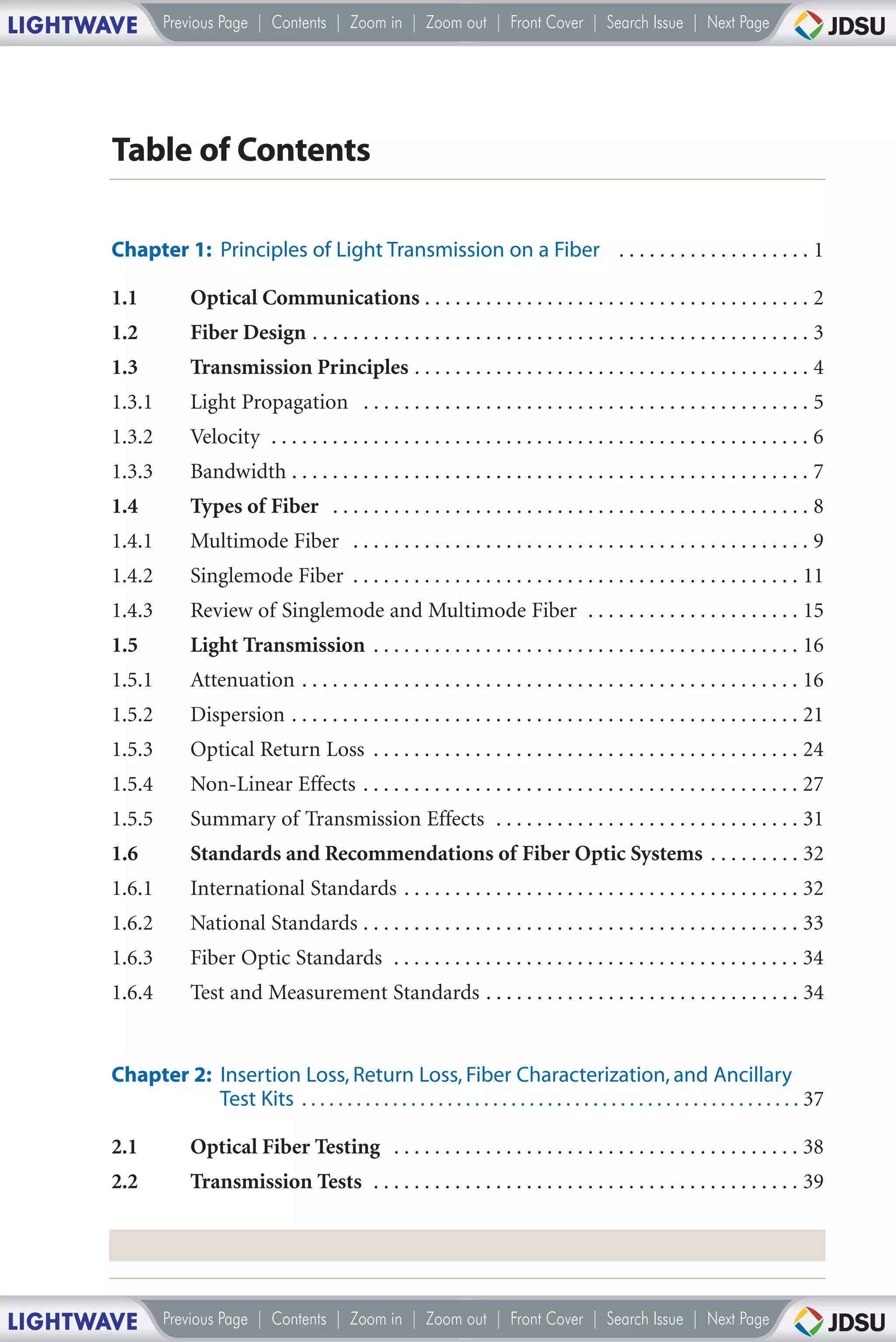
       Table of Contents

       Chapter 1: Principles of Light Transmission on a Fiber . . . . . . . . . . . . . . . . . . . 1

       1.1           Optical Communications . . . . . . . . . . . . . . . . . . . . . . . . . . . . . . . . . . . . . . 2
       1.2           Fiber Design . . . . . . . . . . . . . . . . . . . . . . . . . . . . . . . . . . . . . . . . . . . . . . . . . 3
       1.3           Transmission Principles . . . . . . . . . . . . . . . . . . . . . . . . . . . . . . . . . . . . . . . 4
       1.3.1         Light Propagation . . . . . . . . . . . . . . . . . . . . . . . . . . . . . . . . . . . . . . . . . . . . 5
       1.3.2         Velocity . . . . . . . . . . . . . . . . . . . . . . . . . . . . . . . . . . . . . . . . . . . . . . . . . . . . . 6
       1.3.3         Bandwidth . . . . . . . . . . . . . . . . . . . . . . . . . . . . . . . . . . . . . . . . . . . . . . . . . . . 7
       1.4           Types of Fiber . . . . . . . . . . . . . . . . . . . . . . . . . . . . . . . . . . . . . . . . . . . . . . . 8
       1.4.1         Multimode Fiber . . . . . . . . . . . . . . . . . . . . . . . . . . . . . . . . . . . . . . . . . . . . . 9
       1.4.2         Singlemode Fiber . . . . . . . . . . . . . . . . . . . . . . . . . . . . . . . . . . . . . . . . . . . . 11
       1.4.3         Review of Singlemode and Multimode Fiber . . . . . . . . . . . . . . . . . . . . . 15
       1.5           Light Transmission . . . . . . . . . . . . . . . . . . . . . . . . . . . . . . . . . . . . . . . . . . 16
       1.5.1         Attenuation . . . . . . . . . . . . . . . . . . . . . . . . . . . . . . . . . . . . . . . . . . . . . . . . . 16
       1.5.2         Dispersion . . . . . . . . . . . . . . . . . . . . . . . . . . . . . . . . . . . . . . . . . . . . . . . . . . 21
       1.5.3         Optical Return Loss . . . . . . . . . . . . . . . . . . . . . . . . . . . . . . . . . . . . . . . . . . 24
       1.5.4         Non-Linear Effects . . . . . . . . . . . . . . . . . . . . . . . . . . . . . . . . . . . . . . . . . . . 27
       1.5.5         Summary of Transmission Effects . . . . . . . . . . . . . . . . . . . . . . . . . . . . . . 31
       1.6           Standards and Recommendations of Fiber Optic Systems . . . . . . . . . 32
       1.6.1         International Standards . . . . . . . . . . . . . . . . . . . . . . . . . . . . . . . . . . . . . . . 32
       1.6.2         National Standards . . . . . . . . . . . . . . . . . . . . . . . . . . . . . . . . . . . . . . . . . . . 33
       1.6.3         Fiber Optic Standards . . . . . . . . . . . . . . . . . . . . . . . . . . . . . . . . . . . . . . . . 34
       1.6.4         Test and Measurement Standards . . . . . . . . . . . . . . . . . . . . . . . . . . . . . . . 34


       Chapter 2: Insertion Loss, Return Loss, Fiber Characterization, and Ancillary
                  Test Kits . . . . . . . . . . . . . . . . . . . . . . . . . . . . . . . . . . . . . . . . . . . . . . . . . . . . . . . 37

       2.1           Optical Fiber Testing . . . . . . . . . . . . . . . . . . . . . . . . . . . . . . . . . . . . . . . . 38
       2.2           Transmission Tests . . . . . . . . . . . . . . . . . . . . . . . . . . . . . . . . . . . . . . . . . . 39


LIGHTWAVE       Previous Page | Contents | Zoom in | Zoom out | Front Cover | Search Issue | Next Page


    2.2.1     Measurement Units . . . . . . . . . . . . . . . . . . . . . . . . . . . . . . . . . . . . . . . . . . 39
    2.2.2     Measurement Parameters . . . . . . . . . . . . . . . . . . . . . . . . . . . . . . . . . . . . . 40
    2.2.3     Field Testing . . . . . . . . . . . . . . . . . . . . . . . . . . . . . . . . . . . . . . . . . . . . . . . . 41
    2.3       Optical Tester Families . . . . . . . . . . . . . . . . . . . . . . . . . . . . . . . . . . . . . . . 43
    2.3.1     Light Sources . . . . . . . . . . . . . . . . . . . . . . . . . . . . . . . . . . . . . . . . . . . . . . . . 43
    2.3.2     Power Meters . . . . . . . . . . . . . . . . . . . . . . . . . . . . . . . . . . . . . . . . . . . . . . . 44
    2.3.3     Loss Test Sets . . . . . . . . . . . . . . . . . . . . . . . . . . . . . . . . . . . . . . . . . . . . . . . . 48
    2.3.4     Attenuators . . . . . . . . . . . . . . . . . . . . . . . . . . . . . . . . . . . . . . . . . . . . . . . . . 50
    2.3.5     Optical Loss Budget . . . . . . . . . . . . . . . . . . . . . . . . . . . . . . . . . . . . . . . . . . 50
    2.3.6     Optical Return Loss Meters . . . . . . . . . . . . . . . . . . . . . . . . . . . . . . . . . . . . 53
    2.3.7     Mini-OTDR and Fault Locators . . . . . . . . . . . . . . . . . . . . . . . . . . . . . . . . 56
    2.3.8     Fiber Characterization Testing . . . . . . . . . . . . . . . . . . . . . . . . . . . . . . . . . 57
    2.3.9     Other Test Tools . . . . . . . . . . . . . . . . . . . . . . . . . . . . . . . . . . . . . . . . . . . . . 59
    2.3.10    Monitoring Systems . . . . . . . . . . . . . . . . . . . . . . . . . . . . . . . . . . . . . . . . . . 62


    Chapter 3: Optical Time Domain Reflectometry . . . . . . . . . . . . . . . . . . . . . . . . 65

    3.1       Introduction to OTDR . . . . . . . . . . . . . . . . . . . . . . . . . . . . . . . . . . . . . . . 66
    3.2       Fiber Phenomena . . . . . . . . . . . . . . . . . . . . . . . . . . . . . . . . . . . . . . . . . . . 67
    3.2.1     Rayleigh Scattering and Backscattering . . . . . . . . . . . . . . . . . . . . . . . . . . 67
    3.2.2     Fresnel Reflection and Backreflection . . . . . . . . . . . . . . . . . . . . . . . . . . . 69
    3.3       OTDR Technology . . . . . . . . . . . . . . . . . . . . . . . . . . . . . . . . . . . . . . . . . . . 71
    3.3.1     Emitting Diodes . . . . . . . . . . . . . . . . . . . . . . . . . . . . . . . . . . . . . . . . . . . . . 72
    3.3.2     Using a Pulse Generator with a Laser Diode . . . . . . . . . . . . . . . . . . . . . . 74
    3.3.3     Photodiodes . . . . . . . . . . . . . . . . . . . . . . . . . . . . . . . . . . . . . . . . . . . . . . . . 75
    3.3.4     Time Base and Control Unit . . . . . . . . . . . . . . . . . . . . . . . . . . . . . . . . . . . 76
    3.4       OTDR Specifications . . . . . . . . . . . . . . . . . . . . . . . . . . . . . . . . . . . . . . . . . 78
    3.4.1     Dynamic Range . . . . . . . . . . . . . . . . . . . . . . . . . . . . . . . . . . . . . . . . . . . . . 78


LIGHTWAVE       Previous Page | Contents | Zoom in | Zoom out | Front Cover | Search Issue | Next Page
LIGHTWAVE      Previous Page | Contents | Zoom in | Zoom out | Front Cover | Search Issue | Next Page


       3.4.2      Dead Zone . . . . . . . . . . . . . . . . . . . . . . . . . . . . . . . . . . . . . . . . . . . . . . . . . 81
       3.4.3      Resolution . . . . . . . . . . . . . . . . . . . . . . . . . . . . . . . . . . . . . . . . . . . . . . . . . . 85
       3.4.4      Accuracy . . . . . . . . . . . . . . . . . . . . . . . . . . . . . . . . . . . . . . . . . . . . . . . . . . . 86
       3.4.5      Wavelength . . . . . . . . . . . . . . . . . . . . . . . . . . . . . . . . . . . . . . . . . . . . . . . . . 87


       Chapter 4: Using an Optical Time Domain Reflectometer (OTDR) . . . . . . . . . 89

       4.1        Introduction . . . . . . . . . . . . . . . . . . . . . . . . . . . . . . . . . . . . . . . . . . . . . . . 90
       4.2        Acquisition . . . . . . . . . . . . . . . . . . . . . . . . . . . . . . . . . . . . . . . . . . . . . . . . . 91
       4.2.1      Injection Level . . . . . . . . . . . . . . . . . . . . . . . . . . . . . . . . . . . . . . . . . . . . . . 91
       4.2.2      OTDR Wavelength . . . . . . . . . . . . . . . . . . . . . . . . . . . . . . . . . . . . . . . . . . . 92
       4.2.3      Pulsewidth . . . . . . . . . . . . . . . . . . . . . . . . . . . . . . . . . . . . . . . . . . . . . . . . . 96
       4.2.4      Range . . . . . . . . . . . . . . . . . . . . . . . . . . . . . . . . . . . . . . . . . . . . . . . . . . . . . . 98
       4.2.5      Averaging . . . . . . . . . . . . . . . . . . . . . . . . . . . . . . . . . . . . . . . . . . . . . . . . . . 98
       4.2.6      Fiber Parameters . . . . . . . . . . . . . . . . . . . . . . . . . . . . . . . . . . . . . . . . . . . . 99
       4.3        Measurement . . . . . . . . . . . . . . . . . . . . . . . . . . . . . . . . . . . . . . . . . . . . . . 101
       4.3.1      Event Interpretation . . . . . . . . . . . . . . . . . . . . . . . . . . . . . . . . . . . . . . . . . 101
       4.3.2      OTDR Measurements . . . . . . . . . . . . . . . . . . . . . . . . . . . . . . . . . . . . . . . 103
       4.3.3      Measurement Methods . . . . . . . . . . . . . . . . . . . . . . . . . . . . . . . . . . . . . . 104
       4.3.4      Slope . . . . . . . . . . . . . . . . . . . . . . . . . . . . . . . . . . . . . . . . . . . . . . . . . . . . . 106
       4.3.5      Event Loss . . . . . . . . . . . . . . . . . . . . . . . . . . . . . . . . . . . . . . . . . . . . . . . . . 107
       4.3.6      Reflectance . . . . . . . . . . . . . . . . . . . . . . . . . . . . . . . . . . . . . . . . . . . . . . . . 110
       4.3.7      Optical Return Loss . . . . . . . . . . . . . . . . . . . . . . . . . . . . . . . . . . . . . . . . . 111
       4.4        Measurement Artifacts and Anomalies . . . . . . . . . . . . . . . . . . . . . . . . 114
       4.4.1      Ghosts . . . . . . . . . . . . . . . . . . . . . . . . . . . . . . . . . . . . . . . . . . . . . . . . . . . . 114
       4.4.2      Splice Gain . . . . . . . . . . . . . . . . . . . . . . . . . . . . . . . . . . . . . . . . . . . . . . . . 115
       4.5        Bidirectional Analysis . . . . . . . . . . . . . . . . . . . . . . . . . . . . . . . . . . . . . . 118
       4.5.1      Bidirectional Analysis of a Hypothetical Span . . . . . . . . . . . . . . . . . . . 119


LIGHTWAVE      Previous Page | Contents | Zoom in | Zoom out | Front Cover | Search Issue | Next Page
LIGHTWAVE     Previous Page | Contents | Zoom in | Zoom out | Front Cover | Search Issue | Next Page


    4.6     Getting the Most Out of Your OTDR . . . . . . . . . . . . . . . . . . . . . . . . . . . 122
    4.6.1   Using Launch Cables . . . . . . . . . . . . . . . . . . . . . . . . . . . . . . . . . . . . . . . . . 122
    4.6.2   Verifying Continuity . . . . . . . . . . . . . . . . . . . . . . . . . . . . . . . . . . . . . . . . . 124
    4.6.3   Fault Location . . . . . . . . . . . . . . . . . . . . . . . . . . . . . . . . . . . . . . . . . . . . . . 125
    4.6.4   Effective Refractive Index . . . . . . . . . . . . . . . . . . . . . . . . . . . . . . . . . . . . . 127
    4.6.5   Automating Bidirectional Analysis . . . . . . . . . . . . . . . . . . . . . . . . . . . . . 129
    4.6.6   Loopback Measurement Method . . . . . . . . . . . . . . . . . . . . . . . . . . . . . . . 130
    4.7     OTDR Acceptance Reporting Tool . . . . . . . . . . . . . . . . . . . . . . . . . . . . . 132
    4.7.1   Results Analysis . . . . . . . . . . . . . . . . . . . . . . . . . . . . . . . . . . . . . . . . . . . . . 132
    4.7.2   Results Conditioning . . . . . . . . . . . . . . . . . . . . . . . . . . . . . . . . . . . . . . . . 134
    4.7.3   Report Generation . . . . . . . . . . . . . . . . . . . . . . . . . . . . . . . . . . . . . . . . . . 136
    4.7.4   Document Printout . . . . . . . . . . . . . . . . . . . . . . . . . . . . . . . . . . . . . . . . . . 136


LIGHTWAVE     Previous Page | Contents | Zoom in | Zoom out | Front Cover | Search Issue | Next Page
LIGHTWAVE   Previous Page | Contents | Zoom in | Zoom out | Front Cover | Search Issue | Next Page


       Principles of Light Transmission on a Fiber
                     Chapter 1


LIGHTWAVE   Previous Page | Contents | Zoom in | Zoom out | Front Cover | Search Issue | Next Page


 2


               1.1 Optical Communications
               The principle of an optical communications system is to transmit a
               signal through an optical fiber to a distant receiver. The electrical
               signal is converted into the optical domain at the transmitter and is
               converted back into the original electrical signal at the receiver.
               Fiber optic communication has several advantages over other
               transmission methods, such as copper and radio communication
               systems.
                  • A signal can be sent over long distances (200 km) without the
                    need for regeneration.
                  • The transmission is not sensitive to electromagnetic
                    perturbations. In addition, the fiber does not conduct electricity
                    and is practically insensitive to RF interferences.
                  • Fiber optic systems provide greater capacity than copper or
                    coaxial cable systems.
                  • The fiber optic cable is much lighter and smaller than copper
                    cable. Therefore, fiber optic cables can contain a large number
                    of fibers in a much smaller area. For example, a single fiber
                    cable can consist of 144 fibers.
                  • Optical fiber is reliable, is very flexible, and is not sensitive
                    to vibrations.
                  • Optical fiber is guaranteed for 25 years (compared to a
                    guarantee of 10 years for satellite communications systems).
                  • Operating temperatures for optical fiber varies, but they
                    typically range from -40°C to +80°C.


               There are three main factors that can affect light transmission in an
               optical communication system.
                  1. Attenuation: As the light signal traverses the fiber, it will lose
                  optical power due to absorption, scattering, and other radiation
                  losses. At some point, the power level may become too weak for
                  the receiver to distinguish between the optical signal and the
                  background noise.


LIGHTWAVE   Previous Page | Contents | Zoom in | Zoom out | Front Cover | Search Issue | Next Page


                                                                                                                    3


                        2. Bandwidth: Since the light signal is composed of different
                        frequencies, the fiber will limit the highest and lowest frequencies
                        and will limit the information carrying capacity.
                        3. Dispersion: As the light signal traverses the fiber, the light
                        pulses will spread or broaden and will limit the information
                        carrying capacity at very high bit rates or for transmission over
                        very long distances.


                     1.2        Fiber Design
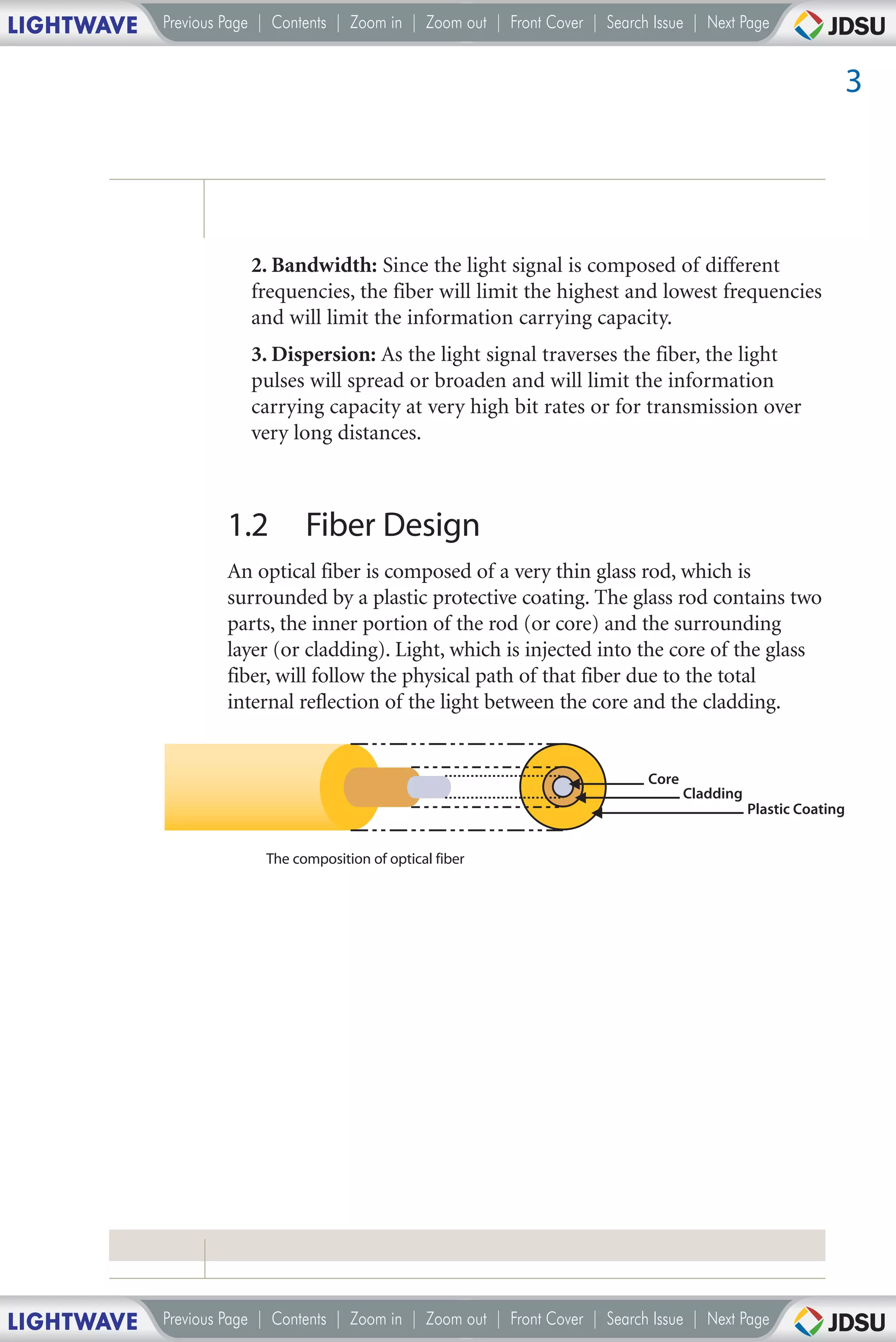
                     An optical fiber is composed of a very thin glass rod, which is
                     surrounded by a plastic protective coating. The glass rod contains two
                     parts, the inner portion of the rod (or core) and the surrounding
                     layer (or cladding). Light, which is injected into the core of the glass
                     fiber, will follow the physical path of that fiber due to the total
                     internal reflection of the light between the core and the cladding.


                                                                                Core
                                                                                       Cladding
                                                                                                  Plastic Coating


                          The composition of optical fiber


LIGHTWAVE   Previous Page | Contents | Zoom in | Zoom out | Front Cover | Search Issue | Next Page


 4


               1.3 Transmission Principles
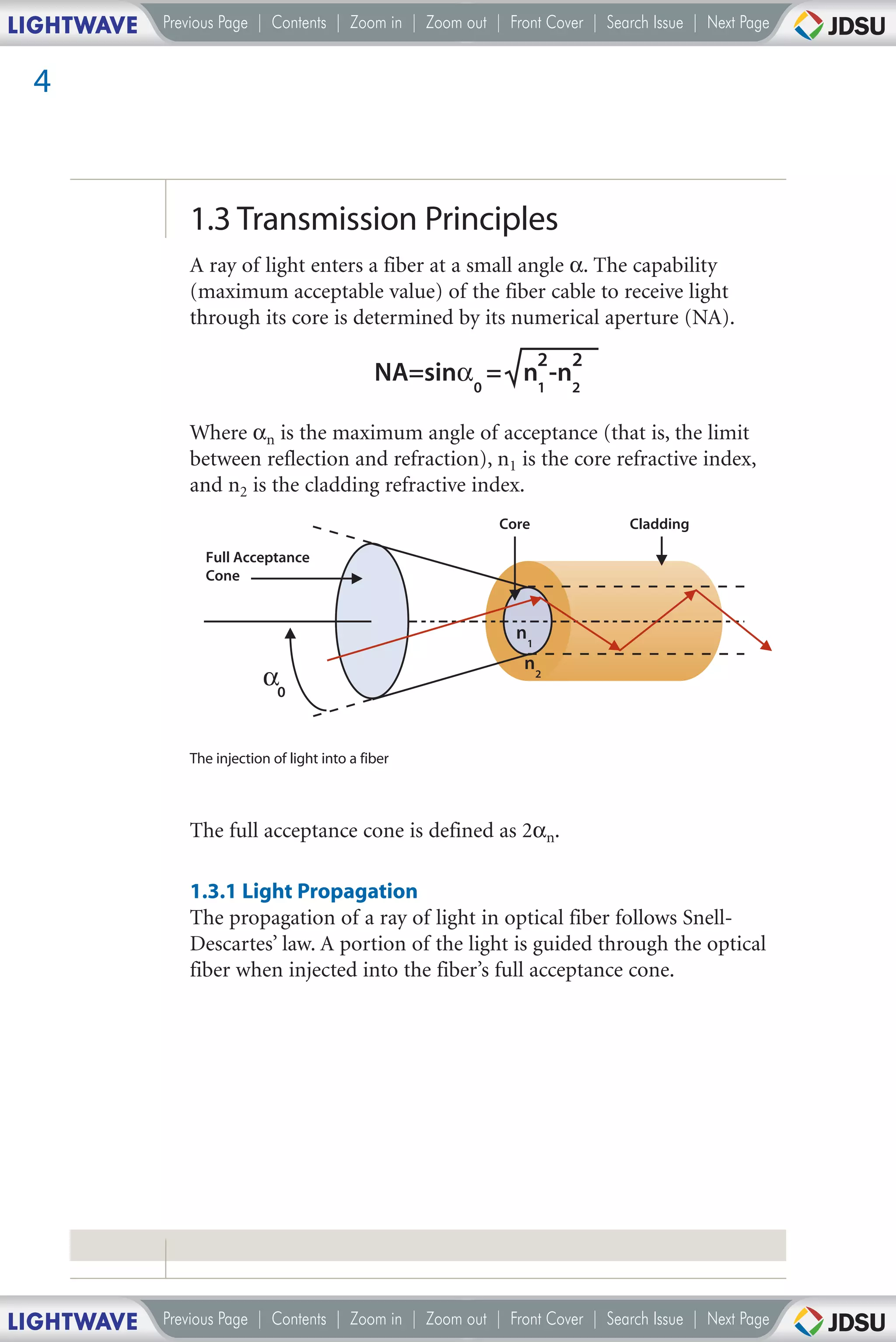
               A ray of light enters a fiber at a small angle α. The capability
               (maximum acceptable value) of the fiber cable to receive light
               through its core is determined by its numerical aperture (NA).
                                                                   2   2
                                               NA=sinα0 = n1 -n2

               Where αn is the maximum angle of acceptance (that is, the limit
               between reflection and refraction), n1 is the core refractive index,
               and n2 is the cladding refractive index.
                                                           Core               Cladding

                  Full Acceptance
                  Cone


                                                              n1
                                                               n2
                           α0

               The injection of light into a fiber


               The full acceptance cone is defined as 2αn.

               1.3.1 Light Propagation
               The propagation of a ray of light in optical fiber follows Snell-
               Descartes’ law. A portion of the light is guided through the optical
               fiber when injected into the fiber’s full acceptance cone.


LIGHTWAVE   Previous Page | Contents | Zoom in | Zoom out | Front Cover | Search Issue | Next Page


                                                                                                     5


                     1.3.1.1 Refraction
                     Refraction is the bending of a ray of light at an interface between
                     two dissimilar transmission media. If α > α0, then the ray is fully
                     refracted and is not captured by the core.
                                                   n1 sin αi = n2 sin αr


                                  α
                                           α0                                                  n2
                                                           αi
                                                                                               n1


                                                                αr

                     Refraction of light


                     1.3.1.2 Reflection
                     Reflection is the abrupt change in direction of a light ray at an
                     interface between two dissimilar transmission media. In this case,
                     the light ray returns to the media from which it originated.
                     If a < α0, then the ray is reflected and remains in the core.
                                                           αi = αr


                                  α
                                           α0                                                  n2
                                                                αi                     αr
                                                                                               n1


                     Reflection of light


LIGHTWAVE   Previous Page | Contents | Zoom in | Zoom out | Front Cover | Search Issue | Next Page


 6


               1.3.1.3 Propagation Principle
               Light rays enter the fiber at different angles and do not follow the
               same paths. Light rays entering the center of the fiber core at a very
               low angle will take a relatively direct path through the center of the
               fiber. Light rays entering the fiber core at a high angle of incidence
               or near the outer edge of the fiber core will take a less direct, longer
               path through the fiber and will traverse the fiber more slowly. Each
               path, resulting from a given angle of incidence and a given entry
               point, will give rise to a mode. As the modes travel along the fiber,
               each of them is attenuated to some degree.


               1.3.2 Velocity
               The velocity at which light travels through a transmission medium
               is determined by the refractive index of the transmission medium.
               The refractive index (n) is a unitless number, which represents the
               ratio of the velocity of light in a vacuum to the velocity of light in
               the transmission medium.

                                                       n= c/v
               Where n is the refractive index of the transmission medium, c is the
               speed of light in a vacuum (2.99792458x10⁸ m/s), and v is the
               speed of light in the transmission medium.
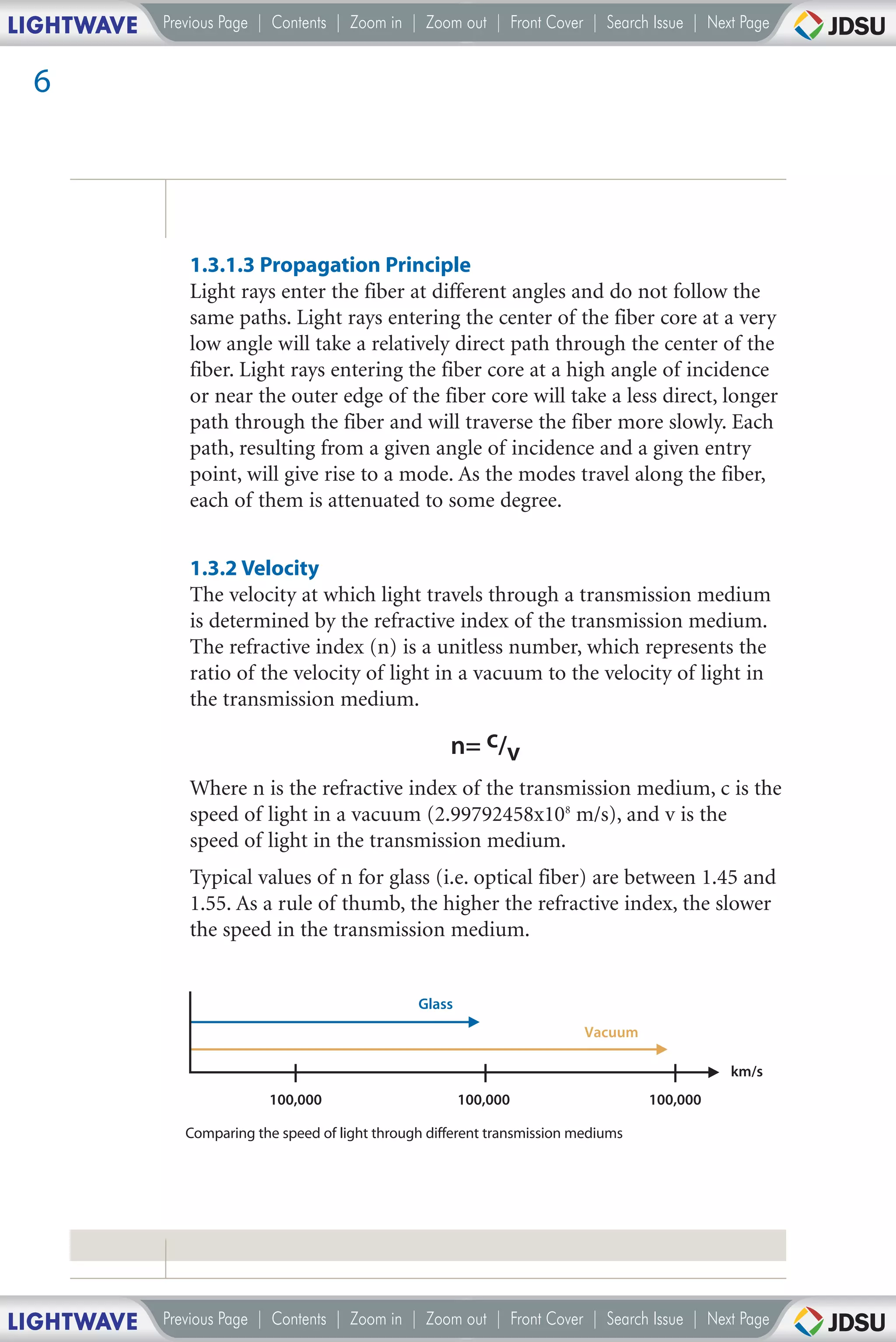
               Typical values of n for glass (i.e. optical fiber) are between 1.45 and
               1.55. As a rule of thumb, the higher the refractive index, the slower
               the speed in the transmission medium.


                                                  Glass
                                                                            Vacuum

                                                                                               km/s
                           100,000                        100,000                    100,000

               Comparing the speed of light through different transmission mediums


LIGHTWAVE   Previous Page | Contents | Zoom in | Zoom out | Front Cover | Search Issue | Next Page


                                                                                                                         7


                     Typical manufacturer’s values for Index of Refraction are:
                     - Corning LEAF
                             n=1.468 @1550 nm
                             n=1.469 @1625 nm
                     - OFS TrueWave Reach
                             n=1.471 @1310 nm
                             n=1.470 @1550 nm

                     1.3.3 Bandwidth
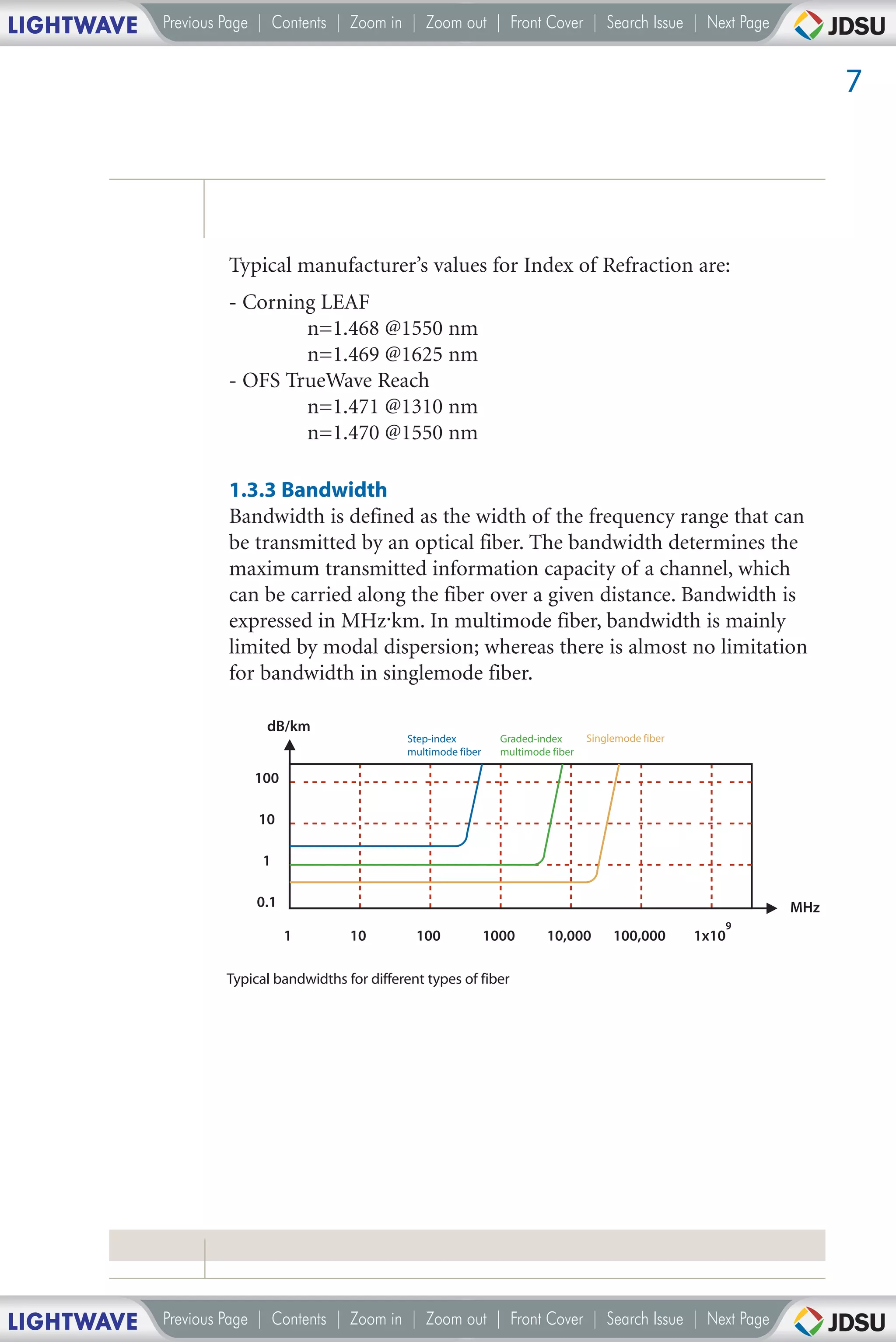
                     Bandwidth is defined as the width of the frequency range that can
                     be transmitted by an optical fiber. The bandwidth determines the
                     maximum transmitted information capacity of a channel, which
                     can be carried along the fiber over a given distance. Bandwidth is
                     expressed in MHz.km. In multimode fiber, bandwidth is mainly
                     limited by modal dispersion; whereas there is almost no limitation
                     for bandwidth in singlemode fiber.

                           dB/km
                                                   Step-index          Graded-index      Singlemode fiber
                                                   multimode fiber     multimode fiber

                         100

                          10

                          1

                          0.1                                                                                      MHz
                                                                                                               9
                                1        10         100              1000       10,000        100,000       1x10

                     Typical bandwidths for different types of fiber


LIGHTWAVE   Previous Page | Contents | Zoom in | Zoom out | Front Cover | Search Issue | Next Page


 8


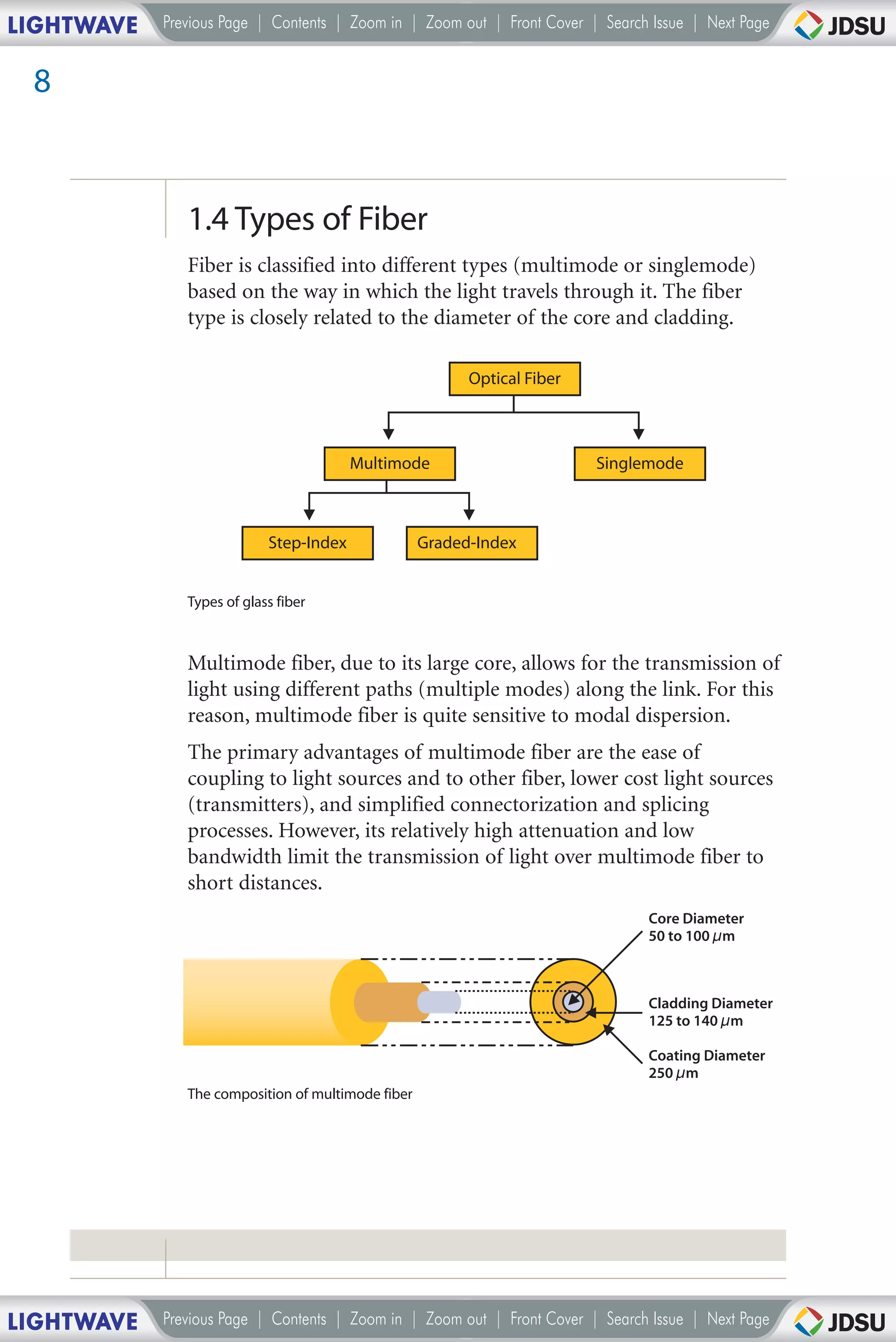
               1.4 Types of Fiber
               Fiber is classified into different types (multimode or singlemode)
               based on the way in which the light travels through it. The fiber
               type is closely related to the diameter of the core and cladding.

                                                          Optical Fiber


                                         Multimode                        Singlemode


                            Step-Index              Graded-Index


               Types of glass fiber


               Multimode fiber, due to its large core, allows for the transmission of
               light using different paths (multiple modes) along the link. For this
               reason, multimode fiber is quite sensitive to modal dispersion.
               The primary advantages of multimode fiber are the ease of
               coupling to light sources and to other fiber, lower cost light sources
               (transmitters), and simplified connectorization and splicing
               processes. However, its relatively high attenuation and low
               bandwidth limit the transmission of light over multimode fiber to
               short distances.
                                                                                Core Diameter
                                                                                50 to 100 µm


                                                                                Cladding Diameter
                                                                                125 to 140 µm

                                                                                Coating Diameter
                                                                                250 µm
               The composition of multimode fiber


LIGHTWAVE   Previous Page | Contents | Zoom in | Zoom out | Front Cover | Search Issue | Next Page


                                                                                                           9


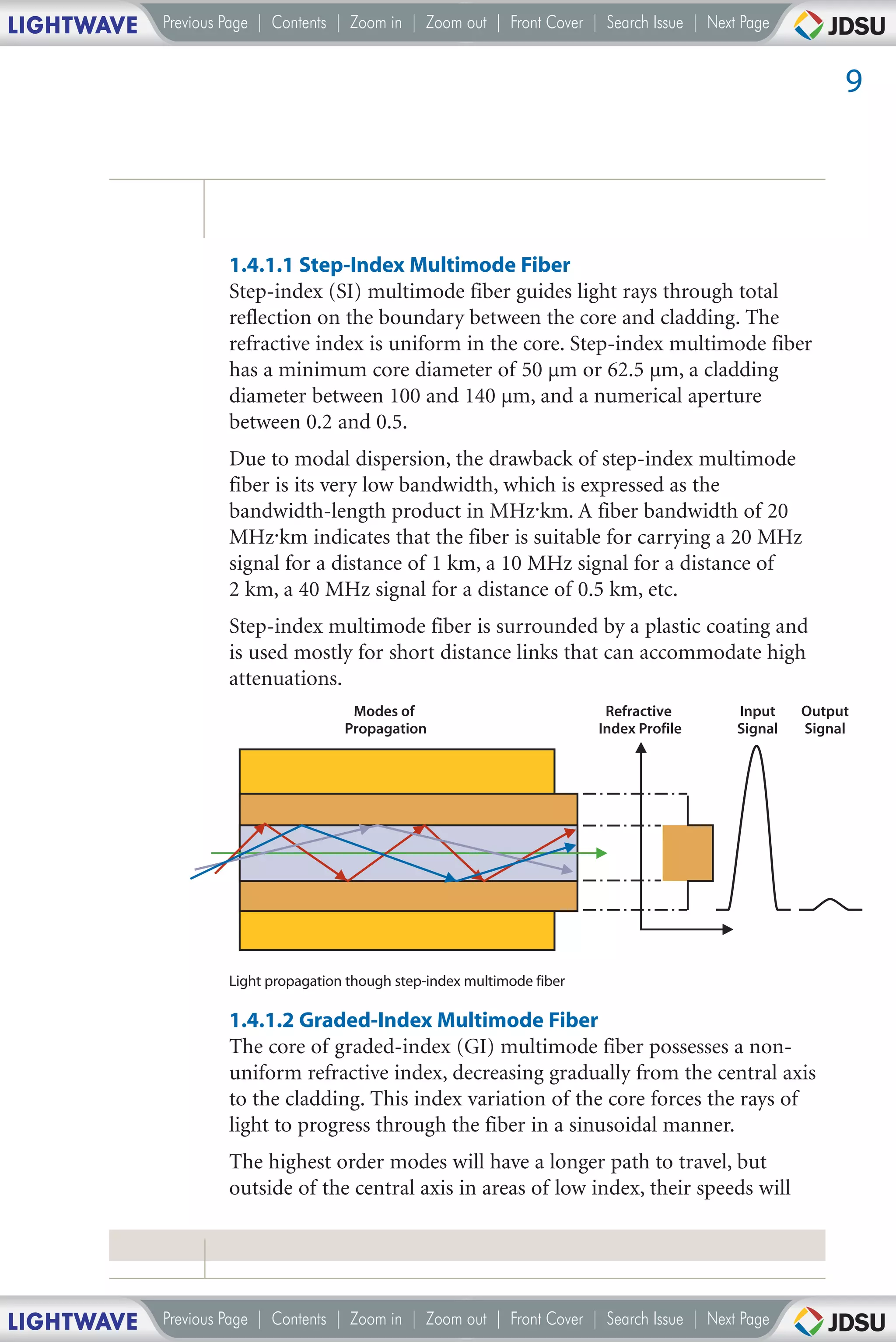
                     1.4.1.1 Step-Index Multimode Fiber
                     Step-index (SI) multimode fiber guides light rays through total
                     reflection on the boundary between the core and cladding. The
                     refractive index is uniform in the core. Step-index multimode fiber
                     has a minimum core diameter of 50 µm or 62.5 µm, a cladding
                     diameter between 100 and 140 µm, and a numerical aperture
                     between 0.2 and 0.5.
                     Due to modal dispersion, the drawback of step-index multimode
                     fiber is its very low bandwidth, which is expressed as the
                     bandwidth-length product in MHz.km. A fiber bandwidth of 20
                     MHz.km indicates that the fiber is suitable for carrying a 20 MHz
                     signal for a distance of 1 km, a 10 MHz signal for a distance of
                     2 km, a 40 MHz signal for a distance of 0.5 km, etc.
                     Step-index multimode fiber is surrounded by a plastic coating and
                     is used mostly for short distance links that can accommodate high
                     attenuations.
                                       Modes of                             Refractive       Input    Output
                                      Propagation                          Index Profile     Signal   Signal


                     Light propagation though step-index multimode fiber

                     1.4.1.2 Graded-Index Multimode Fiber
                     The core of graded-index (GI) multimode fiber possesses a non-
                     uniform refractive index, decreasing gradually from the central axis
                     to the cladding. This index variation of the core forces the rays of
                     light to progress through the fiber in a sinusoidal manner.
                     The highest order modes will have a longer path to travel, but
                     outside of the central axis in areas of low index, their speeds will


LIGHTWAVE   Previous Page | Contents | Zoom in | Zoom out | Front Cover | Search Issue | Next Page


 10


               increase. In addition, the difference in speed between the highest
               order modes and the lowest order modes will be smaller for graded-
               index multimode fiber than for step-index multimode fiber.
                         Modes of                              Refractive         Input    Output
                        Propagation                           Index Profile       Signal   Signal


               Light propagation through graded-index multimode fiber

               Typical attenuations for graded-index multimode fiber:
                  3 dB/km at 850 nm
                  1 dB/km at 1300 nm
               Typical numerical aperture for graded-index multimode fiber: 0.2
               Typical bandwidth-length product for graded-index multimode
               fiber:
                  160 MHz.km at 850 nm
                  500 MHz.km at 1300 nm
               Typical values for the refractive index:
                  1.49 for 62.5 µm at 850 nm
                  1.475 for 50 µm at 850 nm and 1.465 for 50 µm at 1300 nm


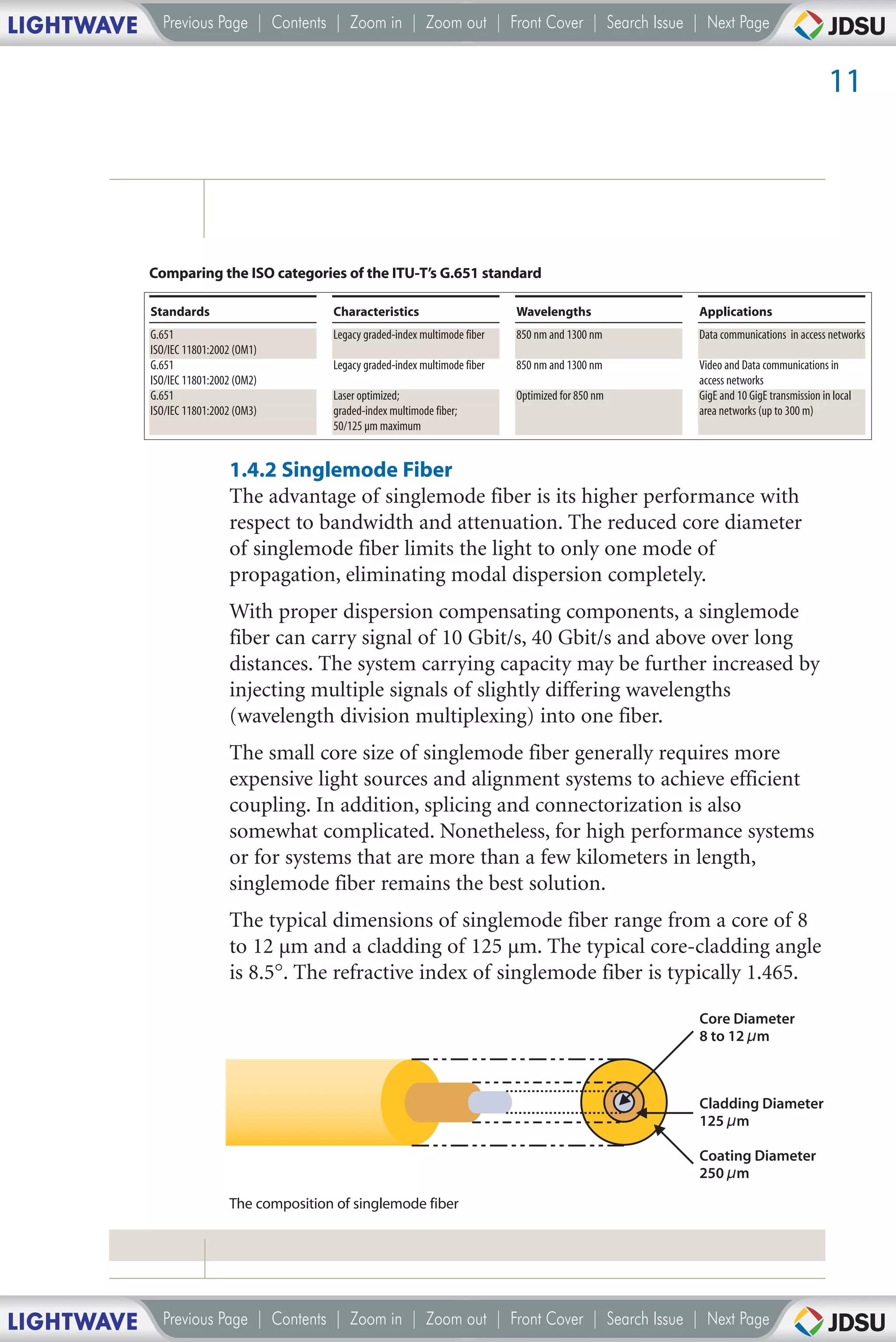
               1.4.1.3 Types of Multimode Fiber
               The ITU-T G.651 standard defines the characteristics of a 50/125
               µm graded-index multimode optical fiber cable. The increased
               demand for bandwidth in multimode applications, including
               Gigabit Ethernet (GigE) and 10 GigE, has resulted in the definition
               of three different ISO categories.


LIGHTWAVE   Previous Page | Contents | Zoom in | Zoom out | Front Cover | Search Issue | Next Page
LIGHTWAVE     Previous Page | Contents | Zoom in | Zoom out | Front Cover | Search Issue | Next Page


                                                                                                                                         11


            Comparing the ISO categories of the ITU-T’s G.651 standard

            Standards                       Characteristics                       Wavelengths            Applications
            G.651                           Legacy graded-index multimode fiber   850 nm and 1300 nm     Data communications in access networks
            ISO/IEC 11801:2002 (OM1)
            G.651                           Legacy graded-index multimode fiber   850 nm and 1300 nm     Video and Data communications in
            ISO/IEC 11801:2002 (OM2)                                                                     access networks
            G.651                           Laser optimized;                      Optimized for 850 nm   GigE and 10 GigE transmission in local
            ISO/IEC 11801:2002 (OM3)        graded-index multimode fiber;                                area networks (up to 300 m)
                                            50/125 µm maximum


                             1.4.2 Singlemode Fiber
                             The advantage of singlemode fiber is its higher performance with
                             respect to bandwidth and attenuation. The reduced core diameter
                             of singlemode fiber limits the light to only one mode of
                             propagation, eliminating modal dispersion completely.
                             With proper dispersion compensating components, a singlemode
                             fiber can carry signal of 10 Gbit/s, 40 Gbit/s and above over long
                             distances. The system carrying capacity may be further increased by
                             injecting multiple signals of slightly differing wavelengths
                             (wavelength division multiplexing) into one fiber.
                             The small core size of singlemode fiber generally requires more
                             expensive light sources and alignment systems to achieve efficient
                             coupling. In addition, splicing and connectorization is also
                             somewhat complicated. Nonetheless, for high performance systems
                             or for systems that are more than a few kilometers in length,
                             singlemode fiber remains the best solution.
                             The typical dimensions of singlemode fiber range from a core of 8
                             to 12 µm and a cladding of 125 µm. The typical core-cladding angle
                             is 8.5°. The refractive index of singlemode fiber is typically 1.465.

                                                                                                         Core Diameter
                                                                                                         8 to 12 µm


                                                                                                         Cladding Diameter
                                                                                                         125 µm

                                                                                                         Coating Diameter
                                                                                                         250 µm
                             The composition of singlemode fiber


LIGHTWAVE     Previous Page | Contents | Zoom in | Zoom out | Front Cover | Search Issue | Next Page
LIGHTWAVE   Previous Page | Contents | Zoom in | Zoom out | Front Cover | Search Issue | Next Page


 12


               Since the small core diameter of singlemode fiber decreases the
               number of propagation modes, only one ray of light propagates
               down the core at a time.


               1.4.2.1 Mode Field Diameter
               The mode field diameter (MFD) of singlemode fiber can be
               expressed as the section of the fiber where the majority of the light
               energy passes.
               The MFD is larger than the physical core diameter. That is, a fiber
               with a physical core of 8 µm can yield a 9.5 µm MFD. This
               phenomenon occurs because some of the light energy also travels
               through the cladding.
                                                                   Light Energy


                           A portion of light travels
                            through the cladding

                                                              MFD


                                           Cladding           Core           Cladding


               The mode field diameter (MFD) of singlemode fiber


               Larger mode field diameters are less sensitive to lateral offset during
               splicing, but they are more sensitive to losses incurred by bending
               during either the installation or cabling processes.


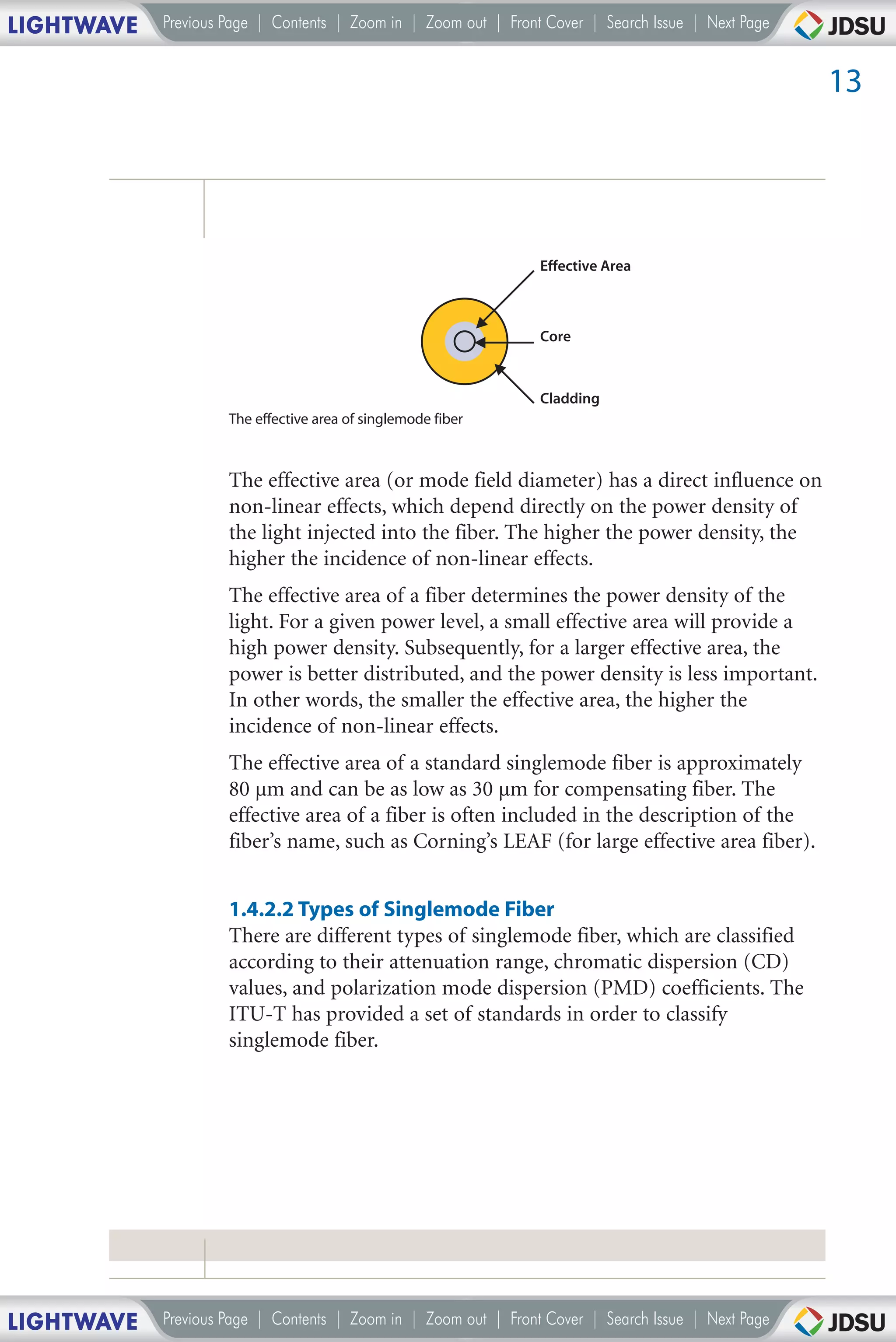
               Effective Area
               Effective area is another term that is used to define the mode field
               diameter. The effective area is the area of the fiber corresponding to
               the mode field diameter.


LIGHTWAVE   Previous Page | Contents | Zoom in | Zoom out | Front Cover | Search Issue | Next Page


                                                                                                     13


                                                                 Effective Area


                                                                 Core


                                                                 Cladding
                     The effective area of singlemode fiber


                     The effective area (or mode field diameter) has a direct influence on
                     non-linear effects, which depend directly on the power density of
                     the light injected into the fiber. The higher the power density, the
                     higher the incidence of non-linear effects.
                     The effective area of a fiber determines the power density of the
                     light. For a given power level, a small effective area will provide a
                     high power density. Subsequently, for a larger effective area, the
                     power is better distributed, and the power density is less important.
                     In other words, the smaller the effective area, the higher the
                     incidence of non-linear effects.
                     The effective area of a standard singlemode fiber is approximately
                     80 µm and can be as low as 30 µm for compensating fiber. The
                     effective area of a fiber is often included in the description of the
                     fiber’s name, such as Corning’s LEAF (for large effective area fiber).


                     1.4.2.2 Types of Singlemode Fiber
                     There are different types of singlemode fiber, which are classified
                     according to their attenuation range, chromatic dispersion (CD)
                     values, and polarization mode dispersion (PMD) coefficients. The
                     ITU-T has provided a set of standards in order to classify
                     singlemode fiber.


LIGHTWAVE   Previous Page | Contents | Zoom in | Zoom out | Front Cover | Search Issue | Next Page
LIGHTWAVE         Previous Page | Contents | Zoom in | Zoom out | Front Cover | Search Issue | Next Page


 14


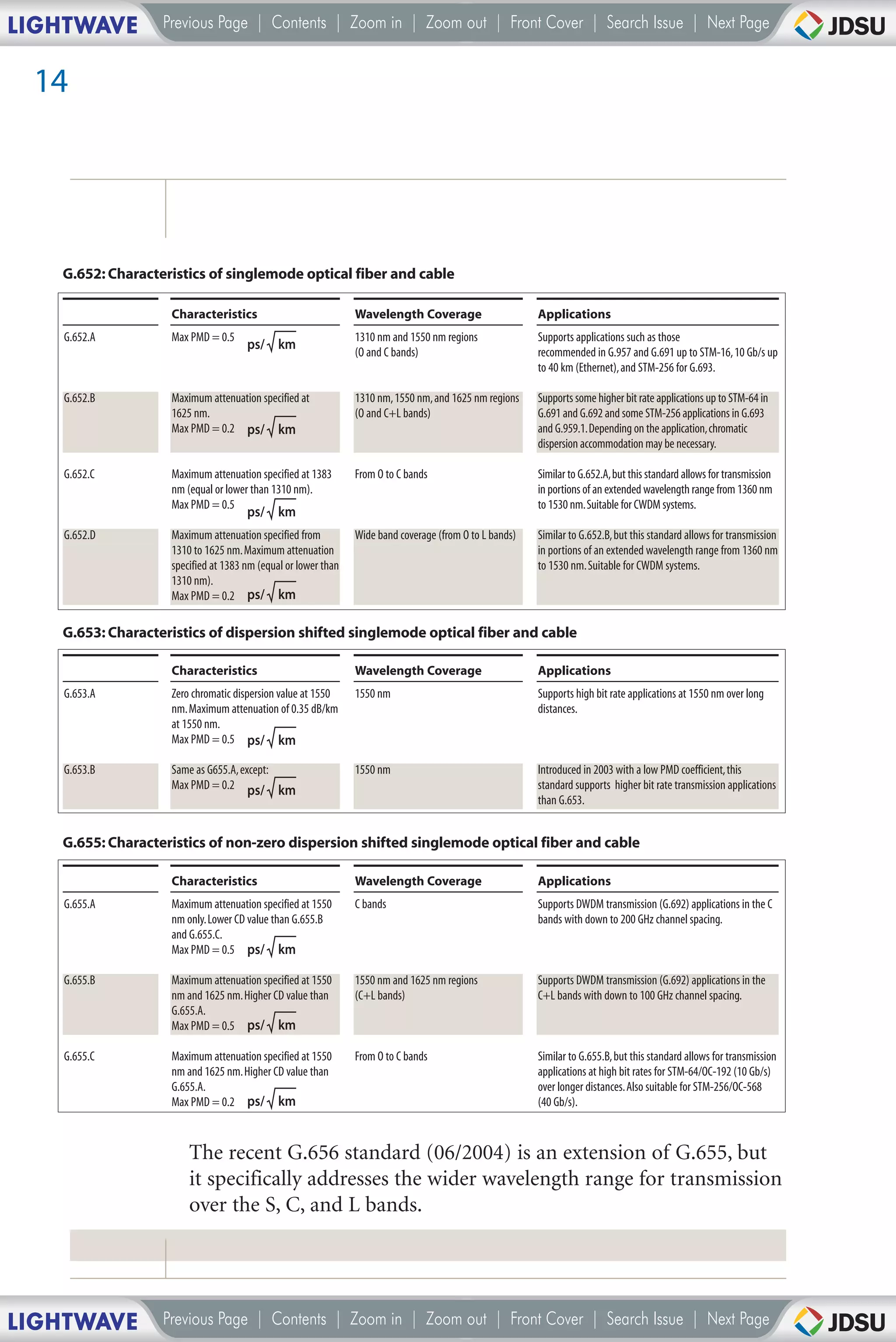
   G.652: Characteristics of singlemode optical fiber and cable

                   Characteristics                             Wavelength Coverage                      Applications
   G.652.A         Max PMD = 0.5                               1310 nm and 1550 nm regions              Supports applications such as those
                                     ps/ km
                                                               (O and C bands)                          recommended in G.957 and G.691 up to STM-16, 10 Gb/s up
                                                                                                        to 40 km (Ethernet), and STM-256 for G.693.

   G.652.B         Maximum attenuation specified at            1310 nm, 1550 nm, and 1625 nm regions    Supports some higher bit rate applications up to STM-64 in
                   1625 nm.                                    (O and C+L bands)                        G.691 and G.692 and some STM-256 applications in G.693
                   Max PMD = 0.2 ps/ km                                                                 and G.959.1.Depending on the application,chromatic
                                                                                                        dispersion accommodation may be necessary.

   G.652.C         Maximum attenuation specified at 1383       From O to C bands                        Similar to G.652.A,but this standard allows for transmission
                   nm (equal or lower than 1310 nm).                                                    in portions of an extended wavelength range from 1360 nm
                   Max PMD = 0.5                                                                        to 1530 nm.Suitable for CWDM systems.
                                     ps/ km
   G.652.D         Maximum attenuation specified from          Wide band coverage (from O to L bands)   Similar to G.652.B, but this standard allows for transmission
                   1310 to 1625 nm. Maximum attenuation                                                 in portions of an extended wavelength range from 1360 nm
                   specified at 1383 nm (equal or lower than                                            to 1530 nm. Suitable for CWDM systems.
                   1310 nm).
                   Max PMD = 0.2 ps/ km

   G.653: Characteristics of dispersion shifted singlemode optical fiber and cable

                   Characteristics                             Wavelength Coverage                      Applications
   G.653.A         Zero chromatic dispersion value at 1550     1550 nm                                  Supports high bit rate applications at 1550 nm over long
                   nm. Maximum attenuation of 0.35 dB/km                                                distances.
                   at 1550 nm.
                   Max PMD = 0.5 ps/ km

   G.653.B         Same as G655.A, except:                     1550 nm                                  Introduced in 2003 with a low PMD coefficient, this
                   Max PMD = 0.2 ps/ km                                                                 standard supports higher bit rate transmission applications
                                                                                                        than G.653.


   G.655: Characteristics of non-zero dispersion shifted singlemode optical fiber and cable

                   Characteristics                             Wavelength Coverage                      Applications
   G.655.A         Maximum attenuation specified at 1550       C bands                                  Supports DWDM transmission (G.692) applications in the C
                   nm only.Lower CD value than G.655.B                                                  bands with down to 200 GHz channel spacing.
                   and G.655.C.
                   Max PMD = 0.5 ps/ km

   G.655.B         Maximum attenuation specified at 1550       1550 nm and 1625 nm regions              Supports DWDM transmission (G.692) applications in the
                   nm and 1625 nm. Higher CD value than        (C+L bands)                              C+L bands with down to 100 GHz channel spacing.
                   G.655.A.
                   Max PMD = 0.5 ps/ km

   G.655.C         Maximum attenuation specified at 1550       From O to C bands                        Similar to G.655.B, but this standard allows for transmission
                   nm and 1625 nm. Higher CD value than                                                 applications at high bit rates for STM-64/OC-192 (10 Gb/s)
                   G.655.A.                                                                             over longer distances.Also suitable for STM-256/OC-568
                   Max PMD = 0.2 ps/ km                                                                 (40 Gb/s).


                       The recent G.656 standard (06/2004) is an extension of G.655, but
                       it specifically addresses the wider wavelength range for transmission
                       over the S, C, and L bands.


LIGHTWAVE         Previous Page | Contents | Zoom in | Zoom out | Front Cover | Search Issue | Next Page
LIGHTWAVE          Previous Page | Contents | Zoom in | Zoom out | Front Cover | Search Issue | Next Page


                                                                                                                                                                                          15


      G.656: Characteristics of non-zero dispersion shifted fiber for wideband transport

                                  Characteristics                              Wavelength Coverage                          Applications
       G.656                      Maximum attenuation specified at 1460        S, C, and L bands                            Supports both CWDM and DWDM systems throughout the
                                  nm, 1550 nm, and 1625 nm . Minimum CD                                                     wavelength range of 1460 nm and 1625 nm.
                                  value of 2 ps/nm.km between 1460 nm
                                  and 1625 nm.
                                  Max PMD = 0.2 ps/ km


                                    There are other types of fiber, such as polarization maintaining
                                    singlemode fiber and plastic fiber, which are outside the scope of
                                    this document.


                                    1.4.3 Review of Singlemode and Multimode Fiber
                                    The table below provides a quick comparison between multimode
                                    and singlemode fiber.

      Review of singlemode and multimode fiber

                                      Multimode                                                                     Singlemode
       Cost of fiber                  Expensive                                                                     Less expensive
       Transmission equipment         Basic and low cost (LED)                                                      More expensive (laser diode)
       Attenuation                    High                                                                          Low
       Transmission wavelengths       850 nm to 1300 nm                                                             1260 nm to 1640 nm
       Use                            Larger core, easier to handle                                                 Connections more complex
       Distances                      Local networks (<2 km)                                                        Access/medium/long haul networks (>200 km)
       Bandwidth                      Limited bandwidth (10 Gb/s over short distances)                              Nearly infinite bandwidth (>1 Tb/s for DWDM)
       Conclusion                     The fiber is more costly, but network deployment is relatively inexpensive.   Provides higher performance, but building the network is expensive.


LIGHTWAVE          Previous Page | Contents | Zoom in | Zoom out | Front Cover | Search Issue | Next Page
LIGHTWAVE   Previous Page | Contents | Zoom in | Zoom out | Front Cover | Search Issue | Next Page


 16


               1.5 Light Transmission
               Light transmission in optical fiber uses three basic elements: a
               transmitter, a receiver, and a transmission medium by which the
               signal is passed from one to the other. The use of optical fiber
               introduces attenuation and dispersion into the system. Attenuation
               tends to increase the power requirements of the transmitter in
               order to meet the power requirements of the receiver. Dispersion,
               on the other hand, limits the bandwidth of the data that can be
               transmitted over the fiber.


               1.5.1 Attenuation
               As the light signal traverses the fiber, it decreases in power level. The
               decrease in power level is expressed in dB or as a rate of loss per
               unit distance (dB/km)


               1.5.1.1 Fiber Spectral Attenuation
               The two main loss mechanisms of light transmission in optical fiber
               are light absorption and scattering.
               Light Absorption
               Light is absorbed in the fiber material as its energy is converted to
               heat due to molecular resonance and wavelength impurities. For
               example, hydrogen and hydroxide resonance occurs at
               approximately 1244 nm and 1383 nm.
               Rayleigh Scattering
               Scattering, primarily Rayleigh scattering, also contributes to
               attenuation. Scattering causes dispersion of the the light energy in
               all directions, with some of the light escaping the fiber core. A small
               portion of this light energy is returned down the core and is termed
               backscattering.
               Forward light scattering (Raman scattering) and backward light
               scattering (Brillouin scattering) are two additional scattering
               phenomena that can occur in optical materials under high power
               conditions.


LIGHTWAVE   Previous Page | Contents | Zoom in | Zoom out | Front Cover | Search Issue | Next Page


                                                                                                                    17


                                                                                             Transmitted Light


                                                                                             Scattered Light


                                                                                             Backscattered Light


                      Backscattering effects of light transmission


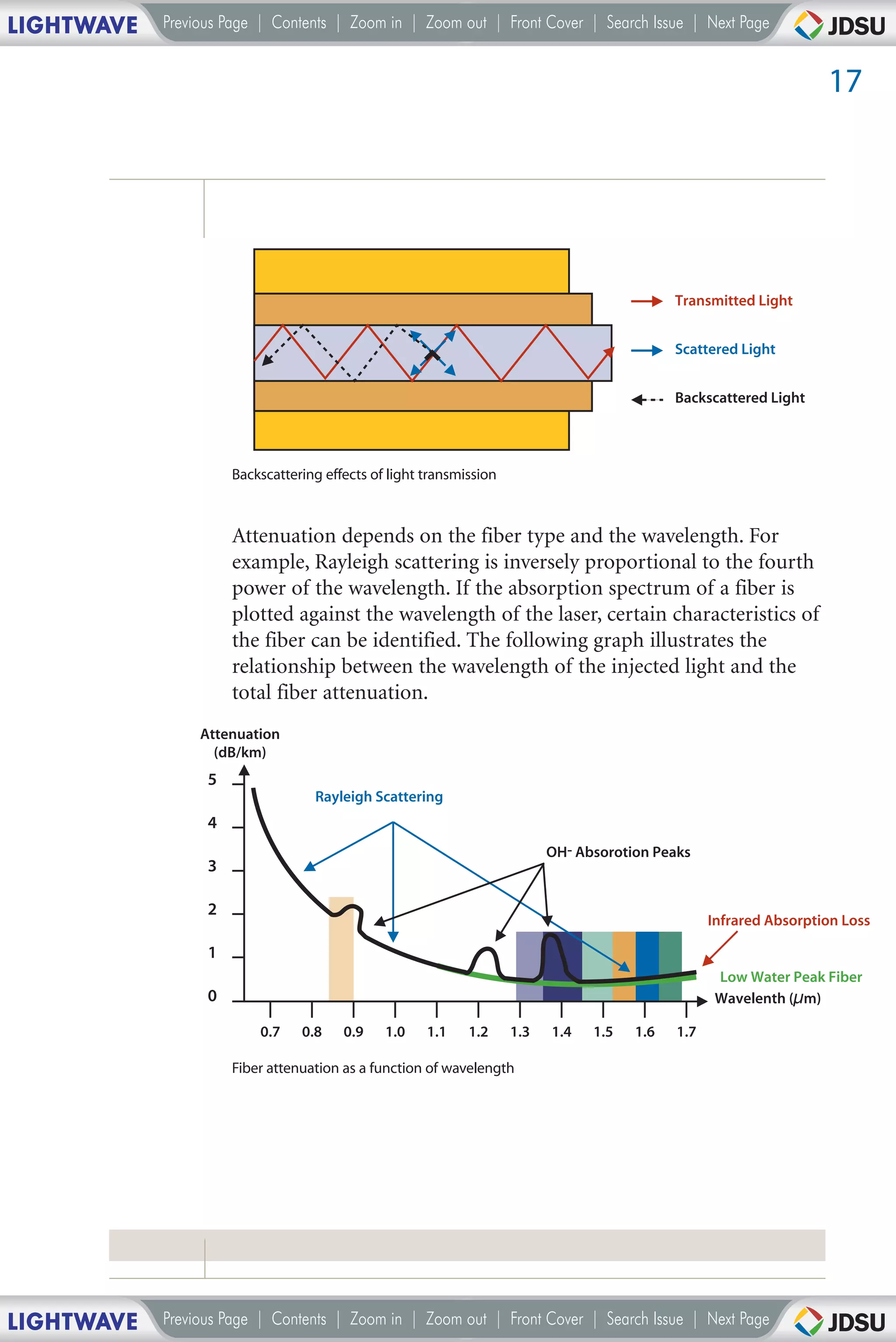
                      Attenuation depends on the fiber type and the wavelength. For
                      example, Rayleigh scattering is inversely proportional to the fourth
                      power of the wavelength. If the absorption spectrum of a fiber is
                      plotted against the wavelength of the laser, certain characteristics of
                      the fiber can be identified. The following graph illustrates the
                      relationship between the wavelength of the injected light and the
                      total fiber attenuation.
                 Attenuation
                   (dB/km)
                  5
                                   Rayleigh Scattering
                  4
                                                                           OH- Absorotion Peaks
                  3

                  2
                                                                                                   Infrared Absorption Loss

                  1
                                                                                                    Low Water Peak Fiber
                  0                                                                                 Wavelenth (µm)

                          0.7    0.8    0.9    1.0    1.1    1.2     1.3   1.4   1.5   1.6   1.7

                      Fiber attenuation as a function of wavelength


LIGHTWAVE   Previous Page | Contents | Zoom in | Zoom out | Front Cover | Search Issue | Next Page


 18


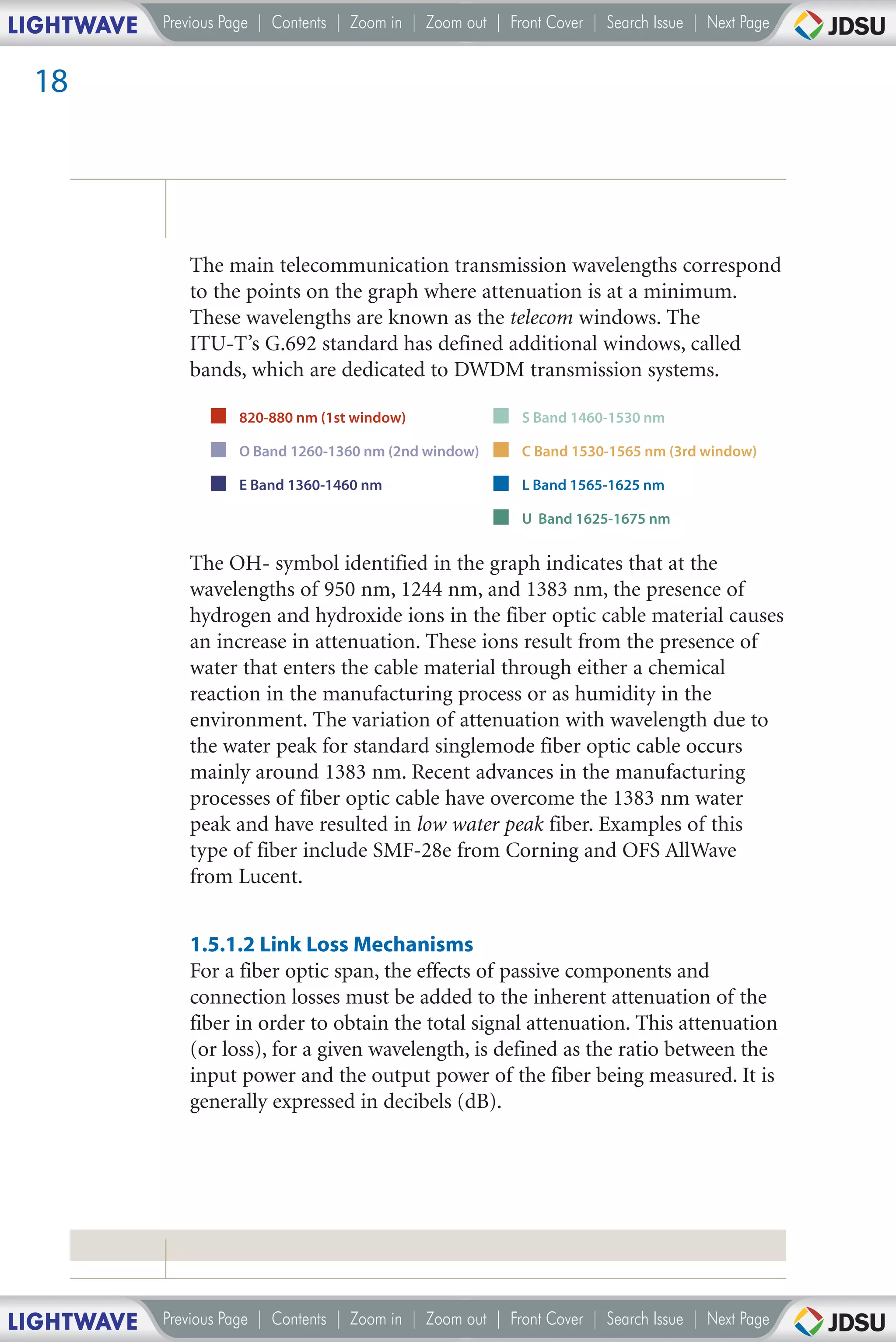
               The main telecommunication transmission wavelengths correspond
               to the points on the graph where attenuation is at a minimum.
               These wavelengths are known as the telecom windows. The
               ITU-T’s G.692 standard has defined additional windows, called
               bands, which are dedicated to DWDM transmission systems.

                      820-880 nm (1st window)                 S Band 1460-1530 nm

                      O Band 1260-1360 nm (2nd window)        C Band 1530-1565 nm (3rd window)

                      E Band 1360-1460 nm                     L Band 1565-1625 nm

                                                              U Band 1625-1675 nm


               The OH- symbol identified in the graph indicates that at the
               wavelengths of 950 nm, 1244 nm, and 1383 nm, the presence of
               hydrogen and hydroxide ions in the fiber optic cable material causes
               an increase in attenuation. These ions result from the presence of
               water that enters the cable material through either a chemical
               reaction in the manufacturing process or as humidity in the
               environment. The variation of attenuation with wavelength due to
               the water peak for standard singlemode fiber optic cable occurs
               mainly around 1383 nm. Recent advances in the manufacturing
               processes of fiber optic cable have overcome the 1383 nm water
               peak and have resulted in low water peak fiber. Examples of this
               type of fiber include SMF-28e from Corning and OFS AllWave
               from Lucent.


               1.5.1.2 Link Loss Mechanisms
               For a fiber optic span, the effects of passive components and
               connection losses must be added to the inherent attenuation of the
               fiber in order to obtain the total signal attenuation. This attenuation
               (or loss), for a given wavelength, is defined as the ratio between the
               input power and the output power of the fiber being measured. It is
               generally expressed in decibels (dB).


LIGHTWAVE   Previous Page | Contents | Zoom in | Zoom out | Front Cover | Search Issue | Next Page


                                                                                                              19


                                                                                      Coupling        Junction
                                                                                        Loss            Loss
                                     Impurities


              Input                                                                                  Output


                        Absorption
            Injection      Loss
              Loss                                                                Macro
                                 Scattering                                         or
                                    Loss       Heterogeneous                      Micro
                                                 Structures                      Bending
                                                 Scattering                        Loss
                                                    Loss

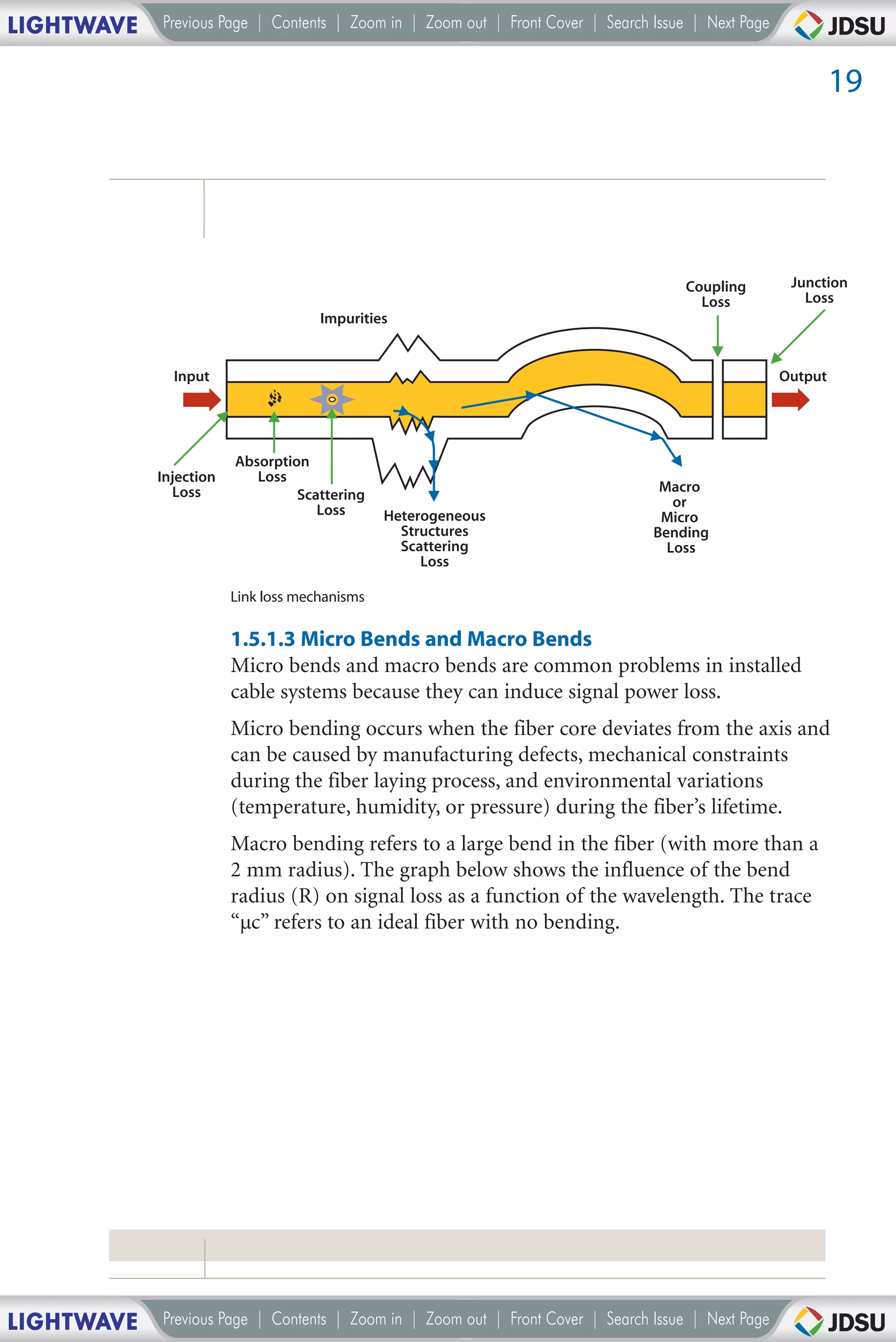
                        Link loss mechanisms

                        1.5.1.3 Micro Bends and Macro Bends
                        Micro bends and macro bends are common problems in installed
                        cable systems because they can induce signal power loss.
                        Micro bending occurs when the fiber core deviates from the axis and
                        can be caused by manufacturing defects, mechanical constraints
                        during the fiber laying process, and environmental variations
                        (temperature, humidity, or pressure) during the fiber’s lifetime.
                        Macro bending refers to a large bend in the fiber (with more than a
                        2 mm radius). The graph below shows the influence of the bend
                        radius (R) on signal loss as a function of the wavelength. The trace
                        “µc” refers to an ideal fiber with no bending.


LIGHTWAVE   Previous Page | Contents | Zoom in | Zoom out | Front Cover | Search Issue | Next Page


 20


                        Loss
                        (dB)


                   2                                                                                  R= 20 mm
                  1.8
                  1.6                                                                                 R= 25 mm
                  1.4
                                                                                                      µc
                  1.2
                   1
                  0.8
                  0.6
                  0.4
                  0.2
                   0                                                                      Wavelenth (µm)

                         1.2     1.3           1.4           1.5             1.6

               The effects of macro bending on a fiber


               For example, the signal loss for a fiber that has a 25 mm macro
               bend radius will be 2 dB at 1625 nm, but only 0.4 dB at 1550 nm.
               Another way of calculating the signal loss is to add the typical fiber
               attenuation coefficient (according to the specific wavelength as
               indicated below) to the bending loss.
                        dB/km


                                         Micro Bending
                   3

                                        Macro Bending                                           Unbent Fiber
                   2


                   1


                   0                                                                      Wavelenth (nm)

                                1100   1200     1300     1400      1500     1600   1700

               Typical attenuation coefficients for bent and unbent fiber


LIGHTWAVE   Previous Page | Contents | Zoom in | Zoom out | Front Cover | Search Issue | Next Page


                                                                                                     21


                        As shown in the above graph, if the L band (1565-1625 nm) or the
                        U band (1625-1675 nm) are utilized, then loss testing is necessary at
                        transmission wavelengths up to the upper limit of the band. For
                        this reason, new test equipment has been developed with 1625 nm
                        testing capabilities. Since the most important fiber parameters for
                        network installation are splice loss, link loss, and optical return loss
                        (ORL), it is necessary to acquire and use the appropriate test
                        equipment.


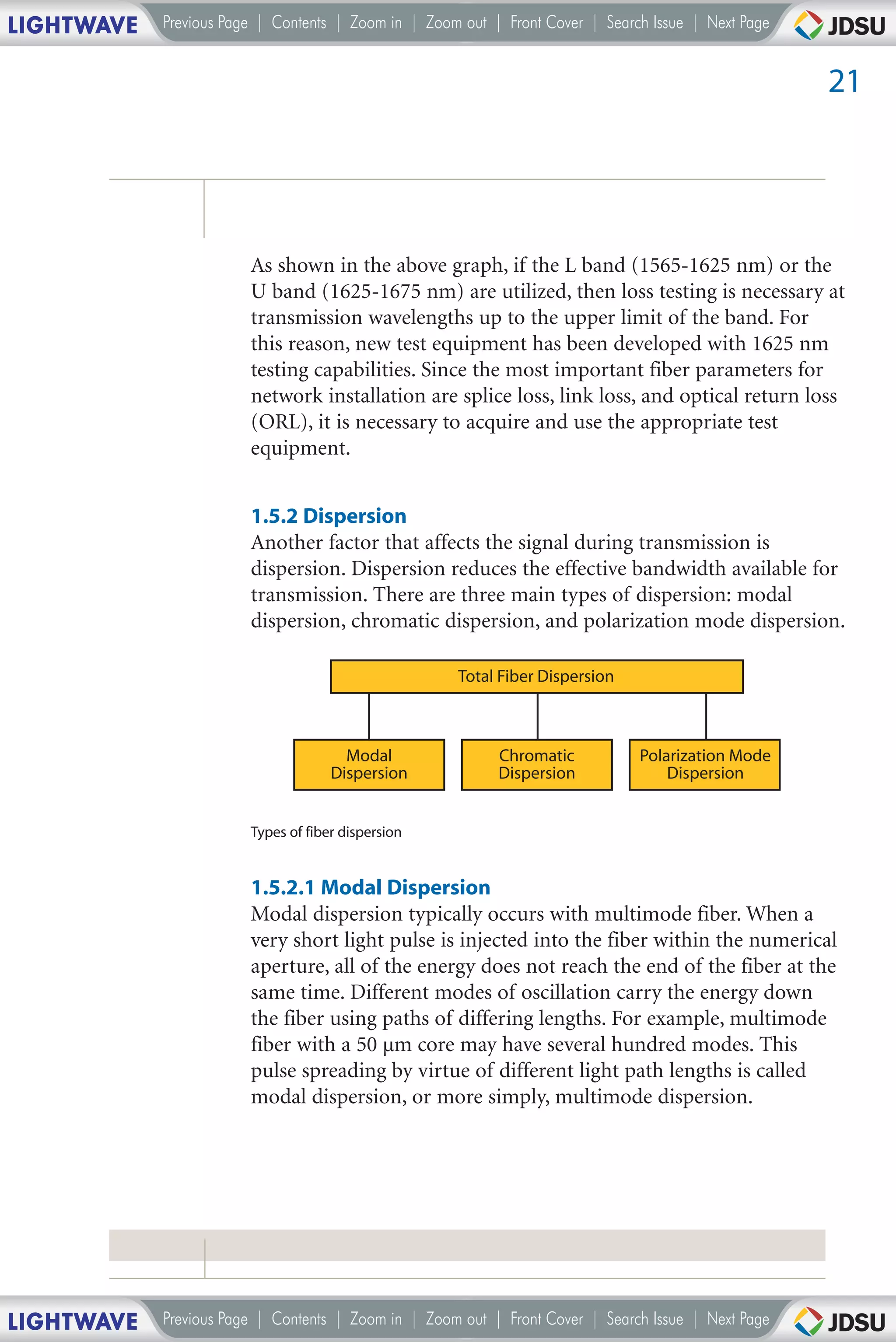
                        1.5.2 Dispersion
                        Another factor that affects the signal during transmission is
                        dispersion. Dispersion reduces the effective bandwidth available for
                        transmission. There are three main types of dispersion: modal
                        dispersion, chromatic dispersion, and polarization mode dispersion.

                                                     Total Fiber Dispersion


                                       Modal               Chromatic           Polarization Mode
                                     Dispersion            Dispersion              Dispersion


                        Types of fiber dispersion


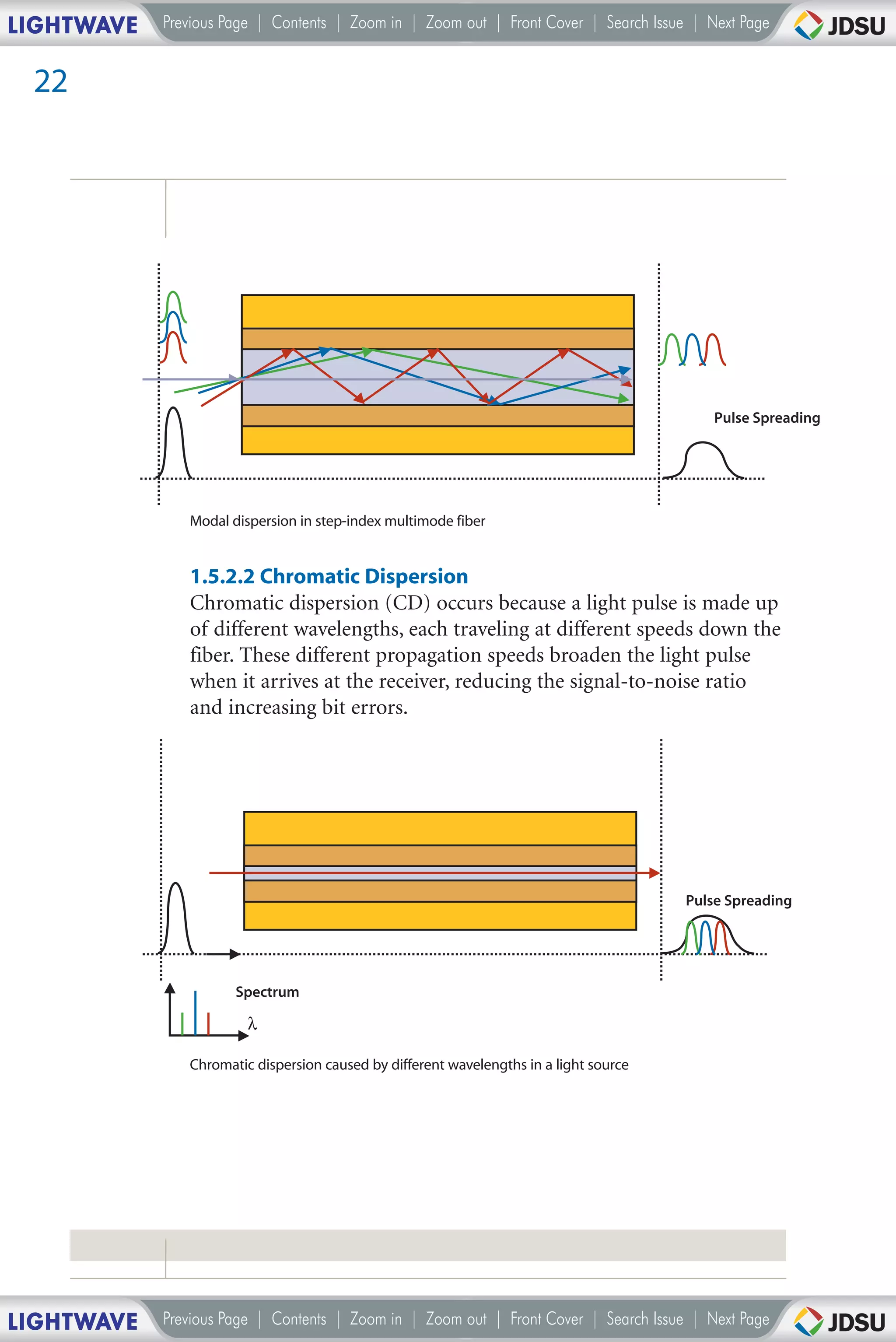
                        1.5.2.1 Modal Dispersion
                        Modal dispersion typically occurs with multimode fiber. When a
                        very short light pulse is injected into the fiber within the numerical
                        aperture, all of the energy does not reach the end of the fiber at the
                        same time. Different modes of oscillation carry the energy down
                        the fiber using paths of differing lengths. For example, multimode
                        fiber with a 50 µm core may have several hundred modes. This
                        pulse spreading by virtue of different light path lengths is called
                        modal dispersion, or more simply, multimode dispersion.


LIGHTWAVE   Previous Page | Contents | Zoom in | Zoom out | Front Cover | Search Issue | Next Page


 22


                                                                                            Pulse Spreading


               Modal dispersion in step-index multimode fiber


               1.5.2.2 Chromatic Dispersion
               Chromatic dispersion (CD) occurs because a light pulse is made up
               of different wavelengths, each traveling at different speeds down the
               fiber. These different propagation speeds broaden the light pulse
               when it arrives at the receiver, reducing the signal-to-noise ratio
               and increasing bit errors.


                                                                                        Pulse Spreading


                      Spectrum

                        λ

               Chromatic dispersion caused by different wavelengths in a light source


LIGHTWAVE   Previous Page | Contents | Zoom in | Zoom out | Front Cover | Search Issue | Next Page


                                                                                                     23


                     Chromatic dispersion is defined by three principal parameters:
                         1. Delay at a given wavelength expressed in ps.
                         2. The coefficient of dispersion (D) expressed in ps/nm. This
                         corresponds to the drift in delay as a function of wavelength
                         (or to the slope of the curve representing delay as a function of
                         distance at a given wavelength). It is expressed in ps/(nm . km)
                         if it is standardized to one kilometer.
                         3. The slope (S) expressed in ps/(nm2 . km). This corresponds to
                         the drift in the coefficient of dispersion as a function of
                         wavelength (or to the slope of the curve representing dispersion
                         as a function of distance at a given wavelength).
                     Both the coefficient of dispersion (standardized to one kilometer)
                     and the slope are dependent on the length of the fiber.
                     Chromatic dispersion primarily depends on the manufacturing
                     process. Cable manufacturers take into account the effects of CD
                     when designing different types of fiber for different applications
                     and different needs, such as standard fiber, dispersion shifted fiber,
                     or non-zero dispersion shifted fiber.


                     1.5.2.3 Polarization Mode Dispersion
                     Polarization mode dispersion (PMD) is a basic property of
                     singlemode fiber. It affects the magnitude of the transmission rate.
                     PMD results from the difference in propagation speeds of the
                     energy of a given wavelength, which is split into two polarization
                     axes that are at right angles to each other (as shown in the diagram
                     below). The main causes of PMD are non-circularities of the fiber
                     design and externally applied stresses on the fiber (macro bending,
                     micro bending, twisting, and temperature variations).


LIGHTWAVE   Previous Page | Contents | Zoom in | Zoom out | Front Cover | Search Issue | Next Page


 24


                         V1


                                                                                               DGD


                         V2


               Polarization mode dispersion (or differential group delay) effects on a fiber


               The PMD is also referred to as the mean value of all differential
               group delays (DGD) and is expressed in picoseconds (ps). It can
               also be stated as the PMD coefficient, which is related to the square
               root of the distance and is expressed in ps/ km.
               The PMD (mean DGD) causes the transmission pulse to broaden
               when it is transmitted along the fiber. This phenomenon generates
               distortion, increasing the bit error rate (BER) of the optical system.
               The consequence of PMD is that it limits the transmission bit rate
               on a link. Therefore, it is important to know the PMD value of the
               fiber in order to calculate the bit rate limits of the fiber optic link.


               1.5.3 Optical Return Loss

               1.5.3.1 Definition
               Optical return loss (ORL) represents the total accumulated light
               power reflected back to the source from the complete optical span.
               This includes the backscattering light from the fiber itself, as well as
               the reflected light from all of the joints and terminations.
               ORL is expressed in decibels (dB) and is defined as the logarithmic
               ratio of the incident power to the reflected power at the fiber origin.

                                                                  Pe
                                          ORL=10Log                           (≥0)
                                                                  Pr
               Where Pe is the emitted power and Pr the reflected power, expressed
               in Watt (W)


LIGHTWAVE   Previous Page | Contents | Zoom in | Zoom out | Front Cover | Search Issue | Next Page


                                                                                                     25


                     A high level of ORL will decrease the performance of some
                     transmission systems. For example, high backreflection can
                     dramatically affect the quality of an analog video signal, resulting
                     in the degradation of the video image quality.
                     The higher the ORL value, the lower the reflected power; and
                     subsequently, the smaller the effect of the reflection. Therefore, an
                     ORL value of 40 dB is more desirable than an ORL value of 30 dB. It
                     is important to note that ORL is expressed as a positive decibel value
                     whereas the reflectance of a connector is expressed as negative value.


                     1.5.3.2 The Distance or Attenuation Effect
                     The total ORL value is affected by both the reflectance value of the
                     event as well as its distance from the transmitter terminal.
                     As the length of the fiber increases, the amount of total
                     backscattered light by the fiber also increases, and the fiber end
                     reflection decreases. Therefore, for a short fiber link without
                     intermediate reflective events, fiber end reflection is the
                     predominate contribution to the total ORL since the amount of
                     reflected light is not highly attenuated by the fiber.
                     On the other hand, end reflection of a long fiber length or a highly
                     attenuated link is attenuated by absorption and scatter effects. In
                     this case, the backscattered light becomes the major contribution to
                     the total ORL, limiting the effect of end reflection.
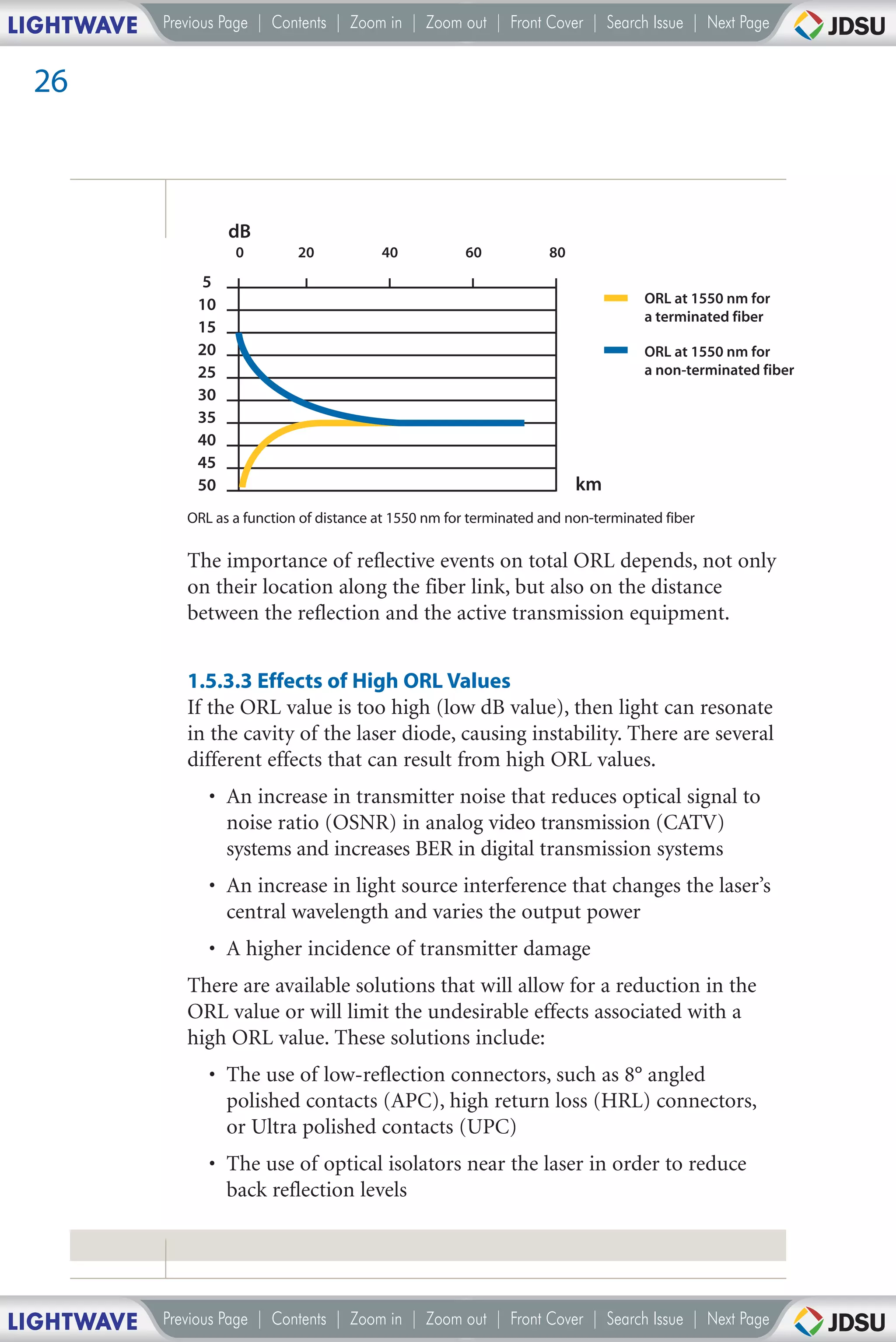
                     The following graph shows the total ORL (reflectance and
                     backscatter) for both terminated fiber (with no end reflection) and
                     non-terminated fiber (with a glass-to-air backreflection of 4% or
                     -14 dB). For distances shorter than 40 km, the difference in ORL
                     between the terminated and non-terminated fiber is significant.
                     But for longer distances (higher losses), the total ORL is
                     almost equivalent.


LIGHTWAVE   Previous Page | Contents | Zoom in | Zoom out | Front Cover | Search Issue | Next Page


 26


                     dB
                      0         20           40           60            80
                5
                10                                                                     ORL at 1550 nm for
                                                                                       a terminated fiber
                15
                20                                                                     ORL at 1550 nm for
                25                                                                     a non-terminated fiber
                30
                35
                40
                45
                50                                                           km
               ORL as a function of distance at 1550 nm for terminated and non-terminated fiber

               The importance of reflective events on total ORL depends, not only
               on their location along the fiber link, but also on the distance
               between the reflection and the active transmission equipment.


               1.5.3.3 Effects of High ORL Values
               If the ORL value is too high (low dB value), then light can resonate
               in the cavity of the laser diode, causing instability. There are several
               different effects that can result from high ORL values.
                  • An increase in transmitter noise that reduces optical signal to
                    noise ratio (OSNR) in analog video transmission (CATV)
                    systems and increases BER in digital transmission systems
                  • An increase in light source interference that changes the laser’s
                    central wavelength and varies the output power
                  • A higher incidence of transmitter damage
               There are available solutions that will allow for a reduction in the
               ORL value or will limit the undesirable effects associated with a
               high ORL value. These solutions include:
                  • The use of low-reflection connectors, such as 8° angled
                    polished contacts (APC), high return loss (HRL) connectors,
                    or Ultra polished contacts (UPC)
                  • The use of optical isolators near the laser in order to reduce
                    back reflection levels


LIGHTWAVE   Previous Page | Contents | Zoom in | Zoom out | Front Cover | Search Issue | Next Page


                                                                                                     27


                     1.5.4 Non-Linear Effects
                     Non-linear effects are mainly caused by the high power level and
                     small effective area of the fiber. With an increase in the power level
                     and the number of optical channels, non-linear effects can become
                     problematic factors in transmission systems. These analog effects
                     can be divided into two categories.
                     1. Refractive index phenomena: Causes phase modulation by
                     variation in the refractive indexes
                        – Self phase modulation (SPM)
                        – Cross phase modulation (XPM)
                        – Four wave mixing (FWM)
                     2. Stimulated scattering phenomena: Leads to power loss
                        – Stimulated Raman scattering (SRS)
                        – Stimulated Brillouin scattering (SBS)


                     1.5.4.1 Refractive Index Phenomena
                     Non-linear effects are dependent upon the non-linear portion of
                     the refractive index n and cause the refractive index to increase for
                     high signal power levels. Behind an EDFA, the high output can
                     create non-linear effects, such as four wave mixing (FWM), self
                     phase modulation (SPM), and cross phase modulation (XPM).
                     Four Wave Mixing
                     Four wave mixing (FWM) is an interference phenomenon that
                     produces unwanted signals from three signal frequencies
                     (λ123 = λ1 + λ2 – λ3) known as ghost channels. Because three
                     different channels induce a fourth channel, this phenomenon is
                     referred to as four wave mixing.
                     There are a number of ways in which channels can combine to
                     form a new channel according to the above formula. In addition, it
                     should be noted that just two channels alone are also capable of
                     inducing a third channel.


LIGHTWAVE   Previous Page | Contents | Zoom in | Zoom out | Front Cover | Search Issue | Next Page


 28


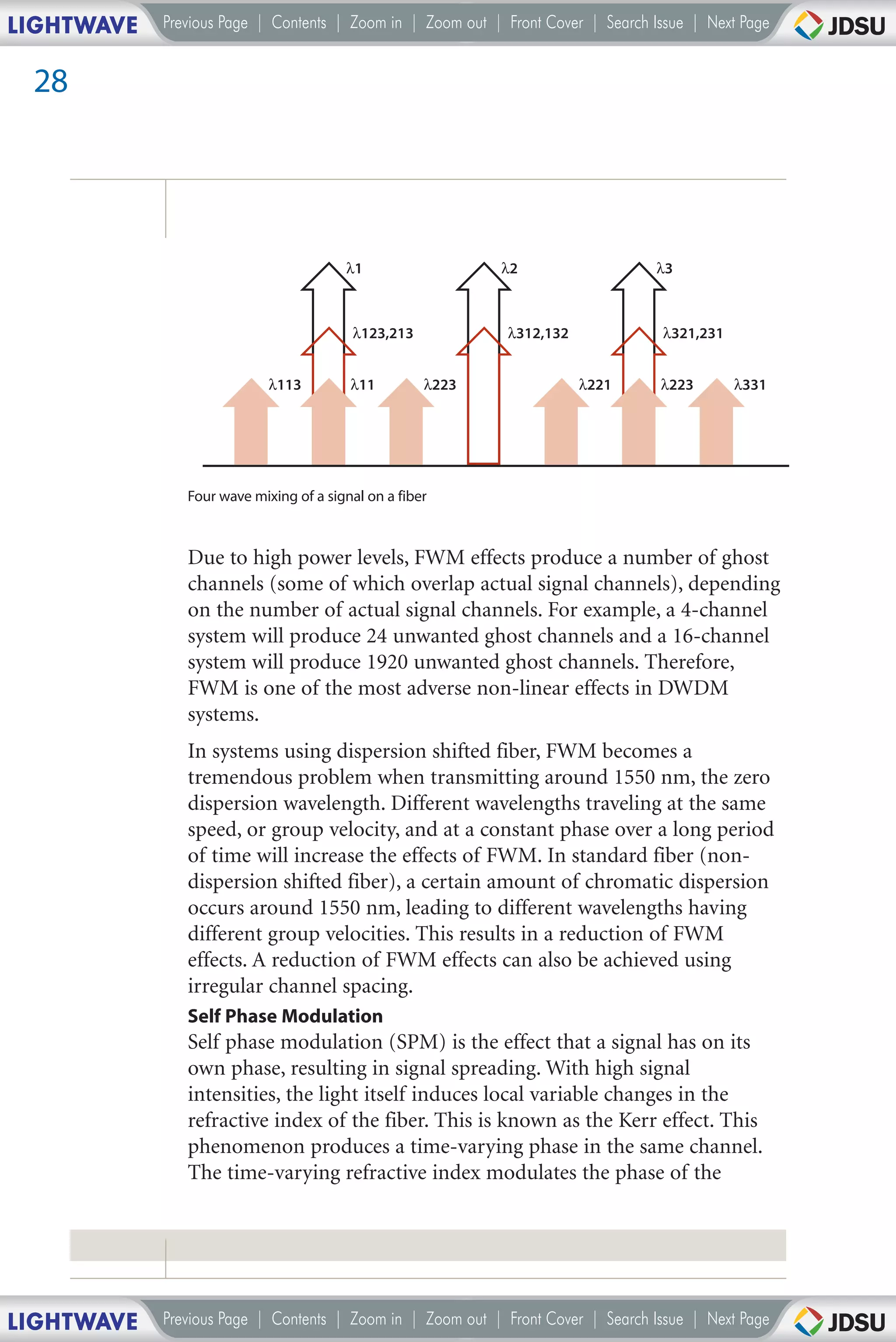
                                        λ1                  λ2                   λ3


                                         λ123,213           λ312,132              λ321,231


                            λ113         λ11         λ223              λ221       λ223       λ331


               Four wave mixing of a signal on a fiber


               Due to high power levels, FWM effects produce a number of ghost
               channels (some of which overlap actual signal channels), depending
               on the number of actual signal channels. For example, a 4-channel
               system will produce 24 unwanted ghost channels and a 16-channel
               system will produce 1920 unwanted ghost channels. Therefore,
               FWM is one of the most adverse non-linear effects in DWDM
               systems.
               In systems using dispersion shifted fiber, FWM becomes a
               tremendous problem when transmitting around 1550 nm, the zero
               dispersion wavelength. Different wavelengths traveling at the same
               speed, or group velocity, and at a constant phase over a long period
               of time will increase the effects of FWM. In standard fiber (non-
               dispersion shifted fiber), a certain amount of chromatic dispersion
               occurs around 1550 nm, leading to different wavelengths having
               different group velocities. This results in a reduction of FWM
               effects. A reduction of FWM effects can also be achieved using
               irregular channel spacing.
               Self Phase Modulation
               Self phase modulation (SPM) is the effect that a signal has on its
               own phase, resulting in signal spreading. With high signal
               intensities, the light itself induces local variable changes in the
               refractive index of the fiber. This is known as the Kerr effect. This
               phenomenon produces a time-varying phase in the same channel.
               The time-varying refractive index modulates the phase of the


LIGHTWAVE   Previous Page | Contents | Zoom in | Zoom out | Front Cover | Search Issue | Next Page


                                                                                                     29


                        transmitted wavelength(s), broadening the wavelength spectrum of
                        the transmitted optical pulse.

                                                                       2π   L
                                                          ∆ϕ =            x
                                                                       λ SxP
                        Where L is the link distance, S is the fiber section, and P is the
                        optical power.
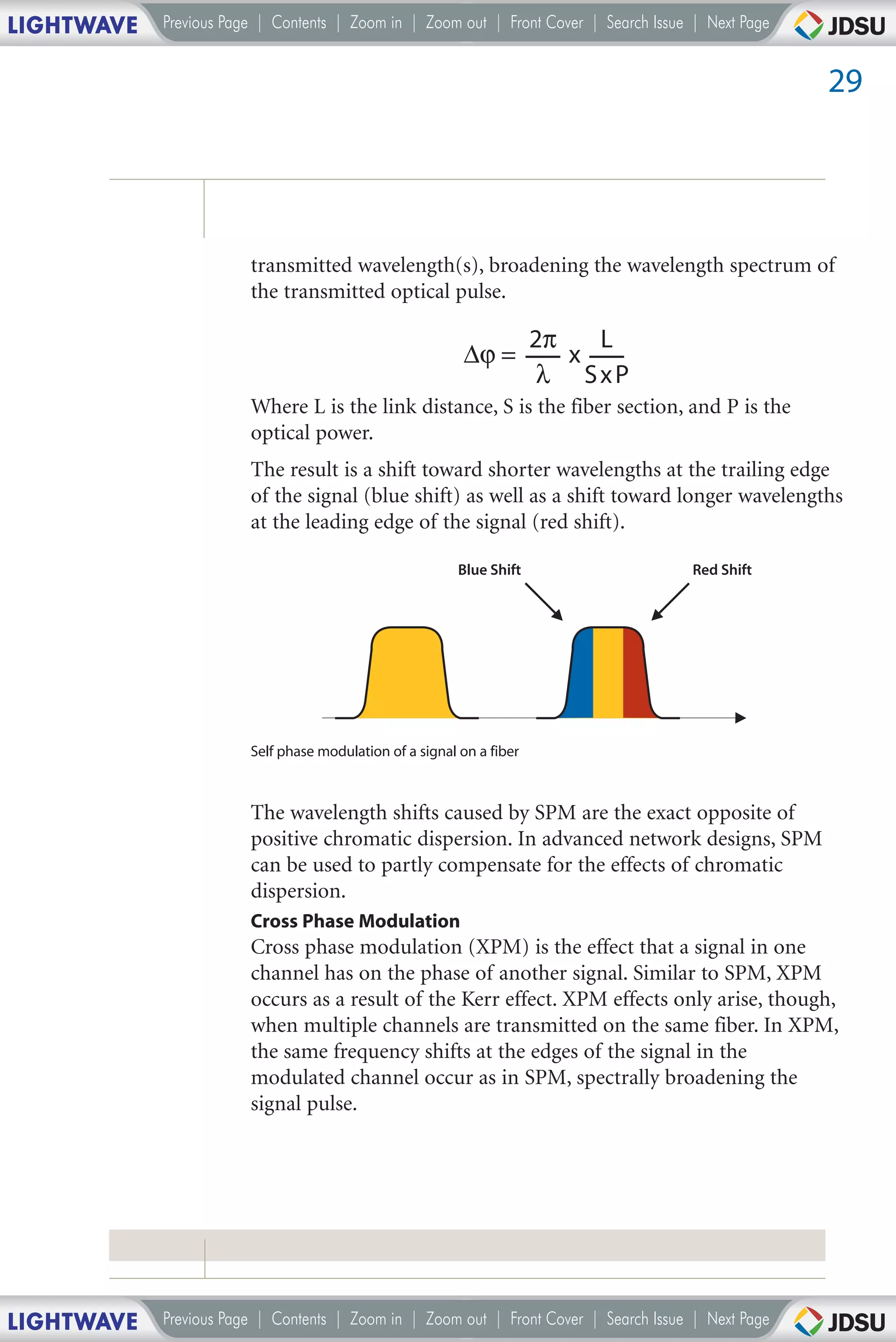
                        The result is a shift toward shorter wavelengths at the trailing edge
                        of the signal (blue shift) as well as a shift toward longer wavelengths
                        at the leading edge of the signal (red shift).

                                                          Blue Shift                   Red Shift


                        Self phase modulation of a signal on a fiber


                        The wavelength shifts caused by SPM are the exact opposite of
                        positive chromatic dispersion. In advanced network designs, SPM
                        can be used to partly compensate for the effects of chromatic
                        dispersion.
                        Cross Phase Modulation
                        Cross phase modulation (XPM) is the effect that a signal in one
                        channel has on the phase of another signal. Similar to SPM, XPM
                        occurs as a result of the Kerr effect. XPM effects only arise, though,
                        when multiple channels are transmitted on the same fiber. In XPM,
                        the same frequency shifts at the edges of the signal in the
                        modulated channel occur as in SPM, spectrally broadening the
                        signal pulse.


LIGHTWAVE   Previous Page | Contents | Zoom in | Zoom out | Front Cover | Search Issue | Next Page


 30


               1.5.4.2 Scattering Phenomena
               Scattering phenomena can be categorized according to the
               processes that occur when the laser signal is scattered by
               fiber molecular vibrations (optical photons) or by induced
               virtual grating.
               Stimulated Raman Scattering
               Stimulated Raman scattering (SRS) is an effect that transfers power
               from a signal at a shorter wavelength to a signal at a longer
               wavelength. SRS is caused by the interaction of signal light waves
               with vibrating molecules (optical photons) within the silica fiber.
               Light is then scattered in all directions. Wavelength differences
               between two signals of about 100 nm (13.2 THz), 1550 nm to 1650
               nm for example, show maximum SRS effects.
               Stimulated Brillouin Scattering
               Stimulated Brillouin scattering (SBS) is a backscattering
               phenomenon that causes loss of power. With high power signals,
               the light waves induce periodic changes in the refractive index of
               the fiber. This can be described as induced virtual grating, which
               travels away from the signal as an acoustic wave. The signal itself is
               then scattered, but it is mostly reflected off this induced virtual
               grating. SBS effects occur when only a few channels are transmitted.


LIGHTWAVE   Previous Page | Contents | Zoom in | Zoom out | Front Cover | Search Issue | Next Page
LIGHTWAVE           Previous Page | Contents | Zoom in | Zoom out | Front Cover | Search Issue | Next Page


                                                                                                                                                                               31


                                  1.5.5 Summary of Transmission Effects
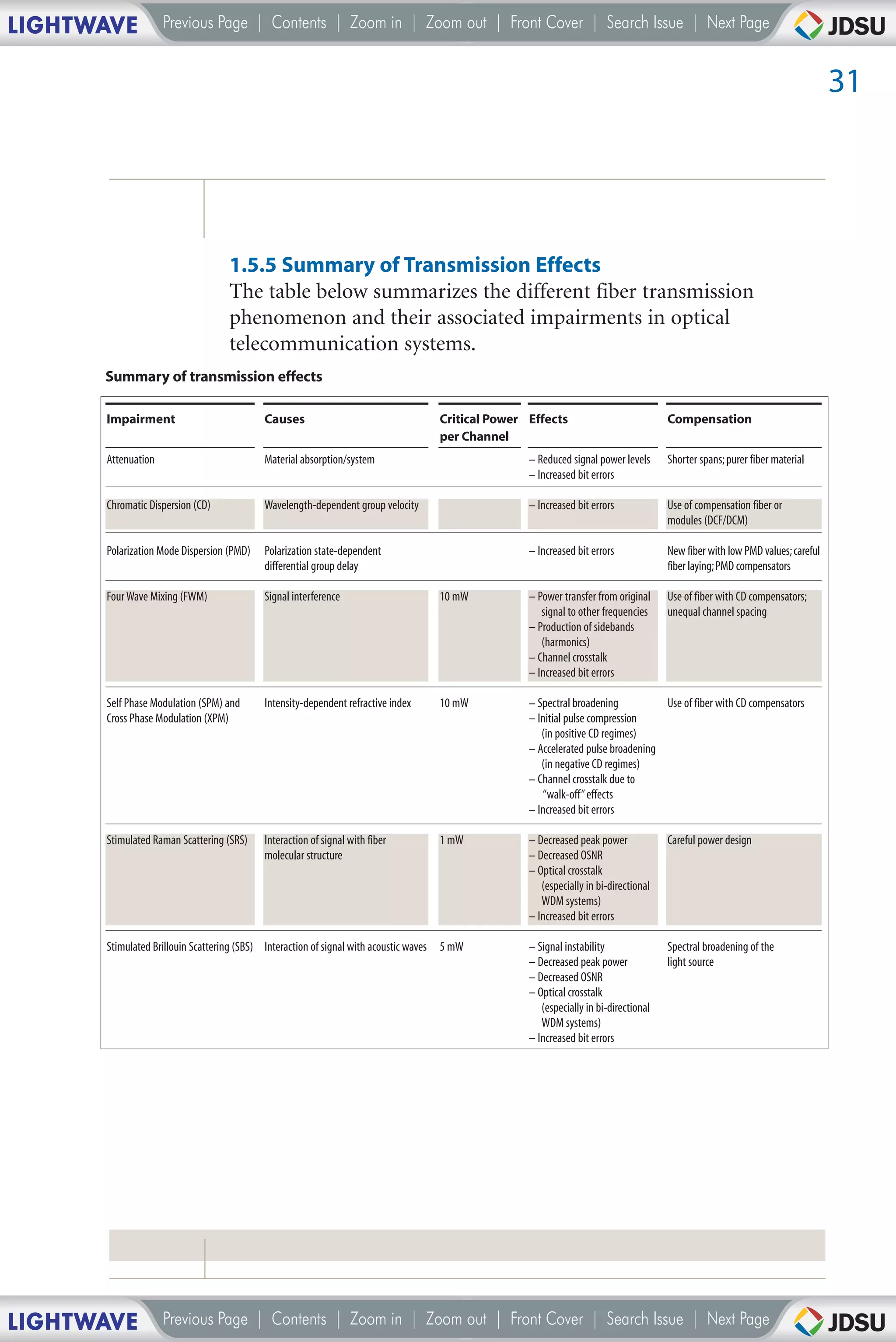
                                  The table below summarizes the different fiber transmission
                                  phenomenon and their associated impairments in optical
                                  telecommunication systems.
      Summary of transmission effects

      Impairment                           Causes                                   Critical Power Effects                            Compensation
                                                                                    per Channel
      Attenuation                          Material absorption/system                              – Reduced signal power levels      Shorter spans; purer fiber material
                                                                                                   – Increased bit errors

      Chromatic Dispersion (CD)            Wavelength-dependent group velocity                     – Increased bit errors             Use of compensation fiber or
                                                                                                                                      modules (DCF/DCM)

      Polarization Mode Dispersion (PMD)   Polarization state-dependent                            – Increased bit errors             New fiber with low PMD values; careful
                                           differential group delay                                                                   fiber laying; PMD compensators

      Four Wave Mixing (FWM)               Signal interference                      10 mW          – Power transfer from original     Use of fiber with CD compensators;
                                                                                                      signal to other frequencies     unequal channel spacing
                                                                                                   – Production of sidebands
                                                                                                      (harmonics)
                                                                                                   – Channel crosstalk
                                                                                                   – Increased bit errors

      Self Phase Modulation (SPM) and      Intensity-dependent refractive index     10 mW          – Spectral broadening          Use of fiber with CD compensators
      Cross Phase Modulation (XPM)                                                                 – Initial pulse compression
                                                                                                      (in positive CD regimes)
                                                                                                   – Accelerated pulse broadening
                                                                                                      (in negative CD regimes)
                                                                                                   – Channel crosstalk due to
                                                                                                      “walk-off” effects
                                                                                                   – Increased bit errors

      Stimulated Raman Scattering (SRS)    Interaction of signal with fiber         1 mW           – Decreased peak power             Careful power design
                                           molecular structure                                     – Decreased OSNR
                                                                                                   – Optical crosstalk
                                                                                                      (especially in bi-directional
                                                                                                      WDM systems)
                                                                                                   – Increased bit errors

      Stimulated Brillouin Scattering (SBS) Interaction of signal with acoustic waves 5 mW         – Signal instability               Spectral broadening of the
                                                                                                   – Decreased peak power             light source
                                                                                                   – Decreased OSNR
                                                                                                   – Optical crosstalk
                                                                                                      (especially in bi-directional
                                                                                                      WDM systems)
                                                                                                   – Increased bit errors


LIGHTWAVE           Previous Page | Contents | Zoom in | Zoom out | Front Cover | Search Issue | Next Page
LIGHTWAVE   Previous Page | Contents | Zoom in | Zoom out | Front Cover | Search Issue | Next Page


 32


               1.6 Standards and Recommendations for
                   Fiber Optic Systems
               There are many international and national standards governing
               optical cable characteristics and measurement methods. Some are
               listed below, but the list is not exhaustive. Releases are subject to
               change.


               1.6.1 International Standards
               There are two main groups working on international standards: the
               International Electrotechnical Commission and the International
               Telecommunication Union.


               1.6.1.1 International Electrotechnical Commission
               The International Electrotechnical Commission (IEC) is a global
               organization that prepares and publishes international standards for
               all electrical, electronic, and related technologies. These standards
               serve as a basis for national standardization.
               The IEC is composed of technical committees who prepare
               technical documents on specific subjects within the scope of an
               application, in order to define the related standards. For example,
               the technical committee TC86 is dedicated to fiber optics, and its
               sub-committees SC86A, SC86B, and SC86C focus on specific
               subjects such as:
               – SC86A: Fibers and Cables
               – SC86B: Fiber Optic Interconnecting Devices and Passive
                Components
               – SC86C: Fiber Optic Systems and Active Devices


LIGHTWAVE   Previous Page | Contents | Zoom in | Zoom out | Front Cover | Search Issue | Next Page


                                                                                                     33


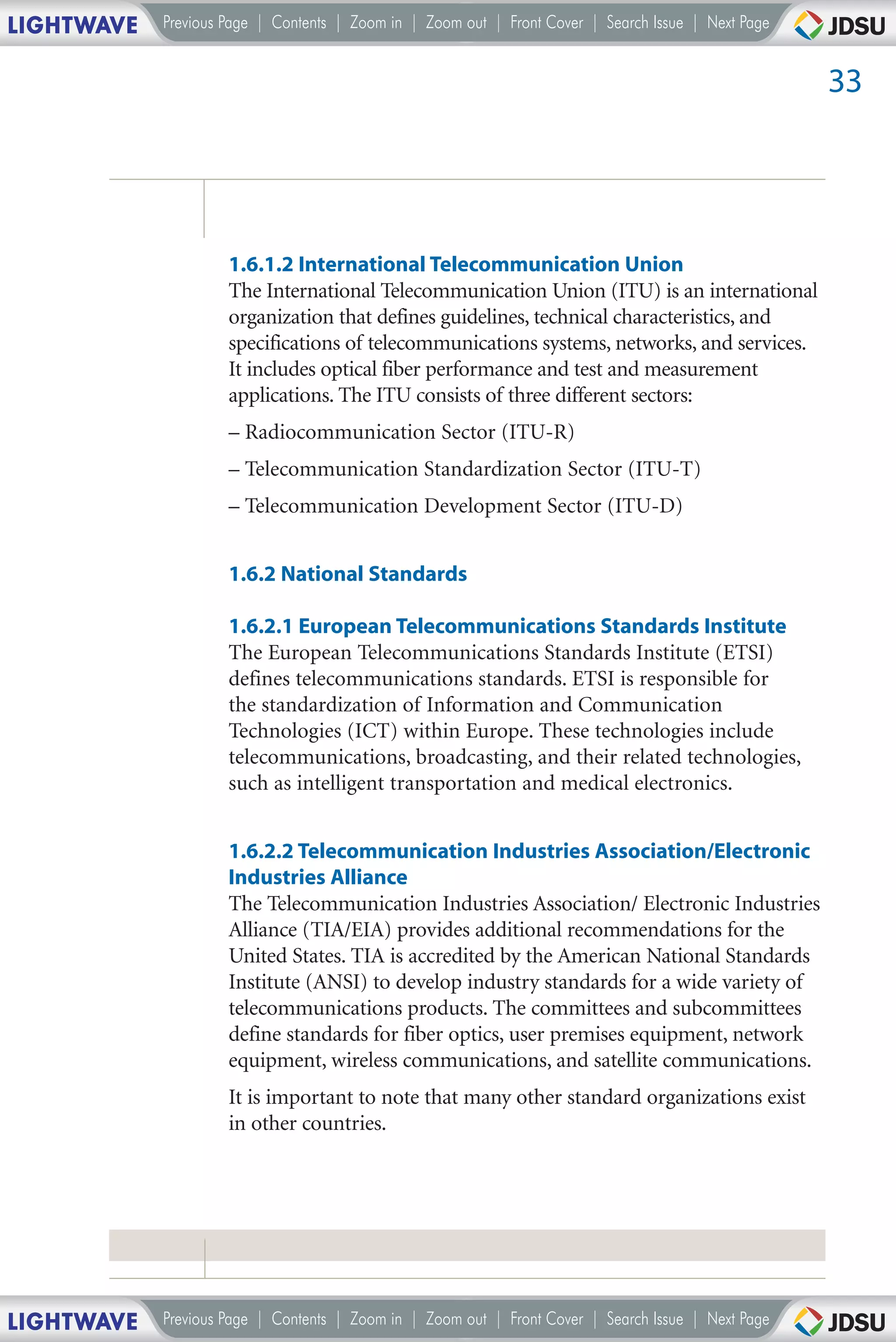
                     1.6.1.2 International Telecommunication Union
                     The International Telecommunication Union (ITU) is an international
                     organization that defines guidelines, technical characteristics, and
                     specifications of telecommunications systems, networks, and services.
                     It includes optical fiber performance and test and measurement
                     applications. The ITU consists of three different sectors:
                     – Radiocommunication Sector (ITU-R)
                     – Telecommunication Standardization Sector (ITU-T)
                     – Telecommunication Development Sector (ITU-D)


                     1.6.2 National Standards

                     1.6.2.1 European Telecommunications Standards Institute
                     The European Telecommunications Standards Institute (ETSI)
                     defines telecommunications standards. ETSI is responsible for
                     the standardization of Information and Communication
                     Technologies (ICT) within Europe. These technologies include
                     telecommunications, broadcasting, and their related technologies,
                     such as intelligent transportation and medical electronics.


                     1.6.2.2 Telecommunication Industries Association/Electronic
                     Industries Alliance
                     The Telecommunication Industries Association/ Electronic Industries
                     Alliance (TIA/EIA) provides additional recommendations for the
                     United States. TIA is accredited by the American National Standards
                     Institute (ANSI) to develop industry standards for a wide variety of
                     telecommunications products. The committees and subcommittees
                     define standards for fiber optics, user premises equipment, network
                     equipment, wireless communications, and satellite communications.
                     It is important to note that many other standard organizations exist
                     in other countries.


LIGHTWAVE   Previous Page | Contents | Zoom in | Zoom out | Front Cover | Search Issue | Next Page


 34


               1.6.3 Fiber Optic Standards
               – IEC 60793-1 and -2: Optical fibers (includes several parts)
               – IEC 60794-1, -2, and -3: Optical fiber cables
               – G.651: Characteristics of 50/125 µm multimode graded-index
                 optical fiber
               – G.652: Characteristics of singlemode optical fiber and cable
               – G.653: Characteristics of singlemode dispersion shifted optical
                 fiber and cable
               – G.654: Characteristics of cut-off shifted singlemode optical fiber
                 and cable
               – G.655: Characteristics of non-zero dispersion shifted singlemode
                 optical fiber and cable
               – G.656: Characteristics of non-zero dispersion shifted fiber for
                 wideband transport


               1.6.4 Test and Measurement Standards

               1.6.4.1 Generic Test Standards
               – IEC 61350: Power meter calibration
               – IEC 61746: OTDR calibration
               – G.650.1: Definition and test methods for linear, deterministic
                 attributes of singlemode fiber and cable
               – G.650.2: Definition and test methods for statistical and
                 non-linear attributes of singlemode fiber and cable


               1.6.4.2 PMD Test Standards
               – G.650.2: Definition and test methods for statistical and
                 non-linear attributes of singlemode fiber and cable
               – IEC 60793 1-48: Optical fibers - Part 1-48: Measurement
                 methods and test procedures - polarization mode dispersion


LIGHTWAVE   Previous Page | Contents | Zoom in | Zoom out | Front Cover | Search Issue | Next Page


                                                                                                     35


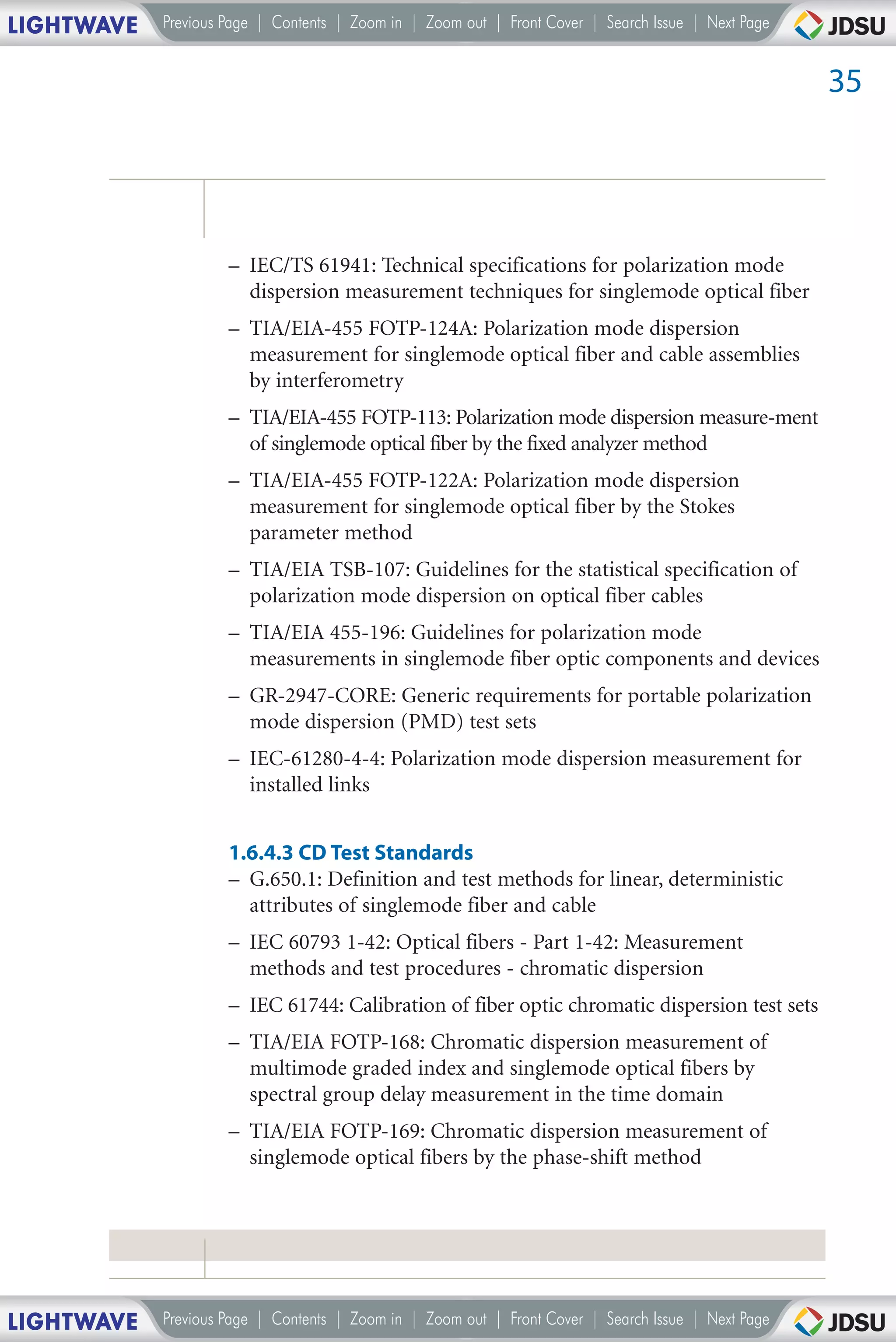
                     – IEC/TS 61941: Technical specifications for polarization mode
                       dispersion measurement techniques for singlemode optical fiber
                     – TIA/EIA-455 FOTP-124A: Polarization mode dispersion
                       measurement for singlemode optical fiber and cable assemblies
                       by interferometry
                     – TIA/EIA-455 FOTP-113: Polarization mode dispersion measure-ment
                       of singlemode optical fiber by the fixed analyzer method
                     – TIA/EIA-455 FOTP-122A: Polarization mode dispersion
                       measurement for singlemode optical fiber by the Stokes
                       parameter method
                     – TIA/EIA TSB-107: Guidelines for the statistical specification of
                       polarization mode dispersion on optical fiber cables
                     – TIA/EIA 455-196: Guidelines for polarization mode
                       measurements in singlemode fiber optic components and devices
                     – GR-2947-CORE: Generic requirements for portable polarization
                       mode dispersion (PMD) test sets
                     – IEC-61280-4-4: Polarization mode dispersion measurement for
                       installed links


                     1.6.4.3 CD Test Standards
                     – G.650.1: Definition and test methods for linear, deterministic
                       attributes of singlemode fiber and cable
                     – IEC 60793 1-42: Optical fibers - Part 1-42: Measurement
                       methods and test procedures - chromatic dispersion
                     – IEC 61744: Calibration of fiber optic chromatic dispersion test sets
                     – TIA/EIA FOTP-168: Chromatic dispersion measurement of
                       multimode graded index and singlemode optical fibers by
                       spectral group delay measurement in the time domain
                     – TIA/EIA FOTP-169: Chromatic dispersion measurement of
                       singlemode optical fibers by the phase-shift method


LIGHTWAVE   Previous Page | Contents | Zoom in | Zoom out | Front Cover | Search Issue | Next Page


 36


               – TIA/EIA FOTP-175: Chromatic dispersion measurement of
                 singlemode optical fibers by the differential phase-shift method
               – GR-761-CORE: Generic criteria for chromatic dispersion test sets
               – GR-2854-CORE: Generic requirements for fiber optic dispersion
                 compensators


LIGHTWAVE   Previous Page | Contents | Zoom in | Zoom out | Front Cover | Search Issue | Next Page


       Insertion Loss, Return Loss, Fiber Characterization,
       and Ancillary Test Kits
                     Chapter 2


LIGHTWAVE   Previous Page | Contents | Zoom in | Zoom out | Front Cover | Search Issue | Next Page


 38


               2.1 Optical Fiber Testing
               When analyzing a fiber optic cable over its product lifetime, a
               series of measurements must be performed in order to ensure
               its integrity.
               – Mechanical tests
               – Geometrical tests
               – Optical tests
               – Transmission tests


               The first three sets of measurements are only performed once since
               there is minor variation in these parameters during the fiber’s
               lifetime. Several measurements are performed on optical fiber or
               cables in order to characterize them before their use in signal
               transmission. Many of these measurements are described in the
               Fiber Optic Test Procedure (FOTP) propositions of the Electronic
               Industries Association (EIA) and are defined in the ITU-T’s G650
               recommendations or in the EN 188 000 document.
               Optical fiber testing

                Mechanical Tests       Geometrical Tests   Optical Tests         Transmission Tests
                Traction               Concentricity       Index profile         Bandwidth
                Torsion                Cylindricity        Numerical aperture    Optical power
                Bending                Core diameter       Spot size             Optical loss
                Temperature            Cladding                                  Optical return loss
                                       diameter                                  Reflectometry
                                                                                 Chromatic dispersion
                                                                                 Polarization mode dispersion
                                                                                 Attenuation profile


LIGHTWAVE   Previous Page | Contents | Zoom in | Zoom out | Front Cover | Search Issue | Next Page


                                                                                                     39


                     2.2 Transmission Tests
                     2.2.1 Measurement Units
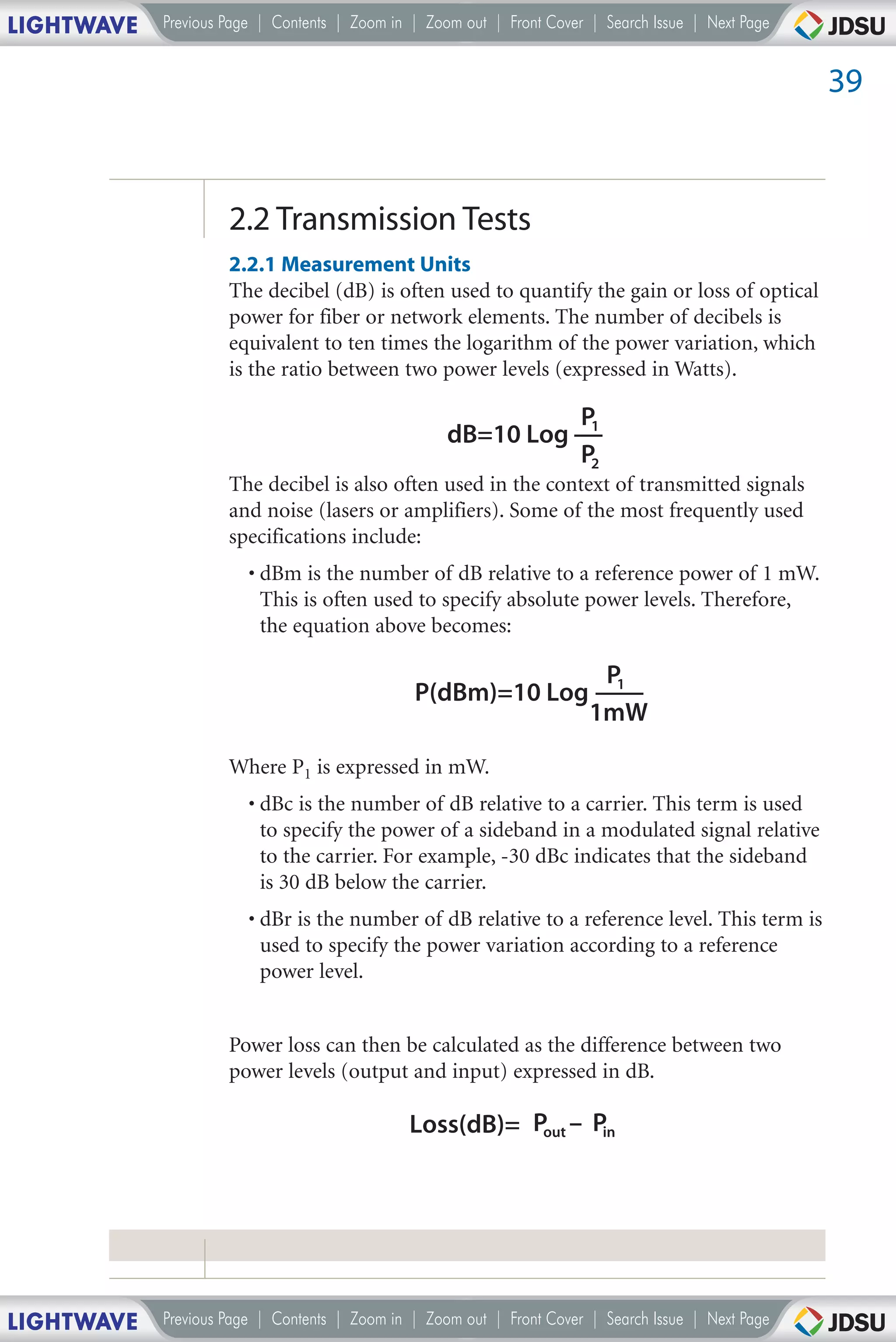
                     The decibel (dB) is often used to quantify the gain or loss of optical
                     power for fiber or network elements. The number of decibels is
                     equivalent to ten times the logarithm of the power variation, which
                     is the ratio between two power levels (expressed in Watts).

                                                                       P1
                                                    dB=10 Log
                                                                       P2
                     The decibel is also often used in the context of transmitted signals
                     and noise (lasers or amplifiers). Some of the most frequently used
                     specifications include:
                        • dBm is the number of dB relative to a reference power of 1 mW.
                          This is often used to specify absolute power levels. Therefore,
                          the equation above becomes:

                                                                         P1
                                               P(dBm)=10 Log
                                                                        1mW

                     Where P1 is expressed in mW.
                        • dBc is the number of dB relative to a carrier. This term is used
                          to specify the power of a sideband in a modulated signal relative
                          to the carrier. For example, -30 dBc indicates that the sideband
                          is 30 dB below the carrier.
                        • dBr is the number of dB relative to a reference level. This term is
                          used to specify the power variation according to a reference
                          power level.


                     Power loss can then be calculated as the difference between two
                     power levels (output and input) expressed in dB.

                                              Loss(dB)= Pout – Pin


LIGHTWAVE   Previous Page | Contents | Zoom in | Zoom out | Front Cover | Search Issue | Next Page


 40


               The table below provides a set of absolute power levels converted
               from Watts to dBm.

               Comparing absolute power levels in Watts and dBm


                           Absolute Power (W)                         Absolute Power (dBm)
                                    1W                                       +30 dBm
                                 100 mW                                      +20 dBm
                                  10 mW                                      +10 dBm
                                   5 mW                                      +7 dBm
                                   1 mW                                       0 dBm
                                 500 µW                                       -3 dBm
                                 100 µW                                      -10 dBm
                                  10 µW                                      -20 dBm
                                   1 µW                                      -30 dBm
                                 100 nW                                      -40 dBm


               The table below provides the relationship between dB and power
               loss in terms of a percentage.

               Comparing loss (dB) and the percentage of power loss

                                Loss (dB)                                Power Loss (%)
                                 -0.10 dB                                      2%
                                 -0.20 dB                                      5%
                                 -0.35 dB                                      8%
                                   -1 dB                                      20%
                                   -3 dB                                      50%
                                   -6 dB                                      75%
                                  -10 dB                                      90%
                                  -20 dB                                      99%


               2.2.2 Measurement Parameters
               In order to qualify the use of an optical fiber or an optical
               fiber system for proper transmission, several key measurements
               are performed.
                  • End-to-end optical link loss
                  • Rate of attenuation per unit length
                  • Attenuation contribution to splices, connectors, and
                    couplers (events)
                  • Length of the fiber or distance to an event


LIGHTWAVE   Previous Page | Contents | Zoom in | Zoom out | Front Cover | Search Issue | Next Page


                                                                                                     41


                        • Linearity of fiber loss per unit length
                          (attenuation discontinuities)
                        • Reflectance or optical return loss (ORL)
                        • Chromatic dispersion (CD)
                        • Polarization mode dispersion (PMD)
                        • Attenuation profile (AP)


                     Other measurements, such as bandwidth, may also be performed.
                     Except for a few specific applications, these other measurements are
                     often less important.
                     Some measurements require access to both ends of the fiber. Others
                     require access to only one end. Measurement techniques that
                     require access to only one end are particularly interesting for field
                     applications since these measurements reduce the time spent
                     traveling from one end of the fiber cable system to the other. Field
                     testing of optical cables requires testing at three levels: installation,
                     maintenance, and restoration.


                     2.2.3 Field Testing
                     The following sections provide a non-exhaustive list of the various
                     tests that can be performed during each level of field testing. The
                     exact nature of a testing program depends on the system design, the
                     system criticality, and the contractual relationship between the
                     cable and components suppliers, system owner, system installer, and
                     system user.


                     2.2.3.1 Installation Tests
                     Pre-Installation Tests
                     Prior to installation, fiber inspections are performed to ensure that
                     the fiber cables received from the manufacturer conform to the
                     required specifications (length, attenuation, etc.) and have not been
                     damaged during transit or cable placement.


LIGHTWAVE   Previous Page | Contents | Zoom in | Zoom out | Front Cover | Search Issue | Next Page


 42


               Installation and Commissioning Tests
               During installation and commissioning, tests are performed to
               determine the quality of cable splices and terminations
               (attenuation, location, and reflectance). Tests are also performed to
               determine that the completed cable subsystem is suitable for the
               intended transmission system (end-to-end loss and system optical
               return loss). All of these tests provide a complete set of
               documentation of the cable link for maintenance purposes.
               2.2.3.2 Maintenance Tests
               Maintenance testing involves periodic evaluation of the cable
               system to ensure that no degradation of the cable, splices, or
               connections has occurred. Tests include cable attenuation as well as
               attenuation and reflection of splices and terminations. In some
               systems, maintenance tests may be performed every few months
               and are compared to historical test results to provide early warning
               signs of degradation. In very high capacity or critical systems,
               automated testing devices may be employed to test the integrity of
               the system every few minutes to give immediate warning of
               degradation or outages.
               2.2.3.3 Troubleshooting
               During cable restoration, testing is first performed to identify the
               cause of the outage (transmitter, receiver, cable, or connector) and
               to locate the fault in the cable if the outage was caused by the cable.
               Testing is then performed to assess the quality of the repaired
               system (permanent splices). This subsequent testing is similar to the
               testing performed at the conclusion of cable installation.


LIGHTWAVE   Previous Page | Contents | Zoom in | Zoom out | Front Cover | Search Issue | Next Page


                                                                                                     43


                     2.3 Optical Tester Families
                     One of the main families of optical testers is optical handhelds. This
                     family is comprised of handheld devices that allow for the
                     measurement of system power level, insertion loss (IL), optical
                     return loss (ORL), reflectrometry, chromatic dispersion (CD),
                     polarization mode dispersion (PMD), and attenuation profile (AP).


                     Examples of JDSU handheld
                     optical testers


                     2.3.1 Light Sources
                     A light source is a device that provides a continuous wave (CW)
                     and stable source of energy for attenuation measurements. It
                     includes a source, either an LED or laser, that is stabilized using an
                     automatic gain control mechanism. LEDs are typically used for
                     multimode fiber. On the other hand, lasers are used for singlemode
                     fiber applications.
                     The output of light from either an LED or laser source may also
                     have the option of modulation (or chopping) at a given frequency.
                     The power meter can then be set to detect this frequency. This
                     method improves ambient light rejection. In this case, a 2 kHz
                     modulated light source can be used with certain types of detectors
                     to tone the fiber for fiber identification or for confirmation
                     of continuity.


LIGHTWAVE   Previous Page | Contents | Zoom in | Zoom out | Front Cover | Search Issue | Next Page
LIGHTWAVE     Previous Page | Contents | Zoom in | Zoom out | Front Cover | Search Issue | Next Page


 44


            Comparing LEDs and lasers

             Characteristics               LEDs                                         Lasers
             Output power                  Linearly proportional to the drive current   Proportional to the current above the threshold
             Current                       Drive current: 50 to 100 mA (peak)           Threshold current: 5 to 40 mA
             Coupled power                 Moderate                                     High
             Speed                         Slower                                       Faster
             Output pattern                Higher                                       Lower
             Bandwidth                     Moderate                                     High
             Available wavelengths         0.66 to 1.65 mm                              0.78 to 1.65 mm
             Spectral width                Wider (40 to 190 nm FWMH)                    Narrower (0.00001 to 10 nm FWHM)
             Fiber type                    Multimode only                               Singlemode and multimode
             Ease-of-use                   Easier                                       Harder
             Lifetime                      Longer                                       Long
             Cost                          Low                                          High


                    2.3.2 Power Meters
                    The power meter is the standard tester in a typical fiber optic
                    technician’s toolkit. It is an invaluable tool during installation
                    and restoration.
                    The power meter’s main function is to display the incident power
                    on the photodiode. Transmitted and received optical power is only
                    measured with an optical power meter. For transmitted power, the
                    power meter is connected directly to the optical transmitter’s
                    output. For received power, the optical transmitter is connected to
                    the fiber system. Then, the power level is read using the power
                    meter at the point on the fiber cable where the optical receiver
                    would be.


                    2.3.2.1 Detector Specifications
                    Currently, power meter photodiodes use Silicon (for multimode
                    applications), Germanium (for singlemode and multimode
                    applications), and InGas (for singlemode and multimode
                    applications) technologies. As shown in the figure below, InGas
                    photodiodes are more adapted to the 1625 nm wavelength than
                    Germanium (Ge) photodiodes since Ge photodiodes are quite
                    sensitive and drop off rapidly at the 1600 nm window.


LIGHTWAVE     Previous Page | Contents | Zoom in | Zoom out | Front Cover | Search Issue | Next Page
LIGHTWAVE   Previous Page | Contents | Zoom in | Zoom out | Front Cover | Search Issue | Next Page


                                                                                                             45


                      Responsivity A/W

                      0.9
                      0.8
                      0.7                                                                          Silicon
                      0.6
                                                                                                   Germanium
                      0.5
                      0.4                                                                          InGas
                      0.3
                      0.2
                      0.1
                       0                                                              Wavelength (µm)

                            0.4     0.6      0.8      1       1.2       1.4   1.6   1.8

                     Responsivity of the three typical detector types


                     Features found on more sophisticated power meters may include
                     temperature stabilization, the ability to calibrate to different
                     wavelengths, the ability to display the power relative to “reference”
                     input, the ability to introduce attenuation, and a high
                     power option.


                     2.3.2.2 Dynamic Range
                     The requirements for a power meter vary depending on the
                     application. Power meters must have enough power to measure the
                     output of the transmitter (to verify operation). They must also be
                     sensitive enough, though, to measure the received power at the far
                     (receive) end of the link. Long-haul telephony systems and cable TV
                     systems use transmitters with outputs as high as +16 dBm and
                     amplifiers with outputs as high as +30 dBm. Receiver power
                     levels can be as low as -36 dBm in systems that use an optical
                     pre-amplifier. In local area networks, though, both receiver and
                     transmitter power levels are much lower.
                     The difference between the maximum input and the minimum
                     sensitivity of the power meter is termed the dynamic range. While
                     the dynamic range for a given meter has limits, the useful power
                     range can be extended beyond the dynamic range by placing an


LIGHTWAVE   Previous Page | Contents | Zoom in | Zoom out | Front Cover | Search Issue | Next Page


 46


               attenuator in front of the power meter input. This, though, limits
               the low end sensitivity of the power meter.
               For high power mode, an internal or external attenuator can
               be used. If an internal attenuator is used, it can be either fixed
               or switched.
               Typical dynamic range requirements for power meters are
               as follows:
                     +20 dBm to -70 dBm for telephony applications
                     +26 dBm to -55 dBm for CATV applications1
                     -20 dBm to -60 dBm for LAN applications


               2.3.2.3 Insertion Loss and Cut Back Measurements
               The most accurate way to measure overall attenuation in a fiber is
               to inject a known level of light in one end and measure the level of
               light that exits at the other end. Light sources and power meters are
               the main instruments recommended by ITU-T G650.1 and IEC
               61350 to measure insertion loss. This measurement requires access
               to both ends of the fiber.
               Cut Back Method
               The cut back method is the most accurate measurement, but it is
               also destructive and cannot be applied in the field. For this reason,
               it is not used during installation and maintenance. Testing using the
               cut back method requires first measuring the attenuation of the
               length of fiber under test. Then, a part of the length of the fiber is
               cut back from the source, and the attenuation is measured as a
               reference. Subtracting the two values provides the attenuation of
               the cut fiber.


               1
                   Most power meters meet these requirements through two modes of operation, a standard mode
                   (+20 to -70 dBm) and a high power mode (+30 to -50 dBm).


LIGHTWAVE   Previous Page | Contents | Zoom in | Zoom out | Front Cover | Search Issue | Next Page


                                                                                                              47


                     Insertion Loss Method
                     The insertion loss method is a non-destructive method, which can
                     be used to measure the attenuation across a fiber, a passive
                     component, or an optical link. With this substitution method, the
                     output from a source fiber and a reference fiber is measured
                     directly. Then, a measurement is obtained with the fiber under test
                     added to the system. The difference between the two results
                     provides the attenuation of the fiber.
                     The purpose of the first or reference measurement is to cancel out,
                     as much as possible, the losses caused by the various patch cables.

                                                         Reference                    Measurement P1
                                                          Pigtail


                Calibrated Light Source                                                 Power Meter

                                                     Fiber Under Test                 Measurement P2


                Calibrated Light Source                                                 Power Meter
                                              Total attenuation of the link
                                             A (dBm) = P1 (dBm) - P2 (dBm)

                     The insertion loss method uses two steps to measure the attenuation along a fiber link


                     It is important to note that significant variations can occur in
                     attenuation measurements if precautions are not taken with the
                     injection conditions.


LIGHTWAVE   Previous Page | Contents | Zoom in | Zoom out | Front Cover | Search Issue | Next Page


 48


               2.3.3 Loss Test Sets
               A loss test set (LTS) combines a power meter and a light source in the
               same instrument. It is a highly accurate tool and is used to determine
               the total amount of loss or attenuation in a fiber under test.
               Tests are usually performed in both directions since results can
               differ slightly from one direction to the other. For example,
               attenuation through couplers and fiber core mismatches can
               significantly differ in either direction. To ensure a better level of
               accuracy, averages are calculated when qualifying a link.
               With traditional light sources and power meters, the instruments
               must either be transferred from one end of the link to the other or
               a light source and a power meter are required at both ends of the
               link. The former requires a total of four instruments in order to
               perform measurements in both directions. With an LTS at each end
               of the link, tests can be performed in both directions using only two
               instruments and without the need to transfer them from one end to
               the other.
               Bi-directional Loss Test Sets
               With a bi-directional loss test set, both of the light sources and
               power meters are connected to the same port. Alternatively,
               bi-directional LTSs can be used as standalone instruments.
               Independent quick referencing for all built-in wavelengths can be
               obtained by connecting the light source and power meter of an
               instrument using a patch cable (loopback referencing). Although
               the side-by-side referencing method is more accurate, the loopback
               referencing method is preferred when the instruments are separate,
               and it is not convenient to co-locate them. When two LTSs are
               connected to the fiber under test, further manipulation is not
               required in order to carry out the bi-directional measurement.


LIGHTWAVE   Previous Page | Contents | Zoom in | Zoom out | Front Cover | Search Issue | Next Page


                                                                                                        49


                 Light Source                                                            Light Source
                                                              FUT


                                                       Reference Fiber
                 Power Meter                                                             Power Meter

                     Insertion loss measurement with two bi-directional loss test sets


                     Most of the current LTS instruments are now fully automated
                     bi-directional test instruments. With the press of a button,
                     bi-directional measurement is performed in few seconds, and
                     a complete report is generated. Automated insertion loss
                     measurement is fast and accurate and requires less training. With
                     automated insertion loss measurement, technicians make fewer
                     errors, which are generally caused by bad or lost reference settings
                     or by errors in the manual movement of the fiber while conducting
                     the test.


                                                                    OFI-2000


LIGHTWAVE   Previous Page | Contents | Zoom in | Zoom out | Front Cover | Search Issue | Next Page


 50


               2.3.4 Attenuators
               A fiber optic attenuator is a passive optical component that is
               intended to reduce the propagation of optical power in the fiber. It
               can provide either fixed or variable attenuation. An attenuator is the
               ideal tool for simulating cable loss for the testing of link power
               margin. A variable attenuator can be set to any loss value within the
               operating range using a light source and a power meter.

                          Light Source                                       Power Meter


                                                                Attenuator

               The use of an optical attenuator in optical testing


               2.3.5 Optical Loss Budget
               When installing a fiber network, network topology and equipment
               specifications must be considered. One of the major parameters
               requiring measurement is optical loss budget, or end-to-end optical
               link loss. When calculating the optical loss budget of a fiber link,
               the source, detector, and optical transmission line must be
               considered. The transmission link includes source-to-fiber coupling
               loss, fiber attenuation loss, and loss from of all of the components
               along the line (connectors, splices, passive components, etc.).
               The optical loss budget sits between maximum and minimum
               values.
                  • The maximum value is defined as the ratio of the minimum
                    optical power launched by the transmitter to the minimum
                    power level that can be received by the receiver while still
                    maintaining communication.


LIGHTWAVE   Previous Page | Contents | Zoom in | Zoom out | Front Cover | Search Issue | Next Page


                                                                                                     51


                         • The minimum value is defined as the ratio of the maximum
                           optical power launched by the transmitter to the maximum
                           power level that can be received by the receiver while still
                           maintaining communication.
                      An example of a typical multimode system includes the following
                      specifications:
                          – Transmitter output optical power -12 dBm ±2 dBm
                          – Optical receiver sensitivity ≤ -27 dBm
                          – Optical receiver dynamic range ≥ 18 dB
                      The transmitter output optical power specification provides the
                      maximum (-10 dBm) and minimum (-14 dBm) power levels that
                      may occur. The optical receiver sensitivity provides the minimum
                      power level that will be detected. The optical receiver dynamic
                      range provides the maximum power level that can be detected
                      (-27 dBm + 18 dBm = -9 dBm).
                      In this example, the maximum optical loss budget is 13 dB based on
                      a minimum output optical power of the transmitter of -14 dBm
                      and a minimum optical receiver sensitivity of -27 dBm.


                   Tx                            Network                     Rx

        Transmitted Power (Pt)                                       Received Power (Pr)

                               Pt max
                                                      Minimum Loss (dB)
                         Pt min                                Pr max
            Optical                                                           Optical Loss Budget:
            Power
             (dBm)                              Maximum Loss (dB)          B max = Pt min – Pr min
                                                                           B min = Pt max – Pr max
                                                            Pr min
                      Calculating the optical loss budget


LIGHTWAVE   Previous Page | Contents | Zoom in | Zoom out | Front Cover | Search Issue | Next Page


 52


               Optical loss budgets should take into account the power margins of
               the cable and equipment. These power margins cover allowances for
               the effects of time and environmental factors (launched power,
               receiver sensitivity, connector, or splice degradation). In order to
               calculate the optical loss budget, typical values of attenuations of
               the different fiber components are used.
                   0.2 dB/km for singlemode fiber loss at 1550 nm
                   0.35 dB/km for singlemode fiber loss at 1310 nm
                   1 dB/km for multimode fiber loss at 1300 nm
                   3 dB/km for multimode fiber loss at 850 nm
                   0.05 dB for a fusion splice
                   0.3 dB for a mechanical splice
                   0.5 dB for a connector pair
                   3.5 dB for a 1 to 2 splitter (3 dB splitting loss plus 0.5 dB excess loss)
               Once the calculation of the overall optical loss budget is completed,
               the cable can be installed.

               An example of a typical optical loss budget calculation


                         Network                Short Haul        Medium Haul         Long Haul
                Distance (km)                     30                 80                200
                Fiber loss (dB/km) at 1550 nm      0.25               0.22               0.19
                Total fiber loss (dB/km)           7.5               17.6               38
                Number of splices                 15                 40                 50
                Average splice loss                0.1                0.1                0.05
                Total splice loss                  1.5                4                  2.5
                Number of connectors               2                  2                  2
                Average connector loss             0.5                0.5                0.5
                Total connector loss               1                  1                  1
                TOTAL LOSS                        10                 22.6               41.5


LIGHTWAVE   Previous Page | Contents | Zoom in | Zoom out | Front Cover | Search Issue | Next Page


                                                                                                        53


                     2.3.6 Optical Return Loss Meters
                     There are several methods that can be used to measure optical
                     return loss (ORL). The most common methods use either an
                     optical continuous wave reflectometer (OCWR) or an optical time
                     domain reflectometer (OTDR).


                     2.3.6.1 OCWR Method
                     Using an OCWR, the light source launches a single wavelength of
                     light at a known power level (Po) into the fiber optic system to the
                     fiber under test. The wavelength must be similar to the wavelength
                     that the communication system will use in its intended application.
                     A directional coupler then routes the backreflections to the detector
                     in the optical power meter.
                     There are two steps that must be performed when measuring the
                     ORL with an OCWR.
                        1. A reference optical power measurement (background return
                           loss) is performed using a non-reflective (< -70 dB)
                           termination plug. The non-reflective termination plug can be
                           replaced by a mandrel wrap or by index-matching gel.

                                                 CW Stabilized
                                                 Light Source
                                                               P0
                                                                      Coupler
                      ORL REF                                                        Non-Refelective
                        Display                                                      Termination Plug
                                                               PREF
                                     Process    Power Meter
                                     Controller


                     ORL referencing using the OCWR method


LIGHTWAVE   Previous Page | Contents | Zoom in | Zoom out | Front Cover | Search Issue | Next Page


 54


                  2. Once referencing is complete, the jumper (coupler/splitter) is
                     connected to the device under test (DUT). Care must be taken
                     at the DUT termination in order to avoid glass-to-air back
                     reflection (-14 dB), which will affect the ORL value. The ORL
                     can then be calculated after measuring the level of reflected
                     optical power in the device under test.

                                    CW Stabilized

                                                                              DUT
                                                          Coupler
            ORL
                                                                                       Termination
            Display                                                                       Plug
                                                   POUT
                          Process    Power Meter
                          Controller

               ORL measurement using the OCWR method


               2.3.6.2 OTDR Method
               The OTDR launches light pulses into the fiber under test and
               collects backscatter information as well as Fresnel reflections. The
               light received by the OTDR corresponds to the reflected power
               according to the injected pulsewidth.

                                         Pulsed
                                         Light Source
                                                                                     DUT
                                                                 Coupler


                Display

                             Process    Photodector
                             Controller


               Setup using the OTDR method


LIGHTWAVE   Previous Page | Contents | Zoom in | Zoom out | Front Cover | Search Issue | Next Page
LIGHTWAVE          Previous Page | Contents | Zoom in | Zoom out | Front Cover | Search Issue | Next Page


                                                                                                                                                           55


                              The ORL is calculated after measuring the level of reflected optical
                              power in the fiber under test according to the pulsewidth.

                                                                                               P0∆t
                                                        ORL=10 Log (                                   )
                                                                                             ∫Pr(z).dz
                              Where Po is the output power of the OTDR, ∆t is the OTDR
                              pulsewidth, and ∫ Pr (z).dz is the total backreflection over the
                              distance of the fiber.


                              2.3.6.3 Differences between the OCWR Method
                              and the OTDR Method
                              ORL measurement with an OTDR is easier to perform than with an
                              OCWR since no power output referencing is required. For
                              technicians used to dealing with OTDR measurements, the ORL
                              value becomes a de facto standard. JDSU’s optical test platforms
                              offer additional value with an automatic ORL measurement while
                              measuring an OTDR trace. Using an OTDR also provides the ability
                              to measure the ORL for a given fiber span or for a specific point on
                              the fiber, such as connector reflectance.
                              However, the OCWR method remains more accurate
                              (approximately ±0.5 dB) than the OTDR method (approximately
                              ±2 dB) and allows for the measurement of very short fiber lengths,
                              such as one or two meter patchcords.
       Comparing OCWR and OTDR

       Characteristics                         OCWR                                                  OTDR
       Spatial resolution                      No                                                    Yes
       Accuracy (typical)                      ± 0.5 dB                                              ± 2 dB
       Dynamic range                           Up to 70 dB                                           ---
       Typical applications                    – Total link ORL and isolated event reflectance       – Spatial characterization of reflective events and
                                                   measurements during fiber installation and            estimation of the total ORL during installation
                                                   commissioning                                     – Perfect tool for troubleshooting when discrete
                                                                                                         elements contributing to the ORL must be identified
       Strengths                               –   Accurate                                          – Locates reflective events
                                               –   Fast                                              – Single-ended measurement
                                               –   Provides real-time results
                                               –   Simple and easy (direct result)
       Weaknesses                              –   Manipulations (reference measurements required)   – Accuracy
                                                                                                     – Long acquisition times


LIGHTWAVE          Previous Page | Contents | Zoom in | Zoom out | Front Cover | Search Issue | Next Page
LIGHTWAVE   Previous Page | Contents | Zoom in | Zoom out | Front Cover | Search Issue | Next Page


 56


               2.3.7 Mini-OTDR and Fault Locators
               Using the same basic technology as the OTDR, a new class of
               instruments became available in the early 1990’s. Known as mini-
               OTDRs, these fiber test instruments are typically battery-powered,
               lightweight, and small enough to be carried in one hand.
               The simplest and earliest designs of these instruments were capable
               of fault location at a minimum, and some were capable of
               providing rudimentary analysis (attenuation, rate of attenuation,
               distance, and reflectance) of fiber systems. Modern designs mimic
               the capabilities of mainframe OTDRs, including sophisticated
               analysis (automatic event detection, table of events, optical return
               loss, trace overlay, and bi-directional analysis) of fiber links, data
               storage capabilities, additional functionality (light source, power
               meter, talk set, and visual fault locator), and even the modularity
               formerly found only in mainframe OTDRs.
               The mini-OTDR has become the popular choice for pre-installation
               and restoration testing where ease-of-use and mobility are important.


                      JDSU mini-OTDR test
                      instrument


LIGHTWAVE   Previous Page | Contents | Zoom in | Zoom out | Front Cover | Search Issue | Next Page


                                                                                                     57


                     2.3.8 Fiber Characterization Testing
                     Most fiber characterization test platforms are modular in design
                     and contain a mainframe and different plug-in modules, which can
                     be added to suit the required application. These platforms can
                     usually perform complete fiber characterization including the
                     following tests:
                     – Loss testing
                     – Optical return loss (ORL)
                     – Optical time domain reflectometry (OTDR)
                     – Polarization mode dispersion (PMD)
                     – Chromatic dispersion (CD)
                     – Attenuation profile (AP) or spectral attenuation (SA)


                     JDSU fiber characterization test platform


                     Fiber characterization platforms contain a controller, display,
                     operator controls, and optional equipment, such as a talk set,
                     printer, input/output interfaces, modem, and hard/floppy disk


LIGHTWAVE   Previous Page | Contents | Zoom in | Zoom out | Front Cover | Search Issue | Next Page


 58


               drives with CD-ROM read/write capabilities. Test modules can be
               plugged into or stacked onto the controller in order to offer the
               required test capabilities. Test modules can have single or multiple
               measurement capabilities, depending on the measurement method.
               For example, CD/OTDR or AP/PMD testing capabilities may be
               offered in one test module, allowing for complete fiber charac-
               terization using one small and lightweight unit.
               The OTDR is the main piece of test equipment that is used to
               analyze a fiber optic link. It consists of a laser source and an optical
               detector. It can be set to allow for testing using various wavelength
               and fiber type combinations.
               Polarization mode dispersion testing is required for high-speed
               transmission systems (≥10 Gb/s) or for very long-haul networks.
               PMD measurements can be performed using different standardized
               methods, such as fixed analyzer, interferometry, or Jones-Matrix
               Eigenanalysis. Each method requires access to both ends and uses a
               light source at the far end.
               Chromatic dispersion is another major limiting factor in high-
               speed transmission systems. CD measurements can be performed
               using different standardized methods, such as phase shift,
               differential phase shift, or pulse delay. With the exception of the
               pulse delay method, a variable wavelength or broadband light
               source is required to perform CD measurement. The pulse delay
               method is a single-ended test method in which a four-wavelength
               OTDR functions as the CD analyzer.
               Attenuation profile, or spectral attenuation profile, testing is an
               optical fiber characterization test that verifies gain-flattened
               network components. The AP solution consists of an optical
               spectrum analyzer, a broadband source (or a broadband power
               meter), and a tunable light source.


LIGHTWAVE   Previous Page | Contents | Zoom in | Zoom out | Front Cover | Search Issue | Next Page


                                                                                                     59


                     2.3.9 Other Test Tools

                     2.3.9.1 Talk Sets
                     Talk sets transmit voice over installed fiber cable, allowing for
                     communication between technicians who are splicing or testing
                     the fiber, even when they are in the field. There are talk sets for
                     both singlemode and multimode applications. Talk sets can be
                     used to replace mobile or land-based telecommunications
                     methods, which may not be cost-effective or may not operate in
                     the field environment.


                     2.3.9.2 Visual Fault Locators
                     Visual fault locators (VFLs) are red light lasers that can visually
                     locate faults, up to approximately five kilometers away. By sending
                     visual light, technicians can easily see breaks and bends in the fiber
                     as the light exits the fiber. This function makes them especially
                     useful for continuity testing of patchcords, jumpers, or short
                     sections of fiber.


                     A visual fault locator


                     VFLs can also be used in conjunction with splicing machines for
                     the identification of fibers to be jointed and with an OTDR for the
                     analysis of failures that occur within the dead zone.
                     The most popular VFLs are composed of a HeNe source. VFLs can
                     use 635 nm, 650 nm, or 670 nm lasers or LEDs, according to the
                     required application.
                        • 670 nm VFLs perform better at longer distances
                        • 635 nm VFLs provide higher visual accuracy


LIGHTWAVE   Previous Page | Contents | Zoom in | Zoom out | Front Cover | Search Issue | Next Page


 60


               2.3.9.3 Fiber Identifiers
               Fiber identifiers (FIs) are test instruments that can identify an
               optical fiber by detecting the optical signals being transmitted
               through the singlemode fiber. By utilizing local detection
               technology (non-destructive macro-bend detection), the FI
               eliminates the need to open the fiber at the splice point for identi-
               fication. FIs can detect continuous wave, live optical transmission,
               and most 270 Hz, 1 kHz, and 2 kHz modulated tones. Some FI
               models use LEDs to simply indicate the presence of traffic on the
               fiber as well as the direction of the transmission and the modulated
               tones. Other FI models are capable of measuring the fiber’s relative
               power and displaying it.


               A fiber identifier


               2.3.9.4 Clip-on Devices
               Clip-on devices are used in conjunction with a suitable light source
               to enable power measurement without disconnecting or damaging
               the fiber. Clip-on devices perform measurements by inserting a
               controlled bend in the fiber and measuring the level of light that
               exits the fiber. This measurement can be performed either non-
               intrusively (low bend) or intrusively (strong bend).


LIGHTWAVE   Previous Page | Contents | Zoom in | Zoom out | Front Cover | Search Issue | Next Page


                                                                                                     61


                     2.3.9.5 Fiber Inspection Microscopes
                     Fiber inspection microscopes, with white LEDs for coaxial
                     illumination, produce excellent detail of scratches and
                     contamination. A well-made connector will have a smooth,
                     polished, and scratch-free finish. Fiber inspection microscopes are
                     strongly recommended for troubleshooting optical connectors and
                     for the critical examination of polish quality.


                     A handheld fiber inspection microscope


                     2.3.9.6 Video Inspection Scopes
                     Video inspection scopes are portable video microscopes that are
                     used to inspect fiber optic terminations. Made with an LED light
                     source and a video camera (CCD), video inspection scopes are used
                     to inspect installed connectors that are located inside hardware
                     devices or on the backside of patch panels. The use of a video
                     inspection scope eliminates the need to access the backside of patch
                     panels or to disassemble hardware devices prior to inspection. They
                     can also be used to check fiber end surfaces and pigtails.


                     A video inspection scope
                     with a handheld display


LIGHTWAVE   Previous Page | Contents | Zoom in | Zoom out | Front Cover | Search Issue | Next Page


 62


                 2.3.10 Monitoring Systems
                 Test equipment can be integrated into an automated monitoring
                 system and connected to a network operation center (NOC). The
                 system monitors the network continuously, alerting technicians and
                 managers to faults as they occur. As a result, network downtime,
                 maintenance resource requirements, and costs are dramatically
                 reduced, enabling network operators to improve the quality of their
                 services and maintain cost-effective service level agreements.
                 The monitoring system is comprised of remote test units (RTU),
                 which are installed at strategic points throughout the optical
                 network, and a central management system. An RTU includes an
                 optical switch, which is used to connect to individual fibers, and an
                 OTDR module.

                                      Network
                                      Operation
                                      Center
                        NOC


                           CC
             CC                               LAN/WAN
                   CC


                           RTU           CC       CC


                   CC
                                      CC Cable Center
            CC
                 A remote monitoring system


LIGHTWAVE   Previous Page | Contents | Zoom in | Zoom out | Front Cover | Search Issue | Next Page


                                                                                                          63


                     Most network operators initially use a fiber monitoring system to
                     look for and sectionalize a catastrophic failure of the link. In this
                     case, the RTU is connected to only one or two fibers out of service
                     (dark fiber) in a multi-fiber link. This set up assumes that in the
                     event of a catastrophic break, all of the fiber strands will be cut.
                          Optical
                          Switch
                          Output             Dark Fiber


                                       Fiber Under Test


               Network                                                                      Network
             Transmission                                                                 Transmission
              Equipment                                                                    Equipment


                                                       Cable Under Test
                     Out-of-service monitoring of a link


                     Remote monitoring can also be accomplished simultaneously with
                     live traffic, using wavelength division multiplexing (WDM)
                     transmission along with test equipment that operates at
                     wavelengths differing from those of the transmission system.
                            Optical
                            Switch
                            Output

            Wavelength                      λ Test                        λ Test           WDM or
             Division                                                                   Blocking Filter
            Multiplexer                        Fiber Under Test


               Network             WDM                                         WDM          Network
             Transmission                                                                 Transmission
              Equipment                                                                    Equipment


                                                       Cable Under Test
                     In-service monitoring of a link


LIGHTWAVE   Previous Page | Contents | Zoom in | Zoom out | Front Cover | Search Issue | Next Page


 64


LIGHTWAVE   Previous Page | Contents | Zoom in | Zoom out | Front Cover | Search Issue | Next Page


       Optical Time Domain Reflectometry
                     Chapter 3


LIGHTWAVE   Previous Page | Contents | Zoom in | Zoom out | Front Cover | Search Issue | Next Page


 66


               3.1 Introduction to OTDR
               An Optical Time Domain Reflectometer (OTDR) is a fiber optic
               tester for the characterization of fiber and optical networks. The
               purpose of an OTDR is to detect, locate, and measure events at any
               location on the fiber link.
               One of the main benefits of an OTDR is that it operates as a one-
               dimensional radar system, allowing for complete fiber charac-
               terization from only one end of the fiber. The resolution of an
               OTDR is between 4 centimeters and 40 meters.
               Using an OTDR, geographic information with regard to localized
               loss and reflective events is generated, providing technicians with a
               pictorial and permanent record of the fiber’s characteristics. This
               record may be used as the fiber’s performance baseline.


LIGHTWAVE   Previous Page | Contents | Zoom in | Zoom out | Front Cover | Search Issue | Next Page


                                                                                                                67


                     3.2 Fiber Phenomena
                     The OTDR’s ability to characterize a fiber is based on detecting
                     small signals that are returned back to the OTDR in response to the
                     injection of a large signal. This process is similar to radar
                     technology. In this regard, the OTDR depends on two types of
                     optical phenomena: Rayleigh scattering and Fresnel reflections. The
                     major difference between these two phenomena is as follows:
                        • Rayleigh scattering is intrinsic to the fiber material itself and is
                          present along the entire length of the fiber. Since Rayleigh
                          scattering is uniform along the length of the fiber,
                          discontinuities in Rayleigh scattering can be used to identify
                          anomalies in the transmission along the fiber link.
                        • Fresnel reflections, on the other hand, are point events and
                          occur only where the fiber comes in contact with air or another
                          media, such as a mechanical connection, splice, or joint.


                     3.2.1 Rayleigh Scattering and Backscattering
                     When a pulse of light is injected into fiber, some of the photons of
                     light are scattered in random directions due to microscopic
                     particles. This effect, referred to as Rayleigh scattering, provides
                     amplitude and temporal information along the length of the fiber.
                     In addition, some of the light is scattered back in the opposite
                     direction of the pulse. This is referred to as the backscattered signal.
                                                                                 Transmitted Light


                                                                                 Scattered Light 5%/km
                                                                                 at 1550 nm

                                                                                 Backscattered Light 1/1000 of
                                                                                 Rayleigh scattering and
                                                                                 backscattering effects in a fiber

                     Rayleigh scattering and backscattering effects in a fiber


                     Scattering loss is the main loss mechanism for fiber operating in the
                     three telecom windows (850 nm, 1310 nm, and 1550 nm). Typically,
                     a singlemode fiber transmitting light at 1550 nm, with a fiber


LIGHTWAVE   Previous Page | Contents | Zoom in | Zoom out | Front Cover | Search Issue | Next Page


 68


               scattering coefficient (αs) of 0.20 dB/km, will lose 5% of the
               transmitted power over a 1 km section of fiber.
               The fiber backscattering factor (S) describes the ratio between the
               backscattered power and the scattered power. S is typically
               proportional to the square of the numerical aperture (NA).
               Depending on the fiber scattering coefficient (αs) and the fiber
               backscattering factor (S), the fiber backscatter coefficient (K) is the
               ratio of the backscattered power to the energy launched into the
               fiber. The logarithmic value of the fiber backscatter coefficient,
               normalized to a 1 ns pulse duration, is given by:

                                   Kns (dB) = 10Log K(S-1) - 90 dB
               When Kns is -80 dB, then for a 1 ns pulse duration, the backscatter
               power is -80 dB below the incident pulse peak power.
               It is important to note that -80 dB at 1 ns is equivalent to -50 dB
               at 1 µs.

                                      K-S (dB) = Kns(dB) + 30 dB
               The Rayleigh scattering effect is similar to shining a flashlight in the
               fog at night. The light beam gets diffused, or scattered, by the
               particles of moisture. A thick fog will scatter more of the light
               because there are more water particles to obstruct it.
               The backscattering effect depends on the launched power Po (W),
               the pulsewidth ∆t (s), the backscattering coefficient K (s-1), the
               distance d (m), and the fiber attenuation a (dB/km).

                               Backscattering = P0 . ∆t . K10-αxd/5
               A higher density of dopants in a fiber will also create more
               scattering and thus higher levels of attenuation per kilometer. An
               OTDR can measure the levels of backscattering very accurately and
               can measure small variations in the characteristics of fiber at any
               point along its length.


LIGHTWAVE   Previous Page | Contents | Zoom in | Zoom out | Front Cover | Search Issue | Next Page


                                                                                                                69


                     While Rayleigh scattering is quite uniform down the length of any
                     given fiber, the magnitude of Rayleigh scattering varies significantly
                     at different wavelengths (as shown in the following diagram) and
                     with different fiber manufacturers.
               Attenuation
                 (dB/km)
                5
                                Rayleigh Scattering
                4
                                                                     OH- Absorption Peaks
                3

                2
                                                                                             Infrared Absorption Loss

                1
                                                                                              Low Water Peak Fiber
                0                                                                              Wavelenth (µm)

                       0.7   0.8    0.9    1.0   1.1    1.2    1.3   1.4   1.5   1.6   1.7

                     Fiber attenuation as a function of wavelength


                     3.2.2 Fresnel Reflection and Backreflection
                     Fresnel reflection occurs when light reflects off a boundary of two
                     optical transmissive materials, each having a different refractive
                     index. This boundary can occur at a joint (connector or mechanical
                     splice), at a non-terminated fiber end, or at a break.


                                                          Pr                     n1           n2
                                                                                        Pi

                     Light reflection phenomenon


LIGHTWAVE   Previous Page | Contents | Zoom in | Zoom out | Front Cover | Search Issue | Next Page


 70


               3.2.2.1 Power Reflection Factor
                                               2
                                 Pr (n1-n2)
                              R=   =        2 ; from fiber to air R = 4%
                                 Pi (n1+n2)
               The magnitude of the Fresnel reflection is dependent on the relative
               difference between the two refractive indexes. The power level of
               reflected light depends on the boundary surface smoothness.


               3.2.2.2 Backreflection
               Backreflection, or reflectance, is the amount of light that is reflected
               back from an optical component of a transmission link (a connector,
               joint, or mechanical splice). It is the logarithmic ratio of the
               reflected power (Pr) to the incident power (Pi) at a particular point.


                                                      Pr
                        Reflectance= 10Log               ; expressed in dB                0
                                                      Pi

               Where Pr is the reflected power (W), Pi is the incident power (W),
               and n1 and n2 are the refractive indexes.
               Reflected light from a boundary between a fiber and air has a
               theoretical value of -14 dB. This value can be over 4000 times more
               powerful than the level of the backscattered light. This means that
               the OTDR detector must be able to process signals that can vary in
               power enormously. Connectors using an index-matching gel can
               reduce Fresnel reflection since the gel minimizes the glass-to-air
               index ratio.
               The table below provides the typical reflectance values for a fiber
               optic connection or break.

               Transition Boundries                        Fresnel Reflection
               Glass-to-air                                -14 dB
               PC-to-PC connector                          -35 dB to -50 dB
               APC-to-APC connector                        -55 dB to -65 dB


LIGHTWAVE   Previous Page | Contents | Zoom in | Zoom out | Front Cover | Search Issue | Next Page


                                                                                                         71


                     3.3 OTDR Technology
                     The OTDR injects light energy into the fiber through a laser diode
                     and pulse generator. The returning light energy is separated from
                     the injected signal using a coupler and is fed to the photodiode. The
                     optical signal is converted to an electrical value, amplified, sampled,
                     and displayed on a screen.

                                          Emitting
                                           Diode                                              Fiber
                                                                                            Under Test
                 Pulse Generator                              Coupler

                                                                           Photodiode
                                                                            Detector

                                                             Amplifier


                    Time Base                               Sampling
                     Control                                   ADC
                       Unit                                 Averaging
                                                            Processing


                     A schematic diagram showing OTDR technology


LIGHTWAVE   Previous Page | Contents | Zoom in | Zoom out | Front Cover | Search Issue | Next Page


 72


               3.3.1 Emitting Diodes
               Laser diodes are semiconductors in which the light is generated by
               an electrical current. Emitting diodes are selected according to the
               central (or peak) wavelength, the wavelength spectral width, and
               the output power.
               Central Wavelength
               The central wavelength is the wavelength at which the source emits
               the most power. It should reflect the test wavelength specifications,
               for example, 850 nm, 1300 nm, 1310 nm, 1550 nm, and 1625 nm.
               The central wavelength is usually specified with its uncertainty,
               which varies from ±30 nm to ±3 nm (for specific temperature-
               controlled lasers).
               Spectral Width
               Light is emitted in a range of wavelengths centered around the
               central wavelength. This range is called the spectral width of
               the source.
               Output Power
               For best results, as much of the source’s power is coupled into the
               fiber. The key requirement is that the output power of the source
               must be strong enough to provide sufficient power to the detector
               at the receiving end.
               There are two main types of emitting diodes used in OTDR
               technology: light emitting diodes and laser diodes.


               3.3.1.1 Light Emitting Diodes
               A light emitting diode (LED) is a semiconductor device that emits a
               narrow spectrum of light. This effect is a form of electrolumi-
               nescence. In general, LEDs are less powerful than lasers, but they are
               much less expensive. LEDs are mainly used in multimode OTDR
               applications (850 and 1300 nm).


LIGHTWAVE   Previous Page | Contents | Zoom in | Zoom out | Front Cover | Search Issue | Next Page


                                                                                                                     73


                     3.3.1.2 Laser Diodes
                     A laser (light amplification by stimulated emission of radiation) is
                     an optical source that emits photons in a coherent beam. Laser light
                     consists of a single wavelength emitted in a narrow beam.
                     Fabry Perot Laser
                     The Fabry Perot (FP) laser is the most common type of laser diode
                     used in OTDR design. It is cost effective and has the ability to
                     deliver a high output power level. It is mainly used in singlemode
                     OTDR applications at 1310 nm, 1550 nm, and 1625 nm
                     wavelengths. FP lasers emit light at a number of discrete
                     wavelengths, delivering a spectral width between 5 nm and 8 nm.
                      Power (W)
                                                                   End Mirror
                                                                                      Active Region


                     The emitted spectrum of a Fabry Perot laser        A schematic diagram of a Fabry Perot laser

                     Distributed Feedback Laser
                     A distributed feedback (DFB) laser is far more precise than a simple
                     Fabry Perot laser, but its output power delivery capability is much
                     lower. FP lasers emit a lot of harmonics over a wavelength range of
                     5 nm and 8 nm. DFB lasers, on the other hand, select only one
                     principal wavelength in the FP laser spectrum, providing a narrow
                     spectral width of <0.1 nm.
                       Power (W)
                                                                    End Mirror
                                                                                        Active Region


                                                      λ                 Bragg
                     The emitted spectrum of a DFB laser                        A schematic diagram of a DFB laser


LIGHTWAVE   Previous Page | Contents | Zoom in | Zoom out | Front Cover | Search Issue | Next Page


 74


                Basically, a DFB laser functions like an FP laser except that it
                contains a Bragg grating inside its cavity between the two
                end mirrors.
             Comparing LEDs and lasers

              Characteristics                 LEDs                                         Lasers
              Output power                    Linearly proportional to the drive current   Proportional to the current above the threshold
              Current                         Drive current: 50 to 100 mA (peak)           Threshold current: 5 to 40 mA
              Coupled power                   Moderate                                     High
              Speed                           Slower                                       Faster
              Output pattern                  Higher                                       Lower
              Bandwidth                       Moderate                                     High
              Available wavelengths           0.66 to 1.65 mm                              0.78 to 1.65 mm
              Spectral width                  Wider (40 to 190 nm FWMH)                    Narrower (0.00001 to 10 nm FWHM)
              Fiber type                      Multimode only                               Singlemode and multimode
              Ease-of-use                     Easier                                       Harder
              Lifetime                        Longer                                       Long
              Cost                            Low                                          High


                An example of a laser component


                3.3.2 Using a Pulse Generator with a Laser Diode
                A pulse generator controls a laser diode, which sends powerful light
                pulses (from 10 mW to 1 W) into the fiber. These pulses can have a
                width in the order of 2 ns to 20 µs and a pulse recurrence frequency
                of several kHz. The duration of the pulse (pulsewidth) can be set by
                the technician for different measurement conditions. The repetition
                rate of the pulses is limited to the rate at which the pulse return is
                completed, before another pulse is launched. The light goes through
                the coupler/splitter and into the fiber under test.
                The OTDR measures the time difference between the outgoing
                pulse and the incoming backscattered pulses, hence the term time
                domain. The power level of the backscattered signal and the


LIGHTWAVE   Previous Page | Contents | Zoom in | Zoom out | Front Cover | Search Issue | Next Page


                                                                                                     75


                     reflected signal is sampled over time. Each measured sample is
                     called an acquisition point, and these points can be plotted on an
                     amplitude scale with respect to time relative to the timing of the
                     launch pulse. The OTDR then converts this time domain
                     information into distance, based on the user-entered refractive
                     index of the fiber. The refractive index entered by the user is
                     inversely proportional to the velocity of propagation of light in the
                     fiber. The OTDR uses this data to convert time to distance on the
                     OTDR display and divides this value by two to factor in the round
                     trip (or two way) travel of light in the fiber. If the user-entered
                     refractive index is incorrect or inaccurate, the resulting distances
                     displayed by the OTDR may be incorrect.
                     Velocity of propagation, or group delay, of light in a fiber:

                                                3.10
                                                               8
                                           c               . 8m
                                         V= n ≈     1.5 = 2 10 s
                     Where V is the group delay, c is the speed of light in a vacuum
                     (2.99792458 m/s), and n is the refractive index.
                     OTDR time to distance conversion (round trip):

                                                     c.t
                                           L=V . t =     = 10 . t
                                                             8

                                                  2 2.n
                     Where L is the distance (m), V is the group delay, t is the
                     pulsewidth (s), c is the speed of light in a vacuum (2.99792458
                     m/s), and n is the refractive index.
                                                                       8
                     Example: For a 10 ns pulsewidth, L = 10 x 10 ns = 1 m


                     3.3.3 Photodiodes
                     OTDR photodiodes are specifically designed to measure the
                     extremely low levels of backscattered light at 0.0001% of that sent
                     by the laser diode. Photodiodes must be able to detect the relatively
                     high power of reflected pulses of light. This can cause problems
                     when analyzing the results of an OTDR.


LIGHTWAVE   Previous Page | Contents | Zoom in | Zoom out | Front Cover | Search Issue | Next Page


 76


               The bandwidth, sensitivity, linearity, and dynamic range of the
               photodiode along with its amplification circuitry are carefully
               selected and are designed to be compatible with the required
               pulsewidths and with the power levels backscattered from the fiber.


               An example of a photodiode component


               3.3.4 Time Base and Control Unit
               The control unit is the brain of the OTDR. It reads all of the
               acquisition points, performs the averaging calculations, plots them
               as a logarithmic function of time, and then displays the resulting
               trace on the OTDR screen.
               The time base controls the pulsewidth, the spacing between
               subsequent pulses, and the signal sampling. Multiple passes are used
               to improve the signal-to-noise ratio of the resulting trace. Since
               noise is random, many data points at a given distance are acquired
               and averaged. This allows the noise level to average out and
               approach zero. The resulting data more accurately represents the
               backscatter or reflection level at a given point. An OTDR may
               acquire up to 128,000 data points and may fire thousands of pulses.
               Therefore, it is imperative that the OTDR processor is very
               powerful, providing the technician with fast performance
               measurement and analysis.


LIGHTWAVE   Previous Page | Contents | Zoom in | Zoom out | Front Cover | Search Issue | Next Page


                                                                                                                          77


                                                                                      L

                              T0                                                      n

                          T0+t

                                                  T0+t1           T0+t2              T0+t3     T0+t4              T0+t5
                     The OTDR pulse generation principle


                     The OTDR display shows a vertical scale of attenuation in dB and a
                     horizontal scale of distance in km (or feet). Numerous acquisition
                     points are plotted, representing the backscatter signature of the
                     fiber under test.


                                                                                                              ice
                                                                                                             pl
                                                  r


                                                                                 r
                                              ai


                                                                                ai
                                                                  e


                                                                                                         lS
                                             rP


                                                                            rP
                                                               lic


                                                                                           d


                                                                                                        ca
                                                             Sp
                                         to


                                                                           to


                                                                                                                    nd
                                                                                          en


                                                                                                    ni
                                        ec


                                                                       ec


                                                                                      rB


                                                                                                                  rE
                                                           n


                                                                                                   ha
                                                       sio
                                    nn


                                                                      nn


                                                                                     be


                                                                                                              be
                                                                                               ec
                                   Co


                                                                  Co
                                                      Fu


                                                                                               M
                                                                                 Fi


                                                                                                             Fi


             Attenuation (dB)


                                                                       Distance (km)
                     A typical OTDR trace


LIGHTWAVE   Previous Page | Contents | Zoom in | Zoom out | Front Cover | Search Issue | Next Page
LIGHTWAVE         Previous Page | Contents | Zoom in | Zoom out | Front Cover | Search Issue | Next Page


 78


                     3.4 OTDR Specifications
                     3.4.1 Dynamic Range
                     The dynamic range is one of the most important characteristics of
                     an OTDR since it determines the maximum observable length of a
                     fiber. Therefore, it also determines the OTDR suitability for
                     analyzing any particular network. The higher the dynamic range,
                     the higher the signal-to-noise ratio and the better the trace and the
                     event detection. The dynamic range is relatively difficult to
                     determine since there is no standard computation method used by
                     all the manufacturers.


                     3.4.1.1 Definitions of Dynamic Range
                     Dynamic range can be defined as the difference between the
                     extrapolated point of the backscatter trace at the near end of the
                     fiber (taken at the intersection between the extrapolated trace and
                     the power axis) and the upper level of the noise floor at (or after)
                     the fiber end. Dynamic range is expressed in decibels (dB). The
                     measurement is performed over a three minute period, and the
                     results are averaged.
                     Depending on the noise level reference, there are many definitions
                     of dynamic range. These definitions introduce values that are not
                     immediately comparable.
    dB


                                                      Measurement        IEC Dynamic         RMS Dynamic
                                                      Range              Range               Range
                                                                         (98% Noise Level)

         0.1 dB Noise Level

                                                       ~ 6.6 dB
         Noise Level (98% Data Points)
         Noise Level (RMS)                                                  1.56 dB
                                                                                                (SNR = 1)
                                                                    km

                     Different definitions of dynamic range


LIGHTWAVE         Previous Page | Contents | Zoom in | Zoom out | Front Cover | Search Issue | Next Page
LIGHTWAVE   Previous Page | Contents | Zoom in | Zoom out | Front Cover | Search Issue | Next Page


                                                                                                     79


                     IEC (98% data points of the noise level)
                     One method of determining dynamic range is to specify the upper
                     level of the noise as the upper limit of the range, which contains at
                     least 98% of all noise data points. This definition is endorsed by the
                     International Electrotechnical Commission (IEC) in the IEC 61746
                     standard. This value of dynamic range is also recommended
                     by Telcordia.
                     RMS
                     The RMS (root mean square) dynamic range, also termed SNR=1,
                     is the difference between the extrapolated point of the backscatter
                     trace at the near end of the fiber (taken at the intersection between
                     the extrapolated trace and the power axis) and the RMS noise level.
                     If the noise is Gaussian, the RMS value can be compared to the
                     IEC 61746 definition by subtracting 1.56 dB from the RMS
                     dynamic range.
                     N=0.1 dB
                     This dynamic range definition provides the technician with an idea
                     of the limit that the OTDR can measure when the noise level is 0.1
                     dB on the trace. The difference between the N=0.1 and the SNR=1
                     (RMS) definition is approximately 6.6 dB less. This means that an
                     OTDR, which has a dynamic range of 28 dB (SNR=1), can measure
                     a fiber event of 0.1 dB with a dynamic range of 21.4 dB.
                     End Detection
                     The end detection dynamic range is the one way difference between
                     the top of a 4% Fresnel reflection at the start of the fiber and the
                     RMS noise level. This value is approximately 12 dB higher than the
                     IEC value.
                     Telcordia Measurement Range
                     The Telcordia measurement range of an OTDR is defined as the
                     maximum attenuation (one way) that can be placed between its
                     optical output port and the event being measured for which it
                     can accurately identify the event. Four OTDR measurement ranges
                     are identified:
                        1. Splice loss measurement range
                        2. Fiber attenuation coefficient measurement range


LIGHTWAVE   Previous Page | Contents | Zoom in | Zoom out | Front Cover | Search Issue | Next Page


 80


                  3. Non-reflective fiber end measurement range
                  4. Reflective fiber end measurement range

               4% Fresnel Reflection
               This dynamic range measurement is more an echometric parameter
               than a reflectometric parameter. It represents the ability of the
               instrument to perceive the peak of a Fresnel reflection for which
               the base cannot be perceived. It is defined as the maximum
               guaranteed range over which the far end of the fiber is detected. It
               can have a minimum value of 0.3 dB higher than the highest peak
               in the noise level.
               Whichever noise definition is used, the dynamic range only defines
               an attenuation loss between two levels on the OTDR trace (from
               maximum signal level to noise floor level). The closer the signal is
               to the noise floor, though, the noisier it becomes.
               The value of the dynamic range, for each definition, can also be
               stated according to different measurement conditions.
               Typical value
               This represents the average or mean value of the dynamic range of
               the OTDRs being manufactured. An increase of approximately 2 dB
               is typically shown in comparison with the specified value.
               Specified value
               This is the minimum dynamic range specified by the manufacturer
               for its OTDR.
               Over a temperature range or at room temperature
               At low and high temperatures, the dynamic range typically
               decreases by 1 dB.


LIGHTWAVE   Previous Page | Contents | Zoom in | Zoom out | Front Cover | Search Issue | Next Page


                                                                                                     81


                     3.4.2 Dead Zone

                     3.4.2.1 Why is there a Dead Zone?
                     An OTDR is designed to detect the backscattered level all along the
                     fiber link. It measures backscattered signals, which are much
                     smaller than the signal that was injected into the fiber. The
                     photodiode, the component receiving the signal, is designed to
                     receive a given level range. When there is a strong reflection, the
                     power received by the photodiode can be more than 4,000 times
                     higher than the backscattered power, saturating the photodiode.
                     The photodiode requires time to recover from its saturated
                     condition. During this time, it will not detect the backscattered
                     signal accurately. The length of fiber that is not fully characterized
                     during this period (pulsewidth + recovery time) is termed the
                     dead zone.


                                               Pulsewidth


                                                             Receiver
                                                             Recovery Time


                                                        Dead Zone
                     The OTDR dead zone


                     3.4.2.2 Attenuation Dead Zone (ADZ)
                     The attenuation dead zone, defined in the IEC 61746 standard for a
                     reflective or attenuating event, is the region after the event where the
                     displayed trace deviates from the undisturbed backscatter trace by
                     more than a given vertical value DF (usually 0.5 dB or 0.1 dB).
                     Telcordia specifies a reflectance of -30 dB and a loss of 0.1 dB and


LIGHTWAVE   Previous Page | Contents | Zoom in | Zoom out | Front Cover | Search Issue | Next Page


 82


                provides several different locations. In general, the higher the
                reflected power that is sent back to the OTDR, the longer the
                attenuation dead zone.


                                                    ADZ


                                                                                       0.5 dB

                Measurement of the attenuation dead zone (ADZ)


                The attenuation dead zone depends on the pulsewidth, the
                reflectance value of the first reflective event, the loss of this event,
                and the distance location. It usually indicates the minimum
                distance after a reflective event where a non-reflective event, a splice
                for example, can be measured.
                              air


                                                                              air
                                             ice


                                                                                                    ice
                            rP


                                                                            rP
                                           pl


                                                                                                  pl
                          to


                                                                          to
                                         nS


                                                                                                nS
                        ec


                                                                        ec
                      nn


                                                                      nn
                                      sio


                                                                                             sio
                    Co


                                                                    Co
                                    Fu


                                                                                           Fu


                           ADZ                                              ADZ


        The connector-to-splice distance is shorter        The connector-to-splice distance is longer than
        than the ADZ. The OTDR cannot see the splice.      the ADZ. The OTDR can see the splice.

               Attenuation dead zone (ADZ) and minimum distance measurements


LIGHTWAVE   Previous Page | Contents | Zoom in | Zoom out | Front Cover | Search Issue | Next Page


                                                                                                     83


                     At short pulsewidths, the recovery time of the photodiode is the
                     primary determinant of the attenuation dead zone and can be five
                     to six times longer than the pulsewidth itself. At long pulsewidths,
                     the pulsewidth itself is the dominant factor. In this case, the
                     attenuation dead zone is, in effect, equal to the pulsewidth. The
                     attenuation dead zone specified for the OTDR is generally
                     measured at the shortest pulsewidth.
                     Telcordia specifies two types of attenuation dead zones: front end
                     dead zone and network dead zone. Historically, the connection
                     between the OTDR was highly reflective. This often caused the dead
                     zone at the front end of the OTDR to be much longer than the dead
                     zone that resulted from a reflection in the network. Currently, the
                     OTDR connection has been engineered to have very low reflectance,
                     and there is little difference between the front end dead zone and
                     the network dead zone.
                     If the front end attenuation dead zone of the OTDR in use is large,
                     the effect can be minimized using a launch cable.


                     3.4.2.3 Event Dead Zones
                     Reflective Events
                     For a reflective event, the event dead zone is defined as the distance
                     between the two opposite points that are 1.5 dB (or FWHM) down
                     from the unsaturated peak of a single reflective event.

                                                                             1.5 dB
                                                         EDZ


                     The event dead zone (EDZ) of a reflective event


LIGHTWAVE   Previous Page | Contents | Zoom in | Zoom out | Front Cover | Search Issue | Next Page
LIGHTWAVE      Previous Page | Contents | Zoom in | Zoom out | Front Cover | Search Issue | Next Page


 84


                   Non-Reflective Events
                   For a non-reflective event, the event dead zone can be described as
                   the distance between the points where the beginning and ending
                   levels of a splice or a given value (≤ 1 dB) are within ±0.1 dB of
                   their initial and final values.


                                                                           0.1 dB
                                               ≤1 dB


                                                             EDZ
                                                                                    0.1 dB
                   The event dead zone (EDZ) of a non-reflective event


                   The event dead zone depends on the pulsewidth and can be
                   reduced using smaller pulsewidths. The effects of the front end
                   event dead zone can also be reduced using a launch cable.
                   The event dead zone is the minimum distance where two
                   consecutive reflective events can still be distinguished. The distance
                   to each event can be measured, but the separate losses of each event
                   cannot be measured.
                             ir

                              r


                                                                                  ir


                                                                                                 ir
                            ai
                           Pa


                                                                                Pa


                                                                                               Pa
                          rP
                  Co tor


                                                                                 r


                                                                                                r
                        to


                                                                               to


                                                                                              to
                      ec

                      ec


                                                                             ec


                                                                                            ec
                    nn

                    nn


                                                                           nn


                                                                                          nn
                  Co


                                                                         Co


                                                                                        Co


                 EDZ
                                                                              EDZ


      Two reflective events are closer than the EDZ.        The second reflective event occurs after the EDZ.
      The OTDR is not able to separate the two events.      The OTDR is able to see the two separate events.

                   Event dead zone and connector discrimination by the OTDR


LIGHTWAVE      Previous Page | Contents | Zoom in | Zoom out | Front Cover | Search Issue | Next Page
LIGHTWAVE   Previous Page | Contents | Zoom in | Zoom out | Front Cover | Search Issue | Next Page


                                                                                                     85


                     3.4.3 Resolution
                     There are four main types of resolution parameters: display
                     (cursor), loss (level), sampling (data point), and distance.


                     3.4.3.1 Display Resolution
                     There are two types of display resolution: readout and cursor.
                     Readout display resolution is the minimum resolution of the
                     displayed value. For example, an attenuation of 0.031 dB will have a
                     resolution of 0.001 dB. The cursor display resolution is the
                     minimum distance, or attenuation, between two displayed points. A
                     typical cursor display resolution value is 1 cm or 0.001 dB.


                     3.4.3.2 Loss Resolution
                     Loss resolution is governed by the resolution of the acquisition circuit.
                     For two similar power levels, it specifies the minimum loss difference
                     that can be measured. This value is generally around 0.01 dB.


                     3.4.3.3 Sampling Resolution
                     Sampling (or data point) resolution is the minimum distance
                     between two acquisition points. This data point resolution can be
                     within centimeters, depending on pulse-width and range. In
                     general, the more data points, the better the sampling resolution.
                     Therefore, the number of data points an OTDR can acquire is an
                     important performance parameter. A typical high-resolution OTDR
                     may have a sampling resolution of 1 cm.


                     3.4.3.4 Distance Resolution
                     Distance resolution is very similar to sampling resolution. The
                     ability of the OTDR to locate an event is affected by the sampling
                     resolution. If the OTDR only samples acquisition points every 4 cm,
                     it can only locate a fiber end within ±4 cm. Similar to the sampling
                     resolution, the distance resolution is a function of the pulsewidth
                     and the range. This specification must not be confused with
                     distance accuracy, which is discussed below.


LIGHTWAVE   Previous Page | Contents | Zoom in | Zoom out | Front Cover | Search Issue | Next Page


 86


               3.4.4 Accuracy
               The accuracy of a measurement is its capacity to be compared with
               a reference value.


               3.4.4.1 Linearity (Attenuation Accuracy)
               The linearity of the acquisition circuit determines how close an
               optical level corresponds to an electrical level across the entire
               range. Most OTDRs have an attenuation accuracy of ±0.05 dB/dB.
               Some OTDRs can have a higher attenuation accuracy of ±0.03
               dB/dB. If an OTDR is non-linear, then for long fiber, the section
               loss values will change significantly.


               3.4.4.2 Distance Accuracy
               The distance accuracy depends on the following parameters:
               Group Index
               Whereas refractive index refers to a single ray in a fiber, group index
               refers to the propagation velocity of all of the light pulses in the
               fiber. The accuracy of the OTDR distance measurements depends
               on the accuracy of the group index.
               Time Base Error
               This is due to the inaccuracy of the quartz in the timing
               mechanism, which can vary from 10-4 to 10-5 seconds. In order to
               calculate the distance error, the time base error must be multiplied
               by the measured distance.
               Distance Error at the Origin
               A typical distance accuracy value for the JDSU T-BERD/MTS-8000
               OTDR is calculated by:
               ± 1x10⁻⁵ x distance ± 1 m ± sampling resolution ± group
               index uncertainties


LIGHTWAVE   Previous Page | Contents | Zoom in | Zoom out | Front Cover | Search Issue | Next Page


                                                                                                     87


                     3.4.5 Wavelength
                     OTDRs measure according to wavelength. The current wavelengths
                     for OTDR are 850 nm and 1300 nm for multimode fiber and 1310
                     nm, 1550 nm, and 1625 nm for singlemode fiber. A 1625 nm laser
                     diode can be used in remote monitoring systems, which carry live
                     traffic. The purpose of using the 1625 nm wavelength is to avoid
                     interference with traffic at 1310 nm and around 1550 nm.
                     Other wavelengths, although not frequently used, are also available:
                        • The 1244 nm and 1383 nm wavelengths can be used for
                          attenuation measurement around the fiber absorption peaks.
                          Due to its high loss, though, the 1244 nm is no longer used,
                          and 1383 nm is the preferred wavelength.
                        • The 1420 nm, 1450 nm, and 1480 nm wavelengths can be used
                          for Raman-amplified systems.
                        • The 1490 nm wavelength can be used for FTTH systems.


                     Some OTDRs display the exact laser wavelengths that are used
                     for measurement. Generally, though, only the generic wavelength
                     is provided.


LIGHTWAVE   Previous Page | Contents | Zoom in | Zoom out | Front Cover | Search Issue | Next Page


 88


LIGHTWAVE   Previous Page | Contents | Zoom in | Zoom out | Front Cover | Search Issue | Next Page


       Using an Optical Time Domain Reflectometer
       (OTDR)
                     Chapter 4


LIGHTWAVE   Previous Page | Contents | Zoom in | Zoom out | Front Cover | Search Issue | Next Page


 90


               4.1 Introduction
               The OTDR is very versatile and has many applications. It is
               important to select an OTDR that has the appropriate specifications
               for the application. With recent breakthroughs in modularity, some
               OTDRs, such as the JDSU T-BERD®/MTS family, can be configured
               flexibly in order to perform testing on almost any kind of fiber
               optic network, singlemode or multimode, short or long haul.
               The use of an OTDR can be broadly defined as a two-step process:
                  1. Acquisition: The OTDR acquires the data and displays the
                    results either numerically or graphically.
                  2. Measurement: The technician analyzes the data and, based on
                    the results, makes a decision to either store, print, or go to the
                    next fiber acquisition.


LIGHTWAVE   Previous Page | Contents | Zoom in | Zoom out | Front Cover | Search Issue | Next Page


                                                                                                     91


                     4.2 Acquisition
                     Most modern OTDRs automatically select the optimal acquisition
                     parameters for a particular fiber by sending out test pulses in a
                     process known as auto-configuration. Using the auto-configuration
                     feature, the technician selects the wavelength (or wavelengths) to
                     test, the acquisition (or averaging) time, and the fiber parameters
                     (refractive index, for example, if not already entered).
                     There are three major approaches to configuring an OTDR:
                        1. A technician may simply allow the OTDR to auto-configure
                          and accept the acquisition parameters selected by the OTDR.
                        2. A more experienced technician may allow the OTDR to
                          auto-configure, but then the technician will analyze the results
                          briefly and change one or more acquisition parameters in order
                          to optimize the configuration for the particular test
                          requirements.
                        3. The experienced technician may choose not to use the
                          auto-configuration feature altogether and will enter the
                          acquisition parameters based on his experience and knowledge
                          of the link under test.
                     Typically, when testing multi-fiber cables, once the appropriate
                     acquisition parameters are selected, they are locked in. The same
                     parameters are then used for every fiber in the cable. This
                     dramatically speeds up the acquisition process and provides for
                     consistency in the data, which is helpful when analyzing or
                     comparing fibers.
                     In the following sections, various acquisition parameters and their
                     effects on the resulting OTDR trace are discussed.


                     4.2.1 Injection Level
                     The injection level is defined as the power level in which the OTDR
                     injects light into the fiber under test. The higher the injection level,
                     the higher the dynamic range. If the injection level is low, the
                     OTDR trace will contain noise, and measurement accuracy will be
                     diminished. Poor launch conditions, resulting in low injection
                     levels, are the primary reason for reductions in accuracy.


LIGHTWAVE   Previous Page | Contents | Zoom in | Zoom out | Front Cover | Search Issue | Next Page


 92


               The presence of dirt on connector faces and damaged or low quality
               pigtails or patchcords are the primary causes of low injection levels.
               It is important that all physical connection points are free of dust
               and dirt in an optical system. With core diameters of less than 10
               µm in singlemode systems, the presence of even a 4 µm speck of
               dirt or dust (approximately the size of the particulate matter in
               cigarette smoke) can severely degrade injections levels.
               Cleaning kits are available for optical systems from basic tools, such
               as isopropyl cleaning solution, Joseph paper, compressed air spays,
               and ready-to-use impregnated wipes, to more advanced methods
               using cassette cleaners and integrated cleaning systems, such as the
               Westover Scientific CleanBlastTM. Mating dirty connectors to the
               OTDR connector may scratch the OTDR connector, permanently
               degrading launch conditions.
               Some OTDRs, like the T-BERD/MTS family, display the measured
               injection level during real-time acquisition or just prior to
               averaging. The result is displayed on a bar graph using a relative
               scale, rating the injection level from good to bad.
               To determine the relative quality of the injection level, the OTDR
               looks out a short distance, observes the backscatter returned from
               the launch pulse, and compares this value to an expected value. It is
               sometimes possible for the injection level to display as unacceptable
               when it is in fact acceptable. This can occur if there is an attenuator
               or splitter on the system near the OTDR. In this case, the
               backscatter level will be lower than expected as measured by the
               injection level meter. Although the injection level increases as
               pulsewidth increases, the scale displayed is calibrated separately for
               each pulsewidth. Therefore, the scale is meaningful at any
               pulsewidth, and increasing the pulsewidth will not change a bad
               injection level to a good one.


               4.2.2 OTDR Wavelength
               The behavior of an optical system is directly related to its
               wavelength of transmission. Optical fiber exhibits different loss


LIGHTWAVE   Previous Page | Contents | Zoom in | Zoom out | Front Cover | Search Issue | Next Page


                                                                                                     93


                     characteristics at different wavelengths. In addition, splice loss
                     values also differ at different wavelengths.
                     In general, the fiber should be tested using the same wavelength
                     that is used for transmission. Therefore, 850 nm and/or 1300 nm
                     wavelengths are used for multimode systems, and 1310 nm and/or
                     1550 nm wavelengths are used for singlemode systems.
                     If testing is only performed at one wavelength, the following
                     parameters must be considered:
                        1. For a given dynamic range, using a wavelength of 1550 nm will
                          see longer distances down the same fiber than a wavelength
                          of 1310 nm due to the lower attenuation in the fiber.
                                • 0.35 dB/km at 1310 nm means that approximately 1 dB
                                  of signal is lost every 3 km.
                                • 0.2 dB/km at 1550 nm means that approximately 1 dB of
                                  signal is lost every 5 km.
                        2. Singlemode fiber has a larger mode field diameter at 1550 nm
                          than at 1310 nm and at 1625 nm than at 1550 nm. Larger
                          mode fields are less sensitive to lateral offset during splicing,
                          but they are more sensitive to losses incurred by bending
                          during installation or in the cabling process.
                                • 1550 nm is more sensitive to bends in the fiber than
                                  1310 nm. This is termed macro bending.
                                • 1310 nm will generally measure splice and connector
                                  losses higher than 1550 nm. These results are from a
                                  Corning study of over 250 splices where the 1310 nm
                                  values were shown to be typically higher by 0.02 dB over
                                  the 1550 nm values for dispersion shifted fiber.


LIGHTWAVE   Previous Page | Contents | Zoom in | Zoom out | Front Cover | Search Issue | Next Page


 94


               Loss (dB)

                           1310                               1550 1580 1620
                           0.013                              0.042 0.094 0.048
                  0.5


                   0
                           1300           1400         1500         1600            1700        λ
                                                                                              (nm)
                                           Sensitivity to bending radius = 37.5 mm

               Loss (dB)

                           1310                               1550 1580 1620
                           0.0051                             0.123 0.489 2.253


                  0.5
                   0
                           1300           1400         1500         1600            1700        λ
                                                                                              (nm)
                                            Sensitivity to bending radius = 30 mm

               The effects of bending on a fiber


               4.2.2.1 From 1310/1550 nm to 1625 nm Testing
               OTDRs are the ideal tools for detecting and locating bends in a
               fiber link, as shown in the graph below. The green trace represents
               measurement at 1310 nm, the violet trace at 1550 nm, and the red
               trace at 1625 nm.


LIGHTWAVE   Previous Page | Contents | Zoom in | Zoom out | Front Cover | Search Issue | Next Page


                                                                                                     95


                     The OTDR graph shows a bend located at 3040 m at 1550 nm and 1625 nm


                     The bending effect is not a new phenomenon. In the past, when the
                     1550 nm wavelength was first introduced and added to the 1310 nm
                     transmission wavelength, the bending effect was analyzed. For
                     example, many optical fiber reports were generated comparing
                     1550 nm splice losses to 1310 nm splice losses in order to detect
                     possible bending effects.
                     Now that OTDR technology has moved into the 1625 nm
                     wavelength area of the spectrum, the same analysis of bending
                     effects must occur.


                     4.2.2.2 When Should Links be Tested at 1625 nm?
                     Networks do not always need to be tested at the 1625 nm
                     wavelength. There are three key circumstances in which 1625 nm
                     testing is required.
                      1. Upgrading of current networks: This is especially important for
                         DWDM network upgrades that will use or plan to use the L and
                         U bands.
                      2. Installation of new fiber networks: Using today’s testing tools,
                         the additional time required to perform testing at 1625 nm


LIGHTWAVE   Previous Page | Contents | Zoom in | Zoom out | Front Cover | Search Issue | Next Page


 96


                   compared to current 1310/1550 nm has become negligible. This
                   has pushed installers to perform testing at all three wavelengths,
                   essentially future-proofing their networks.
                3. In-service testing: This is a well-known application used for
                   remote fiber test systems (RFTS) and for all types of networks.
                   However, for maintenance purposes, classical non-L band
                   transmission, or typical PON networks, if couplers are available
                   in the network with open ends, then contra-propagation testing
                   can be performed at the 1625 nm wavelength without
                   perturbing the 1310/1490/1550 nm transmission. An example of
                   contra-propagation testing is OTDR measurements made at the
                   opposite end of the transmission laser. For high power level
                   transmission systems, it is mandatory to compensate the test
                   wavelength for the effects of Raman scattering.

                                                                                     1625 nm Test
                                                                                     Wavelength
                                                                                       (λ Test)
                                                 λ Test + λ Traffic
                    λ Traffic

                   Tx                                                                 Rx


                                              Fiber Under Test
              In-service testing at 1625 nm using the contra-propagation method


              4.2.3 Pulsewidth
              The duration of the OTDR pulsewidth controls the amount of light
              that is injected into a fiber. The longer the pulsewidth, the greater
              the amount of light energy injected. The more light energy injected,
              the greater the amount of light, which is backscattered or reflected
              back from the fiber to the OTDR.
              Long pulsewidths are used to see long distances down a fiber cable.
              Long pulsewidths also produce longer areas in the OTDR trace
              waveform where measurements are not possible. This is termed the


LIGHTWAVE   Previous Page | Contents | Zoom in | Zoom out | Front Cover | Search Issue | Next Page


                                                                                                     97


                     dead zone of the OTDR. Short pulsewidths, on the other hand,
                     inject lower levels of light, but they also reduce the dead zone of
                     the OTDR.


       10 ns                                                                3 µs


                     100 ns
                                                                     1 µs


                                 300 ns


                     Fiber measurement using different pulsewidths

                     The duration of the pulsewidth is usually given in nanoseconds, but it
                     can also be estimated in meters according to the following formula:

                                                                     cT
                                                           D=
                                                                     2n
                     Where c is the speed of light in a vacuum (2.99792458x10⁸ m/s),
                     T is the pulse duration in ns, and n is the refractive index.


LIGHTWAVE   Previous Page | Contents | Zoom in | Zoom out | Front Cover | Search Issue | Next Page


 98


               For example, a 100 ns pulse can be interpreted as a 10 m pulse.

                         Time or Pulsewidth                   5 ns     10 ns 100 ns         1 µs   10 µs 20 µs

                     Distance or Fiber Length                0.5m       1m           10 m   100 m 1 km 2 km

               Comparing pulsewidth to the fiber length


               4.2.4 Range
               The range of an OTDR is the maximum distance that the OTDR can
               acquire data samples. The longer the range, the further the OTDR
               will shoot pulses down the fiber. The range is generally set at twice
               the distance to the end of the fiber. If the range is set incorrectly, the
               trace waveform may contain measurement artifacts, such as ghosts.


               4.2.5 Averaging
               The OTDR detector functions at extremely low optical power levels
               (as low as 100 photons per meter of fiber). Averaging is the process
               by which each acquisition point is sampled repeatedly, and the
               results are averaged in order to improve the signal-to-noise ratio.
               By selecting the time of acquisition or the number of averages,
               technicians can control the process of averaging within the OTDR.
               The longer the time or the higher the number of averages, the more
               signal the trace waveform will display in random noise conditions.
               The relationship between the acquisition time (number of averages)
               and the amount of improvement to the signal-to-noise ratio is
               expressed by the following equation:

                                                    ∆SNR=5Log10 N
               Where N is the ratio of the two averages.
               Note: The noise distribution is considered random for this formula.


               For example, an acquisition using three minute averaging will
               improve the dynamic range by 1.2 dB when compared to an
               acquisition using one minute averaging.


LIGHTWAVE   Previous Page | Contents | Zoom in | Zoom out | Front Cover | Search Issue | Next Page


                                                                                                     99


                     Averaging improves the signal-to-noise ratio by increasing the
                     number of acquisitions, but the time it takes to average the trace is
                     also increased. However, according to the equation, beyond a
                     certain acquisition time, there is no advantage to be gained since
                     only the signal remains. In theory, multiplying the averaging
                     acquisition time by four will provide a +1.5 dB increase in the
                     dynamic range.


                     4.2.6 Fiber Parameters
                     Several other parameters, which are related to the fiber, can affect
                     OTDR results.


                     4.2.6.1 Refractive Index
                     The refractive index (n) is directly related to distance
                     measurements. When comparing distance results from two
                     acquisitions, technicians must ensure that the appropriate
                     refractive index is used. If the refractive index reported by the
                     fiber manufacturer is used, the OTDR will report the fiber
                     length accurately.
                     However, particularly during fault location, technicians want to
                     determine the cable length using an OTDR. Fiber length and cable
                     length are not identical, though, and differ due to the over length of
                     the fiber in the buffer tube and the geometry (helixing) of the
                     buffer tubes in the cable. The ratio between the fiber length and
                     cable length, termed the helix factor, varies depending on the cable
                     fiber count, the cable design, and even the cable manufacturer.
                     While the helix factor may be reported by the manufacturer, the
                     lack of precision of the value causes a large amount of uncertainty
                     in fault location. For this reason, it is often recommended to
                     measure a known length of similarly constructed cable and
                     determine the effective refractive index that will allow the OTDR to
                     report cable length instead of fiber length.


LIGHTWAVE   Previous Page | Contents | Zoom in | Zoom out | Front Cover | Search Issue | Next Page


 100


               4.2.6.2 Backscatter Coefficient
               The backscatter coefficient (K) tells the OTDR the relative
               backscatter level of a given fiber. The backscatter coefficient is set at
               the factory, and generally, the technician will not change this
               parameter. Changing the backscatter coefficient will affect the
               reported value of reflectance and the optical return loss.
               While the assumption is made that the backscatter coefficient for
               the entire span is consistent, it is possible that there are very slight
               variations from one fiber span to another. This variation can cause
               measurement anomalies, such as splices with negative loss values
               (or gainers).
               Typical backscatter coefficients at 1 ns for singlemode and
               multimode fiber are as follows:
                – Standard singlemode fiber
                          -79 dB at 1310 nm
                          -81 dB at 1550 nm
                          -82 dB at 1625 nm
                – Standard multimode fiber
                          -70 dB at 850 nm
                          -75 dB at 1300 nm


LIGHTWAVE   Previous Page | Contents | Zoom in | Zoom out | Front Cover | Search Issue | Next Page


                                                                                                            101


                     4.3 Measurement
                     Most modern OTDRs perform fully automatic measurements with
                     very little input from the technician.


                     4.3.1 Event Interpretation
                     In general, there are two types of events: reflective and non-reflective.


                     4.3.1.1 Reflective Events
                     Reflective events occur where there is a discontinuity in the fiber,
                     causing an abrupt change in the refractive index. Reflective events
                     can occur at breaks, connector junctions, mechanical splices, or the
                     indeterminate end of fiber. For reflective events, connector loss is
                     typically around 0.5 dB. For mechanical splices, though, the loss
                     typically ranges from 0.1 dB up to 0.2 dB.

                                                         Connector


                                                                       Loss of light at a connector point


                         Reflection of light                                      Point attenuation
                         caused by the connection                                  (insertion loss)
                         of the two fibers at this
                         distance point

                     A reflective event at a connector junction

                     If two reflective events are very close together, the OTDR may have
                     problems measuring the loss of each event. In this case, the loss of
                     the combined events is displayed. This typically occurs when
                     measuring a short fiber length, such as a fiber jumper.


LIGHTWAVE   Previous Page | Contents | Zoom in | Zoom out | Front Cover | Search Issue | Next Page


 102


                                             Connector Connector


            Reflection of light                                                       Cumulative attenuation
            caused by the connection                                                  of both connectors
            of the two fibers at each                                                 (insertion loss)
            distance point


               A reflective event at two connector junctions, which are located close together


               In the case of a fiber end, the reflective event will fall into the noise
               and the measurement of attenuation is not performed.
                                                   Fiber end


                                                                        Fiber end point


                Reflection of light caused by                                       OTDR noise level
                the glass-to-air transition at
                this distance point

               A reflective event at a fiber end

               Fiber ends can also cause a non-reflective event. In this case, no
               reflectance is detected.


LIGHTWAVE   Previous Page | Contents | Zoom in | Zoom out | Front Cover | Search Issue | Next Page


                                                                                                      103


                     4.3.1.2 Non-reflective Events
                     Non-reflective events occur where there are no discontinuities in
                     the fiber and are generally produced by fusion splices or bending
                     losses, such as macro bends. Typical loss values range from 0.02 dB
                     up to 0.1 dB, depending on the splicing equipment and operator.


                             Loss of light at this event


                             Attenuation at this                                         Event loss
                             distance point


                     A non-reflective event


                     For non-reflective events, the event loss can appear as an event gain,
                     displaying a step-up on the OTDR trace.


                     4.3.2 OTDR Measurements
                     The following measurements can be performed by an OTDR:
                      – For each event: Distance location, loss, and reflectance
                      – For each section of fiber: Section length, section loss (in dB),
                        section loss rate (in dB/km), and optical return loss (ORL) of
                        the section
                      – For the complete terminated system: Link length, total link loss
                        (in dB), and ORL of the link


LIGHTWAVE   Previous Page | Contents | Zoom in | Zoom out | Front Cover | Search Issue | Next Page


 104


               4.3.3 Measurement Methods
               The OTDR allows technicians to perform measurements on the
               fiber span in three different ways: full-automatic, semi-automatic,
               and manual measurement functions. Technicians can also use a
               combination of these methods.


               4.3.3.1 Full-Automatic Function
               Using the full-automatic function, the OTDR detects and measures
               all of the events, sections, and fiber ends automatically, using an
               internal detection algorithm.


               Automatic event detection using the JDSU T-BERD/MTS platforms


               4.3.3.2 Semi-Automatic Function
               When the semi-automatic function is selected, the OTDR measures
               and reports an event at each location (distance) where a marker
               has been placed. These markers can be placed either automatically
               or manually.
               The semi-automatic function is of high interest during span
               acceptance (after splicing), when the technician completely
               characterizes all events along the span in order to establish baseline


LIGHTWAVE   Previous Page | Contents | Zoom in | Zoom out | Front Cover | Search Issue | Next Page


                                                                                                     105


                     data. Since automatic detection will not detect and report a non-
                     reflective event with a zero loss, a marker is placed at that location
                     so that the semi-automatic analysis will report the zero loss.
                     Further analysis of the trace using a PC software application, such
                     as the JDSU OFS-100 FiberTrace, allows for bidirectional analysis of
                     the span. The use of the semi-automatic function at fixed marker
                     locations ensures consistency in the number of events from fiber to
                     fiber and from measurements in the opposite direction.


                     Semi-automatic measurement of a 0 dB splice loss


                     4.3.3.3 Manual Measurement Function
                     For even more detailed analysis or for special conditions,
                     technicians completely control the measurement function manually.
                     In this case, the technician places two or more cursors on the fiber
                     in order to control the way the OTDR measures the event.
                     Depending on the parameter being measured, the technician may
                     need to position up to five cursors in order to perform a manual
                     measurement. While this is the slowest and most cumbersome
                     method of measurement, it is important to have this capability


LIGHTWAVE   Previous Page | Contents | Zoom in | Zoom out | Front Cover | Search Issue | Next Page


 106


               available for those fiber spans whose design or construction are
               very unusual and are difficult to analyze accurately using
               automated algorithms.


               Manual measurement using cursors A and B


               4.3.4 Slope
               The slope, or fiber linear attenuation, can be measured (in dB/km)
               either using the 2-point method or by using the least squares
               approximation (LSA) method. The LSA method attempts to
               determine the measurement line that has the closest fit to the set of
               acquisition points. The LSA method is the most precise way to
               measure fiber linear attenuation, but it requires a continuous
               section of fiber, a minimum number of OTDR acquisition points,
               and a relatively clean backscatter signal, which is free of noise.


LIGHTWAVE   Previous Page | Contents | Zoom in | Zoom out | Front Cover | Search Issue | Next Page


                                                                                                     107


                                                                      1.0 dB/div
                                                                     0.02 km/div
                                 A
                                                                          B


                     The least squares approximation method

                     The standard deviation of the slope (dB/km) depends on:
                       – The local noise level (and distribution)
                       – The number of acquisition points used by the LSA method
                     Section loss can be reported in dB or dB/km. Typical section losses
                     range from 0.17 to 0.22 dB/km for 1550 nm systems, 0.30 to 0.35
                     dB/km for 1310 nm singlemode systems, 0.5 to 1.5 dB/km for 1300
                     nm multimode systems, and 2 to 3.5 dB/km for 850 nm systems.


                     4.3.5 Event Loss
                     Using manual measurement, there are two ways to measure event
                     loss: the 2-point method and the 5-point method.


                     4.3.5.1 2-Point Method
                     For the 2-point method, the technician positions the first cursor on
                     the linear backscatter level before the event and the second cursor
                     on the linear backscatter level after the event. The event loss is then
                     the difference between these two cursor measurements.
                     This method can be used for both reflective and non-reflective
                     events. However, the precision of the 2-point method depends on
                     the technician’s ability to place the cursors at the correct positions
                     and can be compromised if the trace has a large amount of residual
                     noise. If the trace is very noisy or spiky, then the technician should
                     try to place the cursor on a data point on the trace that is not


LIGHTWAVE   Previous Page | Contents | Zoom in | Zoom out | Front Cover | Search Issue | Next Page


 108


               located at the top of a spike or the bottom of a trough. This is, in
               effect, a form of visual averaging of the trace.
               If the technician is using the 2-point method to measure a point
               event, such as a splice, as opposed to a length of fiber, then the
               technician should be aware that the result will also include the
               effects of any fiber losses between the cursors because the distance
               between the cursors is non-zero.


               Using the 2-point measurement method between cursors A and B


               4.3.5.2 5-Point Method
               The purpose of the 5-point measurement method of point events is
               to reduce the effects of noise on the fiber span before and after the
               event. This is accomplished by performing a least squares
               approximation analysis on the fiber span. This process minimizes
               the additional fiber loss that is reported as event loss due to the
               non-zero distance between the cursors.
               For the 5-point method, the software uses the position of the five
               cursors to extrapolate the fiber data before and after the event and
               performs a zero distance measurement of the loss at the event


LIGHTWAVE   Previous Page | Contents | Zoom in | Zoom out | Front Cover | Search Issue | Next Page
LIGHTWAVE       Previous Page | Contents | Zoom in | Zoom out | Front Cover | Search Issue | Next Page


                                                                                                         109


                         location. This method can be used to measure the loss of both non-
                         reflective and reflective events.
                         The technician first obtains a slope measurement before and after
                         the event on the linear backscattered level of the trace. The fifth
                         point of measurement is placed just before the event where the
                         backscatter trace suddenly deviates. The loss measurement is then
                         taken at this event location. The 5-point method is more precise
                         than the 2-point method since the OTDR compares the difference
                         between two linear backscatter levels.


                                                  0.051 dB
                     0.195 dB/km
                                                  10120.34 m

            1                                                       0.197 dB/km
                                              2
                                                  5    3
                                                                                          4


       Using the 5-point measurement method


LIGHTWAVE       Previous Page | Contents | Zoom in | Zoom out | Front Cover | Search Issue | Next Page
LIGHTWAVE   Previous Page | Contents | Zoom in | Zoom out | Front Cover | Search Issue | Next Page


 110


               4.3.6 Reflectance
               The reflectance of an event represents the ratio of the reflected
               power to the incident power at a discrete location on the fiber span.
               Reflectance is expressed in decibels (dB). A small negative value
               indicates a higher reflection than a large negative value. That is, a
               reflectance of -33 dB is larger than a reflectance of -60 dB. A larger
               reflectance will appear as a higher peak on the trace waveform.


               Reflectance measurement


               The amount of reflection at a connector, break, or mechanical splice
               depends on the difference in the refractive index between the fiber
               and the material at the fiber interface (another fiber, air, or index-
               matching gel) and the geometry of the break or connector (flat,
               angled, or crushed). Both of these factors allow for the capture of a
               different amount of reflection by in the fiber core.
               Most mechanical splices use an index-matching gel or fluid to
               reduce the difference in the refractive indexes. Smaller differences in
               the refractive index will produce smaller reflections. Some OTDRs
               can automatically measure the amount of reflecting light by placing
               one cursor just in front of the reflection, placing another cursor at
               the top of the reflection, and pressing the appropriate button on the
               control panel of the OTDR.


LIGHTWAVE   Previous Page | Contents | Zoom in | Zoom out | Front Cover | Search Issue | Next Page


                                                                                                     111


                     4.3.7 Optical Return Loss
                     High-performance OTDRs can automatically measure and report a
                     value for the total link optical return loss (ORL). A manual ORL
                     measurement capability is also provided in order to isolate the
                     portion of the link, which contributes the majority of the ORL.


                     4.3.7.1 Measuring ORL with an OTDR
                     The light received by an OTDR corresponds to the behavior of
                     the reflected power along the fiber link according to the injected
                     pulsewidth. The integral of this power allows for the calculation
                     of the total back reflection and for the determination of the
                     ORL value.

                                        ORL=10 Log [(P0x∆t)/(∫Pr(z)dz)]

                     Where Po is the output power of the OTDR, ∆t is the OTDR
                     pulsewidth, and ∫Pr(z)dz is the total backreflected and backscattered
                     power over the distance (partial or total).


                     ORL measurement of a fiber link


LIGHTWAVE   Previous Page | Contents | Zoom in | Zoom out | Front Cover | Search Issue | Next Page


 112


               In addition to providing a total link ORL result, the OTDR allows
               technicians to locate and measure backreflection points. It also
               allows technicians to perform partial ORL measurements
               (according to a given fiber section).
               Total ORL Measurement
               When performing an OTDR acquisition, total ORL is provided
               automatically. It includes the reflected light caused by connectors
               and termination fibers. In order to remove consideration of the
               front-end connector reflectance at the incident power level (Ao), the
               backscattered level (Pbs) is extrapolated to the distance origin.


                                                                    Pbs


                         A0


               Total ORL measurement


LIGHTWAVE   Previous Page | Contents | Zoom in | Zoom out | Front Cover | Search Issue | Next Page


                                                                                                     113


                     Section ORL Measurement
                     It is also possible to measure ORL for a given section of the OTDR
                     trace. Since the backscattered power level (Pbs) is known, the
                     incident power Ao at the starting point is referenced by the cursor.
                     1. Integration of the area between Ao and Ai is performed, where Ai
                     is the power level corresponding to the end of the ORL section
                     located on the OTDR trace by the cursor 2.


                                 P0

                                                              K


                             Pbs(z)


                                                                                  Ai


                                      A0


                                      Cursor 1                             Cursor 2
                     Section ORL measurement


LIGHTWAVE   Previous Page | Contents | Zoom in | Zoom out | Front Cover | Search Issue | Next Page
LIGHTWAVE         Previous Page | Contents | Zoom in | Zoom out | Front Cover | Search Issue | Next Page


 114


                      4.4 Measurement Artifacts and Anomalies
                      Occasionally, unexpected results and events are displayed on the
                      backscattered trace.


                      4.4.1 Ghosts
                      False Fresnel reflections, termed ghosts, on the trace waveform may
                      be observed from time to time. Ghosts can be the result of a strong
                      reflective event on the fiber, causing a large amount of reflected
                      light to be sent back to the OTDR, or an incorrect range setting
                      during acquisition.


                                                                                   Ghost


                      Ghosts on an OTDR trace

                      In both cases, the ghost can be identified since no loss is incurred as
                      the signal passes through this event. In the first case, the distance
                      that the ghost occurs along the trace is a multiple of the distance of
                      the strong reflective event from the OTDR.


    An example of a ghost in the signal noise          An example of a ghost on the OTDR trace


LIGHTWAVE         Previous Page | Contents | Zoom in | Zoom out | Front Cover | Search Issue | Next Page
LIGHTWAVE   Previous Page | Contents | Zoom in | Zoom out | Front Cover | Search Issue | Next Page


                                                                                                     115


                     In order to reduce the reflection, index-matching gel can be used at
                     the reflection point. In addition, the injected power can be reduced
                     by selecting a shorter pulsewidth, selecting a reduced power setting
                     on the OTDR (some OTDRs provide this option), or adding
                     attenuation in the fiber before the reflection.
                     If the event causing the ghost is situated at the end of the fiber, a few
                     short turns around a suitable tool (pen, pencil, mandrel, etc.) will
                     sufficiently attenuate the amount of light being reflected back to the
                     source and eliminate the ghost. This is known as a mandrel wrap.
                     Be sure to select a mandrel of the appropriate diameter for the type
                     of cable, jacketed fiber, or coated fiber being used, eliminating
                     permanent damage to the fiber span. It is never recommended to
                     bend a fiber or cable in order to introduce attenuation without the
                     use of a suitable mandrel, preventing excess bending.


                     4.4.2 Splice Gain
                     It is important to note that an OTDR measures splice loss
                     indirectly, depending on information obtained from the
                     backscattered signal. It is assumed that the backscattering
                     coefficients of the fiber spans are identical all along the link under
                     test. If this is not the case, then measurements can be inaccurate.
                     One common example is the observance of apparent splice gains or
                     gainers. The inaccuracy is quite small, but with today’s fusion
                     splicing equipment and experienced technicians making very low
                     loss splices, it is possible for the effect to make the splice appear to
                     be a gain instead of a loss.


LIGHTWAVE   Previous Page | Contents | Zoom in | Zoom out | Front Cover | Search Issue | Next Page


 116


               A splice gain on an OTDR trace


               4.4.2.1 Splice Gain Theory
               If fibers of different mode field diameters (core size, etc.) are joined,
               the resulting OTDR trace waveform can show a higher backscattering
               level. This is due to the increased level of backscattered signal
               reflected back to the OTDR in the downstream fiber.

                                                A, Ka   Splice     B, Kb
                      OTDR


                                                           S


                                 Ka=Kb= Backscatter Coefficient         S= Splice Attenuation

               A normal splice


LIGHTWAVE   Previous Page | Contents | Zoom in | Zoom out | Front Cover | Search Issue | Next Page


                                                                                                     117


                     This phenomenon can occur when jointing different types of fiber
                     in a multimode span or jointing two fibers with different
                     backscatter coefficients.

                                                       A, Ka     Splice     B, Kb
                             OTDR


                                                                    S1


                                                     Ka<Kb     Ka-Kb=∆K     S1=S+∆K

                     A positive splice from A to B


                                                       B, Kb     Splice     A, Ka
                             OTDR


                                                                     S2


                                                     Ka>Kb     Kb-Ka=∆K     S2=S-∆K

                     A negative splice from B to A


                     The bidirectional or average splice loss value (S) can be calculated:

                                                                    S1+S2
                                                               S=
                                                                      2


LIGHTWAVE   Previous Page | Contents | Zoom in | Zoom out | Front Cover | Search Issue | Next Page


 118


               4.5 Bidirectional Analysis
               It is a known fact that there is no such thing as a passive amplifier
               and that a gain in optical power cannot be obtained from a fusion
               splice, but the OTDR will sometimes report a gain caused by
               differences in the backscatter coefficient. While these backscatter
               coefficient differences will not always cause a gain on the OTDR
               trace, they can still cause erroneous splice loss readings even if the
               reading is a loss.
               Bidirectional analysis is a technique that is used to minimize the
               effects of backscatter coefficient differences along a span, which
               cause these erroneous splice readings. Bidirectional analysis is used
               when very accurate baseline data on a span is desired, during
               acceptance testing, or when accurate measurement of splicing, often
               performed by subcontractors, is desired.
               The concept of bidirectional analysis is as follows: If there is a
               backscatter coefficient mismatch between two spliced fibers, the
               algebraic sense of that difference will change depending on the
               direction of measurement. That is, if measured in one direction, the
               difference will appear as a gain. If measured in the opposite
               direction, the difference will appear as a loss. This difference will
               combine with the actual splice loss during measurement. However, if
               the splice loss reading taken in both directions is averaged, then the
               backscatter effect will subtract out, yielding the actual splice loss.
               While the concept of bidirectional analysis is presented below in
               detail and the manual calculations are presented, in actuality, this
               analysis is usually performed using software applications, such as
               JDSU FiberTrace or FiberCable. These software applications
               automatically perform bidirectional analysis on more complex
               spans than shown here.


LIGHTWAVE   Previous Page | Contents | Zoom in | Zoom out | Front Cover | Search Issue | Next Page


                                                                                                                119


                     4.5.1 Bidirectional Analysis of a Hypothetical Span

                             Connector O                 Fusion              Fusion               Connector E
                                                        Splice A             Splice B


                                              Fiber 1              Fiber 2              Fiber 3
                     The span architecture


                     The hypothetical span is comprised of three fiber sections fusion
                     spliced between connector O and connector E. The relative
                     backscatter profile of the fibers is shown below. In this example, the
                     loss in the fiber is temporarily ignored in order to show that if the
                     backscatter coefficient is sampled at many points along the span,
                     the coefficient will be higher in the second, or middle, section.


                                              Fiber 1              Fiber 2              Fiber 3
                     Backscatter profile of the span

                     For this example, the OTDR displays the effect of the backscatter
                     mismatch as 0.05 dB. Note that the effect will appear as a gain if
                     going into fiber 2, but it will appear as a loss if exiting fiber 2.


                                                         0.05 dB        0.05 dB


                                              Fiber 1              Fiber 2              Fiber 3
                     Apparent loss/gain at the junction due to the backscatter coefficient difference


                     This span has been fusion spliced, and the actual fusion splice loss
                     is -0.03 dB at splice A between fibers 1 and 2 and -0.07 dB at splice
                     B between fibers 2 and 3. For this discussion, a minus sign
                     represents a loss and no sign represents a gain.


LIGHTWAVE   Previous Page | Contents | Zoom in | Zoom out | Front Cover | Search Issue | Next Page


 120


                        Connector O                                                            Connector E
                                                     -0.03 dB             -0.07 dB


                                           Fiber 1              Fiber 2              Fiber 3
               Actual fusion splice loss


               The following diagram shows what the OTDR reads:

                           Connector O                                                           Connector E

                       OTDR


                                                       -0.02 dB
                                                                                     +0.12 dB
                                                      Splice A

                                                                              Splice B


               OTDR measurement from connector O to connector E (O -> E)


               When measuring from connector O to connector E with the fiber
               loss now shown, splice A appears to be a gain of 0.02 dB (the actual
               -0.03 dB loss plus the apparent 0.05 dB gain due to backscatter).
               Splice B appears to be a -0.12 dB loss (the actual -0.07 dB loss plus
               the apparent -0.05 dB loss due to backscatter).


LIGHTWAVE   Previous Page | Contents | Zoom in | Zoom out | Front Cover | Search Issue | Next Page


                                                                                                       121


                          Connector O                                                   Connector E

                                                                                                OTDR


                                                     +0.02 dB


                                                    Splice B                 +0.08 dB


                                                                          Splice A


                     OTDR measurement from connector E to connector O (E -> O)


                     The measurement is then repeated for the opposite direction (from
                     connector E to connector O). Remember that splice B is now on the
                     left side of the OTDR trace, and splice A is on the right side of the
                     OTDR trace. In this case, splice A appears to be a loss of 0.08 dB
                     (the actual 0.03 dB loss plus the apparent 0.05 dB loss due to
                     backscatter), and splice B appears to be a 0.02 dB loss (the actual
                     0.07 dB loss plus the apparent 0.05 dB gain due to backscatter).
                     After performing the two measurements, a simple chart is
                     generated, showing the loss and gain of splices A and B in each
                     direction. The two readings are added together, and the sum is
                     divided by two in order to determine the average (actual) loss.

                                                                OTDR
                                                    O->E    E->O   Sum Average Actual Loss

                                     Splice A       -0.02   0.08   0.06      0.03       0.03

                                     Splice B       0.12    0.02   0.14      0.07       0.07

                     Bidirectional analysis table


                     The results from the table now accurately represent the actual splice
                     losses of the two events.


LIGHTWAVE   Previous Page | Contents | Zoom in | Zoom out | Front Cover | Search Issue | Next Page


 122


               4.6 Getting the Most Out of Your OTDR
               4.6.1 Using Launch Cables

               4.6.1.1 Acceptance Testing Without the Use of Launch and
               Receive Cables
               The OTDR enables technicians to qualify components between
               both ends of a fiber link. However, neither the front end connector
               nor the far end connector can be qualified when the OTDR is
               directly connected to the link at the front end and nothing is
               connected at the far end. In this case, a reference backscattered
               signal is not available. Therefore, loss measurements at the end
               connector points cannot be determined.

                                                                Fiber Under Test
                         OTDR


               Acceptance testing without the use of launch and receive cables

               In order to alleviate this problem, a section of cable is added at the
               OTDR launch location (front end) and at the receive location (far
               end) of the fiber under test.


               4.6.1.2 Acceptance Testing Using Launch and Receive Cables
               Launch and receive cables, consisting of a spool of fiber with a
               specific distance, can be connected to both ends of the fiber link
               under test in order to qualify the front end and far end connectors
               using an OTDR. The length of the launch and receive cables
               depends on the link being tested, but it is generally between 300
               and 500 m for multimode testing and between 1000 m and 2000 m
               for singlemode testing. For very long-haul fiber links, 4000 m of


LIGHTWAVE   Previous Page | Contents | Zoom in | Zoom out | Front Cover | Search Issue | Next Page
LIGHTWAVE      Previous Page | Contents | Zoom in | Zoom out | Front Cover | Search Issue | Next Page


                                                                                                          123


                         cable may be used. The fiber length is highly dependent on the
                         OTDR attenuation dead zone, which is a function of the
                         pulsewidth. The larger the pulsewidth, the longer the launch and
                         receive cables.
                         In order to qualify the front end and far end connectors, the launch
                         cable is connected between the OTDR and the fiber under test, and
                         the receive cable is connected at the far end of the fiber link. The
                         OTDR then characterizes the link including the launch and receive
                         cables. Due to the additional fiber spools, a backscattered signal is
                         measured from both sides of the end connectors, allowing for loss
                         and reflectance measurement of the front end and far end
                         connectors. Therefore, the fiber link under test, as well as all of its
                         components, is correctly qualified.
                        Launch Cable                                                      Receive Cable
                                                            Fiber Under Test
             OTDR


       Acceptance testing using launch and receive cables


                         It is important to note that the fiber used in the launch and receive
                         cable should match the fiber being tested (type, core size, etc.) In
                         addition, the cable connectors should be of high quality.
                         The use of launch and receive cables in OTDR measurement allows
                         for a number of effective tasks including:
                           – Correct measurement of the insertion loss of the link’s far
                             end connectors


LIGHTWAVE      Previous Page | Contents | Zoom in | Zoom out | Front Cover | Search Issue | Next Page
LIGHTWAVE   Previous Page | Contents | Zoom in | Zoom out | Front Cover | Search Issue | Next Page


 124


                 – Shifts the dead zone, caused by the OTDR front end connector,
                   outside of the trace from the link under test
                 – Improves modal equilibrium characteristics in multimode
                   systems so that measurements are more precise
                 – Allows technicians to control the OTDR injection level into the
                   link under test

               4.6.2 Verifying Continuity
               Sometimes a multi-fiber cable is installed and the technician needs
               to verify that the cable is continuous between the two exposed ends.
               An OTDR measurement can be performed on the cable in each
               direction, confirming continuity. An OTDR measurement in one
               direction can be performed in order to determine the length of the
               cable as represented by the trace. However, the length of each fiber
               in the cable often varies by a few meters due to the slightly different
               buffer tube over lengths or the helix geometry of the fibers within
               the cable. It is difficult, if not impossible, to distinguish a fiber with
               a much lower over length from a broken fiber inside the cable,
               which is one meter from the far end.
               An easier way to verify continuity, without having to perform a
               complete OTDR test from both ends, can be accomplished as
               follows. In this case, either access to both ends of the cable is
               required or two technicians, with a communication capability
               between the two technicians, are required.
               The OTDR is connected to one of the fibers in the cable (fiber 1).
               The OTDR is set to Real Time mode, and the end of the resulting
               trace is observed. If the length is grossly short, then it is broken.
               If the length looks approximately correct, then the following steps
               are performed:
                 – If an end spike is not visible, indicating a reflective event at the
                   non-terminated glass/air interface at the end of the cable, then
                   one technician cleaves the fiber end squarely with a hand cleaver.
                   The end spike or end reflection should become apparent. If it
                   does not become apparent, the technician is not holding the end


LIGHTWAVE   Previous Page | Contents | Zoom in | Zoom out | Front Cover | Search Issue | Next Page


                                                                                                     125


                          of fiber 1. Fiber 1 must be broken somewhere inside the cable
                          near the end.
                      – If, at first, a large end spike is visible, the technician dips the end
                        of the fiber in index-matching gel or alcohol or wraps the fiber
                        around a small mandrel near the end. Doing any of these tasks
                        will attenuate the end spike. If it does not, then the fiber is
                        broken somewhere else near the end of the cable.

                     4.6.3 Fault Location
                     The OTDR can be an invaluable tool for fault location. Accurate
                     fault location depends on careful measurement techniques using
                     the OTDR and on complete and accurate system (cable)
                     documentation. While entire courses are often taught on the subject
                     of fault location, following the few recommendations discussed
                     below may make the process more accurate and efficient.
                     Cable breaks can be partial or complete (catastrophic). The most
                     common cause of cable breaks is a dig-up. Over 40% of all breaks
                     are caused by an inadvertent dig-up. In the case of a dig-up, fault
                     location does not need to be extremely precise since the damage can
                     usually be easily located once the technician is near the break. Other
                     types of breaks, including ballistic (from hunting weapons) or
                     rodent damage, are more difficult to find, and accurate location
                     with an OTDR can save a great deal of time and money.

                                                                     Fiber end


                             The end of the fiber causes
                             reflection of light at this                               Noise Floor
                             distance point

                     Break or fiber end location


LIGHTWAVE   Previous Page | Contents | Zoom in | Zoom out | Front Cover | Search Issue | Next Page


 126


               When a cable is damaged, the resulting break may be highly
               reflective or non-reflective. It is generally much easier to
               determine an accurate distance to a reflective break. Therefore,
               it is sometimes helpful to measure several broken fibers until a
               reflective break is detected. If the break is non-reflective, it is
               usually best to let the OTDR’s software determine the distance
               to the event using automatic analysis. This is because placing a
               marker visually can be inaccurate.


               Fault location using an OTDR


               In this case, the technician may want to calibrate the OTDR to
               display distance in cable or sheath distance by using an effective
               refractive index. While the OTDR can accurately determine
               distances to 5 meters in a 10,000 meter span, the helix factor
               of the cable can contribute up to 600 meters of inaccuracy over
               the span.
               An alternate method of determining actual distance from
               optical distance is to measure the break from both end points
               and determine the position of the break relative to the total
               span length. This ratio of the optical distance to the break to the


LIGHTWAVE   Previous Page | Contents | Zoom in | Zoom out | Front Cover | Search Issue | Next Page


                                                                                                     127


                     total optical length of the span will be the same as the ratio of
                     the sheath distance to the break to the total sheath length.
                     It is important to remember the locations where cable slack is
                     stored. If the OTDR reads 1800 meters to a break, but there are
                     200 meters of cable slack stored at an intermediate hand hole,
                     manhole, or pole, then the distance to the break will be
                     similarly shorter.
                     It is also important to remember that sagging in aerial plant
                     sheath distance will differ somewhat from pole distance. After
                     the location of the break is determined, it should be correlated
                     to a cable sequential marking. Then, when excavating the cable
                     or examining the aerial plant with binoculars, the correct
                     section of cable can be confirmed quickly.
                     It is always best to measure the distance to the break from the
                     last event whose physical location is known on the OTDR trace
                     using the cursors. In this manner, the shortest possible
                     measurement is performed by the OTDR, reducing the OTDR’s
                     contribution to measurement inaccuracy.


                     4.6.4 Effective Refractive Index
                     The OTDR determines the distance to the event based on time.
                     The refractive index serves as a correlation factor between time
                     and distance, allowing the OTDR to display distance accurately.
                     If the refractive index provided by the fiber manufacturer is
                     known, the technician can set this value on the OTDR, thus
                     improving the accuracy of the displayed optical distance.
                     In most cable designs, the length of the fiber is greater than the
                     length of the cable. This can be caused by fiber over length in
                     the buffer tubes (in loose buffer designs) or helixing of the
                     buffer tubes or ribbons inside the cable. Therefore, the cable
                     length or physical distance can vary significantly from the fiber
                     length or optical distance.


LIGHTWAVE   Previous Page | Contents | Zoom in | Zoom out | Front Cover | Search Issue | Next Page


 128


               In some cases, notably fault location, technicians may want the
               OTDR to display cable or physical distance instead of optical
               distance. This can be accomplished by using a different value for the
               refractive index. This is sometimes termed the effective refractive
               index, which is adjusted for fiber over length.
               There are two ways to determine the effective refractive index.
                  1. Using cable records or knowing the cable or physical distance
                    (Leff) between two known events on the OTDR trace, the
                    technician obtains the following data from the OTDR:
                          • Optical distance between two known events (Lopt)
                          • Refractive index used by the instrument (RIopt)
               The effective refractive index (RIeff) can then be calculated using the
               formula:

                                         RIeff = (Lopt x RIopt)/Leff
                  2. Using some OTDRs, such as the JDSU T-BERD/MTS platforms,
                    RIeff can be calculated automatically by delimiting the two
                    known events with two cursors and changing the refractive
                    index until the OTDR reports cable or physical distance instead
                    of optical distance.
               During initial cable documentation, it is recommended to use the
               OTDR features that permit the addition of notes to events or files.
               Geographic or GPS data can be entered that will be very useful
               during fault location. Again, there is absolutely no substitute for
               complete, detailed, accurate cable documentation records during
               fault location.


LIGHTWAVE   Previous Page | Contents | Zoom in | Zoom out | Front Cover | Search Issue | Next Page


                                                                                                     129


                     4.6.5 Automating Bidirectional Analysis
                     Testing time increases with the number of fibers. In order to
                     expedite the installation phase or increase the number of fibers
                     tested within a given time period, the importance of having fully
                     automatic tools, such as an automatic bidirectional OTDR tester,
                     becomes clear.
                     The automatic bidirectional OTDR function solves the problems of
                     traditional bidirectional OTDR analysis. An automatic solution
                     provides the following capabilities:
                      – Performs a fiber continuity check to ensure that both units are
                        testing the same fiber
                      – Provides error-free operation by exchanging the master unit’s
                        OTDR test configuration if it differs from the slave unit’s OTDR
                        test configuration
                      – Performs data acquisition on the slave unit and transfers the
                        trace to the master unit
                      – Performs data acquisition on the master unit and transfers the
                        trace to the slave unit
                      – Performs bidirectional measurements on both units
                      – Stores results in a single file or in two files
                     The bidirectional analysis procedure is fully automatic, and all of
                     the test results are immediately accessible on both units. In
                     addition, unprecedented data acquisition speeds and fully
                     automatic bidirectional capabilities significantly reduce test times.


LIGHTWAVE   Previous Page | Contents | Zoom in | Zoom out | Front Cover | Search Issue | Next Page
LIGHTWAVE           Previous Page | Contents | Zoom in | Zoom out | Front Cover | Search Issue | Next Page


 130


                          OTDR Base                                              OTDR Base
          Optical                                                                               Optical
       Communication                                     Dedicated                           Communication
           Port                                  Fiber for Communication                         Port


                                                    Cable Under Test
        OTDR Test                                                                                OTDR Test


       Automatic bidirectional OTDR measurement configuration

                       4.6.6 Loopback Measurement Method
                       Using the loopback method, technicians need only one OTDR for
                       bidirectional OTDR measurement. The OTDR data acquisitions are
                       performed at one end of the fiber (the near end). Since two fibers
                       are measured with one acquisition, the data acquisition time is
                       reduced by a factor of two. One technician is required at the near-
                       end OTDR location while the other technician, located at the far
                       end of the link, loops the fiber path with a splice, patchcord, or
                       launch lead.

          Launch Cable
                                                                                       Patchcord or
                                               Fiber Under Test 1                      Launch Lead
   OTDR

                                               Fiber Under Test 2


          Launch Cable                         Fiber Under Test 3


                                               Fiber Under Test 4


                                               Fiber Under Test 5


                                                        …


         A loopback measurement, measuring O->E of fiber 1 and E->O of fiber 2


LIGHTWAVE           Previous Page | Contents | Zoom in | Zoom out | Front Cover | Search Issue | Next Page
LIGHTWAVE   Previous Page | Contents | Zoom in | Zoom out | Front Cover | Search Issue | Next Page


                                                                                                     131


                     Since the end customer of the cable is not interested in the test
                     method but more in the precise loss results (without the fiber
                     loops), the splice point, patchcord, or launch lead, is eliminated from
                     the result tables so that the report contains only the cable data.


LIGHTWAVE   Previous Page | Contents | Zoom in | Zoom out | Front Cover | Search Issue | Next Page


 132


               4.7 OTDR Acceptance Reporting Tool
               Data collected in the field for analysis must be organized in order to
               generate the acceptance report. The acceptance report provides the
               end customer with an easy-to-read professional report and
               documents the characteristics of the fiber. Technicians organize the
               results into dedicated tables, including cable and job information,
               section length, bidirectional splice loss, end connector reflectance,
               insertion loss, end-to-end loss, wavelength loss comparison, and
               out-of-range loss values.
               The OTDR report generation process requires four steps: results
               analysis, results conditioning, report generation, and document
               printout.


               4.7.1 Results Analysis
               Test results are downloaded and organized in the office computer.
               With direct access to the OTDR traces, the acceptance reporting
               software automatically combines the O->E and E->O traces for
               each fiber at each wavelength.
               The technician follows a simple trace information convention using
               the same cable ID and fiber numbers. O->E indicates one direction.
               E->O indicates the other direction. On one screen, the technician
               has access to all of the bidirectional analysis data that was collected
               on the fibers for the entire cable.


LIGHTWAVE   Previous Page | Contents | Zoom in | Zoom out | Front Cover | Search Issue | Next Page


                                                                                                     133


                  Test results management using JDSU FiberCable software

                     Using the data from the OTDR traces in both directions, event
                     locations can be adjusted on the fiber creating a template.


                  Bidirectional analysis using JDSU FiberCable software


LIGHTWAVE   Previous Page | Contents | Zoom in | Zoom out | Front Cover | Search Issue | Next Page


 134


               This template is then used as a reference for all the other fibers in
               the cable, thus ensuring that the splice points are correctly located
               and recorded for the entire cable. An update of the bidirectional
               analysis status prevents incorrect results.


            The template is applied to all the fibers using JDSU FiberCable software


               The technician may want to include textual information, for fault
               finding and cable restoration purposes, along with the fiber
               template. Each event can be identified with a descriptor (manhole,
               water crossing, bridge, GPS coordinates, or other physical
               landmark) for identification. This information only needs to be
               entered once into the template. It can then be copied to all of the
               other fibers in the cable.


               4.7.2 Results Conditioning
               When all of the fibers are complete with their bidirectional test data
               at both or multiple wavelengths, they must be compiled into cable


LIGHTWAVE   Previous Page | Contents | Zoom in | Zoom out | Front Cover | Search Issue | Next Page


                                                                                                     135


                     records. Using the traditional method, this operation was the
                     longest in the process since all of the data needed to be exported
                     into a spreadsheet and formatted into a table.
                     With such a large amount of test data for processing, it is important
                     to verify the results before running the report. A report preview
                     function may be available. This function is useful in displaying the
                     individual fiber data compiled into table format. The technician can
                     then step through each fiber, display the OTDR traces and the table
                     of events, and preview the data entry in spreadsheet format.


                  Report preview using JDSU FiberCable software


LIGHTWAVE   Previous Page | Contents | Zoom in | Zoom out | Front Cover | Search Issue | Next Page


 136


               4.7.3 Report Generation
               Once the results have been compiled, previewed, and verified
               against specific criteria, the next step is to generate the report using
               a spreadsheet program. The technician selects the different tables
               that are required for the acceptance report.
                – Cable and job information
                – Section length
                – Bidirectional splice loss
                – End connector reflectance and insertion loss
                – End-to-end loss
                – Insertion loss (with a loss test set)
                – Optical return loss (with a loss test set)
                – 1310/1550 nm loss comparison
                – Out-of-range loss values


               4.7.4 Document Printout
               Although the data produced at this stage is complete, more work
               is needed to transform the results into a professional-looking
               cable report.
               Loss comparison tables between wavelengths and out-of-range loss
               values summary tables can be used to identify and point out
               potential problems during installation, either through mechanical
               stress (1310/1550 nm loss comparison) or through non-conformity
               to the cable acceptance criteria.
               At this point, the technician can add information and comments
               regarding the cable, fiber, and test parameters before printing the
               final document. This level of document customization provides
               the technician with the ability to better report the data to the
               end customer.


LIGHTWAVE   Previous Page | Contents | Zoom in | Zoom out | Front Cover | Search Issue | Next Page


                                                                                                     137


                     A customized acceptance report


LIGHTWAVE   Previous Page | Contents | Zoom in | Zoom out | Front Cover | Search Issue | Next Page


 138


               Notes:


LIGHTWAVE   Previous Page | Contents | Zoom in | Zoom out | Front Cover | Search Issue | Next Page


                                                                                               _______


LIGHTWAVE   Previous Page | Contents | Zoom in | Zoom out | Front Cover | Search Issue | Next Page

Jdsu book

  • 1.
    LIGHTWAVE Previous Page | Contents | Zoom in | Zoom out | Front Cover | Search Issue | Next Page ______ LIGHTWAVE Previous Page | Contents | Zoom in | Zoom out | Front Cover | Search Issue | Next Page
  • 2.
    LIGHTWAVE Previous Page | Contents | Zoom in | Zoom out | Front Cover | Search Issue | Next Page Thank you for viewing the JDSU Reference Guide to Fiber Optic Testing. Our sales engineers also are available to serve your testing needs, to answer questions and be of help. Simply contact your nearest JDSU Test & Measurement regional sales office: ______ LIGHTWAVE Previous Page | Contents | Zoom in | Zoom out | Front Cover | Search Issue | Next Page
  • 3.
    LIGHTWAVE Previous Page | Contents | Zoom in | Zoom out | Front Cover | Search Issue | Next Page LIGHTWAVE Previous Page | Contents | Zoom in | Zoom out | Front Cover | Search Issue | Next Page
  • 4.
    LIGHTWAVE Previous Page | Contents | Zoom in | Zoom out | Front Cover | Search Issue | Next Page Reference Guide to Fiber Optic Testing Volume 1 By J. Laferrière G. Lietaert R. Taws S. Wolszczak Contact the authors JDSU 34 rue Necker 42000 Saint-Etienne France Tel. +33 (0) 4 77 47 89 00 Fax +33 (0) 4 77 47 89 70 Stay Informed To be alerted by email to availability of newly published chapters to this guide, go to www.jdsu.com/fiberguide2 LIGHTWAVE Previous Page | Contents | Zoom in | Zoom out | Front Cover | Search Issue | Next Page
  • 5.
    LIGHTWAVE Previous Page | Contents | Zoom in | Zoom out | Front Cover | Search Issue | Next Page Copyright 2007, JDS Uniphase Corporation All rights reserved. The information contained in this document is the property of JDSU. No part of this book may be reproduced or utilized in any form or means, electronic or mechanical, including photocopying, recording, or by any information storage and retrieval system, without permission in writing from the publisher. JDSU shall not be liable for errors contained herein. All terms mentioned in this book that are known to be trademarks or service marks have been appropriately indicated. LIGHTWAVE Previous Page | Contents | Zoom in | Zoom out | Front Cover | Search Issue | Next Page
  • 6.
    LIGHTWAVE Previous Page | Contents | Zoom in | Zoom out | Front Cover | Search Issue | Next Page Table of Contents Chapter 1: Principles of Light Transmission on a Fiber . . . . . . . . . . . . . . . . . . . 1 1.1 Optical Communications . . . . . . . . . . . . . . . . . . . . . . . . . . . . . . . . . . . . . . 2 1.2 Fiber Design . . . . . . . . . . . . . . . . . . . . . . . . . . . . . . . . . . . . . . . . . . . . . . . . . 3 1.3 Transmission Principles . . . . . . . . . . . . . . . . . . . . . . . . . . . . . . . . . . . . . . . 4 1.3.1 Light Propagation . . . . . . . . . . . . . . . . . . . . . . . . . . . . . . . . . . . . . . . . . . . . 5 1.3.2 Velocity . . . . . . . . . . . . . . . . . . . . . . . . . . . . . . . . . . . . . . . . . . . . . . . . . . . . . 6 1.3.3 Bandwidth . . . . . . . . . . . . . . . . . . . . . . . . . . . . . . . . . . . . . . . . . . . . . . . . . . . 7 1.4 Types of Fiber . . . . . . . . . . . . . . . . . . . . . . . . . . . . . . . . . . . . . . . . . . . . . . . 8 1.4.1 Multimode Fiber . . . . . . . . . . . . . . . . . . . . . . . . . . . . . . . . . . . . . . . . . . . . . 9 1.4.2 Singlemode Fiber . . . . . . . . . . . . . . . . . . . . . . . . . . . . . . . . . . . . . . . . . . . . 11 1.4.3 Review of Singlemode and Multimode Fiber . . . . . . . . . . . . . . . . . . . . . 15 1.5 Light Transmission . . . . . . . . . . . . . . . . . . . . . . . . . . . . . . . . . . . . . . . . . . 16 1.5.1 Attenuation . . . . . . . . . . . . . . . . . . . . . . . . . . . . . . . . . . . . . . . . . . . . . . . . . 16 1.5.2 Dispersion . . . . . . . . . . . . . . . . . . . . . . . . . . . . . . . . . . . . . . . . . . . . . . . . . . 21 1.5.3 Optical Return Loss . . . . . . . . . . . . . . . . . . . . . . . . . . . . . . . . . . . . . . . . . . 24 1.5.4 Non-Linear Effects . . . . . . . . . . . . . . . . . . . . . . . . . . . . . . . . . . . . . . . . . . . 27 1.5.5 Summary of Transmission Effects . . . . . . . . . . . . . . . . . . . . . . . . . . . . . . 31 1.6 Standards and Recommendations of Fiber Optic Systems . . . . . . . . . 32 1.6.1 International Standards . . . . . . . . . . . . . . . . . . . . . . . . . . . . . . . . . . . . . . . 32 1.6.2 National Standards . . . . . . . . . . . . . . . . . . . . . . . . . . . . . . . . . . . . . . . . . . . 33 1.6.3 Fiber Optic Standards . . . . . . . . . . . . . . . . . . . . . . . . . . . . . . . . . . . . . . . . 34 1.6.4 Test and Measurement Standards . . . . . . . . . . . . . . . . . . . . . . . . . . . . . . . 34 Chapter 2: Insertion Loss, Return Loss, Fiber Characterization, and Ancillary Test Kits . . . . . . . . . . . . . . . . . . . . . . . . . . . . . . . . . . . . . . . . . . . . . . . . . . . . . . . 37 2.1 Optical Fiber Testing . . . . . . . . . . . . . . . . . . . . . . . . . . . . . . . . . . . . . . . . 38 2.2 Transmission Tests . . . . . . . . . . . . . . . . . . . . . . . . . . . . . . . . . . . . . . . . . . 39 LIGHTWAVE Previous Page | Contents | Zoom in | Zoom out | Front Cover | Search Issue | Next Page
  • 7.
    LIGHTWAVE Previous Page | Contents | Zoom in | Zoom out | Front Cover | Search Issue | Next Page 2.2.1 Measurement Units . . . . . . . . . . . . . . . . . . . . . . . . . . . . . . . . . . . . . . . . . . 39 2.2.2 Measurement Parameters . . . . . . . . . . . . . . . . . . . . . . . . . . . . . . . . . . . . . 40 2.2.3 Field Testing . . . . . . . . . . . . . . . . . . . . . . . . . . . . . . . . . . . . . . . . . . . . . . . . 41 2.3 Optical Tester Families . . . . . . . . . . . . . . . . . . . . . . . . . . . . . . . . . . . . . . . 43 2.3.1 Light Sources . . . . . . . . . . . . . . . . . . . . . . . . . . . . . . . . . . . . . . . . . . . . . . . . 43 2.3.2 Power Meters . . . . . . . . . . . . . . . . . . . . . . . . . . . . . . . . . . . . . . . . . . . . . . . 44 2.3.3 Loss Test Sets . . . . . . . . . . . . . . . . . . . . . . . . . . . . . . . . . . . . . . . . . . . . . . . . 48 2.3.4 Attenuators . . . . . . . . . . . . . . . . . . . . . . . . . . . . . . . . . . . . . . . . . . . . . . . . . 50 2.3.5 Optical Loss Budget . . . . . . . . . . . . . . . . . . . . . . . . . . . . . . . . . . . . . . . . . . 50 2.3.6 Optical Return Loss Meters . . . . . . . . . . . . . . . . . . . . . . . . . . . . . . . . . . . . 53 2.3.7 Mini-OTDR and Fault Locators . . . . . . . . . . . . . . . . . . . . . . . . . . . . . . . . 56 2.3.8 Fiber Characterization Testing . . . . . . . . . . . . . . . . . . . . . . . . . . . . . . . . . 57 2.3.9 Other Test Tools . . . . . . . . . . . . . . . . . . . . . . . . . . . . . . . . . . . . . . . . . . . . . 59 2.3.10 Monitoring Systems . . . . . . . . . . . . . . . . . . . . . . . . . . . . . . . . . . . . . . . . . . 62 Chapter 3: Optical Time Domain Reflectometry . . . . . . . . . . . . . . . . . . . . . . . . 65 3.1 Introduction to OTDR . . . . . . . . . . . . . . . . . . . . . . . . . . . . . . . . . . . . . . . 66 3.2 Fiber Phenomena . . . . . . . . . . . . . . . . . . . . . . . . . . . . . . . . . . . . . . . . . . . 67 3.2.1 Rayleigh Scattering and Backscattering . . . . . . . . . . . . . . . . . . . . . . . . . . 67 3.2.2 Fresnel Reflection and Backreflection . . . . . . . . . . . . . . . . . . . . . . . . . . . 69 3.3 OTDR Technology . . . . . . . . . . . . . . . . . . . . . . . . . . . . . . . . . . . . . . . . . . . 71 3.3.1 Emitting Diodes . . . . . . . . . . . . . . . . . . . . . . . . . . . . . . . . . . . . . . . . . . . . . 72 3.3.2 Using a Pulse Generator with a Laser Diode . . . . . . . . . . . . . . . . . . . . . . 74 3.3.3 Photodiodes . . . . . . . . . . . . . . . . . . . . . . . . . . . . . . . . . . . . . . . . . . . . . . . . 75 3.3.4 Time Base and Control Unit . . . . . . . . . . . . . . . . . . . . . . . . . . . . . . . . . . . 76 3.4 OTDR Specifications . . . . . . . . . . . . . . . . . . . . . . . . . . . . . . . . . . . . . . . . . 78 3.4.1 Dynamic Range . . . . . . . . . . . . . . . . . . . . . . . . . . . . . . . . . . . . . . . . . . . . . 78 LIGHTWAVE Previous Page | Contents | Zoom in | Zoom out | Front Cover | Search Issue | Next Page
  • 8.
    LIGHTWAVE Previous Page | Contents | Zoom in | Zoom out | Front Cover | Search Issue | Next Page 3.4.2 Dead Zone . . . . . . . . . . . . . . . . . . . . . . . . . . . . . . . . . . . . . . . . . . . . . . . . . 81 3.4.3 Resolution . . . . . . . . . . . . . . . . . . . . . . . . . . . . . . . . . . . . . . . . . . . . . . . . . . 85 3.4.4 Accuracy . . . . . . . . . . . . . . . . . . . . . . . . . . . . . . . . . . . . . . . . . . . . . . . . . . . 86 3.4.5 Wavelength . . . . . . . . . . . . . . . . . . . . . . . . . . . . . . . . . . . . . . . . . . . . . . . . . 87 Chapter 4: Using an Optical Time Domain Reflectometer (OTDR) . . . . . . . . . 89 4.1 Introduction . . . . . . . . . . . . . . . . . . . . . . . . . . . . . . . . . . . . . . . . . . . . . . . 90 4.2 Acquisition . . . . . . . . . . . . . . . . . . . . . . . . . . . . . . . . . . . . . . . . . . . . . . . . . 91 4.2.1 Injection Level . . . . . . . . . . . . . . . . . . . . . . . . . . . . . . . . . . . . . . . . . . . . . . 91 4.2.2 OTDR Wavelength . . . . . . . . . . . . . . . . . . . . . . . . . . . . . . . . . . . . . . . . . . . 92 4.2.3 Pulsewidth . . . . . . . . . . . . . . . . . . . . . . . . . . . . . . . . . . . . . . . . . . . . . . . . . 96 4.2.4 Range . . . . . . . . . . . . . . . . . . . . . . . . . . . . . . . . . . . . . . . . . . . . . . . . . . . . . . 98 4.2.5 Averaging . . . . . . . . . . . . . . . . . . . . . . . . . . . . . . . . . . . . . . . . . . . . . . . . . . 98 4.2.6 Fiber Parameters . . . . . . . . . . . . . . . . . . . . . . . . . . . . . . . . . . . . . . . . . . . . 99 4.3 Measurement . . . . . . . . . . . . . . . . . . . . . . . . . . . . . . . . . . . . . . . . . . . . . . 101 4.3.1 Event Interpretation . . . . . . . . . . . . . . . . . . . . . . . . . . . . . . . . . . . . . . . . . 101 4.3.2 OTDR Measurements . . . . . . . . . . . . . . . . . . . . . . . . . . . . . . . . . . . . . . . 103 4.3.3 Measurement Methods . . . . . . . . . . . . . . . . . . . . . . . . . . . . . . . . . . . . . . 104 4.3.4 Slope . . . . . . . . . . . . . . . . . . . . . . . . . . . . . . . . . . . . . . . . . . . . . . . . . . . . . 106 4.3.5 Event Loss . . . . . . . . . . . . . . . . . . . . . . . . . . . . . . . . . . . . . . . . . . . . . . . . . 107 4.3.6 Reflectance . . . . . . . . . . . . . . . . . . . . . . . . . . . . . . . . . . . . . . . . . . . . . . . . 110 4.3.7 Optical Return Loss . . . . . . . . . . . . . . . . . . . . . . . . . . . . . . . . . . . . . . . . . 111 4.4 Measurement Artifacts and Anomalies . . . . . . . . . . . . . . . . . . . . . . . . 114 4.4.1 Ghosts . . . . . . . . . . . . . . . . . . . . . . . . . . . . . . . . . . . . . . . . . . . . . . . . . . . . 114 4.4.2 Splice Gain . . . . . . . . . . . . . . . . . . . . . . . . . . . . . . . . . . . . . . . . . . . . . . . . 115 4.5 Bidirectional Analysis . . . . . . . . . . . . . . . . . . . . . . . . . . . . . . . . . . . . . . 118 4.5.1 Bidirectional Analysis of a Hypothetical Span . . . . . . . . . . . . . . . . . . . 119 LIGHTWAVE Previous Page | Contents | Zoom in | Zoom out | Front Cover | Search Issue | Next Page
  • 9.
    LIGHTWAVE Previous Page | Contents | Zoom in | Zoom out | Front Cover | Search Issue | Next Page 4.6 Getting the Most Out of Your OTDR . . . . . . . . . . . . . . . . . . . . . . . . . . . 122 4.6.1 Using Launch Cables . . . . . . . . . . . . . . . . . . . . . . . . . . . . . . . . . . . . . . . . . 122 4.6.2 Verifying Continuity . . . . . . . . . . . . . . . . . . . . . . . . . . . . . . . . . . . . . . . . . 124 4.6.3 Fault Location . . . . . . . . . . . . . . . . . . . . . . . . . . . . . . . . . . . . . . . . . . . . . . 125 4.6.4 Effective Refractive Index . . . . . . . . . . . . . . . . . . . . . . . . . . . . . . . . . . . . . 127 4.6.5 Automating Bidirectional Analysis . . . . . . . . . . . . . . . . . . . . . . . . . . . . . 129 4.6.6 Loopback Measurement Method . . . . . . . . . . . . . . . . . . . . . . . . . . . . . . . 130 4.7 OTDR Acceptance Reporting Tool . . . . . . . . . . . . . . . . . . . . . . . . . . . . . 132 4.7.1 Results Analysis . . . . . . . . . . . . . . . . . . . . . . . . . . . . . . . . . . . . . . . . . . . . . 132 4.7.2 Results Conditioning . . . . . . . . . . . . . . . . . . . . . . . . . . . . . . . . . . . . . . . . 134 4.7.3 Report Generation . . . . . . . . . . . . . . . . . . . . . . . . . . . . . . . . . . . . . . . . . . 136 4.7.4 Document Printout . . . . . . . . . . . . . . . . . . . . . . . . . . . . . . . . . . . . . . . . . . 136 LIGHTWAVE Previous Page | Contents | Zoom in | Zoom out | Front Cover | Search Issue | Next Page
  • 10.
    LIGHTWAVE Previous Page | Contents | Zoom in | Zoom out | Front Cover | Search Issue | Next Page Principles of Light Transmission on a Fiber Chapter 1 LIGHTWAVE Previous Page | Contents | Zoom in | Zoom out | Front Cover | Search Issue | Next Page
  • 11.
    LIGHTWAVE Previous Page | Contents | Zoom in | Zoom out | Front Cover | Search Issue | Next Page 2 1.1 Optical Communications The principle of an optical communications system is to transmit a signal through an optical fiber to a distant receiver. The electrical signal is converted into the optical domain at the transmitter and is converted back into the original electrical signal at the receiver. Fiber optic communication has several advantages over other transmission methods, such as copper and radio communication systems. • A signal can be sent over long distances (200 km) without the need for regeneration. • The transmission is not sensitive to electromagnetic perturbations. In addition, the fiber does not conduct electricity and is practically insensitive to RF interferences. • Fiber optic systems provide greater capacity than copper or coaxial cable systems. • The fiber optic cable is much lighter and smaller than copper cable. Therefore, fiber optic cables can contain a large number of fibers in a much smaller area. For example, a single fiber cable can consist of 144 fibers. • Optical fiber is reliable, is very flexible, and is not sensitive to vibrations. • Optical fiber is guaranteed for 25 years (compared to a guarantee of 10 years for satellite communications systems). • Operating temperatures for optical fiber varies, but they typically range from -40°C to +80°C. There are three main factors that can affect light transmission in an optical communication system. 1. Attenuation: As the light signal traverses the fiber, it will lose optical power due to absorption, scattering, and other radiation losses. At some point, the power level may become too weak for the receiver to distinguish between the optical signal and the background noise. LIGHTWAVE Previous Page | Contents | Zoom in | Zoom out | Front Cover | Search Issue | Next Page
  • 12.
    LIGHTWAVE Previous Page | Contents | Zoom in | Zoom out | Front Cover | Search Issue | Next Page 3 2. Bandwidth: Since the light signal is composed of different frequencies, the fiber will limit the highest and lowest frequencies and will limit the information carrying capacity. 3. Dispersion: As the light signal traverses the fiber, the light pulses will spread or broaden and will limit the information carrying capacity at very high bit rates or for transmission over very long distances. 1.2 Fiber Design An optical fiber is composed of a very thin glass rod, which is surrounded by a plastic protective coating. The glass rod contains two parts, the inner portion of the rod (or core) and the surrounding layer (or cladding). Light, which is injected into the core of the glass fiber, will follow the physical path of that fiber due to the total internal reflection of the light between the core and the cladding. Core Cladding Plastic Coating The composition of optical fiber LIGHTWAVE Previous Page | Contents | Zoom in | Zoom out | Front Cover | Search Issue | Next Page
  • 13.
    LIGHTWAVE Previous Page | Contents | Zoom in | Zoom out | Front Cover | Search Issue | Next Page 4 1.3 Transmission Principles A ray of light enters a fiber at a small angle α. The capability (maximum acceptable value) of the fiber cable to receive light through its core is determined by its numerical aperture (NA). 2 2 NA=sinα0 = n1 -n2 Where αn is the maximum angle of acceptance (that is, the limit between reflection and refraction), n1 is the core refractive index, and n2 is the cladding refractive index. Core Cladding Full Acceptance Cone n1 n2 α0 The injection of light into a fiber The full acceptance cone is defined as 2αn. 1.3.1 Light Propagation The propagation of a ray of light in optical fiber follows Snell- Descartes’ law. A portion of the light is guided through the optical fiber when injected into the fiber’s full acceptance cone. LIGHTWAVE Previous Page | Contents | Zoom in | Zoom out | Front Cover | Search Issue | Next Page
  • 14.
    LIGHTWAVE Previous Page | Contents | Zoom in | Zoom out | Front Cover | Search Issue | Next Page 5 1.3.1.1 Refraction Refraction is the bending of a ray of light at an interface between two dissimilar transmission media. If α > α0, then the ray is fully refracted and is not captured by the core. n1 sin αi = n2 sin αr α α0 n2 αi n1 αr Refraction of light 1.3.1.2 Reflection Reflection is the abrupt change in direction of a light ray at an interface between two dissimilar transmission media. In this case, the light ray returns to the media from which it originated. If a < α0, then the ray is reflected and remains in the core. αi = αr α α0 n2 αi αr n1 Reflection of light LIGHTWAVE Previous Page | Contents | Zoom in | Zoom out | Front Cover | Search Issue | Next Page
  • 15.
    LIGHTWAVE Previous Page | Contents | Zoom in | Zoom out | Front Cover | Search Issue | Next Page 6 1.3.1.3 Propagation Principle Light rays enter the fiber at different angles and do not follow the same paths. Light rays entering the center of the fiber core at a very low angle will take a relatively direct path through the center of the fiber. Light rays entering the fiber core at a high angle of incidence or near the outer edge of the fiber core will take a less direct, longer path through the fiber and will traverse the fiber more slowly. Each path, resulting from a given angle of incidence and a given entry point, will give rise to a mode. As the modes travel along the fiber, each of them is attenuated to some degree. 1.3.2 Velocity The velocity at which light travels through a transmission medium is determined by the refractive index of the transmission medium. The refractive index (n) is a unitless number, which represents the ratio of the velocity of light in a vacuum to the velocity of light in the transmission medium. n= c/v Where n is the refractive index of the transmission medium, c is the speed of light in a vacuum (2.99792458x10⁸ m/s), and v is the speed of light in the transmission medium. Typical values of n for glass (i.e. optical fiber) are between 1.45 and 1.55. As a rule of thumb, the higher the refractive index, the slower the speed in the transmission medium. Glass Vacuum km/s 100,000 100,000 100,000 Comparing the speed of light through different transmission mediums LIGHTWAVE Previous Page | Contents | Zoom in | Zoom out | Front Cover | Search Issue | Next Page
  • 16.
    LIGHTWAVE Previous Page | Contents | Zoom in | Zoom out | Front Cover | Search Issue | Next Page 7 Typical manufacturer’s values for Index of Refraction are: - Corning LEAF n=1.468 @1550 nm n=1.469 @1625 nm - OFS TrueWave Reach n=1.471 @1310 nm n=1.470 @1550 nm 1.3.3 Bandwidth Bandwidth is defined as the width of the frequency range that can be transmitted by an optical fiber. The bandwidth determines the maximum transmitted information capacity of a channel, which can be carried along the fiber over a given distance. Bandwidth is expressed in MHz.km. In multimode fiber, bandwidth is mainly limited by modal dispersion; whereas there is almost no limitation for bandwidth in singlemode fiber. dB/km Step-index Graded-index Singlemode fiber multimode fiber multimode fiber 100 10 1 0.1 MHz 9 1 10 100 1000 10,000 100,000 1x10 Typical bandwidths for different types of fiber LIGHTWAVE Previous Page | Contents | Zoom in | Zoom out | Front Cover | Search Issue | Next Page
  • 17.
    LIGHTWAVE Previous Page | Contents | Zoom in | Zoom out | Front Cover | Search Issue | Next Page 8 1.4 Types of Fiber Fiber is classified into different types (multimode or singlemode) based on the way in which the light travels through it. The fiber type is closely related to the diameter of the core and cladding. Optical Fiber Multimode Singlemode Step-Index Graded-Index Types of glass fiber Multimode fiber, due to its large core, allows for the transmission of light using different paths (multiple modes) along the link. For this reason, multimode fiber is quite sensitive to modal dispersion. The primary advantages of multimode fiber are the ease of coupling to light sources and to other fiber, lower cost light sources (transmitters), and simplified connectorization and splicing processes. However, its relatively high attenuation and low bandwidth limit the transmission of light over multimode fiber to short distances. Core Diameter 50 to 100 µm Cladding Diameter 125 to 140 µm Coating Diameter 250 µm The composition of multimode fiber LIGHTWAVE Previous Page | Contents | Zoom in | Zoom out | Front Cover | Search Issue | Next Page
  • 18.
    LIGHTWAVE Previous Page | Contents | Zoom in | Zoom out | Front Cover | Search Issue | Next Page 9 1.4.1.1 Step-Index Multimode Fiber Step-index (SI) multimode fiber guides light rays through total reflection on the boundary between the core and cladding. The refractive index is uniform in the core. Step-index multimode fiber has a minimum core diameter of 50 µm or 62.5 µm, a cladding diameter between 100 and 140 µm, and a numerical aperture between 0.2 and 0.5. Due to modal dispersion, the drawback of step-index multimode fiber is its very low bandwidth, which is expressed as the bandwidth-length product in MHz.km. A fiber bandwidth of 20 MHz.km indicates that the fiber is suitable for carrying a 20 MHz signal for a distance of 1 km, a 10 MHz signal for a distance of 2 km, a 40 MHz signal for a distance of 0.5 km, etc. Step-index multimode fiber is surrounded by a plastic coating and is used mostly for short distance links that can accommodate high attenuations. Modes of Refractive Input Output Propagation Index Profile Signal Signal Light propagation though step-index multimode fiber 1.4.1.2 Graded-Index Multimode Fiber The core of graded-index (GI) multimode fiber possesses a non- uniform refractive index, decreasing gradually from the central axis to the cladding. This index variation of the core forces the rays of light to progress through the fiber in a sinusoidal manner. The highest order modes will have a longer path to travel, but outside of the central axis in areas of low index, their speeds will LIGHTWAVE Previous Page | Contents | Zoom in | Zoom out | Front Cover | Search Issue | Next Page
  • 19.
    LIGHTWAVE Previous Page | Contents | Zoom in | Zoom out | Front Cover | Search Issue | Next Page 10 increase. In addition, the difference in speed between the highest order modes and the lowest order modes will be smaller for graded- index multimode fiber than for step-index multimode fiber. Modes of Refractive Input Output Propagation Index Profile Signal Signal Light propagation through graded-index multimode fiber Typical attenuations for graded-index multimode fiber: 3 dB/km at 850 nm 1 dB/km at 1300 nm Typical numerical aperture for graded-index multimode fiber: 0.2 Typical bandwidth-length product for graded-index multimode fiber: 160 MHz.km at 850 nm 500 MHz.km at 1300 nm Typical values for the refractive index: 1.49 for 62.5 µm at 850 nm 1.475 for 50 µm at 850 nm and 1.465 for 50 µm at 1300 nm 1.4.1.3 Types of Multimode Fiber The ITU-T G.651 standard defines the characteristics of a 50/125 µm graded-index multimode optical fiber cable. The increased demand for bandwidth in multimode applications, including Gigabit Ethernet (GigE) and 10 GigE, has resulted in the definition of three different ISO categories. LIGHTWAVE Previous Page | Contents | Zoom in | Zoom out | Front Cover | Search Issue | Next Page
  • 20.
    LIGHTWAVE Previous Page | Contents | Zoom in | Zoom out | Front Cover | Search Issue | Next Page 11 Comparing the ISO categories of the ITU-T’s G.651 standard Standards Characteristics Wavelengths Applications G.651 Legacy graded-index multimode fiber 850 nm and 1300 nm Data communications in access networks ISO/IEC 11801:2002 (OM1) G.651 Legacy graded-index multimode fiber 850 nm and 1300 nm Video and Data communications in ISO/IEC 11801:2002 (OM2) access networks G.651 Laser optimized; Optimized for 850 nm GigE and 10 GigE transmission in local ISO/IEC 11801:2002 (OM3) graded-index multimode fiber; area networks (up to 300 m) 50/125 µm maximum 1.4.2 Singlemode Fiber The advantage of singlemode fiber is its higher performance with respect to bandwidth and attenuation. The reduced core diameter of singlemode fiber limits the light to only one mode of propagation, eliminating modal dispersion completely. With proper dispersion compensating components, a singlemode fiber can carry signal of 10 Gbit/s, 40 Gbit/s and above over long distances. The system carrying capacity may be further increased by injecting multiple signals of slightly differing wavelengths (wavelength division multiplexing) into one fiber. The small core size of singlemode fiber generally requires more expensive light sources and alignment systems to achieve efficient coupling. In addition, splicing and connectorization is also somewhat complicated. Nonetheless, for high performance systems or for systems that are more than a few kilometers in length, singlemode fiber remains the best solution. The typical dimensions of singlemode fiber range from a core of 8 to 12 µm and a cladding of 125 µm. The typical core-cladding angle is 8.5°. The refractive index of singlemode fiber is typically 1.465. Core Diameter 8 to 12 µm Cladding Diameter 125 µm Coating Diameter 250 µm The composition of singlemode fiber LIGHTWAVE Previous Page | Contents | Zoom in | Zoom out | Front Cover | Search Issue | Next Page
  • 21.
    LIGHTWAVE Previous Page | Contents | Zoom in | Zoom out | Front Cover | Search Issue | Next Page 12 Since the small core diameter of singlemode fiber decreases the number of propagation modes, only one ray of light propagates down the core at a time. 1.4.2.1 Mode Field Diameter The mode field diameter (MFD) of singlemode fiber can be expressed as the section of the fiber where the majority of the light energy passes. The MFD is larger than the physical core diameter. That is, a fiber with a physical core of 8 µm can yield a 9.5 µm MFD. This phenomenon occurs because some of the light energy also travels through the cladding. Light Energy A portion of light travels through the cladding MFD Cladding Core Cladding The mode field diameter (MFD) of singlemode fiber Larger mode field diameters are less sensitive to lateral offset during splicing, but they are more sensitive to losses incurred by bending during either the installation or cabling processes. Effective Area Effective area is another term that is used to define the mode field diameter. The effective area is the area of the fiber corresponding to the mode field diameter. LIGHTWAVE Previous Page | Contents | Zoom in | Zoom out | Front Cover | Search Issue | Next Page
  • 22.
    LIGHTWAVE Previous Page | Contents | Zoom in | Zoom out | Front Cover | Search Issue | Next Page 13 Effective Area Core Cladding The effective area of singlemode fiber The effective area (or mode field diameter) has a direct influence on non-linear effects, which depend directly on the power density of the light injected into the fiber. The higher the power density, the higher the incidence of non-linear effects. The effective area of a fiber determines the power density of the light. For a given power level, a small effective area will provide a high power density. Subsequently, for a larger effective area, the power is better distributed, and the power density is less important. In other words, the smaller the effective area, the higher the incidence of non-linear effects. The effective area of a standard singlemode fiber is approximately 80 µm and can be as low as 30 µm for compensating fiber. The effective area of a fiber is often included in the description of the fiber’s name, such as Corning’s LEAF (for large effective area fiber). 1.4.2.2 Types of Singlemode Fiber There are different types of singlemode fiber, which are classified according to their attenuation range, chromatic dispersion (CD) values, and polarization mode dispersion (PMD) coefficients. The ITU-T has provided a set of standards in order to classify singlemode fiber. LIGHTWAVE Previous Page | Contents | Zoom in | Zoom out | Front Cover | Search Issue | Next Page
  • 23.
    LIGHTWAVE Previous Page | Contents | Zoom in | Zoom out | Front Cover | Search Issue | Next Page 14 G.652: Characteristics of singlemode optical fiber and cable Characteristics Wavelength Coverage Applications G.652.A Max PMD = 0.5 1310 nm and 1550 nm regions Supports applications such as those ps/ km (O and C bands) recommended in G.957 and G.691 up to STM-16, 10 Gb/s up to 40 km (Ethernet), and STM-256 for G.693. G.652.B Maximum attenuation specified at 1310 nm, 1550 nm, and 1625 nm regions Supports some higher bit rate applications up to STM-64 in 1625 nm. (O and C+L bands) G.691 and G.692 and some STM-256 applications in G.693 Max PMD = 0.2 ps/ km and G.959.1.Depending on the application,chromatic dispersion accommodation may be necessary. G.652.C Maximum attenuation specified at 1383 From O to C bands Similar to G.652.A,but this standard allows for transmission nm (equal or lower than 1310 nm). in portions of an extended wavelength range from 1360 nm Max PMD = 0.5 to 1530 nm.Suitable for CWDM systems. ps/ km G.652.D Maximum attenuation specified from Wide band coverage (from O to L bands) Similar to G.652.B, but this standard allows for transmission 1310 to 1625 nm. Maximum attenuation in portions of an extended wavelength range from 1360 nm specified at 1383 nm (equal or lower than to 1530 nm. Suitable for CWDM systems. 1310 nm). Max PMD = 0.2 ps/ km G.653: Characteristics of dispersion shifted singlemode optical fiber and cable Characteristics Wavelength Coverage Applications G.653.A Zero chromatic dispersion value at 1550 1550 nm Supports high bit rate applications at 1550 nm over long nm. Maximum attenuation of 0.35 dB/km distances. at 1550 nm. Max PMD = 0.5 ps/ km G.653.B Same as G655.A, except: 1550 nm Introduced in 2003 with a low PMD coefficient, this Max PMD = 0.2 ps/ km standard supports higher bit rate transmission applications than G.653. G.655: Characteristics of non-zero dispersion shifted singlemode optical fiber and cable Characteristics Wavelength Coverage Applications G.655.A Maximum attenuation specified at 1550 C bands Supports DWDM transmission (G.692) applications in the C nm only.Lower CD value than G.655.B bands with down to 200 GHz channel spacing. and G.655.C. Max PMD = 0.5 ps/ km G.655.B Maximum attenuation specified at 1550 1550 nm and 1625 nm regions Supports DWDM transmission (G.692) applications in the nm and 1625 nm. Higher CD value than (C+L bands) C+L bands with down to 100 GHz channel spacing. G.655.A. Max PMD = 0.5 ps/ km G.655.C Maximum attenuation specified at 1550 From O to C bands Similar to G.655.B, but this standard allows for transmission nm and 1625 nm. Higher CD value than applications at high bit rates for STM-64/OC-192 (10 Gb/s) G.655.A. over longer distances.Also suitable for STM-256/OC-568 Max PMD = 0.2 ps/ km (40 Gb/s). The recent G.656 standard (06/2004) is an extension of G.655, but it specifically addresses the wider wavelength range for transmission over the S, C, and L bands. LIGHTWAVE Previous Page | Contents | Zoom in | Zoom out | Front Cover | Search Issue | Next Page
  • 24.
    LIGHTWAVE Previous Page | Contents | Zoom in | Zoom out | Front Cover | Search Issue | Next Page 15 G.656: Characteristics of non-zero dispersion shifted fiber for wideband transport Characteristics Wavelength Coverage Applications G.656 Maximum attenuation specified at 1460 S, C, and L bands Supports both CWDM and DWDM systems throughout the nm, 1550 nm, and 1625 nm . Minimum CD wavelength range of 1460 nm and 1625 nm. value of 2 ps/nm.km between 1460 nm and 1625 nm. Max PMD = 0.2 ps/ km There are other types of fiber, such as polarization maintaining singlemode fiber and plastic fiber, which are outside the scope of this document. 1.4.3 Review of Singlemode and Multimode Fiber The table below provides a quick comparison between multimode and singlemode fiber. Review of singlemode and multimode fiber Multimode Singlemode Cost of fiber Expensive Less expensive Transmission equipment Basic and low cost (LED) More expensive (laser diode) Attenuation High Low Transmission wavelengths 850 nm to 1300 nm 1260 nm to 1640 nm Use Larger core, easier to handle Connections more complex Distances Local networks (<2 km) Access/medium/long haul networks (>200 km) Bandwidth Limited bandwidth (10 Gb/s over short distances) Nearly infinite bandwidth (>1 Tb/s for DWDM) Conclusion The fiber is more costly, but network deployment is relatively inexpensive. Provides higher performance, but building the network is expensive. LIGHTWAVE Previous Page | Contents | Zoom in | Zoom out | Front Cover | Search Issue | Next Page
  • 25.
    LIGHTWAVE Previous Page | Contents | Zoom in | Zoom out | Front Cover | Search Issue | Next Page 16 1.5 Light Transmission Light transmission in optical fiber uses three basic elements: a transmitter, a receiver, and a transmission medium by which the signal is passed from one to the other. The use of optical fiber introduces attenuation and dispersion into the system. Attenuation tends to increase the power requirements of the transmitter in order to meet the power requirements of the receiver. Dispersion, on the other hand, limits the bandwidth of the data that can be transmitted over the fiber. 1.5.1 Attenuation As the light signal traverses the fiber, it decreases in power level. The decrease in power level is expressed in dB or as a rate of loss per unit distance (dB/km) 1.5.1.1 Fiber Spectral Attenuation The two main loss mechanisms of light transmission in optical fiber are light absorption and scattering. Light Absorption Light is absorbed in the fiber material as its energy is converted to heat due to molecular resonance and wavelength impurities. For example, hydrogen and hydroxide resonance occurs at approximately 1244 nm and 1383 nm. Rayleigh Scattering Scattering, primarily Rayleigh scattering, also contributes to attenuation. Scattering causes dispersion of the the light energy in all directions, with some of the light escaping the fiber core. A small portion of this light energy is returned down the core and is termed backscattering. Forward light scattering (Raman scattering) and backward light scattering (Brillouin scattering) are two additional scattering phenomena that can occur in optical materials under high power conditions. LIGHTWAVE Previous Page | Contents | Zoom in | Zoom out | Front Cover | Search Issue | Next Page
  • 26.
    LIGHTWAVE Previous Page | Contents | Zoom in | Zoom out | Front Cover | Search Issue | Next Page 17 Transmitted Light Scattered Light Backscattered Light Backscattering effects of light transmission Attenuation depends on the fiber type and the wavelength. For example, Rayleigh scattering is inversely proportional to the fourth power of the wavelength. If the absorption spectrum of a fiber is plotted against the wavelength of the laser, certain characteristics of the fiber can be identified. The following graph illustrates the relationship between the wavelength of the injected light and the total fiber attenuation. Attenuation (dB/km) 5 Rayleigh Scattering 4 OH- Absorotion Peaks 3 2 Infrared Absorption Loss 1 Low Water Peak Fiber 0 Wavelenth (µm) 0.7 0.8 0.9 1.0 1.1 1.2 1.3 1.4 1.5 1.6 1.7 Fiber attenuation as a function of wavelength LIGHTWAVE Previous Page | Contents | Zoom in | Zoom out | Front Cover | Search Issue | Next Page
  • 27.
    LIGHTWAVE Previous Page | Contents | Zoom in | Zoom out | Front Cover | Search Issue | Next Page 18 The main telecommunication transmission wavelengths correspond to the points on the graph where attenuation is at a minimum. These wavelengths are known as the telecom windows. The ITU-T’s G.692 standard has defined additional windows, called bands, which are dedicated to DWDM transmission systems. 820-880 nm (1st window) S Band 1460-1530 nm O Band 1260-1360 nm (2nd window) C Band 1530-1565 nm (3rd window) E Band 1360-1460 nm L Band 1565-1625 nm U Band 1625-1675 nm The OH- symbol identified in the graph indicates that at the wavelengths of 950 nm, 1244 nm, and 1383 nm, the presence of hydrogen and hydroxide ions in the fiber optic cable material causes an increase in attenuation. These ions result from the presence of water that enters the cable material through either a chemical reaction in the manufacturing process or as humidity in the environment. The variation of attenuation with wavelength due to the water peak for standard singlemode fiber optic cable occurs mainly around 1383 nm. Recent advances in the manufacturing processes of fiber optic cable have overcome the 1383 nm water peak and have resulted in low water peak fiber. Examples of this type of fiber include SMF-28e from Corning and OFS AllWave from Lucent. 1.5.1.2 Link Loss Mechanisms For a fiber optic span, the effects of passive components and connection losses must be added to the inherent attenuation of the fiber in order to obtain the total signal attenuation. This attenuation (or loss), for a given wavelength, is defined as the ratio between the input power and the output power of the fiber being measured. It is generally expressed in decibels (dB). LIGHTWAVE Previous Page | Contents | Zoom in | Zoom out | Front Cover | Search Issue | Next Page
  • 28.
    LIGHTWAVE Previous Page | Contents | Zoom in | Zoom out | Front Cover | Search Issue | Next Page 19 Coupling Junction Loss Loss Impurities Input Output Absorption Injection Loss Loss Macro Scattering or Loss Heterogeneous Micro Structures Bending Scattering Loss Loss Link loss mechanisms 1.5.1.3 Micro Bends and Macro Bends Micro bends and macro bends are common problems in installed cable systems because they can induce signal power loss. Micro bending occurs when the fiber core deviates from the axis and can be caused by manufacturing defects, mechanical constraints during the fiber laying process, and environmental variations (temperature, humidity, or pressure) during the fiber’s lifetime. Macro bending refers to a large bend in the fiber (with more than a 2 mm radius). The graph below shows the influence of the bend radius (R) on signal loss as a function of the wavelength. The trace “µc” refers to an ideal fiber with no bending. LIGHTWAVE Previous Page | Contents | Zoom in | Zoom out | Front Cover | Search Issue | Next Page
  • 29.
    LIGHTWAVE Previous Page | Contents | Zoom in | Zoom out | Front Cover | Search Issue | Next Page 20 Loss (dB) 2 R= 20 mm 1.8 1.6 R= 25 mm 1.4 µc 1.2 1 0.8 0.6 0.4 0.2 0 Wavelenth (µm) 1.2 1.3 1.4 1.5 1.6 The effects of macro bending on a fiber For example, the signal loss for a fiber that has a 25 mm macro bend radius will be 2 dB at 1625 nm, but only 0.4 dB at 1550 nm. Another way of calculating the signal loss is to add the typical fiber attenuation coefficient (according to the specific wavelength as indicated below) to the bending loss. dB/km Micro Bending 3 Macro Bending Unbent Fiber 2 1 0 Wavelenth (nm) 1100 1200 1300 1400 1500 1600 1700 Typical attenuation coefficients for bent and unbent fiber LIGHTWAVE Previous Page | Contents | Zoom in | Zoom out | Front Cover | Search Issue | Next Page
  • 30.
    LIGHTWAVE Previous Page | Contents | Zoom in | Zoom out | Front Cover | Search Issue | Next Page 21 As shown in the above graph, if the L band (1565-1625 nm) or the U band (1625-1675 nm) are utilized, then loss testing is necessary at transmission wavelengths up to the upper limit of the band. For this reason, new test equipment has been developed with 1625 nm testing capabilities. Since the most important fiber parameters for network installation are splice loss, link loss, and optical return loss (ORL), it is necessary to acquire and use the appropriate test equipment. 1.5.2 Dispersion Another factor that affects the signal during transmission is dispersion. Dispersion reduces the effective bandwidth available for transmission. There are three main types of dispersion: modal dispersion, chromatic dispersion, and polarization mode dispersion. Total Fiber Dispersion Modal Chromatic Polarization Mode Dispersion Dispersion Dispersion Types of fiber dispersion 1.5.2.1 Modal Dispersion Modal dispersion typically occurs with multimode fiber. When a very short light pulse is injected into the fiber within the numerical aperture, all of the energy does not reach the end of the fiber at the same time. Different modes of oscillation carry the energy down the fiber using paths of differing lengths. For example, multimode fiber with a 50 µm core may have several hundred modes. This pulse spreading by virtue of different light path lengths is called modal dispersion, or more simply, multimode dispersion. LIGHTWAVE Previous Page | Contents | Zoom in | Zoom out | Front Cover | Search Issue | Next Page
  • 31.
    LIGHTWAVE Previous Page | Contents | Zoom in | Zoom out | Front Cover | Search Issue | Next Page 22 Pulse Spreading Modal dispersion in step-index multimode fiber 1.5.2.2 Chromatic Dispersion Chromatic dispersion (CD) occurs because a light pulse is made up of different wavelengths, each traveling at different speeds down the fiber. These different propagation speeds broaden the light pulse when it arrives at the receiver, reducing the signal-to-noise ratio and increasing bit errors. Pulse Spreading Spectrum λ Chromatic dispersion caused by different wavelengths in a light source LIGHTWAVE Previous Page | Contents | Zoom in | Zoom out | Front Cover | Search Issue | Next Page
  • 32.
    LIGHTWAVE Previous Page | Contents | Zoom in | Zoom out | Front Cover | Search Issue | Next Page 23 Chromatic dispersion is defined by three principal parameters: 1. Delay at a given wavelength expressed in ps. 2. The coefficient of dispersion (D) expressed in ps/nm. This corresponds to the drift in delay as a function of wavelength (or to the slope of the curve representing delay as a function of distance at a given wavelength). It is expressed in ps/(nm . km) if it is standardized to one kilometer. 3. The slope (S) expressed in ps/(nm2 . km). This corresponds to the drift in the coefficient of dispersion as a function of wavelength (or to the slope of the curve representing dispersion as a function of distance at a given wavelength). Both the coefficient of dispersion (standardized to one kilometer) and the slope are dependent on the length of the fiber. Chromatic dispersion primarily depends on the manufacturing process. Cable manufacturers take into account the effects of CD when designing different types of fiber for different applications and different needs, such as standard fiber, dispersion shifted fiber, or non-zero dispersion shifted fiber. 1.5.2.3 Polarization Mode Dispersion Polarization mode dispersion (PMD) is a basic property of singlemode fiber. It affects the magnitude of the transmission rate. PMD results from the difference in propagation speeds of the energy of a given wavelength, which is split into two polarization axes that are at right angles to each other (as shown in the diagram below). The main causes of PMD are non-circularities of the fiber design and externally applied stresses on the fiber (macro bending, micro bending, twisting, and temperature variations). LIGHTWAVE Previous Page | Contents | Zoom in | Zoom out | Front Cover | Search Issue | Next Page
  • 33.
    LIGHTWAVE Previous Page | Contents | Zoom in | Zoom out | Front Cover | Search Issue | Next Page 24 V1 DGD V2 Polarization mode dispersion (or differential group delay) effects on a fiber The PMD is also referred to as the mean value of all differential group delays (DGD) and is expressed in picoseconds (ps). It can also be stated as the PMD coefficient, which is related to the square root of the distance and is expressed in ps/ km. The PMD (mean DGD) causes the transmission pulse to broaden when it is transmitted along the fiber. This phenomenon generates distortion, increasing the bit error rate (BER) of the optical system. The consequence of PMD is that it limits the transmission bit rate on a link. Therefore, it is important to know the PMD value of the fiber in order to calculate the bit rate limits of the fiber optic link. 1.5.3 Optical Return Loss 1.5.3.1 Definition Optical return loss (ORL) represents the total accumulated light power reflected back to the source from the complete optical span. This includes the backscattering light from the fiber itself, as well as the reflected light from all of the joints and terminations. ORL is expressed in decibels (dB) and is defined as the logarithmic ratio of the incident power to the reflected power at the fiber origin. Pe ORL=10Log (≥0) Pr Where Pe is the emitted power and Pr the reflected power, expressed in Watt (W) LIGHTWAVE Previous Page | Contents | Zoom in | Zoom out | Front Cover | Search Issue | Next Page
  • 34.
    LIGHTWAVE Previous Page | Contents | Zoom in | Zoom out | Front Cover | Search Issue | Next Page 25 A high level of ORL will decrease the performance of some transmission systems. For example, high backreflection can dramatically affect the quality of an analog video signal, resulting in the degradation of the video image quality. The higher the ORL value, the lower the reflected power; and subsequently, the smaller the effect of the reflection. Therefore, an ORL value of 40 dB is more desirable than an ORL value of 30 dB. It is important to note that ORL is expressed as a positive decibel value whereas the reflectance of a connector is expressed as negative value. 1.5.3.2 The Distance or Attenuation Effect The total ORL value is affected by both the reflectance value of the event as well as its distance from the transmitter terminal. As the length of the fiber increases, the amount of total backscattered light by the fiber also increases, and the fiber end reflection decreases. Therefore, for a short fiber link without intermediate reflective events, fiber end reflection is the predominate contribution to the total ORL since the amount of reflected light is not highly attenuated by the fiber. On the other hand, end reflection of a long fiber length or a highly attenuated link is attenuated by absorption and scatter effects. In this case, the backscattered light becomes the major contribution to the total ORL, limiting the effect of end reflection. The following graph shows the total ORL (reflectance and backscatter) for both terminated fiber (with no end reflection) and non-terminated fiber (with a glass-to-air backreflection of 4% or -14 dB). For distances shorter than 40 km, the difference in ORL between the terminated and non-terminated fiber is significant. But for longer distances (higher losses), the total ORL is almost equivalent. LIGHTWAVE Previous Page | Contents | Zoom in | Zoom out | Front Cover | Search Issue | Next Page
  • 35.
    LIGHTWAVE Previous Page | Contents | Zoom in | Zoom out | Front Cover | Search Issue | Next Page 26 dB 0 20 40 60 80 5 10 ORL at 1550 nm for a terminated fiber 15 20 ORL at 1550 nm for 25 a non-terminated fiber 30 35 40 45 50 km ORL as a function of distance at 1550 nm for terminated and non-terminated fiber The importance of reflective events on total ORL depends, not only on their location along the fiber link, but also on the distance between the reflection and the active transmission equipment. 1.5.3.3 Effects of High ORL Values If the ORL value is too high (low dB value), then light can resonate in the cavity of the laser diode, causing instability. There are several different effects that can result from high ORL values. • An increase in transmitter noise that reduces optical signal to noise ratio (OSNR) in analog video transmission (CATV) systems and increases BER in digital transmission systems • An increase in light source interference that changes the laser’s central wavelength and varies the output power • A higher incidence of transmitter damage There are available solutions that will allow for a reduction in the ORL value or will limit the undesirable effects associated with a high ORL value. These solutions include: • The use of low-reflection connectors, such as 8° angled polished contacts (APC), high return loss (HRL) connectors, or Ultra polished contacts (UPC) • The use of optical isolators near the laser in order to reduce back reflection levels LIGHTWAVE Previous Page | Contents | Zoom in | Zoom out | Front Cover | Search Issue | Next Page
  • 36.
    LIGHTWAVE Previous Page | Contents | Zoom in | Zoom out | Front Cover | Search Issue | Next Page 27 1.5.4 Non-Linear Effects Non-linear effects are mainly caused by the high power level and small effective area of the fiber. With an increase in the power level and the number of optical channels, non-linear effects can become problematic factors in transmission systems. These analog effects can be divided into two categories. 1. Refractive index phenomena: Causes phase modulation by variation in the refractive indexes – Self phase modulation (SPM) – Cross phase modulation (XPM) – Four wave mixing (FWM) 2. Stimulated scattering phenomena: Leads to power loss – Stimulated Raman scattering (SRS) – Stimulated Brillouin scattering (SBS) 1.5.4.1 Refractive Index Phenomena Non-linear effects are dependent upon the non-linear portion of the refractive index n and cause the refractive index to increase for high signal power levels. Behind an EDFA, the high output can create non-linear effects, such as four wave mixing (FWM), self phase modulation (SPM), and cross phase modulation (XPM). Four Wave Mixing Four wave mixing (FWM) is an interference phenomenon that produces unwanted signals from three signal frequencies (λ123 = λ1 + λ2 – λ3) known as ghost channels. Because three different channels induce a fourth channel, this phenomenon is referred to as four wave mixing. There are a number of ways in which channels can combine to form a new channel according to the above formula. In addition, it should be noted that just two channels alone are also capable of inducing a third channel. LIGHTWAVE Previous Page | Contents | Zoom in | Zoom out | Front Cover | Search Issue | Next Page
  • 37.
    LIGHTWAVE Previous Page | Contents | Zoom in | Zoom out | Front Cover | Search Issue | Next Page 28 λ1 λ2 λ3 λ123,213 λ312,132 λ321,231 λ113 λ11 λ223 λ221 λ223 λ331 Four wave mixing of a signal on a fiber Due to high power levels, FWM effects produce a number of ghost channels (some of which overlap actual signal channels), depending on the number of actual signal channels. For example, a 4-channel system will produce 24 unwanted ghost channels and a 16-channel system will produce 1920 unwanted ghost channels. Therefore, FWM is one of the most adverse non-linear effects in DWDM systems. In systems using dispersion shifted fiber, FWM becomes a tremendous problem when transmitting around 1550 nm, the zero dispersion wavelength. Different wavelengths traveling at the same speed, or group velocity, and at a constant phase over a long period of time will increase the effects of FWM. In standard fiber (non- dispersion shifted fiber), a certain amount of chromatic dispersion occurs around 1550 nm, leading to different wavelengths having different group velocities. This results in a reduction of FWM effects. A reduction of FWM effects can also be achieved using irregular channel spacing. Self Phase Modulation Self phase modulation (SPM) is the effect that a signal has on its own phase, resulting in signal spreading. With high signal intensities, the light itself induces local variable changes in the refractive index of the fiber. This is known as the Kerr effect. This phenomenon produces a time-varying phase in the same channel. The time-varying refractive index modulates the phase of the LIGHTWAVE Previous Page | Contents | Zoom in | Zoom out | Front Cover | Search Issue | Next Page
  • 38.
    LIGHTWAVE Previous Page | Contents | Zoom in | Zoom out | Front Cover | Search Issue | Next Page 29 transmitted wavelength(s), broadening the wavelength spectrum of the transmitted optical pulse. 2π L ∆ϕ = x λ SxP Where L is the link distance, S is the fiber section, and P is the optical power. The result is a shift toward shorter wavelengths at the trailing edge of the signal (blue shift) as well as a shift toward longer wavelengths at the leading edge of the signal (red shift). Blue Shift Red Shift Self phase modulation of a signal on a fiber The wavelength shifts caused by SPM are the exact opposite of positive chromatic dispersion. In advanced network designs, SPM can be used to partly compensate for the effects of chromatic dispersion. Cross Phase Modulation Cross phase modulation (XPM) is the effect that a signal in one channel has on the phase of another signal. Similar to SPM, XPM occurs as a result of the Kerr effect. XPM effects only arise, though, when multiple channels are transmitted on the same fiber. In XPM, the same frequency shifts at the edges of the signal in the modulated channel occur as in SPM, spectrally broadening the signal pulse. LIGHTWAVE Previous Page | Contents | Zoom in | Zoom out | Front Cover | Search Issue | Next Page
  • 39.
    LIGHTWAVE Previous Page | Contents | Zoom in | Zoom out | Front Cover | Search Issue | Next Page 30 1.5.4.2 Scattering Phenomena Scattering phenomena can be categorized according to the processes that occur when the laser signal is scattered by fiber molecular vibrations (optical photons) or by induced virtual grating. Stimulated Raman Scattering Stimulated Raman scattering (SRS) is an effect that transfers power from a signal at a shorter wavelength to a signal at a longer wavelength. SRS is caused by the interaction of signal light waves with vibrating molecules (optical photons) within the silica fiber. Light is then scattered in all directions. Wavelength differences between two signals of about 100 nm (13.2 THz), 1550 nm to 1650 nm for example, show maximum SRS effects. Stimulated Brillouin Scattering Stimulated Brillouin scattering (SBS) is a backscattering phenomenon that causes loss of power. With high power signals, the light waves induce periodic changes in the refractive index of the fiber. This can be described as induced virtual grating, which travels away from the signal as an acoustic wave. The signal itself is then scattered, but it is mostly reflected off this induced virtual grating. SBS effects occur when only a few channels are transmitted. LIGHTWAVE Previous Page | Contents | Zoom in | Zoom out | Front Cover | Search Issue | Next Page
  • 40.
    LIGHTWAVE Previous Page | Contents | Zoom in | Zoom out | Front Cover | Search Issue | Next Page 31 1.5.5 Summary of Transmission Effects The table below summarizes the different fiber transmission phenomenon and their associated impairments in optical telecommunication systems. Summary of transmission effects Impairment Causes Critical Power Effects Compensation per Channel Attenuation Material absorption/system – Reduced signal power levels Shorter spans; purer fiber material – Increased bit errors Chromatic Dispersion (CD) Wavelength-dependent group velocity – Increased bit errors Use of compensation fiber or modules (DCF/DCM) Polarization Mode Dispersion (PMD) Polarization state-dependent – Increased bit errors New fiber with low PMD values; careful differential group delay fiber laying; PMD compensators Four Wave Mixing (FWM) Signal interference 10 mW – Power transfer from original Use of fiber with CD compensators; signal to other frequencies unequal channel spacing – Production of sidebands (harmonics) – Channel crosstalk – Increased bit errors Self Phase Modulation (SPM) and Intensity-dependent refractive index 10 mW – Spectral broadening Use of fiber with CD compensators Cross Phase Modulation (XPM) – Initial pulse compression (in positive CD regimes) – Accelerated pulse broadening (in negative CD regimes) – Channel crosstalk due to “walk-off” effects – Increased bit errors Stimulated Raman Scattering (SRS) Interaction of signal with fiber 1 mW – Decreased peak power Careful power design molecular structure – Decreased OSNR – Optical crosstalk (especially in bi-directional WDM systems) – Increased bit errors Stimulated Brillouin Scattering (SBS) Interaction of signal with acoustic waves 5 mW – Signal instability Spectral broadening of the – Decreased peak power light source – Decreased OSNR – Optical crosstalk (especially in bi-directional WDM systems) – Increased bit errors LIGHTWAVE Previous Page | Contents | Zoom in | Zoom out | Front Cover | Search Issue | Next Page
  • 41.
    LIGHTWAVE Previous Page | Contents | Zoom in | Zoom out | Front Cover | Search Issue | Next Page 32 1.6 Standards and Recommendations for Fiber Optic Systems There are many international and national standards governing optical cable characteristics and measurement methods. Some are listed below, but the list is not exhaustive. Releases are subject to change. 1.6.1 International Standards There are two main groups working on international standards: the International Electrotechnical Commission and the International Telecommunication Union. 1.6.1.1 International Electrotechnical Commission The International Electrotechnical Commission (IEC) is a global organization that prepares and publishes international standards for all electrical, electronic, and related technologies. These standards serve as a basis for national standardization. The IEC is composed of technical committees who prepare technical documents on specific subjects within the scope of an application, in order to define the related standards. For example, the technical committee TC86 is dedicated to fiber optics, and its sub-committees SC86A, SC86B, and SC86C focus on specific subjects such as: – SC86A: Fibers and Cables – SC86B: Fiber Optic Interconnecting Devices and Passive Components – SC86C: Fiber Optic Systems and Active Devices LIGHTWAVE Previous Page | Contents | Zoom in | Zoom out | Front Cover | Search Issue | Next Page
  • 42.
    LIGHTWAVE Previous Page | Contents | Zoom in | Zoom out | Front Cover | Search Issue | Next Page 33 1.6.1.2 International Telecommunication Union The International Telecommunication Union (ITU) is an international organization that defines guidelines, technical characteristics, and specifications of telecommunications systems, networks, and services. It includes optical fiber performance and test and measurement applications. The ITU consists of three different sectors: – Radiocommunication Sector (ITU-R) – Telecommunication Standardization Sector (ITU-T) – Telecommunication Development Sector (ITU-D) 1.6.2 National Standards 1.6.2.1 European Telecommunications Standards Institute The European Telecommunications Standards Institute (ETSI) defines telecommunications standards. ETSI is responsible for the standardization of Information and Communication Technologies (ICT) within Europe. These technologies include telecommunications, broadcasting, and their related technologies, such as intelligent transportation and medical electronics. 1.6.2.2 Telecommunication Industries Association/Electronic Industries Alliance The Telecommunication Industries Association/ Electronic Industries Alliance (TIA/EIA) provides additional recommendations for the United States. TIA is accredited by the American National Standards Institute (ANSI) to develop industry standards for a wide variety of telecommunications products. The committees and subcommittees define standards for fiber optics, user premises equipment, network equipment, wireless communications, and satellite communications. It is important to note that many other standard organizations exist in other countries. LIGHTWAVE Previous Page | Contents | Zoom in | Zoom out | Front Cover | Search Issue | Next Page
  • 43.
    LIGHTWAVE Previous Page | Contents | Zoom in | Zoom out | Front Cover | Search Issue | Next Page 34 1.6.3 Fiber Optic Standards – IEC 60793-1 and -2: Optical fibers (includes several parts) – IEC 60794-1, -2, and -3: Optical fiber cables – G.651: Characteristics of 50/125 µm multimode graded-index optical fiber – G.652: Characteristics of singlemode optical fiber and cable – G.653: Characteristics of singlemode dispersion shifted optical fiber and cable – G.654: Characteristics of cut-off shifted singlemode optical fiber and cable – G.655: Characteristics of non-zero dispersion shifted singlemode optical fiber and cable – G.656: Characteristics of non-zero dispersion shifted fiber for wideband transport 1.6.4 Test and Measurement Standards 1.6.4.1 Generic Test Standards – IEC 61350: Power meter calibration – IEC 61746: OTDR calibration – G.650.1: Definition and test methods for linear, deterministic attributes of singlemode fiber and cable – G.650.2: Definition and test methods for statistical and non-linear attributes of singlemode fiber and cable 1.6.4.2 PMD Test Standards – G.650.2: Definition and test methods for statistical and non-linear attributes of singlemode fiber and cable – IEC 60793 1-48: Optical fibers - Part 1-48: Measurement methods and test procedures - polarization mode dispersion LIGHTWAVE Previous Page | Contents | Zoom in | Zoom out | Front Cover | Search Issue | Next Page
  • 44.
    LIGHTWAVE Previous Page | Contents | Zoom in | Zoom out | Front Cover | Search Issue | Next Page 35 – IEC/TS 61941: Technical specifications for polarization mode dispersion measurement techniques for singlemode optical fiber – TIA/EIA-455 FOTP-124A: Polarization mode dispersion measurement for singlemode optical fiber and cable assemblies by interferometry – TIA/EIA-455 FOTP-113: Polarization mode dispersion measure-ment of singlemode optical fiber by the fixed analyzer method – TIA/EIA-455 FOTP-122A: Polarization mode dispersion measurement for singlemode optical fiber by the Stokes parameter method – TIA/EIA TSB-107: Guidelines for the statistical specification of polarization mode dispersion on optical fiber cables – TIA/EIA 455-196: Guidelines for polarization mode measurements in singlemode fiber optic components and devices – GR-2947-CORE: Generic requirements for portable polarization mode dispersion (PMD) test sets – IEC-61280-4-4: Polarization mode dispersion measurement for installed links 1.6.4.3 CD Test Standards – G.650.1: Definition and test methods for linear, deterministic attributes of singlemode fiber and cable – IEC 60793 1-42: Optical fibers - Part 1-42: Measurement methods and test procedures - chromatic dispersion – IEC 61744: Calibration of fiber optic chromatic dispersion test sets – TIA/EIA FOTP-168: Chromatic dispersion measurement of multimode graded index and singlemode optical fibers by spectral group delay measurement in the time domain – TIA/EIA FOTP-169: Chromatic dispersion measurement of singlemode optical fibers by the phase-shift method LIGHTWAVE Previous Page | Contents | Zoom in | Zoom out | Front Cover | Search Issue | Next Page
  • 45.
    LIGHTWAVE Previous Page | Contents | Zoom in | Zoom out | Front Cover | Search Issue | Next Page 36 – TIA/EIA FOTP-175: Chromatic dispersion measurement of singlemode optical fibers by the differential phase-shift method – GR-761-CORE: Generic criteria for chromatic dispersion test sets – GR-2854-CORE: Generic requirements for fiber optic dispersion compensators LIGHTWAVE Previous Page | Contents | Zoom in | Zoom out | Front Cover | Search Issue | Next Page
  • 46.
    LIGHTWAVE Previous Page | Contents | Zoom in | Zoom out | Front Cover | Search Issue | Next Page Insertion Loss, Return Loss, Fiber Characterization, and Ancillary Test Kits Chapter 2 LIGHTWAVE Previous Page | Contents | Zoom in | Zoom out | Front Cover | Search Issue | Next Page
  • 47.
    LIGHTWAVE Previous Page | Contents | Zoom in | Zoom out | Front Cover | Search Issue | Next Page 38 2.1 Optical Fiber Testing When analyzing a fiber optic cable over its product lifetime, a series of measurements must be performed in order to ensure its integrity. – Mechanical tests – Geometrical tests – Optical tests – Transmission tests The first three sets of measurements are only performed once since there is minor variation in these parameters during the fiber’s lifetime. Several measurements are performed on optical fiber or cables in order to characterize them before their use in signal transmission. Many of these measurements are described in the Fiber Optic Test Procedure (FOTP) propositions of the Electronic Industries Association (EIA) and are defined in the ITU-T’s G650 recommendations or in the EN 188 000 document. Optical fiber testing Mechanical Tests Geometrical Tests Optical Tests Transmission Tests Traction Concentricity Index profile Bandwidth Torsion Cylindricity Numerical aperture Optical power Bending Core diameter Spot size Optical loss Temperature Cladding Optical return loss diameter Reflectometry Chromatic dispersion Polarization mode dispersion Attenuation profile LIGHTWAVE Previous Page | Contents | Zoom in | Zoom out | Front Cover | Search Issue | Next Page
  • 48.
    LIGHTWAVE Previous Page | Contents | Zoom in | Zoom out | Front Cover | Search Issue | Next Page 39 2.2 Transmission Tests 2.2.1 Measurement Units The decibel (dB) is often used to quantify the gain or loss of optical power for fiber or network elements. The number of decibels is equivalent to ten times the logarithm of the power variation, which is the ratio between two power levels (expressed in Watts). P1 dB=10 Log P2 The decibel is also often used in the context of transmitted signals and noise (lasers or amplifiers). Some of the most frequently used specifications include: • dBm is the number of dB relative to a reference power of 1 mW. This is often used to specify absolute power levels. Therefore, the equation above becomes: P1 P(dBm)=10 Log 1mW Where P1 is expressed in mW. • dBc is the number of dB relative to a carrier. This term is used to specify the power of a sideband in a modulated signal relative to the carrier. For example, -30 dBc indicates that the sideband is 30 dB below the carrier. • dBr is the number of dB relative to a reference level. This term is used to specify the power variation according to a reference power level. Power loss can then be calculated as the difference between two power levels (output and input) expressed in dB. Loss(dB)= Pout – Pin LIGHTWAVE Previous Page | Contents | Zoom in | Zoom out | Front Cover | Search Issue | Next Page
  • 49.
    LIGHTWAVE Previous Page | Contents | Zoom in | Zoom out | Front Cover | Search Issue | Next Page 40 The table below provides a set of absolute power levels converted from Watts to dBm. Comparing absolute power levels in Watts and dBm Absolute Power (W) Absolute Power (dBm) 1W +30 dBm 100 mW +20 dBm 10 mW +10 dBm 5 mW +7 dBm 1 mW 0 dBm 500 µW -3 dBm 100 µW -10 dBm 10 µW -20 dBm 1 µW -30 dBm 100 nW -40 dBm The table below provides the relationship between dB and power loss in terms of a percentage. Comparing loss (dB) and the percentage of power loss Loss (dB) Power Loss (%) -0.10 dB 2% -0.20 dB 5% -0.35 dB 8% -1 dB 20% -3 dB 50% -6 dB 75% -10 dB 90% -20 dB 99% 2.2.2 Measurement Parameters In order to qualify the use of an optical fiber or an optical fiber system for proper transmission, several key measurements are performed. • End-to-end optical link loss • Rate of attenuation per unit length • Attenuation contribution to splices, connectors, and couplers (events) • Length of the fiber or distance to an event LIGHTWAVE Previous Page | Contents | Zoom in | Zoom out | Front Cover | Search Issue | Next Page
  • 50.
    LIGHTWAVE Previous Page | Contents | Zoom in | Zoom out | Front Cover | Search Issue | Next Page 41 • Linearity of fiber loss per unit length (attenuation discontinuities) • Reflectance or optical return loss (ORL) • Chromatic dispersion (CD) • Polarization mode dispersion (PMD) • Attenuation profile (AP) Other measurements, such as bandwidth, may also be performed. Except for a few specific applications, these other measurements are often less important. Some measurements require access to both ends of the fiber. Others require access to only one end. Measurement techniques that require access to only one end are particularly interesting for field applications since these measurements reduce the time spent traveling from one end of the fiber cable system to the other. Field testing of optical cables requires testing at three levels: installation, maintenance, and restoration. 2.2.3 Field Testing The following sections provide a non-exhaustive list of the various tests that can be performed during each level of field testing. The exact nature of a testing program depends on the system design, the system criticality, and the contractual relationship between the cable and components suppliers, system owner, system installer, and system user. 2.2.3.1 Installation Tests Pre-Installation Tests Prior to installation, fiber inspections are performed to ensure that the fiber cables received from the manufacturer conform to the required specifications (length, attenuation, etc.) and have not been damaged during transit or cable placement. LIGHTWAVE Previous Page | Contents | Zoom in | Zoom out | Front Cover | Search Issue | Next Page
  • 51.
    LIGHTWAVE Previous Page | Contents | Zoom in | Zoom out | Front Cover | Search Issue | Next Page 42 Installation and Commissioning Tests During installation and commissioning, tests are performed to determine the quality of cable splices and terminations (attenuation, location, and reflectance). Tests are also performed to determine that the completed cable subsystem is suitable for the intended transmission system (end-to-end loss and system optical return loss). All of these tests provide a complete set of documentation of the cable link for maintenance purposes. 2.2.3.2 Maintenance Tests Maintenance testing involves periodic evaluation of the cable system to ensure that no degradation of the cable, splices, or connections has occurred. Tests include cable attenuation as well as attenuation and reflection of splices and terminations. In some systems, maintenance tests may be performed every few months and are compared to historical test results to provide early warning signs of degradation. In very high capacity or critical systems, automated testing devices may be employed to test the integrity of the system every few minutes to give immediate warning of degradation or outages. 2.2.3.3 Troubleshooting During cable restoration, testing is first performed to identify the cause of the outage (transmitter, receiver, cable, or connector) and to locate the fault in the cable if the outage was caused by the cable. Testing is then performed to assess the quality of the repaired system (permanent splices). This subsequent testing is similar to the testing performed at the conclusion of cable installation. LIGHTWAVE Previous Page | Contents | Zoom in | Zoom out | Front Cover | Search Issue | Next Page
  • 52.
    LIGHTWAVE Previous Page | Contents | Zoom in | Zoom out | Front Cover | Search Issue | Next Page 43 2.3 Optical Tester Families One of the main families of optical testers is optical handhelds. This family is comprised of handheld devices that allow for the measurement of system power level, insertion loss (IL), optical return loss (ORL), reflectrometry, chromatic dispersion (CD), polarization mode dispersion (PMD), and attenuation profile (AP). Examples of JDSU handheld optical testers 2.3.1 Light Sources A light source is a device that provides a continuous wave (CW) and stable source of energy for attenuation measurements. It includes a source, either an LED or laser, that is stabilized using an automatic gain control mechanism. LEDs are typically used for multimode fiber. On the other hand, lasers are used for singlemode fiber applications. The output of light from either an LED or laser source may also have the option of modulation (or chopping) at a given frequency. The power meter can then be set to detect this frequency. This method improves ambient light rejection. In this case, a 2 kHz modulated light source can be used with certain types of detectors to tone the fiber for fiber identification or for confirmation of continuity. LIGHTWAVE Previous Page | Contents | Zoom in | Zoom out | Front Cover | Search Issue | Next Page
  • 53.
    LIGHTWAVE Previous Page | Contents | Zoom in | Zoom out | Front Cover | Search Issue | Next Page 44 Comparing LEDs and lasers Characteristics LEDs Lasers Output power Linearly proportional to the drive current Proportional to the current above the threshold Current Drive current: 50 to 100 mA (peak) Threshold current: 5 to 40 mA Coupled power Moderate High Speed Slower Faster Output pattern Higher Lower Bandwidth Moderate High Available wavelengths 0.66 to 1.65 mm 0.78 to 1.65 mm Spectral width Wider (40 to 190 nm FWMH) Narrower (0.00001 to 10 nm FWHM) Fiber type Multimode only Singlemode and multimode Ease-of-use Easier Harder Lifetime Longer Long Cost Low High 2.3.2 Power Meters The power meter is the standard tester in a typical fiber optic technician’s toolkit. It is an invaluable tool during installation and restoration. The power meter’s main function is to display the incident power on the photodiode. Transmitted and received optical power is only measured with an optical power meter. For transmitted power, the power meter is connected directly to the optical transmitter’s output. For received power, the optical transmitter is connected to the fiber system. Then, the power level is read using the power meter at the point on the fiber cable where the optical receiver would be. 2.3.2.1 Detector Specifications Currently, power meter photodiodes use Silicon (for multimode applications), Germanium (for singlemode and multimode applications), and InGas (for singlemode and multimode applications) technologies. As shown in the figure below, InGas photodiodes are more adapted to the 1625 nm wavelength than Germanium (Ge) photodiodes since Ge photodiodes are quite sensitive and drop off rapidly at the 1600 nm window. LIGHTWAVE Previous Page | Contents | Zoom in | Zoom out | Front Cover | Search Issue | Next Page
  • 54.
    LIGHTWAVE Previous Page | Contents | Zoom in | Zoom out | Front Cover | Search Issue | Next Page 45 Responsivity A/W 0.9 0.8 0.7 Silicon 0.6 Germanium 0.5 0.4 InGas 0.3 0.2 0.1 0 Wavelength (µm) 0.4 0.6 0.8 1 1.2 1.4 1.6 1.8 Responsivity of the three typical detector types Features found on more sophisticated power meters may include temperature stabilization, the ability to calibrate to different wavelengths, the ability to display the power relative to “reference” input, the ability to introduce attenuation, and a high power option. 2.3.2.2 Dynamic Range The requirements for a power meter vary depending on the application. Power meters must have enough power to measure the output of the transmitter (to verify operation). They must also be sensitive enough, though, to measure the received power at the far (receive) end of the link. Long-haul telephony systems and cable TV systems use transmitters with outputs as high as +16 dBm and amplifiers with outputs as high as +30 dBm. Receiver power levels can be as low as -36 dBm in systems that use an optical pre-amplifier. In local area networks, though, both receiver and transmitter power levels are much lower. The difference between the maximum input and the minimum sensitivity of the power meter is termed the dynamic range. While the dynamic range for a given meter has limits, the useful power range can be extended beyond the dynamic range by placing an LIGHTWAVE Previous Page | Contents | Zoom in | Zoom out | Front Cover | Search Issue | Next Page
  • 55.
    LIGHTWAVE Previous Page | Contents | Zoom in | Zoom out | Front Cover | Search Issue | Next Page 46 attenuator in front of the power meter input. This, though, limits the low end sensitivity of the power meter. For high power mode, an internal or external attenuator can be used. If an internal attenuator is used, it can be either fixed or switched. Typical dynamic range requirements for power meters are as follows: +20 dBm to -70 dBm for telephony applications +26 dBm to -55 dBm for CATV applications1 -20 dBm to -60 dBm for LAN applications 2.3.2.3 Insertion Loss and Cut Back Measurements The most accurate way to measure overall attenuation in a fiber is to inject a known level of light in one end and measure the level of light that exits at the other end. Light sources and power meters are the main instruments recommended by ITU-T G650.1 and IEC 61350 to measure insertion loss. This measurement requires access to both ends of the fiber. Cut Back Method The cut back method is the most accurate measurement, but it is also destructive and cannot be applied in the field. For this reason, it is not used during installation and maintenance. Testing using the cut back method requires first measuring the attenuation of the length of fiber under test. Then, a part of the length of the fiber is cut back from the source, and the attenuation is measured as a reference. Subtracting the two values provides the attenuation of the cut fiber. 1 Most power meters meet these requirements through two modes of operation, a standard mode (+20 to -70 dBm) and a high power mode (+30 to -50 dBm). LIGHTWAVE Previous Page | Contents | Zoom in | Zoom out | Front Cover | Search Issue | Next Page
  • 56.
    LIGHTWAVE Previous Page | Contents | Zoom in | Zoom out | Front Cover | Search Issue | Next Page 47 Insertion Loss Method The insertion loss method is a non-destructive method, which can be used to measure the attenuation across a fiber, a passive component, or an optical link. With this substitution method, the output from a source fiber and a reference fiber is measured directly. Then, a measurement is obtained with the fiber under test added to the system. The difference between the two results provides the attenuation of the fiber. The purpose of the first or reference measurement is to cancel out, as much as possible, the losses caused by the various patch cables. Reference Measurement P1 Pigtail Calibrated Light Source Power Meter Fiber Under Test Measurement P2 Calibrated Light Source Power Meter Total attenuation of the link A (dBm) = P1 (dBm) - P2 (dBm) The insertion loss method uses two steps to measure the attenuation along a fiber link It is important to note that significant variations can occur in attenuation measurements if precautions are not taken with the injection conditions. LIGHTWAVE Previous Page | Contents | Zoom in | Zoom out | Front Cover | Search Issue | Next Page
  • 57.
    LIGHTWAVE Previous Page | Contents | Zoom in | Zoom out | Front Cover | Search Issue | Next Page 48 2.3.3 Loss Test Sets A loss test set (LTS) combines a power meter and a light source in the same instrument. It is a highly accurate tool and is used to determine the total amount of loss or attenuation in a fiber under test. Tests are usually performed in both directions since results can differ slightly from one direction to the other. For example, attenuation through couplers and fiber core mismatches can significantly differ in either direction. To ensure a better level of accuracy, averages are calculated when qualifying a link. With traditional light sources and power meters, the instruments must either be transferred from one end of the link to the other or a light source and a power meter are required at both ends of the link. The former requires a total of four instruments in order to perform measurements in both directions. With an LTS at each end of the link, tests can be performed in both directions using only two instruments and without the need to transfer them from one end to the other. Bi-directional Loss Test Sets With a bi-directional loss test set, both of the light sources and power meters are connected to the same port. Alternatively, bi-directional LTSs can be used as standalone instruments. Independent quick referencing for all built-in wavelengths can be obtained by connecting the light source and power meter of an instrument using a patch cable (loopback referencing). Although the side-by-side referencing method is more accurate, the loopback referencing method is preferred when the instruments are separate, and it is not convenient to co-locate them. When two LTSs are connected to the fiber under test, further manipulation is not required in order to carry out the bi-directional measurement. LIGHTWAVE Previous Page | Contents | Zoom in | Zoom out | Front Cover | Search Issue | Next Page
  • 58.
    LIGHTWAVE Previous Page | Contents | Zoom in | Zoom out | Front Cover | Search Issue | Next Page 49 Light Source Light Source FUT Reference Fiber Power Meter Power Meter Insertion loss measurement with two bi-directional loss test sets Most of the current LTS instruments are now fully automated bi-directional test instruments. With the press of a button, bi-directional measurement is performed in few seconds, and a complete report is generated. Automated insertion loss measurement is fast and accurate and requires less training. With automated insertion loss measurement, technicians make fewer errors, which are generally caused by bad or lost reference settings or by errors in the manual movement of the fiber while conducting the test. OFI-2000 LIGHTWAVE Previous Page | Contents | Zoom in | Zoom out | Front Cover | Search Issue | Next Page
  • 59.
    LIGHTWAVE Previous Page | Contents | Zoom in | Zoom out | Front Cover | Search Issue | Next Page 50 2.3.4 Attenuators A fiber optic attenuator is a passive optical component that is intended to reduce the propagation of optical power in the fiber. It can provide either fixed or variable attenuation. An attenuator is the ideal tool for simulating cable loss for the testing of link power margin. A variable attenuator can be set to any loss value within the operating range using a light source and a power meter. Light Source Power Meter Attenuator The use of an optical attenuator in optical testing 2.3.5 Optical Loss Budget When installing a fiber network, network topology and equipment specifications must be considered. One of the major parameters requiring measurement is optical loss budget, or end-to-end optical link loss. When calculating the optical loss budget of a fiber link, the source, detector, and optical transmission line must be considered. The transmission link includes source-to-fiber coupling loss, fiber attenuation loss, and loss from of all of the components along the line (connectors, splices, passive components, etc.). The optical loss budget sits between maximum and minimum values. • The maximum value is defined as the ratio of the minimum optical power launched by the transmitter to the minimum power level that can be received by the receiver while still maintaining communication. LIGHTWAVE Previous Page | Contents | Zoom in | Zoom out | Front Cover | Search Issue | Next Page
  • 60.
    LIGHTWAVE Previous Page | Contents | Zoom in | Zoom out | Front Cover | Search Issue | Next Page 51 • The minimum value is defined as the ratio of the maximum optical power launched by the transmitter to the maximum power level that can be received by the receiver while still maintaining communication. An example of a typical multimode system includes the following specifications: – Transmitter output optical power -12 dBm ±2 dBm – Optical receiver sensitivity ≤ -27 dBm – Optical receiver dynamic range ≥ 18 dB The transmitter output optical power specification provides the maximum (-10 dBm) and minimum (-14 dBm) power levels that may occur. The optical receiver sensitivity provides the minimum power level that will be detected. The optical receiver dynamic range provides the maximum power level that can be detected (-27 dBm + 18 dBm = -9 dBm). In this example, the maximum optical loss budget is 13 dB based on a minimum output optical power of the transmitter of -14 dBm and a minimum optical receiver sensitivity of -27 dBm. Tx Network Rx Transmitted Power (Pt) Received Power (Pr) Pt max Minimum Loss (dB) Pt min Pr max Optical Optical Loss Budget: Power (dBm) Maximum Loss (dB) B max = Pt min – Pr min B min = Pt max – Pr max Pr min Calculating the optical loss budget LIGHTWAVE Previous Page | Contents | Zoom in | Zoom out | Front Cover | Search Issue | Next Page
  • 61.
    LIGHTWAVE Previous Page | Contents | Zoom in | Zoom out | Front Cover | Search Issue | Next Page 52 Optical loss budgets should take into account the power margins of the cable and equipment. These power margins cover allowances for the effects of time and environmental factors (launched power, receiver sensitivity, connector, or splice degradation). In order to calculate the optical loss budget, typical values of attenuations of the different fiber components are used. 0.2 dB/km for singlemode fiber loss at 1550 nm 0.35 dB/km for singlemode fiber loss at 1310 nm 1 dB/km for multimode fiber loss at 1300 nm 3 dB/km for multimode fiber loss at 850 nm 0.05 dB for a fusion splice 0.3 dB for a mechanical splice 0.5 dB for a connector pair 3.5 dB for a 1 to 2 splitter (3 dB splitting loss plus 0.5 dB excess loss) Once the calculation of the overall optical loss budget is completed, the cable can be installed. An example of a typical optical loss budget calculation Network Short Haul Medium Haul Long Haul Distance (km) 30 80 200 Fiber loss (dB/km) at 1550 nm 0.25 0.22 0.19 Total fiber loss (dB/km) 7.5 17.6 38 Number of splices 15 40 50 Average splice loss 0.1 0.1 0.05 Total splice loss 1.5 4 2.5 Number of connectors 2 2 2 Average connector loss 0.5 0.5 0.5 Total connector loss 1 1 1 TOTAL LOSS 10 22.6 41.5 LIGHTWAVE Previous Page | Contents | Zoom in | Zoom out | Front Cover | Search Issue | Next Page
  • 62.
    LIGHTWAVE Previous Page | Contents | Zoom in | Zoom out | Front Cover | Search Issue | Next Page 53 2.3.6 Optical Return Loss Meters There are several methods that can be used to measure optical return loss (ORL). The most common methods use either an optical continuous wave reflectometer (OCWR) or an optical time domain reflectometer (OTDR). 2.3.6.1 OCWR Method Using an OCWR, the light source launches a single wavelength of light at a known power level (Po) into the fiber optic system to the fiber under test. The wavelength must be similar to the wavelength that the communication system will use in its intended application. A directional coupler then routes the backreflections to the detector in the optical power meter. There are two steps that must be performed when measuring the ORL with an OCWR. 1. A reference optical power measurement (background return loss) is performed using a non-reflective (< -70 dB) termination plug. The non-reflective termination plug can be replaced by a mandrel wrap or by index-matching gel. CW Stabilized Light Source P0 Coupler ORL REF Non-Refelective Display Termination Plug PREF Process Power Meter Controller ORL referencing using the OCWR method LIGHTWAVE Previous Page | Contents | Zoom in | Zoom out | Front Cover | Search Issue | Next Page
  • 63.
    LIGHTWAVE Previous Page | Contents | Zoom in | Zoom out | Front Cover | Search Issue | Next Page 54 2. Once referencing is complete, the jumper (coupler/splitter) is connected to the device under test (DUT). Care must be taken at the DUT termination in order to avoid glass-to-air back reflection (-14 dB), which will affect the ORL value. The ORL can then be calculated after measuring the level of reflected optical power in the device under test. CW Stabilized DUT Coupler ORL Termination Display Plug POUT Process Power Meter Controller ORL measurement using the OCWR method 2.3.6.2 OTDR Method The OTDR launches light pulses into the fiber under test and collects backscatter information as well as Fresnel reflections. The light received by the OTDR corresponds to the reflected power according to the injected pulsewidth. Pulsed Light Source DUT Coupler Display Process Photodector Controller Setup using the OTDR method LIGHTWAVE Previous Page | Contents | Zoom in | Zoom out | Front Cover | Search Issue | Next Page
  • 64.
    LIGHTWAVE Previous Page | Contents | Zoom in | Zoom out | Front Cover | Search Issue | Next Page 55 The ORL is calculated after measuring the level of reflected optical power in the fiber under test according to the pulsewidth. P0∆t ORL=10 Log ( ) ∫Pr(z).dz Where Po is the output power of the OTDR, ∆t is the OTDR pulsewidth, and ∫ Pr (z).dz is the total backreflection over the distance of the fiber. 2.3.6.3 Differences between the OCWR Method and the OTDR Method ORL measurement with an OTDR is easier to perform than with an OCWR since no power output referencing is required. For technicians used to dealing with OTDR measurements, the ORL value becomes a de facto standard. JDSU’s optical test platforms offer additional value with an automatic ORL measurement while measuring an OTDR trace. Using an OTDR also provides the ability to measure the ORL for a given fiber span or for a specific point on the fiber, such as connector reflectance. However, the OCWR method remains more accurate (approximately ±0.5 dB) than the OTDR method (approximately ±2 dB) and allows for the measurement of very short fiber lengths, such as one or two meter patchcords. Comparing OCWR and OTDR Characteristics OCWR OTDR Spatial resolution No Yes Accuracy (typical) ± 0.5 dB ± 2 dB Dynamic range Up to 70 dB --- Typical applications – Total link ORL and isolated event reflectance – Spatial characterization of reflective events and measurements during fiber installation and estimation of the total ORL during installation commissioning – Perfect tool for troubleshooting when discrete elements contributing to the ORL must be identified Strengths – Accurate – Locates reflective events – Fast – Single-ended measurement – Provides real-time results – Simple and easy (direct result) Weaknesses – Manipulations (reference measurements required) – Accuracy – Long acquisition times LIGHTWAVE Previous Page | Contents | Zoom in | Zoom out | Front Cover | Search Issue | Next Page
  • 65.
    LIGHTWAVE Previous Page | Contents | Zoom in | Zoom out | Front Cover | Search Issue | Next Page 56 2.3.7 Mini-OTDR and Fault Locators Using the same basic technology as the OTDR, a new class of instruments became available in the early 1990’s. Known as mini- OTDRs, these fiber test instruments are typically battery-powered, lightweight, and small enough to be carried in one hand. The simplest and earliest designs of these instruments were capable of fault location at a minimum, and some were capable of providing rudimentary analysis (attenuation, rate of attenuation, distance, and reflectance) of fiber systems. Modern designs mimic the capabilities of mainframe OTDRs, including sophisticated analysis (automatic event detection, table of events, optical return loss, trace overlay, and bi-directional analysis) of fiber links, data storage capabilities, additional functionality (light source, power meter, talk set, and visual fault locator), and even the modularity formerly found only in mainframe OTDRs. The mini-OTDR has become the popular choice for pre-installation and restoration testing where ease-of-use and mobility are important. JDSU mini-OTDR test instrument LIGHTWAVE Previous Page | Contents | Zoom in | Zoom out | Front Cover | Search Issue | Next Page
  • 66.
    LIGHTWAVE Previous Page | Contents | Zoom in | Zoom out | Front Cover | Search Issue | Next Page 57 2.3.8 Fiber Characterization Testing Most fiber characterization test platforms are modular in design and contain a mainframe and different plug-in modules, which can be added to suit the required application. These platforms can usually perform complete fiber characterization including the following tests: – Loss testing – Optical return loss (ORL) – Optical time domain reflectometry (OTDR) – Polarization mode dispersion (PMD) – Chromatic dispersion (CD) – Attenuation profile (AP) or spectral attenuation (SA) JDSU fiber characterization test platform Fiber characterization platforms contain a controller, display, operator controls, and optional equipment, such as a talk set, printer, input/output interfaces, modem, and hard/floppy disk LIGHTWAVE Previous Page | Contents | Zoom in | Zoom out | Front Cover | Search Issue | Next Page
  • 67.
    LIGHTWAVE Previous Page | Contents | Zoom in | Zoom out | Front Cover | Search Issue | Next Page 58 drives with CD-ROM read/write capabilities. Test modules can be plugged into or stacked onto the controller in order to offer the required test capabilities. Test modules can have single or multiple measurement capabilities, depending on the measurement method. For example, CD/OTDR or AP/PMD testing capabilities may be offered in one test module, allowing for complete fiber charac- terization using one small and lightweight unit. The OTDR is the main piece of test equipment that is used to analyze a fiber optic link. It consists of a laser source and an optical detector. It can be set to allow for testing using various wavelength and fiber type combinations. Polarization mode dispersion testing is required for high-speed transmission systems (≥10 Gb/s) or for very long-haul networks. PMD measurements can be performed using different standardized methods, such as fixed analyzer, interferometry, or Jones-Matrix Eigenanalysis. Each method requires access to both ends and uses a light source at the far end. Chromatic dispersion is another major limiting factor in high- speed transmission systems. CD measurements can be performed using different standardized methods, such as phase shift, differential phase shift, or pulse delay. With the exception of the pulse delay method, a variable wavelength or broadband light source is required to perform CD measurement. The pulse delay method is a single-ended test method in which a four-wavelength OTDR functions as the CD analyzer. Attenuation profile, or spectral attenuation profile, testing is an optical fiber characterization test that verifies gain-flattened network components. The AP solution consists of an optical spectrum analyzer, a broadband source (or a broadband power meter), and a tunable light source. LIGHTWAVE Previous Page | Contents | Zoom in | Zoom out | Front Cover | Search Issue | Next Page
  • 68.
    LIGHTWAVE Previous Page | Contents | Zoom in | Zoom out | Front Cover | Search Issue | Next Page 59 2.3.9 Other Test Tools 2.3.9.1 Talk Sets Talk sets transmit voice over installed fiber cable, allowing for communication between technicians who are splicing or testing the fiber, even when they are in the field. There are talk sets for both singlemode and multimode applications. Talk sets can be used to replace mobile or land-based telecommunications methods, which may not be cost-effective or may not operate in the field environment. 2.3.9.2 Visual Fault Locators Visual fault locators (VFLs) are red light lasers that can visually locate faults, up to approximately five kilometers away. By sending visual light, technicians can easily see breaks and bends in the fiber as the light exits the fiber. This function makes them especially useful for continuity testing of patchcords, jumpers, or short sections of fiber. A visual fault locator VFLs can also be used in conjunction with splicing machines for the identification of fibers to be jointed and with an OTDR for the analysis of failures that occur within the dead zone. The most popular VFLs are composed of a HeNe source. VFLs can use 635 nm, 650 nm, or 670 nm lasers or LEDs, according to the required application. • 670 nm VFLs perform better at longer distances • 635 nm VFLs provide higher visual accuracy LIGHTWAVE Previous Page | Contents | Zoom in | Zoom out | Front Cover | Search Issue | Next Page
  • 69.
    LIGHTWAVE Previous Page | Contents | Zoom in | Zoom out | Front Cover | Search Issue | Next Page 60 2.3.9.3 Fiber Identifiers Fiber identifiers (FIs) are test instruments that can identify an optical fiber by detecting the optical signals being transmitted through the singlemode fiber. By utilizing local detection technology (non-destructive macro-bend detection), the FI eliminates the need to open the fiber at the splice point for identi- fication. FIs can detect continuous wave, live optical transmission, and most 270 Hz, 1 kHz, and 2 kHz modulated tones. Some FI models use LEDs to simply indicate the presence of traffic on the fiber as well as the direction of the transmission and the modulated tones. Other FI models are capable of measuring the fiber’s relative power and displaying it. A fiber identifier 2.3.9.4 Clip-on Devices Clip-on devices are used in conjunction with a suitable light source to enable power measurement without disconnecting or damaging the fiber. Clip-on devices perform measurements by inserting a controlled bend in the fiber and measuring the level of light that exits the fiber. This measurement can be performed either non- intrusively (low bend) or intrusively (strong bend). LIGHTWAVE Previous Page | Contents | Zoom in | Zoom out | Front Cover | Search Issue | Next Page
  • 70.
    LIGHTWAVE Previous Page | Contents | Zoom in | Zoom out | Front Cover | Search Issue | Next Page 61 2.3.9.5 Fiber Inspection Microscopes Fiber inspection microscopes, with white LEDs for coaxial illumination, produce excellent detail of scratches and contamination. A well-made connector will have a smooth, polished, and scratch-free finish. Fiber inspection microscopes are strongly recommended for troubleshooting optical connectors and for the critical examination of polish quality. A handheld fiber inspection microscope 2.3.9.6 Video Inspection Scopes Video inspection scopes are portable video microscopes that are used to inspect fiber optic terminations. Made with an LED light source and a video camera (CCD), video inspection scopes are used to inspect installed connectors that are located inside hardware devices or on the backside of patch panels. The use of a video inspection scope eliminates the need to access the backside of patch panels or to disassemble hardware devices prior to inspection. They can also be used to check fiber end surfaces and pigtails. A video inspection scope with a handheld display LIGHTWAVE Previous Page | Contents | Zoom in | Zoom out | Front Cover | Search Issue | Next Page
  • 71.
    LIGHTWAVE Previous Page | Contents | Zoom in | Zoom out | Front Cover | Search Issue | Next Page 62 2.3.10 Monitoring Systems Test equipment can be integrated into an automated monitoring system and connected to a network operation center (NOC). The system monitors the network continuously, alerting technicians and managers to faults as they occur. As a result, network downtime, maintenance resource requirements, and costs are dramatically reduced, enabling network operators to improve the quality of their services and maintain cost-effective service level agreements. The monitoring system is comprised of remote test units (RTU), which are installed at strategic points throughout the optical network, and a central management system. An RTU includes an optical switch, which is used to connect to individual fibers, and an OTDR module. Network Operation Center NOC CC CC LAN/WAN CC RTU CC CC CC CC Cable Center CC A remote monitoring system LIGHTWAVE Previous Page | Contents | Zoom in | Zoom out | Front Cover | Search Issue | Next Page
  • 72.
    LIGHTWAVE Previous Page | Contents | Zoom in | Zoom out | Front Cover | Search Issue | Next Page 63 Most network operators initially use a fiber monitoring system to look for and sectionalize a catastrophic failure of the link. In this case, the RTU is connected to only one or two fibers out of service (dark fiber) in a multi-fiber link. This set up assumes that in the event of a catastrophic break, all of the fiber strands will be cut. Optical Switch Output Dark Fiber Fiber Under Test Network Network Transmission Transmission Equipment Equipment Cable Under Test Out-of-service monitoring of a link Remote monitoring can also be accomplished simultaneously with live traffic, using wavelength division multiplexing (WDM) transmission along with test equipment that operates at wavelengths differing from those of the transmission system. Optical Switch Output Wavelength λ Test λ Test WDM or Division Blocking Filter Multiplexer Fiber Under Test Network WDM WDM Network Transmission Transmission Equipment Equipment Cable Under Test In-service monitoring of a link LIGHTWAVE Previous Page | Contents | Zoom in | Zoom out | Front Cover | Search Issue | Next Page
  • 73.
    LIGHTWAVE Previous Page | Contents | Zoom in | Zoom out | Front Cover | Search Issue | Next Page 64 LIGHTWAVE Previous Page | Contents | Zoom in | Zoom out | Front Cover | Search Issue | Next Page
  • 74.
    LIGHTWAVE Previous Page | Contents | Zoom in | Zoom out | Front Cover | Search Issue | Next Page Optical Time Domain Reflectometry Chapter 3 LIGHTWAVE Previous Page | Contents | Zoom in | Zoom out | Front Cover | Search Issue | Next Page
  • 75.
    LIGHTWAVE Previous Page | Contents | Zoom in | Zoom out | Front Cover | Search Issue | Next Page 66 3.1 Introduction to OTDR An Optical Time Domain Reflectometer (OTDR) is a fiber optic tester for the characterization of fiber and optical networks. The purpose of an OTDR is to detect, locate, and measure events at any location on the fiber link. One of the main benefits of an OTDR is that it operates as a one- dimensional radar system, allowing for complete fiber charac- terization from only one end of the fiber. The resolution of an OTDR is between 4 centimeters and 40 meters. Using an OTDR, geographic information with regard to localized loss and reflective events is generated, providing technicians with a pictorial and permanent record of the fiber’s characteristics. This record may be used as the fiber’s performance baseline. LIGHTWAVE Previous Page | Contents | Zoom in | Zoom out | Front Cover | Search Issue | Next Page
  • 76.
    LIGHTWAVE Previous Page | Contents | Zoom in | Zoom out | Front Cover | Search Issue | Next Page 67 3.2 Fiber Phenomena The OTDR’s ability to characterize a fiber is based on detecting small signals that are returned back to the OTDR in response to the injection of a large signal. This process is similar to radar technology. In this regard, the OTDR depends on two types of optical phenomena: Rayleigh scattering and Fresnel reflections. The major difference between these two phenomena is as follows: • Rayleigh scattering is intrinsic to the fiber material itself and is present along the entire length of the fiber. Since Rayleigh scattering is uniform along the length of the fiber, discontinuities in Rayleigh scattering can be used to identify anomalies in the transmission along the fiber link. • Fresnel reflections, on the other hand, are point events and occur only where the fiber comes in contact with air or another media, such as a mechanical connection, splice, or joint. 3.2.1 Rayleigh Scattering and Backscattering When a pulse of light is injected into fiber, some of the photons of light are scattered in random directions due to microscopic particles. This effect, referred to as Rayleigh scattering, provides amplitude and temporal information along the length of the fiber. In addition, some of the light is scattered back in the opposite direction of the pulse. This is referred to as the backscattered signal. Transmitted Light Scattered Light 5%/km at 1550 nm Backscattered Light 1/1000 of Rayleigh scattering and backscattering effects in a fiber Rayleigh scattering and backscattering effects in a fiber Scattering loss is the main loss mechanism for fiber operating in the three telecom windows (850 nm, 1310 nm, and 1550 nm). Typically, a singlemode fiber transmitting light at 1550 nm, with a fiber LIGHTWAVE Previous Page | Contents | Zoom in | Zoom out | Front Cover | Search Issue | Next Page
  • 77.
    LIGHTWAVE Previous Page | Contents | Zoom in | Zoom out | Front Cover | Search Issue | Next Page 68 scattering coefficient (αs) of 0.20 dB/km, will lose 5% of the transmitted power over a 1 km section of fiber. The fiber backscattering factor (S) describes the ratio between the backscattered power and the scattered power. S is typically proportional to the square of the numerical aperture (NA). Depending on the fiber scattering coefficient (αs) and the fiber backscattering factor (S), the fiber backscatter coefficient (K) is the ratio of the backscattered power to the energy launched into the fiber. The logarithmic value of the fiber backscatter coefficient, normalized to a 1 ns pulse duration, is given by: Kns (dB) = 10Log K(S-1) - 90 dB When Kns is -80 dB, then for a 1 ns pulse duration, the backscatter power is -80 dB below the incident pulse peak power. It is important to note that -80 dB at 1 ns is equivalent to -50 dB at 1 µs. K-S (dB) = Kns(dB) + 30 dB The Rayleigh scattering effect is similar to shining a flashlight in the fog at night. The light beam gets diffused, or scattered, by the particles of moisture. A thick fog will scatter more of the light because there are more water particles to obstruct it. The backscattering effect depends on the launched power Po (W), the pulsewidth ∆t (s), the backscattering coefficient K (s-1), the distance d (m), and the fiber attenuation a (dB/km). Backscattering = P0 . ∆t . K10-αxd/5 A higher density of dopants in a fiber will also create more scattering and thus higher levels of attenuation per kilometer. An OTDR can measure the levels of backscattering very accurately and can measure small variations in the characteristics of fiber at any point along its length. LIGHTWAVE Previous Page | Contents | Zoom in | Zoom out | Front Cover | Search Issue | Next Page
  • 78.
    LIGHTWAVE Previous Page | Contents | Zoom in | Zoom out | Front Cover | Search Issue | Next Page 69 While Rayleigh scattering is quite uniform down the length of any given fiber, the magnitude of Rayleigh scattering varies significantly at different wavelengths (as shown in the following diagram) and with different fiber manufacturers. Attenuation (dB/km) 5 Rayleigh Scattering 4 OH- Absorption Peaks 3 2 Infrared Absorption Loss 1 Low Water Peak Fiber 0 Wavelenth (µm) 0.7 0.8 0.9 1.0 1.1 1.2 1.3 1.4 1.5 1.6 1.7 Fiber attenuation as a function of wavelength 3.2.2 Fresnel Reflection and Backreflection Fresnel reflection occurs when light reflects off a boundary of two optical transmissive materials, each having a different refractive index. This boundary can occur at a joint (connector or mechanical splice), at a non-terminated fiber end, or at a break. Pr n1 n2 Pi Light reflection phenomenon LIGHTWAVE Previous Page | Contents | Zoom in | Zoom out | Front Cover | Search Issue | Next Page
  • 79.
    LIGHTWAVE Previous Page | Contents | Zoom in | Zoom out | Front Cover | Search Issue | Next Page 70 3.2.2.1 Power Reflection Factor 2 Pr (n1-n2) R= = 2 ; from fiber to air R = 4% Pi (n1+n2) The magnitude of the Fresnel reflection is dependent on the relative difference between the two refractive indexes. The power level of reflected light depends on the boundary surface smoothness. 3.2.2.2 Backreflection Backreflection, or reflectance, is the amount of light that is reflected back from an optical component of a transmission link (a connector, joint, or mechanical splice). It is the logarithmic ratio of the reflected power (Pr) to the incident power (Pi) at a particular point. Pr Reflectance= 10Log ; expressed in dB 0 Pi Where Pr is the reflected power (W), Pi is the incident power (W), and n1 and n2 are the refractive indexes. Reflected light from a boundary between a fiber and air has a theoretical value of -14 dB. This value can be over 4000 times more powerful than the level of the backscattered light. This means that the OTDR detector must be able to process signals that can vary in power enormously. Connectors using an index-matching gel can reduce Fresnel reflection since the gel minimizes the glass-to-air index ratio. The table below provides the typical reflectance values for a fiber optic connection or break. Transition Boundries Fresnel Reflection Glass-to-air -14 dB PC-to-PC connector -35 dB to -50 dB APC-to-APC connector -55 dB to -65 dB LIGHTWAVE Previous Page | Contents | Zoom in | Zoom out | Front Cover | Search Issue | Next Page
  • 80.
    LIGHTWAVE Previous Page | Contents | Zoom in | Zoom out | Front Cover | Search Issue | Next Page 71 3.3 OTDR Technology The OTDR injects light energy into the fiber through a laser diode and pulse generator. The returning light energy is separated from the injected signal using a coupler and is fed to the photodiode. The optical signal is converted to an electrical value, amplified, sampled, and displayed on a screen. Emitting Diode Fiber Under Test Pulse Generator Coupler Photodiode Detector Amplifier Time Base Sampling Control ADC Unit Averaging Processing A schematic diagram showing OTDR technology LIGHTWAVE Previous Page | Contents | Zoom in | Zoom out | Front Cover | Search Issue | Next Page
  • 81.
    LIGHTWAVE Previous Page | Contents | Zoom in | Zoom out | Front Cover | Search Issue | Next Page 72 3.3.1 Emitting Diodes Laser diodes are semiconductors in which the light is generated by an electrical current. Emitting diodes are selected according to the central (or peak) wavelength, the wavelength spectral width, and the output power. Central Wavelength The central wavelength is the wavelength at which the source emits the most power. It should reflect the test wavelength specifications, for example, 850 nm, 1300 nm, 1310 nm, 1550 nm, and 1625 nm. The central wavelength is usually specified with its uncertainty, which varies from ±30 nm to ±3 nm (for specific temperature- controlled lasers). Spectral Width Light is emitted in a range of wavelengths centered around the central wavelength. This range is called the spectral width of the source. Output Power For best results, as much of the source’s power is coupled into the fiber. The key requirement is that the output power of the source must be strong enough to provide sufficient power to the detector at the receiving end. There are two main types of emitting diodes used in OTDR technology: light emitting diodes and laser diodes. 3.3.1.1 Light Emitting Diodes A light emitting diode (LED) is a semiconductor device that emits a narrow spectrum of light. This effect is a form of electrolumi- nescence. In general, LEDs are less powerful than lasers, but they are much less expensive. LEDs are mainly used in multimode OTDR applications (850 and 1300 nm). LIGHTWAVE Previous Page | Contents | Zoom in | Zoom out | Front Cover | Search Issue | Next Page
  • 82.
    LIGHTWAVE Previous Page | Contents | Zoom in | Zoom out | Front Cover | Search Issue | Next Page 73 3.3.1.2 Laser Diodes A laser (light amplification by stimulated emission of radiation) is an optical source that emits photons in a coherent beam. Laser light consists of a single wavelength emitted in a narrow beam. Fabry Perot Laser The Fabry Perot (FP) laser is the most common type of laser diode used in OTDR design. It is cost effective and has the ability to deliver a high output power level. It is mainly used in singlemode OTDR applications at 1310 nm, 1550 nm, and 1625 nm wavelengths. FP lasers emit light at a number of discrete wavelengths, delivering a spectral width between 5 nm and 8 nm. Power (W) End Mirror Active Region The emitted spectrum of a Fabry Perot laser A schematic diagram of a Fabry Perot laser Distributed Feedback Laser A distributed feedback (DFB) laser is far more precise than a simple Fabry Perot laser, but its output power delivery capability is much lower. FP lasers emit a lot of harmonics over a wavelength range of 5 nm and 8 nm. DFB lasers, on the other hand, select only one principal wavelength in the FP laser spectrum, providing a narrow spectral width of <0.1 nm. Power (W) End Mirror Active Region λ Bragg The emitted spectrum of a DFB laser A schematic diagram of a DFB laser LIGHTWAVE Previous Page | Contents | Zoom in | Zoom out | Front Cover | Search Issue | Next Page
  • 83.
    LIGHTWAVE Previous Page | Contents | Zoom in | Zoom out | Front Cover | Search Issue | Next Page 74 Basically, a DFB laser functions like an FP laser except that it contains a Bragg grating inside its cavity between the two end mirrors. Comparing LEDs and lasers Characteristics LEDs Lasers Output power Linearly proportional to the drive current Proportional to the current above the threshold Current Drive current: 50 to 100 mA (peak) Threshold current: 5 to 40 mA Coupled power Moderate High Speed Slower Faster Output pattern Higher Lower Bandwidth Moderate High Available wavelengths 0.66 to 1.65 mm 0.78 to 1.65 mm Spectral width Wider (40 to 190 nm FWMH) Narrower (0.00001 to 10 nm FWHM) Fiber type Multimode only Singlemode and multimode Ease-of-use Easier Harder Lifetime Longer Long Cost Low High An example of a laser component 3.3.2 Using a Pulse Generator with a Laser Diode A pulse generator controls a laser diode, which sends powerful light pulses (from 10 mW to 1 W) into the fiber. These pulses can have a width in the order of 2 ns to 20 µs and a pulse recurrence frequency of several kHz. The duration of the pulse (pulsewidth) can be set by the technician for different measurement conditions. The repetition rate of the pulses is limited to the rate at which the pulse return is completed, before another pulse is launched. The light goes through the coupler/splitter and into the fiber under test. The OTDR measures the time difference between the outgoing pulse and the incoming backscattered pulses, hence the term time domain. The power level of the backscattered signal and the LIGHTWAVE Previous Page | Contents | Zoom in | Zoom out | Front Cover | Search Issue | Next Page
  • 84.
    LIGHTWAVE Previous Page | Contents | Zoom in | Zoom out | Front Cover | Search Issue | Next Page 75 reflected signal is sampled over time. Each measured sample is called an acquisition point, and these points can be plotted on an amplitude scale with respect to time relative to the timing of the launch pulse. The OTDR then converts this time domain information into distance, based on the user-entered refractive index of the fiber. The refractive index entered by the user is inversely proportional to the velocity of propagation of light in the fiber. The OTDR uses this data to convert time to distance on the OTDR display and divides this value by two to factor in the round trip (or two way) travel of light in the fiber. If the user-entered refractive index is incorrect or inaccurate, the resulting distances displayed by the OTDR may be incorrect. Velocity of propagation, or group delay, of light in a fiber: 3.10 8 c . 8m V= n ≈ 1.5 = 2 10 s Where V is the group delay, c is the speed of light in a vacuum (2.99792458 m/s), and n is the refractive index. OTDR time to distance conversion (round trip): c.t L=V . t = = 10 . t 8 2 2.n Where L is the distance (m), V is the group delay, t is the pulsewidth (s), c is the speed of light in a vacuum (2.99792458 m/s), and n is the refractive index. 8 Example: For a 10 ns pulsewidth, L = 10 x 10 ns = 1 m 3.3.3 Photodiodes OTDR photodiodes are specifically designed to measure the extremely low levels of backscattered light at 0.0001% of that sent by the laser diode. Photodiodes must be able to detect the relatively high power of reflected pulses of light. This can cause problems when analyzing the results of an OTDR. LIGHTWAVE Previous Page | Contents | Zoom in | Zoom out | Front Cover | Search Issue | Next Page
  • 85.
    LIGHTWAVE Previous Page | Contents | Zoom in | Zoom out | Front Cover | Search Issue | Next Page 76 The bandwidth, sensitivity, linearity, and dynamic range of the photodiode along with its amplification circuitry are carefully selected and are designed to be compatible with the required pulsewidths and with the power levels backscattered from the fiber. An example of a photodiode component 3.3.4 Time Base and Control Unit The control unit is the brain of the OTDR. It reads all of the acquisition points, performs the averaging calculations, plots them as a logarithmic function of time, and then displays the resulting trace on the OTDR screen. The time base controls the pulsewidth, the spacing between subsequent pulses, and the signal sampling. Multiple passes are used to improve the signal-to-noise ratio of the resulting trace. Since noise is random, many data points at a given distance are acquired and averaged. This allows the noise level to average out and approach zero. The resulting data more accurately represents the backscatter or reflection level at a given point. An OTDR may acquire up to 128,000 data points and may fire thousands of pulses. Therefore, it is imperative that the OTDR processor is very powerful, providing the technician with fast performance measurement and analysis. LIGHTWAVE Previous Page | Contents | Zoom in | Zoom out | Front Cover | Search Issue | Next Page
  • 86.
    LIGHTWAVE Previous Page | Contents | Zoom in | Zoom out | Front Cover | Search Issue | Next Page 77 L T0 n T0+t T0+t1 T0+t2 T0+t3 T0+t4 T0+t5 The OTDR pulse generation principle The OTDR display shows a vertical scale of attenuation in dB and a horizontal scale of distance in km (or feet). Numerous acquisition points are plotted, representing the backscatter signature of the fiber under test. ice pl r r ai ai e lS rP rP lic d ca Sp to to nd en ni ec ec rB rE n ha sio nn nn be be ec Co Co Fu M Fi Fi Attenuation (dB) Distance (km) A typical OTDR trace LIGHTWAVE Previous Page | Contents | Zoom in | Zoom out | Front Cover | Search Issue | Next Page
  • 87.
    LIGHTWAVE Previous Page | Contents | Zoom in | Zoom out | Front Cover | Search Issue | Next Page 78 3.4 OTDR Specifications 3.4.1 Dynamic Range The dynamic range is one of the most important characteristics of an OTDR since it determines the maximum observable length of a fiber. Therefore, it also determines the OTDR suitability for analyzing any particular network. The higher the dynamic range, the higher the signal-to-noise ratio and the better the trace and the event detection. The dynamic range is relatively difficult to determine since there is no standard computation method used by all the manufacturers. 3.4.1.1 Definitions of Dynamic Range Dynamic range can be defined as the difference between the extrapolated point of the backscatter trace at the near end of the fiber (taken at the intersection between the extrapolated trace and the power axis) and the upper level of the noise floor at (or after) the fiber end. Dynamic range is expressed in decibels (dB). The measurement is performed over a three minute period, and the results are averaged. Depending on the noise level reference, there are many definitions of dynamic range. These definitions introduce values that are not immediately comparable. dB Measurement IEC Dynamic RMS Dynamic Range Range Range (98% Noise Level) 0.1 dB Noise Level ~ 6.6 dB Noise Level (98% Data Points) Noise Level (RMS) 1.56 dB (SNR = 1) km Different definitions of dynamic range LIGHTWAVE Previous Page | Contents | Zoom in | Zoom out | Front Cover | Search Issue | Next Page
  • 88.
    LIGHTWAVE Previous Page | Contents | Zoom in | Zoom out | Front Cover | Search Issue | Next Page 79 IEC (98% data points of the noise level) One method of determining dynamic range is to specify the upper level of the noise as the upper limit of the range, which contains at least 98% of all noise data points. This definition is endorsed by the International Electrotechnical Commission (IEC) in the IEC 61746 standard. This value of dynamic range is also recommended by Telcordia. RMS The RMS (root mean square) dynamic range, also termed SNR=1, is the difference between the extrapolated point of the backscatter trace at the near end of the fiber (taken at the intersection between the extrapolated trace and the power axis) and the RMS noise level. If the noise is Gaussian, the RMS value can be compared to the IEC 61746 definition by subtracting 1.56 dB from the RMS dynamic range. N=0.1 dB This dynamic range definition provides the technician with an idea of the limit that the OTDR can measure when the noise level is 0.1 dB on the trace. The difference between the N=0.1 and the SNR=1 (RMS) definition is approximately 6.6 dB less. This means that an OTDR, which has a dynamic range of 28 dB (SNR=1), can measure a fiber event of 0.1 dB with a dynamic range of 21.4 dB. End Detection The end detection dynamic range is the one way difference between the top of a 4% Fresnel reflection at the start of the fiber and the RMS noise level. This value is approximately 12 dB higher than the IEC value. Telcordia Measurement Range The Telcordia measurement range of an OTDR is defined as the maximum attenuation (one way) that can be placed between its optical output port and the event being measured for which it can accurately identify the event. Four OTDR measurement ranges are identified: 1. Splice loss measurement range 2. Fiber attenuation coefficient measurement range LIGHTWAVE Previous Page | Contents | Zoom in | Zoom out | Front Cover | Search Issue | Next Page
  • 89.
    LIGHTWAVE Previous Page | Contents | Zoom in | Zoom out | Front Cover | Search Issue | Next Page 80 3. Non-reflective fiber end measurement range 4. Reflective fiber end measurement range 4% Fresnel Reflection This dynamic range measurement is more an echometric parameter than a reflectometric parameter. It represents the ability of the instrument to perceive the peak of a Fresnel reflection for which the base cannot be perceived. It is defined as the maximum guaranteed range over which the far end of the fiber is detected. It can have a minimum value of 0.3 dB higher than the highest peak in the noise level. Whichever noise definition is used, the dynamic range only defines an attenuation loss between two levels on the OTDR trace (from maximum signal level to noise floor level). The closer the signal is to the noise floor, though, the noisier it becomes. The value of the dynamic range, for each definition, can also be stated according to different measurement conditions. Typical value This represents the average or mean value of the dynamic range of the OTDRs being manufactured. An increase of approximately 2 dB is typically shown in comparison with the specified value. Specified value This is the minimum dynamic range specified by the manufacturer for its OTDR. Over a temperature range or at room temperature At low and high temperatures, the dynamic range typically decreases by 1 dB. LIGHTWAVE Previous Page | Contents | Zoom in | Zoom out | Front Cover | Search Issue | Next Page
  • 90.
    LIGHTWAVE Previous Page | Contents | Zoom in | Zoom out | Front Cover | Search Issue | Next Page 81 3.4.2 Dead Zone 3.4.2.1 Why is there a Dead Zone? An OTDR is designed to detect the backscattered level all along the fiber link. It measures backscattered signals, which are much smaller than the signal that was injected into the fiber. The photodiode, the component receiving the signal, is designed to receive a given level range. When there is a strong reflection, the power received by the photodiode can be more than 4,000 times higher than the backscattered power, saturating the photodiode. The photodiode requires time to recover from its saturated condition. During this time, it will not detect the backscattered signal accurately. The length of fiber that is not fully characterized during this period (pulsewidth + recovery time) is termed the dead zone. Pulsewidth Receiver Recovery Time Dead Zone The OTDR dead zone 3.4.2.2 Attenuation Dead Zone (ADZ) The attenuation dead zone, defined in the IEC 61746 standard for a reflective or attenuating event, is the region after the event where the displayed trace deviates from the undisturbed backscatter trace by more than a given vertical value DF (usually 0.5 dB or 0.1 dB). Telcordia specifies a reflectance of -30 dB and a loss of 0.1 dB and LIGHTWAVE Previous Page | Contents | Zoom in | Zoom out | Front Cover | Search Issue | Next Page
  • 91.
    LIGHTWAVE Previous Page | Contents | Zoom in | Zoom out | Front Cover | Search Issue | Next Page 82 provides several different locations. In general, the higher the reflected power that is sent back to the OTDR, the longer the attenuation dead zone. ADZ 0.5 dB Measurement of the attenuation dead zone (ADZ) The attenuation dead zone depends on the pulsewidth, the reflectance value of the first reflective event, the loss of this event, and the distance location. It usually indicates the minimum distance after a reflective event where a non-reflective event, a splice for example, can be measured. air air ice ice rP rP pl pl to to nS nS ec ec nn nn sio sio Co Co Fu Fu ADZ ADZ The connector-to-splice distance is shorter The connector-to-splice distance is longer than than the ADZ. The OTDR cannot see the splice. the ADZ. The OTDR can see the splice. Attenuation dead zone (ADZ) and minimum distance measurements LIGHTWAVE Previous Page | Contents | Zoom in | Zoom out | Front Cover | Search Issue | Next Page
  • 92.
    LIGHTWAVE Previous Page | Contents | Zoom in | Zoom out | Front Cover | Search Issue | Next Page 83 At short pulsewidths, the recovery time of the photodiode is the primary determinant of the attenuation dead zone and can be five to six times longer than the pulsewidth itself. At long pulsewidths, the pulsewidth itself is the dominant factor. In this case, the attenuation dead zone is, in effect, equal to the pulsewidth. The attenuation dead zone specified for the OTDR is generally measured at the shortest pulsewidth. Telcordia specifies two types of attenuation dead zones: front end dead zone and network dead zone. Historically, the connection between the OTDR was highly reflective. This often caused the dead zone at the front end of the OTDR to be much longer than the dead zone that resulted from a reflection in the network. Currently, the OTDR connection has been engineered to have very low reflectance, and there is little difference between the front end dead zone and the network dead zone. If the front end attenuation dead zone of the OTDR in use is large, the effect can be minimized using a launch cable. 3.4.2.3 Event Dead Zones Reflective Events For a reflective event, the event dead zone is defined as the distance between the two opposite points that are 1.5 dB (or FWHM) down from the unsaturated peak of a single reflective event. 1.5 dB EDZ The event dead zone (EDZ) of a reflective event LIGHTWAVE Previous Page | Contents | Zoom in | Zoom out | Front Cover | Search Issue | Next Page
  • 93.
    LIGHTWAVE Previous Page | Contents | Zoom in | Zoom out | Front Cover | Search Issue | Next Page 84 Non-Reflective Events For a non-reflective event, the event dead zone can be described as the distance between the points where the beginning and ending levels of a splice or a given value (≤ 1 dB) are within ±0.1 dB of their initial and final values. 0.1 dB ≤1 dB EDZ 0.1 dB The event dead zone (EDZ) of a non-reflective event The event dead zone depends on the pulsewidth and can be reduced using smaller pulsewidths. The effects of the front end event dead zone can also be reduced using a launch cable. The event dead zone is the minimum distance where two consecutive reflective events can still be distinguished. The distance to each event can be measured, but the separate losses of each event cannot be measured. ir r ir ir ai Pa Pa Pa rP Co tor r r to to to ec ec ec ec nn nn nn nn Co Co Co EDZ EDZ Two reflective events are closer than the EDZ. The second reflective event occurs after the EDZ. The OTDR is not able to separate the two events. The OTDR is able to see the two separate events. Event dead zone and connector discrimination by the OTDR LIGHTWAVE Previous Page | Contents | Zoom in | Zoom out | Front Cover | Search Issue | Next Page
  • 94.
    LIGHTWAVE Previous Page | Contents | Zoom in | Zoom out | Front Cover | Search Issue | Next Page 85 3.4.3 Resolution There are four main types of resolution parameters: display (cursor), loss (level), sampling (data point), and distance. 3.4.3.1 Display Resolution There are two types of display resolution: readout and cursor. Readout display resolution is the minimum resolution of the displayed value. For example, an attenuation of 0.031 dB will have a resolution of 0.001 dB. The cursor display resolution is the minimum distance, or attenuation, between two displayed points. A typical cursor display resolution value is 1 cm or 0.001 dB. 3.4.3.2 Loss Resolution Loss resolution is governed by the resolution of the acquisition circuit. For two similar power levels, it specifies the minimum loss difference that can be measured. This value is generally around 0.01 dB. 3.4.3.3 Sampling Resolution Sampling (or data point) resolution is the minimum distance between two acquisition points. This data point resolution can be within centimeters, depending on pulse-width and range. In general, the more data points, the better the sampling resolution. Therefore, the number of data points an OTDR can acquire is an important performance parameter. A typical high-resolution OTDR may have a sampling resolution of 1 cm. 3.4.3.4 Distance Resolution Distance resolution is very similar to sampling resolution. The ability of the OTDR to locate an event is affected by the sampling resolution. If the OTDR only samples acquisition points every 4 cm, it can only locate a fiber end within ±4 cm. Similar to the sampling resolution, the distance resolution is a function of the pulsewidth and the range. This specification must not be confused with distance accuracy, which is discussed below. LIGHTWAVE Previous Page | Contents | Zoom in | Zoom out | Front Cover | Search Issue | Next Page
  • 95.
    LIGHTWAVE Previous Page | Contents | Zoom in | Zoom out | Front Cover | Search Issue | Next Page 86 3.4.4 Accuracy The accuracy of a measurement is its capacity to be compared with a reference value. 3.4.4.1 Linearity (Attenuation Accuracy) The linearity of the acquisition circuit determines how close an optical level corresponds to an electrical level across the entire range. Most OTDRs have an attenuation accuracy of ±0.05 dB/dB. Some OTDRs can have a higher attenuation accuracy of ±0.03 dB/dB. If an OTDR is non-linear, then for long fiber, the section loss values will change significantly. 3.4.4.2 Distance Accuracy The distance accuracy depends on the following parameters: Group Index Whereas refractive index refers to a single ray in a fiber, group index refers to the propagation velocity of all of the light pulses in the fiber. The accuracy of the OTDR distance measurements depends on the accuracy of the group index. Time Base Error This is due to the inaccuracy of the quartz in the timing mechanism, which can vary from 10-4 to 10-5 seconds. In order to calculate the distance error, the time base error must be multiplied by the measured distance. Distance Error at the Origin A typical distance accuracy value for the JDSU T-BERD/MTS-8000 OTDR is calculated by: ± 1x10⁻⁵ x distance ± 1 m ± sampling resolution ± group index uncertainties LIGHTWAVE Previous Page | Contents | Zoom in | Zoom out | Front Cover | Search Issue | Next Page
  • 96.
    LIGHTWAVE Previous Page | Contents | Zoom in | Zoom out | Front Cover | Search Issue | Next Page 87 3.4.5 Wavelength OTDRs measure according to wavelength. The current wavelengths for OTDR are 850 nm and 1300 nm for multimode fiber and 1310 nm, 1550 nm, and 1625 nm for singlemode fiber. A 1625 nm laser diode can be used in remote monitoring systems, which carry live traffic. The purpose of using the 1625 nm wavelength is to avoid interference with traffic at 1310 nm and around 1550 nm. Other wavelengths, although not frequently used, are also available: • The 1244 nm and 1383 nm wavelengths can be used for attenuation measurement around the fiber absorption peaks. Due to its high loss, though, the 1244 nm is no longer used, and 1383 nm is the preferred wavelength. • The 1420 nm, 1450 nm, and 1480 nm wavelengths can be used for Raman-amplified systems. • The 1490 nm wavelength can be used for FTTH systems. Some OTDRs display the exact laser wavelengths that are used for measurement. Generally, though, only the generic wavelength is provided. LIGHTWAVE Previous Page | Contents | Zoom in | Zoom out | Front Cover | Search Issue | Next Page
  • 97.
    LIGHTWAVE Previous Page | Contents | Zoom in | Zoom out | Front Cover | Search Issue | Next Page 88 LIGHTWAVE Previous Page | Contents | Zoom in | Zoom out | Front Cover | Search Issue | Next Page
  • 98.
    LIGHTWAVE Previous Page | Contents | Zoom in | Zoom out | Front Cover | Search Issue | Next Page Using an Optical Time Domain Reflectometer (OTDR) Chapter 4 LIGHTWAVE Previous Page | Contents | Zoom in | Zoom out | Front Cover | Search Issue | Next Page
  • 99.
    LIGHTWAVE Previous Page | Contents | Zoom in | Zoom out | Front Cover | Search Issue | Next Page 90 4.1 Introduction The OTDR is very versatile and has many applications. It is important to select an OTDR that has the appropriate specifications for the application. With recent breakthroughs in modularity, some OTDRs, such as the JDSU T-BERD®/MTS family, can be configured flexibly in order to perform testing on almost any kind of fiber optic network, singlemode or multimode, short or long haul. The use of an OTDR can be broadly defined as a two-step process: 1. Acquisition: The OTDR acquires the data and displays the results either numerically or graphically. 2. Measurement: The technician analyzes the data and, based on the results, makes a decision to either store, print, or go to the next fiber acquisition. LIGHTWAVE Previous Page | Contents | Zoom in | Zoom out | Front Cover | Search Issue | Next Page
  • 100.
    LIGHTWAVE Previous Page | Contents | Zoom in | Zoom out | Front Cover | Search Issue | Next Page 91 4.2 Acquisition Most modern OTDRs automatically select the optimal acquisition parameters for a particular fiber by sending out test pulses in a process known as auto-configuration. Using the auto-configuration feature, the technician selects the wavelength (or wavelengths) to test, the acquisition (or averaging) time, and the fiber parameters (refractive index, for example, if not already entered). There are three major approaches to configuring an OTDR: 1. A technician may simply allow the OTDR to auto-configure and accept the acquisition parameters selected by the OTDR. 2. A more experienced technician may allow the OTDR to auto-configure, but then the technician will analyze the results briefly and change one or more acquisition parameters in order to optimize the configuration for the particular test requirements. 3. The experienced technician may choose not to use the auto-configuration feature altogether and will enter the acquisition parameters based on his experience and knowledge of the link under test. Typically, when testing multi-fiber cables, once the appropriate acquisition parameters are selected, they are locked in. The same parameters are then used for every fiber in the cable. This dramatically speeds up the acquisition process and provides for consistency in the data, which is helpful when analyzing or comparing fibers. In the following sections, various acquisition parameters and their effects on the resulting OTDR trace are discussed. 4.2.1 Injection Level The injection level is defined as the power level in which the OTDR injects light into the fiber under test. The higher the injection level, the higher the dynamic range. If the injection level is low, the OTDR trace will contain noise, and measurement accuracy will be diminished. Poor launch conditions, resulting in low injection levels, are the primary reason for reductions in accuracy. LIGHTWAVE Previous Page | Contents | Zoom in | Zoom out | Front Cover | Search Issue | Next Page
  • 101.
    LIGHTWAVE Previous Page | Contents | Zoom in | Zoom out | Front Cover | Search Issue | Next Page 92 The presence of dirt on connector faces and damaged or low quality pigtails or patchcords are the primary causes of low injection levels. It is important that all physical connection points are free of dust and dirt in an optical system. With core diameters of less than 10 µm in singlemode systems, the presence of even a 4 µm speck of dirt or dust (approximately the size of the particulate matter in cigarette smoke) can severely degrade injections levels. Cleaning kits are available for optical systems from basic tools, such as isopropyl cleaning solution, Joseph paper, compressed air spays, and ready-to-use impregnated wipes, to more advanced methods using cassette cleaners and integrated cleaning systems, such as the Westover Scientific CleanBlastTM. Mating dirty connectors to the OTDR connector may scratch the OTDR connector, permanently degrading launch conditions. Some OTDRs, like the T-BERD/MTS family, display the measured injection level during real-time acquisition or just prior to averaging. The result is displayed on a bar graph using a relative scale, rating the injection level from good to bad. To determine the relative quality of the injection level, the OTDR looks out a short distance, observes the backscatter returned from the launch pulse, and compares this value to an expected value. It is sometimes possible for the injection level to display as unacceptable when it is in fact acceptable. This can occur if there is an attenuator or splitter on the system near the OTDR. In this case, the backscatter level will be lower than expected as measured by the injection level meter. Although the injection level increases as pulsewidth increases, the scale displayed is calibrated separately for each pulsewidth. Therefore, the scale is meaningful at any pulsewidth, and increasing the pulsewidth will not change a bad injection level to a good one. 4.2.2 OTDR Wavelength The behavior of an optical system is directly related to its wavelength of transmission. Optical fiber exhibits different loss LIGHTWAVE Previous Page | Contents | Zoom in | Zoom out | Front Cover | Search Issue | Next Page
  • 102.
    LIGHTWAVE Previous Page | Contents | Zoom in | Zoom out | Front Cover | Search Issue | Next Page 93 characteristics at different wavelengths. In addition, splice loss values also differ at different wavelengths. In general, the fiber should be tested using the same wavelength that is used for transmission. Therefore, 850 nm and/or 1300 nm wavelengths are used for multimode systems, and 1310 nm and/or 1550 nm wavelengths are used for singlemode systems. If testing is only performed at one wavelength, the following parameters must be considered: 1. For a given dynamic range, using a wavelength of 1550 nm will see longer distances down the same fiber than a wavelength of 1310 nm due to the lower attenuation in the fiber. • 0.35 dB/km at 1310 nm means that approximately 1 dB of signal is lost every 3 km. • 0.2 dB/km at 1550 nm means that approximately 1 dB of signal is lost every 5 km. 2. Singlemode fiber has a larger mode field diameter at 1550 nm than at 1310 nm and at 1625 nm than at 1550 nm. Larger mode fields are less sensitive to lateral offset during splicing, but they are more sensitive to losses incurred by bending during installation or in the cabling process. • 1550 nm is more sensitive to bends in the fiber than 1310 nm. This is termed macro bending. • 1310 nm will generally measure splice and connector losses higher than 1550 nm. These results are from a Corning study of over 250 splices where the 1310 nm values were shown to be typically higher by 0.02 dB over the 1550 nm values for dispersion shifted fiber. LIGHTWAVE Previous Page | Contents | Zoom in | Zoom out | Front Cover | Search Issue | Next Page
  • 103.
    LIGHTWAVE Previous Page | Contents | Zoom in | Zoom out | Front Cover | Search Issue | Next Page 94 Loss (dB) 1310 1550 1580 1620 0.013 0.042 0.094 0.048 0.5 0 1300 1400 1500 1600 1700 λ (nm) Sensitivity to bending radius = 37.5 mm Loss (dB) 1310 1550 1580 1620 0.0051 0.123 0.489 2.253 0.5 0 1300 1400 1500 1600 1700 λ (nm) Sensitivity to bending radius = 30 mm The effects of bending on a fiber 4.2.2.1 From 1310/1550 nm to 1625 nm Testing OTDRs are the ideal tools for detecting and locating bends in a fiber link, as shown in the graph below. The green trace represents measurement at 1310 nm, the violet trace at 1550 nm, and the red trace at 1625 nm. LIGHTWAVE Previous Page | Contents | Zoom in | Zoom out | Front Cover | Search Issue | Next Page
  • 104.
    LIGHTWAVE Previous Page | Contents | Zoom in | Zoom out | Front Cover | Search Issue | Next Page 95 The OTDR graph shows a bend located at 3040 m at 1550 nm and 1625 nm The bending effect is not a new phenomenon. In the past, when the 1550 nm wavelength was first introduced and added to the 1310 nm transmission wavelength, the bending effect was analyzed. For example, many optical fiber reports were generated comparing 1550 nm splice losses to 1310 nm splice losses in order to detect possible bending effects. Now that OTDR technology has moved into the 1625 nm wavelength area of the spectrum, the same analysis of bending effects must occur. 4.2.2.2 When Should Links be Tested at 1625 nm? Networks do not always need to be tested at the 1625 nm wavelength. There are three key circumstances in which 1625 nm testing is required. 1. Upgrading of current networks: This is especially important for DWDM network upgrades that will use or plan to use the L and U bands. 2. Installation of new fiber networks: Using today’s testing tools, the additional time required to perform testing at 1625 nm LIGHTWAVE Previous Page | Contents | Zoom in | Zoom out | Front Cover | Search Issue | Next Page
  • 105.
    LIGHTWAVE Previous Page | Contents | Zoom in | Zoom out | Front Cover | Search Issue | Next Page 96 compared to current 1310/1550 nm has become negligible. This has pushed installers to perform testing at all three wavelengths, essentially future-proofing their networks. 3. In-service testing: This is a well-known application used for remote fiber test systems (RFTS) and for all types of networks. However, for maintenance purposes, classical non-L band transmission, or typical PON networks, if couplers are available in the network with open ends, then contra-propagation testing can be performed at the 1625 nm wavelength without perturbing the 1310/1490/1550 nm transmission. An example of contra-propagation testing is OTDR measurements made at the opposite end of the transmission laser. For high power level transmission systems, it is mandatory to compensate the test wavelength for the effects of Raman scattering. 1625 nm Test Wavelength (λ Test) λ Test + λ Traffic λ Traffic Tx Rx Fiber Under Test In-service testing at 1625 nm using the contra-propagation method 4.2.3 Pulsewidth The duration of the OTDR pulsewidth controls the amount of light that is injected into a fiber. The longer the pulsewidth, the greater the amount of light energy injected. The more light energy injected, the greater the amount of light, which is backscattered or reflected back from the fiber to the OTDR. Long pulsewidths are used to see long distances down a fiber cable. Long pulsewidths also produce longer areas in the OTDR trace waveform where measurements are not possible. This is termed the LIGHTWAVE Previous Page | Contents | Zoom in | Zoom out | Front Cover | Search Issue | Next Page
  • 106.
    LIGHTWAVE Previous Page | Contents | Zoom in | Zoom out | Front Cover | Search Issue | Next Page 97 dead zone of the OTDR. Short pulsewidths, on the other hand, inject lower levels of light, but they also reduce the dead zone of the OTDR. 10 ns 3 µs 100 ns 1 µs 300 ns Fiber measurement using different pulsewidths The duration of the pulsewidth is usually given in nanoseconds, but it can also be estimated in meters according to the following formula: cT D= 2n Where c is the speed of light in a vacuum (2.99792458x10⁸ m/s), T is the pulse duration in ns, and n is the refractive index. LIGHTWAVE Previous Page | Contents | Zoom in | Zoom out | Front Cover | Search Issue | Next Page
  • 107.
    LIGHTWAVE Previous Page | Contents | Zoom in | Zoom out | Front Cover | Search Issue | Next Page 98 For example, a 100 ns pulse can be interpreted as a 10 m pulse. Time or Pulsewidth 5 ns 10 ns 100 ns 1 µs 10 µs 20 µs Distance or Fiber Length 0.5m 1m 10 m 100 m 1 km 2 km Comparing pulsewidth to the fiber length 4.2.4 Range The range of an OTDR is the maximum distance that the OTDR can acquire data samples. The longer the range, the further the OTDR will shoot pulses down the fiber. The range is generally set at twice the distance to the end of the fiber. If the range is set incorrectly, the trace waveform may contain measurement artifacts, such as ghosts. 4.2.5 Averaging The OTDR detector functions at extremely low optical power levels (as low as 100 photons per meter of fiber). Averaging is the process by which each acquisition point is sampled repeatedly, and the results are averaged in order to improve the signal-to-noise ratio. By selecting the time of acquisition or the number of averages, technicians can control the process of averaging within the OTDR. The longer the time or the higher the number of averages, the more signal the trace waveform will display in random noise conditions. The relationship between the acquisition time (number of averages) and the amount of improvement to the signal-to-noise ratio is expressed by the following equation: ∆SNR=5Log10 N Where N is the ratio of the two averages. Note: The noise distribution is considered random for this formula. For example, an acquisition using three minute averaging will improve the dynamic range by 1.2 dB when compared to an acquisition using one minute averaging. LIGHTWAVE Previous Page | Contents | Zoom in | Zoom out | Front Cover | Search Issue | Next Page
  • 108.
    LIGHTWAVE Previous Page | Contents | Zoom in | Zoom out | Front Cover | Search Issue | Next Page 99 Averaging improves the signal-to-noise ratio by increasing the number of acquisitions, but the time it takes to average the trace is also increased. However, according to the equation, beyond a certain acquisition time, there is no advantage to be gained since only the signal remains. In theory, multiplying the averaging acquisition time by four will provide a +1.5 dB increase in the dynamic range. 4.2.6 Fiber Parameters Several other parameters, which are related to the fiber, can affect OTDR results. 4.2.6.1 Refractive Index The refractive index (n) is directly related to distance measurements. When comparing distance results from two acquisitions, technicians must ensure that the appropriate refractive index is used. If the refractive index reported by the fiber manufacturer is used, the OTDR will report the fiber length accurately. However, particularly during fault location, technicians want to determine the cable length using an OTDR. Fiber length and cable length are not identical, though, and differ due to the over length of the fiber in the buffer tube and the geometry (helixing) of the buffer tubes in the cable. The ratio between the fiber length and cable length, termed the helix factor, varies depending on the cable fiber count, the cable design, and even the cable manufacturer. While the helix factor may be reported by the manufacturer, the lack of precision of the value causes a large amount of uncertainty in fault location. For this reason, it is often recommended to measure a known length of similarly constructed cable and determine the effective refractive index that will allow the OTDR to report cable length instead of fiber length. LIGHTWAVE Previous Page | Contents | Zoom in | Zoom out | Front Cover | Search Issue | Next Page
  • 109.
    LIGHTWAVE Previous Page | Contents | Zoom in | Zoom out | Front Cover | Search Issue | Next Page 100 4.2.6.2 Backscatter Coefficient The backscatter coefficient (K) tells the OTDR the relative backscatter level of a given fiber. The backscatter coefficient is set at the factory, and generally, the technician will not change this parameter. Changing the backscatter coefficient will affect the reported value of reflectance and the optical return loss. While the assumption is made that the backscatter coefficient for the entire span is consistent, it is possible that there are very slight variations from one fiber span to another. This variation can cause measurement anomalies, such as splices with negative loss values (or gainers). Typical backscatter coefficients at 1 ns for singlemode and multimode fiber are as follows: – Standard singlemode fiber -79 dB at 1310 nm -81 dB at 1550 nm -82 dB at 1625 nm – Standard multimode fiber -70 dB at 850 nm -75 dB at 1300 nm LIGHTWAVE Previous Page | Contents | Zoom in | Zoom out | Front Cover | Search Issue | Next Page
  • 110.
    LIGHTWAVE Previous Page | Contents | Zoom in | Zoom out | Front Cover | Search Issue | Next Page 101 4.3 Measurement Most modern OTDRs perform fully automatic measurements with very little input from the technician. 4.3.1 Event Interpretation In general, there are two types of events: reflective and non-reflective. 4.3.1.1 Reflective Events Reflective events occur where there is a discontinuity in the fiber, causing an abrupt change in the refractive index. Reflective events can occur at breaks, connector junctions, mechanical splices, or the indeterminate end of fiber. For reflective events, connector loss is typically around 0.5 dB. For mechanical splices, though, the loss typically ranges from 0.1 dB up to 0.2 dB. Connector Loss of light at a connector point Reflection of light Point attenuation caused by the connection (insertion loss) of the two fibers at this distance point A reflective event at a connector junction If two reflective events are very close together, the OTDR may have problems measuring the loss of each event. In this case, the loss of the combined events is displayed. This typically occurs when measuring a short fiber length, such as a fiber jumper. LIGHTWAVE Previous Page | Contents | Zoom in | Zoom out | Front Cover | Search Issue | Next Page
  • 111.
    LIGHTWAVE Previous Page | Contents | Zoom in | Zoom out | Front Cover | Search Issue | Next Page 102 Connector Connector Reflection of light Cumulative attenuation caused by the connection of both connectors of the two fibers at each (insertion loss) distance point A reflective event at two connector junctions, which are located close together In the case of a fiber end, the reflective event will fall into the noise and the measurement of attenuation is not performed. Fiber end Fiber end point Reflection of light caused by OTDR noise level the glass-to-air transition at this distance point A reflective event at a fiber end Fiber ends can also cause a non-reflective event. In this case, no reflectance is detected. LIGHTWAVE Previous Page | Contents | Zoom in | Zoom out | Front Cover | Search Issue | Next Page
  • 112.
    LIGHTWAVE Previous Page | Contents | Zoom in | Zoom out | Front Cover | Search Issue | Next Page 103 4.3.1.2 Non-reflective Events Non-reflective events occur where there are no discontinuities in the fiber and are generally produced by fusion splices or bending losses, such as macro bends. Typical loss values range from 0.02 dB up to 0.1 dB, depending on the splicing equipment and operator. Loss of light at this event Attenuation at this Event loss distance point A non-reflective event For non-reflective events, the event loss can appear as an event gain, displaying a step-up on the OTDR trace. 4.3.2 OTDR Measurements The following measurements can be performed by an OTDR: – For each event: Distance location, loss, and reflectance – For each section of fiber: Section length, section loss (in dB), section loss rate (in dB/km), and optical return loss (ORL) of the section – For the complete terminated system: Link length, total link loss (in dB), and ORL of the link LIGHTWAVE Previous Page | Contents | Zoom in | Zoom out | Front Cover | Search Issue | Next Page
  • 113.
    LIGHTWAVE Previous Page | Contents | Zoom in | Zoom out | Front Cover | Search Issue | Next Page 104 4.3.3 Measurement Methods The OTDR allows technicians to perform measurements on the fiber span in three different ways: full-automatic, semi-automatic, and manual measurement functions. Technicians can also use a combination of these methods. 4.3.3.1 Full-Automatic Function Using the full-automatic function, the OTDR detects and measures all of the events, sections, and fiber ends automatically, using an internal detection algorithm. Automatic event detection using the JDSU T-BERD/MTS platforms 4.3.3.2 Semi-Automatic Function When the semi-automatic function is selected, the OTDR measures and reports an event at each location (distance) where a marker has been placed. These markers can be placed either automatically or manually. The semi-automatic function is of high interest during span acceptance (after splicing), when the technician completely characterizes all events along the span in order to establish baseline LIGHTWAVE Previous Page | Contents | Zoom in | Zoom out | Front Cover | Search Issue | Next Page
  • 114.
    LIGHTWAVE Previous Page | Contents | Zoom in | Zoom out | Front Cover | Search Issue | Next Page 105 data. Since automatic detection will not detect and report a non- reflective event with a zero loss, a marker is placed at that location so that the semi-automatic analysis will report the zero loss. Further analysis of the trace using a PC software application, such as the JDSU OFS-100 FiberTrace, allows for bidirectional analysis of the span. The use of the semi-automatic function at fixed marker locations ensures consistency in the number of events from fiber to fiber and from measurements in the opposite direction. Semi-automatic measurement of a 0 dB splice loss 4.3.3.3 Manual Measurement Function For even more detailed analysis or for special conditions, technicians completely control the measurement function manually. In this case, the technician places two or more cursors on the fiber in order to control the way the OTDR measures the event. Depending on the parameter being measured, the technician may need to position up to five cursors in order to perform a manual measurement. While this is the slowest and most cumbersome method of measurement, it is important to have this capability LIGHTWAVE Previous Page | Contents | Zoom in | Zoom out | Front Cover | Search Issue | Next Page
  • 115.
    LIGHTWAVE Previous Page | Contents | Zoom in | Zoom out | Front Cover | Search Issue | Next Page 106 available for those fiber spans whose design or construction are very unusual and are difficult to analyze accurately using automated algorithms. Manual measurement using cursors A and B 4.3.4 Slope The slope, or fiber linear attenuation, can be measured (in dB/km) either using the 2-point method or by using the least squares approximation (LSA) method. The LSA method attempts to determine the measurement line that has the closest fit to the set of acquisition points. The LSA method is the most precise way to measure fiber linear attenuation, but it requires a continuous section of fiber, a minimum number of OTDR acquisition points, and a relatively clean backscatter signal, which is free of noise. LIGHTWAVE Previous Page | Contents | Zoom in | Zoom out | Front Cover | Search Issue | Next Page
  • 116.
    LIGHTWAVE Previous Page | Contents | Zoom in | Zoom out | Front Cover | Search Issue | Next Page 107 1.0 dB/div 0.02 km/div A B The least squares approximation method The standard deviation of the slope (dB/km) depends on: – The local noise level (and distribution) – The number of acquisition points used by the LSA method Section loss can be reported in dB or dB/km. Typical section losses range from 0.17 to 0.22 dB/km for 1550 nm systems, 0.30 to 0.35 dB/km for 1310 nm singlemode systems, 0.5 to 1.5 dB/km for 1300 nm multimode systems, and 2 to 3.5 dB/km for 850 nm systems. 4.3.5 Event Loss Using manual measurement, there are two ways to measure event loss: the 2-point method and the 5-point method. 4.3.5.1 2-Point Method For the 2-point method, the technician positions the first cursor on the linear backscatter level before the event and the second cursor on the linear backscatter level after the event. The event loss is then the difference between these two cursor measurements. This method can be used for both reflective and non-reflective events. However, the precision of the 2-point method depends on the technician’s ability to place the cursors at the correct positions and can be compromised if the trace has a large amount of residual noise. If the trace is very noisy or spiky, then the technician should try to place the cursor on a data point on the trace that is not LIGHTWAVE Previous Page | Contents | Zoom in | Zoom out | Front Cover | Search Issue | Next Page
  • 117.
    LIGHTWAVE Previous Page | Contents | Zoom in | Zoom out | Front Cover | Search Issue | Next Page 108 located at the top of a spike or the bottom of a trough. This is, in effect, a form of visual averaging of the trace. If the technician is using the 2-point method to measure a point event, such as a splice, as opposed to a length of fiber, then the technician should be aware that the result will also include the effects of any fiber losses between the cursors because the distance between the cursors is non-zero. Using the 2-point measurement method between cursors A and B 4.3.5.2 5-Point Method The purpose of the 5-point measurement method of point events is to reduce the effects of noise on the fiber span before and after the event. This is accomplished by performing a least squares approximation analysis on the fiber span. This process minimizes the additional fiber loss that is reported as event loss due to the non-zero distance between the cursors. For the 5-point method, the software uses the position of the five cursors to extrapolate the fiber data before and after the event and performs a zero distance measurement of the loss at the event LIGHTWAVE Previous Page | Contents | Zoom in | Zoom out | Front Cover | Search Issue | Next Page
  • 118.
    LIGHTWAVE Previous Page | Contents | Zoom in | Zoom out | Front Cover | Search Issue | Next Page 109 location. This method can be used to measure the loss of both non- reflective and reflective events. The technician first obtains a slope measurement before and after the event on the linear backscattered level of the trace. The fifth point of measurement is placed just before the event where the backscatter trace suddenly deviates. The loss measurement is then taken at this event location. The 5-point method is more precise than the 2-point method since the OTDR compares the difference between two linear backscatter levels. 0.051 dB 0.195 dB/km 10120.34 m 1 0.197 dB/km 2 5 3 4 Using the 5-point measurement method LIGHTWAVE Previous Page | Contents | Zoom in | Zoom out | Front Cover | Search Issue | Next Page
  • 119.
    LIGHTWAVE Previous Page | Contents | Zoom in | Zoom out | Front Cover | Search Issue | Next Page 110 4.3.6 Reflectance The reflectance of an event represents the ratio of the reflected power to the incident power at a discrete location on the fiber span. Reflectance is expressed in decibels (dB). A small negative value indicates a higher reflection than a large negative value. That is, a reflectance of -33 dB is larger than a reflectance of -60 dB. A larger reflectance will appear as a higher peak on the trace waveform. Reflectance measurement The amount of reflection at a connector, break, or mechanical splice depends on the difference in the refractive index between the fiber and the material at the fiber interface (another fiber, air, or index- matching gel) and the geometry of the break or connector (flat, angled, or crushed). Both of these factors allow for the capture of a different amount of reflection by in the fiber core. Most mechanical splices use an index-matching gel or fluid to reduce the difference in the refractive indexes. Smaller differences in the refractive index will produce smaller reflections. Some OTDRs can automatically measure the amount of reflecting light by placing one cursor just in front of the reflection, placing another cursor at the top of the reflection, and pressing the appropriate button on the control panel of the OTDR. LIGHTWAVE Previous Page | Contents | Zoom in | Zoom out | Front Cover | Search Issue | Next Page
  • 120.
    LIGHTWAVE Previous Page | Contents | Zoom in | Zoom out | Front Cover | Search Issue | Next Page 111 4.3.7 Optical Return Loss High-performance OTDRs can automatically measure and report a value for the total link optical return loss (ORL). A manual ORL measurement capability is also provided in order to isolate the portion of the link, which contributes the majority of the ORL. 4.3.7.1 Measuring ORL with an OTDR The light received by an OTDR corresponds to the behavior of the reflected power along the fiber link according to the injected pulsewidth. The integral of this power allows for the calculation of the total back reflection and for the determination of the ORL value. ORL=10 Log [(P0x∆t)/(∫Pr(z)dz)] Where Po is the output power of the OTDR, ∆t is the OTDR pulsewidth, and ∫Pr(z)dz is the total backreflected and backscattered power over the distance (partial or total). ORL measurement of a fiber link LIGHTWAVE Previous Page | Contents | Zoom in | Zoom out | Front Cover | Search Issue | Next Page
  • 121.
    LIGHTWAVE Previous Page | Contents | Zoom in | Zoom out | Front Cover | Search Issue | Next Page 112 In addition to providing a total link ORL result, the OTDR allows technicians to locate and measure backreflection points. It also allows technicians to perform partial ORL measurements (according to a given fiber section). Total ORL Measurement When performing an OTDR acquisition, total ORL is provided automatically. It includes the reflected light caused by connectors and termination fibers. In order to remove consideration of the front-end connector reflectance at the incident power level (Ao), the backscattered level (Pbs) is extrapolated to the distance origin. Pbs A0 Total ORL measurement LIGHTWAVE Previous Page | Contents | Zoom in | Zoom out | Front Cover | Search Issue | Next Page
  • 122.
    LIGHTWAVE Previous Page | Contents | Zoom in | Zoom out | Front Cover | Search Issue | Next Page 113 Section ORL Measurement It is also possible to measure ORL for a given section of the OTDR trace. Since the backscattered power level (Pbs) is known, the incident power Ao at the starting point is referenced by the cursor. 1. Integration of the area between Ao and Ai is performed, where Ai is the power level corresponding to the end of the ORL section located on the OTDR trace by the cursor 2. P0 K Pbs(z) Ai A0 Cursor 1 Cursor 2 Section ORL measurement LIGHTWAVE Previous Page | Contents | Zoom in | Zoom out | Front Cover | Search Issue | Next Page
  • 123.
    LIGHTWAVE Previous Page | Contents | Zoom in | Zoom out | Front Cover | Search Issue | Next Page 114 4.4 Measurement Artifacts and Anomalies Occasionally, unexpected results and events are displayed on the backscattered trace. 4.4.1 Ghosts False Fresnel reflections, termed ghosts, on the trace waveform may be observed from time to time. Ghosts can be the result of a strong reflective event on the fiber, causing a large amount of reflected light to be sent back to the OTDR, or an incorrect range setting during acquisition. Ghost Ghosts on an OTDR trace In both cases, the ghost can be identified since no loss is incurred as the signal passes through this event. In the first case, the distance that the ghost occurs along the trace is a multiple of the distance of the strong reflective event from the OTDR. An example of a ghost in the signal noise An example of a ghost on the OTDR trace LIGHTWAVE Previous Page | Contents | Zoom in | Zoom out | Front Cover | Search Issue | Next Page
  • 124.
    LIGHTWAVE Previous Page | Contents | Zoom in | Zoom out | Front Cover | Search Issue | Next Page 115 In order to reduce the reflection, index-matching gel can be used at the reflection point. In addition, the injected power can be reduced by selecting a shorter pulsewidth, selecting a reduced power setting on the OTDR (some OTDRs provide this option), or adding attenuation in the fiber before the reflection. If the event causing the ghost is situated at the end of the fiber, a few short turns around a suitable tool (pen, pencil, mandrel, etc.) will sufficiently attenuate the amount of light being reflected back to the source and eliminate the ghost. This is known as a mandrel wrap. Be sure to select a mandrel of the appropriate diameter for the type of cable, jacketed fiber, or coated fiber being used, eliminating permanent damage to the fiber span. It is never recommended to bend a fiber or cable in order to introduce attenuation without the use of a suitable mandrel, preventing excess bending. 4.4.2 Splice Gain It is important to note that an OTDR measures splice loss indirectly, depending on information obtained from the backscattered signal. It is assumed that the backscattering coefficients of the fiber spans are identical all along the link under test. If this is not the case, then measurements can be inaccurate. One common example is the observance of apparent splice gains or gainers. The inaccuracy is quite small, but with today’s fusion splicing equipment and experienced technicians making very low loss splices, it is possible for the effect to make the splice appear to be a gain instead of a loss. LIGHTWAVE Previous Page | Contents | Zoom in | Zoom out | Front Cover | Search Issue | Next Page
  • 125.
    LIGHTWAVE Previous Page | Contents | Zoom in | Zoom out | Front Cover | Search Issue | Next Page 116 A splice gain on an OTDR trace 4.4.2.1 Splice Gain Theory If fibers of different mode field diameters (core size, etc.) are joined, the resulting OTDR trace waveform can show a higher backscattering level. This is due to the increased level of backscattered signal reflected back to the OTDR in the downstream fiber. A, Ka Splice B, Kb OTDR S Ka=Kb= Backscatter Coefficient S= Splice Attenuation A normal splice LIGHTWAVE Previous Page | Contents | Zoom in | Zoom out | Front Cover | Search Issue | Next Page
  • 126.
    LIGHTWAVE Previous Page | Contents | Zoom in | Zoom out | Front Cover | Search Issue | Next Page 117 This phenomenon can occur when jointing different types of fiber in a multimode span or jointing two fibers with different backscatter coefficients. A, Ka Splice B, Kb OTDR S1 Ka<Kb Ka-Kb=∆K S1=S+∆K A positive splice from A to B B, Kb Splice A, Ka OTDR S2 Ka>Kb Kb-Ka=∆K S2=S-∆K A negative splice from B to A The bidirectional or average splice loss value (S) can be calculated: S1+S2 S= 2 LIGHTWAVE Previous Page | Contents | Zoom in | Zoom out | Front Cover | Search Issue | Next Page
  • 127.
    LIGHTWAVE Previous Page | Contents | Zoom in | Zoom out | Front Cover | Search Issue | Next Page 118 4.5 Bidirectional Analysis It is a known fact that there is no such thing as a passive amplifier and that a gain in optical power cannot be obtained from a fusion splice, but the OTDR will sometimes report a gain caused by differences in the backscatter coefficient. While these backscatter coefficient differences will not always cause a gain on the OTDR trace, they can still cause erroneous splice loss readings even if the reading is a loss. Bidirectional analysis is a technique that is used to minimize the effects of backscatter coefficient differences along a span, which cause these erroneous splice readings. Bidirectional analysis is used when very accurate baseline data on a span is desired, during acceptance testing, or when accurate measurement of splicing, often performed by subcontractors, is desired. The concept of bidirectional analysis is as follows: If there is a backscatter coefficient mismatch between two spliced fibers, the algebraic sense of that difference will change depending on the direction of measurement. That is, if measured in one direction, the difference will appear as a gain. If measured in the opposite direction, the difference will appear as a loss. This difference will combine with the actual splice loss during measurement. However, if the splice loss reading taken in both directions is averaged, then the backscatter effect will subtract out, yielding the actual splice loss. While the concept of bidirectional analysis is presented below in detail and the manual calculations are presented, in actuality, this analysis is usually performed using software applications, such as JDSU FiberTrace or FiberCable. These software applications automatically perform bidirectional analysis on more complex spans than shown here. LIGHTWAVE Previous Page | Contents | Zoom in | Zoom out | Front Cover | Search Issue | Next Page
  • 128.
    LIGHTWAVE Previous Page | Contents | Zoom in | Zoom out | Front Cover | Search Issue | Next Page 119 4.5.1 Bidirectional Analysis of a Hypothetical Span Connector O Fusion Fusion Connector E Splice A Splice B Fiber 1 Fiber 2 Fiber 3 The span architecture The hypothetical span is comprised of three fiber sections fusion spliced between connector O and connector E. The relative backscatter profile of the fibers is shown below. In this example, the loss in the fiber is temporarily ignored in order to show that if the backscatter coefficient is sampled at many points along the span, the coefficient will be higher in the second, or middle, section. Fiber 1 Fiber 2 Fiber 3 Backscatter profile of the span For this example, the OTDR displays the effect of the backscatter mismatch as 0.05 dB. Note that the effect will appear as a gain if going into fiber 2, but it will appear as a loss if exiting fiber 2. 0.05 dB 0.05 dB Fiber 1 Fiber 2 Fiber 3 Apparent loss/gain at the junction due to the backscatter coefficient difference This span has been fusion spliced, and the actual fusion splice loss is -0.03 dB at splice A between fibers 1 and 2 and -0.07 dB at splice B between fibers 2 and 3. For this discussion, a minus sign represents a loss and no sign represents a gain. LIGHTWAVE Previous Page | Contents | Zoom in | Zoom out | Front Cover | Search Issue | Next Page
  • 129.
    LIGHTWAVE Previous Page | Contents | Zoom in | Zoom out | Front Cover | Search Issue | Next Page 120 Connector O Connector E -0.03 dB -0.07 dB Fiber 1 Fiber 2 Fiber 3 Actual fusion splice loss The following diagram shows what the OTDR reads: Connector O Connector E OTDR -0.02 dB +0.12 dB Splice A Splice B OTDR measurement from connector O to connector E (O -> E) When measuring from connector O to connector E with the fiber loss now shown, splice A appears to be a gain of 0.02 dB (the actual -0.03 dB loss plus the apparent 0.05 dB gain due to backscatter). Splice B appears to be a -0.12 dB loss (the actual -0.07 dB loss plus the apparent -0.05 dB loss due to backscatter). LIGHTWAVE Previous Page | Contents | Zoom in | Zoom out | Front Cover | Search Issue | Next Page
  • 130.
    LIGHTWAVE Previous Page | Contents | Zoom in | Zoom out | Front Cover | Search Issue | Next Page 121 Connector O Connector E OTDR +0.02 dB Splice B +0.08 dB Splice A OTDR measurement from connector E to connector O (E -> O) The measurement is then repeated for the opposite direction (from connector E to connector O). Remember that splice B is now on the left side of the OTDR trace, and splice A is on the right side of the OTDR trace. In this case, splice A appears to be a loss of 0.08 dB (the actual 0.03 dB loss plus the apparent 0.05 dB loss due to backscatter), and splice B appears to be a 0.02 dB loss (the actual 0.07 dB loss plus the apparent 0.05 dB gain due to backscatter). After performing the two measurements, a simple chart is generated, showing the loss and gain of splices A and B in each direction. The two readings are added together, and the sum is divided by two in order to determine the average (actual) loss. OTDR O->E E->O Sum Average Actual Loss Splice A -0.02 0.08 0.06 0.03 0.03 Splice B 0.12 0.02 0.14 0.07 0.07 Bidirectional analysis table The results from the table now accurately represent the actual splice losses of the two events. LIGHTWAVE Previous Page | Contents | Zoom in | Zoom out | Front Cover | Search Issue | Next Page
  • 131.
    LIGHTWAVE Previous Page | Contents | Zoom in | Zoom out | Front Cover | Search Issue | Next Page 122 4.6 Getting the Most Out of Your OTDR 4.6.1 Using Launch Cables 4.6.1.1 Acceptance Testing Without the Use of Launch and Receive Cables The OTDR enables technicians to qualify components between both ends of a fiber link. However, neither the front end connector nor the far end connector can be qualified when the OTDR is directly connected to the link at the front end and nothing is connected at the far end. In this case, a reference backscattered signal is not available. Therefore, loss measurements at the end connector points cannot be determined. Fiber Under Test OTDR Acceptance testing without the use of launch and receive cables In order to alleviate this problem, a section of cable is added at the OTDR launch location (front end) and at the receive location (far end) of the fiber under test. 4.6.1.2 Acceptance Testing Using Launch and Receive Cables Launch and receive cables, consisting of a spool of fiber with a specific distance, can be connected to both ends of the fiber link under test in order to qualify the front end and far end connectors using an OTDR. The length of the launch and receive cables depends on the link being tested, but it is generally between 300 and 500 m for multimode testing and between 1000 m and 2000 m for singlemode testing. For very long-haul fiber links, 4000 m of LIGHTWAVE Previous Page | Contents | Zoom in | Zoom out | Front Cover | Search Issue | Next Page
  • 132.
    LIGHTWAVE Previous Page | Contents | Zoom in | Zoom out | Front Cover | Search Issue | Next Page 123 cable may be used. The fiber length is highly dependent on the OTDR attenuation dead zone, which is a function of the pulsewidth. The larger the pulsewidth, the longer the launch and receive cables. In order to qualify the front end and far end connectors, the launch cable is connected between the OTDR and the fiber under test, and the receive cable is connected at the far end of the fiber link. The OTDR then characterizes the link including the launch and receive cables. Due to the additional fiber spools, a backscattered signal is measured from both sides of the end connectors, allowing for loss and reflectance measurement of the front end and far end connectors. Therefore, the fiber link under test, as well as all of its components, is correctly qualified. Launch Cable Receive Cable Fiber Under Test OTDR Acceptance testing using launch and receive cables It is important to note that the fiber used in the launch and receive cable should match the fiber being tested (type, core size, etc.) In addition, the cable connectors should be of high quality. The use of launch and receive cables in OTDR measurement allows for a number of effective tasks including: – Correct measurement of the insertion loss of the link’s far end connectors LIGHTWAVE Previous Page | Contents | Zoom in | Zoom out | Front Cover | Search Issue | Next Page
  • 133.
    LIGHTWAVE Previous Page | Contents | Zoom in | Zoom out | Front Cover | Search Issue | Next Page 124 – Shifts the dead zone, caused by the OTDR front end connector, outside of the trace from the link under test – Improves modal equilibrium characteristics in multimode systems so that measurements are more precise – Allows technicians to control the OTDR injection level into the link under test 4.6.2 Verifying Continuity Sometimes a multi-fiber cable is installed and the technician needs to verify that the cable is continuous between the two exposed ends. An OTDR measurement can be performed on the cable in each direction, confirming continuity. An OTDR measurement in one direction can be performed in order to determine the length of the cable as represented by the trace. However, the length of each fiber in the cable often varies by a few meters due to the slightly different buffer tube over lengths or the helix geometry of the fibers within the cable. It is difficult, if not impossible, to distinguish a fiber with a much lower over length from a broken fiber inside the cable, which is one meter from the far end. An easier way to verify continuity, without having to perform a complete OTDR test from both ends, can be accomplished as follows. In this case, either access to both ends of the cable is required or two technicians, with a communication capability between the two technicians, are required. The OTDR is connected to one of the fibers in the cable (fiber 1). The OTDR is set to Real Time mode, and the end of the resulting trace is observed. If the length is grossly short, then it is broken. If the length looks approximately correct, then the following steps are performed: – If an end spike is not visible, indicating a reflective event at the non-terminated glass/air interface at the end of the cable, then one technician cleaves the fiber end squarely with a hand cleaver. The end spike or end reflection should become apparent. If it does not become apparent, the technician is not holding the end LIGHTWAVE Previous Page | Contents | Zoom in | Zoom out | Front Cover | Search Issue | Next Page
  • 134.
    LIGHTWAVE Previous Page | Contents | Zoom in | Zoom out | Front Cover | Search Issue | Next Page 125 of fiber 1. Fiber 1 must be broken somewhere inside the cable near the end. – If, at first, a large end spike is visible, the technician dips the end of the fiber in index-matching gel or alcohol or wraps the fiber around a small mandrel near the end. Doing any of these tasks will attenuate the end spike. If it does not, then the fiber is broken somewhere else near the end of the cable. 4.6.3 Fault Location The OTDR can be an invaluable tool for fault location. Accurate fault location depends on careful measurement techniques using the OTDR and on complete and accurate system (cable) documentation. While entire courses are often taught on the subject of fault location, following the few recommendations discussed below may make the process more accurate and efficient. Cable breaks can be partial or complete (catastrophic). The most common cause of cable breaks is a dig-up. Over 40% of all breaks are caused by an inadvertent dig-up. In the case of a dig-up, fault location does not need to be extremely precise since the damage can usually be easily located once the technician is near the break. Other types of breaks, including ballistic (from hunting weapons) or rodent damage, are more difficult to find, and accurate location with an OTDR can save a great deal of time and money. Fiber end The end of the fiber causes reflection of light at this Noise Floor distance point Break or fiber end location LIGHTWAVE Previous Page | Contents | Zoom in | Zoom out | Front Cover | Search Issue | Next Page
  • 135.
    LIGHTWAVE Previous Page | Contents | Zoom in | Zoom out | Front Cover | Search Issue | Next Page 126 When a cable is damaged, the resulting break may be highly reflective or non-reflective. It is generally much easier to determine an accurate distance to a reflective break. Therefore, it is sometimes helpful to measure several broken fibers until a reflective break is detected. If the break is non-reflective, it is usually best to let the OTDR’s software determine the distance to the event using automatic analysis. This is because placing a marker visually can be inaccurate. Fault location using an OTDR In this case, the technician may want to calibrate the OTDR to display distance in cable or sheath distance by using an effective refractive index. While the OTDR can accurately determine distances to 5 meters in a 10,000 meter span, the helix factor of the cable can contribute up to 600 meters of inaccuracy over the span. An alternate method of determining actual distance from optical distance is to measure the break from both end points and determine the position of the break relative to the total span length. This ratio of the optical distance to the break to the LIGHTWAVE Previous Page | Contents | Zoom in | Zoom out | Front Cover | Search Issue | Next Page
  • 136.
    LIGHTWAVE Previous Page | Contents | Zoom in | Zoom out | Front Cover | Search Issue | Next Page 127 total optical length of the span will be the same as the ratio of the sheath distance to the break to the total sheath length. It is important to remember the locations where cable slack is stored. If the OTDR reads 1800 meters to a break, but there are 200 meters of cable slack stored at an intermediate hand hole, manhole, or pole, then the distance to the break will be similarly shorter. It is also important to remember that sagging in aerial plant sheath distance will differ somewhat from pole distance. After the location of the break is determined, it should be correlated to a cable sequential marking. Then, when excavating the cable or examining the aerial plant with binoculars, the correct section of cable can be confirmed quickly. It is always best to measure the distance to the break from the last event whose physical location is known on the OTDR trace using the cursors. In this manner, the shortest possible measurement is performed by the OTDR, reducing the OTDR’s contribution to measurement inaccuracy. 4.6.4 Effective Refractive Index The OTDR determines the distance to the event based on time. The refractive index serves as a correlation factor between time and distance, allowing the OTDR to display distance accurately. If the refractive index provided by the fiber manufacturer is known, the technician can set this value on the OTDR, thus improving the accuracy of the displayed optical distance. In most cable designs, the length of the fiber is greater than the length of the cable. This can be caused by fiber over length in the buffer tubes (in loose buffer designs) or helixing of the buffer tubes or ribbons inside the cable. Therefore, the cable length or physical distance can vary significantly from the fiber length or optical distance. LIGHTWAVE Previous Page | Contents | Zoom in | Zoom out | Front Cover | Search Issue | Next Page
  • 137.
    LIGHTWAVE Previous Page | Contents | Zoom in | Zoom out | Front Cover | Search Issue | Next Page 128 In some cases, notably fault location, technicians may want the OTDR to display cable or physical distance instead of optical distance. This can be accomplished by using a different value for the refractive index. This is sometimes termed the effective refractive index, which is adjusted for fiber over length. There are two ways to determine the effective refractive index. 1. Using cable records or knowing the cable or physical distance (Leff) between two known events on the OTDR trace, the technician obtains the following data from the OTDR: • Optical distance between two known events (Lopt) • Refractive index used by the instrument (RIopt) The effective refractive index (RIeff) can then be calculated using the formula: RIeff = (Lopt x RIopt)/Leff 2. Using some OTDRs, such as the JDSU T-BERD/MTS platforms, RIeff can be calculated automatically by delimiting the two known events with two cursors and changing the refractive index until the OTDR reports cable or physical distance instead of optical distance. During initial cable documentation, it is recommended to use the OTDR features that permit the addition of notes to events or files. Geographic or GPS data can be entered that will be very useful during fault location. Again, there is absolutely no substitute for complete, detailed, accurate cable documentation records during fault location. LIGHTWAVE Previous Page | Contents | Zoom in | Zoom out | Front Cover | Search Issue | Next Page
  • 138.
    LIGHTWAVE Previous Page | Contents | Zoom in | Zoom out | Front Cover | Search Issue | Next Page 129 4.6.5 Automating Bidirectional Analysis Testing time increases with the number of fibers. In order to expedite the installation phase or increase the number of fibers tested within a given time period, the importance of having fully automatic tools, such as an automatic bidirectional OTDR tester, becomes clear. The automatic bidirectional OTDR function solves the problems of traditional bidirectional OTDR analysis. An automatic solution provides the following capabilities: – Performs a fiber continuity check to ensure that both units are testing the same fiber – Provides error-free operation by exchanging the master unit’s OTDR test configuration if it differs from the slave unit’s OTDR test configuration – Performs data acquisition on the slave unit and transfers the trace to the master unit – Performs data acquisition on the master unit and transfers the trace to the slave unit – Performs bidirectional measurements on both units – Stores results in a single file or in two files The bidirectional analysis procedure is fully automatic, and all of the test results are immediately accessible on both units. In addition, unprecedented data acquisition speeds and fully automatic bidirectional capabilities significantly reduce test times. LIGHTWAVE Previous Page | Contents | Zoom in | Zoom out | Front Cover | Search Issue | Next Page
  • 139.
    LIGHTWAVE Previous Page | Contents | Zoom in | Zoom out | Front Cover | Search Issue | Next Page 130 OTDR Base OTDR Base Optical Optical Communication Dedicated Communication Port Fiber for Communication Port Cable Under Test OTDR Test OTDR Test Automatic bidirectional OTDR measurement configuration 4.6.6 Loopback Measurement Method Using the loopback method, technicians need only one OTDR for bidirectional OTDR measurement. The OTDR data acquisitions are performed at one end of the fiber (the near end). Since two fibers are measured with one acquisition, the data acquisition time is reduced by a factor of two. One technician is required at the near- end OTDR location while the other technician, located at the far end of the link, loops the fiber path with a splice, patchcord, or launch lead. Launch Cable Patchcord or Fiber Under Test 1 Launch Lead OTDR Fiber Under Test 2 Launch Cable Fiber Under Test 3 Fiber Under Test 4 Fiber Under Test 5 … A loopback measurement, measuring O->E of fiber 1 and E->O of fiber 2 LIGHTWAVE Previous Page | Contents | Zoom in | Zoom out | Front Cover | Search Issue | Next Page
  • 140.
    LIGHTWAVE Previous Page | Contents | Zoom in | Zoom out | Front Cover | Search Issue | Next Page 131 Since the end customer of the cable is not interested in the test method but more in the precise loss results (without the fiber loops), the splice point, patchcord, or launch lead, is eliminated from the result tables so that the report contains only the cable data. LIGHTWAVE Previous Page | Contents | Zoom in | Zoom out | Front Cover | Search Issue | Next Page
  • 141.
    LIGHTWAVE Previous Page | Contents | Zoom in | Zoom out | Front Cover | Search Issue | Next Page 132 4.7 OTDR Acceptance Reporting Tool Data collected in the field for analysis must be organized in order to generate the acceptance report. The acceptance report provides the end customer with an easy-to-read professional report and documents the characteristics of the fiber. Technicians organize the results into dedicated tables, including cable and job information, section length, bidirectional splice loss, end connector reflectance, insertion loss, end-to-end loss, wavelength loss comparison, and out-of-range loss values. The OTDR report generation process requires four steps: results analysis, results conditioning, report generation, and document printout. 4.7.1 Results Analysis Test results are downloaded and organized in the office computer. With direct access to the OTDR traces, the acceptance reporting software automatically combines the O->E and E->O traces for each fiber at each wavelength. The technician follows a simple trace information convention using the same cable ID and fiber numbers. O->E indicates one direction. E->O indicates the other direction. On one screen, the technician has access to all of the bidirectional analysis data that was collected on the fibers for the entire cable. LIGHTWAVE Previous Page | Contents | Zoom in | Zoom out | Front Cover | Search Issue | Next Page
  • 142.
    LIGHTWAVE Previous Page | Contents | Zoom in | Zoom out | Front Cover | Search Issue | Next Page 133 Test results management using JDSU FiberCable software Using the data from the OTDR traces in both directions, event locations can be adjusted on the fiber creating a template. Bidirectional analysis using JDSU FiberCable software LIGHTWAVE Previous Page | Contents | Zoom in | Zoom out | Front Cover | Search Issue | Next Page
  • 143.
    LIGHTWAVE Previous Page | Contents | Zoom in | Zoom out | Front Cover | Search Issue | Next Page 134 This template is then used as a reference for all the other fibers in the cable, thus ensuring that the splice points are correctly located and recorded for the entire cable. An update of the bidirectional analysis status prevents incorrect results. The template is applied to all the fibers using JDSU FiberCable software The technician may want to include textual information, for fault finding and cable restoration purposes, along with the fiber template. Each event can be identified with a descriptor (manhole, water crossing, bridge, GPS coordinates, or other physical landmark) for identification. This information only needs to be entered once into the template. It can then be copied to all of the other fibers in the cable. 4.7.2 Results Conditioning When all of the fibers are complete with their bidirectional test data at both or multiple wavelengths, they must be compiled into cable LIGHTWAVE Previous Page | Contents | Zoom in | Zoom out | Front Cover | Search Issue | Next Page
  • 144.
    LIGHTWAVE Previous Page | Contents | Zoom in | Zoom out | Front Cover | Search Issue | Next Page 135 records. Using the traditional method, this operation was the longest in the process since all of the data needed to be exported into a spreadsheet and formatted into a table. With such a large amount of test data for processing, it is important to verify the results before running the report. A report preview function may be available. This function is useful in displaying the individual fiber data compiled into table format. The technician can then step through each fiber, display the OTDR traces and the table of events, and preview the data entry in spreadsheet format. Report preview using JDSU FiberCable software LIGHTWAVE Previous Page | Contents | Zoom in | Zoom out | Front Cover | Search Issue | Next Page
  • 145.
    LIGHTWAVE Previous Page | Contents | Zoom in | Zoom out | Front Cover | Search Issue | Next Page 136 4.7.3 Report Generation Once the results have been compiled, previewed, and verified against specific criteria, the next step is to generate the report using a spreadsheet program. The technician selects the different tables that are required for the acceptance report. – Cable and job information – Section length – Bidirectional splice loss – End connector reflectance and insertion loss – End-to-end loss – Insertion loss (with a loss test set) – Optical return loss (with a loss test set) – 1310/1550 nm loss comparison – Out-of-range loss values 4.7.4 Document Printout Although the data produced at this stage is complete, more work is needed to transform the results into a professional-looking cable report. Loss comparison tables between wavelengths and out-of-range loss values summary tables can be used to identify and point out potential problems during installation, either through mechanical stress (1310/1550 nm loss comparison) or through non-conformity to the cable acceptance criteria. At this point, the technician can add information and comments regarding the cable, fiber, and test parameters before printing the final document. This level of document customization provides the technician with the ability to better report the data to the end customer. LIGHTWAVE Previous Page | Contents | Zoom in | Zoom out | Front Cover | Search Issue | Next Page
  • 146.
    LIGHTWAVE Previous Page | Contents | Zoom in | Zoom out | Front Cover | Search Issue | Next Page 137 A customized acceptance report LIGHTWAVE Previous Page | Contents | Zoom in | Zoom out | Front Cover | Search Issue | Next Page
  • 147.
    LIGHTWAVE Previous Page | Contents | Zoom in | Zoom out | Front Cover | Search Issue | Next Page 138 Notes: LIGHTWAVE Previous Page | Contents | Zoom in | Zoom out | Front Cover | Search Issue | Next Page
  • 148.
    LIGHTWAVE Previous Page | Contents | Zoom in | Zoom out | Front Cover | Search Issue | Next Page _______ LIGHTWAVE Previous Page | Contents | Zoom in | Zoom out | Front Cover | Search Issue | Next Page