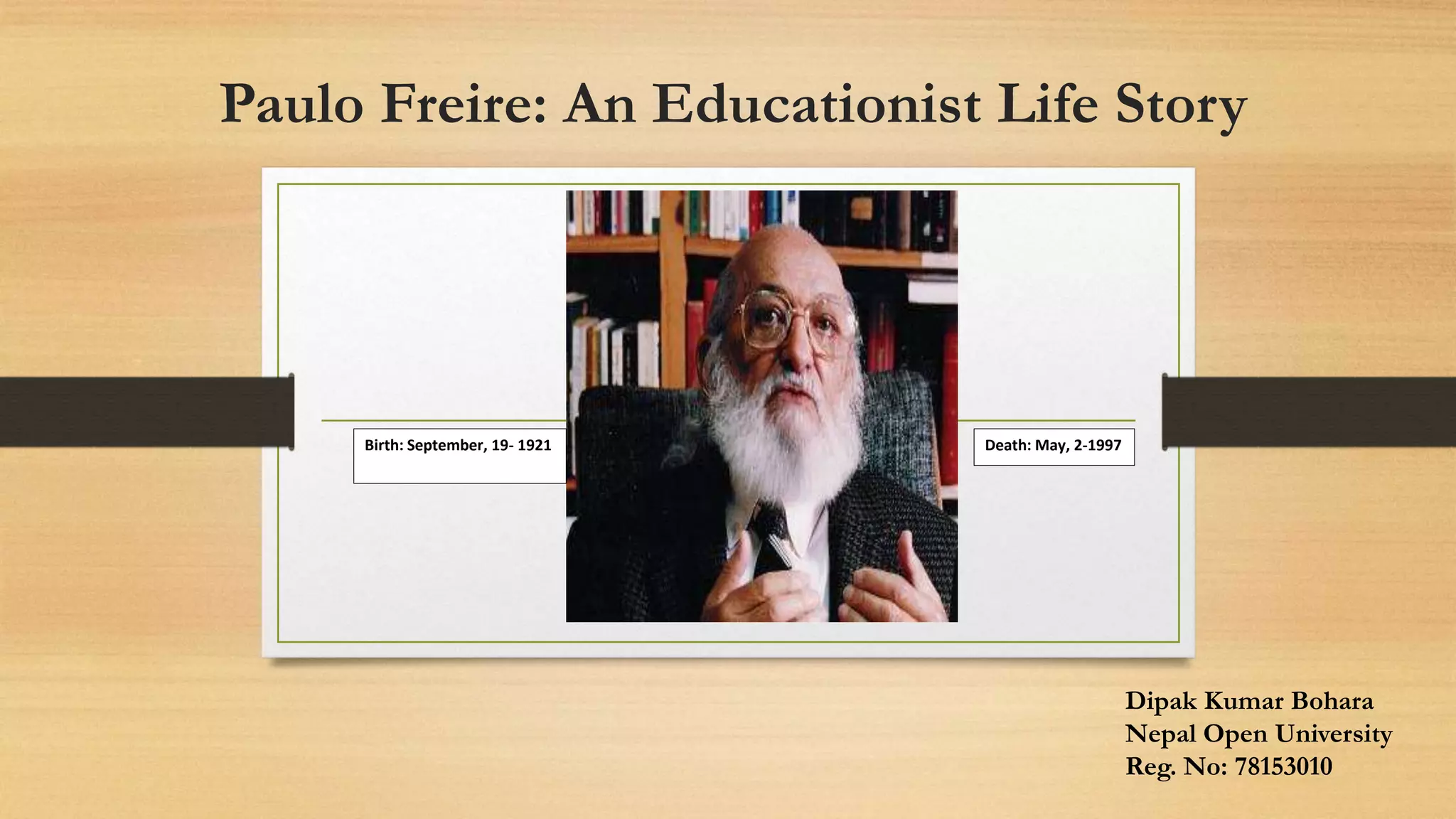
Paulo Freire: An Educationist Life Story
Dipak Kumar Bohara
Nepal Open University
Reg. No: 78153010
Birth: September, 19- 1921 Death: May, 2-1997
Childhood & Early Life:
• He was born into a middle-class family in Brazil in 1921. He was still a young boy
when the Great Depression of 1929 engulfed the world economy and he was
pushed into a life of poverty and hunger.
• His childhood experiences instilled in him empathy for the poor and less fortunate,
and he was deeply motivated to do something to make their lives better.
• Gradually his family’s fortunes improved and he was able to pursue higher
education at reputable institutions. He joined Law School at the University of Recife
in 1943. He also studied philosophy, and the psychology of language.
Paulo Freire: A Glimpse of his Life Story
Background:
Paulo Freire was a professor and philosopher known for his work with adult
illiterates and for promoting critical pedagogy, a theory and philosophy of
education. He believed that each student has a way of thinking critically and is
not just a passive recipient of knowledge or education from a teacher. He
studied the relationship between teaching and learning and endorsed that the
teacher should help students in developing freedom of thought that would
enable them to use their knowledge to take constructive action.
Career:
• He started working as a teacher of Portuguese upon his graduation. In spite of
being admitted to the legal bar he never practiced law.
• He published his first book ‘Education as the Practice of Freedom’ in 1967 and
followed it with his seminal work, ‘Pedagogy of the Oppressed’ in 1968, originally
in Portuguese. This book became very popular and was soon translated into other
languages like English and Spanish.
• He was offered a visiting professorship at Harvard University in 1969.
• He was appointed the special educational advisor to the Department of Education,
World Congress of Churches in Geneva, Switzerland in 1970. During this time he
advised former Portuguese colonies in Africa on educational reforms.
Major Works:
• His book ‘Pedagogy of the Oppressed’ is considered one of the
foundational texts of critical pedagogy. He advocates building a newer model
of relationship between the teacher, student and society. He proposed that
the learner in a teacher-student relationship should be treated as a co-creator
of knowledge and not as a passive recipient of knowledge.
• Freire’s work continued to live on, with the posthumous publication of
several books over the next decade: Pedagogy of Freedom, Teachers as
Cultural Workers, Politics and Education, Pedagogy of Indignation, and
Daring to Dream.
Freirean Pedagogy
• Freire was strongly opposed to banking education and offered an alternative
in the form of problem-posing education. Freire’s support for the former
had an ontological, epistemological, and political grounding. In seeing human
beings and knowledge as necessarily incomplete, as always in a process of
becoming, Freire recognized that while one problem was being addressed,
others would arise.
Reflection:
• By and large, Freire provided the inspiration for a fresh examination of
pedagogy and literacy and gave many educationists a model of how theory
and practice might dynamically be inter-twined.
Thank you so much.

Paulo Freire.pptx

  • 1.
    Paulo Freire: AnEducationist Life Story Dipak Kumar Bohara Nepal Open University Reg. No: 78153010 Birth: September, 19- 1921 Death: May, 2-1997
  • 2.
    Childhood & EarlyLife: • He was born into a middle-class family in Brazil in 1921. He was still a young boy when the Great Depression of 1929 engulfed the world economy and he was pushed into a life of poverty and hunger. • His childhood experiences instilled in him empathy for the poor and less fortunate, and he was deeply motivated to do something to make their lives better. • Gradually his family’s fortunes improved and he was able to pursue higher education at reputable institutions. He joined Law School at the University of Recife in 1943. He also studied philosophy, and the psychology of language.
  • 3.
    Paulo Freire: AGlimpse of his Life Story Background: Paulo Freire was a professor and philosopher known for his work with adult illiterates and for promoting critical pedagogy, a theory and philosophy of education. He believed that each student has a way of thinking critically and is not just a passive recipient of knowledge or education from a teacher. He studied the relationship between teaching and learning and endorsed that the teacher should help students in developing freedom of thought that would enable them to use their knowledge to take constructive action.
  • 4.
    Career: • He startedworking as a teacher of Portuguese upon his graduation. In spite of being admitted to the legal bar he never practiced law. • He published his first book ‘Education as the Practice of Freedom’ in 1967 and followed it with his seminal work, ‘Pedagogy of the Oppressed’ in 1968, originally in Portuguese. This book became very popular and was soon translated into other languages like English and Spanish. • He was offered a visiting professorship at Harvard University in 1969. • He was appointed the special educational advisor to the Department of Education, World Congress of Churches in Geneva, Switzerland in 1970. During this time he advised former Portuguese colonies in Africa on educational reforms.
  • 5.
    Major Works: • Hisbook ‘Pedagogy of the Oppressed’ is considered one of the foundational texts of critical pedagogy. He advocates building a newer model of relationship between the teacher, student and society. He proposed that the learner in a teacher-student relationship should be treated as a co-creator of knowledge and not as a passive recipient of knowledge. • Freire’s work continued to live on, with the posthumous publication of several books over the next decade: Pedagogy of Freedom, Teachers as Cultural Workers, Politics and Education, Pedagogy of Indignation, and Daring to Dream.
  • 6.
    Freirean Pedagogy • Freirewas strongly opposed to banking education and offered an alternative in the form of problem-posing education. Freire’s support for the former had an ontological, epistemological, and political grounding. In seeing human beings and knowledge as necessarily incomplete, as always in a process of becoming, Freire recognized that while one problem was being addressed, others would arise.
  • 7.
    Reflection: • By andlarge, Freire provided the inspiration for a fresh examination of pedagogy and literacy and gave many educationists a model of how theory and practice might dynamically be inter-twined.
  • 8.