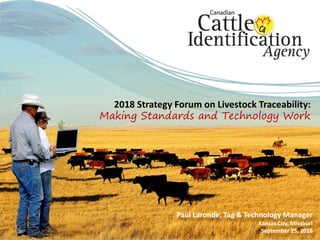
2018 Strategy Forum on Livestock Traceability:
Making Standards and Technology Work
Paul Laronde, Tag & Technology Manager
Kansas City, Missouri
September 25, 2018
Today’s Topics
• Traceability
• CCIA
• My background
• What is a standard
– The importance of standards
• Standards for livestock traceability in Canada
– NIDMAC
– Framework
• Technology statement
• International Standards Organization
– Low Frequency
– Ultra High Frequency
• Value of Standards
What is Traceability
Definition:
“The ability to follow an item or a group of items –
be it animal, plant, food product or ingredient –
from one point in the supply chain to another,
either backwards or forwards.”
Canadian Food Inspection Agency
3
Introduction
• Who is the Canadian Cattle Identification Agency?
– Responsible administrator for cattle, sheep, bison
– Goats & Cervids*
– Data management, data collection
– Tag program
– Transceiver program
4
Who is Paul Laronde
Background
– 25 years in animal ID and trace
– Trace coordinator for OMAFRA
– Tag & Technology Manager at
Canadian Cattle Identification Agency
– CA representative at ISO SC19/WG3 – Animal ID
5
What is a STANDARD
AND, how do standards help?
• Have you ever stopped to wonder why you can use your
bank card almost anywhere in the world?
• Or been thankful the dashboard symbols in the Japanese car
you have hired in Australia are the same as in your own
French car at home in Norway?
6
What is a STANDARD
AND, how do standards help?
• Or noticed you can watch video footage (MPEG)
delivered via the Internet on any of the computers and
devices you access?
• These and many other examples of convenience for
consumers in everyday life show why standards, especially
International Standards, are directly relevant to you.
https://www.iso.org/sites/ConsumersStandards/1_standards.html
7
What is a STANDARD
ISO/IEC Definition
“a document, established by consensus and approved
by a recognized body, that provides, for common and
repeated use, rules, guidelines or characteristics for
activities or their results, aimed at the achievement of
the optimum degree of order in a given context.”*
https://www.iso.org/sites/ConsumersStandards/1_standards.html
8
What is a STANDARD
In general terms,
Standards are voluntary agreements, developed
within an open process that gives all stakeholders,
including consumers, the opportunity to express
their views and have those views considered.
This contributes to their fairness and market
relevance, and promotes confidence in their use.*
https://www.iso.org/sites/ConsumersStandards/1_standards.html
9
STANDARDS in Canada
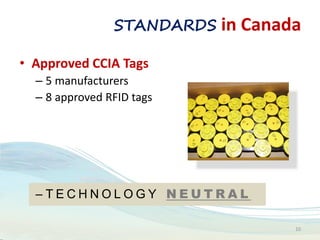
• Approved CCIA Tags
– 5 manufacturers
– 8 approved RFID tags
– T E C H N O L O G Y N E U T R A L
10
Approved Identifiers in Canada
11
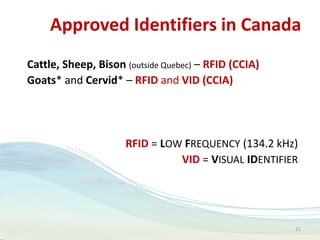
Cattle, Sheep, Bison (outside Quebec) – RFID (CCIA)
Goats* and Cervid* – RFID and VID (CCIA)
RFID = LOW FREQUENCY (134.2 kHz)
VID = VISUAL IDENTIFIER
STANDARDS in Canada1
12
1Livestock tag/identifier/indicator standards
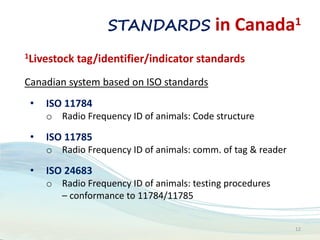
Canadian system based on ISO standards
• ISO 11784
o Radio Frequency ID of animals: Code structure
• ISO 11785
o Radio Frequency ID of animals: comm. of tag & reader
• ISO 24683
o Radio Frequency ID of animals: testing procedures
– conformance to 11784/11785
STANDARDS in Canada1
NIDMAC =
National Identification Device Methodology
Advisory Committee
• Joint government and industry committee
• Approval Framework =
Animal Identifier Approval and Revocation Framework
The framework is the BASIS
for approval of identifiers used in Canada
13
Standards in Canada
• Transceivers
– CCIA tests and ‘approves’ RFID reading equipment
– Internal standard
• Administered by Technical Advisory Committee
• Testing completed by competent testing lab
RFID Reader Standards, Procedures, and Testing Document
Radio Frequency Identification (RFID)
Version 8
April 2013
14
What about UHF?
• What is the Ultra High Frequency (928MHz)
Standard for livestock identification?
– In Canada?
– EPC Gen 2, ISO 18000-6?
15
What about UHF?
• ISO SC19/ WG3
– Project Team – Numbering Schemes for UHF
• 1-5 years away*
16
What is the VALUE of CA Standards?
How does this benefit the system?
– Provides a single platform for animal ID
• Tags, bolus, chips
– ensures consistency of essential features
• Quality
• Reliability
• Performance
• Compatibility
• Interoperability
• Efficiency
• Effectiveness
– Helps make the development, manufacturing and supply or devices
more efficient
17
What is the VALUE of CA Standards
18
Value Proposition
Allows a single technology/device across the system
• Lower cost
• Better/faster supply
Sets a minimum expectation for
• Performance
• Conformance
• Longevity
• Quality
What is the VALUE of CA Standards
Value Proposition
– Allows a process to test conformance and
performance of approved tags
• Keeps inferior tags/vendors out of the system
• Process to remove non-performing products
19
What is the VALUE of CA Standards
Confidence in the system
• governments
• industry
• manufacturers
20
QUESTIONS and DISCUSSION
© 2018 Canadian Cattle Identification Agency
All material in this presentation is the property of Canadian Cattle Identification Agency

Paul Laronde - Making Standards and Technology Work

  • 1.
    2018 Strategy Forumon Livestock Traceability: Making Standards and Technology Work Paul Laronde, Tag & Technology Manager Kansas City, Missouri September 25, 2018
  • 2.
    Today’s Topics • Traceability •CCIA • My background • What is a standard – The importance of standards • Standards for livestock traceability in Canada – NIDMAC – Framework • Technology statement • International Standards Organization – Low Frequency – Ultra High Frequency • Value of Standards
  • 3.
    What is Traceability Definition: “Theability to follow an item or a group of items – be it animal, plant, food product or ingredient – from one point in the supply chain to another, either backwards or forwards.” Canadian Food Inspection Agency 3
  • 4.
    Introduction • Who isthe Canadian Cattle Identification Agency? – Responsible administrator for cattle, sheep, bison – Goats & Cervids* – Data management, data collection – Tag program – Transceiver program 4
  • 5.
    Who is PaulLaronde Background – 25 years in animal ID and trace – Trace coordinator for OMAFRA – Tag & Technology Manager at Canadian Cattle Identification Agency – CA representative at ISO SC19/WG3 – Animal ID 5
  • 6.
    What is aSTANDARD AND, how do standards help? • Have you ever stopped to wonder why you can use your bank card almost anywhere in the world? • Or been thankful the dashboard symbols in the Japanese car you have hired in Australia are the same as in your own French car at home in Norway? 6
  • 7.
    What is aSTANDARD AND, how do standards help? • Or noticed you can watch video footage (MPEG) delivered via the Internet on any of the computers and devices you access? • These and many other examples of convenience for consumers in everyday life show why standards, especially International Standards, are directly relevant to you. https://www.iso.org/sites/ConsumersStandards/1_standards.html 7
  • 8.
    What is aSTANDARD ISO/IEC Definition “a document, established by consensus and approved by a recognized body, that provides, for common and repeated use, rules, guidelines or characteristics for activities or their results, aimed at the achievement of the optimum degree of order in a given context.”* https://www.iso.org/sites/ConsumersStandards/1_standards.html 8
  • 9.
    What is aSTANDARD In general terms, Standards are voluntary agreements, developed within an open process that gives all stakeholders, including consumers, the opportunity to express their views and have those views considered. This contributes to their fairness and market relevance, and promotes confidence in their use.* https://www.iso.org/sites/ConsumersStandards/1_standards.html 9
  • 10.
    STANDARDS in Canada •Approved CCIA Tags – 5 manufacturers – 8 approved RFID tags – T E C H N O L O G Y N E U T R A L 10
  • 11.
    Approved Identifiers inCanada 11 Cattle, Sheep, Bison (outside Quebec) – RFID (CCIA) Goats* and Cervid* – RFID and VID (CCIA) RFID = LOW FREQUENCY (134.2 kHz) VID = VISUAL IDENTIFIER
  • 12.
    STANDARDS in Canada1 12 1Livestocktag/identifier/indicator standards Canadian system based on ISO standards • ISO 11784 o Radio Frequency ID of animals: Code structure • ISO 11785 o Radio Frequency ID of animals: comm. of tag & reader • ISO 24683 o Radio Frequency ID of animals: testing procedures – conformance to 11784/11785
  • 13.
    STANDARDS in Canada1 NIDMAC= National Identification Device Methodology Advisory Committee • Joint government and industry committee • Approval Framework = Animal Identifier Approval and Revocation Framework The framework is the BASIS for approval of identifiers used in Canada 13
  • 14.
    Standards in Canada •Transceivers – CCIA tests and ‘approves’ RFID reading equipment – Internal standard • Administered by Technical Advisory Committee • Testing completed by competent testing lab RFID Reader Standards, Procedures, and Testing Document Radio Frequency Identification (RFID) Version 8 April 2013 14
  • 15.
    What about UHF? •What is the Ultra High Frequency (928MHz) Standard for livestock identification? – In Canada? – EPC Gen 2, ISO 18000-6? 15
  • 16.
    What about UHF? •ISO SC19/ WG3 – Project Team – Numbering Schemes for UHF • 1-5 years away* 16
  • 17.
    What is theVALUE of CA Standards? How does this benefit the system? – Provides a single platform for animal ID • Tags, bolus, chips – ensures consistency of essential features • Quality • Reliability • Performance • Compatibility • Interoperability • Efficiency • Effectiveness – Helps make the development, manufacturing and supply or devices more efficient 17
  • 18.
    What is theVALUE of CA Standards 18 Value Proposition Allows a single technology/device across the system • Lower cost • Better/faster supply Sets a minimum expectation for • Performance • Conformance • Longevity • Quality
  • 19.
    What is theVALUE of CA Standards Value Proposition – Allows a process to test conformance and performance of approved tags • Keeps inferior tags/vendors out of the system • Process to remove non-performing products 19
  • 20.
    What is theVALUE of CA Standards Confidence in the system • governments • industry • manufacturers 20
  • 21.
  • 22.
    © 2018 CanadianCattle Identification Agency All material in this presentation is the property of Canadian Cattle Identification Agency