Patterns and Sequences
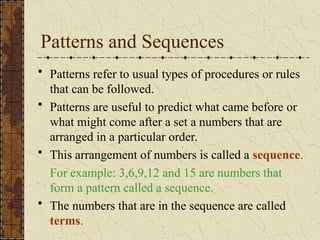
•Patterns refer to usual types of procedures or rules
that can be followed.
• Patterns are useful to predict what came before or
what might come after a set a numbers that are
arranged in a particular order.
• This arrangement of numbers is called a sequence.
For example: 3,6,9,12 and 15 are numbers that
form a pattern called a sequence.
• The numbers that are in the sequence are called
terms.
3.
Patterns and Sequences
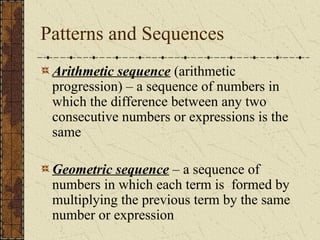
Arithmeticsequence (arithmetic
progression) – a sequence of numbers in
which the difference between any two
consecutive numbers or expressions is the
same
Geometric sequence – a sequence of
numbers in which each term is formed by
multiplying the previous term by the same
number or expression
4.
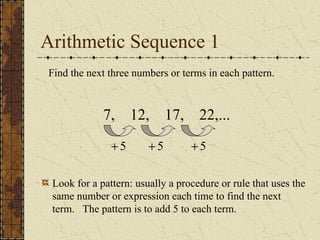
Arithmetic Sequence 1
Findthe next three numbers or terms in each pattern.
7, 12, 17, 22,...
5
+ 5
+
5
+
Look for a pattern: usually a procedure or rule that uses the
same number or expression each time to find the next
term. The pattern is to add 5 to each term.
5.
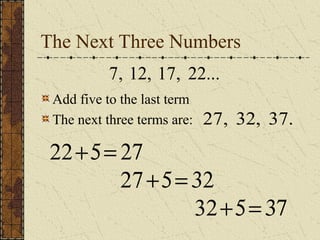
The Next ThreeNumbers
7, 12, 17, 22...
27+5=32
27, 32, 37.
Add five to the last term
The next three terms are:
22+5= 27
32+5=37
6.
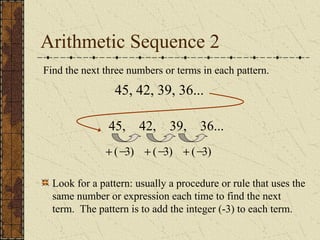
Arithmetic Sequence 2
Findthe next three numbers or terms in each pattern.
45, 42, 39, 36...
45, 42, 39, 36...
)
3
(−
+
Look for a pattern: usually a procedure or rule that uses the
same number or expression each time to find the next
term. The pattern is to add the integer (-3) to each term.
)
3
(−
+
)
3
(−
+
7.
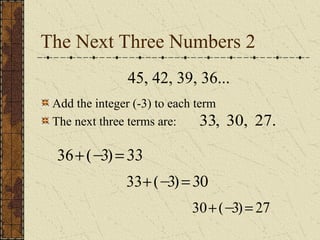
The Next ThreeNumbers 2
36+(−
3)=33
33+(−
3)=30
30+(−
3)= 27
45, 42, 39, 36...
33, 30, 27.
Add the integer (-3) to each term
The next three terms are:
8.
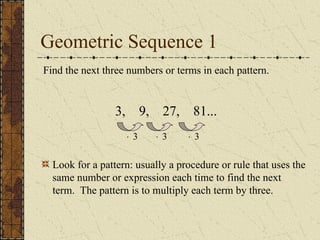
Geometric Sequence 1
Findthe next three numbers or terms in each pattern.
3, 9, 27, 81...
3
× 3
× 3
×
Look for a pattern: usually a procedure or rule that uses the
same number or expression each time to find the next
term. The pattern is to multiply each term by three.
9.
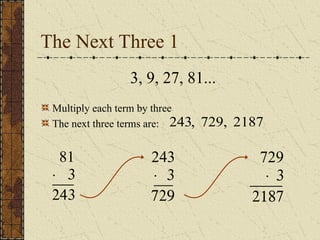
The Next Three1
81
× 3
243
243
× 3
729
729
× 3
2187
3, 9, 27, 81...
243, 729, 2187
Multiply each term by three
The next three terms are:
10.
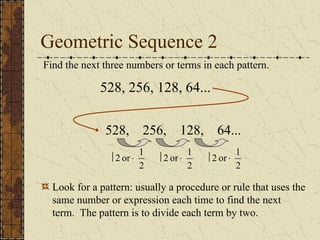
Geometric Sequence 2
Findthe next three numbers or terms in each pattern.
528, 256, 128, 64...
528, 256, 128, 64...
2
1
or
2 ×
÷
Look for a pattern: usually a procedure or rule that uses the
same number or expression each time to find the next
term. The pattern is to divide each term by two.
2
1
or
2 ×
÷
2
1
or
2 ×
÷
11.
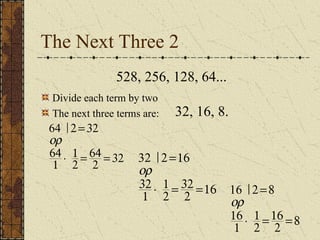
The Next Three2
528, 256, 128, 64...
64÷ 2=32
or
64
1
× 1
2
= 64
2
=32 32÷ 2=16
or
32
1
× 1
2
= 32
2
=16 16÷ 2=8
or
16
1
× 1
2
=16
2
=8
32, 16, 8.
Divide each term by two
The next three terms are:
12.
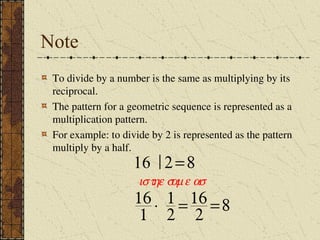
Note
16÷ 2=8
isthe s
ameas
16
1
× 1
2
=16
2
=8
To divide by a number is the same as multiplying by its
reciprocal.
The pattern for a geometric sequence is represented as a
multiplication pattern.
For example: to divide by 2 is represented as the pattern
multiply by a half.
13.
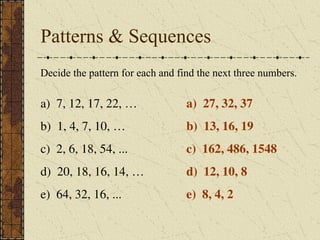
Patterns & Sequences
Decidethe pattern for each and find the next three numbers.
a) 7, 12, 17, 22, …
b) 1, 4, 7, 10, …
c) 2, 6, 18, 54, ...
d) 20, 18, 16, 14, …
e) 64, 32, 16, ...
a) 27, 32, 37
b) 13, 16, 19
c) 162, 486, 1548
d) 12, 10, 8
e) 8, 4, 2