Mathematics 10
SEQUENCE
Introduction
Mr. Rosilito E. Gonzales
PRAYER
Dear Lord, we thank You a hundredfold for
the love and care that You have given us.
May we in return to You, Your good works,
multiply it with love and respect. Add
more faith. Subtract the unworldly
behavior and evil works but divide Your
given talents to others. And to sum it
all may we be united in Your family. In this
we pray,
Amen.
OBJECTIVES:
In this lesson, you will learn to:
 Define sequence
 Differentiate finite and infinite sequence
 Discover and complete a pattern or sequence
 Find the nth term of a sequence
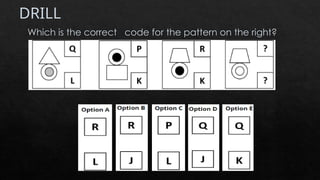
DRILL
Which is the correct code for the pattern on the right?
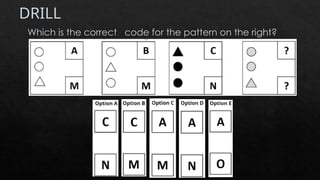
DRILL
Which is the correct code for the pattern on the right?
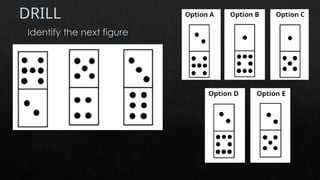
DRILL
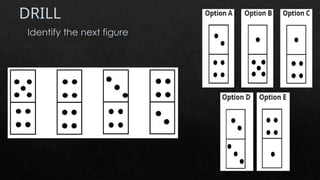
Identify the next figure
DRILL
Identify the next figure
Activity 1: “Getting ready for school”
Arrange the illustrations according to your daily morning routine on a
regular school day.
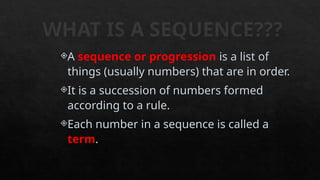
WHAT IS A SEQUENCE???
A sequence or progression is a list of
things (usually numbers) that are in order.
It is a succession of numbers formed
according to a rule.
Each number in a sequence is called a
term.
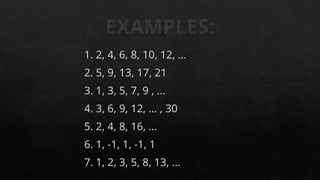
EXAMPLES:
1. 2, 4, 6, 8, 10, 12, …
2. 5, 9, 13, 17, 21
3. 1, 3, 5, 7, 9 , ...
4. 3, 6, 9, 12, ... , 30
5. 2, 4, 8, 16, ...
6. 1, -1, 1, -1, 1
7. 1, 2, 3, 5, 8, 13, ...
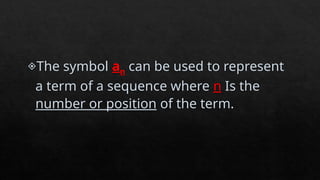
The symbol an can be used to represent
a term of a sequence where n Is the
number or position of the term.
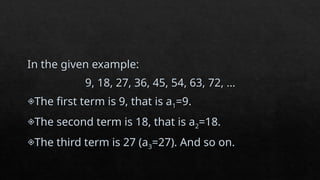
In the given example:
9, 18, 27, 36, 45, 54, 63, 72, …
The first term is 9, that is a1=9.
The second term is 18, that is a2=18.
The third term is 27 (a3=27). And so on.
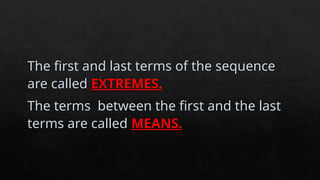
The first and last terms of the sequence
are called EXTREMES.
The terms between the first and the last
terms are called MEANS.
REMEMBER ALSO:
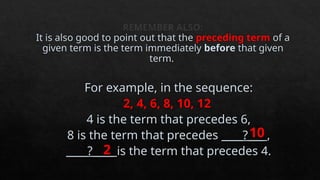
It is also good to point out that the preceding term of a
given term is the term immediately before that given
term.
For example, in the sequence:
2, 4, 6, 8, 10, 12
4 is the term that precedes 6,
8 is the term that precedes ____?___ ,
____?____ is the term that precedes 4.
10
2
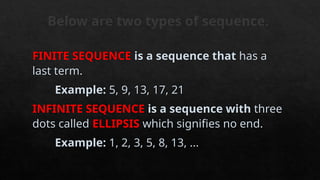
Below are two types of sequence.
FINITE SEQUENCE is a sequence that has a
last term.
Example: 5, 9, 13, 17, 21
INFINITE SEQUENCE is a sequence with three
dots called ELLIPSIS which signifies no end.
Example: 1, 2, 3, 5, 8, 13, ...
Practical Applications
Financial Planning:
Savings Plans: When saving money, people often add a fixed
amount each month. This creates an arithmetic sequence.
For example, if you save $100 every month, your total
savings after each month will form a sequence: $100, $200,
$300, etc. Understanding this helps in predicting future
savings.
Loan Payments: When repaying a loan, understanding the
pattern of payments (which may involve both arithmetic and
geometric sequences) helps in managing finances better.
Scheduling and Time Management:
Exercise Routines: If you increase your workout time by a
fixed amount each week, it forms an arithmetic sequence.
For instance, if you start with 10 minutes and increase by 5
minutes each week, your workout times will be: 10, 15, 20,
etc.
Study Plans: Setting study goals with incremental increases
can also form sequences. If a student starts with 30
minutes of study and increases by 10 minutes each day, the
study time will form a sequence: 30, 40, 50, etc.
Pattern Recognition in Nature:
Natural Patterns: Many natural phenomena follow
sequences and patterns. For instance, the
arrangement of leaves around a stem (phyllotaxis)
often follows the Fibonacci sequence, which is a type
of sequence where each term is the sum of the two
preceding ones.
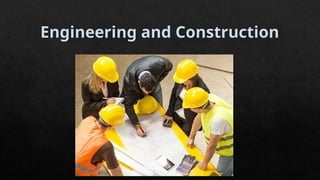
Engineering and Construction
Engineering and Construction:
Building Design: Architects and engineers often use
sequences in design and construction. For example, the
placement of windows or steps in a staircase can follow
specific numerical patterns to ensure structural
integrity and aesthetic appeal.
Material Estimation: When constructing something with
repeated elements, like tiles on a floor or bricks in a
wall, understanding sequences helps in estimating the
total amount of materials needed.
Computer Science and
Technology
Computer Science and Technology:
Algorithm Design: Many algorithms in computer
science are based on sequences and patterns.
Understanding these concepts is crucial for
programming and developing efficient code.
Data Analysis: Identifying patterns in data, such as
trends or cycles, is essential in fields like data science
and analytics. This can involve recognizing numerical
sequences in datasets.
Health and Medicine
Health and Medicine:
Medication Dosage: Some medication schedules
follow a sequence. For example, a doctor might
prescribe a tapering dosage where the amount of
medication is reduced by a fixed amount each day.
Growth Tracking: Tracking the growth of children,
plants, or even investments often involves
recognizing and predicting patterns.
LET’S TRY IT!
Given at least the first three terms of
sequence, you can easily find the next
term in that sequence by simply
discovering a pattern as to how the 3rd
term is derived from the 2nd
term, and the
2nd
term from the 1st
term. You will find
that a constant number is either added
or subtracted or multiplied or divided to
get the next term.
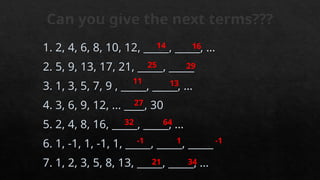
Can you give the next terms???
1. 2, 4, 6, 8, 10, 12, _____, _____, …
2. 5, 9, 13, 17, 21, _____, _____
3. 1, 3, 5, 7, 9 , _____, _____, …
4. 3, 6, 9, 12, ... ____, 30
5. 2, 4, 8, 16, _____, _____, …
6. 1, -1, 1, -1, 1, _____, _____, _____
7. 1, 2, 3, 5, 8, 13, _____, _____, …
14 16
11
29
25
13
32
27
64
1 -1
-1
34
21
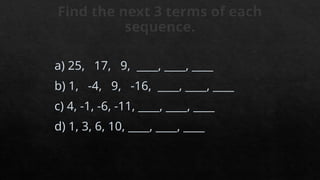
Find the next 3 terms of each
sequence.
a) 25, 17, 9, ____, ____, ____
b) 1, -4, 9, -16, ____, ____, ____
c) 4, -1, -6, -11, ____, ____, ____
d) 1, 3, 6, 10, ____, ____, ____
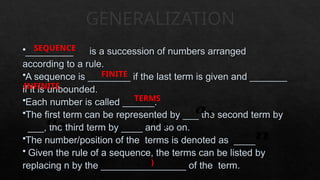
GENERALIZATION
•_________ is a succession of numbers arranged
according to a rule.
•A sequence is ________ if the last term is given and _______
if it is unbounded.
•Each number is called ______.
•The first term can be represented by ___ the second term by
___, the third term by ____ and so on.
•The number/position of the terms is denoted as ____
• Given the rule of a sequence, the terms can be listed by
replacing n by the ________________ of the term.
SEQUENCE
TERMS
FINITE
INFINITE
)
𝒂𝟑
𝒂𝟐
𝒂𝟏
𝒏
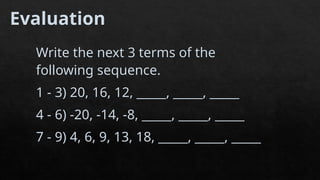
Evaluation
Write the next 3 terms of the
following sequence.
1 - 3) 20, 16, 12, _____, _____, _____
4 - 6) -20, -14, -8, _____, _____, _____
7 - 9) 4, 6, 9, 13, 18, _____, _____, _____
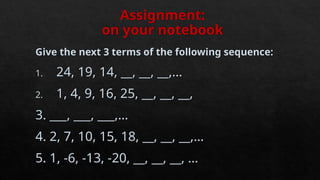
Assignment:
on your notebook
Give the next 3 terms of the following sequence:
1. 24, 19, 14, __, __, __,…
2. 1, 4, 9, 16, 25, __, __, __,
3. ___, ___, ___,…
4. 2, 7, 10, 15, 18, __, __, __,…
5. 1, -6, -13, -20, __, __, __, …
Thank you for listening!

introduction about sequence for grade 10

  • 1.
  • 2.
    PRAYER Dear Lord, wethank You a hundredfold for the love and care that You have given us. May we in return to You, Your good works, multiply it with love and respect. Add more faith. Subtract the unworldly behavior and evil works but divide Your given talents to others. And to sum it all may we be united in Your family. In this we pray, Amen.
  • 3.
    OBJECTIVES: In this lesson,you will learn to:  Define sequence  Differentiate finite and infinite sequence  Discover and complete a pattern or sequence  Find the nth term of a sequence
  • 4.
    DRILL Which is thecorrect code for the pattern on the right?
  • 5.
    DRILL Which is thecorrect code for the pattern on the right?
  • 6.
  • 7.
  • 8.
    Activity 1: “Gettingready for school” Arrange the illustrations according to your daily morning routine on a regular school day.
  • 9.
    WHAT IS ASEQUENCE??? A sequence or progression is a list of things (usually numbers) that are in order. It is a succession of numbers formed according to a rule. Each number in a sequence is called a term.
  • 10.
    EXAMPLES: 1. 2, 4,6, 8, 10, 12, … 2. 5, 9, 13, 17, 21 3. 1, 3, 5, 7, 9 , ... 4. 3, 6, 9, 12, ... , 30 5. 2, 4, 8, 16, ... 6. 1, -1, 1, -1, 1 7. 1, 2, 3, 5, 8, 13, ...
  • 11.
    The symbol ancan be used to represent a term of a sequence where n Is the number or position of the term.
  • 12.
    In the givenexample: 9, 18, 27, 36, 45, 54, 63, 72, … The first term is 9, that is a1=9. The second term is 18, that is a2=18. The third term is 27 (a3=27). And so on.
  • 13.
    The first andlast terms of the sequence are called EXTREMES. The terms between the first and the last terms are called MEANS.
  • 14.
    REMEMBER ALSO: It isalso good to point out that the preceding term of a given term is the term immediately before that given term. For example, in the sequence: 2, 4, 6, 8, 10, 12 4 is the term that precedes 6, 8 is the term that precedes ____?___ , ____?____ is the term that precedes 4. 10 2
  • 15.
    Below are twotypes of sequence. FINITE SEQUENCE is a sequence that has a last term. Example: 5, 9, 13, 17, 21 INFINITE SEQUENCE is a sequence with three dots called ELLIPSIS which signifies no end. Example: 1, 2, 3, 5, 8, 13, ...
  • 16.
  • 18.
    Financial Planning: Savings Plans:When saving money, people often add a fixed amount each month. This creates an arithmetic sequence. For example, if you save $100 every month, your total savings after each month will form a sequence: $100, $200, $300, etc. Understanding this helps in predicting future savings. Loan Payments: When repaying a loan, understanding the pattern of payments (which may involve both arithmetic and geometric sequences) helps in managing finances better.
  • 19.
  • 20.
    Scheduling and TimeManagement: Exercise Routines: If you increase your workout time by a fixed amount each week, it forms an arithmetic sequence. For instance, if you start with 10 minutes and increase by 5 minutes each week, your workout times will be: 10, 15, 20, etc. Study Plans: Setting study goals with incremental increases can also form sequences. If a student starts with 30 minutes of study and increases by 10 minutes each day, the study time will form a sequence: 30, 40, 50, etc.
  • 22.
    Pattern Recognition inNature: Natural Patterns: Many natural phenomena follow sequences and patterns. For instance, the arrangement of leaves around a stem (phyllotaxis) often follows the Fibonacci sequence, which is a type of sequence where each term is the sum of the two preceding ones.
  • 23.
  • 24.
    Engineering and Construction: BuildingDesign: Architects and engineers often use sequences in design and construction. For example, the placement of windows or steps in a staircase can follow specific numerical patterns to ensure structural integrity and aesthetic appeal. Material Estimation: When constructing something with repeated elements, like tiles on a floor or bricks in a wall, understanding sequences helps in estimating the total amount of materials needed.
  • 25.
  • 26.
    Computer Science andTechnology: Algorithm Design: Many algorithms in computer science are based on sequences and patterns. Understanding these concepts is crucial for programming and developing efficient code. Data Analysis: Identifying patterns in data, such as trends or cycles, is essential in fields like data science and analytics. This can involve recognizing numerical sequences in datasets.
  • 27.
  • 28.
    Health and Medicine: MedicationDosage: Some medication schedules follow a sequence. For example, a doctor might prescribe a tapering dosage where the amount of medication is reduced by a fixed amount each day. Growth Tracking: Tracking the growth of children, plants, or even investments often involves recognizing and predicting patterns.
  • 29.
  • 30.
    Given at leastthe first three terms of sequence, you can easily find the next term in that sequence by simply discovering a pattern as to how the 3rd term is derived from the 2nd term, and the 2nd term from the 1st term. You will find that a constant number is either added or subtracted or multiplied or divided to get the next term.
  • 31.
    Can you givethe next terms??? 1. 2, 4, 6, 8, 10, 12, _____, _____, … 2. 5, 9, 13, 17, 21, _____, _____ 3. 1, 3, 5, 7, 9 , _____, _____, … 4. 3, 6, 9, 12, ... ____, 30 5. 2, 4, 8, 16, _____, _____, … 6. 1, -1, 1, -1, 1, _____, _____, _____ 7. 1, 2, 3, 5, 8, 13, _____, _____, … 14 16 11 29 25 13 32 27 64 1 -1 -1 34 21
  • 32.
    Find the next3 terms of each sequence. a) 25, 17, 9, ____, ____, ____ b) 1, -4, 9, -16, ____, ____, ____ c) 4, -1, -6, -11, ____, ____, ____ d) 1, 3, 6, 10, ____, ____, ____
  • 33.
    GENERALIZATION •_________ is asuccession of numbers arranged according to a rule. •A sequence is ________ if the last term is given and _______ if it is unbounded. •Each number is called ______. •The first term can be represented by ___ the second term by ___, the third term by ____ and so on. •The number/position of the terms is denoted as ____ • Given the rule of a sequence, the terms can be listed by replacing n by the ________________ of the term. SEQUENCE TERMS FINITE INFINITE ) 𝒂𝟑 𝒂𝟐 𝒂𝟏 𝒏
  • 34.
    Evaluation Write the next3 terms of the following sequence. 1 - 3) 20, 16, 12, _____, _____, _____ 4 - 6) -20, -14, -8, _____, _____, _____ 7 - 9) 4, 6, 9, 13, 18, _____, _____, _____
  • 35.
    Assignment: on your notebook Givethe next 3 terms of the following sequence: 1. 24, 19, 14, __, __, __,… 2. 1, 4, 9, 16, 25, __, __, __, 3. ___, ___, ___,… 4. 2, 7, 10, 15, 18, __, __, __,… 5. 1, -6, -13, -20, __, __, __, …
  • 36.
    Thank you forlistening!