Quantity Surveying
and Construction
Assessment of Professional Competence


                            rics.org/pathwayguides
Published by: RICS, Parliament Square, London SW1P 3AD


All rights in this publication, including full copyright or publishing right, content and design, are owned by RICS,
except where otherwise described. Any dispute arising out of this publication is subject to the law and jurisdiction
of England and Wales.


 02    QUANTITY SURVEYING AND CONSTRUCTION
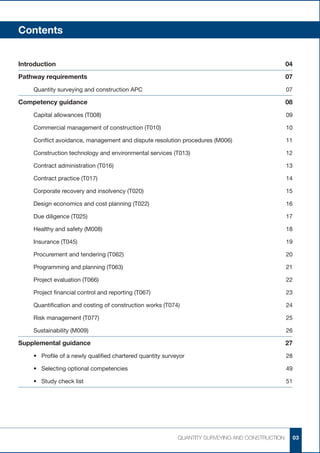
Contents


Introduction	04
Pathway requirements	                                                                              07
    Quantity surveying and construction APC	                                                       07

Competency guidance	                                                                               08
    Capital allowances (T008)	                                                                     09

    Commercial management of construction (T010)	                                                  10

    Conflict avoidance, management and dispute resolution procedures (M006)	                       11

    Construction technology and environmental services (T013)	                                     12

    Contract administration (T016)	                                                                13

    Contract practice (T017)	                                                                      14

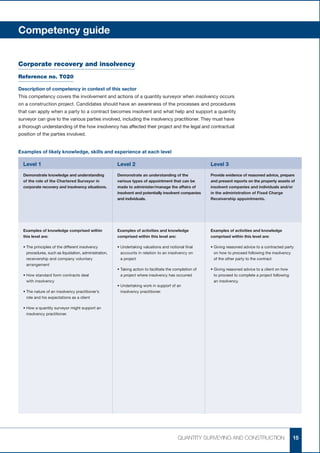
    Corporate recovery and insolvency (T020)	                                                      15

    Design economics and cost planning (T022)	                                                     16

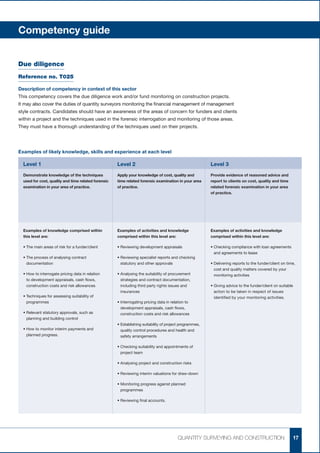
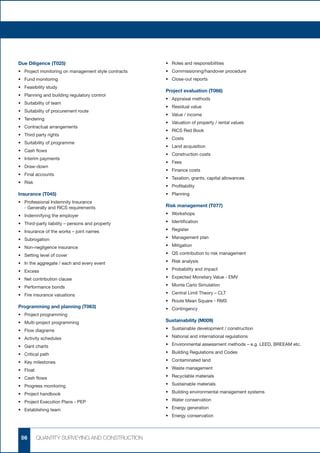
    Due diligence (T025)	                                                                          17

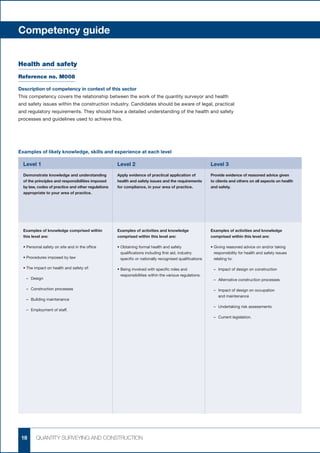
    Healthy and safety (M008)	                                                                     18

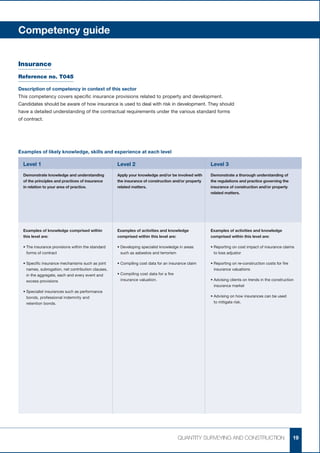
    Insurance (T045)	                                                                              19

    Procurement and tendering (T062)	                                                              20

    Programming and planning (T063)	                                                               21

    Project evaluation (T066)	                                                                     22

    Project financial control and reporting (T067)	                                                23

    Quantification and costing of construction works (T074)	                                       24

    Risk management (T077)	                                                                        25

    Sustainability (M009)	                                                                         26

Supplemental guidance	                                                                             27
    •	 Profile of a newly qualified chartered quantity surveyor 	                                  28

    •	 Selecting optional competencies	                                                            49

    •	 Study check list	                                                                           51


                                                             QUANTITY SURVEYING AND CONSTRUCTION        03
Introduction


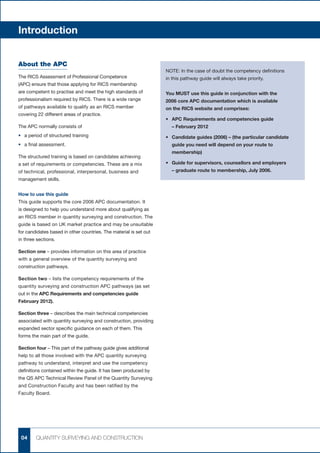
About the APC
                                                                   NOTE: In the case of doubt the competency definitions
The RICS Assessment of Professional Competence                     in this pathway guide will always take priority.
(APC) ensure that those applying for RICS membership
are competent to practise and meet the high standards of           You MUST use this guide in conjunction with the
professionalism required by RICS. There is a wide range            2006 core APC documentation which is available
of pathways available to qualify as an RICS member                 on the RICS website and comprises:
covering 22 different areas of practice.
                                                                   •	 
                                                                      APC Requirements and competencies guide
The APC normally consists of                                         – February 2012
•	 a period of structured training                                 •	  andidate guides (2006) – (the particular candidate
                                                                      C
•	 a final assessment.                                               guide you need will depend on your route to
                                                                     membership)
The structured training is based on candidates achieving
a set of requirements or competencies. These are a mix             •	  uide for supervisors, counsellors and employers
                                                                      G
of technical, professional, interpersonal, business and              – graduate route to membership, July 2006.
management skills.


How to use this guide
This guide supports the core 2006 APC documentation. It
is designed to help you understand more about qualifying as
an RICS member in quantity surveying and construction. The
guide is based on UK market practice and may be unsuitable
for candidates based in other countries. The material is set out
in three sections.

Section one – provides information on this area of practice
with a general overview of the quantity surveying and
construction pathways.

Section two – lists the competency requirements of the
quantity surveying and construction APC pathways (as set
out in the APC Requirements and competencies guide
February 2012).

Section three – describes the main technical competencies
associated with quantity surveying and construction, providing
expanded sector specific guidance on each of them. This
forms the main part of the guide.

Section four – This part of the pathway guide gives additional
help to all those involved with the APC quantity surveying
pathway to understand, interpret and use the competency
definitions contained within the guide. It has been produced by
the QS APC Technical Review Panel of the Quantity Surveying
and Construction Faculty and has been ratified by the
Faculty Board.


 04     QUANTITY SURVEYING AND CONSTRUCTION
Introduction


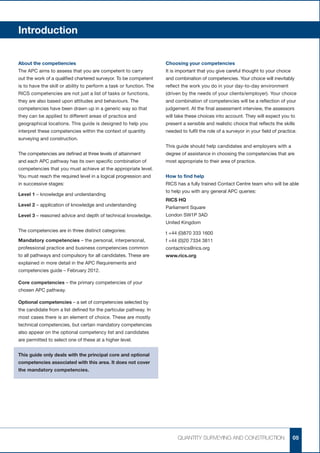
About the competiencies                                              Choosing your competencies
The APC aims to assess that you are competent to carry               It is important that you give careful thought to your choice
out the work of a qualified chartered surveyor. To be competent      and combination of competencies. Your choice will inevitably
is to have the skill or ability to perform a task or function. The   reflect the work you do in your day-to-day environment
RICS competencies are not just a list of tasks or functions,         (driven by the needs of your clients/employer). Your choice
they are also based upon attitudes and behaviours. The               and combination of competencies will be a reflection of your
competencies have been drawn up in a generic way so that             judgement. At the final assessment interview, the assessors
they can be applied to different areas of practice and               will take these choices into account. They will expect you to
geographical locations. This guide is designed to help you           present a sensible and realistic choice that reflects the skills
interpret these competencies within the context of quantity          needed to fulfil the role of a surveyor in your field of practice.
surveying and construction.
                                                                     This guide should help candidates and employers with a
The competencies are defined at three levels of attainment           degree of assistance in choosing the competencies that are
and each APC pathway has its own specific combination of             most appropriate to their area of practice.
competencies that you must achieve at the appropriate level.
You must reach the required level in a logical progression and       How to find help
in successive stages:                                                RICS has a fully trained Contact Centre team who will be able
                                                                     to help you with any general APC queries:
Level 1 – knowledge and understanding
                                                                     RICS HQ
Level 2 – application of knowledge and understanding
                                                                     Parliament Square
Level 3 – reasoned advice and depth of technical knowledge.          London SW1P 3AD
                                                                     United Kingdom
The competencies are in three distinct categories:
                                                                     t +44 (0)870 333 1600
Mandatory competencies – the personal, interpersonal,                f +44 (0)20 7334 3811
professional practice and business competencies common               contactrics@rics.org
to all pathways and compulsory for all candidates. These are         www.rics.org
explained in more detail in the APC Requirements and
competencies guide – February 2012.

Core competencies – the primary competencies of your
chosen APC pathway.

Optional competencies – a set of competencies selected by
the candidate from a list defined for the particular pathway. In
most cases there is an element of choice. These are mostly
technical competencies, but certain mandatory competencies
also appear on the optional competency list and candidates
are permitted to select one of these at a higher level.


This guide only deals with the principal core and optional
competencies associated with this area. It does not cover
the mandatory competencies.


                                                                           QUANTITY SURVEYING AND CONSTRUCTION                       05
Introduction


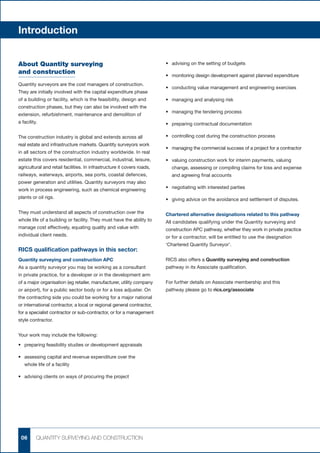
About Quantity surveying                                                 •	 advising on the setting of budgets
and construction                                                         •	  onitoring design development against planned expenditure
                                                                            m
Quantity surveyors are the cost managers of construction.
                                                                         •	 conducting value management and engineering exercises
They are initially involved with the capital expenditure phase
of a building or facility, which is the feasibility, design and          •	 managing and analysing risk
construction phases, but they can also be involved with the
                                                                         •	 managing the tendering process
extension, refurbishment, maintenance and demolition of
a facility.                                                              •	 preparing contractual documentation

The construction industry is global and extends across all               •	 controlling cost during the construction process
real estate and infrastructure markets. Quantity surveyors work
                                                                         •	  anaging the commercial success of a project for a contractor
                                                                            m
in all sectors of the construction industry worldwide. In real
estate this covers residential, commercial, industrial, leisure,         •	  aluing construction work for interim payments, valuing
                                                                            v
agricultural and retail facilities. In infrastructure it covers roads,     change, assessing or compiling claims for loss and expense
railways, waterways, airports, sea ports, coastal defences,                and agreeing final accounts
power generation and utilities. Quantity surveyors may also
                                                                         •	 negotiating with interested parties
work in process engineering, such as chemical engineering
plants or oil rigs.                                                      •	 giving advice on the avoidance and settlement of disputes.

They must understand all aspects of construction over the                Chartered alternative designations related to this pathway
whole life of a building or facility. They must have the ability to      All candidates qualifying under the Quantity surveying and
manage cost effectively, equating quality and value with                 construction APC pathway, whether they work in private practice
individual client needs.                                                 or for a contractor, will be entitled to use the designation
                                                                         ‘Chartered Quantity Surveyor’.
RICS qualification pathways in this sector:
Quantity surveying and construction APC                                  RICS also offers a Quantity surveying and construction
As a quantity surveyor you may be working as a consultant                pathway in its Associate qualification.
in private practice, for a developer or in the development arm
of a major organisation (eg retailer, manufacturer, utility company      For further details on Associate membership and this
or airport), for a public sector body or for a loss adjuster. On         pathway please go to rics.org/associate
the contracting side you could be working for a major national
or international contractor, a local or regional general contractor,
for a specialist contractor or sub-contractor, or for a management
style contractor.


Your work may include the following:

•	 preparing feasibility studies or development appraisals

•	  ssessing capital and revenue expenditure over the
   a
   whole life of a facility

•	 advising clients on ways of procuring the project


 06       QUANTITY SURVEYING AND CONSTRUCTION
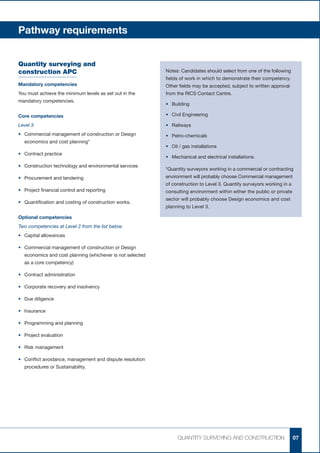
Pathway requirements


Quantity surveying and
construction APC                                           Notes: Candidates should select from one of the following
                                                           fields of work in which to demonstrate their competency.
Mandatory competencies                                     Other fields may be accepted, subject to written approval
You must achieve the minimum levels as set out in the      from the RICS Contact Centre.
mandatory competencies.
                                                           •	Building

Core competencies                                          •	 Civil Engineering

Level 3                                                    •	Railways
•	
  Commercial management of construction or Design          •	Petro-chemicals
  economics and cost planning*
                                                           •	 Oil / gas installations
•	 Contract practice
                                                           •	 Mechanical and electrical installations.
•	 Construction technology and environmental services
                                                           *Quantity surveyors working in a commercial or contracting
•	 Procurement and tendering                               environment will probably choose Commercial management
                                                           of construction to Level 3. Quantity surveyors working in a
•	 Project financial control and reporting                 consulting environment within either the public or private
                                                           sector will probably choose Design economics and cost
•	 Quantification and costing of construction works.
                                                           planning to Level 3.

Optional competencies
Two competencies at Level 2 from the list below.
•	 Capital allowances

•	
  Commercial management of construction or Design
  economics and cost planning (whichever is not selected
  as a core competency)

•	 Contract administration

•	 Corporate recovery and insolvency

•	 Due diligence

•	Insurance

•	 Programming and planning

•	 Project evaluation

•	 Risk management

•	
  Conflict avoidance, management and dispute resolution
  procedures or Sustainability.


                                                                 QUANTITY SURVEYING AND CONSTRUCTION                     07
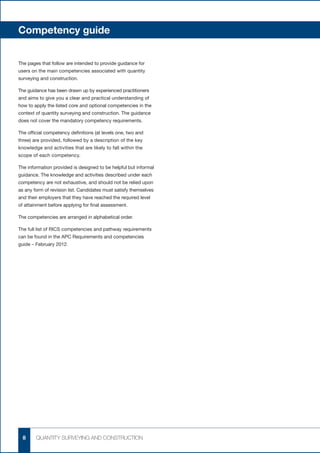
Competency guide


The pages that follow are intended to provide guidance for
users on the main competencies associated with quantity
surveying and construction.

The guidance has been drawn up by experienced practitioners
and aims to give you a clear and practical understanding of
how to apply the listed core and optional competencies in the
context of quantity surveying and construction. The guidance
does not cover the mandatory competency requirements.

The official competency definitions (at levels one, two and
three) are provided, followed by a description of the key
knowledge and activities that are likely to fall within the
scope of each competency.

The information provided is designed to be helpful but informal
guidance. The knowledge and activities described under each
competency are not exhaustive, and should not be relied upon
as any form of revision list. Candidates must satisfy themselves
and their employers that they have reached the required level
of attainment before applying for final assessment.

The competencies are arranged in alphabetical order.

The full list of RICS competencies and pathway requirements
can be found in the APC Requirements and competencies
guide – February 2012.


  8     QUANTITY SURVEYING AND CONSTRUCTION                        08
Competency guide


Capital allowances
Reference no. T008

Description of competency in context of this sector
This competency covers the taxation incentives/capital allowances available on property and structures
in order to prepare claims and give advice to clients. Candidates should have an awareness of the
various types of capital allowance that are available in accordance with capital allowances legislation.
They should have a thorough understanding of types used on their projects.


Examples of likely knowledge, skills and experience at each level

    Level 1                                             Level 2	                                         Level 3	
    Demonstrate knowledge and understanding             Apply knowledge of capital allowances and        Provide evidence of giving reasoned advice;
    of capital allowances and grants.                   grants, including the ability to use source      preparing claims; making applications for
                                                        documents necessary to prepare taxation          grants; preparing and presenting reports to
                                                        allowances analyses.                             clients; and corresponding and negotiating
                                                                                                         with the relevant government and
                                                                                                         other authorities.


    Examples of knowledge comprised within              Examples of activities and knowledge             Examples of activities and knowledge
    this level are:                                     comprised within this level are:                 comprised within this level are:

    •	 he definition of capital allowances and the
      T                                                 •	 ollecting the relevant documentation to
                                                          C                                              •	 reparing and presenting reports and
                                                                                                           P
      history behind their existence                      prepare a claim relating to the type of          documentation
                                                          transaction. For acquisitions this might
    •	The client types that they apply to                 include sale agreements, valuation reports,    •	 roviding advice on issues affecting
                                                                                                           P
                                                          ledgers, drawings and specifications. For        acquisitions, disposals and developments
    •	 he main types of capital allowances available
      T
                                                          developments this might include ledgers,
      relating to property, including plant and                                                          •	 iving advice on the effect and interaction
                                                                                                           G
                                                          building contracts, final accounts, invoices
      machinery, industrial building allowances,                                                           of capital allowances, general taxation and
      hotel allowances and enhanced capital             •	 nderstanding, establishing and applying
                                                          U                                                accounting issues
      allowances                                          entitlement and compliance issues, including
                                                                                                         •	 egotiating and agreeing capital allowances
                                                                                                           N
                                                          other capital allowances such as long life
    •	 he property types that capital allowances
      T                                                                                                    claims with taxation authorities.
                                                          assets, short life assets, flat conversion,
      apply to.
                                                          research and development

                                                        •	dentifying and quantifying qualifying
                                                          I
                                                          expenditure

                                                        •	 he property types that capital allowances
                                                          T
                                                          apply to.


                                                                                           QUANTITY SURVEYING AND CONSTRUCTION                            9
Competency guide


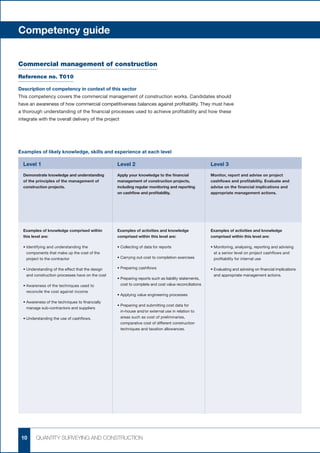
Commercial management of construction
Reference no. T010

Description of competency in context of this sector
This competency covers the commercial management of construction works. Candidates should
have an awareness of how commercial competitiveness balances against profitability. They must have
a thorough understanding of the financial processes used to achieve profitability and how these
integrate with the overall delivery of the project


Examples of likely knowledge, skills and experience at each level

    Level 1                                          Level 2	                                             Level 3	
    Demonstrate knowledge and understanding          Apply your knowledge to the financial                Monitor, report and advise on project
    of the principles of the management of           management of construction projects,                 cashflows and profitability. Evaluate and
    construction projects.                           including regular monitoring and reporting           advise on the financial implications and
                                                     on cashflow and profitability.                       appropriate management actions.


    Examples of knowledge comprised within           Examples of activities and knowledge                 Examples of activities and knowledge
    this level are:                                  comprised within this level are:                     comprised within this level are:

    •	dentifying and understanding the
      I                                              •	Collecting of data for reports                     •	 onitoring, analysing, reporting and advising
                                                                                                            M
      components that make up the cost of the                                                               at a senior level on project cashflows and
      project to the contractor                      •	Carrying out cost to completion exercises            profitability for internal use

    •	 nderstanding of the effect that the design
      U                                              •	Preparing cashflows                                •	 valuating and advising on financial implications
                                                                                                            E
      and construction processes have on the cost                                                           and appropriate management actions.
                                                     •	 reparing reports such as liability statements,
                                                       P
    •	 wareness of the techniques used to
      A                                                cost to complete and cost value reconciliations
      reconcile the cost against income
                                                     •	Applying value engineering processes
    •	 wareness of the techniques to financially
      A
                                                     •	 reparing and submitting cost data for
                                                       P
      manage sub-contractors and suppliers
                                                       in-house and/or external use in relation to
    •	Understanding the use of cashflows.              areas such as cost of preliminaries,
                                                       comparative cost of different construction
                                                       techniques and taxation allowances.


    10     QUANTITY SURVEYING AND CONSTRUCTION
Competency guide


Conflict avoidance, management and dispute
resolution procedures
Reference no. M006

Description of competency in context of this sector
This competency covers the quantity surveyor’s involvement with the avoidance, management and
resolution of disputes in construction projects. Candidates should be aware of the various processes
and techniques commonly used in the industry. They should have a detailed understanding of how
these are applied in practice.


Examples of likely knowledge, skills and experience at each level

    Level 1                                                Level 2	                                          Level 3	
    Demonstrate knowledge and understanding                Provide evidence of practical application         Provide evidence of the application of the
    of the techniques for conflict avoidance,              in your area of practice having regard to         above in the context of advising clients in the
    conflict management and dispute resolution             the relevant law.                                 various circumstances referred to above.
    procedures including for example adjudication
    and arbitration, appropriate to your
    APC pathway.


    Examples of knowledge comprised within                 Examples of activities and knowledge              Examples of activities and knowledge
    this level are:                                        comprised within this level are:                  comprised within this level are:

    •	 echniques for conflict avoidance, management
      T                                                    •	 eveloping further knowledge of the
                                                             D                                               •	 eveloping an in depth knowledge of law
                                                                                                               D
      and resolution, in particular by the appropriate       relevant law governing conflict avoidance         governing conflict avoidance and management
      selection of procurement routes and use of             and management and dispute resolution             and dispute resolution procedures, including
      processes such as partnering                           procedures                                        relevant legislation and case law

    •	 ow various forms of contract deal with
      H                                                    •	 eing involved with adjudication procedures
                                                             B                                               •	 iving reasoned advice on different dispute
                                                                                                               G
      dispute avoidance and their provisions for             in particular and have an understanding of        resolution procedures having reference to
      resolving disputes                                     the default procedures where a construction       particular project circumstances
                                                             contract does not make provision for
    •	 egal and statutory requirements for the
      L                                                      adjudication                                    •	 iving advice on relevant law governing
                                                                                                               G
      resolution of disputes in construction contracts                                                         evidence of fact and expert evidence and the
                                                           •	 eing involved with other dispute resolution
                                                             B                                                 practice and procedures adopted by surveyors
    •	 onflict management and dispute resolution
      C                                                      procedures                                        in the role of either advocate or expert witness
      procedures within the construction process
      including negotiation, mediation and conciliation,   •	 ompiling evidence for use in dispute
                                                             C                                               •	Giving advice as an expert witness.
      adjudication, arbitration, independent expert          resolution procedures.
      determination and litigation.


                                                                                              QUANTITY SURVEYING AND CONSTRUCTION                             11
Competency guide


Construction technology and environmental services
Reference no. T013

Description of competency in context of this sector
This competency covers the design and construction of buildings and other structures. Candidates
should have a clear understanding of the design and construction processes commonly used in the
industry. They should have detailed knowledge of construction solutions relevant to their projects.


Examples of likely knowledge, skills and experience at each level

    Level 1                                           Level 2	                                             Level 3	
    Demonstrate knowledge and understanding           Apply your knowledge to the design and               Advise on the selection and application
    of the principles of design and construction      construction processes.                              of particular processes within your area of
    relating to your chosen field of practice.                                                             experience. This should include liaison with
                                                                                                           specialists and consultants to develop project
                                                                                                           specific design and construction solutions.


    Examples of knowledge comprised within            Examples of activities and knowledge                 Examples of activities and knowledge
    this level are:                                   comprised within this level are:                     comprised within this level are:

    •	 he stages of design from inception to
      T                                               •	 ppreciating how design solutions vary for
                                                        A                                                  •	 dvising on the choice of construction
                                                                                                             A
      completion                                        different types of building such as clear span       solutions for your project
                                                        requirements for warehousing or acoustic
    •	mpact of current legislation and regulations
      I                                                 requirements for accommodation                     •	 eporting on the impact of different design
                                                                                                             R
      (both national and international)                                                                      solutions and construction processes on cost
                                                      •	 nderstanding alternative construction details
                                                        U                                                    and programme.
    •	 ow the various elements of the building
      H                                                 in relation to functional elements of the design
      work and inter-relate                             such as different types of piling or structural
                                                        frame solutions.
    •	The process of constructing the works

    •	 perational and maintenance processes
      O
      post contract.


    12     QUANTITY SURVEYING AND CONSTRUCTION
Competency guide


Contract administration
Reference no. T016

Description of competency in context of this sector
This competency covers the role of a surveyor administering a construction contract. Candidates
should be aware of the roles and responsibilities of the administrator under the main forms of contract.
They should have a detailed understanding of the contractual provisions relating to the forms of
contract that they have administered.


Examples of likely knowledge, skills and experience at each level

    Level 1                                          Level 2	                                           Level 3	
    Demonstrate knowledge and understanding          Implement administrative procedures                Advise on the administrative procedures
    of the contractual, legislative and statutory    necessary for the smooth running of a              necessary for the smooth running of a
    terminology/requirements, of a construction      construction contract.                             construction contract including document
    contract.                                                                                           control techniques and systems, meetings
                                                                                                        and reporting procedures.


    Examples of knowledge comprised within           Examples of activities and knowledge               Examples of activities and knowledge
    this level are:                                  comprised within this level are:                   comprised within this level are:

    •	 he various standard forms of contract
      T                                              •	Issuing instructions                             •	Resolving disputes
      and sub-contract used in the industry
                                                     •	Dealing with payment provisions                  •	 ssessing entitlement for extension of time
                                                                                                          A
    •	 asic contractual mechanisms and procedures
      B
      applied at various stages of the contract      •	Managing change procedures                       •	 ssessing entitlement for loss and expense
                                                                                                          A

    •	 he roles and responsibilities of
      T                                              •	Involvement with dispute avoidance               •	 dvising all parties of their contractual rights
                                                                                                          A
      the administrator.                                                                                  and obligations.
                                                     •	 ealing with completion and possession issues
                                                       D

                                                     •	Issuing certificates.


                                                                                       QUANTITY SURVEYING AND CONSTRUCTION                                    13
Competency guide


Contract practice
Reference no. T017

Description of competency in context of this sector
This competency covers the various forms of contract used in the construction industry. Candidates
should have an awareness of all of the main standard forms of contract and a thorough understanding
of contract law, legislation and the specific forms that they have used.


Examples of likely knowledge, skills and experience at each level

    Level 1                                                Level 2	                                              Level 3	
    Demonstrate knowledge and understanding                Apply your knowledge of the use of the                Provide evidence of reasoned advice,
    of the various forms of contract used in               various standard forms of contract at                 prepare and present reports on the selection
    the construction industry and/or your area             project level, including the implications and         of the appropriate form of contract and
    of business.                                           obligations that apply to the parties to              warranties for your chosen procurement
                                                           the contract.                                         route. This should include advising on the
                                                                                                                 most appropriate contractual procedure at
                                                                                                                 the various stages of a construction or
                                                                                                                 other contract.


    Examples of knowledge comprised within                 Examples of activities and knowledge                  Examples of activities and knowledge
    this level are:                                        comprised within this level are:                      comprised within this level are:

    •	Basic contract law and legislation                   •	Producing contract documentation                    •	 electing the appropriate form of contract
                                                                                                                   S
                                                                                                                   and/or sub-contract for your chosen
    •	Contract documentation                               •	 arrying out the contractual mechanisms
                                                             C                                                     procurement route
                                                             and procedures relevant to the financial
    •	 he various standard forms of contract and
      T                                                      management aspects of your project, such            •	 dvising on the most appropriate contractual
                                                                                                                   A
      sub-contract                                           as change procedures, valuations, loss and            procedure at the various stages of a contract
                                                             expense and final accounts
    •	When the different forms would be used                                                                     •	 valuating the appropriateness and implications
                                                                                                                   E
                                                           •	 nderstanding general contractual provisions
                                                             U                                                     of proposed contractual amendments.
    •	 asic contractual mechanisms and
      B
                                                             such as letters of intent, insurances, retention,
      procedures at various stages of the contract
                                                             bonds, liquidated and ascertained damages,
    •	 hird party rights including relevant legislation
      T                                                      early possession, practical completion and
      and the use of collateral warranties.                  other common contractual mechanisms.


    14     QUANTITY SURVEYING AND CONSTRUCTION
Competency guide


Corporate recovery and insolvency
Reference no. T020

Description of competency in context of this sector
This competency covers the involvement and actions of a quantity surveyor when insolvency occurs
on a construction project. Candidates should have an awareness of the processes and procedures
that can apply when a party to a contract becomes insolvent and what help and support a quantity
surveyor can give to the various parties involved, including the insolvency practitioner. They must have
a thorough understanding of the how insolvency has affected their project and the legal and contractual
position of the parties involved.


Examples of likely knowledge, skills and experience at each level

    Level 1                                              Level 2	                                           Level 3	
    Demonstrate knowledge and understanding              Demonstrate an understanding of the                Provide evidence of reasoned advice, prepare
    of the role of the Chartered Surveyor in             various types of appointment that can be           and present reports on the property assets of
    corporate recovery and insolvency situations.        made to administer/manage the affairs of           insolvent companies and individuals and/or
                                                         insolvent and potentially insolvent companies      in the administration of Fixed Charge
                                                         and individuals.                                   Receivership appointments.


    Examples of knowledge comprised within               Examples of activities and knowledge               Examples of activities and knowledge
    this level are:                                      comprised within this level are:                   comprised within this level are:

    •	 he principles of the different insolvency
      T                                                  •	 ndertaking valuations and notional final
                                                           U                                                •	 iving reasoned advice to a contracted party
                                                                                                              G
      procedures, such as liquidation, administration,     accounts in relation to an insolvency on           on how to proceed following the insolvency
      receivership and company voluntary                   a project                                          of the other party to the contract
      arrangement
                                                         •	 aking action to facilitate the completion of
                                                           T                                                •	 iving reasoned advice to a client on how
                                                                                                              G
    •	 ow standard form contracts deal
      H                                                    a project where insolvency has occurred            to proceed to complete a project following
      with insolvency                                                                                         an insolvency.
                                                         •	 ndertaking work in support of an
                                                           U
    •	 he nature of an insolvency practitioner’s
      T                                                    insolvency practitioner.
      role and his expectations as a client

    •	 ow a quantity surveyor might support an
      H
      insolvency practitioner.


                                                                                             QUANTITY SURVEYING AND CONSTRUCTION                           15
Competency guide


Design economics and cost planning
Reference no. T022

Description of competency in context of this sector
This competency covers the impact of design and other factors on cost throughout the life of
the building and the control of cost during the pre-contract stage. Candidates should have an
awareness of how design decisions and construction processes impact on construction and
operational costs. They must have a thorough understanding of techniques used to manage and
control costs pre-contract.


Examples of likely knowledge, skills and experience at each level

    Level 1                                            Level 2	                                         Level 3	
    Demonstrate knowledge and understanding            Apply your knowledge to the cost                 Give strategic and reasoned advice,
    of the main factors that affect design             management of design development on a            including the preparation and presentation
    economics over the whole life of a building.       project from feasibility to design completion.   of reports with reference to cost, time,
    Demonstrate knowledge and understanding            Prepare and submit cost data to in-house         quality and buildability. Advise on various
    of how cost planning assists in the financial      and/or external data collection agencies.        market factors and trends in construction
    control of projects during the design                                                               costs. Comment on accuracy and risk.
    development stage.


    Examples of knowledge comprised within             Examples of activities and knowledge             Examples of activities and knowledge
    this level are:                                    comprised within this level are:                 comprised within this level are:

    •	 he main factors that affect design economics
      T                                                •	Producing estimates and cost plans             •	 reparing and presenting reports with
                                                                                                          P
      over the whole life of the building including                                                       reference to cost, time, quality and buildability,
      capital and life cycle costs                     •	Carrying out life cycle costing exercises        including qualifications and exclusions

    •	 ow cost planning assists in the financial
      H                                                •	Applying value engineering processes           •	Evaluating building design efficiency
      control of projects during the design
                                                       •	Preparing cost reports                         •	 ssessing/evaluating market factors and
                                                                                                          A
      development stage
                                                                                                          trends in construction costs
                                                       •	 reparing and submitting cost data to
                                                         P
    •	The various stages of cost planning
                                                         in-house and/or external data collection       •	 nalysing the accuracy of predicted cost
                                                                                                          A
    •	Sources of cost data                               agencies.                                        using benchmarking techniques

    •	 djustments that may be required for factors
      A                                                                                                 •	Interrogating historical cost data
      including location, specification, time and
      market forces.                                                                                    •	Using value and risk management techniques.


    16     QUANTITY SURVEYING AND CONSTRUCTION
Competency guide


Due diligence
Reference no. T025

Description of competency in context of this sector
This competency covers the due diligence work and/or fund monitoring on construction projects.
It may also cover the duties of quantity surveyors monitoring the financial management of management
style contracts. Candidates should have an awareness of the areas of concern for funders and clients
within a project and the techniques used in the forensic interrogation and monitoring of those areas.
They must have a thorough understanding of the techniques used on their projects.


Examples of likely knowledge, skills and experience at each level

    Level 1                                            Level 2	                                             Level 3	
    Demonstrate knowledge of the techniques            Apply your knowledge of cost, quality and            Provide evidence of reasoned advice and
    used for cost, quality and time related forensic   time related forensic examination in your area       report to clients on cost, quality and time
    examination in your area of practice.              of practice.                                         related forensic examination in your area
                                                                                                            of practice.


    Examples of knowledge comprised within             Examples of activities and knowledge                 Examples of activities and knowledge
    this level are:                                    comprised within this level are:                     comprised within this level are:

    •	The main areas of risk for a funder/client       •	Reviewing development appraisals                   •	 hecking compliance with loan agreements
                                                                                                              C
                                                                                                              and agreements to lease
    •	 he process of analysing contract
      T                                                •	 eviewing specialist reports and checking
                                                         R
      documentation                                      statutory and other approvals                      •	 elivering reports to the funder/client on time,
                                                                                                              D
                                                                                                              cost and quality matters covered by your
    •	 ow to interrogate pricing data in relation
      H                                                •	 nalysing the suitability of procurement
                                                         A                                                    monitoring activities
      to development appraisals, cash flows,             strategies and contract documentation,
      construction costs and risk allowances             including third party rights issues and            •	 iving advice to the funder/client on suitable
                                                                                                              G
                                                         insurances                                           action to be taken in respect of issues
    •	 echniques for assessing suitability of
      T                                                                                                       identified by your monitoring activities.
      programmes                                       •	nterrogating pricing data in relation to
                                                         I
                                                         development appraisals, cash flows,
    •	 elevant statutory approvals, such as
      R                                                  construction costs and risk allowances
      planning and building control
                                                       •	 stablishing suitability of project programmes,
                                                         E
    •	 ow to monitor interim payments and
      H                                                  quality control procedures and health and
      planned progress.                                  safety arrangements

                                                       •	 hecking suitability and appointments of
                                                         C
                                                         project team

                                                       •	Analysing project and construction risks

                                                       •	Reviewing interim valuations for draw-down

                                                       •	 onitoring progress against planned
                                                         M
                                                         programmes

                                                       •	Reviewing final accounts.


                                                                                           QUANTITY SURVEYING AND CONSTRUCTION                               17
Competency guide


Health and safety
Reference no. M008

Description of competency in context of this sector
This competency covers the relationship between the work of the quantity surveyor and health
and safety issues within the construction industry. Candidates should be aware of legal, practical
and regulatory requirements. They should have a detailed understanding of the health and safety
processes and guidelines used to achieve this.


Examples of likely knowledge, skills and experience at each level

    Level 1                                           Level 2	                                             Level 3	
    Demonstrate knowledge and understanding           Apply evidence of practical application of           Provide evidence of reasoned advice given
    of the principles and responsibilities imposed    health and safety issues and the requirements        to clients and others on all aspects on health
    by law, codes of practice and other regulations   for compliance, in your area of practice.            and safety.
    appropriate to your area of practice.


    Examples of knowledge comprised within            Examples of activities and knowledge                 Examples of activities and knowledge
    this level are:                                   comprised within this level are:                     comprised within this level are:

    •	Personal safety on site and in the office       •	 btaining formal health and safety
                                                        O                                                  •	 iving reasoned advice on and/or taking
                                                                                                             G
                                                        qualifications including first aid, industry         responsibility for health and safety issues
    •	Procedures imposed by law                         specific or nationally recognised qualifications     relating to:

    •	The impact on health and safety of:             •	 eing involved with specific roles and
                                                        B                                                  	 –	 Impact of design on construction
                                                        responsibilities within the various regulations.
    	 –	Design                                                                                             	 –	 Alternative construction processes

    	 –	 Construction processes                                                                            	 –	
                                                                                                               Impact of design on occupation
                                                                                                               and maintenance
    	 –	 Building maintenance
                                                                                                           	 –	 Undertaking risk assessments
    	 –	 Employment of staff.
                                                                                                           	 –	 Current legislation.


    18     QUANTITY SURVEYING AND CONSTRUCTION
Competency guide


Insurance
Reference no. T045

Description of competency in context of this sector
This competency covers specific insurance provisions related to property and development.
Candidates should be aware of how insurance is used to deal with risk in development. They should
have a detailed understanding of the contractual requirements under the various standard forms
of contract.


Examples of likely knowledge, skills and experience at each level

    Level 1                                           Level 2	                                        Level 3	
    Demonstrate knowledge and understanding           Apply your knowledge and/or be involved with    Demonstrate a thorough understanding of
    of the principles and practices of insurance      the insurance of construction and/or property   the regulations and practice governing the
    in relation to your area of practice.             related matters.                                insurance of construction and/or property
                                                                                                      related matters.


    Examples of knowledge comprised within            Examples of activities and knowledge            Examples of activities and knowledge
    this level are:                                   comprised within this level are:                comprised within this level are:

    •	 he insurance provisions within the standard
      T                                               •	 eveloping specialist knowledge in areas
                                                        D                                             •	 eporting on cost impact of insurance claims
                                                                                                        R
      forms of contract                                 such as asbestos and terrorism                  to loss adjustor

    •	 pecific insurance mechanisms such as joint
      S                                               •	Compiling cost data for an insurance claim    •	 eporting on re-construction costs for fire
                                                                                                        R
      names, subrogation, net contribution clauses,                                                     insurance valuations
      in the aggregate, each and every event and      •	 ompiling cost data for a fire
                                                        C
      excess provisions                                 insurance valuation.                          •	 dvising clients on trends in the construction
                                                                                                        A
                                                                                                        insurance market
    •	 pecialist insurances such as performance
      S
      bonds, professional indemnity and                                                               •	 dvising on how insurances can be used
                                                                                                        A
      retention bonds.                                                                                  to mitigate risk.


                                                                                          QUANTITY SURVEYING AND CONSTRUCTION                          19
Competency guide


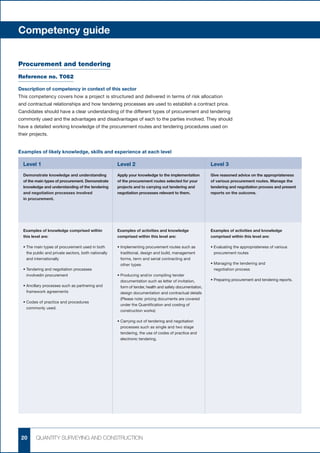
Procurement and tendering
Reference no. T062

Description of competency in context of this sector
This competency covers how a project is structured and delivered in terms of risk allocation
and contractual relationships and how tendering processes are used to establish a contract price.
Candidates should have a clear understanding of the different types of procurement and tendering
commonly used and the advantages and disadvantages of each to the parties involved. They should
have a detailed working knowledge of the procurement routes and tendering procedures used on
their projects.


Examples of likely knowledge, skills and experience at each level

    Level 1                                             Level 2	                                             Level 3	
    Demonstrate knowledge and understanding             Apply your knowledge to the implementation           Give reasoned advice on the appropriateness
    of the main types of procurement. Demonstrate       of the procurement routes selected for your          of various procurement routes. Manage the
    knowledge and understanding of the tendering        projects and to carrying out tendering and           tendering and negotiation process and present
    and negotiation processes involved                  negotiation processes relevant to them.              reports on the outcome.
    in procurement.


    Examples of knowledge comprised within              Examples of activities and knowledge                 Examples of activities and knowledge
    this level are:                                     comprised within this level are:                     comprised within this level are:

    •	 he main types of procurement used in both
      T                                                 •	mplementing procurement routes such as
                                                          I                                                  •	 valuating the appropriateness of various
                                                                                                               E
      the public and private sectors, both nationally     traditional, design and build, management            procurement routes
      and internationally                                 forms, term and serial contracting and
                                                          other types                                        •	 anaging the tendering and
                                                                                                               M
    •	 endering and negotiation processes
      T                                                                                                        negotiation process
      involvedin procurement                            •	 roducing and/or compiling tender
                                                          P
                                                          documentation such as letter of invitation,        •	Preparing procurement and tendering reports.
    •	 ncillary processes such as partnering and
      A                                                   form of tender, health and safety documentation,
      framework agreements                                design documentation and contractual details
                                                          (Please note: pricing documents are covered
    •	 odes of practice and procedures
      C
                                                          under the Quantification and costing of
      commonly used.
                                                          construction works)

                                                        •	 arrying out of tendering and negotiation
                                                          C
                                                          processes such as single and two stage
                                                          tendering, the use of codes of practice and
                                                          electronic tendering.


    20     QUANTITY SURVEYING AND CONSTRUCTION
Competency guide


Programming and planning
Reference no. T063

Description of competency in context of this sector
This competency covers a surveyor’s involvement with the programming and planning of construction
projects. Candidates should have an awareness of the various principles, techniques and issues that
relate to the programming and planning of projects generally. They must have a thorough understanding
of how these principles and techniques have been used and how specific issues have been dealt with
on their projects.


Examples of likely knowledge, skills and experience at each level

    Level 1                                          Level 2	                                              Level 3	
    Describe the principals of financial and         Assess, interpret and report on the                   Provide evidence of reasoned advice on,
    programme monitoring of projects, including      programme control of projects.                        or implement the principals of, executive
    planning techniques such as Gantt charts etc.                                                          programme control of projects. Your advice
    Demonstrate knowledge of the various types                                                             should demonstrate a good understanding of
    of programmes and schedules commonly                                                                   planning techniques (pert diagrams, network
    used on projects.                                                                                      analysis/critical path methods).


    Examples of knowledge comprised within           Examples of activities and knowledge                  Examples of activities and knowledge
    this level are:                                  comprised within this level are:                      comprised within this level are:

    •	 nderstand the need for pre-contract
      U                                              •	 ormulating and reporting on a project
                                                       F                                                   •	nterpreting the effectiveness of a
                                                                                                             I
      planning and programming techniques              programme for different construction projects         project programme
                                                       using planning techniques
    •	 ifferent planning techniques eg Gantt
      D                                                                                                    •	 roviding reasoned advice on the financial
                                                                                                             P
      Charts, Network Analysis and Critical Path     •	 eporting the client’s financial
                                                       R                                                     planning of construction projects (eg a client/
      Analysis etc                                     forecast expenditure of a project using               developer might have a particular way of
                                                       planning techniques                                   funding a project, either fully financed or
    •	 he principles of how a programme is
      T                                                                                                      generating finance from sales in phase one
      affected by change                             •	 alculating a critical path network analysis
                                                       C                                                     to finance later phases. This would give rise
                                                       and/or PERT network analysis as appropriate           to very different strategies affecting both the
    •	 he need for good programming when
      T                                                to determine the longest path                         timing and the cost of a project)
      forecasting accurately materials, man-power,
      machinery and money                            •	dentifying the impact of contractual
                                                       I                                                   •	 nalysing and advising on the possible
                                                                                                             A
                                                       provisions on the effective planning of projects.     outcomes in the event of a strategy change
    •	 he use of planning and programming when
      T
                                                                                                             eg financing provisions, time of construction,
      forecasting expenditure
                                                                                                             scope changes
    •	 he importance of a project or a contract
      T
                                                                                                           •	 dvising on a project programme when
                                                                                                             A
      programme when used together with different
                                                                                                             determining different procurement options.
      forms of contract.


                                                                                         QUANTITY SURVEYING AND CONSTRUCTION                               21
Competency guide


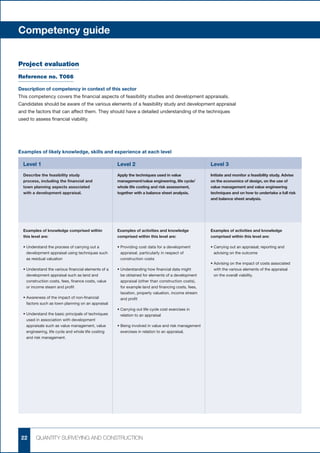
Project evaluation
Reference no. T066

Description of competency in context of this sector
This competency covers the financial aspects of feasibility studies and development appraisals.
Candidates should be aware of the various elements of a feasibility study and development appraisal
and the factors that can affect them. They should have a detailed understanding of the techniques
used to assess financial viability.


Examples of likely knowledge, skills and experience at each level

    Level 1                                             Level 2	                                         Level 3	
    Describe the feasibility study                      Apply the techniques used in value               Initiate and monitor a feasibility study. Advise
    process, including the financial and                management/value engineering, life cycle/        on the economics of design, on the use of
    town planning aspects associated                    whole life costing and risk assessment,          value management and value engineering
    with a development appraisal.                       together with a balance sheet analysis.          techniques and on how to undertake a full risk
                                                                                                         and balance sheet analysis.


    Examples of knowledge comprised within              Examples of activities and knowledge             Examples of activities and knowledge
    this level are:                                     comprised within this level are:                 comprised within this level are:

    •	 nderstand the process of carrying out a
      U                                                 •	 roviding cost data for a development
                                                          P                                              •	 arrying out an appraisal; reporting and
                                                                                                           C
      development appraisal using techniques such         appraisal, particularly in respect of            advising on the outcome
      as residual valuation                               construction costs
                                                                                                         •	 dvising on the impact of costs associated
                                                                                                           A
    •	 nderstand the various financial elements of a
      U                                                 •	 nderstanding how financial data might
                                                          U                                                with the various elements of the appraisal
      development appraisal such as land and              be obtained for elements of a development        on the overall viability.
      construction costs, fees, finance costs, value      appraisal (other than construction costs),
      or income steam and profit                          for example land and financing costs, fees,
                                                          taxation, property valuation, income stream
    •	 wareness of the impact of non-financial
      A                                                   and profit
      factors such as town planning on an appraisal
                                                        •	 arrying out life cycle cost exercises in
                                                          C
    •	 nderstand the basic principals of techniques
      U                                                   relation to an appraisal
      used in association with development
      appraisals such as value management, value        •	 eing involved in value and risk management
                                                          B
      engineering, life cycle and whole life costing      exercises in relation to an appraisal.
      and risk management.


    22     QUANTITY SURVEYING AND CONSTRUCTION
Competency guide


Project financial control and reporting
Reference no. T067

Description of competency in context of this sector
This competency covers the effective cost control of construction projects during the construction
phase. Candidates should be aware of the principles of controlling and reporting costs on any
construction project. They should have a detailed understanding of the control and reporting processes
used on their projects (please note: for surveyors working in contracting this competency covers
externally issued cost advice and reports).


Examples of likely knowledge, skills and experience at each level

    Level 1                                               Level 2	                                           Level 3	
    Demonstrate knowledge and understanding               Apply your knowledge to the management             Advise on strategies and procedures to
    of the effective control of costs during a project.   of project costs. This should include the          control predicted expenditure in line with
    Demonstrate understanding of the legal and            preparation and presentation of financial          a budget.
    contractual constraints and the effect of time        reports on the performance of a project at
    and quality on the cost of a project.                 appropriate intervals, to provide effective
                                                          forecasting of costs, risks and their financial
                                                          implications.


    Examples of knowledge comprised within                Examples of activities and knowledge               Examples of activities and knowledge
    this level are:                                       comprised within this level are:                   comprised within this level are:

    •	 he effective control of costs during the
      T                                                   •	 anaging project costs during the
                                                            M                                                •	mplementing change control procedures
                                                                                                               I
      construction phase of a project                       construction phase                                 within the contract

    •	 he legal and contractual constraints on the
      T                                                   •	 eporting and forecasting costs for different
                                                            R                                                •	Establishing reporting regimes/protocols
      cost of a project such as changes in building         procurement routes and client types
      legislation and design risk allocation                                                                 •	 sing risk management and
                                                                                                               U
                                                          •	 sing cashflows in financial management
                                                            U                                                  analysis techniques.
    •	 he reporting and forecasting of costs during
      T
      the construction phase                              •	 anaging provisional sums/contingencies/
                                                            M
                                                            risk allowances.
    •	 he principles of contingencies/
      T
      risk allowances.


                                                                                             QUANTITY SURVEYING AND CONSTRUCTION                          23
Competency guide


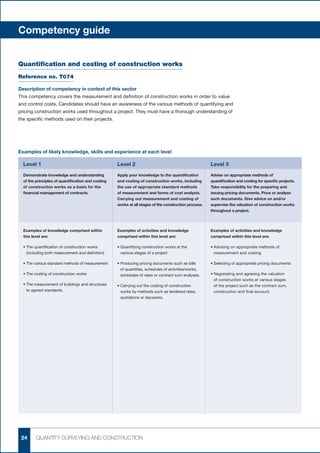
Quantification and costing of construction works
Reference no. T074

Description of competency in context of this sector
This competency covers the measurement and definition of construction works in order to value
and control costs. Candidates should have an awareness of the various methods of quantifying and
pricing construction works used throughout a project. They must have a thorough understanding of
the specific methods used on their projects.


Examples of likely knowledge, skills and experience at each level

    Level 1                                           Level 2	                                           Level 3	
    Demonstrate knowledge and understanding           Apply your knowledge to the quantification         Advise on appropriate methods of
    of the principles of quantification and costing   and costing of construction works, including       quantification and costing for specific projects.
    of construction works as a basis for the          the use of appropriate standard methods            Take responsibility for the preparing and
    financial management of contracts.                of measurement and forms of cost analysis.         issuing pricing documents. Price or analyse
                                                      Carrying out measurement and costing of            such documents. Give advice on and/or
                                                      works at all stages of the construction process.   supervise the valuation of construction works
                                                                                                         throughout a project.


    Examples of knowledge comprised within            Examples of activities and knowledge               Examples of activities and knowledge
    this level are:                                   comprised within this level are:                   comprised within this level are:

    •	 he quantification of construction works
      T                                               •	 uantifying construction works at the
                                                        Q                                                •	 dvising on appropriate methods of
                                                                                                           A
      (including both measurement and definition)       various stages of a project                        measurement and costing

    •	 he various standard methods of measurement
      T                                               •	 roducing pricing documents such as bills
                                                        P                                                •	Selecting of appropriate pricing documents
                                                        of quantities, schedules of activities/works,
    •	The costing of construction works                 schedules of rates or contract sum analyses.     •	 egotiating and agreeing the valuation
                                                                                                           N
                                                                                                           of construction works at various stages
    •	 he measurement of buildings and structures
      T                                               •	 arrying out the costing of construction
                                                        C                                                  of the project such as the contract sum,
      to agreed standards.                              works by methods such as tendered rates,           construction and final account.
                                                        quotations or dayworks.


    24     QUANTITY SURVEYING AND CONSTRUCTION
Competency guide


Risk management
Reference no. T077

Description of competency in context of this sector
This competency covers the management of risk on construction projects. Candidates should
be aware of the benefits to be gained and the techniques and processes used to manage risk.
They should have a detailed understanding of how risk is dealt with on their projects.


Examples of likely knowledge, skills and experience at each level

    Level 1                                         Level 2	                                              Level 3	
    Demonstrate your knowledge and                  Apply your knowledge to carry out risk                Provide evidence of reasoned advice and
    understanding of the nature of risk and, in     assessments taking into account all relevant          implement systems to manage risk by
    particular, of the risks associated with your   factors. Understand the application of the            competent management in relation to
    area of business/practice.                      various methods and techniques used to                specific projects.
                                                    measure risk.


    Examples of knowledge comprised within          Examples of activities and knowledge                  Examples of activities and knowledge
    this level are:                                 comprised within this level are:                      comprised within this level are:

    •	The principles of risk management             •	Contributing towards the identification of risk     •	 dvising on the appropriate procurement
                                                                                                            A
                                                                                                            route in relation to the client’s attitude to risk
    •	 ow the various procurement routes deal
      H                                             •	dentifying who owns the risk in relation to the
                                                      I
      with risk                                       chosen procurement route on your project            •	 ecognising and advising on the appropriate
                                                                                                            R
                                                                                                            methodologies and approach to risk on
    •	Mitigation strategies                         •	 ontributing towards strategies to mitigate risk
                                                      C                                                     a project

    •	The techniques used to quantify risk          •	 ontributing data towards the quantification
                                                      C                                                   •	 aking ownership of the risk register and
                                                                                                            T
                                                      of risk                                               advising on appropriate risk mitigation strategies
    •	The effect of risk on programme and cost.
                                                    •	 onsidering the effect of risk on programme
                                                      C                                                   •	 pplying techniques to quantify risk and
                                                                                                            A
                                                      and management cost specific to their project.        advising client’s on the appropriate level
                                                                                                            of contingency.


                                                                                         QUANTITY SURVEYING AND CONSTRUCTION                                     25
Competency guide


Sustainability
Reference no. M009

Description of competency in context of this sector
This competency covers the role of the quantity surveyor in dealing with the impact of sustainability
issues on development and construction. Candidates should have an awareness of the various ways
in which sustainability can impact on development and construction. They must have a thorough
understanding of the impact made by sustainability on their projects and have been involved with the
financial management of that impact.


Examples of likely knowledge, skills and experience at each level

    Level 1                                                 Level 2	                                          Level 3	
    Demonstrate knowledge and understanding                 Provide evidence of the practical application     Provide evidence of reasoned advice given
    of why and how sustainability seeks to balance          of sustainability appropriate to your area of     to clients and others on the policy, law and
    economic, environmental and social objectives           practice, and of awareness of the circumstances   best practice of sustainability in your area
    at global, national and local levels in the context     in which specialist advice is necessary.          of practice.
    of land, property and the built environment.


    Examples of knowledge comprised within                  Examples of activities and knowledge              Examples of activities and knowledge
    this level are:                                         comprised within this level are:                  comprised within this level are:

    •	 he principles of sustainability within
      T                                                     •	 arrying out capital cost and value
                                                              C                                               •	 iving reasoned advice to your client and
                                                                                                                G
      development and the construction process                engineering exercises to determine the            members of the project team on the financial
                                                              impact of sustainability issues on design         impact of sustainability on a project
    •	 he relationship between property and
      T                                                       and construction processes
      the environment                                                                                         •	 iving reasoned advice on the application of
                                                                                                                G
                                                            •	 arrying out life cycle cost exercises which
                                                              C                                                 environmental law and policy
    •	 ow national and international legislation,
      H                                                       take account of sustainability issues
      regulations and taxation relating to sustainability                                                     •	nterpreting environmental reports and giving
                                                                                                                I
      affect construction                                   •	 nderstanding the measures undertaken
                                                              U                                                 reasoned advice on the financial impact and
                                                              by governments and international bodies to        programme implications on a project
    •	 riteria by which sustainability is measured
      C                                                       encourage the reduction of the environmental
      in relation to finished buildings                       impact of development.                          •	 iving advice on sustainable material
                                                                                                                G
                                                                                                                selection and how performance baselines
    •	 he principles of how design, technology and
      T                                                                                                         can be estimated.
      construction processes can contribute to
      sustainable building

    •	 he principles of material resource efficiency
      T
      within the supply chain.


    26      QUANTITY SURVEYING AND CONSTRUCTION
Supplemental guidance


Additional guidance for the APC QS Pathway
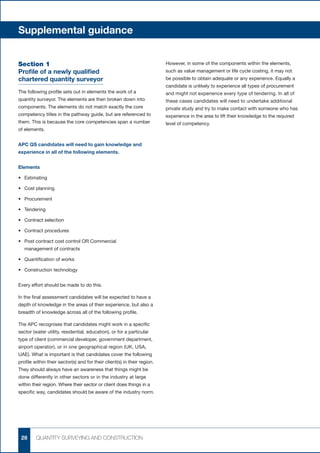
Section 1 – Profile of a newly qualified chartered quantity surveyor
This section sets out, as a minimum, the areas in which a newly qualified chartered quantity
surveyor will have gained knowledge and experience during their time on the APC.

With the introduction of the QS Pathway Guide in 2006 the APC gives a clear definition of the areas
and levels of technical competence required of a QS candidate. Because each candidate’s journey
to achieving the competencies will be unique, the definitions and examples take a generic approach
that could be applied anywhere in the industry. So, what in detail should an individual candidate
have knowledge of or have experienced on their unique journey to professional competence?

This profile aims to help all those involved with the APC process understand and interpret the APC
core competencies for the QS pathway. It should be read in conjunction with the QS pathway core
competencies definitions.


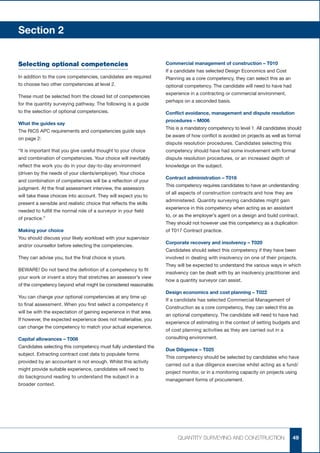
Section 2 – Selecting of optional competencies
In addition to the core competencies, candidates are required to choose two other competencies
at level 2. These must be selected from the closed list of competencies for the quantity surveying
pathway. This section will help candidates with the selection of these optional competencies.


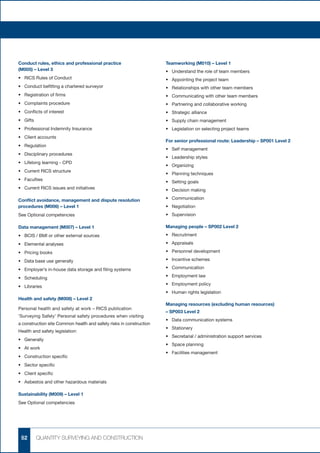
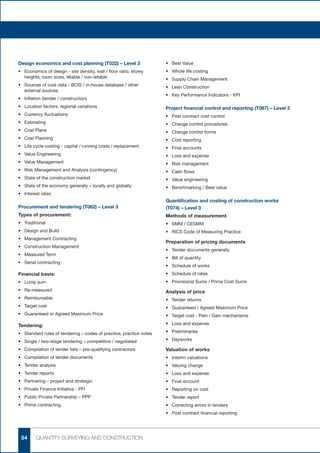
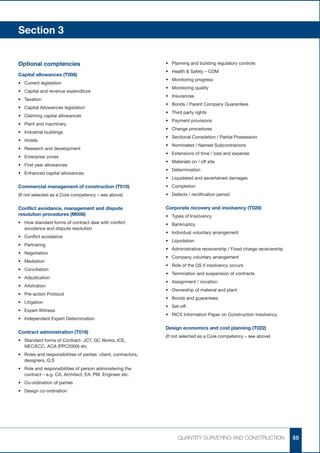
Section 3 – Study check list
In this section the competencies are broken down into a check list of topics to help candidates
make sure they have covered everything that is appropriate to their journey through the pathway.
The list is not meant to be prescriptive. It is not comprehensive, nor must a candidate necessarily
cover every topic. This section is an aide-mémoire only.


NOTE: In the case of doubt the competency definitions in this pathway guide will always
take priority.


This supplemental guidance is intended to assist all candidates worldwide. The examples given in
Section 1 and the topics listed in Section 3 often refer to UK practice. Candidates in other world
regions should interpret these in relation to practices in their region.


                                                                           QUANTITY SURVEYING AND CONSTRUCTION   27
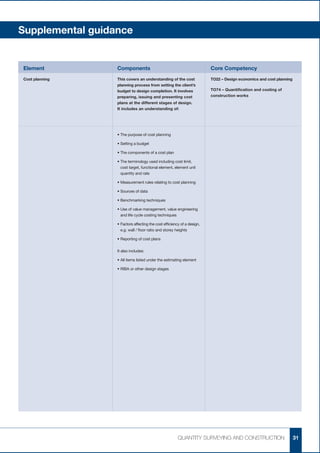
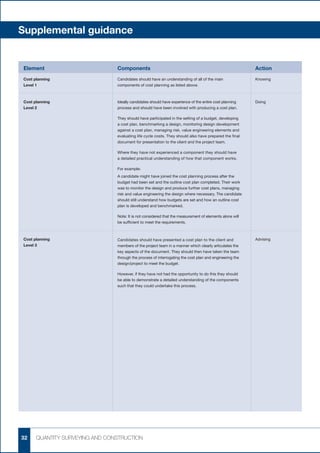
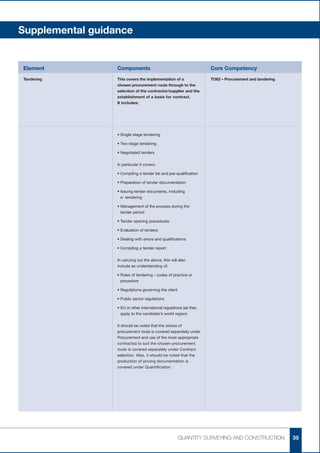
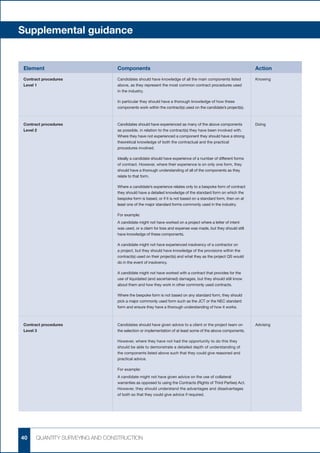
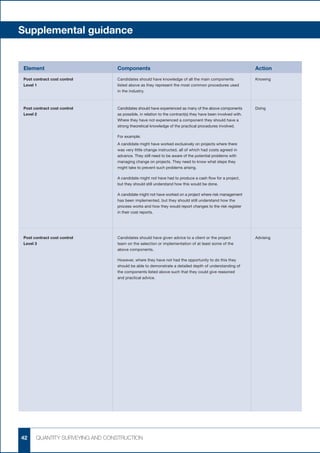
Supplemental guidance


Section 1                                                                 However, in some of the components within the elements,
Profile of a newly qualified                                              such as value management or life cycle costing, it may not
chartered quantity surveyor                                               be possible to obtain adequate or any experience. Equally a
                                                                          candidate is unlikely to experience all types of procurement
The following profile sets out in elements the work of a                  and might not experience every type of tendering. In all of
quantity surveyor. The elements are then broken down into                 these cases candidates will need to undertake additional
components. The elements do not match exactly the core                    private study and try to make contact with someone who has
competency titles in the pathway guide, but are referenced to             experience in the area to lift their knowledge to the required
them. This is because the­core competencies span a number                 level of competency.
of elements.


APC QS candidates will need to gain knowledge and
experience in all of the following elements.


Elements

•	 Estimating

•	 Cost planning

•	 Procurement

•	 Tendering

•	 Contract selection

•	 Contract procedures

•	  ost contract cost control OR Commercial
   P
   management of contracts

•	 Quantification of works

•	 Construction technology


Every effort should be made to do this.

In the final assessment candidates will be expected to have a
depth of knowledge in the areas of their experience, but also a
breadth of knowledge across all of the following profile.

The APC recognises that candidates might work in a specific
sector (water utility, residential, education), or for a particular
type of client (commercial developer, government department,
airport operator), or in one geographical region (UK, USA,
UAE). What is important is that candidates cover the following
profile within their sector(s) and for their client(s) in their region.
They should always have an awareness that things might be
done differently in other sectors or in the industry at large
within their region. Where their sector or client does things in a
specific way, candidates should be aware of the industry norm.
­­­


 28      QUANTITY SURVEYING AND CONSTRUCTION
Supplemental guidance


Element           Components	                                        Core Competency	
Estimating        This covers the preparation and reporting          TO22 – Design economics and cost planning
                  of cost estimates at the different stages
                  of design. It includes an understanding of:        TO74 – Quantification and costing of
                                                                     construction works


                  •	The purpose of cost estimating

                  •	 he different types of cost estimate such
                    T
                    as feasibility, budget or pre-tender estimates

                  •	 he basis of an estimate, such as functional
                    T
                    unit rate, elemental, detailed quantities

                  •	The components of an estimate

                  •	Sources, use and adjustment of data

                  •	Benchmarking techniques

                  •	Reporting cost estimates

                  •	 he difference between a cost estimate,
                    T
                    a cost plan and a cost analysis


                  It also includes:

                  •	Calculating unit rates for items from 	    	
                  	 first principles

                  •	Base dates

                  •	Construction and tender inflation

                  •	Location factors

                  •	 ite/location specific conditions
                    S
                    (e.g. ground conditions and site constraints)

                  •	Programme

                  •	Sustainability requirements

                  •	Professional and statutory fees

                  •	Preliminaries and overheads and profit

                  •	Risk allowances

                  •	Inclusions and exclusions


                                                        QUANTITY SURVEYING AND CONSTRUCTION                      29
Supplemental guidance


Element                         Components	                                                               Action
Estimating                      Candidates should have experience in the preparation of a cost            Knowing
Level 1                         estimate. Ideally they will have experienced all of the components
                                listed above.


Estimating                      Candidates should have experience in the preparation of a cost            Doing
Level 2                         estimate. Ideally they will have experienced all of the components
                                listed above.

                                They should have measured building work items, compiled unit rates
                                and compiled the final cost estimate report, which is presented to
                                the client and members of the project team.

                                Where they have not experienced a component they should have a
                                detailed practical understanding of how that component works.

                                For example:
                                A candidate might have compiled feasibility estimates on a functional
                                unit or elemental basis, but not have undertaken a pre-tender estimate
                                (PTE). They should still understand how to carry out a PTE in practice.


Estimating                      Ideally candidates should have presented an estimate to a client          Advising
Level 3                         and members of the project team in a manner which clearly
                                articulates the key aspects of the estimate. They should also have
                                responded to an interrogation of the estimate by the team.

                                However, if they have not had the opportunity to do this they should
                                be able to demonstrate a detailed understanding of the requirements.


30    QUANTITY SURVEYING AND CONSTRUCTION
Supplemental guidance


Element           Components	                                             Core Competency	
Cost planning     This covers an understanding of the cost                TO22 – Design economics and cost planning
                  planning process from setting the client’s
                  budget to design completion. It involves                TO74 – Quantification and costing of
                  preparing, issuing and presenting cost                  construction works
                  plans at the different stages of design.
                  It includes an understanding of:


                  •	The purpose of cost planning

                  •	Setting a budget

                  •	The components of a cost plan

                  •	 he terminology used including cost limit,
                    T
                    cost target, functional element, element unit
                    quantity and rate

                  •	Measurement rules relating to cost planning

                  •	Sources of data

                  •	Benchmarking techniques

                  •	 se of value management, value engineering
                    U
                    and life cycle costing techniques

                  •	 actors affecting the cost efficiency of a design,
                    F
                    e.g. wall / floor ratio and storey heights

                  •	Reporting of cost plans


                  It also includes:

                  •	All items listed under the estimating element

                  •	RIBA or other design stages


                                                        QUANTITY SURVEYING AND CONSTRUCTION                           31
Supplemental guidance


Element                         Components	                                                              Action
Cost planning                   Candidates should have an understanding of all of the main               Knowing
Level 1                         components of cost planning as listed above.


Cost planning                   Ideally candidates should have experience of the entire cost planning    Doing
Level 2                         process and should have been involved with producing a cost plan.

                                They should have participated in the setting of a budget, developing
                                a cost plan, benchmarking a design, monitoring design development
                                against a cost plan, managing risk, value engineering elements and
                                evaluating life cycle costs. They should also have prepared the final
                                document for presentation to the client and the project team.

                                Where they have not experienced a component they should have
                                a detailed practical understanding of how that component works.

                                For example:
                                A candidate might have joined the cost planning process after the
                                budget had been set and the outline cost plan completed. Their work
                                was to monitor the design and produce further cost plans, managing
                                risk and value engineering the design where necessary. The candidate
                                should still understand how budgets are set and how an outline cost
                                plan is developed and benchmarked.

                                Note: It is not considered that the measurement of elements alone will
                                be sufficient to meet the requirements.


Cost planning                   Candidates should have presented a cost plan to the client and           Advising
Level 3                         members of the project team in a manner which clearly articulates the
                                key aspects of the document. They should then have taken the team
                                through the process of interrogating the cost plan and engineering the
                                design/project to meet the budget.

                                However, if they have not had the opportunity to do this they should
                                be able to demonstrate a detailed understanding of the components
                                such that they could undertake this process.


32    QUANTITY SURVEYING AND CONSTRUCTION
Supplemental guidance


Element           Components	                                         Core Competency	
Procurement       This covers developing a procurement                TO62 – Procurement and tendering
                  strategy and includes giving advice on
                  the most appropriate procurement route
                  to be adopted, covering in particular:


                  •	Traditional

                  •	Design and Build

                  •	 anagement contracting and 	
                    M
                    construction management

                  •	Serial/term contracting

                  •	Partnering


                  In relation to this, it includes the detailed
                  consideration of how the following factors
                  influence the selection of the procurement route:

                  •	Contractual relationships

                  •	Roles and responsibilities of the parties

                  •	Time certainty, quick start or earliest finish

                  •	 ost certainty, cost control, competition, 	
                    C
                    or demonstration of value for money

                  •	Quality management

                  •	Change management

                  •	Risk allocation and management


                  It should be noted that the use of the most
                  appropriate contract(s) to suit the chosen
                  procurement route is covered separately under
                  Contract selection, whilst the implementation
                  of the tendering process through to
                  appointment of the contractor is covered
                  separately under Tendering.


                                                       QUANTITY SURVEYING AND CONSTRUCTION               33
Supplemental guidance


Element                        Components	                                                                 Action
Procurement                    Candidates should have an understanding of all the main components          Knowing
Level 1                        listed above as they represent the most common procurement methods
                               used in the industry.


Procurement                    Candidates should have experience of the selection of a procurement         Doing
Level 2                        route on a single project, or as part of a series of projects and should
                               have given consideration to all of the above components in making
                               that selection. Candidates should be aware of the variances under
                               each of the procurement routes above, e.g. develop and construct
                               under the design and build route.

                               It is unlikely that a candidate will have direct experience of all of
                               the main procurement routes used in the industry. Where they have
                               experience of just one or two routes they should have an awareness
                               of how all of the other types of procurement work in practice. They
                               should also be aware of how a procurement route might be adapted
                               for use in different situations.

                               For example:
                               If a candidate has only worked on design and build procurement,
                               they should still have an understanding of how the other procurement
                               routes work.


Procurement                    Ideally candidates should have given advice direct to a client or project   Advising
Level 3                        team on the selection of a procurement route.

                               However, if they have not had the opportunity to do this they should
                               be able to demonstrate a detailed depth of understanding of the
                               components listed above such that they could give reasoned and
                               practical advice.


34   QUANTITY SURVEYING AND CONSTRUCTION
Supplemental guidance


Element           Components	                                         Core Competency	
Tendering         This covers the implementation of a                 TO62 – Procurement and tendering
                  chosen procurement route through to the
                  selection of the contractor/supplier and the
                  establishment of a basis for contract.
                  It includes:


                  •	Single stage tendering

                  •	Two stage tendering

                  •	Negotiated tenders


                  In particular it covers:

                  •	Compiling a tender list and pre-qualification

                  •	Preparation of tender documentation

                  •	ssuing tender documents, including
                    I
                    e- tendering

                  •	 anagement of the process during the
                    M
                    tender period

                  •	Tender opening procedures

                  •	Evaluation of tenders

                  •	Dealing with errors and qualifications

                  •	Compiling a tender report


                  In carrying out the above, this will also
                  include an understanding of:

                  •	 ules of tendering - codes of practice or
                    R
                    procedure

                  •	Regulations governing the client

                  •	Public sector regulations

                  •	 U or other international regulations (as they
                    E
                    apply to the candidate’s world region)


                  It should be noted that the choice of
                  procurement route is covered separately under
                  Procurement and use of the most appropriate
                  contract(s) to suit the chosen procurement
                  route is covered separately under Contract
                  selection. Also, it should be noted that the
                  production of pricing documentation is
                  covered under Quantification.


                                                       QUANTITY SURVEYING AND CONSTRUCTION               35
Supplemental guidance


Element                         Components	                                                               Action
Tendering                       Candidates should have an understanding of all of the main                Knowing
Level 1                         components listed above, as they represent the most common
                                methods of tendering.


Tendering                       Candidates should have experience of the complete tendering process,      Doing
Level 2                         from compiling the tender list through to the appointment of the
                                contractor/supplier. Ideally they will have experienced different types
                                of tendering, such as single and two-stage.

                                However, where a candidate has experienced only one type of tendering
                                they should have an awareness of how the components listed above
                                work in other situations.

                                For example:
                                A candidate might have experience of single stage selective
                                tendering, but they should also understand how the other forms of
                                tendering work.

                                A candidate might have experience of negotiating with a contractor
                                taken from a framework. They should also understand the tendering
                                processes that formed the framework.

                                A candidate might have been brought into the tendering process to
                                put together the tender documents, after the lender list had been
                                established. The candidate should still understand how contractors
                                are pre-qualified and tender lists compiled.


Tendering                       Ideally candidates should have given advice direct to the client on       Advising
Level 3                         the selection of contractors for the tender list and then ultimately
                                the recommendation to the client on which contractor to appoint.

                                However, if they have not had the opportunity to do this they
                                should be able to demonstrate a detailed depth of understanding of
                                the components listed above such that they could give reasoned
                                and practical advice.


36    QUANTITY SURVEYING AND CONSTRUCTION
Supplemental guidance


Element              Components	                                     Core Competency	
Contract selection   This covers the implementation of a             TO17 – Contract practice
                     chosen This covers giving advice on the
                     most appropriate form of contract to be         TO62 – Procurement and tendering
                     used. This involves main, sub and package
                     contracts from the standard suites of
                     contract commonly used in the industry
                     within the candidate’s particular
                     geographical region, for example:


                     •	JCT

                     •	NEC

                     •	GC Works

                     •	ICE

                     •	IChemE

                     •	FIDIC


                     It also includes a general knowledge of how
                     the main contracts work in respect of:

                     •	Roles and responsibilities of the parties

                     •	Pricing options

                     •	Risk allocation

                     •	Client specific considerations on selection


                     It should be noted that the selection of the
                     most appropriate procurement route is covered
                     separately under Procurement, whilst the
                     implementation of the tendering process is
                     covered separately under Tendering.


                     The detailed application of these contracts
                     is covered under Contract procedures.


                                                        QUANTITY SURVEYING AND CONSTRUCTION             37
Supplemental guidance


Element                         Components	                                                                  Action
Contract selection              Candidates should have an understanding of the forms of contract             Knowing
Level 1                         commonly used in the industry, together with the main components
                                listed above.


Contract selection              Candidates should have been involved with the selection of a suitable        Doing
Level 2                         contract for a procurement route.

                                Where a candidate has not been directly involved with this process
                                they should thoroughly investigate how the form of contract was
                                selected on the project(s) they have worked on.


Contract selection              Ideally candidates should have given advice direct to the client and         Advising
Level 3                         their legal advisors on the selection of the most appropriate form
                                of contract.

                                A candidate is unlikely to have experience of working with all of the
                                various forms of contract available in their sector, but they should have
                                sufficient awareness of those that are available so that they can consider
                                all possibilities and give informed advice to their client or the
                                project team.


38    QUANTITY SURVEYING AND CONSTRUCTION
Supplemental guidance


Element               Components	                                     Core Competency	
Contract procedures   This covers the establishment of construction   TO17 – Contract practice
                      contracts and the mechanisms that are
                      typically found within them. In particular
                      it involves the understanding of these
                      mechanisms and how they impact on the
                      work of a quantity surveyor. It covers:


                      Establishing a contract:

                      •	Basic contract law

                      •	Current contract legislation

                      •	Common standard forms of contract

                      	 and sub-contract in use

                      •	Contract documentation

                      •	Letters of intent

                      •	Third party rights


                      Contract mechanisms:

                      •	Roles of the parties under the contract

                      •	Conflict avoidance and dispute resolution

                      •	Contractor designed works

                      •	Sub-contracting

                      •	Payment provisions

                      •	Change procedures

                      •	Bonds / Parent company guarantees

                      •	Insurances

                      •	Retention – including retention bonds

                      •	Liquidated (and ascertained) damages

                      •	 laims – extensions of time, acceleration,
                        C
                        loss and expense

                      •	Early possession and phasing

                      •	Termination of contract and insolvency

                      •	Contract completion

                      •	Final accounts

                      •	Defects / rectification


                      It should be noted that the selection of the
                      most appropriate contract(s) to suit a chosen
                      procurement route is covered separately under
                      Contract selection.


                                                         QUANTITY SURVEYING AND CONSTRUCTION     39
Supplemental guidance


Element                         Components	                                                                   Action
Contract procedures             Candidates should have knowledge of all the main components listed            Knowing
Level 1                         above, as they represent the most common contract procedures used
                                in the industry.

                                In particular they should have a thorough knowledge of how these
                                components work within the contract(s) used on the candidate’s project(s).


Contract procedures             Candidates should have experienced as many of the above components            Doing
Level 2                         as possible, in relation to the contract(s) they have been involved with.
                                Where they have not experienced a component they should have a strong
                                theoretical knowledge of both the contractual and the practical
                                procedures involved.

                                Ideally a candidate should have experience of a number of different forms
                                of contract. However, where their experience is on only one form, they
                                should have a thorough understanding of all of the components as they
                                relate to that form.

                                Where a candidate’s experience relates only to a bespoke form of contract
                                they should have a detailed knowledge of the standard form on which the
                                bespoke form is based, or if it is not based on a standard form, then on at
                                least one of the major standard forms commonly used in the industry.

                                For example:
                                A candidate might not have worked on a project where a letter of intent
                                was used, or a claim for loss and expense was made, but they should still
                                have knowledge of these components.

                                A candidate might not have experienced insolvency of a contractor on
                                a project, but they should have knowledge of the provisions within the
                                contract(s) used on their project(s) and what they as the project QS would
                                do in the event of insolvency.

                                A candidate might not have worked with a contract that provides for the
                                use of liquidated (and ascertained) damages, but they should still know
                                about them and how they work in other commonly used contracts.

                                Where the bespoke form is not based on any standard form, they should
                                pick a major commonly used form such as the JCT or the NEC standard
                                form and ensure they have a thorough understanding of how it works.


Contract procedures             Candidates should have given advice to a client or the project team on        Advising
Level 3                         the selection or implementation of at least some of the above components.

                                However, where they have not had the opportunity to do this they
                                should be able to demonstrate a detailed depth of understanding of
                                the components listed above such that they could give reasoned and
                                practical advice.

                                For example:
                                A candidate might not have given advice on the use of collateral
                                warranties as opposed to using the Contracts (Rights of Third Parties) Act.
                                However, they should understand the advantages and disadvantages
                                of both so that they could give advice if required.


40    QUANTITY SURVEYING AND CONSTRUCTION
Supplemental guidance


Element                                  Components	                                     Core Competency	
Post contract cost control               This covers the financial management            T17 - Contract practice
(For surveyors working in a consulting   of a project during the construction phase
environment in either the public or      (generally the post contract phase).            TO67 – Project financial control and reporting
private sector)                          It covers cost control procedures and
                                                                                         T074 – Quantification and costing of
                                         reporting. In particular:
                                                                                         construction works


                                         •	Forecasting and cash flows

                                         •	Managing change control procedures

                                         •	Valuing change

                                         •	 xpenditure of provisional and prime
                                           E
                                           cost sums

                                         •	Expenditure of contingencies

                                         •	Carrying out interim valuations

                                         •	Managing risk

                                         •	Value engineering

                                         •	Dealing with claims

                                         •	Authentication of actual costs

                                         •	Reporting regimes and protocols

                                         •	Final accounts

                                         It should be noted that an understanding of
                                         the basic contract mechanisms relating to the
                                         above is covered separately under Contract
                                         procedures. This element deals with the
                                         practicalities of implementing and managing
                                         these mechanisms.

                                         Note: the measurement and pricing of works
                                         is covered under the quantification element.


                                                                             QUANTITY SURVEYING AND CONSTRUCTION                      41
Supplemental guidance


Element                         Components	                                                                 Action
Post contract cost control      Candidates should have knowledge of all the main components                 Knowing
Level 1                         listed above as they represent the most common procedures used
                                in the industry.


Post contract cost control      Candidates should have experienced as many of the above components          Doing
Level 2                         as possible, in relation to the contract(s) they have been involved with.
                                Where they have not experienced a component they should have a
                                strong theoretical knowledge of the practical procedures involved.

                                For example:
                                A candidate might have worked exclusively on projects where there
                                was very little change instructed, all of which had costs agreed in
                                advance. They still need to be aware of the potential problems with
                                managing change on projects. They need to know what steps they
                                might take to prevent such problems arising.

                                A candidate might not have had to produce a cash flow for a project,
                                but they should still understand how this would be done.

                                A candidate might not have worked on a project where risk management
                                has been implemented, but they should still understand how the
                                process works and how they would report changes to the risk register
                                in their cost reports.


Post contract cost control      Candidates should have given advice to a client or the project              Advising
Level 3                         team on the selection or implementation of at least some of the
                                above components.

                                However, where they have not had the opportunity to do this they
                                should be able to demonstrate a detailed depth of understanding of
                                the components listed above such that they could give reasoned
                                and practical advice.


42    QUANTITY SURVEYING AND CONSTRUCTION
Supplemental guidance


Element                                     Components	                                       Core Competency	
Commercial management of contracts          This covers the commercial management of          T010 - Commercial management
                                            contracts where the surveyor is working on        of construction
(For surveyors working in a commercial or   the contracting or sub-contracting side of the
contracting environment)                    profession, or where they are involved in fee     T17 - Contract practice
                                            based contracting such as construction
(This might also apply to surveyors
                                            management or management contracting.
working in management contracting and
                                            It includes:
construction management)


                                            •	 andover of estimate and setting up of
                                              H
                                              the construction budget

                                            •	Cash flow forecasting

                                            •	 inancial management of supply chain,
                                              F
                                              including: procurement, interim payments,
                                              valuation of change, ascertainment of loss
                                              and ­­
                                                   expense, agreement of final accounts

                                            •	Administration of sub-contract and supplier 	
                                            	agreements

                                            •	Cost evaluation of alternative design and 	
                                            	 construction processes including value 	
                                            	engineering

                                            •	Reconciliation of value and cost

                                            •	Cost to completion forecasting and reporting

                                            •	Managing contingency and risk

                                            •	Alternative profit recognition conventions 	
                                            	 (current / final margin basis)

                                            •	Preparation of information for internal/ 	
                                            	 external audit

                                            •	Internal and external cost reporting

                                            •	Forecasted final account projections


                                                                                 QUANTITY SURVEYING AND CONSTRUCTION         43
Supplemental guidance


Element                              Components	                                                                 Action
Commercial management of contracts   Candidates should have knowledge of all the main components                 Knowing
Level 1                              listed above as they represent the most common procedures used
                                     in the industry.


Commercial management of contracts   Candidates should have experienced as many of the above                     Doing
Level 2                              components as possible, in relation to the contract(s) they have been
                                     involved with. Where they have not experienced a component they
                                     should have a strong theoretical knowledge of the practical
                                     procedures involved.

                                     For example:
                                     A candidate might have carried out cost value reconciliation for part
                                     of their project but not all of it. They will need to investigate how the
                                     remainder of the project is dealt with so that they have a thorough
                                     understanding of this component.

                                     They might only have experienced financial management of the supply
                                     chain, but they should still be aware of how cost value reconciliation is
                                     carried out and its use in preparing monthly accounts at either project
                                     or business level.


Commercial management of contracts   Ideally candidates should have given advice on suitable commercial          Advising
Level 3                              management procedures. They should be able to compare and
                                     contrast different techniques and their relevance to a given project.

                                     If they have not had an opportunity to do this they should be able to
                                     demonstrate a depth of understanding of the components listed above,
                                     sufficient to be able to give advice on a specific project.


44   QUANTITY SURVEYING AND CONSTRUCTION
Supplemental guidance


Element                   Components	                                         Core Competency	
Quantification of works   This covers the measurement of works                TO22 – Design economics and cost planning
                          for the purpose of:
                                                                              TO74 – Quantification and costing of
                                                                              construction works


                          •	Preparing estimates and cost plans

                          •	 roducing tender and contract
                            P
                            documentation, such as elemental sum
                            analyses, schedules of works, bills
                            of quantities

                          •	Valuing works for interim payments, change 	
                          	 and final accounts


                          It includes understanding:

                          •	The purpose of measurement

                          •	 he need for a standardised approach
                            T
                            to measuring

                          •	Measurement rules

                          •	 ifferent ways in which floor areas can
                            D
                            be measured and reported

                          •	Build-up of unit rates and prices from first 	
                          	 principles, i.e. labour, plant, materials, etc.

                          •	
                            Build-up of costs in respect of preliminaries
                            – note that merely applying a percentage
                            addition is not sufficient

                          •	Quantification of overheads and profit

                          •	 uantification of risk and calculation of
                            Q
                            a risk allowance

                          •	Forecasting tender and construction inflation


                          It also includes an understanding of the
                          importance of the description that accompanies
                          any numeric data and having a knowledge
                          of the different categories of measurement,
                          such as:

                          •	Floor Area

                          •	Functional Unit

                          •	Elemental

                          •	Composite quantities

                          •	Detailed quantities


                                                               QUANTITY SURVEYING AND CONSTRUCTION                        45
Supplemental guidance


Element                         Components	                                                             Action
Quantification of works         Candidates should have an understanding of the reasons for              Knowing
Level 1                         measuring construction work and the rules of measurement commonly
                                used in the industry. They should also understand the different
                                approaches used and their application to measuring work.


Quantification of works         Candidates should have experience of measuring construction work        Doing
Level 2                         for the purpose of preparing cost estimates, cost plans, tender/
                                contract pricing documents and valuing change.

                                For example:
                                A candidate might not have been involved with the preparation of a
                                bill of quantities, but they should have been involved with producing
                                some sort of pricing daocument, whether it is a schedule of works
                                or an elemental analysis.


Quantification of works         Ideally candidates should be able to demonstrate that they are          Advising
Level 3                         capable of explaining approaches to measurement and when they
                                should be used, to clients and project team members.


46    QUANTITY SURVEYING AND CONSTRUCTION
Supplemental guidance


Element                   Components	                                         Core Competency	
Construction technology   This covers an understanding of design and          TO13 – Construction technology and
                          construction technology and methodology.            environmental services
                          It is considered that an understanding of
                          this is essential in order to appreciate its
                          effect on the cost of a project and to be able
                          to quantify works in order to manage costs.


                          This will typically include the following:

                          •	Demolition and site preparation

                          •	Foundation systems and substructures

                          •	Superstructures, such as frames or bridges

                          •	 uilding envelopes, such as external walls
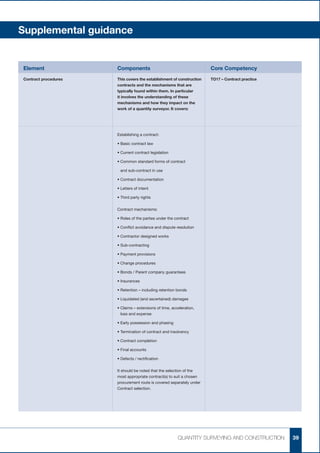
                            B
                            and roofs

                          •	nternal structures, such as partitions
                            I
                            and doors

                          •	Finishes, fixtures and fittings

                          •	Services installations, including underground 	
                          	 drainage and transportation systems

                          •	External works and landscaping

                          •	Road, pavement and rail track works

                          •	Major earthworks and tunnelling.


                          In respect of all the above, it will also include
                          the particular impact of the following on the
                          methods of construction and materials selected:

                          •	Building Regulations or Codes and other 	
                          	 related legislation

                          •	Sustainability requirements.


                                                               QUANTITY SURVEYING AND CONSTRUCTION                 47
Supplemental guidance


Element                         Components	                                                               Action
Construction technology         Candidates should have a basic understanding of all the main              Knowing
Level 1                         components listed above as they represent the most common
                                elements that make up buildings/structures.


Construction technology         Candidates should have experience of all of the components listed         Doing
Level 2                         above as they relate to their work in respect of estimating, production
                                of pricing documents, compilation of tender and contract documents,
                                interim valuations, valuing change and compiling final accounts.

                                Where a candidate has not experienced a component they should
                                have an understanding of how that component works in respect of
                                their sector.

                                For example:
                                A candidate might only have worked on one type of substructure,
                                but they should be aware of other solutions.

                                A candidate working on low rise residential projects might never have
                                been involved with a structural frame. However, they should still
                                understand the basic principles of how a frame works.


Construction technology         Ideally candidates should have advised clients on elements of the         Advising
Level 3                         design where the selection of particular methods of construction and
                                or materials have had a significant impact on the cost. This should
                                also have considered practical alternatives to that specified by the
                                professional team.

                                However, if they have not had the opportunity to do this they should
                                be able to demonstrate a detailed understanding of the components
                                listed above such that they could give reasoned and practical advice.


48    QUANTITY SURVEYING AND CONSTRUCTION
Section 2


Selecting optional competencies                                    Commercial management of construction – T010
                                                                   If a candidate has selected Design Economics and Cost
In addition to the core competencies, candidates are required      Planning as a core competency, they can select this as an
to choose two other competencies at level 2.                       optional competency. The candidate will need to have had
                                                                   experience in a contracting or commercial environment,
These must be selected from the closed list of competencies
                                                                   perhaps on a seconded basis.
for the quantity surveying pathway. The following is a guide
to the selection of optional competencies.                         Conflict avoidance, management and dispute resolution
                                                                   procedures – M006
What the guides say
                                                                   This is a mandatory competency to level 1. All candidates should
The RICS APC requirements and competencies guide says
                                                                   be aware of how conflict is avoided on projects as well as formal
on page 2:
                                                                   dispute resolution procedures. Candidates selecting this
“It is important that you give careful thought to your choice      competency should have had some involvement with formal
and combination of competencies. Your choice will inevitably       dispute resolution procedures, or an increased depth of
reflect the work you do in your day-to-day environment             knowledge on the subject.
(driven by the needs of your clients/employer). Your choice
                                                                   Contract administration – T016
and combination of competencies will be a reflection of your
                                                                   This competency requires candidates to have an understanding
judgment. At the final assessment interview, the assessors
                                                                   of all aspects of construction contracts and how they are
will take these choices into account. They will expect you to
                                                                   administered. Quantity surveying candidates might gain
present a sensible and realistic choice that reflects the skills
                                                                   experience in this competency when acting as an assistant
needed to fulfill the normal role of a surveyor in your field
                                                                   to, or as the employer’s agent on a design and build contract.
of practice.”
                                                                   They should not however use this competency as a duplication
Making your choice                                                 of T017 Contract practice.
You should discuss your likely workload with your supervisor
                                                                   Corporate recovery and insolvency – T020
and/or counsellor before selecting the competencies.
                                                                   Candidates should select this competency if they have been
They can advise you, but the final choice is yours.                involved in dealing with insolvency on one of their projects.
                                                                   They will be expected to understand the various ways in which
BEWARE! Do not bend the definition of a competency to fit
                                                                   insolvency can be dealt with by an insolvency practitioner and
your work or invent a story that stretches an assessor’s view
                                                                   how a quantity surveyor can assist.
of the competency beyond what might be considered reasonable.
                                                                   Design economics and cost planning – T022
You can change your optional competencies at any time up
                                                                   If a candidate has selected Commercial Management of
to final assessment. When you first select a competency it
                                                                   Construction as a core competency, they can select this as
will be with the expectation of gaining experience in that area.
                                                                   an optional competency. The candidate will need to have had
If however, the expected experience does not materialise, you
                                                                   experience of estimating in the context of setting budgets and
can change the competency to match your actual experience.
                                                                   of cost planning activities as they are carried out in a
Capital allowances – T008                                          consulting environment.
Candidates selecting this competency must fully understand the
                                                                   Due Diligence – T025
subject. Extracting contract cost data to populate forms
                                                                   This competency should be selected by candidates who have
provided by an accountant is not enough. Whilst this activity
                                                                   carried out a due diligence exercise whilst acting as a fund/
might provide suitable experience, candidates will need to
                                                                   project monitor, or in a monitoring capacity on projects using
do background reading to understand the subject in a
                                                                   management forms of procurement.
broader context.


                                                                        QUANTITY SURVEYING AND CONSTRUCTION                     49
Section 2


Insurance – T045
All candidates will be expected to have an understanding
of the insurance provisions on their projects. Candidates
selecting this competency should have a deeper understanding
of insurance matters generally and have been involved with
an insurance claim or have dealt with a loss adjuster.

Programming and planning – T063
Candidates selecting this competency should have had
involvement with the programming or scheduling of work.
Candidates working in a contracting environment are most
likely to gain experience in this competency. Candidates
working in private practice may engage with this competency
when working in the role of employer’s agent, when analysing
preliminaries or dealing with claims.

Project evaluation – T066
Candidates selecting this competency should have been involved
with feasibility studies or development appraisals and should
understand how all aspects of these exercises work.

Risk management – T077
In addition to a general understanding of how risk is dealt with
in construction, candidates selecting this competency should
have been involved with formal risk management processes
on a project. They should be able to carry out a quantitative
risk analysis as part of the overall risk management process.

Sustainability – M009
This is a mandatory competency to level 1. In addition to a
general awareness of sustainability issues in construction,
candidates selecting this competency should have some
further specialist knowledge or experience in this subject.
They should have had experience in the costing of sustainability.


 50     QUANTITY SURVEYING AND CONSTRUCTION
Section 3


Study check list                                                    Client care (M003) – Level 2
                                                                    •	 Understanding client objectives
In this section the competencies are broken down into a
                                                                    •	 Establishing client’s brief
list of topics to help candidates make sure they have covered
                                                                    •	 Appointment documents
everything that is appropriate to their journey through the
                                                                    •	 Fees
pathway competencies. The lists are not meant to be prescriptive.
                                                                    •	 Complaints procedures
They are not comprehensive, nor must a candidate necessarily
cover every topic. The lists are an aide-mémoire only.              •	 Key Performance Indicators
                                                                    •	 Establishing communications with client team
Law – In the 2006 guides there is no Law competency.                •	 Involvement of stakeholders
Any legal, legislative or case law matters have been absorbed
into the individual mandatory, core and optional competencies.      Communication and negotiation
Candidates should be aware that they must consider how              (M004) – Level 2
the law in their world region impacts on each of the                Oral communication:			
individual competencies.                                            •	 Phone calls
                                                                    •	 Reporting at meetings
This list is not exhaustive.
                                                                    •	 Facilitating/chairing meeting
Generally:	                                                         •	 Client and bid presentations
You should be reading articles in current copies of:                •	 Staff presentations
•	 RICS Business and Construction Journal                           •	 Contractor/consultant interviews
•	 RICS news e-mails                                                •	 Public speaking at seminars etc
•	 Other construction and property journals                         •	 Listening skills
•	 Quality newspapers
                                                                    Written/graphical communication:
Mandatory competencies                                              •	 Letters, memos and emails
Accounting principles and procedures                                •	 Report writing
(M001) – Level 1                                                    •	 Programming
•	 Balance sheets / profit and loss account                         •	 Using drawn information – checking scales and revisions
•	 Taxation                                                         •	 Using CAD documents
•	 Revenue and capital expenditure
                                                                    Negotiation:
•	 Cash flows
                                                                    •	 Establishing objectives
•	 Auditing
                                                                    •	 Setting strategy
•	 Ratio analysis
                                                                    •	 Collecting and presenting evidence
•	 Credit control
•	 Profitability
•	 Insolvency
•	 Legislation

Business planning (M002) – Level 1
•	 Legislation
•	 Short / long term strategies
•	 Market analysis
•	 Five year plans
•	  usiness support services – administration, secretarial,
   B
   HR, IT etc.
•	 Staffing levels – recruitment / turnover


                                                                          QUANTITY SURVEYING AND CONSTRUCTION                    51
Conduct rules, ethics and professional practice                      Teamworking (M010) – Level 1
(M005) – Level 3                                                     •	 Understand the role of team members
•	 RICS Rules of Conduct                                             •	 Appointing the project team
•	 Conduct befitting a chartered surveyor                            •	 Relationships with other team members
•	 Registration of firms                                             •	 Communicating with other team members
•	 Complaints procedure                                              •	 Partnering and collaborative working
•	 Conflicts of interest                                             •	 Strategic alliance
•	 Gifts                                                             •	 Supply chain management
•	 Professional Indemnity Insurance                                  •	 Legislation on selecting project teams
•	 Client accounts
                                                                     For senior professional route: Leadership – SP001 Level 2
•	 Regulation
                                                                     •	 Self management
•	 Disciplinary procedures
                                                                     •	 Leadership styles
•	 Lifelong learning - CPD
                                                                     •	 Organizing
•	 Current RICS structure
                                                                     •	 Planning techniques
•	 Faculties
                                                                     •	 Setting goals
•	 Current RICS issues and initiatives                               •	 Decision making

Conflict avoidance, management and dispute resolution                •	 Communication
procedures (M006) – Level 1                                          •	 Negotiation
See Optional competencies                                            •	 Supervision

Data management (M007) – Level 1                                     Managing people – SP002 Level 2
•	 BCIS / BMI or other external sources                              •	 Recruitment

•	 Elemental analyses                                                •	 Appraisals

•	 Pricing books                                                     •	 Personnel development

•	 Data base use generally                                           •	 Incentive schemes

•	 Employer’s in-house data storage and filing systems               •	 Communication

•	 Scheduling                                                        •	 Employment law
                                                                     •	 Employment policy
•	 Libraries
                                                                     •	 Human rights legislation
Health and safety (M008) – Level 2
                                                                     Managing resources (excluding human resources)
Personal health and safety at work – RICS publication
                                                                     – SP003 Level 2
‘Surveying Safely’ Personal safety procedures when visiting
                                                                     •	 Data communication systems
a construction site Common health and safety risks in construction
                                                                     •	 Stationery
Health and safety legislation:		
                                                                     •	 Secretarial / administration support services
•	 Generally
                                                                     •	 Space planning
•	 At work
                                                                     •	 Facilities management
•	 Construction specific
•	 Sector specific
•	 Client specific
•	 Asbestos and other hazardous materials

Sustainability (M009) – Level 1
See Optional competencies


 52        QUANTITY SURVEYING AND CONSTRUCTION
Section 3


Core Competencies                                                   Construction technology and environmental services
                                                                    (T013) – Level 3
Commercial management of construction (T010) – Level 3
                                                                    Construction technology			
•	 Estimating
                                                                    •	 Substructures – basements, types of piling, etc.
•	 Establishing budgets
                                                                    •	 Superstructures
•	 Cash flows
                                                                    •	 Comparison of concrete / steel frames
•	 Reporting financial progress against budget
                                                                    •	 Floor structures
•	 Procurement of labour
                                                                    •	 External walls, windows and doors
•	 Procurement of plant and materials
                                                                    •	 Cladding / glazing
•	 Procurement of sub-contracts
                                                                    •	 Roof structures and coverings
•	 Financial management of supply chain
                                                                    •	 Partitioning systems and doors
•	 Financial management of multiple projects
                                                                    •	 Finishes and fixtures
Contract practice (T017) – Level 3                                  •	 Hard and soft landscaping
•	 Principles of contract law                                       •	 Engineering structures
•	 Legislation                                                      •	 Bridges
•	 Current case-law – look out for cases reported in journals       •	 Tunnels
•	  tandard forms of main and sub contract – e.g. JCT, 	 	
   S                                                            	   •	 Roads
   NEC/ECC, GC Works, ICE, ACA, IChemE, FIDIC, etc.
                                                                    •	 Railways
•	  oles  responsibilities of parties – Client, Contract 	 	
   R                                                           	
                                                                    •	 Waterways
   Administrator / Employer’s Agent / Project manager / 			
   Engineer, Contractor, Sub-contractors, Quantity Surveyor         •	 Sea defences
•	 Assignment / Novation                                            •	 Earthworks
•	 Third party rights - Legislation / Collateral Warranties         •	 Sewage treatment plants
•	 Letters of intent – Comfort letters / Consent to spend /         •	 Processing plant
	   Recognition of contract                                         •	 Services technology
•	  erformance security - Bonds / Parent Company Guarantees
   P                                                                •	 Electrical systems
•	 Insurances                                                       •	 Mechanical systems
•	 Advance payments                                                 •	 internal / external drainage
•	 Interim valuations and payment provisions
                                                                    •	 Mains services
•	 Materials on/off site
                                                                    •	 Air-conditioning / ventilation systems
•	 Fluctuations
                                                                    •	 Fire safety systems
•	 Retention – retention bonds
                                                                    •	 Security systems
•	 Change procedures
                                                                    •	 Environmental systems and controls
•	 Valuing change - variations / compensation events
                                                                    •	 Data systems
•	 Extensions of time
                                                                    •	 Building types and other structures
•	 Claims / Loss and Expense
                                                                    •	 Building regulations and codes
•	 Dispute avoidance and resolution
                                                                    •	 Planning legislation and procedures
•	 Named / Nominated subcontractors
                                                                    •	 Party wall issues / rights of light
•	 Sectional Completion / Partial Possession
                                                                    •	 Dangerous / banned substances – asbestos etc
•	 Design Portions / Performance specified works
                                                                    •	 Pre-fabrication
•	 Determination
                                                                    •	 Disability legislation
•	 Final Accounts
•	 Completion
•	 Liquidated and Ascertained Damages
•	 Defects rectification period


                                                                          QUANTITY SURVEYING AND CONSTRUCTION             53
Design economics and cost planning (T022) – Level 3                  •	 Best Value
•	  conomics of design - site density, wall / floor ratio, storey
   E                                                                 •	 Whole life costing
   heights, room sizes, letable / non-letable                        •	 Supply Chain Management
•	  ources of cost data - BCIS / in-house database / other
   S                                                                 •	 Lean Construction
   external sources
                                                                     •	 Key Performance Indicators - KPI
•	 Inflation (tender / construction)
•	 Location factors, regional variations                             Project financial control and reporting (T067) – Level 3
•	 Currency fluctuations                                             •	 Post contract cost control
•	 Estimating                                                        •	 Change control procedures
•	 Cost Plans                                                        •	 Change control forms
•	 Cost Planning                                                     •	 Cost reporting
•	 Life cycle costing - capital / running costs / replacement        •	 Final accounts
•	 Value Engineering                                                 •	 Loss and expense
•	 Value Management                                                  •	 Risk management
•	 Risk Management and Analysis (contingency)                        •	 Cash flows
•	 State of the construction market                                  •	 Value engineering
•	 State of the economy generally – locally and globally             •	 Benchmarking / Best value
•	 Interest rates
                                                                     Quantification and costing of construction works
Procurement and tendering (T062) – Level 3                           (T074) – Level 3
Types of procurement:                                                Methods of measurement
•	 Traditional                                                       •	 SMM / CESMM
•	 Design and Build                                                  •	 RICS Code of Measuring Practice
•	 Management Contracting
                                                                     Preparation of pricing documents
•	 Construction Management
                                                                     •	 Tender documents generally
•	 Measured Term
                                                                     •	 Bill of quantity
•	 Serial contracting
                                                                     •	 Schedule of works
Financial basis:                                                     •	 Schedule of rates
•	 Lump sum                                                          •	 Provisional Sums / Prime Cost Sums
•	 Re-measured                                                       Analysis of price
•	 Reimbursable                                                      •	 Tender returns
•	 Target cost                                                       •	 Guaranteed / Agreed Maximum Price
•	 Guaranteed or Agreed Maximum Price                                •	 Target cost - Pain / Gain mechanisms

Tendering:                                                           •	 Loss and expense

•	 Standard rules of tendering – codes of practice, practice notes   •	 Preliminaries

•	 Single / two-stage tendering – competitive / negotiated           •	 Dayworks

•	 Compilation of tender lists – pre-qualifying contractors          Valuation of works	
•	 Compilation of tender documents                                   •	 Interim valuations
•	 Tender analysis                                                   •	 Valuing change
•	 Tender reports                                                    •	 Loss and expense
•	 Partnering – project and strategic                                •	 Final account
•	 Private Finance Initiative - PFI                                  •	 Reporting on cost	
•	 Public Private Partnership – PPP                                  •	 Tender report
•	 Prime contracting                                                 •	 Correcting errors in tenders
                                                                     •	 Post contract financial reporting


 54      QUANTITY SURVEYING AND CONSTRUCTION
Section 3


Optional comptencies                                              •	 Planning and building regulatory controls
                                                                  •	 Health  Safety – CDM
Capital allowances (T008)
                                                                  •	 Monitoring progress
•	 Current legislation
                                                                  •	 Monitoring quality
•	 Capital and revenue expenditure
                                                                  •	 Insurances
•	 Taxation
                                                                  •	 Bonds / Parent Company Guarantees
•	 Capital Allowances legislation
                                                                  •	 Third party rights
•	 Claiming capital allowances
                                                                  •	 Payment provisions	
•	 Plant and machinery
                                                                  •	 Change procedures
•	 Industrial buildings
                                                                  •	 Sectional Completion / Partial Possession
•	 Hotels
                                                                  •	 Nominated / Named Subcontractors
•	 Research and development
                                                                  •	 Extensions of time / loss and expense
•	 Enterprise zones
                                                                  •	 Materials on / off site
•	 First year allowances
                                                                  •	 Determination
•	 Enhanced capital allowances
                                                                  •	 Liquidated and ascertained damages
Commercial management of construction (T010)                      •	 Completion
(If not selected as a Core competency – see above)                •	 Defects / rectification period


Conflict avoidance, management and dispute                        Corporate recovery and insolvency (T020)
resolution procedures (M006)                                      •	 Types of Insolvency
•	  ow standard forms of contract deal with conflict
   H                                                              •	 Bankruptcy
   avoidance and dispute resolution
                                                                  •	 Individual voluntary arrangement
•	 Conflict avoidance
                                                                  •	 Liquidation
•	 Partnering
                                                                  •	 Administrative receivership / Fixed charge receivership
•	 Negotiation
                                                                  •	 Company voluntary arrangement
•	 Mediation
                                                                  •	 Role of the QS if insolvency occurs
•	 Conciliation
                                                                  •	 Termination and suspension of contracts
•	 Adjudication
                                                                  •	 Assignment / novation
•	 Arbitration
                                                                  •	 Ownership of material and plant
•	 Pre-action Protocol
                                                                  •	 Bonds and guarantees
•	 Litigation
                                                                  •	 Set-off
•	 Expert Witness
                                                                  •	 RICS Information Paper on Construction Insolvency
•	 Independent Expert Determination

                                                                  Design economics and cost planning (T022)
Contract administration (T016)
                                                                  (If not selected as a Core competency – see above)
•	  tandard forms of Contract- JCT, GC Works, ICE,
   S
   NEC/ECC, ACA (PPC2000) etc
•	  oles and responsibilities of parties -client, contractors,
   R
   designers, Q.S
•	  ole and responsibilities of person administering the
   R
   contract – e.g. CA, Architect, EA, PM, Engineer etc.
•	 Co-ordination of parties
•	 Design co-ordination


                                                                        QUANTITY SURVEYING AND CONSTRUCTION                    55
Due Diligence (T025)                                  •	 Roles and responsibilities
•	 Project monitoring on management style contracts   •	 Commissioning/handover procedure
•	 Fund monitoring                                    •	 Close-out reports
•	 Feasibility study
                                                      Project evaluation (T066)
•	 Planning and building regulatory control
                                                      •	 Appraisal methods	
•	 Suitability of team
                                                      •	 Residual value
•	 Suitability of procurement route
                                                      •	 Value / income
•	 Tendering
                                                      •	 Valuation of property / rental values
•	 Contractual arrangements
                                                      •	 RICS Red Book
•	 Third party rights
                                                      •	 Costs
•	 Suitability of programme
                                                      •	 Land acquisition
•	 Cash flows
                                                      •	 Construction costs
•	 Interim payments
                                                      •	 Fees
•	 Draw-down
                                                      •	 Finance costs
•	 Final accounts
                                                      •	 Taxation, grants, capital allowances
•	 Risk
                                                      •	 Profitability
Insurance (T045)                                      •	 Planning
•	  rofessional Indemnity Insurance
   P
   - Generally and RICS requirements                  Risk management (T077)

•	 Indemnifying the employer                          •	 Workshops

•	 Third-party liability – persons and property       •	 Identification	   	       	         	    	

•	 Insurance of the works – joint names               •	 Register

•	 Subrogation                                        •	 Management plan

•	 Non-negligence insurance                           •	 Mitigation

•	 Setting level of cover                             •	 QS contribution to risk management

•	 In the aggregate / each and every event            •	 Risk analysis

•	 Excess                                             •	 Probability and impact

•	 Net contribution clause                            •	 Expected Monetary Value - EMV

•	 Performance bonds                                  •	 Monte Carlo Simulation

•	 Fire insurance valuations                          •	 Central Limit Theory – CLT
                                                      •	 Route Mean Square - RMS
Programming and planning (T063)                       •	 Contingency
•	 Project programming
•	 Multi-project programming                          Sustainability (M009)

•	 Flow diagrams                                      •	 Sustainable development / construction

•	 Activity schedules                                 •	 National and international regulations

•	 Gant charts                                        •	 Environmental assessment methods – e.g. LEED, BREEAM etc.

•	 Critical path                                      •	 Building Regulations and Codes

•	 Key milestones                                     •	 Contaminated land

•	 Float                                              •	 Waste management

•	 Cash flows                                         •	 Recyclable materials

•	 Progress monitoring                                •	 Sustainable materials

•	 Project handbook                                   •	 Building environmental management systems

•	 Project Execution Plans - PEP                      •	 Water conservation

•	 Establishing team                                  •	 Energy generation
                                                      •	 Energy conservation


 56        QUANTITY SURVEYING AND CONSTRUCTION
rics.org


RICS HQ                  Advancing standards in land, property and construction.
Parliament Square	
London SW1P 3AD          RICS is the world’s leading qualification when it comes to
United Kingdom           professional standards in land, property and construction.
Worldwide media
                         In a world where more and more people, governments, banks and
enquiries:
                         commercial organisations demand greater certainty of professional
e pressoffice@rics.org
                         standards and ethics, attaining RICS status is the recognised
Contact Centre:          mark of property professionalism.
e contactrics@rics.org
t +44 (0)870 333 1600    Over 100 000 property professionals working in the major established
f +44 (0)20 7334 3811    and emerging economies of the world have already recognised the
                         importance of securing RICS status by becoming members.
                         RICS is an independent professional body originally established
                         in the UK by Royal Charter. Since 1868, RICS has been committed
                         to setting and upholding the highest standards of excellence and
                         integrity – providing impartial, authoritative advice on key issues
                         affecting businesses and society.
                         RICS is a regulator of both its individual members and firms enabling
                         it to maintain the highest standards and providing the basis for
                         unparalleled client confidence in the sector.
                         RICS has a worldwide network. For further information simply contact
                         the relevant RICS office or our Contact Centre.

                         Europe                   Asia                          Americas
                         (excluding United        Room 2203                     One Grand Central Place
                         Kingdom and Ireland)     Hopewell Centre               60 East 42nd Street
                         Rue Ducale 67            183 Queen’s Road East         Suite 2810
                         1000 Brussels            Wanchai                       New York 10165 – 2811
                         Belgium                  Hong Kong                     USA
                         t +32 2 733 10 19        t +852 2537 7117              t +1 212 847 7400
                         f +32 2 742 97 48        f +852 2537 2756              f +1 212 847 7401
                         ricseurope@rics.org      ricsasia@rics.org             ricsamericas@rics.org


                         United Kingdom           Africa                        Ireland
                         Parliament Square        PO Box 3400                   38 Merrion Square
                         London SW1P 3AD          Witkoppen 2068                Dublin 2
                         United Kingdom           South Africa                  Ireland
                         t +44 (0)870 333 1600    t +27 11 467 2857 	           t +353 1 644 5500
                         f +44 (0)207 334 3811    f +27 86 514 0655             f +353 1 661 1797
                         contactrics@rics.org     ricsafrica@rics.org           ricsireland@rics.org


                         Oceania                  Middle East                   India
                         Suite 2, Level 16        Office G14, Block 3           48  49 Centrum Plaza
                         1 Castlereagh Street     Knowledge Village             Sector Road
                         Sydney, NSW 2000         Dubai                         Sector 53, Gurgaon – 122002
                         Australia                United Arab Emirates          India
                         t +61 2 9216 2333        t +971 4 375 3074             t +91 124 459 5400
                         f +61 2 9232 5591        f +971 4 427 2498             f +91 124 459 5402
                         info@rics.org.au         ricsmenea@rics.org            ricsindia@rics.org


                                                                 QUANTITY SURVEYING AND CONSTRUCTION          57

Pathway guide quantity_surveying_construction_dwl_pt

  • 1.
    Quantity Surveying and Construction Assessmentof Professional Competence rics.org/pathwayguides
  • 2.
    Published by: RICS,Parliament Square, London SW1P 3AD All rights in this publication, including full copyright or publishing right, content and design, are owned by RICS, except where otherwise described. Any dispute arising out of this publication is subject to the law and jurisdiction of England and Wales. 02 QUANTITY SURVEYING AND CONSTRUCTION
  • 3.
    Contents Introduction 04 Pathway requirements 07 Quantity surveying and construction APC 07 Competency guidance 08 Capital allowances (T008) 09 Commercial management of construction (T010) 10 Conflict avoidance, management and dispute resolution procedures (M006) 11 Construction technology and environmental services (T013) 12 Contract administration (T016) 13 Contract practice (T017) 14 Corporate recovery and insolvency (T020) 15 Design economics and cost planning (T022) 16 Due diligence (T025) 17 Healthy and safety (M008) 18 Insurance (T045) 19 Procurement and tendering (T062) 20 Programming and planning (T063) 21 Project evaluation (T066) 22 Project financial control and reporting (T067) 23 Quantification and costing of construction works (T074) 24 Risk management (T077) 25 Sustainability (M009) 26 Supplemental guidance 27 • Profile of a newly qualified chartered quantity surveyor 28 • Selecting optional competencies 49 • Study check list 51 QUANTITY SURVEYING AND CONSTRUCTION 03
  • 4.
    Introduction About the APC NOTE: In the case of doubt the competency definitions The RICS Assessment of Professional Competence in this pathway guide will always take priority. (APC) ensure that those applying for RICS membership are competent to practise and meet the high standards of You MUST use this guide in conjunction with the professionalism required by RICS. There is a wide range 2006 core APC documentation which is available of pathways available to qualify as an RICS member on the RICS website and comprises: covering 22 different areas of practice. • APC Requirements and competencies guide The APC normally consists of – February 2012 • a period of structured training • andidate guides (2006) – (the particular candidate C • a final assessment. guide you need will depend on your route to membership) The structured training is based on candidates achieving a set of requirements or competencies. These are a mix • uide for supervisors, counsellors and employers G of technical, professional, interpersonal, business and – graduate route to membership, July 2006. management skills. How to use this guide This guide supports the core 2006 APC documentation. It is designed to help you understand more about qualifying as an RICS member in quantity surveying and construction. The guide is based on UK market practice and may be unsuitable for candidates based in other countries. The material is set out in three sections. Section one – provides information on this area of practice with a general overview of the quantity surveying and construction pathways. Section two – lists the competency requirements of the quantity surveying and construction APC pathways (as set out in the APC Requirements and competencies guide February 2012). Section three – describes the main technical competencies associated with quantity surveying and construction, providing expanded sector specific guidance on each of them. This forms the main part of the guide. Section four – This part of the pathway guide gives additional help to all those involved with the APC quantity surveying pathway to understand, interpret and use the competency definitions contained within the guide. It has been produced by the QS APC Technical Review Panel of the Quantity Surveying and Construction Faculty and has been ratified by the Faculty Board. 04 QUANTITY SURVEYING AND CONSTRUCTION
  • 5.
    Introduction About the competiencies Choosing your competencies The APC aims to assess that you are competent to carry It is important that you give careful thought to your choice out the work of a qualified chartered surveyor. To be competent and combination of competencies. Your choice will inevitably is to have the skill or ability to perform a task or function. The reflect the work you do in your day-to-day environment RICS competencies are not just a list of tasks or functions, (driven by the needs of your clients/employer). Your choice they are also based upon attitudes and behaviours. The and combination of competencies will be a reflection of your competencies have been drawn up in a generic way so that judgement. At the final assessment interview, the assessors they can be applied to different areas of practice and will take these choices into account. They will expect you to geographical locations. This guide is designed to help you present a sensible and realistic choice that reflects the skills interpret these competencies within the context of quantity needed to fulfil the role of a surveyor in your field of practice. surveying and construction. This guide should help candidates and employers with a The competencies are defined at three levels of attainment degree of assistance in choosing the competencies that are and each APC pathway has its own specific combination of most appropriate to their area of practice. competencies that you must achieve at the appropriate level. You must reach the required level in a logical progression and How to find help in successive stages: RICS has a fully trained Contact Centre team who will be able to help you with any general APC queries: Level 1 – knowledge and understanding RICS HQ Level 2 – application of knowledge and understanding Parliament Square Level 3 – reasoned advice and depth of technical knowledge. London SW1P 3AD United Kingdom The competencies are in three distinct categories: t +44 (0)870 333 1600 Mandatory competencies – the personal, interpersonal, f +44 (0)20 7334 3811 professional practice and business competencies common contactrics@rics.org to all pathways and compulsory for all candidates. These are www.rics.org explained in more detail in the APC Requirements and competencies guide – February 2012. Core competencies – the primary competencies of your chosen APC pathway. Optional competencies – a set of competencies selected by the candidate from a list defined for the particular pathway. In most cases there is an element of choice. These are mostly technical competencies, but certain mandatory competencies also appear on the optional competency list and candidates are permitted to select one of these at a higher level. This guide only deals with the principal core and optional competencies associated with this area. It does not cover the mandatory competencies. QUANTITY SURVEYING AND CONSTRUCTION 05
  • 6.
    Introduction About Quantity surveying • advising on the setting of budgets and construction • onitoring design development against planned expenditure m Quantity surveyors are the cost managers of construction. • conducting value management and engineering exercises They are initially involved with the capital expenditure phase of a building or facility, which is the feasibility, design and • managing and analysing risk construction phases, but they can also be involved with the • managing the tendering process extension, refurbishment, maintenance and demolition of a facility. • preparing contractual documentation The construction industry is global and extends across all • controlling cost during the construction process real estate and infrastructure markets. Quantity surveyors work • anaging the commercial success of a project for a contractor m in all sectors of the construction industry worldwide. In real estate this covers residential, commercial, industrial, leisure, • aluing construction work for interim payments, valuing v agricultural and retail facilities. In infrastructure it covers roads, change, assessing or compiling claims for loss and expense railways, waterways, airports, sea ports, coastal defences, and agreeing final accounts power generation and utilities. Quantity surveyors may also • negotiating with interested parties work in process engineering, such as chemical engineering plants or oil rigs. • giving advice on the avoidance and settlement of disputes. They must understand all aspects of construction over the Chartered alternative designations related to this pathway whole life of a building or facility. They must have the ability to All candidates qualifying under the Quantity surveying and manage cost effectively, equating quality and value with construction APC pathway, whether they work in private practice individual client needs. or for a contractor, will be entitled to use the designation ‘Chartered Quantity Surveyor’. RICS qualification pathways in this sector: Quantity surveying and construction APC RICS also offers a Quantity surveying and construction As a quantity surveyor you may be working as a consultant pathway in its Associate qualification. in private practice, for a developer or in the development arm of a major organisation (eg retailer, manufacturer, utility company For further details on Associate membership and this or airport), for a public sector body or for a loss adjuster. On pathway please go to rics.org/associate the contracting side you could be working for a major national or international contractor, a local or regional general contractor, for a specialist contractor or sub-contractor, or for a management style contractor. Your work may include the following: • preparing feasibility studies or development appraisals • ssessing capital and revenue expenditure over the a whole life of a facility • advising clients on ways of procuring the project 06 QUANTITY SURVEYING AND CONSTRUCTION
  • 7.
    Pathway requirements Quantity surveyingand construction APC Notes: Candidates should select from one of the following fields of work in which to demonstrate their competency. Mandatory competencies Other fields may be accepted, subject to written approval You must achieve the minimum levels as set out in the from the RICS Contact Centre. mandatory competencies. • Building Core competencies • Civil Engineering Level 3 • Railways • Commercial management of construction or Design • Petro-chemicals economics and cost planning* • Oil / gas installations • Contract practice • Mechanical and electrical installations. • Construction technology and environmental services *Quantity surveyors working in a commercial or contracting • Procurement and tendering environment will probably choose Commercial management of construction to Level 3. Quantity surveyors working in a • Project financial control and reporting consulting environment within either the public or private sector will probably choose Design economics and cost • Quantification and costing of construction works. planning to Level 3. Optional competencies Two competencies at Level 2 from the list below. • Capital allowances • Commercial management of construction or Design economics and cost planning (whichever is not selected as a core competency) • Contract administration • Corporate recovery and insolvency • Due diligence • Insurance • Programming and planning • Project evaluation • Risk management • Conflict avoidance, management and dispute resolution procedures or Sustainability. QUANTITY SURVEYING AND CONSTRUCTION 07
  • 8.
    Competency guide The pagesthat follow are intended to provide guidance for users on the main competencies associated with quantity surveying and construction. The guidance has been drawn up by experienced practitioners and aims to give you a clear and practical understanding of how to apply the listed core and optional competencies in the context of quantity surveying and construction. The guidance does not cover the mandatory competency requirements. The official competency definitions (at levels one, two and three) are provided, followed by a description of the key knowledge and activities that are likely to fall within the scope of each competency. The information provided is designed to be helpful but informal guidance. The knowledge and activities described under each competency are not exhaustive, and should not be relied upon as any form of revision list. Candidates must satisfy themselves and their employers that they have reached the required level of attainment before applying for final assessment. The competencies are arranged in alphabetical order. The full list of RICS competencies and pathway requirements can be found in the APC Requirements and competencies guide – February 2012. 8 QUANTITY SURVEYING AND CONSTRUCTION 08
  • 9.
    Competency guide Capital allowances Referenceno. T008 Description of competency in context of this sector This competency covers the taxation incentives/capital allowances available on property and structures in order to prepare claims and give advice to clients. Candidates should have an awareness of the various types of capital allowance that are available in accordance with capital allowances legislation. They should have a thorough understanding of types used on their projects. Examples of likely knowledge, skills and experience at each level Level 1 Level 2 Level 3 Demonstrate knowledge and understanding Apply knowledge of capital allowances and Provide evidence of giving reasoned advice; of capital allowances and grants. grants, including the ability to use source preparing claims; making applications for documents necessary to prepare taxation grants; preparing and presenting reports to allowances analyses. clients; and corresponding and negotiating with the relevant government and other authorities. Examples of knowledge comprised within Examples of activities and knowledge Examples of activities and knowledge this level are: comprised within this level are: comprised within this level are: • he definition of capital allowances and the T • ollecting the relevant documentation to C • reparing and presenting reports and P history behind their existence prepare a claim relating to the type of documentation transaction. For acquisitions this might • The client types that they apply to include sale agreements, valuation reports, • roviding advice on issues affecting P ledgers, drawings and specifications. For acquisitions, disposals and developments • he main types of capital allowances available T developments this might include ledgers, relating to property, including plant and • iving advice on the effect and interaction G building contracts, final accounts, invoices machinery, industrial building allowances, of capital allowances, general taxation and hotel allowances and enhanced capital • nderstanding, establishing and applying U accounting issues allowances entitlement and compliance issues, including • egotiating and agreeing capital allowances N other capital allowances such as long life • he property types that capital allowances T claims with taxation authorities. assets, short life assets, flat conversion, apply to. research and development • dentifying and quantifying qualifying I expenditure • he property types that capital allowances T apply to. QUANTITY SURVEYING AND CONSTRUCTION 9
  • 10.
    Competency guide Commercial managementof construction Reference no. T010 Description of competency in context of this sector This competency covers the commercial management of construction works. Candidates should have an awareness of how commercial competitiveness balances against profitability. They must have a thorough understanding of the financial processes used to achieve profitability and how these integrate with the overall delivery of the project Examples of likely knowledge, skills and experience at each level Level 1 Level 2 Level 3 Demonstrate knowledge and understanding Apply your knowledge to the financial Monitor, report and advise on project of the principles of the management of management of construction projects, cashflows and profitability. Evaluate and construction projects. including regular monitoring and reporting advise on the financial implications and on cashflow and profitability. appropriate management actions. Examples of knowledge comprised within Examples of activities and knowledge Examples of activities and knowledge this level are: comprised within this level are: comprised within this level are: • dentifying and understanding the I • Collecting of data for reports • onitoring, analysing, reporting and advising M components that make up the cost of the at a senior level on project cashflows and project to the contractor • Carrying out cost to completion exercises profitability for internal use • nderstanding of the effect that the design U • Preparing cashflows • valuating and advising on financial implications E and construction processes have on the cost and appropriate management actions. • reparing reports such as liability statements, P • wareness of the techniques used to A cost to complete and cost value reconciliations reconcile the cost against income • Applying value engineering processes • wareness of the techniques to financially A • reparing and submitting cost data for P manage sub-contractors and suppliers in-house and/or external use in relation to • Understanding the use of cashflows. areas such as cost of preliminaries, comparative cost of different construction techniques and taxation allowances. 10 QUANTITY SURVEYING AND CONSTRUCTION
  • 11.
    Competency guide Conflict avoidance,management and dispute resolution procedures Reference no. M006 Description of competency in context of this sector This competency covers the quantity surveyor’s involvement with the avoidance, management and resolution of disputes in construction projects. Candidates should be aware of the various processes and techniques commonly used in the industry. They should have a detailed understanding of how these are applied in practice. Examples of likely knowledge, skills and experience at each level Level 1 Level 2 Level 3 Demonstrate knowledge and understanding Provide evidence of practical application Provide evidence of the application of the of the techniques for conflict avoidance, in your area of practice having regard to above in the context of advising clients in the conflict management and dispute resolution the relevant law. various circumstances referred to above. procedures including for example adjudication and arbitration, appropriate to your APC pathway. Examples of knowledge comprised within Examples of activities and knowledge Examples of activities and knowledge this level are: comprised within this level are: comprised within this level are: • echniques for conflict avoidance, management T • eveloping further knowledge of the D • eveloping an in depth knowledge of law D and resolution, in particular by the appropriate relevant law governing conflict avoidance governing conflict avoidance and management selection of procurement routes and use of and management and dispute resolution and dispute resolution procedures, including processes such as partnering procedures relevant legislation and case law • ow various forms of contract deal with H • eing involved with adjudication procedures B • iving reasoned advice on different dispute G dispute avoidance and their provisions for in particular and have an understanding of resolution procedures having reference to resolving disputes the default procedures where a construction particular project circumstances contract does not make provision for • egal and statutory requirements for the L adjudication • iving advice on relevant law governing G resolution of disputes in construction contracts evidence of fact and expert evidence and the • eing involved with other dispute resolution B practice and procedures adopted by surveyors • onflict management and dispute resolution C procedures in the role of either advocate or expert witness procedures within the construction process including negotiation, mediation and conciliation, • ompiling evidence for use in dispute C • Giving advice as an expert witness. adjudication, arbitration, independent expert resolution procedures. determination and litigation. QUANTITY SURVEYING AND CONSTRUCTION 11
  • 12.
    Competency guide Construction technologyand environmental services Reference no. T013 Description of competency in context of this sector This competency covers the design and construction of buildings and other structures. Candidates should have a clear understanding of the design and construction processes commonly used in the industry. They should have detailed knowledge of construction solutions relevant to their projects. Examples of likely knowledge, skills and experience at each level Level 1 Level 2 Level 3 Demonstrate knowledge and understanding Apply your knowledge to the design and Advise on the selection and application of the principles of design and construction construction processes. of particular processes within your area of relating to your chosen field of practice. experience. This should include liaison with specialists and consultants to develop project specific design and construction solutions. Examples of knowledge comprised within Examples of activities and knowledge Examples of activities and knowledge this level are: comprised within this level are: comprised within this level are: • he stages of design from inception to T • ppreciating how design solutions vary for A • dvising on the choice of construction A completion different types of building such as clear span solutions for your project requirements for warehousing or acoustic • mpact of current legislation and regulations I requirements for accommodation • eporting on the impact of different design R (both national and international) solutions and construction processes on cost • nderstanding alternative construction details U and programme. • ow the various elements of the building H in relation to functional elements of the design work and inter-relate such as different types of piling or structural frame solutions. • The process of constructing the works • perational and maintenance processes O post contract. 12 QUANTITY SURVEYING AND CONSTRUCTION
  • 13.
    Competency guide Contract administration Referenceno. T016 Description of competency in context of this sector This competency covers the role of a surveyor administering a construction contract. Candidates should be aware of the roles and responsibilities of the administrator under the main forms of contract. They should have a detailed understanding of the contractual provisions relating to the forms of contract that they have administered. Examples of likely knowledge, skills and experience at each level Level 1 Level 2 Level 3 Demonstrate knowledge and understanding Implement administrative procedures Advise on the administrative procedures of the contractual, legislative and statutory necessary for the smooth running of a necessary for the smooth running of a terminology/requirements, of a construction construction contract. construction contract including document contract. control techniques and systems, meetings and reporting procedures. Examples of knowledge comprised within Examples of activities and knowledge Examples of activities and knowledge this level are: comprised within this level are: comprised within this level are: • he various standard forms of contract T • Issuing instructions • Resolving disputes and sub-contract used in the industry • Dealing with payment provisions • ssessing entitlement for extension of time A • asic contractual mechanisms and procedures B applied at various stages of the contract • Managing change procedures • ssessing entitlement for loss and expense A • he roles and responsibilities of T • Involvement with dispute avoidance • dvising all parties of their contractual rights A the administrator. and obligations. • ealing with completion and possession issues D • Issuing certificates. QUANTITY SURVEYING AND CONSTRUCTION 13
  • 14.
    Competency guide Contract practice Referenceno. T017 Description of competency in context of this sector This competency covers the various forms of contract used in the construction industry. Candidates should have an awareness of all of the main standard forms of contract and a thorough understanding of contract law, legislation and the specific forms that they have used. Examples of likely knowledge, skills and experience at each level Level 1 Level 2 Level 3 Demonstrate knowledge and understanding Apply your knowledge of the use of the Provide evidence of reasoned advice, of the various forms of contract used in various standard forms of contract at prepare and present reports on the selection the construction industry and/or your area project level, including the implications and of the appropriate form of contract and of business. obligations that apply to the parties to warranties for your chosen procurement the contract. route. This should include advising on the most appropriate contractual procedure at the various stages of a construction or other contract. Examples of knowledge comprised within Examples of activities and knowledge Examples of activities and knowledge this level are: comprised within this level are: comprised within this level are: • Basic contract law and legislation • Producing contract documentation • electing the appropriate form of contract S and/or sub-contract for your chosen • Contract documentation • arrying out the contractual mechanisms C procurement route and procedures relevant to the financial • he various standard forms of contract and T management aspects of your project, such • dvising on the most appropriate contractual A sub-contract as change procedures, valuations, loss and procedure at the various stages of a contract expense and final accounts • When the different forms would be used • valuating the appropriateness and implications E • nderstanding general contractual provisions U of proposed contractual amendments. • asic contractual mechanisms and B such as letters of intent, insurances, retention, procedures at various stages of the contract bonds, liquidated and ascertained damages, • hird party rights including relevant legislation T early possession, practical completion and and the use of collateral warranties. other common contractual mechanisms. 14 QUANTITY SURVEYING AND CONSTRUCTION
  • 15.
    Competency guide Corporate recoveryand insolvency Reference no. T020 Description of competency in context of this sector This competency covers the involvement and actions of a quantity surveyor when insolvency occurs on a construction project. Candidates should have an awareness of the processes and procedures that can apply when a party to a contract becomes insolvent and what help and support a quantity surveyor can give to the various parties involved, including the insolvency practitioner. They must have a thorough understanding of the how insolvency has affected their project and the legal and contractual position of the parties involved. Examples of likely knowledge, skills and experience at each level Level 1 Level 2 Level 3 Demonstrate knowledge and understanding Demonstrate an understanding of the Provide evidence of reasoned advice, prepare of the role of the Chartered Surveyor in various types of appointment that can be and present reports on the property assets of corporate recovery and insolvency situations. made to administer/manage the affairs of insolvent companies and individuals and/or insolvent and potentially insolvent companies in the administration of Fixed Charge and individuals. Receivership appointments. Examples of knowledge comprised within Examples of activities and knowledge Examples of activities and knowledge this level are: comprised within this level are: comprised within this level are: • he principles of the different insolvency T • ndertaking valuations and notional final U • iving reasoned advice to a contracted party G procedures, such as liquidation, administration, accounts in relation to an insolvency on on how to proceed following the insolvency receivership and company voluntary a project of the other party to the contract arrangement • aking action to facilitate the completion of T • iving reasoned advice to a client on how G • ow standard form contracts deal H a project where insolvency has occurred to proceed to complete a project following with insolvency an insolvency. • ndertaking work in support of an U • he nature of an insolvency practitioner’s T insolvency practitioner. role and his expectations as a client • ow a quantity surveyor might support an H insolvency practitioner. QUANTITY SURVEYING AND CONSTRUCTION 15
  • 16.
    Competency guide Design economicsand cost planning Reference no. T022 Description of competency in context of this sector This competency covers the impact of design and other factors on cost throughout the life of the building and the control of cost during the pre-contract stage. Candidates should have an awareness of how design decisions and construction processes impact on construction and operational costs. They must have a thorough understanding of techniques used to manage and control costs pre-contract. Examples of likely knowledge, skills and experience at each level Level 1 Level 2 Level 3 Demonstrate knowledge and understanding Apply your knowledge to the cost Give strategic and reasoned advice, of the main factors that affect design management of design development on a including the preparation and presentation economics over the whole life of a building. project from feasibility to design completion. of reports with reference to cost, time, Demonstrate knowledge and understanding Prepare and submit cost data to in-house quality and buildability. Advise on various of how cost planning assists in the financial and/or external data collection agencies. market factors and trends in construction control of projects during the design costs. Comment on accuracy and risk. development stage. Examples of knowledge comprised within Examples of activities and knowledge Examples of activities and knowledge this level are: comprised within this level are: comprised within this level are: • he main factors that affect design economics T • Producing estimates and cost plans • reparing and presenting reports with P over the whole life of the building including reference to cost, time, quality and buildability, capital and life cycle costs • Carrying out life cycle costing exercises including qualifications and exclusions • ow cost planning assists in the financial H • Applying value engineering processes • Evaluating building design efficiency control of projects during the design • Preparing cost reports • ssessing/evaluating market factors and A development stage trends in construction costs • reparing and submitting cost data to P • The various stages of cost planning in-house and/or external data collection • nalysing the accuracy of predicted cost A • Sources of cost data agencies. using benchmarking techniques • djustments that may be required for factors A • Interrogating historical cost data including location, specification, time and market forces. • Using value and risk management techniques. 16 QUANTITY SURVEYING AND CONSTRUCTION
  • 17.
    Competency guide Due diligence Referenceno. T025 Description of competency in context of this sector This competency covers the due diligence work and/or fund monitoring on construction projects. It may also cover the duties of quantity surveyors monitoring the financial management of management style contracts. Candidates should have an awareness of the areas of concern for funders and clients within a project and the techniques used in the forensic interrogation and monitoring of those areas. They must have a thorough understanding of the techniques used on their projects. Examples of likely knowledge, skills and experience at each level Level 1 Level 2 Level 3 Demonstrate knowledge of the techniques Apply your knowledge of cost, quality and Provide evidence of reasoned advice and used for cost, quality and time related forensic time related forensic examination in your area report to clients on cost, quality and time examination in your area of practice. of practice. related forensic examination in your area of practice. Examples of knowledge comprised within Examples of activities and knowledge Examples of activities and knowledge this level are: comprised within this level are: comprised within this level are: • The main areas of risk for a funder/client • Reviewing development appraisals • hecking compliance with loan agreements C and agreements to lease • he process of analysing contract T • eviewing specialist reports and checking R documentation statutory and other approvals • elivering reports to the funder/client on time, D cost and quality matters covered by your • ow to interrogate pricing data in relation H • nalysing the suitability of procurement A monitoring activities to development appraisals, cash flows, strategies and contract documentation, construction costs and risk allowances including third party rights issues and • iving advice to the funder/client on suitable G insurances action to be taken in respect of issues • echniques for assessing suitability of T identified by your monitoring activities. programmes • nterrogating pricing data in relation to I development appraisals, cash flows, • elevant statutory approvals, such as R construction costs and risk allowances planning and building control • stablishing suitability of project programmes, E • ow to monitor interim payments and H quality control procedures and health and planned progress. safety arrangements • hecking suitability and appointments of C project team • Analysing project and construction risks • Reviewing interim valuations for draw-down • onitoring progress against planned M programmes • Reviewing final accounts. QUANTITY SURVEYING AND CONSTRUCTION 17
  • 18.
    Competency guide Health andsafety Reference no. M008 Description of competency in context of this sector This competency covers the relationship between the work of the quantity surveyor and health and safety issues within the construction industry. Candidates should be aware of legal, practical and regulatory requirements. They should have a detailed understanding of the health and safety processes and guidelines used to achieve this. Examples of likely knowledge, skills and experience at each level Level 1 Level 2 Level 3 Demonstrate knowledge and understanding Apply evidence of practical application of Provide evidence of reasoned advice given of the principles and responsibilities imposed health and safety issues and the requirements to clients and others on all aspects on health by law, codes of practice and other regulations for compliance, in your area of practice. and safety. appropriate to your area of practice. Examples of knowledge comprised within Examples of activities and knowledge Examples of activities and knowledge this level are: comprised within this level are: comprised within this level are: • Personal safety on site and in the office • btaining formal health and safety O • iving reasoned advice on and/or taking G qualifications including first aid, industry responsibility for health and safety issues • Procedures imposed by law specific or nationally recognised qualifications relating to: • The impact on health and safety of: • eing involved with specific roles and B – Impact of design on construction responsibilities within the various regulations. – Design – Alternative construction processes – Construction processes – Impact of design on occupation and maintenance – Building maintenance – Undertaking risk assessments – Employment of staff. – Current legislation. 18 QUANTITY SURVEYING AND CONSTRUCTION
  • 19.
    Competency guide Insurance Reference no.T045 Description of competency in context of this sector This competency covers specific insurance provisions related to property and development. Candidates should be aware of how insurance is used to deal with risk in development. They should have a detailed understanding of the contractual requirements under the various standard forms of contract. Examples of likely knowledge, skills and experience at each level Level 1 Level 2 Level 3 Demonstrate knowledge and understanding Apply your knowledge and/or be involved with Demonstrate a thorough understanding of of the principles and practices of insurance the insurance of construction and/or property the regulations and practice governing the in relation to your area of practice. related matters. insurance of construction and/or property related matters. Examples of knowledge comprised within Examples of activities and knowledge Examples of activities and knowledge this level are: comprised within this level are: comprised within this level are: • he insurance provisions within the standard T • eveloping specialist knowledge in areas D • eporting on cost impact of insurance claims R forms of contract such as asbestos and terrorism to loss adjustor • pecific insurance mechanisms such as joint S • Compiling cost data for an insurance claim • eporting on re-construction costs for fire R names, subrogation, net contribution clauses, insurance valuations in the aggregate, each and every event and • ompiling cost data for a fire C excess provisions insurance valuation. • dvising clients on trends in the construction A insurance market • pecialist insurances such as performance S bonds, professional indemnity and • dvising on how insurances can be used A retention bonds. to mitigate risk. QUANTITY SURVEYING AND CONSTRUCTION 19
  • 20.
    Competency guide Procurement andtendering Reference no. T062 Description of competency in context of this sector This competency covers how a project is structured and delivered in terms of risk allocation and contractual relationships and how tendering processes are used to establish a contract price. Candidates should have a clear understanding of the different types of procurement and tendering commonly used and the advantages and disadvantages of each to the parties involved. They should have a detailed working knowledge of the procurement routes and tendering procedures used on their projects. Examples of likely knowledge, skills and experience at each level Level 1 Level 2 Level 3 Demonstrate knowledge and understanding Apply your knowledge to the implementation Give reasoned advice on the appropriateness of the main types of procurement. Demonstrate of the procurement routes selected for your of various procurement routes. Manage the knowledge and understanding of the tendering projects and to carrying out tendering and tendering and negotiation process and present and negotiation processes involved negotiation processes relevant to them. reports on the outcome. in procurement. Examples of knowledge comprised within Examples of activities and knowledge Examples of activities and knowledge this level are: comprised within this level are: comprised within this level are: • he main types of procurement used in both T • mplementing procurement routes such as I • valuating the appropriateness of various E the public and private sectors, both nationally traditional, design and build, management procurement routes and internationally forms, term and serial contracting and other types • anaging the tendering and M • endering and negotiation processes T negotiation process involvedin procurement • roducing and/or compiling tender P documentation such as letter of invitation, • Preparing procurement and tendering reports. • ncillary processes such as partnering and A form of tender, health and safety documentation, framework agreements design documentation and contractual details (Please note: pricing documents are covered • odes of practice and procedures C under the Quantification and costing of commonly used. construction works) • arrying out of tendering and negotiation C processes such as single and two stage tendering, the use of codes of practice and electronic tendering. 20 QUANTITY SURVEYING AND CONSTRUCTION
  • 21.
    Competency guide Programming andplanning Reference no. T063 Description of competency in context of this sector This competency covers a surveyor’s involvement with the programming and planning of construction projects. Candidates should have an awareness of the various principles, techniques and issues that relate to the programming and planning of projects generally. They must have a thorough understanding of how these principles and techniques have been used and how specific issues have been dealt with on their projects. Examples of likely knowledge, skills and experience at each level Level 1 Level 2 Level 3 Describe the principals of financial and Assess, interpret and report on the Provide evidence of reasoned advice on, programme monitoring of projects, including programme control of projects. or implement the principals of, executive planning techniques such as Gantt charts etc. programme control of projects. Your advice Demonstrate knowledge of the various types should demonstrate a good understanding of of programmes and schedules commonly planning techniques (pert diagrams, network used on projects. analysis/critical path methods). Examples of knowledge comprised within Examples of activities and knowledge Examples of activities and knowledge this level are: comprised within this level are: comprised within this level are: • nderstand the need for pre-contract U • ormulating and reporting on a project F • nterpreting the effectiveness of a I planning and programming techniques programme for different construction projects project programme using planning techniques • ifferent planning techniques eg Gantt D • roviding reasoned advice on the financial P Charts, Network Analysis and Critical Path • eporting the client’s financial R planning of construction projects (eg a client/ Analysis etc forecast expenditure of a project using developer might have a particular way of planning techniques funding a project, either fully financed or • he principles of how a programme is T generating finance from sales in phase one affected by change • alculating a critical path network analysis C to finance later phases. This would give rise and/or PERT network analysis as appropriate to very different strategies affecting both the • he need for good programming when T to determine the longest path timing and the cost of a project) forecasting accurately materials, man-power, machinery and money • dentifying the impact of contractual I • nalysing and advising on the possible A provisions on the effective planning of projects. outcomes in the event of a strategy change • he use of planning and programming when T eg financing provisions, time of construction, forecasting expenditure scope changes • he importance of a project or a contract T • dvising on a project programme when A programme when used together with different determining different procurement options. forms of contract. QUANTITY SURVEYING AND CONSTRUCTION 21
  • 22.
    Competency guide Project evaluation Referenceno. T066 Description of competency in context of this sector This competency covers the financial aspects of feasibility studies and development appraisals. Candidates should be aware of the various elements of a feasibility study and development appraisal and the factors that can affect them. They should have a detailed understanding of the techniques used to assess financial viability. Examples of likely knowledge, skills and experience at each level Level 1 Level 2 Level 3 Describe the feasibility study Apply the techniques used in value Initiate and monitor a feasibility study. Advise process, including the financial and management/value engineering, life cycle/ on the economics of design, on the use of town planning aspects associated whole life costing and risk assessment, value management and value engineering with a development appraisal. together with a balance sheet analysis. techniques and on how to undertake a full risk and balance sheet analysis. Examples of knowledge comprised within Examples of activities and knowledge Examples of activities and knowledge this level are: comprised within this level are: comprised within this level are: • nderstand the process of carrying out a U • roviding cost data for a development P • arrying out an appraisal; reporting and C development appraisal using techniques such appraisal, particularly in respect of advising on the outcome as residual valuation construction costs • dvising on the impact of costs associated A • nderstand the various financial elements of a U • nderstanding how financial data might U with the various elements of the appraisal development appraisal such as land and be obtained for elements of a development on the overall viability. construction costs, fees, finance costs, value appraisal (other than construction costs), or income steam and profit for example land and financing costs, fees, taxation, property valuation, income stream • wareness of the impact of non-financial A and profit factors such as town planning on an appraisal • arrying out life cycle cost exercises in C • nderstand the basic principals of techniques U relation to an appraisal used in association with development appraisals such as value management, value • eing involved in value and risk management B engineering, life cycle and whole life costing exercises in relation to an appraisal. and risk management. 22 QUANTITY SURVEYING AND CONSTRUCTION
  • 23.
    Competency guide Project financialcontrol and reporting Reference no. T067 Description of competency in context of this sector This competency covers the effective cost control of construction projects during the construction phase. Candidates should be aware of the principles of controlling and reporting costs on any construction project. They should have a detailed understanding of the control and reporting processes used on their projects (please note: for surveyors working in contracting this competency covers externally issued cost advice and reports). Examples of likely knowledge, skills and experience at each level Level 1 Level 2 Level 3 Demonstrate knowledge and understanding Apply your knowledge to the management Advise on strategies and procedures to of the effective control of costs during a project. of project costs. This should include the control predicted expenditure in line with Demonstrate understanding of the legal and preparation and presentation of financial a budget. contractual constraints and the effect of time reports on the performance of a project at and quality on the cost of a project. appropriate intervals, to provide effective forecasting of costs, risks and their financial implications. Examples of knowledge comprised within Examples of activities and knowledge Examples of activities and knowledge this level are: comprised within this level are: comprised within this level are: • he effective control of costs during the T • anaging project costs during the M • mplementing change control procedures I construction phase of a project construction phase within the contract • he legal and contractual constraints on the T • eporting and forecasting costs for different R • Establishing reporting regimes/protocols cost of a project such as changes in building procurement routes and client types legislation and design risk allocation • sing risk management and U • sing cashflows in financial management U analysis techniques. • he reporting and forecasting of costs during T the construction phase • anaging provisional sums/contingencies/ M risk allowances. • he principles of contingencies/ T risk allowances. QUANTITY SURVEYING AND CONSTRUCTION 23
  • 24.
    Competency guide Quantification andcosting of construction works Reference no. T074 Description of competency in context of this sector This competency covers the measurement and definition of construction works in order to value and control costs. Candidates should have an awareness of the various methods of quantifying and pricing construction works used throughout a project. They must have a thorough understanding of the specific methods used on their projects. Examples of likely knowledge, skills and experience at each level Level 1 Level 2 Level 3 Demonstrate knowledge and understanding Apply your knowledge to the quantification Advise on appropriate methods of of the principles of quantification and costing and costing of construction works, including quantification and costing for specific projects. of construction works as a basis for the the use of appropriate standard methods Take responsibility for the preparing and financial management of contracts. of measurement and forms of cost analysis. issuing pricing documents. Price or analyse Carrying out measurement and costing of such documents. Give advice on and/or works at all stages of the construction process. supervise the valuation of construction works throughout a project. Examples of knowledge comprised within Examples of activities and knowledge Examples of activities and knowledge this level are: comprised within this level are: comprised within this level are: • he quantification of construction works T • uantifying construction works at the Q • dvising on appropriate methods of A (including both measurement and definition) various stages of a project measurement and costing • he various standard methods of measurement T • roducing pricing documents such as bills P • Selecting of appropriate pricing documents of quantities, schedules of activities/works, • The costing of construction works schedules of rates or contract sum analyses. • egotiating and agreeing the valuation N of construction works at various stages • he measurement of buildings and structures T • arrying out the costing of construction C of the project such as the contract sum, to agreed standards. works by methods such as tendered rates, construction and final account. quotations or dayworks. 24 QUANTITY SURVEYING AND CONSTRUCTION
  • 25.
    Competency guide Risk management Referenceno. T077 Description of competency in context of this sector This competency covers the management of risk on construction projects. Candidates should be aware of the benefits to be gained and the techniques and processes used to manage risk. They should have a detailed understanding of how risk is dealt with on their projects. Examples of likely knowledge, skills and experience at each level Level 1 Level 2 Level 3 Demonstrate your knowledge and Apply your knowledge to carry out risk Provide evidence of reasoned advice and understanding of the nature of risk and, in assessments taking into account all relevant implement systems to manage risk by particular, of the risks associated with your factors. Understand the application of the competent management in relation to area of business/practice. various methods and techniques used to specific projects. measure risk. Examples of knowledge comprised within Examples of activities and knowledge Examples of activities and knowledge this level are: comprised within this level are: comprised within this level are: • The principles of risk management • Contributing towards the identification of risk • dvising on the appropriate procurement A route in relation to the client’s attitude to risk • ow the various procurement routes deal H • dentifying who owns the risk in relation to the I with risk chosen procurement route on your project • ecognising and advising on the appropriate R methodologies and approach to risk on • Mitigation strategies • ontributing towards strategies to mitigate risk C a project • The techniques used to quantify risk • ontributing data towards the quantification C • aking ownership of the risk register and T of risk advising on appropriate risk mitigation strategies • The effect of risk on programme and cost. • onsidering the effect of risk on programme C • pplying techniques to quantify risk and A and management cost specific to their project. advising client’s on the appropriate level of contingency. QUANTITY SURVEYING AND CONSTRUCTION 25
  • 26.
    Competency guide Sustainability Reference no.M009 Description of competency in context of this sector This competency covers the role of the quantity surveyor in dealing with the impact of sustainability issues on development and construction. Candidates should have an awareness of the various ways in which sustainability can impact on development and construction. They must have a thorough understanding of the impact made by sustainability on their projects and have been involved with the financial management of that impact. Examples of likely knowledge, skills and experience at each level Level 1 Level 2 Level 3 Demonstrate knowledge and understanding Provide evidence of the practical application Provide evidence of reasoned advice given of why and how sustainability seeks to balance of sustainability appropriate to your area of to clients and others on the policy, law and economic, environmental and social objectives practice, and of awareness of the circumstances best practice of sustainability in your area at global, national and local levels in the context in which specialist advice is necessary. of practice. of land, property and the built environment. Examples of knowledge comprised within Examples of activities and knowledge Examples of activities and knowledge this level are: comprised within this level are: comprised within this level are: • he principles of sustainability within T • arrying out capital cost and value C • iving reasoned advice to your client and G development and the construction process engineering exercises to determine the members of the project team on the financial impact of sustainability issues on design impact of sustainability on a project • he relationship between property and T and construction processes the environment • iving reasoned advice on the application of G • arrying out life cycle cost exercises which C environmental law and policy • ow national and international legislation, H take account of sustainability issues regulations and taxation relating to sustainability • nterpreting environmental reports and giving I affect construction • nderstanding the measures undertaken U reasoned advice on the financial impact and by governments and international bodies to programme implications on a project • riteria by which sustainability is measured C encourage the reduction of the environmental in relation to finished buildings impact of development. • iving advice on sustainable material G selection and how performance baselines • he principles of how design, technology and T can be estimated. construction processes can contribute to sustainable building • he principles of material resource efficiency T within the supply chain. 26 QUANTITY SURVEYING AND CONSTRUCTION
  • 27.
    Supplemental guidance Additional guidancefor the APC QS Pathway Section 1 – Profile of a newly qualified chartered quantity surveyor This section sets out, as a minimum, the areas in which a newly qualified chartered quantity surveyor will have gained knowledge and experience during their time on the APC. With the introduction of the QS Pathway Guide in 2006 the APC gives a clear definition of the areas and levels of technical competence required of a QS candidate. Because each candidate’s journey to achieving the competencies will be unique, the definitions and examples take a generic approach that could be applied anywhere in the industry. So, what in detail should an individual candidate have knowledge of or have experienced on their unique journey to professional competence? This profile aims to help all those involved with the APC process understand and interpret the APC core competencies for the QS pathway. It should be read in conjunction with the QS pathway core competencies definitions. Section 2 – Selecting of optional competencies In addition to the core competencies, candidates are required to choose two other competencies at level 2. These must be selected from the closed list of competencies for the quantity surveying pathway. This section will help candidates with the selection of these optional competencies. Section 3 – Study check list In this section the competencies are broken down into a check list of topics to help candidates make sure they have covered everything that is appropriate to their journey through the pathway. The list is not meant to be prescriptive. It is not comprehensive, nor must a candidate necessarily cover every topic. This section is an aide-mémoire only. NOTE: In the case of doubt the competency definitions in this pathway guide will always take priority. This supplemental guidance is intended to assist all candidates worldwide. The examples given in Section 1 and the topics listed in Section 3 often refer to UK practice. Candidates in other world regions should interpret these in relation to practices in their region. QUANTITY SURVEYING AND CONSTRUCTION 27
  • 28.
    Supplemental guidance Section 1 However, in some of the components within the elements, Profile of a newly qualified such as value management or life cycle costing, it may not chartered quantity surveyor be possible to obtain adequate or any experience. Equally a candidate is unlikely to experience all types of procurement The following profile sets out in elements the work of a and might not experience every type of tendering. In all of quantity surveyor. The elements are then broken down into these cases candidates will need to undertake additional components. The elements do not match exactly the core private study and try to make contact with someone who has competency titles in the pathway guide, but are referenced to experience in the area to lift their knowledge to the required them. This is because the­core competencies span a number level of competency. of elements. APC QS candidates will need to gain knowledge and experience in all of the following elements. Elements • Estimating • Cost planning • Procurement • Tendering • Contract selection • Contract procedures • ost contract cost control OR Commercial P management of contracts • Quantification of works • Construction technology Every effort should be made to do this. In the final assessment candidates will be expected to have a depth of knowledge in the areas of their experience, but also a breadth of knowledge across all of the following profile. The APC recognises that candidates might work in a specific sector (water utility, residential, education), or for a particular type of client (commercial developer, government department, airport operator), or in one geographical region (UK, USA, UAE). What is important is that candidates cover the following profile within their sector(s) and for their client(s) in their region. They should always have an awareness that things might be done differently in other sectors or in the industry at large within their region. Where their sector or client does things in a specific way, candidates should be aware of the industry norm. ­­­ 28 QUANTITY SURVEYING AND CONSTRUCTION
  • 29.
    Supplemental guidance Element Components Core Competency Estimating This covers the preparation and reporting TO22 – Design economics and cost planning of cost estimates at the different stages of design. It includes an understanding of: TO74 – Quantification and costing of construction works • The purpose of cost estimating • he different types of cost estimate such T as feasibility, budget or pre-tender estimates • he basis of an estimate, such as functional T unit rate, elemental, detailed quantities • The components of an estimate • Sources, use and adjustment of data • Benchmarking techniques • Reporting cost estimates • he difference between a cost estimate, T a cost plan and a cost analysis It also includes: • Calculating unit rates for items from first principles • Base dates • Construction and tender inflation • Location factors • ite/location specific conditions S (e.g. ground conditions and site constraints) • Programme • Sustainability requirements • Professional and statutory fees • Preliminaries and overheads and profit • Risk allowances • Inclusions and exclusions QUANTITY SURVEYING AND CONSTRUCTION 29
  • 30.
    Supplemental guidance Element Components Action Estimating Candidates should have experience in the preparation of a cost Knowing Level 1 estimate. Ideally they will have experienced all of the components listed above. Estimating Candidates should have experience in the preparation of a cost Doing Level 2 estimate. Ideally they will have experienced all of the components listed above. They should have measured building work items, compiled unit rates and compiled the final cost estimate report, which is presented to the client and members of the project team. Where they have not experienced a component they should have a detailed practical understanding of how that component works. For example: A candidate might have compiled feasibility estimates on a functional unit or elemental basis, but not have undertaken a pre-tender estimate (PTE). They should still understand how to carry out a PTE in practice. Estimating Ideally candidates should have presented an estimate to a client Advising Level 3 and members of the project team in a manner which clearly articulates the key aspects of the estimate. They should also have responded to an interrogation of the estimate by the team. However, if they have not had the opportunity to do this they should be able to demonstrate a detailed understanding of the requirements. 30 QUANTITY SURVEYING AND CONSTRUCTION
  • 31.
    Supplemental guidance Element Components Core Competency Cost planning This covers an understanding of the cost TO22 – Design economics and cost planning planning process from setting the client’s budget to design completion. It involves TO74 – Quantification and costing of preparing, issuing and presenting cost construction works plans at the different stages of design. It includes an understanding of: • The purpose of cost planning • Setting a budget • The components of a cost plan • he terminology used including cost limit, T cost target, functional element, element unit quantity and rate • Measurement rules relating to cost planning • Sources of data • Benchmarking techniques • se of value management, value engineering U and life cycle costing techniques • actors affecting the cost efficiency of a design, F e.g. wall / floor ratio and storey heights • Reporting of cost plans It also includes: • All items listed under the estimating element • RIBA or other design stages QUANTITY SURVEYING AND CONSTRUCTION 31
  • 32.
    Supplemental guidance Element Components Action Cost planning Candidates should have an understanding of all of the main Knowing Level 1 components of cost planning as listed above. Cost planning Ideally candidates should have experience of the entire cost planning Doing Level 2 process and should have been involved with producing a cost plan. They should have participated in the setting of a budget, developing a cost plan, benchmarking a design, monitoring design development against a cost plan, managing risk, value engineering elements and evaluating life cycle costs. They should also have prepared the final document for presentation to the client and the project team. Where they have not experienced a component they should have a detailed practical understanding of how that component works. For example: A candidate might have joined the cost planning process after the budget had been set and the outline cost plan completed. Their work was to monitor the design and produce further cost plans, managing risk and value engineering the design where necessary. The candidate should still understand how budgets are set and how an outline cost plan is developed and benchmarked. Note: It is not considered that the measurement of elements alone will be sufficient to meet the requirements. Cost planning Candidates should have presented a cost plan to the client and Advising Level 3 members of the project team in a manner which clearly articulates the key aspects of the document. They should then have taken the team through the process of interrogating the cost plan and engineering the design/project to meet the budget. However, if they have not had the opportunity to do this they should be able to demonstrate a detailed understanding of the components such that they could undertake this process. 32 QUANTITY SURVEYING AND CONSTRUCTION
  • 33.
    Supplemental guidance Element Components Core Competency Procurement This covers developing a procurement TO62 – Procurement and tendering strategy and includes giving advice on the most appropriate procurement route to be adopted, covering in particular: • Traditional • Design and Build • anagement contracting and M construction management • Serial/term contracting • Partnering In relation to this, it includes the detailed consideration of how the following factors influence the selection of the procurement route: • Contractual relationships • Roles and responsibilities of the parties • Time certainty, quick start or earliest finish • ost certainty, cost control, competition, C or demonstration of value for money • Quality management • Change management • Risk allocation and management It should be noted that the use of the most appropriate contract(s) to suit the chosen procurement route is covered separately under Contract selection, whilst the implementation of the tendering process through to appointment of the contractor is covered separately under Tendering. QUANTITY SURVEYING AND CONSTRUCTION 33
  • 34.
    Supplemental guidance Element Components Action Procurement Candidates should have an understanding of all the main components Knowing Level 1 listed above as they represent the most common procurement methods used in the industry. Procurement Candidates should have experience of the selection of a procurement Doing Level 2 route on a single project, or as part of a series of projects and should have given consideration to all of the above components in making that selection. Candidates should be aware of the variances under each of the procurement routes above, e.g. develop and construct under the design and build route. It is unlikely that a candidate will have direct experience of all of the main procurement routes used in the industry. Where they have experience of just one or two routes they should have an awareness of how all of the other types of procurement work in practice. They should also be aware of how a procurement route might be adapted for use in different situations. For example: If a candidate has only worked on design and build procurement, they should still have an understanding of how the other procurement routes work. Procurement Ideally candidates should have given advice direct to a client or project Advising Level 3 team on the selection of a procurement route. However, if they have not had the opportunity to do this they should be able to demonstrate a detailed depth of understanding of the components listed above such that they could give reasoned and practical advice. 34 QUANTITY SURVEYING AND CONSTRUCTION
  • 35.
    Supplemental guidance Element Components Core Competency Tendering This covers the implementation of a TO62 – Procurement and tendering chosen procurement route through to the selection of the contractor/supplier and the establishment of a basis for contract. It includes: • Single stage tendering • Two stage tendering • Negotiated tenders In particular it covers: • Compiling a tender list and pre-qualification • Preparation of tender documentation • ssuing tender documents, including I e- tendering • anagement of the process during the M tender period • Tender opening procedures • Evaluation of tenders • Dealing with errors and qualifications • Compiling a tender report In carrying out the above, this will also include an understanding of: • ules of tendering - codes of practice or R procedure • Regulations governing the client • Public sector regulations • U or other international regulations (as they E apply to the candidate’s world region) It should be noted that the choice of procurement route is covered separately under Procurement and use of the most appropriate contract(s) to suit the chosen procurement route is covered separately under Contract selection. Also, it should be noted that the production of pricing documentation is covered under Quantification. QUANTITY SURVEYING AND CONSTRUCTION 35
  • 36.
    Supplemental guidance Element Components Action Tendering Candidates should have an understanding of all of the main Knowing Level 1 components listed above, as they represent the most common methods of tendering. Tendering Candidates should have experience of the complete tendering process, Doing Level 2 from compiling the tender list through to the appointment of the contractor/supplier. Ideally they will have experienced different types of tendering, such as single and two-stage. However, where a candidate has experienced only one type of tendering they should have an awareness of how the components listed above work in other situations. For example: A candidate might have experience of single stage selective tendering, but they should also understand how the other forms of tendering work. A candidate might have experience of negotiating with a contractor taken from a framework. They should also understand the tendering processes that formed the framework. A candidate might have been brought into the tendering process to put together the tender documents, after the lender list had been established. The candidate should still understand how contractors are pre-qualified and tender lists compiled. Tendering Ideally candidates should have given advice direct to the client on Advising Level 3 the selection of contractors for the tender list and then ultimately the recommendation to the client on which contractor to appoint. However, if they have not had the opportunity to do this they should be able to demonstrate a detailed depth of understanding of the components listed above such that they could give reasoned and practical advice. 36 QUANTITY SURVEYING AND CONSTRUCTION
  • 37.
    Supplemental guidance Element Components Core Competency Contract selection This covers the implementation of a TO17 – Contract practice chosen This covers giving advice on the most appropriate form of contract to be TO62 – Procurement and tendering used. This involves main, sub and package contracts from the standard suites of contract commonly used in the industry within the candidate’s particular geographical region, for example: • JCT • NEC • GC Works • ICE • IChemE • FIDIC It also includes a general knowledge of how the main contracts work in respect of: • Roles and responsibilities of the parties • Pricing options • Risk allocation • Client specific considerations on selection It should be noted that the selection of the most appropriate procurement route is covered separately under Procurement, whilst the implementation of the tendering process is covered separately under Tendering. The detailed application of these contracts is covered under Contract procedures. QUANTITY SURVEYING AND CONSTRUCTION 37
  • 38.
    Supplemental guidance Element Components Action Contract selection Candidates should have an understanding of the forms of contract Knowing Level 1 commonly used in the industry, together with the main components listed above. Contract selection Candidates should have been involved with the selection of a suitable Doing Level 2 contract for a procurement route. Where a candidate has not been directly involved with this process they should thoroughly investigate how the form of contract was selected on the project(s) they have worked on. Contract selection Ideally candidates should have given advice direct to the client and Advising Level 3 their legal advisors on the selection of the most appropriate form of contract. A candidate is unlikely to have experience of working with all of the various forms of contract available in their sector, but they should have sufficient awareness of those that are available so that they can consider all possibilities and give informed advice to their client or the project team. 38 QUANTITY SURVEYING AND CONSTRUCTION
  • 39.
    Supplemental guidance Element Components Core Competency Contract procedures This covers the establishment of construction TO17 – Contract practice contracts and the mechanisms that are typically found within them. In particular it involves the understanding of these mechanisms and how they impact on the work of a quantity surveyor. It covers: Establishing a contract: • Basic contract law • Current contract legislation • Common standard forms of contract and sub-contract in use • Contract documentation • Letters of intent • Third party rights Contract mechanisms: • Roles of the parties under the contract • Conflict avoidance and dispute resolution • Contractor designed works • Sub-contracting • Payment provisions • Change procedures • Bonds / Parent company guarantees • Insurances • Retention – including retention bonds • Liquidated (and ascertained) damages • laims – extensions of time, acceleration, C loss and expense • Early possession and phasing • Termination of contract and insolvency • Contract completion • Final accounts • Defects / rectification It should be noted that the selection of the most appropriate contract(s) to suit a chosen procurement route is covered separately under Contract selection. QUANTITY SURVEYING AND CONSTRUCTION 39
  • 40.
    Supplemental guidance Element Components Action Contract procedures Candidates should have knowledge of all the main components listed Knowing Level 1 above, as they represent the most common contract procedures used in the industry. In particular they should have a thorough knowledge of how these components work within the contract(s) used on the candidate’s project(s). Contract procedures Candidates should have experienced as many of the above components Doing Level 2 as possible, in relation to the contract(s) they have been involved with. Where they have not experienced a component they should have a strong theoretical knowledge of both the contractual and the practical procedures involved. Ideally a candidate should have experience of a number of different forms of contract. However, where their experience is on only one form, they should have a thorough understanding of all of the components as they relate to that form. Where a candidate’s experience relates only to a bespoke form of contract they should have a detailed knowledge of the standard form on which the bespoke form is based, or if it is not based on a standard form, then on at least one of the major standard forms commonly used in the industry. For example: A candidate might not have worked on a project where a letter of intent was used, or a claim for loss and expense was made, but they should still have knowledge of these components. A candidate might not have experienced insolvency of a contractor on a project, but they should have knowledge of the provisions within the contract(s) used on their project(s) and what they as the project QS would do in the event of insolvency. A candidate might not have worked with a contract that provides for the use of liquidated (and ascertained) damages, but they should still know about them and how they work in other commonly used contracts. Where the bespoke form is not based on any standard form, they should pick a major commonly used form such as the JCT or the NEC standard form and ensure they have a thorough understanding of how it works. Contract procedures Candidates should have given advice to a client or the project team on Advising Level 3 the selection or implementation of at least some of the above components. However, where they have not had the opportunity to do this they should be able to demonstrate a detailed depth of understanding of the components listed above such that they could give reasoned and practical advice. For example: A candidate might not have given advice on the use of collateral warranties as opposed to using the Contracts (Rights of Third Parties) Act. However, they should understand the advantages and disadvantages of both so that they could give advice if required. 40 QUANTITY SURVEYING AND CONSTRUCTION
  • 41.
    Supplemental guidance Element Components Core Competency Post contract cost control This covers the financial management T17 - Contract practice (For surveyors working in a consulting of a project during the construction phase environment in either the public or (generally the post contract phase). TO67 – Project financial control and reporting private sector) It covers cost control procedures and T074 – Quantification and costing of reporting. In particular: construction works • Forecasting and cash flows • Managing change control procedures • Valuing change • xpenditure of provisional and prime E cost sums • Expenditure of contingencies • Carrying out interim valuations • Managing risk • Value engineering • Dealing with claims • Authentication of actual costs • Reporting regimes and protocols • Final accounts It should be noted that an understanding of the basic contract mechanisms relating to the above is covered separately under Contract procedures. This element deals with the practicalities of implementing and managing these mechanisms. Note: the measurement and pricing of works is covered under the quantification element. QUANTITY SURVEYING AND CONSTRUCTION 41
  • 42.
    Supplemental guidance Element Components Action Post contract cost control Candidates should have knowledge of all the main components Knowing Level 1 listed above as they represent the most common procedures used in the industry. Post contract cost control Candidates should have experienced as many of the above components Doing Level 2 as possible, in relation to the contract(s) they have been involved with. Where they have not experienced a component they should have a strong theoretical knowledge of the practical procedures involved. For example: A candidate might have worked exclusively on projects where there was very little change instructed, all of which had costs agreed in advance. They still need to be aware of the potential problems with managing change on projects. They need to know what steps they might take to prevent such problems arising. A candidate might not have had to produce a cash flow for a project, but they should still understand how this would be done. A candidate might not have worked on a project where risk management has been implemented, but they should still understand how the process works and how they would report changes to the risk register in their cost reports. Post contract cost control Candidates should have given advice to a client or the project Advising Level 3 team on the selection or implementation of at least some of the above components. However, where they have not had the opportunity to do this they should be able to demonstrate a detailed depth of understanding of the components listed above such that they could give reasoned and practical advice. 42 QUANTITY SURVEYING AND CONSTRUCTION
  • 43.
    Supplemental guidance Element Components Core Competency Commercial management of contracts This covers the commercial management of T010 - Commercial management contracts where the surveyor is working on of construction (For surveyors working in a commercial or the contracting or sub-contracting side of the contracting environment) profession, or where they are involved in fee T17 - Contract practice based contracting such as construction (This might also apply to surveyors management or management contracting. working in management contracting and It includes: construction management) • andover of estimate and setting up of H the construction budget • Cash flow forecasting • inancial management of supply chain, F including: procurement, interim payments, valuation of change, ascertainment of loss and ­­ expense, agreement of final accounts • Administration of sub-contract and supplier agreements • Cost evaluation of alternative design and construction processes including value engineering • Reconciliation of value and cost • Cost to completion forecasting and reporting • Managing contingency and risk • Alternative profit recognition conventions (current / final margin basis) • Preparation of information for internal/ external audit • Internal and external cost reporting • Forecasted final account projections QUANTITY SURVEYING AND CONSTRUCTION 43
  • 44.
    Supplemental guidance Element Components Action Commercial management of contracts Candidates should have knowledge of all the main components Knowing Level 1 listed above as they represent the most common procedures used in the industry. Commercial management of contracts Candidates should have experienced as many of the above Doing Level 2 components as possible, in relation to the contract(s) they have been involved with. Where they have not experienced a component they should have a strong theoretical knowledge of the practical procedures involved. For example: A candidate might have carried out cost value reconciliation for part of their project but not all of it. They will need to investigate how the remainder of the project is dealt with so that they have a thorough understanding of this component. They might only have experienced financial management of the supply chain, but they should still be aware of how cost value reconciliation is carried out and its use in preparing monthly accounts at either project or business level. Commercial management of contracts Ideally candidates should have given advice on suitable commercial Advising Level 3 management procedures. They should be able to compare and contrast different techniques and their relevance to a given project. If they have not had an opportunity to do this they should be able to demonstrate a depth of understanding of the components listed above, sufficient to be able to give advice on a specific project. 44 QUANTITY SURVEYING AND CONSTRUCTION
  • 45.
    Supplemental guidance Element Components Core Competency Quantification of works This covers the measurement of works TO22 – Design economics and cost planning for the purpose of: TO74 – Quantification and costing of construction works • Preparing estimates and cost plans • roducing tender and contract P documentation, such as elemental sum analyses, schedules of works, bills of quantities • Valuing works for interim payments, change and final accounts It includes understanding: • The purpose of measurement • he need for a standardised approach T to measuring • Measurement rules • ifferent ways in which floor areas can D be measured and reported • Build-up of unit rates and prices from first principles, i.e. labour, plant, materials, etc. • Build-up of costs in respect of preliminaries – note that merely applying a percentage addition is not sufficient • Quantification of overheads and profit • uantification of risk and calculation of Q a risk allowance • Forecasting tender and construction inflation It also includes an understanding of the importance of the description that accompanies any numeric data and having a knowledge of the different categories of measurement, such as: • Floor Area • Functional Unit • Elemental • Composite quantities • Detailed quantities QUANTITY SURVEYING AND CONSTRUCTION 45
  • 46.
    Supplemental guidance Element Components Action Quantification of works Candidates should have an understanding of the reasons for Knowing Level 1 measuring construction work and the rules of measurement commonly used in the industry. They should also understand the different approaches used and their application to measuring work. Quantification of works Candidates should have experience of measuring construction work Doing Level 2 for the purpose of preparing cost estimates, cost plans, tender/ contract pricing documents and valuing change. For example: A candidate might not have been involved with the preparation of a bill of quantities, but they should have been involved with producing some sort of pricing daocument, whether it is a schedule of works or an elemental analysis. Quantification of works Ideally candidates should be able to demonstrate that they are Advising Level 3 capable of explaining approaches to measurement and when they should be used, to clients and project team members. 46 QUANTITY SURVEYING AND CONSTRUCTION
  • 47.
    Supplemental guidance Element Components Core Competency Construction technology This covers an understanding of design and TO13 – Construction technology and construction technology and methodology. environmental services It is considered that an understanding of this is essential in order to appreciate its effect on the cost of a project and to be able to quantify works in order to manage costs. This will typically include the following: • Demolition and site preparation • Foundation systems and substructures • Superstructures, such as frames or bridges • uilding envelopes, such as external walls B and roofs • nternal structures, such as partitions I and doors • Finishes, fixtures and fittings • Services installations, including underground drainage and transportation systems • External works and landscaping • Road, pavement and rail track works • Major earthworks and tunnelling. In respect of all the above, it will also include the particular impact of the following on the methods of construction and materials selected: • Building Regulations or Codes and other related legislation • Sustainability requirements. QUANTITY SURVEYING AND CONSTRUCTION 47
  • 48.
    Supplemental guidance Element Components Action Construction technology Candidates should have a basic understanding of all the main Knowing Level 1 components listed above as they represent the most common elements that make up buildings/structures. Construction technology Candidates should have experience of all of the components listed Doing Level 2 above as they relate to their work in respect of estimating, production of pricing documents, compilation of tender and contract documents, interim valuations, valuing change and compiling final accounts. Where a candidate has not experienced a component they should have an understanding of how that component works in respect of their sector. For example: A candidate might only have worked on one type of substructure, but they should be aware of other solutions. A candidate working on low rise residential projects might never have been involved with a structural frame. However, they should still understand the basic principles of how a frame works. Construction technology Ideally candidates should have advised clients on elements of the Advising Level 3 design where the selection of particular methods of construction and or materials have had a significant impact on the cost. This should also have considered practical alternatives to that specified by the professional team. However, if they have not had the opportunity to do this they should be able to demonstrate a detailed understanding of the components listed above such that they could give reasoned and practical advice. 48 QUANTITY SURVEYING AND CONSTRUCTION
  • 49.
    Section 2 Selecting optionalcompetencies Commercial management of construction – T010 If a candidate has selected Design Economics and Cost In addition to the core competencies, candidates are required Planning as a core competency, they can select this as an to choose two other competencies at level 2. optional competency. The candidate will need to have had experience in a contracting or commercial environment, These must be selected from the closed list of competencies perhaps on a seconded basis. for the quantity surveying pathway. The following is a guide to the selection of optional competencies. Conflict avoidance, management and dispute resolution procedures – M006 What the guides say This is a mandatory competency to level 1. All candidates should The RICS APC requirements and competencies guide says be aware of how conflict is avoided on projects as well as formal on page 2: dispute resolution procedures. Candidates selecting this “It is important that you give careful thought to your choice competency should have had some involvement with formal and combination of competencies. Your choice will inevitably dispute resolution procedures, or an increased depth of reflect the work you do in your day-to-day environment knowledge on the subject. (driven by the needs of your clients/employer). Your choice Contract administration – T016 and combination of competencies will be a reflection of your This competency requires candidates to have an understanding judgment. At the final assessment interview, the assessors of all aspects of construction contracts and how they are will take these choices into account. They will expect you to administered. Quantity surveying candidates might gain present a sensible and realistic choice that reflects the skills experience in this competency when acting as an assistant needed to fulfill the normal role of a surveyor in your field to, or as the employer’s agent on a design and build contract. of practice.” They should not however use this competency as a duplication Making your choice of T017 Contract practice. You should discuss your likely workload with your supervisor Corporate recovery and insolvency – T020 and/or counsellor before selecting the competencies. Candidates should select this competency if they have been They can advise you, but the final choice is yours. involved in dealing with insolvency on one of their projects. They will be expected to understand the various ways in which BEWARE! Do not bend the definition of a competency to fit insolvency can be dealt with by an insolvency practitioner and your work or invent a story that stretches an assessor’s view how a quantity surveyor can assist. of the competency beyond what might be considered reasonable. Design economics and cost planning – T022 You can change your optional competencies at any time up If a candidate has selected Commercial Management of to final assessment. When you first select a competency it Construction as a core competency, they can select this as will be with the expectation of gaining experience in that area. an optional competency. The candidate will need to have had If however, the expected experience does not materialise, you experience of estimating in the context of setting budgets and can change the competency to match your actual experience. of cost planning activities as they are carried out in a Capital allowances – T008 consulting environment. Candidates selecting this competency must fully understand the Due Diligence – T025 subject. Extracting contract cost data to populate forms This competency should be selected by candidates who have provided by an accountant is not enough. Whilst this activity carried out a due diligence exercise whilst acting as a fund/ might provide suitable experience, candidates will need to project monitor, or in a monitoring capacity on projects using do background reading to understand the subject in a management forms of procurement. broader context. QUANTITY SURVEYING AND CONSTRUCTION 49
  • 50.
    Section 2 Insurance –T045 All candidates will be expected to have an understanding of the insurance provisions on their projects. Candidates selecting this competency should have a deeper understanding of insurance matters generally and have been involved with an insurance claim or have dealt with a loss adjuster. Programming and planning – T063 Candidates selecting this competency should have had involvement with the programming or scheduling of work. Candidates working in a contracting environment are most likely to gain experience in this competency. Candidates working in private practice may engage with this competency when working in the role of employer’s agent, when analysing preliminaries or dealing with claims. Project evaluation – T066 Candidates selecting this competency should have been involved with feasibility studies or development appraisals and should understand how all aspects of these exercises work. Risk management – T077 In addition to a general understanding of how risk is dealt with in construction, candidates selecting this competency should have been involved with formal risk management processes on a project. They should be able to carry out a quantitative risk analysis as part of the overall risk management process. Sustainability – M009 This is a mandatory competency to level 1. In addition to a general awareness of sustainability issues in construction, candidates selecting this competency should have some further specialist knowledge or experience in this subject. They should have had experience in the costing of sustainability. 50 QUANTITY SURVEYING AND CONSTRUCTION
  • 51.
    Section 3 Study checklist Client care (M003) – Level 2 • Understanding client objectives In this section the competencies are broken down into a • Establishing client’s brief list of topics to help candidates make sure they have covered • Appointment documents everything that is appropriate to their journey through the • Fees pathway competencies. The lists are not meant to be prescriptive. • Complaints procedures They are not comprehensive, nor must a candidate necessarily cover every topic. The lists are an aide-mémoire only. • Key Performance Indicators • Establishing communications with client team Law – In the 2006 guides there is no Law competency. • Involvement of stakeholders Any legal, legislative or case law matters have been absorbed into the individual mandatory, core and optional competencies. Communication and negotiation Candidates should be aware that they must consider how (M004) – Level 2 the law in their world region impacts on each of the Oral communication: individual competencies. • Phone calls • Reporting at meetings This list is not exhaustive. • Facilitating/chairing meeting Generally: • Client and bid presentations You should be reading articles in current copies of: • Staff presentations • RICS Business and Construction Journal • Contractor/consultant interviews • RICS news e-mails • Public speaking at seminars etc • Other construction and property journals • Listening skills • Quality newspapers Written/graphical communication: Mandatory competencies • Letters, memos and emails Accounting principles and procedures • Report writing (M001) – Level 1 • Programming • Balance sheets / profit and loss account • Using drawn information – checking scales and revisions • Taxation • Using CAD documents • Revenue and capital expenditure Negotiation: • Cash flows • Establishing objectives • Auditing • Setting strategy • Ratio analysis • Collecting and presenting evidence • Credit control • Profitability • Insolvency • Legislation Business planning (M002) – Level 1 • Legislation • Short / long term strategies • Market analysis • Five year plans • usiness support services – administration, secretarial, B HR, IT etc. • Staffing levels – recruitment / turnover QUANTITY SURVEYING AND CONSTRUCTION 51
  • 52.
    Conduct rules, ethicsand professional practice Teamworking (M010) – Level 1 (M005) – Level 3 • Understand the role of team members • RICS Rules of Conduct • Appointing the project team • Conduct befitting a chartered surveyor • Relationships with other team members • Registration of firms • Communicating with other team members • Complaints procedure • Partnering and collaborative working • Conflicts of interest • Strategic alliance • Gifts • Supply chain management • Professional Indemnity Insurance • Legislation on selecting project teams • Client accounts For senior professional route: Leadership – SP001 Level 2 • Regulation • Self management • Disciplinary procedures • Leadership styles • Lifelong learning - CPD • Organizing • Current RICS structure • Planning techniques • Faculties • Setting goals • Current RICS issues and initiatives • Decision making Conflict avoidance, management and dispute resolution • Communication procedures (M006) – Level 1 • Negotiation See Optional competencies • Supervision Data management (M007) – Level 1 Managing people – SP002 Level 2 • BCIS / BMI or other external sources • Recruitment • Elemental analyses • Appraisals • Pricing books • Personnel development • Data base use generally • Incentive schemes • Employer’s in-house data storage and filing systems • Communication • Scheduling • Employment law • Employment policy • Libraries • Human rights legislation Health and safety (M008) – Level 2 Managing resources (excluding human resources) Personal health and safety at work – RICS publication – SP003 Level 2 ‘Surveying Safely’ Personal safety procedures when visiting • Data communication systems a construction site Common health and safety risks in construction • Stationery Health and safety legislation: • Secretarial / administration support services • Generally • Space planning • At work • Facilities management • Construction specific • Sector specific • Client specific • Asbestos and other hazardous materials Sustainability (M009) – Level 1 See Optional competencies 52 QUANTITY SURVEYING AND CONSTRUCTION
  • 53.
    Section 3 Core Competencies Construction technology and environmental services (T013) – Level 3 Commercial management of construction (T010) – Level 3 Construction technology • Estimating • Substructures – basements, types of piling, etc. • Establishing budgets • Superstructures • Cash flows • Comparison of concrete / steel frames • Reporting financial progress against budget • Floor structures • Procurement of labour • External walls, windows and doors • Procurement of plant and materials • Cladding / glazing • Procurement of sub-contracts • Roof structures and coverings • Financial management of supply chain • Partitioning systems and doors • Financial management of multiple projects • Finishes and fixtures Contract practice (T017) – Level 3 • Hard and soft landscaping • Principles of contract law • Engineering structures • Legislation • Bridges • Current case-law – look out for cases reported in journals • Tunnels • tandard forms of main and sub contract – e.g. JCT, S • Roads NEC/ECC, GC Works, ICE, ACA, IChemE, FIDIC, etc. • Railways • oles responsibilities of parties – Client, Contract R • Waterways Administrator / Employer’s Agent / Project manager / Engineer, Contractor, Sub-contractors, Quantity Surveyor • Sea defences • Assignment / Novation • Earthworks • Third party rights - Legislation / Collateral Warranties • Sewage treatment plants • Letters of intent – Comfort letters / Consent to spend / • Processing plant Recognition of contract • Services technology • erformance security - Bonds / Parent Company Guarantees P • Electrical systems • Insurances • Mechanical systems • Advance payments • internal / external drainage • Interim valuations and payment provisions • Mains services • Materials on/off site • Air-conditioning / ventilation systems • Fluctuations • Fire safety systems • Retention – retention bonds • Security systems • Change procedures • Environmental systems and controls • Valuing change - variations / compensation events • Data systems • Extensions of time • Building types and other structures • Claims / Loss and Expense • Building regulations and codes • Dispute avoidance and resolution • Planning legislation and procedures • Named / Nominated subcontractors • Party wall issues / rights of light • Sectional Completion / Partial Possession • Dangerous / banned substances – asbestos etc • Design Portions / Performance specified works • Pre-fabrication • Determination • Disability legislation • Final Accounts • Completion • Liquidated and Ascertained Damages • Defects rectification period QUANTITY SURVEYING AND CONSTRUCTION 53
  • 54.
    Design economics andcost planning (T022) – Level 3 • Best Value • conomics of design - site density, wall / floor ratio, storey E • Whole life costing heights, room sizes, letable / non-letable • Supply Chain Management • ources of cost data - BCIS / in-house database / other S • Lean Construction external sources • Key Performance Indicators - KPI • Inflation (tender / construction) • Location factors, regional variations Project financial control and reporting (T067) – Level 3 • Currency fluctuations • Post contract cost control • Estimating • Change control procedures • Cost Plans • Change control forms • Cost Planning • Cost reporting • Life cycle costing - capital / running costs / replacement • Final accounts • Value Engineering • Loss and expense • Value Management • Risk management • Risk Management and Analysis (contingency) • Cash flows • State of the construction market • Value engineering • State of the economy generally – locally and globally • Benchmarking / Best value • Interest rates Quantification and costing of construction works Procurement and tendering (T062) – Level 3 (T074) – Level 3 Types of procurement: Methods of measurement • Traditional • SMM / CESMM • Design and Build • RICS Code of Measuring Practice • Management Contracting Preparation of pricing documents • Construction Management • Tender documents generally • Measured Term • Bill of quantity • Serial contracting • Schedule of works Financial basis: • Schedule of rates • Lump sum • Provisional Sums / Prime Cost Sums • Re-measured Analysis of price • Reimbursable • Tender returns • Target cost • Guaranteed / Agreed Maximum Price • Guaranteed or Agreed Maximum Price • Target cost - Pain / Gain mechanisms Tendering: • Loss and expense • Standard rules of tendering – codes of practice, practice notes • Preliminaries • Single / two-stage tendering – competitive / negotiated • Dayworks • Compilation of tender lists – pre-qualifying contractors Valuation of works • Compilation of tender documents • Interim valuations • Tender analysis • Valuing change • Tender reports • Loss and expense • Partnering – project and strategic • Final account • Private Finance Initiative - PFI • Reporting on cost • Public Private Partnership – PPP • Tender report • Prime contracting • Correcting errors in tenders • Post contract financial reporting 54 QUANTITY SURVEYING AND CONSTRUCTION
  • 55.
    Section 3 Optional comptencies • Planning and building regulatory controls • Health Safety – CDM Capital allowances (T008) • Monitoring progress • Current legislation • Monitoring quality • Capital and revenue expenditure • Insurances • Taxation • Bonds / Parent Company Guarantees • Capital Allowances legislation • Third party rights • Claiming capital allowances • Payment provisions • Plant and machinery • Change procedures • Industrial buildings • Sectional Completion / Partial Possession • Hotels • Nominated / Named Subcontractors • Research and development • Extensions of time / loss and expense • Enterprise zones • Materials on / off site • First year allowances • Determination • Enhanced capital allowances • Liquidated and ascertained damages Commercial management of construction (T010) • Completion (If not selected as a Core competency – see above) • Defects / rectification period Conflict avoidance, management and dispute Corporate recovery and insolvency (T020) resolution procedures (M006) • Types of Insolvency • ow standard forms of contract deal with conflict H • Bankruptcy avoidance and dispute resolution • Individual voluntary arrangement • Conflict avoidance • Liquidation • Partnering • Administrative receivership / Fixed charge receivership • Negotiation • Company voluntary arrangement • Mediation • Role of the QS if insolvency occurs • Conciliation • Termination and suspension of contracts • Adjudication • Assignment / novation • Arbitration • Ownership of material and plant • Pre-action Protocol • Bonds and guarantees • Litigation • Set-off • Expert Witness • RICS Information Paper on Construction Insolvency • Independent Expert Determination Design economics and cost planning (T022) Contract administration (T016) (If not selected as a Core competency – see above) • tandard forms of Contract- JCT, GC Works, ICE, S NEC/ECC, ACA (PPC2000) etc • oles and responsibilities of parties -client, contractors, R designers, Q.S • ole and responsibilities of person administering the R contract – e.g. CA, Architect, EA, PM, Engineer etc. • Co-ordination of parties • Design co-ordination QUANTITY SURVEYING AND CONSTRUCTION 55
  • 56.
    Due Diligence (T025) • Roles and responsibilities • Project monitoring on management style contracts • Commissioning/handover procedure • Fund monitoring • Close-out reports • Feasibility study Project evaluation (T066) • Planning and building regulatory control • Appraisal methods • Suitability of team • Residual value • Suitability of procurement route • Value / income • Tendering • Valuation of property / rental values • Contractual arrangements • RICS Red Book • Third party rights • Costs • Suitability of programme • Land acquisition • Cash flows • Construction costs • Interim payments • Fees • Draw-down • Finance costs • Final accounts • Taxation, grants, capital allowances • Risk • Profitability Insurance (T045) • Planning • rofessional Indemnity Insurance P - Generally and RICS requirements Risk management (T077) • Indemnifying the employer • Workshops • Third-party liability – persons and property • Identification • Insurance of the works – joint names • Register • Subrogation • Management plan • Non-negligence insurance • Mitigation • Setting level of cover • QS contribution to risk management • In the aggregate / each and every event • Risk analysis • Excess • Probability and impact • Net contribution clause • Expected Monetary Value - EMV • Performance bonds • Monte Carlo Simulation • Fire insurance valuations • Central Limit Theory – CLT • Route Mean Square - RMS Programming and planning (T063) • Contingency • Project programming • Multi-project programming Sustainability (M009) • Flow diagrams • Sustainable development / construction • Activity schedules • National and international regulations • Gant charts • Environmental assessment methods – e.g. LEED, BREEAM etc. • Critical path • Building Regulations and Codes • Key milestones • Contaminated land • Float • Waste management • Cash flows • Recyclable materials • Progress monitoring • Sustainable materials • Project handbook • Building environmental management systems • Project Execution Plans - PEP • Water conservation • Establishing team • Energy generation • Energy conservation 56 QUANTITY SURVEYING AND CONSTRUCTION
  • 57.
    rics.org RICS HQ Advancing standards in land, property and construction. Parliament Square London SW1P 3AD RICS is the world’s leading qualification when it comes to United Kingdom professional standards in land, property and construction. Worldwide media In a world where more and more people, governments, banks and enquiries: commercial organisations demand greater certainty of professional e pressoffice@rics.org standards and ethics, attaining RICS status is the recognised Contact Centre: mark of property professionalism. e contactrics@rics.org t +44 (0)870 333 1600 Over 100 000 property professionals working in the major established f +44 (0)20 7334 3811 and emerging economies of the world have already recognised the importance of securing RICS status by becoming members. RICS is an independent professional body originally established in the UK by Royal Charter. Since 1868, RICS has been committed to setting and upholding the highest standards of excellence and integrity – providing impartial, authoritative advice on key issues affecting businesses and society. RICS is a regulator of both its individual members and firms enabling it to maintain the highest standards and providing the basis for unparalleled client confidence in the sector. RICS has a worldwide network. For further information simply contact the relevant RICS office or our Contact Centre. Europe Asia Americas (excluding United Room 2203 One Grand Central Place Kingdom and Ireland) Hopewell Centre 60 East 42nd Street Rue Ducale 67 183 Queen’s Road East Suite 2810 1000 Brussels Wanchai New York 10165 – 2811 Belgium Hong Kong USA t +32 2 733 10 19 t +852 2537 7117 t +1 212 847 7400 f +32 2 742 97 48 f +852 2537 2756 f +1 212 847 7401 ricseurope@rics.org ricsasia@rics.org ricsamericas@rics.org United Kingdom Africa Ireland Parliament Square PO Box 3400 38 Merrion Square London SW1P 3AD Witkoppen 2068 Dublin 2 United Kingdom South Africa Ireland t +44 (0)870 333 1600 t +27 11 467 2857 t +353 1 644 5500 f +44 (0)207 334 3811 f +27 86 514 0655 f +353 1 661 1797 contactrics@rics.org ricsafrica@rics.org ricsireland@rics.org Oceania Middle East India Suite 2, Level 16 Office G14, Block 3 48 49 Centrum Plaza 1 Castlereagh Street Knowledge Village Sector Road Sydney, NSW 2000 Dubai Sector 53, Gurgaon – 122002 Australia United Arab Emirates India t +61 2 9216 2333 t +971 4 375 3074 t +91 124 459 5400 f +61 2 9232 5591 f +971 4 427 2498 f +91 124 459 5402 info@rics.org.au ricsmenea@rics.org ricsindia@rics.org QUANTITY SURVEYING AND CONSTRUCTION 57