VOLLEYBALL
HISTORY
PARTCIPANTS AND OFFICIATING OFFICIALS
PLAYING FORMAT
FACILITIES AND EQUIPMENT
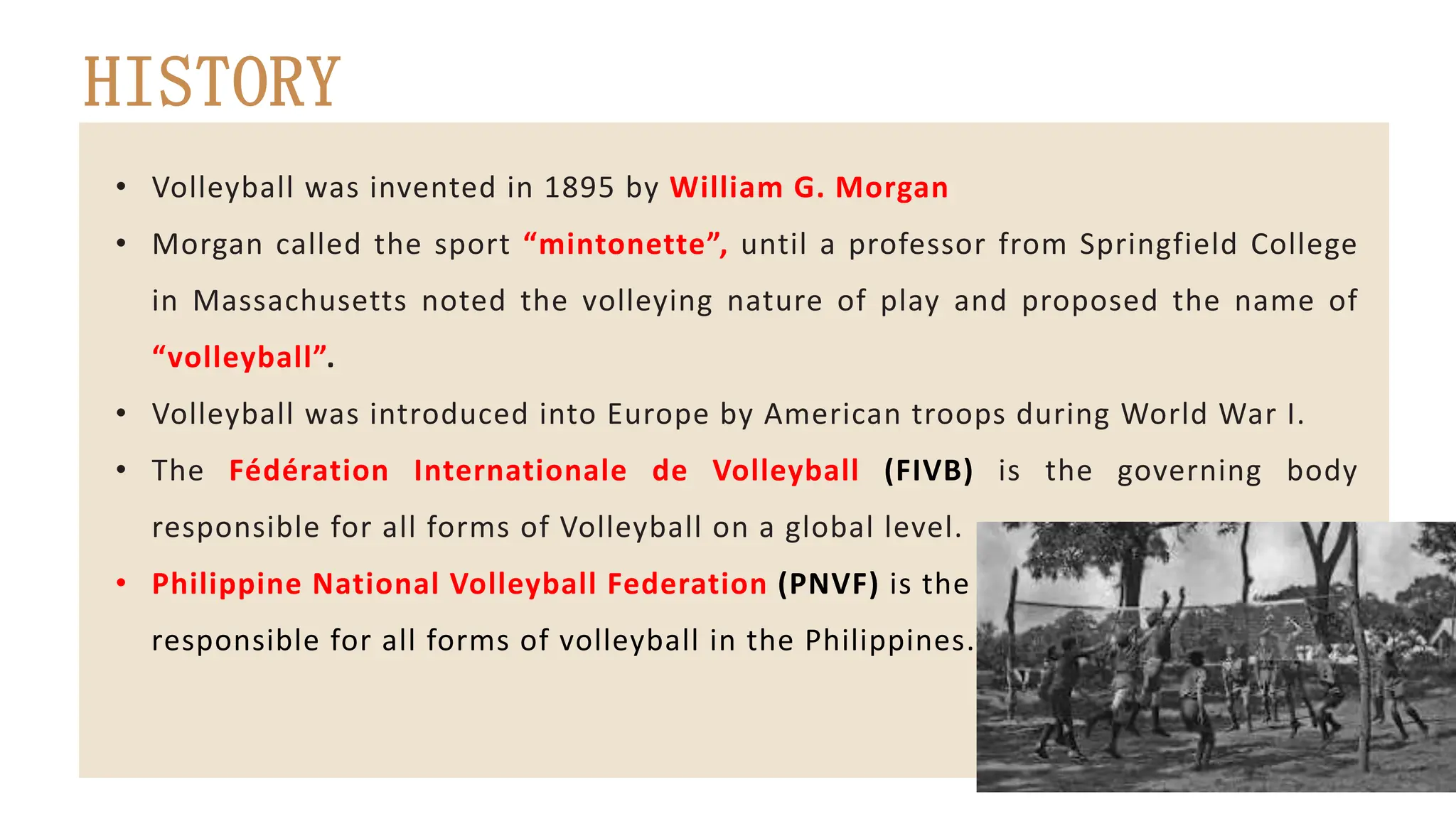
• Volleyball was invented in 1895 by William G. Morgan
• Morgan called the sport “mintonette”, until a professor from Springfield College
in Massachusetts noted the volleying nature of play and proposed the name of
“volleyball”.
• Volleyball was introduced into Europe by American troops during World War I.
• The Fédération Internationale de Volleyball (FIVB) is the governing body
responsible for all forms of Volleyball on a global level.
• Philippine National Volleyball Federation (PNVF) is the
responsible for all forms of volleyball in the Philippines.
HISTORY
FACILITIES AND EQUIPEMENT
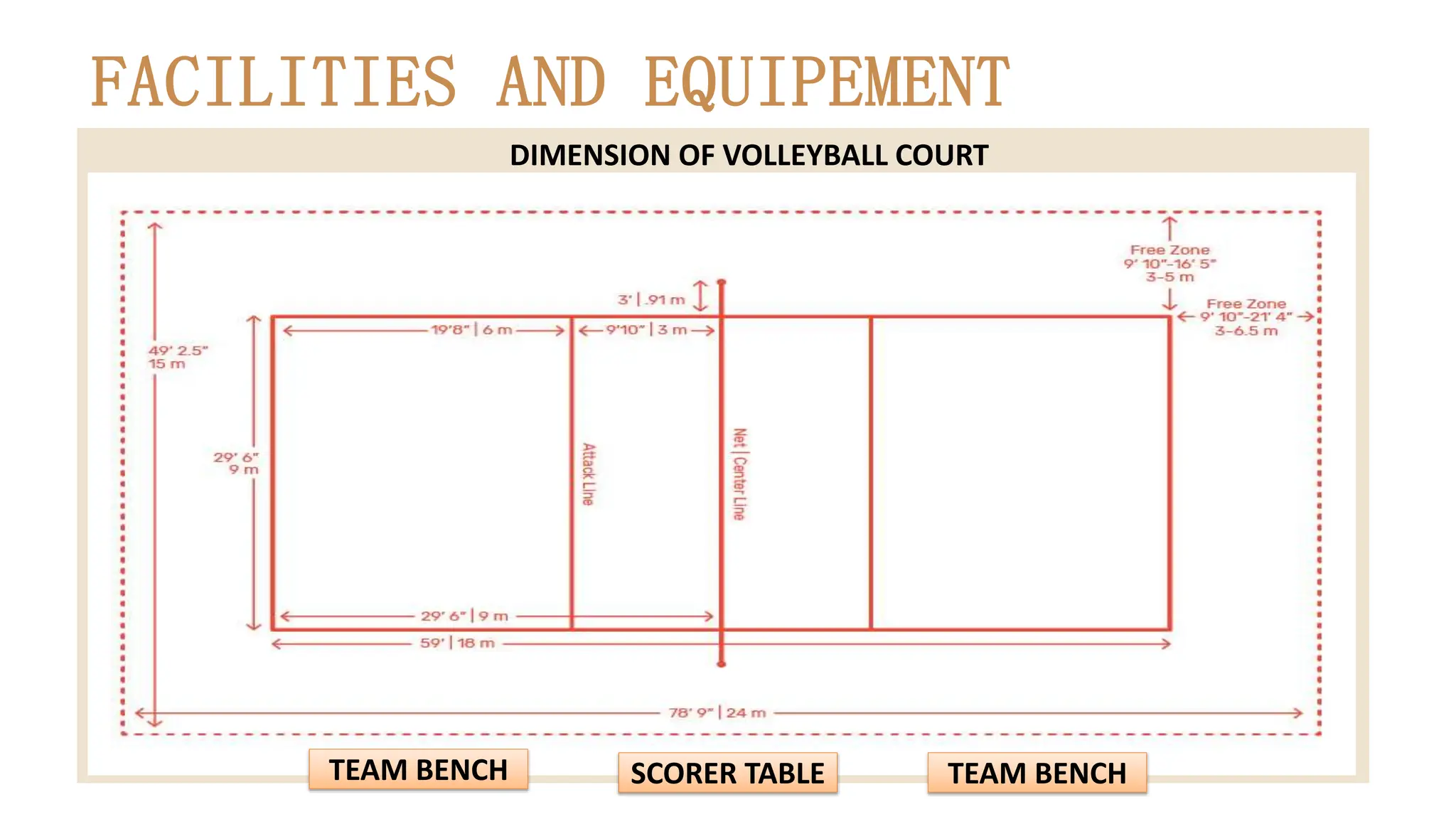
DIMENSION OF VOLLEYBALL COURT
FACILITIES AND EQUIPEMENT
TEAM BENCH SCORER TABLE TEAM BENCH
FACILITIES AND EQUIPEMENT
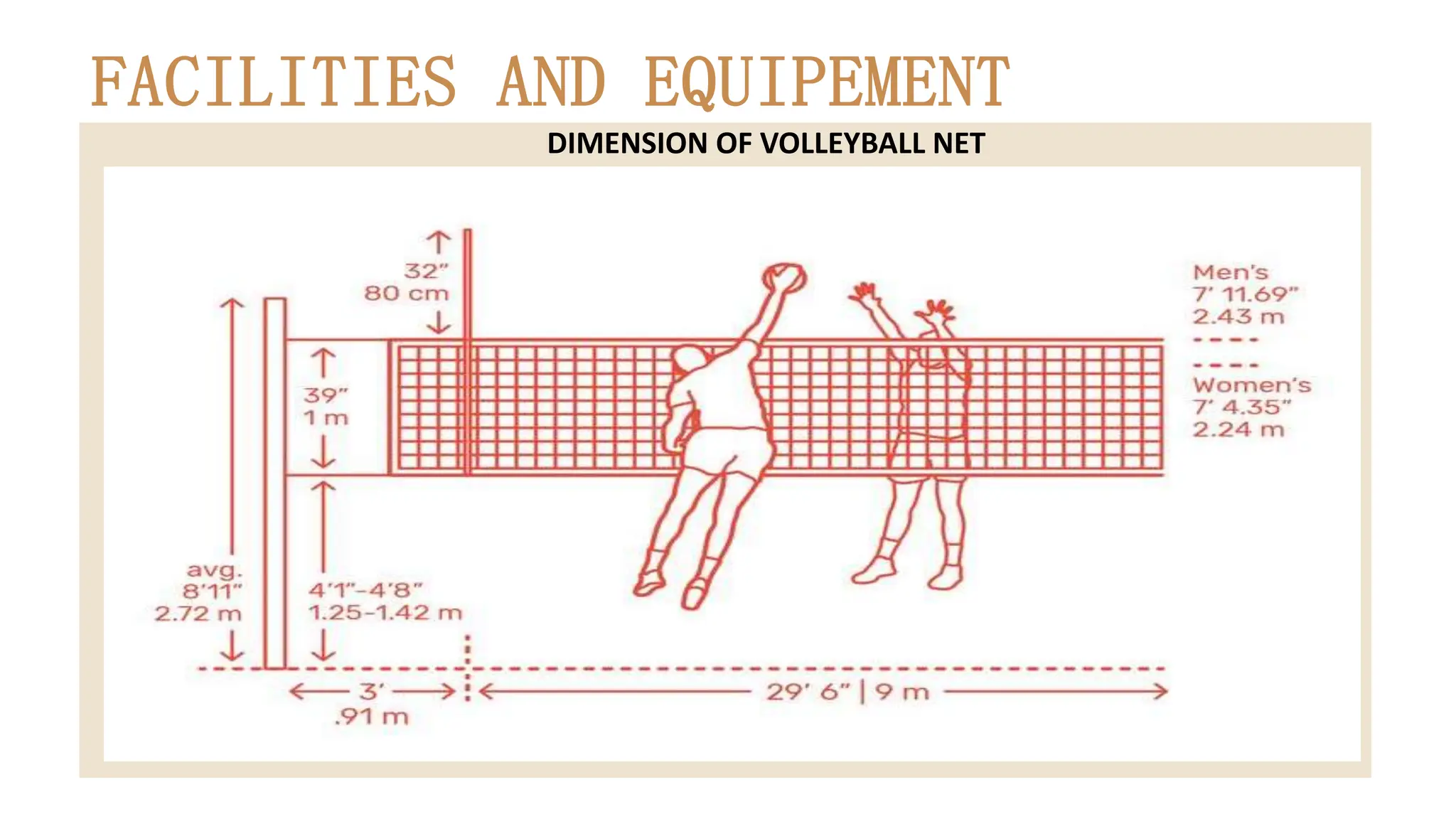
DIMENSION OF VOLLEYBALL NET
FACILITIES AND EQUIPEMENT
DIMENSION OF FLAGLET
• Circumference: 65-67 cm
• Diameter: 20.7-23.3 cm
• Inside pressure shall be
0.30 to 0.325 kg/cm2
FACILITIES AND EQUIPEMENT
PARTICIPANTS
AND
OFFICIATING OFFICIALS ROLE
PARTICIPANTS AND OFFICIATING OFFICIALS ROLE
• FOR THE MATCH - a game consist of up to 6 players per team.
• TEAM CAPTAIN - who shall be indicated on the score sheet.
- PRIOR to the match the captain represents his/her team in the toss, then
signs the score sheet.
- to ASK authorization;
a) to change all or part of the equipment,
b) to verify the positions of the teams,
c) to check the floor, the net, and the all,
d) to ask for an explanation on the application or interpretation of
the rules,
e) does not agree with decisions of the 1st referee, captain may
choose to have an official protest against such decisions.
f) can request time-outs and substitutions,
g) at the END of the match, the team capatain signs the score
sheet to ratify the result.
• COACH - selects the starting line-ups, substitutions, and takes time outs. In these
functions his/her contacting official is the 2nd referee.
- PRIOR to the match, the coach records or checks the names and numbers of
his/her players on the score sheet team roster, and then signs it.
- sits on the team bench nearest to the scorer, but may leave it.
- NOT ALLOWED to enter the court as a player.
• ASSISTANT COACH – sits on the team bench, but has no right to intervene in the match.
- if the coach have to leave his/her team for any reasons including
sanction, an assistant coach may assume the coach’s functions.
• 1st REFEREE - whistle any violations and player’s to serve.
- If the second referee doesn't catch any violations, the first referee has the
authority to make the call.
- giving sanctions and awards, only the first referee has the authority to issue
sanctions to players, coaches, etc.
- overall in charge of the entire game.
• 2nd REFEREE - should whistle net violations, centerline violations, serve and receive position
faults, and serving order violations.
- concerned with matters such as keeping time, assisting the first referee in
making calls, administering substitutions, and verbally communicating with
team coaches.
• LINE JUDGES – there are 2 judges per game, each controls an end line and an entire sideline.
- during the rally, responsible for indicating whether a ball has landed “in” or
“out” when the ball lands near the lines he/she has been assigned to monitor.
• BALL RETRIEVERS – there are 6 ball retrievers per game, one at each corner of the free zone
and one behind each referee.
- responsible for retrieving the ball after each rally and bringing it to the
server.
• SCORER – record everything that occurs during a volleyball match.
- keep track of the score, substitutions, and all the decisions of the referees.
- Meticulous attention to detail and the ability to multitask are two important
characteristics of scorer.
PLAYING FORMAT
PLAYING FORMAT
• TO SCORE A POINT - by successfully landing the ball on the opponent’s court.
- when the opponent team commits a fault.
- when the opponent team receives a penalty.
• RALLY - is the sequence of playing actions from the moment of the service hit by the
server until the ball is out of play.
• COMPLETED RALLY - is the sequence of playing actions which results in the award of a
point. These includes: the award of a penalty and loss of service hit
made after the time limit.
• SERVING TEAM - wins a rally, it scores a point and continues to serve.
• RECEIVING TEAM – wins a rally, it scores a point and it must serve next.
• TO WIN A SET – there should be 5 sets per match and 25 points per set
(except the deciding 5th set)
PLAYING FORMAT
• TO WIN THE MATCH – won by the team that wins three sets.
- in the case of a 2-2 tie, the deciding 5th set is played to 15 points.
• TOSS - the winner of the toss chooses options: the right to serve; receive the service; and the side
of the court. Then loser takes the remaining choice.
• 10 MINUTE WARM UP -before the game starts.
• POSITIONS - the three players along the net are front-row players and the other three are back-row
players. After the service hit, the players may move around and occupy any positions
on their court and the free zone.
4
5
3
6
2
1
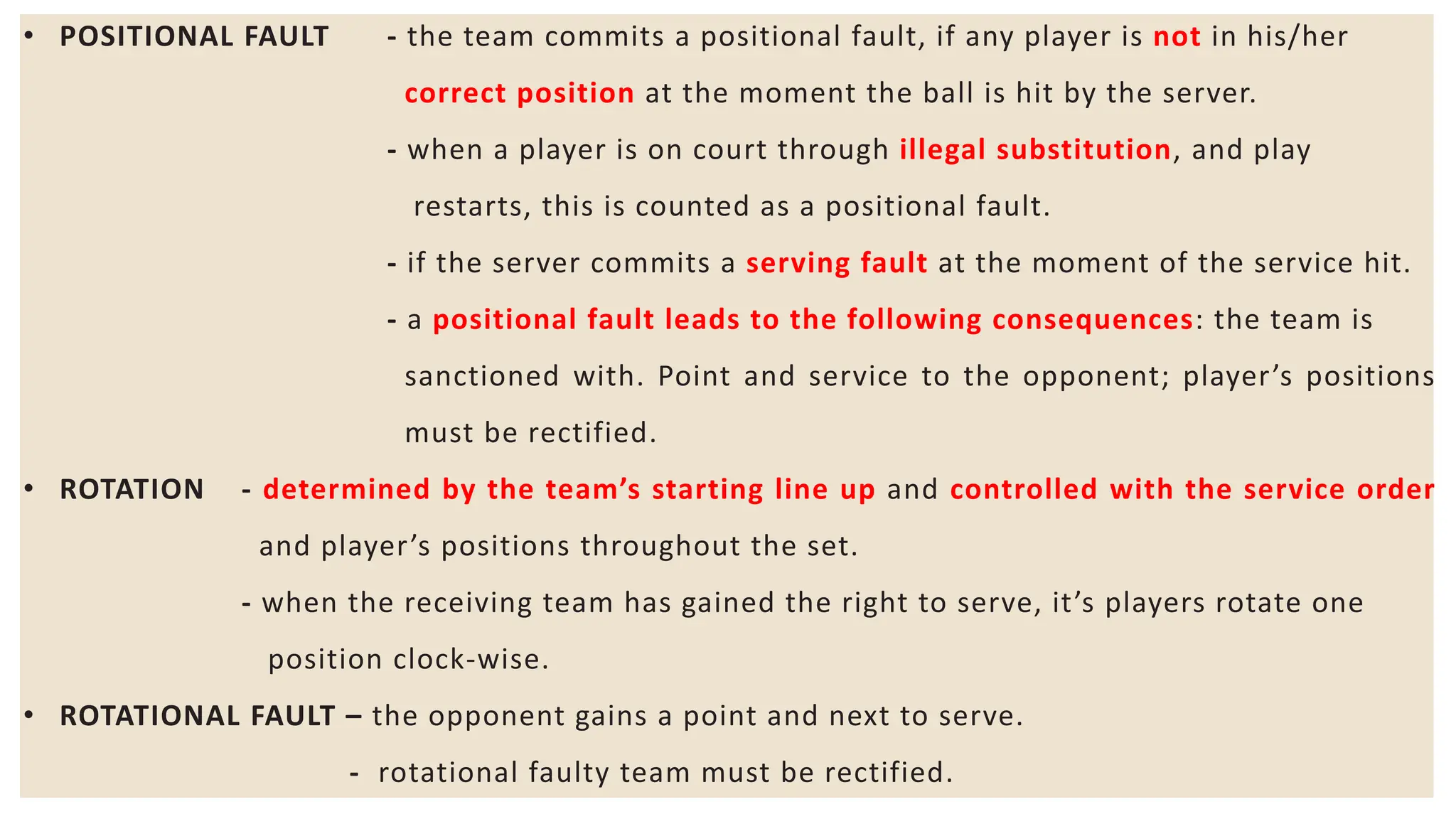
• POSITIONAL FAULT - the team commits a positional fault, if any player is not in his/her
correct position at the moment the ball is hit by the server.
- when a player is on court through illegal substitution, and play
restarts, this is counted as a positional fault.
- if the server commits a serving fault at the moment of the service hit.
- a positional fault leads to the following consequences: the team is
sanctioned with. Point and service to the opponent; player’s positions
must be rectified.
• ROTATION - determined by the team’s starting line up and controlled with the service order
and player’s positions throughout the set.
- when the receiving team has gained the right to serve, it’s players rotate one
position clock-wise.
• ROTATIONAL FAULT – the opponent gains a point and next to serve.
- rotational faulty team must be rectified.
6 Basic Fundamentals
in Volleyball
is a defensive skill used to save the ball from hitting the
ground. It is often done when the ball does not come
directly at the player, and a standard underhand pass
would be impossible or extremely difficult to get. To get
into a digging position, the player must sink their hips low
to the floor with their heels slightly raised in order to be
light on their feet. They must then stretch out their arms
into the underhand pass position. In order to dig for the
ball, the player must push off their toes and use their
lower body to move their upper body. Players must also
be ready to dive for the ball, but that’s often not
necessary if you’re already positioned to where the ball
might be going.
Also known as the bump, is used to receive the ball from
the opposing team's serve or hit. The goal of passing is to
keep the ball in play and set up an offensive play. To pass
effectively, the player should get in position, keep their
arms straight and feet parallel, extend their knees
forward, and make contact with the ball using their
forearms.
The serve is the first contact in a volleyball game, and it's
an important opportunity to gain an advantage over the
opposing team. It is a skill that every player must
master as it’s the first move that can give your team
momentum and shut down your opponent’s momentum.
There are different types of serves, such as the
underhand serve, the overhand serve, and the jump
serve.
A volleyball spike or attack is the strategy used to send
the ball over the net to the opponent in such a manner
that ball is not returnable.
The spike is performed by moving the arm in a way such
that you angle the ball to land on the ground of your
opponent's side of the court.
Setting or overhead passing is the most important step in
an offensive play as it determines which player gets to
spike or attack.
To set, the player should use their fingertips and create a
triangle with their thumb and fingers. Their hands should
be above their heads with their fingers relaxed but
steady, with their knees and elbows slightly bent. When
they are about to set, it’s important to follow through with
the motion with their entire body by extending their
knees and straightening their arms.
Blocking is a defensive skill used to stop the opposing
team's attack and can also be used to potentially score
points. Blockers must focus on stopping the opposing
team’s offensive attacks, while also paying attention to
the opposing setter so that they can better predict the
opposing team’s attack strategy. It is important for
blockers to be able to react to an attack quickly and be in
position before the attack is completed. Blockers must
have good timing, vertical height, and hand positioning in
order to effectively stop the opposing team’s attack. An
amazing blocker will be able to predict where the ball is
going to be and already be in a position to block
immediately after the ball is set.
WARM-UP
CONDITIONING
COOL DOWN
STRETCHING
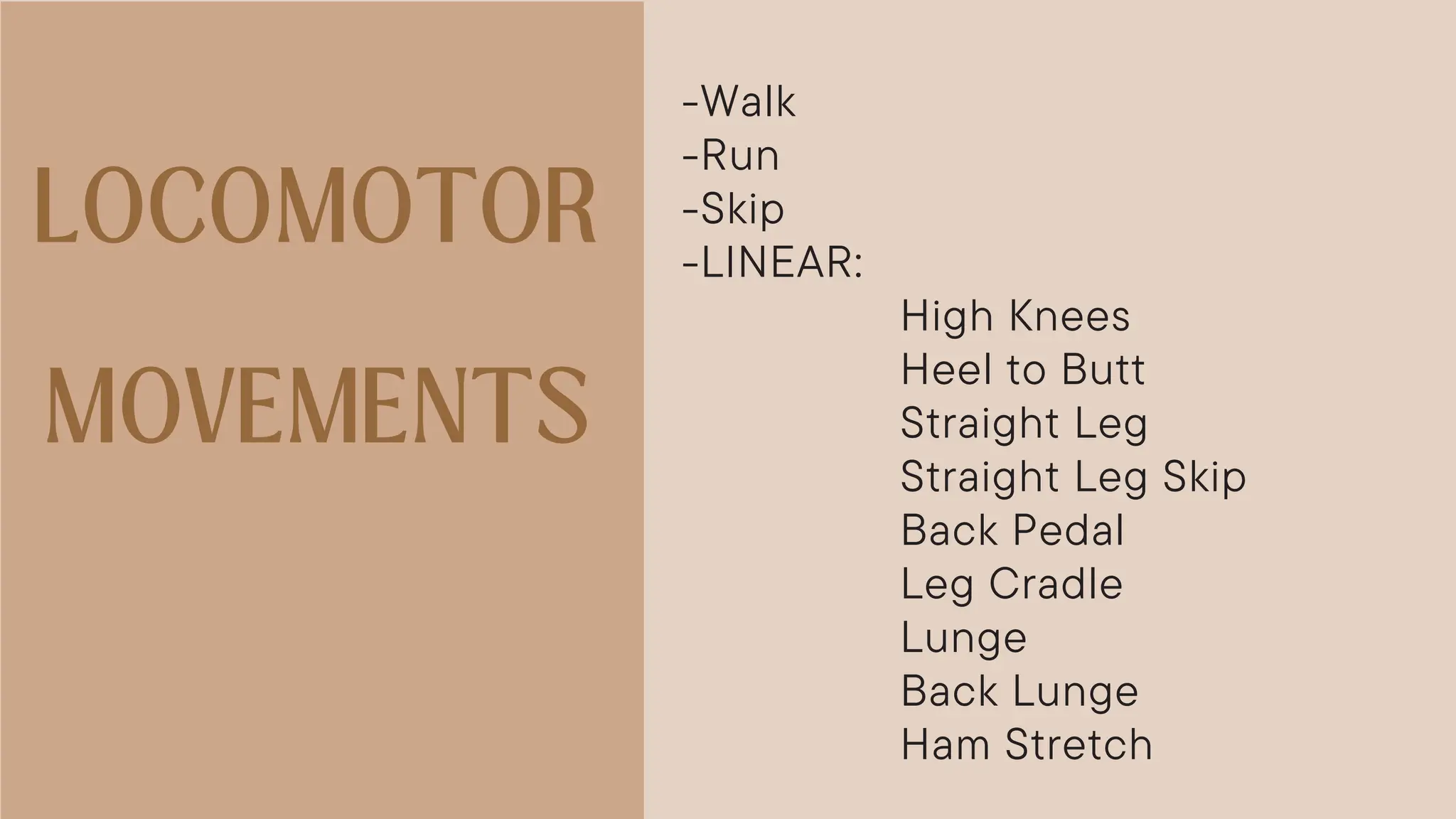
LOCOMOTOR AND
NON-LOCOMOTOR
MOVEMENTS
-Walk
-Run
-Skip
-LINEAR:
High Knees
Heel to Butt
Straight Leg
Straight Leg Skip
Back Pedal
Leg Cradle
Lunge
Back Lunge
Ham Stretch
-Dead Bug Series
-Bird Dog Series
-Fire Hydrant
-Cobra Push Up
-High and Low Plank
- Sequence
Conceptualization of the Problem and
Formulation of Hypothesis and Variables
This study underwent the
following stages: (a)
conceptualization of the problem
and formulation of the hypothesis
and variables, (b.) construction of
research instruments, (c) data
gathered, (d) data analysis and
interpretation. (e) preparation of
research reports to the panel, and
(f) presentation of research
reports to the panel. These
phases are summarized in figure
2.0.
Construction of Research Instrument
Gathered Data
Analyzation and Interpretation of Data
Preparation of Research Reports to the
Panel
Presentation of Research Reports to the
Panel
PATHFIT-4.Everything about VOLLEYBALL .pptx

PATHFIT-4.Everything about VOLLEYBALL .pptx

  • 1.
  • 2.
    HISTORY PARTCIPANTS AND OFFICIATINGOFFICIALS PLAYING FORMAT FACILITIES AND EQUIPMENT
  • 3.
    • Volleyball wasinvented in 1895 by William G. Morgan • Morgan called the sport “mintonette”, until a professor from Springfield College in Massachusetts noted the volleying nature of play and proposed the name of “volleyball”. • Volleyball was introduced into Europe by American troops during World War I. • The Fédération Internationale de Volleyball (FIVB) is the governing body responsible for all forms of Volleyball on a global level. • Philippine National Volleyball Federation (PNVF) is the responsible for all forms of volleyball in the Philippines. HISTORY
  • 4.
  • 5.
    DIMENSION OF VOLLEYBALLCOURT FACILITIES AND EQUIPEMENT TEAM BENCH SCORER TABLE TEAM BENCH
  • 6.
  • 7.
  • 8.
    • Circumference: 65-67cm • Diameter: 20.7-23.3 cm • Inside pressure shall be 0.30 to 0.325 kg/cm2 FACILITIES AND EQUIPEMENT
  • 9.
  • 10.
    PARTICIPANTS AND OFFICIATINGOFFICIALS ROLE • FOR THE MATCH - a game consist of up to 6 players per team. • TEAM CAPTAIN - who shall be indicated on the score sheet. - PRIOR to the match the captain represents his/her team in the toss, then signs the score sheet. - to ASK authorization; a) to change all or part of the equipment, b) to verify the positions of the teams, c) to check the floor, the net, and the all, d) to ask for an explanation on the application or interpretation of the rules, e) does not agree with decisions of the 1st referee, captain may choose to have an official protest against such decisions.
  • 11.
    f) can requesttime-outs and substitutions, g) at the END of the match, the team capatain signs the score sheet to ratify the result. • COACH - selects the starting line-ups, substitutions, and takes time outs. In these functions his/her contacting official is the 2nd referee. - PRIOR to the match, the coach records or checks the names and numbers of his/her players on the score sheet team roster, and then signs it. - sits on the team bench nearest to the scorer, but may leave it. - NOT ALLOWED to enter the court as a player. • ASSISTANT COACH – sits on the team bench, but has no right to intervene in the match. - if the coach have to leave his/her team for any reasons including sanction, an assistant coach may assume the coach’s functions.
  • 12.
    • 1st REFEREE- whistle any violations and player’s to serve. - If the second referee doesn't catch any violations, the first referee has the authority to make the call. - giving sanctions and awards, only the first referee has the authority to issue sanctions to players, coaches, etc. - overall in charge of the entire game. • 2nd REFEREE - should whistle net violations, centerline violations, serve and receive position faults, and serving order violations. - concerned with matters such as keeping time, assisting the first referee in making calls, administering substitutions, and verbally communicating with team coaches. • LINE JUDGES – there are 2 judges per game, each controls an end line and an entire sideline. - during the rally, responsible for indicating whether a ball has landed “in” or “out” when the ball lands near the lines he/she has been assigned to monitor.
  • 13.
    • BALL RETRIEVERS– there are 6 ball retrievers per game, one at each corner of the free zone and one behind each referee. - responsible for retrieving the ball after each rally and bringing it to the server. • SCORER – record everything that occurs during a volleyball match. - keep track of the score, substitutions, and all the decisions of the referees. - Meticulous attention to detail and the ability to multitask are two important characteristics of scorer.
  • 14.
  • 15.
    PLAYING FORMAT • TOSCORE A POINT - by successfully landing the ball on the opponent’s court. - when the opponent team commits a fault. - when the opponent team receives a penalty. • RALLY - is the sequence of playing actions from the moment of the service hit by the server until the ball is out of play. • COMPLETED RALLY - is the sequence of playing actions which results in the award of a point. These includes: the award of a penalty and loss of service hit made after the time limit. • SERVING TEAM - wins a rally, it scores a point and continues to serve. • RECEIVING TEAM – wins a rally, it scores a point and it must serve next. • TO WIN A SET – there should be 5 sets per match and 25 points per set (except the deciding 5th set)
  • 16.
    PLAYING FORMAT • TOWIN THE MATCH – won by the team that wins three sets. - in the case of a 2-2 tie, the deciding 5th set is played to 15 points. • TOSS - the winner of the toss chooses options: the right to serve; receive the service; and the side of the court. Then loser takes the remaining choice. • 10 MINUTE WARM UP -before the game starts. • POSITIONS - the three players along the net are front-row players and the other three are back-row players. After the service hit, the players may move around and occupy any positions on their court and the free zone. 4 5 3 6 2 1
  • 17.
    • POSITIONAL FAULT- the team commits a positional fault, if any player is not in his/her correct position at the moment the ball is hit by the server. - when a player is on court through illegal substitution, and play restarts, this is counted as a positional fault. - if the server commits a serving fault at the moment of the service hit. - a positional fault leads to the following consequences: the team is sanctioned with. Point and service to the opponent; player’s positions must be rectified. • ROTATION - determined by the team’s starting line up and controlled with the service order and player’s positions throughout the set. - when the receiving team has gained the right to serve, it’s players rotate one position clock-wise. • ROTATIONAL FAULT – the opponent gains a point and next to serve. - rotational faulty team must be rectified.
  • 18.
  • 19.
    is a defensiveskill used to save the ball from hitting the ground. It is often done when the ball does not come directly at the player, and a standard underhand pass would be impossible or extremely difficult to get. To get into a digging position, the player must sink their hips low to the floor with their heels slightly raised in order to be light on their feet. They must then stretch out their arms into the underhand pass position. In order to dig for the ball, the player must push off their toes and use their lower body to move their upper body. Players must also be ready to dive for the ball, but that’s often not necessary if you’re already positioned to where the ball might be going.
  • 20.
    Also known asthe bump, is used to receive the ball from the opposing team's serve or hit. The goal of passing is to keep the ball in play and set up an offensive play. To pass effectively, the player should get in position, keep their arms straight and feet parallel, extend their knees forward, and make contact with the ball using their forearms.
  • 21.
    The serve isthe first contact in a volleyball game, and it's an important opportunity to gain an advantage over the opposing team. It is a skill that every player must master as it’s the first move that can give your team momentum and shut down your opponent’s momentum. There are different types of serves, such as the underhand serve, the overhand serve, and the jump serve.
  • 22.
    A volleyball spikeor attack is the strategy used to send the ball over the net to the opponent in such a manner that ball is not returnable. The spike is performed by moving the arm in a way such that you angle the ball to land on the ground of your opponent's side of the court.
  • 23.
    Setting or overheadpassing is the most important step in an offensive play as it determines which player gets to spike or attack. To set, the player should use their fingertips and create a triangle with their thumb and fingers. Their hands should be above their heads with their fingers relaxed but steady, with their knees and elbows slightly bent. When they are about to set, it’s important to follow through with the motion with their entire body by extending their knees and straightening their arms.
  • 24.
    Blocking is adefensive skill used to stop the opposing team's attack and can also be used to potentially score points. Blockers must focus on stopping the opposing team’s offensive attacks, while also paying attention to the opposing setter so that they can better predict the opposing team’s attack strategy. It is important for blockers to be able to react to an attack quickly and be in position before the attack is completed. Blockers must have good timing, vertical height, and hand positioning in order to effectively stop the opposing team’s attack. An amazing blocker will be able to predict where the ball is going to be and already be in a position to block immediately after the ball is set.
  • 27.
  • 28.
  • 29.
    -Walk -Run -Skip -LINEAR: High Knees Heel toButt Straight Leg Straight Leg Skip Back Pedal Leg Cradle Lunge Back Lunge Ham Stretch
  • 30.
    -Dead Bug Series -BirdDog Series -Fire Hydrant -Cobra Push Up -High and Low Plank - Sequence
  • 31.
    Conceptualization of theProblem and Formulation of Hypothesis and Variables This study underwent the following stages: (a) conceptualization of the problem and formulation of the hypothesis and variables, (b.) construction of research instruments, (c) data gathered, (d) data analysis and interpretation. (e) preparation of research reports to the panel, and (f) presentation of research reports to the panel. These phases are summarized in figure 2.0. Construction of Research Instrument Gathered Data Analyzation and Interpretation of Data Preparation of Research Reports to the Panel Presentation of Research Reports to the Panel