INNOVATION MANAGEMENTINNOVATION MANAGEMENT
AND INTELLECTUALAND INTELLECTUAL
PROPERY RIGHTSPROPERY RIGHTS
Intellectual Property in
Today’s Economy
• Since mid-1980s the number of patents
granted in the USPTO has grown by 6% a
year.
• Companies such as IBM, Motorola,
Mitsubishi, Canon, Hitachi, Eastman Kodak
apply for over 1000 patents a year.
Intellectual Property in
Today’s Economy
• IBM earns over US$ 1 billion a year from
patent licensing revenues
• Over 80% of the market value of Microsoft
derives from its intangible assets, especially
its intellectual property (trademarks,
patents, trade secret over source code,
copyright over software)
• The value of the Coca-Cola trademark
exceeds US$ 50 billion.
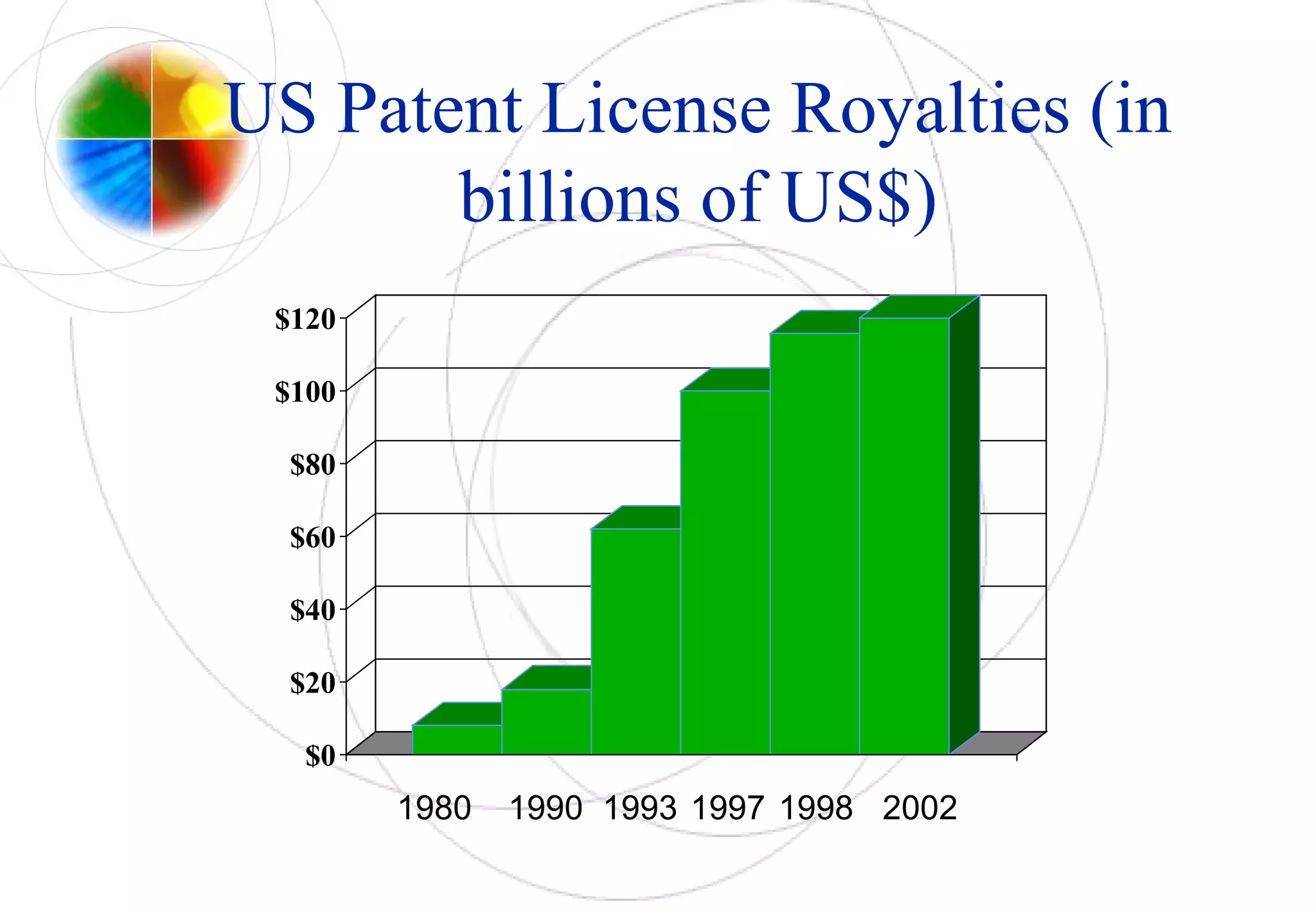
US Patent License Royalties (in
billions of US$)
$0
$20
$40
$60
$80
$100
$120
1980 20021990 1993 1997 1998
Dr. Horst Fischer, Corporate Vice
President, Siemens AG
“Any company wishing to prosper in the
next millennium will also have to
efficiently manage its IP portfolio”.
“For this reason it has become essential that
every manager in the enterprise - not just
those working in the corporate legal
department - appreciates and
understands not only what IP is, but how
it can be more effectively exploited."
What is INNOVATION?
“1. A New Idea Method or Device
2. The Introduction of Something New”
”
(Encyclopedia Britannica)
Basic Research
Applied Research
Invention
Development
Production
Marketing
“Technology-Push Linear Model of Innovation”
Innovation
• To innovate may be expensive (investments in
R&D)
• High degree of uncertainty and risk associated to
the innovation process
• Requires skilled labour
Innovation
But:
• Prevents technological dependence
• Research to meet actual needs
• Process innovation: to save capital and/or
labour, gains in productivity
• Product innovation: introduction of new
(better? more efficient?) products
• Problem of appropriation
• E.g. pharmaceutical sector
• E.g. music or software industry
• Recoup investments in R&D
What are the factors that determine
the success of a new product in the
marketplace ?
Factors determining the
success of a new product
• The product provides functional advantages over
competing or substitute products
• The retail-selling price is considered to be advantageous
• The product and/or its packaging has an attractive design
• The new product is properly branded, promoted and
advertised
• The new product is readily available to customers in the
main retail shops
• Consistent product quality
• A number of after-sales services are provided
• If functional improvements, attractive
designs and a well-positioned brand are
some of the features that may determine the
success of a new product, what can an SME
do to protect them and maintain its
exclusivity over their use?
Intellectual Property Rights
• Innovative functional
features
• Design / aesthetic
aspects
• Brands
Patents or utility
models
Industrial designs
Trademarks
Intellectual Property Rights
• Patent for the fountain pen
that could store ink
• Utility Model for the grip and
pippette for injection of ink
• Industrial Design: smart
design with the grip in the
shape of an arrow
• Trademark: provided on the
product and the packaging to
distinguish it from other pens
Source: Japanese Patent Office
What is a Patent?
A patent is an exclusive right granted for an
invention
What is an invention?
– It’s the solution to a technical problem
What type of protection is granted?
– The protection granted by a patent enables the
patent holder to prevent anybody from
commercially exploiting the invention without
the consent of the patent holder
What is a Patent?
• Patentabililty requirements:
– The invention must be new
– It must involve an inventive step
– It must be capable of industrial application
• Maximum duration of a patent: 20 years
(but annual fees must be paid)
• Territorial right
Patents
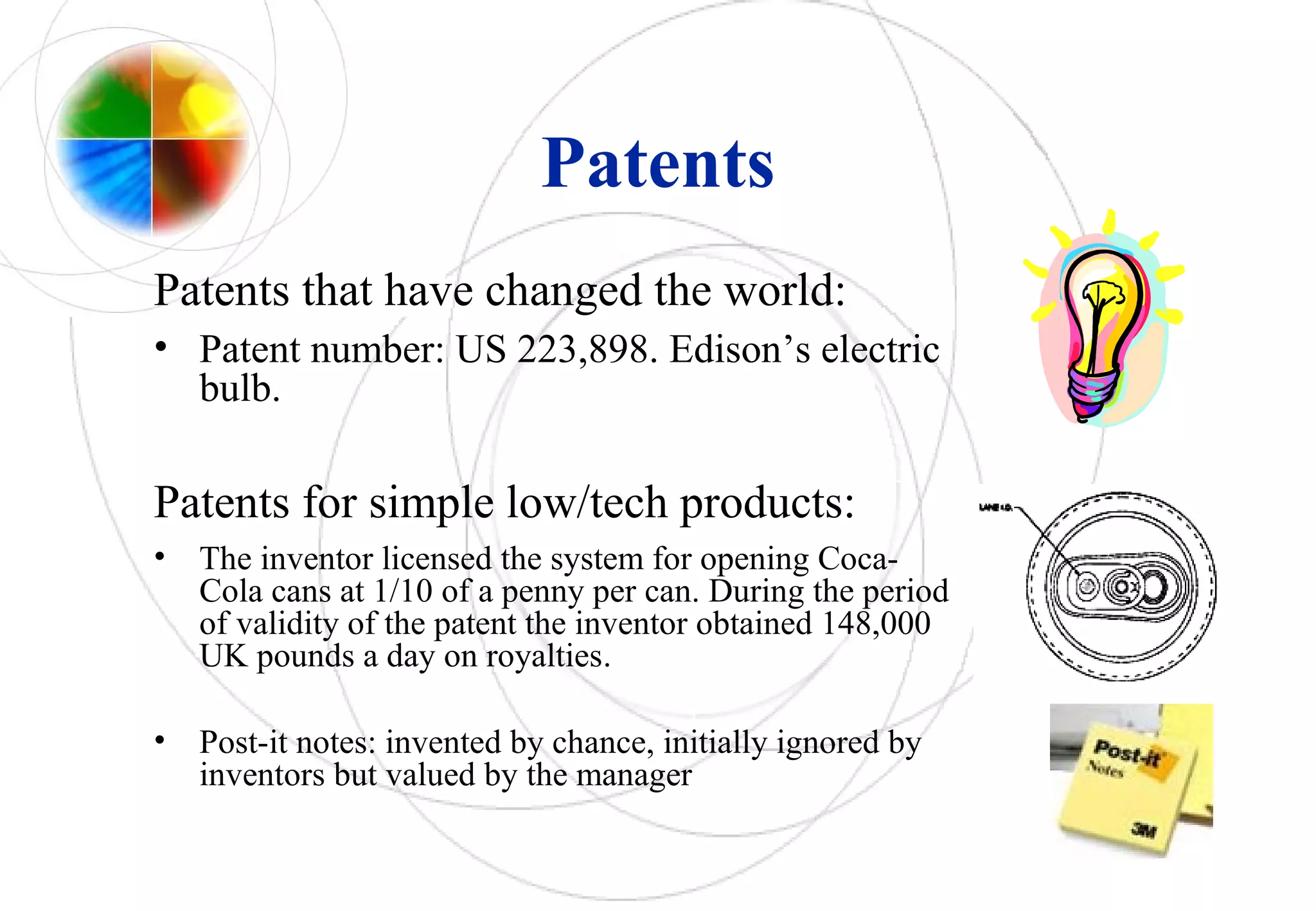
Patents that have changed the world:
• Patent number: US 223,898. Edison’s electric
bulb.
Patents for simple low/tech products:
• The inventor licensed the system for opening Coca-
Cola cans at 1/10 of a penny per can. During the period
of validity of the patent the inventor obtained 148,000
UK pounds a day on royalties.
• Post-it notes: invented by chance, initially ignored by
inventors but valued by the manager
Patents
• Why do European SMEs apply for patent
protection?
– Market exclusivity
– Recouping R&D investments
– Facilitates licensing
– Advantageous negotiating tool
– Financing opportunities (venture capitalists, etc)
– Favorable image and credibility
– Higher market value and publicity
– International expansion
Patents
• Covers all fields of technology
• There are thousands of patents on simple everyday
products
United States 143 137
Japan 150 059
PATENTS GRANTED IN 1999
3. Strategies for the
acquisition of patents
• Patent or keep secret?
– Advantages of patents: stronger protection, 20 year duration,
exclusive rights, facilitates licensing negotiations, a secret is
hard to keep...
– Disadvantages of patents: costs, publication after 18 months,
may delay the launch of a new product, hard to enforce...
– Alternatives to patents: lead-time advantage, secrecy,
trademarks, technological measures of protection, constant
innovation,
Strategies for the
acquisition of patents
• Trade secrets: no need for registration. But
there are three essential requirements:
– The information must be secret !
– It must have commercial value because it is
secret
– It must have been subject to reasonable steps by
the holder to keep it secret (e.g. confidentiality
agreements)
Strategies for the
acquisition of patents
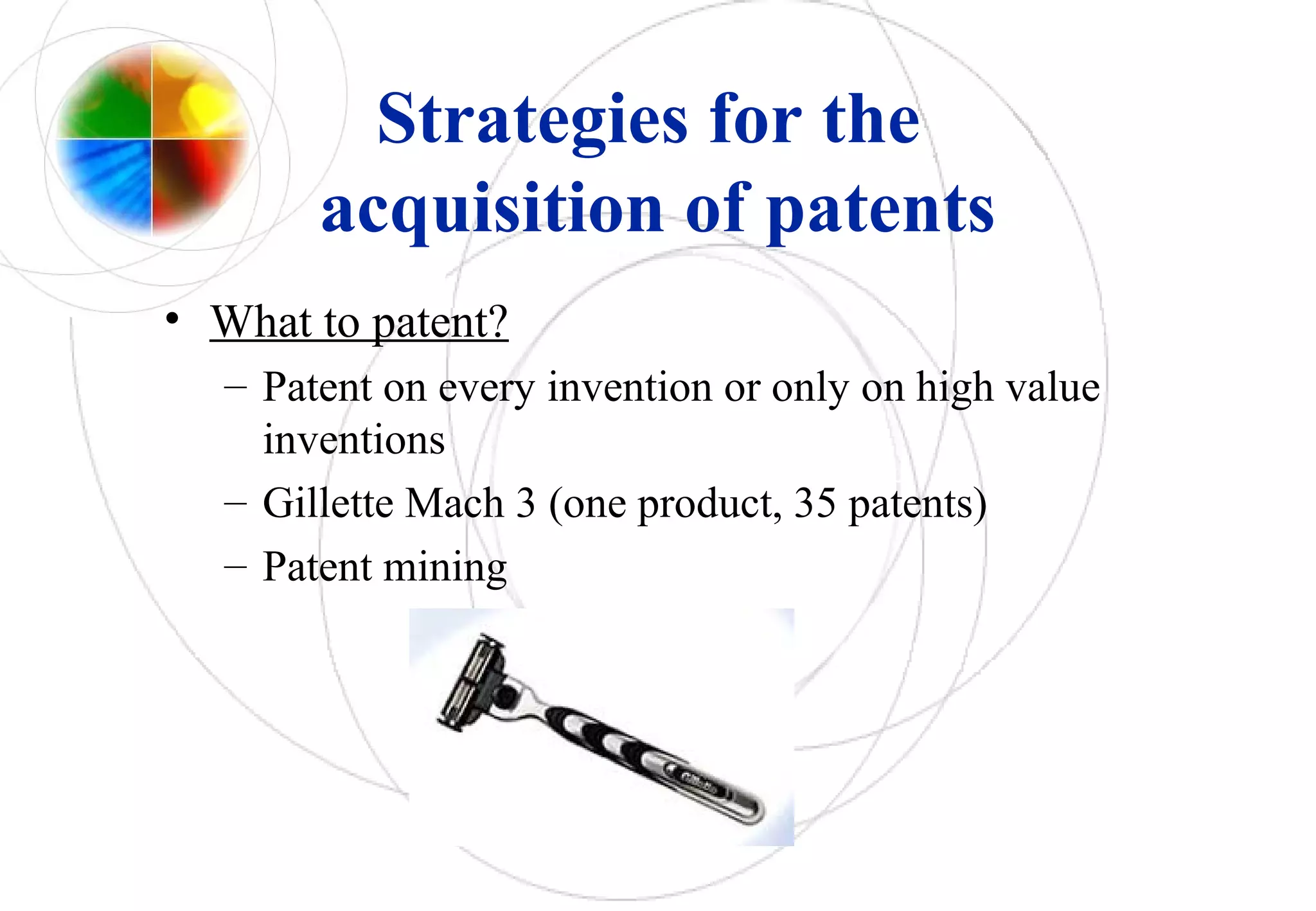
• What to patent?
– Patent on every invention or only on high value
inventions
– Gillette Mach 3 (one product, 35 patents)
– Patent mining
Strategies for the
acquisition of patents
• When to patent?
– Late patenting may lead to losing the
invention to a competitor
– First-to-file system
– Annual maintenance costs increase every
year
Strategies for the
acquisition of patents
• Where to patent?
– Where will the product be commercialized?
– What are the costs involved in patenting abroad?
– What are the main markets for the product?
– Where are the main competitors based?
– Advantages of the PCT (provides more time)
Strategies for the
acquisition of patents
• Who owns the patent?
– Company, entrepreneur or employee?
– What happens for subcontracted work?
Strategies for patent
exploitation
• Case study of own exploitation of a patent
– Case: Mandy Haberman
– Invention of a non-spill drinking vessel
– Application for patents and industrial designs
– Registered mark: Anywayup®
– Difficulties in accessing the main retail stores and
supermarkets
– Search for a partner
– Creation of a new company to commercialize the
product
– Infringement and litigation
Strategies for patent
exploitation
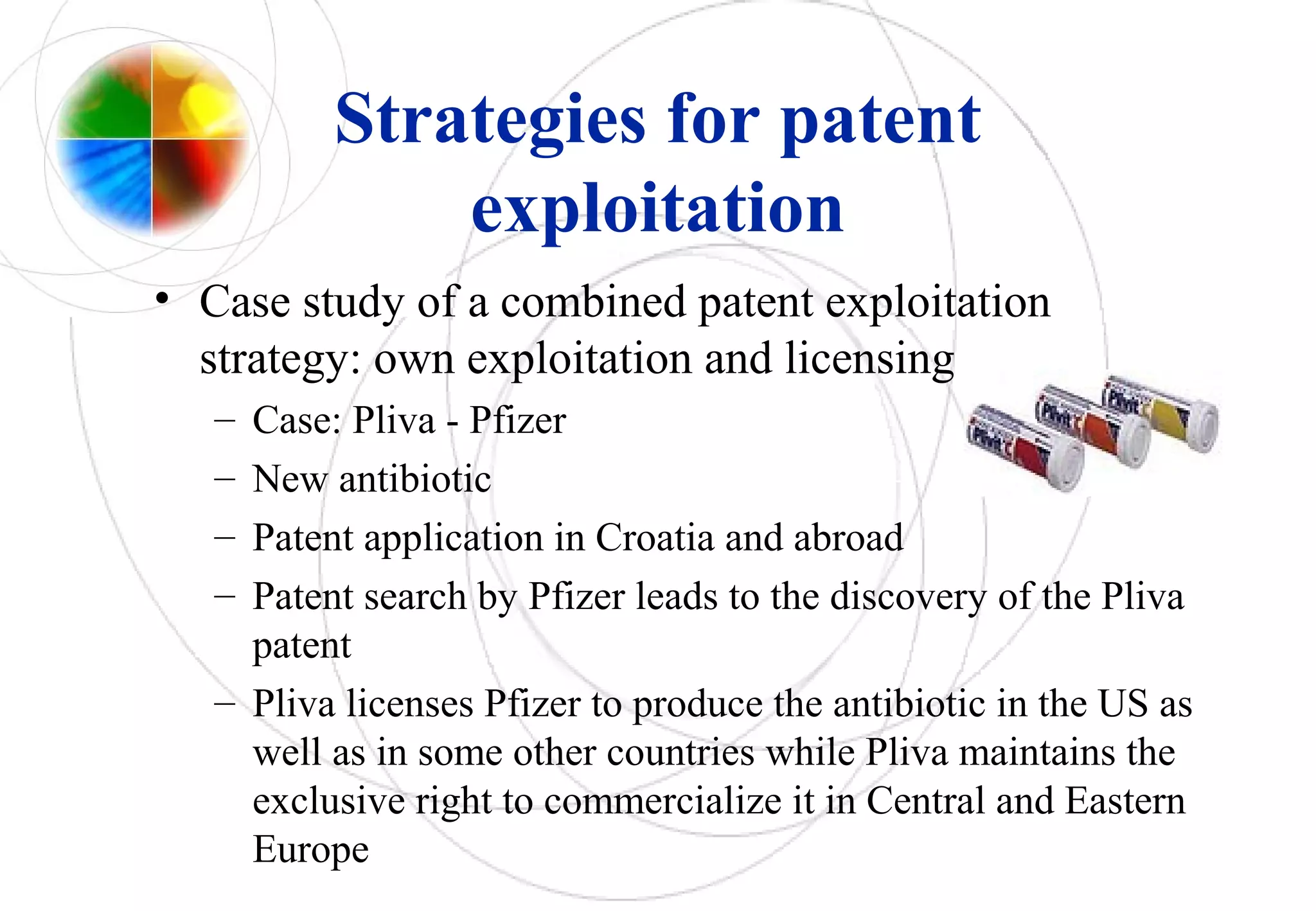
• Case study of a combined patent exploitation
strategy: own exploitation and licensing
– Case: Pliva - Pfizer
– New antibiotic
– Patent application in Croatia and abroad
– Patent search by Pfizer leads to the discovery of the Pliva
patent
– Pliva licenses Pfizer to produce the antibiotic in the US as
well as in some other countries while Pliva maintains the
exclusive right to commercialize it in Central and Eastern
Europe
Strategies for patent
exploitation
• Case study of a non-exclusive
licensing strategy:
– Case: Bishop Engineering
– Enterprise specialized in power steering
technology
– Over 300 patents since WWII
– Earns 1 Australian dollar per unit made
– Over 5 million dollars a year on royalties
THE OTHER SIDE OF THE MEDAL
Patents:
The other side of the medal
• Patent → 1. “deed securing to a person an exclusive
right granted for an invention”
→ 2. “open, evident, manifest”; “open to public
perusal” < Latin patens
(Collins Dictionary)
Patent Information
• All patents are published (generally 18
months after the application is filed) and are
in the public domain
• A patent is an exchange between the
inventor and society
Using Patent Information
Did you know?
• The entire set of patent documents worldwide includes
approximately 40 million items.
• Every year approximately 1 million patent applications are
published.
• About two-thirds of the technical information revealed in
patents is never published elsewhere.
Using Patent Information
Did you know?
• Most of the inventions are disclosed to the public for the
first time when the patent is being published. (e.g. jet
engine invented by Wittle in 1936).
• The information contained in the patent documents IS
NOT SECRET!
Thomas Edison:
“I start where the last man stopped”
Albert Szent-Györgyi von Nagyrapolt
(Nobel Laureate in Medicine):
“Discovery consists in seeing what everybody
has seen, and thinking what nobody has
thought”
Predator Boot
• Patents expire: in Europe only about 20% of
patents are maintained for 20 years
• Patents have territorial limits. What is not
patented in Spain is in the public domain (in
Spain)
• Patents have limits of scope. Patents only
protect what is contained in the patent
claims
Using Patent Information
• “Patent information” is the technical and legal
information contained in patent documents that are
published periodically by patent offices.
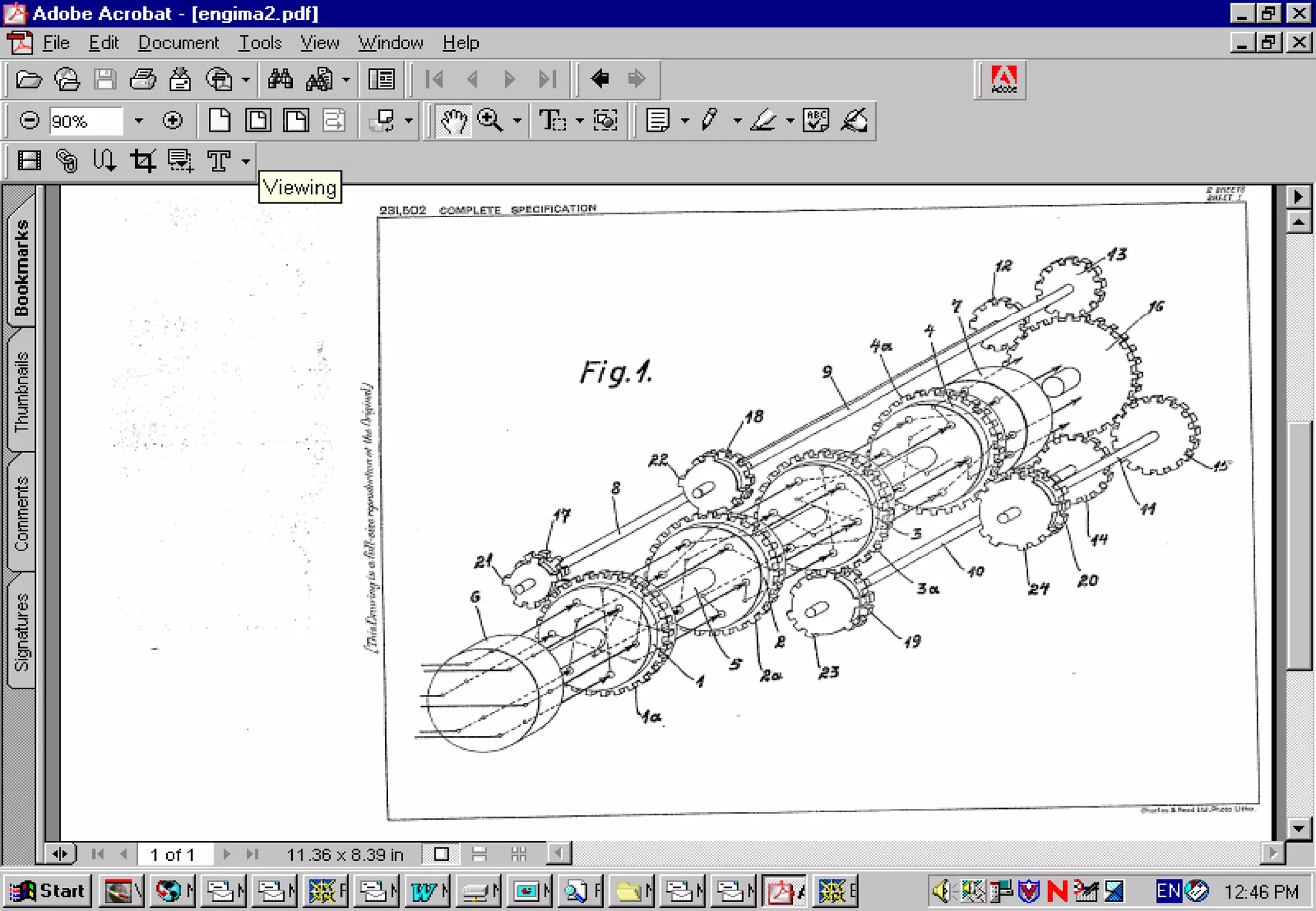
• A patent document includes the full description of how
a patented invention works and the claims which
determine the scope of protection as well as details on
who patented the invention, when it was patented and
reference to relevant literature.
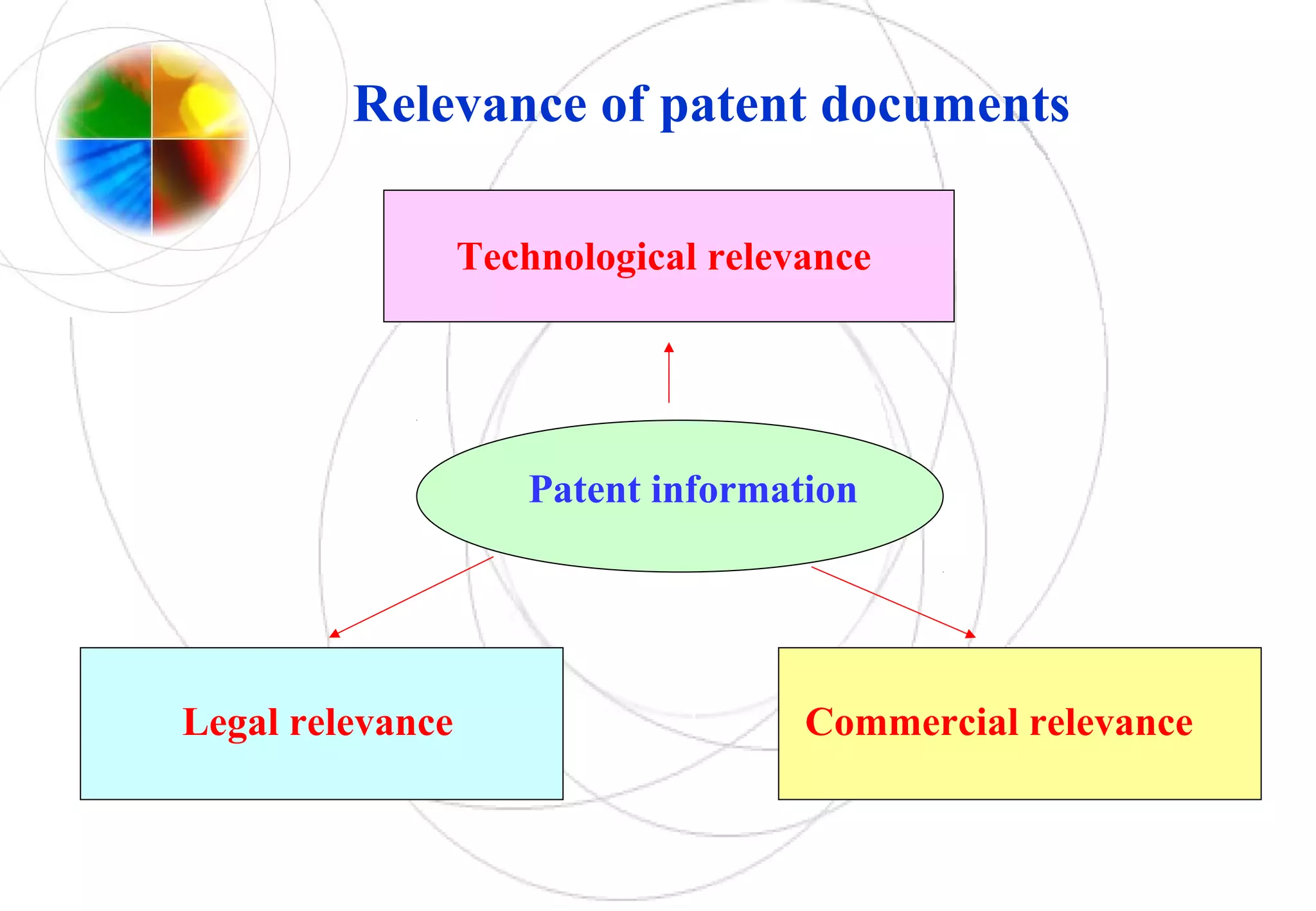
Patent information
Technological relevance
Legal relevance
Relevance of patent documents
Commercial relevance
Using patent information
Legal relevance:
• Avoid possible infringement problems
• Assess patentability of your own inventions
• Oppose grant of patents wherever they
conflict with your own patent
Using patent information
Technological relevance:
• Keep abreast with latest technologies in your field of
expertise
• Avoid unnecessary expenses in researching what is
already known
– In Europe, more than US$ 30 mill. per year is waisted in
unnecessary research - 30% of the total investment in R&D
• Identify and evaluate technology for technology
transfer
• Get ideas for further innovation
Using patent information
Commercial Relevance
• Locate business partners
• Locate suppliers and materials
• Monitor activities of real and potential
competitors
• Identify niche markets
CD-ROMs
DVDs
Paper On the
Internet
Where can we find patent documents?

Patents burrone

  • 1.
    INNOVATION MANAGEMENTINNOVATION MANAGEMENT ANDINTELLECTUALAND INTELLECTUAL PROPERY RIGHTSPROPERY RIGHTS
  • 2.
    Intellectual Property in Today’sEconomy • Since mid-1980s the number of patents granted in the USPTO has grown by 6% a year. • Companies such as IBM, Motorola, Mitsubishi, Canon, Hitachi, Eastman Kodak apply for over 1000 patents a year.
  • 3.
    Intellectual Property in Today’sEconomy • IBM earns over US$ 1 billion a year from patent licensing revenues • Over 80% of the market value of Microsoft derives from its intangible assets, especially its intellectual property (trademarks, patents, trade secret over source code, copyright over software) • The value of the Coca-Cola trademark exceeds US$ 50 billion.
  • 6.
    US Patent LicenseRoyalties (in billions of US$) $0 $20 $40 $60 $80 $100 $120 1980 20021990 1993 1997 1998
  • 7.
    Dr. Horst Fischer,Corporate Vice President, Siemens AG “Any company wishing to prosper in the next millennium will also have to efficiently manage its IP portfolio”. “For this reason it has become essential that every manager in the enterprise - not just those working in the corporate legal department - appreciates and understands not only what IP is, but how it can be more effectively exploited."
  • 8.
    What is INNOVATION? “1.A New Idea Method or Device 2. The Introduction of Something New” ” (Encyclopedia Britannica)
  • 9.
  • 10.
    Innovation • To innovatemay be expensive (investments in R&D) • High degree of uncertainty and risk associated to the innovation process • Requires skilled labour
  • 11.
    Innovation But: • Prevents technologicaldependence • Research to meet actual needs • Process innovation: to save capital and/or labour, gains in productivity • Product innovation: introduction of new (better? more efficient?) products
  • 12.
    • Problem ofappropriation • E.g. pharmaceutical sector • E.g. music or software industry • Recoup investments in R&D
  • 13.
    What are thefactors that determine the success of a new product in the marketplace ?
  • 14.
    Factors determining the successof a new product • The product provides functional advantages over competing or substitute products • The retail-selling price is considered to be advantageous • The product and/or its packaging has an attractive design • The new product is properly branded, promoted and advertised • The new product is readily available to customers in the main retail shops • Consistent product quality • A number of after-sales services are provided
  • 15.
    • If functionalimprovements, attractive designs and a well-positioned brand are some of the features that may determine the success of a new product, what can an SME do to protect them and maintain its exclusivity over their use?
  • 16.
    Intellectual Property Rights •Innovative functional features • Design / aesthetic aspects • Brands Patents or utility models Industrial designs Trademarks
  • 17.
    Intellectual Property Rights •Patent for the fountain pen that could store ink • Utility Model for the grip and pippette for injection of ink • Industrial Design: smart design with the grip in the shape of an arrow • Trademark: provided on the product and the packaging to distinguish it from other pens Source: Japanese Patent Office
  • 18.
    What is aPatent? A patent is an exclusive right granted for an invention What is an invention? – It’s the solution to a technical problem What type of protection is granted? – The protection granted by a patent enables the patent holder to prevent anybody from commercially exploiting the invention without the consent of the patent holder
  • 19.
    What is aPatent? • Patentabililty requirements: – The invention must be new – It must involve an inventive step – It must be capable of industrial application • Maximum duration of a patent: 20 years (but annual fees must be paid) • Territorial right
  • 20.
    Patents Patents that havechanged the world: • Patent number: US 223,898. Edison’s electric bulb. Patents for simple low/tech products: • The inventor licensed the system for opening Coca- Cola cans at 1/10 of a penny per can. During the period of validity of the patent the inventor obtained 148,000 UK pounds a day on royalties. • Post-it notes: invented by chance, initially ignored by inventors but valued by the manager
  • 21.
    Patents • Why doEuropean SMEs apply for patent protection? – Market exclusivity – Recouping R&D investments – Facilitates licensing – Advantageous negotiating tool – Financing opportunities (venture capitalists, etc) – Favorable image and credibility – Higher market value and publicity – International expansion
  • 22.
    Patents • Covers allfields of technology • There are thousands of patents on simple everyday products United States 143 137 Japan 150 059 PATENTS GRANTED IN 1999
  • 23.
    3. Strategies forthe acquisition of patents • Patent or keep secret? – Advantages of patents: stronger protection, 20 year duration, exclusive rights, facilitates licensing negotiations, a secret is hard to keep... – Disadvantages of patents: costs, publication after 18 months, may delay the launch of a new product, hard to enforce... – Alternatives to patents: lead-time advantage, secrecy, trademarks, technological measures of protection, constant innovation,
  • 24.
    Strategies for the acquisitionof patents • Trade secrets: no need for registration. But there are three essential requirements: – The information must be secret ! – It must have commercial value because it is secret – It must have been subject to reasonable steps by the holder to keep it secret (e.g. confidentiality agreements)
  • 26.
    Strategies for the acquisitionof patents • What to patent? – Patent on every invention or only on high value inventions – Gillette Mach 3 (one product, 35 patents) – Patent mining
  • 27.
    Strategies for the acquisitionof patents • When to patent? – Late patenting may lead to losing the invention to a competitor – First-to-file system – Annual maintenance costs increase every year
  • 28.
    Strategies for the acquisitionof patents • Where to patent? – Where will the product be commercialized? – What are the costs involved in patenting abroad? – What are the main markets for the product? – Where are the main competitors based? – Advantages of the PCT (provides more time)
  • 29.
    Strategies for the acquisitionof patents • Who owns the patent? – Company, entrepreneur or employee? – What happens for subcontracted work?
  • 30.
    Strategies for patent exploitation •Case study of own exploitation of a patent – Case: Mandy Haberman – Invention of a non-spill drinking vessel – Application for patents and industrial designs – Registered mark: Anywayup® – Difficulties in accessing the main retail stores and supermarkets – Search for a partner – Creation of a new company to commercialize the product – Infringement and litigation
  • 31.
    Strategies for patent exploitation •Case study of a combined patent exploitation strategy: own exploitation and licensing – Case: Pliva - Pfizer – New antibiotic – Patent application in Croatia and abroad – Patent search by Pfizer leads to the discovery of the Pliva patent – Pliva licenses Pfizer to produce the antibiotic in the US as well as in some other countries while Pliva maintains the exclusive right to commercialize it in Central and Eastern Europe
  • 32.
    Strategies for patent exploitation •Case study of a non-exclusive licensing strategy: – Case: Bishop Engineering – Enterprise specialized in power steering technology – Over 300 patents since WWII – Earns 1 Australian dollar per unit made – Over 5 million dollars a year on royalties
  • 33.
    THE OTHER SIDEOF THE MEDAL
  • 34.
    Patents: The other sideof the medal • Patent → 1. “deed securing to a person an exclusive right granted for an invention” → 2. “open, evident, manifest”; “open to public perusal” < Latin patens (Collins Dictionary)
  • 35.
    Patent Information • Allpatents are published (generally 18 months after the application is filed) and are in the public domain • A patent is an exchange between the inventor and society
  • 36.
    Using Patent Information Didyou know? • The entire set of patent documents worldwide includes approximately 40 million items. • Every year approximately 1 million patent applications are published. • About two-thirds of the technical information revealed in patents is never published elsewhere.
  • 37.
    Using Patent Information Didyou know? • Most of the inventions are disclosed to the public for the first time when the patent is being published. (e.g. jet engine invented by Wittle in 1936). • The information contained in the patent documents IS NOT SECRET!
  • 40.
    Thomas Edison: “I startwhere the last man stopped”
  • 41.
    Albert Szent-Györgyi vonNagyrapolt (Nobel Laureate in Medicine): “Discovery consists in seeing what everybody has seen, and thinking what nobody has thought”
  • 42.
  • 43.
    • Patents expire:in Europe only about 20% of patents are maintained for 20 years • Patents have territorial limits. What is not patented in Spain is in the public domain (in Spain) • Patents have limits of scope. Patents only protect what is contained in the patent claims
  • 44.
    Using Patent Information •“Patent information” is the technical and legal information contained in patent documents that are published periodically by patent offices. • A patent document includes the full description of how a patented invention works and the claims which determine the scope of protection as well as details on who patented the invention, when it was patented and reference to relevant literature.
  • 45.
    Patent information Technological relevance Legalrelevance Relevance of patent documents Commercial relevance
  • 46.
    Using patent information Legalrelevance: • Avoid possible infringement problems • Assess patentability of your own inventions • Oppose grant of patents wherever they conflict with your own patent
  • 47.
    Using patent information Technologicalrelevance: • Keep abreast with latest technologies in your field of expertise • Avoid unnecessary expenses in researching what is already known – In Europe, more than US$ 30 mill. per year is waisted in unnecessary research - 30% of the total investment in R&D • Identify and evaluate technology for technology transfer • Get ideas for further innovation
  • 48.
    Using patent information CommercialRelevance • Locate business partners • Locate suppliers and materials • Monitor activities of real and potential competitors • Identify niche markets
  • 49.
    CD-ROMs DVDs Paper On the Internet Wherecan we find patent documents?