Patents & Patent LawPatents & Patent Law
Vijay Kumar M.
97 000 29 123
What is a Patent?What is a Patent?
 A patent is a right to monopolize an invention. A would-
be inventor specifies the scope of activities from which
he wants to exclude others (the claims), and submits it to
the Patent Office. Patent Office evaluates whether these
claims depict an invention within the sense of the Patent
law and whether the invention is correctly disclosed and
industrially applicable (formal examination). Some
patent offices will moreover examine whether the
invention is new and non-obvious (substantive
examination). If the application passes the examination
hurdles, the Patent Office grants the applicant exclusive
rights to produce and market the invention for a period
of 20 years.
Patentability RequirementsPatentability Requirements
 Patentable subject matter
 Utility
 Novelty
 Non obviousness
 Specification
Patentable Subject matterPatentable Subject matter
 This Requirement lays down the list of subjects
that are eligible to get a patent as Eligible
Subjects and those that are not eligible as Non-
Patentable subjects/Inventions.
 In order to comply with this requirement the
inventions should fall under the eligible subjects
and be outside the list of non-patentable
inventions.
NoveltyNovelty
 New
 Prior Art
 Anticipation
 Public Knowledge
 Public domain information
 Ph.D Thesis available in library
Non-ObviousnessNon-Obviousness
 Inventive Step
 Technical advancement or having economic
significance or both
 Should not be obvious
 Ordinary person skilled in the art
Utility/ Industrial ApplicationUtility/ Industrial Application
 Should be useful in any industry
 Even if it is used for one single individual the
requirement is meet
SpecificationSpecification
 Complete Information about the invention
 Different Modes and Best mode of performing
the Invention
 Boundaries of the Invention
 May contain drawings
 Should end with claims
 Claims should be supported by the description
of the invention
Copyright vs PatentsCopyright vs Patents
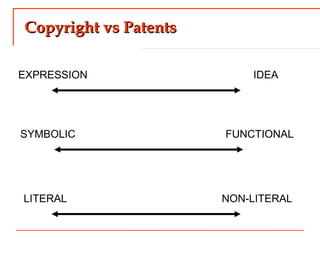
EXPRESSION IDEA
LITERAL NON-LITERAL
SYMBOLIC FUNCTIONAL
Copyright vs PatentsCopyright vs Patents
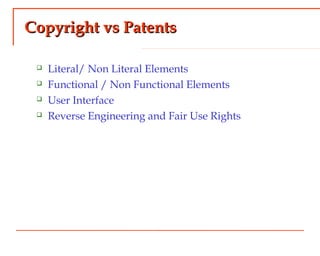
 Literal/ Non Literal Elements
 Functional / Non Functional Elements
 User Interface
 Reverse Engineering and Fair Use Rights
Copyright Vs. PatentsCopyright Vs. Patents
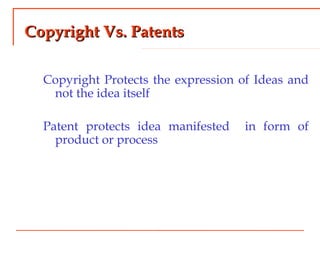
Copyright Protects the expression of Ideas and
not the idea itself
Patent protects idea manifested in form of
product or process
Q A&
Q&AQ&A
Vijay Kumar M
IP Markets
vijay@ipmarkets.in
+91 -9293123797
+91-40-23305525
+91-97000 29123
Patent and Patent Law

Patent and Patent Law

  • 1.
    Patents & PatentLawPatents & Patent Law Vijay Kumar M. 97 000 29 123
  • 2.
    What is aPatent?What is a Patent?  A patent is a right to monopolize an invention. A would- be inventor specifies the scope of activities from which he wants to exclude others (the claims), and submits it to the Patent Office. Patent Office evaluates whether these claims depict an invention within the sense of the Patent law and whether the invention is correctly disclosed and industrially applicable (formal examination). Some patent offices will moreover examine whether the invention is new and non-obvious (substantive examination). If the application passes the examination hurdles, the Patent Office grants the applicant exclusive rights to produce and market the invention for a period of 20 years.
  • 3.
    Patentability RequirementsPatentability Requirements Patentable subject matter  Utility  Novelty  Non obviousness  Specification
  • 4.
    Patentable Subject matterPatentableSubject matter  This Requirement lays down the list of subjects that are eligible to get a patent as Eligible Subjects and those that are not eligible as Non- Patentable subjects/Inventions.  In order to comply with this requirement the inventions should fall under the eligible subjects and be outside the list of non-patentable inventions.
  • 5.
    NoveltyNovelty  New  PriorArt  Anticipation  Public Knowledge  Public domain information  Ph.D Thesis available in library
  • 6.
    Non-ObviousnessNon-Obviousness  Inventive Step Technical advancement or having economic significance or both  Should not be obvious  Ordinary person skilled in the art
  • 7.
    Utility/ Industrial ApplicationUtility/Industrial Application  Should be useful in any industry  Even if it is used for one single individual the requirement is meet
  • 8.
    SpecificationSpecification  Complete Informationabout the invention  Different Modes and Best mode of performing the Invention  Boundaries of the Invention  May contain drawings  Should end with claims  Claims should be supported by the description of the invention
  • 9.
    Copyright vs PatentsCopyrightvs Patents EXPRESSION IDEA LITERAL NON-LITERAL SYMBOLIC FUNCTIONAL
  • 10.
    Copyright vs PatentsCopyrightvs Patents  Literal/ Non Literal Elements  Functional / Non Functional Elements  User Interface  Reverse Engineering and Fair Use Rights
  • 11.
    Copyright Vs. PatentsCopyrightVs. Patents Copyright Protects the expression of Ideas and not the idea itself Patent protects idea manifested in form of product or process
  • 12.
  • 13.
    Q&AQ&A Vijay Kumar M IPMarkets vijay@ipmarkets.in +91 -9293123797 +91-40-23305525 +91-97000 29123