Presented By -:
Bhagwan Singh
Neha
Sonali
Growth of Patanjali Brand from
Local to Global Market : A Study
Research By -:
Namrata Maheshwari
and R P Sharma
Introduction
• Yoga, Ayurveda, Spiritualism and Vedas are the identities of India in the
world.
• In making yoga a popular term, Baba Ramdev’s contribution is
phenomenal.
• Patanjali Ayurved Limited is an Indian FMCG company.
• Manufacturing units and headquarters are located in the industrial area
of Haridwar while having registered office is located at Delhi.
• The company manufactures mineral and herbal products.
• Balkrishna established Patanjali Ayurved Limited in 2006 along with
Baba Ramdev with the objective of establishing science of Ayurveda in
accordance and coordinating with the latest technology and ancient
wisdom
Patanjali operates via three business
segments:
• Foods (foods, supplements, digestives, dairy, juices, etc.)
• FMCG (cosmetics—shampoo, soaps and facewash)home care
(detergent—cakes, powder, liquid, etc.)
• Ayurvedic products (healthcare products for blood pressure, skin
diseases, joint pain, etc.).
Patanjali’s three principles are:
• Cost-effective manner of production.
• World-class quality with natural ingredients.
• Ploughing back the profits into the business.
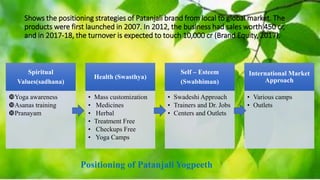
Shows the positioning strategies of Patanjali brand from local to global market. The
products were first launched in 2007. In 2012, the business had sales worth 450 cr,
and in 2017-18, the turnover is expected to touch 10,000 cr (Brand Equity, 2017).
Spiritual
Values(sadhana)
Yoga awareness
Asanas training
Pranayam
Health (Swasthya)
• Mass customization
• Medicines
• Herbal
• Treatment Free
• Checkups Free
• Yoga Camps
Self – Esteem
(Swabhiman)
• Swadeshi Approach
• Trainers and Dr. Jobs
• Centers and Outlets
International Market
Approach
• Various camps
• Outlets
Positioning of Patanjali Yogpeeth
Brand Strategy for Patanjali
• Brand and Trust
• Brand and Emotional Hijacking
• Value Brand
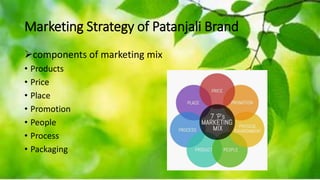
Marketing Strategy of Patanjali Brand
components of marketing mix
• Products
• Price
• Place
• Promotion
• People
• Process
• Packaging
Future Commitments
• Baba Ramdev’s vision is to make this brand a world famous and
acceptable brand
• Establish one lakh Swadeshi Kendra in rural India.
• Planning to make a stronger online presence to sell its product on the
digital platform such as Amazon, Flipkart, Paytm Mall, 1MG,
bigbasket, grofers, shopclues and snapdeal.
• Under the ‘Act East’ policy, strengthening ties with the countries in
India’s east. Such as China, Myanmar, Bangladesh and others.
Conclusion
• The Patanjali brand has grown into a colossal 5,000 cr business
empire in just about a decade from its commercial launch.
• The study concludes that there is a strong synergy between image
and identity of brand Baba Ramdev.
• Patanjali not only in India but also in America, Africa, UK and USA,
and business is growing at an increasing rate.
Thank You

Patanjali ppt

  • 1.
    Presented By -: BhagwanSingh Neha Sonali
  • 2.
    Growth of PatanjaliBrand from Local to Global Market : A Study Research By -: Namrata Maheshwari and R P Sharma
  • 3.
    Introduction • Yoga, Ayurveda,Spiritualism and Vedas are the identities of India in the world. • In making yoga a popular term, Baba Ramdev’s contribution is phenomenal. • Patanjali Ayurved Limited is an Indian FMCG company. • Manufacturing units and headquarters are located in the industrial area of Haridwar while having registered office is located at Delhi. • The company manufactures mineral and herbal products. • Balkrishna established Patanjali Ayurved Limited in 2006 along with Baba Ramdev with the objective of establishing science of Ayurveda in accordance and coordinating with the latest technology and ancient wisdom
  • 4.
    Patanjali operates viathree business segments: • Foods (foods, supplements, digestives, dairy, juices, etc.) • FMCG (cosmetics—shampoo, soaps and facewash)home care (detergent—cakes, powder, liquid, etc.) • Ayurvedic products (healthcare products for blood pressure, skin diseases, joint pain, etc.).
  • 5.
    Patanjali’s three principlesare: • Cost-effective manner of production. • World-class quality with natural ingredients. • Ploughing back the profits into the business.
  • 6.
    Shows the positioningstrategies of Patanjali brand from local to global market. The products were first launched in 2007. In 2012, the business had sales worth 450 cr, and in 2017-18, the turnover is expected to touch 10,000 cr (Brand Equity, 2017). Spiritual Values(sadhana) Yoga awareness Asanas training Pranayam Health (Swasthya) • Mass customization • Medicines • Herbal • Treatment Free • Checkups Free • Yoga Camps Self – Esteem (Swabhiman) • Swadeshi Approach • Trainers and Dr. Jobs • Centers and Outlets International Market Approach • Various camps • Outlets Positioning of Patanjali Yogpeeth
  • 7.
    Brand Strategy forPatanjali • Brand and Trust • Brand and Emotional Hijacking • Value Brand
  • 8.
    Marketing Strategy ofPatanjali Brand components of marketing mix • Products • Price • Place • Promotion • People • Process • Packaging
  • 9.
    Future Commitments • BabaRamdev’s vision is to make this brand a world famous and acceptable brand • Establish one lakh Swadeshi Kendra in rural India. • Planning to make a stronger online presence to sell its product on the digital platform such as Amazon, Flipkart, Paytm Mall, 1MG, bigbasket, grofers, shopclues and snapdeal. • Under the ‘Act East’ policy, strengthening ties with the countries in India’s east. Such as China, Myanmar, Bangladesh and others.
  • 10.
    Conclusion • The Patanjalibrand has grown into a colossal 5,000 cr business empire in just about a decade from its commercial launch. • The study concludes that there is a strong synergy between image and identity of brand Baba Ramdev. • Patanjali not only in India but also in America, Africa, UK and USA, and business is growing at an increasing rate.
  • 11.