English Department
Passive sentences CPI Tino Grandío
Passive structures
 Passive structures focus on what happens to the subject (whereas active sentences
focus on what the subject does):
ACTIVE PASSIVE
o Your sister broke the window. The window was broken yesterday.
o Ancient Egyptians built the pyramids. The pyramids were built by the ancient
Egyptians.
 We use the passive when who or what caused the action is considered irrelevant:
o America was discovered in 1492.
o Better computers are designed every month.
Structure
 PASSIVE SUBJECT + BE + PAST PARTICIPLE + (BY …)
o I was born in 1997.
o These books were written by Agatha Christie.
o My house has been redecorated.
o Some students won't be invited to the party.
o Is our classroom cleaned every day?
 We have to use the right tense of be (according to the usual rules) and then add the past
participle of the main verb.
 If we want to say who does/did the action we use by + ...
From active to passive
Shakespeare wrote Hamlet.
Hamlet was written by Shakespeare.
 The direct object (=Hamlet) becomes the subject.
 The right form & tense of be is required (=was, in the past simple as in the active
sentence.)
 The main verb is in the past participle form (=written).
 If necessary, the active subject becomes the agent (=by Shakespeare) but if it's
irrelevant (people, they, somebody...) don't mention it in the passive.
Two passives
 Sometimes an active sentence has two objects (direct and indirect). Both might be the
subject of a passive sentence:
o They offered the book to him.
 The book was offered to him.
 He was offered the book.
o They asked me some difficult questions at the exam.
 Some difficult questions were asked at the exam.
 I was asked some difficult questions at the exam.
It is said that... / She is said to + INF...
 When we are reporting information about somebody or something it is possible to use
these expressions:
o People say that she is very intelligent.
 It is said that she is very intelligent.
 She is said to be very intelligent.
o They think that Compostela is very rainy.
 It is thought that Compostela is very rainy.
 Compostela is thought to be very rainy.
 Common verbs used this way are: say, believe, think, understand, expect, etc.
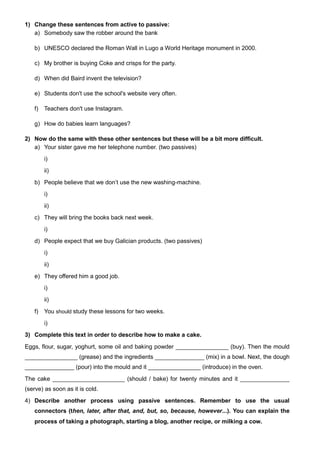
1) Change these sentences from active to passive:
a) Somebody saw the robber around the bank
b) UNESCO declared the Roman Wall in Lugo a World Heritage monument in 2000.
c) My brother is buying Coke and crisps for the party.
d) When did Baird invent the television?
e) Students don't use the school's website very often.
f) Teachers don't use Instagram.
g) How do babies learn languages?
2) Now do the same with these other sentences but these will be a bit more difficult.
a) Your sister gave me her telephone number. (two passives)
i)
ii)
b) People believe that we don’t use the new washing-machine.
i)
ii)
c) They will bring the books back next week.
i)
d) People expect that we buy Galician products. (two passives)
i)
ii)
e) They offered him a good job.
i)
ii)
f) You should study these lessons for two weeks.
i)
3) Complete this text in order to describe how to make a cake.
Eggs, flour, sugar, yoghurt, some oil and baking powder ________________ (buy). Then the mould
________________ (grease) and the ingredients _______________ (mix) in a bowl. Next, the dough
_______________ (pour) into the mould and it ________________ (introduce) in the oven.
The cake ______________________ (should / bake) for twenty minutes and it _______________
(serve) as soon as it is cold.
4) Describe another process using passive sentences. Remember to use the usual
connectors (then, later, after that, and, but, so, because, however...). You can explain the
process of taking a photograph, starting a blog, another recipe, or milking a cow.

Passive structures

  • 1.
    English Department Passive sentencesCPI Tino Grandío Passive structures  Passive structures focus on what happens to the subject (whereas active sentences focus on what the subject does): ACTIVE PASSIVE o Your sister broke the window. The window was broken yesterday. o Ancient Egyptians built the pyramids. The pyramids were built by the ancient Egyptians.  We use the passive when who or what caused the action is considered irrelevant: o America was discovered in 1492. o Better computers are designed every month. Structure  PASSIVE SUBJECT + BE + PAST PARTICIPLE + (BY …) o I was born in 1997. o These books were written by Agatha Christie. o My house has been redecorated. o Some students won't be invited to the party. o Is our classroom cleaned every day?  We have to use the right tense of be (according to the usual rules) and then add the past participle of the main verb.  If we want to say who does/did the action we use by + ... From active to passive Shakespeare wrote Hamlet. Hamlet was written by Shakespeare.  The direct object (=Hamlet) becomes the subject.  The right form & tense of be is required (=was, in the past simple as in the active sentence.)  The main verb is in the past participle form (=written).  If necessary, the active subject becomes the agent (=by Shakespeare) but if it's irrelevant (people, they, somebody...) don't mention it in the passive. Two passives  Sometimes an active sentence has two objects (direct and indirect). Both might be the subject of a passive sentence: o They offered the book to him.  The book was offered to him.  He was offered the book. o They asked me some difficult questions at the exam.  Some difficult questions were asked at the exam.  I was asked some difficult questions at the exam. It is said that... / She is said to + INF...  When we are reporting information about somebody or something it is possible to use these expressions: o People say that she is very intelligent.  It is said that she is very intelligent.  She is said to be very intelligent. o They think that Compostela is very rainy.  It is thought that Compostela is very rainy.  Compostela is thought to be very rainy.  Common verbs used this way are: say, believe, think, understand, expect, etc.
  • 2.
    1) Change thesesentences from active to passive: a) Somebody saw the robber around the bank b) UNESCO declared the Roman Wall in Lugo a World Heritage monument in 2000. c) My brother is buying Coke and crisps for the party. d) When did Baird invent the television? e) Students don't use the school's website very often. f) Teachers don't use Instagram. g) How do babies learn languages? 2) Now do the same with these other sentences but these will be a bit more difficult. a) Your sister gave me her telephone number. (two passives) i) ii) b) People believe that we don’t use the new washing-machine. i) ii) c) They will bring the books back next week. i) d) People expect that we buy Galician products. (two passives) i) ii) e) They offered him a good job. i) ii) f) You should study these lessons for two weeks. i) 3) Complete this text in order to describe how to make a cake. Eggs, flour, sugar, yoghurt, some oil and baking powder ________________ (buy). Then the mould ________________ (grease) and the ingredients _______________ (mix) in a bowl. Next, the dough _______________ (pour) into the mould and it ________________ (introduce) in the oven. The cake ______________________ (should / bake) for twenty minutes and it _______________ (serve) as soon as it is cold. 4) Describe another process using passive sentences. Remember to use the usual connectors (then, later, after that, and, but, so, because, however...). You can explain the process of taking a photograph, starting a blog, another recipe, or milking a cow.