PASSIVE SMOKING
Presented by:
Dinesh Garg
Garbham Bhargav
Himank Srivastava
Amit Patwa
Ankit Negi
INTRODUCTION
The smoke exhaled by
someone else or
emitted by the tip of a
burning cigarette is
called environmental
tobacco smoke, and
breathing it in is
known as passive
smoking.
OUTLINE
Harmful Effects
Proportion of non-smokers who
live in a household with at-least
one smoker
Attitudes towards smoking
Smoking and the law
Conclusion
Harmful Effects
Fatal risks
•Lung cancers.
•Heart disease.
Non-fatal impacts
•Lung function, cough.
•Asthma.
Children
•Sudden infant death, lung
disease.
Unborn child
•Spontaneous abortion, prenatal
death, preterm birth, low birth
weight.
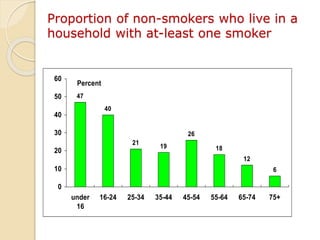
Proportion of non-smokers who live in a
household with at-least one smoker
47
40
21
19
26
18
12
6
0
10
20
30
40
50
60
under
16
16-24 25-34 35-44 45-54 55-64 65-74 75+
Percent
Attitudes towards smoking
Smoking status
Percent agreeing that smoking
should be restricted…
Current
smoker
Ex-
smoker
Never
smoked
All
adults
…at work 70 89 92 86
…in restaurants 72 91 94 88
…in pubs 28 55 67 54
…in other public places 84 87 89 87
Source: Office of National Statistics survey 2011
Smoking and the law
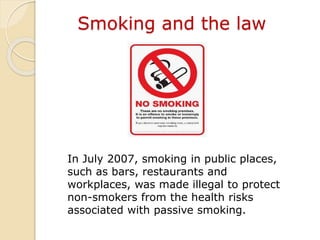
In July 2007, smoking in public places,
such as bars, restaurants and
workplaces, was made illegal to protect
non-smokers from the health risks
associated with passive smoking.
CONCLUSION
Passive smoking mostly affects the
children under age group of 16 years.
Parents should not smoke inside the
house as it affects the health of the children
badly.
70% of the smokers think that the
smoking can be restricted if rules are
strictly followed.
QUESTIONS ?
THANK YOU

Passive smoking

  • 1.
    PASSIVE SMOKING Presented by: DineshGarg Garbham Bhargav Himank Srivastava Amit Patwa Ankit Negi
  • 2.
    INTRODUCTION The smoke exhaledby someone else or emitted by the tip of a burning cigarette is called environmental tobacco smoke, and breathing it in is known as passive smoking.
  • 3.
    OUTLINE Harmful Effects Proportion ofnon-smokers who live in a household with at-least one smoker Attitudes towards smoking Smoking and the law Conclusion
  • 4.
    Harmful Effects Fatal risks •Lungcancers. •Heart disease. Non-fatal impacts •Lung function, cough. •Asthma. Children •Sudden infant death, lung disease. Unborn child •Spontaneous abortion, prenatal death, preterm birth, low birth weight.
  • 5.
    Proportion of non-smokerswho live in a household with at-least one smoker 47 40 21 19 26 18 12 6 0 10 20 30 40 50 60 under 16 16-24 25-34 35-44 45-54 55-64 65-74 75+ Percent
  • 6.
    Attitudes towards smoking Smokingstatus Percent agreeing that smoking should be restricted… Current smoker Ex- smoker Never smoked All adults …at work 70 89 92 86 …in restaurants 72 91 94 88 …in pubs 28 55 67 54 …in other public places 84 87 89 87 Source: Office of National Statistics survey 2011
  • 7.
    Smoking and thelaw In July 2007, smoking in public places, such as bars, restaurants and workplaces, was made illegal to protect non-smokers from the health risks associated with passive smoking.
  • 8.
    CONCLUSION Passive smoking mostlyaffects the children under age group of 16 years. Parents should not smoke inside the house as it affects the health of the children badly. 70% of the smokers think that the smoking can be restricted if rules are strictly followed.
  • 9.
  • 10.