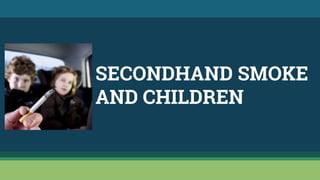
SECONDHAND SMOKE
AND CHILDREN
Hello!
I am Thang
student of
Hanoi School of Public Health
OUTLINE
04
Text Title
Place your own
text here
01
Secondhand smoke
(SHS) exposure
Children and SHS exposure:
Where? How? How much?
02 Consequences of SHS
Health effects on children
03
Solutions
How to protect children from
SHS
Secondhand
smoke (SHS)
exposure
1
Secondhand smoke is the combination of
smoke from the burning end of a cigarette
and the smoke breathed out by smokers
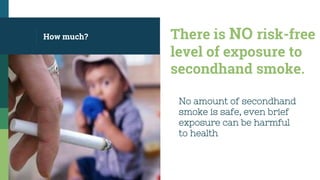
How much?
No amount of secondhand
smoke is safe, even brief
exposure can be harmful
to health
There is NO risk-free
level of exposure to
secondhand smoke.
How?
IN 2014, 40% OF
CHILDREN WERE
EXPOSED TO
SECONDHAND SMOKE
How?
Among children who live in homes in
which no one smokes indoors, those
who live in multi-unit housing
(for example, apartments or condos)
have 45% higher cotinine levels
than children who live in single-
family homes.
During 2011–2012, 2 out of
every 5 children ages 3 to 11
in the US were exposed to SHS
regularly
Who?
Secondhand smoke exposure is
higher among people with low
incomes
During 2011–2012, more than 2 out
of every 5 (43.2%) nonsmokers who
lived below the poverty level were
exposed to secondhand smoke.
Some groups continue to have
high levels of secondhand
smoke exposure. These include:
blue-collar workers, service
workers, construction
workers
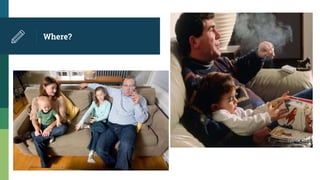
Where?
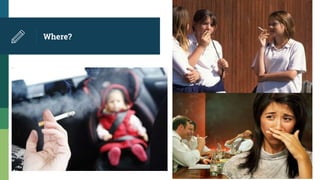
Where?
Healths effects of
secondhand smoke
on children
Because their bodies are developing,
infants and young children are
especially vulnerable to the poisons
in secondhand smoke
2
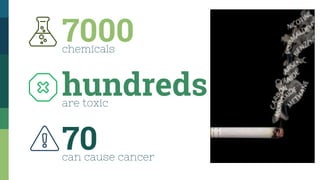
7000chemicals
70can cause cancer
hundredsare toxic
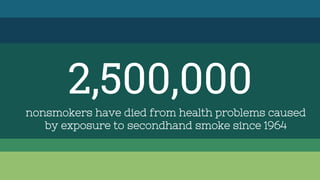
2,500,000
nonsmokers have died from health problems caused
by exposure to secondhand smoke since 1964
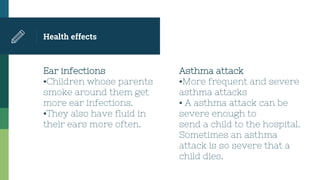
Ear infections
▪Children whose parents
smoke around them get
more ear infections.
▪They also have fluid in
their ears more often.
Health effects
Asthma attack
▪More frequent and severe
asthma attacks
▪ A asthma attack can be
severe enough to
send a child to the hospital.
Sometimes an asthma
attack is so severe that a
child dies.
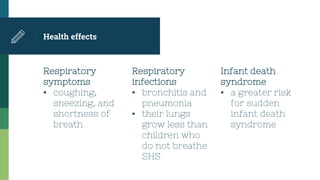
Health effects
Respiratory
symptoms
▪ coughing,
sneezing, and
shortness of
breath
Respiratory
infections
▪ bronchitis and
pneumonia
▪ their lungs
grow less than
children who
do not breathe
SHS
Infant death
syndrome
▪ a greater risk
for sudden
infant death
syndrome
SOLUTIONS
What could we do to protect children
from SHS?
3
Take simple steps to
protect children from SHS
 Support family and friends who also want to stop smoking
 Ask people not to smoke around children.
 Teach children to stay away from SHS. Encourage teens not to
smoke
 Make the decision to quit smoking. Get help from your doctor,
family, and friends
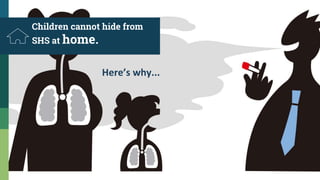
Children cannot hide from
SHS at home.
Here’s why...
This is a slide title
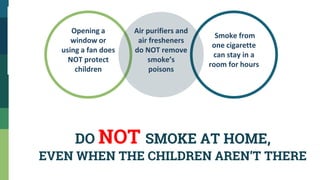
Opening a
window or
using a fan does
NOT protect
children
Smoke from
one cigarette
can stay in a
room for hours
Air purifiers and
air fresheners
do NOT remove
smoke’s
poisons
DO NOT SMOKE AT HOME,
EVEN WHEN THE CHILDREN AREN’T THERE
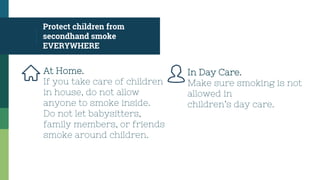
At Home.
If you take care of children
in house, do not allow
anyone to smoke inside.
Do not let babysitters,
family members, or friends
smoke around children.
Protect children from
secondhand smoke
EVERYWHERE
In Day Care.
Make sure smoking is not
allowed in
children’s day care.
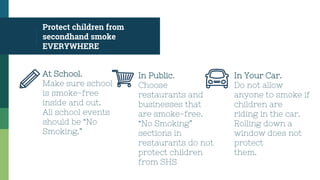
At School.
Make sure school
is smoke-free
inside and out.
All school events
should be “No
Smoking.”
In Public.
Choose
restaurants and
businesses that
are smoke-free.
“No Smoking”
sections in
restaurants do not
protect children
from SHS
In Your Car.
Do not allow
anyone to smoke if
children are
riding in the car.
Rolling down a
window does not
protect
them.
Protect children from
secondhand smoke
EVERYWHERE
THANK YOU FOR LISTENING!

Secondhand Smoke and Children

  • 1.
  • 2.
    Hello! I am Thang studentof Hanoi School of Public Health
  • 3.
    OUTLINE 04 Text Title Place yourown text here 01 Secondhand smoke (SHS) exposure Children and SHS exposure: Where? How? How much? 02 Consequences of SHS Health effects on children 03 Solutions How to protect children from SHS
  • 4.
  • 5.
    Secondhand smoke isthe combination of smoke from the burning end of a cigarette and the smoke breathed out by smokers
  • 6.
    How much? No amountof secondhand smoke is safe, even brief exposure can be harmful to health There is NO risk-free level of exposure to secondhand smoke.

  • 7.
    How? IN 2014, 40%OF CHILDREN WERE EXPOSED TO SECONDHAND SMOKE
  • 8.
    How? Among children wholive in homes in which no one smokes indoors, those who live in multi-unit housing (for example, apartments or condos) have 45% higher cotinine levels than children who live in single- family homes. During 2011–2012, 2 out of every 5 children ages 3 to 11 in the US were exposed to SHS regularly
  • 9.
    Who? Secondhand smoke exposureis higher among people with low incomes During 2011–2012, more than 2 out of every 5 (43.2%) nonsmokers who lived below the poverty level were exposed to secondhand smoke. Some groups continue to have high levels of secondhand smoke exposure. These include: blue-collar workers, service workers, construction workers
  • 10.
  • 11.
  • 12.
    Healths effects of secondhandsmoke on children Because their bodies are developing, infants and young children are especially vulnerable to the poisons in secondhand smoke 2
  • 13.
  • 14.
    2,500,000 nonsmokers have diedfrom health problems caused by exposure to secondhand smoke since 1964
  • 15.
    Ear infections ▪Children whoseparents smoke around them get more ear infections. ▪They also have fluid in their ears more often. Health effects Asthma attack ▪More frequent and severe asthma attacks ▪ A asthma attack can be severe enough to send a child to the hospital. Sometimes an asthma attack is so severe that a child dies.
  • 16.
    Health effects Respiratory symptoms ▪ coughing, sneezing,and shortness of breath Respiratory infections ▪ bronchitis and pneumonia ▪ their lungs grow less than children who do not breathe SHS Infant death syndrome ▪ a greater risk for sudden infant death syndrome
  • 17.
    SOLUTIONS What could wedo to protect children from SHS? 3
  • 18.
    Take simple stepsto protect children from SHS  Support family and friends who also want to stop smoking  Ask people not to smoke around children.  Teach children to stay away from SHS. Encourage teens not to smoke  Make the decision to quit smoking. Get help from your doctor, family, and friends
  • 19.
    Children cannot hidefrom SHS at home. Here’s why...
  • 20.
    This is aslide title
  • 21.
    Opening a window or usinga fan does NOT protect children Smoke from one cigarette can stay in a room for hours Air purifiers and air fresheners do NOT remove smoke’s poisons DO NOT SMOKE AT HOME, EVEN WHEN THE CHILDREN AREN’T THERE
  • 22.
    At Home. If youtake care of children in house, do not allow anyone to smoke inside. Do not let babysitters, family members, or friends smoke around children. Protect children from secondhand smoke EVERYWHERE In Day Care. Make sure smoking is not allowed in children’s day care.
  • 23.
    At School. Make sureschool is smoke-free inside and out. All school events should be “No Smoking.” In Public. Choose restaurants and businesses that are smoke-free. “No Smoking” sections in restaurants do not protect children from SHS In Your Car. Do not allow anyone to smoke if children are riding in the car. Rolling down a window does not protect them. Protect children from secondhand smoke EVERYWHERE
  • 24.
    THANK YOU FORLISTENING!

Editor's Notes

  • #11 Most exposure to secondhand smoke occurs in
  • #12 homes People are also exposed to secondhand smoke in public places—such as in restaurants, bars, and casinos—as well as in cars and other vehicles
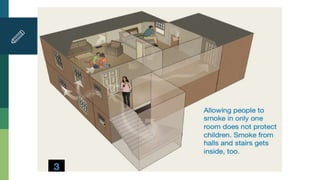
  • #21 Smoking outside in a hall or stairwell does not protect children inside. Smoke goes under doors, windows, and through cracks. • To protect the children inside, homes and apartment buildings must be smoke-free.