How can we ensure
How can we ensure
How can we ensure
smoke-free indoor places?
An Actor-Network Theory Analysis
GAURAV DESHMUKH - DT2022004
Pace
Pace
Pace
Intro
Innovation in Practice
Insights into Each Loop
Actor-Network Theory
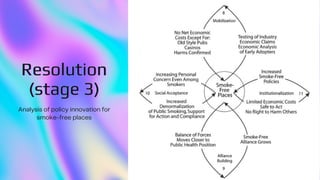
Automization of the Issue
The contest and the negotiation of Solutions
Resolution
Mobilization
Alliance Building
Engagement with the Public
Broader Impliactions
Autonomization and Institutionalization
Intro
Intro
Intro
There are several human and non-human actors involved
that are identified as key attributes of those jurisdictions
that successfully pursue the innovation.
TRANSNATIONAL ISSUES LIKE THE TOBACCO EPIDEMIC
ARE MAJOR CHALLENGES THAT DEFY ANALYSIS AND
MANAGEMENT BY CONVENTIONAL METHODS
1.
Actor-
Actor-
Actor-
Network
Network
Network
Theory
Theory
Theory
Actor-network theory is
a comprehensive
framework for the
analysis of fundamental
system change.
2.
Methodological
approach to social
theory where
everything in the social
and natural worlds
exists in constantly
shifting networks of
relationships
.The development of an actor-network
necessarily signals the pursuit of a goal,
which generally stimulates the
development of counter networks, or
‘anti-programs', with different goals or
that seek to block the goal being sought.
They compete for allies, institutional
endorsement, public support, and
tangible and intangible resources
ACTOR-NETWORK THEORY
Bruno Lataur
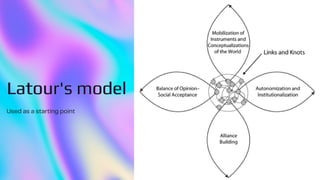
Latour's model
Latour's model
Latour's model
Used as a starting point
Mobilization
Mobilization
Mobilization
Non-humans are progressively
loaded into discourse
Alliance Building
Alliance Building
Alliance Building
Ally building vs Rejecting
Balance of Opinions
Balance of Opinions
Balance of Opinions
Gaining the acceptance of individuals
potentially affected
Institutionalization
Institutional support for, an innovation
emerges from the appropriate structures.
Innovation in
Innovation in
Innovation in
Practice
Practice
Practice
Autonomization of the issue
The Contest and Negotiation of
Solutions
Resolution
1.
2.
3.
3.
Automization of
Automization of
Automization of
the Issue
the Issue
the Issue
Early stage in which all major actors
will start forming allies, public will
question the state of art and
government will start interrogating
the issue.
3.1
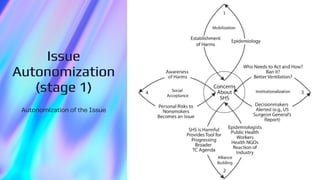
Issue
Issue
Issue
Autonomization
Autonomization
Autonomization
(stage 1)
(stage 1)
(stage 1)
Autonomization of the Issue
THE CONTEST
THE CONTEST
THE CONTEST
AND THE
AND THE
AND THE
NEGOTIATION
NEGOTIATION
NEGOTIATION
OF SOLUTIONS
OF SOLUTIONS
OF SOLUTIONS
Second stage where solutions will
emerge from all the sides, public
will start choosing sides, allies will
sever and bound and government
will start some level of policy
3.2
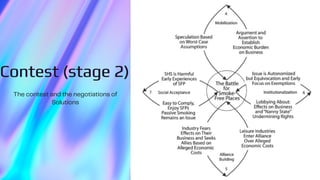
Contest (stage 2)
Contest (stage 2)
Contest (stage 2)
The contest and the negotiations of
Solutions
3.3
Resolution
Resolution
Resolution
Late stage where the discourse will
start to have a major side, social
acceptance will become prominent
and government will be more open
to form stricter polices.
Resolution
Resolution
Resolution
(stage 3)
(stage 3)
(stage 3)
Analysis of policy innovation for
smoke-free places
Insights into
Insights into
Insights into
Each Loop
Each Loop
Each Loop
Mobilization
Alliance Building
Social Acceptance
Institutionalization
4.
Mobilization
Mobilization
Mobilization
There are 2 classes of scientific
research mobilized in support of
the stories: evolving research
relevant to the issue and research
directed at understanding the
problem (once identified) and
developing and evaluating
solutions.
4.1
Alliance
Alliance
Alliance
Building
Building
Building
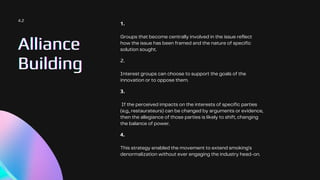
1.
Groups that become centrally involved in the issue reflect
how the issue has been framed and the nature of specific
solution sought.
4.2
2.
Interest groups can choose to support the goals of the
innovation or to oppose them.
3.
If the perceived impacts on the interests of specific parties
(e.g., restaurateurs) can be changed by arguments or evidence,
then the allegiance of those parties is likely to shift, changing
the balance of power.
4.
This strategy enabled the movement to extend smoking’s
denormalization without ever engaging the industry head-on.
Engagement
Engagement
Engagement
with the Public
with the Public
with the Public
It has to be justified
on a balance of
interests.
Or threaten to vote
against the
government.
Finally onus is on the
government.
Right to clean air Vs
Right to smoke
To show their
dissent, public can
join tobacoo-free
coalitions.
4.3
LOREM IPSUM
Lorem Ipsum
LOREM IPSUM
Lorem Ipsum
LOREM IPSUM
Lorem Ipsum
Lorem Ipsum
4.4
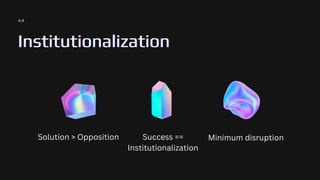
Institutionalization
Solution > Opposition Success ==
Institutionalization
Minimum disruption
Broader
Broader
Broader
Implications
Implications
Implications
Implications for other
complex public health
problems ex. Obesity &
Climate Change.
Effective solutions to
complex problems emerge
where collaboration
facilitates strong actor-
network development.
ANT is not a predictive tool,
but descriptive tool. It
facilitates understanding
of the reasons of success
or failure in different
contexts.
5
Medical-Industrial Complex
Sources
Sources
Sources
Actor-Network Theory/Network
Geographies, G.T. Jóhannesson, J.O.
Bærenholdt, in International
Encyclopedia of Human Geography,
2009
David Young, Ron Borland, Ken Coghill,
“An Actor-Network Theory Analysis of
Policy Innovation for Smoke-Free
Places: Understanding Change in
Complex Systems”, American Journal
of Public Health 100, no. 7 (July 1,
2010): pp. 1208-1217
N Engl J Med 1980; 303:963-970, DOI:
10.1056/NEJM198010233031703
Flessa, S., & Huebner, C. (2021).
Innovations in Health Care—A
Conceptual Framework. International
Journal of Environmental Research
and Public Health, 18(19).
https://doi.org/10.3390/ijerph1819100
26
1.
2.
3.
4.

Passive Smoking- Actor Network Theory Analysis.pdf

  • 1.
    How can weensure How can we ensure How can we ensure smoke-free indoor places? smoke-free indoor places? smoke-free indoor places? An Actor-Network Theory Analysis GAURAV DESHMUKH - DT2022004
  • 2.
    Pace Pace Pace Intro Innovation in Practice Insightsinto Each Loop Actor-Network Theory Automization of the Issue The contest and the negotiation of Solutions Resolution Mobilization Alliance Building Engagement with the Public Broader Impliactions Autonomization and Institutionalization
  • 3.
    Intro Intro Intro There are severalhuman and non-human actors involved that are identified as key attributes of those jurisdictions that successfully pursue the innovation. TRANSNATIONAL ISSUES LIKE THE TOBACCO EPIDEMIC ARE MAJOR CHALLENGES THAT DEFY ANALYSIS AND MANAGEMENT BY CONVENTIONAL METHODS 1.
  • 4.
    Actor- Actor- Actor- Network Network Network Theory Theory Theory Actor-network theory is acomprehensive framework for the analysis of fundamental system change. 2. Methodological approach to social theory where everything in the social and natural worlds exists in constantly shifting networks of relationships
  • 5.
    .The development ofan actor-network necessarily signals the pursuit of a goal, which generally stimulates the development of counter networks, or ‘anti-programs', with different goals or that seek to block the goal being sought. They compete for allies, institutional endorsement, public support, and tangible and intangible resources ACTOR-NETWORK THEORY ACTOR-NETWORK THEORY ACTOR-NETWORK THEORY Bruno Lataur
  • 6.
    Latour's model Latour's model Latour'smodel Used as a starting point
  • 7.
    Mobilization Mobilization Mobilization Non-humans are progressively loadedinto discourse Alliance Building Alliance Building Alliance Building Ally building vs Rejecting Balance of Opinions Balance of Opinions Balance of Opinions Gaining the acceptance of individuals potentially affected Institutionalization Institutionalization Institutionalization Institutional support for, an innovation emerges from the appropriate structures.
  • 8.
    Innovation in Innovation in Innovationin Practice Practice Practice Autonomization of the issue The Contest and Negotiation of Solutions Resolution 1. 2. 3. 3.
  • 9.
    Automization of Automization of Automizationof the Issue the Issue the Issue Early stage in which all major actors will start forming allies, public will question the state of art and government will start interrogating the issue. 3.1
  • 10.
  • 11.
    THE CONTEST THE CONTEST THECONTEST AND THE AND THE AND THE NEGOTIATION NEGOTIATION NEGOTIATION OF SOLUTIONS OF SOLUTIONS OF SOLUTIONS Second stage where solutions will emerge from all the sides, public will start choosing sides, allies will sever and bound and government will start some level of policy 3.2
  • 12.
    Contest (stage 2) Contest(stage 2) Contest (stage 2) The contest and the negotiations of Solutions
  • 13.
    3.3 Resolution Resolution Resolution Late stage wherethe discourse will start to have a major side, social acceptance will become prominent and government will be more open to form stricter polices.
  • 14.
    Resolution Resolution Resolution (stage 3) (stage 3) (stage3) Analysis of policy innovation for smoke-free places
  • 15.
    Insights into Insights into Insightsinto Each Loop Each Loop Each Loop Mobilization Alliance Building Social Acceptance Institutionalization 4.
  • 16.
    Mobilization Mobilization Mobilization There are 2classes of scientific research mobilized in support of the stories: evolving research relevant to the issue and research directed at understanding the problem (once identified) and developing and evaluating solutions. 4.1
  • 17.
    Alliance Alliance Alliance Building Building Building 1. Groups that becomecentrally involved in the issue reflect how the issue has been framed and the nature of specific solution sought. 4.2 2. Interest groups can choose to support the goals of the innovation or to oppose them. 3. If the perceived impacts on the interests of specific parties (e.g., restaurateurs) can be changed by arguments or evidence, then the allegiance of those parties is likely to shift, changing the balance of power. 4. This strategy enabled the movement to extend smoking’s denormalization without ever engaging the industry head-on.
  • 18.
    Engagement Engagement Engagement with the Public withthe Public with the Public It has to be justified on a balance of interests. Or threaten to vote against the government. Finally onus is on the government. Right to clean air Vs Right to smoke To show their dissent, public can join tobacoo-free coalitions. 4.3
  • 19.
    LOREM IPSUM Lorem Ipsum LOREMIPSUM Lorem Ipsum LOREM IPSUM Lorem Ipsum Lorem Ipsum 4.4 Institutionalization Institutionalization Institutionalization Solution > Opposition Success == Institutionalization Minimum disruption
  • 20.
    Broader Broader Broader Implications Implications Implications Implications for other complexpublic health problems ex. Obesity & Climate Change. Effective solutions to complex problems emerge where collaboration facilitates strong actor- network development. ANT is not a predictive tool, but descriptive tool. It facilitates understanding of the reasons of success or failure in different contexts. 5 Medical-Industrial Complex
  • 21.
    Sources Sources Sources Actor-Network Theory/Network Geographies, G.T.Jóhannesson, J.O. Bærenholdt, in International Encyclopedia of Human Geography, 2009 David Young, Ron Borland, Ken Coghill, “An Actor-Network Theory Analysis of Policy Innovation for Smoke-Free Places: Understanding Change in Complex Systems”, American Journal of Public Health 100, no. 7 (July 1, 2010): pp. 1208-1217 N Engl J Med 1980; 303:963-970, DOI: 10.1056/NEJM198010233031703 Flessa, S., & Huebner, C. (2021). Innovations in Health Care—A Conceptual Framework. International Journal of Environmental Research and Public Health, 18(19). https://doi.org/10.3390/ijerph1819100 26 1. 2. 3. 4.