





Future Scenarios
Implementation Toolkit
1
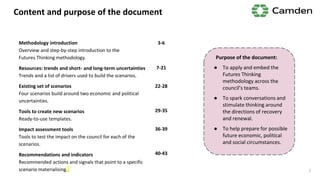
Content and purpose of the document
Methodology introduction
Overview and step-by-step introduction to the
Futures Thinking methodology.
Resources: trends and short- and long-term uncertainties
Trends and a list of drivers used to build the scenarios.
Existing set of scenarios
Four scenarios build around two economic and political
uncertainties.
Tools to create new scenarios
Ready-to-use templates.
Impact assessment tools
Tools to test the impact on the council for each of the
scenarios.
Recommendations and indicators
Recommended actions and signals that point to a specific
scenario materialising. 2
Purpose of the document:
● To apply and embed the
Futures Thinking
methodology across the
council’s teams.
● To spark conversations and
stimulate thinking around
the directions of recovery
and renewal.
● To help prepare for possible
future economic, political
and social circumstances.
3-6
7-21
22-28
29-35
36-39
40-43
Methodology
introduction
3
Future scenarios
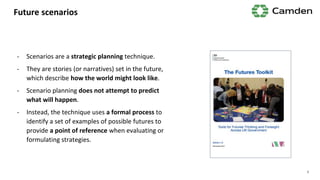
- Scenarios are a strategic planning technique.
- They are stories (or narratives) set in the future,
which describe how the world might look like.
- Scenario planning does not attempt to predict
what will happen.
- Instead, the technique uses a formal process to
identify a set of examples of possible futures to
provide a point of reference when evaluating or
formulating strategies.
4
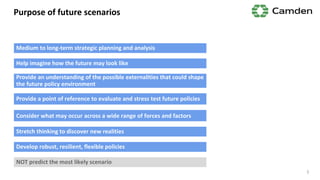
Purpose of future scenarios
5
Medium to long-term strategic planning and analysis
Help imagine how the future may look like
Provide an understanding of the possible externalities that could shape
the future policy environment
Provide a point of reference to evaluate and stress test future policies
Consider what may occur across a wide range of forces and factors
Stretch thinking to discover new realities
Develop robust, resilient, flexible policies
NOT predict the most likely scenario
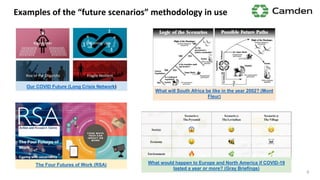
Examples of the “future scenarios” methodology in use
6
The Four Futures of Work (RSA)
Our COVID Future (Long Crisis Network)
What would happen to Europe and North America if COVID-19
lasted a year or more? (Gray Briefings)
What will South Africa be like in the year 2002? (Mont
Fleur)
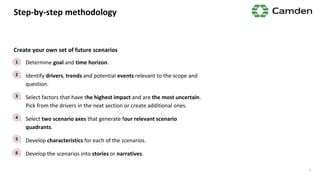
Step-by-step methodology
Create your own set of future scenarios
1. Determine goal and time horizon.
2. Identify drivers, trends and potential events relevant to the scope and
question.
3. Select factors that have the highest impact and are the most uncertain.
Pick from the drivers in the next section or create additional ones.
4. Select two scenario axes that generate four relevant scenario
quadrants.
5. Develop characteristics for each of the scenarios.
6. Develop the scenarios into stories or narratives.
1
2
3
4
5
6
7
Resources
8
Trends and short- and
long-term uncertainties
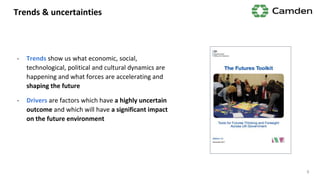
Trends & uncertainties
- Trends show us what economic, social,
technological, political and cultural dynamics are
happening and what forces are accelerating and
shaping the future
- Drivers are factors which have a highly uncertain
outcome and which will have a significant impact
on the future environment
9
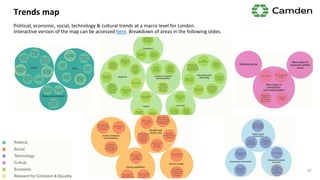
Trends map
Political, economic, social, technology & cultural trends at a macro level for London.
Interactive version of the map can be accessed here. Breakdown of areas in the following slides.
10
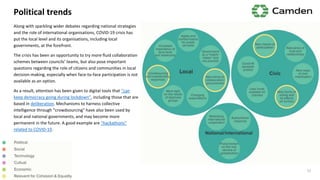
Political trends
Along with sparkling wider debates regarding national strategies
and the role of international organisations, COVID-19 crisis has
put the local level and its organisations, including local
governments, at the forefront.
The crisis has been an opportunity to try more fluid collaboration
schemes between councils’ teams, but also pose important
questions regarding the role of citizens and communities in local
decision-making, especially when face-to-face participation is not
available as an option.
As a result, attention has been given to digital tools that “can
keep democracy going during lockdown”, including those that are
based in deliberation. Mechanisms to harness collective
intelligence through “crowdsourcing” have also been used by
local and national governments, and may become more
permanent in the future. A good example are “hackathons”
related to COVID-19.
11
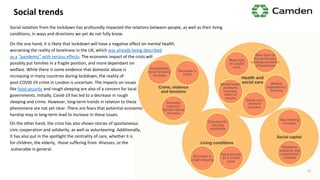
Social trends
On the one hand, it is likely that lockdown will have a negative effect on mental health,
worsening the reality of loneliness in the UK, which was already being described
as a “pandemic” with serious effects. The economic impact of the crisis will
possibly put families in a fragile position, and more dependant on
welfare. While there is some evidence that domestic abuse is
increasing in many countries during lockdown, the reality of
post-COVID 19 crime in London is uncertain. The impacts on issues
like food security and rough sleeping are also of a concern for local
governments. Initially, Covid-19 has led to a decrease in rough
sleeping and crime. However, long-term trends in relation to these
phenomena are not yet clear. There are fears that potential economic
harship may in long-term lead to increase in these issues.
On the other hand, the crisis has also shown stories of spontaneous
civic cooperation and solidarity, as well as volunteering. Additionally,
it has also put in the spotlight the centrality of care, whether it is
for children, the elderly, those suffering from illnesses, or the
vulnerable in general.
Social isolation from the lockdown has profoundly impacted the relations between people, as well as their living
conditions, in ways and directions we yet do not fully know.
12
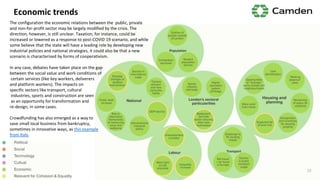
Economic trends
The configuration the economic relations between the public, private
and non-for-profit sector may be largely modified by the crisis. The
direction, however, is still unclear. Taxation, for instance, could be
increased or lowered as a response to post-COVID 19 scenario, and while
some believe that the state will have a leading role by developing new
industrial policies and national strategies, it could also be that a new
scenario is characterised by forms of cooperativism.
In any case, debates have taken place on the gap
between the social value and work conditions of
certain services (like key workers, deliverers
and platform workers). The impacts on
specific sectors like transport, cultural
industries, sports and construction are seen
as an opportunity for transformation and
re-design, in some cases.
Crowdfunding has also emerged as a way to
save small local business from bankruptcy,
sometimes in innovative ways, as this example
from Italy.
13
Technology trends
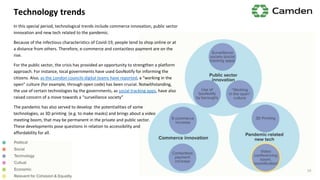
In this special period, technological trends include commerce innovation, public sector
innovation and new tech related to the pandemic.
Because of the infectious characteristics of Covid-19, people tend to shop online or at
a distance from others. Therefore, e-commerce and contactless payment are on the
rise.
For the public sector, the crisis has provided an opportunity to strengthen a platform
approach. For instance, local governments have used GovNotify for informing the
citizens. Also, as the London councils digital teams have reported, a “working in the
open” culture (for example, through open code) has been crucial. Notwithstanding,
the use of certain technologies by the governments, as social tracking apps, have also
raised concern of a move towards a “surveillance society”
The pandemic has also served to develop the potentialities of some
technologies, as 3D printing (e.g. to make masks) and brings about a video
meeting boom, that may be permanent in the private and public sector.
These developments pose questions in relation to accessibility and
affordability for all.
14
Cultural trends
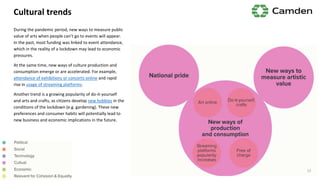
During the pandemic period, new ways to measure public
value of arts when people can’t go to events will appear.
In the past, most funding was linked to event attendance,
which in the reality of a lockdown may lead to economic
pressures.
At the same time, new ways of culture production and
consumption emerge or are accelerated. For example,
attendance of exhibitions or concerts online and rapid
rise in usage of streaming platforms.
Another trend is a growing popularity of do-it-yourself
and arts and crafts, as citizens develop new hobbies in the
conditions of the lockdown (e.g. gardening). These new
preferences and consumer habits will potentially lead to
new business and economic implications in the future.
15
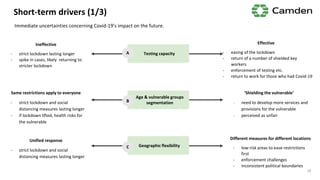
Unified response
- strict lockdown and social
distancing measures lasting longer
Different measures for different locations
- low-risk areas to ease restrictions
first
- enforcement challenges
- inconsistent political boundaries
Geographic flexibility
Short-term drivers (1/3)
Immediate uncertainties concerning Covid-19’s impact on the future.
Testing capacity
Age & vulnerable groups
segmentation
A
B
C
Ineffective
- strict lockdown lasting longer
- spike in cases, likely returning to
stricter lockdown
Effective
- easing of the lockdown
- return of a number of shielded key
workers
- enforcement of testing etc.
- return to work for those who had Covid-19
Same restrictions apply to everyone
- strict lockdown and social
distancing measures lasting longer
- if lockdown lifted, health risks for
the vulnerable
‘Shielding the vulnerable’
- need to develop more services and
provisions for the vulnerable
- perceived as unfair
16
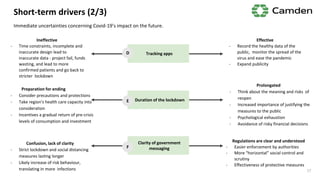
Confusion, lack of clarity
- Strict lockdown and social distancing
measures lasting longer
- Likely increase of risk behaviour,
translating in more infections
Regulations are clear and understood
- Easier enforcement by authorities
- More “horizontal” social control and
scrutiny
- Effectiveness of protective measures
Clarity of government
messaging
Short-term drivers (2/3)
Immediate uncertainties concerning Covid-19’s impact on the future.
Tracking apps
Duration of the lockdown
D
E
F
Ineffective
- Time constraints, incomplete and
inaccurate design lead to
inaccurate data - project fail, funds
wasting, and lead to more
confirmed patients and go back to
stricter lockdown
Effective
- Record the healthy data of the
public, monitor the spread of the
virus and ease the pandemic
- Expand publicity
Preparation for ending
- Consider precautions and protections
- Take region's health care capacity into
consideration
- Incentives a gradual return of pre-crisis
levels of consumption and investment
Prolongated
- Think about the meaning and risks of
reopen
- Increased importance of justifying the
measures to the public
- Psychological exhaustion
- Avoidance of risky financial decisions
17
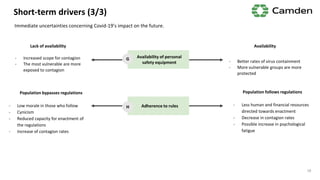
Short-term drivers (3/3)
Immediate uncertainties concerning Covid-19’s impact on the future.
Availability of personal
safety equipment
Adherence to rules
G
H
Lack of availability
- Increased scope for contagion
- The most vulnerable are more
exposed to contagion
Availability
- Better rates of virus containment
- More vulnerable groups are more
protected
Population bypasses regulations
- Low morale in those who follow
- Cynicism
- Reduced capacity for enactment of
the regulations
- Increase of contagion rates
Population follows regulations
- Less human and financial resources
directed towards enactment
- Decrease in contagion rates
- Possible increase in psychological
fatigue
18
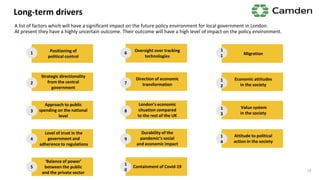
Long-term drivers
A list of factors which will have a significant impact on the future policy environment for local government in London.
At present they have a highly uncertain outcome. Their outcome will have a high level of impact on the policy environment.
Positioning of
political control
Strategic directionality
from the central
government
Approach to public
spending on the national
level
Level of trust in the
government and
adherence to regulations
Oversight over tracking
technologies
Direction of economic
transformation
London’s economic
situation compared
to the rest of the UK
Migration
Economic attitudes
in the society
Value system
in the society
Attitude to political
action in the society
‘Balance of power’
between the public
and the private sector
Durability of the
pandemic’s social
and economic impact
Containment of Covid-19
1
2
3
6
7
8
1
1
1
2
1
3
4
5
9
1
0
1
4
19
‘Balance of power’
between the public and
the private sector
Spending to stimulate the
economy, sustainable funding
models
Spending cuts
Approach to public
spending on the national
level
Decrease of trust in the
government, lack of adherence
to guidance
Increase of trust in the
government, adherence
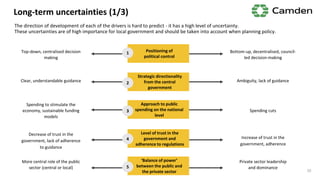
Long-term uncertainties (1/3)
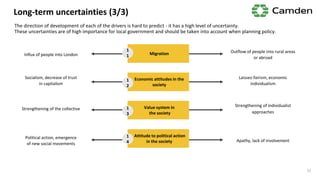
The direction of development of each of the drivers is hard to predict - it has a high level of uncertainty.
These uncertainties are of high importance for local government and should be taken into account when planning policy.
Positioning of
political control
Strategic directionality
from the central
government
Level of trust in the
government and
adherence to regulations
1
2
3
4
5
Top-down, centralised decision
making
Bottom-up, decentralised, council-
led decision-making
Clear, understandable guidance Ambiguity, lack of guidance
More central role of the public
sector (central or local)
Private sector leadership
and dominance
20
Long-lasting economic and social
transformation, emergence of
a new normality
Bounce-back to normal
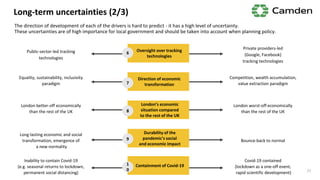
Long-term uncertainties (2/3)
The direction of development of each of the drivers is hard to predict - it has a high level of uncertainty.
These uncertainties are of high importance for local government and should be taken into account when planning policy.
Public-sector-led tracking
technologies
Private providers-led
(Google, Facebook)
tracking technologies
Equality, sustainability, inclusivity
paradigm
Competition, wealth accumulation,
value extraction paradigm
Oversight over tracking
technologies
Direction of economic
transformation
Durability of the
pandemic’s social
and economic impact
6
7
9
London’s economic
situation compared
to the rest of the UK
London better-off economically
than the rest of the UK
London worst-off economically
than the rest of the UK8
Containment of Covid-19
Inability to contain Covid-19
(e.g. seasonal returns to lockdown,
permanent social distancing)
Covid-19 contained
(lockdown as a one-off event,
rapid scientific development)
1
0 21
Political action, emergence
of new social movements
Apathy, lack of involvement
Long-term uncertainties (3/3)
The direction of development of each of the drivers is hard to predict - it has a high level of uncertainty.
These uncertainties are of high importance for local government and should be taken into account when planning policy.
Influx of people into London
Outflow of people into rural areas
or abroad
Socialism, decrease of trust
in capitalism
Laissez-fairism, economic
individualism
Strengthening of the collective
Strengthening of individualist
approaches
Migration
Economic attitudes in the
society
Value system in
the society
Attitude to political action
in the society
1
1
1
2
1
3
1
4
22
Existing set
of scenarios
23
Four scenarios build around two
economic and political uncertainties
Future scenarios
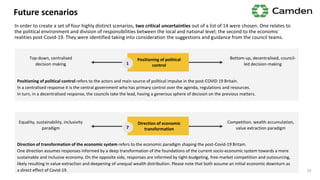
Top-down, centralised
decision making
Bottom-up, decentralised, council-
led decision-making
Positioning of political
control1
Positioning of political control refers to the actors and main source of political impulse in the post-COVID 19 Britain.
In a centralised response it is the central government who has primary control over the agenda, regulations and resources.
In turn, in a decentralised response, the councils take the lead, having a generous sphere of decision on the previous matters.
Equality, sustainability, inclusivity
paradigm
Competition, wealth accumulation,
value extraction paradigm
Direction of economic
transformation7
Direction of transformation of the economic system refers to the economic paradigm shaping the post-Covid-19 Britain.
One direction assumes responses informed by a deep transformation of the foundations of the current socio-economic system towards a more
sustainable and inclusive economy. On the opposite side, responses are informed by tight-budgeting, free-market competition and outsourcing,
likely resulting in value-extraction and deepening of unequal wealth distribution. Please note that both assume an initial economic downturn as
a direct effect of Covid-19.
In order to create a set of four highly distinct scenarios, two critical uncertainties out of a list of 14 were chosen. One relates to
the political environment and division of responsibilities between the local and national level; the second to the economic
realities post-Covid-19. They were identified taking into consideration the suggestions and guidance from the council teams.
24
Future scenarios
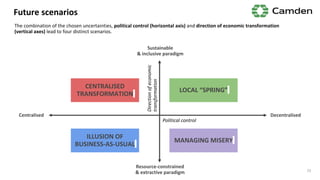
DecentralisedCentralised
Sustainable
& inclusive paradigm
Resource-constrained
& extractive paradigm
Political control
Directionofeconomic
transformation
ILLUSION OF
BUSINESS-AS-USUAL
MANAGING MISERY
CENTRALISED
TRANSFORMATION
LOCAL “SPRING”
The combination of the chosen uncertainties, political control (horizontal axis) and direction of economic transformation
(vertical axes) lead to four distinct scenarios.
25
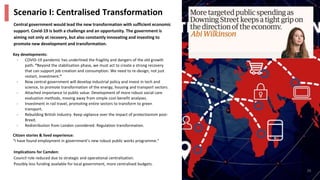
Scenario I: Centralised Transformation
Central government would lead the new transformation with sufficient economic
support. Covid-19 is both a challenge and an opportunity. The government is
aiming not only at recovery, but also constantly innovating and investing to
promote new development and transformation.
Citizen stories & lived experience:
“I have found employment in government’s new robust public works programme.”
Key developments:
- COVID-19 pandemic has underlined the fragility and dangers of the old growth
path. “Beyond the stabilisation phase, we must act to create a strong recovery
that can support job creation and consumption. We need to re-design, not just
restart, investment.”
- Now central government will develop industrial policy and invest in tech and
science, to promote transformation of the energy, housing and transport sectors.
- Attached importance to public value. Development of more robust social care
evaluation methods, moving away from simple cost-benefit analyses.
- Investment in rail travel, promoting entire sectors to transform to green
transport.
- Rebuilding British industry. Keep vigilance over the impact of protectionism post-
Brexit.
- Redistribution from London considered. Regulation transformation.
Implications for Camden:
Council role reduced due to strategic and operational centralisation.
Possibly less funding available for local government, more centralised budgets.
26
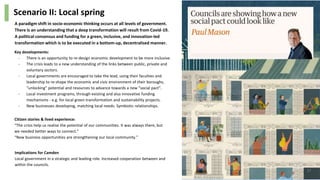
Scenario II: Local spring
Citizen stories & lived experience:
“The crisis help us realise the potential of our communities. It was always there, but
we needed better ways to connect.”
“New business opportunities are strengthening our local community.”
Key developments:
- There is an opportunity to re-design economic development to be more inclusive.
- The crisis leads to a new understanding of the links between public, private and
voluntary sectors.
- Local governments are encouraged to take the lead, using their faculties and
leadership to re-shape the economic and civic environment of their boroughs,
“unlocking” potential and resources to advance towards a new “social pact”.
- Local investment programs, through existing and also innovative funding
mechanisms - e.g. for local green transformation and sustainability projects.
- New businesses developing, matching local needs. Symbiotic relationships.
Implications for Camden
Local government in a strategic and leading role. Increased cooperation between and
within the councils.
A paradigm shift in socio-economic thinking occurs at all levels of government.
There is an understanding that a deep transformation will result from Covid-19.
A political consensus and funding for a green, inclusive, and innovation-led
transformation which is to be executed in a bottom-up, decentralised manner.
27
Key developments
- Guiding principles: productivity, consumption, exchange value.
- Centrally managed funding, not allowing for local-level flexibility.
- Government expecting the economy to return to normal after the initial crisis.
- State support for businesses only on short-term basis. Pressures on
businesses to return to trading or close. Unconditional bailouts of big
businesses.
- Market speculation and value extraction (e.g. in housing).
- Increased deregulation. Environmental destruction.
- Dismantling of welfare programs and labour protection.
- Rise of inequalities. Economic hardship leading to social unrest, mental health
problems and anti-immigrant sentiment.
- Risks: can work only if COVID-19 proves controllable over a short period.
Possible market collapse and economic hardship for many.
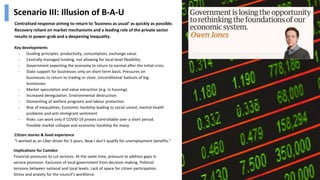
Scenario III: Illusion of B-A-U
Citizen stories & lived experience
“I worked as an Uber driver for 5 years. Now I don’t qualify for unemployment benefits.”
Implications for Camden
Financial pressures to cut services. At the same time, pressure to address gaps in
service provision. Exclusion of local government from decision-making. Political
tensions between national and local levels. Lack of space for citizen participation.
Stress and anxiety for the council’s workforce.
Centralised response aiming to return to ‘business as usual’ as quickly as possible.
Recovery reliant on market mechanisms and a leading role of the private sector
results in power-grab and a deepening inequality.
28
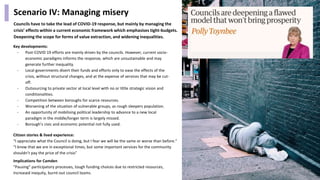
Scenario IV: Managing misery
Councils have to take the lead of COVID-19 response, but mainly by managing the
crisis’ effects within a current economic framework which emphasises tight-budgets.
Deepening the scope for forms of value extraction, and widening inequalities.
Citizen stories & lived experience:
“I appreciate what the Council is doing, but I fear we will be the same or worse than before.”
“I know that we are in exceptional times, but some important services for the community
shouldn’t pay the price of the crisis”
Key developments:
- Post-COVID 19 efforts are mainly driven by the councils. However, current socio-
economic paradigms informs the response, which are unsustainable and may
generate further inequality.
- Local governments divert their funds and efforts only to ease the effects of the
crisis, without structural changes, and at the expense of services that may be cut-
off.
- Outsourcing to private sector at local level with no or little strategic vision and
conditionalities.
- Competition between boroughs for scarce resources.
- Worsening of the situation of vulnerable groups, as rough sleepers population.
- An opportunity of mobilising political leadership to advance to a new local
paradigm in the middle/longer term is largely missed.
- Borough’s civic and economic potential not fully used.
Implications for Camden
“Pausing” participatory processes, tough funding choices due to restricted resources,
increased inequity, burnt-out council teams.
29
Tools to create
new scenarios
30
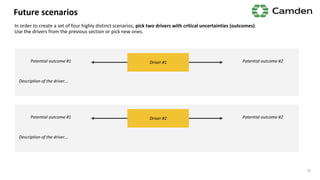
Future scenarios
Potential outcome #1 Potential outcome #2Driver #1
Description of the driver...
In order to create a set of four highly distinct scenarios, pick two drivers with critical uncertainties (outcomes).
Use the drivers from the previous section or pick new ones.
31
Potential outcome #1 Potential outcome #2Driver #2
Description of the driver...
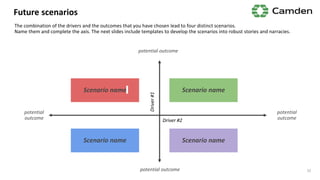
Future scenarios
potential
outcome
potential
outcome
potential outcome
potential outcome
Driver #2
Driver#1
Scenario name Scenario name
The combination of the drivers and the outcomes that you have chosen lead to four distinct scenarios.
Name them and complete the axis. The next slides include templates to develop the scenarios into robust stories and narracies.
32
visual placeholder
Scenario I: Scenario name
Summary
Citizen stories & lived experience:
…..
Key developments:
- Description
Implications for Camden:
…..
33
Scenario II: Scenario name
34
visual placeholder
Summary
Citizen stories & lived experience:
…..
Key developments:
- Description
Implications for Camden:
…..
Scenario III: Scenario name
35
visual placeholder
Summary
Citizen stories & lived experience:
…..
Key developments:
- Description
Implications for Camden:
…..
Scenario IV: Scenario name
36
visual placeholder
Summary
Citizen stories & lived experience:
…..
Key developments:
- Description
Implications for Camden:
…..
Impact
assessment
tools
37
Potential audiences
Different audiences with whom these tools can be used.
38
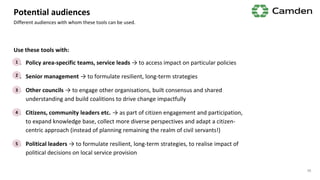
Use these tools with:
1. Policy area-specific teams, service leads → to access impact on particular policies
2. Senior management → to formulate resilient, long-term strategies
3. Other councils → to engage other organisations, built consensus and shared
understanding and build coalitions to drive change impactfully
4. Citizens, community leaders etc. → as part of citizen engagement and participation,
to expand knowledge base, collect more diverse perspectives and adapt a citizen-
centric approach (instead of planning remaining the realm of civil servants!)
5. Political leaders → to formulate resilient, long-term strategies, to realise impact of
political decisions on local service provision
1
2
3
4
5
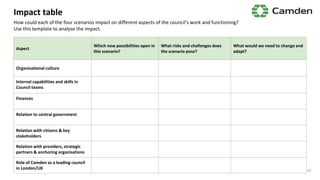
Impact table
How could each of the four scenarios impact on different aspects of the council’s work and functioning?
Use this template to analyse the impact.
Aspect
Which new possibilities open in
this scenario?
What risks and challenges does
the scenario pose?
What would we need to change and
adapt?
Organisational culture
Internal capabilities and skills in
Council teams
Finances
Relation to central government
Relation with citizens & key
stakeholders
Relation with providers, strategic
partners & anchoring organisations
Role of Camden as a leading council
in London/UK 39
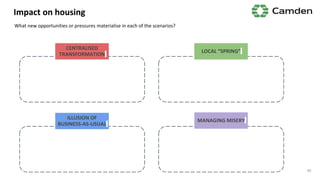
Impact on housing
What new opportunities or pressures materialise in each of the scenarios?
40
CENTRALISED
TRANSFORMATION
LOCAL “SPRING”
ILLUSION OF
BUSINESS-AS-USUAL
MANAGING MISERY
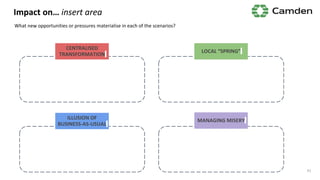
Impact on… insert area
What new opportunities or pressures materialise in each of the scenarios?
41
CENTRALISED
TRANSFORMATION
LOCAL “SPRING”
ILLUSION OF
BUSINESS-AS-USUAL
MANAGING MISERY
Recommendations
and indicators
42
Recommendations and indicators
- Recommendations refer to proposed actions in
relation to each of the scenarios
- Indicators signal what events may suggest that one
or more of the scenarios is materialising
43
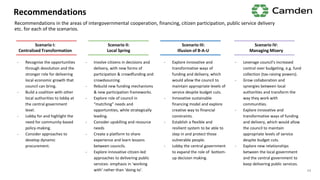
Recommendations
Recommendations in the areas of intergovernmental cooperation, financing, citizen participation, public service delivery
etc. for each of the scenarios.
Scenario I:
Centralised Transformation
Scenario II:
Local Spring
Scenario III:
Illusion of B-A-U
Scenario IV:
Managing Misery
- Recognise the opportunities
through devolution and the
stronger role for delivering
local economic growth that
council can bring.
- Build a coalition with other
local authorities to lobby at
the central government
level.
- Lobby for and highlight the
need for community-based
policy-making.
- Consider approaches to
develop dynamic
procurement.
- Involve citizens in decisions and
delivery, with new forms of
participation & crowdfunding and
crowdsourcing.
- Rebuild new funding mechanisms
& new participation frameworks.
- Explore role of council in
“matching” needs and
opportunities, while strategically
leading.
- Consider upskilling and resource
needs
- Create a platform to share
experience and learn lessons
between councils.
- Explore innovative citizen-led
approaches to delivering public
services- emphasis in ‘working
with’ rather than ‘doing to’.
- Explore innovative and
transformative ways of
funding and delivery, which
would allow the council to
maintain appropriate levels of
service despite budget cuts.
- Innovative sustainable
financing model and explore
creative way to financial
constraints.
- Establish a flexible and
resilient system to be able to
step in and protect those
vulnerable people.
- Lobby the central government
to expand the role of bottom-
up decision making.
- Leverage council's increased
control over budgeting, e.g. fund
collection (tax-raising powers).
- Grow collaboration and
synergies between local
authorities and transform the
way they work with
communities.
- Explore innovative and
transformative ways of funding
and delivery, which would allow
the council to maintain
appropriate levels of service
despite budget cuts.
- Explore new relationships
between the local government
and the central government to
keep delivering public services.
44
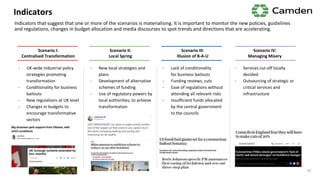
Indicators
Indicators that suggest that one or more of the scenarios is materialising. It is important to monitor the new policies, guidelines
and regulations, changes in budget allocation and media discourses to spot trends and directions that are accelerating.
Scenario I:
Centralised Transformation
Scenario II:
Local Spring
Scenario III:
Illusion of B-A-U
Scenario IV:
Managing Misery
- UK-wide industrial policy
strategies promoting
transformation
- Conditionality for business
bailouts
- New regulations at UK level
- Changes in budgets to
encourage transformative
sectors
- New local strategies and
plans
- Development of alternative
schemes of funding
- Use of regulatory powers by
local authorities, to achieve
transformation
- Lack of conditionality
for business bailouts
- Funding reviews, cuts
- Ease of regulations without
attending all relevant risks
- Insufficient funds allocated
by the central government
to the councils
- Services cut-off locally
decided
- Outsourcing of strategic or
critical services and
infrastructure
45
Thank you and
good luck applying
the toolkit!
46

Future Trends & Scenarios

  • 1.
  • 2.
    Content and purposeof the document Methodology introduction Overview and step-by-step introduction to the Futures Thinking methodology. Resources: trends and short- and long-term uncertainties Trends and a list of drivers used to build the scenarios. Existing set of scenarios Four scenarios build around two economic and political uncertainties. Tools to create new scenarios Ready-to-use templates. Impact assessment tools Tools to test the impact on the council for each of the scenarios. Recommendations and indicators Recommended actions and signals that point to a specific scenario materialising. 2 Purpose of the document: ● To apply and embed the Futures Thinking methodology across the council’s teams. ● To spark conversations and stimulate thinking around the directions of recovery and renewal. ● To help prepare for possible future economic, political and social circumstances. 3-6 7-21 22-28 29-35 36-39 40-43
  • 3.
  • 4.
    Future scenarios - Scenariosare a strategic planning technique. - They are stories (or narratives) set in the future, which describe how the world might look like. - Scenario planning does not attempt to predict what will happen. - Instead, the technique uses a formal process to identify a set of examples of possible futures to provide a point of reference when evaluating or formulating strategies. 4
  • 5.
    Purpose of futurescenarios 5 Medium to long-term strategic planning and analysis Help imagine how the future may look like Provide an understanding of the possible externalities that could shape the future policy environment Provide a point of reference to evaluate and stress test future policies Consider what may occur across a wide range of forces and factors Stretch thinking to discover new realities Develop robust, resilient, flexible policies NOT predict the most likely scenario
  • 6.
    Examples of the“future scenarios” methodology in use 6 The Four Futures of Work (RSA) Our COVID Future (Long Crisis Network) What would happen to Europe and North America if COVID-19 lasted a year or more? (Gray Briefings) What will South Africa be like in the year 2002? (Mont Fleur)
  • 7.
    Step-by-step methodology Create yourown set of future scenarios 1. Determine goal and time horizon. 2. Identify drivers, trends and potential events relevant to the scope and question. 3. Select factors that have the highest impact and are the most uncertain. Pick from the drivers in the next section or create additional ones. 4. Select two scenario axes that generate four relevant scenario quadrants. 5. Develop characteristics for each of the scenarios. 6. Develop the scenarios into stories or narratives. 1 2 3 4 5 6 7
  • 8.
    Resources 8 Trends and short-and long-term uncertainties
  • 9.
    Trends & uncertainties -Trends show us what economic, social, technological, political and cultural dynamics are happening and what forces are accelerating and shaping the future - Drivers are factors which have a highly uncertain outcome and which will have a significant impact on the future environment 9
  • 10.
    Trends map Political, economic,social, technology & cultural trends at a macro level for London. Interactive version of the map can be accessed here. Breakdown of areas in the following slides. 10
  • 11.
    Political trends Along withsparkling wider debates regarding national strategies and the role of international organisations, COVID-19 crisis has put the local level and its organisations, including local governments, at the forefront. The crisis has been an opportunity to try more fluid collaboration schemes between councils’ teams, but also pose important questions regarding the role of citizens and communities in local decision-making, especially when face-to-face participation is not available as an option. As a result, attention has been given to digital tools that “can keep democracy going during lockdown”, including those that are based in deliberation. Mechanisms to harness collective intelligence through “crowdsourcing” have also been used by local and national governments, and may become more permanent in the future. A good example are “hackathons” related to COVID-19. 11
  • 12.
    Social trends On theone hand, it is likely that lockdown will have a negative effect on mental health, worsening the reality of loneliness in the UK, which was already being described as a “pandemic” with serious effects. The economic impact of the crisis will possibly put families in a fragile position, and more dependant on welfare. While there is some evidence that domestic abuse is increasing in many countries during lockdown, the reality of post-COVID 19 crime in London is uncertain. The impacts on issues like food security and rough sleeping are also of a concern for local governments. Initially, Covid-19 has led to a decrease in rough sleeping and crime. However, long-term trends in relation to these phenomena are not yet clear. There are fears that potential economic harship may in long-term lead to increase in these issues. On the other hand, the crisis has also shown stories of spontaneous civic cooperation and solidarity, as well as volunteering. Additionally, it has also put in the spotlight the centrality of care, whether it is for children, the elderly, those suffering from illnesses, or the vulnerable in general. Social isolation from the lockdown has profoundly impacted the relations between people, as well as their living conditions, in ways and directions we yet do not fully know. 12
  • 13.
    Economic trends The configurationthe economic relations between the public, private and non-for-profit sector may be largely modified by the crisis. The direction, however, is still unclear. Taxation, for instance, could be increased or lowered as a response to post-COVID 19 scenario, and while some believe that the state will have a leading role by developing new industrial policies and national strategies, it could also be that a new scenario is characterised by forms of cooperativism. In any case, debates have taken place on the gap between the social value and work conditions of certain services (like key workers, deliverers and platform workers). The impacts on specific sectors like transport, cultural industries, sports and construction are seen as an opportunity for transformation and re-design, in some cases. Crowdfunding has also emerged as a way to save small local business from bankruptcy, sometimes in innovative ways, as this example from Italy. 13
  • 14.
    Technology trends In thisspecial period, technological trends include commerce innovation, public sector innovation and new tech related to the pandemic. Because of the infectious characteristics of Covid-19, people tend to shop online or at a distance from others. Therefore, e-commerce and contactless payment are on the rise. For the public sector, the crisis has provided an opportunity to strengthen a platform approach. For instance, local governments have used GovNotify for informing the citizens. Also, as the London councils digital teams have reported, a “working in the open” culture (for example, through open code) has been crucial. Notwithstanding, the use of certain technologies by the governments, as social tracking apps, have also raised concern of a move towards a “surveillance society” The pandemic has also served to develop the potentialities of some technologies, as 3D printing (e.g. to make masks) and brings about a video meeting boom, that may be permanent in the private and public sector. These developments pose questions in relation to accessibility and affordability for all. 14
  • 15.
    Cultural trends During thepandemic period, new ways to measure public value of arts when people can’t go to events will appear. In the past, most funding was linked to event attendance, which in the reality of a lockdown may lead to economic pressures. At the same time, new ways of culture production and consumption emerge or are accelerated. For example, attendance of exhibitions or concerts online and rapid rise in usage of streaming platforms. Another trend is a growing popularity of do-it-yourself and arts and crafts, as citizens develop new hobbies in the conditions of the lockdown (e.g. gardening). These new preferences and consumer habits will potentially lead to new business and economic implications in the future. 15
  • 16.
    Unified response - strictlockdown and social distancing measures lasting longer Different measures for different locations - low-risk areas to ease restrictions first - enforcement challenges - inconsistent political boundaries Geographic flexibility Short-term drivers (1/3) Immediate uncertainties concerning Covid-19’s impact on the future. Testing capacity Age & vulnerable groups segmentation A B C Ineffective - strict lockdown lasting longer - spike in cases, likely returning to stricter lockdown Effective - easing of the lockdown - return of a number of shielded key workers - enforcement of testing etc. - return to work for those who had Covid-19 Same restrictions apply to everyone - strict lockdown and social distancing measures lasting longer - if lockdown lifted, health risks for the vulnerable ‘Shielding the vulnerable’ - need to develop more services and provisions for the vulnerable - perceived as unfair 16
  • 17.
    Confusion, lack ofclarity - Strict lockdown and social distancing measures lasting longer - Likely increase of risk behaviour, translating in more infections Regulations are clear and understood - Easier enforcement by authorities - More “horizontal” social control and scrutiny - Effectiveness of protective measures Clarity of government messaging Short-term drivers (2/3) Immediate uncertainties concerning Covid-19’s impact on the future. Tracking apps Duration of the lockdown D E F Ineffective - Time constraints, incomplete and inaccurate design lead to inaccurate data - project fail, funds wasting, and lead to more confirmed patients and go back to stricter lockdown Effective - Record the healthy data of the public, monitor the spread of the virus and ease the pandemic - Expand publicity Preparation for ending - Consider precautions and protections - Take region's health care capacity into consideration - Incentives a gradual return of pre-crisis levels of consumption and investment Prolongated - Think about the meaning and risks of reopen - Increased importance of justifying the measures to the public - Psychological exhaustion - Avoidance of risky financial decisions 17
  • 18.
    Short-term drivers (3/3) Immediateuncertainties concerning Covid-19’s impact on the future. Availability of personal safety equipment Adherence to rules G H Lack of availability - Increased scope for contagion - The most vulnerable are more exposed to contagion Availability - Better rates of virus containment - More vulnerable groups are more protected Population bypasses regulations - Low morale in those who follow - Cynicism - Reduced capacity for enactment of the regulations - Increase of contagion rates Population follows regulations - Less human and financial resources directed towards enactment - Decrease in contagion rates - Possible increase in psychological fatigue 18
  • 19.
    Long-term drivers A listof factors which will have a significant impact on the future policy environment for local government in London. At present they have a highly uncertain outcome. Their outcome will have a high level of impact on the policy environment. Positioning of political control Strategic directionality from the central government Approach to public spending on the national level Level of trust in the government and adherence to regulations Oversight over tracking technologies Direction of economic transformation London’s economic situation compared to the rest of the UK Migration Economic attitudes in the society Value system in the society Attitude to political action in the society ‘Balance of power’ between the public and the private sector Durability of the pandemic’s social and economic impact Containment of Covid-19 1 2 3 6 7 8 1 1 1 2 1 3 4 5 9 1 0 1 4 19
  • 20.
    ‘Balance of power’ betweenthe public and the private sector Spending to stimulate the economy, sustainable funding models Spending cuts Approach to public spending on the national level Decrease of trust in the government, lack of adherence to guidance Increase of trust in the government, adherence Long-term uncertainties (1/3) The direction of development of each of the drivers is hard to predict - it has a high level of uncertainty. These uncertainties are of high importance for local government and should be taken into account when planning policy. Positioning of political control Strategic directionality from the central government Level of trust in the government and adherence to regulations 1 2 3 4 5 Top-down, centralised decision making Bottom-up, decentralised, council- led decision-making Clear, understandable guidance Ambiguity, lack of guidance More central role of the public sector (central or local) Private sector leadership and dominance 20
  • 21.
    Long-lasting economic andsocial transformation, emergence of a new normality Bounce-back to normal Long-term uncertainties (2/3) The direction of development of each of the drivers is hard to predict - it has a high level of uncertainty. These uncertainties are of high importance for local government and should be taken into account when planning policy. Public-sector-led tracking technologies Private providers-led (Google, Facebook) tracking technologies Equality, sustainability, inclusivity paradigm Competition, wealth accumulation, value extraction paradigm Oversight over tracking technologies Direction of economic transformation Durability of the pandemic’s social and economic impact 6 7 9 London’s economic situation compared to the rest of the UK London better-off economically than the rest of the UK London worst-off economically than the rest of the UK8 Containment of Covid-19 Inability to contain Covid-19 (e.g. seasonal returns to lockdown, permanent social distancing) Covid-19 contained (lockdown as a one-off event, rapid scientific development) 1 0 21
  • 22.
    Political action, emergence ofnew social movements Apathy, lack of involvement Long-term uncertainties (3/3) The direction of development of each of the drivers is hard to predict - it has a high level of uncertainty. These uncertainties are of high importance for local government and should be taken into account when planning policy. Influx of people into London Outflow of people into rural areas or abroad Socialism, decrease of trust in capitalism Laissez-fairism, economic individualism Strengthening of the collective Strengthening of individualist approaches Migration Economic attitudes in the society Value system in the society Attitude to political action in the society 1 1 1 2 1 3 1 4 22
  • 23.
    Existing set of scenarios 23 Fourscenarios build around two economic and political uncertainties
  • 24.
    Future scenarios Top-down, centralised decisionmaking Bottom-up, decentralised, council- led decision-making Positioning of political control1 Positioning of political control refers to the actors and main source of political impulse in the post-COVID 19 Britain. In a centralised response it is the central government who has primary control over the agenda, regulations and resources. In turn, in a decentralised response, the councils take the lead, having a generous sphere of decision on the previous matters. Equality, sustainability, inclusivity paradigm Competition, wealth accumulation, value extraction paradigm Direction of economic transformation7 Direction of transformation of the economic system refers to the economic paradigm shaping the post-Covid-19 Britain. One direction assumes responses informed by a deep transformation of the foundations of the current socio-economic system towards a more sustainable and inclusive economy. On the opposite side, responses are informed by tight-budgeting, free-market competition and outsourcing, likely resulting in value-extraction and deepening of unequal wealth distribution. Please note that both assume an initial economic downturn as a direct effect of Covid-19. In order to create a set of four highly distinct scenarios, two critical uncertainties out of a list of 14 were chosen. One relates to the political environment and division of responsibilities between the local and national level; the second to the economic realities post-Covid-19. They were identified taking into consideration the suggestions and guidance from the council teams. 24
  • 25.
    Future scenarios DecentralisedCentralised Sustainable & inclusiveparadigm Resource-constrained & extractive paradigm Political control Directionofeconomic transformation ILLUSION OF BUSINESS-AS-USUAL MANAGING MISERY CENTRALISED TRANSFORMATION LOCAL “SPRING” The combination of the chosen uncertainties, political control (horizontal axis) and direction of economic transformation (vertical axes) lead to four distinct scenarios. 25
  • 26.
    Scenario I: CentralisedTransformation Central government would lead the new transformation with sufficient economic support. Covid-19 is both a challenge and an opportunity. The government is aiming not only at recovery, but also constantly innovating and investing to promote new development and transformation. Citizen stories & lived experience: “I have found employment in government’s new robust public works programme.” Key developments: - COVID-19 pandemic has underlined the fragility and dangers of the old growth path. “Beyond the stabilisation phase, we must act to create a strong recovery that can support job creation and consumption. We need to re-design, not just restart, investment.” - Now central government will develop industrial policy and invest in tech and science, to promote transformation of the energy, housing and transport sectors. - Attached importance to public value. Development of more robust social care evaluation methods, moving away from simple cost-benefit analyses. - Investment in rail travel, promoting entire sectors to transform to green transport. - Rebuilding British industry. Keep vigilance over the impact of protectionism post- Brexit. - Redistribution from London considered. Regulation transformation. Implications for Camden: Council role reduced due to strategic and operational centralisation. Possibly less funding available for local government, more centralised budgets. 26
  • 27.
    Scenario II: Localspring Citizen stories & lived experience: “The crisis help us realise the potential of our communities. It was always there, but we needed better ways to connect.” “New business opportunities are strengthening our local community.” Key developments: - There is an opportunity to re-design economic development to be more inclusive. - The crisis leads to a new understanding of the links between public, private and voluntary sectors. - Local governments are encouraged to take the lead, using their faculties and leadership to re-shape the economic and civic environment of their boroughs, “unlocking” potential and resources to advance towards a new “social pact”. - Local investment programs, through existing and also innovative funding mechanisms - e.g. for local green transformation and sustainability projects. - New businesses developing, matching local needs. Symbiotic relationships. Implications for Camden Local government in a strategic and leading role. Increased cooperation between and within the councils. A paradigm shift in socio-economic thinking occurs at all levels of government. There is an understanding that a deep transformation will result from Covid-19. A political consensus and funding for a green, inclusive, and innovation-led transformation which is to be executed in a bottom-up, decentralised manner. 27
  • 28.
    Key developments - Guidingprinciples: productivity, consumption, exchange value. - Centrally managed funding, not allowing for local-level flexibility. - Government expecting the economy to return to normal after the initial crisis. - State support for businesses only on short-term basis. Pressures on businesses to return to trading or close. Unconditional bailouts of big businesses. - Market speculation and value extraction (e.g. in housing). - Increased deregulation. Environmental destruction. - Dismantling of welfare programs and labour protection. - Rise of inequalities. Economic hardship leading to social unrest, mental health problems and anti-immigrant sentiment. - Risks: can work only if COVID-19 proves controllable over a short period. Possible market collapse and economic hardship for many. Scenario III: Illusion of B-A-U Citizen stories & lived experience “I worked as an Uber driver for 5 years. Now I don’t qualify for unemployment benefits.” Implications for Camden Financial pressures to cut services. At the same time, pressure to address gaps in service provision. Exclusion of local government from decision-making. Political tensions between national and local levels. Lack of space for citizen participation. Stress and anxiety for the council’s workforce. Centralised response aiming to return to ‘business as usual’ as quickly as possible. Recovery reliant on market mechanisms and a leading role of the private sector results in power-grab and a deepening inequality. 28
  • 29.
    Scenario IV: Managingmisery Councils have to take the lead of COVID-19 response, but mainly by managing the crisis’ effects within a current economic framework which emphasises tight-budgets. Deepening the scope for forms of value extraction, and widening inequalities. Citizen stories & lived experience: “I appreciate what the Council is doing, but I fear we will be the same or worse than before.” “I know that we are in exceptional times, but some important services for the community shouldn’t pay the price of the crisis” Key developments: - Post-COVID 19 efforts are mainly driven by the councils. However, current socio- economic paradigms informs the response, which are unsustainable and may generate further inequality. - Local governments divert their funds and efforts only to ease the effects of the crisis, without structural changes, and at the expense of services that may be cut- off. - Outsourcing to private sector at local level with no or little strategic vision and conditionalities. - Competition between boroughs for scarce resources. - Worsening of the situation of vulnerable groups, as rough sleepers population. - An opportunity of mobilising political leadership to advance to a new local paradigm in the middle/longer term is largely missed. - Borough’s civic and economic potential not fully used. Implications for Camden “Pausing” participatory processes, tough funding choices due to restricted resources, increased inequity, burnt-out council teams. 29
  • 30.
    Tools to create newscenarios 30
  • 31.
    Future scenarios Potential outcome#1 Potential outcome #2Driver #1 Description of the driver... In order to create a set of four highly distinct scenarios, pick two drivers with critical uncertainties (outcomes). Use the drivers from the previous section or pick new ones. 31 Potential outcome #1 Potential outcome #2Driver #2 Description of the driver...
  • 32.
    Future scenarios potential outcome potential outcome potential outcome potentialoutcome Driver #2 Driver#1 Scenario name Scenario name Scenario name Scenario name The combination of the drivers and the outcomes that you have chosen lead to four distinct scenarios. Name them and complete the axis. The next slides include templates to develop the scenarios into robust stories and narracies. 32
  • 33.
    visual placeholder Scenario I:Scenario name Summary Citizen stories & lived experience: ….. Key developments: - Description Implications for Camden: ….. 33
  • 34.
    Scenario II: Scenarioname 34 visual placeholder Summary Citizen stories & lived experience: ….. Key developments: - Description Implications for Camden: …..
  • 35.
    Scenario III: Scenarioname 35 visual placeholder Summary Citizen stories & lived experience: ….. Key developments: - Description Implications for Camden: …..
  • 36.
    Scenario IV: Scenarioname 36 visual placeholder Summary Citizen stories & lived experience: ….. Key developments: - Description Implications for Camden: …..
  • 37.
  • 38.
    Potential audiences Different audienceswith whom these tools can be used. 38 Use these tools with: 1. Policy area-specific teams, service leads → to access impact on particular policies 2. Senior management → to formulate resilient, long-term strategies 3. Other councils → to engage other organisations, built consensus and shared understanding and build coalitions to drive change impactfully 4. Citizens, community leaders etc. → as part of citizen engagement and participation, to expand knowledge base, collect more diverse perspectives and adapt a citizen- centric approach (instead of planning remaining the realm of civil servants!) 5. Political leaders → to formulate resilient, long-term strategies, to realise impact of political decisions on local service provision 1 2 3 4 5
  • 39.
    Impact table How couldeach of the four scenarios impact on different aspects of the council’s work and functioning? Use this template to analyse the impact. Aspect Which new possibilities open in this scenario? What risks and challenges does the scenario pose? What would we need to change and adapt? Organisational culture Internal capabilities and skills in Council teams Finances Relation to central government Relation with citizens & key stakeholders Relation with providers, strategic partners & anchoring organisations Role of Camden as a leading council in London/UK 39
  • 40.
    Impact on housing Whatnew opportunities or pressures materialise in each of the scenarios? 40 CENTRALISED TRANSFORMATION LOCAL “SPRING” ILLUSION OF BUSINESS-AS-USUAL MANAGING MISERY
  • 41.
    Impact on… insertarea What new opportunities or pressures materialise in each of the scenarios? 41 CENTRALISED TRANSFORMATION LOCAL “SPRING” ILLUSION OF BUSINESS-AS-USUAL MANAGING MISERY
  • 42.
  • 43.
    Recommendations and indicators -Recommendations refer to proposed actions in relation to each of the scenarios - Indicators signal what events may suggest that one or more of the scenarios is materialising 43
  • 44.
    Recommendations Recommendations in theareas of intergovernmental cooperation, financing, citizen participation, public service delivery etc. for each of the scenarios. Scenario I: Centralised Transformation Scenario II: Local Spring Scenario III: Illusion of B-A-U Scenario IV: Managing Misery - Recognise the opportunities through devolution and the stronger role for delivering local economic growth that council can bring. - Build a coalition with other local authorities to lobby at the central government level. - Lobby for and highlight the need for community-based policy-making. - Consider approaches to develop dynamic procurement. - Involve citizens in decisions and delivery, with new forms of participation & crowdfunding and crowdsourcing. - Rebuild new funding mechanisms & new participation frameworks. - Explore role of council in “matching” needs and opportunities, while strategically leading. - Consider upskilling and resource needs - Create a platform to share experience and learn lessons between councils. - Explore innovative citizen-led approaches to delivering public services- emphasis in ‘working with’ rather than ‘doing to’. - Explore innovative and transformative ways of funding and delivery, which would allow the council to maintain appropriate levels of service despite budget cuts. - Innovative sustainable financing model and explore creative way to financial constraints. - Establish a flexible and resilient system to be able to step in and protect those vulnerable people. - Lobby the central government to expand the role of bottom- up decision making. - Leverage council's increased control over budgeting, e.g. fund collection (tax-raising powers). - Grow collaboration and synergies between local authorities and transform the way they work with communities. - Explore innovative and transformative ways of funding and delivery, which would allow the council to maintain appropriate levels of service despite budget cuts. - Explore new relationships between the local government and the central government to keep delivering public services. 44
  • 45.
    Indicators Indicators that suggestthat one or more of the scenarios is materialising. It is important to monitor the new policies, guidelines and regulations, changes in budget allocation and media discourses to spot trends and directions that are accelerating. Scenario I: Centralised Transformation Scenario II: Local Spring Scenario III: Illusion of B-A-U Scenario IV: Managing Misery - UK-wide industrial policy strategies promoting transformation - Conditionality for business bailouts - New regulations at UK level - Changes in budgets to encourage transformative sectors - New local strategies and plans - Development of alternative schemes of funding - Use of regulatory powers by local authorities, to achieve transformation - Lack of conditionality for business bailouts - Funding reviews, cuts - Ease of regulations without attending all relevant risks - Insufficient funds allocated by the central government to the councils - Services cut-off locally decided - Outsourcing of strategic or critical services and infrastructure 45
  • 46.
    Thank you and goodluck applying the toolkit! 46