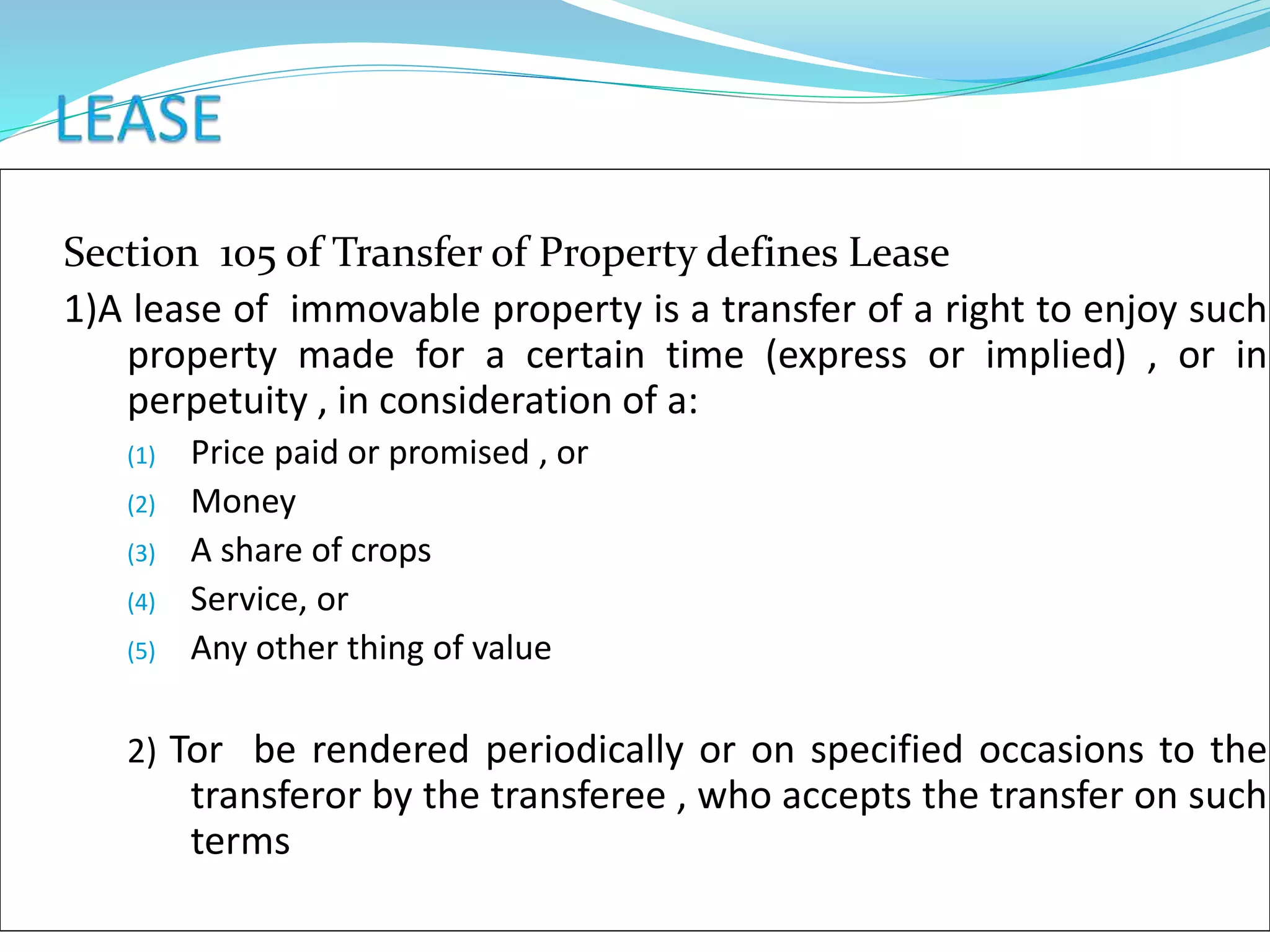
The document discusses the legal framework of leases as defined in Section 105 and Section 108 of the Transfer of Property Act, detailing the rights and liabilities of both lessors and lessees. It outlines the lessor's duties, including disclosure of property defects, providing possession, and ensuring quiet enjoyment, while also highlighting the lessee's obligations such as paying rent, maintaining the property, and using it reasonably. Various clauses provide specifics regarding rights to accretions, payment responsibilities, and conditions for terminating or assigning leases.
![Liabilities of Lessor
The liabilities of lessor are –
Duty of disclosure [ Clause(a) ]
Duty to give possession [ Clause (b) ]
Covenant for quiet enjoyment [ Clause (c)]](https://image.slidesharecdn.com/rightandliabilitiesoflessorlessee-180409043339/75/Right-and-liabilities-of-lessor-lessee-under-Transfer-of-Property-Act-5-2048.jpg)
![Duty to Disclosure [Section 108(m)]
Clause (a) provides that the lessor is bound to disclose to
the lessee any material defect in the property with
reference to it’s intended use of which the lessor is aware
but the lessee is not aware .
Defects are of two types apparent and latent . The lessor is
bound to disclose latent defects because such defects
cannot be discovered with ordinary care.
Duty of disclosure is especially important where defects
affect right of enjoyment or use of the property](https://image.slidesharecdn.com/rightandliabilitiesoflessorlessee-180409043339/75/Right-and-liabilities-of-lessor-lessee-under-Transfer-of-Property-Act-6-2048.jpg)
![To Give Possession [Section 108(m)]
The lessor is under a duty, on the lesseee's request, to
put him in possession of the property.
If he fails to deliver possession to the lesseee, he
cannot recover rent or enforce the obligations of the
lesseee under the agreement.
However the duty of the lessor to deliver possession
only arises when there is a request by the lessee in this
request](https://image.slidesharecdn.com/rightandliabilitiesoflessorlessee-180409043339/75/Right-and-liabilities-of-lessor-lessee-under-Transfer-of-Property-Act-7-2048.jpg)
![Covenant for Quiet Enjoyment [Section
108(m)]
The clause provides that if the lesseee pays rent reserved
by the lease and performs the contract binding on him,
he may hold the property during the time limited by the
lease without interruption.
What constitutes a breach of a covenant for quiet
enjoyment is not always easy to determine. Some
guidelines have been provided by the Madhya Pradesh
High Court in Daryao Singh v. Pramilabai (AIR 1959
M.P 191 )](https://image.slidesharecdn.com/rightandliabilitiesoflessorlessee-180409043339/75/Right-and-liabilities-of-lessor-lessee-under-Transfer-of-Property-Act-8-2048.jpg)


![Right to Accretions [ Sec. 108(d) ]
If during the continuance of a lease any accretion,
accession or addition is made to property given by way of
lease such accretion, accession or addition shall be deemed
to be comprised in the original lease
The addition may be natural, e.g.. by flood or alluvial
activity or at the expense of the lesseee or maybe a tree
planted by the tenant.
However lesse cannot have title to such accretion and lesse
should surrender the accretion after the period of tenancy.](https://image.slidesharecdn.com/rightandliabilitiesoflessorlessee-180409043339/75/Right-and-liabilities-of-lessor-lessee-under-Transfer-of-Property-Act-11-2048.jpg)
![To Avoid Lease [Section 108(e) ]
In the case of the destruction of the subject-matter of
lease, the lesseee, if he is not to be blamed for such
destruction, could avoid the lease at his option
In cases where the whole rent has been paid in advance,
and the property is destroyed before the period of lease
expires the lesseee has a right to recover the proportionate
part of the rent already paid.
The application of this Section has been clearly stated by
the Supreme Court in the case Shaha Ratansi Khimji &
Sons v Kumbhar Sons Hotel (P) Ltd [ (2014) 14 SCC 1 ]](https://image.slidesharecdn.com/rightandliabilitiesoflessorlessee-180409043339/75/Right-and-liabilities-of-lessor-lessee-under-Transfer-of-Property-Act-12-2048.jpg)
![To Charge for Repair [Section 108 (f)]
This clause provides that If the lessor neglects to make
any repairs which he is bound to make to the property
after notice within a reasonable time , the lessee may
make the repair himself and deduct the expense of
such repairs with interest from the rent or otherwise
recover it from the lessor
The lessor is not bound to make repairs but if he has
agreed at the time of the lease with the lessee that he
will make the necessary repairs then he becomes
bound to make the repair.](https://image.slidesharecdn.com/rightandliabilitiesoflessorlessee-180409043339/75/Right-and-liabilities-of-lessor-lessee-under-Transfer-of-Property-Act-14-2048.jpg)
![Right to Make Payments [Section 108(g)]
This clause provides that if lessor neglects to make any
payment which he is bound to make and which if not
made by him , is recoverable from the lessee or against
the property , the lessee may make such payment
himself and deduct it with interest from rent or
otherwise recover it from the lessor.](https://image.slidesharecdn.com/rightandliabilitiesoflessorlessee-180409043339/75/Right-and-liabilities-of-lessor-lessee-under-Transfer-of-Property-Act-15-2048.jpg)
![Right to remove fixtures Section [108(h)]
The lesseee may, even after the determination of the
lease, remove, at any time while he is in possession of
the property leased, but not afterwards, all things
which he has attached to the earth. But he must leave
the property in the state in which he received it.
This clause provides an exception to the general rule
that things attached to earth become part of it](https://image.slidesharecdn.com/rightandliabilitiesoflessorlessee-180409043339/75/Right-and-liabilities-of-lessor-lessee-under-Transfer-of-Property-Act-16-2048.jpg)
![Right to have benefit of Crops[Section 108(i)]
When a lease is of uncertain duration and the
interest of the lesseee is determined otherwise
than his fault, the lesseee is entitled to the benefit
of all crops growing ,planted or sown by him.
Lessee or his legal representative has been given
the right to ingress and egress to visit the leased
property to gather and carry the grown crops](https://image.slidesharecdn.com/rightandliabilitiesoflessorlessee-180409043339/75/Right-and-liabilities-of-lessor-lessee-under-Transfer-of-Property-Act-17-2048.jpg)
![Right to Assign his Interest [Section 108(j)]
In absence of any contract to the contrary ,
this section empowers the lesseee to transfer
absolutely or by way of mortgage or sub-lease
the whole or any part of his interest in the
property. His transferee or assignee may
likewise, transfer his interest
However , The lesseee shall not by reason
only of such transfer, cease to be subject to
any of the liabilities attached to lease](https://image.slidesharecdn.com/rightandliabilitiesoflessorlessee-180409043339/75/Right-and-liabilities-of-lessor-lessee-under-Transfer-of-Property-Act-18-2048.jpg)

![Liabilities of Lessee
[Clause (k) to (q)]](https://image.slidesharecdn.com/rightandliabilitiesoflessorlessee-180409043339/75/Right-and-liabilities-of-lessor-lessee-under-Transfer-of-Property-Act-20-2048.jpg)
![Duty to disclose material facts materially increasing
the value of property [Section 108(k)]
Under this clause the lesseee is bound to disclose to
the lessor any defect of which he is aware but lessor is
not aware and which materially increases the value of
such interest.
Where the lesseee fails to disclose the fact and the
lessor suffers thereby, he can sue for compensation.
He would have no right to avoid lease unless there is
an express agreement to that effect.](https://image.slidesharecdn.com/rightandliabilitiesoflessorlessee-180409043339/75/Right-and-liabilities-of-lessor-lessee-under-Transfer-of-Property-Act-21-2048.jpg)
![Duty to pay rent[ Section 108(l)]
A lesseee is under a duty or obligation to pay or tender
the premium or rent to the lessor or his agent at proper
time or place.
The obligation to pay rent arises as soon as the lesseee
has been put into possession
Where the lesseee fails to pay the rent and it has fallen
into arrears, the lessor has two remedies against him.
Firstly, he is entitled to file a suit for arrears of rent; or
he can start ejectment proceeding on ground of non
payment](https://image.slidesharecdn.com/rightandliabilitiesoflessorlessee-180409043339/75/Right-and-liabilities-of-lessor-lessee-under-Transfer-of-Property-Act-22-2048.jpg)
![Duty to Maintain the property [Section
108(m)]
The lessee is bound to keep on the termination of
lease to restore the property in as good condition
as it was when he was put into posession
He is bound to allow the lessor and his agents at all
reasonable to enter upon property and inspect its
conditions
Only the changes caused by reasonable wear and
tear or irresistable force are allowed under this
clause](https://image.slidesharecdn.com/rightandliabilitiesoflessorlessee-180409043339/75/Right-and-liabilities-of-lessor-lessee-under-Transfer-of-Property-Act-23-2048.jpg)
![Duty to Give Notice [Section 108(n)]
If the lesseee becomes aware that any person has
initiated any proceeding to recover whole or any
part of the property, or has encroached upon it or
has interfered with the right of the lessor, he must
bring such a fact to the knowledge of the lessor
Where the title of the lessor is endangered, he may
sue for a declaration of his rights and for a decree
giving him a formal possession as against the
trespasser. (Raj Kumar v. Ali Mia ,AIR 1923 Cal.
192.)](https://image.slidesharecdn.com/rightandliabilitiesoflessorlessee-180409043339/75/Right-and-liabilities-of-lessor-lessee-under-Transfer-of-Property-Act-24-2048.jpg)
![Duty to use Property in a Reasonable
way [Section 108(o) ]
This Clause provides that the lessee may use the
property and its products as a person of ordinary
prudence would use them if they were his own.
He must not cut down the trees or sell the timber , or
pull down or damage the buildings belonging to the
lessor
Lessor must not use or allow others to use the property
for a purpose other than that for which it is leased](https://image.slidesharecdn.com/rightandliabilitiesoflessorlessee-180409043339/75/Right-and-liabilities-of-lessor-lessee-under-Transfer-of-Property-Act-25-2048.jpg)
![Duty not to erect permanent Structure [Section
108(p)]
A lesseee is under a duty not to erect any permanent
structure on the property except for agricultural purposes or
without the consent of the lessor.
The restriction under this clause is only against a permanent
structure
What is a permanent structure is a question of fact
depending on the nature of the structure and intention with
which it is erected(Surya Properties Pvt. Ltd. v.
Bimelendu Nath,(1963) 67 Cal. W.N. 977)](https://image.slidesharecdn.com/rightandliabilitiesoflessorlessee-180409043339/75/Right-and-liabilities-of-lessor-lessee-under-Transfer-of-Property-Act-26-2048.jpg)
![Duty to restore possession [Section
108(q)]
This clause provides that on determination of lease the
lessee is bound to put the lessor into the possession of
the property
When the tenant does not vacate the tenanted
premises even after the expiry of notice he becomes
liable to pay damages as well as mesne profits to the
lessor.
This rule is known as the rule in Henderson v. Square](https://image.slidesharecdn.com/rightandliabilitiesoflessorlessee-180409043339/75/Right-and-liabilities-of-lessor-lessee-under-Transfer-of-Property-Act-27-2048.jpg)


