ENGAGING COMMUNITIES IN WHOLISTIC HEALTH DEVELOPMENT: THE  ‘THV MODEL’
INTRODUCTION
PURPOSE To collectively contribute to the improvement in the quality of health care and life of the people of  Burangi  area in  Malindi /Magharini  district  along the  Kenyan coast by engaging active community   participation in  its own  development  in a model we call “ Total Health Village .” THE MAP/GENESIS PARTNERSHIP
WHY?  “ We are attracted and bound by absolute like mindedness in VISION MISSION AND CORE VALUES THE MAP/GENESIS PARTNERSHIP
SIMILAR CORE VALUES We are  Christian  with  mirror  visions and missions We are driven by a  holistic participatory  approach  to health development emphasizing local sustainability We specialise in  human health care We prioritise reaching to the  poorest, the marginalised, and underprivileged in society
SIMILAR CORE VALUES Our philosophy is anchored on  realistic  empowerment of communities and individuals Our  inputs are low  but our expected  outputs are high .....hence we support cost effective interventions Commitment to  transparency  and  good stewardship of resources
SOME FEW HEALTH SECTOR INDICES FROM KENYA 5000 health facilities in Kenya 4500 doctors; 1000 in public service. 50% concentrated in Nairobi: Ratio  1 physician to 10,000 citizens (compared to 26:10,000 in US) 47,000 Nurses & other cadres of medical personnel (10:10,000) 4.6% GDP towards health financing ($29 USD per capita) far below the minimum $34 recommended for Africa by WHO. 40% of financing comes from Kenyan Government; 15% donors, rest by private sector
SOME FEW HEALTH SECTOR INDICES FROM KENYA 58% of health services run by private sector which caters to high income clientele 90% resources devoted to curative a service that only 10% of the population accesses. 90% of morbidity (and mortality) is caused by preventable  infective diseases (and poverty)
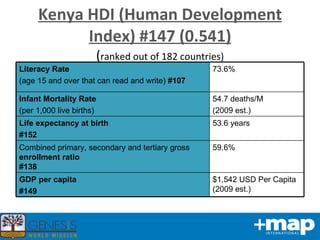
Kenya HDI (Human Development Index) #147 (0.541) ( ranked out of 182 countries) Literacy Rate   (age 15 and over that can read and write)  #107 73.6% Infant Mortality Rate (per 1,000 live births) 54.7 deaths/M (2009 est.) Life expectancy at birth   #152 53.6 years Combined primary, secondary and tertiary gross  enrollment ratio  #138 59.6% GDP per capita   #149 $1,542 USD Per Capita (2009 est.)
THE  BURANGI PROJECT  is a total health village (THV) program
The THV is a  ‘ low-input($15 pp/py), high-impact strategy for achieving the ‘Millennium Development Goals.’ It is a cost effective community development strategy that  is expected lead to Total Well Being by impacting  a whole village of close to a thousand people through a facilitative and low input cost strategy .  It is a completely participatory strategy where communities  analyze their situation, and plan a response strategy,  and implement it using  Community’s Own Resources/Persons and engaging External partners only in a facilitative role where they have no capacity in solving their own problems. WHAT IS A THV?
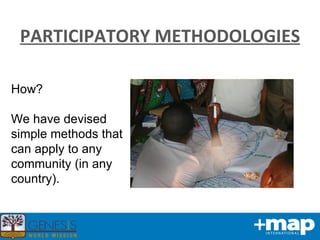
PARTICIPATORY METHODOLOGIES How? We have devised simple methods that can apply to any community (in any country).
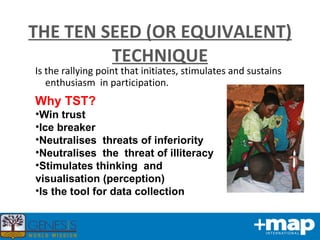
Is the rallying point that initiates, stimulates and sustains enthusiasm  in participation. THE TEN SEED (OR EQUIVALENT) TECHNIQUE Why TST? Win trust Ice breaker Neutralises  threats of inferiority Neutralises  the  threat of illiteracy Stimulates thinking  and visualisation (perception) Is the tool for data collection
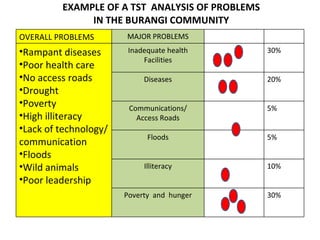
EXAMPLE OF A TST  ANALYSIS OF PROBLEMS  IN THE BURANGI COMMUNITY OVERALL PROBLEMS MAJOR PROBLEMS Rampant diseases Poor health care No access roads Drought Poverty High illiteracy Lack of technology/ communication Floods Wild animals Poor leadership Inadequate health Facilities 30% Diseases 20% Communications/ Access Roads 5% Floods 5% Illiteracy 10% Poverty  and  hunger 30%
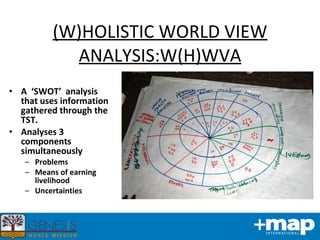
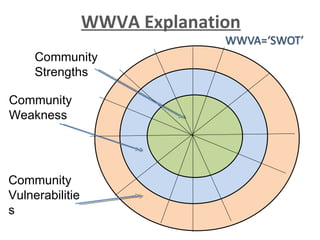
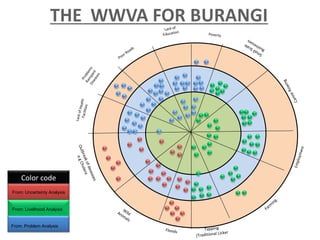
A  ‘SWOT’  analysis  that uses information gathered through the TST. Analyses 3 components simultaneously Problems Means of earning livelihood Uncertainties (W)HOLISTIC WORLD VIEW ANALYSIS:W(H)WVA
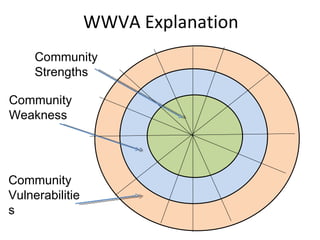
WWVA Explanation Community Strengths Community Weakness Community Vulnerabilities
Lack of Health Facilities Outbreak of deseases e.g Cholera Problems Rampant  Diseases Poor Roads Wild Animals Floods Tapping (Traditional Licker Farming E mploymen t Canoe Rowing Lack of Education Small Scale Businesses Poverty From: Uncertainty Analysis From: Livelihood Analysis From: Problem Analysis Color code
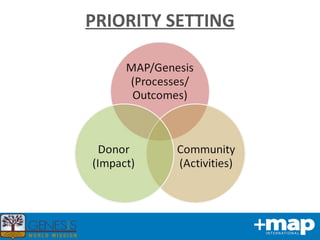
PRIORITY SETTING
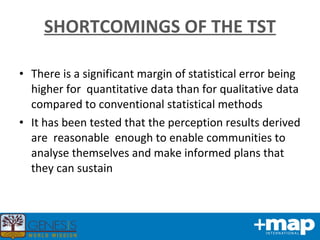
There is a significant margin of statistical error being higher for  quantitative data than for qualitative data compared to conventional statistical methods It has been tested that the perception results derived are  reasonable  enough to enable communities to analyse themselves and make informed plans that they can sustain SHORTCOMINGS OF THE TST
POINT OF ENTRY THEMATIC AREAS FOR BURANGI THV HEALTH Access to quality medical care through mobile and static health clinics Access  to quality drinking water Improved community, domestic and personal sanitation SUSTAINABLE  DAILY LIVELIHOOD Improved food security Improved income generation Environmental preservation  Through tree planting and use of alternative renewable sources of energy and others
EXPECTED IMPACT THE GOAL: Improved quality of life as measured by positive changes in the human development index EXPECTED  MAIN OUTCOME: A community empowered to take charge of its own destiny
RESOURCES ALLOCATION  THE 50 | 40 | 10®  PRINCIPLE 50% TOWARDS PROMOTION. INVEST IN PEOPLE 40% TOWARDS PREVENTION.  INVEST IN SYSTEMS/STRATEGIES 10% TOWARDS  PROVISION: INVEST IN CONSUMABLES
WHAT ABOUT SUSTAINABILITY? Involve the people right from the beginning Teach them to ‘learn how to learn“ To ‘learn how to dream constructively” Elevation of self esteem and self confidence “ Doing with” rather than “doing for” Weigh when to give what…don’t interfere with their strength. Support their vulnerabilities and their weakness. Don’t do what they do well. Emphasize  transferable skills and locally sustainable technology
WWVA Explanation Community Strengths Community Weakness Community Vulnerabilities
WHAT ABOUT SUSTAINABILITY? Involve local leadership from the start Involve women and school children who provide great potential as change agents Understand  and respect their culture and social values; handle what you might think is retrogressive culture with tact. Don’t aim to make them a mirror image of your self. Let them discover  their inherent ability. Enthusiasm is the driver of sustainability.
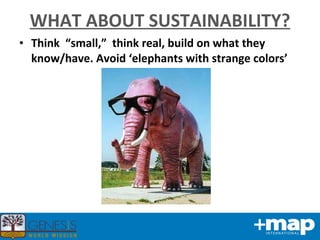
WHAT ABOUT SUSTAINABILITY? Think  “small,”  think real, build on what they know/have. Avoid ‘elephants with strange colors’
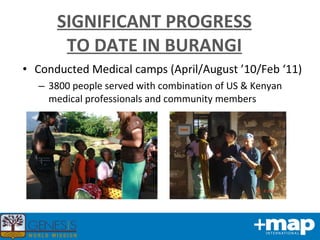
SIGNIFICANT PROGRESS TO DATE IN BURANGI Conducted Medical camps (April/August ’10/Feb ‘11) 3800 people served with combination of US & Kenyan medical professionals and community members
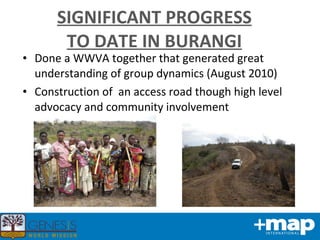
SIGNIFICANT PROGRESS TO DATE IN BURANGI Done a WWVA together that generated great understanding of group dynamics (August 2010) Construction of  an access road though high level advocacy and community involvement
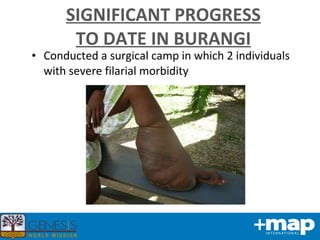
SIGNIFICANT PROGRESS TO DATE IN BURANGI Conducted a surgical camp in which 2 individuals with severe filarial morbidity
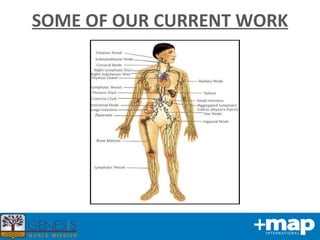
SOME OF OUR CURRENT WORK
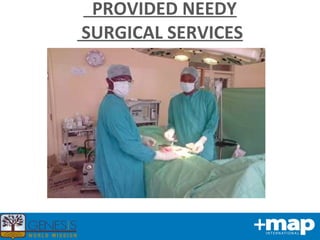
PROVIDED NEEDY  SURGICAL SERVICES
BURANGI CHALLENGES  The greatest challenge is adequate resources to facilitate this worthy cause  Financial…extreme poverty (1/3 of average Kenyan daily earnings) Human….not labor but knowledge Material…….technology
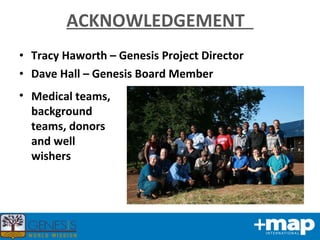
ACKNOWLEDGEMENT  Tracy Haworth – Genesis Project Director Dave Hall – Genesis Board Member Medical teams, background teams, donors and well wishers
OPEN INVITATION All of you Health care professionals (and students) Technical people in other areas Any person with a heart for sharing or witness. Any person who can donate a dollar or two (or more) or any other gifts in-kind towards this mission
ABUNDANT BLESSINGS THANK YOU

Participatory Community Health Development

  • 1.
    ENGAGINGCOMMUNITIES IN WHOLISTIC HEALTH DEVELOPMENT: THE ‘THV MODEL’
  • 2.
  • 3.
    PURPOSE To collectivelycontribute to the improvement in the quality of health care and life of the people of Burangi area in Malindi /Magharini district along the Kenyan coast by engaging active community participation in its own development in a model we call “ Total Health Village .” THE MAP/GENESIS PARTNERSHIP
  • 4.
    WHY? “We are attracted and bound by absolute like mindedness in VISION MISSION AND CORE VALUES THE MAP/GENESIS PARTNERSHIP
  • 5.
    SIMILAR CORE VALUESWe are Christian with mirror visions and missions We are driven by a holistic participatory approach to health development emphasizing local sustainability We specialise in human health care We prioritise reaching to the poorest, the marginalised, and underprivileged in society
  • 6.
    SIMILAR CORE VALUESOur philosophy is anchored on realistic empowerment of communities and individuals Our inputs are low but our expected outputs are high .....hence we support cost effective interventions Commitment to transparency and good stewardship of resources
  • 7.
    SOME FEW HEALTHSECTOR INDICES FROM KENYA 5000 health facilities in Kenya 4500 doctors; 1000 in public service. 50% concentrated in Nairobi: Ratio 1 physician to 10,000 citizens (compared to 26:10,000 in US) 47,000 Nurses & other cadres of medical personnel (10:10,000) 4.6% GDP towards health financing ($29 USD per capita) far below the minimum $34 recommended for Africa by WHO. 40% of financing comes from Kenyan Government; 15% donors, rest by private sector
  • 8.
    SOME FEW HEALTHSECTOR INDICES FROM KENYA 58% of health services run by private sector which caters to high income clientele 90% resources devoted to curative a service that only 10% of the population accesses. 90% of morbidity (and mortality) is caused by preventable infective diseases (and poverty)
  • 9.
    Kenya HDI (HumanDevelopment Index) #147 (0.541) ( ranked out of 182 countries) Literacy Rate (age 15 and over that can read and write) #107 73.6% Infant Mortality Rate (per 1,000 live births) 54.7 deaths/M (2009 est.) Life expectancy at birth #152 53.6 years Combined primary, secondary and tertiary gross enrollment ratio #138 59.6% GDP per capita #149 $1,542 USD Per Capita (2009 est.)
  • 10.
    THE BURANGIPROJECT is a total health village (THV) program
  • 11.
    The THV isa ‘ low-input($15 pp/py), high-impact strategy for achieving the ‘Millennium Development Goals.’ It is a cost effective community development strategy that is expected lead to Total Well Being by impacting a whole village of close to a thousand people through a facilitative and low input cost strategy . It is a completely participatory strategy where communities analyze their situation, and plan a response strategy, and implement it using Community’s Own Resources/Persons and engaging External partners only in a facilitative role where they have no capacity in solving their own problems. WHAT IS A THV?
  • 12.
    PARTICIPATORY METHODOLOGIES How?We have devised simple methods that can apply to any community (in any country).
  • 13.
    Is the rallyingpoint that initiates, stimulates and sustains enthusiasm in participation. THE TEN SEED (OR EQUIVALENT) TECHNIQUE Why TST? Win trust Ice breaker Neutralises threats of inferiority Neutralises the threat of illiteracy Stimulates thinking and visualisation (perception) Is the tool for data collection
  • 14.
    EXAMPLE OF ATST ANALYSIS OF PROBLEMS IN THE BURANGI COMMUNITY OVERALL PROBLEMS MAJOR PROBLEMS Rampant diseases Poor health care No access roads Drought Poverty High illiteracy Lack of technology/ communication Floods Wild animals Poor leadership Inadequate health Facilities 30% Diseases 20% Communications/ Access Roads 5% Floods 5% Illiteracy 10% Poverty and hunger 30%
  • 15.
    A ‘SWOT’ analysis that uses information gathered through the TST. Analyses 3 components simultaneously Problems Means of earning livelihood Uncertainties (W)HOLISTIC WORLD VIEW ANALYSIS:W(H)WVA
  • 16.
    WWVA Explanation CommunityStrengths Community Weakness Community Vulnerabilities
  • 17.
    Lack of HealthFacilities Outbreak of deseases e.g Cholera Problems Rampant Diseases Poor Roads Wild Animals Floods Tapping (Traditional Licker Farming E mploymen t Canoe Rowing Lack of Education Small Scale Businesses Poverty From: Uncertainty Analysis From: Livelihood Analysis From: Problem Analysis Color code
  • 18.
  • 19.
    There is asignificant margin of statistical error being higher for quantitative data than for qualitative data compared to conventional statistical methods It has been tested that the perception results derived are reasonable enough to enable communities to analyse themselves and make informed plans that they can sustain SHORTCOMINGS OF THE TST
  • 20.
    POINT OF ENTRYTHEMATIC AREAS FOR BURANGI THV HEALTH Access to quality medical care through mobile and static health clinics Access to quality drinking water Improved community, domestic and personal sanitation SUSTAINABLE DAILY LIVELIHOOD Improved food security Improved income generation Environmental preservation Through tree planting and use of alternative renewable sources of energy and others
  • 21.
    EXPECTED IMPACT THEGOAL: Improved quality of life as measured by positive changes in the human development index EXPECTED MAIN OUTCOME: A community empowered to take charge of its own destiny
  • 22.
    RESOURCES ALLOCATION THE 50 | 40 | 10® PRINCIPLE 50% TOWARDS PROMOTION. INVEST IN PEOPLE 40% TOWARDS PREVENTION. INVEST IN SYSTEMS/STRATEGIES 10% TOWARDS PROVISION: INVEST IN CONSUMABLES
  • 23.
    WHAT ABOUT SUSTAINABILITY?Involve the people right from the beginning Teach them to ‘learn how to learn“ To ‘learn how to dream constructively” Elevation of self esteem and self confidence “ Doing with” rather than “doing for” Weigh when to give what…don’t interfere with their strength. Support their vulnerabilities and their weakness. Don’t do what they do well. Emphasize transferable skills and locally sustainable technology
  • 24.
    WWVA Explanation CommunityStrengths Community Weakness Community Vulnerabilities
  • 25.
    WHAT ABOUT SUSTAINABILITY?Involve local leadership from the start Involve women and school children who provide great potential as change agents Understand and respect their culture and social values; handle what you might think is retrogressive culture with tact. Don’t aim to make them a mirror image of your self. Let them discover their inherent ability. Enthusiasm is the driver of sustainability.
  • 26.
    WHAT ABOUT SUSTAINABILITY?Think “small,” think real, build on what they know/have. Avoid ‘elephants with strange colors’
  • 27.
    SIGNIFICANT PROGRESS TODATE IN BURANGI Conducted Medical camps (April/August ’10/Feb ‘11) 3800 people served with combination of US & Kenyan medical professionals and community members
  • 28.
    SIGNIFICANT PROGRESS TODATE IN BURANGI Done a WWVA together that generated great understanding of group dynamics (August 2010) Construction of an access road though high level advocacy and community involvement
  • 29.
    SIGNIFICANT PROGRESS TODATE IN BURANGI Conducted a surgical camp in which 2 individuals with severe filarial morbidity
  • 30.
    SOME OF OURCURRENT WORK
  • 31.
    PROVIDED NEEDY SURGICAL SERVICES
  • 32.
    BURANGI CHALLENGES The greatest challenge is adequate resources to facilitate this worthy cause Financial…extreme poverty (1/3 of average Kenyan daily earnings) Human….not labor but knowledge Material…….technology
  • 33.
    ACKNOWLEDGEMENT TracyHaworth – Genesis Project Director Dave Hall – Genesis Board Member Medical teams, background teams, donors and well wishers
  • 34.
    OPEN INVITATION Allof you Health care professionals (and students) Technical people in other areas Any person with a heart for sharing or witness. Any person who can donate a dollar or two (or more) or any other gifts in-kind towards this mission
  • 35.

Editor's Notes

  • #2 3/6/2011 Genesis World Mission, Faith Hope and Charity Dinner and Auction Dr. Julius Kavuludi, MAP International Kenya
  • #3 Board members &staff of GWM,Dr Karl watts ,all distinguished guests and friends ( name , place and apologies for my accent) .Accept greetings from Kenya .May I start by thanking GWM and specifically Tracy and Dave for reaching out to us at MAP –KO an action that has culminated into the inception of this great partnership ,and for extending this invitation and making it possible FOR ME to be here today. May I also thank all of our you-our guests for sparing your precious time to be here today. your presence here bears great testimony to your great love and confidence in GWM and its mission and your genuine desire to put a mark of hope to a needy person in some remote corner of the world where our partner organizations are serve. Am greatly humbled and honored to stand before you It all started early last year when Tracy and Dave reached out to us at MAP IN Nairobi and we engaged into exploring the possibility of coming together in partnership for strengthening community health efforts in some villages of kenya.Right from the very beginning it was amazing for all of us to discover that we sounded like clones, our pulses were completely in sync with each in every aspect That we explored and I want to thank Tracy and Dave for this initiative and all the subsequent sometimes frustrating shuttling to and from Nairobi and all the paper work that has seen our two organizations start worthy work that is the subject of these celebration today 3/6/2011 Genesis World Mission, Faith Hope and Charity Dinner and Auction Dr. Julius Kavuludi, MAP International Kenya
  • #4 3/6/2011 Genesis World Mission, Faith Hope and Charity Dinner and Auction Dr. Julius Kavuludi, MAP International Kenya
  • #5 3/6/2011 Genesis World Mission, Faith Hope and Charity Dinner and Auction Dr. Julius Kavuludi, MAP International Kenya
  • #6 3/6/2011 Genesis World Mission, Faith Hope and Charity Dinner and Auction Dr. Julius Kavuludi, MAP International Kenya
  • #7 3/6/2011 Genesis World Mission, Faith Hope and Charity Dinner and Auction Dr. Julius Kavuludi, MAP International Kenya
  • #8 3/6/2011 Genesis World Mission, Faith Hope and Charity Dinner and Auction Dr. Julius Kavuludi, MAP International Kenya
  • #9 3/6/2011 Genesis World Mission, Faith Hope and Charity Dinner and Auction Dr. Julius Kavuludi, MAP International Kenya
  • #10 3/6/2011 Genesis World Mission, Faith Hope and Charity Dinner and Auction Dr. Julius Kavuludi, MAP International Kenya
  • #15 3/6/2011 Genesis World Mission, Faith Hope and Charity Dinner and Auction Dr. Julius Kavuludi, MAP International Kenya
  • #17 3/6/2011 Genesis World Mission, Faith Hope and Charity Dinner and Auction Dr. Julius Kavuludi, MAP International Kenya
  • #18 3/6/2011 Genesis World Mission, Faith Hope and Charity Dinner and Auction Dr. Julius Kavuludi, MAP International Kenya
  • #25 3/6/2011 Genesis World Mission, Faith Hope and Charity Dinner and Auction Dr. Julius Kavuludi, MAP International Kenya