The Path Forward
Health Care is a Right,
Not a Privilege.
16/24/20
Healthcare: A Turning Point
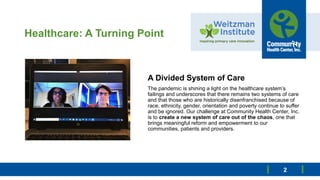
A Divided System of Care
The pandemic is shining a light on the healthcare system’s
failings and underscores that there remains two systems of care
and that those who are historically disenfranchised because of
race, ethnicity, gender, orientation and poverty continue to suffer
and be ignored. Our challenge at Community Health Center, Inc.
is to create a new system of care out of the chaos, one that
brings meaningful reform and empowerment to our
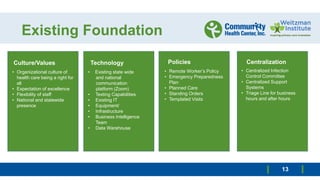
communities, patients and providers.
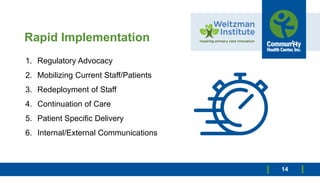
2
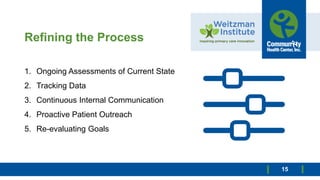
Building a
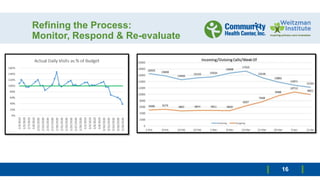
Foundation
A New Path Forward
Four Teams:
Team 1:
• Look at how our “crisis“ delivery model is functioning
• Determine steps to improve current model
Team 2:
• Assess changes happening within the neighborhoods we serve
• Understand how the healthcare landscape is reacting
Team 3:
• Lay practical and conceptual foundation for new
delivery model
Team 4:
• Prepare through our national affiliates to share,
learn and grow
3
Team 1: Survive
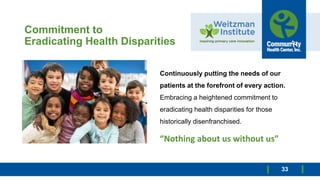
Focus:
Clinical and Operational
performance of the temporary
model that we stood up within
days of the pandemic's arrival in
Connecticut, primarily through
remote work and telehealth.
Team 1 worked to ensure the
delivery of quality patient care
and to support our workforce in
functioning safely and efficiently.
Steps:
1. Identify challenges to the sustainability of this
new environment and to provide recommendations
for improvement
2. Develop comprehensive work plan to make short term
improvements with specific goals and timelines across
departments and disciplines
3. Rapid implementation of temporary set-up with the knowledge
that ongoing improvement would be needed in the future
4
Team 2: Assess
Focus:
All health care is local.
Substantive Health Care Redesign has
for too long ignored the social
determinants of health; racial
inequity, income disparity, legal
status, food insecurity, educational
opportunity and digital capacity. All
of the social systems underlying
social determinants are experiencing
disruption and have advocates with
similar energy to ours who are
helping reshape that landscape into a
new and responsive health system.
.
5
Steps:
1. Review changes in the behavior of the health system
2. Gain understanding of the changes going on for those we serve in
the neighborhoods they live
3. Factor in disruptions of social systems underlying social
determinants
4. Embrace advocates with similar energy
5. Help shape the landscape of a redesign for a new and responsive
health system
Team 3: Build
Focus:
Understand how we can
fundamentally transform the way
that primary care is delivered, with
the goal of improved clinical
outcomes and increased community
empowerment.
6
Steps:
1. Gain understanding and act on patient and employee satisfaction
2. Embrace a heightened commitment to eradicating health
disparities for those historically disenfranchised
3. Ensure regulatory relief on the use of telehealth technology
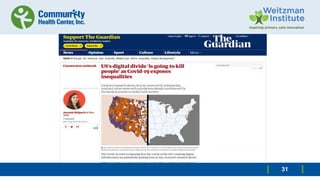
4. Address the digital divide
5. Explore home health technologies
Team 4: Spread
Focus:
The current health system was
defined by institutions that don’t
represent the communities most
impacted. We have new tools to
deploy to engage patients beyond the
walls of our clinics. And we need
pragmatic research to help guide us
and ensure that what we are doing is
actually beneficial.
.
7
Steps:
1. Develop content with specific focus areas and solutions
2. Spread content beyond our health center
3. Incorporate diverse views
4. Ensure we experience the full advantage of the knowledge and
opportunity for collaboration presented
We didn’t get here on our own.
We can’t move forward alone.
There has never been a time like this
when collectively we have the opportunity
to build a better delivery system. Join us
in this exciting opportunity – let’s look
to each other and bring about
a brighter future.
8
We didn’t get here on our own.
We can’t move forward alone.
We will walk you through
the details of our work to
date. We want to engage
with your feedback.
9
Please Submit Your Questions
10
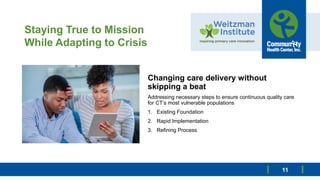
Staying True to Mission
While Adapting to Crisis
Changing care delivery without
skipping a beatbeat
Addressing necessary steps to ensure continuous quality care
for CT’s most vulnerable populations
1. Existing Foundation
2. Rapid Implementation
3. Refining Process
11
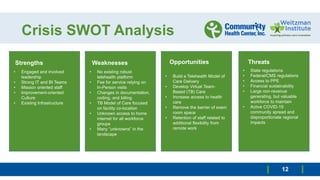
Crisis SWOT Analysis
Focus: Clinical and Operational
performance of the temporary
model that we stood up within
days of the pandemic's arrival in
Connecticut, primarily through
remote work and telehealth.
Team 1 worked to ensure the
delivery of quality patient care
and to support our workforce in
functioning safely and efficiently.
12
• Engaged and involved
leadership
• Strong IT and BI Teams
• Mission oriented staff
• Improvement-oriented
Culture
• Existing Infrastructure
Strengths Weaknesses Opportunities Threats
• No existing robust
telehealth platform
• Fee for service relying on
In-Person visits
• Changes in documentation,
coding, and billing
• TB Model of Care focused
on facility co-location
• Unknown access to home
internet for all workforce
groups
• Many “unknowns” in the
landscape
• Build a Telehealth Model of
Care Delivery
• Develop Virtual Team-
Based (TB) Care
• Increase access to health
care
• Remove the barrier of exam
room space
• Retention of staff related to
additional flexibility from
remote work
• State regulations
• Federal/CMS regulations
• Access to PPE
• Financial sustainability
• Large non-revenue
generating, but valuable
workforce to maintain
• Active COVID-19
community spread and
disproportionate regional
impacts
Existing Foundation
Focus: Clinical and Operational
performance of the temporary
model that we stood up within
days of the pandemic's arrival in
Connecticut, primarily through
remote work and telehealth.
Team 1 worked to ensure the
delivery of quality patient care
and to support our workforce in
functioning safely and efficiently.
13
• Organizational culture of
health care being a right for
all
• Expectation of excellence
• Flexibility of staff
• National and statewide
presence
Culture/Values Technology Policies Centralization
• Existing state wide
and national
communication
platform (Zoom)
• Texting Capabilities
• Existing IT
• Equipment/
• Infrastructure
• Business Intelligence
Team
• Data Warehouse
• Remote Worker’s Policy
• Emergency Preparedness
Plan
• Planned Care
• Standing Orders
• Templated Visits
• Centralized Infection
Control Committee
• Centralized Support
Systems
• Triage Line for business
hours and after hours
Rapid Implementation
14
1. Regulatory Advocacy
2. Mobilizing Current Staff/Patients
3. Redeployment of Staff
4. Continuation of Care
5. Patient Specific Delivery
6. Internal/External Communications
Refining the Process
15
1. Ongoing Assessments of Current State
2. Tracking Data
3. Continuous Internal Communication
4. Proactive Patient Outreach
5. Re-evaluating Goals
Refining the Process:
Monitor, Respond & Re-evaluate
Focus: Clinical and Operational
performance of the temporary
model that we stood up within
days of the pandemic's arrival in
Connecticut, primarily through
remote work and telehealth.
Team 1 worked to ensure the
delivery of quality patient care
and to support our workforce in
functioning safely and efficiently.
16
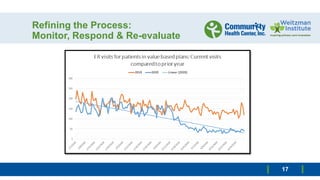
Refining the Process:
Monitor, Respond & Re-evaluate
17
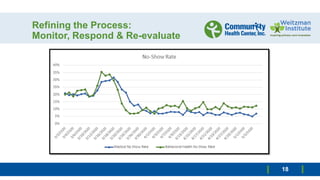
Refining the Process:
Monitor, Respond & Re-evaluate
Focus: Clinical and Operational
performance of the temporary
model that we stood up within
days of the pandemic's arrival in
Connecticut, primarily through
remote work and telehealth.
Team 1 worked to ensure the
delivery of quality patient care
and to support our workforce in
functioning safely and efficiently.
18
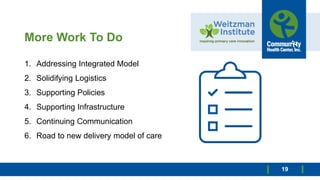
More Work To Do
19
1. Addressing Integrated Model
2. Solidifying Logistics
3. Supporting Policies
4. Supporting Infrastructure
5. Continuing Communication
6. Road to new delivery model of care
Social Determinants
of Health
The Imperative to Create
Equity in Health
20
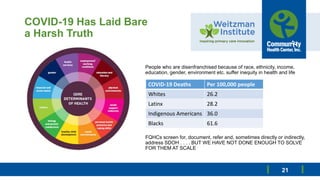
COVID-19 Has Laid Bare
a Harsh Truth
People who are disenfranchised because of race, ethnicity, income,
education, gender, environment etc. suffer inequity in health and life
21
FQHCs screen for, document, refer and, sometimes directly or indirectly,
address SDOH . . . . BUT WE HAVE NOT DONE ENOUGH TO SOLVE
FOR THEM AT SCALE
COVID-19 Deaths Per 100,000 people
Whites 26.2
Latinx 28.2
Indigenous Americans 36.0
Blacks 61.6
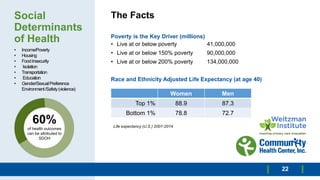
Social
Determinants
of Health
The Facts
Poverty is the Key Driver (millions)
• Live at or below poverty 41,000,000
• Live at or below 150% poverty 90,000,000
• Live at or below 200% poverty 134,000,000
Race and Ethnicity Adjusted Life Expectancy (at age 40)
22
• Income/Poverty
• Housing
• FoodInsecurity
• Isolation
• Transportation
• Education
• Gender/SexualPreference
Environment/Safety(violence)
Women Men
Top 1% 88.9 87.3
Bottom 1% 78.8 72.7
Life expectancy (U.S.) 2001-2014
60%
of health outcomes
can be attributed to
SDOH
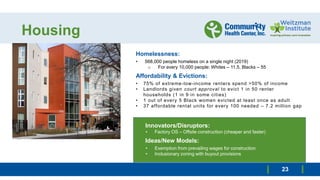
Housing
Homelessness:
• 568,000 people homeless on a single night (2019)
o For every 10,000 people: Whites – 11.5, Blacks – 55
Affordability & Evictions:
• 75% of extreme-low-income renters spend >50% of income
• Landlords given court approval to evict 1 in 50 renter
households (1 in 9 in some cities)
• 1 out of every 5 Black women evicted at least once as adult
• 37 affordable rental units for every 100 needed – 7.2 million gap
23
Innovators/Disruptors:
• Factory OS – Offsite construction (cheaper and faster)
Ideas/New Models:
• Exemption from prevailing wages for construction
• Inclusionary zoning with buyout provisions
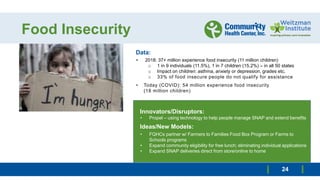
Food Insecurity
Data:
• 2018: 37+ million experience food insecurity (11 million children)
o 1 in 9 individuals (11.5%), 1 in 7 children (15.2%) – in all 50 states
o Impact on children: asthma, anxiety or depression, grades etc.
o 33% of food insecure people do not qualify for assistance
• Today (COVID): 54 million experience food insecurity
(18 million children)
24
Innovators/Disruptors:
• Propel – using technology to help people manage SNAP and extend benefits
Ideas/New Models:
• FQHCs partner w/ Farmers to Families Food Box Program or Farms to
Schools programs
• Expand community eligibility for free lunch; eliminating individual applications
• Expand SNAP deliveries direct from store/online to home
A
History of
Innovation
25
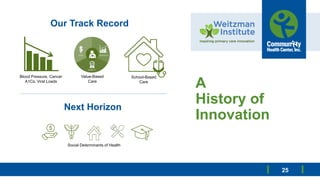
Our Track Record
Blood Pressure, Cancer
A1Cs, Viral Loads
Value-Based
Care
School-Based
Care
Social Determinants of Health
Next Horizon
A 360 Assessment
We are not alone in valuing the opportunity to care for our patients
• Yesterday’s Minute Clinic (“You’re sick. We’re quick”) is today’s pharmacy-based “Doctor’s Office” in your
neighborhood
• As we have grown to care for 29 million people, others have recognized the opportunities brought by the
expansion of Medicaid, ACA coverage and the closing of private practices
• The transition to telehealth will benefit them as much as it benefits us
• Both established corporations and start-ups see this move as a business opportunity—tied to shareholder
value (MAVEN, American Well)
• Our shareholders are our patients and neighborhoods. We are economic engines and we know our
populations - but we have to better address SDOH as part of our strategy
26
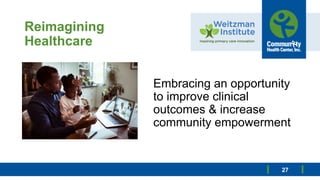
Reimagining
Healthcare
Embracing an opportunity
to improve clinical
outcomes & increase
community empowerment
27
Workforce Models
28
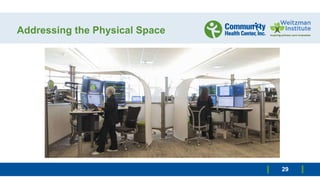
1. Fully on-site for in person care
2. Hybrid of on-site & telehealth
3. Telehealth from telehealth pods
4. Fully remote/Telehealth from home
Addressing the Physical Space
29
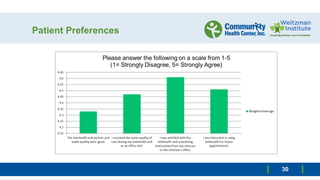
Patient Preferences
Focus: Clinical and Operational
performance of the temporary
model that we stood up within
days of the pandemic's arrival in
Connecticut, primarily through
remote work and teleheRoRrob’s
alth. Team 1 worked to ensure
the delivery of quality patient care
and to support our workforce in
functioning safely and efficiently.
30
31
Explore Home
Health Technologies
32
Embracing patient’s desire for remote
healthcare while simultaneously
collecting health data in the hopes of
improving overall outcomes.
Commitment to
Eradicating Health Disparities
33
Continuously putting the needs of our
patients at the forefront of every action.
Embracing a heightened commitment to
eradicating health disparities for those
historically disenfranchised.
“Nothing about us without us”
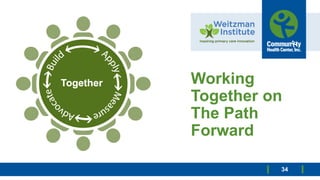
Working
Together on
The Path
Forward
34
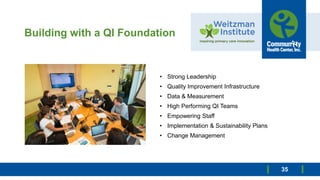
Building with a QI Foundation
• Strong Leadership
• Quality Improvement Infrastructure
• Data & Measurement
• High Performing QI Teams
• Empowering Staff
• Implementation & Sustainability Plans
• Change Management
35
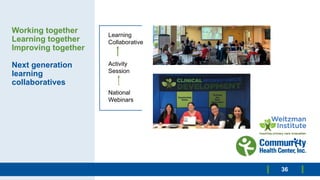
Working together
Learning together
Improving together
Next generation
learning
collaboratives
Learning
Collaborative
Activity
Session
National
Webinars
36
Working together
Learning together
Improving together
Project ECHO Practice Transformation
• Practice transformation specialists
• Formal curriculum
• “Case”-based discussion
37
Connect with the Medical
Neighborhood
Strengthen Primary Care
• New tools to strengthen primary care
• Increase what we can accomplish in our health centers
• Engage patients in new ways
38
Training the
Next Generation
• Residents – medical (MD, DO, APRN), behavioral health, dental
• Students – medical, nursing, medical assistants, public health
• Administrators
• Community Health Workers
• Peer Support Specialists
Train future healthcare staff to OUR model of care
39
Research/Evaluation
Evaluation Methods
• Process evaluation
• Impact evaluation
• Outcome evaluation
• Summative evaluation
• Organizational and systems evaluation
• Rapid evaluation and assessment
Research Approaches
• Mixed methods
• Implementation science
• Community based participatory research
• Experiments and field trials
• Survey design
• Focus groups
• Secondary analysis
40
Join Us!
We can’t do this alone.
Join the conversation.
41

The Path Forward

  • 1.
    The Path Forward HealthCare is a Right, Not a Privilege. 16/24/20
  • 2.
    Healthcare: A TurningPoint A Divided System of Care The pandemic is shining a light on the healthcare system’s failings and underscores that there remains two systems of care and that those who are historically disenfranchised because of race, ethnicity, gender, orientation and poverty continue to suffer and be ignored. Our challenge at Community Health Center, Inc. is to create a new system of care out of the chaos, one that brings meaningful reform and empowerment to our communities, patients and providers. 2
  • 3.
    Building a Foundation A NewPath Forward Four Teams: Team 1: • Look at how our “crisis“ delivery model is functioning • Determine steps to improve current model Team 2: • Assess changes happening within the neighborhoods we serve • Understand how the healthcare landscape is reacting Team 3: • Lay practical and conceptual foundation for new delivery model Team 4: • Prepare through our national affiliates to share, learn and grow 3
  • 4.
    Team 1: Survive Focus: Clinicaland Operational performance of the temporary model that we stood up within days of the pandemic's arrival in Connecticut, primarily through remote work and telehealth. Team 1 worked to ensure the delivery of quality patient care and to support our workforce in functioning safely and efficiently. Steps: 1. Identify challenges to the sustainability of this new environment and to provide recommendations for improvement 2. Develop comprehensive work plan to make short term improvements with specific goals and timelines across departments and disciplines 3. Rapid implementation of temporary set-up with the knowledge that ongoing improvement would be needed in the future 4
  • 5.
    Team 2: Assess Focus: Allhealth care is local. Substantive Health Care Redesign has for too long ignored the social determinants of health; racial inequity, income disparity, legal status, food insecurity, educational opportunity and digital capacity. All of the social systems underlying social determinants are experiencing disruption and have advocates with similar energy to ours who are helping reshape that landscape into a new and responsive health system. . 5 Steps: 1. Review changes in the behavior of the health system 2. Gain understanding of the changes going on for those we serve in the neighborhoods they live 3. Factor in disruptions of social systems underlying social determinants 4. Embrace advocates with similar energy 5. Help shape the landscape of a redesign for a new and responsive health system
  • 6.
    Team 3: Build Focus: Understandhow we can fundamentally transform the way that primary care is delivered, with the goal of improved clinical outcomes and increased community empowerment. 6 Steps: 1. Gain understanding and act on patient and employee satisfaction 2. Embrace a heightened commitment to eradicating health disparities for those historically disenfranchised 3. Ensure regulatory relief on the use of telehealth technology 4. Address the digital divide 5. Explore home health technologies
  • 7.
    Team 4: Spread Focus: Thecurrent health system was defined by institutions that don’t represent the communities most impacted. We have new tools to deploy to engage patients beyond the walls of our clinics. And we need pragmatic research to help guide us and ensure that what we are doing is actually beneficial. . 7 Steps: 1. Develop content with specific focus areas and solutions 2. Spread content beyond our health center 3. Incorporate diverse views 4. Ensure we experience the full advantage of the knowledge and opportunity for collaboration presented
  • 8.
    We didn’t gethere on our own. We can’t move forward alone. There has never been a time like this when collectively we have the opportunity to build a better delivery system. Join us in this exciting opportunity – let’s look to each other and bring about a brighter future. 8
  • 9.
    We didn’t gethere on our own. We can’t move forward alone. We will walk you through the details of our work to date. We want to engage with your feedback. 9
  • 10.
    Please Submit YourQuestions 10
  • 11.
    Staying True toMission While Adapting to Crisis Changing care delivery without skipping a beatbeat Addressing necessary steps to ensure continuous quality care for CT’s most vulnerable populations 1. Existing Foundation 2. Rapid Implementation 3. Refining Process 11
  • 12.
    Crisis SWOT Analysis Focus:Clinical and Operational performance of the temporary model that we stood up within days of the pandemic's arrival in Connecticut, primarily through remote work and telehealth. Team 1 worked to ensure the delivery of quality patient care and to support our workforce in functioning safely and efficiently. 12 • Engaged and involved leadership • Strong IT and BI Teams • Mission oriented staff • Improvement-oriented Culture • Existing Infrastructure Strengths Weaknesses Opportunities Threats • No existing robust telehealth platform • Fee for service relying on In-Person visits • Changes in documentation, coding, and billing • TB Model of Care focused on facility co-location • Unknown access to home internet for all workforce groups • Many “unknowns” in the landscape • Build a Telehealth Model of Care Delivery • Develop Virtual Team- Based (TB) Care • Increase access to health care • Remove the barrier of exam room space • Retention of staff related to additional flexibility from remote work • State regulations • Federal/CMS regulations • Access to PPE • Financial sustainability • Large non-revenue generating, but valuable workforce to maintain • Active COVID-19 community spread and disproportionate regional impacts
  • 13.
    Existing Foundation Focus: Clinicaland Operational performance of the temporary model that we stood up within days of the pandemic's arrival in Connecticut, primarily through remote work and telehealth. Team 1 worked to ensure the delivery of quality patient care and to support our workforce in functioning safely and efficiently. 13 • Organizational culture of health care being a right for all • Expectation of excellence • Flexibility of staff • National and statewide presence Culture/Values Technology Policies Centralization • Existing state wide and national communication platform (Zoom) • Texting Capabilities • Existing IT • Equipment/ • Infrastructure • Business Intelligence Team • Data Warehouse • Remote Worker’s Policy • Emergency Preparedness Plan • Planned Care • Standing Orders • Templated Visits • Centralized Infection Control Committee • Centralized Support Systems • Triage Line for business hours and after hours
  • 14.
    Rapid Implementation 14 1. RegulatoryAdvocacy 2. Mobilizing Current Staff/Patients 3. Redeployment of Staff 4. Continuation of Care 5. Patient Specific Delivery 6. Internal/External Communications
  • 15.
    Refining the Process 15 1.Ongoing Assessments of Current State 2. Tracking Data 3. Continuous Internal Communication 4. Proactive Patient Outreach 5. Re-evaluating Goals
  • 16.
    Refining the Process: Monitor,Respond & Re-evaluate Focus: Clinical and Operational performance of the temporary model that we stood up within days of the pandemic's arrival in Connecticut, primarily through remote work and telehealth. Team 1 worked to ensure the delivery of quality patient care and to support our workforce in functioning safely and efficiently. 16
  • 17.
    Refining the Process: Monitor,Respond & Re-evaluate 17
  • 18.
    Refining the Process: Monitor,Respond & Re-evaluate Focus: Clinical and Operational performance of the temporary model that we stood up within days of the pandemic's arrival in Connecticut, primarily through remote work and telehealth. Team 1 worked to ensure the delivery of quality patient care and to support our workforce in functioning safely and efficiently. 18
  • 19.
    More Work ToDo 19 1. Addressing Integrated Model 2. Solidifying Logistics 3. Supporting Policies 4. Supporting Infrastructure 5. Continuing Communication 6. Road to new delivery model of care
  • 20.
    Social Determinants of Health TheImperative to Create Equity in Health 20
  • 21.
    COVID-19 Has LaidBare a Harsh Truth People who are disenfranchised because of race, ethnicity, income, education, gender, environment etc. suffer inequity in health and life 21 FQHCs screen for, document, refer and, sometimes directly or indirectly, address SDOH . . . . BUT WE HAVE NOT DONE ENOUGH TO SOLVE FOR THEM AT SCALE COVID-19 Deaths Per 100,000 people Whites 26.2 Latinx 28.2 Indigenous Americans 36.0 Blacks 61.6
  • 22.
    Social Determinants of Health The Facts Povertyis the Key Driver (millions) • Live at or below poverty 41,000,000 • Live at or below 150% poverty 90,000,000 • Live at or below 200% poverty 134,000,000 Race and Ethnicity Adjusted Life Expectancy (at age 40) 22 • Income/Poverty • Housing • FoodInsecurity • Isolation • Transportation • Education • Gender/SexualPreference Environment/Safety(violence) Women Men Top 1% 88.9 87.3 Bottom 1% 78.8 72.7 Life expectancy (U.S.) 2001-2014 60% of health outcomes can be attributed to SDOH
  • 23.
    Housing Homelessness: • 568,000 peoplehomeless on a single night (2019) o For every 10,000 people: Whites – 11.5, Blacks – 55 Affordability & Evictions: • 75% of extreme-low-income renters spend >50% of income • Landlords given court approval to evict 1 in 50 renter households (1 in 9 in some cities) • 1 out of every 5 Black women evicted at least once as adult • 37 affordable rental units for every 100 needed – 7.2 million gap 23 Innovators/Disruptors: • Factory OS – Offsite construction (cheaper and faster) Ideas/New Models: • Exemption from prevailing wages for construction • Inclusionary zoning with buyout provisions
  • 24.
    Food Insecurity Data: • 2018:37+ million experience food insecurity (11 million children) o 1 in 9 individuals (11.5%), 1 in 7 children (15.2%) – in all 50 states o Impact on children: asthma, anxiety or depression, grades etc. o 33% of food insecure people do not qualify for assistance • Today (COVID): 54 million experience food insecurity (18 million children) 24 Innovators/Disruptors: • Propel – using technology to help people manage SNAP and extend benefits Ideas/New Models: • FQHCs partner w/ Farmers to Families Food Box Program or Farms to Schools programs • Expand community eligibility for free lunch; eliminating individual applications • Expand SNAP deliveries direct from store/online to home
  • 25.
    A History of Innovation 25 Our TrackRecord Blood Pressure, Cancer A1Cs, Viral Loads Value-Based Care School-Based Care Social Determinants of Health Next Horizon
  • 26.
    A 360 Assessment Weare not alone in valuing the opportunity to care for our patients • Yesterday’s Minute Clinic (“You’re sick. We’re quick”) is today’s pharmacy-based “Doctor’s Office” in your neighborhood • As we have grown to care for 29 million people, others have recognized the opportunities brought by the expansion of Medicaid, ACA coverage and the closing of private practices • The transition to telehealth will benefit them as much as it benefits us • Both established corporations and start-ups see this move as a business opportunity—tied to shareholder value (MAVEN, American Well) • Our shareholders are our patients and neighborhoods. We are economic engines and we know our populations - but we have to better address SDOH as part of our strategy 26
  • 27.
    Reimagining Healthcare Embracing an opportunity toimprove clinical outcomes & increase community empowerment 27
  • 28.
    Workforce Models 28 1. Fullyon-site for in person care 2. Hybrid of on-site & telehealth 3. Telehealth from telehealth pods 4. Fully remote/Telehealth from home
  • 29.
  • 30.
    Patient Preferences Focus: Clinicaland Operational performance of the temporary model that we stood up within days of the pandemic's arrival in Connecticut, primarily through remote work and teleheRoRrob’s alth. Team 1 worked to ensure the delivery of quality patient care and to support our workforce in functioning safely and efficiently. 30
  • 31.
  • 32.
    Explore Home Health Technologies 32 Embracingpatient’s desire for remote healthcare while simultaneously collecting health data in the hopes of improving overall outcomes.
  • 33.
    Commitment to Eradicating HealthDisparities 33 Continuously putting the needs of our patients at the forefront of every action. Embracing a heightened commitment to eradicating health disparities for those historically disenfranchised. “Nothing about us without us”
  • 34.
  • 35.
    Building with aQI Foundation • Strong Leadership • Quality Improvement Infrastructure • Data & Measurement • High Performing QI Teams • Empowering Staff • Implementation & Sustainability Plans • Change Management 35
  • 36.
    Working together Learning together Improvingtogether Next generation learning collaboratives Learning Collaborative Activity Session National Webinars 36
  • 37.
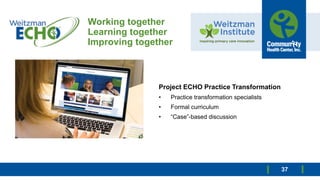
    Working together Learning together Improvingtogether Project ECHO Practice Transformation • Practice transformation specialists • Formal curriculum • “Case”-based discussion 37
  • 38.
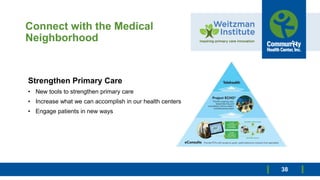
    Connect with theMedical Neighborhood Strengthen Primary Care • New tools to strengthen primary care • Increase what we can accomplish in our health centers • Engage patients in new ways 38
  • 39.
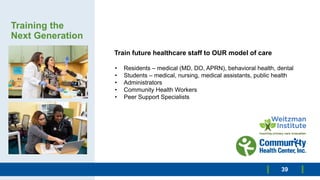
    Training the Next Generation •Residents – medical (MD, DO, APRN), behavioral health, dental • Students – medical, nursing, medical assistants, public health • Administrators • Community Health Workers • Peer Support Specialists Train future healthcare staff to OUR model of care 39
  • 40.
    Research/Evaluation Evaluation Methods • Processevaluation • Impact evaluation • Outcome evaluation • Summative evaluation • Organizational and systems evaluation • Rapid evaluation and assessment Research Approaches • Mixed methods • Implementation science • Community based participatory research • Experiments and field trials • Survey design • Focus groups • Secondary analysis 40
  • 41.
    Join Us! We can’tdo this alone. Join the conversation. 41