Dr. Ricardo Sosa
May 2016
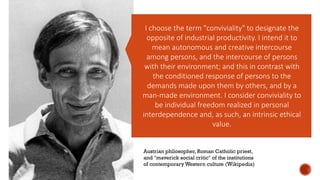
I choose the term "conviviality" to designate the
opposite of industrial productivity. I intend it to
mean autonomous and creative intercourse
among persons, and the intercourse of persons
with their environment; and this in contrast with
the conditioned response of persons to the
demands made upon them by others, and by a
man-made environment. I consider conviviality to
be individual freedom realized in personal
interdependence and, as such, an intrinsic ethical
value.
Austrian philosopher, Roman Catholic priest,
and "maverick social critic" of the institutions
of contemporary Western culture (Wikipedia)
Doing vs. Being participatory & collaborative
Discourse, authenticity, risks, politics, time, trade-offs,
trust, dispositions
Universal & diverse creativity
Oppression, ‘sedentarism’, facilitation, information,
practice, synergies
Assumptions and biases
Building (human) relationships
Singularity
Sharing: control, responsibility, roles, goals,
framings, means
Communicate: agendas, constraints, core beliefs,
perceptions, self-limitations
Empathic understanding, humility
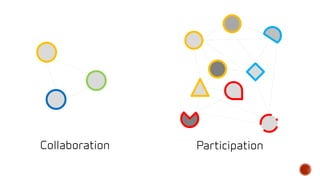
Collaboration Participation
List 10 good reasons to collaborate with others in
your MCTthesis (students, external partners,
etc.)
List 10 good reasons to NOTcollaborate with
others in your MCTthesis
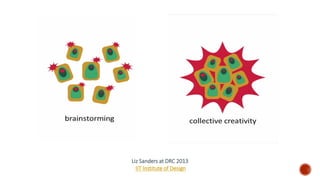
Liz Sanders at DRC 2013
IIT Institute of Design
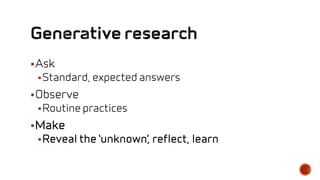
Ask
Standard, expected answers
Observe
Routine practices
Make
Reveal the ‘unknown’, reflect, learn
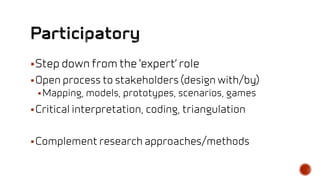
Step down from the ‘expert’ role
Open process to stakeholders (design with/by)
Mapping, models, prototypes, scenarios, games
Critical interpretation, coding, triangulation
Complement research approaches/methods
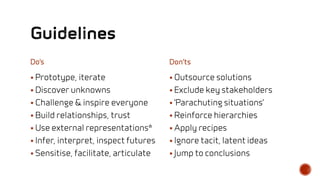
Do’s
 Prototype, iterate
 Discover unknowns
 Challenge & inspire everyone
 Build relationships, trust
 Use external representations*
 Infer, interpret, inspect futures
 Sensitise, facilitate, articulate
Don’ts
 Outsource solutions
 Exclude key stakeholders
 ‘Parachuting situations’
 Reinforce hierarchies
 Apply recipes
 Ignore tacit, latent ideas
 Jump to conclusions
Participatory collaborative research practice

Participatory collaborative research practice

  • 1.
  • 2.
    I choose theterm "conviviality" to designate the opposite of industrial productivity. I intend it to mean autonomous and creative intercourse among persons, and the intercourse of persons with their environment; and this in contrast with the conditioned response of persons to the demands made upon them by others, and by a man-made environment. I consider conviviality to be individual freedom realized in personal interdependence and, as such, an intrinsic ethical value. Austrian philosopher, Roman Catholic priest, and "maverick social critic" of the institutions of contemporary Western culture (Wikipedia)
  • 3.
    Doing vs. Beingparticipatory & collaborative Discourse, authenticity, risks, politics, time, trade-offs, trust, dispositions Universal & diverse creativity Oppression, ‘sedentarism’, facilitation, information, practice, synergies
  • 4.
    Assumptions and biases Building(human) relationships Singularity
  • 5.
    Sharing: control, responsibility,roles, goals, framings, means Communicate: agendas, constraints, core beliefs, perceptions, self-limitations Empathic understanding, humility
  • 6.
  • 7.
    List 10 goodreasons to collaborate with others in your MCTthesis (students, external partners, etc.)
  • 8.
    List 10 goodreasons to NOTcollaborate with others in your MCTthesis
  • 9.
    Liz Sanders atDRC 2013 IIT Institute of Design
  • 10.
    Ask Standard, expected answers Observe Routinepractices Make Reveal the ‘unknown’, reflect, learn
  • 11.
    Step down fromthe ‘expert’ role Open process to stakeholders (design with/by) Mapping, models, prototypes, scenarios, games Critical interpretation, coding, triangulation Complement research approaches/methods
  • 12.
    Do’s  Prototype, iterate Discover unknowns  Challenge & inspire everyone  Build relationships, trust  Use external representations*  Infer, interpret, inspect futures  Sensitise, facilitate, articulate Don’ts  Outsource solutions  Exclude key stakeholders  ‘Parachuting situations’  Reinforce hierarchies  Apply recipes  Ignore tacit, latent ideas  Jump to conclusions