APPLICATION OF
PARTIAL DERIVATIVES
Asha Rani
Business Mathematics
Section H, IV Semester
Asha Rani
To revise what we have done so far in class in Calculus…
Limit, function and Continuity
First order derivatives – Increasing & decreasing
Function and its Application
Second order derivatives- Concavity, Convexity
and point of inflection and its application
Maxima, minima and its Application
Partial derivatives- Basics
Application of Partial derivates – Elasticities,
Marginal Productivity.
Asha Rani
Session Details
This session covers : -
• Marginal Rate of Technical Substitution
• Elasticity of Substitution
• Multi-variate Optimisation
• Constrained Optimisation
Solved illustrations and Practice Handouts are
provided separately.
Asha Rani
Marginal Rate of Technical Substitution
Marginal Rate of Technical Substitution is the amount by which the quantity
of one input has to be reduced when one extra unit of another input is used,
so that output remains constant.
It shows the relation between inputs, and the trade-offs amongst them,
without changing the level of total output.
MRTS is equal to the slope of Isoquants.
When using common inputs such as capital (K) and labour (L), the MRTS
can be obtained using the following formula:
Asha Rani
Marginal Rate of Technical Substitution
• Let Production function is 𝑃 = 𝑓(𝐿, 𝐾)
• By definition 𝑀𝑅𝑇𝑆 = −
𝑑𝐾
𝑑𝐿
• Total differential of the production function
𝑑𝑃 = 𝑓𝐿𝑑𝐿 + 𝑓𝐾𝑑𝐾
𝑓𝐿 and 𝑓𝐾 are Marginal productivity of Labour &
Capital which are partial derivatives of P w.r.t. L
and K respectively.
• Along the an Isoquant, 𝑑𝑃 = 0
0 = 𝑓𝐿𝑑𝐿 + 𝑓𝐾𝑑𝐾
−
𝑑𝐾
𝑑𝐿
=
𝑓𝐿
𝑓𝐾
i.e. 𝑀𝑅𝑇𝑆 =
𝑓𝐿
𝑓𝐾
Asha Rani
Elasticity of Substitution
• Elasticity of substitution is defined as the ratio of
the percentage change in the K/L ratio to the
percentage change of the MRTSLK
• 𝜎 =
Τ
𝑑 Τ
𝐾 𝐿 ( Τ
𝐾 𝐿)
Τ
𝑑 𝑀𝑅𝑇𝑆 𝑀𝑅𝑇𝑆
= 𝑀𝑅𝑇𝑆 ∗
𝐿
𝐾
∗
1
𝑑 𝑀𝑅𝑇𝑆
𝑑
𝐾
𝐿
Asha Rani
Illustrative Problem
Ques:1. Find the marginal rate of technical
substitution and the elasticity of substitution for
the following production function:
𝑥 = 𝑓 𝑙, 𝑘 = 𝛼𝑘−𝜃
+ 1 − 𝛼 𝑙−𝜃 −
1
𝜃
Where x is the total output obtained by using l and
k units of labour and capital respectively.
Asha Rani
Now, let’s move to
maxima and minima
using Calculus …
More than One
Independent Variables.
Asha Rani
NOW, LET’S MOVE TO MINIMA AND MAXIMA USING
CALCULUS … MORE THAN ONE INDEPENDENT
VARIABLES.
MINIMA AND MAXIMA – MORE THAN ONE
INDEPENDENT VARIABLE (X) WITHOUT CONSTRAINTS
 Necessary Condition for Maxima and Minima: If a function f(x,y) is
continuous and differentiable everywhere in the interval [a,b], and has a maxima or
minima, then fx = fy = 0.
 Sufficient Condition for Maxima and Minima: If f(x,y) is
continuous and twice differentiable everywhere in the interval [a,b] and fx = fy
= 0, then f(x,y) has –
o Maximum Value: if fxx fyy - fxy > 0; the function will have a
maximum value if fxx, fyy < 0
o Minimum Value: if fxx fyy - fxy > 0; the function will have a
minimum value if fxx , fyy > 0
Note:
i. Since for both minima and maxima, fxx fyy - fxy > 0, fxx and fyy
must be of the same sign.
ii. If fxx fyy - fxy < 0, neither a maxima nor a minima exists and in
such a case, there exists a Saddle Point.
2
2
2
2
Asha Rani
Illustrative Problem
Question:1. A company manufactures two types of typewriters –
electrical (E) and manual (M). The revenue function of the
company, in thousands, is: R=8E+ 5M + 2EM – E2 - 2M2 +20,
Determine the quantity of electrical and manual typewriters
which lead to maximum revenue. Also calculate the maximum
revenue.
Asha Rani
Let us also cover one
more problem given
in the handouts
Asha Rani
Lagrange’s Multiplier-
A Method of Constrained
Optimization
Asha Rani
Lagrange’s Multiplier…
It is a method that help us in optimizing a particular
function subject to a constraint.
Let’s consider a two variable function: f(x,y) which is to
be optimized subject to a constraint: g(x,y)=0.
Also, let  be the Lagrangian Multiplier and 𝜆g(x,y)=0.
Then, we can define a Lagrangian Function as
follows:L(x, y, 𝜆) = f(x,y) - 𝜆g(x,y)
Asha Rani
Lagrange’s Multiplier…
Now, calculate the partial derivatives of L(x, y,
𝜆) with respect to x, y and 𝜆 and put them
equal to zero. And, solve for x, y and 𝜆.
To check whether f(x,y) is maxima or minima,
find the following Hessian Determinant-
0 x y
x xx xy
x yx yy
g g
H g f f
g f f
=
Asha Rani
Lagrange’s Multiplier…
If H is greater than zero,
the f(x,y) is maximum;
if H is less than zero,
f(x,y) is minimum.
Asha Rani
Illustrative Problem
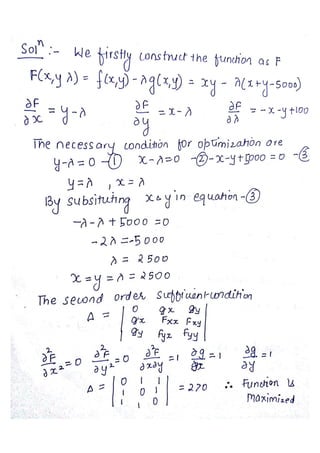
Question:1. Use the method
of Lagrange Multiplier to find
out the maximum value of
f 𝑥, 𝑦 = 𝑥𝑦
subject to constraint:
𝑔 𝑥, 𝑦 = 𝑥 + 𝑦 − 5000 = 0
Asha Rani
What is the Interpretation of Lagrangian
Multiplier - ?
It represents – Increase in the Value of
Objective Function if the constraint is
relaxed by one unit.
It is called – Marginal Contribution of
‘relaxation’ of the constraint by one unit.
B.Com. (Hons.), IIIrd Semester
Business Mathematics, Section A and H Asha Rani
Class Discussion Questions of Partial Derivative
Basic Questions
Ques:1. Find out the Second order Partial Derivatives of 𝑧 = 2𝑥2
𝑦2
+ 3𝑥𝑦2
+ 𝑦3
.
Ques:2. Show that function 𝐹(𝑥, 𝑦) = [𝑎𝑥−𝛽
+ b𝑦−𝛽
]
−
1
β
is homogeneous of degree 1.
Ques:3. Verify Euler’s Theorem for 𝑧 = 𝑥2
𝑒𝑦/𝑥
.
Ques:4. Calculate the first and second order differentials of the function:
𝑦 = 3𝑥2
+ 𝑥𝑦 − 2𝑦2
Ques:5. Examine the following function for local maxima and minima:
𝑧 = 𝑓(𝑥, 𝑦) = 10𝑥 + 20𝑦 − 2𝑥𝑦 − 3𝑥2
− 2𝑦2
Ques:6. Examine the function 𝑧 = 𝑓(𝑥, 𝑦) = −𝑥3
+ 27𝑥 − 4𝑦2
for local extrema.
Application of Partial Derivative
Ques:7. If x1 and p1 are the demand and prices of tea, x2 and p2 are demand and price
of coffee and demand function are given by:
𝑥1 = 𝑝1
−1.7
𝑝2
0.6
and 𝑥2 = 𝑝1
0.4
𝑝2
−0.8
Calculate the two cross elasticities of demand and point out whether the commodities
are competitive or complementary.
Ques:8. Given the demand functions of two commodities as:
𝑄1 = 2000 +
400
𝑝1+3
− 50𝑝2 and 𝑄2 = 2000 +
500
𝑝1+4
− 100𝑝2
(i) Find the nature of commodities.
(ii) Calculate the four partial elasticities of p1= 5 and p2 =1.
Ques: 9. The joint demand functions of two products are 𝑥1 = 2𝑝1
−0.6
𝑝2
0.8
and
𝑥2 = 3𝑝1
0.7
𝑝2
−0.5
, where 𝑥1 and 𝑥2 are the units demanded of the two products when
their prices are Rs. 𝑝1 and Rs. 𝑝2 per unit respectively. Find four partial price
elasticities at the particular prices 𝑝1 and 𝑝2. Also find the % changes in the quantity
demanded when:
(i) 𝑝1 increases by 2% from the existing level.
B.Com. (Hons.), IIIrd Semester
Business Mathematics, Section A and H Asha Rani
(ii) 𝑝2 increases by 2% from the existing level.
Ques:10. The production function of a commodity is: Q = 10L – 0.1L2
+15K – 0.2K2
+2KL where L is labour, K is capital and Q is production.
(i) Calculate the marginal products of the two inputs when 10 units of each
labour and capital are used,
(ii) If 10 units of capital are used, what is the upper limit for the use of labour
which a rational producer will never exceeds.
Ques:11. Suppose a firm has a production 𝑥 = [𝑎𝐿4
+ 𝑏𝐾4
]1/2
, 0<a<1, 0<b<1,
where L and K are labour and capital respectively. Find the marginal product of
Labour and marginal product of capital. Compute the degree of homogeneity and
verify Euler’s Theorem. What is the nature of returns to scale?
Ques:12. Define homogeneous function. Find out the degree of homogeneity of the
following production function:
𝑄−𝛽
= 𝑎𝐾−𝛽
+ 𝑏𝐿−𝛽
,
where Q represents the output, L and K denotes the factors of production labour and
capital respectively.
Ques:13. For the following production function, show that the marginal products
depend upon only on the ratio of factors
𝑥 = 𝑓(𝑙, 𝑘) =
2ℎ𝑙𝑘−𝛼𝑙2−𝛽𝑘2
𝑐𝑙+𝑑𝑘
Also, determine the degree of homogeneity and verify Euler’s theorem for the
function.
Ques:14. The following is a linear homogeneous production function, where X,L, K
represents output, labour and capital respectively: 𝑋 = √𝑎𝐿2 + 2ℎ𝐿𝐾 + 𝑏𝐾2, show
that the sum of L times the marginal product of labour and K times the marginal
product of capital equals to total product.
Ques:15. A production function is given by Q=AL1/3
K1/3
, where L and K denotes the
factors of production labour and capital respectively
(i) Find the behaviour of marginal product of each factor.
(ii) What is the nature of returns to scale?
B.Com. (Hons.), IIIrd Semester
Business Mathematics, Section A and H Asha Rani
(iii) Show that the total product is not exhausted if each factor is paid a price
equal to its marginal product.
Ques:16. At a certain factory, daily output is Q = 60L1/3
K1/2
units, where L indicates
the size of the labour force and K denotes capital investment. Use the concept of total
differential to estimate the %by which the daily output change if the capital investment
and labour force are both increased by 3 %. What is the nature of returns ton scale in
this case?
Ques:17. If the production functions is: X = 2ALK – BL2
– CK2
, find dK/dL and
d2
K/d2
L. Under what condition the isoquants are downward sloping and convex to the
origin?
Ques:18. Find the marginal rate of technical substitution and the elasticity of
substitution for the following production function:
𝑥 = 𝑓(𝑙, 𝑘) = [𝛼𝑘−𝜃
+ (1 − 𝛼)𝑙−𝜃
]-1/θ
Where x is the total output obtained by using l and k units of labour and capital
respectively.
Ques:19. Use the method of Lagrange Multiplier to find out the maximum value of
𝑓(𝑥, 𝑦) = 𝑥𝑦
subject to constraint:
𝑔(𝑥, 𝑦) = 𝑥 + 𝑦 − 5000 = 0
Ques:20. A producer desires to minimize his cost of production C = 2L + 5K, where
L and K are inputs, subject to production function Q = LK. Use the method of
Lagrange Multiplier to find out the optimum combination of inputs if total output is
40 units.
Ques:21. A company manufactures two types of typewriters – electrical (E) and
manual (M). The revenue function of the company, in thousands, is:
R=8E+ 5M + 2EM – E2
- 2M2
+20, Determine the quantity of electrical and manual
typewriters which lead to maximum revenue. Also calculate the maximum revenue.
Ques: 22. A firm sells two products A and B, their joint demand functions are
𝑥1 = 175 − 4𝑝1 − 𝑝2 and 𝑥2 = 90 − 2𝑝1 − 3𝑝2,
B.Com. (Hons.), IIIrd Semester
Business Mathematics, Section A and H Asha Rani
where 𝑥1 and 𝑥2 are the units demanded for the two products when their prices are
given as 𝑝1and 𝑝2 per unit respectively. Determine the prices which should be charged
to maximize total revenue of the two products. Also, find the maximum revenue.
Ques: 23. A firm produces two items X1 and X2. The market Prices are given by p1
=100 – 2x1 and p2 = 125 – 3x2. The cost of production is 12x1 +11x2 +4x1x2 for
producing x1 and x2 items. Find how many items of each should be produced to have
the joint profit maximum?
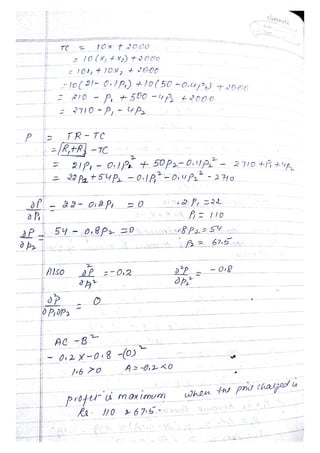
Ques: 24. A monopolist charges different prices in the two markets where his demand
function are x1 = 21 -0.1p1 and x2 = 50 – 0.4p2, p1 and p2 being prices and x1 and x2 are
quantities demanded. His total cost function is TC = 10x + 2000, where x is total
output. Find the prices that the monopolist should charge to maximize his profit. Also
verify that the higher price will be charged in the market having the lower price
elasticity of demand.
Ques: 25. A monopolist discriminates prices b/w two markets and the average
revenue functions for the two markets are:
𝐴𝑅1 = 53 − 4𝑄1 and 𝐴𝑅2 = 29 − 3𝑄2
And his total cost function is C + 5Q. Find the profit maximizing outputs and prices
in the two markets. What are these values when there is no price discrimination?

Partial Derivatives.pdf

  • 1.
    APPLICATION OF PARTIAL DERIVATIVES AshaRani Business Mathematics Section H, IV Semester
  • 3.
    Asha Rani To revisewhat we have done so far in class in Calculus… Limit, function and Continuity First order derivatives – Increasing & decreasing Function and its Application Second order derivatives- Concavity, Convexity and point of inflection and its application Maxima, minima and its Application Partial derivatives- Basics Application of Partial derivates – Elasticities, Marginal Productivity.
  • 4.
    Asha Rani Session Details Thissession covers : - • Marginal Rate of Technical Substitution • Elasticity of Substitution • Multi-variate Optimisation • Constrained Optimisation Solved illustrations and Practice Handouts are provided separately.
  • 5.
    Asha Rani Marginal Rateof Technical Substitution Marginal Rate of Technical Substitution is the amount by which the quantity of one input has to be reduced when one extra unit of another input is used, so that output remains constant. It shows the relation between inputs, and the trade-offs amongst them, without changing the level of total output. MRTS is equal to the slope of Isoquants. When using common inputs such as capital (K) and labour (L), the MRTS can be obtained using the following formula:
  • 6.
    Asha Rani Marginal Rateof Technical Substitution • Let Production function is 𝑃 = 𝑓(𝐿, 𝐾) • By definition 𝑀𝑅𝑇𝑆 = − 𝑑𝐾 𝑑𝐿 • Total differential of the production function 𝑑𝑃 = 𝑓𝐿𝑑𝐿 + 𝑓𝐾𝑑𝐾 𝑓𝐿 and 𝑓𝐾 are Marginal productivity of Labour & Capital which are partial derivatives of P w.r.t. L and K respectively. • Along the an Isoquant, 𝑑𝑃 = 0 0 = 𝑓𝐿𝑑𝐿 + 𝑓𝐾𝑑𝐾 − 𝑑𝐾 𝑑𝐿 = 𝑓𝐿 𝑓𝐾 i.e. 𝑀𝑅𝑇𝑆 = 𝑓𝐿 𝑓𝐾
  • 7.
    Asha Rani Elasticity ofSubstitution • Elasticity of substitution is defined as the ratio of the percentage change in the K/L ratio to the percentage change of the MRTSLK • 𝜎 = Τ 𝑑 Τ 𝐾 𝐿 ( Τ 𝐾 𝐿) Τ 𝑑 𝑀𝑅𝑇𝑆 𝑀𝑅𝑇𝑆 = 𝑀𝑅𝑇𝑆 ∗ 𝐿 𝐾 ∗ 1 𝑑 𝑀𝑅𝑇𝑆 𝑑 𝐾 𝐿
  • 8.
    Asha Rani Illustrative Problem Ques:1.Find the marginal rate of technical substitution and the elasticity of substitution for the following production function: 𝑥 = 𝑓 𝑙, 𝑘 = 𝛼𝑘−𝜃 + 1 − 𝛼 𝑙−𝜃 − 1 𝜃 Where x is the total output obtained by using l and k units of labour and capital respectively.
  • 11.
    Asha Rani Now, let’smove to maxima and minima using Calculus … More than One Independent Variables.
  • 12.
    Asha Rani NOW, LET’SMOVE TO MINIMA AND MAXIMA USING CALCULUS … MORE THAN ONE INDEPENDENT VARIABLES. MINIMA AND MAXIMA – MORE THAN ONE INDEPENDENT VARIABLE (X) WITHOUT CONSTRAINTS  Necessary Condition for Maxima and Minima: If a function f(x,y) is continuous and differentiable everywhere in the interval [a,b], and has a maxima or minima, then fx = fy = 0.  Sufficient Condition for Maxima and Minima: If f(x,y) is continuous and twice differentiable everywhere in the interval [a,b] and fx = fy = 0, then f(x,y) has – o Maximum Value: if fxx fyy - fxy > 0; the function will have a maximum value if fxx, fyy < 0 o Minimum Value: if fxx fyy - fxy > 0; the function will have a minimum value if fxx , fyy > 0 Note: i. Since for both minima and maxima, fxx fyy - fxy > 0, fxx and fyy must be of the same sign. ii. If fxx fyy - fxy < 0, neither a maxima nor a minima exists and in such a case, there exists a Saddle Point. 2 2 2 2
  • 14.
    Asha Rani Illustrative Problem Question:1.A company manufactures two types of typewriters – electrical (E) and manual (M). The revenue function of the company, in thousands, is: R=8E+ 5M + 2EM – E2 - 2M2 +20, Determine the quantity of electrical and manual typewriters which lead to maximum revenue. Also calculate the maximum revenue.
  • 16.
    Asha Rani Let usalso cover one more problem given in the handouts
  • 19.
    Asha Rani Lagrange’s Multiplier- AMethod of Constrained Optimization
  • 20.
    Asha Rani Lagrange’s Multiplier… Itis a method that help us in optimizing a particular function subject to a constraint. Let’s consider a two variable function: f(x,y) which is to be optimized subject to a constraint: g(x,y)=0. Also, let  be the Lagrangian Multiplier and 𝜆g(x,y)=0. Then, we can define a Lagrangian Function as follows:L(x, y, 𝜆) = f(x,y) - 𝜆g(x,y)
  • 21.
    Asha Rani Lagrange’s Multiplier… Now,calculate the partial derivatives of L(x, y, 𝜆) with respect to x, y and 𝜆 and put them equal to zero. And, solve for x, y and 𝜆. To check whether f(x,y) is maxima or minima, find the following Hessian Determinant- 0 x y x xx xy x yx yy g g H g f f g f f =
  • 22.
    Asha Rani Lagrange’s Multiplier… IfH is greater than zero, the f(x,y) is maximum; if H is less than zero, f(x,y) is minimum.
  • 23.
    Asha Rani Illustrative Problem Question:1.Use the method of Lagrange Multiplier to find out the maximum value of f 𝑥, 𝑦 = 𝑥𝑦 subject to constraint: 𝑔 𝑥, 𝑦 = 𝑥 + 𝑦 − 5000 = 0
  • 25.
    Asha Rani What isthe Interpretation of Lagrangian Multiplier - ? It represents – Increase in the Value of Objective Function if the constraint is relaxed by one unit. It is called – Marginal Contribution of ‘relaxation’ of the constraint by one unit.
  • 26.
    B.Com. (Hons.), IIIrdSemester Business Mathematics, Section A and H Asha Rani Class Discussion Questions of Partial Derivative Basic Questions Ques:1. Find out the Second order Partial Derivatives of 𝑧 = 2𝑥2 𝑦2 + 3𝑥𝑦2 + 𝑦3 . Ques:2. Show that function 𝐹(𝑥, 𝑦) = [𝑎𝑥−𝛽 + b𝑦−𝛽 ] − 1 β is homogeneous of degree 1. Ques:3. Verify Euler’s Theorem for 𝑧 = 𝑥2 𝑒𝑦/𝑥 . Ques:4. Calculate the first and second order differentials of the function: 𝑦 = 3𝑥2 + 𝑥𝑦 − 2𝑦2 Ques:5. Examine the following function for local maxima and minima: 𝑧 = 𝑓(𝑥, 𝑦) = 10𝑥 + 20𝑦 − 2𝑥𝑦 − 3𝑥2 − 2𝑦2 Ques:6. Examine the function 𝑧 = 𝑓(𝑥, 𝑦) = −𝑥3 + 27𝑥 − 4𝑦2 for local extrema. Application of Partial Derivative Ques:7. If x1 and p1 are the demand and prices of tea, x2 and p2 are demand and price of coffee and demand function are given by: 𝑥1 = 𝑝1 −1.7 𝑝2 0.6 and 𝑥2 = 𝑝1 0.4 𝑝2 −0.8 Calculate the two cross elasticities of demand and point out whether the commodities are competitive or complementary. Ques:8. Given the demand functions of two commodities as: 𝑄1 = 2000 + 400 𝑝1+3 − 50𝑝2 and 𝑄2 = 2000 + 500 𝑝1+4 − 100𝑝2 (i) Find the nature of commodities. (ii) Calculate the four partial elasticities of p1= 5 and p2 =1. Ques: 9. The joint demand functions of two products are 𝑥1 = 2𝑝1 −0.6 𝑝2 0.8 and 𝑥2 = 3𝑝1 0.7 𝑝2 −0.5 , where 𝑥1 and 𝑥2 are the units demanded of the two products when their prices are Rs. 𝑝1 and Rs. 𝑝2 per unit respectively. Find four partial price elasticities at the particular prices 𝑝1 and 𝑝2. Also find the % changes in the quantity demanded when: (i) 𝑝1 increases by 2% from the existing level.
  • 27.
    B.Com. (Hons.), IIIrdSemester Business Mathematics, Section A and H Asha Rani (ii) 𝑝2 increases by 2% from the existing level. Ques:10. The production function of a commodity is: Q = 10L – 0.1L2 +15K – 0.2K2 +2KL where L is labour, K is capital and Q is production. (i) Calculate the marginal products of the two inputs when 10 units of each labour and capital are used, (ii) If 10 units of capital are used, what is the upper limit for the use of labour which a rational producer will never exceeds. Ques:11. Suppose a firm has a production 𝑥 = [𝑎𝐿4 + 𝑏𝐾4 ]1/2 , 0<a<1, 0<b<1, where L and K are labour and capital respectively. Find the marginal product of Labour and marginal product of capital. Compute the degree of homogeneity and verify Euler’s Theorem. What is the nature of returns to scale? Ques:12. Define homogeneous function. Find out the degree of homogeneity of the following production function: 𝑄−𝛽 = 𝑎𝐾−𝛽 + 𝑏𝐿−𝛽 , where Q represents the output, L and K denotes the factors of production labour and capital respectively. Ques:13. For the following production function, show that the marginal products depend upon only on the ratio of factors 𝑥 = 𝑓(𝑙, 𝑘) = 2ℎ𝑙𝑘−𝛼𝑙2−𝛽𝑘2 𝑐𝑙+𝑑𝑘 Also, determine the degree of homogeneity and verify Euler’s theorem for the function. Ques:14. The following is a linear homogeneous production function, where X,L, K represents output, labour and capital respectively: 𝑋 = √𝑎𝐿2 + 2ℎ𝐿𝐾 + 𝑏𝐾2, show that the sum of L times the marginal product of labour and K times the marginal product of capital equals to total product. Ques:15. A production function is given by Q=AL1/3 K1/3 , where L and K denotes the factors of production labour and capital respectively (i) Find the behaviour of marginal product of each factor. (ii) What is the nature of returns to scale?
  • 28.
    B.Com. (Hons.), IIIrdSemester Business Mathematics, Section A and H Asha Rani (iii) Show that the total product is not exhausted if each factor is paid a price equal to its marginal product. Ques:16. At a certain factory, daily output is Q = 60L1/3 K1/2 units, where L indicates the size of the labour force and K denotes capital investment. Use the concept of total differential to estimate the %by which the daily output change if the capital investment and labour force are both increased by 3 %. What is the nature of returns ton scale in this case? Ques:17. If the production functions is: X = 2ALK – BL2 – CK2 , find dK/dL and d2 K/d2 L. Under what condition the isoquants are downward sloping and convex to the origin? Ques:18. Find the marginal rate of technical substitution and the elasticity of substitution for the following production function: 𝑥 = 𝑓(𝑙, 𝑘) = [𝛼𝑘−𝜃 + (1 − 𝛼)𝑙−𝜃 ]-1/θ Where x is the total output obtained by using l and k units of labour and capital respectively. Ques:19. Use the method of Lagrange Multiplier to find out the maximum value of 𝑓(𝑥, 𝑦) = 𝑥𝑦 subject to constraint: 𝑔(𝑥, 𝑦) = 𝑥 + 𝑦 − 5000 = 0 Ques:20. A producer desires to minimize his cost of production C = 2L + 5K, where L and K are inputs, subject to production function Q = LK. Use the method of Lagrange Multiplier to find out the optimum combination of inputs if total output is 40 units. Ques:21. A company manufactures two types of typewriters – electrical (E) and manual (M). The revenue function of the company, in thousands, is: R=8E+ 5M + 2EM – E2 - 2M2 +20, Determine the quantity of electrical and manual typewriters which lead to maximum revenue. Also calculate the maximum revenue. Ques: 22. A firm sells two products A and B, their joint demand functions are 𝑥1 = 175 − 4𝑝1 − 𝑝2 and 𝑥2 = 90 − 2𝑝1 − 3𝑝2,
  • 29.
    B.Com. (Hons.), IIIrdSemester Business Mathematics, Section A and H Asha Rani where 𝑥1 and 𝑥2 are the units demanded for the two products when their prices are given as 𝑝1and 𝑝2 per unit respectively. Determine the prices which should be charged to maximize total revenue of the two products. Also, find the maximum revenue. Ques: 23. A firm produces two items X1 and X2. The market Prices are given by p1 =100 – 2x1 and p2 = 125 – 3x2. The cost of production is 12x1 +11x2 +4x1x2 for producing x1 and x2 items. Find how many items of each should be produced to have the joint profit maximum? Ques: 24. A monopolist charges different prices in the two markets where his demand function are x1 = 21 -0.1p1 and x2 = 50 – 0.4p2, p1 and p2 being prices and x1 and x2 are quantities demanded. His total cost function is TC = 10x + 2000, where x is total output. Find the prices that the monopolist should charge to maximize his profit. Also verify that the higher price will be charged in the market having the lower price elasticity of demand. Ques: 25. A monopolist discriminates prices b/w two markets and the average revenue functions for the two markets are: 𝐴𝑅1 = 53 − 4𝑄1 and 𝐴𝑅2 = 29 − 3𝑄2 And his total cost function is C + 5Q. Find the profit maximizing outputs and prices in the two markets. What are these values when there is no price discrimination?