V. IDENTITY, SEX, AND
THE METAPHYSICS
OF SUBSTANCE
➔ What can be meant by “identity”?
➔ How do the assumptions inform the
discourses on “gender identity”?
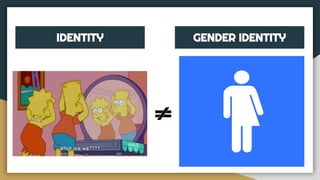
IDENTITY GENDER IDENTITY
NOTES
Butler claims the question of identity cannot proceed to gender identity
because “persons only become intelligible through becoming gendered in
conformity with the recognizable standards of gender intelligibility.”
Gendered conformity
● SEX
- sex doesn't tell you who you are it tells you what you are.Sex does
not define you
● GENDER
- represents who we are on the inside. The feeling we get when we wake
up every morning. Not what the world see when they look at us, but
what we see when we look at ourselves. Often people's gender do not
match their sex and cause confusion within themselves. Our gender
identity is who we decide to be after our chromosomes are set in
place. The problem with this is these rules society set in place for
us.
● Our sex is how we understand what we are anD ourgender is how we
understand who we are
➔ To what extent do regulatory
practices of gender formation and
division constitute identity
➔ Is “identity” a normative ideal rather
than a descriptive feature of
experience?
Notes
● the “coherence” and “continuity” of “the person” are not logical or
analytic features of personhood, but, rather, socially instituted and
maintained norms of intelligibility.
● “incoherent” and “discontinuous” gendered beings appear as persons but
fail to conform to the gendered norms of cultural intelligibility by
which persons are defined.
● Butler argues that discontinuity and incoherence are produced by the
very laws that seek to establish causal or expressive lines of
connection among biological sex, culturally constituted genders, and
the expression or effect of both in the manifestation of sexual desire
though sexual practice
● Butler argues that identity is an effect of discursive
practices--regulatory practices of compulsory heterosexuality, and
gender identity is understood as a relationship among sex, gender,
sexual practice, and desire.
● discursive practices
- A poststructuralist term for the way in which a discourse is acted
on and circulated within a culture.
- Poststructuralism A set of ideas that can be called postmodern
but that, following Michel Foucault, critically examine
structuralist concepts of truth, reality, self, and culture. This
way of thinking rejects the idea that power is centralized in the
major stuctures of society. It also rejects the idea of social
structures as natural or given. Instead, power is understood as
diffused throughout society as a result of the function of
discourse.
- Postmodern A philosophical movement across a variety of
disciplines that has sought to dismantle many of the assumptions
that underlie the established truths of the modern era.
Concepts of Sex
● Irigaray's
● Foucault’s
● Wittig’s
● Irigaray’s, that claim there is only one sex, the masculine, that
elaborates itself in and through the production of the “Other,”
● Foucault’s, for instance, that assume that the category of sex,
whether masculine or feminine, is a production of a diffuse regulatory
economy of sexuality
● Wittig’s argument that the category of sex is, under the conditions of
compulsory heterosexuality, always feminine (the masculine remaining
unmarked and, hence, synonymous with the “universal”).
● Wittig concurs,however paradoxically, with Foucault in claiming that
the category of sex would itself disappear and, indeed, dissipate
through the disruption and displacement of heterosexual hegemony
● The various explanatory models offered here suggest the very different
ways in which the category of sex is understood depending on how the
field of power is articulated
● The various explanatory models offered here suggest the
● very different ways in which the category of sex is understood
● depending on how the field of power is articulated.
●
●
●
Metaphysics of Substance
● Gender proves to be performative
● Gender is not a noun
● Butler argues that feminists have overly bought into the "metaphysics of
substance" (arguments of the importance of materiality), and instead, sees sex and
gender as both culturally influenced with meaning through linguistics and cultural
symbols.
● Performativity is not a single act, but instead is a " repetition" and "ritual" which is
naturalized " in the context of the body" (xv). Gender, rather than an intrinsic essence is
maintained and naturalized through acts through the body.
● Aretha Franklin (30). One is one’s gender to the extent that one is not the other gender, a
formulation that presupposes and enforces the restriction of gender within that binary pair.
This conception of gender presupposes a casual relation among SEX/GENDER/DESIRE (that desire
reflects or expresses gender and that gender reflects or expresses desire) and the
metaphysical unity of the three is assumed to be truly known and expressed. This dream of
symmetry is presupposed, reified and rationalized (31). So the appearance fo an “abiding
substance or gendered self” is thus produced by the regulation of attributes along culturally
established lines of coherence.
● Butler then claims that the “ontology of substances itself is not only an artificial effect,
but essentially superfluous” (34). THUS the substantive effect of gender is performatively
produced and compelled by the regulatory practices of gender coherence. Gender proves to be
performative within the discourse of the metaphysics of substance. Performative, that is,
constituting the identity it is purported to BE. She challenges us to rethink gender outside
the categories of the metaphysics of substance, and consider that: “there is no gender
identity behind the expressions of gender; that identity is performatively constituted by the
very expressions that are said to be its results.”

Part v: judith butler summary

  • 1.
    V. IDENTITY, SEX,AND THE METAPHYSICS OF SUBSTANCE
  • 2.
    ➔ What canbe meant by “identity”? ➔ How do the assumptions inform the discourses on “gender identity”?
  • 3.
  • 4.
    NOTES Butler claims thequestion of identity cannot proceed to gender identity because “persons only become intelligible through becoming gendered in conformity with the recognizable standards of gender intelligibility.” Gendered conformity ● SEX - sex doesn't tell you who you are it tells you what you are.Sex does not define you ● GENDER - represents who we are on the inside. The feeling we get when we wake up every morning. Not what the world see when they look at us, but what we see when we look at ourselves. Often people's gender do not match their sex and cause confusion within themselves. Our gender identity is who we decide to be after our chromosomes are set in place. The problem with this is these rules society set in place for us. ● Our sex is how we understand what we are anD ourgender is how we understand who we are
  • 5.
    ➔ To whatextent do regulatory practices of gender formation and division constitute identity ➔ Is “identity” a normative ideal rather than a descriptive feature of experience?
  • 6.
    Notes ● the “coherence”and “continuity” of “the person” are not logical or analytic features of personhood, but, rather, socially instituted and maintained norms of intelligibility. ● “incoherent” and “discontinuous” gendered beings appear as persons but fail to conform to the gendered norms of cultural intelligibility by which persons are defined. ● Butler argues that discontinuity and incoherence are produced by the very laws that seek to establish causal or expressive lines of connection among biological sex, culturally constituted genders, and the expression or effect of both in the manifestation of sexual desire though sexual practice ● Butler argues that identity is an effect of discursive practices--regulatory practices of compulsory heterosexuality, and gender identity is understood as a relationship among sex, gender, sexual practice, and desire.
  • 7.
    ● discursive practices -A poststructuralist term for the way in which a discourse is acted on and circulated within a culture. - Poststructuralism A set of ideas that can be called postmodern but that, following Michel Foucault, critically examine structuralist concepts of truth, reality, self, and culture. This way of thinking rejects the idea that power is centralized in the major stuctures of society. It also rejects the idea of social structures as natural or given. Instead, power is understood as diffused throughout society as a result of the function of discourse. - Postmodern A philosophical movement across a variety of disciplines that has sought to dismantle many of the assumptions that underlie the established truths of the modern era.
  • 8.
    Concepts of Sex ●Irigaray's ● Foucault’s ● Wittig’s
  • 9.
    ● Irigaray’s, thatclaim there is only one sex, the masculine, that elaborates itself in and through the production of the “Other,” ● Foucault’s, for instance, that assume that the category of sex, whether masculine or feminine, is a production of a diffuse regulatory economy of sexuality ● Wittig’s argument that the category of sex is, under the conditions of compulsory heterosexuality, always feminine (the masculine remaining unmarked and, hence, synonymous with the “universal”). ● Wittig concurs,however paradoxically, with Foucault in claiming that the category of sex would itself disappear and, indeed, dissipate through the disruption and displacement of heterosexual hegemony ● The various explanatory models offered here suggest the very different ways in which the category of sex is understood depending on how the field of power is articulated ● The various explanatory models offered here suggest the ● very different ways in which the category of sex is understood ● depending on how the field of power is articulated.
  • 10.
  • 11.
    Metaphysics of Substance ●Gender proves to be performative ● Gender is not a noun
  • 12.
    ● Butler arguesthat feminists have overly bought into the "metaphysics of substance" (arguments of the importance of materiality), and instead, sees sex and gender as both culturally influenced with meaning through linguistics and cultural symbols. ● Performativity is not a single act, but instead is a " repetition" and "ritual" which is naturalized " in the context of the body" (xv). Gender, rather than an intrinsic essence is maintained and naturalized through acts through the body. ● Aretha Franklin (30). One is one’s gender to the extent that one is not the other gender, a formulation that presupposes and enforces the restriction of gender within that binary pair. This conception of gender presupposes a casual relation among SEX/GENDER/DESIRE (that desire reflects or expresses gender and that gender reflects or expresses desire) and the metaphysical unity of the three is assumed to be truly known and expressed. This dream of symmetry is presupposed, reified and rationalized (31). So the appearance fo an “abiding substance or gendered self” is thus produced by the regulation of attributes along culturally established lines of coherence. ● Butler then claims that the “ontology of substances itself is not only an artificial effect, but essentially superfluous” (34). THUS the substantive effect of gender is performatively produced and compelled by the regulatory practices of gender coherence. Gender proves to be performative within the discourse of the metaphysics of substance. Performative, that is, constituting the identity it is purported to BE. She challenges us to rethink gender outside the categories of the metaphysics of substance, and consider that: “there is no gender identity behind the expressions of gender; that identity is performatively constituted by the very expressions that are said to be its results.”