1. What picture do you see on the
board?
2. How does an engine work?
3. Why an engine doesn’t get overheated?
4. Based from the activity we have, what
do you think will be our topic this day?
SERVICING
MECHANICAL SYSTEM -
COOLING SYSTEM (SMS)
What is a Cooling System?
A cooling system is made up of several
components that work together as one unit. It
keeps the vehicles’ internal combustion
engines within an acceptable range of
temperatures. Without a cooling system, your
engine would overheat, causing the pistons
and valves to warp.
What is a Cooling System?
In a way, the cooling system takes over your
car’s natural radiator and prevents it from
overheating on its own instead of relying on
air to keep cool. Without a proper car air
conditioner, it’ll stop operating correctly.
You’ll experience these hiccups more when
driving at high speeds or making it go through
demanding terrains such as hills and
mountains.
How Does an Engine Cooling System Work?
A vehicle’s cooling system removes heat from
the engine through water, coolant fluid, and
air. The vehicle’s water pump pressurizes
coolant inside hoses, which are connected to
different parts of your car. This includes your
radiator, heater core, and internal
combustion engine block
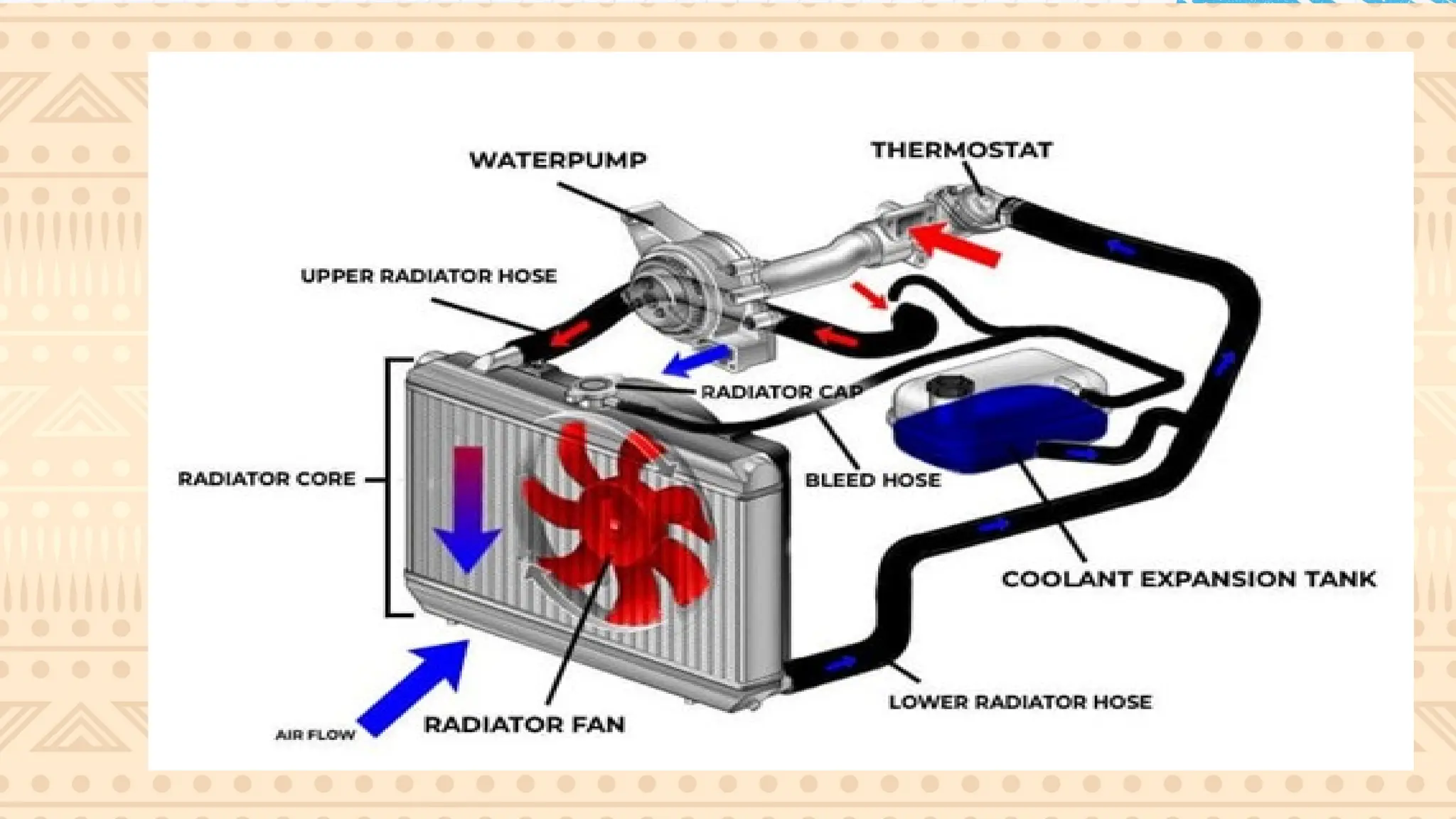
How Does an Engine Cooling System Work?
When you start your car, coolant flows through
closed passageways to your unit’s cylinder head.
Once it’s hot, the thermostat opens to allow
coolant into the radiator. From there, the radiator
absorbs heat from the engine’s water-cooled
components and sends it out of your vehicle via its
fins.
As air flows through your radiator, heat is dissipated
away from the coolant. The coolants will then go
back around to absorb more heat
The Components of a Cooling System
A vehicle’s cooling system comprises
different parts that keep the engine
at safe temperatures. The
components also protect it from
potential damage related to too
much heat exposure
Components of the Cooling System
The engine is where all
the action happens since
this is what makes a
vehicle go. A properly
working engine not only
allows your car to start on
demand but also keeps it
cool when running
Engines are designed with
cooling circuits that run liquid
coolant through passages in
the engine block. They’re
aided by the water pump,
which circulates liquid into
and out of the radiator to
transfer heat away.
Components of the Cooling
System
Radiator: The key
component that
dissipates heat from
the coolant into the
atmosphere through
air flow.
A radiator is located in
front of or behind the
engine. It has thin metal
fins protruding from its
length to increase surface
area for heat transfer. Its
size directly influences
how efficiently it will work
as a radiator.
Components of the Cooling
System
Water Pump:
Circulates coolant
throughout the
engine block and
the radiator.
It is transparent in colour.
You can easily track your
levels by looking at it
directly or through a
reservoir tank underneath
the hood. Coolant flows
through the entire cooling
system.
Components of the Cooling
System
Water Pump: the coolant
needs periodic
replacement considering
that it naturally loses its
ability to retain high levels
of coolants over time
Water picks up heat from
engine parts bringing it
into contact with radiator
fins before handing it to
the air flowing past the
radiator. The fluid also
transfers heat away from
the engine block.
Components of the Cooling System
Cooling Fan: The cooling
fan works under command
from your car’s computer or
by a manually operated
switch to turn on and off as
needed. It creates airflow
over the radiator, which
helps it cool down and
prevent overheating.
If you drive your car for
long periods without
letting the engine run at
average temperature,
it’ll activate the cooling
fan more frequently.
Components of the Cooling System
Hoses: Hoses connect
different components
and carry coolant or
oil mixture from the
engine to radiator and
back again.
It connects the water
pump and engine block
to allow water access
throughout the cooling
system for a constant
cooling effect.
Components of the Cooling
System
Coolant (Antifreeze):
The fluid that absorbs
heat from the engine
and carries it to the
radiator.
Components of the Cooling
System
The thermostat’s primary purpose
is to regulate coolant
temperature by ensuring it
doesn’t exceed safe limits. Its
secondary function is to make
sure your car gets warm enough
in cold weather. This way, you
can defrost windows and see
where you’re going without
wearing ski goggles and earmuffs.
It does this by opening and
closing as needed to allow
coolant to circulate through
the engine block. If the
engine is cold, the thermostat
stops coolant flow until it
reaches optimum
temperature, after which it
opens to allow circulation
again.
There are mainly two types of
cooling systems :
(a) Air cooled system, and
(b) Water cooled system.
1. Air Cooled System
 Air Cooled system is generally used in small engine
such as 15-20KW and in aero plane engines
 In this system fins or extended surface are provided
on the cylinder wall, cylinder head etc.
 Heat generated due to combustion in the engine
cylinder will be conducted to the fins and when the
air flows over the fins, heat will be dissipated to air.
What is the purpose of the cooling
system?
Purpose- to remove the excessive heat from the
engine to avoid components in the engine
damaged.
Too much cooling is also not desirable because it
reduce the thermal efficiency.
The engine will perform best in the desired operating
temperature.
Factors affect cooling efficiency
The amount of heat dissipated to air
depends upon:
1. amount of air flowing through the fins.
2. Fin surface area.
3. Thermal conductively of metal used
for fins.
Advantages:
System is light because radiator/pump is
absent.
There are no leakages.
Coolant and antifreeze solution are not
required.
Can be used in cold climates, where if
water is used it may freeze.
Disadvantages:
Comparatively it is less efficient.
It is used in aero planes and motorcycle
engines where the engines are exposed
to air directly.
2. Water-cooled System
 In this method, cooling water jackets are provided
around the cylinder, cylinder head, valve seat etc.
 The water when circulated through the jackets, it
absorbs heat of combustion.
 This hot water will then be cooling in the radiator
partially by a fan and partially by the flow
developed by the forward motion of the vehicle.
 The cooled water is again recirculated through the
water jackets.
Advantages:
 Uniform cooling of cylinder, cylinder head and
valves
 Specific fuel consumption of engine improves by
using water cooling system.
 If we employ water cooling system, then engine
need not be provided at the front end of moving
vehicle.
 Engine is less noisy as compared with air cooled
engines, as it has water for damping noise.
Disadvantages:
It depends upon the supply of water.
The water pump which circulates water
absorbs considerable power.
If the water cooling system fails then it will
result in severe damage of engine.
The water cooling system is high cost as it has
more number of parts.
Also it requires more maintenance and care
for its parts.
Now let’s an activity. Posted on the board is a
‘word puzzle’ The word are related in our topic.
what you are going to do is to find words. The
words may appear horizontally,
diagonally(backward/upward).
When you find the word, circle it in the puzzle then
cross it off on the list.
C S D R E I O O L I W A T H O S E S E R
O R A D A R T O R H O S S P U N M P W H
L W O W A W A T E R P U M P O I A E O
R I C W F W D W A A G G W L A T S N H
H J K O N A A C I A A E E A I E S Y G O
M R A O T A T O D A N N R R M G S E S
E A D L E N F O N O T G G C E E N T N S
T D C I R R E G U L S O O T D T I I G E
S W O S W A R L N I A O R E A T L E I E
Y I O Y A D P I R I L G T S Y S M N W
S A L T S I U N E E L E S A H A R S E A
G T A I S A M G D O O O A Y A Y G T
N O N H T T M S S L M O O A P A I T I A
I F T H O R Y Y G R O L G C E S S M N I
L H A N E S H T E G L I E S D K G E E R
O O I E T O O H S E I S N W A N N M A C
O S R E E R T E E N S Y G A T I E A I O
C R M N M E T S Y S D E L O O C R I A L
Divide the learner into two group and
each group will debate with the
topic about which is the better to use
the water cooled or air cooled
system?
Criteria Excellent (4) Good (3) Satisfactory (2) Needs Improvement (1)
Knowledge and
Under-
standing
Demonstrates
thorough
understanding of both
water-cooled and air-
cooled systems,
including technical
details and benefits.
Shows good
understanding of both
systems with some
technical details and
benefits.
Demonstrates basic
understanding but
lacks depth or
overlooks key
technical aspects.
Shows little
understanding of the
systems or their
technical differences.
Use of Evidence
Effectively uses
relevant and credible
sources to support
arguments. Integrates
evidence seamlessly
into arguments.
Uses sources to
support arguments
but may lack
integration or clarity
in some instances.
Attempts to use
sources but with
limited relevance or
effectiveness.
Uses irrelevant
sources or fails to
support arguments
with credible
evidence.
Engagement and
Participation
Actively engages in the
debate, contributing
relevant points and
responding thoughtfully
to peers.
Generally participates
in the debate,
contributing points and
responding to peers.
Participation is
minimal or lacks
active engagement
with peers' arguments.
Shows disinterest or
minimal contribution to
the debate.
Sketch or draw their ideal cooling system for
a classroom or learning environment on
paper.
ACTIVITY
Materials Needed:
• Paper
• Markers, colored pencils, or crayons
• Optional: Access to internet for research
purposes
Divide the class into five teams. Each
group must be performed leakage test on
cooling system and observe
Occupational Health and Safety
practices.
Instructions:
1. Prepare tools and materials needed
2. Ensure the engine is cool before starting.
3. Remove the radiator cap and attach the pressure
tester.
4. Pump the tester to the recommended pressure
(usually specified in the vehicle’s service manual).
5. Observe the pressure gauge. If it drops steadily, there
is a leak in the system.
6. Check for any signs of coolant escaping under
pressure
Components
of cooling
system
What Is the Major Cause of
Vehicle Cooling System Failure?
The most common problems regarding
cooling systems include leaks, corrosion,
rusted hoses, broken hoses, or
malfunctioning water pumps. Other issues
may involve the radiator fan not running
correctly because of a faulty sensor or
computer command.
Is It Safe to Drive With a Coolant Light on?
If your car’s cooling system has any problem, the red
warning light will turn on to alert you. It usually occurs
when sensors within the engine block detect low
fluid levels before anything gets too severe.
Once you notice this light, pull over and have a
mechanic inspect your vehicle. Don’t ignore it if you
want to prevent further damage that might be
expensive.
Activity 1: Split the class into small groups and give each
group a sample vehicle (or vehicle manual) to identify
the type of cooling system.
Have the students look for key components (radiator,
water pump, cooling fan, engine fins) to determine if the
vehicle uses a liquid or air cooling system.
Ask the students to write down the cooling system type
and explain how they identified it (based on components
like coolant hoses or the absence of a radiator).
EVALUATION:
Directions: Answer the following as indicated. Write your answers
on the answer sheet provided by your instructor.
1. What are the two types of cooling system?
2. What type of cooling system is that wherein heat is removed
from around the combustion chambers by a heat-absorbing liquid
(coolant) circulating inside the engine?
3. What is the type of cooling system which employs air rather
than liquid as the medium to transfer heat from the?
4. Enumerate at least 5 components/parts of the cooling system.
True or False. Write true if the statement is true; if false, write false.
Get your answer sheet from your trainer.
____ 1. From the water pump, the coolant goes into the engine
block.
____ 2. Coolant returns from the left radiator tank and lower hose
to the cylinder head.
____ 3. When the coolant is cold, the thermostat closes and the
coolant continues to flow.
____ 4. When the engine reaches normal operating temperature,
the thermostat closes and the coolant stops to flow.
____ 5. Low temperature causes lubricating oil to break down.
.

Part of the COOLING SYSTEM and Functions

  • 1.
    1. What picturedo you see on the board? 2. How does an engine work?
  • 2.
    3. Why anengine doesn’t get overheated? 4. Based from the activity we have, what do you think will be our topic this day?
  • 3.
  • 4.
    What is aCooling System? A cooling system is made up of several components that work together as one unit. It keeps the vehicles’ internal combustion engines within an acceptable range of temperatures. Without a cooling system, your engine would overheat, causing the pistons and valves to warp.
  • 5.
    What is aCooling System? In a way, the cooling system takes over your car’s natural radiator and prevents it from overheating on its own instead of relying on air to keep cool. Without a proper car air conditioner, it’ll stop operating correctly. You’ll experience these hiccups more when driving at high speeds or making it go through demanding terrains such as hills and mountains.
  • 7.
    How Does anEngine Cooling System Work? A vehicle’s cooling system removes heat from the engine through water, coolant fluid, and air. The vehicle’s water pump pressurizes coolant inside hoses, which are connected to different parts of your car. This includes your radiator, heater core, and internal combustion engine block
  • 8.
    How Does anEngine Cooling System Work? When you start your car, coolant flows through closed passageways to your unit’s cylinder head. Once it’s hot, the thermostat opens to allow coolant into the radiator. From there, the radiator absorbs heat from the engine’s water-cooled components and sends it out of your vehicle via its fins. As air flows through your radiator, heat is dissipated away from the coolant. The coolants will then go back around to absorb more heat
  • 9.
    The Components ofa Cooling System A vehicle’s cooling system comprises different parts that keep the engine at safe temperatures. The components also protect it from potential damage related to too much heat exposure
  • 10.
    Components of theCooling System The engine is where all the action happens since this is what makes a vehicle go. A properly working engine not only allows your car to start on demand but also keeps it cool when running Engines are designed with cooling circuits that run liquid coolant through passages in the engine block. They’re aided by the water pump, which circulates liquid into and out of the radiator to transfer heat away.
  • 11.
    Components of theCooling System Radiator: The key component that dissipates heat from the coolant into the atmosphere through air flow. A radiator is located in front of or behind the engine. It has thin metal fins protruding from its length to increase surface area for heat transfer. Its size directly influences how efficiently it will work as a radiator.
  • 12.
    Components of theCooling System Water Pump: Circulates coolant throughout the engine block and the radiator. It is transparent in colour. You can easily track your levels by looking at it directly or through a reservoir tank underneath the hood. Coolant flows through the entire cooling system.
  • 13.
    Components of theCooling System Water Pump: the coolant needs periodic replacement considering that it naturally loses its ability to retain high levels of coolants over time Water picks up heat from engine parts bringing it into contact with radiator fins before handing it to the air flowing past the radiator. The fluid also transfers heat away from the engine block.
  • 14.
    Components of theCooling System Cooling Fan: The cooling fan works under command from your car’s computer or by a manually operated switch to turn on and off as needed. It creates airflow over the radiator, which helps it cool down and prevent overheating. If you drive your car for long periods without letting the engine run at average temperature, it’ll activate the cooling fan more frequently.
  • 15.
    Components of theCooling System Hoses: Hoses connect different components and carry coolant or oil mixture from the engine to radiator and back again. It connects the water pump and engine block to allow water access throughout the cooling system for a constant cooling effect.
  • 16.
    Components of theCooling System Coolant (Antifreeze): The fluid that absorbs heat from the engine and carries it to the radiator.
  • 17.
    Components of theCooling System The thermostat’s primary purpose is to regulate coolant temperature by ensuring it doesn’t exceed safe limits. Its secondary function is to make sure your car gets warm enough in cold weather. This way, you can defrost windows and see where you’re going without wearing ski goggles and earmuffs. It does this by opening and closing as needed to allow coolant to circulate through the engine block. If the engine is cold, the thermostat stops coolant flow until it reaches optimum temperature, after which it opens to allow circulation again.
  • 20.
    There are mainlytwo types of cooling systems : (a) Air cooled system, and (b) Water cooled system.
  • 21.
    1. Air CooledSystem  Air Cooled system is generally used in small engine such as 15-20KW and in aero plane engines  In this system fins or extended surface are provided on the cylinder wall, cylinder head etc.  Heat generated due to combustion in the engine cylinder will be conducted to the fins and when the air flows over the fins, heat will be dissipated to air.
  • 22.
    What is thepurpose of the cooling system? Purpose- to remove the excessive heat from the engine to avoid components in the engine damaged. Too much cooling is also not desirable because it reduce the thermal efficiency. The engine will perform best in the desired operating temperature.
  • 24.
    Factors affect coolingefficiency The amount of heat dissipated to air depends upon: 1. amount of air flowing through the fins. 2. Fin surface area. 3. Thermal conductively of metal used for fins.
  • 25.
    Advantages: System is lightbecause radiator/pump is absent. There are no leakages. Coolant and antifreeze solution are not required. Can be used in cold climates, where if water is used it may freeze.
  • 26.
    Disadvantages: Comparatively it isless efficient. It is used in aero planes and motorcycle engines where the engines are exposed to air directly.
  • 27.
    2. Water-cooled System In this method, cooling water jackets are provided around the cylinder, cylinder head, valve seat etc.  The water when circulated through the jackets, it absorbs heat of combustion.  This hot water will then be cooling in the radiator partially by a fan and partially by the flow developed by the forward motion of the vehicle.  The cooled water is again recirculated through the water jackets.
  • 28.
    Advantages:  Uniform coolingof cylinder, cylinder head and valves  Specific fuel consumption of engine improves by using water cooling system.  If we employ water cooling system, then engine need not be provided at the front end of moving vehicle.  Engine is less noisy as compared with air cooled engines, as it has water for damping noise.
  • 29.
    Disadvantages: It depends uponthe supply of water. The water pump which circulates water absorbs considerable power. If the water cooling system fails then it will result in severe damage of engine. The water cooling system is high cost as it has more number of parts. Also it requires more maintenance and care for its parts.
  • 30.
    Now let’s anactivity. Posted on the board is a ‘word puzzle’ The word are related in our topic. what you are going to do is to find words. The words may appear horizontally, diagonally(backward/upward). When you find the word, circle it in the puzzle then cross it off on the list.
  • 31.
    C S DR E I O O L I W A T H O S E S E R O R A D A R T O R H O S S P U N M P W H L W O W A W A T E R P U M P O I A E O R I C W F W D W A A G G W L A T S N H H J K O N A A C I A A E E A I E S Y G O M R A O T A T O D A N N R R M G S E S E A D L E N F O N O T G G C E E N T N S T D C I R R E G U L S O O T D T I I G E S W O S W A R L N I A O R E A T L E I E Y I O Y A D P I R I L G T S Y S M N W S A L T S I U N E E L E S A H A R S E A G T A I S A M G D O O O A Y A Y G T N O N H T T M S S L M O O A P A I T I A I F T H O R Y Y G R O L G C E S S M N I L H A N E S H T E G L I E S D K G E E R O O I E T O O H S E I S N W A N N M A C O S R E E R T E E N S Y G A T I E A I O C R M N M E T S Y S D E L O O C R I A L
  • 32.
    Divide the learnerinto two group and each group will debate with the topic about which is the better to use the water cooled or air cooled system?
  • 33.
    Criteria Excellent (4)Good (3) Satisfactory (2) Needs Improvement (1) Knowledge and Under- standing Demonstrates thorough understanding of both water-cooled and air- cooled systems, including technical details and benefits. Shows good understanding of both systems with some technical details and benefits. Demonstrates basic understanding but lacks depth or overlooks key technical aspects. Shows little understanding of the systems or their technical differences. Use of Evidence Effectively uses relevant and credible sources to support arguments. Integrates evidence seamlessly into arguments. Uses sources to support arguments but may lack integration or clarity in some instances. Attempts to use sources but with limited relevance or effectiveness. Uses irrelevant sources or fails to support arguments with credible evidence. Engagement and Participation Actively engages in the debate, contributing relevant points and responding thoughtfully to peers. Generally participates in the debate, contributing points and responding to peers. Participation is minimal or lacks active engagement with peers' arguments. Shows disinterest or minimal contribution to the debate.
  • 34.
    Sketch or drawtheir ideal cooling system for a classroom or learning environment on paper. ACTIVITY Materials Needed: • Paper • Markers, colored pencils, or crayons • Optional: Access to internet for research purposes
  • 35.
    Divide the classinto five teams. Each group must be performed leakage test on cooling system and observe Occupational Health and Safety practices.
  • 36.
    Instructions: 1. Prepare toolsand materials needed 2. Ensure the engine is cool before starting. 3. Remove the radiator cap and attach the pressure tester. 4. Pump the tester to the recommended pressure (usually specified in the vehicle’s service manual). 5. Observe the pressure gauge. If it drops steadily, there is a leak in the system. 6. Check for any signs of coolant escaping under pressure
  • 39.
  • 40.
    What Is theMajor Cause of Vehicle Cooling System Failure? The most common problems regarding cooling systems include leaks, corrosion, rusted hoses, broken hoses, or malfunctioning water pumps. Other issues may involve the radiator fan not running correctly because of a faulty sensor or computer command.
  • 41.
    Is It Safeto Drive With a Coolant Light on? If your car’s cooling system has any problem, the red warning light will turn on to alert you. It usually occurs when sensors within the engine block detect low fluid levels before anything gets too severe. Once you notice this light, pull over and have a mechanic inspect your vehicle. Don’t ignore it if you want to prevent further damage that might be expensive.
  • 42.
    Activity 1: Splitthe class into small groups and give each group a sample vehicle (or vehicle manual) to identify the type of cooling system. Have the students look for key components (radiator, water pump, cooling fan, engine fins) to determine if the vehicle uses a liquid or air cooling system. Ask the students to write down the cooling system type and explain how they identified it (based on components like coolant hoses or the absence of a radiator).
  • 43.
  • 44.
    Directions: Answer thefollowing as indicated. Write your answers on the answer sheet provided by your instructor. 1. What are the two types of cooling system? 2. What type of cooling system is that wherein heat is removed from around the combustion chambers by a heat-absorbing liquid (coolant) circulating inside the engine? 3. What is the type of cooling system which employs air rather than liquid as the medium to transfer heat from the? 4. Enumerate at least 5 components/parts of the cooling system.
  • 45.
    True or False.Write true if the statement is true; if false, write false. Get your answer sheet from your trainer. ____ 1. From the water pump, the coolant goes into the engine block. ____ 2. Coolant returns from the left radiator tank and lower hose to the cylinder head. ____ 3. When the coolant is cold, the thermostat closes and the coolant continues to flow. ____ 4. When the engine reaches normal operating temperature, the thermostat closes and the coolant stops to flow. ____ 5. Low temperature causes lubricating oil to break down. .