Publick school No 12
Veriko Michitashvili – English teacher
Tsotne Japharidze – student
Manana Manvelishvili – student
Giorgi Surameli – student
Maia Papuashvili - student
Project Designers
Ana Abisonashvili - student
Giorgi Sanakoevi - student
Sopi Tsutskiridze - student
Giorgi Mtvarelidze – student
Elina Gozalovi - student
Project Designers
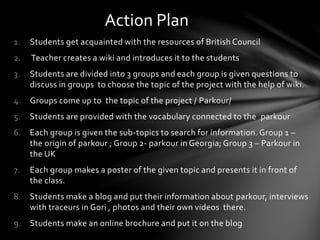
1. Students get acquainted with the resources of British Council
2. Teacher creates a wiki and introduces it to the students
3. Students are divided into 3 groups and each group is given questions to
discuss in groups to choose the topic of the project with the help of wiki.
4. Groups come up to the topic of the project / Parkour/
5. Students are provided with the vocabulary connected to the parkour
6. Each group is given the sub-topics to search for information. Group 1 –
the origin of parkour ; Group 2- parkour in Georgia; Group 3 – Parkour in
the UK
7. Each group makes a poster of the given topic and presents it in front of
the class.
8. Students make a blog and put their information about parkour, interviews
with traceurs in Gori , photos and their own videos there.
9. Students make an online brochure and put it on the blog
Action Plan
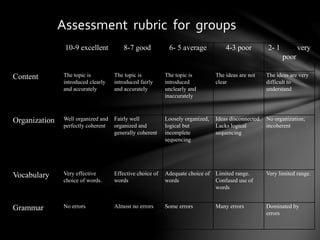
10-9 excellent 8-7 good 6- 5 average 4-3 poor 2- 1 very
poor
Content The topic is
introduced clearly
and accurately
The topic is
introduced fairly
and accurately
The topic is
introduced
unclearly and
inaccurately
The ideas are not
clear
The ideas are very
difficult to
understand
Organization Well organized and
perfectly coherent
Fairly well
organized and
generally coherent
Loosely organized,
logical but
incomplete
sequencing
Ideas disconnected.
Lacks logical
sequencing
No organization;
incoherent
Vocabulary Very effective
choice of words.
Effective choice of
words
Adequate choice of
words
Limited range.
Confused use of
words
Very limited range.
Grammar No errors Almost no errors Some errors Many errors Dominated by
errors
Assessment rubric for groups
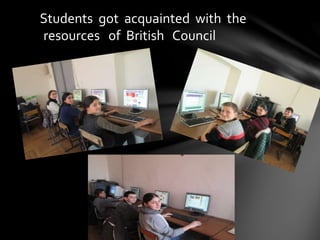
Students got acquainted with the
resources of British Council
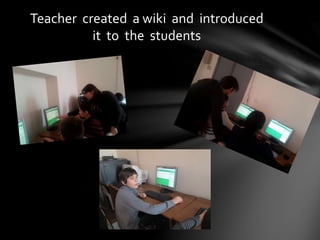
Teacher created a wiki and introduced
it to the students
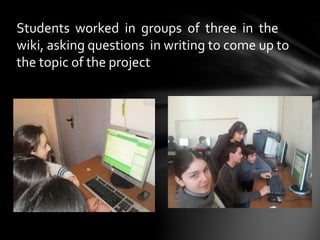
Students worked in groups of three in the
wiki, asking questions in writing to come up to
the topic of the project
http://veriko.pbworks.com
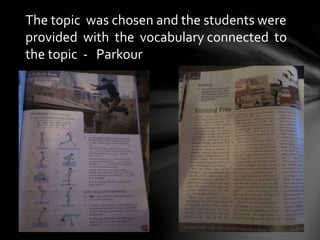
The topic was chosen and the students were
provided with the vocabulary connected to
the topic - Parkour
Group 1 – The origin of Parkour
Group 2 – Parkour in Georgia
Group 3 – parkour in the UK
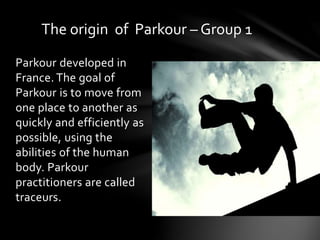
The origin of Parkour – Group 1
Parkour developed in
France. The goal of
Parkour is to move from
one place to another as
quickly and efficiently as
possible, using the
abilities of the human
body. Parkour
practitioners are called
traceurs.
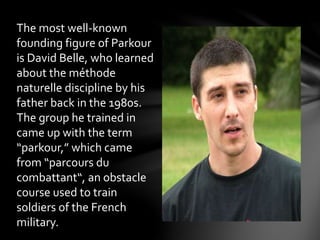
The most well-known
founding figure of Parkour
is David Belle, who learned
about the méthode
naturelle discipline by his
father back in the 1980s.
The group he trained in
came up with the term
“parkour,” which came
from “parcours du
combattant“, an obstacle
course used to train
soldiers of the French
military.
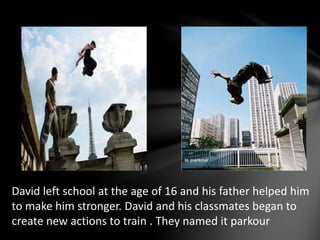
David left school at the age of 16 and his father helped him
to make him stronger. David and his classmates began to
create new actions to train . They named it parkour
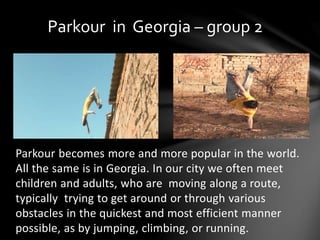
Parkour becomes more and more popular in the world.
All the same is in Georgia. In our city we often meet
children and adults, who are moving along a route,
typically trying to get around or through various
obstacles in the quickest and most efficient manner
possible, as by jumping, climbing, or running.
Parkour in Georgia – group 2
Parkour in Gori
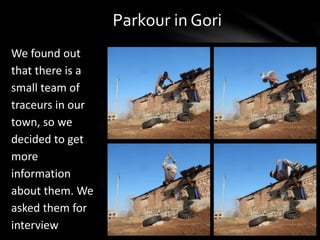
We found out
that there is a
small team of
traceurs in our
town, so we
decided to get
more
information
about them. We
asked them for
interview
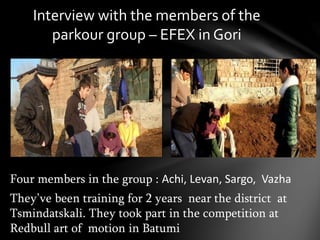
Interview with the members of the
parkour group – EFEX in Gori
Four members in the group : Achi, Levan, Sargo, Vazha
They’ve been training for 2 years near the district at
Tsmindatskali. They took part in the competition at
Redbull art of motion in Batumi
The performance of EFEX- filmed by
our group members
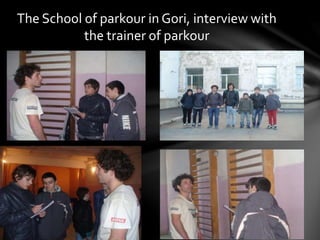
The School of parkour in Gori, interview with
the trainer of parkour
The performance of the future traceurs in
Gori – filmed by the members of our group
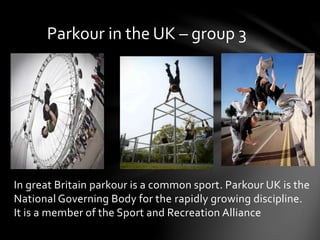
In great Britain parkour is a common sport. Parkour UK is the
National Governing Body for the rapidly growing discipline.
It is a member of the Sport and Recreation Alliance
Parkour in the UK – group 3
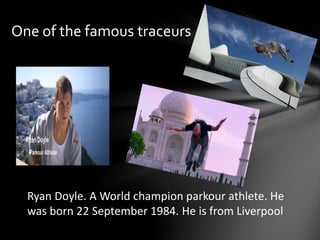
One of the famous traceurs
Ryan Doyle. A World champion parkour athlete. He
was born 22 September 1984. He is from Liverpool
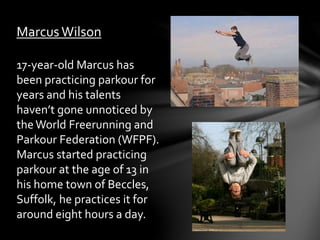
MarcusWilson
17-year-old Marcus has
been practicing parkour for
years and his talents
haven’t gone unnoticed by
theWorld Freerunning and
Parkour Federation (WFPF).
Marcus started practicing
parkour at the age of 13 in
his home town of Beccles,
Suffolk, he practices it for
around eight hours a day.
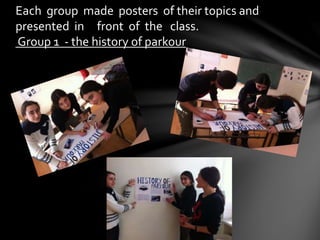
Each group made posters of their topics and
presented in front of the class.
Group 1 - the history of parkour
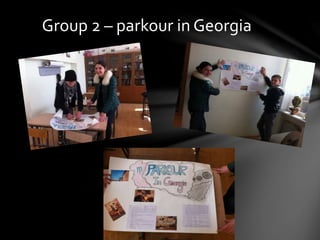
Group 2 – parkour in Georgia
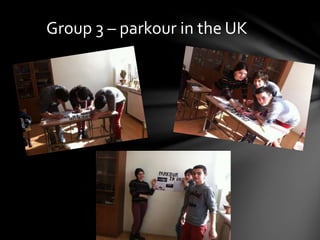
Group 3 – parkour in the UK
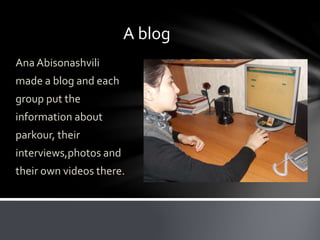
A blog
Ana Abisonashvili
made a blog and each
group put the
information about
parkour, their
interviews,photos and
their own videos there.
http://parkourefex.wordpress.com
Students learnt how to design an online
brochure and placed it on the blog
Thanks for watching

Parkour

  • 1.
  • 2.
    Veriko Michitashvili –English teacher Tsotne Japharidze – student Manana Manvelishvili – student Giorgi Surameli – student Maia Papuashvili - student Project Designers
  • 3.
    Ana Abisonashvili -student Giorgi Sanakoevi - student Sopi Tsutskiridze - student Giorgi Mtvarelidze – student Elina Gozalovi - student Project Designers
  • 4.
    1. Students getacquainted with the resources of British Council 2. Teacher creates a wiki and introduces it to the students 3. Students are divided into 3 groups and each group is given questions to discuss in groups to choose the topic of the project with the help of wiki. 4. Groups come up to the topic of the project / Parkour/ 5. Students are provided with the vocabulary connected to the parkour 6. Each group is given the sub-topics to search for information. Group 1 – the origin of parkour ; Group 2- parkour in Georgia; Group 3 – Parkour in the UK 7. Each group makes a poster of the given topic and presents it in front of the class. 8. Students make a blog and put their information about parkour, interviews with traceurs in Gori , photos and their own videos there. 9. Students make an online brochure and put it on the blog Action Plan
  • 5.
    10-9 excellent 8-7good 6- 5 average 4-3 poor 2- 1 very poor Content The topic is introduced clearly and accurately The topic is introduced fairly and accurately The topic is introduced unclearly and inaccurately The ideas are not clear The ideas are very difficult to understand Organization Well organized and perfectly coherent Fairly well organized and generally coherent Loosely organized, logical but incomplete sequencing Ideas disconnected. Lacks logical sequencing No organization; incoherent Vocabulary Very effective choice of words. Effective choice of words Adequate choice of words Limited range. Confused use of words Very limited range. Grammar No errors Almost no errors Some errors Many errors Dominated by errors Assessment rubric for groups
  • 6.
    Students got acquaintedwith the resources of British Council
  • 7.
    Teacher created awiki and introduced it to the students
  • 8.
    Students worked ingroups of three in the wiki, asking questions in writing to come up to the topic of the project
  • 9.
  • 10.
    The topic waschosen and the students were provided with the vocabulary connected to the topic - Parkour
  • 11.
    Group 1 –The origin of Parkour Group 2 – Parkour in Georgia Group 3 – parkour in the UK
  • 12.
    The origin ofParkour – Group 1 Parkour developed in France. The goal of Parkour is to move from one place to another as quickly and efficiently as possible, using the abilities of the human body. Parkour practitioners are called traceurs.
  • 13.
    The most well-known foundingfigure of Parkour is David Belle, who learned about the méthode naturelle discipline by his father back in the 1980s. The group he trained in came up with the term “parkour,” which came from “parcours du combattant“, an obstacle course used to train soldiers of the French military.
  • 14.
    David left schoolat the age of 16 and his father helped him to make him stronger. David and his classmates began to create new actions to train . They named it parkour
  • 15.
    Parkour becomes moreand more popular in the world. All the same is in Georgia. In our city we often meet children and adults, who are moving along a route, typically trying to get around or through various obstacles in the quickest and most efficient manner possible, as by jumping, climbing, or running. Parkour in Georgia – group 2
  • 16.
    Parkour in Gori Wefound out that there is a small team of traceurs in our town, so we decided to get more information about them. We asked them for interview
  • 17.
    Interview with themembers of the parkour group – EFEX in Gori Four members in the group : Achi, Levan, Sargo, Vazha They’ve been training for 2 years near the district at Tsmindatskali. They took part in the competition at Redbull art of motion in Batumi
  • 18.
    The performance ofEFEX- filmed by our group members
  • 19.
    The School ofparkour in Gori, interview with the trainer of parkour
  • 20.
    The performance ofthe future traceurs in Gori – filmed by the members of our group
  • 21.
    In great Britainparkour is a common sport. Parkour UK is the National Governing Body for the rapidly growing discipline. It is a member of the Sport and Recreation Alliance Parkour in the UK – group 3
  • 22.
    One of thefamous traceurs Ryan Doyle. A World champion parkour athlete. He was born 22 September 1984. He is from Liverpool
  • 23.
    MarcusWilson 17-year-old Marcus has beenpracticing parkour for years and his talents haven’t gone unnoticed by theWorld Freerunning and Parkour Federation (WFPF). Marcus started practicing parkour at the age of 13 in his home town of Beccles, Suffolk, he practices it for around eight hours a day.
  • 24.
    Each group madeposters of their topics and presented in front of the class. Group 1 - the history of parkour
  • 25.
    Group 2 –parkour in Georgia
  • 26.
    Group 3 –parkour in the UK
  • 27.
    A blog Ana Abisonashvili madea blog and each group put the information about parkour, their interviews,photos and their own videos there.
  • 28.
  • 29.
    Students learnt howto design an online brochure and placed it on the blog
  • 30.