• Edubilla.com is one of the fastest
growing education information
portals. It helps education
institutions thrive in an open and
dynamic world. Edubilla.com is
privately funded and backed by
leading provider of online web
solutions. We provide the great
platform to all the above people to
communicate together and share
knowledge and We strongly
believes about Social Learning. To
provide the best education platform,
You can join with us.
• Get all information towards Sports,
types of sports, lists of sports,
sports rules, sports equipments
details in edubilla.com. Also know
the sports origin, sports history etc
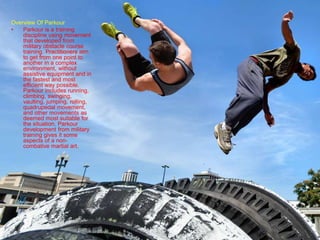
Overview Of Parkour
• Parkour is a training
discipline using movement
that developed from
military obstacle course
training. Practitioners aim
to get from one point to
another in a complex
environment, without
assistive equipment and in
the fastest and most
efficient way possible.
Parkour includes running,
climbing, swinging,
vaulting, jumping, rolling,
quadrupedal movement,
and other movements as
deemed most suitable for
the situation. Parkour
development from military
training gives it some
aspects of a non-
combative martial art.
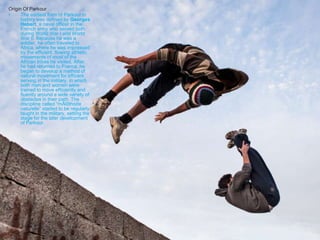
Origin Of Parkour
• The earliest form of Parkour in
history was defined by Georges
Hebert, a naval officer in the
French army who served both
during World War I and World
War II. Because he was a
soldier, he often traveled to
Africa, where he was impressed
by the efficient, flowing athletic
movements of most of the
African tribes he visited. After
he had returned to France, he
began to develop a method of
natural movement for officers
serving in the military, in which
both men and women were
trained to move efficiently and
fluently around a wide variety of
obstacles in their path. The
discipline called “méthode
naturelle” started to be regularly
taught in the military, setting the
stage for the later development
of Parkour.
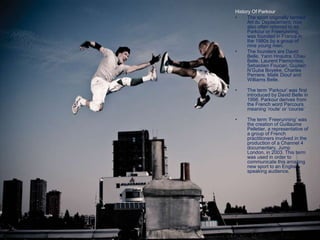
History Of Parkour
• The sport originally termed
Art du Deplacement, now
also often referred to as
Parkour or Freerunning,
was founded in France in
the 1980s by a group of
nine young men.
• The founders are David
Belle, Yann Hnautra, Chau
Belle, Laurent Piemontesi,
Sebastien Foucan, Guylain
N’Guba Boyeke, Charles
Perriere, Malik Diouf and
Williams Belle.
• The term ‘Parkour’ was first
introduced by David Belle in
1998. Parkour derives from
the French word Parcours
meaning ‘route’ or ‘course’
• The term ‘Freerunning’ was
the creation of Guillaume
Pelletier, a representative of
a group of French
practitioners involved in the
production of a Channel 4
documentary, Jump
London, in 2003. This term
was used in order to
communicate this amazing
new sport to an English-
speaking audience.
Governing Bodies
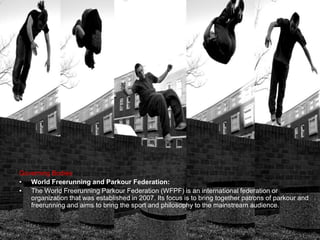
• World Freerunning and Parkour Federation:
• The World Freerunning Parkour Federation (WFPF) is an international federation or
organization that was established in 2007. Its focus is to bring together patrons of parkour and
freerunning and aims to bring the sport and philosophy to the mainstream audience.
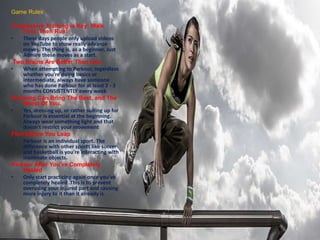
Game Rules
Progressive Training is Key: Walk
First, Then Run!
• These days people only upload videos
on YouTube to show really advance
moves. The thing is, as a beginner, Just
Admire these moves as a start.
Two Brains Are Better Than One
• When attempting to Parkour, regardless
whether you're doing basics or
intermediate, always have someone
who has done Parkour for at least 2 - 3
months CONSISTENTLY every week.
Dressing Can Bring The Best, and The
Worst Of You.
• Yes, dressing up, or rather suiting up for
Parkour is essential at the beginning.
Always wear something light and that
doesn't restrict your movement
Plan Before You Leap
• Parkour is an individual sport. The
difference with other sports like soccer
and basketball is you're interacting with
inanimate objects.
Parkour After You've Completely
Healed
• Only start practicing again once you've
completely healed .This is to prevent
overusing your injured part and causing
more injury to it than it already is.
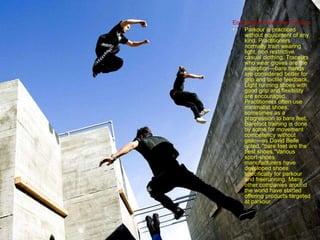
Equipments Need For Parkour
• Parkour is practiced
without equipment of any
kind. Practitioners
normally train wearing
light, non restrictive
casual clothing. Traceurs
who wear gloves are the
exception—bare hands
are considered better for
grip and tactile feedback.
Light running shoes with
good grip and flexibility
are encouraged.
Practitioners often use
minimalist shoes,
sometimes as a
progression to bare feet.
Barefoot training is done
by some for movement
competency without
gear—as David Belle
noted, "bare feet are the
best shoes."Various
sport-shoes
manufacturers have
developed shoes
specifically for parkour
and freerunning. Many
other companies around
the world have started
offering products targeted
at parkour
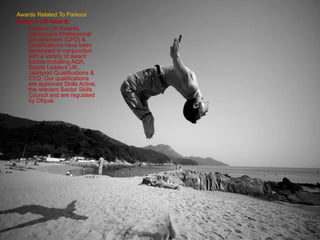
Awards Related To Parkour
Parkour UK Award:
• Parkour UK Awards,
Continuous Professional
Development (CPD) &
Qualifications have been
developed in conjunction
with a variety of award
bodies including AQA,
Sports Leaders UK,
1st4sport Qualifications &
CYQ. Our qualifications
are approved Skills Active,
the relevant Sector Skills
Council and are regulated
by Ofqual.
Parkour sports collection information

Parkour sports collection information

  • 2.
    • Edubilla.com isone of the fastest growing education information portals. It helps education institutions thrive in an open and dynamic world. Edubilla.com is privately funded and backed by leading provider of online web solutions. We provide the great platform to all the above people to communicate together and share knowledge and We strongly believes about Social Learning. To provide the best education platform, You can join with us. • Get all information towards Sports, types of sports, lists of sports, sports rules, sports equipments details in edubilla.com. Also know the sports origin, sports history etc
  • 3.
    Overview Of Parkour •Parkour is a training discipline using movement that developed from military obstacle course training. Practitioners aim to get from one point to another in a complex environment, without assistive equipment and in the fastest and most efficient way possible. Parkour includes running, climbing, swinging, vaulting, jumping, rolling, quadrupedal movement, and other movements as deemed most suitable for the situation. Parkour development from military training gives it some aspects of a non- combative martial art.
  • 4.
    Origin Of Parkour •The earliest form of Parkour in history was defined by Georges Hebert, a naval officer in the French army who served both during World War I and World War II. Because he was a soldier, he often traveled to Africa, where he was impressed by the efficient, flowing athletic movements of most of the African tribes he visited. After he had returned to France, he began to develop a method of natural movement for officers serving in the military, in which both men and women were trained to move efficiently and fluently around a wide variety of obstacles in their path. The discipline called “méthode naturelle” started to be regularly taught in the military, setting the stage for the later development of Parkour.
  • 5.
    History Of Parkour •The sport originally termed Art du Deplacement, now also often referred to as Parkour or Freerunning, was founded in France in the 1980s by a group of nine young men. • The founders are David Belle, Yann Hnautra, Chau Belle, Laurent Piemontesi, Sebastien Foucan, Guylain N’Guba Boyeke, Charles Perriere, Malik Diouf and Williams Belle. • The term ‘Parkour’ was first introduced by David Belle in 1998. Parkour derives from the French word Parcours meaning ‘route’ or ‘course’ • The term ‘Freerunning’ was the creation of Guillaume Pelletier, a representative of a group of French practitioners involved in the production of a Channel 4 documentary, Jump London, in 2003. This term was used in order to communicate this amazing new sport to an English- speaking audience.
  • 6.
    Governing Bodies • WorldFreerunning and Parkour Federation: • The World Freerunning Parkour Federation (WFPF) is an international federation or organization that was established in 2007. Its focus is to bring together patrons of parkour and freerunning and aims to bring the sport and philosophy to the mainstream audience.
  • 7.
    Game Rules Progressive Trainingis Key: Walk First, Then Run! • These days people only upload videos on YouTube to show really advance moves. The thing is, as a beginner, Just Admire these moves as a start. Two Brains Are Better Than One • When attempting to Parkour, regardless whether you're doing basics or intermediate, always have someone who has done Parkour for at least 2 - 3 months CONSISTENTLY every week. Dressing Can Bring The Best, and The Worst Of You. • Yes, dressing up, or rather suiting up for Parkour is essential at the beginning. Always wear something light and that doesn't restrict your movement Plan Before You Leap • Parkour is an individual sport. The difference with other sports like soccer and basketball is you're interacting with inanimate objects. Parkour After You've Completely Healed • Only start practicing again once you've completely healed .This is to prevent overusing your injured part and causing more injury to it than it already is.
  • 8.
    Equipments Need ForParkour • Parkour is practiced without equipment of any kind. Practitioners normally train wearing light, non restrictive casual clothing. Traceurs who wear gloves are the exception—bare hands are considered better for grip and tactile feedback. Light running shoes with good grip and flexibility are encouraged. Practitioners often use minimalist shoes, sometimes as a progression to bare feet. Barefoot training is done by some for movement competency without gear—as David Belle noted, "bare feet are the best shoes."Various sport-shoes manufacturers have developed shoes specifically for parkour and freerunning. Many other companies around the world have started offering products targeted at parkour
  • 9.
    Awards Related ToParkour Parkour UK Award: • Parkour UK Awards, Continuous Professional Development (CPD) & Qualifications have been developed in conjunction with a variety of award bodies including AQA, Sports Leaders UK, 1st4sport Qualifications & CYQ. Our qualifications are approved Skills Active, the relevant Sector Skills Council and are regulated by Ofqual.