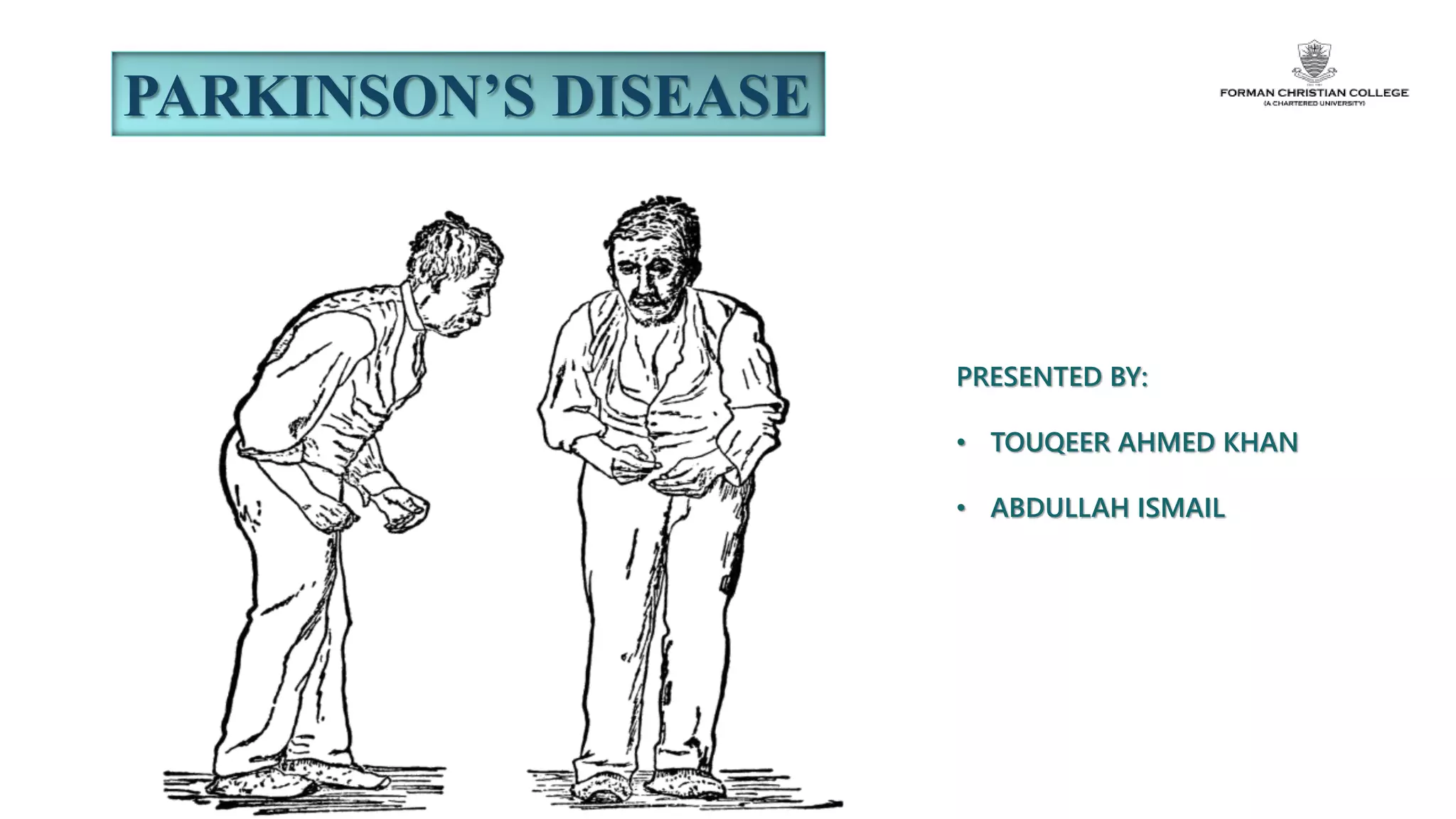
PARKINSON’S DISEASE
PRESENTED BY:
• TOUQEER AHMED KHAN
• ABDULLAH ISMAIL
DESCRIPTION:
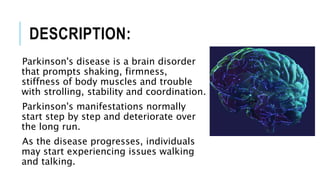
Parkinson's disease is a brain disorder
that prompts shaking, firmness,
stiffness of body muscles and trouble
with strolling, stability and coordination.
Parkinson's manifestations normally
start step by step and deteriorate over
the long run.
As the disease progresses, individuals
may start experiencing issues walking
and talking.
PATHOLOGY:
There are two nervous systems in our
brain. Substantia Nigra and the Corpus
Striatum.
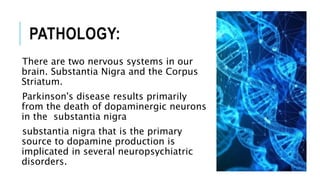
Parkinson's disease results primarily
from the death of dopaminergic neurons
in the substantia nigra
substantia nigra that is the primary
source to dopamine production is
implicated in several neuropsychiatric
disorders.
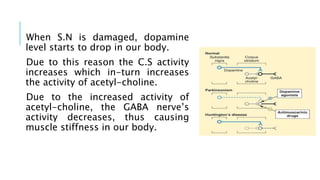
When S.N is damaged, dopamine
level starts to drop in our body.
Due to this reason the C.S activity
increases which in-turn increases
the activity of acetyl-choline.
Due to the increased activity of
acetyl-choline, the GABA nerve’s
activity decreases, thus causing
muscle stiffness in our body.
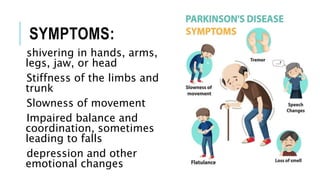
SYMPTOMS:
shivering in hands, arms,
legs, jaw, or head
Stiffness of the limbs and
trunk
Slowness of movement
Impaired balance and
coordination, sometimes
leading to falls
depression and other
emotional changes
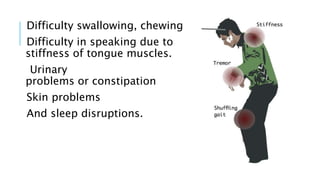
Difficulty swallowing, chewing
Difficulty in speaking due to
stiffness of tongue muscles.
Urinary
problems or constipation
Skin problems
And sleep disruptions.
GENETIC LINKAGE:
Two genes responsible for
hereditary Parkinson's disease have
been recognized
1. alpha-synuclein gene located in
the long arm of chromosome 4
2. the parkin gene located in the
long arm of chromosome 6.
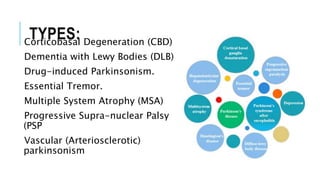
TYPES:
Corticobasal Degeneration (CBD)
Dementia with Lewy Bodies (DLB)
Drug-induced Parkinsonism.
Essential Tremor.
Multiple System Atrophy (MSA)
Progressive Supra-nuclear Palsy
(PSP
Vascular (Arteriosclerotic)
parkinsonism
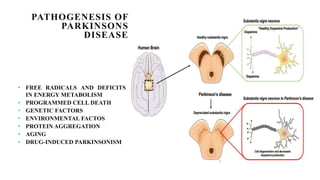
PATHOGENESIS OF
PARKINSONS
DISEASE
• FREE RADICALS AND DEFICITS
IN ENERGY METABOLISM
• PROGRAMMED CELL DEATH
• GENETIC FACTORS
• ENVIRONMENTAL FACTOS
• PROTEIN AGGREGATION
• AGING
• DRUG-INDUCED PARKINSONISM
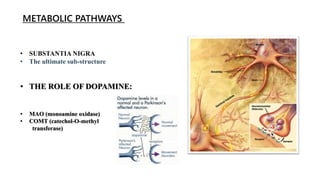
METABOLIC PATHWAYS
• SUBSTANTIA NIGRA
• The ultimate sub-structure
• THE ROLE OF DOPAMINE:
• MAO (monoamine oxidase)
• COMT (catechol-O-methyl
transferase)
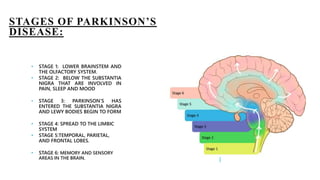
STAGES OF PARKINSON’S
DISEASE:
• STAGE 1: LOWER BRAINSTEM AND
THE OLFACTORY SYSTEM.
• STAGE 2: BELOW THE SUBSTANTIA
NIGRA THAT ARE INVOLVED IN
PAIN, SLEEP AND MOOD
• STAGE 3: PARKINSON’S HAS
ENTERED THE SUBSTANTIA NIGRA
AND LEWY BODIES BEGIN TO FORM
• STAGE 4: SPREAD TO THE LIMBIC
SYSTEM
• STAGE 5:TEMPORAL, PARIETAL,
AND FRONTAL LOBES.
• STAGE 6: MEMORY AND SENSORY
AREAS IN THE BRAIN.
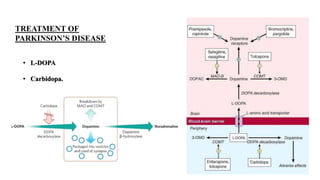
TREATMENT OF
PARKINSON’S DISEASE
• L-DOPA
• Carbidopa.
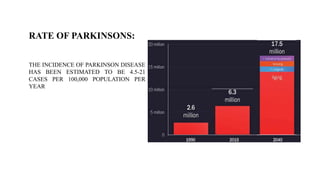
RATE OF PARKINSONS:
THE INCIDENCE OF PARKINSON DISEASE
HAS BEEN ESTIMATED TO BE 4.5-21
CASES PER 100,000 POPULATION PER
YEAR
Parkinson's disease ppt SlideShare

Parkinson's disease ppt SlideShare

  • 1.
    PARKINSON’S DISEASE PRESENTED BY: •TOUQEER AHMED KHAN • ABDULLAH ISMAIL
  • 2.
    DESCRIPTION: Parkinson's disease isa brain disorder that prompts shaking, firmness, stiffness of body muscles and trouble with strolling, stability and coordination. Parkinson's manifestations normally start step by step and deteriorate over the long run. As the disease progresses, individuals may start experiencing issues walking and talking.
  • 3.
    PATHOLOGY: There are twonervous systems in our brain. Substantia Nigra and the Corpus Striatum. Parkinson's disease results primarily from the death of dopaminergic neurons in the substantia nigra substantia nigra that is the primary source to dopamine production is implicated in several neuropsychiatric disorders.
  • 4.
    When S.N isdamaged, dopamine level starts to drop in our body. Due to this reason the C.S activity increases which in-turn increases the activity of acetyl-choline. Due to the increased activity of acetyl-choline, the GABA nerve’s activity decreases, thus causing muscle stiffness in our body.
  • 5.
    SYMPTOMS: shivering in hands,arms, legs, jaw, or head Stiffness of the limbs and trunk Slowness of movement Impaired balance and coordination, sometimes leading to falls depression and other emotional changes
  • 6.
    Difficulty swallowing, chewing Difficultyin speaking due to stiffness of tongue muscles. Urinary problems or constipation Skin problems And sleep disruptions.
  • 7.
    GENETIC LINKAGE: Two genesresponsible for hereditary Parkinson's disease have been recognized 1. alpha-synuclein gene located in the long arm of chromosome 4 2. the parkin gene located in the long arm of chromosome 6.
  • 8.
    TYPES: Corticobasal Degeneration (CBD) Dementiawith Lewy Bodies (DLB) Drug-induced Parkinsonism. Essential Tremor. Multiple System Atrophy (MSA) Progressive Supra-nuclear Palsy (PSP Vascular (Arteriosclerotic) parkinsonism
  • 9.
    PATHOGENESIS OF PARKINSONS DISEASE • FREERADICALS AND DEFICITS IN ENERGY METABOLISM • PROGRAMMED CELL DEATH • GENETIC FACTORS • ENVIRONMENTAL FACTOS • PROTEIN AGGREGATION • AGING • DRUG-INDUCED PARKINSONISM
  • 10.
    METABOLIC PATHWAYS • SUBSTANTIANIGRA • The ultimate sub-structure • THE ROLE OF DOPAMINE: • MAO (monoamine oxidase) • COMT (catechol-O-methyl transferase)
  • 11.
    STAGES OF PARKINSON’S DISEASE: •STAGE 1: LOWER BRAINSTEM AND THE OLFACTORY SYSTEM. • STAGE 2: BELOW THE SUBSTANTIA NIGRA THAT ARE INVOLVED IN PAIN, SLEEP AND MOOD • STAGE 3: PARKINSON’S HAS ENTERED THE SUBSTANTIA NIGRA AND LEWY BODIES BEGIN TO FORM • STAGE 4: SPREAD TO THE LIMBIC SYSTEM • STAGE 5:TEMPORAL, PARIETAL, AND FRONTAL LOBES. • STAGE 6: MEMORY AND SENSORY AREAS IN THE BRAIN.
  • 12.
  • 13.
    RATE OF PARKINSONS: THEINCIDENCE OF PARKINSON DISEASE HAS BEEN ESTIMATED TO BE 4.5-21 CASES PER 100,000 POPULATION PER YEAR