FLPN 23 MAY 2018
PARENTAL ALIENATION
At the intersection of family law,
social science and lived experience
©Dialogue In Growth Pty. Ltd. 2018 Reproduction and
distribution restricted
1
AT THE INTERSECTION
• “…It is a sad fact in family law that a determination which is
most consistent with the best interests of the children can
appear to reward bad behaviour,”
• “…As undesirable as it may be from the father’s perspective,
the potential for the children to continue to suffer emotional
abuse by the mother in this manner diminishes if the children
do not spend any time with the father” .
• Wang & Dennison (No. 2) [2009] FamCA 1251 (18
December 2009).©Dialogue In Growth Pty. Ltd. 2018 Reproduction and distribution restricted 2
AT THE INTERSECTION
• “Indeed it is hard to think of a single category of parenting cases
that potentially throws up as many legal consideration as cases
where a child rejects a parent or resists contact. Moreover these
are often some of the most high conflict cases in Family law Court
of Australia”
• Altobelli, T 2011 P. 1
• AFCC 2018 conference theme on PA-August 2018
• EMMM/UTAS inaugural conference on PA-October 2018
©Dialogue In Growth Pty. Ltd. 2018 Reproduction and distribution restricted 3
FAMILY LAW: A FUNCTIONAL DESCRIPTION OF
PA
• Section 4AB Family Law Act, 1975: Definition of family violence
etc. (1) For the purposes of this Act, family violence means
violent, threatening or other behaviour by a person that coerces or
controls a member of the person's family (the family member ), or
causes the family member to be fearful.
• (2) Examples of behaviour that may constitute family violence
include (but are not limited to):
• (i) preventing the family member from making or keeping
connections with his or her family, friends or culture;
©Dialogue In Growth Pty. Ltd. 2018 Reproduction and distribution restricted 4
FAMILY LAW CONSIDERATIONS OF PA
• Discussion about whether PA and/or PAS are diagnosable or classifiable
(DSM 5, ICD-11) not relevant to how family law responds to PA
• Gendered perspectives on PA do not inform family law’s perspectives on
children’s best interests
• ‘Family law is prepared to discount children’s views if family
consultants/single experts can advise sufficient presentation of PA.
• Australian family law prefers a model of alienation that “focuses
attention on the child shifted away from the parent” (Altobelli, T 2011)
©Dialogue In Growth Pty. Ltd. 2018 Reproduction and distribution restricted 5
HOW PA FOOLS THE EXPERTS
• Research shows that alienated children’s accounts are unreliable under
alienation conditions
• Bernet, W, Verrocchio, MC & Korosi, S 2015.
• Addressing PA by ‘prescribing the symptom’ (the rejected parent) is
counter intuitive
• Conventional therapeutic approaches are contraindicated-delusional,
triangulated system
• Confusion over the REAL target and the PROXY target/focus of PA
©Dialogue In Growth Pty. Ltd. 2018 Reproduction and distribution restricted 6
ALIENATED PARENTS DILEMMA
• Alienated parents cannot defend themselves or their children
without seeming to incriminate themselves.
• Family law may not consider reunification/remediation as a default
prime goal
• Validating ‘bad’ (alienating) parenting in the best interests of the
child
• Alienated parents must expose alienating behaviour as causative
to their children’s rejection BUT must inevitably focus upon their
ex-partners to do this.©Dialogue In Growth Pty. Ltd. 2018 Reproduction and distribution
restricted
7
WHAT ARE WE TALKING ABOUT?
• “[PA] is a disorder that arises primarily in the context of child custody
disputes. Its primary manifestation is the child's campaign of denigration
against a parent, a campaign that has no justification”
• (Gardener, 1985).
• [Alienated child] “Who expresses freely persistently, unreasonable negative
feelings and beliefs (such as anger, hatred, rejection and/or fear) towards
a parent that are disproportionate to the child's actual experience with
that parent. Entrenched alienated children are marked by an un-
ambivalent, strident rejection of the parent with no apparent guilt or
conflict”
• (Johnston, 2005)
©Dialogue In Growth Pty. Ltd. 2018 Reproduction and distribution restricted 8
WHAT ARE WE TALKING ABOUT?
• “A disturbance in which children, usually in the context of sharing
a parents negative attitudes, suffer unreasonable aversion to a
person, or persons, with whom they formally enjoyed normal
relations or with whom they would normally develop affectionate
relations”
• (Warshak, 2006).
• “A parentally induced suppression of a child’s attachment bonding
motivations towards a normal-range and affectionately available
parent”
• (Childress, C.A 2015).
©Dialogue In Growth Pty. Ltd. 2018 Reproduction and distribution restricted 9
CLASSES OF PARENTAL ALIENATION
• ‘Classical’ parental alienation
• Psycho-pathological-an intra-psychic, inter-personal disorder
(e.g. PA and PAS)-A disorder in the individual (child)
• Manifests in the child as a result of ONE parent’s intent, action,
behaviour where the targeted parent’s behaviour and parenting
are inconsequential.
• Seminal definition based upon 8 criteria
• (Gardner 1998a, p. 311,Gardner 2002a, p. 95)
©Dialogue In Growth Pty. Ltd. 2018 Reproduction and distribution restricted 10
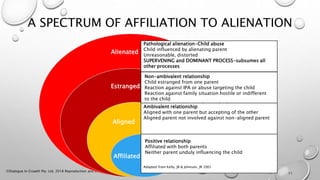
A SPECTRUM OF AFFILIATION TO ALIENATION
©Dialogue In Growth Pty. Ltd. 2018 Reproduction and distribution restricted
11
Alienated
Estranged
Aligned
Affiliated
Non-ambivalent relationship
Child estranged from one parent
Reaction against IPA or abuse targeting the child
Reaction against family situation hostile or indifferent
to the child
Protective parenting may be involved
Pathological alienation-Child abuse
Child influenced by alienating parent
Unreasonable, distorted
SUPERVENING and DOMINANT PROCESS-subsumes all
other processes
Positive relationship
Affiliated with both parents
Neither parent unduly influencing the child
Ambivalent relationship
Aligned with one parent but accepting of the other
Aligned parent not involved against non-aligned parent
Adapted from Kelly, JB & Johnson, JR 2001
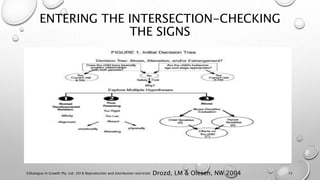
ENTERING THE INTERSECTION-CHECKING
THE SIGNS
©Dialogue In Growth Pty. Ltd. 2018 Reproduction and distribution restricted 12Drozd, LM & Olesen, NW 2004
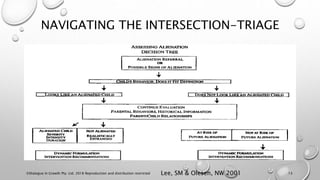
NAVIGATING THE INTERSECTION-TRIAGE
©Dialogue In Growth Pty. Ltd. 2018 Reproduction and distribution restricted 13Lee, SM & Olesen, NW 2001
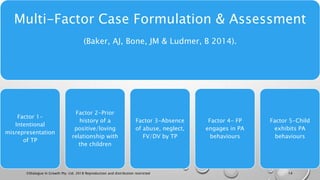
Multi-Factor Case Formulation & Assessment
(Baker, AJ, Bone, JM & Ludmer, B 2014).
Factor 1-
Intentional
misrepresentation
of TP
Factor 2-Prior
history of a
positive/loving
relationship with
the children
Factor 3-Absence
of abuse, neglect,
FV/DV by TP
Factor 4- FP
engages in PA
behaviours
Factor 5-Child
exhibits PA
behaviours
©Dialogue In Growth Pty. Ltd. 2018 Reproduction and distribution restricted 14
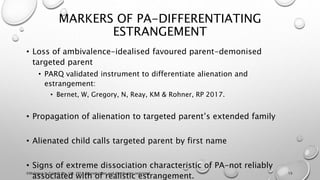
MARKERS OF PA-DIFFERENTIATING
ESTRANGEMENT
• Loss of ambivalence-idealised favoured parent-demonised
targeted parent
• PARQ validated instrument to differentiate alienation and
estrangement:
• Bernet, W, Gregory, N, Reay, KM & Rohner, RP 2017.
• Propagation of alienation to targeted parent’s extended family
• Alienated child calls targeted parent by first name
• Signs of extreme dissociation characteristic of PA-not reliably
associated with of realistic estrangement.
©Dialogue In Growth Pty. Ltd. 2018 Reproduction and distribution restricted 15
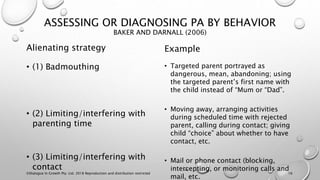
ASSESSING OR DIAGNOSING PA BY BEHAVIOR
BAKER AND DARNALL (2006)
Alienating strategy
• (1) Badmouthing
• (2) Limiting/interfering with
parenting time
• (3) Limiting/interfering with
contact
Example
• Targeted parent portrayed as
dangerous, mean, abandoning; using
the targeted parent’s first name with
the child instead of “Mum or “Dad”.
• Moving away, arranging activities
during scheduled time with rejected
parent, calling during contact; giving
child “choice” about whether to have
contact, etc.
• Mail or phone contact (blocking,
intercepting, or monitoring calls and
mail, etc.
©Dialogue In Growth Pty. Ltd. 2018 Reproduction and distribution restricted 16
ASSESSING OR DIAGNOSING PA?
BAKER AND DARNALL (2006)
Alienating strategy
• (4) Limiting/interfering
with symbolic contact
• (5) Interfering with
information
Example
• Limiting mentioning, no
photographs, having child call
someone else “Mum” or “Dad”;
changing child’s name, etc.
• Refusing to communicate,
using child as messenger not
giving important school and
medical information, etc.©Dialogue In Growth Pty. Ltd. 2018 Reproduction and distribution restricted 17
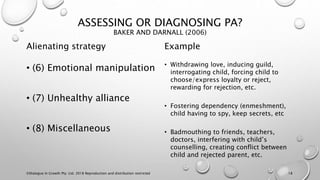
ASSESSING OR DIAGNOSING PA?
BAKER AND DARNALL (2006)
Alienating strategy
• (6) Emotional manipulation
• (7) Unhealthy alliance
• (8) Miscellaneous
Example
• Withdrawing love, inducing guild,
interrogating child, forcing child to
choose/express loyalty or reject,
rewarding for rejection, etc.
• Fostering dependency (enmeshment),
child having to spy, keep secrets, etc
• Badmouthing to friends, teachers,
doctors, interfering with child’s
counselling, creating conflict between
child and rejected parent, etc.
©Dialogue In Growth Pty. Ltd. 2018 Reproduction and distribution restricted 18
PA INTERVENTION GOALS AND OUTCOMES
• Reunification with targeted parent-can remediation NOT be in the
child’s best interest?
• A re-formed relationship between child and favoured/alienating
parent
• Court ordered reportable specialised intervention for parental
alienation-as soon as parental alienation is identified (Johnston
and Goldman, 2010).
• Noncompliance with court orders needs to be sanctioned.
©Dialogue In Growth Pty. Ltd. 2018 Reproduction and distribution restricted 19
BEST PRACTICE PRINCIPLES FOR PA
INTERVENTION
• Awarding primary parental responsibility to the targeted parent
when parental alienation is severe is critical to child’s best
interests.
• Removing the targeted child from the care of their favoured parent
does NOT harm the child (Dunne and Hedrick, 1994; Gardner,
2001)-distress if present is transient.
• Removing the targeted child from the alienating parent protects the
child from further harm
• Conventional family therapy is ineffective (in cases of severe
alienation) and may cause further harm (Reay, 2015; Warshak,
©Dialogue In Growth Pty. Ltd. 2018 Reproduction and distribution restricted 20
PA INTERVENTION DECISION MATRIX
©Dialogue In Growth Pty. Ltd. 2018 Reproduction and distribution restricted 21
Alienating Parent
Mild
Naive
Moderate
Active
Severe
ObsessiveTargetedParent
Positive
Competen
t
Traumatis
ed
Reactive
Abusive
Negligent
Supervised time with
targeted parent
Trauma
counselling/education
Modified family therapy
Time with targeted parent
Trauma counselling &
education
Modified family therapy
No time with rejected
parent
Aligned not alienated
Trauma
counselling/education
Change of
residence,
parental
responsibili
ty
Psycho-
social
reunificatio
n
program
SEVERE PA-INTERVENTION PROGRAMS IN
AUSTRALIA
• FBAC Family Bridges for Alienated Children (USA, Canada, South
Africa, Australia), Warshak.R, Rand.R
• Legal mandate
• Mandatory exclusion period between alienated child and favoured
parent
• Since 2005-most researched
• Trained facilitators in Australia
• Intervention (Australia)
• Court ordered reportable therapy-alienated child often remains with
favoured/alienating parent
©Dialogue In Growth Pty. Ltd. 2018 Reproduction and distribution restricted 22
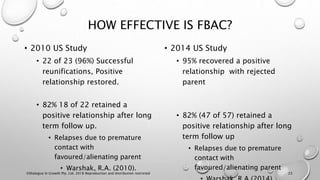
HOW EFFECTIVE IS FBAC?
• 2010 US Study
• 22 of 23 (96%) Successful
reunifications, Positive
relationship restored.
• 82% 18 of 22 retained a
positive relationship after long
term follow up.
• Relapses due to premature
contact with
favoured/alienating parent
• Warshak, R.A. (2010).
• 2014 US Study
• 95% recovered a positive
relationship with rejected
parent
• 82% (47 of 57) retained a
positive relationship after long
term follow up
• Relapses due to premature
contact with
favoured/alienating parent
©Dialogue In Growth Pty. Ltd. 2018 Reproduction and distribution restricted 23
REFERENCES
• Altobelli, T 2011, 'When a Child Rejects a Parent : Why Children Resist Contact', Australian Journal of Family Law, vol. 25,
no. 3, pp. 185-209.
• Baker, AJL 2006, 'Patterns of Parental Alienation Syndrome: A Qualitative Study of Adults Who Were Alienated from a Parent
as a Child', American Journal of Family Therapy, vol. 34, no. 1, pp. 63-78.
• Baker, AJL & Darnall, D 2006, 'Behaviors and Strategies Employed in Parental Alienation', Journal of Divorce & Remarriage,
vol. 45, no. 1-2, pp. 97-124.
• Baker, J. A. Dr. In ASSOCIATION OF FAMILY AND CONCILIATION COURTS, NEW YORK CHAPTER (AFCC - NY)
The Spectrum of Parental Alienation and Estrangement: Challenges for Mental Health Professionals, Attorneys & the Court,
14 June 2014
• Baker, AJ 2014, 'Parental Alienation as a Form of Psychological Maltreatment: Review of Theory and Research',
MALTRATTAMENTO E ABUSO ALL’INFANZIA.
• Baker, J. A. Dr. In ASSOCIATION OF FAMILY AND CONCILIATION COURTS, NEW YORK CHAPTER (AFCC - NY)
The Spectrum of Parental Alienation and Estrangement: Challenges for Mental Health Professionals, Attorneys & the Court,
14 June 2014
• Baker, AJ, Bone, JM & Ludmer, B 2014, 'Documenting Your Case for Your Attorney', in The High-Conflict Custody Battle:
Protect Yourself and Your Kids from a Toxic Divorce, False Accusations, and Parental Alienation, New Harbinger
Publications, pp. 91-122.
• Bernet, W, Verrocchio, MC & Korosi, S 2015, 'Yes, children are susceptible to manipulation: Commentary on article by
Clemente and Padilla-Racero', Children and Youth Services Review, vol. 56, pp. 135-8.©Dialogue In Growth Pty. Ltd. 2018 Reproduction and distribution restricted 24
REFERENCES
• Baker, AJL & Eichler, A 2016, 'The Linkage between Parental Alienation Behaviors and Child Alienation', Journal of
Divorce & Remarriage, vol. 57, no. 7, pp. 475-84.
• Bernet, W, Gregory, N, Reay, KM & Rohner, RP 2017, 'An Objective Measure of Splitting in Parental Alienation: The
Parental Acceptance-Rejection Questionnaire', Journal of Forensic Sciences.
• Bernet, W, Wamboldt, MZ & Narrow, WE 2016, 'Child Affected by Parental Relationship Distress', J Am Acad Child
Adolesc Psychiatry, vol. 55, no. 7, pp. 571-9.
• Childress, CA 2015, An Attachment Based Model of Parental Alienation, Oaksong Press, Claremont, California.
• Darnall, D. (1998). Divorce casualties: Protecting your children from parental alienation. Lanham, MD: Taylor
Publishing Co.
• Drozd, LM & Olesen, NW 2004, 'Is It Abuse, Alienation, and/or Estrangement?: A Decision Tree', Journal of Child
Custody, vol. 1, no. 3, pp. 65-106.
• Drozd, L, Saini, M & Olesen, N 2016, 'Empirical Studies of Alienation', in Parenting Plan Evaluations: Applied
Research for the Family Court, 2 edn, Oxford University Press, New York, pp. 374-430,
<http://www.lesliedrozd.com/lectures/Kuehnle_Drozd_AFCC-FL_WA_Spring_2012.pdf>.
• Drozd, L, Saini, M & Olesen, N 2016, Parenting Plan Evaluations: Applied Research for the Family Court, 2 edn,
Oxford University Press, New York.
©Dialogue In Growth Pty. Ltd. 2018 Reproduction and distribution restricted 25
REFERENCES
• Fidler, BJ & Bala, N 2010, 'Children Resisting Postseparation Contact with a Parent: Concepts, Controversies, and
Conundrums', Family Court Review, vol. 48, no. 1, pp. 10-47.
• Friedlander, S & Walters, MG 2010, 'When a Child Rejects a Parent: Tailoring the Intervention to Fit the Problem', Family
Court Review, vol. 48, no. 1, pp. 98-111.
• Gardner, RA 'Parental Alienation (Pa) and Parental Alienation Syndrome (Pas)', American Journal of Forensic Psychology, vol.
21, no. 1, pp. 39 - 64.
• —— 1985, 'Recent Trends in Divorce and Custody Litigations', Academy Forum, vol. 29, no. 2, pp. 3-7.
• —— 1998a, 'Letter to the Editor', Child Maltreatment, vol. 3, no. 4, pp. 309-12.
• —— 1998b, 'The Parental Alienation Syndrome. 2nd', Cresskill, New Jersey: Creative Therapeutics.
• —— 1998c, 'Recommendations for Dealing with Parents Who Induce a Parental Alienation Syndrome in Their Children',
Journal of Divorce & Remarriage, vol. 28, no. 3-4, pp. 1-23.
• —— 1999, 'Differentiating between Parental Alienation Syndrome and Bone Fide Abuse-Neglect', The American Journal of
Family Therapy, vol. 27, no. 2, pp. 97 - 107.
• —— 2001, 'The Parental Alienation Syndrome: Sixteen Years Later', Academy Forum, vol. 45, no. 1, pp. 10-2.
• —— 2002a, 'Parental Alienation Syndrome Vs. Parental Alienation: Which Diagnosis Should Evaluators Use in Child-Custody
Disputes?', American Journal of Family Therapy, vol. 30, no. 2, pp. 93-115.
©Dialogue In Growth Pty. Ltd. 2018 Reproduction and distribution restricted 26
REFERENCES
• —— 2002b, 'Rebuttal to Kelly and Johnson's Article. Children Speak out for Children', The American Journal of Family
Therapy, vol. 17, no. 2, pp. 5-10.
• Gottlieb, LK 2012a, 'The Alienated Parent', in The Parental Alienation Syndrome: A Family Therapy and Collaborative
Systems Approach to Amelioration, Charles Thomas Publishers USA Springfield Illinois, p. 117.
• —— 2012b, The Parental Alienation Syndrome: A Family Therapy and Collaborative Systems Approach to Amelioration,
Springfield : Charles C Thomas, Springfield.
• —— 2012c, 'Parental Alienation Syndrome: A Form of Child Abuse and More', in The Parental Alienation Syndrome: A Family
Therapy and Collaborative Systems Approach to Amelioration, Charles C Thomas, Publisher, Ltd., Springfield, Illinois, p.
209.
• Kelly, JB & Johnson, JR 2001, 'The Alienated Child: A Reformulation of Parental Alienation Syndrome', Family Court Review,
vol. 39, no. 3, pp. 249-66.
• Kopetski, L. M. (2006). Commentary: Parental alienation syndrome. In R. A. Gardner, S. R. Sauber, & D.Lorandos (Eds.), The
international handbook of parental alienation syndrome: Conceptual, clinical and legal considerations (pp. 378–390).
Springfield, IL: Charles C. Thomas.
• Kruk, E 2016a, 'Parental Alienation and the Bystander Effect', Psychology Today,
<https://www.psychologytoday.com/blog/co-parenting-after-divorce/201605/parental-alienation-and-the-bystander-
effect>.
• —— 2016b, 'Professional Misunderstanding of Parental Alienation', Psychology Today,
©Dialogue In Growth Pty. Ltd. 2018 Reproduction and distribution restricted 27
REFERENCES
• Lee, SM & Olesen, NW 2001, 'Assessing for Alienation in Child Custody and Access Evaluations', Family Court Review, vol.
39, no. 3, pp. 282-98.
• Rathus, Z 2017, 'Mapping the Use of Social Science in Australian Courts: The Example of Family Law Children’s Cases',
Griffith Law Review, vol. 25, no. 3, pp. 352-82.
• Reay, K. (2015). Family Reflections: A Promising Therapeutic Program Designed to Treat Severely Alienated Children and
Their Family System. American Journal of Family Therapy, Volume 43, Issue 2, pp. 1-12, 2015
• Templer, K, Matthewson, M, Haines, J & Cox, G 2016, 'Recommendations for Best Practice in Response to Parental
Alienation: Findings from a Systematic Review', Journal of Family Therapy.
• Vassiliou, D & Cartwright, G 2001, 'The Lost Parents' Perspective on Parental Alienation Syndrome', The American Journal of
Family Therapy, vol. 29, no. 3, pp. 181-91.
• Warshak, R.A. (2010). Family Bridges: Using Insights From Social Science to Reconnect Parents and Alienated Children.
Family Court Review. Volume 38. No 1. January 2010. Association of Family and Conciliation Courts.
• Warshak, R.A (2014). Parental Alienation: What it is; How to Manage it. University of Texas School of Law. American
Academy of Matrimonial Lawyers (Texas Chapter). Innovations ;Breaking Boundaries in Custody Litigation. 12-13 June
2014. Dallas, Texas. USA.
• Warshak, RA 2015, 'Ten Parental Alienation Fallacies That Compromise Decisions in Court and in Therapy', Professional
Psychology: Research and Practice, vol. 46, no. 4, pp. 235-49.
• Weigel, DJ & Donovan, KA 2006, 'Parental Alienation Syndrome: Diagnostic and Triadic Perspectives', The Family Journal,
vol. 14, no. 3, pp. 274-82.
©Dialogue In Growth Pty. Ltd. 2018 Reproduction and distribution restricted 28

Parental Alienation at the Intersection of Family Law, Social Science and Lived Experience

  • 1.
    FLPN 23 MAY2018 PARENTAL ALIENATION At the intersection of family law, social science and lived experience ©Dialogue In Growth Pty. Ltd. 2018 Reproduction and distribution restricted 1
  • 2.
    AT THE INTERSECTION •“…It is a sad fact in family law that a determination which is most consistent with the best interests of the children can appear to reward bad behaviour,” • “…As undesirable as it may be from the father’s perspective, the potential for the children to continue to suffer emotional abuse by the mother in this manner diminishes if the children do not spend any time with the father” . • Wang & Dennison (No. 2) [2009] FamCA 1251 (18 December 2009).©Dialogue In Growth Pty. Ltd. 2018 Reproduction and distribution restricted 2
  • 3.
    AT THE INTERSECTION •“Indeed it is hard to think of a single category of parenting cases that potentially throws up as many legal consideration as cases where a child rejects a parent or resists contact. Moreover these are often some of the most high conflict cases in Family law Court of Australia” • Altobelli, T 2011 P. 1 • AFCC 2018 conference theme on PA-August 2018 • EMMM/UTAS inaugural conference on PA-October 2018 ©Dialogue In Growth Pty. Ltd. 2018 Reproduction and distribution restricted 3
  • 4.
    FAMILY LAW: AFUNCTIONAL DESCRIPTION OF PA • Section 4AB Family Law Act, 1975: Definition of family violence etc. (1) For the purposes of this Act, family violence means violent, threatening or other behaviour by a person that coerces or controls a member of the person's family (the family member ), or causes the family member to be fearful. • (2) Examples of behaviour that may constitute family violence include (but are not limited to): • (i) preventing the family member from making or keeping connections with his or her family, friends or culture; ©Dialogue In Growth Pty. Ltd. 2018 Reproduction and distribution restricted 4
  • 5.
    FAMILY LAW CONSIDERATIONSOF PA • Discussion about whether PA and/or PAS are diagnosable or classifiable (DSM 5, ICD-11) not relevant to how family law responds to PA • Gendered perspectives on PA do not inform family law’s perspectives on children’s best interests • ‘Family law is prepared to discount children’s views if family consultants/single experts can advise sufficient presentation of PA. • Australian family law prefers a model of alienation that “focuses attention on the child shifted away from the parent” (Altobelli, T 2011) ©Dialogue In Growth Pty. Ltd. 2018 Reproduction and distribution restricted 5
  • 6.
    HOW PA FOOLSTHE EXPERTS • Research shows that alienated children’s accounts are unreliable under alienation conditions • Bernet, W, Verrocchio, MC & Korosi, S 2015. • Addressing PA by ‘prescribing the symptom’ (the rejected parent) is counter intuitive • Conventional therapeutic approaches are contraindicated-delusional, triangulated system • Confusion over the REAL target and the PROXY target/focus of PA ©Dialogue In Growth Pty. Ltd. 2018 Reproduction and distribution restricted 6
  • 7.
    ALIENATED PARENTS DILEMMA •Alienated parents cannot defend themselves or their children without seeming to incriminate themselves. • Family law may not consider reunification/remediation as a default prime goal • Validating ‘bad’ (alienating) parenting in the best interests of the child • Alienated parents must expose alienating behaviour as causative to their children’s rejection BUT must inevitably focus upon their ex-partners to do this.©Dialogue In Growth Pty. Ltd. 2018 Reproduction and distribution restricted 7
  • 8.
    WHAT ARE WETALKING ABOUT? • “[PA] is a disorder that arises primarily in the context of child custody disputes. Its primary manifestation is the child's campaign of denigration against a parent, a campaign that has no justification” • (Gardener, 1985). • [Alienated child] “Who expresses freely persistently, unreasonable negative feelings and beliefs (such as anger, hatred, rejection and/or fear) towards a parent that are disproportionate to the child's actual experience with that parent. Entrenched alienated children are marked by an un- ambivalent, strident rejection of the parent with no apparent guilt or conflict” • (Johnston, 2005) ©Dialogue In Growth Pty. Ltd. 2018 Reproduction and distribution restricted 8
  • 9.
    WHAT ARE WETALKING ABOUT? • “A disturbance in which children, usually in the context of sharing a parents negative attitudes, suffer unreasonable aversion to a person, or persons, with whom they formally enjoyed normal relations or with whom they would normally develop affectionate relations” • (Warshak, 2006). • “A parentally induced suppression of a child’s attachment bonding motivations towards a normal-range and affectionately available parent” • (Childress, C.A 2015). ©Dialogue In Growth Pty. Ltd. 2018 Reproduction and distribution restricted 9
  • 10.
    CLASSES OF PARENTALALIENATION • ‘Classical’ parental alienation • Psycho-pathological-an intra-psychic, inter-personal disorder (e.g. PA and PAS)-A disorder in the individual (child) • Manifests in the child as a result of ONE parent’s intent, action, behaviour where the targeted parent’s behaviour and parenting are inconsequential. • Seminal definition based upon 8 criteria • (Gardner 1998a, p. 311,Gardner 2002a, p. 95) ©Dialogue In Growth Pty. Ltd. 2018 Reproduction and distribution restricted 10
  • 11.
    A SPECTRUM OFAFFILIATION TO ALIENATION ©Dialogue In Growth Pty. Ltd. 2018 Reproduction and distribution restricted 11 Alienated Estranged Aligned Affiliated Non-ambivalent relationship Child estranged from one parent Reaction against IPA or abuse targeting the child Reaction against family situation hostile or indifferent to the child Protective parenting may be involved Pathological alienation-Child abuse Child influenced by alienating parent Unreasonable, distorted SUPERVENING and DOMINANT PROCESS-subsumes all other processes Positive relationship Affiliated with both parents Neither parent unduly influencing the child Ambivalent relationship Aligned with one parent but accepting of the other Aligned parent not involved against non-aligned parent Adapted from Kelly, JB & Johnson, JR 2001
  • 12.
    ENTERING THE INTERSECTION-CHECKING THESIGNS ©Dialogue In Growth Pty. Ltd. 2018 Reproduction and distribution restricted 12Drozd, LM & Olesen, NW 2004
  • 13.
    NAVIGATING THE INTERSECTION-TRIAGE ©DialogueIn Growth Pty. Ltd. 2018 Reproduction and distribution restricted 13Lee, SM & Olesen, NW 2001
  • 14.
    Multi-Factor Case Formulation& Assessment (Baker, AJ, Bone, JM & Ludmer, B 2014). Factor 1- Intentional misrepresentation of TP Factor 2-Prior history of a positive/loving relationship with the children Factor 3-Absence of abuse, neglect, FV/DV by TP Factor 4- FP engages in PA behaviours Factor 5-Child exhibits PA behaviours ©Dialogue In Growth Pty. Ltd. 2018 Reproduction and distribution restricted 14
  • 15.
    MARKERS OF PA-DIFFERENTIATING ESTRANGEMENT •Loss of ambivalence-idealised favoured parent-demonised targeted parent • PARQ validated instrument to differentiate alienation and estrangement: • Bernet, W, Gregory, N, Reay, KM & Rohner, RP 2017. • Propagation of alienation to targeted parent’s extended family • Alienated child calls targeted parent by first name • Signs of extreme dissociation characteristic of PA-not reliably associated with of realistic estrangement. ©Dialogue In Growth Pty. Ltd. 2018 Reproduction and distribution restricted 15
  • 16.
    ASSESSING OR DIAGNOSINGPA BY BEHAVIOR BAKER AND DARNALL (2006) Alienating strategy • (1) Badmouthing • (2) Limiting/interfering with parenting time • (3) Limiting/interfering with contact Example • Targeted parent portrayed as dangerous, mean, abandoning; using the targeted parent’s first name with the child instead of “Mum or “Dad”. • Moving away, arranging activities during scheduled time with rejected parent, calling during contact; giving child “choice” about whether to have contact, etc. • Mail or phone contact (blocking, intercepting, or monitoring calls and mail, etc. ©Dialogue In Growth Pty. Ltd. 2018 Reproduction and distribution restricted 16
  • 17.
    ASSESSING OR DIAGNOSINGPA? BAKER AND DARNALL (2006) Alienating strategy • (4) Limiting/interfering with symbolic contact • (5) Interfering with information Example • Limiting mentioning, no photographs, having child call someone else “Mum” or “Dad”; changing child’s name, etc. • Refusing to communicate, using child as messenger not giving important school and medical information, etc.©Dialogue In Growth Pty. Ltd. 2018 Reproduction and distribution restricted 17
  • 18.
    ASSESSING OR DIAGNOSINGPA? BAKER AND DARNALL (2006) Alienating strategy • (6) Emotional manipulation • (7) Unhealthy alliance • (8) Miscellaneous Example • Withdrawing love, inducing guild, interrogating child, forcing child to choose/express loyalty or reject, rewarding for rejection, etc. • Fostering dependency (enmeshment), child having to spy, keep secrets, etc • Badmouthing to friends, teachers, doctors, interfering with child’s counselling, creating conflict between child and rejected parent, etc. ©Dialogue In Growth Pty. Ltd. 2018 Reproduction and distribution restricted 18
  • 19.
    PA INTERVENTION GOALSAND OUTCOMES • Reunification with targeted parent-can remediation NOT be in the child’s best interest? • A re-formed relationship between child and favoured/alienating parent • Court ordered reportable specialised intervention for parental alienation-as soon as parental alienation is identified (Johnston and Goldman, 2010). • Noncompliance with court orders needs to be sanctioned. ©Dialogue In Growth Pty. Ltd. 2018 Reproduction and distribution restricted 19
  • 20.
    BEST PRACTICE PRINCIPLESFOR PA INTERVENTION • Awarding primary parental responsibility to the targeted parent when parental alienation is severe is critical to child’s best interests. • Removing the targeted child from the care of their favoured parent does NOT harm the child (Dunne and Hedrick, 1994; Gardner, 2001)-distress if present is transient. • Removing the targeted child from the alienating parent protects the child from further harm • Conventional family therapy is ineffective (in cases of severe alienation) and may cause further harm (Reay, 2015; Warshak, ©Dialogue In Growth Pty. Ltd. 2018 Reproduction and distribution restricted 20
  • 21.
    PA INTERVENTION DECISIONMATRIX ©Dialogue In Growth Pty. Ltd. 2018 Reproduction and distribution restricted 21 Alienating Parent Mild Naive Moderate Active Severe ObsessiveTargetedParent Positive Competen t Traumatis ed Reactive Abusive Negligent Supervised time with targeted parent Trauma counselling/education Modified family therapy Time with targeted parent Trauma counselling & education Modified family therapy No time with rejected parent Aligned not alienated Trauma counselling/education Change of residence, parental responsibili ty Psycho- social reunificatio n program
  • 22.
    SEVERE PA-INTERVENTION PROGRAMSIN AUSTRALIA • FBAC Family Bridges for Alienated Children (USA, Canada, South Africa, Australia), Warshak.R, Rand.R • Legal mandate • Mandatory exclusion period between alienated child and favoured parent • Since 2005-most researched • Trained facilitators in Australia • Intervention (Australia) • Court ordered reportable therapy-alienated child often remains with favoured/alienating parent ©Dialogue In Growth Pty. Ltd. 2018 Reproduction and distribution restricted 22
  • 23.
    HOW EFFECTIVE ISFBAC? • 2010 US Study • 22 of 23 (96%) Successful reunifications, Positive relationship restored. • 82% 18 of 22 retained a positive relationship after long term follow up. • Relapses due to premature contact with favoured/alienating parent • Warshak, R.A. (2010). • 2014 US Study • 95% recovered a positive relationship with rejected parent • 82% (47 of 57) retained a positive relationship after long term follow up • Relapses due to premature contact with favoured/alienating parent ©Dialogue In Growth Pty. Ltd. 2018 Reproduction and distribution restricted 23
  • 24.
    REFERENCES • Altobelli, T2011, 'When a Child Rejects a Parent : Why Children Resist Contact', Australian Journal of Family Law, vol. 25, no. 3, pp. 185-209. • Baker, AJL 2006, 'Patterns of Parental Alienation Syndrome: A Qualitative Study of Adults Who Were Alienated from a Parent as a Child', American Journal of Family Therapy, vol. 34, no. 1, pp. 63-78. • Baker, AJL & Darnall, D 2006, 'Behaviors and Strategies Employed in Parental Alienation', Journal of Divorce & Remarriage, vol. 45, no. 1-2, pp. 97-124. • Baker, J. A. Dr. In ASSOCIATION OF FAMILY AND CONCILIATION COURTS, NEW YORK CHAPTER (AFCC - NY) The Spectrum of Parental Alienation and Estrangement: Challenges for Mental Health Professionals, Attorneys & the Court, 14 June 2014 • Baker, AJ 2014, 'Parental Alienation as a Form of Psychological Maltreatment: Review of Theory and Research', MALTRATTAMENTO E ABUSO ALL’INFANZIA. • Baker, J. A. Dr. In ASSOCIATION OF FAMILY AND CONCILIATION COURTS, NEW YORK CHAPTER (AFCC - NY) The Spectrum of Parental Alienation and Estrangement: Challenges for Mental Health Professionals, Attorneys & the Court, 14 June 2014 • Baker, AJ, Bone, JM & Ludmer, B 2014, 'Documenting Your Case for Your Attorney', in The High-Conflict Custody Battle: Protect Yourself and Your Kids from a Toxic Divorce, False Accusations, and Parental Alienation, New Harbinger Publications, pp. 91-122. • Bernet, W, Verrocchio, MC & Korosi, S 2015, 'Yes, children are susceptible to manipulation: Commentary on article by Clemente and Padilla-Racero', Children and Youth Services Review, vol. 56, pp. 135-8.©Dialogue In Growth Pty. Ltd. 2018 Reproduction and distribution restricted 24
  • 25.
    REFERENCES • Baker, AJL& Eichler, A 2016, 'The Linkage between Parental Alienation Behaviors and Child Alienation', Journal of Divorce & Remarriage, vol. 57, no. 7, pp. 475-84. • Bernet, W, Gregory, N, Reay, KM & Rohner, RP 2017, 'An Objective Measure of Splitting in Parental Alienation: The Parental Acceptance-Rejection Questionnaire', Journal of Forensic Sciences. • Bernet, W, Wamboldt, MZ & Narrow, WE 2016, 'Child Affected by Parental Relationship Distress', J Am Acad Child Adolesc Psychiatry, vol. 55, no. 7, pp. 571-9. • Childress, CA 2015, An Attachment Based Model of Parental Alienation, Oaksong Press, Claremont, California. • Darnall, D. (1998). Divorce casualties: Protecting your children from parental alienation. Lanham, MD: Taylor Publishing Co. • Drozd, LM & Olesen, NW 2004, 'Is It Abuse, Alienation, and/or Estrangement?: A Decision Tree', Journal of Child Custody, vol. 1, no. 3, pp. 65-106. • Drozd, L, Saini, M & Olesen, N 2016, 'Empirical Studies of Alienation', in Parenting Plan Evaluations: Applied Research for the Family Court, 2 edn, Oxford University Press, New York, pp. 374-430, <http://www.lesliedrozd.com/lectures/Kuehnle_Drozd_AFCC-FL_WA_Spring_2012.pdf>. • Drozd, L, Saini, M & Olesen, N 2016, Parenting Plan Evaluations: Applied Research for the Family Court, 2 edn, Oxford University Press, New York. ©Dialogue In Growth Pty. Ltd. 2018 Reproduction and distribution restricted 25
  • 26.
    REFERENCES • Fidler, BJ& Bala, N 2010, 'Children Resisting Postseparation Contact with a Parent: Concepts, Controversies, and Conundrums', Family Court Review, vol. 48, no. 1, pp. 10-47. • Friedlander, S & Walters, MG 2010, 'When a Child Rejects a Parent: Tailoring the Intervention to Fit the Problem', Family Court Review, vol. 48, no. 1, pp. 98-111. • Gardner, RA 'Parental Alienation (Pa) and Parental Alienation Syndrome (Pas)', American Journal of Forensic Psychology, vol. 21, no. 1, pp. 39 - 64. • —— 1985, 'Recent Trends in Divorce and Custody Litigations', Academy Forum, vol. 29, no. 2, pp. 3-7. • —— 1998a, 'Letter to the Editor', Child Maltreatment, vol. 3, no. 4, pp. 309-12. • —— 1998b, 'The Parental Alienation Syndrome. 2nd', Cresskill, New Jersey: Creative Therapeutics. • —— 1998c, 'Recommendations for Dealing with Parents Who Induce a Parental Alienation Syndrome in Their Children', Journal of Divorce & Remarriage, vol. 28, no. 3-4, pp. 1-23. • —— 1999, 'Differentiating between Parental Alienation Syndrome and Bone Fide Abuse-Neglect', The American Journal of Family Therapy, vol. 27, no. 2, pp. 97 - 107. • —— 2001, 'The Parental Alienation Syndrome: Sixteen Years Later', Academy Forum, vol. 45, no. 1, pp. 10-2. • —— 2002a, 'Parental Alienation Syndrome Vs. Parental Alienation: Which Diagnosis Should Evaluators Use in Child-Custody Disputes?', American Journal of Family Therapy, vol. 30, no. 2, pp. 93-115. ©Dialogue In Growth Pty. Ltd. 2018 Reproduction and distribution restricted 26
  • 27.
    REFERENCES • —— 2002b,'Rebuttal to Kelly and Johnson's Article. Children Speak out for Children', The American Journal of Family Therapy, vol. 17, no. 2, pp. 5-10. • Gottlieb, LK 2012a, 'The Alienated Parent', in The Parental Alienation Syndrome: A Family Therapy and Collaborative Systems Approach to Amelioration, Charles Thomas Publishers USA Springfield Illinois, p. 117. • —— 2012b, The Parental Alienation Syndrome: A Family Therapy and Collaborative Systems Approach to Amelioration, Springfield : Charles C Thomas, Springfield. • —— 2012c, 'Parental Alienation Syndrome: A Form of Child Abuse and More', in The Parental Alienation Syndrome: A Family Therapy and Collaborative Systems Approach to Amelioration, Charles C Thomas, Publisher, Ltd., Springfield, Illinois, p. 209. • Kelly, JB & Johnson, JR 2001, 'The Alienated Child: A Reformulation of Parental Alienation Syndrome', Family Court Review, vol. 39, no. 3, pp. 249-66. • Kopetski, L. M. (2006). Commentary: Parental alienation syndrome. In R. A. Gardner, S. R. Sauber, & D.Lorandos (Eds.), The international handbook of parental alienation syndrome: Conceptual, clinical and legal considerations (pp. 378–390). Springfield, IL: Charles C. Thomas. • Kruk, E 2016a, 'Parental Alienation and the Bystander Effect', Psychology Today, <https://www.psychologytoday.com/blog/co-parenting-after-divorce/201605/parental-alienation-and-the-bystander- effect>. • —— 2016b, 'Professional Misunderstanding of Parental Alienation', Psychology Today, ©Dialogue In Growth Pty. Ltd. 2018 Reproduction and distribution restricted 27
  • 28.
    REFERENCES • Lee, SM& Olesen, NW 2001, 'Assessing for Alienation in Child Custody and Access Evaluations', Family Court Review, vol. 39, no. 3, pp. 282-98. • Rathus, Z 2017, 'Mapping the Use of Social Science in Australian Courts: The Example of Family Law Children’s Cases', Griffith Law Review, vol. 25, no. 3, pp. 352-82. • Reay, K. (2015). Family Reflections: A Promising Therapeutic Program Designed to Treat Severely Alienated Children and Their Family System. American Journal of Family Therapy, Volume 43, Issue 2, pp. 1-12, 2015 • Templer, K, Matthewson, M, Haines, J & Cox, G 2016, 'Recommendations for Best Practice in Response to Parental Alienation: Findings from a Systematic Review', Journal of Family Therapy. • Vassiliou, D & Cartwright, G 2001, 'The Lost Parents' Perspective on Parental Alienation Syndrome', The American Journal of Family Therapy, vol. 29, no. 3, pp. 181-91. • Warshak, R.A. (2010). Family Bridges: Using Insights From Social Science to Reconnect Parents and Alienated Children. Family Court Review. Volume 38. No 1. January 2010. Association of Family and Conciliation Courts. • Warshak, R.A (2014). Parental Alienation: What it is; How to Manage it. University of Texas School of Law. American Academy of Matrimonial Lawyers (Texas Chapter). Innovations ;Breaking Boundaries in Custody Litigation. 12-13 June 2014. Dallas, Texas. USA. • Warshak, RA 2015, 'Ten Parental Alienation Fallacies That Compromise Decisions in Court and in Therapy', Professional Psychology: Research and Practice, vol. 46, no. 4, pp. 235-49. • Weigel, DJ & Donovan, KA 2006, 'Parental Alienation Syndrome: Diagnostic and Triadic Perspectives', The Family Journal, vol. 14, no. 3, pp. 274-82. ©Dialogue In Growth Pty. Ltd. 2018 Reproduction and distribution restricted 28

Editor's Notes

  • #4 PARQ validated instrument to differentiate alienation and estrangement: Bernet, W, Gregory, N, Reay, KM & Rohner, RP 2017. DSM 5 category: 'Child Affected by Parental Relationship Distress “when the focus of clinical attention is the negative effects of parental relationship discord:Bernet, W, Wamboldt, MZ & Narrow, WE 2016 DSM 5 psychological abuse “may include negative attributions of the other’s intentions, hostility toward or scapegoating of the other, and unwarranted feelings of estrangement.”
  • #6 Expert’ discussions about PA lack consistency Family law must distinguish reasons for a child’s resistance to contact or rejection of a parent Different assessment criteria and different interventions depending on nature of rejection. Conflation of alignment, estrangement (abuse, neglect, FV), enmeshment, alienation Is enmeshment a separate category or subsumed within alienation? 1: Institutions and authority figures who provide a clear and unambiguous expectation that the children will repair their relationship with the alienated or targeted parent, 2: Parents who refrain from interfering and undermining behaviors. Immediate and automatic sanctions imposed for any and all violations 3: An alienating or favoured parent who assumes responsibility for their role in the situation 4: Parents refraining from negative communication with each other 5: Parents who intervene and contradict the children should they complain about the other parent. They encourage the children to work out their issues directly with that parent 6: Children who refrain from negative communication with one parent about the other and comply with the parenting plan 7: A mechanism to ensure that any therapists for the children are informed of these elements and actively support the goal of the children having a positive relationship with both parents 8: A mechanism to ensure that the parents and the children follow the parenting plan and imposition of immediate and automatic sanctions on the parent who interferes with the other parent's time and/or interferes with the children’s relationship with the other parent Baker, J. A. Dr. In ASSOCIATION OF FAMILY AND CONCILIATION COURTS, NEW YORK CHAPTER (AFCC - NY) The Spectrum of Parental Alienation and Estrangement: Challenges for Mental Health Professionals, Attorneys & the Court, 14 June 2014 Child inclusive-child focused practice-favour children’s subjective testimony. Conflating alignment, estrangement, enmeshment and alienation Targeted parent is implicated in the ‘alienated child’ formulation of PA, e.g. rigid, non-empathic, conflict avoidant Lack of a framework/methodology for Family law to order/enforce interventions to place alienated children with their rejected parents when it is against the children’s will. A relationship issue not an abuse problem-unlike FV/DV That is, that the child largely alienates themselves from a parent as a distressed response to multiple factors in their relational  and family context (“alienated child” formulation of PA.)  Consistent with the child focused, child centric principles in section 60 B Altobelli, T 2011 Family consultants/single experts unfamiliar with PA assessment and ‘fear’ of ordering counter-intuitive interventions. Do not consider (or know about) evidence based interventions (e.g FBAC) ‘Don’t know what to do’-when confronted by harsh, irrational parental rejection.
  • #7 A delusional family system Alienated child +Alienating parent-Targeted parent=metastable family system A traumatised targeted/alienated parent Disabled and discouraged as a parent Uncooperative child an uncooperative favoured/alienating parent Intervention takes place whilst alienation trauma continues If the alienated child remains in the care of their favoured/alienating parent A case of ‘prescribing the symptom’ However, perceived ‘problem’ of the rejected parent is the solution Adolescent/teenage murders inspired by ‘Slender Man’ Radicalisation
  • #8 “Alienated parents…find themselves in a double-bind situation: if they pursue a relationship with their resistant children, they are labeled aggressive or insensitive to their children’s feelings. But if they do not pursue their visits, they are accused of abandoning their children.” Gottlieb.L 2009 p 209. PAS is ‘junk science’- lacking empirical validation Claims that parental alienation syndrome has not met the criteria for scientific merit Parental alienation has not been recognised by professional associations  Parental alienation does not exist  Advocates for parental alienation claim that allegations of abuse are always false ”Dr Richard Gardner and his followers support paedophilia”.
  • #9 So let us start out with some simple definitions of what we talking about. First you will see Richard Gardner’s original definition in 1985 and then you see a more recent definition by Richard Warshak. Watching a hold on to the idea the central idea that the child develops negative attitudes, and versions or rejections of a parent or parenting figure with whom they would normally have enjoyed a loving and normal relationship that is really are starting point with a question start. Some definitions of Parental Alienation: “One parent deliberately damages, and in some cases destroys, the previously healthy, loving relationship between his or her child and the child’s other parent”. “A form of emotional child abuse where a custodial/residential parent belittles or vilifies the other parent to the child” “A set of strategies that a parent uses to foster a child’s rejection of the other parent”. Parental Alienation Syndrome (PAS) is determined by the extent to which efforts of the alienating parent have been successfully manifest in the child, and not by the parents efforts alone.
  • #11 Clinical-pathological parental alienation Attachment based parental alienation (AB-PA), (Childress, C.A 2015). Campaign of denigration (against the rejected parent in conjunction with the favoured/alienating parent), Weak, frivolous, or absurd rationalisations for the deprecation, Lack of ambivalence, ‘Splitting’/dissociation-The "independent thinker" phenomenon. Reflexive support of the alienating parent in the parental conflict, Absence of guilt over cruelty to and/or exploitation of the alienated parent, Presence of “borrowed scenarios”., and Spread of the animosity to the friends and/or extended family of the alienated parent. (Gardner 1999, p. 98)
  • #12  There are many reasons why the relationship between children and parents rupture, there are many reasons why children refuse to spend time with parents. I am only here to talk about one of those reasons. And that is parental alienation or what Kelly and Johnson called pathological alienation. Now I have taken Kelly and Johnson’s model for spectrum and have modified it to show the pathological alienation of the child to be influenced by a hostile favoured or alienating parent not emphasise this process is dominating process that supersedes all supervenes all other issues the child faces usually in the context of a high conflict separation and divorce We also know the children will quite rightly rejected parent who is being abusive towards them where they been involved in family abuse; estranged. Parents who restrict or withdraw their child in contact with an abusive parent call protective parents would draw a very clear distinction between protective parenting and alienation is not the same thing nor are they to be confused. We also know the children naturally form alignments with parents and sometimes these alignments could be superficially hostile driven by quite understandable All phenomena such as parenting styles personalities are anger and grief and confused emotional responses in the wake of separation and divorce yet such children maintain ambivalence towards the parent against whom they are aligned. And in particular the parent with whom they are aligned does not exploit that situation. Sometimes parental alienation and extreme alignment have been confused or conflated. To me this is an exercise in political correctness. Yes, children can be extremely aligned with the clear distinction as will discuss later is the role of a favourite or alienating parent in creating that alienation which is very distant date from alignment by amongst other things the loss of ambivalence and reflexive support of the favoured or alienating parent
  • #15 “[Custody evaluations] involve clinical interviews, taking a careful history, perhaps psychological testing, observations of parents and children, speaking with other people who have some other information that may assist the assessor…So I think the way to assess alienation is to use multiple methods to gain information about the family.” P4. Fidler, BJ, Bala, N & Saini, MA 2012, 'Assessment and Measurement Tools for Alienation', in Children Who Resist Post Separation Parental Contact: A Differential Approach for Legal and Mental Health Clinical judgment, multiple sources Educated opinion-based upon (social) science but is not science: Fidler, BJ, Bala, N & Saini, MA 2012, Absence of universally agreed, validated, reliable assessment instruments & methodologies Also true for other relational presentations Existing instruments (personality, relational, parenting inventories) provide indicators, predispositions, statistical possibilities but not certainties Gardner’s (1985) 8 criteria are phenomenological domains of PA-not diagnostic criteria. In particular a survey conducted of self-reporting adults claiming to have been targets of parental alienation identified the number of alienating strategies and behaviours that significantly correlated with those strategies described by adult alienated children representing alienating strategies Amy J. L. Baker & Darnall, 2006. It may be possible to assess PA by a combination of observed behaviours of children rejecting contact with a targeted parent AND the behaviours and actions of the favoured parent Favoured/alienating parenting may be directly observed OR Indirectly observed by reports from children and others (collateral contacts) Parental alienation behaviours and alienating outcomes in children have been found to be highly correlated Amy J. L. Baker & Darnall, 2006; Amy. J. L. Baker & Eichler, 2016. Identified parental alienation strategies: Baker, AJL & Darnall, D 2006. Alienating strategy Example (1) Badmouthing Targeted parent portrayed as dangerous, mean, abandoning; using the targeted parent’s first name with the child instead of “Mum or “Dad”. (2) Limiting/interfering with parenting time Moving away, arranging activities during scheduled time with rejected parent, calling during contact; giving child “choice” about whether to have contact, etc. (3) Limiting/interfering with contact Mail or phone contact (blocking, intercepting, or monitoring calls and mail, etc. Alienating strategy Example (4) Limiting/interfering with symbolic contact Limiting mentioning, no photographs, having child call someone else “Mum” or “Dad”; changing child’s name, etc. (5) Interfering with information Refusing to communicate, using child as messenger not giving important school and medical information, etc. Alienating strategy Example (6) Emotional manipulation Withdrawing love, inducing guilt, interrogating child, forcing child to choose/express loyalty or reject, rewarding for rejection, etc. Fostering dependency (enmeshment), child having to spy, keep secrets, etc (7) Unhealthy alliance (8) Miscellaneous Badmouthing to friends, teachers, doctors, interfering with child’s counselling, creating conflict between child and rejected parent, etc.
  • #17 Baker and Darnall (2006) identify up to 1,300 actions, categorized into 66 strategies. These strategies are summarized into 7 groups, and a miscellaneous group “[Custody evaluations] involve clinical interviews, taking a careful history, perhaps psychological testing, observations of parents and children, speaking with other people who have some other information that may assist the assessor…So I think the way to assess alienation is to use multiple methods to gain information about the family.” P4. Fidler, BJ, Bala, N & Saini, MA 2012, 'Assessment and Measurement Tools for Alienation', in Children Who Resist Post Separation Parental Contact: A Differential Approach for Legal and Mental Health
  • #18 “[Custody evaluations] involve clinical interviews, taking a careful history, perhaps psychological testing, observations of parents and children, speaking with other people who have some other information that may assist the assessor…So I think the way to assess alienation is to use multiple methods to gain information about the family.” P4. Fidler, BJ, Bala, N & Saini, MA 2012, 'Assessment and Measurement Tools for Alienation', in Children Who Resist Post Separation Parental Contact: A Differential Approach for Legal and Mental Health
  • #19 “[Custody evaluations] involve clinical interviews, taking a careful history, perhaps psychological testing, observations of parents and children, speaking with other people who have some other information that may assist the assessor…So I think the way to assess alienation is to use multiple methods to gain information about the family.” P4. Fidler, BJ, Bala, N & Saini, MA 2012, 'Assessment and Measurement Tools for Alienation', in Children Who Resist Post Separation Parental Contact: A Differential Approach for Legal and Mental Health
  • #20 Sanctions will provide alienating parents with an incentive to engage in therapy. Both parents, more capable, skilled and attuned to their children Where possible
  • #21 The available evidence suggests that the degree of change required may depend on the severity of the alienation Further, any family therapy program for parental alienation should: Provide each family member with psychoeducation about parental alienation and its sequelae; Protect the targeted children from harm caused by the alienation; Use therapeutic intervention that reduces the targeted child’s distress and improves psychological well-being; Templer, K, Matthewson, M, Haines, J & Cox, G 2016, Further, any family therapy programme for parental alienation should: Challenge child’s distorted thinking and teach them critical thinking skills; Work to improve the targeted parent-child relationship; Templer, K, Matthewson, M, Haines, J & Cox, G 2016, Prepare the alienating parent for an improvement in the quality of the targeted parent-child relationship and challenge their distorted thinking Employ conflict resolution techniques to repair the co-parenting relationship Establish healthy boundaries and communication within the family Templer, K, Matthewson, M, Haines, J & Cox, G 2016 1. The therapist may "join" with the children or the alienating parent against the targeted parent 2. The children will still be exposed to negative messages about the targeted parent 3. The process of therapy may encourage or force the children entrench their position by "making the case" for the rejection of the targeted parent, 4. The therapy identifies the targeted parent as the problem Baker, J. A. 14 June 2014, Reay, K. (2015). 5. The environment is not reparative because it does not allow the targeted parent to function as a parent, 6. It is unlikely that the alienating parent will deliver the children, even if ordered to do so if the therapist ‘outs’ them, appears to support reconciliation or focuses on their behavior, 7. Most therapists are not trained to deal with the unique issues in alienation cases, Baker, J. A. 14 June 2014, Reay, K. (2015).
  • #23  Now will quickly cover constructive intervention programs that operate and the family Court mandates in the US, Canada and soon in Australia. I am one of three trained facilitators of this program in Australia in Australia At least one of these programs has been running for quite some time and has been well research for efficacy. They all share the following common factors: They are residential programmes They are mandated programs and the child’s attendance is enforced The court mandate usually involves a change in parental responsibility and residence Released to these programs there is an enforced exclusion between the favoured parent and the alienated child. Where there is enforced exclusion, there is an after-care program that facilitates a different relationship between formally alienating parent and child The alienated child and the rejected parent are always brought together Overcoming Boundaries (USA) Voluntary No exclusion period Family Reflections Reconciliation Programme (FRRP) (Canada), Reay. K Analogous to FBAC Since 2012 Efficacy study
  • #24 This programme is highly effective in the long run. However what is interesting is that the research shows that the failures are entirely due to premature and at times unlawful contact usually instigated by the alienating parent. 23 Rejected parent-alienated children families All with prior failed experience of counselling, family therapy, other court ordered ‘family counselling’ or other intervention 57 alienated children 40 of 57 >12 y.o 22 >14 y.o 33% rejected their mother Evenly divided by gender