Paraphrasing in research is writing on author’s
selected work/quotation in your own words/
language where you avoid copying the views
and opinions as it is instead without changing
the main content you interpret the idea in more
simple and lucid manner.
 It includes all of the author’s ideas.
 It includes only the author’s ideas.
 It is accurate and fair.
 It is entirely in your own words.
 It is properly cited.
 Put the information in a new order.
 Break down complex ideas into smaller pieces.
 Use different vocabulary. Consult a thesaurus if
necessary.
 Accurately represent the author. Be faithful to what
s/he is saying.
 Imagine that you are explaining the material to a friend
who doesn’t understand it well.
 Be clear that the ideas presented are clearly attributed
to the author.
 “The global spread of English is not only an issue
for teachers and learners of English. The
unprecedented spread of one language and the extent
of its use as a global lingua franca in many walks of
life raises as many questions and concerns as does
economic and cultural globalization. A fact which
must certainly not be overlooked is that talk about
‘the global spread of English’ does not mean that
having access to English in order to gain access to
knowledge is a commodity available to all who
desire it, nor that English as an international means
of communication is welcome wherever it is
available – far from it.” (Seidlhofer 7)
 English has spread worldwide, and this is relevant
for more people than just those who teach and learn
the language. A single language has never spread in
this way before, and its global status brings forth
issues, just as do other types of globalization
including the economic and the cultural. Indeed,
although English is labeled as ‘global’, not
everyone who wants to have a command of English
in order to gain more information is able to do so.
Likewise, even though in many situations people
can use English for international dialogue, they do
not do so. (Seidlhofer 7)
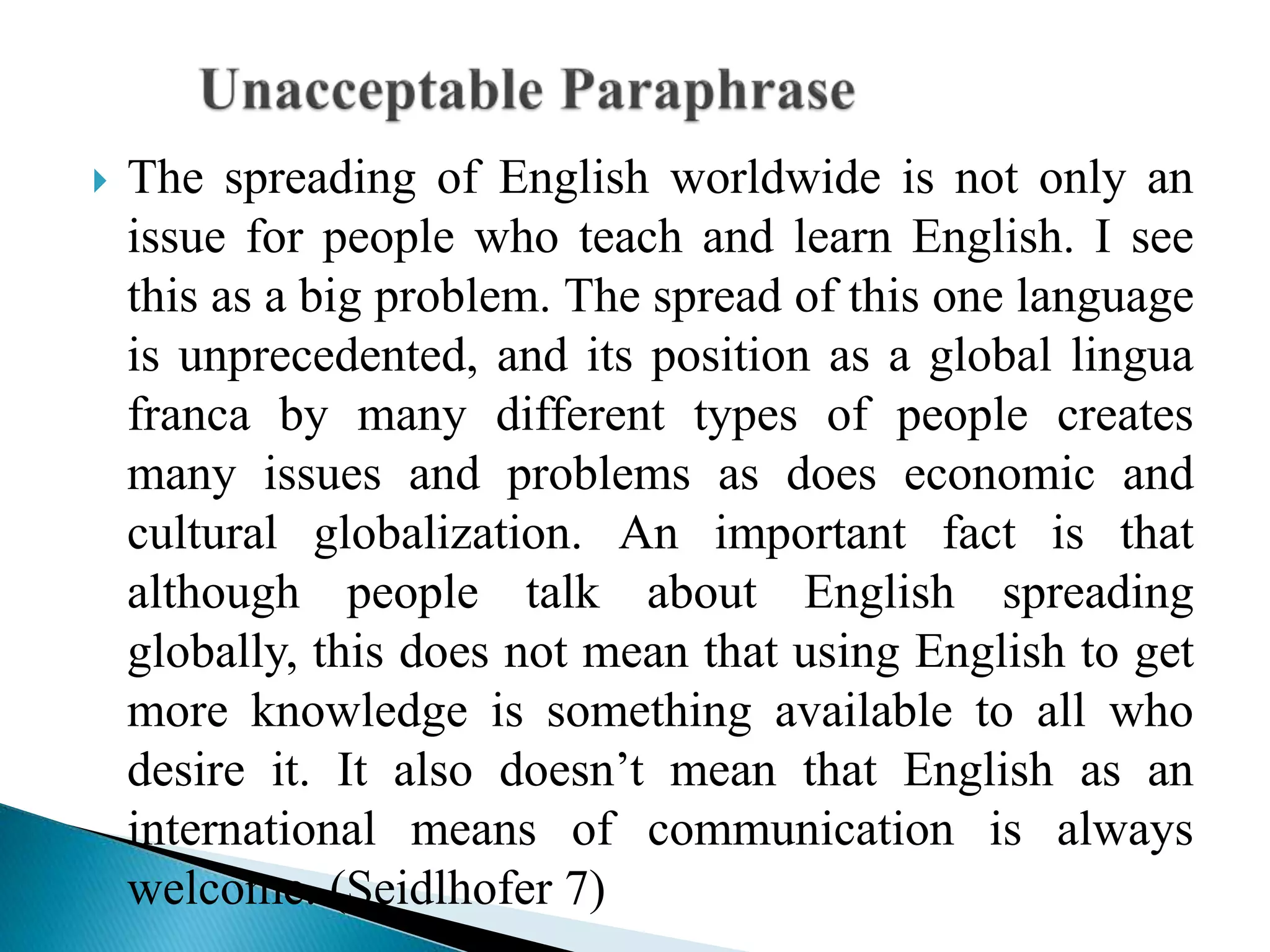
 The spreading of English worldwide is not only an
issue for people who teach and learn English. I see
this as a big problem. The spread of this one language
is unprecedented, and its position as a global lingua
franca by many different types of people creates
many issues and problems as does economic and
cultural globalization. An important fact is that
although people talk about English spreading
globally, this does not mean that using English to get
more knowledge is something available to all who
desire it. It also doesn’t mean that English as an
international means of communication is always
welcome. (Seidlhofer 7)

Paraphrasing in research

  • 1.
    Paraphrasing in researchis writing on author’s selected work/quotation in your own words/ language where you avoid copying the views and opinions as it is instead without changing the main content you interpret the idea in more simple and lucid manner.
  • 4.
     It includesall of the author’s ideas.  It includes only the author’s ideas.  It is accurate and fair.  It is entirely in your own words.  It is properly cited.
  • 5.
     Put theinformation in a new order.  Break down complex ideas into smaller pieces.  Use different vocabulary. Consult a thesaurus if necessary.  Accurately represent the author. Be faithful to what s/he is saying.  Imagine that you are explaining the material to a friend who doesn’t understand it well.  Be clear that the ideas presented are clearly attributed to the author.
  • 6.
     “The globalspread of English is not only an issue for teachers and learners of English. The unprecedented spread of one language and the extent of its use as a global lingua franca in many walks of life raises as many questions and concerns as does economic and cultural globalization. A fact which must certainly not be overlooked is that talk about ‘the global spread of English’ does not mean that having access to English in order to gain access to knowledge is a commodity available to all who desire it, nor that English as an international means of communication is welcome wherever it is available – far from it.” (Seidlhofer 7)
  • 7.
     English hasspread worldwide, and this is relevant for more people than just those who teach and learn the language. A single language has never spread in this way before, and its global status brings forth issues, just as do other types of globalization including the economic and the cultural. Indeed, although English is labeled as ‘global’, not everyone who wants to have a command of English in order to gain more information is able to do so. Likewise, even though in many situations people can use English for international dialogue, they do not do so. (Seidlhofer 7)
  • 8.
     The spreadingof English worldwide is not only an issue for people who teach and learn English. I see this as a big problem. The spread of this one language is unprecedented, and its position as a global lingua franca by many different types of people creates many issues and problems as does economic and cultural globalization. An important fact is that although people talk about English spreading globally, this does not mean that using English to get more knowledge is something available to all who desire it. It also doesn’t mean that English as an international means of communication is always welcome. (Seidlhofer 7)