Paraphrasing in Academic Writing
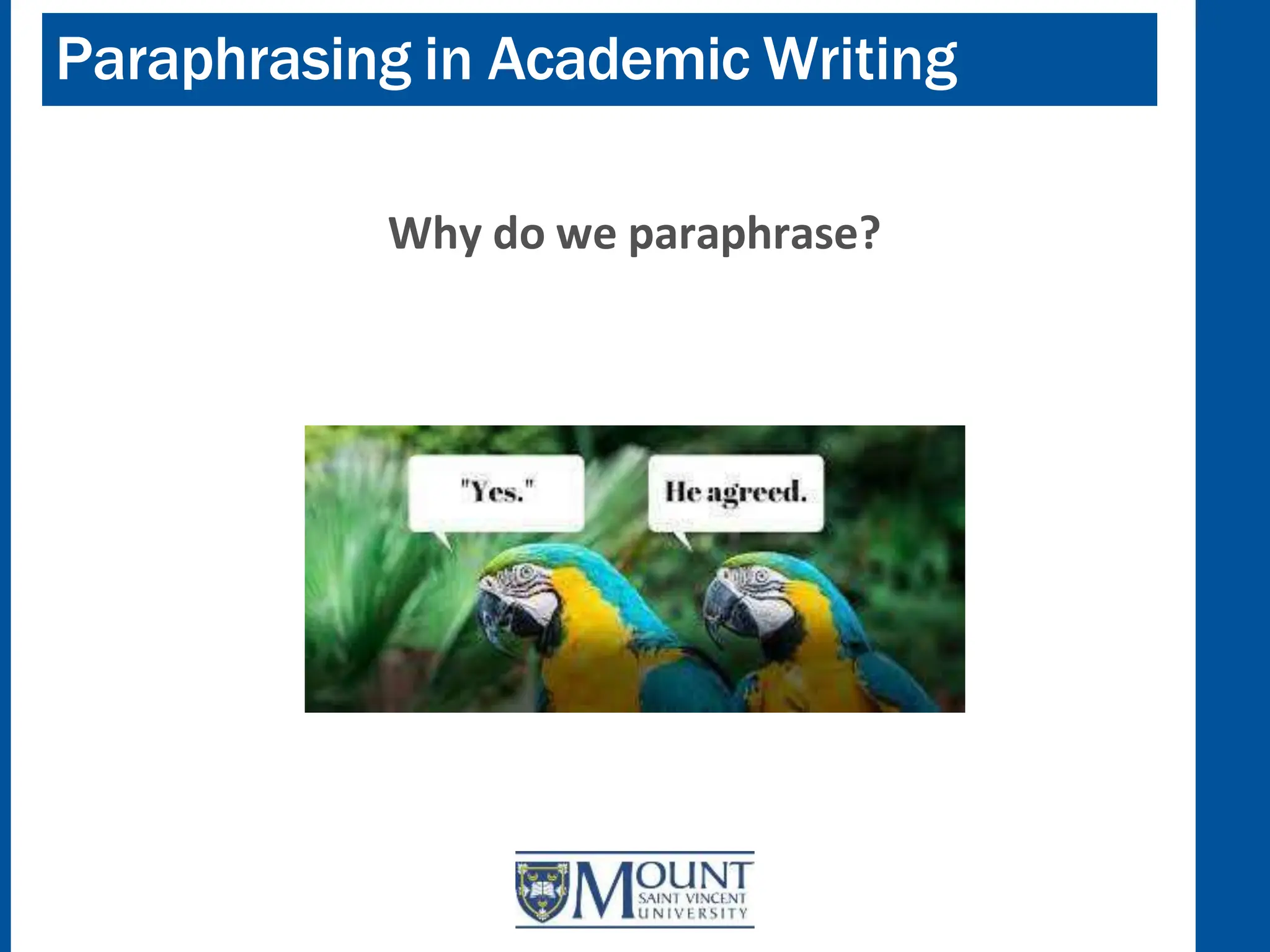
Why do we paraphrase?
Paraphrasing in Academic Writing
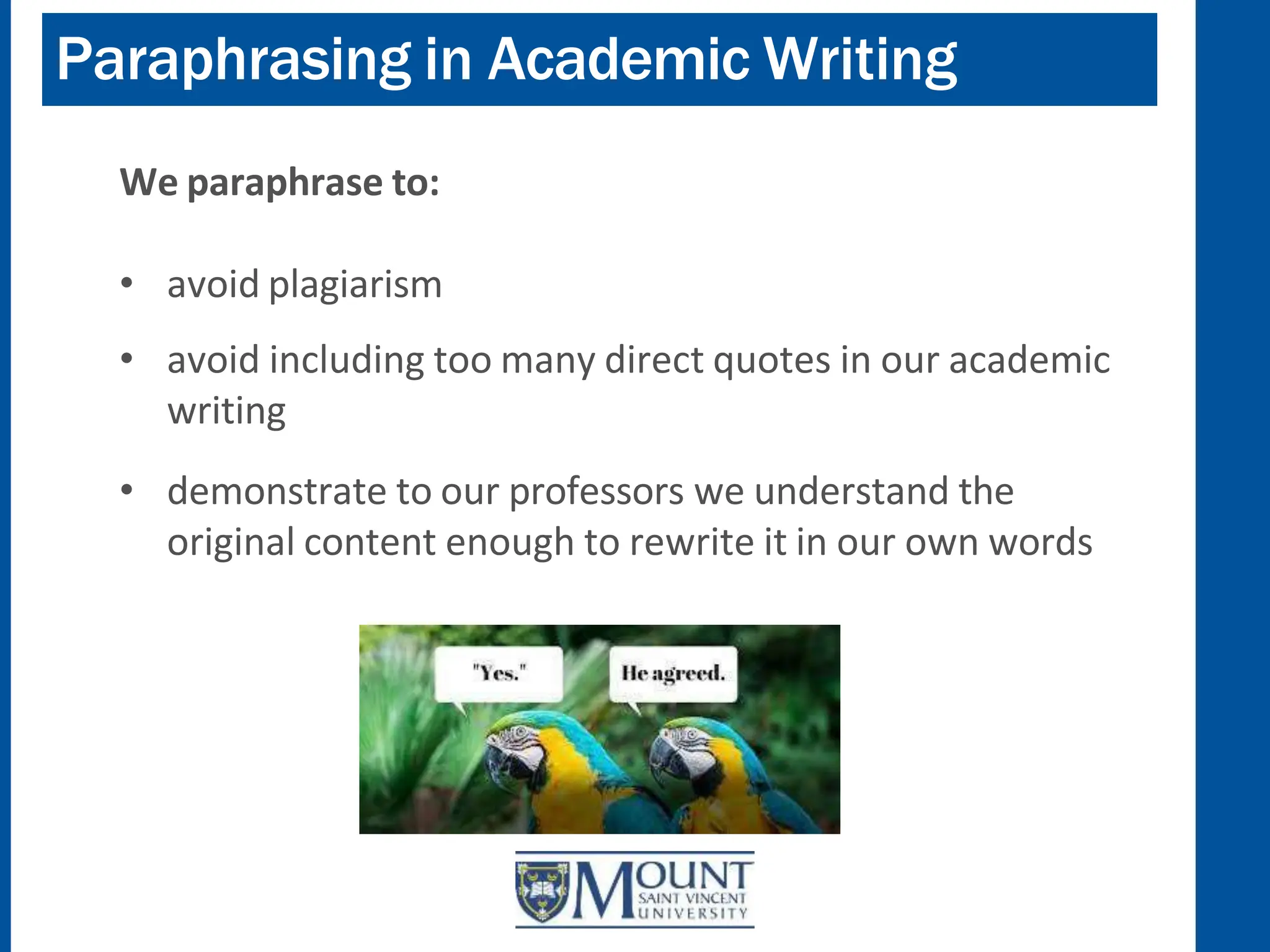
We paraphrase to:
• avoid plagiarism
• avoid including too many direct quotes in our academic
writing
• demonstrate to our professors we understand the
original content enough to rewrite it in our own words
Paraphrasing in Academic Writing
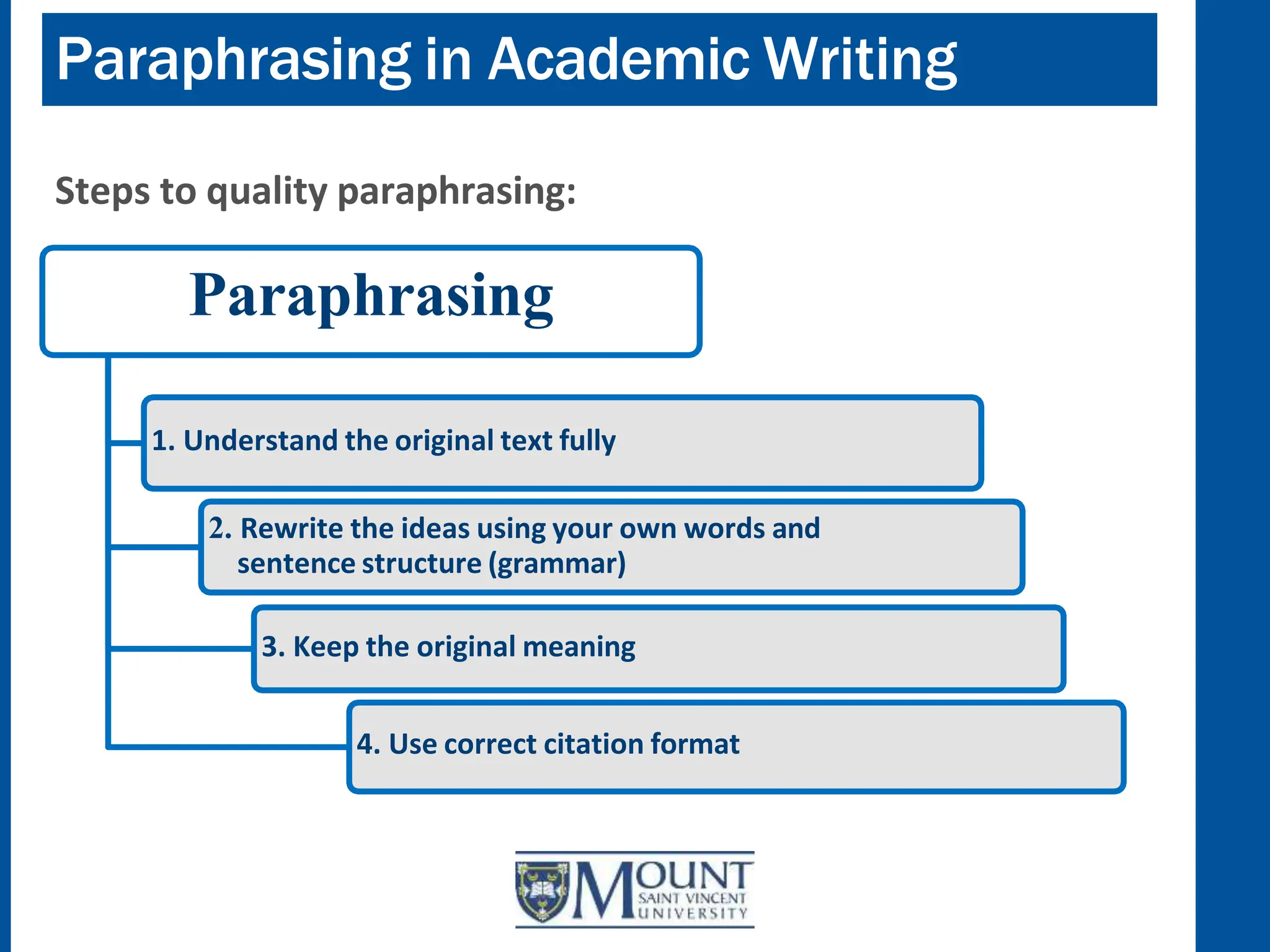
Steps to quality paraphrasing:
Paraphrasing
1. Understand the original text fully
2. Rewrite the ideas using your own words and
sentence structure (grammar)
3. Keep the original meaning
4. Use correct citation format
Paraphrasing in Academic Writing
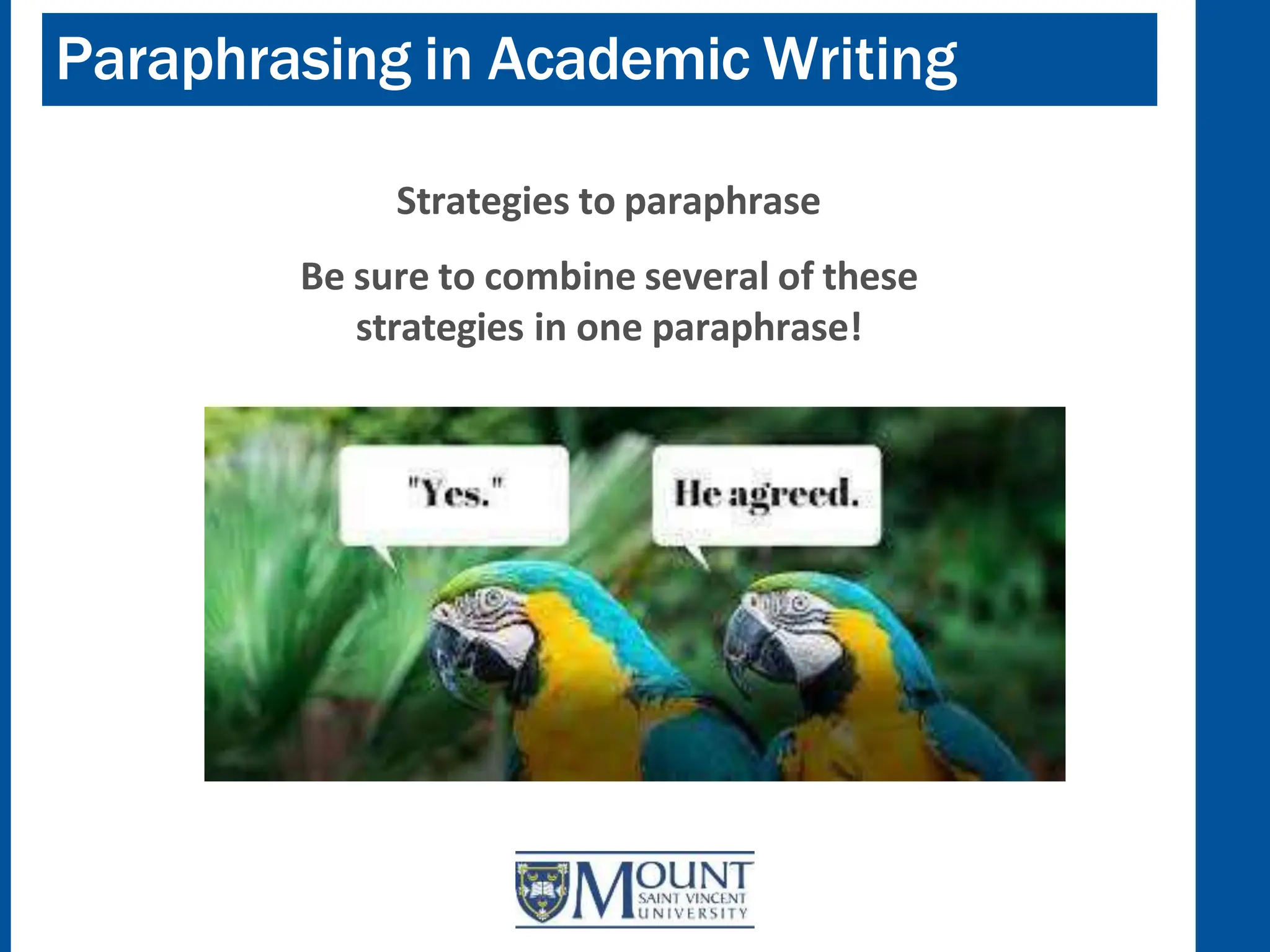
Strategies to paraphrase
Be sure to combine several of these
strategies in one paraphrase!
Paraphrasing in Academic Writing
Strategy 1: Synonyms
Paraphrasing in Academic Writing
Strategy 1: Synonyms
Rewriting a sentence or phrase using new words or phrases.
Original: “More than half of the women who attended the
one-day meeting were in business with their
spouses” (Bowes Cashen, 2021, p. 41).
The majority
Paraphrase: of the women who went to the one-
day meeting were in business with their life partners
(Bowes Cashen, 2021).
(*these two sentences have the same meaning!)
(*note the different citations and use of “ ”*)
Paraphrasing in Academic Writing
Strategy 1: Synonyms - Now you try!
Rewriting a sentence or phrase using new words or phrases.
Original: “Although the coach’s strategy was a little dangerous,
the team was successful” (Jones, 2020, p. 220).
Even though
Paraphrase: the coach’s plan was risky, the team was
successful (Jones, 2020).
Original: “Two students were kicked out of school because of the
no fighting rule” (Currie, 2019, p. 31).
expelled
Paraphrase: Two students were from school due to the
no fighting policy (Currie, 2019).
(*note the different citations and the use of “ ”*)
Paraphrasing in Academic Writing
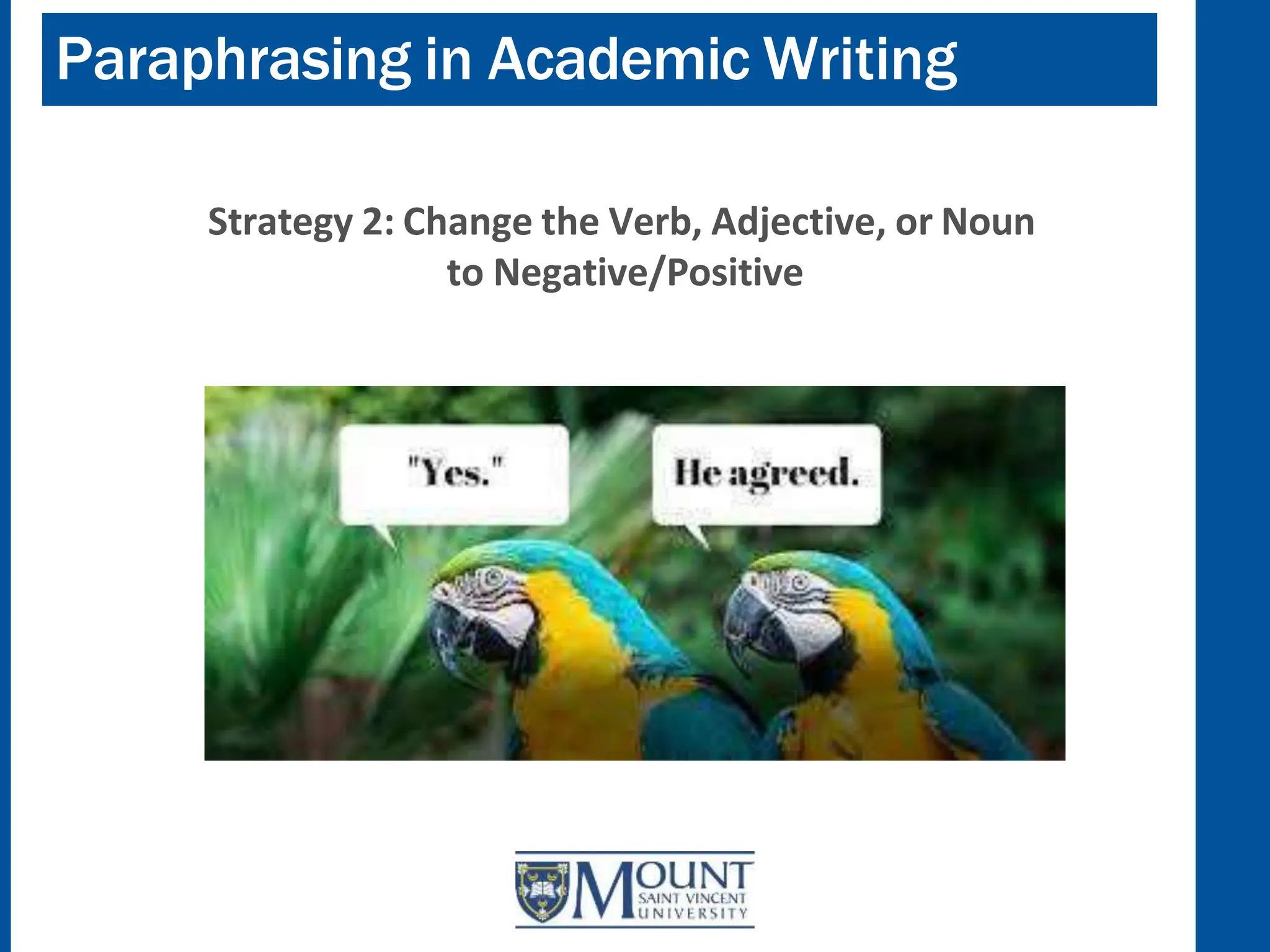
Strategy 2: Change the Verb, Adjective, or Noun
to Negative/Positive
Paraphrasing in Academic Writing
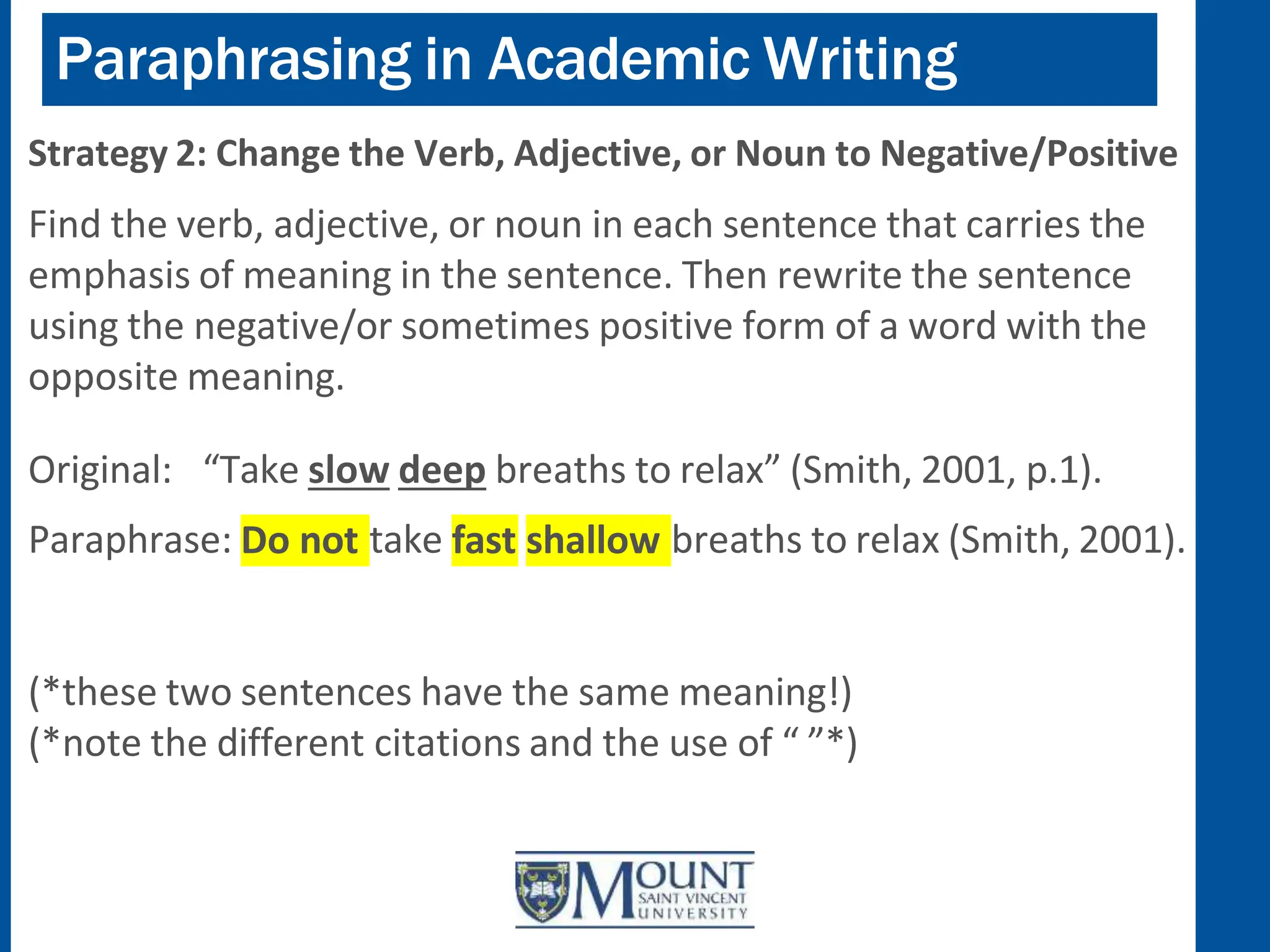
Strategy 2: Change the Verb, Adjective, or Noun to Negative/Positive
Find the verb, adjective, or noun in each sentence that carries the
emphasis of meaning in the sentence. Then rewrite the sentence
using the negative/or sometimes positive form of a word with the
opposite meaning.
Original: “Take slow deep breaths to relax” (Smith, 2001, p.1).
Do not
Paraphrase: take fast shallow breaths to relax (Smith, 2001).
(*these two sentences have the same meaning!)
(*note the different citations and the use of “ ”*)
Paraphrasing in Academic Writing
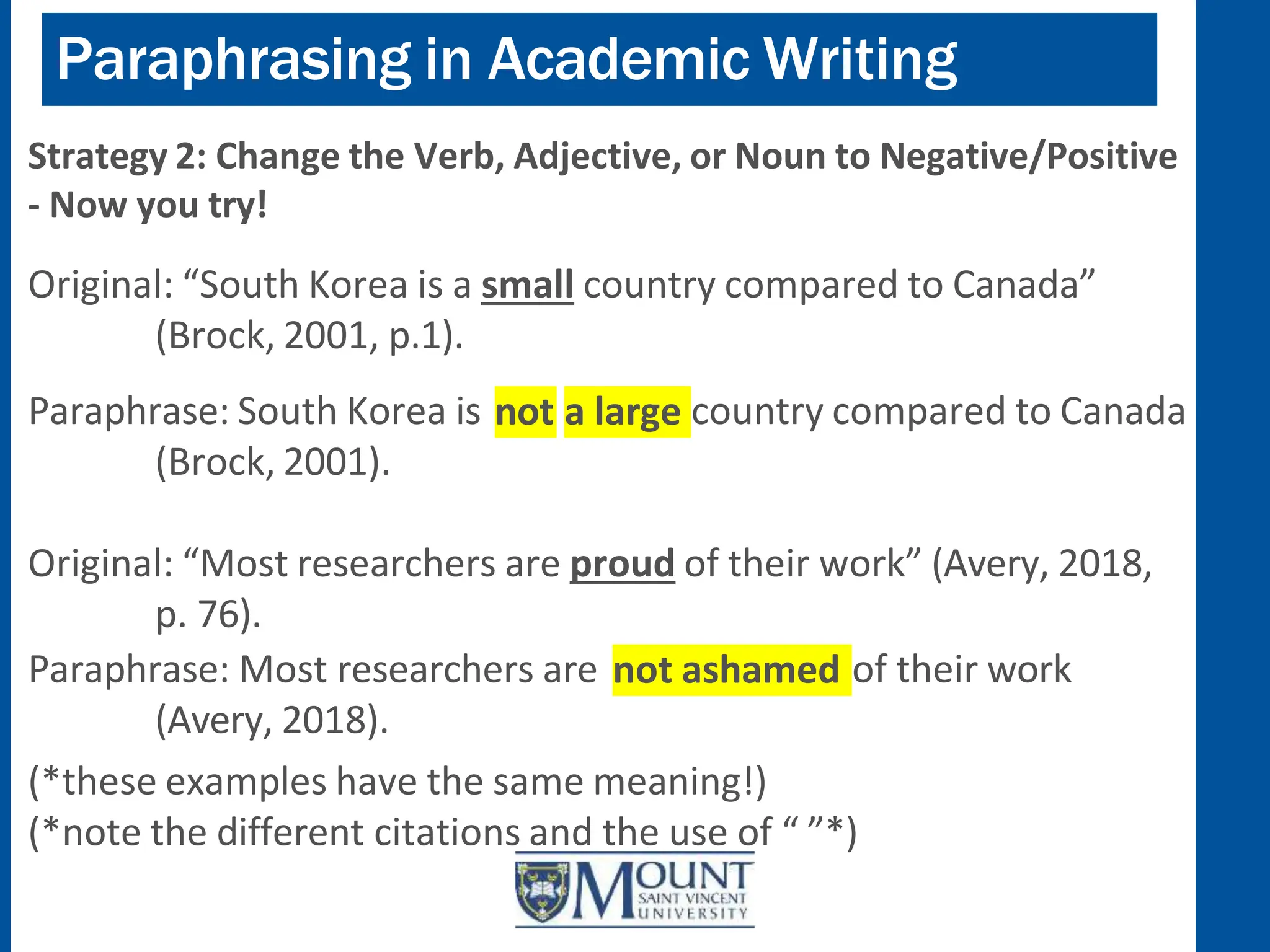
Strategy 2: Change the Verb, Adjective, or Noun to Negative/Positive
- Now you try!
Original: “South Korea is a small country compared to Canada”
(Brock, 2001, p.1).
not a large
Paraphrase: South Korea is country compared to Canada
(Brock, 2001).
Original: “Most researchers are proud of their work” (Avery, 2018,
p. 76).
not ashamed
Paraphrase: Most researchers are of their work
(Avery, 2018).
(*these examples have the same meaning!)
(*note the different citations and the use of “ ”*)
Paraphrasing in Academic Writing
Strategy 3: Switching Active/Passive Verb Tenses
Paraphrasing in Academic Writing
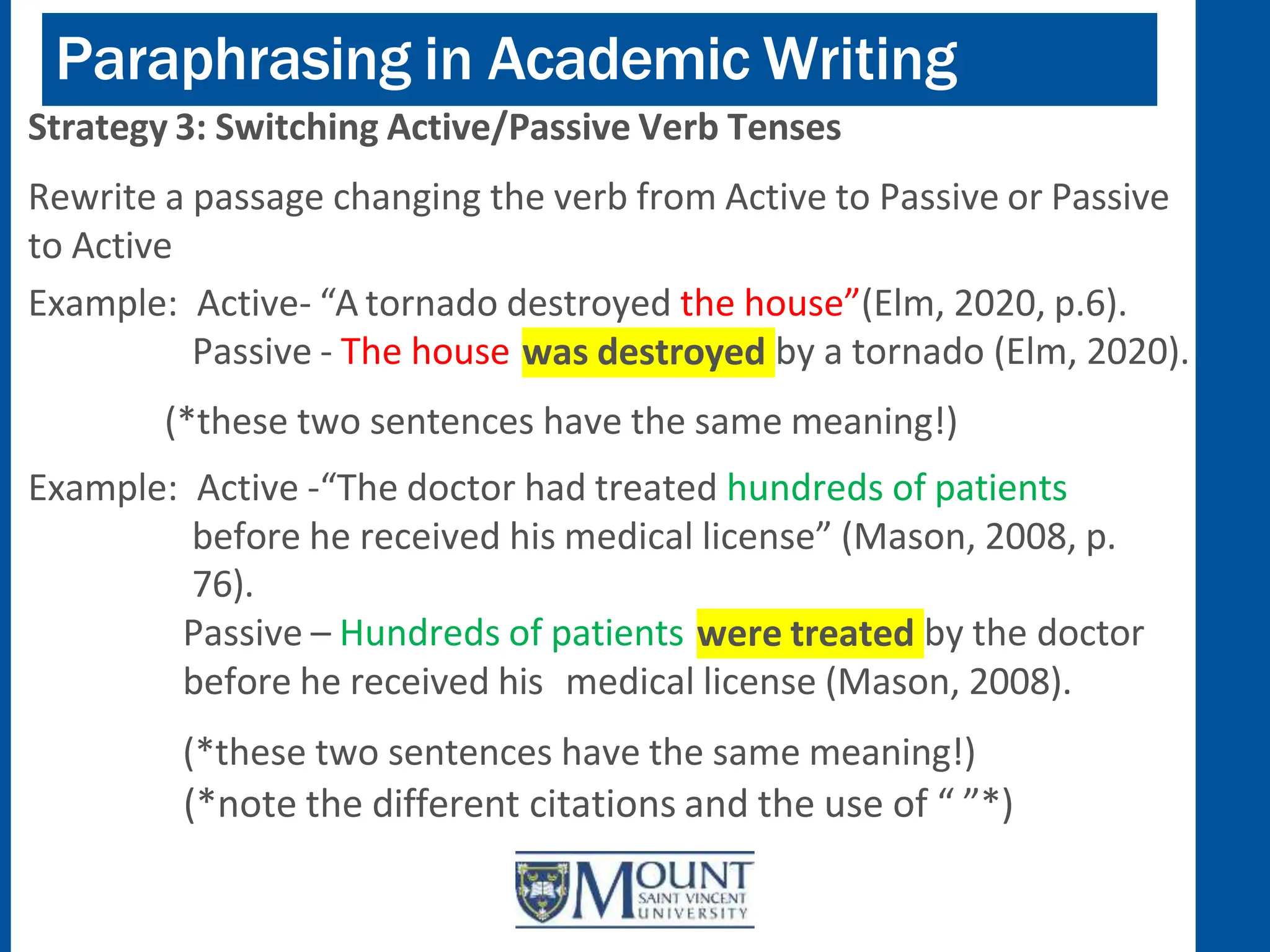
Strategy 3: Switching Active/Passive Verb Tenses
Rewrite a passage changing the verb from Active to Passive or Passive
to Active
Example: Active- “A tornado destroyed the house”(Elm, 2020, p.6).
was destroyed
Passive - The house by a tornado (Elm, 2020).
(*these two sentences have the same meaning!)
Example: Active -“The doctor had treated hundreds of patients
before he received his medical license” (Mason, 2008, p.
were treated
76).
Passive – Hundreds of patients by the doctor
before he received his medical license (Mason, 2008).
(*these two sentences have the same meaning!)
(*note the different citations and the use of “ ”*)
Paraphrasing in Academic Writing
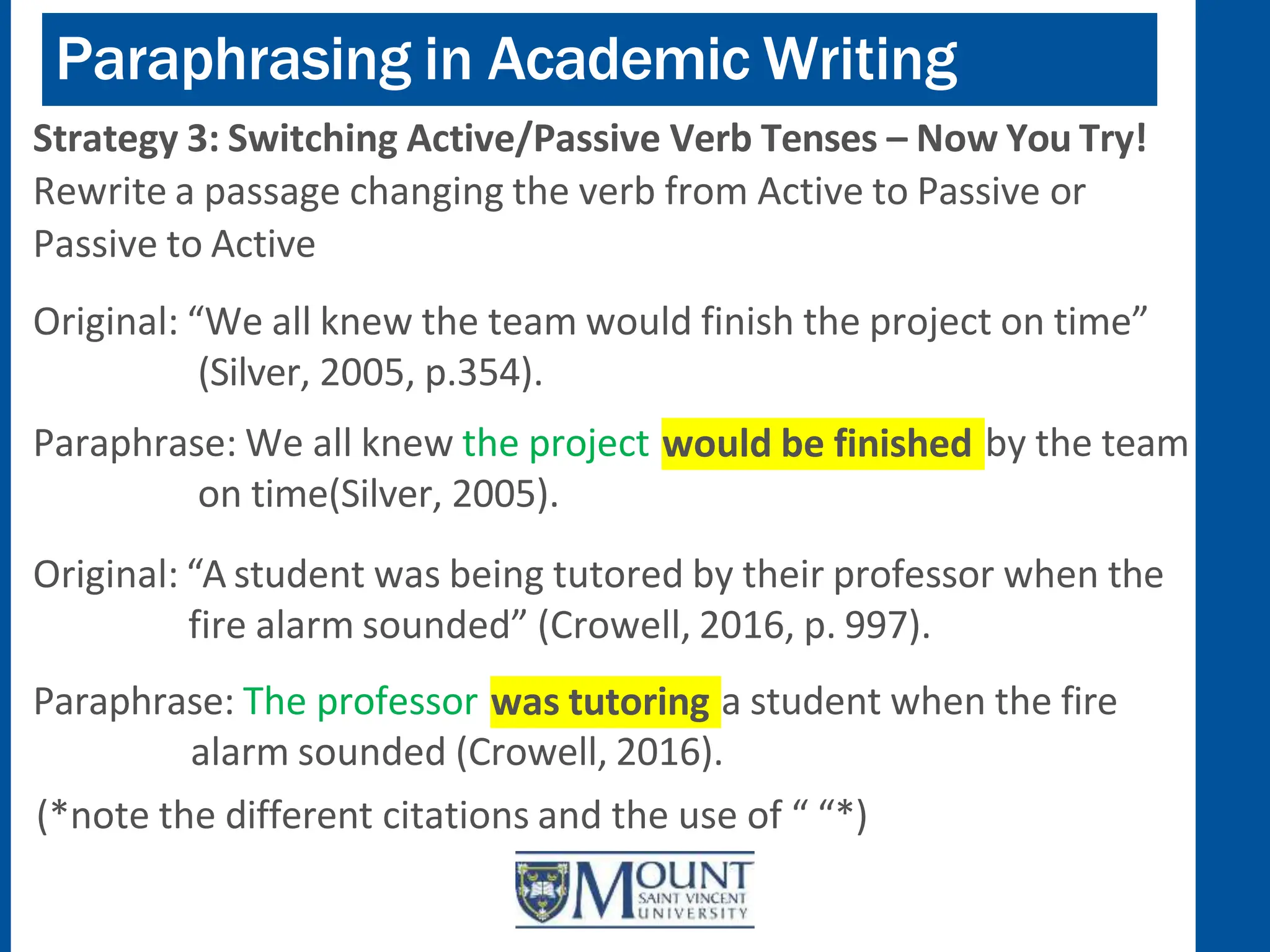
Strategy 3: Switching Active/Passive Verb Tenses – Now You Try!
Rewrite a passage changing the verb from Active to Passive or
Passive to Active
Original: “We all knew the team would finish the project on time”
(Silver, 2005, p.354).
would be finished
Paraphrase: We all knew the project by the team
on time(Silver, 2005).
Original: “A student was being tutored by their professor when the
fire alarm sounded” (Crowell, 2016, p. 997).
was tutoring
Paraphrase: The professor a student when the fire
alarm sounded (Crowell, 2016).
(*note the different citations and the use of “ “*)
Paraphrasing in Academic Writing
Strategy 4: Change Nouns to Verbs or Verbs to Nouns
Paraphrasing in Academic Writing
Strategy 4: Change Nouns to Verbs or Verbs to Nouns
Change the Noun into a Verb or the Verb to a Noun, then rewrite
the sentence around it.
Noun to Verb:
Original: “You have to give us your decision by tomorrow”
(Jacques, 2021, p. 22).
to decide
Paraphrase: You have by tomorrow (Jacques, 2021).
(*these two sentences have the same meaning!)
Verb to Noun:
Original: “Researchers investigated the issue” (James, 2011, p.87).
an investigation
Paraphrase: Researchers conducted into the issue
(James, 2011, p. 87).
(*these two sentences have the same meaning!)
(*note the different citations and the use of “ “*)
Paraphrasing in Academic Writing
Strategy 4: Change Nouns to Verbs or Verbs to Nouns – Now You Try!
Change the Noun into a Verb or the Verb to a Noun, then rewrite the
sentence around it.
Original: “We did a review of the company’s annual reports”
(Jacques, 2021, p. 22).
reviewed
Paraphrase: We the company’s annual reports (Jacques,
2021).
(*these two sentences have the same meaning!)
Original: “This essay analyzes climate change and describes a
potential solution” (Bowes, 2015, p. 87).
an analysis
Paraphrase: This essay gives of the problem of climate
change and describes a potential solution (Bowes, 2015).
(*these two sentences have the same meaning!)
(*note the different citations and the use of “ “*)
Paraphrasing in Academic Writing
Strategy 5: Paraphrase with Conjunctions (combining phrases)
Paraphrasing in Academic Writing
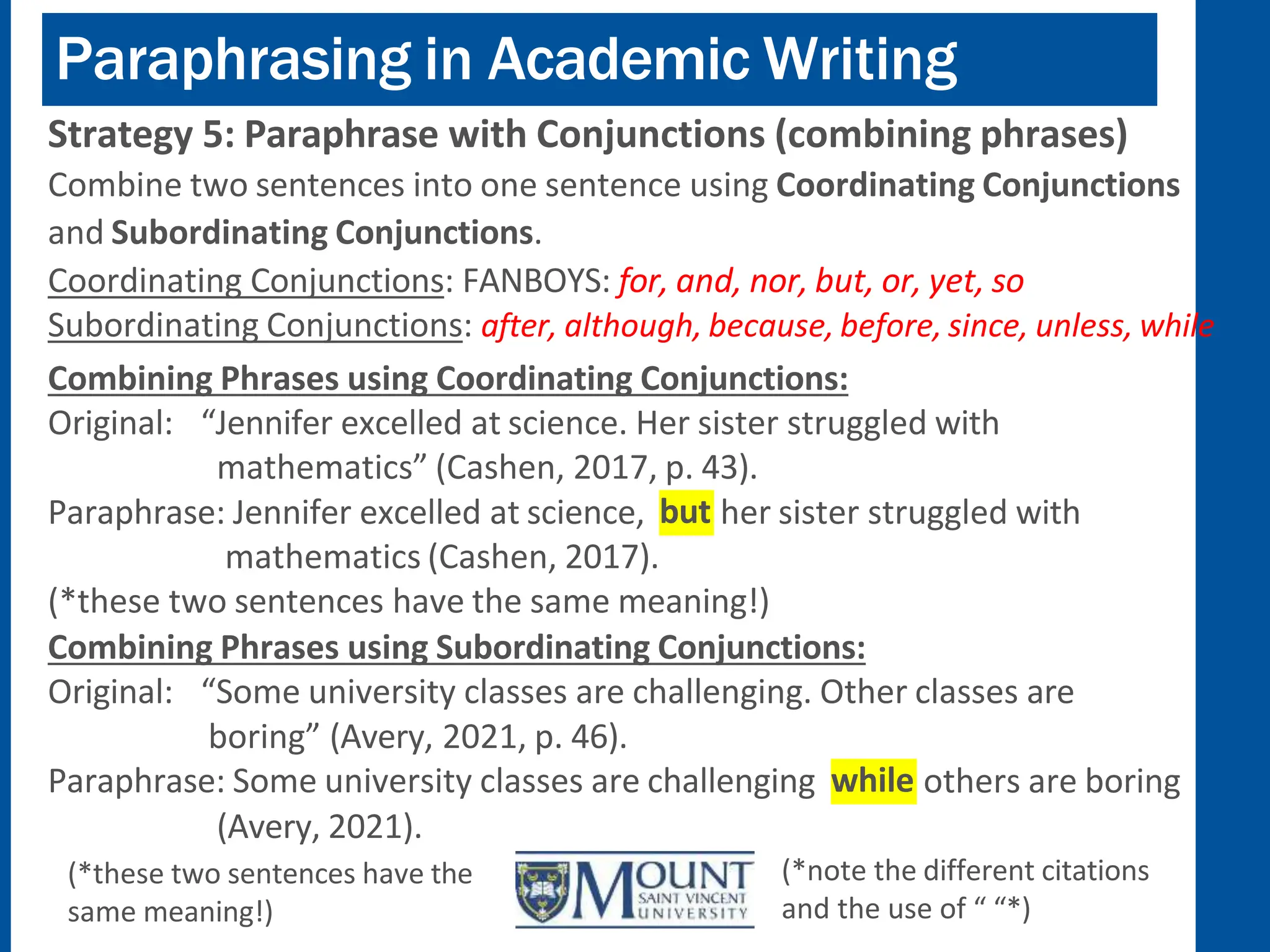
Strategy 5: Paraphrase with Conjunctions (combining phrases)
Combine two sentences into one sentence using Coordinating Conjunctions
and Subordinating Conjunctions.
Coordinating Conjunctions: FANBOYS: for, and, nor, but, or, yet, so
Subordinating Conjunctions: after, although, because, before, since, unless, while
Combining Phrases using Coordinating Conjunctions:
Original: “Jennifer excelled at science. Her sister struggled with
mathematics” (Cashen, 2017, p. 43).
but
Paraphrase: Jennifer excelled at science, her sister struggled with
mathematics (Cashen, 2017).
(*these two sentences have the same meaning!)
Combining Phrases using Subordinating Conjunctions:
Original: “Some university classes are challenging. Other classes are
boring” (Avery, 2021, p. 46).
Paraphrase: Some university classes are challenging
(Avery, 2021).
while others are boring
(*these two sentences have the
same meaning!)
(*note the different citations
and the use of “ “*)
Paraphrasing in Academic Writing
Strategy 5: Paraphrase with Conjunctions (combining phrases)
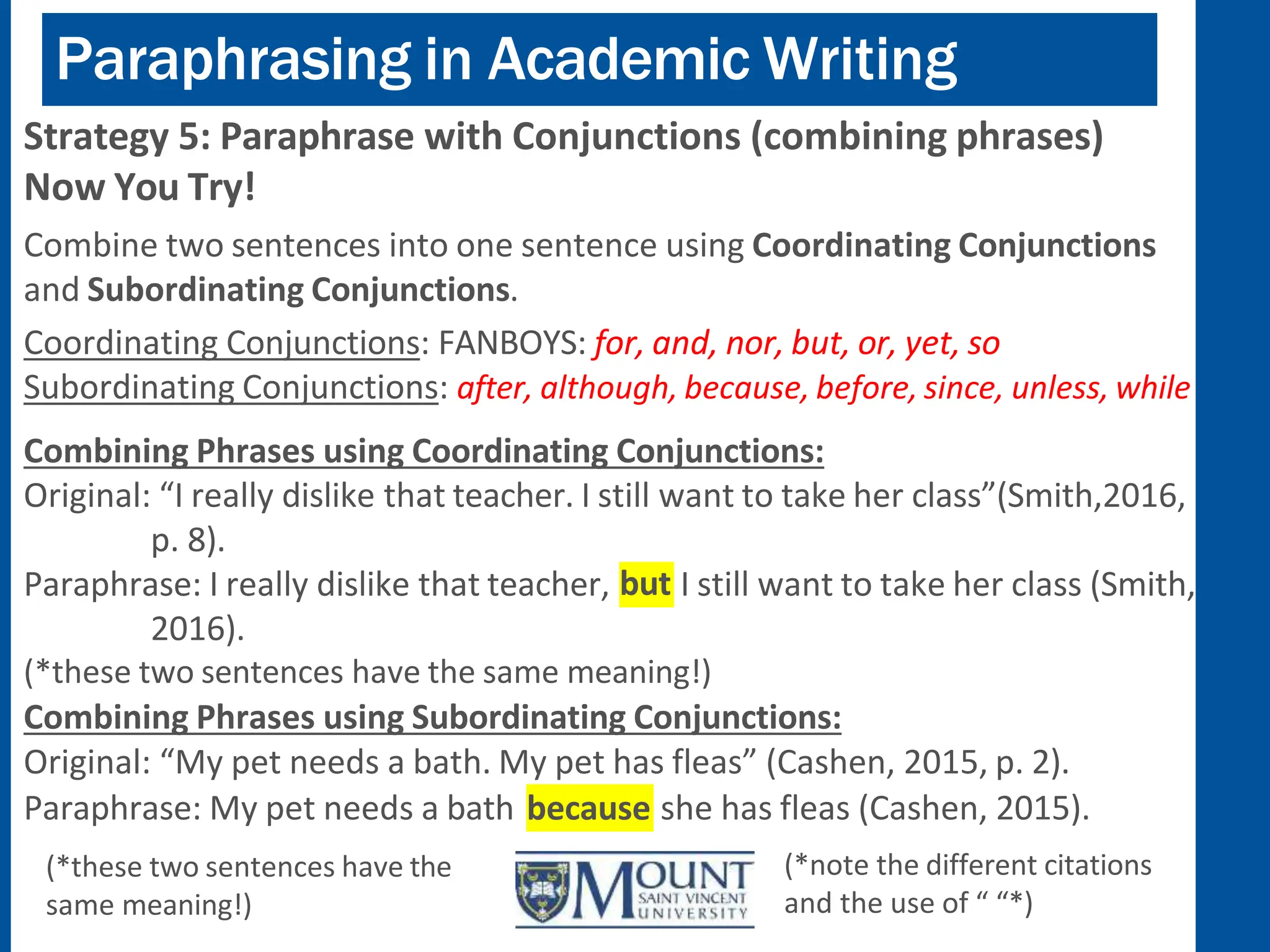
Now You Try!
Combine two sentences into one sentence using Coordinating Conjunctions
and Subordinating Conjunctions.
Coordinating Conjunctions: FANBOYS: for, and, nor, but, or, yet, so
Subordinating Conjunctions: after, although, because, before, since, unless, while
Combining Phrases using Coordinating Conjunctions:
Original: “I really dislike that teacher. I still want to take her class”(Smith,2016,
but I still want to take her class (Smith,
p. 8).
Paraphrase: I really dislike that teacher,
2016).
(*these two sentences have the same meaning!)
Combining Phrases using Subordinating Conjunctions:
Original: “My pet needs a bath. My pet has fleas” (Cashen, 2015, p. 2).
because
Paraphrase: My pet needs a bath
(*these two sentences have the
same meaning!)
she has fleas (Cashen, 2015).
(*note the different citations
and the use of “ “*)
Paraphrasing in Academic Writing
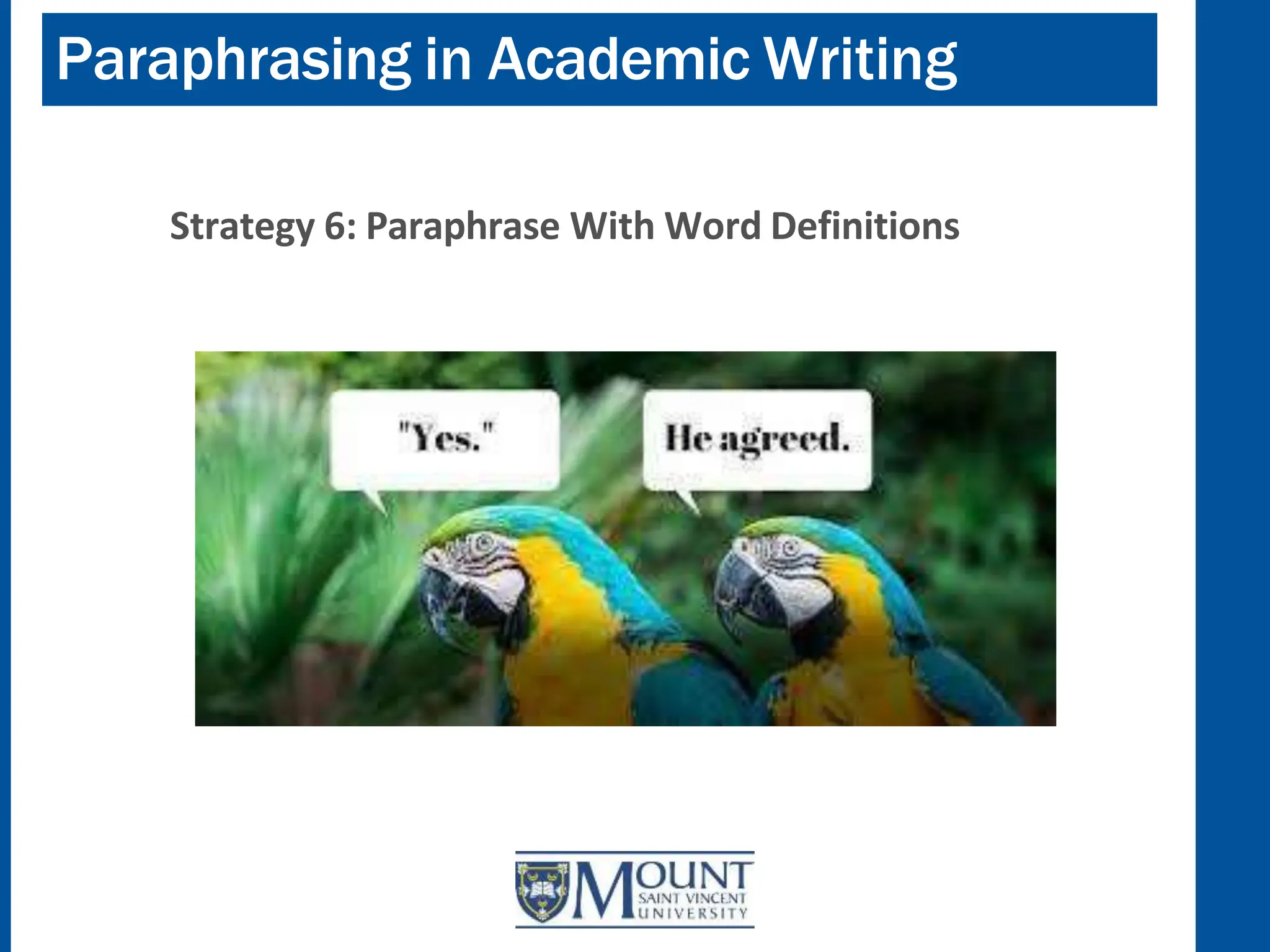
Strategy 6: Paraphrase With Word Definitions
Paraphrasing in Academic Writing
Strategy 6: Paraphrase With Word Definitions
Paraphrase sentences by removing words and replacing them
with their definitions.
Original: “Sellers are taking advantage of the significant increase
in in the housing market” (Currie,2021,p. 34).
Paraphrase: are exploiting the very
People selling their homes
serious growth in the housing market (Currie, 2021).
(*these two sentences have the same meaning!)
(*note the different citations and the use of “ ”*)
Paraphrasing in Academic Writing
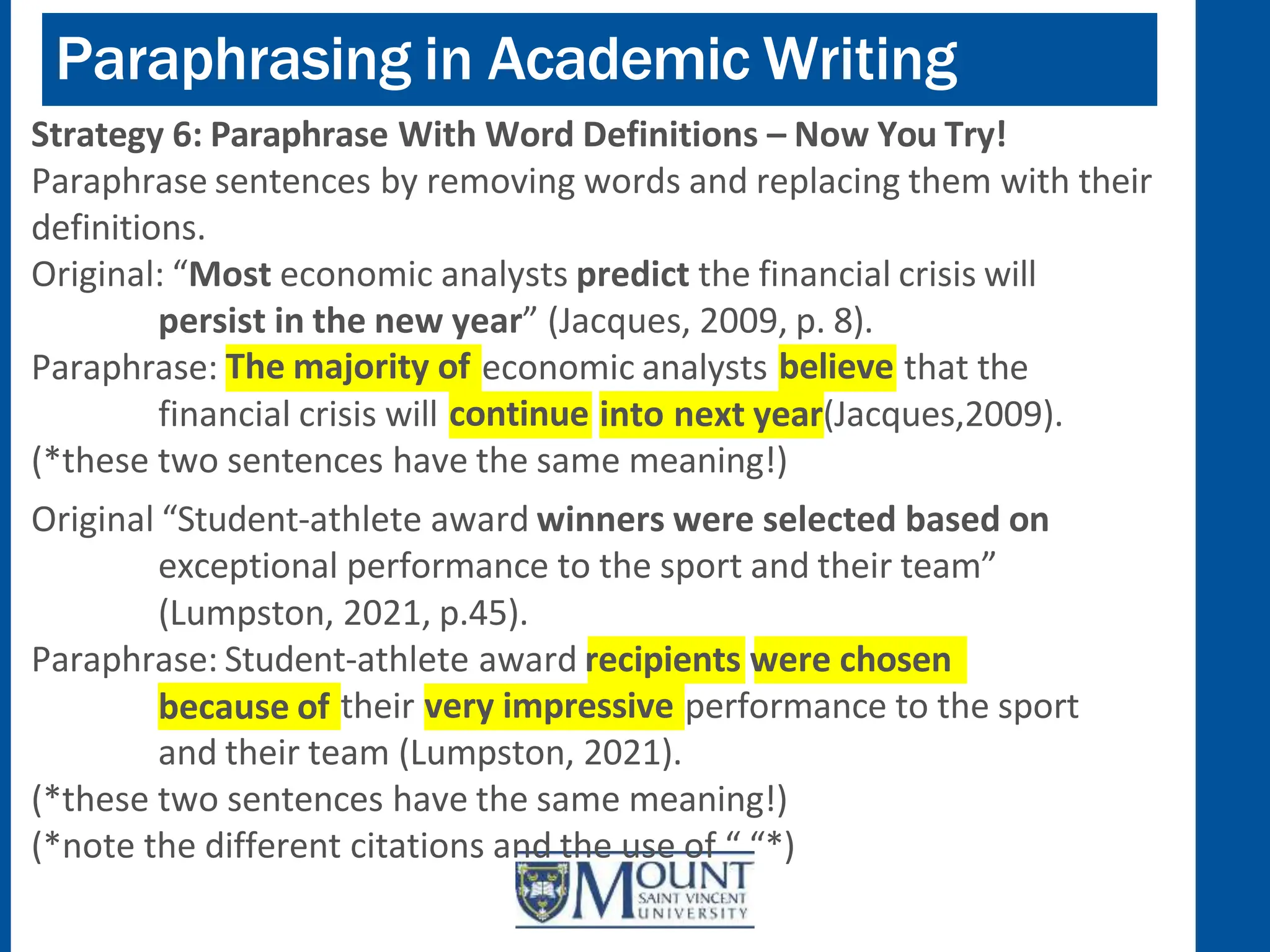
Strategy 6: Paraphrase With Word Definitions – Now You Try!
Paraphrase sentences by removing words and replacing them with their
definitions.
Original: “Most economic analysts predict the financial crisis will
persist in the new year” (Jacques, 2009, p. 8).
The majority of
Paraphrase: economic analysts believe that the
continue
financial crisis will into next year(Jacques,2009).
(*these two sentences have the same meaning!)
Original “Student-athlete award winners were selected based on
exceptional performance to the sport and their team”
(Lumpston, 2021, p.45).
Paraphrase: Student-athlete award recipients were chosen
because of very impressive
their performance to the sport
and their team (Lumpston, 2021).
(*these two sentences have the same meaning!)
(*note the different citations and the use of “ “*)
Citing a Paraphrase in Academic Writing
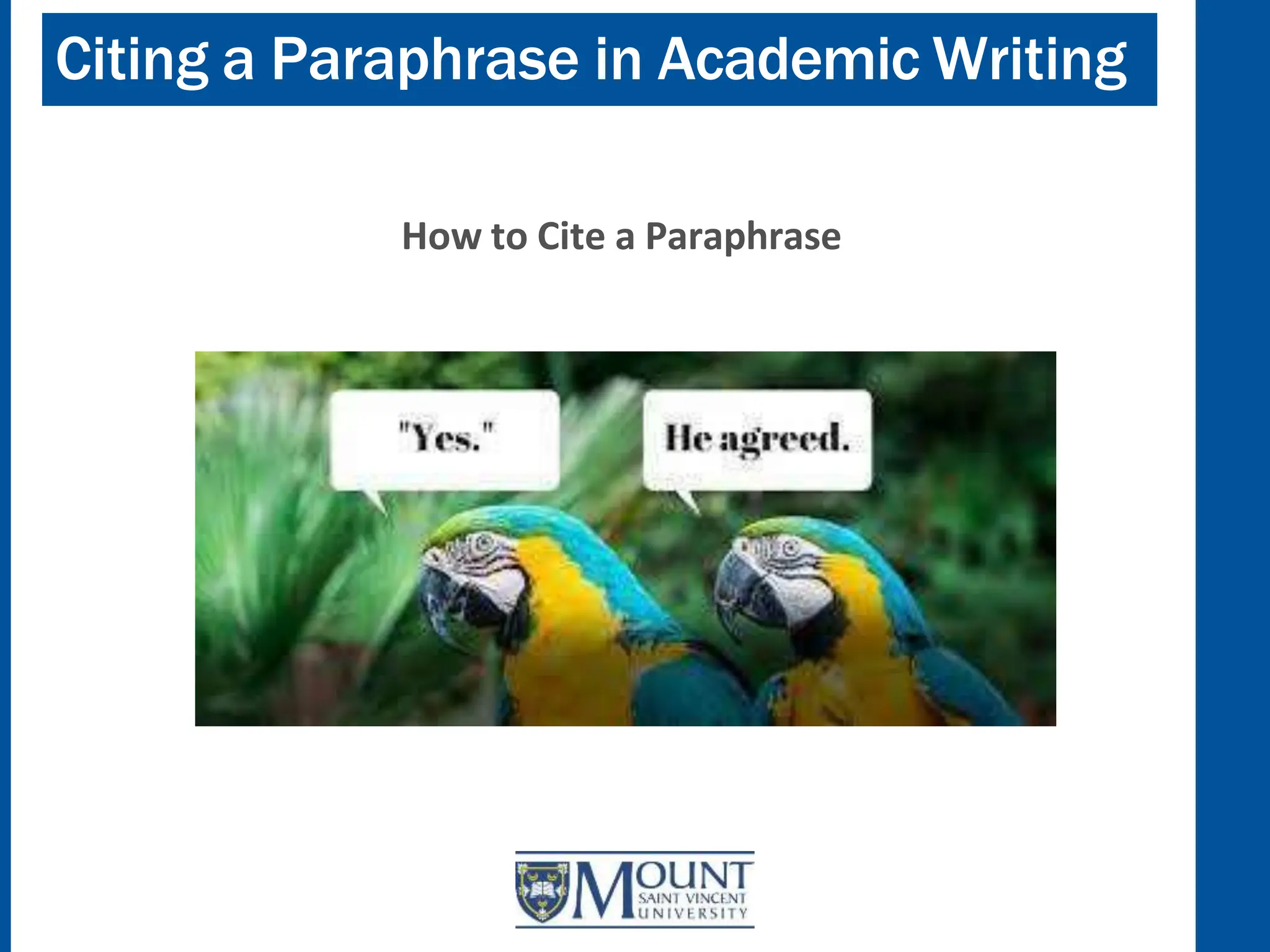
How to Cite a Paraphrase
Citing a Paraphrase in Academic Writing
How to cite a paraphrase:
In-text:
• Author (last name)
• Year
• In parenthesis ( )
Format:
• At the end of the paraphrase
o MSVU International students are highly active students
(Jones, 2021).
• Can refer to the author at the beginning of the paraphrase
o According to Jones(2021), MSVU International students are
highly active students.
Reference List:
• Reference according to the appropriate citation style guide
Citing a Paraphrase in Academic Writing
To sum up
We paraphrase to:
• avoid plagiarism
• avoid including too many direct quotes in our academic writing
• demonstrate you understand the original content enough to rewrite it
in your own words
6 strategies for paraphrasing:
• use Synonyms
• change the Verb, Adjective, or Noun to Negative/Positive
• change Active to Passive or Passive to Active
• change Nouns to Verbs or Verbs to Nouns
• paraphrase with Conjunctions (combining phrases)
• paraphrase With Word Definitions
Citation:
• (author (last name) + year)
• reference list
Use
multiple
strategies
in a single
paraphrase

Paraphrasing-and-Citation. How to paraphrase and cite the reference without plagiarism.

  • 1.
  • 2.
    Paraphrasing in AcademicWriting Why do we paraphrase?
  • 3.
    Paraphrasing in AcademicWriting We paraphrase to: • avoid plagiarism • avoid including too many direct quotes in our academic writing • demonstrate to our professors we understand the original content enough to rewrite it in our own words
  • 4.
    Paraphrasing in AcademicWriting Steps to quality paraphrasing: Paraphrasing 1. Understand the original text fully 2. Rewrite the ideas using your own words and sentence structure (grammar) 3. Keep the original meaning 4. Use correct citation format
  • 5.
    Paraphrasing in AcademicWriting Strategies to paraphrase Be sure to combine several of these strategies in one paraphrase!
  • 6.
    Paraphrasing in AcademicWriting Strategy 1: Synonyms
  • 7.
    Paraphrasing in AcademicWriting Strategy 1: Synonyms Rewriting a sentence or phrase using new words or phrases. Original: “More than half of the women who attended the one-day meeting were in business with their spouses” (Bowes Cashen, 2021, p. 41). The majority Paraphrase: of the women who went to the one- day meeting were in business with their life partners (Bowes Cashen, 2021). (*these two sentences have the same meaning!) (*note the different citations and use of “ ”*)
  • 8.
    Paraphrasing in AcademicWriting Strategy 1: Synonyms - Now you try! Rewriting a sentence or phrase using new words or phrases. Original: “Although the coach’s strategy was a little dangerous, the team was successful” (Jones, 2020, p. 220). Even though Paraphrase: the coach’s plan was risky, the team was successful (Jones, 2020). Original: “Two students were kicked out of school because of the no fighting rule” (Currie, 2019, p. 31). expelled Paraphrase: Two students were from school due to the no fighting policy (Currie, 2019). (*note the different citations and the use of “ ”*)
  • 9.
    Paraphrasing in AcademicWriting Strategy 2: Change the Verb, Adjective, or Noun to Negative/Positive
  • 10.
    Paraphrasing in AcademicWriting Strategy 2: Change the Verb, Adjective, or Noun to Negative/Positive Find the verb, adjective, or noun in each sentence that carries the emphasis of meaning in the sentence. Then rewrite the sentence using the negative/or sometimes positive form of a word with the opposite meaning. Original: “Take slow deep breaths to relax” (Smith, 2001, p.1). Do not Paraphrase: take fast shallow breaths to relax (Smith, 2001). (*these two sentences have the same meaning!) (*note the different citations and the use of “ ”*)
  • 11.
    Paraphrasing in AcademicWriting Strategy 2: Change the Verb, Adjective, or Noun to Negative/Positive - Now you try! Original: “South Korea is a small country compared to Canada” (Brock, 2001, p.1). not a large Paraphrase: South Korea is country compared to Canada (Brock, 2001). Original: “Most researchers are proud of their work” (Avery, 2018, p. 76). not ashamed Paraphrase: Most researchers are of their work (Avery, 2018). (*these examples have the same meaning!) (*note the different citations and the use of “ ”*)
  • 12.
    Paraphrasing in AcademicWriting Strategy 3: Switching Active/Passive Verb Tenses
  • 13.
    Paraphrasing in AcademicWriting Strategy 3: Switching Active/Passive Verb Tenses Rewrite a passage changing the verb from Active to Passive or Passive to Active Example: Active- “A tornado destroyed the house”(Elm, 2020, p.6). was destroyed Passive - The house by a tornado (Elm, 2020). (*these two sentences have the same meaning!) Example: Active -“The doctor had treated hundreds of patients before he received his medical license” (Mason, 2008, p. were treated 76). Passive – Hundreds of patients by the doctor before he received his medical license (Mason, 2008). (*these two sentences have the same meaning!) (*note the different citations and the use of “ ”*)
  • 14.
    Paraphrasing in AcademicWriting Strategy 3: Switching Active/Passive Verb Tenses – Now You Try! Rewrite a passage changing the verb from Active to Passive or Passive to Active Original: “We all knew the team would finish the project on time” (Silver, 2005, p.354). would be finished Paraphrase: We all knew the project by the team on time(Silver, 2005). Original: “A student was being tutored by their professor when the fire alarm sounded” (Crowell, 2016, p. 997). was tutoring Paraphrase: The professor a student when the fire alarm sounded (Crowell, 2016). (*note the different citations and the use of “ “*)
  • 15.
    Paraphrasing in AcademicWriting Strategy 4: Change Nouns to Verbs or Verbs to Nouns
  • 16.
    Paraphrasing in AcademicWriting Strategy 4: Change Nouns to Verbs or Verbs to Nouns Change the Noun into a Verb or the Verb to a Noun, then rewrite the sentence around it. Noun to Verb: Original: “You have to give us your decision by tomorrow” (Jacques, 2021, p. 22). to decide Paraphrase: You have by tomorrow (Jacques, 2021). (*these two sentences have the same meaning!) Verb to Noun: Original: “Researchers investigated the issue” (James, 2011, p.87). an investigation Paraphrase: Researchers conducted into the issue (James, 2011, p. 87). (*these two sentences have the same meaning!) (*note the different citations and the use of “ “*)
  • 17.
    Paraphrasing in AcademicWriting Strategy 4: Change Nouns to Verbs or Verbs to Nouns – Now You Try! Change the Noun into a Verb or the Verb to a Noun, then rewrite the sentence around it. Original: “We did a review of the company’s annual reports” (Jacques, 2021, p. 22). reviewed Paraphrase: We the company’s annual reports (Jacques, 2021). (*these two sentences have the same meaning!) Original: “This essay analyzes climate change and describes a potential solution” (Bowes, 2015, p. 87). an analysis Paraphrase: This essay gives of the problem of climate change and describes a potential solution (Bowes, 2015). (*these two sentences have the same meaning!) (*note the different citations and the use of “ “*)
  • 18.
    Paraphrasing in AcademicWriting Strategy 5: Paraphrase with Conjunctions (combining phrases)
  • 19.
    Paraphrasing in AcademicWriting Strategy 5: Paraphrase with Conjunctions (combining phrases) Combine two sentences into one sentence using Coordinating Conjunctions and Subordinating Conjunctions. Coordinating Conjunctions: FANBOYS: for, and, nor, but, or, yet, so Subordinating Conjunctions: after, although, because, before, since, unless, while Combining Phrases using Coordinating Conjunctions: Original: “Jennifer excelled at science. Her sister struggled with mathematics” (Cashen, 2017, p. 43). but Paraphrase: Jennifer excelled at science, her sister struggled with mathematics (Cashen, 2017). (*these two sentences have the same meaning!) Combining Phrases using Subordinating Conjunctions: Original: “Some university classes are challenging. Other classes are boring” (Avery, 2021, p. 46). Paraphrase: Some university classes are challenging (Avery, 2021). while others are boring (*these two sentences have the same meaning!) (*note the different citations and the use of “ “*)
  • 20.
    Paraphrasing in AcademicWriting Strategy 5: Paraphrase with Conjunctions (combining phrases) Now You Try! Combine two sentences into one sentence using Coordinating Conjunctions and Subordinating Conjunctions. Coordinating Conjunctions: FANBOYS: for, and, nor, but, or, yet, so Subordinating Conjunctions: after, although, because, before, since, unless, while Combining Phrases using Coordinating Conjunctions: Original: “I really dislike that teacher. I still want to take her class”(Smith,2016, but I still want to take her class (Smith, p. 8). Paraphrase: I really dislike that teacher, 2016). (*these two sentences have the same meaning!) Combining Phrases using Subordinating Conjunctions: Original: “My pet needs a bath. My pet has fleas” (Cashen, 2015, p. 2). because Paraphrase: My pet needs a bath (*these two sentences have the same meaning!) she has fleas (Cashen, 2015). (*note the different citations and the use of “ “*)
  • 21.
    Paraphrasing in AcademicWriting Strategy 6: Paraphrase With Word Definitions
  • 22.
    Paraphrasing in AcademicWriting Strategy 6: Paraphrase With Word Definitions Paraphrase sentences by removing words and replacing them with their definitions. Original: “Sellers are taking advantage of the significant increase in in the housing market” (Currie,2021,p. 34). Paraphrase: are exploiting the very People selling their homes serious growth in the housing market (Currie, 2021). (*these two sentences have the same meaning!) (*note the different citations and the use of “ ”*)
  • 23.
    Paraphrasing in AcademicWriting Strategy 6: Paraphrase With Word Definitions – Now You Try! Paraphrase sentences by removing words and replacing them with their definitions. Original: “Most economic analysts predict the financial crisis will persist in the new year” (Jacques, 2009, p. 8). The majority of Paraphrase: economic analysts believe that the continue financial crisis will into next year(Jacques,2009). (*these two sentences have the same meaning!) Original “Student-athlete award winners were selected based on exceptional performance to the sport and their team” (Lumpston, 2021, p.45). Paraphrase: Student-athlete award recipients were chosen because of very impressive their performance to the sport and their team (Lumpston, 2021). (*these two sentences have the same meaning!) (*note the different citations and the use of “ “*)
  • 24.
    Citing a Paraphrasein Academic Writing How to Cite a Paraphrase
  • 25.
    Citing a Paraphrasein Academic Writing How to cite a paraphrase: In-text: • Author (last name) • Year • In parenthesis ( ) Format: • At the end of the paraphrase o MSVU International students are highly active students (Jones, 2021). • Can refer to the author at the beginning of the paraphrase o According to Jones(2021), MSVU International students are highly active students. Reference List: • Reference according to the appropriate citation style guide
  • 26.
    Citing a Paraphrasein Academic Writing To sum up We paraphrase to: • avoid plagiarism • avoid including too many direct quotes in our academic writing • demonstrate you understand the original content enough to rewrite it in your own words 6 strategies for paraphrasing: • use Synonyms • change the Verb, Adjective, or Noun to Negative/Positive • change Active to Passive or Passive to Active • change Nouns to Verbs or Verbs to Nouns • paraphrase with Conjunctions (combining phrases) • paraphrase With Word Definitions Citation: • (author (last name) + year) • reference list Use multiple strategies in a single paraphrase