About parabola, an example of
learning shifts on Internet
Danut Dragoi, PhD
California
02/02/2017
2
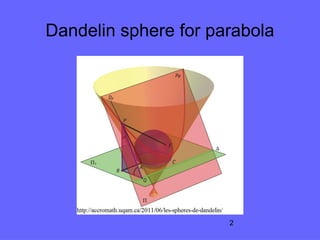
Dandelin sphere for parabola
3
Parabola as a section in a cone
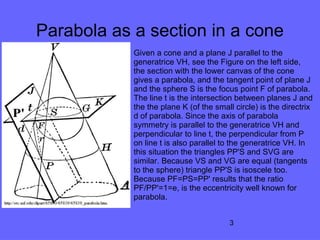
Given a cone and a plane J parallel to the
generatrice VH, see the Figure on the left side,
the section with the lower canvas of the cone
gives a parabola, and the tangent point of plane J
and the sphere S is the focus point F of parabola.
The line t is the intersection between planes J and
the the plane K (of the small circle) is the directrix
d of parabola. Since the axis of parabola
symmetry is parallel to the generatrice VH and
perpendicular to line t, the perpendicular from P
on line t is also parallel to the generatrice VH. In
this situation the triangles PP'S and SVG are
similar. Because VS and VG are equal (tangents
to the sphere) triangle PP'S is isoscele too.
Because PF=PS=PP' results that the ratio
PF/PP'=1=e, is the eccentricity well known for
parabola.
4
Direct calculation of the focus and
the position of the directrix
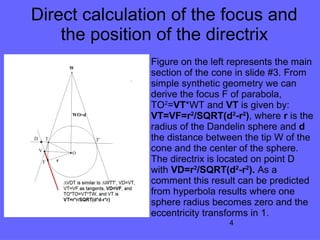
Figure on the left represents the main
section of the cone in slide #3. From
simple synthetic geometry we can
derive the focus F of parabola,
TO2
=VT*WT and VT is given by:
VT=VF=r2
/SQRT(d2
-r2
), where r is the
radius of the Dandelin sphere and d
the distance between the tip W of the
cone and the center of the sphere.
The directrix is located on point D
with VD=r2
/SQRT(d2
-r2
). As a
comment this result can be predicted
from hyperbola results where one
sphere radius becomes zero and the
eccentricity transforms in 1.
5
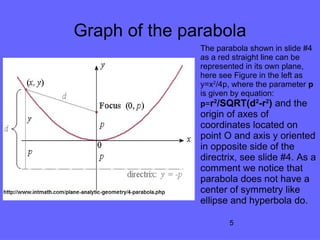
Graph of the parabola
The parabola shown in slide #4
as a red straight line can be
represented in its own plane,
here see Figure in the left as
y=x2
/4p, where the parameter p
is given by equation:
p=r2
/SQRT(d2
-r2
) and the
origin of axes of
coordinates located on
point O and axis y oriented
in opposite side of the
directrix, see slide #4. As a
comment we notice that
parabola does not have a
center of symmetry like
ellipse and hyperbola do.
6
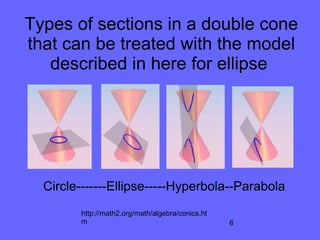
Types of sections in a double cone
that can be treated with the model
described in here for ellipse
Circle-------Ellipse-----Hyperbola--Parabola
http://math2.org/math/algebra/conics.ht
m
7
Conclusion

Using the learning shifts suggested in a
previous posting, link below,
the Internet is found very helpful on fully
describing the parabola utilizing the synthetic
geometry in space and plane.

The method shown could be applied easily to
other conics such as ellipse, and hyperbola.
https://www.linkedin.com/pulse/learning-shifts-internet-era-danut-dragoi?trk=mp-reader-
card

Parabola as an-example-learning-shifts-on-internet

  • 1.
    About parabola, anexample of learning shifts on Internet Danut Dragoi, PhD California 02/02/2017
  • 2.
  • 3.
    3 Parabola as asection in a cone Given a cone and a plane J parallel to the generatrice VH, see the Figure on the left side, the section with the lower canvas of the cone gives a parabola, and the tangent point of plane J and the sphere S is the focus point F of parabola. The line t is the intersection between planes J and the the plane K (of the small circle) is the directrix d of parabola. Since the axis of parabola symmetry is parallel to the generatrice VH and perpendicular to line t, the perpendicular from P on line t is also parallel to the generatrice VH. In this situation the triangles PP'S and SVG are similar. Because VS and VG are equal (tangents to the sphere) triangle PP'S is isoscele too. Because PF=PS=PP' results that the ratio PF/PP'=1=e, is the eccentricity well known for parabola.
  • 4.
    4 Direct calculation ofthe focus and the position of the directrix Figure on the left represents the main section of the cone in slide #3. From simple synthetic geometry we can derive the focus F of parabola, TO2 =VT*WT and VT is given by: VT=VF=r2 /SQRT(d2 -r2 ), where r is the radius of the Dandelin sphere and d the distance between the tip W of the cone and the center of the sphere. The directrix is located on point D with VD=r2 /SQRT(d2 -r2 ). As a comment this result can be predicted from hyperbola results where one sphere radius becomes zero and the eccentricity transforms in 1.
  • 5.
    5 Graph of theparabola The parabola shown in slide #4 as a red straight line can be represented in its own plane, here see Figure in the left as y=x2 /4p, where the parameter p is given by equation: p=r2 /SQRT(d2 -r2 ) and the origin of axes of coordinates located on point O and axis y oriented in opposite side of the directrix, see slide #4. As a comment we notice that parabola does not have a center of symmetry like ellipse and hyperbola do.
  • 6.
    6 Types of sectionsin a double cone that can be treated with the model described in here for ellipse Circle-------Ellipse-----Hyperbola--Parabola http://math2.org/math/algebra/conics.ht m
  • 7.
    7 Conclusion  Using the learningshifts suggested in a previous posting, link below, the Internet is found very helpful on fully describing the parabola utilizing the synthetic geometry in space and plane.  The method shown could be applied easily to other conics such as ellipse, and hyperbola. https://www.linkedin.com/pulse/learning-shifts-internet-era-danut-dragoi?trk=mp-reader- card