LEAN BILLING
ENABLEMENT
USE-CASE
Lean approach to billing mitigates expensive and inefficient
BSS stacks and supports agility in a changing market.
2
LEAN APPROACH TO BILLING MITIGATES EXPENSIVE AND
INEFFICIENT BSS STACKS AND SUPPORTS AGILITY IN A
CHANGING MARKET.
| LEAN BILLING ENABLEMENT
Mobile telco operators facing intense competition
in today’s rapidly evolving network world would
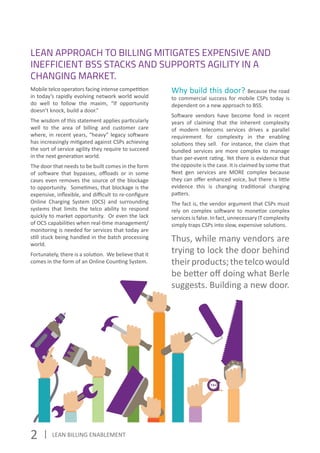
do well to follow the maxim, “If opportunity
doesn’t knock, build a door.”
The wisdom of this statement applies particularly
well to the area of billing and customer care
where, in recent years, “heavy” legacy software
has increasingly mitigated against CSPs achieving
the sort of service agility they require to succeed
in the next generation world.
The door that needs to be built comes in the form
of software that bypasses, offloads or in some
cases even removes the source of the blockage
to opportunity. Sometimes, that blockage is the
expensive, inflexible, and difficult to re-configure
Online Charging System (OCS) and surrounding
systems that limits the telco ability to respond
quickly to market opportunity. Or even the lack
of OCS capabilities when real-time management/
monitoring is needed for services that today are
still stuck being handled in the batch processing
world.
Fortunately, there is a solution. We believe that it
comes in the form of an Online Counting System.
Why build this door? Because the road
to commercial success for mobile CSPs today is
dependent on a new approach to BSS.
Software vendors have become fond in recent
years of claiming that the inherent complexity
of modern telecoms services drives a parallel
requirement for complexity in the enabling
solutions they sell. For instance, the claim that
bundled services are more complex to manage
than per-event rating. Yet there is evidence that
the opposite is the case. It is claimed by some that
Next gen services are MORE complex because
they can offer enhanced voice, but there is little
evidence this is changing traditional charging
patters.
The fact is, the vendor argument that CSPs must
rely on complex software to monetize complex
services is false. In fact, unnecessary IT complexity
simply traps CSPs into slow, expensive solutions.
Thus, while many vendors are
trying to lock the door behind
theirproducts;thetelcowould
be better off doing what Berle
suggests. Building a new door.
3
A quick review of progressive Use Cases underlines this. In reality, the complexity in today’s telco market,
such as it is, exists almost entirely on the service provider’s side of the ledger. Software needn’t come into it,
something any number of modern Use Cases prove. Let’s consider an example:
Take an operator that wants to “push” a service package (or bundle) of
the sort favored by much of the industry. The exact offering is tailored
to subscriber’s historic usage figures. It provides a mix of voice, data and
text that subscribers are known to use. Knowledge of past behavior gives
our operator an insight into the sort of service offer to which subscribers
are likely to be responsive.
So far, so good. A subscriber accepts the bundle offer but to differentiate
this competitor’s similar offerings our operator, rather than push for
top-up’s once various service limits have been met (as is common
in saturated markets) decides it would be more valuable to pursue a
different sort of upgrade strategy; one that will make the SP stand out
from the competition.
Why do this? For one thing, because our operator knows (or at least
suspects) that his average customer often has a bit of spare money in his
or her pocket that might willingly be used buying something else he has
to sell, like, say, a networked movie that could be watched on the metro
to work. Plus, our operator knows that his rivals aren’t taking this sort
of reactive and creative approach (because, not having listened to Berle,
they haven’t built a door to grab the opportunity).
To exploit the potential hidden here, our operator decides he needs to
offer his customers a flexible instead of a “hard stop bundle/package”
service like everyone else. Increased market share and reduced churn
are suddenly within reach but the time has come to get the door building
equipment out.
If this sounds complicated – and most BSS vendors would like you to believe it is – then the good news is that
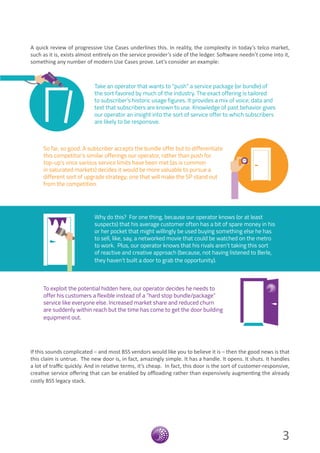
this claim is untrue. The new door is, in fact, amazingly simple. It has a handle. It opens. It shuts. It handles
a lot of traffic quickly. And in relative terms, it’s cheap. In fact, this door is the sort of customer-responsive,
creative service offering that can be enabled by offloading rather than expensively augmenting the already
costly BSS legacy stack.
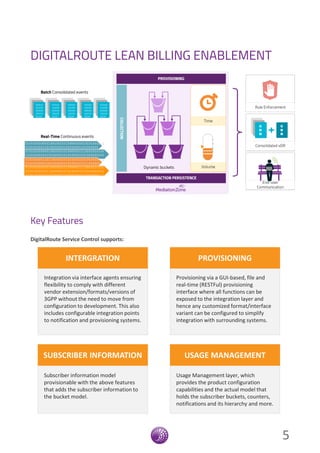
Everything described above can be achieved
through what is becoming known as a Usage
Management (DigitalRoute product Service
Control) BSS strategy that offloads thick
traditional BSS in favor of smart, agile and lean
implementations.
If we’re being literal, Usage Management/Service
Control can best be thought of as pre-configured
use cases (rather than a metaphorical door).
4 | LEAN BILLING ENABLEMENT
The best starting point for the journey to a leaner
BSS environment is at the beginning of the stack,
right at the boundary between network and IT
where the usage events are collected and treated.
Smartness in this layer, with Usage Management,
is the first step for a CSP who wants to trim its BSS
costs.
The approach, which enables an outcome widely
identified as “lean billing” is based around three
central features:
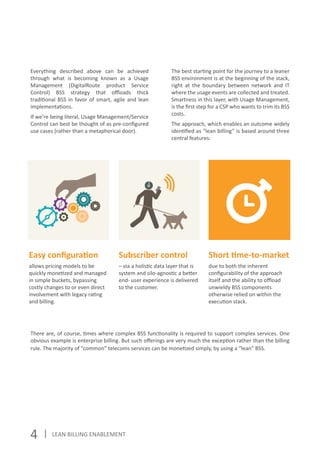
Easy configuration
allows pricing models to be
quickly monetized and managed
in simple buckets, bypassing
costly changes to or even direct
involvement with legacy rating
and billing.
Subscriber control
– via a holistic data layer that is
system and silo-agnostic a better
end- user experience is delivered
to the customer.
Short time-to-market
due to both the inherent
configurability of the approach
itself and the ability to offload
unwieldy BSS components
otherwise relied on within the
execution stack.
There are, of course, times where complex BSS functionality is required to support complex services. One
obvious example is enterprise billing. But such offerings are very much the exception rather than the billing
rule. The majority of “common” telecoms services can be monetized simply, by using a “lean” BSS.
5
DIGITALROUTE LEAN BILLING ENABLEMENT
Key Features
DigitalRoute Service Control supports:
Integration via interface agents ensuring
flexibility to comply with different
vendor extension/formats/versions of
3GPP without the need to move from
configuration to development. This also
includes configurable integration points
to notification and provisioning systems.
Provisioning via a GUI-based, file and
real-time (RESTFul) provisioning
interface where all functions can be
exposed to the integration layer and
hence any customized format/interface
variant can be configured to simplify
integration with surrounding systems.
Subscriber information model
provisionable with the above features
that adds the subscriber information to
the bucket model.
Usage Management layer, which
provides the product configuration
capabilities and the actual model that
holds the subscriber buckets, counters,
notifications and its hierarchy and more.
SUBSCRIBER INFORMATION USAGE MANAGEMENT
INTERGRATION PROVISIONING
Scaling & Performance
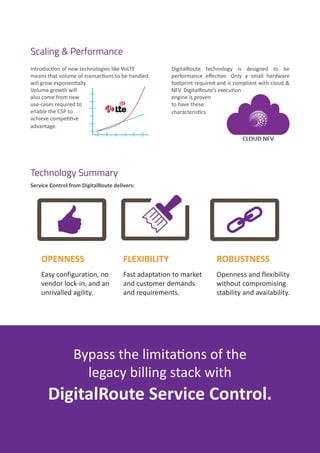
Introduction of new technologies like VoLTE
means that volume of transactions to be handled
will grow exponentially.
Volume growth will
also come from new
use-cases required to
enable the CSP to
achieve competitive
advantage.
DigitalRoute technology is designed to be
performance effective. Only a small hardware
footprint required and is compliant with cloud &
NFV. DigitalRoute’s execution
engine is proven
to have these
characteristics.
Technology Summary
Service Control from DigitalRoute delivers:
Bypass the limitations of the
legacy billing stack with
DigitalRoute Service Control.
OPENNESS
Easy configuration, no
vendor lock-in, and an
unrivalled agility.
FLEXIBILITY
Fast adaptation to market
and customer demands
and requirements.
ROBUSTNESS
Openness and flexibility
without compromising
stability and availability.

PAPER Lean Billing 2015

  • 1.
    LEAN BILLING ENABLEMENT USE-CASE Lean approachto billing mitigates expensive and inefficient BSS stacks and supports agility in a changing market.
  • 2.
    2 LEAN APPROACH TOBILLING MITIGATES EXPENSIVE AND INEFFICIENT BSS STACKS AND SUPPORTS AGILITY IN A CHANGING MARKET. | LEAN BILLING ENABLEMENT Mobile telco operators facing intense competition in today’s rapidly evolving network world would do well to follow the maxim, “If opportunity doesn’t knock, build a door.” The wisdom of this statement applies particularly well to the area of billing and customer care where, in recent years, “heavy” legacy software has increasingly mitigated against CSPs achieving the sort of service agility they require to succeed in the next generation world. The door that needs to be built comes in the form of software that bypasses, offloads or in some cases even removes the source of the blockage to opportunity. Sometimes, that blockage is the expensive, inflexible, and difficult to re-configure Online Charging System (OCS) and surrounding systems that limits the telco ability to respond quickly to market opportunity. Or even the lack of OCS capabilities when real-time management/ monitoring is needed for services that today are still stuck being handled in the batch processing world. Fortunately, there is a solution. We believe that it comes in the form of an Online Counting System. Why build this door? Because the road to commercial success for mobile CSPs today is dependent on a new approach to BSS. Software vendors have become fond in recent years of claiming that the inherent complexity of modern telecoms services drives a parallel requirement for complexity in the enabling solutions they sell. For instance, the claim that bundled services are more complex to manage than per-event rating. Yet there is evidence that the opposite is the case. It is claimed by some that Next gen services are MORE complex because they can offer enhanced voice, but there is little evidence this is changing traditional charging patters. The fact is, the vendor argument that CSPs must rely on complex software to monetize complex services is false. In fact, unnecessary IT complexity simply traps CSPs into slow, expensive solutions. Thus, while many vendors are trying to lock the door behind theirproducts;thetelcowould be better off doing what Berle suggests. Building a new door.
  • 3.
    3 A quick reviewof progressive Use Cases underlines this. In reality, the complexity in today’s telco market, such as it is, exists almost entirely on the service provider’s side of the ledger. Software needn’t come into it, something any number of modern Use Cases prove. Let’s consider an example: Take an operator that wants to “push” a service package (or bundle) of the sort favored by much of the industry. The exact offering is tailored to subscriber’s historic usage figures. It provides a mix of voice, data and text that subscribers are known to use. Knowledge of past behavior gives our operator an insight into the sort of service offer to which subscribers are likely to be responsive. So far, so good. A subscriber accepts the bundle offer but to differentiate this competitor’s similar offerings our operator, rather than push for top-up’s once various service limits have been met (as is common in saturated markets) decides it would be more valuable to pursue a different sort of upgrade strategy; one that will make the SP stand out from the competition. Why do this? For one thing, because our operator knows (or at least suspects) that his average customer often has a bit of spare money in his or her pocket that might willingly be used buying something else he has to sell, like, say, a networked movie that could be watched on the metro to work. Plus, our operator knows that his rivals aren’t taking this sort of reactive and creative approach (because, not having listened to Berle, they haven’t built a door to grab the opportunity). To exploit the potential hidden here, our operator decides he needs to offer his customers a flexible instead of a “hard stop bundle/package” service like everyone else. Increased market share and reduced churn are suddenly within reach but the time has come to get the door building equipment out. If this sounds complicated – and most BSS vendors would like you to believe it is – then the good news is that this claim is untrue. The new door is, in fact, amazingly simple. It has a handle. It opens. It shuts. It handles a lot of traffic quickly. And in relative terms, it’s cheap. In fact, this door is the sort of customer-responsive, creative service offering that can be enabled by offloading rather than expensively augmenting the already costly BSS legacy stack.
  • 4.
    Everything described abovecan be achieved through what is becoming known as a Usage Management (DigitalRoute product Service Control) BSS strategy that offloads thick traditional BSS in favor of smart, agile and lean implementations. If we’re being literal, Usage Management/Service Control can best be thought of as pre-configured use cases (rather than a metaphorical door). 4 | LEAN BILLING ENABLEMENT The best starting point for the journey to a leaner BSS environment is at the beginning of the stack, right at the boundary between network and IT where the usage events are collected and treated. Smartness in this layer, with Usage Management, is the first step for a CSP who wants to trim its BSS costs. The approach, which enables an outcome widely identified as “lean billing” is based around three central features: Easy configuration allows pricing models to be quickly monetized and managed in simple buckets, bypassing costly changes to or even direct involvement with legacy rating and billing. Subscriber control – via a holistic data layer that is system and silo-agnostic a better end- user experience is delivered to the customer. Short time-to-market due to both the inherent configurability of the approach itself and the ability to offload unwieldy BSS components otherwise relied on within the execution stack. There are, of course, times where complex BSS functionality is required to support complex services. One obvious example is enterprise billing. But such offerings are very much the exception rather than the billing rule. The majority of “common” telecoms services can be monetized simply, by using a “lean” BSS.
  • 5.
    5 DIGITALROUTE LEAN BILLINGENABLEMENT Key Features DigitalRoute Service Control supports: Integration via interface agents ensuring flexibility to comply with different vendor extension/formats/versions of 3GPP without the need to move from configuration to development. This also includes configurable integration points to notification and provisioning systems. Provisioning via a GUI-based, file and real-time (RESTFul) provisioning interface where all functions can be exposed to the integration layer and hence any customized format/interface variant can be configured to simplify integration with surrounding systems. Subscriber information model provisionable with the above features that adds the subscriber information to the bucket model. Usage Management layer, which provides the product configuration capabilities and the actual model that holds the subscriber buckets, counters, notifications and its hierarchy and more. SUBSCRIBER INFORMATION USAGE MANAGEMENT INTERGRATION PROVISIONING
  • 6.
    Scaling & Performance Introductionof new technologies like VoLTE means that volume of transactions to be handled will grow exponentially. Volume growth will also come from new use-cases required to enable the CSP to achieve competitive advantage. DigitalRoute technology is designed to be performance effective. Only a small hardware footprint required and is compliant with cloud & NFV. DigitalRoute’s execution engine is proven to have these characteristics. Technology Summary Service Control from DigitalRoute delivers: Bypass the limitations of the legacy billing stack with DigitalRoute Service Control. OPENNESS Easy configuration, no vendor lock-in, and an unrivalled agility. FLEXIBILITY Fast adaptation to market and customer demands and requirements. ROBUSTNESS Openness and flexibility without compromising stability and availability.