Name: VYAS NUPUR HITESHBHAI.
Roll No:43
Year: 2015-2016
Subject: The Neo-classical Literature
Topic: The Themes of Gulliver Travels
Email id: nupurvyas1995@gmail.com
• The Theme of Travel and Discovery
• As a Satire of Human Nature
• As Utopian and Dystopian Fiction
• As Political Allegory
• It is Travelogue.
• It is fictional travelogue contain factual elements related to travel
by sea.
• The four parts linked by the theme of travel and discovery.
• Each of islands Gulliver arrives at offers varying and diverse
experiences for traveller.
• The entire novel is the framework of travelogue documenting the
new,bizzarre,and occasionally life-threatening experiences that
befall Gulliver.
• Travel and discovery offers opportunity's to present Gulliver in
varied situations where the pride depravity commonly associated
with human race.
• The travelogue takes the reader on a journey of discovering
places and observing the customs and manners of the people
through the eyes of the writer-narrator.
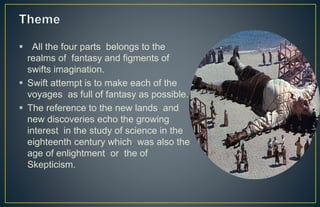
 All the four parts belongs to the
realms of fantasy and figments of
swifts imagination.
 Swift attempt is to make each of the
voyages as full of fantasy as possible.
 The reference to the new lands and
new discoveries echo the growing
interest in the study of science in the
eighteenth century which was also the
age of enlightment or the of
Skepticism.
o Satire is Literary genre in which human vices, weaknesses, and
follies are held up to ridicule.
o In Gulliver’s travels , Swift uses satire as vehicle to point to the
depraved state of Human kind.
o Swift work as an attempt to shock the human race out of its
complacency and turned them towards the direction of self-
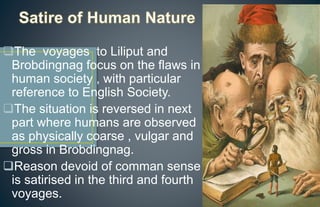
The voyages to Liliput and
Brobdingnag focus on the flaws in
human society , with particular
reference to English Society.
The situation is reversed in next
part where humans are observed
as physically coarse , vulgar and
gross in Brobdingnag.
Reason devoid of comman sense
is satirised in the third and fourth
voyages.
 The term Utopia means an
ideal world or an ideal society.
 Dystopia means an
unpleasant, nightmarish
world.
 The land of the Houyhnhnms
seems almost utopian but
here Swift exposes a world
where Reason prevails in its
perfection but is devoid of
personal identity.
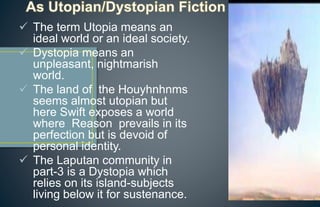
 The Laputan community in
part-3 is a Dystopia which
relies on its island-subjects
living below it for sustenance.
 An is a literary genre means its
meaning could be read on two
levels – a primary level and
literary level.
 Swift uses to highlight the
allegorical elements in his tale
and thus the allegory functions
as an excellent vehicle of
criticism of English government
and its activities.
• There are several allegorical references to life in the Royal courts
of George-1 in the first section of the novel.
• The flippancy and hollowness of court life are satirized through
the Lilliputian ministers and antics.
• The conflict between Roman Catholic and the Anglican churches
presented as Big Endians and the Little Endians.
• Patens of War and destruction are woven into the allegorical
motif.
Paper 2 the neo classical  lit.  ppt

Paper 2 the neo classical lit. ppt

  • 1.
    Name: VYAS NUPURHITESHBHAI. Roll No:43 Year: 2015-2016 Subject: The Neo-classical Literature Topic: The Themes of Gulliver Travels Email id: nupurvyas1995@gmail.com
  • 2.
    • The Themeof Travel and Discovery • As a Satire of Human Nature • As Utopian and Dystopian Fiction • As Political Allegory
  • 4.
    • It isTravelogue. • It is fictional travelogue contain factual elements related to travel by sea. • The four parts linked by the theme of travel and discovery. • Each of islands Gulliver arrives at offers varying and diverse experiences for traveller. • The entire novel is the framework of travelogue documenting the new,bizzarre,and occasionally life-threatening experiences that befall Gulliver. • Travel and discovery offers opportunity's to present Gulliver in varied situations where the pride depravity commonly associated with human race. • The travelogue takes the reader on a journey of discovering places and observing the customs and manners of the people through the eyes of the writer-narrator.
  • 5.
     All thefour parts belongs to the realms of fantasy and figments of swifts imagination.  Swift attempt is to make each of the voyages as full of fantasy as possible.  The reference to the new lands and new discoveries echo the growing interest in the study of science in the eighteenth century which was also the age of enlightment or the of Skepticism.
  • 6.
    o Satire isLiterary genre in which human vices, weaknesses, and follies are held up to ridicule. o In Gulliver’s travels , Swift uses satire as vehicle to point to the depraved state of Human kind. o Swift work as an attempt to shock the human race out of its complacency and turned them towards the direction of self-
  • 7.
    The voyages toLiliput and Brobdingnag focus on the flaws in human society , with particular reference to English Society. The situation is reversed in next part where humans are observed as physically coarse , vulgar and gross in Brobdingnag. Reason devoid of comman sense is satirised in the third and fourth voyages.
  • 8.
     The termUtopia means an ideal world or an ideal society.  Dystopia means an unpleasant, nightmarish world.  The land of the Houyhnhnms seems almost utopian but here Swift exposes a world where Reason prevails in its perfection but is devoid of personal identity.  The Laputan community in part-3 is a Dystopia which relies on its island-subjects living below it for sustenance.
  • 9.
     An isa literary genre means its meaning could be read on two levels – a primary level and literary level.  Swift uses to highlight the allegorical elements in his tale and thus the allegory functions as an excellent vehicle of criticism of English government and its activities.
  • 10.
    • There areseveral allegorical references to life in the Royal courts of George-1 in the first section of the novel. • The flippancy and hollowness of court life are satirized through the Lilliputian ministers and antics. • The conflict between Roman Catholic and the Anglican churches presented as Big Endians and the Little Endians. • Patens of War and destruction are woven into the allegorical motif.