CFO Summit XXII 2011
Navigating the Merger and Acquisitions
Minefield to Facilitate a Smooth Integration
Alberto Elli
VP and Controller
Global Finishes Group
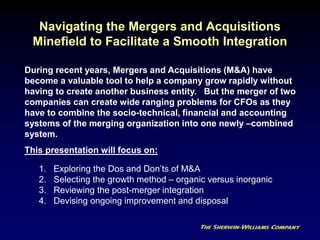
Navigating the Mergers and Acquisitions
Minefield to Facilitate a Smooth Integration
1. Exploring the Dos and Don’ts of M&A
2. Selecting the growth method – organic versus inorganic
3. Reviewing the post-merger integration
4. Devising ongoing improvement and disposal
During recent years, Mergers and Acquisitions (M&A) have
become a valuable tool to help a company grow rapidly without
having to create another business entity. But the merger of two
companies can create wide ranging problems for CFOs as they
have to combine the socio-technical, financial and accounting
systems of the merging organization into one newly –combined
system.
This presentation will focus on:
Organic or with M&A, the Goal is:
Build Shareholder Value
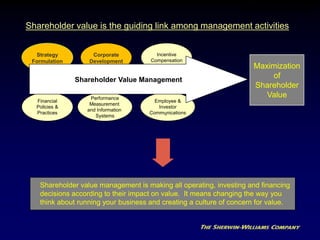
Maximization
of
Shareholder
Value
Shareholder value is the guiding link among management activities
MANAGEMENT’S MISSION
Employee &
Investor
Communications
Performance
Measurement
and Information
Systems
Financial
Policies &
Practices
Shareholder value management is making all operating, investing and financing
decisions according to their impact on value. It means changing the way you
think about running your business and creating a culture of concern for value.
Strategy
Formulation
Corporate
Development
Incentive
Compensation
Shareholder Value Management
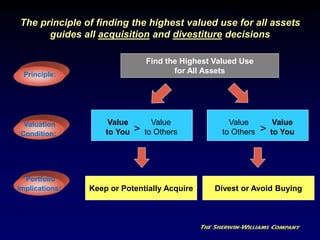
The principle of finding the highest valued use for all assets
guides all acquisition and divestiture decisions
Principle:
Portfolio
Implications:
Valuation
Condition:
Find the Highest Valued Use
for All Assets
Keep or Potentially Acquire Divest or Avoid Buying
Value
to You
Value
to Others>
Value
to You
Value
to Others >
CREATING VALUE WITH M&A
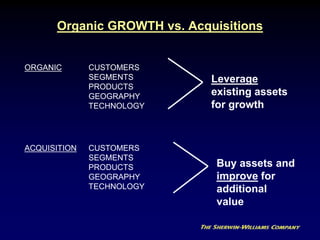
Organic GROWTH vs. Acquisitions
Leverage
existing assets
for growth
Buy assets and
improve for
additional
value
ORGANIC CUSTOMERS
SEGMENTS
PRODUCTS
GEOGRAPHY
TECHNOLOGY
CUSTOMERS
SEGMENTS
PRODUCTS
GEOGRAPHY
TECHNOLOGY
ACQUISITION
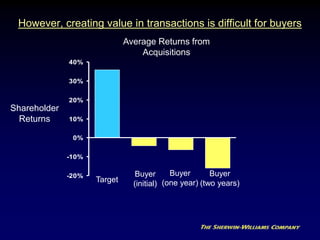
However, creating value in transactions is difficult for buyers
Shareholder
Returns
Average Returns from
Acquisitions
-20%
-10%
0%
10%
20%
30%
40%
Target
Buyer
(initial)
Buyer
(one year)
Buyer
(two years)
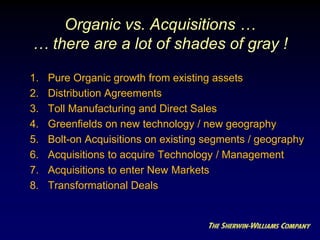
Organic vs. Acquisitions …
… there are a lot of shades of gray !
1. Pure Organic growth from existing assets
2. Distribution Agreements
3. Toll Manufacturing and Direct Sales
4. Greenfields on new technology / new geography
5. Bolt-on Acquisitions on existing segments / geography
6. Acquisitions to acquire Technology / Management
7. Acquisitions to enter New Markets
8. Transformational Deals
Therefore, defining the Strategy is a prerequisite
to create Shareholders’ Value
• Forget about available acquisition targets at first
• Focus on the “Big Idea”
• What do you need to drive a compelling,
differentiated, and sustainable competitive
advantage?
• Is an Acquisition the best alternative ?
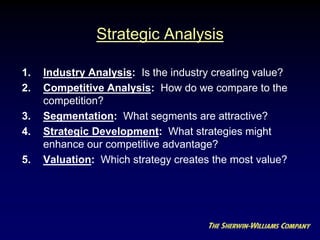
Strategic Analysis
1. Industry Analysis: Is the industry creating value?
2. Competitive Analysis: How do we compare to the
competition?
3. Segmentation: What segments are attractive?
4. Strategic Development: What strategies might
enhance our competitive advantage?
5. Valuation: Which strategy creates the most value?
Acquisitions
• Does an acquisition accelerate our ability to
deliver our Strategic Plan?
• How? Scale Brands - Segment
Distribution Management
Geography Technology
• Can we add value to the business and is the value of the
combined entity greater than the sum of the parts?
1 + 1 = 3 … Synergies ?
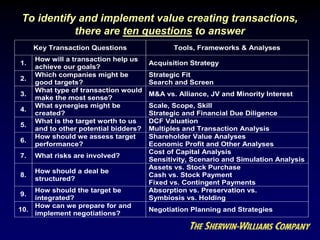
To identify and implement value creating transactions,
there are ten questions to answer
M&A PROCESS
Key Transaction Questions Tools, Frameworks & Analyses
1.
How will a transaction help us
achieve our goals?
Acquisition Strategy
2.
Which companies might be
good targets?
Strategic Fit
Search and Screen
3.
What type of transaction would
make the most sense?
M&A vs. Alliance, JV and Minority Interest
4.
What synergies might be
created?
Scale, Scope, Skill
Strategic and Financial Due Diligence
5.
What is the target worth to us
and to other potential bidders?
DCF Valuation
Multiples and Transaction Analysis
6.
How should we assess target
performance?
Shareholder Value Analyses
Economic Profit and Other Analyses
7. What risks are involved?
Cost of Capital Analysis
Sensitivity, Scenario and Simulation Analysis
8.
How should a deal be
structured?
Assets vs. Stock Purchase
Cash vs. Stock Payment
Fixed vs. Contingent Payments
9.
How should the target be
integrated?
Absorption vs. Preservation vs.
Symbiosis vs. Holding
10.
How can we prepare for and
implement negotiations?
Negotiation Planning and Strategies
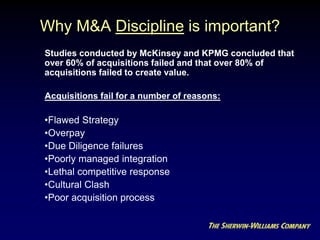
Why M&A Discipline is important?
Studies conducted by McKinsey and KPMG concluded that
over 60% of acquisitions failed and that over 80% of
acquisitions failed to create value.
Acquisitions fail for a number of reasons:
•Flawed Strategy
•Overpay
•Due Diligence failures
•Poorly managed integration
•Lethal competitive response
•Cultural Clash
•Poor acquisition process
Strategy
• Company
• Group
• Division
• Segment
CEO
COO
CFO
Corp Dev.
Div. Pres.
Corp. Dev.
and / or
Div. Pres. /
Operating
Team
Corp.
Div. Pres.
and
Operating
Team
Div. Pres. /
Operating Team
Corp.
Team
Outside
Corp.
and
Division
Corp. Dev. w/
• Div. Pres. /
OP Team
• Legal
• Environmental
• Tax
Strategic
Agreement Courtship Negotiation Close Integration
Target
Identification
Post
Analysis
Board of Directors
Approval
Senior
Management
Approval
Corp. Dev.
and
Div. Pres.
Board of Directors
Review
Sherwin-Williams Acquisition Process
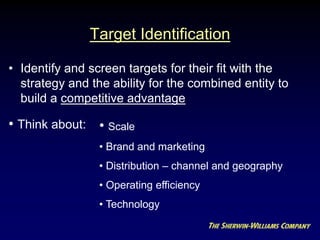
Target Identification
• Identify and screen targets for their fit with the
strategy and the ability for the combined entity to
build a competitive advantage
• Scale
• Brand and marketing
• Distribution – channel and geography
• Operating efficiency
• Technology
• Think about:
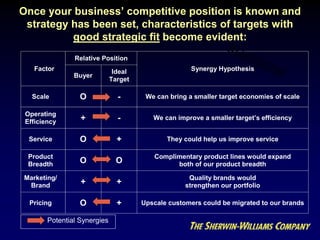
Once your business’ competitive position is known and
strategy has been set, characteristics of targets with
good strategic fit become evident:
Factor
Relative Position
Synergy Hypothesis
Buyer
Ideal
Target
Scale O - We can bring a smaller target economies of scale
Operating
Efficiency + - We can improve a smaller target’s efficiency
Service O + They could help us improve service
Product
Breadth O O
Complimentary product lines would expand
both of our product breadth
Marketing/
Brand + +
Quality brands would
strengthen our portfolio
Pricing O + Upscale customers could be migrated to our brands
Potential Synergies
The value of a company will be the highest of its
acquisition, current and break up values
The Value Spectrum
STRATEGY SYNERGIES
Break Up
Value
Current
Value
Acquisition
Value
 Also known as
asset value or
liquidation
value
 Assumes that
the best
strategy for the
business is to
cease
operations
 Also known as
stand-alone
value
 Assumes that
the best
strategy is the
current strategy
 Also known as
value with
synergies
 Includes
synergies the
firm might be
able to create
with other
businesses
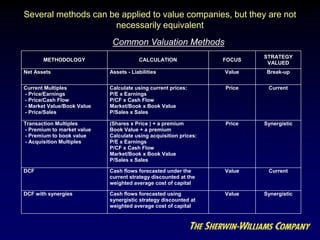
Several methods can be applied to value companies, but they are not
necessarily equivalent
METHODOLOGY CALCULATION FOCUS
STRATEGY
VALUED
Net Assets Assets - Liabilities Value Break-up
Current Multiples
- Price/Earnings
- Price/Cash Flow
- Market Value/Book Value
- Price/Sales
Calculate using current prices:
P/E x Earnings
P/CF x Cash Flow
Market/Book x Book Value
P/Sales x Sales
Price Current
Transaction Multiples
- Premium to market value
- Premium to book value
- Acquisition Multiples
(Shares x Price ) + a premium
Book Value + a premium
Calculate using acquisition prices:
P/E x Earnings
P/CF x Cash Flow
Market/Book x Book Value
P/Sales x Sales
Price Synergistic
DCF Cash flows forecasted under the
current strategy discounted at the
weighted average cost of capital
Value Current
DCF with synergies Cash flows forecasted using
synergistic strategy discounted at
weighted average cost of capital
Value Synergistic
PRICE VS. VALUE
Common Valuation Methods
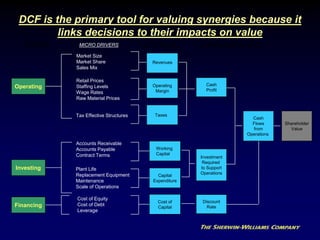
DCF is the primary tool for valuing synergies because it
links decisions to their impacts on value
DECISIONS
Operating
Margin
Taxes
Working
Capital
Capital
Expenditure
Cost of
Capital
Market Size
Market Share
Sales Mix
Retail Prices
Staffing Levels
Wage Rates
Raw Material Prices
Tax Effective Structures
Accounts Receivable
Accounts Payable
Contract Terms
Plant Life
Replacement Equipment
Maintenance
Scale of Operations
Cost of Equity
Cost of Debt
Leverage
VALUE DRIVERSMICRO DRIVERS
Cash
Profit
Investment
Required
to Support
Operations
Discount
Rate
Cash
Flows
from
Operations
Shareholder
Value
DETERMINANTS OF VALUE
Revenues
Operating
Investing
Financing
DISCOUNTED CASH FLOW FRAMEWORK
The DCF framework discounts free operating cash flows
to estimate a company's value
DISCOUNTED CASH FLOW FRAMEWORK
(C)
Forecast Period Residual Period
+
+
=
- =
2006 2007 2008 2009 2010 2011 - - - - - - - -
Residual Value
CF CF CF CF CF1 2 3 4 5
(A)
(B)
(D)
(E)
Present Value of
Free Oper. Cash
Flow
Present Value of
Residual Value
Non Operating
Assets
Enterprise Value
Market Value
of Debt and other
Obligations
Shareholder
Value
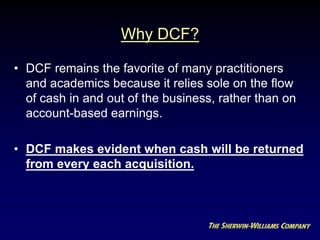
Why DCF?
• DCF remains the favorite of many practitioners
and academics because it relies sole on the flow
of cash in and out of the business, rather than on
account-based earnings.
• DCF makes evident when cash will be returned
from every each acquisition.
Due Diligence - Definition
• Thorough investigation of the business, personnel, legal,
financial and tax state of a potential acquisition
• Significant commitment of time, resources and money by
both Sherwin-Williams and seller
• Process managed by Corporate Development but support
from Operating Team and Corporate Staff is critical
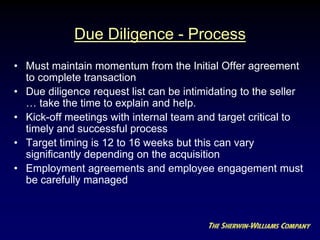
Due Diligence - Process
• Must maintain momentum from the Initial Offer agreement
to complete transaction
• Due diligence request list can be intimidating to the seller
… take the time to explain and help.
• Kick-off meetings with internal team and target critical to
timely and successful process
• Target timing is 12 to 16 weeks but this can vary
significantly depending on the acquisition
• Employment agreements and employee engagement must
be carefully managed
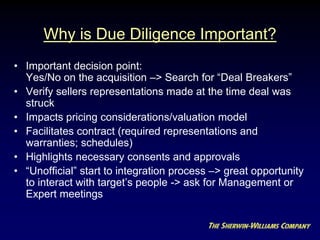
Why is Due Diligence Important?
• Important decision point:
Yes/No on the acquisition –> Search for “Deal Breakers”
• Verify sellers representations made at the time deal was
struck
• Impacts pricing considerations/valuation model
• Facilitates contract (required representations and
warranties; schedules)
• Highlights necessary consents and approvals
• “Unofficial” start to integration process –> great opportunity
to interact with target’s people -> ask for Management or
Expert meetings
Due Diligence Areas of Focus
• Environmental
• Legal/Litigation
• Tax
• Pension (legacy costs)
• Working Capital (overdues and slow-moving)
• Compensation and Benefits
• Foreign Corrupt Practices Act (FCPA)
Integration is one of the least glamorous, yet most important
phases of the acquisition process
• The Critical Success Factors noted in your Strategic
Agreement/Approval presentations and financially detailed in
your valuation/proforma should guide your integration process.
• Integration starts during the courtship phase, well before the
deal is completed
• Each acquisition is different and requires its own unique
integration approach
• Integration is process that requires active management
Integration Phase
Lessons Learned (1) … Top Management view:
1. Maintain focus: new distribution, new technology, new markets
2. Stick to a model process (discipline)
3. Set IRR Targets: Domestic: …% International: …% (+risk premium)
4. Improve division top line and profitability
5. Manage cash and its return
6. Accuracy and integrity of financial statements
7. Detailed focus on integration and synergies
8. Size matters (…think larger…)
9. Post analysis
10. Stay aggressive and build targets’ pipeline
Lessons Learned (2)… Divisional Management view:
1. The business model drives the right acquisition’s price.
2. To enter in new markets is multiple times more resources’ consuming
than strengthen our position in existing countries (bolt-on).
3. Dimension matters (sales and/or market share).
4. In targeting acquisitions, integration ability and substantial synergies
are key decision points.
5. A target must be profitable: we are not in the turnaround business (?)
6. Spend time to assess the country risks and competitors’ strengths .
Lessons Learned (3) : Pre-Deal
• Bring more intelligence to the process. Assess current capabilities
and resources needed at the very beginning.
• Reinforce guidelines on communication with the press
• Don’t be scared by the complexity. Ask for alternatives
• Take advantage of your local team in the existing geography.
• Develop second-best to take care of day-to-day operations when your
first line gets deeply involved in a sizable deal.
• Discuss tax implications at the very beginning (Asset vs. Stock deals).
• Look at formulas for price sharing and to minimize cash upfront,
( like earn-out formulas or significant hold-backs)
Lessons Learned (4): Integration
• Have your own fully dedicated gatekeeper
and a thorough Project Management Plan
• Assign dedicated financial people from day zero.
• Create taskforces and checklists (better on-line).
However, do not expect to get by with off-the-shelf checklists
• Implement ASAP your Policies and Procedures.
• Training on FCPA (and f/up on any due diligence findings) is one of
the most important element to set the right tone on compliance
Lessons Learned (5): Pro-forma year-one
• Not to the point of “sand-bagging” but a jump start is really
needed to create morale and confidence on both sides.
• Be prudent. Work on “what-if” scenarios
• Consider salary integration issues (equalization / retention /
different benefits or perqs).
• Estimate extra taskforce / temporary management
• Be realistic with environmental costs, as well as Health and
Safety (multinational standards are very high!)
• IT integration is always very costly (do not underestimate
network and communication costs -> security) .
Lessons Learned (6) : The Way Forward
• Create a repository/common database to share relevant information
on lessons learned about due diligence, valuation, integration …
• Monitor how you are improving Profitability and Market Share
through the right balance between M&A vs. Organic Growth .
• Measure if acquisitions are delivering proforma (and returning cash
invested); keep “measurable” as long as possible also bolts-on
acquisitions.
• Create specific Divisional Corporate Development Teams to keep
the M&A process alive and to build pipeline of targets.
• Coordinate Divisional CD with Corporate CD with open
communication and full sharing of pipeline!
BACK - UPS
Impact of Due Diligence on Valuation
• Verify sellers representations made at the time LOI was
signed (i.e.. sales, profits, GM, pricing, etc.)
• Confirm viability of synergy/dissynergy assumptions
• Input liabilities/assets not originally included in the original
valuation model (i.e.. current liabilities that might transfer
with the business, compliance/remediation costs)
• Update estimated transaction costs
Gain a clear understanding of the value of the
business going into negotiating the SPA
The five primary components of value in an acquisition are “stand-alone” value,
and four types of synergies
Stand-Alone
Value
Synergies
Buyer Creates
within Target
Synergies
Target Creates
within Buyer
Dis-Synergies
Buyer would
Face
Buyer’s
Defensive
Synergies
Total Value
to Buyer
The amount of the potential buyer’s stand-alone value
lost if the target is not acquired
The reduction in value caused by combining two businesses
The value of all improvements to the buyer’s operations
The value of all improvements to the target’s operations
The value of the target as a “stand-alone” entity under its
currently anticipated strategy
1.
2.
3.
4.
5.
+
+
+
+
=
VALUING SYNERGIES
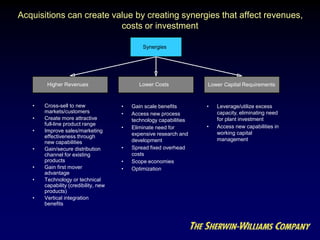
Acquisitions can create value by creating synergies that affect revenues,
costs or investment
• Cross-sell to new
markets/customers
• Create more attractive
full-line product range
• Improve sales/marketing
effectiveness through
new capabilities
• Gain/secure distribution
channel for existing
products
• Gain first mover
advantage
• Technology or technical
capability (credibility, new
products)
• Vertical integration
benefits
VALUING SYNERGIES
Synergies
Higher Revenues Lower Costs Lower Capital Requirements
• Gain scale benefits
• Access new process
technology capabilities
• Eliminate need for
expensive research and
development
• Spread fixed overhead
costs
• Scope economies
• Optimization
• Leverage/utilize excess
capacity, eliminating need
for plant investment
• Access new capabilities in
working capital
management
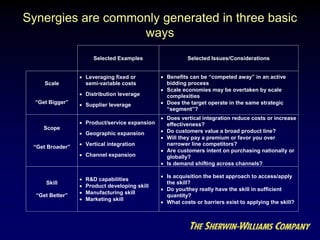
Synergies are commonly generated in three basic
ways
Selected Examples Selected Issues/Considerations
Scale
“Get Bigger”
 Leveraging fixed or
semi-variable costs
 Distribution leverage
 Supplier leverage
 Benefits can be “competed away” in an active
bidding process
 Scale economies may be overtaken by scale
complexities
 Does the target operate in the same strategic
“segment”?
Scope
“Get Broader”
 Product/service expansion
 Geographic expansion
 Vertical integration
 Channel expansion
 Does vertical integration reduce costs or increase
effectiveness?
 Do customers value a broad product line?
 Will they pay a premium or favor you over
narrower line competitors?
 Are customers intent on purchasing nationally or
globally?
 Is demand shifting across channels?
Skill
“Get Better”
 R&D capabilities
 Product developing skill
 Manufacturing skill
 Marketing skill
 Is acquisition the best approach to access/apply
the skill?
 Do you/they really have the skill in sufficient
quantity?
 What costs or barriers exist to applying the skill?
SYNERGIES
Some synergies take longer to achieve than others
TIMING
Short Term Medium Term Long Term
 Staff reductions
 Cutting variable costs
 Access to assets
 Technology leverage
 Supplier efficiencies
 Customer acquisition
 Geographic expansion
 Channel expansion
 Combine distribution
 Cross-selling
 Production economies
 Skill transfer
 Sales force integration
 International
coordination
 Joint R&D
 Vertical integration
Common Synergy Timing*
*Illustrative only
Avoid the “seven deadly sins” of synergy identification
and evaluation
1. Over-estimating the amount (or underestimating the timing) of total synergies
2. Confusing total synergies with unique synergies
3. Assuming that synergies created within your operations can necessarily be saved
for your shareholders
4. Forgetting to look for synergies created within the target and within our operations
5. Forgetting to identify and value dis-synergies
6. Over-estimating defensive synergies
7. Pursuing targets without a clear understanding of whether they are worth more or
less to you than other bidders
COMMON ERRORS
Business Environment
Vision
Strategy
Processes
Structure
Culture
Performance Results
Feedback Loops
The Business
All “Business Decisions” are Tested for “Compatibility” Among the
Framework Components
Possessing true Domain Knowledge
Provider of Global Coatings Business Solutions
Clearly defined Customers, Brands and
Channels Segmentation
Achieving Best-in-Class Process Excellence
Having Motivated, Skilled People in the Right Jobs
Operating in a Culture of Disciplined People,
Disciplined Thought & Disciplined Action; open dialog
Accountable for the targeted Business Results
Coatings Business Management Framework
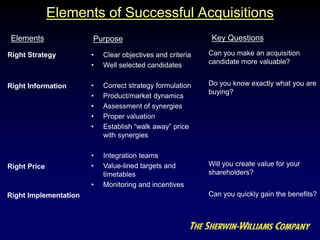
Elements of Successful Acquisitions
• Clear objectives and criteria
• Well selected candidates
• Correct strategy formulation
• Product/market dynamics
• Assessment of synergies
• Proper valuation
• Establish “walk away” price
with synergies
• Integration teams
• Value-lined targets and
timetables
• Monitoring and incentives
Can you make an acquisition
candidate more valuable?
Can you quickly gain the benefits?
Will you create value for your
shareholders?
Do you know exactly what you are
buying?
Right Strategy
Right Information
Right Price
Right Implementation
Elements Key QuestionsPurpose

CFO Summit XXI-A.Elli M&A

  • 1.
    CFO Summit XXII2011 Navigating the Merger and Acquisitions Minefield to Facilitate a Smooth Integration Alberto Elli VP and Controller Global Finishes Group
  • 2.
    Navigating the Mergersand Acquisitions Minefield to Facilitate a Smooth Integration 1. Exploring the Dos and Don’ts of M&A 2. Selecting the growth method – organic versus inorganic 3. Reviewing the post-merger integration 4. Devising ongoing improvement and disposal During recent years, Mergers and Acquisitions (M&A) have become a valuable tool to help a company grow rapidly without having to create another business entity. But the merger of two companies can create wide ranging problems for CFOs as they have to combine the socio-technical, financial and accounting systems of the merging organization into one newly –combined system. This presentation will focus on:
  • 3.
    Organic or withM&A, the Goal is: Build Shareholder Value
  • 4.
    Maximization of Shareholder Value Shareholder value isthe guiding link among management activities MANAGEMENT’S MISSION Employee & Investor Communications Performance Measurement and Information Systems Financial Policies & Practices Shareholder value management is making all operating, investing and financing decisions according to their impact on value. It means changing the way you think about running your business and creating a culture of concern for value. Strategy Formulation Corporate Development Incentive Compensation Shareholder Value Management
  • 5.
    The principle offinding the highest valued use for all assets guides all acquisition and divestiture decisions Principle: Portfolio Implications: Valuation Condition: Find the Highest Valued Use for All Assets Keep or Potentially Acquire Divest or Avoid Buying Value to You Value to Others> Value to You Value to Others > CREATING VALUE WITH M&A
  • 6.
    Organic GROWTH vs.Acquisitions Leverage existing assets for growth Buy assets and improve for additional value ORGANIC CUSTOMERS SEGMENTS PRODUCTS GEOGRAPHY TECHNOLOGY CUSTOMERS SEGMENTS PRODUCTS GEOGRAPHY TECHNOLOGY ACQUISITION
  • 7.
    However, creating valuein transactions is difficult for buyers Shareholder Returns Average Returns from Acquisitions -20% -10% 0% 10% 20% 30% 40% Target Buyer (initial) Buyer (one year) Buyer (two years)
  • 8.
    Organic vs. Acquisitions… … there are a lot of shades of gray ! 1. Pure Organic growth from existing assets 2. Distribution Agreements 3. Toll Manufacturing and Direct Sales 4. Greenfields on new technology / new geography 5. Bolt-on Acquisitions on existing segments / geography 6. Acquisitions to acquire Technology / Management 7. Acquisitions to enter New Markets 8. Transformational Deals
  • 9.
    Therefore, defining theStrategy is a prerequisite to create Shareholders’ Value • Forget about available acquisition targets at first • Focus on the “Big Idea” • What do you need to drive a compelling, differentiated, and sustainable competitive advantage? • Is an Acquisition the best alternative ?
  • 10.
    Strategic Analysis 1. IndustryAnalysis: Is the industry creating value? 2. Competitive Analysis: How do we compare to the competition? 3. Segmentation: What segments are attractive? 4. Strategic Development: What strategies might enhance our competitive advantage? 5. Valuation: Which strategy creates the most value?
  • 11.
    Acquisitions • Does anacquisition accelerate our ability to deliver our Strategic Plan? • How? Scale Brands - Segment Distribution Management Geography Technology • Can we add value to the business and is the value of the combined entity greater than the sum of the parts? 1 + 1 = 3 … Synergies ?
  • 12.
    To identify andimplement value creating transactions, there are ten questions to answer M&A PROCESS Key Transaction Questions Tools, Frameworks & Analyses 1. How will a transaction help us achieve our goals? Acquisition Strategy 2. Which companies might be good targets? Strategic Fit Search and Screen 3. What type of transaction would make the most sense? M&A vs. Alliance, JV and Minority Interest 4. What synergies might be created? Scale, Scope, Skill Strategic and Financial Due Diligence 5. What is the target worth to us and to other potential bidders? DCF Valuation Multiples and Transaction Analysis 6. How should we assess target performance? Shareholder Value Analyses Economic Profit and Other Analyses 7. What risks are involved? Cost of Capital Analysis Sensitivity, Scenario and Simulation Analysis 8. How should a deal be structured? Assets vs. Stock Purchase Cash vs. Stock Payment Fixed vs. Contingent Payments 9. How should the target be integrated? Absorption vs. Preservation vs. Symbiosis vs. Holding 10. How can we prepare for and implement negotiations? Negotiation Planning and Strategies
  • 13.
    Why M&A Disciplineis important? Studies conducted by McKinsey and KPMG concluded that over 60% of acquisitions failed and that over 80% of acquisitions failed to create value. Acquisitions fail for a number of reasons: •Flawed Strategy •Overpay •Due Diligence failures •Poorly managed integration •Lethal competitive response •Cultural Clash •Poor acquisition process
  • 14.
    Strategy • Company • Group •Division • Segment CEO COO CFO Corp Dev. Div. Pres. Corp. Dev. and / or Div. Pres. / Operating Team Corp. Div. Pres. and Operating Team Div. Pres. / Operating Team Corp. Team Outside Corp. and Division Corp. Dev. w/ • Div. Pres. / OP Team • Legal • Environmental • Tax Strategic Agreement Courtship Negotiation Close Integration Target Identification Post Analysis Board of Directors Approval Senior Management Approval Corp. Dev. and Div. Pres. Board of Directors Review Sherwin-Williams Acquisition Process
  • 15.
    Target Identification • Identifyand screen targets for their fit with the strategy and the ability for the combined entity to build a competitive advantage • Scale • Brand and marketing • Distribution – channel and geography • Operating efficiency • Technology • Think about:
  • 16.
    Once your business’competitive position is known and strategy has been set, characteristics of targets with good strategic fit become evident: Factor Relative Position Synergy Hypothesis Buyer Ideal Target Scale O - We can bring a smaller target economies of scale Operating Efficiency + - We can improve a smaller target’s efficiency Service O + They could help us improve service Product Breadth O O Complimentary product lines would expand both of our product breadth Marketing/ Brand + + Quality brands would strengthen our portfolio Pricing O + Upscale customers could be migrated to our brands Potential Synergies
  • 17.
    The value ofa company will be the highest of its acquisition, current and break up values The Value Spectrum STRATEGY SYNERGIES Break Up Value Current Value Acquisition Value  Also known as asset value or liquidation value  Assumes that the best strategy for the business is to cease operations  Also known as stand-alone value  Assumes that the best strategy is the current strategy  Also known as value with synergies  Includes synergies the firm might be able to create with other businesses
  • 18.
    Several methods canbe applied to value companies, but they are not necessarily equivalent METHODOLOGY CALCULATION FOCUS STRATEGY VALUED Net Assets Assets - Liabilities Value Break-up Current Multiples - Price/Earnings - Price/Cash Flow - Market Value/Book Value - Price/Sales Calculate using current prices: P/E x Earnings P/CF x Cash Flow Market/Book x Book Value P/Sales x Sales Price Current Transaction Multiples - Premium to market value - Premium to book value - Acquisition Multiples (Shares x Price ) + a premium Book Value + a premium Calculate using acquisition prices: P/E x Earnings P/CF x Cash Flow Market/Book x Book Value P/Sales x Sales Price Synergistic DCF Cash flows forecasted under the current strategy discounted at the weighted average cost of capital Value Current DCF with synergies Cash flows forecasted using synergistic strategy discounted at weighted average cost of capital Value Synergistic PRICE VS. VALUE Common Valuation Methods
  • 19.
    DCF is theprimary tool for valuing synergies because it links decisions to their impacts on value DECISIONS Operating Margin Taxes Working Capital Capital Expenditure Cost of Capital Market Size Market Share Sales Mix Retail Prices Staffing Levels Wage Rates Raw Material Prices Tax Effective Structures Accounts Receivable Accounts Payable Contract Terms Plant Life Replacement Equipment Maintenance Scale of Operations Cost of Equity Cost of Debt Leverage VALUE DRIVERSMICRO DRIVERS Cash Profit Investment Required to Support Operations Discount Rate Cash Flows from Operations Shareholder Value DETERMINANTS OF VALUE Revenues Operating Investing Financing DISCOUNTED CASH FLOW FRAMEWORK
  • 20.
    The DCF frameworkdiscounts free operating cash flows to estimate a company's value DISCOUNTED CASH FLOW FRAMEWORK (C) Forecast Period Residual Period + + = - = 2006 2007 2008 2009 2010 2011 - - - - - - - - Residual Value CF CF CF CF CF1 2 3 4 5 (A) (B) (D) (E) Present Value of Free Oper. Cash Flow Present Value of Residual Value Non Operating Assets Enterprise Value Market Value of Debt and other Obligations Shareholder Value
  • 21.
    Why DCF? • DCFremains the favorite of many practitioners and academics because it relies sole on the flow of cash in and out of the business, rather than on account-based earnings. • DCF makes evident when cash will be returned from every each acquisition.
  • 22.
    Due Diligence -Definition • Thorough investigation of the business, personnel, legal, financial and tax state of a potential acquisition • Significant commitment of time, resources and money by both Sherwin-Williams and seller • Process managed by Corporate Development but support from Operating Team and Corporate Staff is critical
  • 23.
    Due Diligence -Process • Must maintain momentum from the Initial Offer agreement to complete transaction • Due diligence request list can be intimidating to the seller … take the time to explain and help. • Kick-off meetings with internal team and target critical to timely and successful process • Target timing is 12 to 16 weeks but this can vary significantly depending on the acquisition • Employment agreements and employee engagement must be carefully managed
  • 24.
    Why is DueDiligence Important? • Important decision point: Yes/No on the acquisition –> Search for “Deal Breakers” • Verify sellers representations made at the time deal was struck • Impacts pricing considerations/valuation model • Facilitates contract (required representations and warranties; schedules) • Highlights necessary consents and approvals • “Unofficial” start to integration process –> great opportunity to interact with target’s people -> ask for Management or Expert meetings
  • 25.
    Due Diligence Areasof Focus • Environmental • Legal/Litigation • Tax • Pension (legacy costs) • Working Capital (overdues and slow-moving) • Compensation and Benefits • Foreign Corrupt Practices Act (FCPA)
  • 26.
    Integration is oneof the least glamorous, yet most important phases of the acquisition process • The Critical Success Factors noted in your Strategic Agreement/Approval presentations and financially detailed in your valuation/proforma should guide your integration process. • Integration starts during the courtship phase, well before the deal is completed • Each acquisition is different and requires its own unique integration approach • Integration is process that requires active management Integration Phase
  • 27.
    Lessons Learned (1)… Top Management view: 1. Maintain focus: new distribution, new technology, new markets 2. Stick to a model process (discipline) 3. Set IRR Targets: Domestic: …% International: …% (+risk premium) 4. Improve division top line and profitability 5. Manage cash and its return 6. Accuracy and integrity of financial statements 7. Detailed focus on integration and synergies 8. Size matters (…think larger…) 9. Post analysis 10. Stay aggressive and build targets’ pipeline
  • 28.
    Lessons Learned (2)…Divisional Management view: 1. The business model drives the right acquisition’s price. 2. To enter in new markets is multiple times more resources’ consuming than strengthen our position in existing countries (bolt-on). 3. Dimension matters (sales and/or market share). 4. In targeting acquisitions, integration ability and substantial synergies are key decision points. 5. A target must be profitable: we are not in the turnaround business (?) 6. Spend time to assess the country risks and competitors’ strengths .
  • 29.
    Lessons Learned (3): Pre-Deal • Bring more intelligence to the process. Assess current capabilities and resources needed at the very beginning. • Reinforce guidelines on communication with the press • Don’t be scared by the complexity. Ask for alternatives • Take advantage of your local team in the existing geography. • Develop second-best to take care of day-to-day operations when your first line gets deeply involved in a sizable deal. • Discuss tax implications at the very beginning (Asset vs. Stock deals). • Look at formulas for price sharing and to minimize cash upfront, ( like earn-out formulas or significant hold-backs)
  • 30.
    Lessons Learned (4):Integration • Have your own fully dedicated gatekeeper and a thorough Project Management Plan • Assign dedicated financial people from day zero. • Create taskforces and checklists (better on-line). However, do not expect to get by with off-the-shelf checklists • Implement ASAP your Policies and Procedures. • Training on FCPA (and f/up on any due diligence findings) is one of the most important element to set the right tone on compliance
  • 31.
    Lessons Learned (5):Pro-forma year-one • Not to the point of “sand-bagging” but a jump start is really needed to create morale and confidence on both sides. • Be prudent. Work on “what-if” scenarios • Consider salary integration issues (equalization / retention / different benefits or perqs). • Estimate extra taskforce / temporary management • Be realistic with environmental costs, as well as Health and Safety (multinational standards are very high!) • IT integration is always very costly (do not underestimate network and communication costs -> security) .
  • 32.
    Lessons Learned (6): The Way Forward • Create a repository/common database to share relevant information on lessons learned about due diligence, valuation, integration … • Monitor how you are improving Profitability and Market Share through the right balance between M&A vs. Organic Growth . • Measure if acquisitions are delivering proforma (and returning cash invested); keep “measurable” as long as possible also bolts-on acquisitions. • Create specific Divisional Corporate Development Teams to keep the M&A process alive and to build pipeline of targets. • Coordinate Divisional CD with Corporate CD with open communication and full sharing of pipeline!
  • 33.
  • 34.
    Impact of DueDiligence on Valuation • Verify sellers representations made at the time LOI was signed (i.e.. sales, profits, GM, pricing, etc.) • Confirm viability of synergy/dissynergy assumptions • Input liabilities/assets not originally included in the original valuation model (i.e.. current liabilities that might transfer with the business, compliance/remediation costs) • Update estimated transaction costs Gain a clear understanding of the value of the business going into negotiating the SPA
  • 35.
    The five primarycomponents of value in an acquisition are “stand-alone” value, and four types of synergies Stand-Alone Value Synergies Buyer Creates within Target Synergies Target Creates within Buyer Dis-Synergies Buyer would Face Buyer’s Defensive Synergies Total Value to Buyer The amount of the potential buyer’s stand-alone value lost if the target is not acquired The reduction in value caused by combining two businesses The value of all improvements to the buyer’s operations The value of all improvements to the target’s operations The value of the target as a “stand-alone” entity under its currently anticipated strategy 1. 2. 3. 4. 5. + + + + = VALUING SYNERGIES
  • 36.
    Acquisitions can createvalue by creating synergies that affect revenues, costs or investment • Cross-sell to new markets/customers • Create more attractive full-line product range • Improve sales/marketing effectiveness through new capabilities • Gain/secure distribution channel for existing products • Gain first mover advantage • Technology or technical capability (credibility, new products) • Vertical integration benefits VALUING SYNERGIES Synergies Higher Revenues Lower Costs Lower Capital Requirements • Gain scale benefits • Access new process technology capabilities • Eliminate need for expensive research and development • Spread fixed overhead costs • Scope economies • Optimization • Leverage/utilize excess capacity, eliminating need for plant investment • Access new capabilities in working capital management
  • 37.
    Synergies are commonlygenerated in three basic ways Selected Examples Selected Issues/Considerations Scale “Get Bigger”  Leveraging fixed or semi-variable costs  Distribution leverage  Supplier leverage  Benefits can be “competed away” in an active bidding process  Scale economies may be overtaken by scale complexities  Does the target operate in the same strategic “segment”? Scope “Get Broader”  Product/service expansion  Geographic expansion  Vertical integration  Channel expansion  Does vertical integration reduce costs or increase effectiveness?  Do customers value a broad product line?  Will they pay a premium or favor you over narrower line competitors?  Are customers intent on purchasing nationally or globally?  Is demand shifting across channels? Skill “Get Better”  R&D capabilities  Product developing skill  Manufacturing skill  Marketing skill  Is acquisition the best approach to access/apply the skill?  Do you/they really have the skill in sufficient quantity?  What costs or barriers exist to applying the skill? SYNERGIES
  • 38.
    Some synergies takelonger to achieve than others TIMING Short Term Medium Term Long Term  Staff reductions  Cutting variable costs  Access to assets  Technology leverage  Supplier efficiencies  Customer acquisition  Geographic expansion  Channel expansion  Combine distribution  Cross-selling  Production economies  Skill transfer  Sales force integration  International coordination  Joint R&D  Vertical integration Common Synergy Timing* *Illustrative only
  • 39.
    Avoid the “sevendeadly sins” of synergy identification and evaluation 1. Over-estimating the amount (or underestimating the timing) of total synergies 2. Confusing total synergies with unique synergies 3. Assuming that synergies created within your operations can necessarily be saved for your shareholders 4. Forgetting to look for synergies created within the target and within our operations 5. Forgetting to identify and value dis-synergies 6. Over-estimating defensive synergies 7. Pursuing targets without a clear understanding of whether they are worth more or less to you than other bidders COMMON ERRORS
  • 40.
    Business Environment Vision Strategy Processes Structure Culture Performance Results FeedbackLoops The Business All “Business Decisions” are Tested for “Compatibility” Among the Framework Components Possessing true Domain Knowledge Provider of Global Coatings Business Solutions Clearly defined Customers, Brands and Channels Segmentation Achieving Best-in-Class Process Excellence Having Motivated, Skilled People in the Right Jobs Operating in a Culture of Disciplined People, Disciplined Thought & Disciplined Action; open dialog Accountable for the targeted Business Results Coatings Business Management Framework
  • 41.
    Elements of SuccessfulAcquisitions • Clear objectives and criteria • Well selected candidates • Correct strategy formulation • Product/market dynamics • Assessment of synergies • Proper valuation • Establish “walk away” price with synergies • Integration teams • Value-lined targets and timetables • Monitoring and incentives Can you make an acquisition candidate more valuable? Can you quickly gain the benefits? Will you create value for your shareholders? Do you know exactly what you are buying? Right Strategy Right Information Right Price Right Implementation Elements Key QuestionsPurpose