
The Effect of Absorptive Capacity and Social Capital
on the Adoption of Agricultural Innovations
Dr. Eric T. Micheels
Department of Bioresource Policy, Business & Economics
CAES Organized Symposia
August 5, 2013
Washington, DC

www.usask.ca
Motivation



Improving Farmers’ Capacity to Innovate
Matching procedure with AAFC projects
• Survey developed in consultation with economists
in the Research and Analysis Directorate/AAFC



Funded by SPAA

www.usask.ca
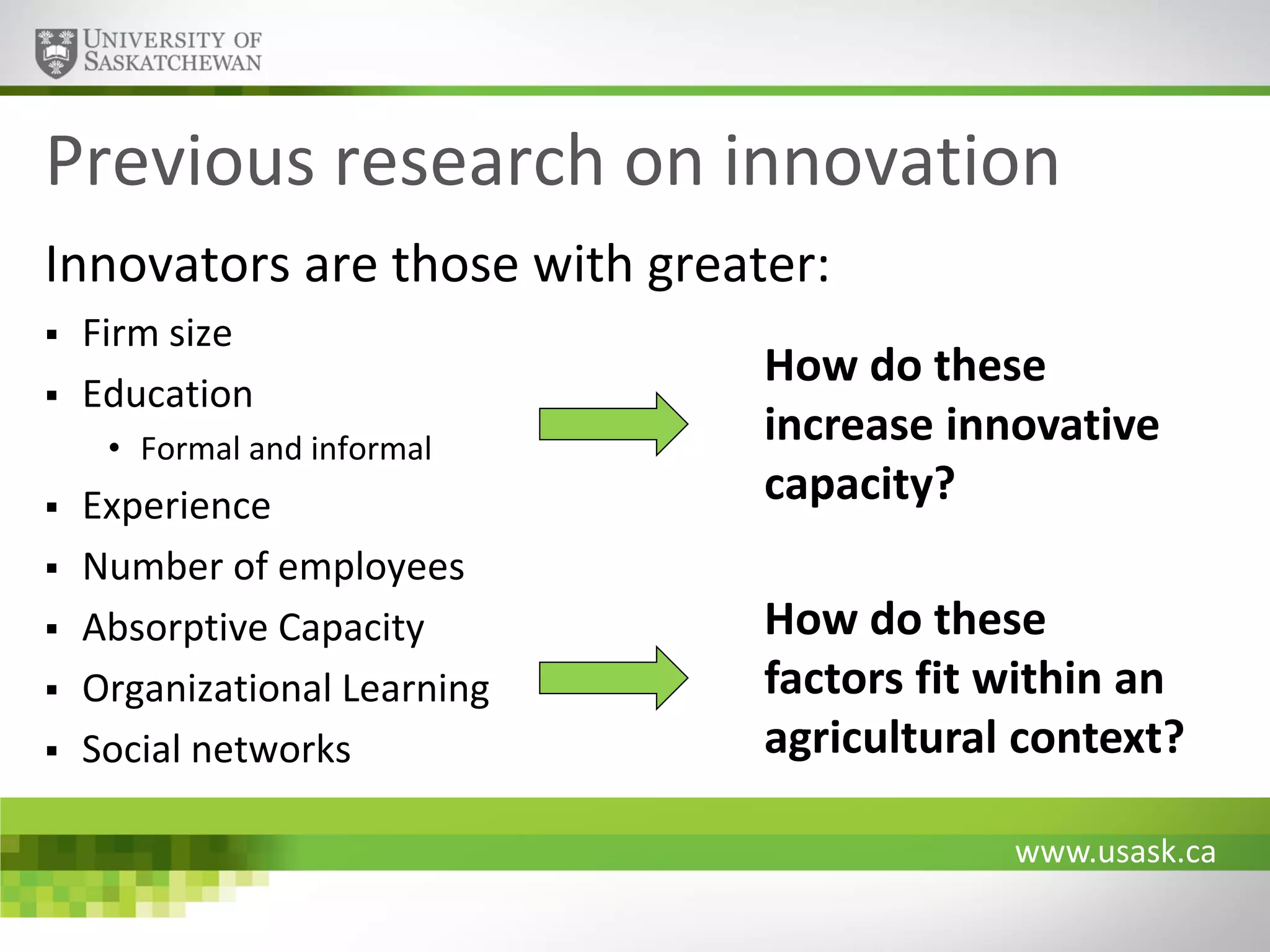
Previous research on innovation
Innovators are those with greater:



Firm size
Education
• Formal and informal







Experience
Number of employees
Absorptive Capacity
Organizational Learning
Social networks

How do these
increase innovative
capacity?
How do these
factors fit within an
agricultural context?
www.usask.ca
Insights from Other Disciplines


Ability to innovate/adopt new practices is
affected by human capital factors
• Absorptive Capacity
• Social Capital
• Organizational Learning

www.usask.ca
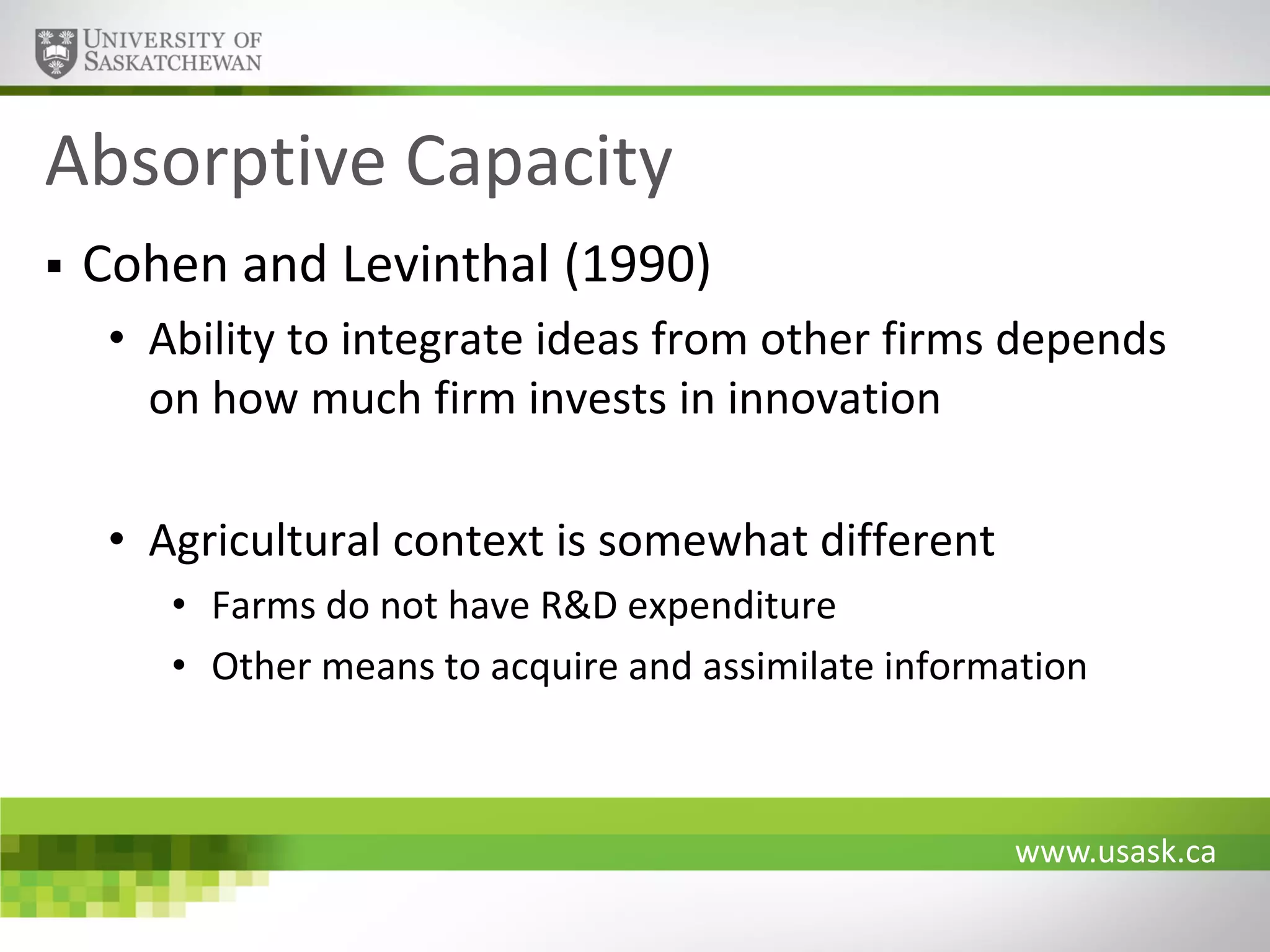
Absorptive Capacity


Cohen and Levinthal (1990)
• Ability to integrate ideas from other firms depends
on how much firm invests in innovation
• Agricultural context is somewhat different
• Farms do not have R&D expenditure
• Other means to acquire and assimilate information

www.usask.ca
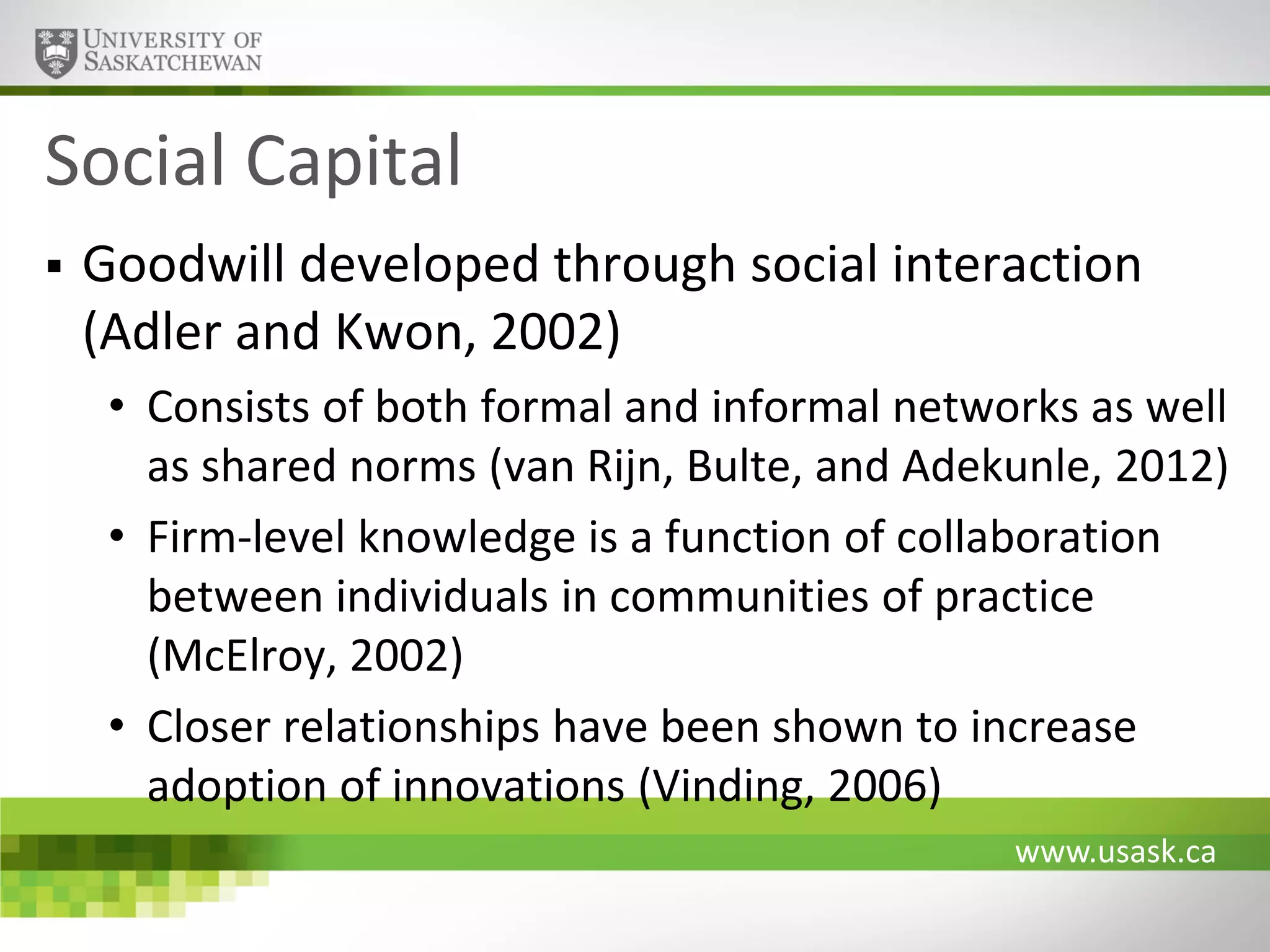
Social Capital


Goodwill developed through social interaction
(Adler and Kwon, 2002)
• Consists of both formal and informal networks as well
as shared norms (van Rijn, Bulte, and Adekunle, 2012)
• Firm-level knowledge is a function of collaboration
between individuals in communities of practice
(McElroy, 2002)
• Closer relationships have been shown to increase
adoption of innovations (Vinding, 2006)
www.usask.ca
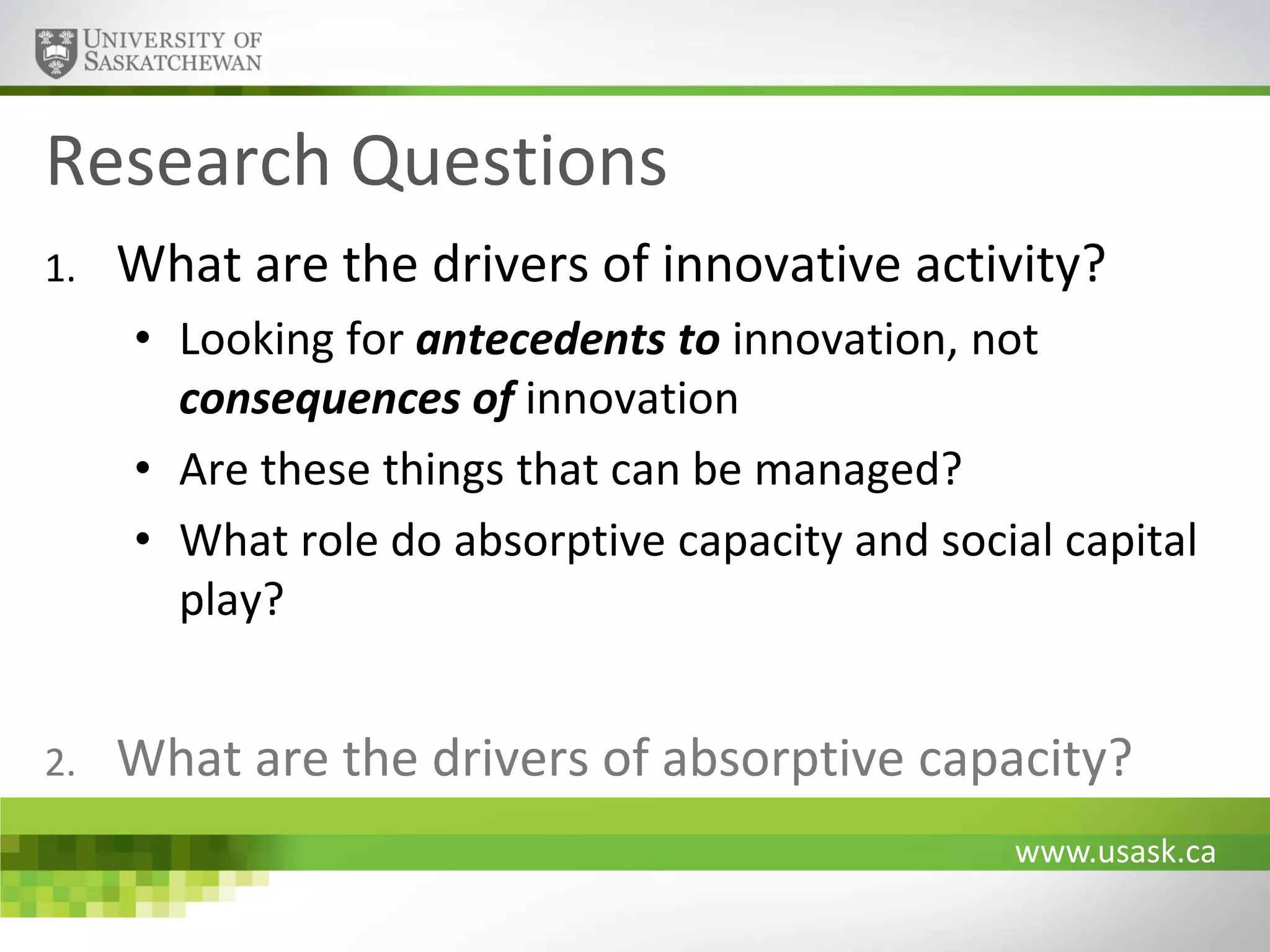
Research Questions
1.

What are the drivers of innovative activity?
• Looking for antecedents to innovation, not
consequences of innovation
• Are these things that can be managed?
• What role do absorptive capacity and social capital
play?

2.

What are the drivers of absorptive capacity?
www.usask.ca
SURVEY AND METHODS
www.usask.ca
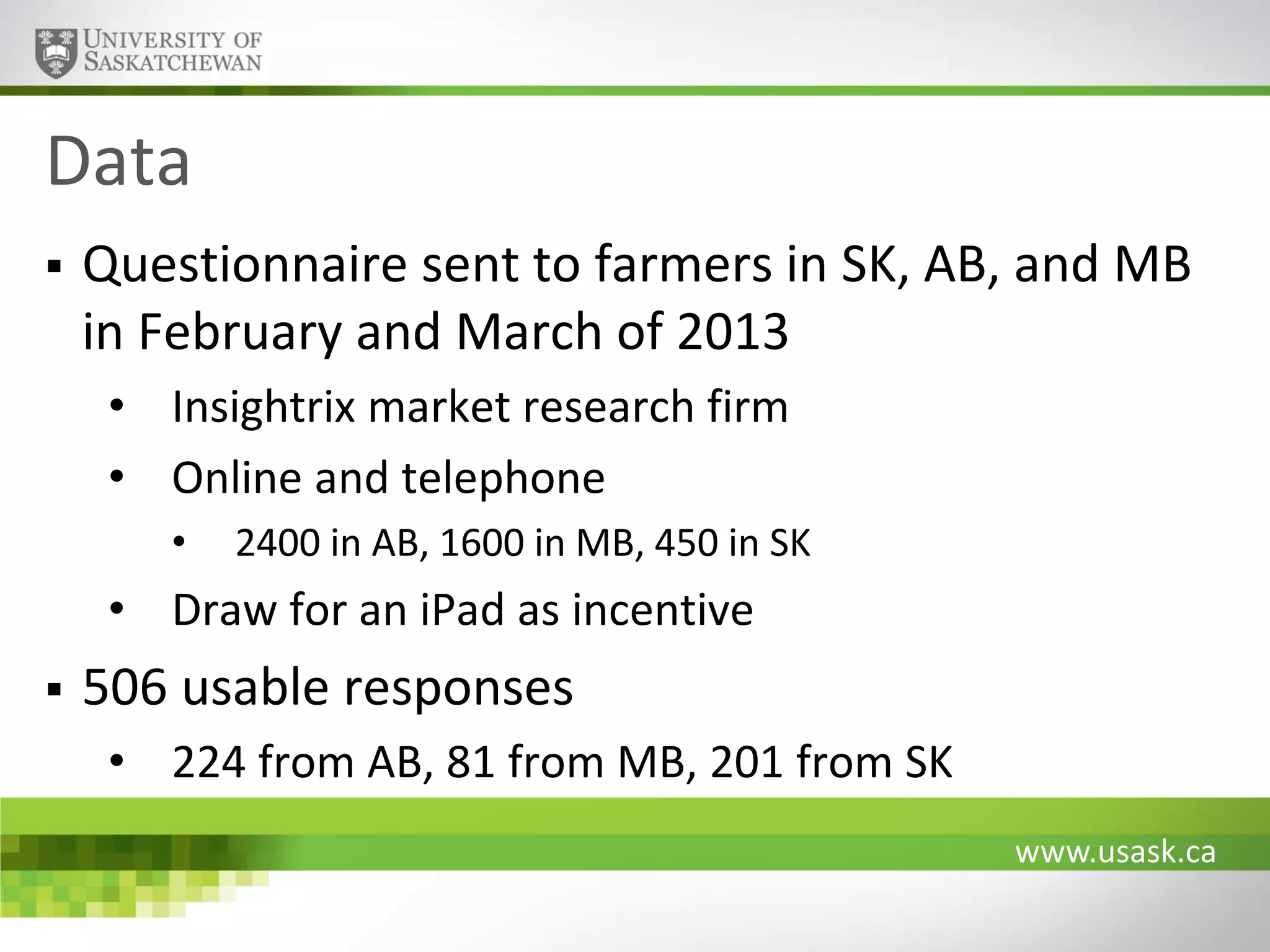
Data


Questionnaire sent to farmers in SK, AB, and MB
in February and March of 2013
• Insightrix market research firm
• Online and telephone
•

2400 in AB, 1600 in MB, 450 in SK

• Draw for an iPad as incentive


506 usable responses
• 224 from AB, 81 from MB, 201 from SK
www.usask.ca
Type and Degree of Innovation


Innovation measured across four categories
• Product, Process, Organizational, Marketing



Respondents were asked about their level of
adoption regarding different agricultural
practices
• Not at all
• Some extent
• To a great extent
www.usask.ca
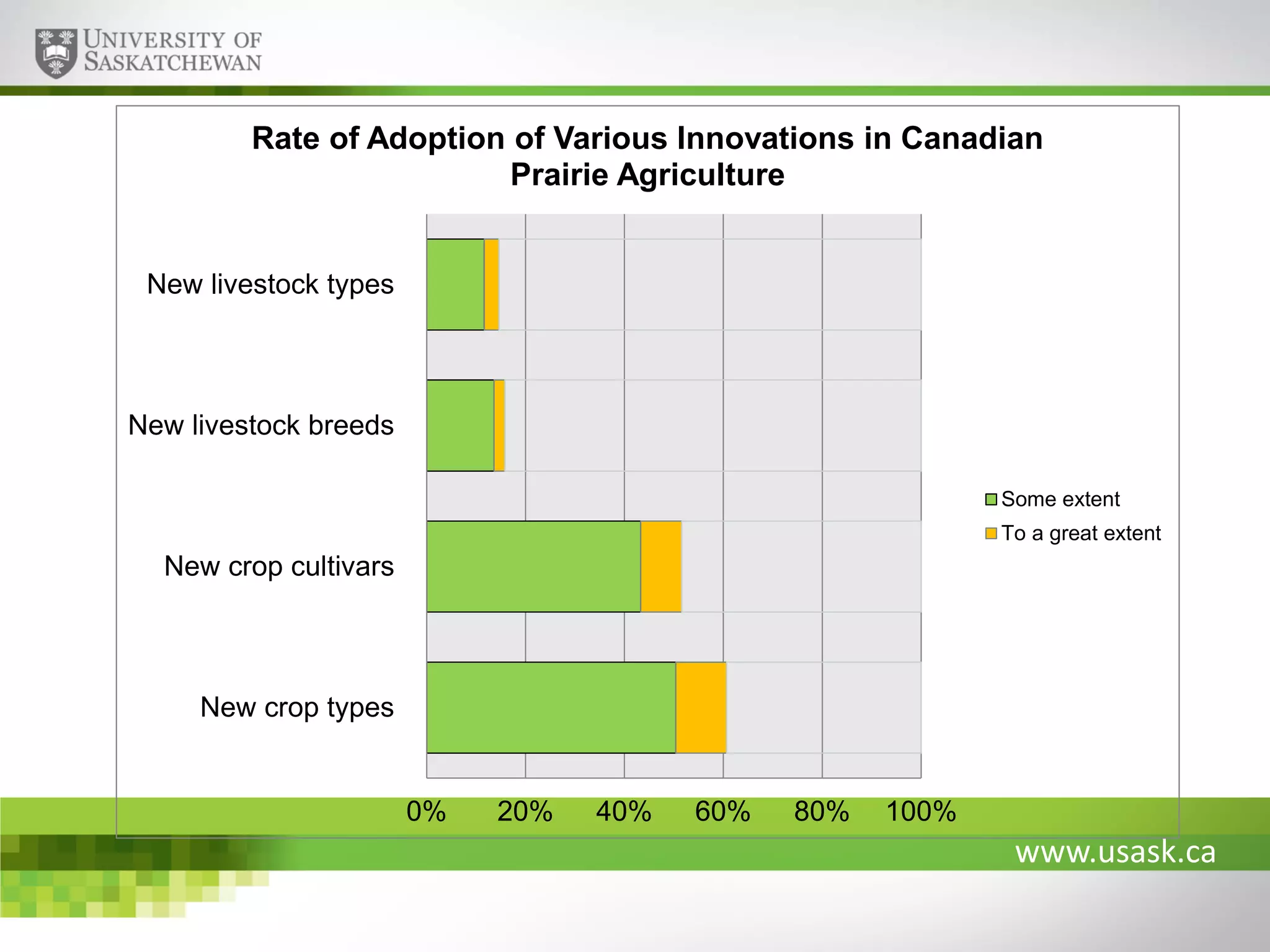
Rate of Adoption of Various Innovations in Canadian
Prairie Agriculture

New livestock types

New livestock breeds
Some extent
To a great extent

New crop cultivars

New crop types

0%

20%

40%

60%

80%

100%

www.usask.ca
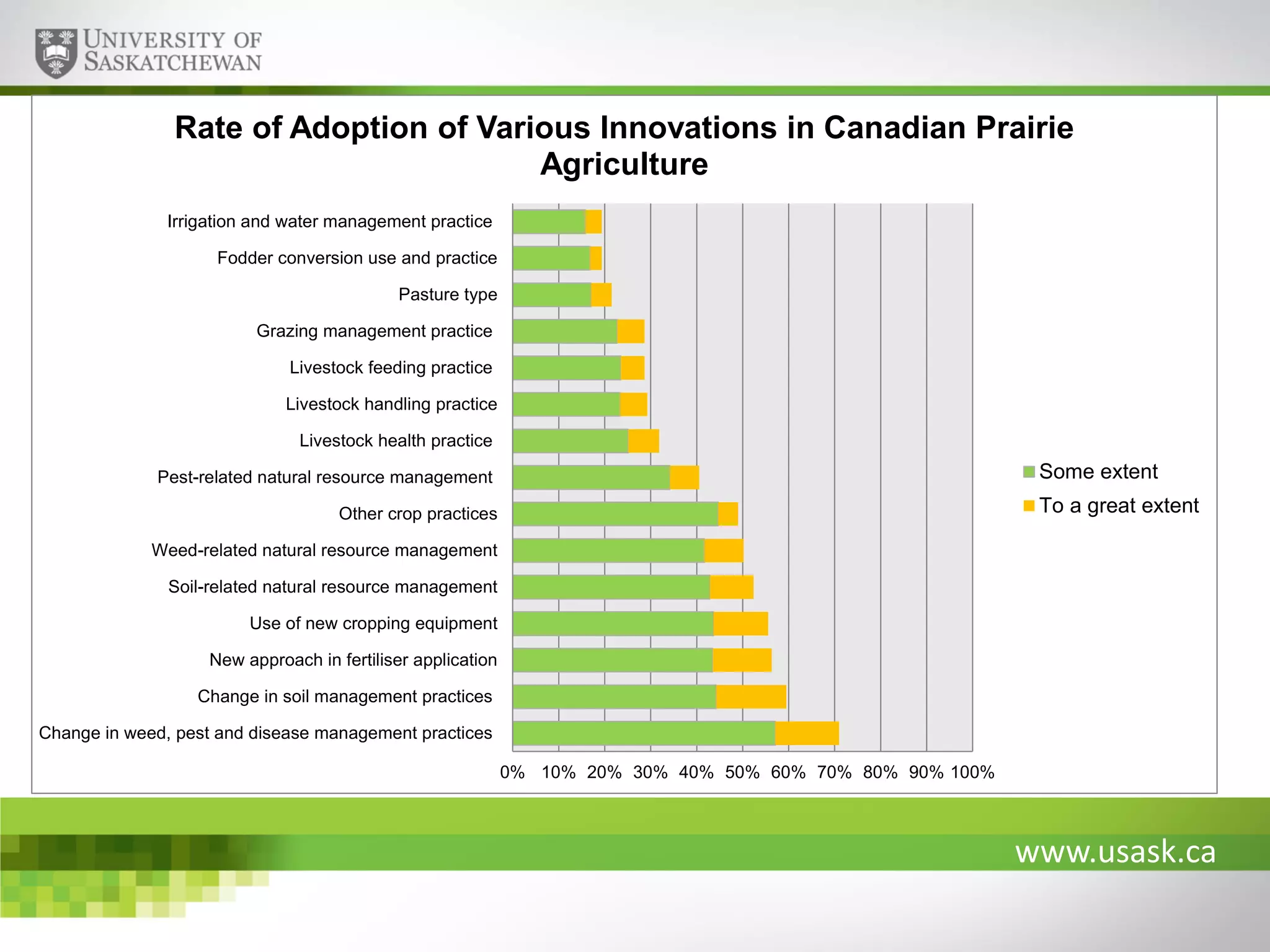
Rate of Adoption of Various Innovations in Canadian Prairie
Agriculture
Irrigation and water management practice
Fodder conversion use and practice
Pasture type
Grazing management practice
Livestock feeding practice
Livestock handling practice
Livestock health practice

Some extent

Pest-related natural resource management

To a great extent

Other crop practices
Weed-related natural resource management
Soil-related natural resource management
Use of new cropping equipment
New approach in fertiliser application
Change in soil management practices
Change in weed, pest and disease management practices
0% 10% 20% 30% 40% 50% 60% 70% 80% 90% 100%

www.usask.ca
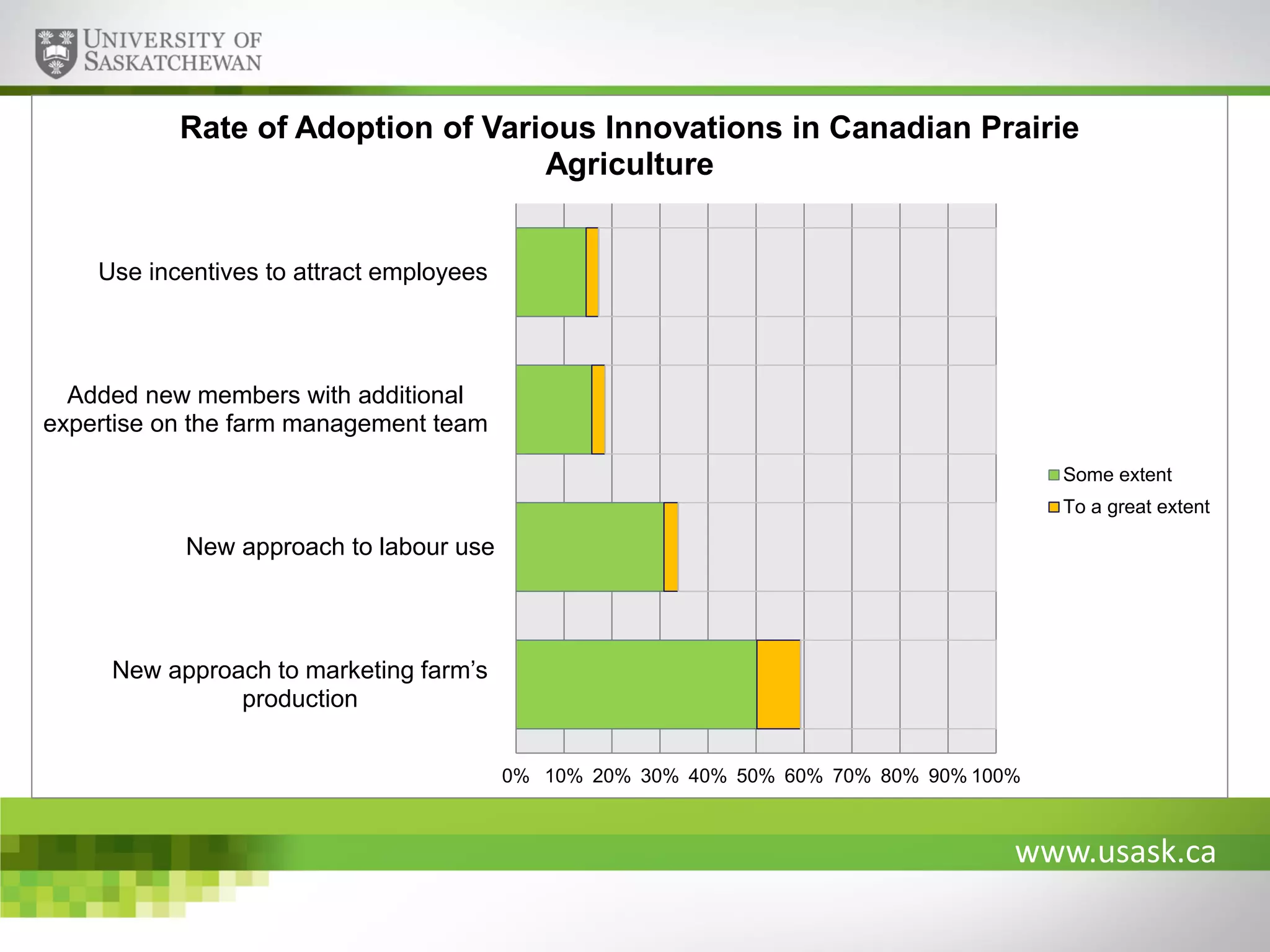
Rate of Adoption of Various Innovations in Canadian Prairie
Agriculture

Use incentives to attract employees

Added new members with additional
expertise on the farm management team
Some extent
To a great extent

New approach to labour use

New approach to marketing farm’s
production
0% 10% 20% 30% 40% 50% 60% 70% 80% 90% 100%

www.usask.ca
Social Capital
Eight item scale measuring use of social contacts
(Molina-Morales and Martinez-Fernandez, 2010)
• There is an informal network among customers, suppliers and
competitors.
• You consider that other firms feel a special duty to stand
behind you in times of trouble, so you consider it only fair
that your company should also give support to other firms.
• Your company has received considerable information about
products and markets from local institutions.
www.usask.ca
Potential Absorptive Capacity
Multi Item scale developed by Flatten, Engelen,
Zahra, & Brettel (2011) and Jansen, Bosch, &
Volberda, (2005)


How do firms acquire and assimilate knowledge?
• People on our farm have frequent interactions with business
partners to acquire new knowledge.
• We collect industry information through informal means (e.g.
lunch with industry friends, talks with trade partners).
• We quickly recognize changes in technical possibilities.
www.usask.ca
Realized Absorptive Capacity


What is the process of implementing new knowledge
into innovative activities?
• Our farm quickly recognizes the usefulness of new external
knowledge to existing knowledge.
• We convert external information directly into new business
applications to be used on our farm.
• Application of external information to our farm contributes to
our profitability.
www.usask.ca
Organizational Learning
Nine item scale measuring commitment to
learning and open-mindedness (Sinkula, Baker,
and Noordewier, 1997)
• The sense around here is that employee learning is an
investment, not an expense.
• Learning in my farm is seen as a key commodity necessary to
guarantee organizational survival.
• We encourage employees to “think outside of the box.”
www.usask.ca
Factors Driving Adoption



Dependent Variable – Number of adoptions
Independent Variables
• Human Capital (Absorptive Capacity, Learning, Social
Capital, Barriers to Innovation, Experience,
Employees)
• Farm Characteristics (Size, Type, Location, Successor,
Operator Age)
• Management tools (Track performance, Use of
consultants)
www.usask.ca
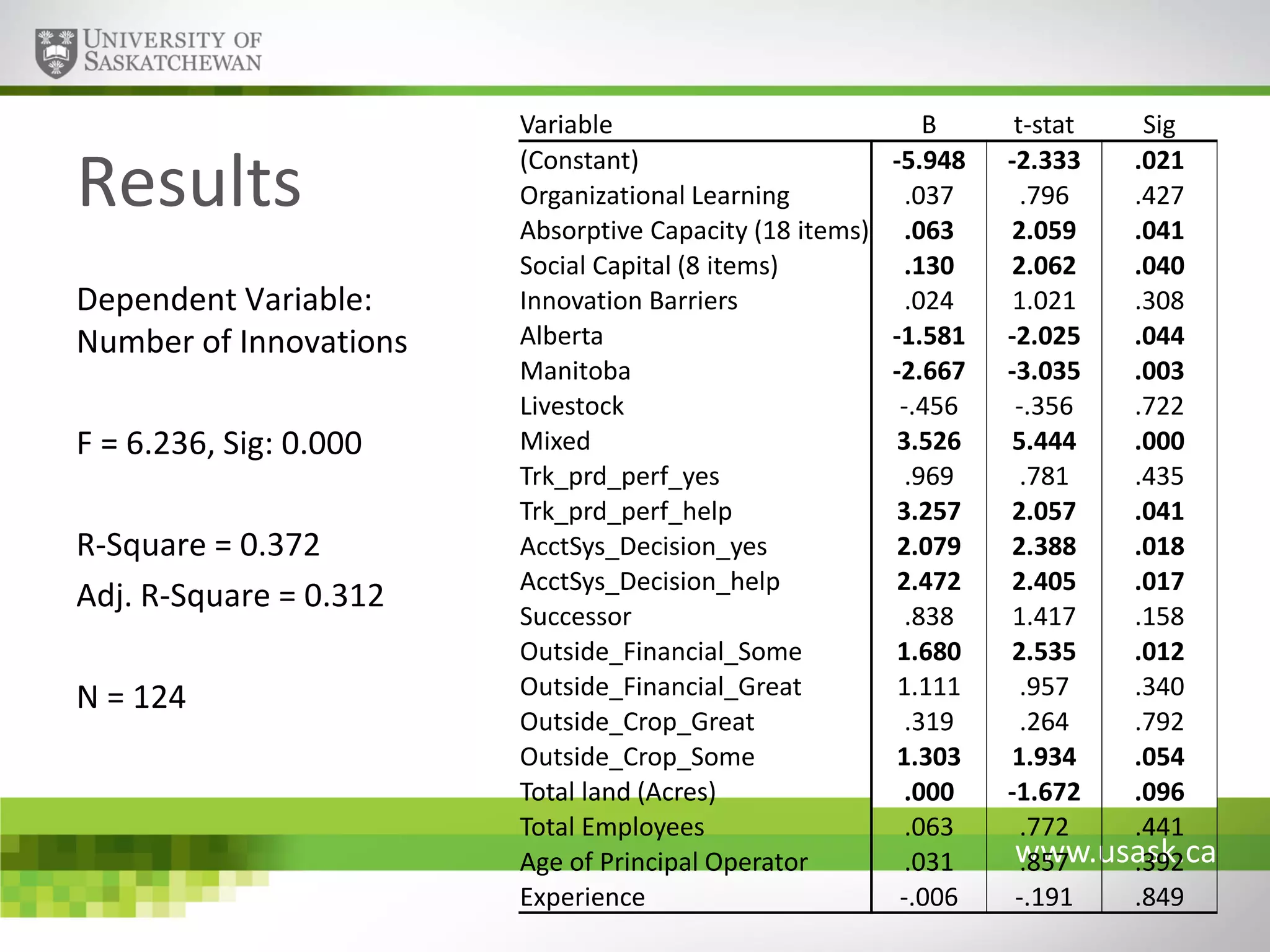
Results
Dependent Variable:
Number of Innovations
F = 6.236, Sig: 0.000
R-Square = 0.372
Adj. R-Square = 0.312
N = 124

Variable
(Constant)
Organizational Learning
Absorptive Capacity (18 items)
Social Capital (8 items)
Innovation Barriers
Alberta
Manitoba
Livestock
Mixed
Trk_prd_perf_yes
Trk_prd_perf_help
AcctSys_Decision_yes
AcctSys_Decision_help
Successor
Outside_Financial_Some
Outside_Financial_Great
Outside_Crop_Great
Outside_Crop_Some
Total land (Acres)
Total Employees
Age of Principal Operator
Experience

B
-5.948
.037
.063
.130
.024
-1.581
-2.667
-.456
3.526
.969
3.257
2.079
2.472
.838
1.680
1.111
.319
1.303
.000
.063
.031
-.006

t-stat
Sig
-2.333
.021
.796
.427
2.059
.041
2.062
.040
1.021
.308
-2.025
.044
-3.035
.003
-.356
.722
5.444
.000
.781
.435
2.057
.041
2.388
.018
2.405
.017
1.417
.158
2.535
.012
.957
.340
.264
.792
1.934
.054
-1.672
.096
.772
.441
www.usask.ca
.857
.392
-.191
.849
Discussion


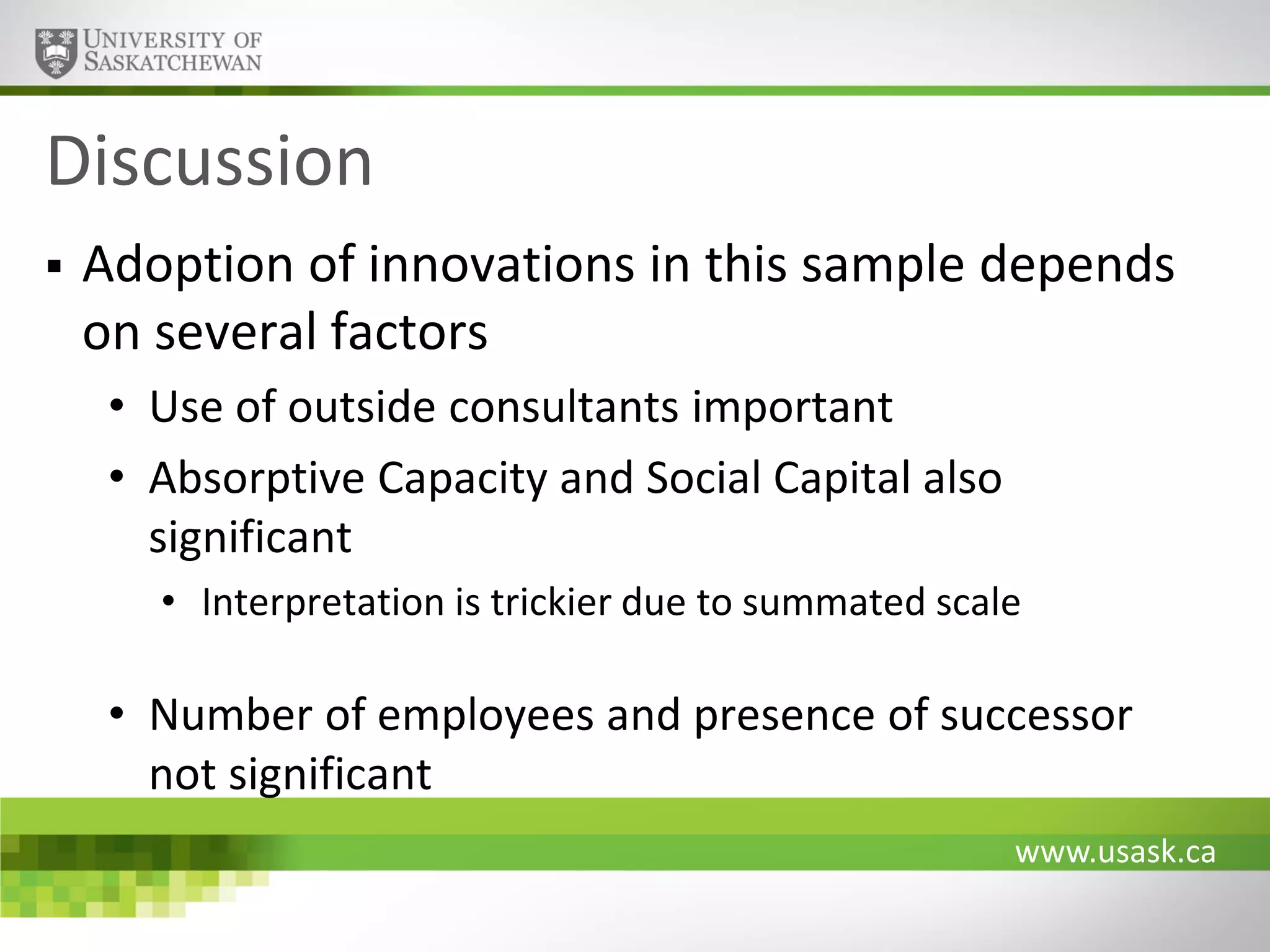
Adoption of innovations in this sample depends
on several factors
• Use of outside consultants important
• Absorptive Capacity and Social Capital also
significant
• Interpretation is trickier due to summated scale

• Number of employees and presence of successor
not significant
www.usask.ca
Future Research


Does innovation type matter?



Structural model to examine factors that
contribute to absorptive capacity and adoption



Do adopters have better performance
measures?
www.usask.ca
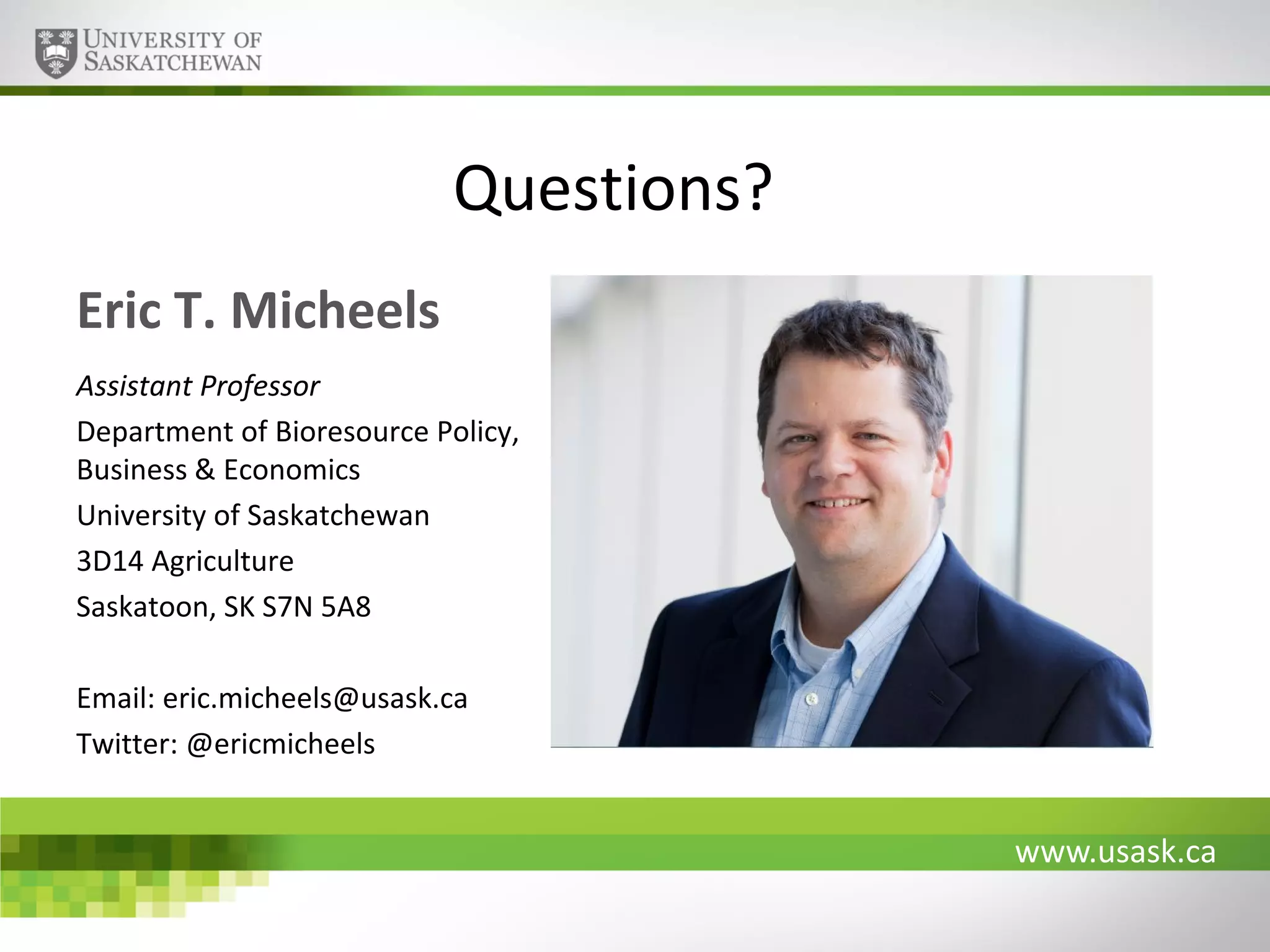
Questions?
Eric T. Micheels
Assistant Professor
Department of Bioresource Policy,
Business & Economics
University of Saskatchewan
3D14 Agriculture
Saskatoon, SK S7N 5A8
Email: eric.micheels@usask.ca
Twitter: @ericmicheels

www.usask.ca

The Effect of Absorptive Capacity and Social Capital on the Adoption of Agricultural Innovations

  • 1.
    The Effect ofAbsorptive Capacity and Social Capital on the Adoption of Agricultural Innovations Dr. Eric T. Micheels Department of Bioresource Policy, Business & Economics CAES Organized Symposia August 5, 2013 Washington, DC www.usask.ca
  • 2.
    Motivation   Improving Farmers’ Capacityto Innovate Matching procedure with AAFC projects • Survey developed in consultation with economists in the Research and Analysis Directorate/AAFC  Funded by SPAA www.usask.ca
  • 3.
    Previous research oninnovation Innovators are those with greater:   Firm size Education • Formal and informal      Experience Number of employees Absorptive Capacity Organizational Learning Social networks How do these increase innovative capacity? How do these factors fit within an agricultural context? www.usask.ca
  • 4.
    Insights from OtherDisciplines  Ability to innovate/adopt new practices is affected by human capital factors • Absorptive Capacity • Social Capital • Organizational Learning www.usask.ca
  • 5.
    Absorptive Capacity  Cohen andLevinthal (1990) • Ability to integrate ideas from other firms depends on how much firm invests in innovation • Agricultural context is somewhat different • Farms do not have R&D expenditure • Other means to acquire and assimilate information www.usask.ca
  • 6.
    Social Capital  Goodwill developedthrough social interaction (Adler and Kwon, 2002) • Consists of both formal and informal networks as well as shared norms (van Rijn, Bulte, and Adekunle, 2012) • Firm-level knowledge is a function of collaboration between individuals in communities of practice (McElroy, 2002) • Closer relationships have been shown to increase adoption of innovations (Vinding, 2006) www.usask.ca
  • 7.
    Research Questions 1. What arethe drivers of innovative activity? • Looking for antecedents to innovation, not consequences of innovation • Are these things that can be managed? • What role do absorptive capacity and social capital play? 2. What are the drivers of absorptive capacity? www.usask.ca
  • 8.
  • 9.
    Data  Questionnaire sent tofarmers in SK, AB, and MB in February and March of 2013 • Insightrix market research firm • Online and telephone • 2400 in AB, 1600 in MB, 450 in SK • Draw for an iPad as incentive  506 usable responses • 224 from AB, 81 from MB, 201 from SK www.usask.ca
  • 10.
    Type and Degreeof Innovation  Innovation measured across four categories • Product, Process, Organizational, Marketing  Respondents were asked about their level of adoption regarding different agricultural practices • Not at all • Some extent • To a great extent www.usask.ca
  • 11.
    Rate of Adoptionof Various Innovations in Canadian Prairie Agriculture New livestock types New livestock breeds Some extent To a great extent New crop cultivars New crop types 0% 20% 40% 60% 80% 100% www.usask.ca
  • 12.
    Rate of Adoptionof Various Innovations in Canadian Prairie Agriculture Irrigation and water management practice Fodder conversion use and practice Pasture type Grazing management practice Livestock feeding practice Livestock handling practice Livestock health practice Some extent Pest-related natural resource management To a great extent Other crop practices Weed-related natural resource management Soil-related natural resource management Use of new cropping equipment New approach in fertiliser application Change in soil management practices Change in weed, pest and disease management practices 0% 10% 20% 30% 40% 50% 60% 70% 80% 90% 100% www.usask.ca
  • 13.
    Rate of Adoptionof Various Innovations in Canadian Prairie Agriculture Use incentives to attract employees Added new members with additional expertise on the farm management team Some extent To a great extent New approach to labour use New approach to marketing farm’s production 0% 10% 20% 30% 40% 50% 60% 70% 80% 90% 100% www.usask.ca
  • 14.
    Social Capital Eight itemscale measuring use of social contacts (Molina-Morales and Martinez-Fernandez, 2010) • There is an informal network among customers, suppliers and competitors. • You consider that other firms feel a special duty to stand behind you in times of trouble, so you consider it only fair that your company should also give support to other firms. • Your company has received considerable information about products and markets from local institutions. www.usask.ca
  • 15.
    Potential Absorptive Capacity MultiItem scale developed by Flatten, Engelen, Zahra, & Brettel (2011) and Jansen, Bosch, & Volberda, (2005)  How do firms acquire and assimilate knowledge? • People on our farm have frequent interactions with business partners to acquire new knowledge. • We collect industry information through informal means (e.g. lunch with industry friends, talks with trade partners). • We quickly recognize changes in technical possibilities. www.usask.ca
  • 16.
    Realized Absorptive Capacity  Whatis the process of implementing new knowledge into innovative activities? • Our farm quickly recognizes the usefulness of new external knowledge to existing knowledge. • We convert external information directly into new business applications to be used on our farm. • Application of external information to our farm contributes to our profitability. www.usask.ca
  • 17.
    Organizational Learning Nine itemscale measuring commitment to learning and open-mindedness (Sinkula, Baker, and Noordewier, 1997) • The sense around here is that employee learning is an investment, not an expense. • Learning in my farm is seen as a key commodity necessary to guarantee organizational survival. • We encourage employees to “think outside of the box.” www.usask.ca
  • 18.
    Factors Driving Adoption   DependentVariable – Number of adoptions Independent Variables • Human Capital (Absorptive Capacity, Learning, Social Capital, Barriers to Innovation, Experience, Employees) • Farm Characteristics (Size, Type, Location, Successor, Operator Age) • Management tools (Track performance, Use of consultants) www.usask.ca
  • 19.
    Results Dependent Variable: Number ofInnovations F = 6.236, Sig: 0.000 R-Square = 0.372 Adj. R-Square = 0.312 N = 124 Variable (Constant) Organizational Learning Absorptive Capacity (18 items) Social Capital (8 items) Innovation Barriers Alberta Manitoba Livestock Mixed Trk_prd_perf_yes Trk_prd_perf_help AcctSys_Decision_yes AcctSys_Decision_help Successor Outside_Financial_Some Outside_Financial_Great Outside_Crop_Great Outside_Crop_Some Total land (Acres) Total Employees Age of Principal Operator Experience B -5.948 .037 .063 .130 .024 -1.581 -2.667 -.456 3.526 .969 3.257 2.079 2.472 .838 1.680 1.111 .319 1.303 .000 .063 .031 -.006 t-stat Sig -2.333 .021 .796 .427 2.059 .041 2.062 .040 1.021 .308 -2.025 .044 -3.035 .003 -.356 .722 5.444 .000 .781 .435 2.057 .041 2.388 .018 2.405 .017 1.417 .158 2.535 .012 .957 .340 .264 .792 1.934 .054 -1.672 .096 .772 .441 www.usask.ca .857 .392 -.191 .849
  • 20.
    Discussion  Adoption of innovationsin this sample depends on several factors • Use of outside consultants important • Absorptive Capacity and Social Capital also significant • Interpretation is trickier due to summated scale • Number of employees and presence of successor not significant www.usask.ca
  • 21.
    Future Research  Does innovationtype matter?  Structural model to examine factors that contribute to absorptive capacity and adoption  Do adopters have better performance measures? www.usask.ca
  • 22.
    Questions? Eric T. Micheels AssistantProfessor Department of Bioresource Policy, Business & Economics University of Saskatchewan 3D14 Agriculture Saskatoon, SK S7N 5A8 Email: eric.micheels@usask.ca Twitter: @ericmicheels www.usask.ca