The Later Pandyas
INTRODUCTION
 The Pandya dynasty, also known as
the Pandyas of Madurai, was a dynasty
of south India,
 It is one of the three ethnically Tamil
lineages, the other two being
the Chola and the Chera.
 The rulers of the three dynasties were
referred to as "the three crowned rulers
(the mu-ventar) of the Tamil country".
INTRODUCTION
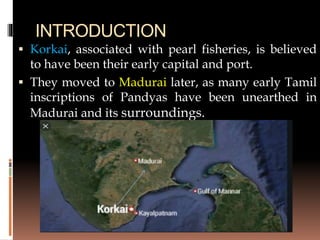
 Korkai, associated with pearl fisheries, is believed
to have been their early capital and port.
 They moved to Madurai later, as many early Tamil
inscriptions of Pandyas have been unearthed in
Madurai and its surroundings.
INTRODUCTION
 Under the Pandya kings of the Sangam
Age, Madurai was a great centre of
culture.
 Poets and writers of Tamil language
gatherer there and contributed to the
development of Tamil Classics.
 The Pandyas had re-established their
strong position in south Tamil Nadu by
the end of the 6th century A.D. (CE), after
eliminating the rule of Kalabhras.
INTRODUCTION
 Thereafter taking advantage of the decline
of Chola power, the later Pandyas re-
established their authority.
 Their rule continued until 16th century.
REVIVAL
(recovery) OF PANDYA
(A.D. (CE) 600 - 920)
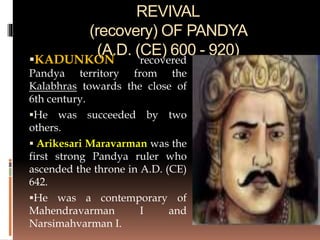
KADUNKON recovered
Pandya territory from the
Kalabhras towards the close of
6th century.
He was succeeded by two
others.
 Arikesari Maravarman was the
first strong Pandya ruler who
ascended the throne in A.D. (CE)
642.
He was a contemporary of
Mahendravarman I and
Narsimahvarman I.
KADUNKON
 Inscriptions and copper plates praise his
victory over his counterparts:
 Cheras,
 Cholas,
 Pallavas
 Sinhalese.
 Arikesari Maravarman is identified with
the Kun Pandian, the persecutor of Jains.
REVIVAL OF PANDYA KINGDOM
(A.D. (CE) 600 - 920)
 After Arikesari, the greatest of the
dynasty was Jatila Parantaka
Nedunjadayan (Varaguna I) (756-815), the
donor of the Velvikkudi plates.
 Nedunjadayan expanded the Pandya
territory to include Thanjavur,
Tiruchirappalli, Salem and Coimbatore
districts
REVIVAL OF PANDYA KINGDOM
(A.D. (CE) 600 - 920)
 Nedunjadayan’s successors Srimara
Srivallabha and Varaguna II, were
successively defeated by Pallavas.
 Later they could not face the rising Chola
dynasty under Parantaka I.
 Parantaka I defeated the Pandya king
Rajasimha II who fled the country in 920.
 Thus ended the Pandya rule revived by
Kadungon.
Rise of Later Pandyas
(1190 - 1310)
 The Chola viceroyalty became weak in
Pandya country after the death of
Adhirajendra (the last king of Vijayalaya
line).
 Eventually the Pandya kingdom could
emerge as the only leading Tamil dynasty
in the 13th century.
Rise of Later Pandyas
(1190 - 1310)
 Madurai continued to be their capital.
Now Kayal was their great port.
 MARCO POLO, a famous traveller from
Venice, visited Kayal twice, in 1288 and
1293.
 He tells us that this port town was full of
ships from Arabia and China and bustling
with business activities.
MARCO POLO
 Marco Polo hailed the Pandyan
Kingdom as ‘the richest and the
most splendid province in the
world’.
 Together with Ceylon, he
added, it ‘produced most of the
gems and pearls that are found
in the world’.
 In his travel account he
recorded the incidents of sati
and the polygamy practiced by
the kings.
SADAIYAVARMAN SUNDARAPANDYAN
 Jatavarman Sundara Pandyan I, also known
as Sadayavarman Sundara Pandyan,
 The illustrious ruler of the second Pandya
Kingdom was Sadaiyavarman (Jatavarman)
Sundarapandyan (1251 to 1268).
 He brought the entire Tamil Nadu under his
rule, which extended up to Nellore in
Andhra.
 He held the Hoysalas in check.
SADAIYAVARMAN SUNDARAPANDYAN
 The Chera ruler, the chief of Malanadu,
accepted his feudatory position and paid
tribute to Sundarapandyan.
 Emboldened by the decline of the Chola
state, the Boja King of Malwa region Vira
Someswara challenged Sundarapandyan.
 In a war at Kannanur, Sundarapandyan
defeated Someswara.
SADAIYAVARMAN SUNDARAPANDYAN
 Sundarapandyan succeeded in
establishing his authority over the
chieftains of Cuddalore, Kanchipuram in
northern Tamil Nadu, Arcot and Salem in
the western region.
SADAIYAVARMAN SUNDARAPANDYAN
 There were two or three co-regents who
ruled simultaneously along with
Sundarapandyan:
 VikramaPandyan
 ViraPandyan.
 After Sundarapandyan, MARAVARMAN
KULASEKARAN ruled successfully for a
period of 40 years , giving the country peace
and prosperity
SADAIYAVARMAN SUNDARAPANDYAN
 MARAVARMAN KULASEKARAN had two
sons.
 The king’s appointment of ViraPandyan as a co-
regent provoked the other son Sundara Pandyan
who killed his father Maravarman Kulasekaran.
 In the civil war that ensued, ViraPandyan won
and became firmly established in his kingdom.
 The defeated SundaraPandyan fled to Delhi and
took refuge under the protection of Ala-ud-din
Khalji.
 This provided the opening for the invasion of
Malik Kafur.
SADAIYAVARMAN SUNDARAPANDYAN
 After Malik Kafur’s invasion, the Pandyan
Kingdom came to be divided among a
number of kings from the main ruling
Pandya’s family.
 In Madurai, a Muslim State subordinate to
the Delhi Sultan came to be established.

Later pandyas

  • 1.
  • 3.
    INTRODUCTION  The Pandyadynasty, also known as the Pandyas of Madurai, was a dynasty of south India,  It is one of the three ethnically Tamil lineages, the other two being the Chola and the Chera.  The rulers of the three dynasties were referred to as "the three crowned rulers (the mu-ventar) of the Tamil country".
  • 4.
    INTRODUCTION  Korkai, associatedwith pearl fisheries, is believed to have been their early capital and port.  They moved to Madurai later, as many early Tamil inscriptions of Pandyas have been unearthed in Madurai and its surroundings.
  • 5.
    INTRODUCTION  Under thePandya kings of the Sangam Age, Madurai was a great centre of culture.  Poets and writers of Tamil language gatherer there and contributed to the development of Tamil Classics.  The Pandyas had re-established their strong position in south Tamil Nadu by the end of the 6th century A.D. (CE), after eliminating the rule of Kalabhras.
  • 6.
    INTRODUCTION  Thereafter takingadvantage of the decline of Chola power, the later Pandyas re- established their authority.  Their rule continued until 16th century.
  • 7.
    REVIVAL (recovery) OF PANDYA (A.D.(CE) 600 - 920) KADUNKON recovered Pandya territory from the Kalabhras towards the close of 6th century. He was succeeded by two others.  Arikesari Maravarman was the first strong Pandya ruler who ascended the throne in A.D. (CE) 642. He was a contemporary of Mahendravarman I and Narsimahvarman I.
  • 8.
    KADUNKON  Inscriptions andcopper plates praise his victory over his counterparts:  Cheras,  Cholas,  Pallavas  Sinhalese.  Arikesari Maravarman is identified with the Kun Pandian, the persecutor of Jains.
  • 9.
    REVIVAL OF PANDYAKINGDOM (A.D. (CE) 600 - 920)  After Arikesari, the greatest of the dynasty was Jatila Parantaka Nedunjadayan (Varaguna I) (756-815), the donor of the Velvikkudi plates.  Nedunjadayan expanded the Pandya territory to include Thanjavur, Tiruchirappalli, Salem and Coimbatore districts
  • 10.
    REVIVAL OF PANDYAKINGDOM (A.D. (CE) 600 - 920)  Nedunjadayan’s successors Srimara Srivallabha and Varaguna II, were successively defeated by Pallavas.  Later they could not face the rising Chola dynasty under Parantaka I.  Parantaka I defeated the Pandya king Rajasimha II who fled the country in 920.  Thus ended the Pandya rule revived by Kadungon.
  • 11.
    Rise of LaterPandyas (1190 - 1310)  The Chola viceroyalty became weak in Pandya country after the death of Adhirajendra (the last king of Vijayalaya line).  Eventually the Pandya kingdom could emerge as the only leading Tamil dynasty in the 13th century.
  • 12.
    Rise of LaterPandyas (1190 - 1310)  Madurai continued to be their capital. Now Kayal was their great port.  MARCO POLO, a famous traveller from Venice, visited Kayal twice, in 1288 and 1293.  He tells us that this port town was full of ships from Arabia and China and bustling with business activities.
  • 13.
    MARCO POLO  MarcoPolo hailed the Pandyan Kingdom as ‘the richest and the most splendid province in the world’.  Together with Ceylon, he added, it ‘produced most of the gems and pearls that are found in the world’.  In his travel account he recorded the incidents of sati and the polygamy practiced by the kings.
  • 14.
    SADAIYAVARMAN SUNDARAPANDYAN  JatavarmanSundara Pandyan I, also known as Sadayavarman Sundara Pandyan,  The illustrious ruler of the second Pandya Kingdom was Sadaiyavarman (Jatavarman) Sundarapandyan (1251 to 1268).  He brought the entire Tamil Nadu under his rule, which extended up to Nellore in Andhra.  He held the Hoysalas in check.
  • 15.
    SADAIYAVARMAN SUNDARAPANDYAN  TheChera ruler, the chief of Malanadu, accepted his feudatory position and paid tribute to Sundarapandyan.  Emboldened by the decline of the Chola state, the Boja King of Malwa region Vira Someswara challenged Sundarapandyan.  In a war at Kannanur, Sundarapandyan defeated Someswara.
  • 16.
    SADAIYAVARMAN SUNDARAPANDYAN  Sundarapandyansucceeded in establishing his authority over the chieftains of Cuddalore, Kanchipuram in northern Tamil Nadu, Arcot and Salem in the western region.
  • 18.
    SADAIYAVARMAN SUNDARAPANDYAN  Therewere two or three co-regents who ruled simultaneously along with Sundarapandyan:  VikramaPandyan  ViraPandyan.  After Sundarapandyan, MARAVARMAN KULASEKARAN ruled successfully for a period of 40 years , giving the country peace and prosperity
  • 19.
    SADAIYAVARMAN SUNDARAPANDYAN  MARAVARMANKULASEKARAN had two sons.  The king’s appointment of ViraPandyan as a co- regent provoked the other son Sundara Pandyan who killed his father Maravarman Kulasekaran.  In the civil war that ensued, ViraPandyan won and became firmly established in his kingdom.  The defeated SundaraPandyan fled to Delhi and took refuge under the protection of Ala-ud-din Khalji.  This provided the opening for the invasion of Malik Kafur.
  • 20.
    SADAIYAVARMAN SUNDARAPANDYAN  AfterMalik Kafur’s invasion, the Pandyan Kingdom came to be divided among a number of kings from the main ruling Pandya’s family.  In Madurai, a Muslim State subordinate to the Delhi Sultan came to be established.