RESPONCES AT
DIFFERENT LEVELS
ISOLATION &
QUARATINE
PANDEMIC MODULE_3.1_OUTBREAK
MX
TEXT
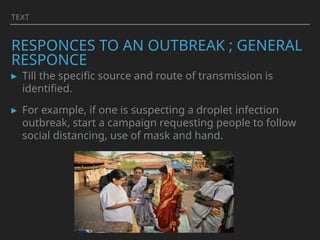
RESPONCES TO AN OUTBREAK ; GENERAL
RESPONCE
▸ Till the specific source and route of transmission is
identified.
▸ For example, if one is suspecting a droplet infection
outbreak, start a campaign requesting people to follow
social distancing, use of mask and hand.
TEXT
RESPONCES TO AN OUTBREAK; SPECIFIC
MEASURES
▸ Depend on causative agent.
▸ BROAD STEPS ARE:
▸ Identification and nullification of the source of outbreak like
chlorinating wells,
▸ Minimising transmission to prevent further exposure: vector
control,
▸ Protection of the host- immunization / chemoprophylaxis,
▸ Controlling the reservoir include early diagnosis, notification,
isolation, treatment, quarantine.
TEXT
▸ Broadly these are measures, pending results of
epidemiologic/outbreak investigation.
▸ these activities routinely are now included in primary
health care- it requires community participation, political
support and intersectoral co-ordination.
TEXT
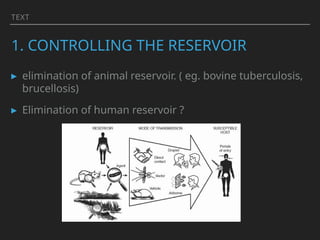
1. CONTROLLING THE RESERVOIR
▸ elimination of animal reservoir. ( eg. bovine tuberculosis,
brucellosis)
▸ Elimination of human reservoir ?
1. CONTROLLING THE RESERVOIR
STAMPING OUT THE ‘SPARK’ ; (A) EARLY
DIAGNOSIS
▸ the first step in the control of an outbreak is its Rapid
identification.
▸ for treatment of patients;
▸ for epidemiological investigations for eg. the source of
infection from index case (known) to the primary source
(unknown) of infection.
▸ to study tpp —descriptive epidemiology
RESERVOIR
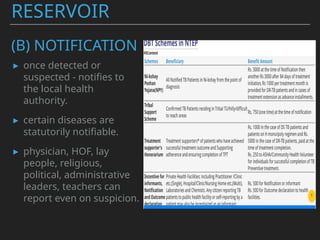
(B) NOTIFICATION
▸ once detected or
suspected - notifies to
the local health
authority.
▸ certain diseases are
statutorily notifiable.
▸ physician, HOF, lay
people, religious,
political, administrative
leaders, teachers can
report even on suspicion.
RESERVOIR
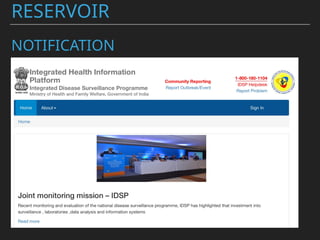
NOTIFICATION
RESERVOIR
NOTIFICATION
▸ IHR - INTERNATIONAL HEALTH REGULATIONS
▸ To WHO
▸ Cholera, Plague, Yellow fever;
▸ Under surveillance: louse borne Typhus fever, Relapsing
fever, Paralytic Polio, Malaria, viral Influenza-A, SARS,
Small pox..
RESERVOIR
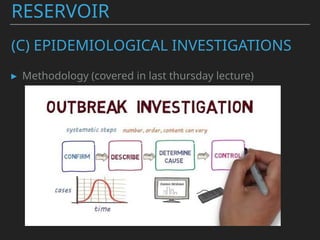
(C) EPIDEMIOLOGICAL INVESTIGATIONS
▸ Methodology (covered in last thursday lecture)
TEXT
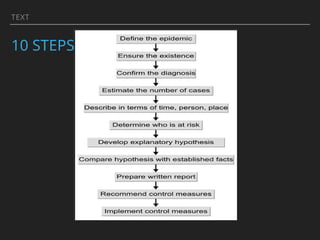
10 STEPS:
(D) ISOLATION
▸ Oldest ds control measure.
▸ “Separation, for the period of communicability of infected
persons or animals from others in such places and under
such conditions, as to prevent or limit the direct or
indirect transmission of the infectious agent from those
infected to those who are susceptible or who may spread
the agent to others”
1. CONTROLLING THE
RESERVOIR
(D) ISOLATION
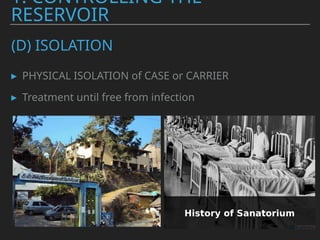
▸ PHYSICAL ISOLATION of CASE or CARRIER
▸ Treatment until free from infection
1. CONTROLLING THE
RESERVOIR
(D) ISOLATION
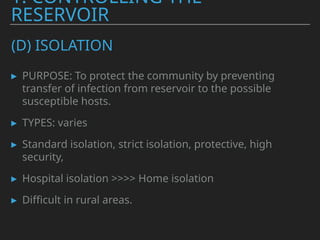
▸ PURPOSE: To protect the community by preventing
transfer of infection from reservoir to the possible
susceptible hosts.
▸ TYPES: varies
▸ Standard isolation, strict isolation, protective, high
security,
▸ Hospital isolation >>>> Home isolation
▸ Difficult in rural areas.
1. CONTROLLING THE
RESERVOIR
(D) ISOLATION
▸ RING ISOLATION : Encircling the infected persons with a
barrier of immune persons through whom the infection
is unable to spread.
▸ Ring isolation in context of Small pox : a public health
strategy where, upon identifying a smallpox case, the
immediate close contacts of that person are isolated and
vaccinated, creating a "ring" of protection around the
infected individual to prevent further spread of the
disease.
1. CONTROLLING THE
RESERVOIR
(D) ISOLATION
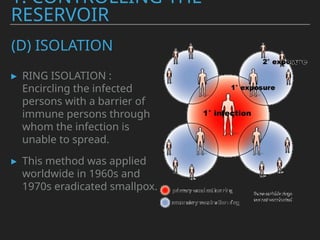
▸ RING ISOLATION :
Encircling the infected
persons with a barrier of
immune persons through
whom the infection is
unable to spread.
▸ This method was applied
worldwide in 1960s and
1970s eradicated smallpox.
1. CONTROLLING THE
RESERVOIR
(D) ISOLATION ; WHEN AND FOR WHAT ?
▸ For diseases like Diphtheria, Cholera, Streptococcal
resp disease, pneumonic plague.. Isolation has
distinctive value
▸ However Isolation becomes a futile excercise for ds
where there is a large component of subclincal
infection and carrier state like Polio, Hepatitis A,
Typhoid fever..
▸ Isolation has failed for TB, Leprosy and STDs
1. CONTROLLING THE
RESERVOIR
(D) ISOLATION ; WHEN AND FOR WHAT ?
▸ Isolation has FAILED in the control of ds like Leprosy, TB,
STDs.
▸ here the Concept of Physical isolation has replaced by
CHEMICAL Isolation.
▸ that is rapid treatment of cases in their homes and
rendering them non-infectious as quickly as possible.
▸ in todays times, Isolation is recommended only when the
risk of transmission if the infection is exceptionally
serious.
1. CONTROLLING THE
RESERVOIR
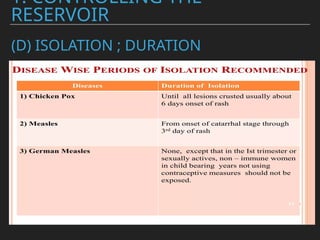
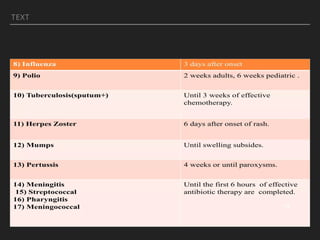
(D) ISOLATION ; DURATION
1. CONTROLLING THE
RESERVOIR
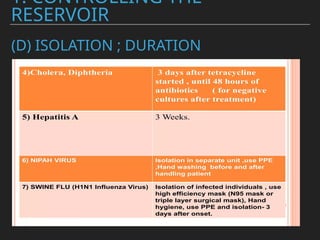
(D) ISOLATION ; DURATION
1. CONTROLLING THE
RESERVOIR
TEXT
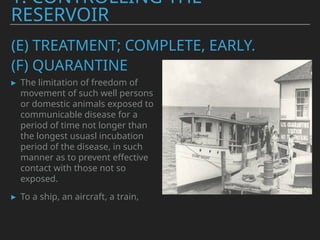
(E) TREATMENT; COMPLETE, EARLY.
▸ The limitation of freedom of
movement of such well persons
or domestic animals exposed to
communicable disease for a
period of time not longer than
the longest usuasl incubation
period of the disease, in such
manner as to prevent effective
contact with those not so
exposed.
▸ To a ship, an aircraft, a train,
1. CONTROLLING THE
RESERVOIR
(F) QUARANTINE
▸ ABSOLUTE QUARANTINE:
▸ MODIFIED QUARATINE: A selective partial limitaion of
freedom of movement such as exclusion of children from
school.
▸ SEGRAGATION;
▸ With better techniques of early diagnosis and Rx,
quaratine as a method of disease control has become
outdated.
▸ It has been replaced by Active Surveillance.
1. CONTROLLING THE
RESERVOIR
(F) QUARANTINE
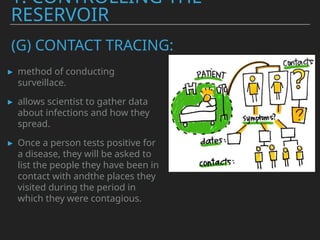
▸ method of conducting
surveillace.
▸ allows scientist to gather data
about infections and how they
spread.
▸ Once a person tests positive for
a disease, they will be asked to
list the people they have been in
contact with andthe places they
visited during the period in
which they were contagious.
1. CONTROLLING THE
RESERVOIR
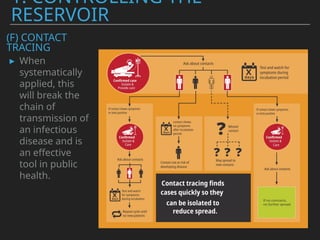
(G) CONTACT TRACING:
▸ When
systematically
applied, this
will break the
chain of
transmission of
an infectious
disease and is
an effective
tool in public
health.
1. CONTROLLING THE
RESERVOIR
(F) CONTACT
TRACING
TEXT
NEXT LECTURE
▸ Case scenarios
▸ preparation of EPIDEMIC CURVE
▸ Preparation of SPOT MAP
▸ Calculation of ATTACK RATE from a given data.
THANK
YOU
CASE
ACTIVITIES OF INTER-
SECTORAL
CO-ORDINATION,
FORMATION & MEETING OF
RRT.
TEXT
RECAP
▸ IN THE PREVIOUS LECTURE
▸ PRINCIPLES OF PRIMARY HEALTH CARE.
▸ OUTBREAK CONTROL TEAM MEMBERS
TEXT
OUTBREAK TEAM
MEMBERS
▸ AN EPIDEMIOLOGIST
▸ CLINICIAN
▸ MICROBIOLOGIST
▸ ENVIRONMENTAL HEALTH
OFFICER
▸ COMMUNICATION SPECIALIST
▸ DATA MANAGER
▸ ADMINISTRATIVE SUPPORT STAFF
TEXT
RRT
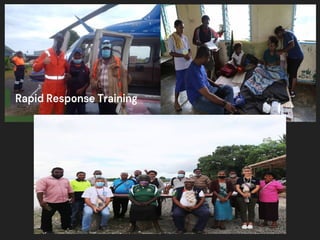
In the event of a suspected outbreak, the Rapid Response Teams (RRT)
-
a multidisciplinary team that looks into various aspects of an outbreak
is alerted.
RRT will be to investigate and confirm outbreak.
The members of RRT are regularly doing their work but, in the event of
an outbreak, come together to undertake a special function.
TEXT
RRT
They should work in coordination with the Government health staff.
They will help and support health staff in management and control of
outbreak but the responsibility of implementing control measures
mainly rests with local health staff.
RRT should be formed at all levels of administrative system (district,
block, Panchayat).
The name, address and mobile phone number of RRT members should
be available at respective levels so that they can be alerted as soon as
possible.
TEXT
CASE SCENARIO 1
Mr. X, Medical Officer of a primary health centre noticed increased
number of cases
with symptoms of fever, sore throat and cough during third week of
March. While taking detailed history one patient had a history of
international travel 2 weeks back from a place where some of his
friends also had similar illness.
In the next week, one of the tertiary care hospitals in the city reported
increased number of severe acute respiratory illness among admitted
patients and two of them died due to this.
As a Medical Officer or a member of a district health care team, how do
you investigate this and manage the situation?
TEXT
CASE SCENARIO 2
Dr. X was appointed as Medical Officer of the Primary
Health Centre. One of his field staff reported three cases of
watery diarrhoea and dehydration (two mild and one
severe) in his field area and he referred them for admission
to the hospital.
As a health professional what do you think about this
episode and how do we proceed to investigate and control
the situation.
TEXT
CASE SCENARIO 3
Dr. X was on casualty duty that day. Mr. Y, 49 years old, presented to Medicine
casualty
with high grade fever (3 days), retro-orbital pain, myalgia and rash.
While eliciting detailed history from the patient, he revealed that there was history of
fever and bodyache for his brother and brother’s wife one week back for which they
took treatment in a private hospital.
Mr. Y and his four brothers lived in nearby houses in the same compound (within 300
metres).
He took paracetamol on the first two days of fever thinking that he was feverish as he
walked in the rain the previous day.
As a health professional what do you think about this episode and how do we
proceed
to investigate and manage the situation.
TEXT
CASE SCENARIO 4
Mr. A,17 years old, was brought to Medicine casualty with history of headache,
myalgia
and vomiting in the past 2 days. He reached home only 4 days back after a tour along
with 13 friends.
The day after he came home, he had mild fever and body ache. He
thought it might be due to tedious travel and took rest at home. But last night his
friend
phoned him and said that one of their friends was taken to hospital following fever,
vomiting and loss of consciousness.
As a health professional what do you think about this episode and how do we
proceed
to investigate and manage the situation.
TEXT
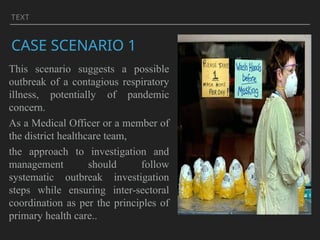
CASE SCENARIO 1
This scenario suggests a possible
outbreak of a contagious respiratory
illness, potentially of pandemic
concern.
As a Medical Officer or a member of
the district healthcare team,
the approach to investigation and
management should follow
systematic outbreak investigation
steps while ensuring inter-sectoral
coordination as per the principles of
primary health care..
TEXT
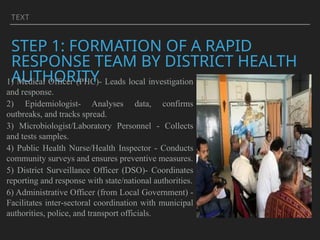
STEP 1: FORMATION OF A RAPID
RESPONSE TEAM BY DISTRICT HEALTH
AUTHORITY
1) Medical Officer (PHC)- Leads local investigation
and response.
2) Epidemiologist- Analyses data, confirms
outbreaks, and tracks spread.
3) Microbiologist/Laboratory Personnel - Collects
and tests samples.
4) Public Health Nurse/Health Inspector - Conducts
community surveys and ensures preventive measures.
5) District Surveillance Officer (DSO)- Coordinates
reporting and response with state/national authorities.
6) Administrative Officer (from Local Government) -
Facilitates inter-sectoral coordination with municipal
authorities, police, and transport officials.
TEXT
STEP 2: CASE DEFINITION & CASE
FINDING
1) Establish a working case definition
(e.g., fever + sore throat + cough + recent
travel/contact history).
2) Conduct active case search in hospitals,
community health centers, and primary
care clinics.
3) Contact tertiary care hospitals for
retrospective case review.
4) Enhance Integrated Disease
Surveillance Programme (IDSP) reporting
for real-time data collection.
TEXT
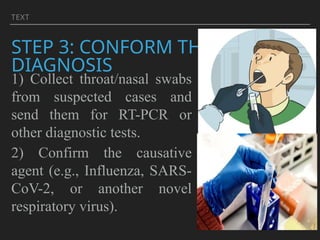
STEP 3: CONFORM THE
DIAGNOSIS
1) Collect throat/nasal swabs
from suspected cases and
send them for RT-PCR or
other diagnostic tests.
2) Confirm the causative
agent (e.g., Influenza, SARS-
CoV-2, or another novel
respiratory virus).
TEXT
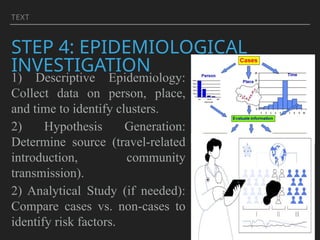
STEP 4: EPIDEMIOLOGICAL
INVESTIGATION
1) Descriptive Epidemiology:
Collect data on person, place,
and time to identify clusters.
2) Hypothesis Generation:
Determine source (travel-related
introduction, community
transmission).
2) Analytical Study (if needed):
Compare cases vs. non-cases to
identify risk factors.
TEXT
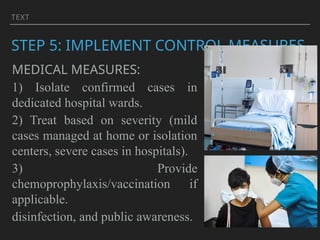
STEP 5: IMPLEMENT CONTROL MEASURES
MEDICAL MEASURES:
1) Isolate confirmed cases in
dedicated hospital wards.
2) Treat based on severity (mild
cases managed at home or isolation
centers, severe cases in hospitals).
3) Provide
chemoprophylaxis/vaccination if
applicable.
disinfection, and public awareness.
TEXT
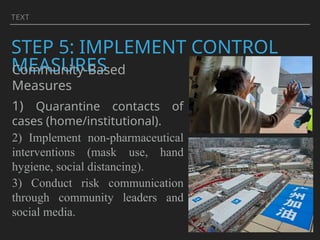
STEP 5: IMPLEMENT CONTROL
MEASURES
Community-Based
Measures
1) Quarantine contacts of
cases (home/institutional).
2) Implement non-pharmaceutical
interventions (mask use, hand
hygiene, social distancing).
3) Conduct risk communication
through community leaders and
social media.
TEXT
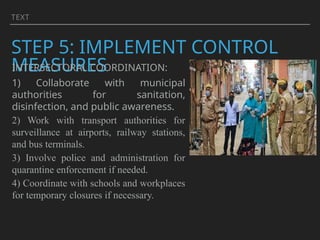
STEP 5: IMPLEMENT CONTROL
MEASURES
INTERSECTORAL COORDINATION:
1) Collaborate with municipal
authorities for sanitation,
disinfection, and public awareness.
2) Work with transport authorities for
surveillance at airports, railway stations,
and bus terminals.
3) Involve police and administration for
quarantine enforcement if needed.
4) Coordinate with schools and workplaces
for temporary closures if necessary.
TEXT
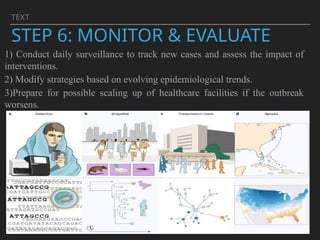
STEP 6: MONITOR & EVALUATE
1) Conduct daily surveillance to track new cases and assess the impact of
interventions.
2) Modify strategies based on evolving epidemiological trends.
3)Prepare for possible scaling up of healthcare facilities if the outbreak
worsens.
TEXT
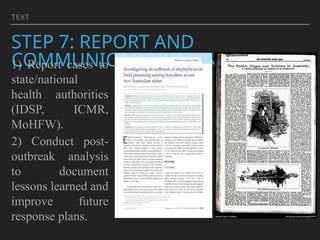
STEP 7: REPORT AND
COMMUNICATE FINDINGS
1) Report cases to
state/national
health authorities
(IDSP, ICMR,
MoHFW).
2) Conduct post-
outbreak analysis
to document
lessons learned and
improve future
response plans.
THANK
YOU

PANDEMIC MODULE 3.1.pptx FOR MBBS 2019 M

  • 1.
    RESPONCES AT DIFFERENT LEVELS ISOLATION& QUARATINE PANDEMIC MODULE_3.1_OUTBREAK MX
  • 3.
    TEXT RESPONCES TO ANOUTBREAK ; GENERAL RESPONCE ▸ Till the specific source and route of transmission is identified. ▸ For example, if one is suspecting a droplet infection outbreak, start a campaign requesting people to follow social distancing, use of mask and hand.
  • 4.
    TEXT RESPONCES TO ANOUTBREAK; SPECIFIC MEASURES ▸ Depend on causative agent. ▸ BROAD STEPS ARE: ▸ Identification and nullification of the source of outbreak like chlorinating wells, ▸ Minimising transmission to prevent further exposure: vector control, ▸ Protection of the host- immunization / chemoprophylaxis, ▸ Controlling the reservoir include early diagnosis, notification, isolation, treatment, quarantine.
  • 5.
    TEXT ▸ Broadly theseare measures, pending results of epidemiologic/outbreak investigation. ▸ these activities routinely are now included in primary health care- it requires community participation, political support and intersectoral co-ordination.
  • 6.
    TEXT 1. CONTROLLING THERESERVOIR ▸ elimination of animal reservoir. ( eg. bovine tuberculosis, brucellosis) ▸ Elimination of human reservoir ?
  • 7.
    1. CONTROLLING THERESERVOIR STAMPING OUT THE ‘SPARK’ ; (A) EARLY DIAGNOSIS ▸ the first step in the control of an outbreak is its Rapid identification. ▸ for treatment of patients; ▸ for epidemiological investigations for eg. the source of infection from index case (known) to the primary source (unknown) of infection. ▸ to study tpp —descriptive epidemiology
  • 8.
    RESERVOIR (B) NOTIFICATION ▸ oncedetected or suspected - notifies to the local health authority. ▸ certain diseases are statutorily notifiable. ▸ physician, HOF, lay people, religious, political, administrative leaders, teachers can report even on suspicion.
  • 9.
  • 10.
    RESERVOIR NOTIFICATION ▸ IHR -INTERNATIONAL HEALTH REGULATIONS ▸ To WHO ▸ Cholera, Plague, Yellow fever; ▸ Under surveillance: louse borne Typhus fever, Relapsing fever, Paralytic Polio, Malaria, viral Influenza-A, SARS, Small pox..
  • 11.
    RESERVOIR (C) EPIDEMIOLOGICAL INVESTIGATIONS ▸Methodology (covered in last thursday lecture)
  • 12.
  • 13.
    (D) ISOLATION ▸ Oldestds control measure. ▸ “Separation, for the period of communicability of infected persons or animals from others in such places and under such conditions, as to prevent or limit the direct or indirect transmission of the infectious agent from those infected to those who are susceptible or who may spread the agent to others” 1. CONTROLLING THE RESERVOIR
  • 14.
    (D) ISOLATION ▸ PHYSICALISOLATION of CASE or CARRIER ▸ Treatment until free from infection 1. CONTROLLING THE RESERVOIR
  • 15.
    (D) ISOLATION ▸ PURPOSE:To protect the community by preventing transfer of infection from reservoir to the possible susceptible hosts. ▸ TYPES: varies ▸ Standard isolation, strict isolation, protective, high security, ▸ Hospital isolation >>>> Home isolation ▸ Difficult in rural areas. 1. CONTROLLING THE RESERVOIR
  • 16.
    (D) ISOLATION ▸ RINGISOLATION : Encircling the infected persons with a barrier of immune persons through whom the infection is unable to spread. ▸ Ring isolation in context of Small pox : a public health strategy where, upon identifying a smallpox case, the immediate close contacts of that person are isolated and vaccinated, creating a "ring" of protection around the infected individual to prevent further spread of the disease. 1. CONTROLLING THE RESERVOIR
  • 17.
    (D) ISOLATION ▸ RINGISOLATION : Encircling the infected persons with a barrier of immune persons through whom the infection is unable to spread. ▸ This method was applied worldwide in 1960s and 1970s eradicated smallpox. 1. CONTROLLING THE RESERVOIR
  • 18.
    (D) ISOLATION ;WHEN AND FOR WHAT ? ▸ For diseases like Diphtheria, Cholera, Streptococcal resp disease, pneumonic plague.. Isolation has distinctive value ▸ However Isolation becomes a futile excercise for ds where there is a large component of subclincal infection and carrier state like Polio, Hepatitis A, Typhoid fever.. ▸ Isolation has failed for TB, Leprosy and STDs 1. CONTROLLING THE RESERVOIR
  • 19.
    (D) ISOLATION ;WHEN AND FOR WHAT ? ▸ Isolation has FAILED in the control of ds like Leprosy, TB, STDs. ▸ here the Concept of Physical isolation has replaced by CHEMICAL Isolation. ▸ that is rapid treatment of cases in their homes and rendering them non-infectious as quickly as possible. ▸ in todays times, Isolation is recommended only when the risk of transmission if the infection is exceptionally serious. 1. CONTROLLING THE RESERVOIR
  • 20.
    (D) ISOLATION ;DURATION 1. CONTROLLING THE RESERVOIR
  • 21.
    (D) ISOLATION ;DURATION 1. CONTROLLING THE RESERVOIR
  • 22.
  • 23.
    (E) TREATMENT; COMPLETE,EARLY. ▸ The limitation of freedom of movement of such well persons or domestic animals exposed to communicable disease for a period of time not longer than the longest usuasl incubation period of the disease, in such manner as to prevent effective contact with those not so exposed. ▸ To a ship, an aircraft, a train, 1. CONTROLLING THE RESERVOIR (F) QUARANTINE
  • 24.
    ▸ ABSOLUTE QUARANTINE: ▸MODIFIED QUARATINE: A selective partial limitaion of freedom of movement such as exclusion of children from school. ▸ SEGRAGATION; ▸ With better techniques of early diagnosis and Rx, quaratine as a method of disease control has become outdated. ▸ It has been replaced by Active Surveillance. 1. CONTROLLING THE RESERVOIR (F) QUARANTINE
  • 25.
    ▸ method ofconducting surveillace. ▸ allows scientist to gather data about infections and how they spread. ▸ Once a person tests positive for a disease, they will be asked to list the people they have been in contact with andthe places they visited during the period in which they were contagious. 1. CONTROLLING THE RESERVOIR (G) CONTACT TRACING:
  • 26.
    ▸ When systematically applied, this willbreak the chain of transmission of an infectious disease and is an effective tool in public health. 1. CONTROLLING THE RESERVOIR (F) CONTACT TRACING
  • 27.
    TEXT NEXT LECTURE ▸ Casescenarios ▸ preparation of EPIDEMIC CURVE ▸ Preparation of SPOT MAP ▸ Calculation of ATTACK RATE from a given data.
  • 28.
  • 29.
  • 30.
    TEXT RECAP ▸ IN THEPREVIOUS LECTURE ▸ PRINCIPLES OF PRIMARY HEALTH CARE. ▸ OUTBREAK CONTROL TEAM MEMBERS
  • 31.
    TEXT OUTBREAK TEAM MEMBERS ▸ ANEPIDEMIOLOGIST ▸ CLINICIAN ▸ MICROBIOLOGIST ▸ ENVIRONMENTAL HEALTH OFFICER ▸ COMMUNICATION SPECIALIST ▸ DATA MANAGER ▸ ADMINISTRATIVE SUPPORT STAFF
  • 32.
    TEXT RRT In the eventof a suspected outbreak, the Rapid Response Teams (RRT) - a multidisciplinary team that looks into various aspects of an outbreak is alerted. RRT will be to investigate and confirm outbreak. The members of RRT are regularly doing their work but, in the event of an outbreak, come together to undertake a special function.
  • 33.
    TEXT RRT They should workin coordination with the Government health staff. They will help and support health staff in management and control of outbreak but the responsibility of implementing control measures mainly rests with local health staff. RRT should be formed at all levels of administrative system (district, block, Panchayat). The name, address and mobile phone number of RRT members should be available at respective levels so that they can be alerted as soon as possible.
  • 36.
    TEXT CASE SCENARIO 1 Mr.X, Medical Officer of a primary health centre noticed increased number of cases with symptoms of fever, sore throat and cough during third week of March. While taking detailed history one patient had a history of international travel 2 weeks back from a place where some of his friends also had similar illness. In the next week, one of the tertiary care hospitals in the city reported increased number of severe acute respiratory illness among admitted patients and two of them died due to this. As a Medical Officer or a member of a district health care team, how do you investigate this and manage the situation?
  • 37.
    TEXT CASE SCENARIO 2 Dr.X was appointed as Medical Officer of the Primary Health Centre. One of his field staff reported three cases of watery diarrhoea and dehydration (two mild and one severe) in his field area and he referred them for admission to the hospital. As a health professional what do you think about this episode and how do we proceed to investigate and control the situation.
  • 38.
    TEXT CASE SCENARIO 3 Dr.X was on casualty duty that day. Mr. Y, 49 years old, presented to Medicine casualty with high grade fever (3 days), retro-orbital pain, myalgia and rash. While eliciting detailed history from the patient, he revealed that there was history of fever and bodyache for his brother and brother’s wife one week back for which they took treatment in a private hospital. Mr. Y and his four brothers lived in nearby houses in the same compound (within 300 metres). He took paracetamol on the first two days of fever thinking that he was feverish as he walked in the rain the previous day. As a health professional what do you think about this episode and how do we proceed to investigate and manage the situation.
  • 39.
    TEXT CASE SCENARIO 4 Mr.A,17 years old, was brought to Medicine casualty with history of headache, myalgia and vomiting in the past 2 days. He reached home only 4 days back after a tour along with 13 friends. The day after he came home, he had mild fever and body ache. He thought it might be due to tedious travel and took rest at home. But last night his friend phoned him and said that one of their friends was taken to hospital following fever, vomiting and loss of consciousness. As a health professional what do you think about this episode and how do we proceed to investigate and manage the situation.
  • 40.
    TEXT CASE SCENARIO 1 Thisscenario suggests a possible outbreak of a contagious respiratory illness, potentially of pandemic concern. As a Medical Officer or a member of the district healthcare team, the approach to investigation and management should follow systematic outbreak investigation steps while ensuring inter-sectoral coordination as per the principles of primary health care..
  • 41.
    TEXT STEP 1: FORMATIONOF A RAPID RESPONSE TEAM BY DISTRICT HEALTH AUTHORITY 1) Medical Officer (PHC)- Leads local investigation and response. 2) Epidemiologist- Analyses data, confirms outbreaks, and tracks spread. 3) Microbiologist/Laboratory Personnel - Collects and tests samples. 4) Public Health Nurse/Health Inspector - Conducts community surveys and ensures preventive measures. 5) District Surveillance Officer (DSO)- Coordinates reporting and response with state/national authorities. 6) Administrative Officer (from Local Government) - Facilitates inter-sectoral coordination with municipal authorities, police, and transport officials.
  • 42.
    TEXT STEP 2: CASEDEFINITION & CASE FINDING 1) Establish a working case definition (e.g., fever + sore throat + cough + recent travel/contact history). 2) Conduct active case search in hospitals, community health centers, and primary care clinics. 3) Contact tertiary care hospitals for retrospective case review. 4) Enhance Integrated Disease Surveillance Programme (IDSP) reporting for real-time data collection.
  • 43.
    TEXT STEP 3: CONFORMTHE DIAGNOSIS 1) Collect throat/nasal swabs from suspected cases and send them for RT-PCR or other diagnostic tests. 2) Confirm the causative agent (e.g., Influenza, SARS- CoV-2, or another novel respiratory virus).
  • 44.
    TEXT STEP 4: EPIDEMIOLOGICAL INVESTIGATION 1)Descriptive Epidemiology: Collect data on person, place, and time to identify clusters. 2) Hypothesis Generation: Determine source (travel-related introduction, community transmission). 2) Analytical Study (if needed): Compare cases vs. non-cases to identify risk factors.
  • 45.
    TEXT STEP 5: IMPLEMENTCONTROL MEASURES MEDICAL MEASURES: 1) Isolate confirmed cases in dedicated hospital wards. 2) Treat based on severity (mild cases managed at home or isolation centers, severe cases in hospitals). 3) Provide chemoprophylaxis/vaccination if applicable. disinfection, and public awareness.
  • 46.
    TEXT STEP 5: IMPLEMENTCONTROL MEASURES Community-Based Measures 1) Quarantine contacts of cases (home/institutional). 2) Implement non-pharmaceutical interventions (mask use, hand hygiene, social distancing). 3) Conduct risk communication through community leaders and social media.
  • 47.
    TEXT STEP 5: IMPLEMENTCONTROL MEASURES INTERSECTORAL COORDINATION: 1) Collaborate with municipal authorities for sanitation, disinfection, and public awareness. 2) Work with transport authorities for surveillance at airports, railway stations, and bus terminals. 3) Involve police and administration for quarantine enforcement if needed. 4) Coordinate with schools and workplaces for temporary closures if necessary.
  • 48.
    TEXT STEP 6: MONITOR& EVALUATE 1) Conduct daily surveillance to track new cases and assess the impact of interventions. 2) Modify strategies based on evolving epidemiological trends. 3)Prepare for possible scaling up of healthcare facilities if the outbreak worsens.
  • 49.
    TEXT STEP 7: REPORTAND COMMUNICATE FINDINGS 1) Report cases to state/national health authorities (IDSP, ICMR, MoHFW). 2) Conduct post- outbreak analysis to document lessons learned and improve future response plans.
  • 50.