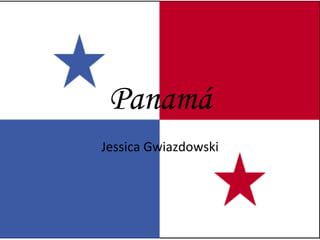
Panamá Jessica Gwiazdowski
The Geography of Panamá: This country is located in central America, just between Costa Rica and Colombia.  It has a total area of 74,340 sq km which is estimated to be a little smaller than the state of South Carolina.  74,340 sq km of that total is land, and the other 1,080 sq km is water.  Panamá has a coast line of 2,490 km.   Along with an extended rainy period, it has many hot and humid periods. With a mostly steep and rugged mountain landscape, Panamá also has upland plains.
The natural resources of this country include: Copper, mahogany forests, shrimp, and hydropower.  Major Agricultural Resources include: bananas, rice, corn, coffee, sugarcane, vegetables, livestock, and shrimp.  The Darien area has natural dangers, which include: Serve storms and forest fires.  Problems with water pollution from runoff has been threatening fishery resources in Panamá. Being that shrimp is one of their natural resources, this has become an environmental issue.  There also has been deforestation taking place in the tropical rain forest. In urban areas there has been much air pollution.
 
The People of Panamá: Panamá has a population of 3,360,474 people.  29.3% of the population is within the ages of 0-14 years. 63.9% of the population is within the ages of 15-64 years.  6.8% of the population is older than the age of 65.  There are 20,000 people living with HIV in Panamá, fewer than 1,000 deaths have occurred because of it.  Major infectious diseases such as, Bacterial diarrhea, Dengue fever, and Malaria, take place often through out Panamá. Bacterial diarrhea is considered to be a food or waterborne disease.  Dengue fever and Malaria are considered to be vector borne diseases.
Among the population, 85% are of the Roman Catholic religion and 15% are Protestant.  Spanish is the official language of Panamá even though many Panamanians are bilingual.  According to the 2000 census, 91.9% of the population can read and write.  Females have a school life expectancy of 14 years. Males have a school life expectancy of 13 years.
The Government of Panamá: Panamá's government is a constitutional democracy.  Independence Day is celebrate November 3rd for they independence from Colombia in 1903. Their constitution was arranged on October 11, 1972. It was then revised in 1978, 1983, 1994, and 2004.  The legal system of Panamá is based on a civil law system. Their Executive branch includes the Chief of State, the Head of Government (the President and Vice President), and the Cabinet. Since July 1, 2009, the President has been Ricardo Martineli Berrocal and the Vice President has been Juan Carlos Varela. Each term is five years long. The president and vice president are not eligible for reelection consecutively after their term, they must wait two terms before a reelection.  The next election is to be held in 2014.
The Economy of Panamá: 7.1% of this country is listed as unemployed.  28.6% of the population falls below the poverty line.  Major Industries within Panamá include construction, brewing, and sugar milling.  In 1904, Panamá introduced their first coins which followed the separation of Panamá from Colombia in 1903.  The currency of Panamá is referred to as the Balboa.  1 US dollar is equal to 1 balboa.
 
The Military Aspect of Panamá: Panamá has no regular military forces although it does have the Panamanian National Police, the National Air-Naval Service, and the National Border Service. The population is available for military service if needed throughout the ages of 16-49.  In February of 1990, the President had discontinued the military and reformed the security by creating public forces.
Tourist Attractions: The Panamá Canal is a heavily populated tourist attraction.  The canal dates back to the 16 th  century. A Spanish official suggest creating a canal route in 1534. At first the government had lost interest in the canal after several plans for it. Early in the 18th century, a book of a German scientist sparked sudden interest in the canal project. In 1819, the Spanish government allowed construction of the canal to begin. Americans began to dig through the canal in the search of gold in 1848.  Panamá signed a treaty with the United States stating that the United States had guaranteed Panamá's independence and gave them full access to the canal.  The canal is about 51 miles long.  The dangers of landslides had been ignored during the construction of the canal. The construction caused many landslides.  Gatun's dam along the canal is able to generate enough electricity to power everything needed in the canal.
Another tourist attraction of Panamá is Balboa Avenue.  Balboa Avenue runs along side the bay and many sky scrapers and stores.  El Cope National Park is located in central Panama.  This attraction is also known as the Park of Major General Omar, who was an officer of Panama.  The park reaches about 15,000 acres. This national park is known for its mists and fogs. This park protects certain watersheds and birds, such as the Golden-Olive Woodpecker and the Red-Fronted Parrot.
Well known dishes of Panamá : Tamales: A popular dish made from boiled ground corn and spices with either chicken or pork inside.  Empanadas: A Cornish pastry that is made from flour pastry and corn flour. They are usually filled with chicken and cheese. Patacones: A fried green plantain that has salt added to it and is fried.  Tajadas: A ripe plantain that's cute into slices and baked with cinnamon.
http://gwiazdowski.glogster.com/panama/
Work Cited &quot;CIA - The World Factbook -- Panama.&quot;  Welcome to the CIA Web Site Central Intelligence Agency . Web. 30 Mar. 2010. < https://www.cia.gov/library/publications/the-world-factbook/geos/pm.html >.   &quot;Panama History.&quot;  American History and World History at Historycentral.com the Largest and Most Complete History Site on the Web . Web. 30 Mar. 2010. < http://www.historycentral.com/nationbynation/panama/history1.html >. &quot;Typical Food, Panamanian Food, Panama Food || Focus Panama.&quot;  Home Page || Focus Publications Int . Web. 12 Apr. 2010. <http://www.focuspublicationsint.com/focuspanama/en/food.htm>. &quot;Panama Currency History.&quot;  AT&T . Web. 11 Apr. 2010. <http://bellsouthpwp.net/r/u/ruiz_b/Colonial_Currency/currency_history.htm>.   &quot;The Panama Canal.&quot;  Business Broadband Services | Home Broadband Packages- Eclipse Internet . Web. 15 Apr. 2010. <http://www.eclipse.co.uk/~sl5763/panama.htm>. http://seeker401.files.wordpress.com/2009/07/panama-canal-boat. jpg http://buycheapcoffee.com/wp-content/themes/simplecss/images/cheap%20coffee%20beans. jpg http://www.tupolitica.com/wp-content/gallery/galeria-estatal/presidente-ricardo-martinelli-berrocal. jpg http://www.spicebazaar.com.au/x-scripts/oscommerce/images/empanadas.jpg

Panamá

  • 1.
  • 2.
    The Geography ofPanamá: This country is located in central America, just between Costa Rica and Colombia. It has a total area of 74,340 sq km which is estimated to be a little smaller than the state of South Carolina. 74,340 sq km of that total is land, and the other 1,080 sq km is water. Panamá has a coast line of 2,490 km. Along with an extended rainy period, it has many hot and humid periods. With a mostly steep and rugged mountain landscape, Panamá also has upland plains.
  • 3.
    The natural resourcesof this country include: Copper, mahogany forests, shrimp, and hydropower. Major Agricultural Resources include: bananas, rice, corn, coffee, sugarcane, vegetables, livestock, and shrimp. The Darien area has natural dangers, which include: Serve storms and forest fires. Problems with water pollution from runoff has been threatening fishery resources in Panamá. Being that shrimp is one of their natural resources, this has become an environmental issue. There also has been deforestation taking place in the tropical rain forest. In urban areas there has been much air pollution.
  • 4.
  • 5.
    The People ofPanamá: Panamá has a population of 3,360,474 people. 29.3% of the population is within the ages of 0-14 years. 63.9% of the population is within the ages of 15-64 years. 6.8% of the population is older than the age of 65. There are 20,000 people living with HIV in Panamá, fewer than 1,000 deaths have occurred because of it. Major infectious diseases such as, Bacterial diarrhea, Dengue fever, and Malaria, take place often through out Panamá. Bacterial diarrhea is considered to be a food or waterborne disease. Dengue fever and Malaria are considered to be vector borne diseases.
  • 6.
    Among the population,85% are of the Roman Catholic religion and 15% are Protestant. Spanish is the official language of Panamá even though many Panamanians are bilingual. According to the 2000 census, 91.9% of the population can read and write. Females have a school life expectancy of 14 years. Males have a school life expectancy of 13 years.
  • 7.
    The Government ofPanamá: Panamá's government is a constitutional democracy. Independence Day is celebrate November 3rd for they independence from Colombia in 1903. Their constitution was arranged on October 11, 1972. It was then revised in 1978, 1983, 1994, and 2004. The legal system of Panamá is based on a civil law system. Their Executive branch includes the Chief of State, the Head of Government (the President and Vice President), and the Cabinet. Since July 1, 2009, the President has been Ricardo Martineli Berrocal and the Vice President has been Juan Carlos Varela. Each term is five years long. The president and vice president are not eligible for reelection consecutively after their term, they must wait two terms before a reelection. The next election is to be held in 2014.
  • 8.
    The Economy ofPanamá: 7.1% of this country is listed as unemployed. 28.6% of the population falls below the poverty line. Major Industries within Panamá include construction, brewing, and sugar milling. In 1904, Panamá introduced their first coins which followed the separation of Panamá from Colombia in 1903. The currency of Panamá is referred to as the Balboa. 1 US dollar is equal to 1 balboa.
  • 9.
  • 10.
    The Military Aspectof Panamá: Panamá has no regular military forces although it does have the Panamanian National Police, the National Air-Naval Service, and the National Border Service. The population is available for military service if needed throughout the ages of 16-49. In February of 1990, the President had discontinued the military and reformed the security by creating public forces.
  • 11.
    Tourist Attractions: ThePanamá Canal is a heavily populated tourist attraction. The canal dates back to the 16 th century. A Spanish official suggest creating a canal route in 1534. At first the government had lost interest in the canal after several plans for it. Early in the 18th century, a book of a German scientist sparked sudden interest in the canal project. In 1819, the Spanish government allowed construction of the canal to begin. Americans began to dig through the canal in the search of gold in 1848. Panamá signed a treaty with the United States stating that the United States had guaranteed Panamá's independence and gave them full access to the canal. The canal is about 51 miles long. The dangers of landslides had been ignored during the construction of the canal. The construction caused many landslides. Gatun's dam along the canal is able to generate enough electricity to power everything needed in the canal.
  • 12.
    Another tourist attractionof Panamá is Balboa Avenue. Balboa Avenue runs along side the bay and many sky scrapers and stores. El Cope National Park is located in central Panama. This attraction is also known as the Park of Major General Omar, who was an officer of Panama. The park reaches about 15,000 acres. This national park is known for its mists and fogs. This park protects certain watersheds and birds, such as the Golden-Olive Woodpecker and the Red-Fronted Parrot.
  • 13.
    Well known dishesof Panamá : Tamales: A popular dish made from boiled ground corn and spices with either chicken or pork inside. Empanadas: A Cornish pastry that is made from flour pastry and corn flour. They are usually filled with chicken and cheese. Patacones: A fried green plantain that has salt added to it and is fried. Tajadas: A ripe plantain that's cute into slices and baked with cinnamon.
  • 14.
  • 15.
    Work Cited &quot;CIA- The World Factbook -- Panama.&quot; Welcome to the CIA Web Site Central Intelligence Agency . Web. 30 Mar. 2010. < https://www.cia.gov/library/publications/the-world-factbook/geos/pm.html >.   &quot;Panama History.&quot; American History and World History at Historycentral.com the Largest and Most Complete History Site on the Web . Web. 30 Mar. 2010. < http://www.historycentral.com/nationbynation/panama/history1.html >. &quot;Typical Food, Panamanian Food, Panama Food || Focus Panama.&quot; Home Page || Focus Publications Int . Web. 12 Apr. 2010. <http://www.focuspublicationsint.com/focuspanama/en/food.htm>. &quot;Panama Currency History.&quot; AT&T . Web. 11 Apr. 2010. <http://bellsouthpwp.net/r/u/ruiz_b/Colonial_Currency/currency_history.htm>.   &quot;The Panama Canal.&quot; Business Broadband Services | Home Broadband Packages- Eclipse Internet . Web. 15 Apr. 2010. <http://www.eclipse.co.uk/~sl5763/panama.htm>. http://seeker401.files.wordpress.com/2009/07/panama-canal-boat. jpg http://buycheapcoffee.com/wp-content/themes/simplecss/images/cheap%20coffee%20beans. jpg http://www.tupolitica.com/wp-content/gallery/galeria-estatal/presidente-ricardo-martinelli-berrocal. jpg http://www.spicebazaar.com.au/x-scripts/oscommerce/images/empanadas.jpg