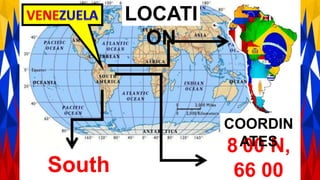
South
8 00 N,
66 00
LOCATI
ON
COORDIN
ATES
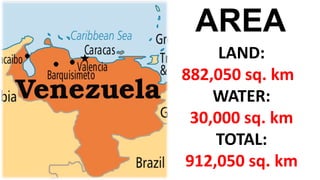
LAND:
882,050 sq. km
WATER:
30,000 sq. km
TOTAL:
912,050 sq. km
AREA
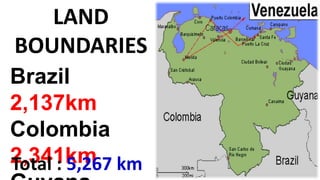
Brazil
2,137km
Colombia
2,341km
LAND
BOUNDARIES
Total : 5,267 km
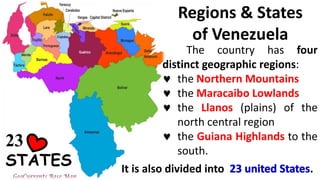
Regions & States
of Venezuela
The country has four
distinct geographic regions:
 the Northern Mountains
 the Maracaibo Lowlands
 the Llanos (plains) of the
north central region
 the Guiana Highlands to the
south.
It is also divided into .
23
STATES
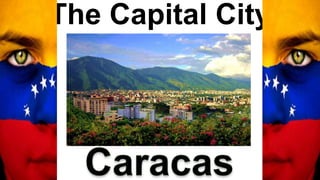
The Capital City
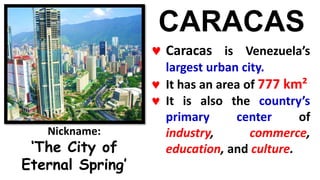
CARACAS
 Caracas is Venezuela’s
largest urban city.
 It has an area of 777 km²
 It is also the country’s
primary center of
industry, commerce,
education, and culture.
Nickname:
‘The City of
Eternal Spring’
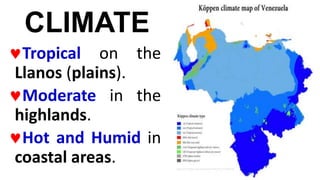
CLIMATE
Tropical on the
Llanos (plains).
Moderate in the
highlands.
Hot and Humid in
coastal areas.
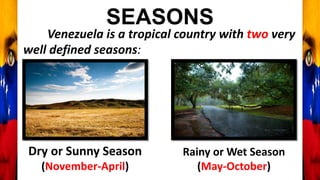
SEASONS
Venezuela is a tropical country with two very
well defined seasons:
Rainy or Wet Season
(May-October)
Dry or Sunny Season
(November-April)
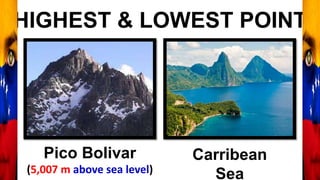
HIGHEST & LOWEST POINT
Carribean
Sea
Pico Bolivar
(5,007 m above sea level)
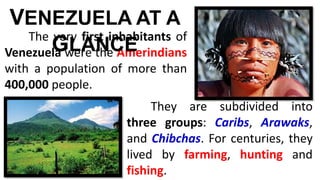
The very first inhabitants of
Venezuela were the Amerindians
with a population of more than
400,000 people.
VENEZUELA AT A
GLANCE
They are subdivided into
three groups: Caribs, Arawaks,
and Chibchas. For centuries, they
lived by farming, hunting and
fishing.
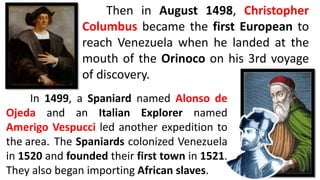
Then in August 1498, Christopher
Columbus became the first European to
reach Venezuela when he landed at the
mouth of the Orinoco on his 3rd voyage
of discovery.
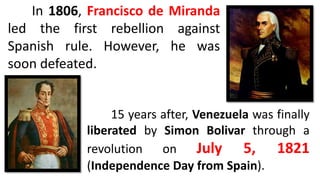
In 1499, a Spaniard named Alonso de
Ojeda and an Italian Explorer named
Amerigo Vespucci led another expedition to
the area. The Spaniards colonized Venezuela
in 1520 and founded their first town in 1521.
They also began importing African slaves.
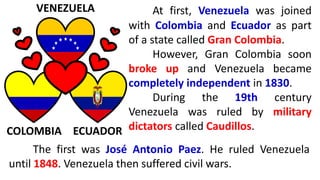
In 1806, Francisco de Miranda
led the first rebellion against
Spanish rule. However, he was
soon defeated.
15 years after, Venezuela was finally
liberated by Simon Bolivar through a
revolution on July 5, 1821
(Independence Day from Spain).
At first, Venezuela was joined
with Colombia and Ecuador as part
of a state called Gran Colombia.
However, Gran Colombia soon
broke up and Venezuela became
completely independent in 1830.
During the 19th century
Venezuela was ruled by military
dictators called Caudillos.
VENEZUELA
COLOMBIA ECUADOR
The first was José Antonio Paez. He ruled Venezuela
until 1848. Venezuela then suffered civil wars.
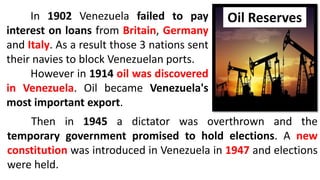
In 1902 Venezuela failed to pay
interest on loans from Britain, Germany
and Italy. As a result those 3 nations sent
their navies to block Venezuelan ports.
However in 1914 oil was discovered
in Venezuela. Oil became Venezuela's
most important export.
Then in 1945 a dictator was overthrown and the
temporary government promised to hold elections. A new
constitution was introduced in Venezuela in 1947 and elections
were held.
Oil Reserves
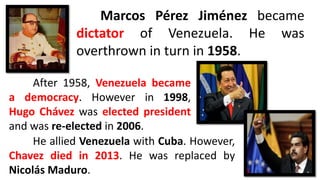
Marcos Pérez Jiménez became
dictator of Venezuela. He was
overthrown in turn in 1958.
After 1958, Venezuela became
a democracy. However in 1998,
Hugo Chávez was elected president
and was re-elected in 2006.
He allied Venezuela with Cuba. However,
Chavez died in 2013. He was replaced by
Nicolás Maduro.
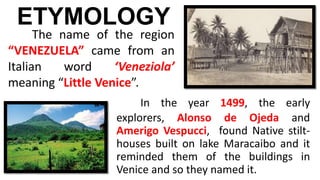
In the year 1499, the early
explorers, Alonso de Ojeda and
Amerigo Vespucci, found Native stilt-
houses built on lake Maracaibo and it
reminded them of the buildings in
Venice and so they named it.
ETYMOLOGY
The name of the region
“VENEZUELA” came from an
Italian word ‘Veneziola’
meaning “Little Venice”.
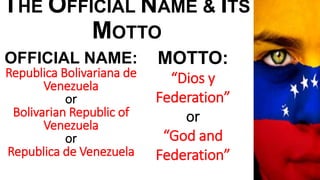
THE OFFICIAL NAME & ITS
MOTTO
OFFICIAL NAME:
Republica Bolivariana de
Venezuela
or
Bolivarian Republic of
Venezuela
or
Republica de Venezuela
MOTTO:
“Dios y
Federation”
or
“God and
Federation”
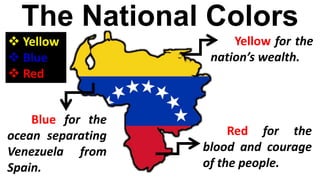
The National Colors
Blue for the
ocean separating
Venezuela from
Spain.
Yellow for the
nation’s wealth.
Red for the
blood and courage
of the people.
 Yellow
 Blue
 Red
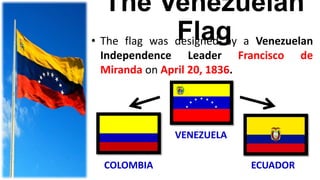
The Venezuelan
Flag• The flag was designed by a Venezuelan
Independence Leader Francisco de
Miranda on April 20, 1836.
VENEZUELA
COLOMBIA ECUADOR
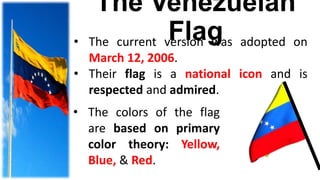
The Venezuelan
Flag• The current version was adopted on
March 12, 2006.
• Their flag is a national icon and is
respected and admired.
• The colors of the flag
are based on primary
color theory: Yellow,
Blue, & Red.
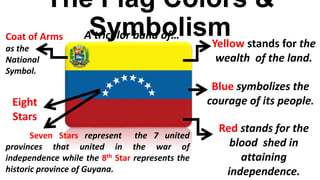
The Flag Colors &
SymbolismYellow stands for the
wealth of the land.
Blue symbolizes the
courage of its people.
Seven Stars represent the 7 united
provinces that united in the war of
independence while the 8th Star represents the
historic province of Guyana.
Red stands for the
blood shed in
attaining
independence.
Coat of Arms
as the
National
Symbol.
Eight
Stars
A tricolor band of…
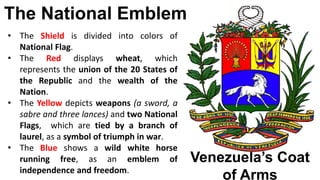
The National Emblem
Venezuela’s Coat
of Arms
• The Shield is divided into colors of
National Flag.
• The Red displays wheat, which
represents the union of the 20 States of
the Republic and the wealth of the
Nation.
• The Yellow depicts weapons (a sword, a
sabre and three lances) and two National
Flags, which are tied by a branch of
laurel, as a symbol of triumph in war.
• The Blue shows a wild white horse
running free, as an emblem of
independence and freedom.
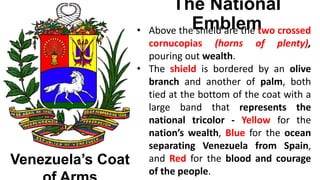
The National
Emblem
Venezuela’s Coat
• Above the shield are the two crossed
cornucopias (horns of plenty),
pouring out wealth.
• The shield is bordered by an olive
branch and another of palm, both
tied at the bottom of the coat with a
large band that represents the
national tricolor - Yellow for the
nation’s wealth, Blue for the ocean
separating Venezuela from Spain,
and Red for the blood and courage
of the people.
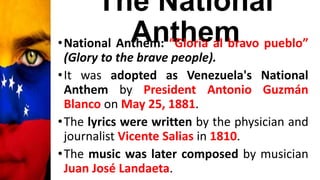
The National
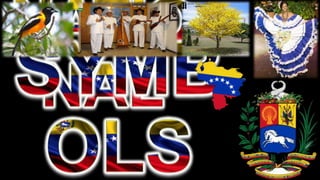
Anthem•National Anthem: “Gloria al bravo pueblo”
(Glory to the brave people).
•It was adopted as Venezuela's National
Anthem by President Antonio Guzmán
Blanco on May 25, 1881.
•The lyrics were written by the physician and
journalist Vicente Salias in 1810.
•The music was later composed by musician
Juan José Landaeta.
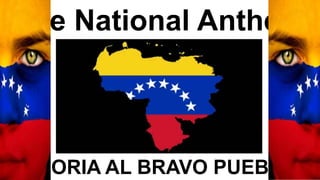
The National Anthem
GLORIA AL BRAVO PUEBLO
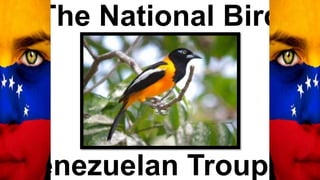
The National Bird
Venezuelan Troupial
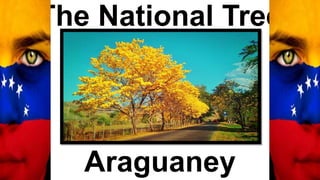
The National Tree
Araguaney
The National Flower
Cattleya Trianae [Orchid]
(Flower of May)
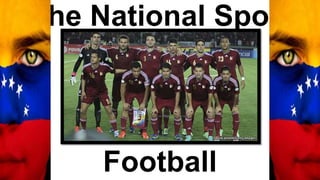
The National Sport
Football
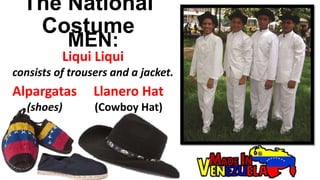
The National
Costume
Liqui Liqui
consists of trousers and a jacket.
MEN:
Alpargatas
(shoes)
Llanero Hat
(Cowboy Hat)
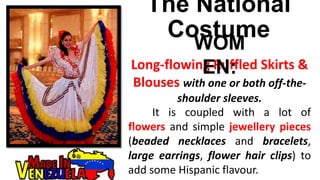
The National
Costume
Long-flowing Ruffled Skirts &
Blouses with one or both off-the-
shoulder sleeves.
WOM
EN:
It is coupled with a lot of
flowers and simple jewellery pieces
(beaded necklaces and bracelets,
large earrings, flower hair clips) to
add some Hispanic flavour.
The National Dance & Music
Joropo
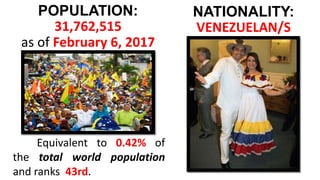
NATIONALITY:
VENEZUELAN/S
POPULATION:
31,762,515
as of February 6, 2017
Equivalent to 0.42% of
the total world population
and ranks 43rd.
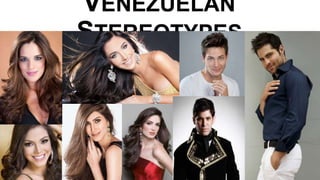
VENEZUELAN
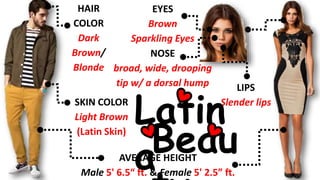
STEREOTYPES
AVERAGE HEIGHT
Male 5' 6.5“ ft. & Female 5' 2.5” ft.
HAIR
COLOR
Dark
Brown/
Blonde
SKIN COLOR
Light Brown
(Latin Skin)
EYES
Brown
Sparkling Eyes
NOSE
broad, wide, drooping
tip w/ a dorsal hump LIPS
Slender lips
Latin
aBeau
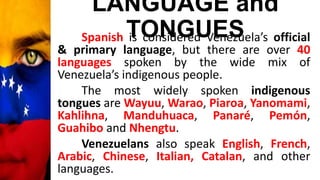
LANGUAGE and
TONGUESSpanish is considered Venezuela’s official
& primary language, but there are over 40
languages spoken by the wide mix of
Venezuela’s indigenous people.
The most widely spoken indigenous
tongues are Wayuu, Warao, Piaroa, Yanomami,
Kahlihna, Manduhuaca, Panaré, Pemón,
Guahibo and Nhengtu.
Venezuelans also speak English, French,
Arabic, Chinese, Italian, Catalan, and other
languages.
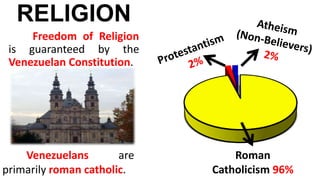
RELIGION
Freedom of Religion
is guaranteed by the
Venezuelan Constitution.
Roman
Catholicism 96%
Venezuelans are
primarily roman catholic.
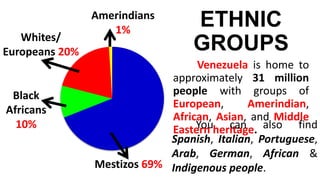
ETHNIC
GROUPS
Venezuela is home to
approximately 31 million
people with groups of
European, Amerindian,
African, Asian, and Middle
Eastern heritage.
Mestizos 69%
Whites/
Europeans 20%
Black
Africans
10%
Amerindians
1%
You can also find
Spanish, Italian, Portuguese,
Arab, German, African &
Indigenous people.
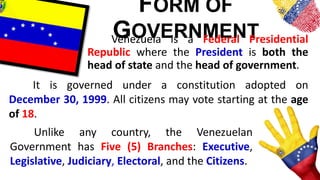
FORM OF
GOVERNMENTVenezuela is a Federal Presidential
Republic where the President is both the
head of state and the head of government.
It is governed under a constitution adopted on
December 30, 1999. All citizens may vote starting at the age
of 18.
Unlike any country, the Venezuelan
Government has Five (5) Branches: Executive,
Legislative, Judiciary, Electoral, and the Citizens.
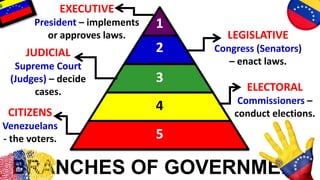
EXECUTIVE
President – implements
or approves laws. LEGISLATIVE
Congress (Senators)
– enact laws.
JUDICIAL
Supreme Court
(Judges) – decide
cases. ELECTORAL
Commissioners –
conduct elections.CITIZENS
Venezuelans
- the voters.
1
2
3
4
5
BRANCHES OF GOVERNMENT
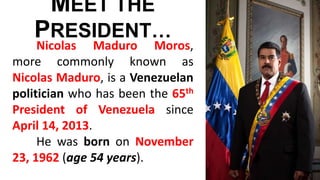
MEET THE
PRESIDENT…
Nicolas Maduro Moros,
more commonly known as
Nicolas Maduro, is a Venezuelan
politician who has been the 65th
President of Venezuela since
April 14, 2013.
He was born on November
23, 1962 (age 54 years).
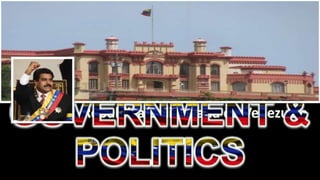
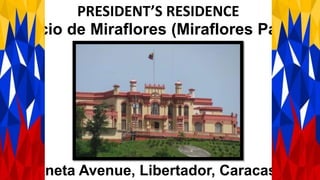
Palacio de Miraflores (Miraflores Palace)
Urdaneta Avenue, Libertador, Caracas City
PRESIDENT’S RESIDENCE
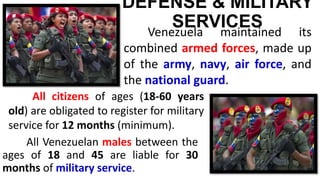
DEFENSE & MILITARY
SERVICES
All Venezuelan males between the
ages of 18 and 45 are liable for 30
months of military service.
Venezuela maintained its
combined armed forces, made up
of the army, navy, air force, and
the national guard.
All citizens of ages (18-60 years
old) are obligated to register for military
service for 12 months (minimum).
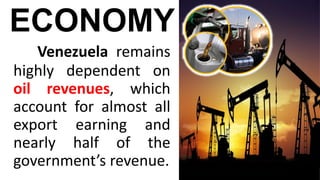
Venezuela remains
highly dependent on
oil revenues, which
account for almost all
export earning and
nearly half of the
government’s revenue.
ECONOMY
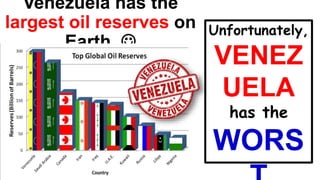
Venezuela has the
largest oil reserves on
Earth. 
Unfortunately,
VENEZ
UELA
has the
WORS
INDUSTRI
ESAgricultural products,
livestock, raw materials,
machinery and equipment,
transport equipment,
construction materials,
medical equipment,
pharmaceuticals, chemicals,
iron and steel products,
crude oil and petroleum
products.
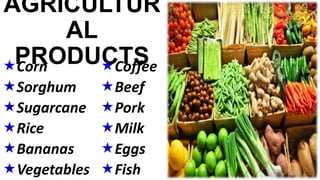
AGRICULTUR
AL
PRODUCTSCorn
Sorghum
Sugarcane
Rice
Bananas
Vegetables
Coffee
Beef
Pork
Milk
Eggs
Fish
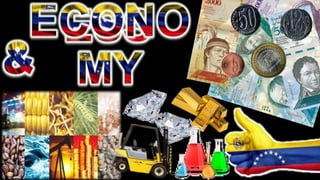
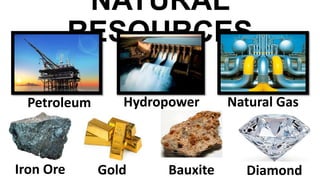
NATURAL
RESOURCES
Petroleum Hydropower Natural Gas
Iron Ore Gold Bauxite Diamond
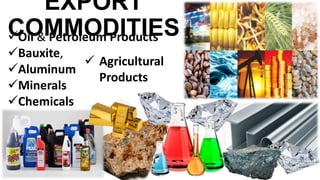
EXPORT
COMMODITIESOil & Petroleum Products
Bauxite,
Aluminum
Minerals
Chemicals
 Agricultural
Products
EXPORT
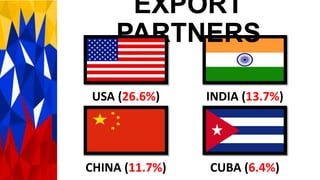
PARTNERS
USA (26.6%) INDIA (13.7%)
CHINA (11.7%) CUBA (6.4%)
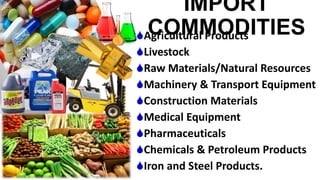
IMPORT
COMMODITIESAgricultural Products
Livestock
Raw Materials/Natural Resources
Machinery & Transport Equipment
Construction Materials
Medical Equipment
Pharmaceuticals
Chemicals & Petroleum Products
Iron and Steel Products.
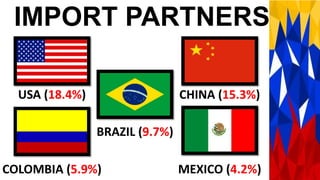
IMPORT PARTNERS
USA (18.4%) CHINA (15.3%)
BRAZIL (9.7%)
COLOMBIA (5.9%) MEXICO (4.2%)
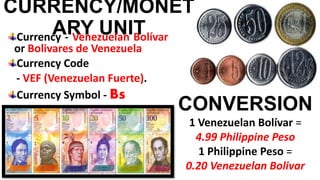
CURRENCY/MONET
ARY UNITCurrency - Venezuelan Bolívar
or Bolivares de Venezuela
Currency Code
- VEF (Venezuelan Fuerte).
Currency Symbol - Bs
CONVERSION
1 Venezuelan Bolívar =
4.99 Philippine Peso
1 Philippine Peso =
0.20 Venezuelan Bolivar
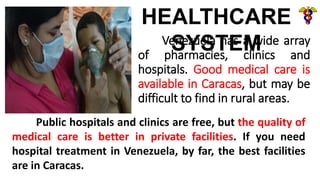
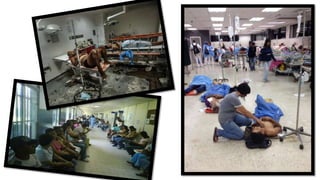
Venezuela has a wide array
of pharmacies, clinics and
hospitals. Good medical care is
available in Caracas, but may be
difficult to find in rural areas.
HEALTHCARE
SYSTEM
Public hospitals and clinics are free, but the quality of
medical care is better in private facilities. If you need
hospital treatment in Venezuela, by far, the best facilities
are in Caracas.
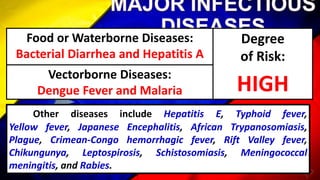
Food or Waterborne Diseases:
Bacterial Diarrhea and Hepatitis A
Degree
of Risk:
HIGH
Vectorborne Diseases:
Dengue Fever and Malaria
Other diseases include Hepatitis E, Typhoid fever,
Yellow fever, Japanese Encephalitis, African Trypanosomiasis,
Plague, Crimean-Congo hemorrhagic fever, Rift Valley fever,
Chikungunya, Leptospirosis, Schistosomiasis, Meningococcal
meningitis, and Rabies.
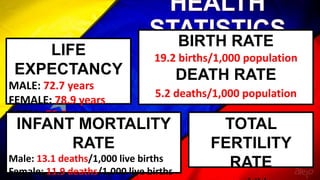
BIRTH RATE
19.2 births/1,000 population
DEATH RATE
5.2 deaths/1,000 population
LIFE
EXPECTANCY
MALE: 72.7 years
FEMALE: 78.9 years
TOTAL: 75.8 years
TOTAL
FERTILITY
RATE
INFANT MORTALITY
RATE
Male: 13.1 deaths/1,000 live births
Female: 11.9 deaths/1,000 live births
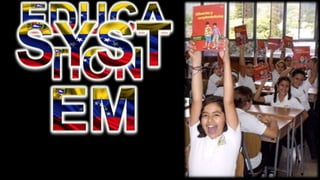
SYSTEMATIC
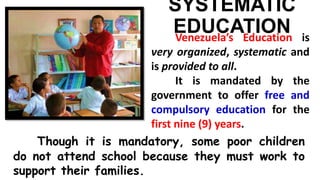
EDUCATIONVenezuela’s Education is
very organized, systematic and
is provided to all.
It is mandated by the
government to offer free and
compulsory education for the
first nine (9) years.
Though it is mandatory, some poor children
do not attend school because they must work to
support their families.
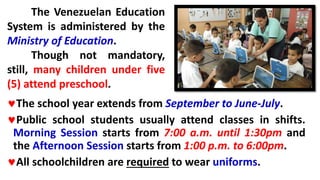
The school year extends from September to June-July.
Public school students usually attend classes in shifts.
Morning Session starts from 7:00 a.m. until 1:30pm and
the Afternoon Session starts from 1:00 p.m. to 6:00pm.
All schoolchildren are required to wear uniforms.
The Venezuelan Education
System is administered by the
Ministry of Education.
Though not mandatory,
still, many children under five
(5) attend preschool.
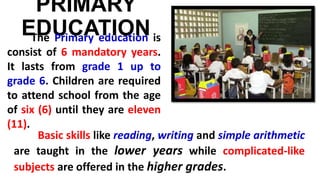
PRIMARY
EDUCATIONThe Primary education is
consist of 6 mandatory years.
It lasts from grade 1 up to
grade 6. Children are required
to attend school from the age
of six (6) until they are eleven
(11).
Basic skills like reading, writing and simple arithmetic
are taught in the lower years while complicated-like
subjects are offered in the higher grades.
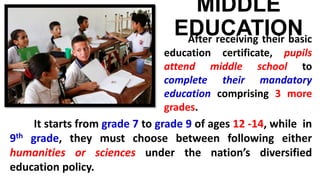
MIDDLE
EDUCATIONAfter receiving their basic
education certificate, pupils
attend middle school to
complete their mandatory
education comprising 3 more
grades.
It starts from grade 7 to grade 9 of ages 12 -14, while in
9th grade, they must choose between following either
humanities or sciences under the nation’s diversified
education policy.
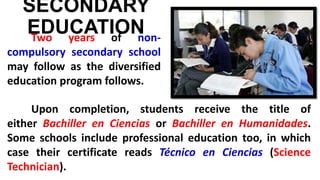
SECONDARY
EDUCATIONTwo years of non-
compulsory secondary school
may follow as the diversified
education program follows.
Upon completion, students receive the title of
either Bachiller en Ciencias or Bachiller en Humanidades.
Some schools include professional education too, in which
case their certificate reads Técnico en Ciencias (Science
Technician).
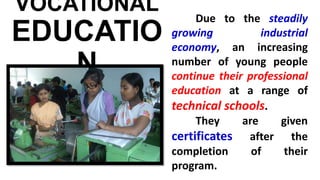
VOCATIONAL
EDUCATIO
N
Due to the steadily
growing industrial
economy, an increasing
number of young people
continue their professional
education at a range of
technical schools.
They are given
certificates after the
completion of their
program.
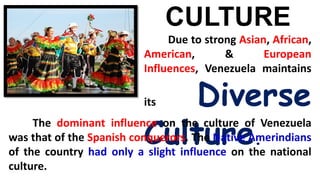
CULTURE
Due to strong Asian, African,
American, & European
Influences, Venezuela maintains
its Diverse
Culture.
The dominant influence on the culture of Venezuela
was that of the Spanish conquerors. The Native Amerindians
of the country had only a slight influence on the national
culture.
Men greet with an abrazo (a full embrace, while patting
each other on the back
Women greet with an abrazo and a kiss on the cheek.
Otherwise a handshake is usual.
Common greetings include ¡Buenos días! (“Good
morning”), ¡Buenas tardes! (“Good afternoon”), and
¡Buenas noches! (“Good evening”). Young people
generally use the more casual ¡Hola! (“Hi”). Greetings
often include inquiries about a person’s health.
Among close friends and relatives…
► Venezuelans stand very close when speaking. One to
two feet is normal. It can be considered rude to back up
or away from someone while they are speaking.
► There is a fair amount of touching between men and
men, and women and women while
conversing. Touching between men and women is
limited.
PERSONAL SPACE &
TOUCHING
 Seating posture is important. Try to keep both feet on
the floor, and avoid slouching. Don't put your feet on
furniture.
 The “ch-ch” sound is used to get someone's attention or
to get a bus to stop.
 The North American “O.K.” sign is extremely rude.
 Pointing with your index finger can be considered rude.
Motioning with your entire hand is more polite.
 Always maintain eye contact when talking.
GESTURE & BODY LANGUAGE
 Any violation of rules is punishable by law.
 The legal drinking age in is 18, but it is not heavily
enforced. .
 The legal smoking age is 18 but it is somewhat enforced.
 Being in possession or caught trafficking, pushing, and
taking of small quantities of drugs results in a minimum
10 year jail sentence.
 As in any country, it is highly advisable to practice safe
sex and use condoms.
LAW & ORDER
 Appearances count. It is important to be neat, clean and
properly groomed. Your watch and jewelry will be
noticed.
 For business, Men should wear conservative, dark suits.
 Women should wear feminine business suits, dresses,
skirts and blouses.
DRESS ETIQUETTE
 For social events, always arrive at least half an hour to
an hour later than the invitation reads.
 VIPs arrive very late for social occasions in order to
“make an entrance.”
 Meals are for socializing. Discuss business only if your
host initiates it.
 You will normally be served a great deal of food and
drink; Venezuelans enjoy both, but do not abuse either.
DINING AND ENTERTAINMENT
ETIQUETTE
 Don’t be too punctual for dinner meetings. Arriving on
time can be interpreted as over eager or even greedy.
 Try not to refuse an offer of coffee. It is a symbol of
hospitality.
 Dress smartly for dinner.
 Let the host show you where to sit.
 Hold a fork in your left hand and the knife in your right.
 You can start eating after the host says ‘buen provecho’.
 Keep your hands visible above the table.
DINING, FOOD & TABLE
ETIQUETTE
 Do not put your elbows on the table.
 The host makes the first toast with the word ‘salud!’ and
then you may begin drinking.
 Leave a small amount of food on your plate after you
have finished.
 Indicate you have finished eating by placing your cutlery
together on your plate with the handles facing right.
 Never eat with your hands.
 Don’t be surprised if Venezuelans make physical contact
with you. They are open, physical and friendly.
DINING, FOOD & TABLE
ETIQUETTE
• Do not slouch at table and keep both feet on the floor
while seated.
• Do not discuss politics or business at table unless
discussion of said topics was the original purpose of the
meal.
• Venezuelans like to eat and drink a lot, so expect a large
meal with lots of carbohydrates.
• Do not overeat as you will appear greedy.
• Do not get drunk during dinner.
DINING, FOOD & TABLE
ETIQUETTE
OFFICIAL
HOLIDAYS
and
CELEBRATIONSNew Year’s Day (1
January)
Carnaval (two days
before Ash Wednesday)
Holy Week
Declaration of
Independence (19 April)
May Day (1 May)
Battle of Carabobo (24
June)
Independence Day (5 July)
Simón Bolívar’s Birthday
(24 July)
Public Officials’ Day (first
Monday in September)
Columbus Day (12
October)
Christmas Eve, Christmas
Day (25 December)
VENEZUELAN
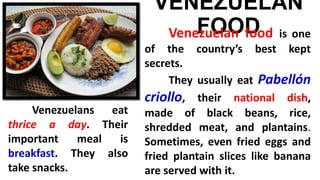
FOODVenezuelan food is one
of the country’s best kept
secrets.
They usually eat Pabellón
criollo, their national dish,
made of black beans, rice,
shredded meat, and plantains.
Sometimes, even fried eggs and
fried plantain slices like banana
are served with it.
Venezuelans eat
thrice a day. Their
important meal is
breakfast. They also
take snacks.
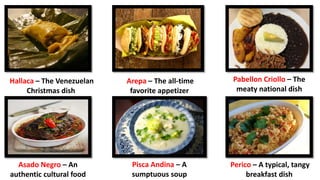
Arepa – The all-time
favorite appetizer
Hallaca – The Venezuelan
Christmas dish
Pabellon Criollo – The
meaty national dish
Asado Negro – An
authentic cultural food
Pisca Andina – A
sumptuous soup
Perico – A typical, tangy
breakfast dish
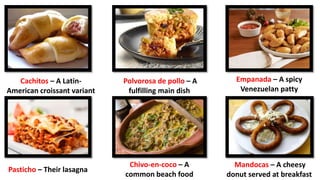
Polvorosa de pollo – A
fulfilling main dish
Cachitos – A Latin-
American croissant variant
Empanada – A spicy
Venezuelan patty
Pasticho – Their lasagna
Chivo-en-coco – A
common beach food
Mandocas – A cheesy
donut served at breakfast
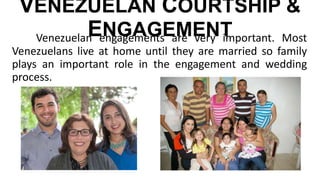
VENEZUELAN COURTSHIP &
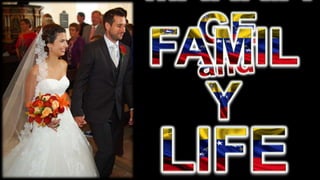
ENGAGEMENTVenezuelan engagements are very important. Most
Venezuelans live at home until they are married so family
plays an important role in the engagement and wedding
process.
COURTSHIP &
ENGAGEMENT
Couples choose their own partners
but family approval is highly
valued.
It is customary for the groom to
approach the father of the bride-to-
be and ask for his permission and
blessing before proposing to his
daughter.
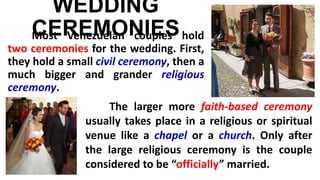
WEDDING
CEREMONIESMost Venezuelan couples hold
two ceremonies for the wedding. First,
they hold a small civil ceremony, then a
much bigger and grander religious
ceremony.
The larger more faith-based ceremony
usually takes place in a religious or spiritual
venue like a chapel or a church. Only after
the large religious ceremony is the couple
considered to be “officially” married.
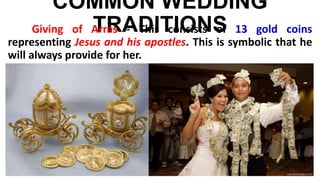
COMMON WEDDING
TRADITIONSGiving of Arras - This consists of 13 gold coins
representing Jesus and his apostles. This is symbolic that he
will always provide for her.
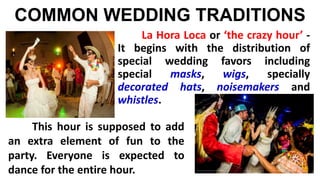
COMMON WEDDING TRADITIONS
La Hora Loca or ‘the crazy hour’ -
It begins with the distribution of
special wedding favors including
special masks, wigs, specially
decorated hats, noisemakers and
whistles.
This hour is supposed to add
an extra element of fun to the
party. Everyone is expected to
dance for the entire hour.
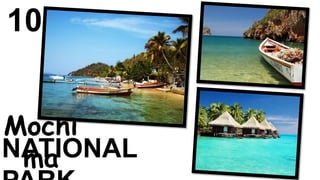
1
0
10
Mochi
maNATIONAL
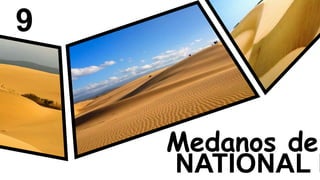
9
Medanos de
NATIONAL P
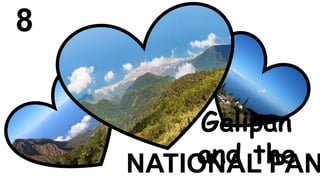
8
Galipan
and theNATIONAL PAN
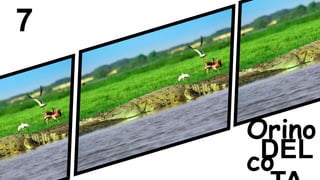
7
Orino
coDEL
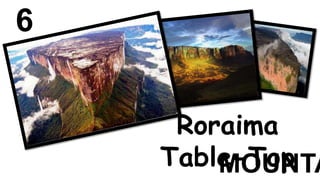
6
Roraima
Table-TopMOUNTA
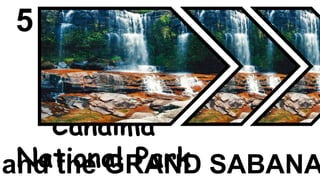
5
Canaima
National Parkand the GRAND SABANA
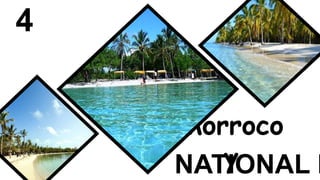
4
Morroco
yNATIONAL P
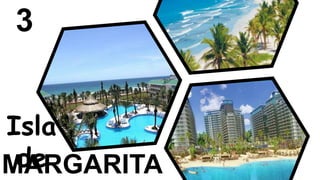
3
Isla
deMARGARITA
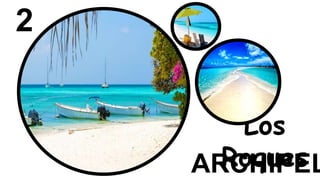
2
Los
RoquesARCHIPEL
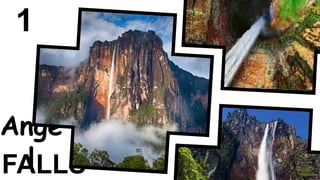
1
Ange
lFALLS
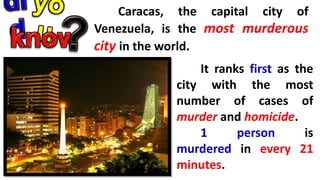
Caracas, the capital city of
Venezuela, is the most murderous
city in the world.
It ranks first as the
city with the most
number of cases of
murder and homicide.
1 person is
murdered in every 21
minutes.
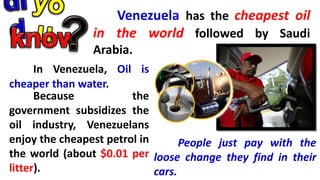
Venezuela has the cheapest oil
in the world followed by Saudi
Arabia.
In Venezuela, Oil is
cheaper than water.
Because the
government subsidizes the
oil industry, Venezuelans
enjoy the cheapest petrol in
the world (about $0.01 per
litter).
People just pay with the
loose change they find in their
cars.
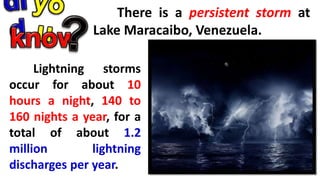
There is a persistent storm at
Lake Maracaibo, Venezuela.
Lightning storms
occur for about 10
hours a night, 140 to
160 nights a year, for a
total of about 1.2
million lightning
discharges per year.
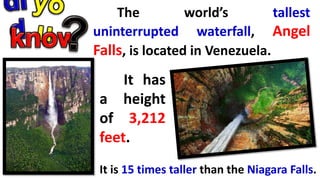
The world’s tallest
uninterrupted waterfall, Angel
Falls, is located in Venezuela.
It has
a height
of 3,212
feet.
It is 15 times taller than the Niagara Falls.
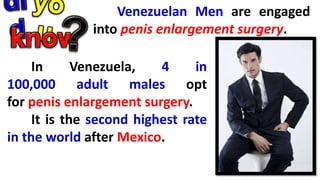
Venezuelan Men are engaged
into penis enlargement surgery.
In Venezuela, 4 in
100,000 adult males opt
for penis enlargement surgery.
It is the second highest rate
in the world after Mexico.
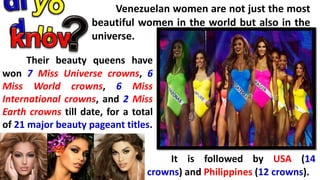
Venezuelan women are not just the most
beautiful women in the world but also in the
universe.
Their beauty queens have
won 7 Miss Universe crowns, 6
Miss World crowns, 6 Miss
International crowns, and 2 Miss
Earth crowns till date, for a total
of 21 major beauty pageant titles.
It is followed by USA (14
crowns) and Philippines (12 crowns).
Venezuela

Venezuela

  • 6.
    South 8 00 N, 6600 LOCATI ON COORDIN ATES
  • 7.
    LAND: 882,050 sq. km WATER: 30,000sq. km TOTAL: 912,050 sq. km AREA
  • 8.
  • 9.
    Regions & States ofVenezuela The country has four distinct geographic regions:  the Northern Mountains  the Maracaibo Lowlands  the Llanos (plains) of the north central region  the Guiana Highlands to the south. It is also divided into . 23 STATES
  • 10.
  • 11.
    CARACAS  Caracas isVenezuela’s largest urban city.  It has an area of 777 km²  It is also the country’s primary center of industry, commerce, education, and culture. Nickname: ‘The City of Eternal Spring’
  • 12.
    CLIMATE Tropical on the Llanos(plains). Moderate in the highlands. Hot and Humid in coastal areas.
  • 13.
    SEASONS Venezuela is atropical country with two very well defined seasons: Rainy or Wet Season (May-October) Dry or Sunny Season (November-April)
  • 14.
    HIGHEST & LOWESTPOINT Carribean Sea Pico Bolivar (5,007 m above sea level)
  • 16.
    The very firstinhabitants of Venezuela were the Amerindians with a population of more than 400,000 people. VENEZUELA AT A GLANCE They are subdivided into three groups: Caribs, Arawaks, and Chibchas. For centuries, they lived by farming, hunting and fishing.
  • 17.
    Then in August1498, Christopher Columbus became the first European to reach Venezuela when he landed at the mouth of the Orinoco on his 3rd voyage of discovery. In 1499, a Spaniard named Alonso de Ojeda and an Italian Explorer named Amerigo Vespucci led another expedition to the area. The Spaniards colonized Venezuela in 1520 and founded their first town in 1521. They also began importing African slaves.
  • 18.
    In 1806, Franciscode Miranda led the first rebellion against Spanish rule. However, he was soon defeated. 15 years after, Venezuela was finally liberated by Simon Bolivar through a revolution on July 5, 1821 (Independence Day from Spain).
  • 19.
    At first, Venezuelawas joined with Colombia and Ecuador as part of a state called Gran Colombia. However, Gran Colombia soon broke up and Venezuela became completely independent in 1830. During the 19th century Venezuela was ruled by military dictators called Caudillos. VENEZUELA COLOMBIA ECUADOR The first was José Antonio Paez. He ruled Venezuela until 1848. Venezuela then suffered civil wars.
  • 20.
    In 1902 Venezuelafailed to pay interest on loans from Britain, Germany and Italy. As a result those 3 nations sent their navies to block Venezuelan ports. However in 1914 oil was discovered in Venezuela. Oil became Venezuela's most important export. Then in 1945 a dictator was overthrown and the temporary government promised to hold elections. A new constitution was introduced in Venezuela in 1947 and elections were held. Oil Reserves
  • 21.
    Marcos Pérez Jiménezbecame dictator of Venezuela. He was overthrown in turn in 1958. After 1958, Venezuela became a democracy. However in 1998, Hugo Chávez was elected president and was re-elected in 2006. He allied Venezuela with Cuba. However, Chavez died in 2013. He was replaced by Nicolás Maduro.
  • 22.
    In the year1499, the early explorers, Alonso de Ojeda and Amerigo Vespucci, found Native stilt- houses built on lake Maracaibo and it reminded them of the buildings in Venice and so they named it. ETYMOLOGY The name of the region “VENEZUELA” came from an Italian word ‘Veneziola’ meaning “Little Venice”.
  • 24.
    THE OFFICIAL NAME& ITS MOTTO OFFICIAL NAME: Republica Bolivariana de Venezuela or Bolivarian Republic of Venezuela or Republica de Venezuela MOTTO: “Dios y Federation” or “God and Federation”
  • 25.
    The National Colors Bluefor the ocean separating Venezuela from Spain. Yellow for the nation’s wealth. Red for the blood and courage of the people.  Yellow  Blue  Red
  • 26.
    The Venezuelan Flag• Theflag was designed by a Venezuelan Independence Leader Francisco de Miranda on April 20, 1836. VENEZUELA COLOMBIA ECUADOR
  • 27.
    The Venezuelan Flag• Thecurrent version was adopted on March 12, 2006. • Their flag is a national icon and is respected and admired. • The colors of the flag are based on primary color theory: Yellow, Blue, & Red.
  • 28.
    The Flag Colors& SymbolismYellow stands for the wealth of the land. Blue symbolizes the courage of its people. Seven Stars represent the 7 united provinces that united in the war of independence while the 8th Star represents the historic province of Guyana. Red stands for the blood shed in attaining independence. Coat of Arms as the National Symbol. Eight Stars A tricolor band of…
  • 29.
    The National Emblem Venezuela’sCoat of Arms • The Shield is divided into colors of National Flag. • The Red displays wheat, which represents the union of the 20 States of the Republic and the wealth of the Nation. • The Yellow depicts weapons (a sword, a sabre and three lances) and two National Flags, which are tied by a branch of laurel, as a symbol of triumph in war. • The Blue shows a wild white horse running free, as an emblem of independence and freedom.
  • 30.
    The National Emblem Venezuela’s Coat •Above the shield are the two crossed cornucopias (horns of plenty), pouring out wealth. • The shield is bordered by an olive branch and another of palm, both tied at the bottom of the coat with a large band that represents the national tricolor - Yellow for the nation’s wealth, Blue for the ocean separating Venezuela from Spain, and Red for the blood and courage of the people.
  • 31.
    The National Anthem•National Anthem:“Gloria al bravo pueblo” (Glory to the brave people). •It was adopted as Venezuela's National Anthem by President Antonio Guzmán Blanco on May 25, 1881. •The lyrics were written by the physician and journalist Vicente Salias in 1810. •The music was later composed by musician Juan José Landaeta.
  • 32.
  • 33.
  • 34.
  • 35.
    The National Flower CattleyaTrianae [Orchid] (Flower of May)
  • 36.
  • 37.
    The National Costume Liqui Liqui consistsof trousers and a jacket. MEN: Alpargatas (shoes) Llanero Hat (Cowboy Hat)
  • 38.
    The National Costume Long-flowing RuffledSkirts & Blouses with one or both off-the- shoulder sleeves. WOM EN: It is coupled with a lot of flowers and simple jewellery pieces (beaded necklaces and bracelets, large earrings, flower hair clips) to add some Hispanic flavour.
  • 39.
    The National Dance& Music Joropo
  • 41.
    NATIONALITY: VENEZUELAN/S POPULATION: 31,762,515 as of February6, 2017 Equivalent to 0.42% of the total world population and ranks 43rd.
  • 42.
  • 43.
    AVERAGE HEIGHT Male 5'6.5“ ft. & Female 5' 2.5” ft. HAIR COLOR Dark Brown/ Blonde SKIN COLOR Light Brown (Latin Skin) EYES Brown Sparkling Eyes NOSE broad, wide, drooping tip w/ a dorsal hump LIPS Slender lips Latin aBeau
  • 44.
    LANGUAGE and TONGUESSpanish isconsidered Venezuela’s official & primary language, but there are over 40 languages spoken by the wide mix of Venezuela’s indigenous people. The most widely spoken indigenous tongues are Wayuu, Warao, Piaroa, Yanomami, Kahlihna, Manduhuaca, Panaré, Pemón, Guahibo and Nhengtu. Venezuelans also speak English, French, Arabic, Chinese, Italian, Catalan, and other languages.
  • 45.
    RELIGION Freedom of Religion isguaranteed by the Venezuelan Constitution. Roman Catholicism 96% Venezuelans are primarily roman catholic.
  • 46.
    ETHNIC GROUPS Venezuela is hometo approximately 31 million people with groups of European, Amerindian, African, Asian, and Middle Eastern heritage. Mestizos 69% Whites/ Europeans 20% Black Africans 10% Amerindians 1% You can also find Spanish, Italian, Portuguese, Arab, German, African & Indigenous people.
  • 48.
    FORM OF GOVERNMENTVenezuela isa Federal Presidential Republic where the President is both the head of state and the head of government. It is governed under a constitution adopted on December 30, 1999. All citizens may vote starting at the age of 18. Unlike any country, the Venezuelan Government has Five (5) Branches: Executive, Legislative, Judiciary, Electoral, and the Citizens.
  • 49.
    EXECUTIVE President – implements orapproves laws. LEGISLATIVE Congress (Senators) – enact laws. JUDICIAL Supreme Court (Judges) – decide cases. ELECTORAL Commissioners – conduct elections.CITIZENS Venezuelans - the voters. 1 2 3 4 5 BRANCHES OF GOVERNMENT
  • 50.
    MEET THE PRESIDENT… Nicolas MaduroMoros, more commonly known as Nicolas Maduro, is a Venezuelan politician who has been the 65th President of Venezuela since April 14, 2013. He was born on November 23, 1962 (age 54 years).
  • 51.
    Palacio de Miraflores(Miraflores Palace) Urdaneta Avenue, Libertador, Caracas City PRESIDENT’S RESIDENCE
  • 52.
    DEFENSE & MILITARY SERVICES AllVenezuelan males between the ages of 18 and 45 are liable for 30 months of military service. Venezuela maintained its combined armed forces, made up of the army, navy, air force, and the national guard. All citizens of ages (18-60 years old) are obligated to register for military service for 12 months (minimum).
  • 54.
    Venezuela remains highly dependenton oil revenues, which account for almost all export earning and nearly half of the government’s revenue. ECONOMY
  • 55.
    Venezuela has the largestoil reserves on Earth.  Unfortunately, VENEZ UELA has the WORS
  • 56.
    INDUSTRI ESAgricultural products, livestock, rawmaterials, machinery and equipment, transport equipment, construction materials, medical equipment, pharmaceuticals, chemicals, iron and steel products, crude oil and petroleum products.
  • 57.
  • 58.
    NATURAL RESOURCES Petroleum Hydropower NaturalGas Iron Ore Gold Bauxite Diamond
  • 59.
    EXPORT COMMODITIESOil & PetroleumProducts Bauxite, Aluminum Minerals Chemicals  Agricultural Products
  • 60.
    EXPORT PARTNERS USA (26.6%) INDIA(13.7%) CHINA (11.7%) CUBA (6.4%)
  • 61.
    IMPORT COMMODITIESAgricultural Products Livestock Raw Materials/NaturalResources Machinery & Transport Equipment Construction Materials Medical Equipment Pharmaceuticals Chemicals & Petroleum Products Iron and Steel Products.
  • 62.
    IMPORT PARTNERS USA (18.4%)CHINA (15.3%) BRAZIL (9.7%) COLOMBIA (5.9%) MEXICO (4.2%)
  • 63.
    CURRENCY/MONET ARY UNITCurrency -Venezuelan Bolívar or Bolivares de Venezuela Currency Code - VEF (Venezuelan Fuerte). Currency Symbol - Bs CONVERSION 1 Venezuelan Bolívar = 4.99 Philippine Peso 1 Philippine Peso = 0.20 Venezuelan Bolivar
  • 65.
    Venezuela has awide array of pharmacies, clinics and hospitals. Good medical care is available in Caracas, but may be difficult to find in rural areas. HEALTHCARE SYSTEM Public hospitals and clinics are free, but the quality of medical care is better in private facilities. If you need hospital treatment in Venezuela, by far, the best facilities are in Caracas.
  • 67.
    Food or WaterborneDiseases: Bacterial Diarrhea and Hepatitis A Degree of Risk: HIGH Vectorborne Diseases: Dengue Fever and Malaria Other diseases include Hepatitis E, Typhoid fever, Yellow fever, Japanese Encephalitis, African Trypanosomiasis, Plague, Crimean-Congo hemorrhagic fever, Rift Valley fever, Chikungunya, Leptospirosis, Schistosomiasis, Meningococcal meningitis, and Rabies.
  • 68.
    BIRTH RATE 19.2 births/1,000population DEATH RATE 5.2 deaths/1,000 population LIFE EXPECTANCY MALE: 72.7 years FEMALE: 78.9 years TOTAL: 75.8 years TOTAL FERTILITY RATE INFANT MORTALITY RATE Male: 13.1 deaths/1,000 live births Female: 11.9 deaths/1,000 live births
  • 70.
    SYSTEMATIC EDUCATIONVenezuela’s Education is veryorganized, systematic and is provided to all. It is mandated by the government to offer free and compulsory education for the first nine (9) years. Though it is mandatory, some poor children do not attend school because they must work to support their families.
  • 71.
    The school yearextends from September to June-July. Public school students usually attend classes in shifts. Morning Session starts from 7:00 a.m. until 1:30pm and the Afternoon Session starts from 1:00 p.m. to 6:00pm. All schoolchildren are required to wear uniforms. The Venezuelan Education System is administered by the Ministry of Education. Though not mandatory, still, many children under five (5) attend preschool.
  • 72.
    PRIMARY EDUCATIONThe Primary educationis consist of 6 mandatory years. It lasts from grade 1 up to grade 6. Children are required to attend school from the age of six (6) until they are eleven (11). Basic skills like reading, writing and simple arithmetic are taught in the lower years while complicated-like subjects are offered in the higher grades.
  • 73.
    MIDDLE EDUCATIONAfter receiving theirbasic education certificate, pupils attend middle school to complete their mandatory education comprising 3 more grades. It starts from grade 7 to grade 9 of ages 12 -14, while in 9th grade, they must choose between following either humanities or sciences under the nation’s diversified education policy.
  • 74.
    SECONDARY EDUCATIONTwo years ofnon- compulsory secondary school may follow as the diversified education program follows. Upon completion, students receive the title of either Bachiller en Ciencias or Bachiller en Humanidades. Some schools include professional education too, in which case their certificate reads Técnico en Ciencias (Science Technician).
  • 75.
    VOCATIONAL EDUCATIO N Due to thesteadily growing industrial economy, an increasing number of young people continue their professional education at a range of technical schools. They are given certificates after the completion of their program.
  • 79.
    CULTURE Due to strongAsian, African, American, & European Influences, Venezuela maintains its Diverse Culture. The dominant influence on the culture of Venezuela was that of the Spanish conquerors. The Native Amerindians of the country had only a slight influence on the national culture.
  • 80.
    Men greet withan abrazo (a full embrace, while patting each other on the back Women greet with an abrazo and a kiss on the cheek. Otherwise a handshake is usual. Common greetings include ¡Buenos días! (“Good morning”), ¡Buenas tardes! (“Good afternoon”), and ¡Buenas noches! (“Good evening”). Young people generally use the more casual ¡Hola! (“Hi”). Greetings often include inquiries about a person’s health. Among close friends and relatives…
  • 81.
    ► Venezuelans standvery close when speaking. One to two feet is normal. It can be considered rude to back up or away from someone while they are speaking. ► There is a fair amount of touching between men and men, and women and women while conversing. Touching between men and women is limited. PERSONAL SPACE & TOUCHING
  • 82.
     Seating postureis important. Try to keep both feet on the floor, and avoid slouching. Don't put your feet on furniture.  The “ch-ch” sound is used to get someone's attention or to get a bus to stop.  The North American “O.K.” sign is extremely rude.  Pointing with your index finger can be considered rude. Motioning with your entire hand is more polite.  Always maintain eye contact when talking. GESTURE & BODY LANGUAGE
  • 83.
     Any violationof rules is punishable by law.  The legal drinking age in is 18, but it is not heavily enforced. .  The legal smoking age is 18 but it is somewhat enforced.  Being in possession or caught trafficking, pushing, and taking of small quantities of drugs results in a minimum 10 year jail sentence.  As in any country, it is highly advisable to practice safe sex and use condoms. LAW & ORDER
  • 84.
     Appearances count.It is important to be neat, clean and properly groomed. Your watch and jewelry will be noticed.  For business, Men should wear conservative, dark suits.  Women should wear feminine business suits, dresses, skirts and blouses. DRESS ETIQUETTE
  • 85.
     For socialevents, always arrive at least half an hour to an hour later than the invitation reads.  VIPs arrive very late for social occasions in order to “make an entrance.”  Meals are for socializing. Discuss business only if your host initiates it.  You will normally be served a great deal of food and drink; Venezuelans enjoy both, but do not abuse either. DINING AND ENTERTAINMENT ETIQUETTE
  • 86.
     Don’t betoo punctual for dinner meetings. Arriving on time can be interpreted as over eager or even greedy.  Try not to refuse an offer of coffee. It is a symbol of hospitality.  Dress smartly for dinner.  Let the host show you where to sit.  Hold a fork in your left hand and the knife in your right.  You can start eating after the host says ‘buen provecho’.  Keep your hands visible above the table. DINING, FOOD & TABLE ETIQUETTE
  • 87.
     Do notput your elbows on the table.  The host makes the first toast with the word ‘salud!’ and then you may begin drinking.  Leave a small amount of food on your plate after you have finished.  Indicate you have finished eating by placing your cutlery together on your plate with the handles facing right.  Never eat with your hands.  Don’t be surprised if Venezuelans make physical contact with you. They are open, physical and friendly. DINING, FOOD & TABLE ETIQUETTE
  • 88.
    • Do notslouch at table and keep both feet on the floor while seated. • Do not discuss politics or business at table unless discussion of said topics was the original purpose of the meal. • Venezuelans like to eat and drink a lot, so expect a large meal with lots of carbohydrates. • Do not overeat as you will appear greedy. • Do not get drunk during dinner. DINING, FOOD & TABLE ETIQUETTE
  • 89.
    OFFICIAL HOLIDAYS and CELEBRATIONSNew Year’s Day(1 January) Carnaval (two days before Ash Wednesday) Holy Week Declaration of Independence (19 April) May Day (1 May) Battle of Carabobo (24 June) Independence Day (5 July) Simón Bolívar’s Birthday (24 July) Public Officials’ Day (first Monday in September) Columbus Day (12 October) Christmas Eve, Christmas Day (25 December)
  • 91.
    VENEZUELAN FOODVenezuelan food isone of the country’s best kept secrets. They usually eat Pabellón criollo, their national dish, made of black beans, rice, shredded meat, and plantains. Sometimes, even fried eggs and fried plantain slices like banana are served with it. Venezuelans eat thrice a day. Their important meal is breakfast. They also take snacks.
  • 92.
    Arepa – Theall-time favorite appetizer Hallaca – The Venezuelan Christmas dish Pabellon Criollo – The meaty national dish Asado Negro – An authentic cultural food Pisca Andina – A sumptuous soup Perico – A typical, tangy breakfast dish
  • 93.
    Polvorosa de pollo– A fulfilling main dish Cachitos – A Latin- American croissant variant Empanada – A spicy Venezuelan patty Pasticho – Their lasagna Chivo-en-coco – A common beach food Mandocas – A cheesy donut served at breakfast
  • 95.
    VENEZUELAN COURTSHIP & ENGAGEMENTVenezuelanengagements are very important. Most Venezuelans live at home until they are married so family plays an important role in the engagement and wedding process.
  • 96.
    COURTSHIP & ENGAGEMENT Couples choosetheir own partners but family approval is highly valued. It is customary for the groom to approach the father of the bride-to- be and ask for his permission and blessing before proposing to his daughter.
  • 97.
    WEDDING CEREMONIESMost Venezuelan coupleshold two ceremonies for the wedding. First, they hold a small civil ceremony, then a much bigger and grander religious ceremony. The larger more faith-based ceremony usually takes place in a religious or spiritual venue like a chapel or a church. Only after the large religious ceremony is the couple considered to be “officially” married.
  • 98.
    COMMON WEDDING TRADITIONSGiving ofArras - This consists of 13 gold coins representing Jesus and his apostles. This is symbolic that he will always provide for her.
  • 99.
    COMMON WEDDING TRADITIONS LaHora Loca or ‘the crazy hour’ - It begins with the distribution of special wedding favors including special masks, wigs, specially decorated hats, noisemakers and whistles. This hour is supposed to add an extra element of fun to the party. Everyone is expected to dance for the entire hour.
  • 100.
  • 101.
  • 102.
  • 103.
  • 104.
  • 105.
  • 106.
  • 107.
  • 108.
  • 109.
  • 110.
  • 112.
    Caracas, the capitalcity of Venezuela, is the most murderous city in the world. It ranks first as the city with the most number of cases of murder and homicide. 1 person is murdered in every 21 minutes.
  • 113.
    Venezuela has thecheapest oil in the world followed by Saudi Arabia. In Venezuela, Oil is cheaper than water. Because the government subsidizes the oil industry, Venezuelans enjoy the cheapest petrol in the world (about $0.01 per litter). People just pay with the loose change they find in their cars.
  • 114.
    There is apersistent storm at Lake Maracaibo, Venezuela. Lightning storms occur for about 10 hours a night, 140 to 160 nights a year, for a total of about 1.2 million lightning discharges per year.
  • 115.
    The world’s tallest uninterruptedwaterfall, Angel Falls, is located in Venezuela. It has a height of 3,212 feet. It is 15 times taller than the Niagara Falls.
  • 116.
    Venezuelan Men areengaged into penis enlargement surgery. In Venezuela, 4 in 100,000 adult males opt for penis enlargement surgery. It is the second highest rate in the world after Mexico.
  • 117.
    Venezuelan women arenot just the most beautiful women in the world but also in the universe. Their beauty queens have won 7 Miss Universe crowns, 6 Miss World crowns, 6 Miss International crowns, and 2 Miss Earth crowns till date, for a total of 21 major beauty pageant titles. It is followed by USA (14 crowns) and Philippines (12 crowns).