CHYLE LEAK
Overview, Causes, Composition, Diagnosis, Complications, Maintenance,
Treatment, and Management
Report by: Pamela Johnson
Sodexo Distance Dietetic Internship
Why Chyle Leaks?
• “Hot Topic” during my time as a Dietetic Intern at Sharp
Grossmont Hospital (3 Individual Cases)
• Typically very rare case that not many interns may be able to
learn about
• New and interesting topic for myself to learn about during my
internship
Icebreaker
• Word Jumble!
What is Chyle?
• Milky like-fluid consisting of lymph and chylomicrons made in the
small intestine during the digestion of fat and drained by lacteals
into the lymphatic system
• Made up of lipids, protein, electrolytes, and cellular elements
• Odorless and Alkaline
• 1 liter Contains roughly:
• 200 Calories
• 20-30g Protein
• 5-30g Fat
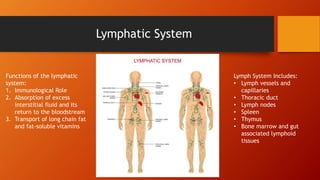
Lymphatic System
Functions of the lymphatic
system:
1. Immunological Role
2. Absorption of excess
interstitial fluid and its
return to the bloodstream
3. Transport of long chain fat
and fat-soluble vitamins
Lymph System Includes:
• Lymph vessels and
capillaries
• Thoracic duct
• Lymph nodes
• Spleen
• Thymus
• Bone marrow and gut
associated lymphoid
tissues
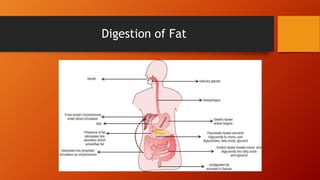
Digestion of Fat
What are the potential causes?
• Primary: Congenital Lymphangiectasia
• Secondary: Postoperative trauma or obstruction following
abdominal, neck or thoracic operations
• Abdominal aortic surgery, lymph node dissection, duodeno-pancreatic
resections, esophageal procedures, thoracic and cervical spine procedures,
and left neck dissections
• Incidence rate of 1-4%
• Non-Traumatic Causes such as cancer of the lymphatic system (lymphoma)
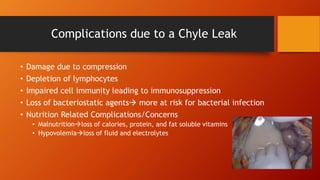
Complications due to a Chyle Leak
• Damage due to compression
• Depletion of lymphocytes
• Impaired cell immunity leading to immunosuppression
• Loss of bacteriostatic agents more at risk for bacterial infection
• Nutrition Related Complications/Concerns
• Malnutritionloss of calories, protein, and fat soluble vitamins
• Hypovolemialoss of fluid and electrolytes
Symptoms Associated with a Leak
• White or reddish milky fluid drainage from drains in the chest,
abdomen, or neck
• Pleural Fluid Trigcylgeride level greater than 110 mg/dL
• Dyspnea, chest pain, and tachycardia
• Pleural effusion and abdominal ascites
Treatment Options
• Vary patient by patient depending on patient’s needs
• Options Include:
• Dietary Modification
• Specialized low-fat formula for Enteral Nutrition for those who cannot
tolerate an oral diet
• Bowel rest with parenteral nutrition for those with a non-functioning GI
tract
• Pharmacological (Octreotide)
• Drainage
• Direct Surgical Repair
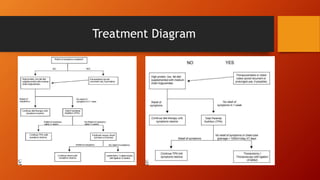
Treatment Diagram
Treatment: Oral Dietary Modification
• Goal: Decrease production of flow, replenish fluid and electrolyte
loss, and prevent malnutrition by the repletion of nutrition stores
• Low-Fat or Fat-Free Diet
• MCT Oil Supplementation
Low-Fat/Fat-Free Diet
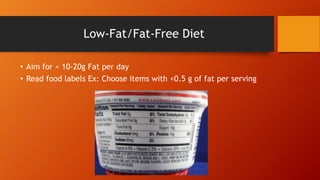
• Aim for < 10-20g Fat per day
• Read food labels Ex: Choose items with <0.5 g of fat per serving
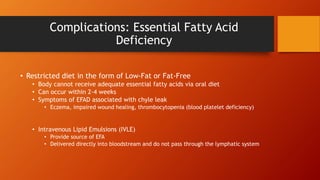
Complications: Essential Fatty Acid
Deficiency
• Restricted diet in the form of Low-Fat or Fat-Free
• Body cannot receive adequate essential fatty acids via oral diet
• Can occur within 2-4 weeks
• Symptoms of EFAD associated with chyle leak
• Eczema, impaired wound healing, thrombocytopenia (blood platelet deficiency)
• Intravenous Lipid Emulsions (IVLE)
• Provide source of EFA
• Delivered directly into bloodstream and do not pass through the lymphatic system
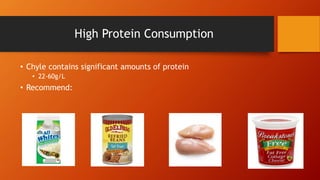
High Protein Consumption
• Chyle contains significant amounts of protein
• 22-60g/L
• Recommend:
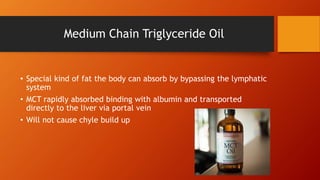
Medium Chain Triglyceride Oil
• Special kind of fat the body can absorb by bypassing the lymphatic
system
• MCT rapidly absorbed binding with albumin and transported
directly to the liver via portal vein
• Will not cause chyle build up
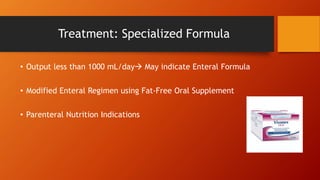
Treatment: Specialized Formula
• Output less than 1000 mL/day May indicate Enteral Formula
• Modified Enteral Regimen using Fat-Free Oral Supplement
• Parenteral Nutrition Indications
Treatment: Pharmacological
• Octreotide
• Somatostatin Analog
• Inhibits growth hormones, glucagon, insulin, and suppresses GI hormones
• Works by decreasing lymph flow and intestinal absorption of fats
• Typically 50 micrograms 3 x day
• Side Effects: nausea, diarrhea, cutaneous flushing, sinus bradycardia, and
elevated liver function
Treatment: Surgical Repair
• Indications:
• >1L output present
• No signs of closure within 2-3 weeks
• Signs of nutritional or metabolic complications from leak
• Further damage is present
• Patient begins to deteriorate
Possibilities Requiring Evidence Based
Research
• Recommend a High-Fat diet 1 day prior to surgery/procedure?
• Is a Clear Liquid Diet post-op appropriate?
• Liberalizing fat intake within an oral diet based on chyle output?
• Micronutrient loss (Selenium Deficiency)
Conclusion
• Treatment varies depending on the patient and patient’s needs
• Nutrition therapy and management is an important component in
chyle leak treatment
• Very important to evaluate individuals thoroughly in order to
determine the best and most successful type of regimen
Questions?
References
• McCray, Stacey, and Carol Rees Parrish. "Nutritional management of chyle leaks: an
update." Pract Gastroenterol 94 (2011): 12-32.
• Qureshi, Sajid S., et al. "Chyle leak following surgery for abdominal
neuroblastoma." Journal of pediatric surgery (2015).
• Sriram, Krishnan, Robert A. Meguid, and Michael M. Meguid. "Nutritional support in adults
with chyle leaks." Nutrition (2015).
• Smoke, Addy, and Mark H. DeLegge. "Chyle leaks: consensus on management?." Nutrition
in Clinical Practice 23.5 (2008): 529-532.

Pam J Chyle Leak Presentation

  • 1.
    CHYLE LEAK Overview, Causes,Composition, Diagnosis, Complications, Maintenance, Treatment, and Management Report by: Pamela Johnson Sodexo Distance Dietetic Internship
  • 2.
    Why Chyle Leaks? •“Hot Topic” during my time as a Dietetic Intern at Sharp Grossmont Hospital (3 Individual Cases) • Typically very rare case that not many interns may be able to learn about • New and interesting topic for myself to learn about during my internship
  • 3.
  • 4.
    What is Chyle? •Milky like-fluid consisting of lymph and chylomicrons made in the small intestine during the digestion of fat and drained by lacteals into the lymphatic system • Made up of lipids, protein, electrolytes, and cellular elements • Odorless and Alkaline • 1 liter Contains roughly: • 200 Calories • 20-30g Protein • 5-30g Fat
  • 5.
    Lymphatic System Functions ofthe lymphatic system: 1. Immunological Role 2. Absorption of excess interstitial fluid and its return to the bloodstream 3. Transport of long chain fat and fat-soluble vitamins Lymph System Includes: • Lymph vessels and capillaries • Thoracic duct • Lymph nodes • Spleen • Thymus • Bone marrow and gut associated lymphoid tissues
  • 6.
  • 7.
    What are thepotential causes? • Primary: Congenital Lymphangiectasia • Secondary: Postoperative trauma or obstruction following abdominal, neck or thoracic operations • Abdominal aortic surgery, lymph node dissection, duodeno-pancreatic resections, esophageal procedures, thoracic and cervical spine procedures, and left neck dissections • Incidence rate of 1-4% • Non-Traumatic Causes such as cancer of the lymphatic system (lymphoma)
  • 8.
    Complications due toa Chyle Leak • Damage due to compression • Depletion of lymphocytes • Impaired cell immunity leading to immunosuppression • Loss of bacteriostatic agents more at risk for bacterial infection • Nutrition Related Complications/Concerns • Malnutritionloss of calories, protein, and fat soluble vitamins • Hypovolemialoss of fluid and electrolytes
  • 9.
    Symptoms Associated witha Leak • White or reddish milky fluid drainage from drains in the chest, abdomen, or neck • Pleural Fluid Trigcylgeride level greater than 110 mg/dL • Dyspnea, chest pain, and tachycardia • Pleural effusion and abdominal ascites
  • 10.
    Treatment Options • Varypatient by patient depending on patient’s needs • Options Include: • Dietary Modification • Specialized low-fat formula for Enteral Nutrition for those who cannot tolerate an oral diet • Bowel rest with parenteral nutrition for those with a non-functioning GI tract • Pharmacological (Octreotide) • Drainage • Direct Surgical Repair
  • 11.
  • 12.
    Treatment: Oral DietaryModification • Goal: Decrease production of flow, replenish fluid and electrolyte loss, and prevent malnutrition by the repletion of nutrition stores • Low-Fat or Fat-Free Diet • MCT Oil Supplementation
  • 13.
    Low-Fat/Fat-Free Diet • Aimfor < 10-20g Fat per day • Read food labels Ex: Choose items with <0.5 g of fat per serving
  • 14.
    Complications: Essential FattyAcid Deficiency • Restricted diet in the form of Low-Fat or Fat-Free • Body cannot receive adequate essential fatty acids via oral diet • Can occur within 2-4 weeks • Symptoms of EFAD associated with chyle leak • Eczema, impaired wound healing, thrombocytopenia (blood platelet deficiency) • Intravenous Lipid Emulsions (IVLE) • Provide source of EFA • Delivered directly into bloodstream and do not pass through the lymphatic system
  • 15.
    High Protein Consumption •Chyle contains significant amounts of protein • 22-60g/L • Recommend:
  • 16.
    Medium Chain TriglycerideOil • Special kind of fat the body can absorb by bypassing the lymphatic system • MCT rapidly absorbed binding with albumin and transported directly to the liver via portal vein • Will not cause chyle build up
  • 17.
    Treatment: Specialized Formula •Output less than 1000 mL/day May indicate Enteral Formula • Modified Enteral Regimen using Fat-Free Oral Supplement • Parenteral Nutrition Indications
  • 18.
    Treatment: Pharmacological • Octreotide •Somatostatin Analog • Inhibits growth hormones, glucagon, insulin, and suppresses GI hormones • Works by decreasing lymph flow and intestinal absorption of fats • Typically 50 micrograms 3 x day • Side Effects: nausea, diarrhea, cutaneous flushing, sinus bradycardia, and elevated liver function
  • 19.
    Treatment: Surgical Repair •Indications: • >1L output present • No signs of closure within 2-3 weeks • Signs of nutritional or metabolic complications from leak • Further damage is present • Patient begins to deteriorate
  • 20.
    Possibilities Requiring EvidenceBased Research • Recommend a High-Fat diet 1 day prior to surgery/procedure? • Is a Clear Liquid Diet post-op appropriate? • Liberalizing fat intake within an oral diet based on chyle output? • Micronutrient loss (Selenium Deficiency)
  • 21.
    Conclusion • Treatment variesdepending on the patient and patient’s needs • Nutrition therapy and management is an important component in chyle leak treatment • Very important to evaluate individuals thoroughly in order to determine the best and most successful type of regimen
  • 22.
  • 23.
    References • McCray, Stacey,and Carol Rees Parrish. "Nutritional management of chyle leaks: an update." Pract Gastroenterol 94 (2011): 12-32. • Qureshi, Sajid S., et al. "Chyle leak following surgery for abdominal neuroblastoma." Journal of pediatric surgery (2015). • Sriram, Krishnan, Robert A. Meguid, and Michael M. Meguid. "Nutritional support in adults with chyle leaks." Nutrition (2015). • Smoke, Addy, and Mark H. DeLegge. "Chyle leaks: consensus on management?." Nutrition in Clinical Practice 23.5 (2008): 529-532.

Editor's Notes

  • #3 Back in November while I was completing my patient services rotation Jennifer approached me about a patient with a chyle leak who needed to abide by a very low fat diet. I provided her with a list of food items we had in stock that contained 0-0.5g fat per serving in order to provide this particular patient with a variety of meal options. Jennifer encouraged me to present on chyle leaks due to it’s rare occurrence and to familiarize myself with this type of diagnosis.
  • #4 I thought it would be fun to do a little word jumble before we get started... I am going to pass out the word jumble which relates to our chyle leak topic and you will have two minutes to accurately determine the 5 word jumbles. Whoever is able to accomplish this first will win a prize! Ready set go!!! Answers: Medium Chain Triglyceride Lmyphatic System Ocrtreotide Low-fat diet Chyle
  • #5 Lymph- fluid that circulates throughout the lymphatic system Chylomicrons-lipoprotein particles consisting of triglycerides, phospholipids, cholesterol, and proteins Lacteals-lymphatic vessels of the small intestine that absorb digested fats
  • #6 Lymphatic system is a network of lymph nodes connected by lymphatic vessels. Transports lymph throughout the body. Chyle is carried around the body by lymphatic vessels, just like blood is carried around the body by blood vessels.
  • #7 Multistep process 1.Food is ingested 2.lingual lipase is secreted-works on the food 3.in stomach gastric lipase continues working on food 4.fat moves into intestine 5. biles salts release and act as an emulsifier 6. fatty acids digested into small bowel 7. bile, fatty acids, and unhydrolyzed glycerides form to make micelles (liquid molecules in aqueous solutions) 8. this formation increases surface area of fats allowing lipase to work better and more efficiently 9. micelles transport fatty acids and monoglycerides to intestinal villi (small finger like structures that protrude from epithelial lining of small intestine) 10. once monoglycerides and fatty acids are absorbed within bowel they are resynthesized into TG combining with fatty acids, cholesterol, and protein to form chylomicrons 11. chylomicrons enter the lymphatic system through lacteals (lymph vessels in the villous region) 12. chylomicrons enter circulation via subclavian vein (outer border of first rib) over a period of several hours 13. lipoprotein lipase clears chylomicrons from the blood vessels, releasing fatty acids for absorption into the cells
  • #8 Congenital Lymphangiectasia-rare developmental disorder that is present at birth, results in abnormally widened lymphatic vessels within the lungsinfants develop potentially life-threatening respiratory distress Most causes are secondary and commonly a nick after surgery
  • #9 Lymphocytes-white blood cells in the immune system
  • #10 A lot of the time diagnosis is usually made after the patient has recovered from the injury and has started eating Pleural Fluid/Effusion- build up of fluid between the tissues that line the lungs and the chest Dyspnea- difficult breathing
  • #12 Diagram giving examples of treatment options depending on if a patient has relief of specific symptoms or not and what the next steps may be to move forward with the treatment options
  • #13 Goal: Decrease production of flow, replenish fluid and electrolyte loss, and prevent malnutrition by the repletion of nutrition stores
  • #14 When fat is reduced in the diet, the body makes less chyle therefore less fluid leaks into the body No studies actually demonstrate exactly how much fat is acceptable to promote closure of a leak but 10-20g of fat is a very low fat content per day and is a good range that I have seen used
  • #15 May occur due to abiding by such a restricted fat diet EFA are necessary for healthy cell membrane formation, cholesterol metabolism, blood clotting, as well as proper development and functioning of the brain and nervous system. Essential Fatty Acid Content of common Oils and Portion needd to meet 4% total caloreis (Sunflower oil 3.3g/tsp)
  • #16 Important to increase protein due to loss from chyle leakHigh protein fat free/low-fat options such as: fat-free egg substitutes, egg whites, egg beaters, white poultry meat without skin or fat, lean fish, fat-free lunch meat, fat-free vegetable burgers, fat-free beans/beans boiled and cooked without fat, fat-free refried beans, non-fat/fat-free dairy products (milk, cheese, yogurt, cottage cheese), fat-free Carnation Instant Breakfast
  • #17 MCT: Provides the body with fat that will not interfere with a chyle leakage Does not contain EFA
  • #18 EN: Example Vivonex, contains 100% amino acids and very low fat content (3g fat per 1000mL) Semi Elemental: 1) better absorbed, 2) less allergenic, 3) better tolerated in patients with malabsorptive states and 4) cause less exocrine pancreatic stimulation in patients with pancreatitis. Oral supplement-less expensive option than a low fat formula and easier to obtain or purchase-may be reasonable for short term (Enlive or Resource Breeze) TPN: full caloric support while allowing bowel rest, bowel rest decreases chyle flow, allowing possibility of healing to occur
  • #19 No consensus on when to start medication, appropriate dosage, or when to discontinue Somatostatin is a hormone produced by the hypothalamus and some other tissues such as the pancreas and the gastrointestinal tract. It inhibits the release of growth hormone from the anterior pituitary, and insulin and glucagon from the pancreas. Somatostatin also decreases the release of most gastrointestinal hormones and reduces gastric acid and pancreatic secretion. It can reduce abdominal blood flow therefore somatostatin analogs can be used to reduce bleeding from esophageal varices. Somatostatin analogs are used for treatment of tumors secreting vasoactive intestinal peptide, carcinoid tumors, glucagonomas and various pituitary adenomas. It is also used to treat acromegaly (a condition in where there is over secretion of growth hormone in an adult).
  • #20 Surgical procedures depend on the site and etiology of the leak. Some researchers recommend oral whole cream or enteral formula 3-4 hours prior to surgery in order to identify the source of the leak
  • #21 1. Provide indication for source of chyle leak 2. Will these liquids increase chyle flow? Limited fat but Volume of liquids too much? 3. How much fat is too much? 4. Loss from chyle result in symptoms such as lower extremity weakness, cardiomyopathy (abnormal heart muscle), hair loss, diarrhea