Prof. Dr. Muhammad Arshad
Tamgha-i-Imtiaz
Distinguished National Professor
President, Soil Science Society of Pakistan
Dean, Faculty of Agriculture
University of Agriculture, Faisalabad-Pakistan
“Pakistan soil resources, issues, threats, ongoing activities
and their sustainable management
Asian Soil Partnership Consultation Workshop on Sustainable Management and
Protection of Soil Resources (Bangkok, Thailand: 13-15 MAY, 2015)
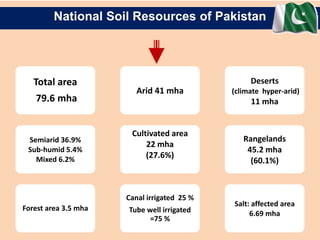
National Soil Resources of Pakistan
Total area
79.6 mha
Semiarid 36.9%
Sub-humid 5.4%
Mixed 6.2%
Forest area 3.5 mha
Canal irrigated 25 %
Tube well irrigated
=75 %
Cultivated area
22 mha
(27.6%)
Arid 41 mha
Deserts
(climate hyper-arid)
11 mha
Rangelands
45.2 mha
(60.1%)
Salt: affected area
6.69 mha
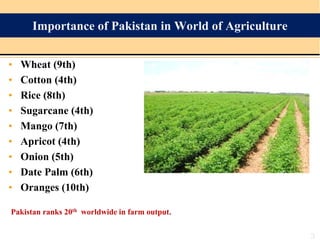
Importance of Pakistan in World of Agriculture
• Wheat (9th)
• Cotton (4th)
• Rice (8th)
• Sugarcane (4th)
• Mango (7th)
• Apricot (4th)
• Onion (5th)
• Date Palm (6th)
• Oranges (10th)
Pakistan ranks 20th worldwide in farm output.
3
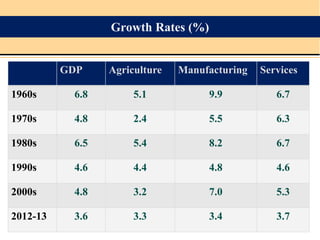
Growth Rates (%)
GDP Agriculture Manufacturing Services
1960s 6.8 5.1 9.9 6.7
1970s 4.8 2.4 5.5 6.3
1980s 6.5 5.4 8.2 6.7
1990s 4.6 4.4 4.8 4.6
2000s 4.8 3.2 7.0 5.3
2012-13 3.6 3.3 3.4 3.7
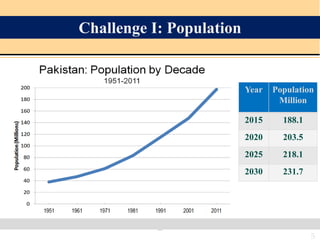
Challenge I: Population
5
Year Population
Million
2015 188.1
2020 203.5
2025 218.1
2030 231.7
s
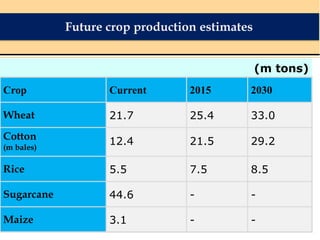
Future crop production estimates
(m tons)
Crop Current 2015 2030
Wheat 21.7 25.4 33.0
Cotton
(m bales)
12.4 21.5 29.2
Rice 5.5 7.5 8.5
Sugarcane 44.6 - -
Maize 3.1 - -
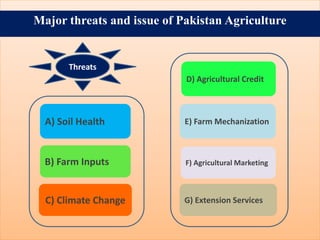
A) Soil Health
B) Farm Inputs
C) Climate Change
E) Farm Mechanization
F) Agricultural Marketing
G) Extension Services
D) Agricultural Credit
Major threats and issue of Pakistan Agriculture
Threats
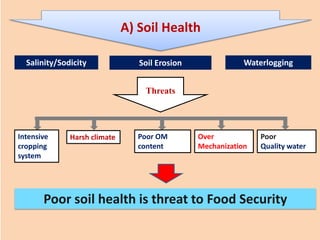
A) Soil Health
Threats
Poor
Quality water
Over
Mechanization
Intensive
cropping
system
Poor OM
content
Harsh climate
Poor soil health is threat to Food Security
Salinity/Sodicity Soil Erosion Waterlogging
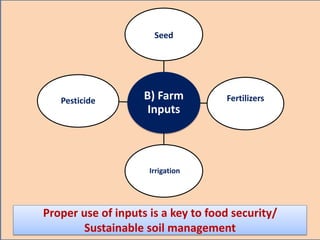
B) Farm
Inputs
Seed
Fertilizers
Irrigation
Pesticide
Proper use of inputs is a key to food security/
Sustainable soil management
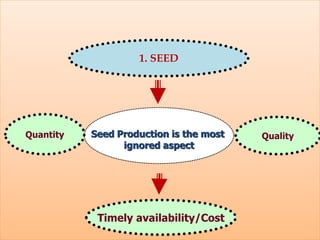
Seed Production is the most
ignored aspect
1. SEED
Timely availability/Cost
Quantity Quality
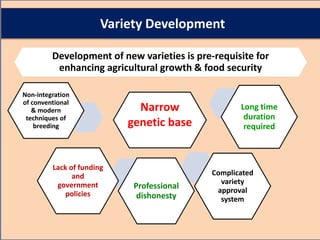
Narrow
genetic base
Development of new varieties is pre-requisite for
enhancing agricultural growth & food security
Long time
duration
required
Complicated
variety
approval
system
Professional
dishonesty
Lack of funding
and
government
policies
Non-integration
of conventional
& modern
techniques of
breeding
Variety Development
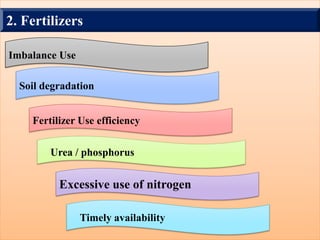
Fertilizer Use efficiency
Urea / phosphorus
Soil degradation
Imbalance Use
Timely availability
Excessive use of nitrogen
2. Fertilizers
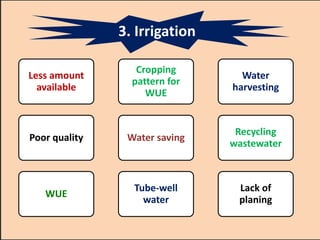
Less amount
available
Poor quality
WUE
Tube-well
water
Water saving
Cropping
pattern for
WUE
Water
harvesting
Recycling
wastewater
Lack of
planing
3. Irrigation
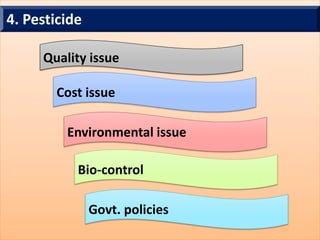
4. Pesticide
Bio-control
Govt. policies
Environmental issue
Cost issue
Quality issue
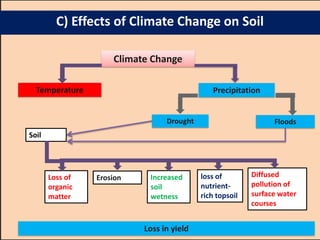
Climate Change
Temperature
Floods
Precipitation
Drought
Soil
Loss of
organic
matter
Erosion Diffused
pollution of
surface water
courses
loss of
nutrient-
rich topsoil
Increased
soil
wetness
C) Effects of Climate Change on Soil
Loss in yield
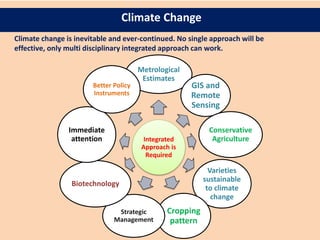
Climate Change
Climate change is inevitable and ever-continued. No single approach will be
effective, only multi disciplinary integrated approach can work.
Integrated
Approach is
Required
Metrological
Estimates
GIS and
Remote
Sensing
Conservative
Agriculture
Varieties
sustainable
to climate
change
Cropping
pattern
Strategic
Management
Biotechnology
Immediate
attention
Better Policy
Instruments
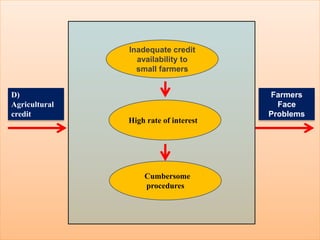
Inadequate credit
availability to
small farmers
High rate of interest
Cumbersome
procedures
D)
Agricultural
credit
Farmers
Face
Problems
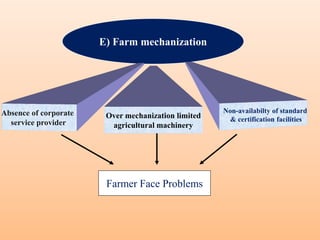
E) Farm mechanization
Absence of corporate
service provider
Non-availabilty of standard
& certification facilitiesOver mechanization limited
agricultural machinery
Farmer Face Problems
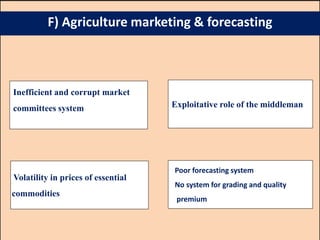
Inefficient and corrupt market
committees system Exploitative role of the middleman
Volatility in prices of essential
commodities
Poor forecasting system
No system for grading and quality
premium
F) Agriculture marketing & forecasting
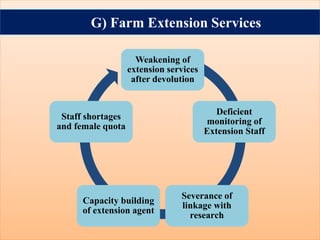
G) Farm Extension Services
Weakening of
extension services
after devolution
Deficient
monitoring of
Extension Staff
Severance of
linkage with
research
Capacity building
of extension agent
Staff shortages
and female quota
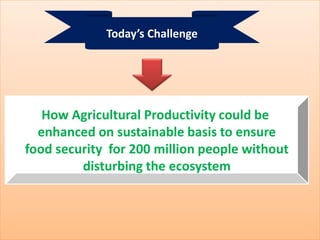
How Agricultural Productivity could be
enhanced on sustainable basis to ensure
food security for 200 million people without
disturbing the ecosystem
Today’s Challenge
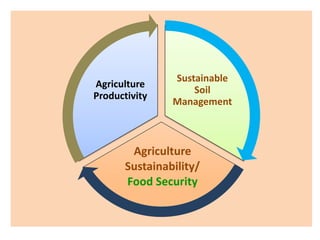
Sustainable
Soil
Management
Agriculture
Sustainability/
Food Security
Agriculture
Productivity
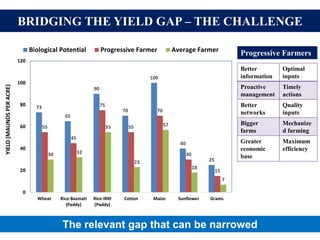
BRIDGING THE YIELD GAP – THE CHALLENGE
73
65
90
70
100
40
25
55
45
75
55
70
30
15
30 32
55
23
57
18
7
0
20
40
60
80
100
120
Wheat Rice-Basmati
(Paddy)
Rice-IRRI
(Paddy)
Cotton Maize Sunflower Grams
YIELD(MAUNDSPERACRE)
Biological Potential Progressive Farmer Average Farmer
Better
information
Optimal
inputs
Proactive
management
Timely
actions
Better
networks
Quality
inputs
Bigger
farms
Mechanize
d farming
Greater
economic
base
Maximum
efficiency
Progressive Farmers
The relevant gap that can be narrowed
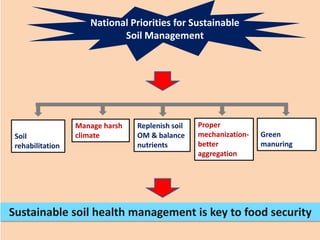
Green
manuring
Proper
mechanization-
better
aggregation
Soil
rehabilitation
Replenish soil
OM & balance
nutrients
Manage harsh
climate
Sustainable soil health management is key to food security
National Priorities for Sustainable
Soil Management
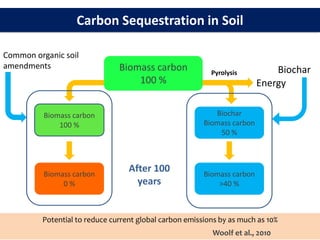
Carbon Sequestration in Soil
Biomass carbon
100 %
Biomass carbon
100 %
Biochar
Biomass carbon
50 %
Biomass carbon
0 %
Biomass carbon
>40 %
Energy
After 100
years
Common organic soil
amendments Biochar
Potential to reduce current global carbon emissions by as much as 10%
Woolf et al., 2010
Pyrolysis
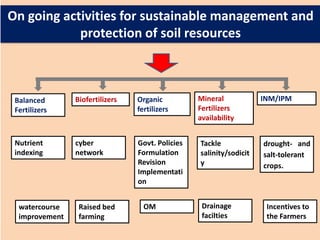
INM/IPMMineral
Fertilizers
availability
Balanced
Fertilizers
Organic
fertilizers
Biofertilizers
On going activities for sustainable management and
protection of soil resources
Nutrient
indexing
cyber
network
Govt. Policies
Formulation
Revision
Implementati
on
Tackle
salinity/sodicit
y
drought- and
salt-tolerant
crops.
watercourse
improvement
Raised bed
farming
OM Incentives to
the Farmers
Drainage
facilties
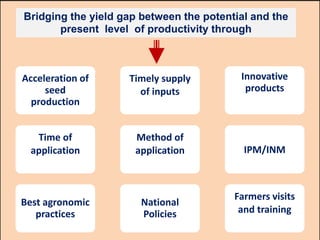
Bridging the yield gap between the potential and the
present level of productivity through
Acceleration of
seed
production
Time of
application
Best agronomic
practices
National
Policies
Method of
application
Timely supply
of inputs
Innovative
products
IPM/INM
Farmers visits
and training
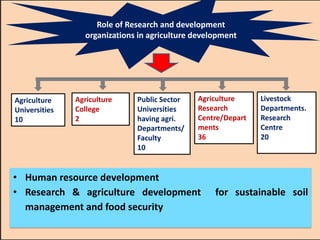
Livestock
Departments.
Research
Centre
20
Agriculture
Research
Centre/Depart
ments
36
Agriculture
Universities
10
Public Sector
Universities
having agri.
Departments/
Faculty
10
Agriculture
College
2
• Human resource development
• Research & agriculture development for sustainable soil
management and food security
Role of Research and development
organizations in agriculture development
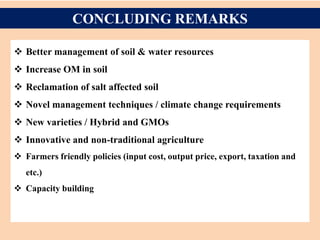
CONCLUDING REMARKS
 Better management of soil & water resources
 Increase OM in soil
 Reclamation of salt affected soil
 Novel management techniques / climate change requirements
 New varieties / Hybrid and GMOs
 Innovative and non-traditional agriculture
 Farmers friendly policies (input cost, output price, export, taxation and
etc.)
 Capacity building
Thanks…..!

Pakistan

  • 1.
    Prof. Dr. MuhammadArshad Tamgha-i-Imtiaz Distinguished National Professor President, Soil Science Society of Pakistan Dean, Faculty of Agriculture University of Agriculture, Faisalabad-Pakistan “Pakistan soil resources, issues, threats, ongoing activities and their sustainable management Asian Soil Partnership Consultation Workshop on Sustainable Management and Protection of Soil Resources (Bangkok, Thailand: 13-15 MAY, 2015)
  • 2.
    National Soil Resourcesof Pakistan Total area 79.6 mha Semiarid 36.9% Sub-humid 5.4% Mixed 6.2% Forest area 3.5 mha Canal irrigated 25 % Tube well irrigated =75 % Cultivated area 22 mha (27.6%) Arid 41 mha Deserts (climate hyper-arid) 11 mha Rangelands 45.2 mha (60.1%) Salt: affected area 6.69 mha
  • 3.
    Importance of Pakistanin World of Agriculture • Wheat (9th) • Cotton (4th) • Rice (8th) • Sugarcane (4th) • Mango (7th) • Apricot (4th) • Onion (5th) • Date Palm (6th) • Oranges (10th) Pakistan ranks 20th worldwide in farm output. 3
  • 4.
    Growth Rates (%) GDPAgriculture Manufacturing Services 1960s 6.8 5.1 9.9 6.7 1970s 4.8 2.4 5.5 6.3 1980s 6.5 5.4 8.2 6.7 1990s 4.6 4.4 4.8 4.6 2000s 4.8 3.2 7.0 5.3 2012-13 3.6 3.3 3.4 3.7
  • 5.
    Challenge I: Population 5 YearPopulation Million 2015 188.1 2020 203.5 2025 218.1 2030 231.7 s
  • 6.
    Future crop productionestimates (m tons) Crop Current 2015 2030 Wheat 21.7 25.4 33.0 Cotton (m bales) 12.4 21.5 29.2 Rice 5.5 7.5 8.5 Sugarcane 44.6 - - Maize 3.1 - -
  • 7.
    A) Soil Health B)Farm Inputs C) Climate Change E) Farm Mechanization F) Agricultural Marketing G) Extension Services D) Agricultural Credit Major threats and issue of Pakistan Agriculture Threats
  • 8.
    A) Soil Health Threats Poor Qualitywater Over Mechanization Intensive cropping system Poor OM content Harsh climate Poor soil health is threat to Food Security Salinity/Sodicity Soil Erosion Waterlogging
  • 9.
    B) Farm Inputs Seed Fertilizers Irrigation Pesticide Proper useof inputs is a key to food security/ Sustainable soil management
  • 10.
    Seed Production isthe most ignored aspect 1. SEED Timely availability/Cost Quantity Quality
  • 11.
    Narrow genetic base Development ofnew varieties is pre-requisite for enhancing agricultural growth & food security Long time duration required Complicated variety approval system Professional dishonesty Lack of funding and government policies Non-integration of conventional & modern techniques of breeding Variety Development
  • 12.
    Fertilizer Use efficiency Urea/ phosphorus Soil degradation Imbalance Use Timely availability Excessive use of nitrogen 2. Fertilizers
  • 13.
    Less amount available Poor quality WUE Tube-well water Watersaving Cropping pattern for WUE Water harvesting Recycling wastewater Lack of planing 3. Irrigation
  • 14.
  • 15.
    Climate Change Temperature Floods Precipitation Drought Soil Loss of organic matter ErosionDiffused pollution of surface water courses loss of nutrient- rich topsoil Increased soil wetness C) Effects of Climate Change on Soil Loss in yield
  • 16.
    Climate Change Climate changeis inevitable and ever-continued. No single approach will be effective, only multi disciplinary integrated approach can work. Integrated Approach is Required Metrological Estimates GIS and Remote Sensing Conservative Agriculture Varieties sustainable to climate change Cropping pattern Strategic Management Biotechnology Immediate attention Better Policy Instruments
  • 17.
    Inadequate credit availability to smallfarmers High rate of interest Cumbersome procedures D) Agricultural credit Farmers Face Problems
  • 18.
    E) Farm mechanization Absenceof corporate service provider Non-availabilty of standard & certification facilitiesOver mechanization limited agricultural machinery Farmer Face Problems
  • 19.
    Inefficient and corruptmarket committees system Exploitative role of the middleman Volatility in prices of essential commodities Poor forecasting system No system for grading and quality premium F) Agriculture marketing & forecasting
  • 20.
    G) Farm ExtensionServices Weakening of extension services after devolution Deficient monitoring of Extension Staff Severance of linkage with research Capacity building of extension agent Staff shortages and female quota
  • 21.
    How Agricultural Productivitycould be enhanced on sustainable basis to ensure food security for 200 million people without disturbing the ecosystem Today’s Challenge
  • 22.
  • 23.
    BRIDGING THE YIELDGAP – THE CHALLENGE 73 65 90 70 100 40 25 55 45 75 55 70 30 15 30 32 55 23 57 18 7 0 20 40 60 80 100 120 Wheat Rice-Basmati (Paddy) Rice-IRRI (Paddy) Cotton Maize Sunflower Grams YIELD(MAUNDSPERACRE) Biological Potential Progressive Farmer Average Farmer Better information Optimal inputs Proactive management Timely actions Better networks Quality inputs Bigger farms Mechanize d farming Greater economic base Maximum efficiency Progressive Farmers The relevant gap that can be narrowed
  • 24.
    Green manuring Proper mechanization- better aggregation Soil rehabilitation Replenish soil OM &balance nutrients Manage harsh climate Sustainable soil health management is key to food security National Priorities for Sustainable Soil Management
  • 25.
    Carbon Sequestration inSoil Biomass carbon 100 % Biomass carbon 100 % Biochar Biomass carbon 50 % Biomass carbon 0 % Biomass carbon >40 % Energy After 100 years Common organic soil amendments Biochar Potential to reduce current global carbon emissions by as much as 10% Woolf et al., 2010 Pyrolysis
  • 26.
    INM/IPMMineral Fertilizers availability Balanced Fertilizers Organic fertilizers Biofertilizers On going activitiesfor sustainable management and protection of soil resources Nutrient indexing cyber network Govt. Policies Formulation Revision Implementati on Tackle salinity/sodicit y drought- and salt-tolerant crops. watercourse improvement Raised bed farming OM Incentives to the Farmers Drainage facilties
  • 27.
    Bridging the yieldgap between the potential and the present level of productivity through Acceleration of seed production Time of application Best agronomic practices National Policies Method of application Timely supply of inputs Innovative products IPM/INM Farmers visits and training
  • 28.
    Livestock Departments. Research Centre 20 Agriculture Research Centre/Depart ments 36 Agriculture Universities 10 Public Sector Universities having agri. Departments/ Faculty 10 Agriculture College 2 •Human resource development • Research & agriculture development for sustainable soil management and food security Role of Research and development organizations in agriculture development
  • 29.
    CONCLUDING REMARKS  Bettermanagement of soil & water resources  Increase OM in soil  Reclamation of salt affected soil  Novel management techniques / climate change requirements  New varieties / Hybrid and GMOs  Innovative and non-traditional agriculture  Farmers friendly policies (input cost, output price, export, taxation and etc.)  Capacity building
  • 30.