NCMP-102
LEC
PAIN
ASSESSMENT
Soltes | Bustamante | Pasibe | Bengoa
OBJECTIVES
1
2
3
Explain the pathophysiology of
pain.
Differentiate between the etiology of
acute and chronic pain.
Discuss the various physiologic response
to pain.
OBJECTIVES
CONT.
4
5
6
Assess pain as the fifth vital sign
Initiate an interview with the client and
ask about their experience with the pain.
Perform a physical assessment of the
client experiencing pain.
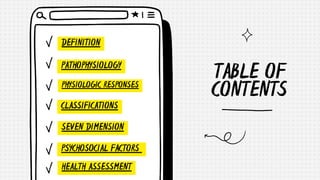
TABLE OF
CONTENTS
DEFINITION
PHYSIOLOGIC RESPONSES
CLASSIFICATIONS
SEVEN DIMENSION
PSYCHOSOCIAL FACTORS
PATHOPHYSIOLOGY
HEALTH ASSESSMENT
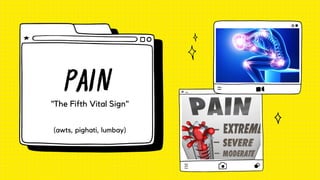
PAIN
(awts, pighati, lumbay)
"The Fifth Vital Sign"
PAIN
"An unpleasant sensory
and emotional experience,
which we primarily
associate with tissue
damage or describe in
terms of such damage."
- International Association for the study of Pain, 2011
PAIN
"Pain is whatever the
person says it is"
- McCaffery and Pasero
PAIN
"Pain is a combination of
physiologic phenomena
but with psychosocial
aspects that influence
perception of the pain."
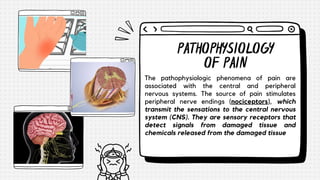
The pathophysiologic phenomena of pain are
associated with the central and peripheral
nervous systems. The source of pain stimulates
peripheral nerve endings (nociceptors), which
transmit the sensations to the central nervous
system (CNS). They are sensory receptors that
detect signals from damaged tissue and
chemicals released from the damaged tissue
PATHOPHYSIOLOGY
OF PAIN
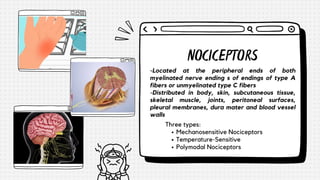
-Located at the peripheral ends of both
myelinated nerve ending s of endings of type A
fibers or unmyelinated type C fibers
-Distributed in body, skin, subcutaneous tissue,
skeletal muscle, joints, peritoneal surfaces,
pleural membranes, dura mater and blood vessel
walls
NOCICEPTORS
Mechanosensitive Nociceptors
Temperature-Sensitive
Polymodal Nociceptors
Three types:
-Involved in pain perception (nociception)
PHYSIOLOGIC PROCESSES
Transduction
Transmission
Perception
Modulation
- Begins when a mechanical, thermal, or chemical
stimulus results in tissue injury or damage stimulating
the nociceptor, which are the primary afferent nerves
for receiving painful stimuli.
TRANSDUCTION
TRANSMISSION
- Initiated by this inflammatory process resulting in the
conduction of an impulse in the primary afferent
neurons to the dorsal horn of the spinal cord.
- still poorly understood.
-Studies have shown that emotional status (depression
and anxiety) affects directly the pain perceived and
thus reported by clients.
PERCEPTION
MODULATION
-Is a difficult phenomenon to explain.
Modulation changes or inhibits the pain message relay
in the spinal cord. The descending modular pain
pathways either increase (excite) or inhibit pain
transmission
PHYSIOLOGIC
RESPONSES
TO PAIN
Pain Elicits a stress responses in the
human body that triggers the
sympathetic nervous system, resulting
in physiologic responses such as:
Anxiety, fear, hopelessness, sleeplessness,
thoughts of suicide
Focus on pain, reports on pain, cries and
moans, frowns and facial grimaces
decrease in cognitive function, mental
confusion, altered temperament, high
somatization and dilated pupils.
Increased heart rate, peripheral systemic, and
coronary vascular resistance, increase blood
pressure
Increased respiratory rate and sputum
retention, resulting in infection and atelectasis.
PHYSIOLOGIC
RESPONSES
TO PAIN
CONT.
Decreased gastric and intestinal motility
Decreased urinary output, resulting in urinary
retention, fluid overload, depression of all
immune responses
Increased antidiuretic hormone, epinephrine,
norepinephrine, aldosterone, glucagons,
decreased insulin, testosterone
Hyperglycemia, glucose intolerance, insulin
resistance, protein catabolism
Muscle spasm, resulting in impaired muscle
function and immobility, perspiration.
LET'S HAVE A
GAME
Take a Picture
of:
A Hybrid Bring
ME
MECHANICS
Take a Picture of a
subject depending on the
topic given.
Ex.
(A picture of an object
starting with Letter B
*Balloon* put it on top of your
head)
(An Object that is liquid and
clear, Place it on top of your
feet.)
MECHANICS
Send your photos
through our Group Chat
in NCMP102 LEC
Type the name of the
Object
First to Send that meets
the mechanics will win
TAKE NOTE: With Prizes
PRACTICE
ROUND
An Object that is on
your desk starting
with Letter P.
Place it on the top of
your lap
FIRST
ROUND
An Object that
starts with letter A.
Place it near your
ears
SECOND
ROUND
An Object that is
found in your Room,
starting with I
Place it on the tip of
your nose
THIRD
ROUND
An Object that
might cause pain
starts with N
Place it on a chair
CLASSIFICATIONS
OF
PAIN
CLASSIFICATIONS
OF
PAIN
ACUTE PAIN
CHRONIC NONMALIGNANT PAIN
CANCER PAIN
NOCICEPTIVE
NEUROPHATIC
INFLAMMATORY
INTRACTABLE PAIN
BY CAUSE
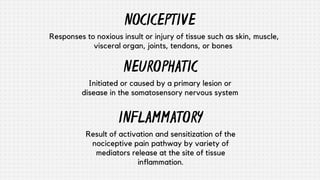
NOCICEPTIVE
NEUROPHATIC
Initiated or caused by a primary lesion or
disease in the somatosensory nervous system
Responses to noxious insult or injury of tissue such as skin, muscle,
visceral organ, joints, tendons, or bones
INFLAMMATORY
Result of activation and sensitization of the
nociceptive pain pathway by variety of
mediators release at the site of tissue
inflammation.
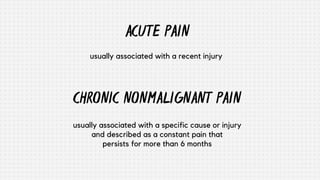
ACUTE PAIN
CHRONIC NONMALIGNANT PAIN
usually associated with a specific cause or injury
and described as a constant pain that
persists for more than 6 months
usually associated with a recent injury
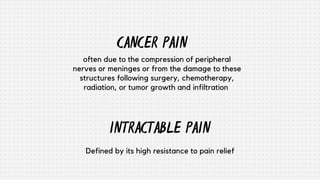
INTRACTABLE PAIN
Defined by its high resistance to pain relief
often due to the compression of peripheral
nerves or meninges or from the damage to these
structures following surgery, chemotherapy,
radiation, or tumor growth and infiltration
CANCER PAIN
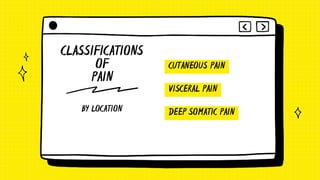
CLASSIFICATIONS
OF
PAIN
CUTANEOUS PAIN
VISCERAL PAIN
DEEP SOMATIC PAIN
BY LOCATION
Skin or Subcutaneous tissue
VISCERAL PAIN
CUTANEOUS PAIN
Abdominal cavity, thorax, cranium
DEEP SOMATIC PAIN
Ligaments, tendons, bones blood vessel, nerves
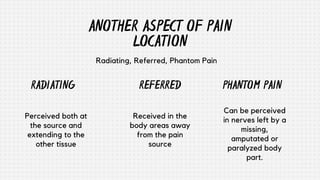
PHANTOM PAIN
ANOTHER ASPECT OF PAIN
LOCATION
Radiating, Referred, Phantom Pain
Can be perceived
in nerves left by a
missing,
amputated or
paralyzed body
part.
REFERRED
RADIATING
Received in the
body areas away
from the pain
source
Perceived both at
the source and
extending to the
other tissue
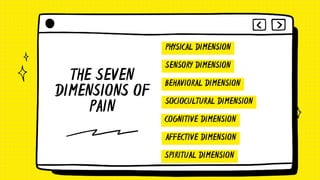
THE SEVEN
DIMENSIONS OF
PAIN
PHYSICAL DIMENSION
SENSORY DIMENSION
BEHAVIORAL DIMENSION
SOCIOCULTURAL DIMENSION
COGNITIVE DIMENSION
SPIRITUAL DIMENSION
AFFECTIVE DIMENSION
PHYSICAL DIMENSION
- the physiologic effects jus described
SENSORY DIMENSION
- the quality of the pain and how severe the pain is perceived
BEHAVIORAL DIMENSION
- the verbal and nonverbal that the patient demonstrates
as response
SOCIOCULTURAL DIMENSION
- concern the influences of the patient's social context
and cultural background on the pain experience
COGNITIVE DIMENSION
- concerns
'beliefs, attitudes, intentions, and motivations related to its management
AFFECTIVE DIMENSION
- concerns feelings, sentiments, and emotions related to pain experience
SPIRITUAL DIMENSION
- refers to the meaning and purpose that the person
"attributes to the pain, self, others, and divine."
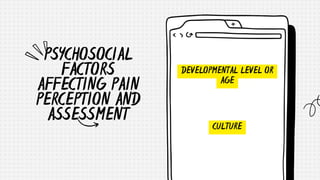
PSYCHOSOCIAL
FACTORS
AFFECTING PAIN
PERCEPTION AND
ASSESSMENT
DEVELOPMENTAL LEVEL OR
AGE
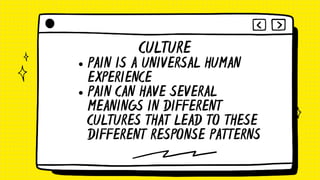
CULTURE
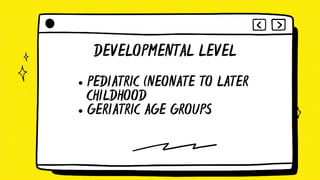
PEDIATRIC (NEONATE TO LATER
CHILDHOOD
GERIATRIC AGE GROUPS
DEVELOPMENTAL LEVEL
PAIN IS A UNIVERSAL HUMAN
EXPERIENCE
PAIN CAN HAVE SEVERAL
MEANINGS IN DIFFERENT
CULTURES THAT LEAD TO THESE
DIFFERENT RESPONSE PATTERNS
CULTURE
PAIN ASSESSMENT TOOLS
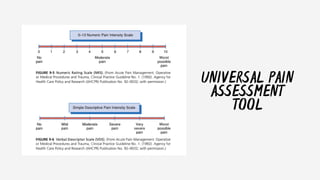
UNIVERSAL PAIN
ASSESSMENT
TOOL
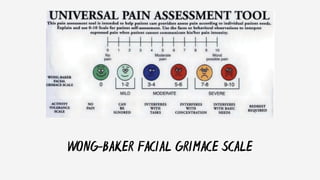
WONG-BAKER FACIAL GRIMACE SCALE
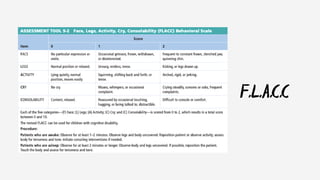
F.L.A.C.C
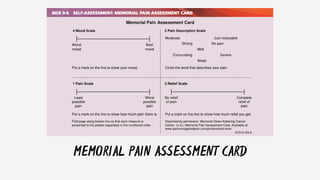
MEMORIAL PAIN ASSESSMENT CARD
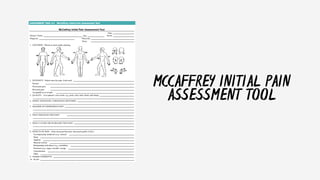
MCCAFFREY INITIAL PAIN
ASSESSMENT TOOL
THANK YOU!

Pain Assessment.pdf

  • 1.
  • 2.
    OBJECTIVES 1 2 3 Explain the pathophysiologyof pain. Differentiate between the etiology of acute and chronic pain. Discuss the various physiologic response to pain.
  • 3.
    OBJECTIVES CONT. 4 5 6 Assess pain asthe fifth vital sign Initiate an interview with the client and ask about their experience with the pain. Perform a physical assessment of the client experiencing pain.
  • 4.
    TABLE OF CONTENTS DEFINITION PHYSIOLOGIC RESPONSES CLASSIFICATIONS SEVENDIMENSION PSYCHOSOCIAL FACTORS PATHOPHYSIOLOGY HEALTH ASSESSMENT
  • 5.
  • 6.
    PAIN "An unpleasant sensory andemotional experience, which we primarily associate with tissue damage or describe in terms of such damage." - International Association for the study of Pain, 2011
  • 7.
    PAIN "Pain is whateverthe person says it is" - McCaffery and Pasero
  • 8.
    PAIN "Pain is acombination of physiologic phenomena but with psychosocial aspects that influence perception of the pain."
  • 9.
    The pathophysiologic phenomenaof pain are associated with the central and peripheral nervous systems. The source of pain stimulates peripheral nerve endings (nociceptors), which transmit the sensations to the central nervous system (CNS). They are sensory receptors that detect signals from damaged tissue and chemicals released from the damaged tissue PATHOPHYSIOLOGY OF PAIN
  • 10.
    -Located at theperipheral ends of both myelinated nerve ending s of endings of type A fibers or unmyelinated type C fibers -Distributed in body, skin, subcutaneous tissue, skeletal muscle, joints, peritoneal surfaces, pleural membranes, dura mater and blood vessel walls NOCICEPTORS Mechanosensitive Nociceptors Temperature-Sensitive Polymodal Nociceptors Three types:
  • 11.
    -Involved in painperception (nociception) PHYSIOLOGIC PROCESSES Transduction Transmission Perception Modulation
  • 12.
    - Begins whena mechanical, thermal, or chemical stimulus results in tissue injury or damage stimulating the nociceptor, which are the primary afferent nerves for receiving painful stimuli. TRANSDUCTION TRANSMISSION - Initiated by this inflammatory process resulting in the conduction of an impulse in the primary afferent neurons to the dorsal horn of the spinal cord.
  • 13.
    - still poorlyunderstood. -Studies have shown that emotional status (depression and anxiety) affects directly the pain perceived and thus reported by clients. PERCEPTION MODULATION -Is a difficult phenomenon to explain. Modulation changes or inhibits the pain message relay in the spinal cord. The descending modular pain pathways either increase (excite) or inhibit pain transmission
  • 14.
    PHYSIOLOGIC RESPONSES TO PAIN Pain Elicitsa stress responses in the human body that triggers the sympathetic nervous system, resulting in physiologic responses such as: Anxiety, fear, hopelessness, sleeplessness, thoughts of suicide Focus on pain, reports on pain, cries and moans, frowns and facial grimaces decrease in cognitive function, mental confusion, altered temperament, high somatization and dilated pupils. Increased heart rate, peripheral systemic, and coronary vascular resistance, increase blood pressure Increased respiratory rate and sputum retention, resulting in infection and atelectasis.
  • 15.
    PHYSIOLOGIC RESPONSES TO PAIN CONT. Decreased gastricand intestinal motility Decreased urinary output, resulting in urinary retention, fluid overload, depression of all immune responses Increased antidiuretic hormone, epinephrine, norepinephrine, aldosterone, glucagons, decreased insulin, testosterone Hyperglycemia, glucose intolerance, insulin resistance, protein catabolism Muscle spasm, resulting in impaired muscle function and immobility, perspiration.
  • 16.
    LET'S HAVE A GAME Takea Picture of: A Hybrid Bring ME
  • 17.
    MECHANICS Take a Pictureof a subject depending on the topic given. Ex. (A picture of an object starting with Letter B *Balloon* put it on top of your head) (An Object that is liquid and clear, Place it on top of your feet.)
  • 18.
    MECHANICS Send your photos throughour Group Chat in NCMP102 LEC Type the name of the Object First to Send that meets the mechanics will win TAKE NOTE: With Prizes
  • 19.
    PRACTICE ROUND An Object thatis on your desk starting with Letter P. Place it on the top of your lap
  • 20.
    FIRST ROUND An Object that startswith letter A. Place it near your ears
  • 21.
    SECOND ROUND An Object thatis found in your Room, starting with I Place it on the tip of your nose
  • 22.
    THIRD ROUND An Object that mightcause pain starts with N Place it on a chair
  • 23.
  • 24.
    CLASSIFICATIONS OF PAIN ACUTE PAIN CHRONIC NONMALIGNANTPAIN CANCER PAIN NOCICEPTIVE NEUROPHATIC INFLAMMATORY INTRACTABLE PAIN BY CAUSE
  • 25.
    NOCICEPTIVE NEUROPHATIC Initiated or causedby a primary lesion or disease in the somatosensory nervous system Responses to noxious insult or injury of tissue such as skin, muscle, visceral organ, joints, tendons, or bones INFLAMMATORY Result of activation and sensitization of the nociceptive pain pathway by variety of mediators release at the site of tissue inflammation.
  • 26.
    ACUTE PAIN CHRONIC NONMALIGNANTPAIN usually associated with a specific cause or injury and described as a constant pain that persists for more than 6 months usually associated with a recent injury
  • 27.
    INTRACTABLE PAIN Defined byits high resistance to pain relief often due to the compression of peripheral nerves or meninges or from the damage to these structures following surgery, chemotherapy, radiation, or tumor growth and infiltration CANCER PAIN
  • 28.
  • 29.
    Skin or Subcutaneoustissue VISCERAL PAIN CUTANEOUS PAIN Abdominal cavity, thorax, cranium DEEP SOMATIC PAIN Ligaments, tendons, bones blood vessel, nerves
  • 30.
    PHANTOM PAIN ANOTHER ASPECTOF PAIN LOCATION Radiating, Referred, Phantom Pain Can be perceived in nerves left by a missing, amputated or paralyzed body part. REFERRED RADIATING Received in the body areas away from the pain source Perceived both at the source and extending to the other tissue
  • 31.
    THE SEVEN DIMENSIONS OF PAIN PHYSICALDIMENSION SENSORY DIMENSION BEHAVIORAL DIMENSION SOCIOCULTURAL DIMENSION COGNITIVE DIMENSION SPIRITUAL DIMENSION AFFECTIVE DIMENSION
  • 32.
    PHYSICAL DIMENSION - thephysiologic effects jus described SENSORY DIMENSION - the quality of the pain and how severe the pain is perceived BEHAVIORAL DIMENSION - the verbal and nonverbal that the patient demonstrates as response SOCIOCULTURAL DIMENSION - concern the influences of the patient's social context and cultural background on the pain experience
  • 33.
    COGNITIVE DIMENSION - concerns 'beliefs,attitudes, intentions, and motivations related to its management AFFECTIVE DIMENSION - concerns feelings, sentiments, and emotions related to pain experience SPIRITUAL DIMENSION - refers to the meaning and purpose that the person "attributes to the pain, self, others, and divine."
  • 34.
  • 35.
    PEDIATRIC (NEONATE TOLATER CHILDHOOD GERIATRIC AGE GROUPS DEVELOPMENTAL LEVEL
  • 36.
    PAIN IS AUNIVERSAL HUMAN EXPERIENCE PAIN CAN HAVE SEVERAL MEANINGS IN DIFFERENT CULTURES THAT LEAD TO THESE DIFFERENT RESPONSE PATTERNS CULTURE
  • 37.
  • 38.
  • 39.
  • 40.
  • 41.
  • 42.
  • 43.