Pages 245-146, Exercise 14

Using relative pronouns when, that
                 or 0
(0 = no relative pronoun is needed)
Pages 245-146, Exercise 14

In this exercise, you need to
  think about two different
           factors:
When you use when as a relative
pronoun, it’s because the embedded
    sentence has a preposition.

                    AND
   You can leave out the pronoun when
       it stands for an object in the
            embedded sentence.
#1. Six o’clock is the time
 _________ the auction
           stops
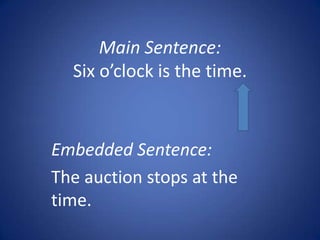
Main Sentence:
  Six o’clock is the time.


Embedded Sentence:
The auction stops at the
time.
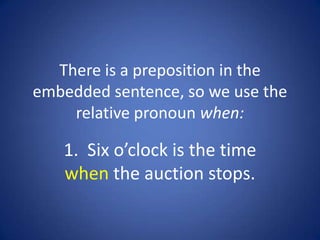
There is a preposition in the
embedded sentence, so we use the
    relative pronoun when:

   1. Six o’clock is the time
   when the auction stops.
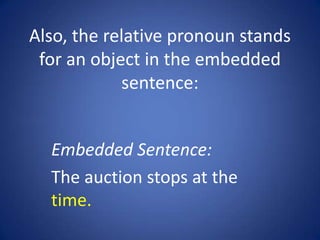
Also, the relative pronoun stands
 for an object in the embedded
            sentence:


  Embedded Sentence:
  The auction stops at the
  time.
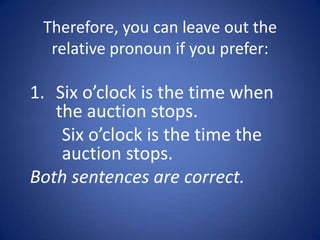
Therefore, you can leave out the
  relative pronoun if you prefer:

1. Six o’clock is the time when
   the auction stops.
    Six o’clock is the time the
    auction stops.
Both sentences are correct.
2. Do you remember the year
  _________ Meg Whitman
  started to work for eBay?
Main Sentence:
Do you remember the year?


Embedded Sentence:
Meg Whitman started to
work for eBay in the year.
There is a preposition in the
   embedded sentence:


Embedded Sentence:
Meg Whitman started to
work for eBay in the year.
Therefore, use relative pronoun
             when:


  2. Do you remember the
  year when Meg Whitman
  started to work for eBay?
Also, the relative pronoun stands
 for an object in the embedded
            sentence:


  Embedded Sentence:
  Meg Whitman started to
  work for eBay in the year.
Therefore, you can leave out the
      relative pronoun if you prefer:

2.     Do you remember the year when Meg
       Whitman started to work for eBay?

       Do you remember the year Meg
       Whitman started to work for eBay?

Both sentences are correct.
3. 2008 was a year _______
       had 366 days.
Main Sentence:
     2008 was a year.


Embedded Sentence:
The year had 366 days.
There is no preposition in the
embedded sentence, so we use the
 relative pronoun that or which:

    3. 2008 was a year that
         had 366 days.
Also, the relative pronoun stands
for the subject in the embedded
            sentence:


  Embedded Sentence:
  The year had 266 days.
Therefore, it is not possible to
  omit the relative pronoun.

You can use either that or which,
   but the relative pronoun is
            required.
4. New Year’s Eve is a time
   ___________ I love.
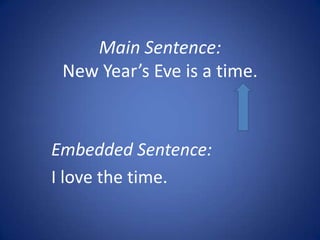
Main Sentence:
 New Year’s Eve is a time.


Embedded Sentence:
I love the time.
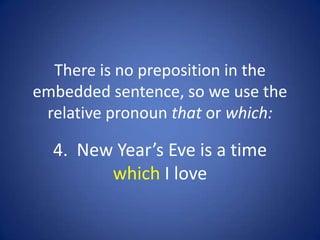
There is no preposition in the
embedded sentence, so we use the
 relative pronoun that or which:

  4. New Year’s Eve is a time
        which I love
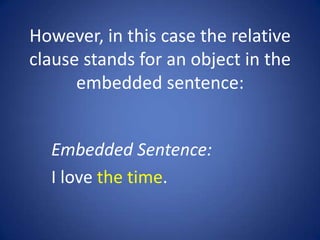
However, in this case the relative
clause stands for an object in the
      embedded sentence:


  Embedded Sentence:
  I love the time.
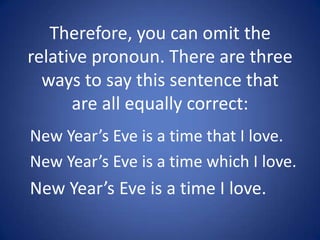
Therefore, you can omit the
relative pronoun. There are three
  ways to say this sentence that
      are all equally correct:
New Year’s Eve is a time that I love.
New Year’s Eve is a time which I love.
New Year’s Eve is a time I love.
Now you try it:

5. February is the only month
 __________ has fewer than
           30days.
Main Sentence:
February is the only month.


Embedded Sentence:
February has fewer than 30
days.
Ask yourself:
• Does the embedded
     sentence have a
       preposition?
 • Does the relative
  pronoun stand for the
  subject or the object?
Now you try it:

6. My birthday is a day
________ I think about my
past.
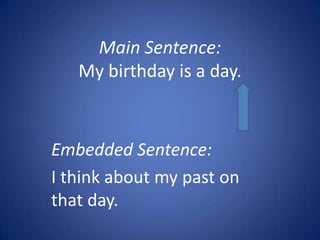
Main Sentence:
   My birthday is a day.


Embedded Sentence:
I think about my past on
that day.
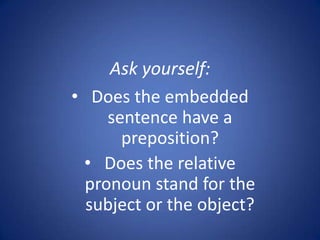
Ask yourself:
• Does the embedded
     sentence have a
       preposition?
 • Does the relative
  pronoun stand for the
  subject or the object?
Now you’re on your own!

Pages 245 246 exercise 14

  • 1.
    Pages 245-146, Exercise14 Using relative pronouns when, that or 0 (0 = no relative pronoun is needed)
  • 2.
    Pages 245-146, Exercise14 In this exercise, you need to think about two different factors:
  • 3.
    When you usewhen as a relative pronoun, it’s because the embedded sentence has a preposition. AND You can leave out the pronoun when it stands for an object in the embedded sentence.
  • 4.
    #1. Six o’clockis the time _________ the auction stops
  • 5.
    Main Sentence: Six o’clock is the time. Embedded Sentence: The auction stops at the time.
  • 6.
    There is apreposition in the embedded sentence, so we use the relative pronoun when: 1. Six o’clock is the time when the auction stops.
  • 7.
    Also, the relativepronoun stands for an object in the embedded sentence: Embedded Sentence: The auction stops at the time.
  • 8.
    Therefore, you canleave out the relative pronoun if you prefer: 1. Six o’clock is the time when the auction stops. Six o’clock is the time the auction stops. Both sentences are correct.
  • 9.
    2. Do youremember the year _________ Meg Whitman started to work for eBay?
  • 10.
    Main Sentence: Do youremember the year? Embedded Sentence: Meg Whitman started to work for eBay in the year.
  • 11.
    There is apreposition in the embedded sentence: Embedded Sentence: Meg Whitman started to work for eBay in the year.
  • 12.
    Therefore, use relativepronoun when: 2. Do you remember the year when Meg Whitman started to work for eBay?
  • 13.
    Also, the relativepronoun stands for an object in the embedded sentence: Embedded Sentence: Meg Whitman started to work for eBay in the year.
  • 14.
    Therefore, you canleave out the relative pronoun if you prefer: 2. Do you remember the year when Meg Whitman started to work for eBay? Do you remember the year Meg Whitman started to work for eBay? Both sentences are correct.
  • 15.
    3. 2008 wasa year _______ had 366 days.
  • 16.
    Main Sentence: 2008 was a year. Embedded Sentence: The year had 366 days.
  • 17.
    There is nopreposition in the embedded sentence, so we use the relative pronoun that or which: 3. 2008 was a year that had 366 days.
  • 18.
    Also, the relativepronoun stands for the subject in the embedded sentence: Embedded Sentence: The year had 266 days.
  • 19.
    Therefore, it isnot possible to omit the relative pronoun. You can use either that or which, but the relative pronoun is required.
  • 20.
    4. New Year’sEve is a time ___________ I love.
  • 21.
    Main Sentence: NewYear’s Eve is a time. Embedded Sentence: I love the time.
  • 22.
    There is nopreposition in the embedded sentence, so we use the relative pronoun that or which: 4. New Year’s Eve is a time which I love
  • 23.
    However, in thiscase the relative clause stands for an object in the embedded sentence: Embedded Sentence: I love the time.
  • 24.
    Therefore, you canomit the relative pronoun. There are three ways to say this sentence that are all equally correct: New Year’s Eve is a time that I love. New Year’s Eve is a time which I love. New Year’s Eve is a time I love.
  • 25.
    Now you tryit: 5. February is the only month __________ has fewer than 30days.
  • 26.
    Main Sentence: February isthe only month. Embedded Sentence: February has fewer than 30 days.
  • 27.
    Ask yourself: • Doesthe embedded sentence have a preposition? • Does the relative pronoun stand for the subject or the object?
  • 28.
    Now you tryit: 6. My birthday is a day ________ I think about my past.
  • 29.
    Main Sentence: My birthday is a day. Embedded Sentence: I think about my past on that day.
  • 30.
    Ask yourself: • Doesthe embedded sentence have a preposition? • Does the relative pronoun stand for the subject or the object?
  • 31.
    Now you’re onyour own!