Page replacement algorithms
        Ubaidullah alias kashif
             MSCCN-III
             Sukkur IBA.
Paging:- In computer operating systems, paging
is one of the memory-management schemes by
which a computer can store and retrieve data
from secondary storage for use in main
memory.
Page fault The main functions of paging are
performed when a program tries to access
pages that are not currently mapped to physical
memory (RAM). This situation is known as a
page fault.
Page replacement algorithm
Page replacement algorithms decide which
memory pages to page out (swap out, write
to disk) when a page of memory needs to be
allocated.
 Paging happens when a page fault occurs and
a free page cannot be used to satisfy the
allocation, either because there are none, or
because the number of free pages is lower
than some threshold.
Clock


The clock algorithm keeps a circular list of pages in
memory, with the "hand" (iterator) pointing to the last
examined page frame in the list.
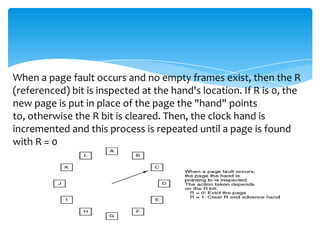
When a page fault occurs and no empty frames exist, then the R
(referenced) bit is inspected at the hand's location. If R is 0, the
new page is put in place of the page the "hand" points
to, otherwise the R bit is cleared. Then, the clock hand is
incremented and this process is repeated until a page is found
with R = 0
LRU & NRU


LRU keeps track of page usage over a short period of
time, while NRU just looks at the usage in the last
clock interval.
Adaptive replacement cache

ARC improves the basic LRU strategy by splitting the
cache directory into two lists, T1 and T2, for recently
and frequently referenced entries.
In turn, each of these is extended with a ghost list (B1
or B2), which is attached to the bottom of the two
lists. These ghost lists act as scorecards by keeping
track of the history of recently evicted (expelled)
cache entries, and the algorithm uses ghost hits to
adapt to recent change in resource usage.
T1, for recent cache entries.
T2, for frequent entries, referenced at least twice.
B1, ghost entries recently evicted from the T1 cache, but are still
tracked.
B2, similar ghost entries, but evicted from T2.
T1 and B1 together are referred to as L1, a combined history of
recent single references. Similarly, L2 is the combination of T2
and B2
...[    B1     <-[         T1          <-!-> T2    ]->  B2 ] . ….
   [ ……………. . . . [ . . . . . . ! . .^. …………...... ] …… . . . ]
                  [       fixed cache size (c)      ]

Page Replacement Algorithms

  • 1.
    Page replacement algorithms Ubaidullah alias kashif MSCCN-III Sukkur IBA.
  • 2.
    Paging:- In computeroperating systems, paging is one of the memory-management schemes by which a computer can store and retrieve data from secondary storage for use in main memory. Page fault The main functions of paging are performed when a program tries to access pages that are not currently mapped to physical memory (RAM). This situation is known as a page fault.
  • 3.
    Page replacement algorithm Pagereplacement algorithms decide which memory pages to page out (swap out, write to disk) when a page of memory needs to be allocated. Paging happens when a page fault occurs and a free page cannot be used to satisfy the allocation, either because there are none, or because the number of free pages is lower than some threshold.
  • 4.
    Clock The clock algorithmkeeps a circular list of pages in memory, with the "hand" (iterator) pointing to the last examined page frame in the list.
  • 5.
    When a pagefault occurs and no empty frames exist, then the R (referenced) bit is inspected at the hand's location. If R is 0, the new page is put in place of the page the "hand" points to, otherwise the R bit is cleared. Then, the clock hand is incremented and this process is repeated until a page is found with R = 0
  • 6.
    LRU & NRU LRUkeeps track of page usage over a short period of time, while NRU just looks at the usage in the last clock interval.
  • 7.
    Adaptive replacement cache ARCimproves the basic LRU strategy by splitting the cache directory into two lists, T1 and T2, for recently and frequently referenced entries. In turn, each of these is extended with a ghost list (B1 or B2), which is attached to the bottom of the two lists. These ghost lists act as scorecards by keeping track of the history of recently evicted (expelled) cache entries, and the algorithm uses ghost hits to adapt to recent change in resource usage.
  • 8.
    T1, for recentcache entries. T2, for frequent entries, referenced at least twice. B1, ghost entries recently evicted from the T1 cache, but are still tracked. B2, similar ghost entries, but evicted from T2. T1 and B1 together are referred to as L1, a combined history of recent single references. Similarly, L2 is the combination of T2 and B2
  • 9.
    ...[ B1 <-[ T1 <-!-> T2 ]-> B2 ] . …. [ ……………. . . . [ . . . . . . ! . .^. …………...... ] …… . . . ] [ fixed cache size (c) ]

Editor's Notes

  • #10 New entries enter T1, to the left of !, and are gradually pushed to the left, eventually being evicted from T1 into B1, and finally dropped out altogether.Any entry in L1 that gets referenced once more, gets another chance, and enters L2, just to the right of the central ! marker. From there, it is again pushed outward, from T2 into B2. Entries in L2 that get another hit can repeat this indefinitely, until they finally drop out on the far right of B2.