Advanced Paediatric Life Support The Practical
Approach Fourth Edition Advanced Life Support
Group download
https://ebookbell.com/product/advanced-paediatric-life-support-
the-practical-approach-fourth-edition-advanced-life-support-
group-4298640
Explore and download more ebooks at ebookbell.com
Here are some recommended products that we believe you will be
interested in. You can click the link to download.
Advanced Paediatric Life Support The Practical Approach Fifth Edition
Advanced Life Support Group Alsg
https://ebookbell.com/product/advanced-paediatric-life-support-the-
practical-approach-fifth-edition-advanced-life-support-group-
alsg-4298642
Prehospital Paediatric Life Support A Practical Approach To The
Outofhospital Emergency Care Of Children Second Edition Advanced Life
Support Group
https://ebookbell.com/product/prehospital-paediatric-life-support-a-
practical-approach-to-the-outofhospital-emergency-care-of-children-
second-edition-advanced-life-support-group-4310514
Paediatric And Neonatal Safe Transfer And Retrieval The Practical
Approach Advanced Life Support Group Alsg
https://ebookbell.com/product/paediatric-and-neonatal-safe-transfer-
and-retrieval-the-practical-approach-advanced-life-support-group-
alsg-4309648
Advanced Paediatric Life Support A Practical Approach To Emergencies
7th 7th Edition Stephanie Smith
https://ebookbell.com/product/advanced-paediatric-life-support-a-
practical-approach-to-emergencies-7th-7th-edition-stephanie-
smith-51991720
Advanced Paediatric Life Support 3rd Edition 3rd Kevin Mackwayjones
https://ebookbell.com/product/advanced-paediatric-life-support-3rd-
edition-3rd-kevin-mackwayjones-2162254
Advanced Paediatric Life Support A Practical Approach To Emergencies
6th Edition Martin Samuels Sue Wieteska
https://ebookbell.com/product/advanced-paediatric-life-support-a-
practical-approach-to-emergencies-6th-edition-martin-samuels-sue-
wieteska-5701308
Advanced Paediatric Life Support Advanced Life Support Groupsue
Wieteska
https://ebookbell.com/product/advanced-paediatric-life-support-
advanced-life-support-groupsue-wieteska-11330232
Paediatric Advanced Life Support Phil Jevonauth
https://ebookbell.com/product/paediatric-advanced-life-support-phil-
jevonauth-4309646
European Paediatric Advanced Life Support Erc Guidelines 2021 Edition
Erc
https://ebookbell.com/product/european-paediatric-advanced-life-
support-erc-guidelines-2021-edition-erc-59012894
ADVANCED PAEDIATRIC LIFE SUPPORT
Fourth edition
ADVANCED
PAEDIATRIC
LIFE SUPPORT
The Practical Approach
Fourth edition
Advanced Life Support Group
Edited by
Kevin Mackway-Jones
Elizabeth Molyneux
Barbara Phillips
Susan Wieteska
c
 2005 by Blackwell Publishing Ltd
BMJ Books is an imprint of the BMJ Publishing Group Limited, used under licence
Blackwell Publishing, Inc., 350 Main Street, Malden, Massachusetts 02148-5020, USA
Blackwell Publishing Ltd, 9600 Garsington Road, Oxford OX4 2DQ, UK
Blackwell Publishing Asia Pty Ltd, 550 Swanston Street, Carlton, Victoria 3053, Australia
The right of the Author to be identified as the Author of this Work has been asserted in accordance with
the Copyright, Designs and Patents Act 1988.
All rights reserved. No part of this publication may be reproduced, stored in a retrieval system,
or transmitted, in any form or by any means, electronic, mechanical, photocopying, recording or
otherwise, except as permitted by the UK Copyright, Designs and Patents Act 1988, without the
prior permission of the publisher.
First published in 1993 by the BMJ Publishing Group
Reprinted in 1994, 1995, 1996
Second edition 1997, reprinted 1998, reprinted with revisions 1998, 1999, 2000
Third edition 2001, second impression 2003, third impression 2003
Library of Congress Cataloging-in-Publication Data
Advanced paediatric life support : the practical approach / Advanced Life Support Group;
edited by Kevin Mackway-Jones . . . [et al.].– 4th ed.
p.; cm.
Includes index.
ISBN 0-7279-1847-8
1. Pediatric emergencies. 2. Pediatric intensive care. 3. Life support systems (Critical care)
[DNLM: 1. Emergencies–Child. 2. Emergencies–Infant. 3. Critical Care–Child. 4. Critical
Care–Infant. 5. Wounds and Injuries–therapy–Child. 6. Wounds and Injuries–therapy–Infant.
WS 205 A244 2004] I. Mackway-Jones, Kevin. II. Advanced Life Support Group
(Manchester, England)
RJ370.A326 2004
618.92’0028–dc22
2004021823
ISBN-13: 9780727918475
ISBN-10: 0727918478
Catalogue records for this title are available from the British Library and the Library of Congress
Set by Techbooks, New Delhi, India
Printed and bound in Spain by GraphyCems, Navarra
Commissioning Editor: Mary Banks
Development Editor: Veronica Pock
Production Controller: Kate Charman
For further information on Blackwell Publishing, visit our website:
http://www.blackwellpublishing.com
The publisher’s policy is to use permanent paper from mills that operate a sustainable forestry policy,
and which has been manufactured from pulp processed using acid-free and elementary chlorine-free
practices. Furthermore, the publisher ensures that the text paper and cover board used have met
acceptable environmental accreditation standards.
CONTENTS
Working Group ix
Contributors xi
Preface to the Fourth Edition xiii
Preface to the First Edition xiv
Acknowledgements xv
Contact Details and Further Information xvii
PART I: INTRODUCTION
Chapter 1 Introduction 3
Chapter 2 Why treat children differently? 7
Chapter 3 Structured approach to emergency paediatrics 15
PART II: LIFE SUPPORT
Chapter 4 Basic life support 21
Chapter 5 Advanced support of the airway and ventilation 37
Chapter 6 The management of cardiac arrest 47
PART III: THE SERIOUSLY ILL CHILD
Chapter 7 The structured approach to the seriously ill child 59
Chapter 8 The child with breathing difficulties 73
Chapter 9 The child in shock 97
Chapter 10 The child with an abnormal pulse rate or rhythm 115
Chapter 11 The child with a decreased conscious level 125
Chapter 12 The convulsing child 139
v
CONTENTS
PART IV: THE SERIOUSLY INJURED CHILD
Chapter 13 The structured approach to the seriously injured child 151
Chapter 14 The child with chest injury 167
Chapter 15 The child with abdominal injury 175
Chapter 16 The child with trauma to the head 179
Chapter 17 The child with injuries to the extremities or the spine 189
Chapter 18 The burned or scalded child 199
Chapter 19 The child with an electrical injury or drowning 205
PART V: PRACTICAL PROCEDURES
Chapter 20 Practical procedures – airway and breathing 215
Chapter 21 Practical procedures – circulation 231
Chapter 22 Practical procedures – trauma 243
Chapter 23 Interpreting trauma X-rays 253
Chapter 24 Structured approach to stabilisation and transfer 265
PART VI: APPENDICES
Appendix A Acid–base balance 279
Appendix B Fluid and electrolyte management 285
Appendix C Child abuse 299
Appendix D Prevention of injury in children 309
Appendix E When a child dies 313
Appendix F Management of pain in children 317
Appendix G Triage 327
Appendix H General approach to poisoning and envenomation 331
Appendix I Resuscitation of the baby at birth 347
Appendix J Formulary 361
Index 385
vi
ASSOCIATE EDITORS
P. Oakley Trauma Anaesthesia, Stoke on Trent
B. Phillips Paediatric Emergency Medicine, Liverpool
M. Samuels Paediatric ICU, Stoke on Trent
S. Young Paediatric Emergency Medicine, Melbourne
vii
WORKING GROUP
A. Argent Paediatric ICU, Cape Town
A. Charters Emergency Nursing, Portsmouth
E. Duval Paediatrics, Antwerp
C. Ewing Paediatrics, Manchester
M. Felix Paediatrics, Coimbra
G. Hughes Emergency Medicine, Wellington
F. Jewkes Pre-Hospital Paediatrics, Wiltshire
K. Katsanoulas Anaesthetics/ICU, Thessaloniki
J. Leigh Anaesthesia, Bristol
K. Mackway-Jones Emergency Medicine, Manchester
E. Molyneux Paediatric Emergency Medicine, Blantyre, Malawi
P. Oakley Anaesthesia/Trauma, Stoke on Trent
T. Rajka Paediatrics, Oslo
B. Phillips Paediatric Emergency Medicine, Liverpool
I. Sammy Paediatric Emergency Medicine, Trinidad
M. Samuels Paediatric ICU, Stoke on Trent
N. Turner Anaesthesia, Amsterdam
I. Vidmar Paediatrics, Ljubljana
J. Walker Paediatric Surgery, Sheffield
ix
WORKING GROUP
C. Whyte Paediatric ICU Nursing, Middlesbrough
S. Wieteska ALSG Group Manager, Manchester
K. Williams Paediatric Emergency Nursing, Liverpool
J. Wyllie Neonatology, Middlesbrough
S. Young Paediatric Emergency Medicine, Melbourne
x
CONTRIBUTORS
R. Appleton Paediatric Neurology, Liverpool
A. Argent Paediatric ICU, Cape Town
C. Baillie Paediatric Surgery, Liverpool
P. Baines Paediatric Intensive Care, Liverpool
I. Barker Paediatric Anaesthesia, Sheffield
D. Bickerstaff Paediatric Orthopaedics, Sheffield
R. Bingham Paediatric Anaesthesia, London
P. Brennan Paediatric Emergency Medicine, Sheffield
J. Britto Paediatric Intensive Care, London
G. Browne Paediatric Emergency Medicine, Sydney
C. Cahill Emergency Medicine, Portsmouth
H. Carty Paediatric Radiology, Liverpool
A. Charters Emergency Nursing, Portsmouth
M. Clarke Paediatric Neurology, Manchester
J. Couriel Paediatric Respiratory Medicine, Liverpool
P. Driscoll Emergency Medicine, Manchester
J. Fothergill Emergency Medicine, London
P. Habibi Paediatric Intensive Care, London
D. Heaf Paediatric Respiratory Medicine, Liverpool
J. K. Heltne Anaesthesia, Haukeland
F. Jewkes Pre-Hospital Paediatrics, Wiltshire
E. Ladusans Paediatric Cardiology, Manchester
J. Leggatte Paediatric Neurosurgery, Manchester
xi
CONTRIBUTORS
J. Leigh Anaesthesia, Bristol
S. Levene Child Accident Prevention Trust, London
M. Lewis Paediatric Nephrology, Manchester
K. Mackway-Jones Emergency Medicine, Manchester
I. Maconochie Emergency Paediatrics, London
J. Madar Neonatology, Plymouth
T. Martland Paediatric Neurologist, Manchester
E. Molyneux Paediatric Emergency Medicine, Malawi
D. Nicholson Radiology, Manchester
A. Nunn Pharmacy, Liverpool
P. Oakley Anaesthesia, Stoke on Trent
R. Perkins Paediatric Anaesthesia, Manchester
B. Phillips Paediatric Emergency Medicine, Liverpool
T. Rajka Paediatrics, Oslo
J. Robson Paediatric Emergency Medicine, Liverpool
I. Sammy Paediatric Emergency Medicine, Trinidad
M. Samuels Paediatric ICU, Stoke on Trent
D. Sims Neonatology, Manchester
A. Sprigg Paediatric Radiology, Sheffield
B. Stewart Paediatric Emergency Medicine, Liverpool
J. Stuart Emergency Medicine, Manchester
L. Teebay Child Protection and Paediatric Emergency Medicine, Liverpool
J. Tibballs Paediatric Intensive Care, Melbourne
N. Turner Anaesthesia, Amsterdam
J. Walker Paediatric Surgery, Sheffield
W. Whitehouse Paediatric Neurologist, Nottingham
S. Wieteska ALSG Group Manager, Manchester
M. Williams Emergency Medicine, York
B. Wilson Paediatric Radiology, Manchester
J. Wyllie Neonatology, Middlesbrough
S. Young Paediatric Emergency Medicine, Melbourne
D. Zideman Anaesthesia, London
xii
PREFACE TO FOURTH EDITION
When we first published this book in 1993 our aim was to bring a structured approach and simple guidelines to
the emergency management of ill and injured children. The Advanced Paediatric Life Support (APLS) concept
and courses have gone a long way towards this.
APLS is now well established in the United Kingdom, Australasia, the Caribbean, mainland Europe, the
Middle East, Scandanavia and South Africa. Modified versions of the course are being taught in countries
which are developing, have a poorer health infrastructure and have specific serious health problems. These
include Africa and parts of Asia and South America. In this work the Advanced Life Support Group (ALSG) are
collaborating with many other agencies: more information on these developments can be found on the ALSG
Web site.
A small “family” of courses have developed from APLS in response to different training needs. One is the
Paediatric Life Support (PLS) course, a 1-day, locally delivered course for health professionals who have a
subsidiary responsibility for the emergency care of children, and the other is the Pre-Hospital Paediatric Life
Support (PHPLS) course, which has its own textbook and is for the pre-hospital provider.
In the original APLS course the aim was to manage the critically ill or injured child for the first hour. As
the course has developed, there has been gradual extension of its scope and the inclusion of more material and
training so as to provide the emergency team with the knowledge and skills to manage the seriously ill or injured
child to stabilisation and transfer. The presentation of the fourth edition reflects the pace of change of medical
science and the international nature of APLS. The text is now presented in a loose leaf format. When there
are evidence-based changes to practice that can benefit children in the emergency situation, a new page will be
available to be downloaded from the ALSG Web site and inserted in the current text. In late 2005, for example,
new International Liaison Committee on Resuscitation (ILCOR) guidelines for resuscitation from cardiac arrest
will be published and ALSG will publish an update to the chapter on our Web site. The basic text reflects UK
practice as this country is still the largest user of courses. However, for areas of the world where practice is
different there is a facility for pages to be printed from the ALSG Web site and substituted in the text. See the
“Contact Details and Further Information” page for details.
A further presentational change is the inclusion of marginal indicators to show where BestBETs and other
Web-based references can be found. A list of references becomes obsolete no sooner than it is printed, so we have
engaged the power of the World Wide Web to keep our readers up to date with the evidence. See the “Contact
Details and Further Information” page for details.
The days spent on courses are just part of a learning process; both skills and knowledge need continual
reinforcement. At the end of your APLS course you will receive a CD-ROM and a logbook for you to use back at
your place of work. We hope that this will contribute to the development of your emergency paediatric practice.
Over the years an increasing number of experts have contributed to the work and we extend our thanks both
to them and to our instructors, who unceasingly provide helpful feedback. Consultation with instructors has
greatly contributed to this new edition and to the revised course.
KMJ
EM
BP
SW
Manchester 2005
xiii
PREFACE TO THE FIRST EDITION
Advanced Paediatric Life Support: The Practical Approach was written to improve the emer-
gency care of children, and has been developed by a number of paediatricians, paediatric
surgeons, emergency physicians and anaesthetists from several UK centres. It is the core
text for the APLS (UK) course, and will also be of value to medical and allied personnel
unable to attend the course. It is designed to include all the common emergencies, and
also covers a number of less common diagnoses that are amenable to good initial treat-
ment. The remit is the first hour of care, because it is during this time that the subsequent
course of the child is set.
The book is divided into six parts. Part I introduces the subject by discussing the causes
of childhood emergencies, the reasons why children need to be treated differently and
the ways in which a seriously ill child can be recognised quickly. Part II deals with the
techniques of life support. Both basic and advanced techniques are covered, and there is a
separate section on resuscitation of the newborn. Part III deals with children who present
with serious illness. Shock is dealt with in detail, because recognition and treatment can
be particularly difficult. Cardiac and respiratory emergencies, and coma and convulsions,
are also discussed. Part IV concentrates on the child who has been seriously injured. Injury
is the most common cause of death in the 1–14-year age group and the importance of
this topic cannot be overemphasised. Part V gives practical guidance on performing the
procedures mentioned elsewhere in the text. Finally, Part VI (the appendices) deals with
other areas of importance.
Emergencies in children generate a great deal of anxiety – in the child, the parents and
in the medical and nursing staff who deal with them. We hope that this book will shed
some light on the subject of paediatric emergency care, and that it will raise the standard
of paediatric life support. An understanding of the contents will allow doctors, nurses
and paramedics dealing with seriously ill and injured children to approach their care with
confidence.
Kevin Mackway-Jones
Elizabeth Molyneux
Barbara Phillips
Susan Wieteska
(Editorial Board)
1993
xiv
ACKNOWLEDGEMENTS
A great many people have put a lot of hard work into the production of this book, and
the accompanying advanced life support course. The editors would like to thank all the
contributors for their efforts and all the APLS instructors who took the time to send us
their comments on the earlier editions.
We are greatly indebted to Helen Carruthers, MMAA, Mary Harrison, MMAA, and
Kate Wieteska for producing the excellent line drawings that illustrate the text. Thanks
to the Status Epilepticus Working Party for the status epilecticus protocol and the Child’s
Glasgow Coma Scale. The information in Table 9.1 is taken from Lessons from Research
for Doctors in Training produced by the Meningitis Research Foundation.
We are also grateful to Dr Ros Roden, from the ATLS subcommittee who advised on
consistency issues between ATLS and APLS trauma.
ALSG gratefully acknowledge the support of the Royal College of Paediatrics and Child
Health (UK). The Specialist Groups of the RCPCH have agreed to advise on the clinical
content of chapters relevant to their specialism. ALSG wish to thank the following:
British Society for Paediatric Endocrinology Dr G Butler, Paediatric  Adolescent
Endocrinology, Leeds
Dr J Edge, Paediatrics, Oxford
British Paediatric Cardiac Association Dr B Craig, Paediatric Cardiology,
Belfast
British Association for Paediatric Nephrology Dr J Evans, Paediatric Nephrology,
Nottingham
British Association of Community Child Health Dr T Hutchison, Community
Paediatrics, Bath
Dr J Mok, Community Paediatrics,
Edinburgh
British Paediatric Haematology Forum Dr S Kinsey, Paediatric Haematology, Leeds
British Paediatric Intensive Care Group Dr P Habibi, Paediatric Intensive Care,
London
xv
ACKNOWLEDGEMENTS
British Paediatric Immunology and Infectious Dr H Lyall, Paediatric Infectious
Diseases, London
Diseases Group
British Inherited Metabolic Disease Group Dr G Shortland, Paediatrics, Cardiff
Dr Hall, Paediatrics, Sheffield
Dr R Bowker, Paediatrics, Nottingham
British Paediatric Radiology and Dr A Sprigg, Sheffield
Imaging Group
British Paediatric Respiratory Society Dr J Couriel, Respiratory Paediatrics,
Liverpool
Finally, we would like to thank, in advance, those of you who will attend the Advanced
Paediatric Life Support course and other courses using this text; no doubt, you will have
much constructive criticism to offer.
xvi
CONTACT DETAILS AND FURTHER INFORMATION
ALSG: www.alsg.org
BestBETS: www.bestbets.org
For details on ALSG courses visit the Web site or contact:
Advanced Life Support Group
ALSG Centre for Training  Development
29-31 Ellesmere Street
Swinton, Manchester
M27 0LA
Tel: +44 (0)161 794 1999
Fax: +44 (0)161 794 9111
Email: enquiries@alsg.org
Clinicians practising in tropical and under-resourced health care systems are advised to
read A Manual for International Child Health Care (0 7279 1476 6) published by Blackwell,
which gives details of additional relevant illnesses not included in this text.
NOTE
Sections with the grey marginal tint are relevant for the Paediatric Life Support (PLS)
course.
UPDATES
The material contained within this book is updated on a 4-yearly cycle. However, practice
may change in the interim period. For example, it is anticipated that there will be minor
changes made following the publication of the updated ILCOR guidelines at the end of
2005.
We will post any changes on the ALSG Web site, so we advise that you visit the Web site
regularly to check for updates (url: www.alsg.org/updates). The Web site will provide you
with a new page to download and replace the existing page in your book.
REFERENCES
Throughout the text, you will see one of two logos indicating that evidence/references
are available via the Web:
To access the evidence, visit the BestBETs Web site www.bestbets.org (the
number next to the logo indicates the BestBET reference number. To find a
specific BET click on “Databases”, “Search” and type in the BET number
under “Terms”, then click “Search”.
To access the references visit the ALSG Web site www.alsg.org/references
ON-LINE FEEDBACK
It is important to ALSG that the contact with our providers continues after a course is
completed. We now contact everyone 6 months after their course has taken place asking
for on-line feedback on the course. This information is then used whenever the course is
updated to ensure that the course provides optimum training to its participants.
xvii
PART
I
INTRODUCTION
1
CHAPTER
1
Introduction
1.1 INTRODUCTION
Each year many millions of children around the world die from potentially preventable
and treatable causes. Whilst the majority of these deaths would be prevented by atten-
tion to living conditions and public health measures, an improvement in the recogni-
tion of serious illness and delivery of initial medical treatment would undoubtedly save
lives.
The training of health care practitioners and the resources available for health care de-
livery varies enormously among countries. It is possible however to improve the outcome
of serious illness and injury in children with modest resources if the basic principles of
resuscitation are adhered to. The structured sequential approach to the recognition and
treatment of the seriously ill and injured child followed in this manual is applicable in
many situations and circumstances.
1.2 MORTALITY RATES IN CHILDHOOD
Worldwide mortality rates in children have fallen substantially and consistently over
the last 100 years. The World Health Organisation has estimated that the global infant
mortality rate has fallen from 180 in 1950 to 67 in 2000. In some developed countries
the fall has been even more dramatic. For example in Australia the infant mortality rate
in 1902 was 107: one hundred years later in 2002 the figure had reduced to 5.0. Even
with figures at such low levels, the rates in developed countries have recently continued
to fall. In England and Wales the infant mortality rates have halved in the last 18 years,
falling from 10.8 in 1983 to 5.1 in 2001.
These dramatic improvements in infant mortality are due largely to improvements in
living conditions such as sanitation, shelter, quality of drinking water and better nutri-
tion. Some medical measures such as better obstetric and neonatal care and the ad-
vent of mass vaccination have also played substantial roles. The delivery of better acute
care for seriously ill and injured children is likely to assist in reducing mortality rates
further.
3
INTRODUCTION
The infant mortality rate is defined as the number of deaths of children under 1 year of
age in one calendar year per 1000 live births in the same calendar year.
The mortality rate decreases significantly with the increasing age of the child, with the
highest death rate occurring in the first 28 days, and indeed most deaths occur on the
first day of life. Male children are more likely to die than females in all age groups, a
trend which is not reversed until much later in life.
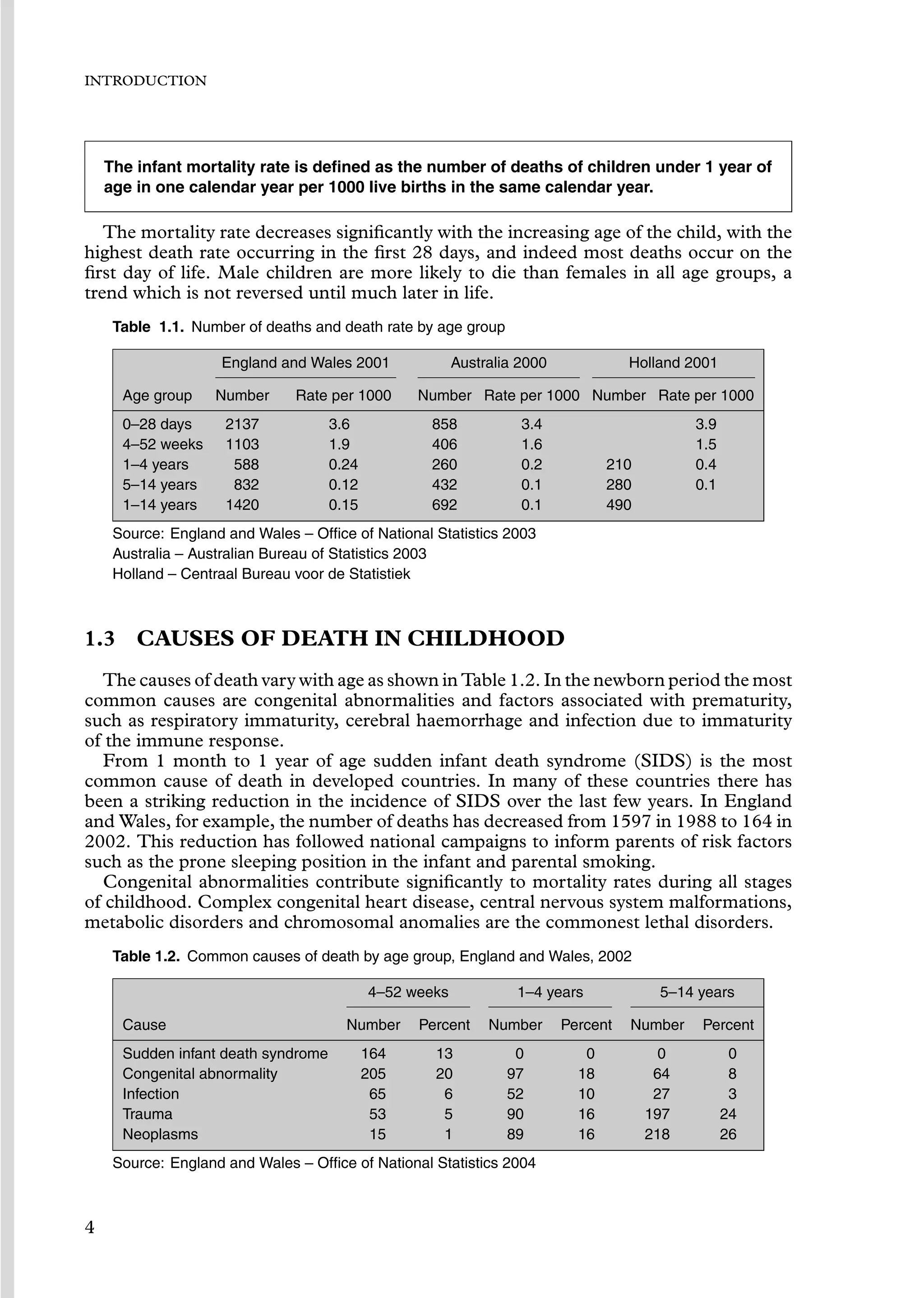
Table 1.1. Number of deaths and death rate by age group
England and Wales 2001 Australia 2000 Holland 2001
Age group Number Rate per 1000 Number Rate per 1000 Number Rate per 1000
0–28 days 2137 3.6 858 3.4 3.9
4–52 weeks 1103 1.9 406 1.6 1.5
1–4 years 588 0.24 260 0.2 210 0.4
5–14 years 832 0.12 432 0.1 280 0.1
1–14 years 1420 0.15 692 0.1 490
Source: England and Wales – Office of National Statistics 2003
Australia – Australian Bureau of Statistics 2003
Holland – Centraal Bureau voor de Statistiek
1.3 CAUSES OF DEATH IN CHILDHOOD
The causes of death vary with age as shown in Table 1.2. In the newborn period the most
common causes are congenital abnormalities and factors associated with prematurity,
such as respiratory immaturity, cerebral haemorrhage and infection due to immaturity
of the immune response.
From 1 month to 1 year of age sudden infant death syndrome (SIDS) is the most
common cause of death in developed countries. In many of these countries there has
been a striking reduction in the incidence of SIDS over the last few years. In England
and Wales, for example, the number of deaths has decreased from 1597 in 1988 to 164 in
2002. This reduction has followed national campaigns to inform parents of risk factors
such as the prone sleeping position in the infant and parental smoking.
Congenital abnormalities contribute significantly to mortality rates during all stages
of childhood. Complex congenital heart disease, central nervous system malformations,
metabolic disorders and chromosomal anomalies are the commonest lethal disorders.
Table 1.2. Common causes of death by age group, England and Wales, 2002
4–52 weeks 1–4 years 5–14 years
Cause Number Percent Number Percent Number Percent
Sudden infant death syndrome 164 13 0 0 0 0
Congenital abnormality 205 20 97 18 64 8
Infection 65 6 52 10 27 3
Trauma 53 5 90 16 197 24
Neoplasms 15 1 89 16 218 26
Source: England and Wales – Office of National Statistics 2004
4
INTRODUCTION
After 1 year of age trauma is a frequent cause of death in the UK, and remains so
until well into adult life. Deaths from trauma have been described as falling into three
groups. In the first group there is overwhelming damage at the time of trauma, and
the injury caused is incompatible with life; children with such massive injuries will die
within minutes whatever is done. Those in the second group die because of progressive
respiratory failure, circulatory insufficiency, or raised intracranial pressure secondary to
the effects of injury; death occurs within a few hours if no treatment is administered,
but may be avoided if treatment is prompt and effective. The final group consists of late
deaths due to raised intracranial pressure, infection or multiple organ failure. Appropriate
management in the first few hours will decrease mortality in this group also.
In developing countries infectious diseases are still major causes of death. Seven out
of 10 childhood deaths can be attributed to just five main causes: pneumonia, diarrhoea,
measles, malaria and malnutrition. Three out of every four children seen by health ser-
vices are suffering from at least one of these conditions. HIV/AIDS has contributed to
this and also been associated with increasing deaths from tuberculosis in countries af-
fected. As these societies become more urbanised the mortality from trauma, especially
from motor vehicle accidents, increases. In South Africa, a country which, although
developing rapidly, has large areas of severe poverty, the under-5’s mortality rate has re-
cently been shown to include 40% (42,749) deaths from HIV/AIDS, 11% (11,876) from
low birth weight, 21% (22,680) from infections and 3% (3506) from trauma. In older
South African children, trauma, especially road traffic accidents, homicide and suicide
are leading causes of death. In Trinidad, children under 1 year of age accounted for 4%
of deaths in 1997, with infant mortality at 17 per 1000 live births. In Trinidadian school
children, the foremost cause of death was injury, with infections causing one fifth of
deaths.
In developed countries, many children with diseases that were once invariably fatal,
such as complex congenital heart disease, inborn errors of metabolism, haematological
malignancies or cystic fibrosis, are now treated or “cured” by drugs, operation, diet,
transplant or, soon, even gene therapy. In these children, common acute illnesses such
as varicella or chest infections have potentially lethal consequences. They require a low
threshold for rapid aggressive treatment delivered by a team with an understanding of
their underlying disease.
Only a minority of childhood deaths, such as those due to end-stage neoplastic disease,
are expected and “managed”. There should be timely discussions among child, family
and health carers to identify whether and in what manner resuscitation should be carried
out to prevent unwanted and inappropriate resuscitation and interventions.
1.4 PATHWAYS LEADING TO CARDIORESPIRATORY
ARREST
As the outcome from cardiorespiratory arrest in children is poor the only effective way
to prevent death and permanent disability is to understand its antecedent events, and be
able to recognise and treat them vigorously.
Cardiac arrest in children is rarely due to primary cardiac disease. This differs from
the situation in an adult where the primary arrest is often cardiac, and circulatory and
respiratory function may remain near-normal until the moment of arrest.
In children, most cardiorespiratory arrests are secondary to hypoxia caused by respi-
ratory pathology, including birth asphyxia, inhalation of foreign body, bronchiolitis and
asthma. Respiratory arrest also occurs secondary to neurological dysfunction caused by
such events as a convulsion or poisoning. Raised intracranial pressure (ICP) due to head
5
INTRODUCTION
injury or acute encephalopathy eventually leads to respiratory arrest, but severe neuronal
damage has already been sustained before the arrest occurs.
Whatever the cause, by the time of cardiac arrest the child has had a period of respiratory
insufficiency, which will have caused hypoxia and respiratory acidosis. The combination
of hypoxia and acidosis causes cell damage and death (particularly in more sensitive
organs such as the brain, liver and kidney), before myocardial damage is severe enough
to cause cardiac arrest.
Most other cardiac arrests in children are secondary to circulatory failure. This will
have resulted often from fluid or blood loss, or from fluid maldistribution within the
circulatory system. The former may be due to gastroenteritis, burns or trauma, whilst
the latter is often caused by sepsis or anaphylaxis. Because all organs are deprived of
essential nutrients and oxygen as shock progresses to cardiac arrest, circulatory failure,
like respiratory failure, causes tissue hypoxia and acidosis. In fact, both pathways may
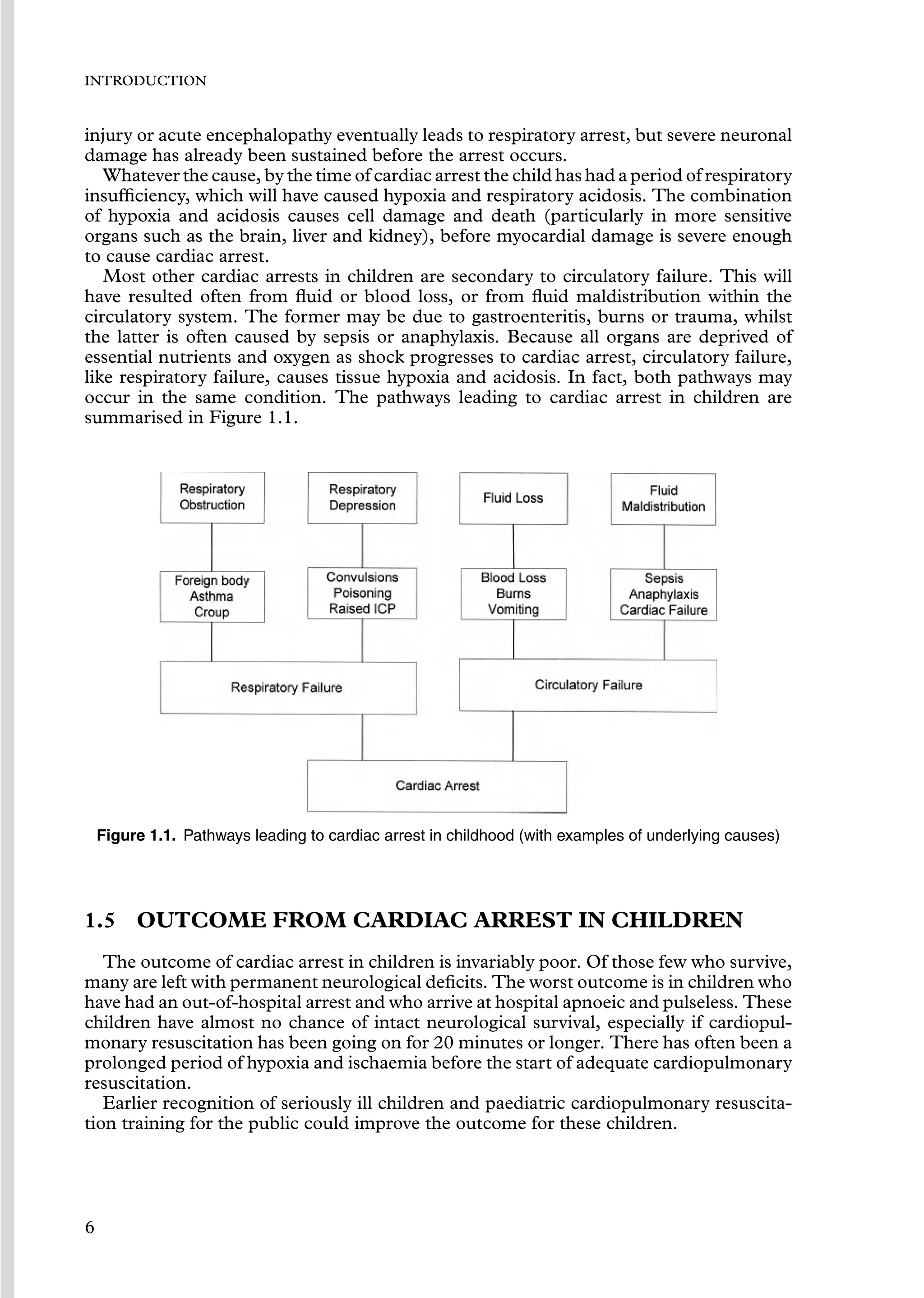
occur in the same condition. The pathways leading to cardiac arrest in children are
summarised in Figure 1.1.
Figure 1.1. Pathways leading to cardiac arrest in childhood (with examples of underlying causes)
1.5 OUTCOME FROM CARDIAC ARREST IN CHILDREN
The outcome of cardiac arrest in children is invariably poor. Of those few who survive,
many are left with permanent neurological deficits. The worst outcome is in children who
have had an out-of-hospital arrest and who arrive at hospital apnoeic and pulseless. These
children have almost no chance of intact neurological survival, especially if cardiopul-
monary resuscitation has been going on for 20 minutes or longer. There has often been a
prolonged period of hypoxia and ischaemia before the start of adequate cardiopulmonary
resuscitation.
Earlier recognition of seriously ill children and paediatric cardiopulmonary resuscita-
tion training for the public could improve the outcome for these children.
6
CHAPTER
2
Why treat children differently?
2.1 INTRODUCTION
Children are a diverse group of people. They vary enormously in weight, size, shape,
intellectual ability and emotional responses. At birth a child is, on average, a 3·5-kg,
50-cm-long individual with small respiratory and cardiovascular reserves and an imma-
ture immune system. They are capable of limited movement, exhibit limited emotional
responses and are dependent upon adults for all their needs. Fourteen or more years later
at the other end of childhood, the adolescent is a 50-kg, 160-cm-tall person who looks
like an adult.
Competent management of a seriously ill or injured child who may fall anywhere
between these two extremes requires a knowledge of these anatomical, physiological and
emotional differences and a strategy of how to deal with them.
The key differences to consider in children are:
1. Weight
2. Anatomical – size and shape
3. Physiological – cardiovascular, respiratory, immune function
4. Psychological – intellectual ability and emotional response
2.2 WEIGHT
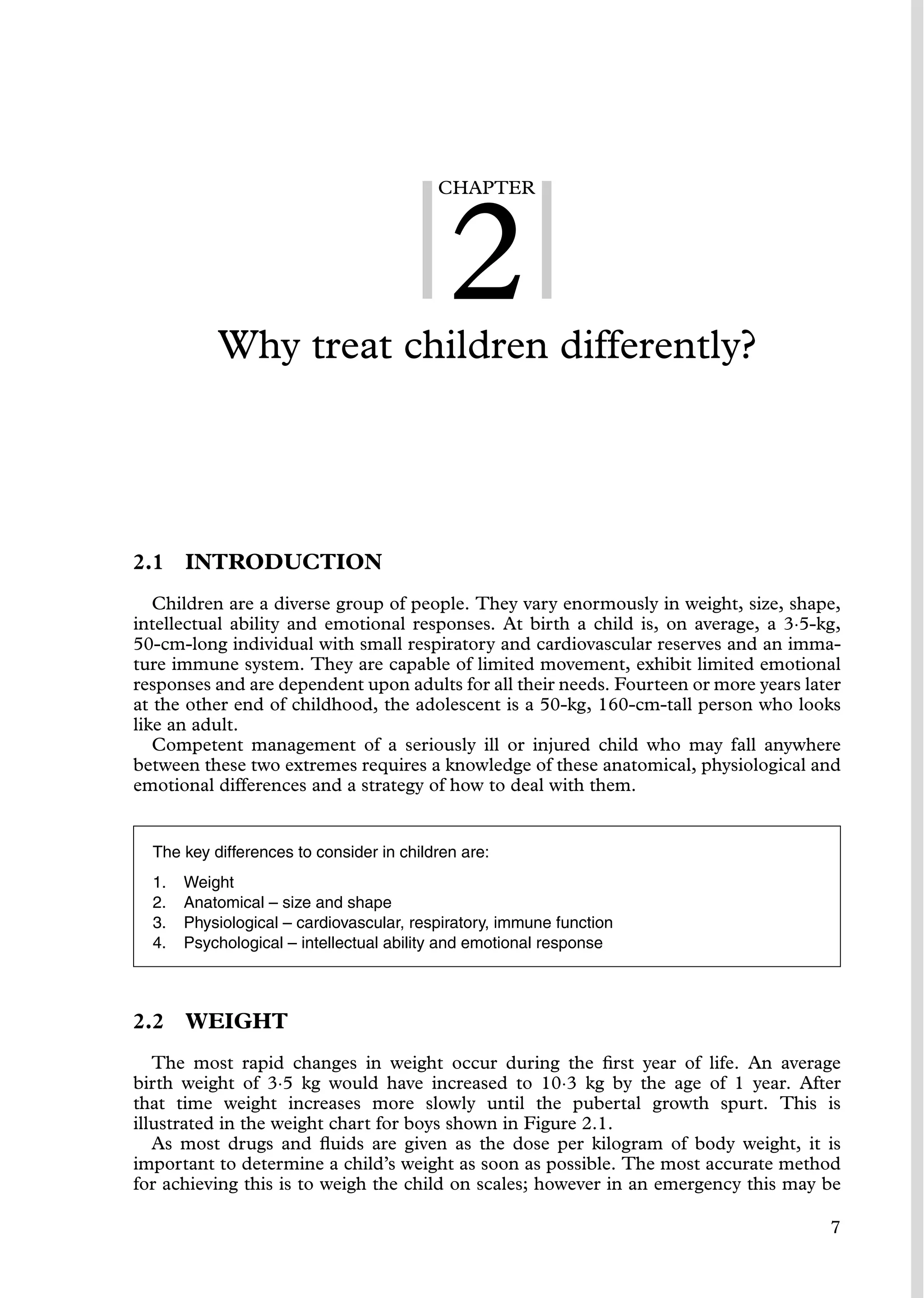
The most rapid changes in weight occur during the first year of life. An average
birth weight of 3·5 kg would have increased to 10·3 kg by the age of 1 year. After
that time weight increases more slowly until the pubertal growth spurt. This is
illustrated in the weight chart for boys shown in Figure 2.1.
As most drugs and fluids are given as the dose per kilogram of body weight, it is
important to determine a child’s weight as soon as possible. The most accurate method
for achieving this is to weigh the child on scales; however in an emergency this may be
7
WHY TREAT CHILDREN DIFFERENTLY?
Figure 2.1. Centile chart for weight in boys
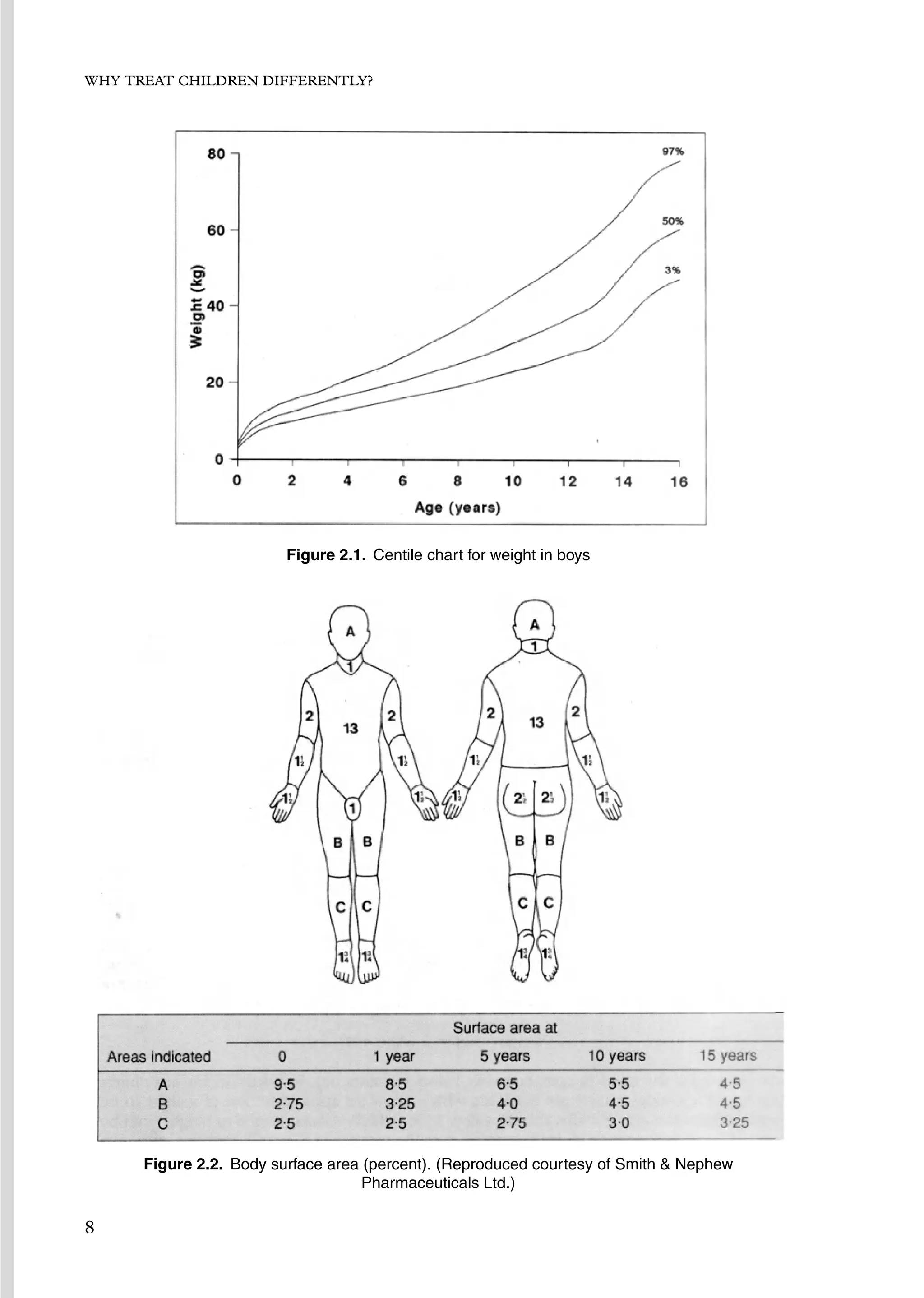
Figure 2.2. Body surface area (percent). (Reproduced courtesy of Smith  Nephew
Pharmaceuticals Ltd.)
8
WHY TREAT CHILDREN DIFFERENTLY?
impracticable. In this situation the child’s weight may be estimated by one of a number
of methods.
The Broselow tape uses the height (or length) of the child to estimate weight. The tape
is laid alongside the child and the estimated weight read from the calibrations on the tape.
This is a quick, easy and relatively accurate method.
If a child’s age is known and it is between 1 and 10 years, the following formula may
be useful:
Weight (in kg) = 2 (age in years + 4)
The formula method has the added advantage of allowing an estimation
of the weight to be made before the child arrives in hospital so that the appro-
priate equipment and drugs may be arranged for. Whatever the method, it is
essential that the carer is sufficiently familiar with it to be able to use it quickly 64
and accurately under pressure.
2.3 ANATOMICAL
As the child’s weight increases with age the size, shape and proportions of various
organs also change. Particular anatomical changes are relevant to emergency care.
Airway
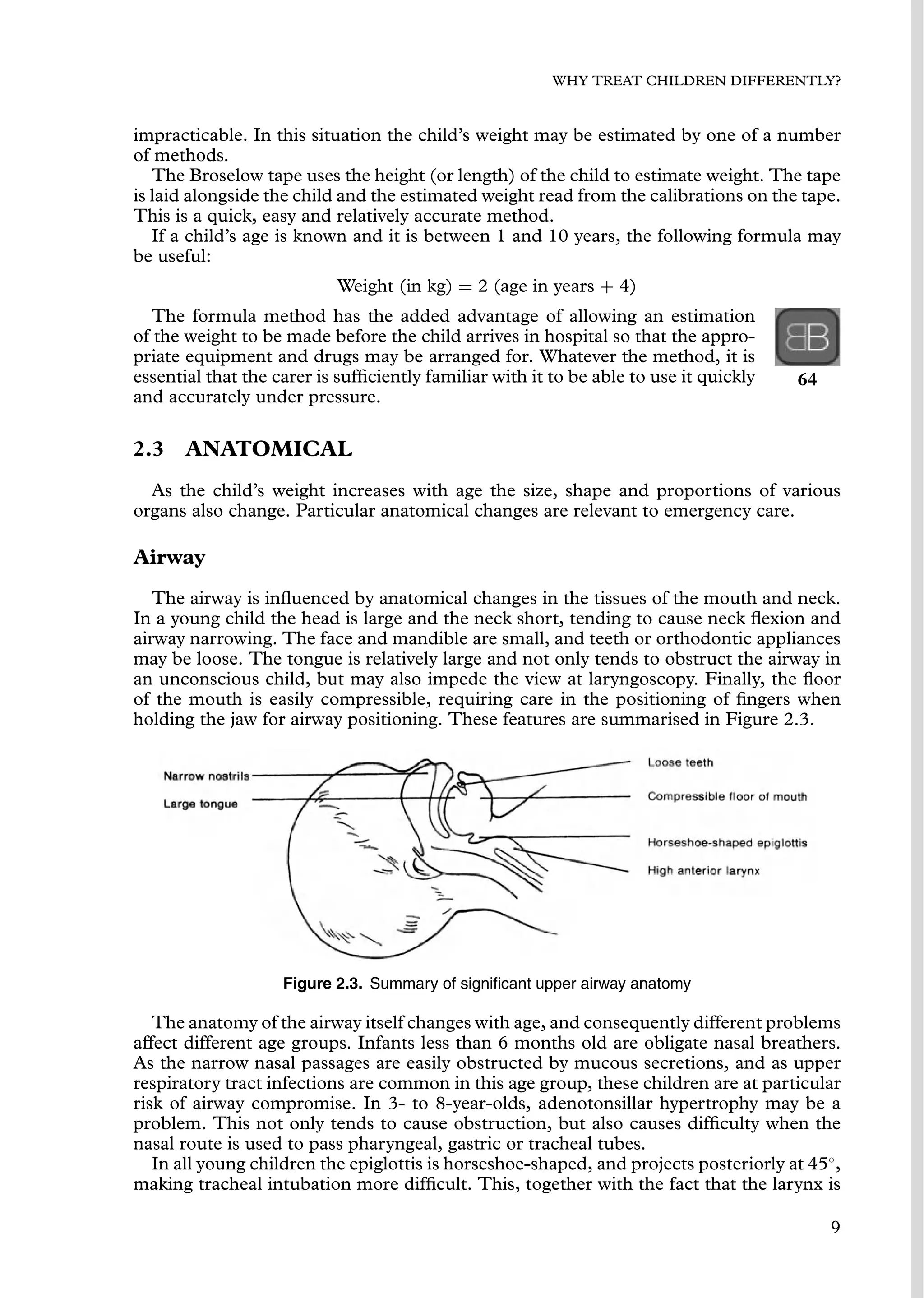
The airway is influenced by anatomical changes in the tissues of the mouth and neck.
In a young child the head is large and the neck short, tending to cause neck flexion and
airway narrowing. The face and mandible are small, and teeth or orthodontic appliances
may be loose. The tongue is relatively large and not only tends to obstruct the airway in
an unconscious child, but may also impede the view at laryngoscopy. Finally, the floor
of the mouth is easily compressible, requiring care in the positioning of fingers when
holding the jaw for airway positioning. These features are summarised in Figure 2.3.
Figure 2.3. Summary of significant upper airway anatomy
The anatomy of the airway itself changes with age, and consequently different problems
affect different age groups. Infants less than 6 months old are obligate nasal breathers.
As the narrow nasal passages are easily obstructed by mucous secretions, and as upper
respiratory tract infections are common in this age group, these children are at particular
risk of airway compromise. In 3- to 8-year-olds, adenotonsillar hypertrophy may be a
problem. This not only tends to cause obstruction, but also causes difficulty when the
nasal route is used to pass pharyngeal, gastric or tracheal tubes.
In all young children the epiglottis is horseshoe-shaped, and projects posteriorly at 45◦
,
making tracheal intubation more difficult. This, together with the fact that the larynx is
9
WHY TREAT CHILDREN DIFFERENTLY?
high and anterior (at the level of the second and third cervical vertebrae in the infant,
compared with the fifth and sixth vertebrae in the adult), means that it is easier to intubate
an infant using a straight-blade laryngoscope. The cricoid ring is the narrowest part of the
upper airway (as opposed to the larynx in an adult). The narrow cross-sectional area at
this point, together with the fact that the cricoid ring is lined by pseudo-stratified ciliated
epithelium loosely bound to areolar tissue, makes it particularly susceptible to oedema.
As tracheal tube cuffs tend to lie at this level, uncuffed tubes are preferred in pre-pubertal
children.
The trachea is short and soft. Overextension of the neck as well as flexion may therefore
cause tracheal compression. The short trachea and the symmetry of the carinal angles
mean that not only is tube displacement more likely, but a tube or a foreign body is also
just as likely to be displaced into the left as the right main-stem bronchus.
Breathing
The lungs are relatively immature at birth. The air–tissue interface has a relatively small
total surface area in the infant (less than 3 m2
). In addition, there is a 10-fold increase in
the number of small airways from birth to adulthood.
Both the upper and lower airways are relatively small, and are consequently more easily
obstructed. As resistance to flow is inversely proportional to the fourth power of the airway
radius (halving the radius increases the resistance 16-fold), seemingly small obstructions
can have significant effects on air entry in children.
Infants rely mainly on diaphragmatic breathing. Their muscles are more likely to fa-
tigue, as they have fewer type I (slow-twitch, highly oxidative, fatigue-resistant) fibres
compared with adults. Pre-term infants’ muscles have even less type I fibres. These chil-
dren are consequently more prone to respiratory failure.
The ribs lie more horizontally in infants, and therefore contribute less to chest ex-
pansion. In the injured child, the compliant chest wall may allow serious parenchymal
injuries to occur without necessarily incurring rib fractures. For multiple rib fractures to
occur the force must be very large; the parenchymal injury that results is consequently
very severe and flail chest is tolerated badly.
Circulation
At birth the two cardiac ventricles are of similar weight; by 2 months of age the RV/LV
weight ratio is 0·5. These changes are reflected in the infant’s ECG. During the first
months of life the right ventricle (RV) dominance is apparent, but by 4–6 months of age
the left ventricle (LV) is dominant. As the heart develops during childhood, the sizes of
the P wave and QRS complex increase, and the P–R interval and QRS duration become
longer.
The child’s circulating blood volume per kilogram of body weight (70–80 ml/kg) is
higher than that of an adult, but the actual volume is small. This means that in infants and
small children, relatively small absolute amounts of blood loss can be critically important.
Body surface area
The body surface area (BSA) to weight ratio decreases with increasing age. Small
children, with a high ratio, lose heat more rapidly and consequently are relatively more
prone to hypothermia. At birth the head accounts for 19% of BSA; this falls to 9% by
the age of 15 years. Figure 2.2 shows these changes.
10
WHY TREAT CHILDREN DIFFERENTLY?
2.4 PHYSIOLOGICAL
Respiratory
The infant has a relatively greater metabolic rate and oxygen consumption. This is one
reason for an increased respiratory rate. However, the tidal volume remains relatively
constant in relation to body weight (5–7 ml/kg) through to adulthood. The work of
breathing is also relatively unchanged at about 1% of the metabolic rate, although it is
increased in the pre-term infant.
Table 2.1. Respiratory rate by age at rest
Age (years) Respiratory rate (breaths per minute)
1 30–40
1–2 25–35
2–5 25–30
5–12 20–25
12 15–20
In the adult, the lung and chest wall contribute equally to the total compliance. In
the newborn, most of the impedance to expansion is due to the lung, and is critically
dependent on the surfactant. The lung compliance increases over the first week of life as
fluid is removed from the lung. The child’s compliant chest wall leads to prominent sternal
recession and rib space indrawing when the airway is obstructed or lung compliance
decreases. It also allows the intrathoracic pressure to be less “negative”. This reduces
small-airway patency. As a result, the lung volume at the end of expiration is similar to
the closing volume (the volume at which small-airway closure starts to take place).
At birth, the oxygen dissociation curve is shifted to the left and P50 (Po2 at 50% oxygen
saturation) is greatly reduced. This is due to the fact that 70% of the haemoglobin is in
the form of HbF; this gradually declines to negligible amounts by the age of 6 months.
The immature infant lung is also more vulnerable to insult. Following prolonged venti-
lation of a pre-term infant, bronchopulmonary dysplasia may cause oxygen dependence
for up to a year. Many infants who have suffered from bronchiolitis remain “chesty” for
a year or more.
Cardiovascular
The infant has a relatively small stroke volume (1·5 ml/kg at birth) but has the highest
cardiac index seen at any stage of life (300 ml/min/kg). Cardiac index decreases with age
and is 100 ml/min/kg in adolescence and 70–80 ml/min/kg in the adult. At the same time
the stroke volume increases as the heart gets bigger. As cardiac output is the product of
stroke volume and heart rate, these changes underlie the heart rate changes seen during
childhood (shown in Table 2.2).
Table 2.2. Heart rate by age
Age (years) Heart rate (beats per minute)
1 110–160
1–2 100–150
2–5 95–140
5–12 80–120
12 60–100
11
WHY TREAT CHILDREN DIFFERENTLY?
As the stroke volume is small and relatively fixed in infants, cardiac output is directly
related to heart rate. The practical importance of this is that the response to volume
therapy is blunted because stroke volume cannot increase greatly to improve cardiac
output. By the age of 2 years myocardial function and response to fluid are similar to
those of an adult.
Systemic vascular resistance rises after birth and continues to do so until adulthood is
reached. This is reflected in the changes seen in blood pressure – shown in Table 2.3.
Table 2.3. Systolic blood pressure by age
Age (years) Systolic blood pressure (mmHg)
1 70–90
1–2 80–95
2–5 80–100
5–12 90–110
12 100–120
Immune function
At birth the immune system is immature and consequently babies are more
susceptible than older children to many infections such as bronchiolitis, sep-
ticaemia, meningitis and urinary tract infections. Maternal antibodies acqui-
red across the placenta provide some early protection but these progressively
decline during the first 6 months. These are replaced slowly by the infant’s as
756
he or she grows older. Breastfeeding provides some protection against respiratory and
gastrointestinal infections.
2.5 PSYCHOLOGICAL
Children vary enormously in their intellectual ability and their emotional response. A
knowledge of child development assists in understanding a child’s behaviour and formu-
lating an appropriate management strategy. Particular challenges exist in communicating
with children and as far as possible easing their fear of the circumstances they find them-
selves in.
Communication
Infants and young children either have no language ability or are still developing their
speech. This causes difficulty when symptoms such as pain need to be described. Even
children who are usually fluent may remain silent. Information has to be gleaned from
the limited verbal communication, and from the many non-verbal cues (such as facial
expression and posture) that are available. Older children are more likely to understand
aspects of their illness and treatment and so be reassured by adequate age-appropriate
communication.
Fear
All emergency situations, and many other situations that adults would not classify as
emergencies, engender fear in children. This causes additional distress to the child and
12
WHY TREAT CHILDREN DIFFERENTLY?
adds to parental anxiety. Physiological parameters, such as pulse rate and respiratory rate,
are altered because of it, and this in turn makes clinical assessment more difficult.
Fear is a particular problem in the pre-school child who often has a “magical” concept
of illness and injury. This means that the child may think that the problem has been caused
by some bad wish or thought that he or she has had. School-age children and adolescents
may have fearsome concepts of what might happen to them in hospital because of ideas
they have picked up from adult conversation, films and television.
Knowledge allays fear and it is therefore important to explain things as clearly as
possible to the child. Explanations must be phrased in a way that the child can understand.
Play can be used to do this (e.g. applying a bandage to a teddy first), and also helps to
maintain some semblance of normality in a strange and stressful situation. Finally, parents
must be allowed to stay with the child at all times; their absence from the child’s bedside
will only add further fears, both to the child and to the parents themselves.
2.6 SUMMARY
• Absolute size and relative body proportions change with age.
• Observations on children must be related to their age.
• Therapy in children must be related to their age and weight.
• The special psychological needs of children must be considered.
13
CHAPTER
3
Structured approach to
emergency paediatrics
3.1 INTRODUCTION
The reception of a child with a life-threatening condition or the collapse of a child on the
ward presents a major challenge to staff. The infrequency and, often unforeseen, nature
of the events adds to the anxiety for all, including parents. The structured approach will
enable the clinician to manage emergencies.
This approach will initially focus on identifying and treating the immediate threats to life,
that is a closed or obstructed airway, absent or distressed respiration, or pulselessness or
shock. These first interventions comprise resuscitation.
The next step is to identify the key features that in any serious illness or injury give
the clinician a signpost to the likeliest working diagnosis. From this, the best emergency
treatment can be identified to start to treat the child’s illness or injury.
The final phase of the structured approach is to stabilise the child, focussing on achieving
homoeostasis and system control and leading onto transfer to a definitive care environ-
ment, which will often be the paediatric intensive care unit.
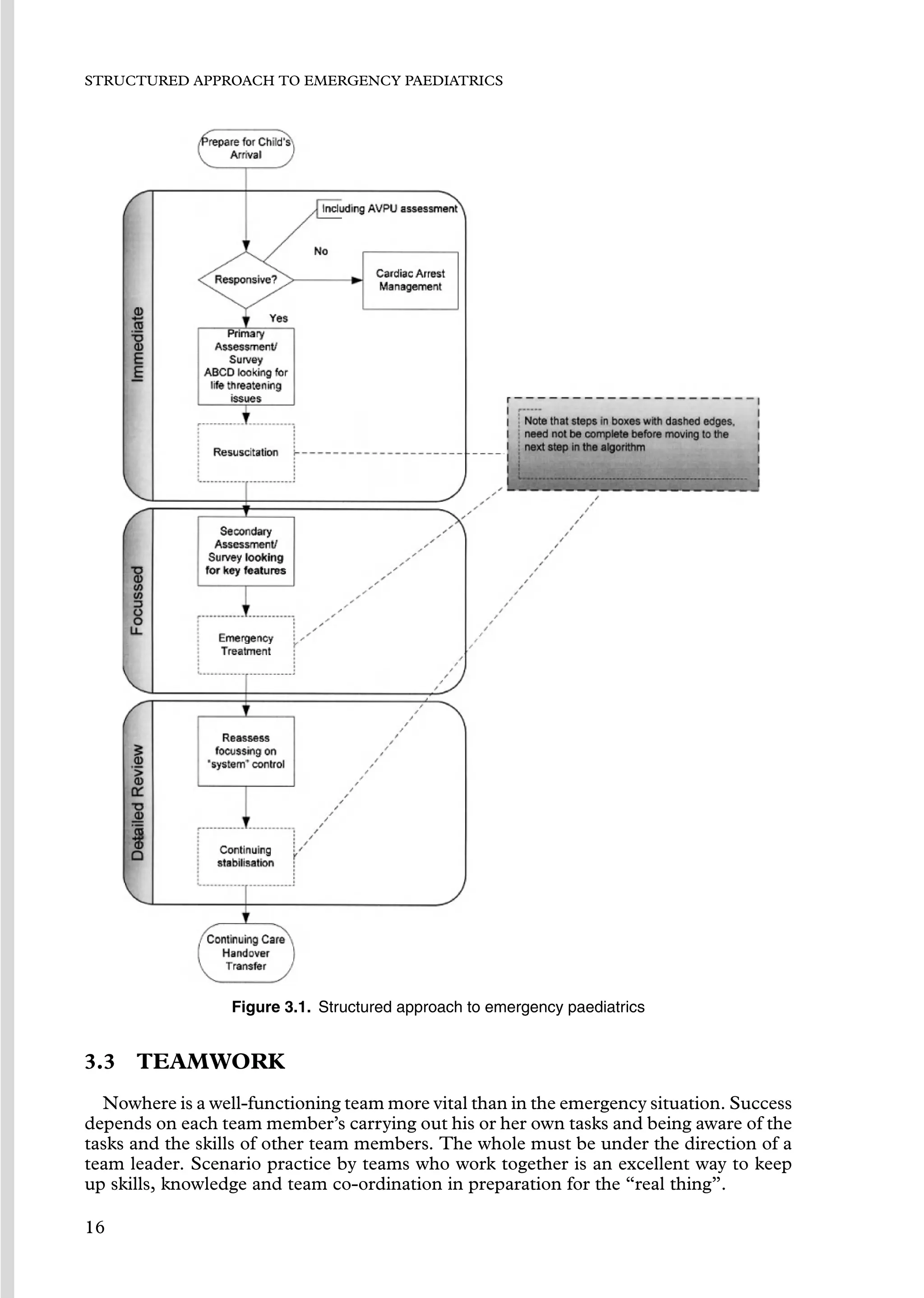
Figure 3.1 shows the structured approach in diagrammatic form. Throughout this text
the same structure will be used so the clinician will become familiar with the approach
and be able to apply it to any clinical emergency situation.
3.2 PREPARATION
If warning has been received of the child’s arrival then preparations can be made:
• Ensure that appropriate help is available: critical illness and injury need a team ap-
proach.
• Work out the likely drug, fluid and equipment needs.
For unexpected emergencies, ensure that all areas where children may be treated are
stocked with the drugs, fluid and equipment needed for any childhood emergencies.
15
STRUCTURED APPROACH TO EMERGENCY PAEDIATRICS
Figure 3.1. Structured approach to emergency paediatrics
3.3 TEAMWORK
Nowhere is a well-functioning team more vital than in the emergency situation. Success
depends on each team member’s carrying out his or her own tasks and being aware of the
tasks and the skills of other team members. The whole must be under the direction of a
team leader. Scenario practice by teams who work together is an excellent way to keep
up skills, knowledge and team co-ordination in preparation for the “real thing”.
16
STRUCTURED APPROACH TO EMERGENCY PAEDIATRICS
3.4 COMMUNICATION
In the previous chapter, issues about communication with the ill or injured child were
highlighted. Communication is no less important with families and with clinical col-
leagues. When things have gone wrong a fault in communication has often been involved.
Contemporaneous recording of clinical findings, of the child’s history and of test results
and management plans seems obvious but in the emergency situation can be overlooked.
A template for note keeping is to be found in Chapter 13.
3.5 CONSENT
Consent legislation and practice are complex areas: different jurisdictions have different
rulings. The general approach is that in an emergency where you consider that it is in
the child’s best interests to proceed, you may treat the child, provided it is limited to that
treatment which is reasonably required in that emergency.
In the UK the General Medical Council provides guidance for doctors, and hospitals
will have internal policies with which you should be familiar.
17
PART
II
LIFE SUPPORT
19
CHAPTER
4
Basic life support
LEARNING OBJECTIVES
In this chapter, you will learn:
• how to assess the collapsed patient and perform basic life support
4.1 INTRODUCTION
Paediatric basic life support (BLS) is not simply a scaled-down version of that provided
for adults, although, where possible, guidelines are the same for all ages to aid teaching
and retention. Some of the techniques employed need to be varied according to the size
of the child. A somewhat artificial line is generally drawn between infants (less than 1 year
old) and children (between one year and puberty), and this chapter follows that approach.
The preponderance of hypoxic causes of paediatric cardiorespiratory arrest means that
oxygen delivery rather than defibrillation is the critical step in children. This underlines
the major differences with the adult algorithm.
By applying the basic techniques described, a single rescuer can support the vital
respiratory and circulatory functions of a collapsed child with no equipment.
Basic life support is the foundation on which advanced life support is built. Therefore
it is essential that all advanced life support providers are proficient at basic techniques,
and that they are capable of ensuring that basic support is provided continuously and
well during resuscitation.
4.2 PRIMARY ASSESSMENT AND RESUSCITATION
Once the child has been approached safely and a simple test for unresponsiveness has
been carried out, assessment and treatment follow the familiar ABC pattern. The overall
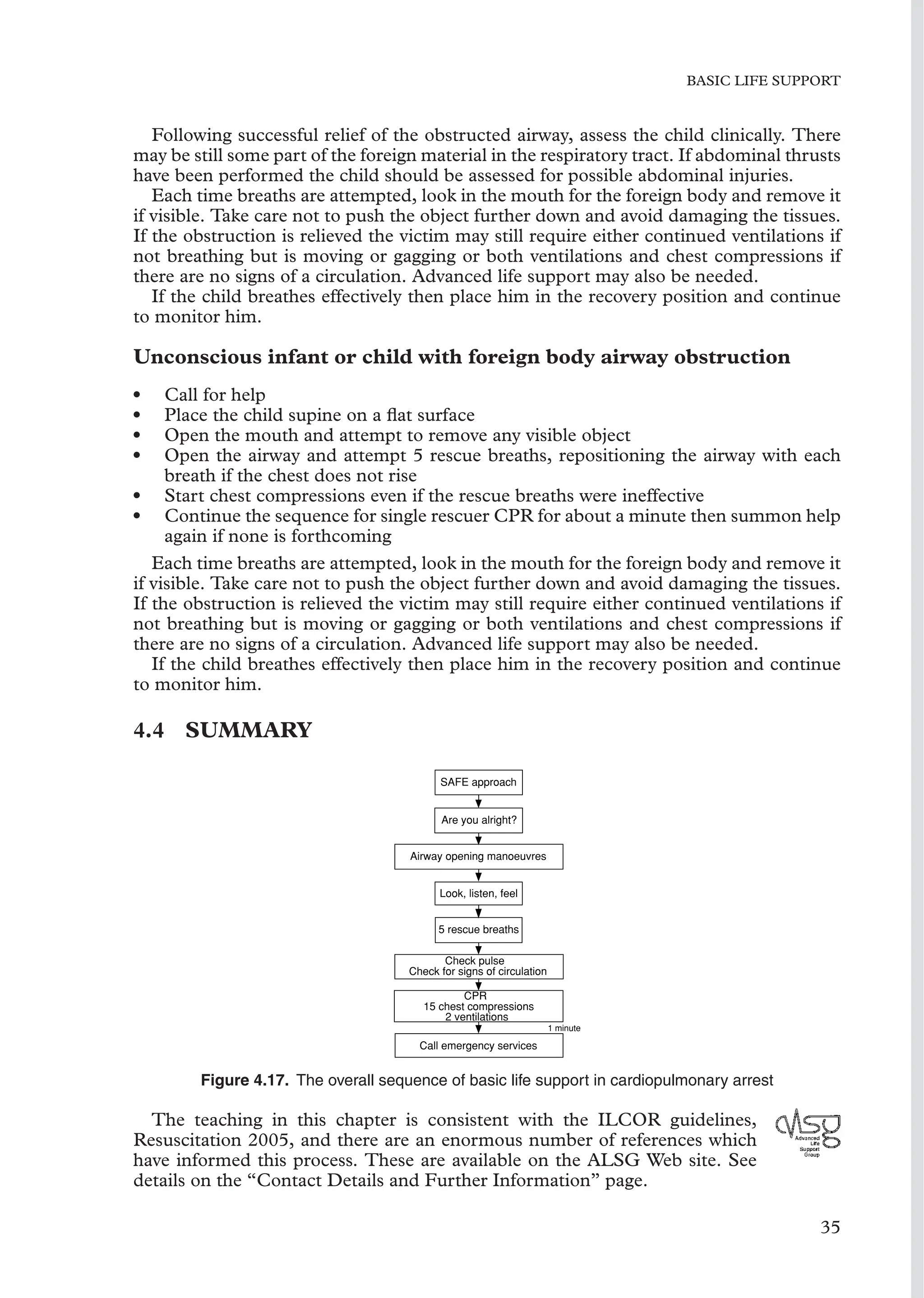
sequence of basic life support in paediatric cardiopulmonary arrest is summarised in
21
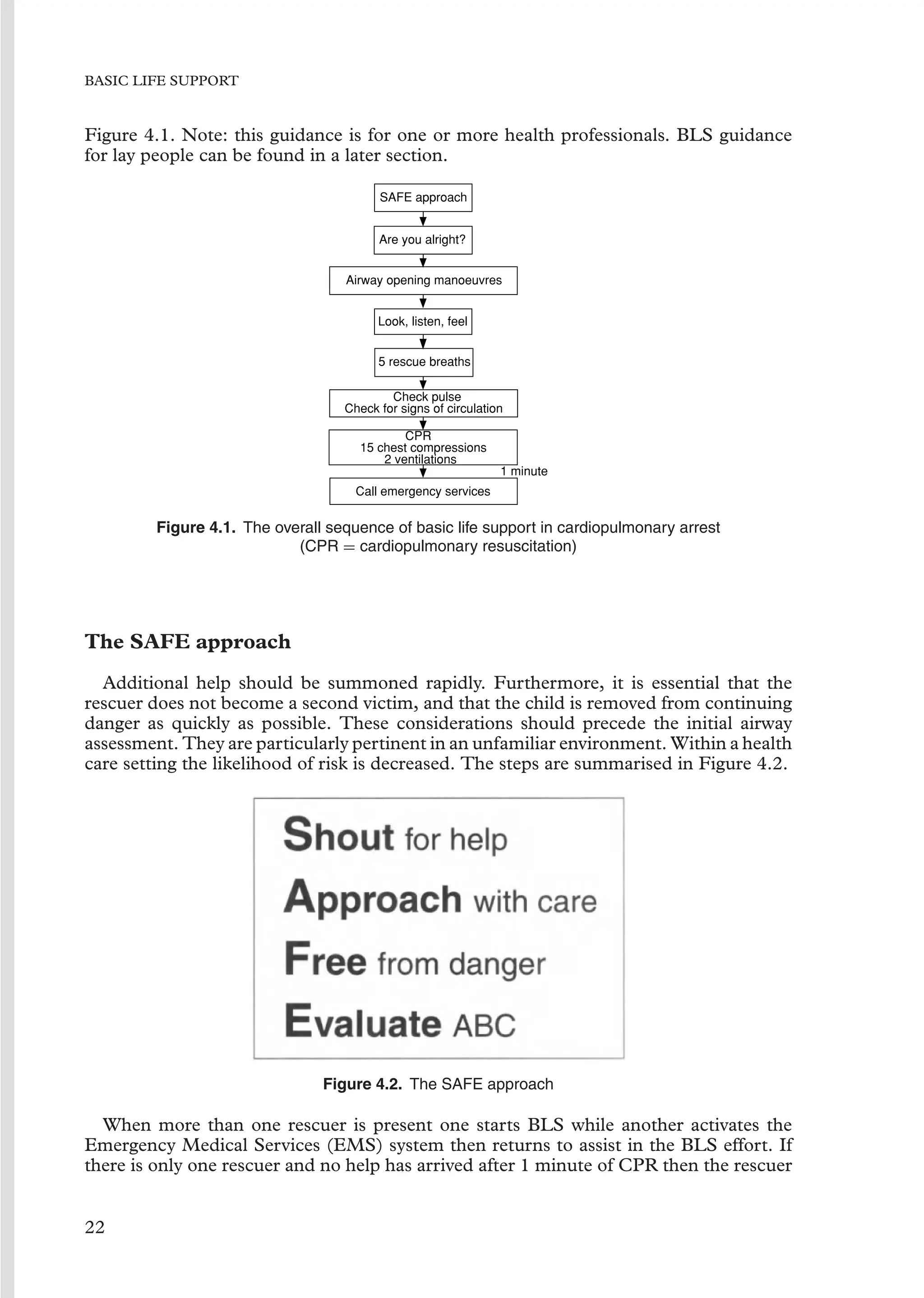
BASIC LIFE SUPPORT
Figure 4.1. Note: this guidance is for one or more health professionals. BLS guidance
for lay people can be found in a later section.
SAFE approach
Are you alright?
Airway opening manoeuvres
Look, listen, feel
5 rescue breaths
Check pulse
Check for signs of circulation
CPR
15 chest compressions
2 ventilations
Call emergency services
1 minute
Figure 4.1. The overall sequence of basic life support in cardiopulmonary arrest
(CPR = cardiopulmonary resuscitation)
The SAFE approach
Additional help should be summoned rapidly. Furthermore, it is essential that the
rescuer does not become a second victim, and that the child is removed from continuing
danger as quickly as possible. These considerations should precede the initial airway
assessment. They are particularly pertinent in an unfamiliar environment. Within a health
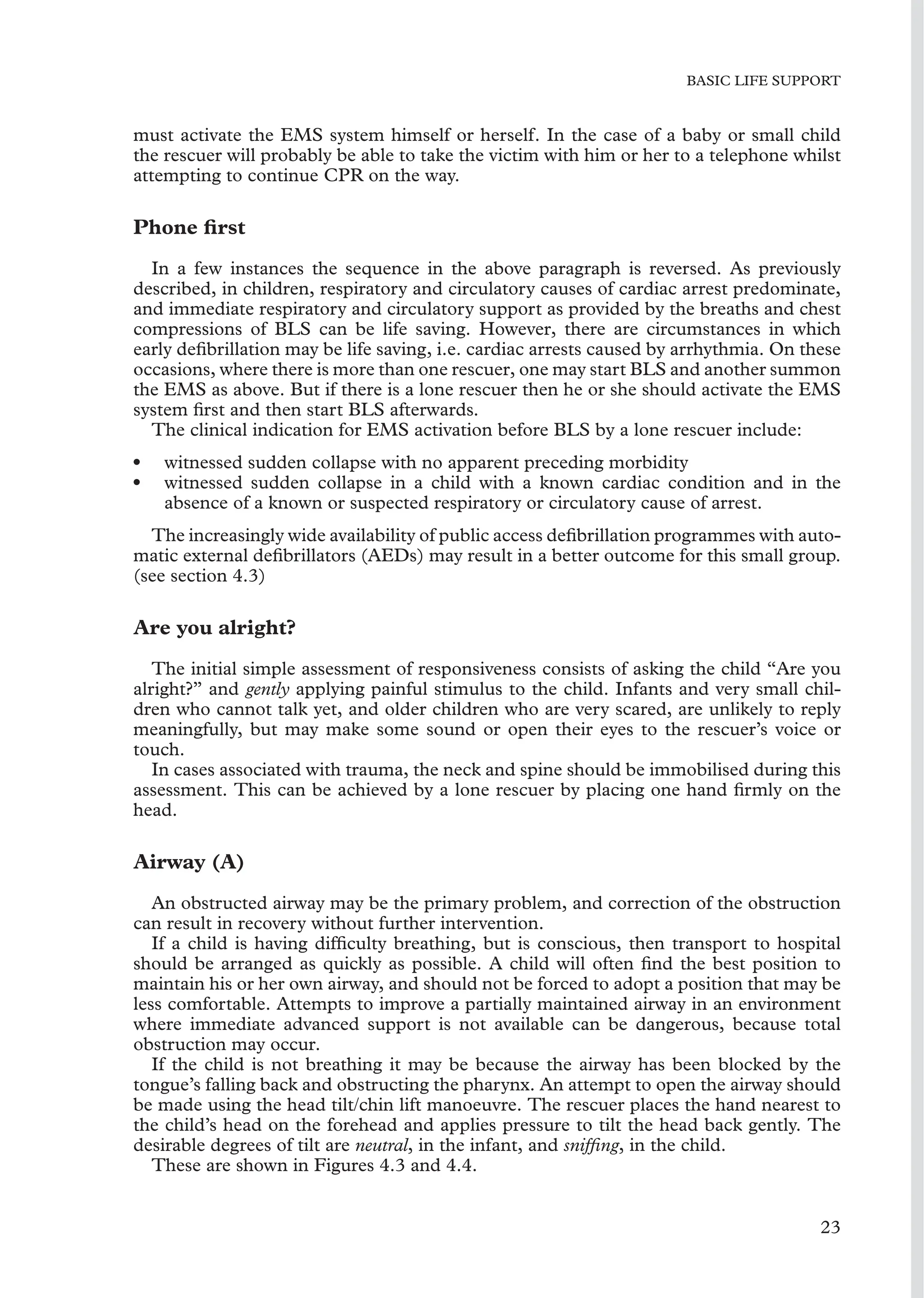
care setting the likelihood of risk is decreased. The steps are summarised in Figure 4.2.
Figure 4.2. The SAFE approach
When more than one rescuer is present one starts BLS while another activates the
Emergency Medical Services (EMS) system then returns to assist in the BLS effort. If
there is only one rescuer and no help has arrived after 1 minute of CPR then the rescuer
22
BASIC LIFE SUPPORT
must activate the EMS system himself or herself. In the case of a baby or small child
the rescuer will probably be able to take the victim with him or her to a telephone whilst
attempting to continue CPR on the way.
Phone first
In a few instances the sequence in the above paragraph is reversed. As previously
described, in children, respiratory and circulatory causes of cardiac arrest predominate,
and immediate respiratory and circulatory support as provided by the breaths and chest
compressions of BLS can be life saving. However, there are circumstances in which
early defibrillation may be life saving, i.e. cardiac arrests caused by arrhythmia. On these
occasions, where there is more than one rescuer, one may start BLS and another summon
the EMS as above. But if there is a lone rescuer then he or she should activate the EMS
system first and then start BLS afterwards.
The clinical indication for EMS activation before BLS by a lone rescuer include:
• witnessed sudden collapse with no apparent preceding morbidity
• witnessed sudden collapse in a child with a known cardiac condition and in the
absence of a known or suspected respiratory or circulatory cause of arrest.
The increasingly wide availability of public access defibrillation programmes with auto-
matic external defibrillators (AEDs) may result in a better outcome for this small group.
(see section 4.3)
Are you alright?
The initial simple assessment of responsiveness consists of asking the child “Are you
alright?” and gently applying painful stimulus to the child. Infants and very small chil-
dren who cannot talk yet, and older children who are very scared, are unlikely to reply
meaningfully, but may make some sound or open their eyes to the rescuer’s voice or
touch.
In cases associated with trauma, the neck and spine should be immobilised during this
assessment. This can be achieved by a lone rescuer by placing one hand firmly on the
head.
Airway (A)
An obstructed airway may be the primary problem, and correction of the obstruction
can result in recovery without further intervention.
If a child is having difficulty breathing, but is conscious, then transport to hospital
should be arranged as quickly as possible. A child will often find the best position to
maintain his or her own airway, and should not be forced to adopt a position that may be
less comfortable. Attempts to improve a partially maintained airway in an environment
where immediate advanced support is not available can be dangerous, because total
obstruction may occur.
If the child is not breathing it may be because the airway has been blocked by the
tongue’s falling back and obstructing the pharynx. An attempt to open the airway should
be made using the head tilt/chin lift manoeuvre. The rescuer places the hand nearest to
the child’s head on the forehead and applies pressure to tilt the head back gently. The
desirable degrees of tilt are neutral, in the infant, and sniffing, in the child.
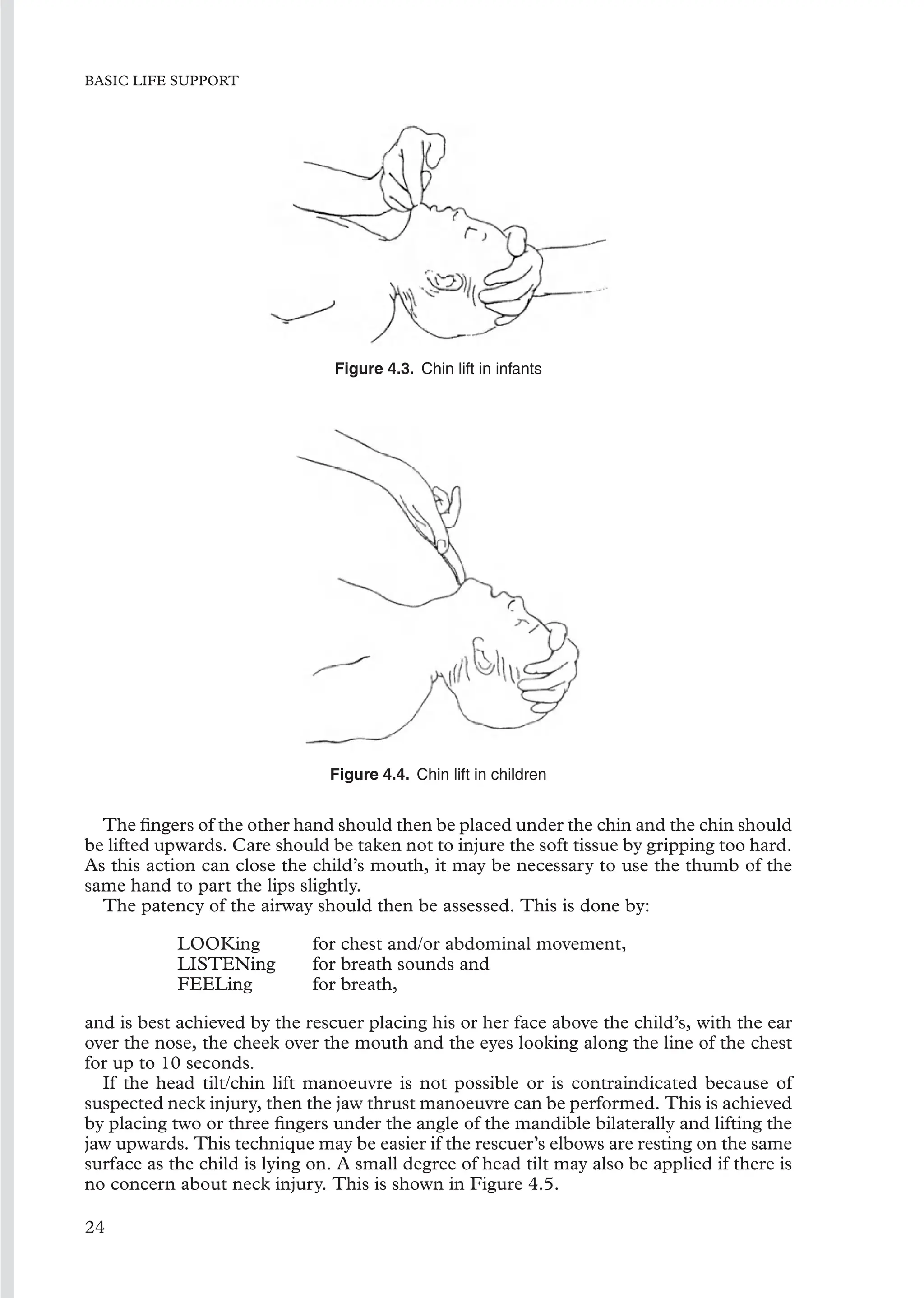
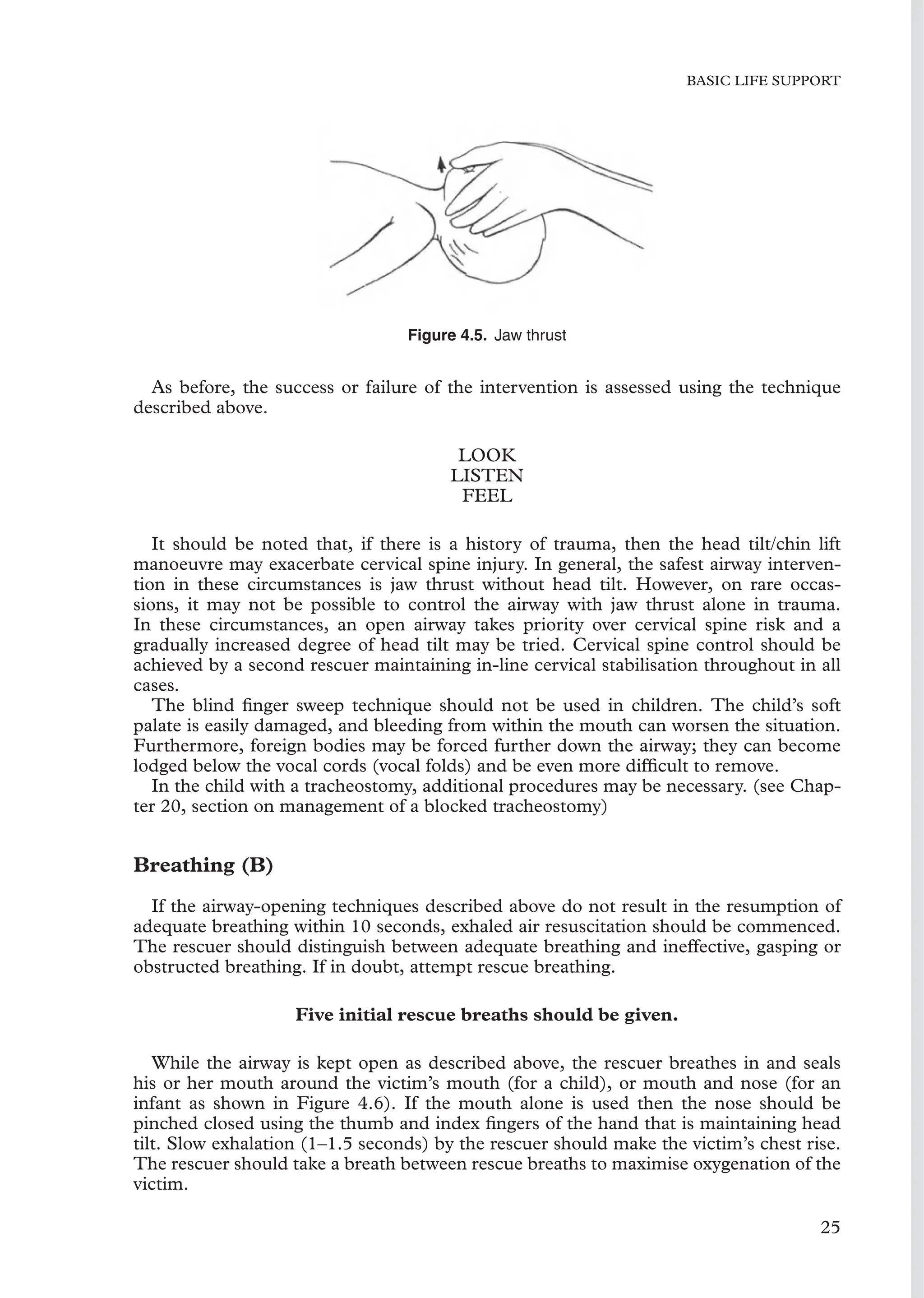
These are shown in Figures 4.3 and 4.4.
23
BASIC LIFE SUPPORT
Figure 4.3. Chin lift in infants
Figure 4.4. Chin lift in children
The fingers of the other hand should then be placed under the chin and the chin should
be lifted upwards. Care should be taken not to injure the soft tissue by gripping too hard.
As this action can close the child’s mouth, it may be necessary to use the thumb of the
same hand to part the lips slightly.
The patency of the airway should then be assessed. This is done by:
LOOKing for chest and/or abdominal movement,
LISTENing for breath sounds and
FEELing for breath,
and is best achieved by the rescuer placing his or her face above the child’s, with the ear
over the nose, the cheek over the mouth and the eyes looking along the line of the chest
for up to 10 seconds.
If the head tilt/chin lift manoeuvre is not possible or is contraindicated because of
suspected neck injury, then the jaw thrust manoeuvre can be performed. This is achieved
by placing two or three fingers under the angle of the mandible bilaterally and lifting the
jaw upwards. This technique may be easier if the rescuer’s elbows are resting on the same
surface as the child is lying on. A small degree of head tilt may also be applied if there is
no concern about neck injury. This is shown in Figure 4.5.
24
BASIC LIFE SUPPORT
Figure 4.5. Jaw thrust
As before, the success or failure of the intervention is assessed using the technique
described above.
LOOK
LISTEN
FEEL
It should be noted that, if there is a history of trauma, then the head tilt/chin lift
manoeuvre may exacerbate cervical spine injury. In general, the safest airway interven-
tion in these circumstances is jaw thrust without head tilt. However, on rare occas-
sions, it may not be possible to control the airway with jaw thrust alone in trauma.
In these circumstances, an open airway takes priority over cervical spine risk and a
gradually increased degree of head tilt may be tried. Cervical spine control should be
achieved by a second rescuer maintaining in-line cervical stabilisation throughout in all
cases.
The blind finger sweep technique should not be used in children. The child’s soft
palate is easily damaged, and bleeding from within the mouth can worsen the situation.
Furthermore, foreign bodies may be forced further down the airway; they can become
lodged below the vocal cords (vocal folds) and be even more difficult to remove.
In the child with a tracheostomy, additional procedures may be necessary. (see Chap-
ter 20, section on management of a blocked tracheostomy)
Breathing (B)
If the airway-opening techniques described above do not result in the resumption of
adequate breathing within 10 seconds, exhaled air resuscitation should be commenced.
The rescuer should distinguish between adequate breathing and ineffective, gasping or
obstructed breathing. If in doubt, attempt rescue breathing.
Five initial rescue breaths should be given.
While the airway is kept open as described above, the rescuer breathes in and seals
his or her mouth around the victim’s mouth (for a child), or mouth and nose (for an
infant as shown in Figure 4.6). If the mouth alone is used then the nose should be
pinched closed using the thumb and index fingers of the hand that is maintaining head
tilt. Slow exhalation (1–1.5 seconds) by the rescuer should make the victim’s chest rise.
The rescuer should take a breath between rescue breaths to maximise oxygenation of the
victim.
25
BASIC LIFE SUPPORT
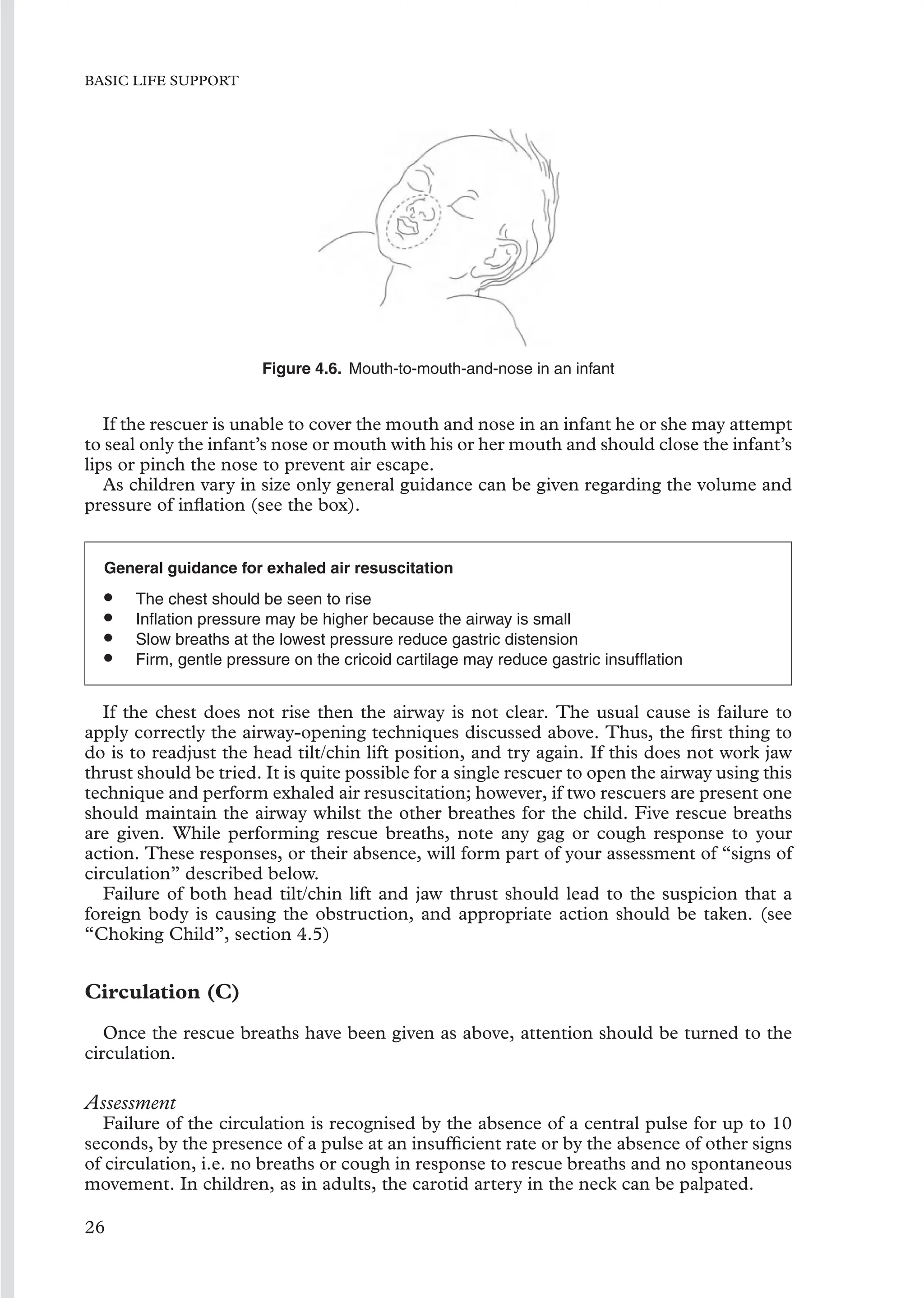
Figure 4.6. Mouth-to-mouth-and-nose in an infant
If the rescuer is unable to cover the mouth and nose in an infant he or she may attempt
to seal only the infant’s nose or mouth with his or her mouth and should close the infant’s
lips or pinch the nose to prevent air escape.
As children vary in size only general guidance can be given regarding the volume and
pressure of inflation (see the box).
General guidance for exhaled air resuscitation
• The chest should be seen to rise
• Inflation pressure may be higher because the airway is small
• Slow breaths at the lowest pressure reduce gastric distension
• Firm, gentle pressure on the cricoid cartilage may reduce gastric insufflation
If the chest does not rise then the airway is not clear. The usual cause is failure to
apply correctly the airway-opening techniques discussed above. Thus, the first thing to
do is to readjust the head tilt/chin lift position, and try again. If this does not work jaw
thrust should be tried. It is quite possible for a single rescuer to open the airway using this
technique and perform exhaled air resuscitation; however, if two rescuers are present one
should maintain the airway whilst the other breathes for the child. Five rescue breaths
are given. While performing rescue breaths, note any gag or cough response to your
action. These responses, or their absence, will form part of your assessment of “signs of
circulation” described below.
Failure of both head tilt/chin lift and jaw thrust should lead to the suspicion that a
foreign body is causing the obstruction, and appropriate action should be taken. (see
“Choking Child”, section 4.5)
Circulation (C)
Once the rescue breaths have been given as above, attention should be turned to the
circulation.
Assessment
Failure of the circulation is recognised by the absence of a central pulse for up to 10
seconds, by the presence of a pulse at an insufficient rate or by the absence of other signs
of circulation, i.e. no breaths or cough in response to rescue breaths and no spontaneous
movement. In children, as in adults, the carotid artery in the neck can be palpated.
26
BASIC LIFE SUPPORT
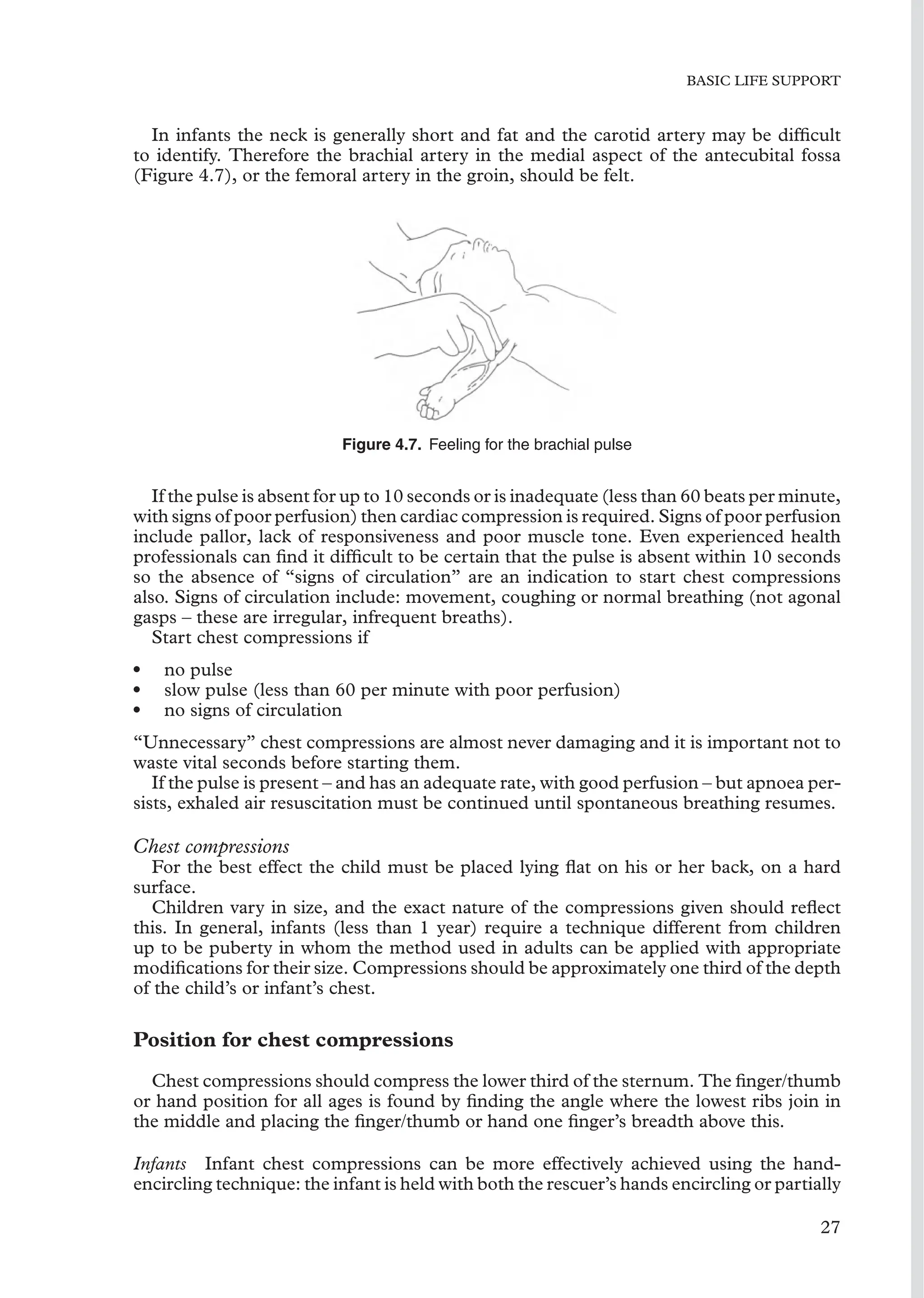
In infants the neck is generally short and fat and the carotid artery may be difficult
to identify. Therefore the brachial artery in the medial aspect of the antecubital fossa
(Figure 4.7), or the femoral artery in the groin, should be felt.
Figure 4.7. Feeling for the brachial pulse
If the pulse is absent for up to 10 seconds or is inadequate (less than 60 beats per minute,
with signs of poor perfusion) then cardiac compression is required. Signs of poor perfusion
include pallor, lack of responsiveness and poor muscle tone. Even experienced health
professionals can find it difficult to be certain that the pulse is absent within 10 seconds
so the absence of “signs of circulation” are an indication to start chest compressions
also. Signs of circulation include: movement, coughing or normal breathing (not agonal
gasps – these are irregular, infrequent breaths).
Start chest compressions if
• no pulse
• slow pulse (less than 60 per minute with poor perfusion)
• no signs of circulation
“Unnecessary” chest compressions are almost never damaging and it is important not to
waste vital seconds before starting them.
If the pulse is present – and has an adequate rate, with good perfusion – but apnoea per-
sists, exhaled air resuscitation must be continued until spontaneous breathing resumes.
Chest compressions
For the best effect the child must be placed lying flat on his or her back, on a hard
surface.
Children vary in size, and the exact nature of the compressions given should reflect
this. In general, infants (less than 1 year) require a technique different from children
up to be puberty in whom the method used in adults can be applied with appropriate
modifications for their size. Compressions should be approximately one third of the depth
of the child’s or infant’s chest.
Position for chest compressions
Chest compressions should compress the lower third of the sternum. The finger/thumb
or hand position for all ages is found by finding the angle where the lowest ribs join in
the middle and placing the finger/thumb or hand one finger’s breadth above this.
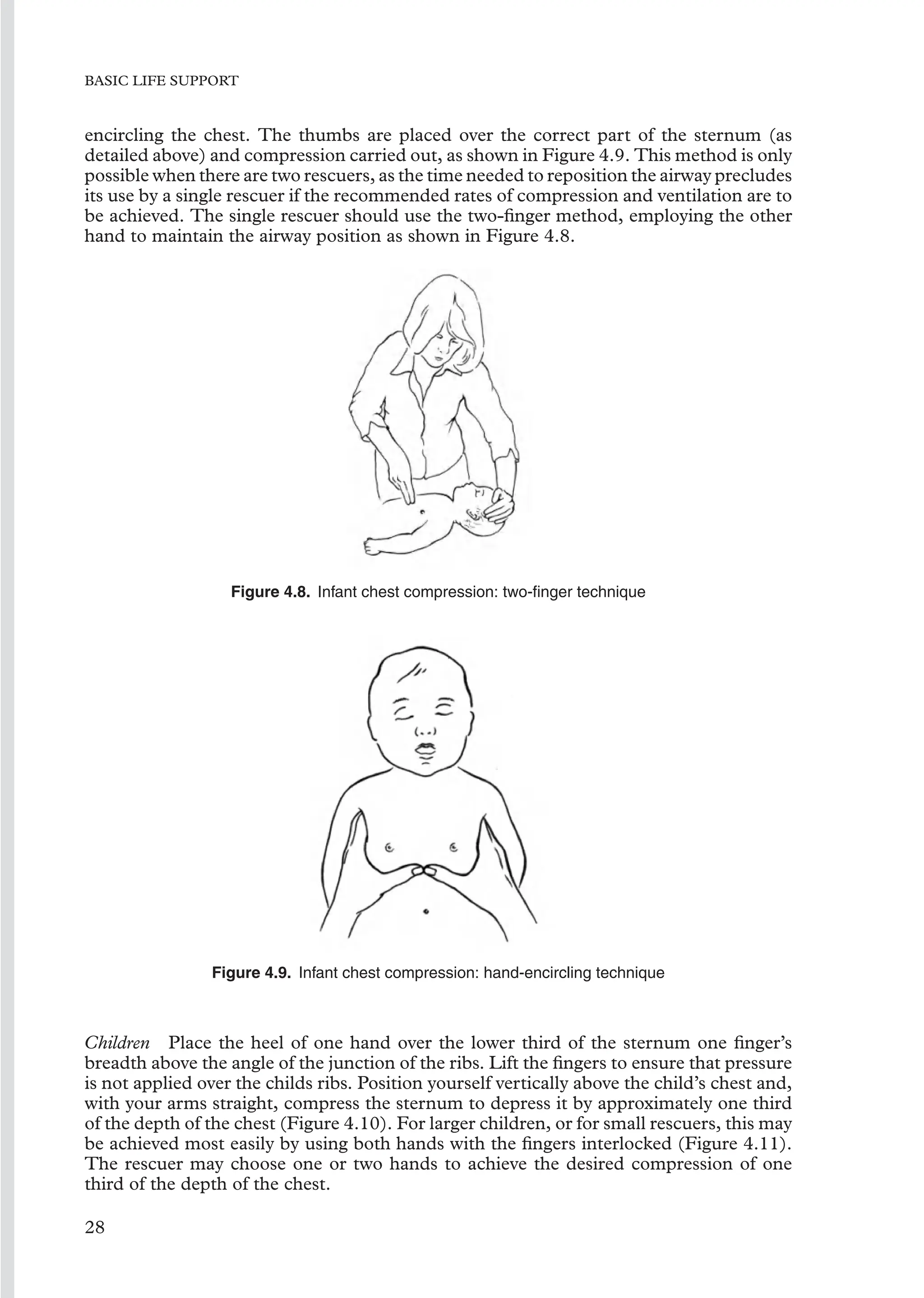
Infants Infant chest compressions can be more effectively achieved using the hand-
encircling technique: the infant is held with both the rescuer’s hands encircling or partially
27
BASIC LIFE SUPPORT
encircling the chest. The thumbs are placed over the correct part of the sternum (as
detailed above) and compression carried out, as shown in Figure 4.9. This method is only
possible when there are two rescuers, as the time needed to reposition the airway precludes
its use by a single rescuer if the recommended rates of compression and ventilation are to
be achieved. The single rescuer should use the two-finger method, employing the other
hand to maintain the airway position as shown in Figure 4.8.
Figure 4.8. Infant chest compression: two-finger technique
Figure 4.9. Infant chest compression: hand-encircling technique
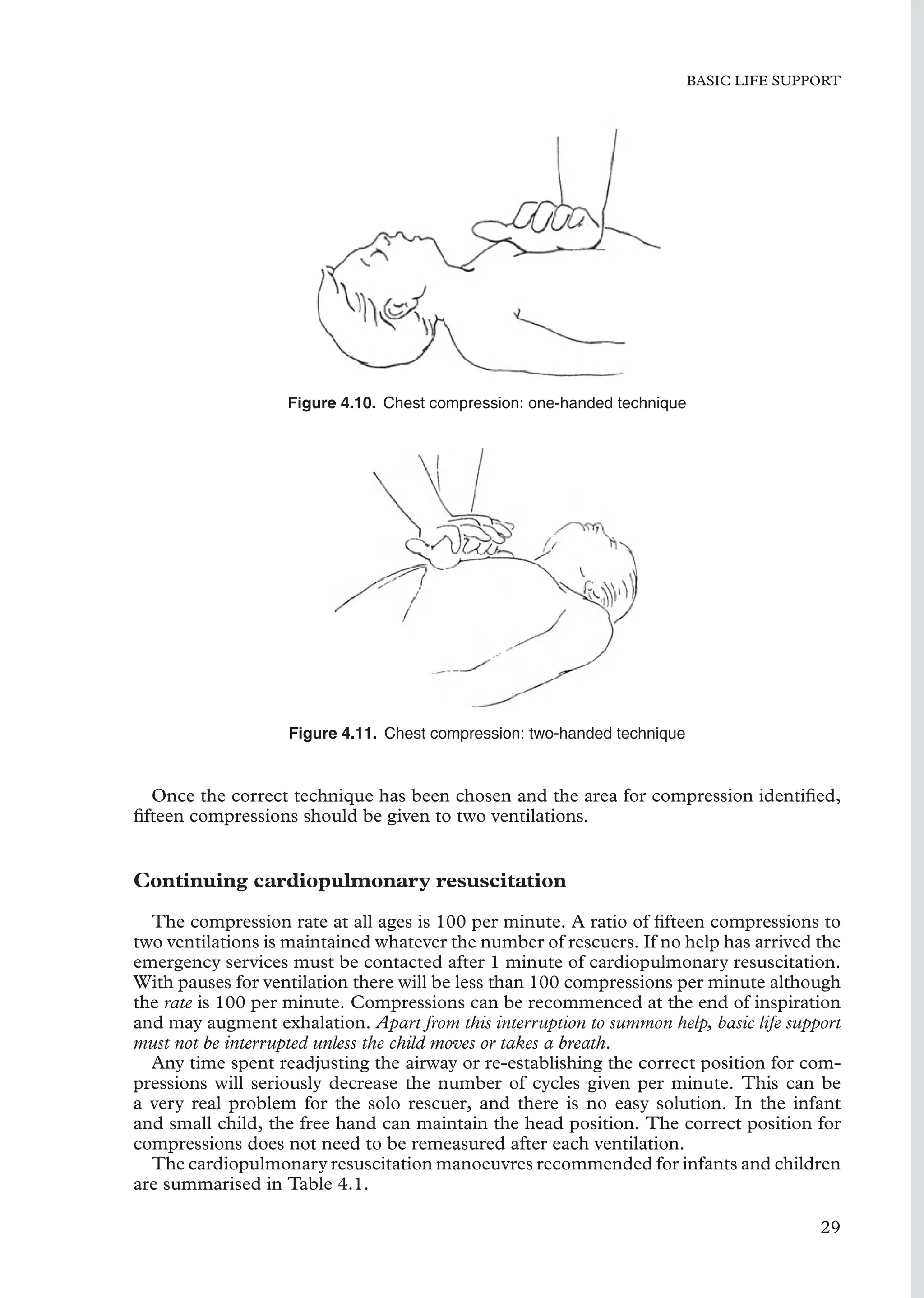
Children Place the heel of one hand over the lower third of the sternum one finger’s
breadth above the angle of the junction of the ribs. Lift the fingers to ensure that pressure
is not applied over the childs ribs. Position yourself vertically above the child’s chest and,
with your arms straight, compress the sternum to depress it by approximately one third
of the depth of the chest (Figure 4.10). For larger children, or for small rescuers, this may
be achieved most easily by using both hands with the fingers interlocked (Figure 4.11).
The rescuer may choose one or two hands to achieve the desired compression of one
third of the depth of the chest.
28
BASIC LIFE SUPPORT
Figure 4.10. Chest compression: one-handed technique
Figure 4.11. Chest compression: two-handed technique
Once the correct technique has been chosen and the area for compression identified,
fifteen compressions should be given to two ventilations.
Continuing cardiopulmonary resuscitation
The compression rate at all ages is 100 per minute. A ratio of fifteen compressions to
two ventilations is maintained whatever the number of rescuers. If no help has arrived the
emergency services must be contacted after 1 minute of cardiopulmonary resuscitation.
With pauses for ventilation there will be less than 100 compressions per minute although
the rate is 100 per minute. Compressions can be recommenced at the end of inspiration
and may augment exhalation. Apart from this interruption to summon help, basic life support
must not be interrupted unless the child moves or takes a breath.
Any time spent readjusting the airway or re-establishing the correct position for com-
pressions will seriously decrease the number of cycles given per minute. This can be
a very real problem for the solo rescuer, and there is no easy solution. In the infant
and small child, the free hand can maintain the head position. The correct position for
compressions does not need to be remeasured after each ventilation.
The cardiopulmonary resuscitation manoeuvres recommended for infants and children
are summarised in Table 4.1.
29
BASIC LIFE SUPPORT
Table 4.1. Summary of basic life support techniques in infants and children
Infant (1yr) Child (1 yr to puberty)
Airway
Head-tilt position Neutral Sniffing
Breathing
Initial slow breaths Five Five
Circulation
Pulse check Brachial or femoral Carotid
Landmark One finger-breadth
above xiphisternum
One finger-breadth
above xiphisternum
Technique Two fingers or two
thumbs
One or two hands
Cardiopulmonary
resuscitation ratio
15:2 15:2
Automatic external defibrillators (AEDs) in children
The use of the AED is now included in basic life support teaching for adults because
early defibrillation is the most effective intervention for the large majority of unpredicted
cardiac arrests in adults. As has been stated, in children and young people circulatory
or respiratory causes of cardiac arrest predominate. However, in certain circumstances
(described in section 4.2) children may suffer a primary cardiac cause for cardiac arrest,
and the use of an AED may be life saving. Recently there has been a large increase in
the number of AEDs, together with trained operators, made available in public places
such as airports, places of entertainment and shops, so the opportunity for their use will
correspondingly increase.
In this text the discussion of the use of AEDs with regard to children will be found in
the chapter on The Management of Cardiac Arrest (Chapter 6).
Recovery position
No specific recovery position has been identified for children. The child should be
placed in a stable, lateral position that ensures maintenance of an open airway with free
drainage of fluid from the mouth, ability to monitor and gain access to the patient, security
of the cervical spine and attention to pressure points.
Age definitions
As the techniques of CPR have been simplified there is now no need to distinguish
between different ages of children but only between infants (under one year) and children
(from one year to puberty). It is clearly inappropriate and also unnecessary to establish
the physical evidence for puberty at CPR. The rescuer should use paediatric guidelines if
he or she believes the victim to be a child. If the victim is, in fact, a young adult, no harm
will be caused as the aetiology of cardiac arrest is, in general, similar in this age group to
that in childhood, i.e. hypoxic/ischaemic rather than cardiac in origin.
Compression: ventilation ratios
Experimental work has shown that coronary perfusion pressure in resuscitation in-
creases if sequences of compressions are prolonged rather than curtailed. Equally,
30
BASIC LIFE SUPPORT
ventilations are a vital part of all resuscitation and are needed early especially in the
hypoxic/ischaemic arrests characteristic of childhood. There is no experimental evidence
to support any particular ratio in childhood but a 15:2 ratio has been validated by exper-
imental and mathematical studies and is the recommended ratio for health care profes-
sionals.
Lay rescuers
It has become clear that bystanders often do not undertake BLS because they are afraid
to do it wrongly and because of an anxiety about performing mouth-to-mouth resuscita-
tion on strangers. For lay rescuers, therefore, the adult compression/ventilation ratio of 30
compressions to 2 ventilations is recommended for children as well as adults thus simplify-
ing the guidance. To increase the appropriateness for children, lay rescuers can be advised
to precede their efforts by 5 rescue breaths if the victim is a child. Single health care pro-
fessional rescuers are also enabled to perform a ratio of 30 compressions to 2 ventilations
for children if they find difficulty in the transition from compressions to ventilations.
4.2 BASIC LIFE SUPPORT AND INFECTION RISK
There have been a few reports of transmission of infectious diseases from casualties to
rescuers during mouth-to-mouth resuscitation. The most serious concern in children is
meningococcus, and rescuers involved in the resuscitation of the airway in such patients
should take standard prophylactic antibiotics (rifampicin or ciprofloxacin).
There have been no reported cases of transmission of either hepatitis B or human im-
munodeficiency virus (HIV) through mouth-to-mouth ventilation. Blood-to-blood con-
tact is the single most important route of transmission of these viruses, and in non-trauma
resuscitations the risks are negligible. Sputum, saliva, sweat, tears, urine and vomit are
low-risk fluids. Precautions should be taken, if possible, in cases where there might be
contact with blood, semen, vaginal secretions, cerebrospinal fluid, pleural and peritoneal
fluids and amniotic fluid. Precautions are also recommended if any bodily secretion con-
tains visible blood. Devices that prevent direct contact between the rescuer and the victim
(such as resuscitation masks) can be used to lower risk; gauze swabs or any other porous
material placed over the victim’s mouth is of no benefit in this regard.
The number of children in the UK with AIDS or HIV-1 infection is less than the number
of adults similarly affected. If transmission of HIV-1 does occur in the UK, it is therefore
much more likely to be from adult rescuer to child rather than the other way around.
In countries where HIV/AIDS is more prevalent the risk to the rescuer will be greater.
In South Africa, in a medical ward 25–40% of children may be HIV-positive but the
prevalence is lower in trauma cases. In the Caribbean, HIV prevalence is second only
to sub-Saharan Africa. The situation may change, as effective anti-retroviral agents are
made available to poor countries.
Although practice manikins have not been shown to be a source of infection, regular
cleaning is recommended and should be carried out as shown in the manufacturer’s
instructions. Infection rates vary from country to country and rescuers must be aware of
the local risk.
4.3 THE CHOKING CHILD
Introduction
The vast majority of deaths from foreign body airway obstruction (FBAO) occur in
pre-school children. Virtually anything may be inhaled, foodstuffs predominating. The
31
BASIC LIFE SUPPORT
diagnosis may not be clear-cut, but should be suspected if the onset of respiratory com-
promise is sudden and is associated with coughing, gagging and stridor.
Airway obstruction also occurs with infections such as acute epiglottitis and croup. In
these cases, attempts to relieve the obstruction using the methods described below are
dangerous. Children with known or suspected infectious causes of obstruction, and those
who are still breathing and in whom the cause of obstruction is unclear, should be taken
to hospital urgently. The treatment of these children is dealt with in Chapter 8.
If a foreign body is easily visible and accessible in the mouth then remove it but while
attempting that, take great care not to push it further into the airway. Do not perform
blind finger sweeps of the mouth or upper airway as these may further impact a foreign
body and damage tissues without removing the object.
The physical methods of clearing the airway, described below, should therefore only
be performed if:
1. The diagnosis of FBAO is clear-cut (witnessed or strongly suspected) and ineffective
coughing and increasing dyspnoea, loss of consciousness or apnoea have occurred.
2. Head tilt/chin lift and jaw thrust have failed to open the airway of an apnoeic child.
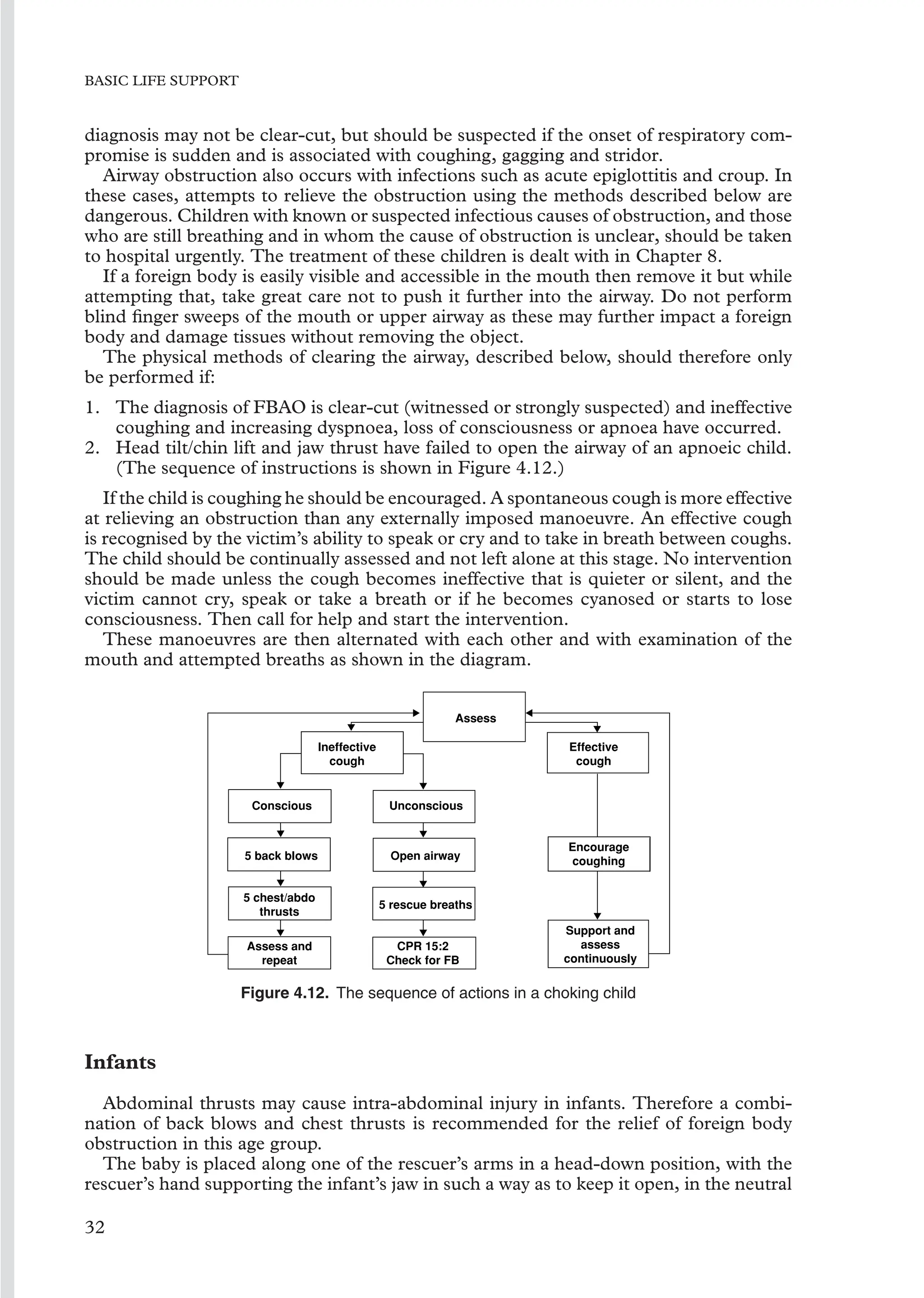
(The sequence of instructions is shown in Figure 4.12.)
If the child is coughing he should be encouraged. A spontaneous cough is more effective
at relieving an obstruction than any externally imposed manoeuvre. An effective cough
is recognised by the victim’s ability to speak or cry and to take in breath between coughs.
The child should be continually assessed and not left alone at this stage. No intervention
should be made unless the cough becomes ineffective that is quieter or silent, and the
victim cannot cry, speak or take a breath or if he becomes cyanosed or starts to lose
consciousness. Then call for help and start the intervention.
These manoeuvres are then alternated with each other and with examination of the
mouth and attempted breaths as shown in the diagram.
Assess
Effective
cough
Encourage
coughing
Support and
assess
continuously
Ineffective
cough
Conscious
5 back blows
5 chest/abdo
thrusts
Assess and
repeat
Unconscious
Open airway
5 rescue breaths
CPR 15:2
Check for FB
Figure 4.12. The sequence of actions in a choking child
Infants
Abdominal thrusts may cause intra-abdominal injury in infants. Therefore a combi-
nation of back blows and chest thrusts is recommended for the relief of foreign body
obstruction in this age group.
The baby is placed along one of the rescuer’s arms in a head-down position, with the
rescuer’s hand supporting the infant’s jaw in such a way as to keep it open, in the neutral
32
BASIC LIFE SUPPORT
position. The rescuer then rests his or her arm along the thigh, and delivers five back
blows with the heel of the free hand.
If the obstruction is not relieved the baby is turned over and laid along the rescuer’s
thigh, still in a head-down position. Five chest thrusts are given – using the same land-
marks as for cardiac compression but at a rate of one per second. If an infant is too large
to allow use of the single-arm technique described above, then the same manoeuvres can
be performed by laying the baby across the rescuer’s lap. These techniques are shown in
Figures 4.13 and 4.14.
Figure 4.13. Back blows in an infant
Figure 4.14. Chest thrusts in an infant
Children
Back blows can be used as in infants (Figure 4.15) or in the case of a larger child,
with child supported in a forward leaning position. In the child the abdominal thrust
(Heimlich manoeuvre) can also be used. This can be performed with the victim either
standing or lying but the former is usually more appropriate.
If this is to be attempted with the child standing the rescuer moves behind the victim
and passes his or her arms around the victim’s body. Owing to the short height of children,
33
BASIC LIFE SUPPORT
Figure 4.15. Back blows in a small child
it may be necessary for an adult to raise the child or kneel behind them to carry out the
standing manoeuvre effectively. One hand is formed into a fist and placed against the
child’s abdomen above the umbilicus and below the xiphisternum. The other hand is
placed over the fist, and both hands are thrust sharply upwards into the abdomen. This
is repeated five times unless the object causing the obstruction is expelled before then.
This technique is shown in Figure 4.16.
Figure 4.16. Heimlich manoeuvre in a standing child
To carry out the Heimlich manoeuvre in a supine child, the rescuer kneels at his or
her feet. If the child is large it may be necessary to kneel astride him or her. The heel
of one hand is placed against the child’s abdomen above the umbilicus and below the
xiphisternum. The other hand is placed on top of the first, and both hands are thrust
sharply upwards into the abdomen, with care being taken to direct the thrust in the
midline. This is repeated five times unless the object causing the obstruction is expelled
before that.
34
BASIC LIFE SUPPORT
Following successful relief of the obstructed airway, assess the child clinically. There
may be still some part of the foreign material in the respiratory tract. If abdominal thrusts
have been performed the child should be assessed for possible abdominal injuries.
Each time breaths are attempted, look in the mouth for the foreign body and remove it
if visible. Take care not to push the object further down and avoid damaging the tissues.
If the obstruction is relieved the victim may still require either continued ventilations if
not breathing but is moving or gagging or both ventilations and chest compressions if
there are no signs of a circulation. Advanced life support may also be needed.
If the child breathes effectively then place him in the recovery position and continue
to monitor him.
Unconscious infant or child with foreign body airway obstruction
• Call for help
• Place the child supine on a flat surface
• Open the mouth and attempt to remove any visible object
• Open the airway and attempt 5 rescue breaths, repositioning the airway with each
breath if the chest does not rise
• Start chest compressions even if the rescue breaths were ineffective
• Continue the sequence for single rescuer CPR for about a minute then summon help
again if none is forthcoming
Each time breaths are attempted, look in the mouth for the foreign body and remove it
if visible. Take care not to push the object further down and avoid damaging the tissues.
If the obstruction is relieved the victim may still require either continued ventilations if
not breathing but is moving or gagging or both ventilations and chest compressions if
there are no signs of a circulation. Advanced life support may also be needed.
If the child breathes effectively then place him in the recovery position and continue
to monitor him.
4.4 SUMMARY
SAFE approach
Are you alright?
Airway opening manoeuvres
Look, listen, feel
5 rescue breaths
Check pulse
Check for signs of circulation
CPR
15 chest compressions
2 ventilations
Call emergency services
1 minute
Figure 4.17. The overall sequence of basic life support in cardiopulmonary arrest
The teaching in this chapter is consistent with the ILCOR guidelines,
Resuscitation 2005, and there are an enormous number of references which
have informed this process. These are available on the ALSG Web site. See
details on the “Contact Details and Further Information” page.
35
CHAPTER
5
Advanced support of the
airway and ventilation
LEARNING OBJECTIVES
In this chapter, you will learn:
• how to assess and manage the airway with adjuncts and equipment
• how to support breathing with simple equipment
• how to respond to an airway/breathing problem with a structured approach
5.1 INTRODUCTION
Management of airway and breathing has priority in the resuscitation of patients of
all ages; however, the rate at which respiratory function can deteriorate in children is
particularly high. Effective resuscitation techniques must be applied quickly and in order
of priority. The differences between adults and children must be realised and familiarity
with equipment assured. Techniques for obtaining a patent and protected airway, and for
achieving adequate ventilation and oxygenation, must be learned and practised. These
techniques must be integrated into a prioritised system of care. It should be stressed that
basic, simple techniques are often effective and life saving.
5.2 EQUIPMENT FOR MANAGING THE AIRWAY
Necessary airway equipment
Face masks
Airways including laryngeal mask airways (LMAs)
Self-inflating bag–valve–mask devices
Tracheal tubes, introducers and connectors
Suction devices
Cricothyroidotomy cannulae
37
ADVANCED SUPPORT OF THE AIRWAY AND VENTILATION
The airway equipment indicated in the box should be available in all resuscitation areas.
It is crucial that familiarity with it is gained before an emergency situation occurs.
Pharyngeal airways
There are two main types of pharyngeal airway:
1. Oropharyngeal
2. Nasopharyngeal
1. The oropharyngeal or Guedel airway is used in the unconscious or obtunded patient
to provide a patent airway channel between the tongue and the posterior pharyngeal
wall. It may also be used to stabilise the position of an oral endotracheal tube.
In the awake patient with an intact gag reflex, it may not be tolerated and may
induce vomiting.
The oropharyngeal airway is available in a variety of sizes. A correctly sized airway
when placed with its flange at the centre of the incisors, then curved around the face,
will reach the angle of the mandible. Too small an airway may be ineffective, too large
an airway may cause laryngospasm. Either may cause mucosal trauma or may worsen
airway obstruction. Reassessment following placement is therefore a vital part of safe
insertion of an airway device. Techniques for insertion are described in Chapter 20.
2. The nasopharyngeal airway is often better tolerated than the Guedel airway. It is con-
traindicated in fractures of the anterior base of the skull. It may also cause significant
haemorrhage from the vascular nasal mucosa. A suitable length can be estimated
by measuring from the tip of the nose to the tragus of the ear. An appropriate di-
ameter is one that just fits into the nostril without causing sustained blanching of
the alae nasi. As small-sized nasopharyngeal airways are not commercially available,
shortened endotracheal tubes may be used.
The acid test of success, as in all therapeutic interventions, is that insertion of one or
other of these devices should result in improvement in the patient’s condition. If it does
not occur then a reappraisal of the choice or size of airway is urgently required.
Figure 5.1. Sizing an oropharyngeal airway
38
ADVANCED SUPPORT OF THE AIRWAY AND VENTILATION
Laryngoscopes
Two principal designs of laryngoscope for use in children exist: straight bladed and
curved bladed.
The straight-bladed laryngoscope is usually employed to directly lift the epiglottis,
thereby uncovering the vocal folds. The advantage of this approach is that the epiglottis
is moved sufficiently so that it does not obscure the cords. The disadvantage potentially
is vagal stimulation causing laryngospasm or bradycardia.
The curved-bladed laryngoscope is designed to move the epiglottis forward by lifting
it from in front. The tip of the blade is inserted into the mucosal pocket, known as the
vallecula, anterior to the epiglottis and the epiglottis is then moved forward by pressure
in the vallecula. This may be equally effective at obtaining a view of the cords and has the
advantage that less vagal stimulation ensues, as the mucosa of the vallecula is innervated
by the glossopharyngeal nerve.
A laryngoscope blade should be chosen appropriate for age. It is possible to intubate
with a blade which is too long but not one which is too short.
Laryngoscopes are notoriously unreliable pieces of equipment which may develop flat
batteries and unserviceable bulbs very quickly between uses. It is vital therefore, that a
spare should be available at all times and that equipment should be regularly checked to
ensure it is in good working order.
Trachea
Laryngeal inlet
Figure 5.2. View of larynx using a straight-bladed laryngoscope
Tracheal tubes
Tracheal tubes come in a variety of designs, the most useful for resuscitation being
the plain plastic tube. Uncuffed tubes should be used during resuscitation, by those who
do not have much paediatric anaesthetic experience, for children up until approximately
10 years of age. Until this point, the larynx is circular in cross section and the narrowest
39
ADVANCED SUPPORT OF THE AIRWAY AND VENTILATION
Epiglottis
Trachea
Laryngeal inlet
Figure 5.3. View of larynx using a curved-bladed laryngoscope
part of it is at the cricoid ring, rather than the vocal cords. An appropriately sized tube
should give a relatively gas-tight fit in the larynx but should not be so tight that no
leak is audible when the bag is compressed. Failure to observe this condition may lead to
damage to the mucosa at the level of the cricoid ring and to subsequent oedema following
extubation.
Estimating the appropriate size of an uncuffed tracheal tube is carried out as follows:
Internal diameter (mm) = (Age/4) + 4
Length (cm) = (Age/2) + 12 for an oral tube
Length (cm) = (Age/2) + 15 for nasal tube
These formulae are appropriate for ages over 1 year. Neonates usually require a tube
of internal diameter 3–3.5 mm, although pre-term infants may need one of diameter
2.5 mm. Cuffed tubes should not be used in neonates. Tracheal tubes are measured in
sizes by their internal diameter in millimetres. They are provided in whole- and half-
millimetre sizes. The clinician should select a tube of appropriate size but also prepare
one a size smaller and one a size larger.
In the circumstances of resuscitation in a young child where the lungs are very “stiff”,
for example in a cardiac arrest from severe bronchiolitis, a cuffed tube rather than an
uncuffed tube may be used but the risk of airway damage from the cuff must be balanced
against the risk of failure to inflate the lungs.
Tracheal tube introducers
Intubation can be facilitated by the use of a stylet or introducer, placed through the
lumen of the tracheal tube. There are two types: soft and flexible or firm and malleable.
The former can be allowed to project out of the tip of the tube, as long as it is handled
very gently. The latter is used to alter the shape of the tube, but can easily damage the
tissues if allowed to protrude from the end of the tracheal tube. Tracheal tube introducers
should not be used to force a tracheal tube into position.
40
Another Random Document on
Scribd Without Any Related Topics
small donations ($1 to $5,000) are particularly important to
maintaining tax exempt status with the IRS.
The Foundation is committed to complying with the laws regulating
charities and charitable donations in all 50 states of the United
States. Compliance requirements are not uniform and it takes a
considerable effort, much paperwork and many fees to meet and
keep up with these requirements. We do not solicit donations in
locations where we have not received written confirmation of
compliance. To SEND DONATIONS or determine the status of
compliance for any particular state visit www.gutenberg.org/donate.
While we cannot and do not solicit contributions from states where
we have not met the solicitation requirements, we know of no
prohibition against accepting unsolicited donations from donors in
such states who approach us with offers to donate.
International donations are gratefully accepted, but we cannot make
any statements concerning tax treatment of donations received from
outside the United States. U.S. laws alone swamp our small staff.
Please check the Project Gutenberg web pages for current donation
methods and addresses. Donations are accepted in a number of
other ways including checks, online payments and credit card
donations. To donate, please visit: www.gutenberg.org/donate.
Section 5. General Information About
Project Gutenberg™ electronic works
Professor Michael S. Hart was the originator of the Project
Gutenberg™ concept of a library of electronic works that could be
freely shared with anyone. For forty years, he produced and
distributed Project Gutenberg™ eBooks with only a loose network of
volunteer support.
Project Gutenberg™ eBooks are often created from several printed
editions, all of which are confirmed as not protected by copyright in
the U.S. unless a copyright notice is included. Thus, we do not
necessarily keep eBooks in compliance with any particular paper
edition.
Most people start at our website which has the main PG search
facility: www.gutenberg.org.
This website includes information about Project Gutenberg™,
including how to make donations to the Project Gutenberg Literary
Archive Foundation, how to help produce our new eBooks, and how
to subscribe to our email newsletter to hear about new eBooks.
Welcome to our website – the perfect destination for book lovers and
knowledge seekers. We believe that every book holds a new world,
offering opportunities for learning, discovery, and personal growth.
That’s why we are dedicated to bringing you a diverse collection of
books, ranging from classic literature and specialized publications to
self-development guides and children's books.
More than just a book-buying platform, we strive to be a bridge
connecting you with timeless cultural and intellectual values. With an
elegant, user-friendly interface and a smart search system, you can
quickly find the books that best suit your interests. Additionally,
our special promotions and home delivery services help you save time
and fully enjoy the joy of reading.
Join us on a journey of knowledge exploration, passion nurturing, and
personal growth every day!
ebookbell.com

Advanced Paediatric Life Support The Practical Approach Fourth Edition Advanced Life Support Group

  • 1.
    Advanced Paediatric LifeSupport The Practical Approach Fourth Edition Advanced Life Support Group download https://ebookbell.com/product/advanced-paediatric-life-support- the-practical-approach-fourth-edition-advanced-life-support- group-4298640 Explore and download more ebooks at ebookbell.com
  • 2.
    Here are somerecommended products that we believe you will be interested in. You can click the link to download. Advanced Paediatric Life Support The Practical Approach Fifth Edition Advanced Life Support Group Alsg https://ebookbell.com/product/advanced-paediatric-life-support-the- practical-approach-fifth-edition-advanced-life-support-group- alsg-4298642 Prehospital Paediatric Life Support A Practical Approach To The Outofhospital Emergency Care Of Children Second Edition Advanced Life Support Group https://ebookbell.com/product/prehospital-paediatric-life-support-a- practical-approach-to-the-outofhospital-emergency-care-of-children- second-edition-advanced-life-support-group-4310514 Paediatric And Neonatal Safe Transfer And Retrieval The Practical Approach Advanced Life Support Group Alsg https://ebookbell.com/product/paediatric-and-neonatal-safe-transfer- and-retrieval-the-practical-approach-advanced-life-support-group- alsg-4309648 Advanced Paediatric Life Support A Practical Approach To Emergencies 7th 7th Edition Stephanie Smith https://ebookbell.com/product/advanced-paediatric-life-support-a- practical-approach-to-emergencies-7th-7th-edition-stephanie- smith-51991720


  • 3.
    Advanced Paediatric LifeSupport 3rd Edition 3rd Kevin Mackwayjones https://ebookbell.com/product/advanced-paediatric-life-support-3rd- edition-3rd-kevin-mackwayjones-2162254 Advanced Paediatric Life Support A Practical Approach To Emergencies 6th Edition Martin Samuels Sue Wieteska https://ebookbell.com/product/advanced-paediatric-life-support-a- practical-approach-to-emergencies-6th-edition-martin-samuels-sue- wieteska-5701308 Advanced Paediatric Life Support Advanced Life Support Groupsue Wieteska https://ebookbell.com/product/advanced-paediatric-life-support- advanced-life-support-groupsue-wieteska-11330232 Paediatric Advanced Life Support Phil Jevonauth https://ebookbell.com/product/paediatric-advanced-life-support-phil- jevonauth-4309646 European Paediatric Advanced Life Support Erc Guidelines 2021 Edition Erc https://ebookbell.com/product/european-paediatric-advanced-life- support-erc-guidelines-2021-edition-erc-59012894
  • 5.
    ADVANCED PAEDIATRIC LIFESUPPORT Fourth edition
  • 6.
    ADVANCED PAEDIATRIC LIFE SUPPORT The PracticalApproach Fourth edition Advanced Life Support Group Edited by Kevin Mackway-Jones Elizabeth Molyneux Barbara Phillips Susan Wieteska
  • 7.
    c 2005 byBlackwell Publishing Ltd BMJ Books is an imprint of the BMJ Publishing Group Limited, used under licence Blackwell Publishing, Inc., 350 Main Street, Malden, Massachusetts 02148-5020, USA Blackwell Publishing Ltd, 9600 Garsington Road, Oxford OX4 2DQ, UK Blackwell Publishing Asia Pty Ltd, 550 Swanston Street, Carlton, Victoria 3053, Australia The right of the Author to be identified as the Author of this Work has been asserted in accordance with the Copyright, Designs and Patents Act 1988. All rights reserved. No part of this publication may be reproduced, stored in a retrieval system, or transmitted, in any form or by any means, electronic, mechanical, photocopying, recording or otherwise, except as permitted by the UK Copyright, Designs and Patents Act 1988, without the prior permission of the publisher. First published in 1993 by the BMJ Publishing Group Reprinted in 1994, 1995, 1996 Second edition 1997, reprinted 1998, reprinted with revisions 1998, 1999, 2000 Third edition 2001, second impression 2003, third impression 2003 Library of Congress Cataloging-in-Publication Data Advanced paediatric life support : the practical approach / Advanced Life Support Group; edited by Kevin Mackway-Jones . . . [et al.].– 4th ed. p.; cm. Includes index. ISBN 0-7279-1847-8 1. Pediatric emergencies. 2. Pediatric intensive care. 3. Life support systems (Critical care) [DNLM: 1. Emergencies–Child. 2. Emergencies–Infant. 3. Critical Care–Child. 4. Critical Care–Infant. 5. Wounds and Injuries–therapy–Child. 6. Wounds and Injuries–therapy–Infant. WS 205 A244 2004] I. Mackway-Jones, Kevin. II. Advanced Life Support Group (Manchester, England) RJ370.A326 2004 618.92’0028–dc22 2004021823 ISBN-13: 9780727918475 ISBN-10: 0727918478 Catalogue records for this title are available from the British Library and the Library of Congress Set by Techbooks, New Delhi, India Printed and bound in Spain by GraphyCems, Navarra Commissioning Editor: Mary Banks Development Editor: Veronica Pock Production Controller: Kate Charman For further information on Blackwell Publishing, visit our website: http://www.blackwellpublishing.com The publisher’s policy is to use permanent paper from mills that operate a sustainable forestry policy, and which has been manufactured from pulp processed using acid-free and elementary chlorine-free practices. Furthermore, the publisher ensures that the text paper and cover board used have met acceptable environmental accreditation standards.
  • 8.
    CONTENTS Working Group ix Contributorsxi Preface to the Fourth Edition xiii Preface to the First Edition xiv Acknowledgements xv Contact Details and Further Information xvii PART I: INTRODUCTION Chapter 1 Introduction 3 Chapter 2 Why treat children differently? 7 Chapter 3 Structured approach to emergency paediatrics 15 PART II: LIFE SUPPORT Chapter 4 Basic life support 21 Chapter 5 Advanced support of the airway and ventilation 37 Chapter 6 The management of cardiac arrest 47 PART III: THE SERIOUSLY ILL CHILD Chapter 7 The structured approach to the seriously ill child 59 Chapter 8 The child with breathing difficulties 73 Chapter 9 The child in shock 97 Chapter 10 The child with an abnormal pulse rate or rhythm 115 Chapter 11 The child with a decreased conscious level 125 Chapter 12 The convulsing child 139 v
  • 9.
    CONTENTS PART IV: THESERIOUSLY INJURED CHILD Chapter 13 The structured approach to the seriously injured child 151 Chapter 14 The child with chest injury 167 Chapter 15 The child with abdominal injury 175 Chapter 16 The child with trauma to the head 179 Chapter 17 The child with injuries to the extremities or the spine 189 Chapter 18 The burned or scalded child 199 Chapter 19 The child with an electrical injury or drowning 205 PART V: PRACTICAL PROCEDURES Chapter 20 Practical procedures – airway and breathing 215 Chapter 21 Practical procedures – circulation 231 Chapter 22 Practical procedures – trauma 243 Chapter 23 Interpreting trauma X-rays 253 Chapter 24 Structured approach to stabilisation and transfer 265 PART VI: APPENDICES Appendix A Acid–base balance 279 Appendix B Fluid and electrolyte management 285 Appendix C Child abuse 299 Appendix D Prevention of injury in children 309 Appendix E When a child dies 313 Appendix F Management of pain in children 317 Appendix G Triage 327 Appendix H General approach to poisoning and envenomation 331 Appendix I Resuscitation of the baby at birth 347 Appendix J Formulary 361 Index 385 vi
  • 10.
    ASSOCIATE EDITORS P. OakleyTrauma Anaesthesia, Stoke on Trent B. Phillips Paediatric Emergency Medicine, Liverpool M. Samuels Paediatric ICU, Stoke on Trent S. Young Paediatric Emergency Medicine, Melbourne vii
  • 11.
    WORKING GROUP A. ArgentPaediatric ICU, Cape Town A. Charters Emergency Nursing, Portsmouth E. Duval Paediatrics, Antwerp C. Ewing Paediatrics, Manchester M. Felix Paediatrics, Coimbra G. Hughes Emergency Medicine, Wellington F. Jewkes Pre-Hospital Paediatrics, Wiltshire K. Katsanoulas Anaesthetics/ICU, Thessaloniki J. Leigh Anaesthesia, Bristol K. Mackway-Jones Emergency Medicine, Manchester E. Molyneux Paediatric Emergency Medicine, Blantyre, Malawi P. Oakley Anaesthesia/Trauma, Stoke on Trent T. Rajka Paediatrics, Oslo B. Phillips Paediatric Emergency Medicine, Liverpool I. Sammy Paediatric Emergency Medicine, Trinidad M. Samuels Paediatric ICU, Stoke on Trent N. Turner Anaesthesia, Amsterdam I. Vidmar Paediatrics, Ljubljana J. Walker Paediatric Surgery, Sheffield ix
  • 12.
    WORKING GROUP C. WhytePaediatric ICU Nursing, Middlesbrough S. Wieteska ALSG Group Manager, Manchester K. Williams Paediatric Emergency Nursing, Liverpool J. Wyllie Neonatology, Middlesbrough S. Young Paediatric Emergency Medicine, Melbourne x
  • 13.
    CONTRIBUTORS R. Appleton PaediatricNeurology, Liverpool A. Argent Paediatric ICU, Cape Town C. Baillie Paediatric Surgery, Liverpool P. Baines Paediatric Intensive Care, Liverpool I. Barker Paediatric Anaesthesia, Sheffield D. Bickerstaff Paediatric Orthopaedics, Sheffield R. Bingham Paediatric Anaesthesia, London P. Brennan Paediatric Emergency Medicine, Sheffield J. Britto Paediatric Intensive Care, London G. Browne Paediatric Emergency Medicine, Sydney C. Cahill Emergency Medicine, Portsmouth H. Carty Paediatric Radiology, Liverpool A. Charters Emergency Nursing, Portsmouth M. Clarke Paediatric Neurology, Manchester J. Couriel Paediatric Respiratory Medicine, Liverpool P. Driscoll Emergency Medicine, Manchester J. Fothergill Emergency Medicine, London P. Habibi Paediatric Intensive Care, London D. Heaf Paediatric Respiratory Medicine, Liverpool J. K. Heltne Anaesthesia, Haukeland F. Jewkes Pre-Hospital Paediatrics, Wiltshire E. Ladusans Paediatric Cardiology, Manchester J. Leggatte Paediatric Neurosurgery, Manchester xi
  • 14.
    CONTRIBUTORS J. Leigh Anaesthesia,Bristol S. Levene Child Accident Prevention Trust, London M. Lewis Paediatric Nephrology, Manchester K. Mackway-Jones Emergency Medicine, Manchester I. Maconochie Emergency Paediatrics, London J. Madar Neonatology, Plymouth T. Martland Paediatric Neurologist, Manchester E. Molyneux Paediatric Emergency Medicine, Malawi D. Nicholson Radiology, Manchester A. Nunn Pharmacy, Liverpool P. Oakley Anaesthesia, Stoke on Trent R. Perkins Paediatric Anaesthesia, Manchester B. Phillips Paediatric Emergency Medicine, Liverpool T. Rajka Paediatrics, Oslo J. Robson Paediatric Emergency Medicine, Liverpool I. Sammy Paediatric Emergency Medicine, Trinidad M. Samuels Paediatric ICU, Stoke on Trent D. Sims Neonatology, Manchester A. Sprigg Paediatric Radiology, Sheffield B. Stewart Paediatric Emergency Medicine, Liverpool J. Stuart Emergency Medicine, Manchester L. Teebay Child Protection and Paediatric Emergency Medicine, Liverpool J. Tibballs Paediatric Intensive Care, Melbourne N. Turner Anaesthesia, Amsterdam J. Walker Paediatric Surgery, Sheffield W. Whitehouse Paediatric Neurologist, Nottingham S. Wieteska ALSG Group Manager, Manchester M. Williams Emergency Medicine, York B. Wilson Paediatric Radiology, Manchester J. Wyllie Neonatology, Middlesbrough S. Young Paediatric Emergency Medicine, Melbourne D. Zideman Anaesthesia, London xii
  • 15.
    PREFACE TO FOURTHEDITION When we first published this book in 1993 our aim was to bring a structured approach and simple guidelines to the emergency management of ill and injured children. The Advanced Paediatric Life Support (APLS) concept and courses have gone a long way towards this. APLS is now well established in the United Kingdom, Australasia, the Caribbean, mainland Europe, the Middle East, Scandanavia and South Africa. Modified versions of the course are being taught in countries which are developing, have a poorer health infrastructure and have specific serious health problems. These include Africa and parts of Asia and South America. In this work the Advanced Life Support Group (ALSG) are collaborating with many other agencies: more information on these developments can be found on the ALSG Web site. A small “family” of courses have developed from APLS in response to different training needs. One is the Paediatric Life Support (PLS) course, a 1-day, locally delivered course for health professionals who have a subsidiary responsibility for the emergency care of children, and the other is the Pre-Hospital Paediatric Life Support (PHPLS) course, which has its own textbook and is for the pre-hospital provider. In the original APLS course the aim was to manage the critically ill or injured child for the first hour. As the course has developed, there has been gradual extension of its scope and the inclusion of more material and training so as to provide the emergency team with the knowledge and skills to manage the seriously ill or injured child to stabilisation and transfer. The presentation of the fourth edition reflects the pace of change of medical science and the international nature of APLS. The text is now presented in a loose leaf format. When there are evidence-based changes to practice that can benefit children in the emergency situation, a new page will be available to be downloaded from the ALSG Web site and inserted in the current text. In late 2005, for example, new International Liaison Committee on Resuscitation (ILCOR) guidelines for resuscitation from cardiac arrest will be published and ALSG will publish an update to the chapter on our Web site. The basic text reflects UK practice as this country is still the largest user of courses. However, for areas of the world where practice is different there is a facility for pages to be printed from the ALSG Web site and substituted in the text. See the “Contact Details and Further Information” page for details. A further presentational change is the inclusion of marginal indicators to show where BestBETs and other Web-based references can be found. A list of references becomes obsolete no sooner than it is printed, so we have engaged the power of the World Wide Web to keep our readers up to date with the evidence. See the “Contact Details and Further Information” page for details. The days spent on courses are just part of a learning process; both skills and knowledge need continual reinforcement. At the end of your APLS course you will receive a CD-ROM and a logbook for you to use back at your place of work. We hope that this will contribute to the development of your emergency paediatric practice. Over the years an increasing number of experts have contributed to the work and we extend our thanks both to them and to our instructors, who unceasingly provide helpful feedback. Consultation with instructors has greatly contributed to this new edition and to the revised course. KMJ EM BP SW Manchester 2005 xiii
  • 16.
    PREFACE TO THEFIRST EDITION Advanced Paediatric Life Support: The Practical Approach was written to improve the emer- gency care of children, and has been developed by a number of paediatricians, paediatric surgeons, emergency physicians and anaesthetists from several UK centres. It is the core text for the APLS (UK) course, and will also be of value to medical and allied personnel unable to attend the course. It is designed to include all the common emergencies, and also covers a number of less common diagnoses that are amenable to good initial treat- ment. The remit is the first hour of care, because it is during this time that the subsequent course of the child is set. The book is divided into six parts. Part I introduces the subject by discussing the causes of childhood emergencies, the reasons why children need to be treated differently and the ways in which a seriously ill child can be recognised quickly. Part II deals with the techniques of life support. Both basic and advanced techniques are covered, and there is a separate section on resuscitation of the newborn. Part III deals with children who present with serious illness. Shock is dealt with in detail, because recognition and treatment can be particularly difficult. Cardiac and respiratory emergencies, and coma and convulsions, are also discussed. Part IV concentrates on the child who has been seriously injured. Injury is the most common cause of death in the 1–14-year age group and the importance of this topic cannot be overemphasised. Part V gives practical guidance on performing the procedures mentioned elsewhere in the text. Finally, Part VI (the appendices) deals with other areas of importance. Emergencies in children generate a great deal of anxiety – in the child, the parents and in the medical and nursing staff who deal with them. We hope that this book will shed some light on the subject of paediatric emergency care, and that it will raise the standard of paediatric life support. An understanding of the contents will allow doctors, nurses and paramedics dealing with seriously ill and injured children to approach their care with confidence. Kevin Mackway-Jones Elizabeth Molyneux Barbara Phillips Susan Wieteska (Editorial Board) 1993 xiv
  • 17.
    ACKNOWLEDGEMENTS A great manypeople have put a lot of hard work into the production of this book, and the accompanying advanced life support course. The editors would like to thank all the contributors for their efforts and all the APLS instructors who took the time to send us their comments on the earlier editions. We are greatly indebted to Helen Carruthers, MMAA, Mary Harrison, MMAA, and Kate Wieteska for producing the excellent line drawings that illustrate the text. Thanks to the Status Epilepticus Working Party for the status epilecticus protocol and the Child’s Glasgow Coma Scale. The information in Table 9.1 is taken from Lessons from Research for Doctors in Training produced by the Meningitis Research Foundation. We are also grateful to Dr Ros Roden, from the ATLS subcommittee who advised on consistency issues between ATLS and APLS trauma. ALSG gratefully acknowledge the support of the Royal College of Paediatrics and Child Health (UK). The Specialist Groups of the RCPCH have agreed to advise on the clinical content of chapters relevant to their specialism. ALSG wish to thank the following: British Society for Paediatric Endocrinology Dr G Butler, Paediatric Adolescent Endocrinology, Leeds Dr J Edge, Paediatrics, Oxford British Paediatric Cardiac Association Dr B Craig, Paediatric Cardiology, Belfast British Association for Paediatric Nephrology Dr J Evans, Paediatric Nephrology, Nottingham British Association of Community Child Health Dr T Hutchison, Community Paediatrics, Bath Dr J Mok, Community Paediatrics, Edinburgh British Paediatric Haematology Forum Dr S Kinsey, Paediatric Haematology, Leeds British Paediatric Intensive Care Group Dr P Habibi, Paediatric Intensive Care, London xv
  • 18.
    ACKNOWLEDGEMENTS British Paediatric Immunologyand Infectious Dr H Lyall, Paediatric Infectious Diseases, London Diseases Group British Inherited Metabolic Disease Group Dr G Shortland, Paediatrics, Cardiff Dr Hall, Paediatrics, Sheffield Dr R Bowker, Paediatrics, Nottingham British Paediatric Radiology and Dr A Sprigg, Sheffield Imaging Group British Paediatric Respiratory Society Dr J Couriel, Respiratory Paediatrics, Liverpool Finally, we would like to thank, in advance, those of you who will attend the Advanced Paediatric Life Support course and other courses using this text; no doubt, you will have much constructive criticism to offer. xvi
  • 19.
    CONTACT DETAILS ANDFURTHER INFORMATION ALSG: www.alsg.org BestBETS: www.bestbets.org For details on ALSG courses visit the Web site or contact: Advanced Life Support Group ALSG Centre for Training Development 29-31 Ellesmere Street Swinton, Manchester M27 0LA Tel: +44 (0)161 794 1999 Fax: +44 (0)161 794 9111 Email: enquiries@alsg.org Clinicians practising in tropical and under-resourced health care systems are advised to read A Manual for International Child Health Care (0 7279 1476 6) published by Blackwell, which gives details of additional relevant illnesses not included in this text. NOTE Sections with the grey marginal tint are relevant for the Paediatric Life Support (PLS) course. UPDATES The material contained within this book is updated on a 4-yearly cycle. However, practice may change in the interim period. For example, it is anticipated that there will be minor changes made following the publication of the updated ILCOR guidelines at the end of 2005. We will post any changes on the ALSG Web site, so we advise that you visit the Web site regularly to check for updates (url: www.alsg.org/updates). The Web site will provide you with a new page to download and replace the existing page in your book. REFERENCES Throughout the text, you will see one of two logos indicating that evidence/references are available via the Web: To access the evidence, visit the BestBETs Web site www.bestbets.org (the number next to the logo indicates the BestBET reference number. To find a specific BET click on “Databases”, “Search” and type in the BET number under “Terms”, then click “Search”. To access the references visit the ALSG Web site www.alsg.org/references ON-LINE FEEDBACK It is important to ALSG that the contact with our providers continues after a course is completed. We now contact everyone 6 months after their course has taken place asking for on-line feedback on the course. This information is then used whenever the course is updated to ensure that the course provides optimum training to its participants. xvii
  • 20.
  • 21.
    CHAPTER 1 Introduction 1.1 INTRODUCTION Each yearmany millions of children around the world die from potentially preventable and treatable causes. Whilst the majority of these deaths would be prevented by atten- tion to living conditions and public health measures, an improvement in the recogni- tion of serious illness and delivery of initial medical treatment would undoubtedly save lives. The training of health care practitioners and the resources available for health care de- livery varies enormously among countries. It is possible however to improve the outcome of serious illness and injury in children with modest resources if the basic principles of resuscitation are adhered to. The structured sequential approach to the recognition and treatment of the seriously ill and injured child followed in this manual is applicable in many situations and circumstances. 1.2 MORTALITY RATES IN CHILDHOOD Worldwide mortality rates in children have fallen substantially and consistently over the last 100 years. The World Health Organisation has estimated that the global infant mortality rate has fallen from 180 in 1950 to 67 in 2000. In some developed countries the fall has been even more dramatic. For example in Australia the infant mortality rate in 1902 was 107: one hundred years later in 2002 the figure had reduced to 5.0. Even with figures at such low levels, the rates in developed countries have recently continued to fall. In England and Wales the infant mortality rates have halved in the last 18 years, falling from 10.8 in 1983 to 5.1 in 2001. These dramatic improvements in infant mortality are due largely to improvements in living conditions such as sanitation, shelter, quality of drinking water and better nutri- tion. Some medical measures such as better obstetric and neonatal care and the ad- vent of mass vaccination have also played substantial roles. The delivery of better acute care for seriously ill and injured children is likely to assist in reducing mortality rates further. 3
  • 22.
    INTRODUCTION The infant mortalityrate is defined as the number of deaths of children under 1 year of age in one calendar year per 1000 live births in the same calendar year. The mortality rate decreases significantly with the increasing age of the child, with the highest death rate occurring in the first 28 days, and indeed most deaths occur on the first day of life. Male children are more likely to die than females in all age groups, a trend which is not reversed until much later in life. Table 1.1. Number of deaths and death rate by age group England and Wales 2001 Australia 2000 Holland 2001 Age group Number Rate per 1000 Number Rate per 1000 Number Rate per 1000 0–28 days 2137 3.6 858 3.4 3.9 4–52 weeks 1103 1.9 406 1.6 1.5 1–4 years 588 0.24 260 0.2 210 0.4 5–14 years 832 0.12 432 0.1 280 0.1 1–14 years 1420 0.15 692 0.1 490 Source: England and Wales – Office of National Statistics 2003 Australia – Australian Bureau of Statistics 2003 Holland – Centraal Bureau voor de Statistiek 1.3 CAUSES OF DEATH IN CHILDHOOD The causes of death vary with age as shown in Table 1.2. In the newborn period the most common causes are congenital abnormalities and factors associated with prematurity, such as respiratory immaturity, cerebral haemorrhage and infection due to immaturity of the immune response. From 1 month to 1 year of age sudden infant death syndrome (SIDS) is the most common cause of death in developed countries. In many of these countries there has been a striking reduction in the incidence of SIDS over the last few years. In England and Wales, for example, the number of deaths has decreased from 1597 in 1988 to 164 in 2002. This reduction has followed national campaigns to inform parents of risk factors such as the prone sleeping position in the infant and parental smoking. Congenital abnormalities contribute significantly to mortality rates during all stages of childhood. Complex congenital heart disease, central nervous system malformations, metabolic disorders and chromosomal anomalies are the commonest lethal disorders. Table 1.2. Common causes of death by age group, England and Wales, 2002 4–52 weeks 1–4 years 5–14 years Cause Number Percent Number Percent Number Percent Sudden infant death syndrome 164 13 0 0 0 0 Congenital abnormality 205 20 97 18 64 8 Infection 65 6 52 10 27 3 Trauma 53 5 90 16 197 24 Neoplasms 15 1 89 16 218 26 Source: England and Wales – Office of National Statistics 2004 4
  • 23.
    INTRODUCTION After 1 yearof age trauma is a frequent cause of death in the UK, and remains so until well into adult life. Deaths from trauma have been described as falling into three groups. In the first group there is overwhelming damage at the time of trauma, and the injury caused is incompatible with life; children with such massive injuries will die within minutes whatever is done. Those in the second group die because of progressive respiratory failure, circulatory insufficiency, or raised intracranial pressure secondary to the effects of injury; death occurs within a few hours if no treatment is administered, but may be avoided if treatment is prompt and effective. The final group consists of late deaths due to raised intracranial pressure, infection or multiple organ failure. Appropriate management in the first few hours will decrease mortality in this group also. In developing countries infectious diseases are still major causes of death. Seven out of 10 childhood deaths can be attributed to just five main causes: pneumonia, diarrhoea, measles, malaria and malnutrition. Three out of every four children seen by health ser- vices are suffering from at least one of these conditions. HIV/AIDS has contributed to this and also been associated with increasing deaths from tuberculosis in countries af- fected. As these societies become more urbanised the mortality from trauma, especially from motor vehicle accidents, increases. In South Africa, a country which, although developing rapidly, has large areas of severe poverty, the under-5’s mortality rate has re- cently been shown to include 40% (42,749) deaths from HIV/AIDS, 11% (11,876) from low birth weight, 21% (22,680) from infections and 3% (3506) from trauma. In older South African children, trauma, especially road traffic accidents, homicide and suicide are leading causes of death. In Trinidad, children under 1 year of age accounted for 4% of deaths in 1997, with infant mortality at 17 per 1000 live births. In Trinidadian school children, the foremost cause of death was injury, with infections causing one fifth of deaths. In developed countries, many children with diseases that were once invariably fatal, such as complex congenital heart disease, inborn errors of metabolism, haematological malignancies or cystic fibrosis, are now treated or “cured” by drugs, operation, diet, transplant or, soon, even gene therapy. In these children, common acute illnesses such as varicella or chest infections have potentially lethal consequences. They require a low threshold for rapid aggressive treatment delivered by a team with an understanding of their underlying disease. Only a minority of childhood deaths, such as those due to end-stage neoplastic disease, are expected and “managed”. There should be timely discussions among child, family and health carers to identify whether and in what manner resuscitation should be carried out to prevent unwanted and inappropriate resuscitation and interventions. 1.4 PATHWAYS LEADING TO CARDIORESPIRATORY ARREST As the outcome from cardiorespiratory arrest in children is poor the only effective way to prevent death and permanent disability is to understand its antecedent events, and be able to recognise and treat them vigorously. Cardiac arrest in children is rarely due to primary cardiac disease. This differs from the situation in an adult where the primary arrest is often cardiac, and circulatory and respiratory function may remain near-normal until the moment of arrest. In children, most cardiorespiratory arrests are secondary to hypoxia caused by respi- ratory pathology, including birth asphyxia, inhalation of foreign body, bronchiolitis and asthma. Respiratory arrest also occurs secondary to neurological dysfunction caused by such events as a convulsion or poisoning. Raised intracranial pressure (ICP) due to head 5
  • 24.
    INTRODUCTION injury or acuteencephalopathy eventually leads to respiratory arrest, but severe neuronal damage has already been sustained before the arrest occurs. Whatever the cause, by the time of cardiac arrest the child has had a period of respiratory insufficiency, which will have caused hypoxia and respiratory acidosis. The combination of hypoxia and acidosis causes cell damage and death (particularly in more sensitive organs such as the brain, liver and kidney), before myocardial damage is severe enough to cause cardiac arrest. Most other cardiac arrests in children are secondary to circulatory failure. This will have resulted often from fluid or blood loss, or from fluid maldistribution within the circulatory system. The former may be due to gastroenteritis, burns or trauma, whilst the latter is often caused by sepsis or anaphylaxis. Because all organs are deprived of essential nutrients and oxygen as shock progresses to cardiac arrest, circulatory failure, like respiratory failure, causes tissue hypoxia and acidosis. In fact, both pathways may occur in the same condition. The pathways leading to cardiac arrest in children are summarised in Figure 1.1. Figure 1.1. Pathways leading to cardiac arrest in childhood (with examples of underlying causes) 1.5 OUTCOME FROM CARDIAC ARREST IN CHILDREN The outcome of cardiac arrest in children is invariably poor. Of those few who survive, many are left with permanent neurological deficits. The worst outcome is in children who have had an out-of-hospital arrest and who arrive at hospital apnoeic and pulseless. These children have almost no chance of intact neurological survival, especially if cardiopul- monary resuscitation has been going on for 20 minutes or longer. There has often been a prolonged period of hypoxia and ischaemia before the start of adequate cardiopulmonary resuscitation. Earlier recognition of seriously ill children and paediatric cardiopulmonary resuscita- tion training for the public could improve the outcome for these children. 6
  • 25.
    CHAPTER 2 Why treat childrendifferently? 2.1 INTRODUCTION Children are a diverse group of people. They vary enormously in weight, size, shape, intellectual ability and emotional responses. At birth a child is, on average, a 3·5-kg, 50-cm-long individual with small respiratory and cardiovascular reserves and an imma- ture immune system. They are capable of limited movement, exhibit limited emotional responses and are dependent upon adults for all their needs. Fourteen or more years later at the other end of childhood, the adolescent is a 50-kg, 160-cm-tall person who looks like an adult. Competent management of a seriously ill or injured child who may fall anywhere between these two extremes requires a knowledge of these anatomical, physiological and emotional differences and a strategy of how to deal with them. The key differences to consider in children are: 1. Weight 2. Anatomical – size and shape 3. Physiological – cardiovascular, respiratory, immune function 4. Psychological – intellectual ability and emotional response 2.2 WEIGHT The most rapid changes in weight occur during the first year of life. An average birth weight of 3·5 kg would have increased to 10·3 kg by the age of 1 year. After that time weight increases more slowly until the pubertal growth spurt. This is illustrated in the weight chart for boys shown in Figure 2.1. As most drugs and fluids are given as the dose per kilogram of body weight, it is important to determine a child’s weight as soon as possible. The most accurate method for achieving this is to weigh the child on scales; however in an emergency this may be 7
  • 26.
    WHY TREAT CHILDRENDIFFERENTLY? Figure 2.1. Centile chart for weight in boys Figure 2.2. Body surface area (percent). (Reproduced courtesy of Smith Nephew Pharmaceuticals Ltd.) 8
  • 27.
    WHY TREAT CHILDRENDIFFERENTLY? impracticable. In this situation the child’s weight may be estimated by one of a number of methods. The Broselow tape uses the height (or length) of the child to estimate weight. The tape is laid alongside the child and the estimated weight read from the calibrations on the tape. This is a quick, easy and relatively accurate method. If a child’s age is known and it is between 1 and 10 years, the following formula may be useful: Weight (in kg) = 2 (age in years + 4) The formula method has the added advantage of allowing an estimation of the weight to be made before the child arrives in hospital so that the appro- priate equipment and drugs may be arranged for. Whatever the method, it is essential that the carer is sufficiently familiar with it to be able to use it quickly 64 and accurately under pressure. 2.3 ANATOMICAL As the child’s weight increases with age the size, shape and proportions of various organs also change. Particular anatomical changes are relevant to emergency care. Airway The airway is influenced by anatomical changes in the tissues of the mouth and neck. In a young child the head is large and the neck short, tending to cause neck flexion and airway narrowing. The face and mandible are small, and teeth or orthodontic appliances may be loose. The tongue is relatively large and not only tends to obstruct the airway in an unconscious child, but may also impede the view at laryngoscopy. Finally, the floor of the mouth is easily compressible, requiring care in the positioning of fingers when holding the jaw for airway positioning. These features are summarised in Figure 2.3. Figure 2.3. Summary of significant upper airway anatomy The anatomy of the airway itself changes with age, and consequently different problems affect different age groups. Infants less than 6 months old are obligate nasal breathers. As the narrow nasal passages are easily obstructed by mucous secretions, and as upper respiratory tract infections are common in this age group, these children are at particular risk of airway compromise. In 3- to 8-year-olds, adenotonsillar hypertrophy may be a problem. This not only tends to cause obstruction, but also causes difficulty when the nasal route is used to pass pharyngeal, gastric or tracheal tubes. In all young children the epiglottis is horseshoe-shaped, and projects posteriorly at 45◦ , making tracheal intubation more difficult. This, together with the fact that the larynx is 9
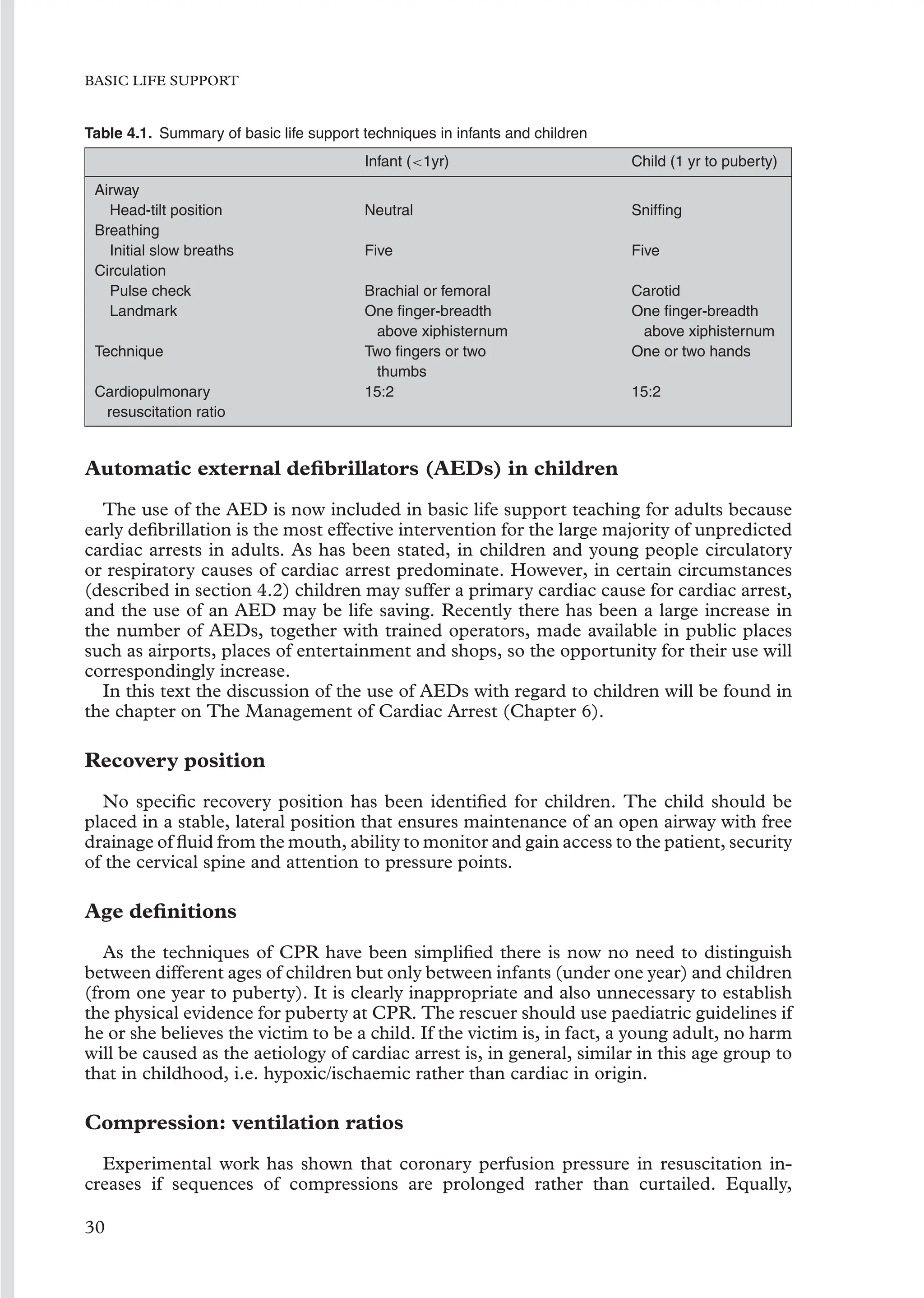
  • 28.
    WHY TREAT CHILDRENDIFFERENTLY? high and anterior (at the level of the second and third cervical vertebrae in the infant, compared with the fifth and sixth vertebrae in the adult), means that it is easier to intubate an infant using a straight-blade laryngoscope. The cricoid ring is the narrowest part of the upper airway (as opposed to the larynx in an adult). The narrow cross-sectional area at this point, together with the fact that the cricoid ring is lined by pseudo-stratified ciliated epithelium loosely bound to areolar tissue, makes it particularly susceptible to oedema. As tracheal tube cuffs tend to lie at this level, uncuffed tubes are preferred in pre-pubertal children. The trachea is short and soft. Overextension of the neck as well as flexion may therefore cause tracheal compression. The short trachea and the symmetry of the carinal angles mean that not only is tube displacement more likely, but a tube or a foreign body is also just as likely to be displaced into the left as the right main-stem bronchus. Breathing The lungs are relatively immature at birth. The air–tissue interface has a relatively small total surface area in the infant (less than 3 m2 ). In addition, there is a 10-fold increase in the number of small airways from birth to adulthood. Both the upper and lower airways are relatively small, and are consequently more easily obstructed. As resistance to flow is inversely proportional to the fourth power of the airway radius (halving the radius increases the resistance 16-fold), seemingly small obstructions can have significant effects on air entry in children. Infants rely mainly on diaphragmatic breathing. Their muscles are more likely to fa- tigue, as they have fewer type I (slow-twitch, highly oxidative, fatigue-resistant) fibres compared with adults. Pre-term infants’ muscles have even less type I fibres. These chil- dren are consequently more prone to respiratory failure. The ribs lie more horizontally in infants, and therefore contribute less to chest ex- pansion. In the injured child, the compliant chest wall may allow serious parenchymal injuries to occur without necessarily incurring rib fractures. For multiple rib fractures to occur the force must be very large; the parenchymal injury that results is consequently very severe and flail chest is tolerated badly. Circulation At birth the two cardiac ventricles are of similar weight; by 2 months of age the RV/LV weight ratio is 0·5. These changes are reflected in the infant’s ECG. During the first months of life the right ventricle (RV) dominance is apparent, but by 4–6 months of age the left ventricle (LV) is dominant. As the heart develops during childhood, the sizes of the P wave and QRS complex increase, and the P–R interval and QRS duration become longer. The child’s circulating blood volume per kilogram of body weight (70–80 ml/kg) is higher than that of an adult, but the actual volume is small. This means that in infants and small children, relatively small absolute amounts of blood loss can be critically important. Body surface area The body surface area (BSA) to weight ratio decreases with increasing age. Small children, with a high ratio, lose heat more rapidly and consequently are relatively more prone to hypothermia. At birth the head accounts for 19% of BSA; this falls to 9% by the age of 15 years. Figure 2.2 shows these changes. 10
  • 29.
    WHY TREAT CHILDRENDIFFERENTLY? 2.4 PHYSIOLOGICAL Respiratory The infant has a relatively greater metabolic rate and oxygen consumption. This is one reason for an increased respiratory rate. However, the tidal volume remains relatively constant in relation to body weight (5–7 ml/kg) through to adulthood. The work of breathing is also relatively unchanged at about 1% of the metabolic rate, although it is increased in the pre-term infant. Table 2.1. Respiratory rate by age at rest Age (years) Respiratory rate (breaths per minute) 1 30–40 1–2 25–35 2–5 25–30 5–12 20–25 12 15–20 In the adult, the lung and chest wall contribute equally to the total compliance. In the newborn, most of the impedance to expansion is due to the lung, and is critically dependent on the surfactant. The lung compliance increases over the first week of life as fluid is removed from the lung. The child’s compliant chest wall leads to prominent sternal recession and rib space indrawing when the airway is obstructed or lung compliance decreases. It also allows the intrathoracic pressure to be less “negative”. This reduces small-airway patency. As a result, the lung volume at the end of expiration is similar to the closing volume (the volume at which small-airway closure starts to take place). At birth, the oxygen dissociation curve is shifted to the left and P50 (Po2 at 50% oxygen saturation) is greatly reduced. This is due to the fact that 70% of the haemoglobin is in the form of HbF; this gradually declines to negligible amounts by the age of 6 months. The immature infant lung is also more vulnerable to insult. Following prolonged venti- lation of a pre-term infant, bronchopulmonary dysplasia may cause oxygen dependence for up to a year. Many infants who have suffered from bronchiolitis remain “chesty” for a year or more. Cardiovascular The infant has a relatively small stroke volume (1·5 ml/kg at birth) but has the highest cardiac index seen at any stage of life (300 ml/min/kg). Cardiac index decreases with age and is 100 ml/min/kg in adolescence and 70–80 ml/min/kg in the adult. At the same time the stroke volume increases as the heart gets bigger. As cardiac output is the product of stroke volume and heart rate, these changes underlie the heart rate changes seen during childhood (shown in Table 2.2). Table 2.2. Heart rate by age Age (years) Heart rate (beats per minute) 1 110–160 1–2 100–150 2–5 95–140 5–12 80–120 12 60–100 11
  • 30.
    WHY TREAT CHILDRENDIFFERENTLY? As the stroke volume is small and relatively fixed in infants, cardiac output is directly related to heart rate. The practical importance of this is that the response to volume therapy is blunted because stroke volume cannot increase greatly to improve cardiac output. By the age of 2 years myocardial function and response to fluid are similar to those of an adult. Systemic vascular resistance rises after birth and continues to do so until adulthood is reached. This is reflected in the changes seen in blood pressure – shown in Table 2.3. Table 2.3. Systolic blood pressure by age Age (years) Systolic blood pressure (mmHg) 1 70–90 1–2 80–95 2–5 80–100 5–12 90–110 12 100–120 Immune function At birth the immune system is immature and consequently babies are more susceptible than older children to many infections such as bronchiolitis, sep- ticaemia, meningitis and urinary tract infections. Maternal antibodies acqui- red across the placenta provide some early protection but these progressively decline during the first 6 months. These are replaced slowly by the infant’s as 756 he or she grows older. Breastfeeding provides some protection against respiratory and gastrointestinal infections. 2.5 PSYCHOLOGICAL Children vary enormously in their intellectual ability and their emotional response. A knowledge of child development assists in understanding a child’s behaviour and formu- lating an appropriate management strategy. Particular challenges exist in communicating with children and as far as possible easing their fear of the circumstances they find them- selves in. Communication Infants and young children either have no language ability or are still developing their speech. This causes difficulty when symptoms such as pain need to be described. Even children who are usually fluent may remain silent. Information has to be gleaned from the limited verbal communication, and from the many non-verbal cues (such as facial expression and posture) that are available. Older children are more likely to understand aspects of their illness and treatment and so be reassured by adequate age-appropriate communication. Fear All emergency situations, and many other situations that adults would not classify as emergencies, engender fear in children. This causes additional distress to the child and 12
  • 31.
    WHY TREAT CHILDRENDIFFERENTLY? adds to parental anxiety. Physiological parameters, such as pulse rate and respiratory rate, are altered because of it, and this in turn makes clinical assessment more difficult. Fear is a particular problem in the pre-school child who often has a “magical” concept of illness and injury. This means that the child may think that the problem has been caused by some bad wish or thought that he or she has had. School-age children and adolescents may have fearsome concepts of what might happen to them in hospital because of ideas they have picked up from adult conversation, films and television. Knowledge allays fear and it is therefore important to explain things as clearly as possible to the child. Explanations must be phrased in a way that the child can understand. Play can be used to do this (e.g. applying a bandage to a teddy first), and also helps to maintain some semblance of normality in a strange and stressful situation. Finally, parents must be allowed to stay with the child at all times; their absence from the child’s bedside will only add further fears, both to the child and to the parents themselves. 2.6 SUMMARY • Absolute size and relative body proportions change with age. • Observations on children must be related to their age. • Therapy in children must be related to their age and weight. • The special psychological needs of children must be considered. 13
  • 32.
    CHAPTER 3 Structured approach to emergencypaediatrics 3.1 INTRODUCTION The reception of a child with a life-threatening condition or the collapse of a child on the ward presents a major challenge to staff. The infrequency and, often unforeseen, nature of the events adds to the anxiety for all, including parents. The structured approach will enable the clinician to manage emergencies. This approach will initially focus on identifying and treating the immediate threats to life, that is a closed or obstructed airway, absent or distressed respiration, or pulselessness or shock. These first interventions comprise resuscitation. The next step is to identify the key features that in any serious illness or injury give the clinician a signpost to the likeliest working diagnosis. From this, the best emergency treatment can be identified to start to treat the child’s illness or injury. The final phase of the structured approach is to stabilise the child, focussing on achieving homoeostasis and system control and leading onto transfer to a definitive care environ- ment, which will often be the paediatric intensive care unit. Figure 3.1 shows the structured approach in diagrammatic form. Throughout this text the same structure will be used so the clinician will become familiar with the approach and be able to apply it to any clinical emergency situation. 3.2 PREPARATION If warning has been received of the child’s arrival then preparations can be made: • Ensure that appropriate help is available: critical illness and injury need a team ap- proach. • Work out the likely drug, fluid and equipment needs. For unexpected emergencies, ensure that all areas where children may be treated are stocked with the drugs, fluid and equipment needed for any childhood emergencies. 15
  • 33.
    STRUCTURED APPROACH TOEMERGENCY PAEDIATRICS Figure 3.1. Structured approach to emergency paediatrics 3.3 TEAMWORK Nowhere is a well-functioning team more vital than in the emergency situation. Success depends on each team member’s carrying out his or her own tasks and being aware of the tasks and the skills of other team members. The whole must be under the direction of a team leader. Scenario practice by teams who work together is an excellent way to keep up skills, knowledge and team co-ordination in preparation for the “real thing”. 16
  • 34.
    STRUCTURED APPROACH TOEMERGENCY PAEDIATRICS 3.4 COMMUNICATION In the previous chapter, issues about communication with the ill or injured child were highlighted. Communication is no less important with families and with clinical col- leagues. When things have gone wrong a fault in communication has often been involved. Contemporaneous recording of clinical findings, of the child’s history and of test results and management plans seems obvious but in the emergency situation can be overlooked. A template for note keeping is to be found in Chapter 13. 3.5 CONSENT Consent legislation and practice are complex areas: different jurisdictions have different rulings. The general approach is that in an emergency where you consider that it is in the child’s best interests to proceed, you may treat the child, provided it is limited to that treatment which is reasonably required in that emergency. In the UK the General Medical Council provides guidance for doctors, and hospitals will have internal policies with which you should be familiar. 17
  • 35.
  • 36.
    CHAPTER 4 Basic life support LEARNINGOBJECTIVES In this chapter, you will learn: • how to assess the collapsed patient and perform basic life support 4.1 INTRODUCTION Paediatric basic life support (BLS) is not simply a scaled-down version of that provided for adults, although, where possible, guidelines are the same for all ages to aid teaching and retention. Some of the techniques employed need to be varied according to the size of the child. A somewhat artificial line is generally drawn between infants (less than 1 year old) and children (between one year and puberty), and this chapter follows that approach. The preponderance of hypoxic causes of paediatric cardiorespiratory arrest means that oxygen delivery rather than defibrillation is the critical step in children. This underlines the major differences with the adult algorithm. By applying the basic techniques described, a single rescuer can support the vital respiratory and circulatory functions of a collapsed child with no equipment. Basic life support is the foundation on which advanced life support is built. Therefore it is essential that all advanced life support providers are proficient at basic techniques, and that they are capable of ensuring that basic support is provided continuously and well during resuscitation. 4.2 PRIMARY ASSESSMENT AND RESUSCITATION Once the child has been approached safely and a simple test for unresponsiveness has been carried out, assessment and treatment follow the familiar ABC pattern. The overall sequence of basic life support in paediatric cardiopulmonary arrest is summarised in 21
  • 37.
    BASIC LIFE SUPPORT Figure4.1. Note: this guidance is for one or more health professionals. BLS guidance for lay people can be found in a later section. SAFE approach Are you alright? Airway opening manoeuvres Look, listen, feel 5 rescue breaths Check pulse Check for signs of circulation CPR 15 chest compressions 2 ventilations Call emergency services 1 minute Figure 4.1. The overall sequence of basic life support in cardiopulmonary arrest (CPR = cardiopulmonary resuscitation) The SAFE approach Additional help should be summoned rapidly. Furthermore, it is essential that the rescuer does not become a second victim, and that the child is removed from continuing danger as quickly as possible. These considerations should precede the initial airway assessment. They are particularly pertinent in an unfamiliar environment. Within a health care setting the likelihood of risk is decreased. The steps are summarised in Figure 4.2. Figure 4.2. The SAFE approach When more than one rescuer is present one starts BLS while another activates the Emergency Medical Services (EMS) system then returns to assist in the BLS effort. If there is only one rescuer and no help has arrived after 1 minute of CPR then the rescuer 22
  • 38.
    BASIC LIFE SUPPORT mustactivate the EMS system himself or herself. In the case of a baby or small child the rescuer will probably be able to take the victim with him or her to a telephone whilst attempting to continue CPR on the way. Phone first In a few instances the sequence in the above paragraph is reversed. As previously described, in children, respiratory and circulatory causes of cardiac arrest predominate, and immediate respiratory and circulatory support as provided by the breaths and chest compressions of BLS can be life saving. However, there are circumstances in which early defibrillation may be life saving, i.e. cardiac arrests caused by arrhythmia. On these occasions, where there is more than one rescuer, one may start BLS and another summon the EMS as above. But if there is a lone rescuer then he or she should activate the EMS system first and then start BLS afterwards. The clinical indication for EMS activation before BLS by a lone rescuer include: • witnessed sudden collapse with no apparent preceding morbidity • witnessed sudden collapse in a child with a known cardiac condition and in the absence of a known or suspected respiratory or circulatory cause of arrest. The increasingly wide availability of public access defibrillation programmes with auto- matic external defibrillators (AEDs) may result in a better outcome for this small group. (see section 4.3) Are you alright? The initial simple assessment of responsiveness consists of asking the child “Are you alright?” and gently applying painful stimulus to the child. Infants and very small chil- dren who cannot talk yet, and older children who are very scared, are unlikely to reply meaningfully, but may make some sound or open their eyes to the rescuer’s voice or touch. In cases associated with trauma, the neck and spine should be immobilised during this assessment. This can be achieved by a lone rescuer by placing one hand firmly on the head. Airway (A) An obstructed airway may be the primary problem, and correction of the obstruction can result in recovery without further intervention. If a child is having difficulty breathing, but is conscious, then transport to hospital should be arranged as quickly as possible. A child will often find the best position to maintain his or her own airway, and should not be forced to adopt a position that may be less comfortable. Attempts to improve a partially maintained airway in an environment where immediate advanced support is not available can be dangerous, because total obstruction may occur. If the child is not breathing it may be because the airway has been blocked by the tongue’s falling back and obstructing the pharynx. An attempt to open the airway should be made using the head tilt/chin lift manoeuvre. The rescuer places the hand nearest to the child’s head on the forehead and applies pressure to tilt the head back gently. The desirable degrees of tilt are neutral, in the infant, and sniffing, in the child. These are shown in Figures 4.3 and 4.4. 23
  • 39.
    BASIC LIFE SUPPORT Figure4.3. Chin lift in infants Figure 4.4. Chin lift in children The fingers of the other hand should then be placed under the chin and the chin should be lifted upwards. Care should be taken not to injure the soft tissue by gripping too hard. As this action can close the child’s mouth, it may be necessary to use the thumb of the same hand to part the lips slightly. The patency of the airway should then be assessed. This is done by: LOOKing for chest and/or abdominal movement, LISTENing for breath sounds and FEELing for breath, and is best achieved by the rescuer placing his or her face above the child’s, with the ear over the nose, the cheek over the mouth and the eyes looking along the line of the chest for up to 10 seconds. If the head tilt/chin lift manoeuvre is not possible or is contraindicated because of suspected neck injury, then the jaw thrust manoeuvre can be performed. This is achieved by placing two or three fingers under the angle of the mandible bilaterally and lifting the jaw upwards. This technique may be easier if the rescuer’s elbows are resting on the same surface as the child is lying on. A small degree of head tilt may also be applied if there is no concern about neck injury. This is shown in Figure 4.5. 24
  • 40.
    BASIC LIFE SUPPORT Figure4.5. Jaw thrust As before, the success or failure of the intervention is assessed using the technique described above. LOOK LISTEN FEEL It should be noted that, if there is a history of trauma, then the head tilt/chin lift manoeuvre may exacerbate cervical spine injury. In general, the safest airway interven- tion in these circumstances is jaw thrust without head tilt. However, on rare occas- sions, it may not be possible to control the airway with jaw thrust alone in trauma. In these circumstances, an open airway takes priority over cervical spine risk and a gradually increased degree of head tilt may be tried. Cervical spine control should be achieved by a second rescuer maintaining in-line cervical stabilisation throughout in all cases. The blind finger sweep technique should not be used in children. The child’s soft palate is easily damaged, and bleeding from within the mouth can worsen the situation. Furthermore, foreign bodies may be forced further down the airway; they can become lodged below the vocal cords (vocal folds) and be even more difficult to remove. In the child with a tracheostomy, additional procedures may be necessary. (see Chap- ter 20, section on management of a blocked tracheostomy) Breathing (B) If the airway-opening techniques described above do not result in the resumption of adequate breathing within 10 seconds, exhaled air resuscitation should be commenced. The rescuer should distinguish between adequate breathing and ineffective, gasping or obstructed breathing. If in doubt, attempt rescue breathing. Five initial rescue breaths should be given. While the airway is kept open as described above, the rescuer breathes in and seals his or her mouth around the victim’s mouth (for a child), or mouth and nose (for an infant as shown in Figure 4.6). If the mouth alone is used then the nose should be pinched closed using the thumb and index fingers of the hand that is maintaining head tilt. Slow exhalation (1–1.5 seconds) by the rescuer should make the victim’s chest rise. The rescuer should take a breath between rescue breaths to maximise oxygenation of the victim. 25
  • 41.
    BASIC LIFE SUPPORT Figure4.6. Mouth-to-mouth-and-nose in an infant If the rescuer is unable to cover the mouth and nose in an infant he or she may attempt to seal only the infant’s nose or mouth with his or her mouth and should close the infant’s lips or pinch the nose to prevent air escape. As children vary in size only general guidance can be given regarding the volume and pressure of inflation (see the box). General guidance for exhaled air resuscitation • The chest should be seen to rise • Inflation pressure may be higher because the airway is small • Slow breaths at the lowest pressure reduce gastric distension • Firm, gentle pressure on the cricoid cartilage may reduce gastric insufflation If the chest does not rise then the airway is not clear. The usual cause is failure to apply correctly the airway-opening techniques discussed above. Thus, the first thing to do is to readjust the head tilt/chin lift position, and try again. If this does not work jaw thrust should be tried. It is quite possible for a single rescuer to open the airway using this technique and perform exhaled air resuscitation; however, if two rescuers are present one should maintain the airway whilst the other breathes for the child. Five rescue breaths are given. While performing rescue breaths, note any gag or cough response to your action. These responses, or their absence, will form part of your assessment of “signs of circulation” described below. Failure of both head tilt/chin lift and jaw thrust should lead to the suspicion that a foreign body is causing the obstruction, and appropriate action should be taken. (see “Choking Child”, section 4.5) Circulation (C) Once the rescue breaths have been given as above, attention should be turned to the circulation. Assessment Failure of the circulation is recognised by the absence of a central pulse for up to 10 seconds, by the presence of a pulse at an insufficient rate or by the absence of other signs of circulation, i.e. no breaths or cough in response to rescue breaths and no spontaneous movement. In children, as in adults, the carotid artery in the neck can be palpated. 26
  • 42.
    BASIC LIFE SUPPORT Ininfants the neck is generally short and fat and the carotid artery may be difficult to identify. Therefore the brachial artery in the medial aspect of the antecubital fossa (Figure 4.7), or the femoral artery in the groin, should be felt. Figure 4.7. Feeling for the brachial pulse If the pulse is absent for up to 10 seconds or is inadequate (less than 60 beats per minute, with signs of poor perfusion) then cardiac compression is required. Signs of poor perfusion include pallor, lack of responsiveness and poor muscle tone. Even experienced health professionals can find it difficult to be certain that the pulse is absent within 10 seconds so the absence of “signs of circulation” are an indication to start chest compressions also. Signs of circulation include: movement, coughing or normal breathing (not agonal gasps – these are irregular, infrequent breaths). Start chest compressions if • no pulse • slow pulse (less than 60 per minute with poor perfusion) • no signs of circulation “Unnecessary” chest compressions are almost never damaging and it is important not to waste vital seconds before starting them. If the pulse is present – and has an adequate rate, with good perfusion – but apnoea per- sists, exhaled air resuscitation must be continued until spontaneous breathing resumes. Chest compressions For the best effect the child must be placed lying flat on his or her back, on a hard surface. Children vary in size, and the exact nature of the compressions given should reflect this. In general, infants (less than 1 year) require a technique different from children up to be puberty in whom the method used in adults can be applied with appropriate modifications for their size. Compressions should be approximately one third of the depth of the child’s or infant’s chest. Position for chest compressions Chest compressions should compress the lower third of the sternum. The finger/thumb or hand position for all ages is found by finding the angle where the lowest ribs join in the middle and placing the finger/thumb or hand one finger’s breadth above this. Infants Infant chest compressions can be more effectively achieved using the hand- encircling technique: the infant is held with both the rescuer’s hands encircling or partially 27
  • 43.
    BASIC LIFE SUPPORT encirclingthe chest. The thumbs are placed over the correct part of the sternum (as detailed above) and compression carried out, as shown in Figure 4.9. This method is only possible when there are two rescuers, as the time needed to reposition the airway precludes its use by a single rescuer if the recommended rates of compression and ventilation are to be achieved. The single rescuer should use the two-finger method, employing the other hand to maintain the airway position as shown in Figure 4.8. Figure 4.8. Infant chest compression: two-finger technique Figure 4.9. Infant chest compression: hand-encircling technique Children Place the heel of one hand over the lower third of the sternum one finger’s breadth above the angle of the junction of the ribs. Lift the fingers to ensure that pressure is not applied over the childs ribs. Position yourself vertically above the child’s chest and, with your arms straight, compress the sternum to depress it by approximately one third of the depth of the chest (Figure 4.10). For larger children, or for small rescuers, this may be achieved most easily by using both hands with the fingers interlocked (Figure 4.11). The rescuer may choose one or two hands to achieve the desired compression of one third of the depth of the chest. 28
  • 44.
    BASIC LIFE SUPPORT Figure4.10. Chest compression: one-handed technique Figure 4.11. Chest compression: two-handed technique Once the correct technique has been chosen and the area for compression identified, fifteen compressions should be given to two ventilations. Continuing cardiopulmonary resuscitation The compression rate at all ages is 100 per minute. A ratio of fifteen compressions to two ventilations is maintained whatever the number of rescuers. If no help has arrived the emergency services must be contacted after 1 minute of cardiopulmonary resuscitation. With pauses for ventilation there will be less than 100 compressions per minute although the rate is 100 per minute. Compressions can be recommenced at the end of inspiration and may augment exhalation. Apart from this interruption to summon help, basic life support must not be interrupted unless the child moves or takes a breath. Any time spent readjusting the airway or re-establishing the correct position for com- pressions will seriously decrease the number of cycles given per minute. This can be a very real problem for the solo rescuer, and there is no easy solution. In the infant and small child, the free hand can maintain the head position. The correct position for compressions does not need to be remeasured after each ventilation. The cardiopulmonary resuscitation manoeuvres recommended for infants and children are summarised in Table 4.1. 29
  • 45.
    BASIC LIFE SUPPORT Table4.1. Summary of basic life support techniques in infants and children Infant (1yr) Child (1 yr to puberty) Airway Head-tilt position Neutral Sniffing Breathing Initial slow breaths Five Five Circulation Pulse check Brachial or femoral Carotid Landmark One finger-breadth above xiphisternum One finger-breadth above xiphisternum Technique Two fingers or two thumbs One or two hands Cardiopulmonary resuscitation ratio 15:2 15:2 Automatic external defibrillators (AEDs) in children The use of the AED is now included in basic life support teaching for adults because early defibrillation is the most effective intervention for the large majority of unpredicted cardiac arrests in adults. As has been stated, in children and young people circulatory or respiratory causes of cardiac arrest predominate. However, in certain circumstances (described in section 4.2) children may suffer a primary cardiac cause for cardiac arrest, and the use of an AED may be life saving. Recently there has been a large increase in the number of AEDs, together with trained operators, made available in public places such as airports, places of entertainment and shops, so the opportunity for their use will correspondingly increase. In this text the discussion of the use of AEDs with regard to children will be found in the chapter on The Management of Cardiac Arrest (Chapter 6). Recovery position No specific recovery position has been identified for children. The child should be placed in a stable, lateral position that ensures maintenance of an open airway with free drainage of fluid from the mouth, ability to monitor and gain access to the patient, security of the cervical spine and attention to pressure points. Age definitions As the techniques of CPR have been simplified there is now no need to distinguish between different ages of children but only between infants (under one year) and children (from one year to puberty). It is clearly inappropriate and also unnecessary to establish the physical evidence for puberty at CPR. The rescuer should use paediatric guidelines if he or she believes the victim to be a child. If the victim is, in fact, a young adult, no harm will be caused as the aetiology of cardiac arrest is, in general, similar in this age group to that in childhood, i.e. hypoxic/ischaemic rather than cardiac in origin. Compression: ventilation ratios Experimental work has shown that coronary perfusion pressure in resuscitation in- creases if sequences of compressions are prolonged rather than curtailed. Equally, 30
  • 46.
    BASIC LIFE SUPPORT ventilationsare a vital part of all resuscitation and are needed early especially in the hypoxic/ischaemic arrests characteristic of childhood. There is no experimental evidence to support any particular ratio in childhood but a 15:2 ratio has been validated by exper- imental and mathematical studies and is the recommended ratio for health care profes- sionals. Lay rescuers It has become clear that bystanders often do not undertake BLS because they are afraid to do it wrongly and because of an anxiety about performing mouth-to-mouth resuscita- tion on strangers. For lay rescuers, therefore, the adult compression/ventilation ratio of 30 compressions to 2 ventilations is recommended for children as well as adults thus simplify- ing the guidance. To increase the appropriateness for children, lay rescuers can be advised to precede their efforts by 5 rescue breaths if the victim is a child. Single health care pro- fessional rescuers are also enabled to perform a ratio of 30 compressions to 2 ventilations for children if they find difficulty in the transition from compressions to ventilations. 4.2 BASIC LIFE SUPPORT AND INFECTION RISK There have been a few reports of transmission of infectious diseases from casualties to rescuers during mouth-to-mouth resuscitation. The most serious concern in children is meningococcus, and rescuers involved in the resuscitation of the airway in such patients should take standard prophylactic antibiotics (rifampicin or ciprofloxacin). There have been no reported cases of transmission of either hepatitis B or human im- munodeficiency virus (HIV) through mouth-to-mouth ventilation. Blood-to-blood con- tact is the single most important route of transmission of these viruses, and in non-trauma resuscitations the risks are negligible. Sputum, saliva, sweat, tears, urine and vomit are low-risk fluids. Precautions should be taken, if possible, in cases where there might be contact with blood, semen, vaginal secretions, cerebrospinal fluid, pleural and peritoneal fluids and amniotic fluid. Precautions are also recommended if any bodily secretion con- tains visible blood. Devices that prevent direct contact between the rescuer and the victim (such as resuscitation masks) can be used to lower risk; gauze swabs or any other porous material placed over the victim’s mouth is of no benefit in this regard. The number of children in the UK with AIDS or HIV-1 infection is less than the number of adults similarly affected. If transmission of HIV-1 does occur in the UK, it is therefore much more likely to be from adult rescuer to child rather than the other way around. In countries where HIV/AIDS is more prevalent the risk to the rescuer will be greater. In South Africa, in a medical ward 25–40% of children may be HIV-positive but the prevalence is lower in trauma cases. In the Caribbean, HIV prevalence is second only to sub-Saharan Africa. The situation may change, as effective anti-retroviral agents are made available to poor countries. Although practice manikins have not been shown to be a source of infection, regular cleaning is recommended and should be carried out as shown in the manufacturer’s instructions. Infection rates vary from country to country and rescuers must be aware of the local risk. 4.3 THE CHOKING CHILD Introduction The vast majority of deaths from foreign body airway obstruction (FBAO) occur in pre-school children. Virtually anything may be inhaled, foodstuffs predominating. The 31
  • 47.
    BASIC LIFE SUPPORT diagnosismay not be clear-cut, but should be suspected if the onset of respiratory com- promise is sudden and is associated with coughing, gagging and stridor. Airway obstruction also occurs with infections such as acute epiglottitis and croup. In these cases, attempts to relieve the obstruction using the methods described below are dangerous. Children with known or suspected infectious causes of obstruction, and those who are still breathing and in whom the cause of obstruction is unclear, should be taken to hospital urgently. The treatment of these children is dealt with in Chapter 8. If a foreign body is easily visible and accessible in the mouth then remove it but while attempting that, take great care not to push it further into the airway. Do not perform blind finger sweeps of the mouth or upper airway as these may further impact a foreign body and damage tissues without removing the object. The physical methods of clearing the airway, described below, should therefore only be performed if: 1. The diagnosis of FBAO is clear-cut (witnessed or strongly suspected) and ineffective coughing and increasing dyspnoea, loss of consciousness or apnoea have occurred. 2. Head tilt/chin lift and jaw thrust have failed to open the airway of an apnoeic child. (The sequence of instructions is shown in Figure 4.12.) If the child is coughing he should be encouraged. A spontaneous cough is more effective at relieving an obstruction than any externally imposed manoeuvre. An effective cough is recognised by the victim’s ability to speak or cry and to take in breath between coughs. The child should be continually assessed and not left alone at this stage. No intervention should be made unless the cough becomes ineffective that is quieter or silent, and the victim cannot cry, speak or take a breath or if he becomes cyanosed or starts to lose consciousness. Then call for help and start the intervention. These manoeuvres are then alternated with each other and with examination of the mouth and attempted breaths as shown in the diagram. Assess Effective cough Encourage coughing Support and assess continuously Ineffective cough Conscious 5 back blows 5 chest/abdo thrusts Assess and repeat Unconscious Open airway 5 rescue breaths CPR 15:2 Check for FB Figure 4.12. The sequence of actions in a choking child Infants Abdominal thrusts may cause intra-abdominal injury in infants. Therefore a combi- nation of back blows and chest thrusts is recommended for the relief of foreign body obstruction in this age group. The baby is placed along one of the rescuer’s arms in a head-down position, with the rescuer’s hand supporting the infant’s jaw in such a way as to keep it open, in the neutral 32
  • 48.
    BASIC LIFE SUPPORT position.The rescuer then rests his or her arm along the thigh, and delivers five back blows with the heel of the free hand. If the obstruction is not relieved the baby is turned over and laid along the rescuer’s thigh, still in a head-down position. Five chest thrusts are given – using the same land- marks as for cardiac compression but at a rate of one per second. If an infant is too large to allow use of the single-arm technique described above, then the same manoeuvres can be performed by laying the baby across the rescuer’s lap. These techniques are shown in Figures 4.13 and 4.14. Figure 4.13. Back blows in an infant Figure 4.14. Chest thrusts in an infant Children Back blows can be used as in infants (Figure 4.15) or in the case of a larger child, with child supported in a forward leaning position. In the child the abdominal thrust (Heimlich manoeuvre) can also be used. This can be performed with the victim either standing or lying but the former is usually more appropriate. If this is to be attempted with the child standing the rescuer moves behind the victim and passes his or her arms around the victim’s body. Owing to the short height of children, 33
  • 49.
    BASIC LIFE SUPPORT Figure4.15. Back blows in a small child it may be necessary for an adult to raise the child or kneel behind them to carry out the standing manoeuvre effectively. One hand is formed into a fist and placed against the child’s abdomen above the umbilicus and below the xiphisternum. The other hand is placed over the fist, and both hands are thrust sharply upwards into the abdomen. This is repeated five times unless the object causing the obstruction is expelled before then. This technique is shown in Figure 4.16. Figure 4.16. Heimlich manoeuvre in a standing child To carry out the Heimlich manoeuvre in a supine child, the rescuer kneels at his or her feet. If the child is large it may be necessary to kneel astride him or her. The heel of one hand is placed against the child’s abdomen above the umbilicus and below the xiphisternum. The other hand is placed on top of the first, and both hands are thrust sharply upwards into the abdomen, with care being taken to direct the thrust in the midline. This is repeated five times unless the object causing the obstruction is expelled before that. 34
  • 50.
    BASIC LIFE SUPPORT Followingsuccessful relief of the obstructed airway, assess the child clinically. There may be still some part of the foreign material in the respiratory tract. If abdominal thrusts have been performed the child should be assessed for possible abdominal injuries. Each time breaths are attempted, look in the mouth for the foreign body and remove it if visible. Take care not to push the object further down and avoid damaging the tissues. If the obstruction is relieved the victim may still require either continued ventilations if not breathing but is moving or gagging or both ventilations and chest compressions if there are no signs of a circulation. Advanced life support may also be needed. If the child breathes effectively then place him in the recovery position and continue to monitor him. Unconscious infant or child with foreign body airway obstruction • Call for help • Place the child supine on a flat surface • Open the mouth and attempt to remove any visible object • Open the airway and attempt 5 rescue breaths, repositioning the airway with each breath if the chest does not rise • Start chest compressions even if the rescue breaths were ineffective • Continue the sequence for single rescuer CPR for about a minute then summon help again if none is forthcoming Each time breaths are attempted, look in the mouth for the foreign body and remove it if visible. Take care not to push the object further down and avoid damaging the tissues. If the obstruction is relieved the victim may still require either continued ventilations if not breathing but is moving or gagging or both ventilations and chest compressions if there are no signs of a circulation. Advanced life support may also be needed. If the child breathes effectively then place him in the recovery position and continue to monitor him. 4.4 SUMMARY SAFE approach Are you alright? Airway opening manoeuvres Look, listen, feel 5 rescue breaths Check pulse Check for signs of circulation CPR 15 chest compressions 2 ventilations Call emergency services 1 minute Figure 4.17. The overall sequence of basic life support in cardiopulmonary arrest The teaching in this chapter is consistent with the ILCOR guidelines, Resuscitation 2005, and there are an enormous number of references which have informed this process. These are available on the ALSG Web site. See details on the “Contact Details and Further Information” page. 35
  • 51.
    CHAPTER 5 Advanced support ofthe airway and ventilation LEARNING OBJECTIVES In this chapter, you will learn: • how to assess and manage the airway with adjuncts and equipment • how to support breathing with simple equipment • how to respond to an airway/breathing problem with a structured approach 5.1 INTRODUCTION Management of airway and breathing has priority in the resuscitation of patients of all ages; however, the rate at which respiratory function can deteriorate in children is particularly high. Effective resuscitation techniques must be applied quickly and in order of priority. The differences between adults and children must be realised and familiarity with equipment assured. Techniques for obtaining a patent and protected airway, and for achieving adequate ventilation and oxygenation, must be learned and practised. These techniques must be integrated into a prioritised system of care. It should be stressed that basic, simple techniques are often effective and life saving. 5.2 EQUIPMENT FOR MANAGING THE AIRWAY Necessary airway equipment Face masks Airways including laryngeal mask airways (LMAs) Self-inflating bag–valve–mask devices Tracheal tubes, introducers and connectors Suction devices Cricothyroidotomy cannulae 37
  • 52.
    ADVANCED SUPPORT OFTHE AIRWAY AND VENTILATION The airway equipment indicated in the box should be available in all resuscitation areas. It is crucial that familiarity with it is gained before an emergency situation occurs. Pharyngeal airways There are two main types of pharyngeal airway: 1. Oropharyngeal 2. Nasopharyngeal 1. The oropharyngeal or Guedel airway is used in the unconscious or obtunded patient to provide a patent airway channel between the tongue and the posterior pharyngeal wall. It may also be used to stabilise the position of an oral endotracheal tube. In the awake patient with an intact gag reflex, it may not be tolerated and may induce vomiting. The oropharyngeal airway is available in a variety of sizes. A correctly sized airway when placed with its flange at the centre of the incisors, then curved around the face, will reach the angle of the mandible. Too small an airway may be ineffective, too large an airway may cause laryngospasm. Either may cause mucosal trauma or may worsen airway obstruction. Reassessment following placement is therefore a vital part of safe insertion of an airway device. Techniques for insertion are described in Chapter 20. 2. The nasopharyngeal airway is often better tolerated than the Guedel airway. It is con- traindicated in fractures of the anterior base of the skull. It may also cause significant haemorrhage from the vascular nasal mucosa. A suitable length can be estimated by measuring from the tip of the nose to the tragus of the ear. An appropriate di- ameter is one that just fits into the nostril without causing sustained blanching of the alae nasi. As small-sized nasopharyngeal airways are not commercially available, shortened endotracheal tubes may be used. The acid test of success, as in all therapeutic interventions, is that insertion of one or other of these devices should result in improvement in the patient’s condition. If it does not occur then a reappraisal of the choice or size of airway is urgently required. Figure 5.1. Sizing an oropharyngeal airway 38
  • 53.
    ADVANCED SUPPORT OFTHE AIRWAY AND VENTILATION Laryngoscopes Two principal designs of laryngoscope for use in children exist: straight bladed and curved bladed. The straight-bladed laryngoscope is usually employed to directly lift the epiglottis, thereby uncovering the vocal folds. The advantage of this approach is that the epiglottis is moved sufficiently so that it does not obscure the cords. The disadvantage potentially is vagal stimulation causing laryngospasm or bradycardia. The curved-bladed laryngoscope is designed to move the epiglottis forward by lifting it from in front. The tip of the blade is inserted into the mucosal pocket, known as the vallecula, anterior to the epiglottis and the epiglottis is then moved forward by pressure in the vallecula. This may be equally effective at obtaining a view of the cords and has the advantage that less vagal stimulation ensues, as the mucosa of the vallecula is innervated by the glossopharyngeal nerve. A laryngoscope blade should be chosen appropriate for age. It is possible to intubate with a blade which is too long but not one which is too short. Laryngoscopes are notoriously unreliable pieces of equipment which may develop flat batteries and unserviceable bulbs very quickly between uses. It is vital therefore, that a spare should be available at all times and that equipment should be regularly checked to ensure it is in good working order. Trachea Laryngeal inlet Figure 5.2. View of larynx using a straight-bladed laryngoscope Tracheal tubes Tracheal tubes come in a variety of designs, the most useful for resuscitation being the plain plastic tube. Uncuffed tubes should be used during resuscitation, by those who do not have much paediatric anaesthetic experience, for children up until approximately 10 years of age. Until this point, the larynx is circular in cross section and the narrowest 39
  • 54.
    ADVANCED SUPPORT OFTHE AIRWAY AND VENTILATION Epiglottis Trachea Laryngeal inlet Figure 5.3. View of larynx using a curved-bladed laryngoscope part of it is at the cricoid ring, rather than the vocal cords. An appropriately sized tube should give a relatively gas-tight fit in the larynx but should not be so tight that no leak is audible when the bag is compressed. Failure to observe this condition may lead to damage to the mucosa at the level of the cricoid ring and to subsequent oedema following extubation. Estimating the appropriate size of an uncuffed tracheal tube is carried out as follows: Internal diameter (mm) = (Age/4) + 4 Length (cm) = (Age/2) + 12 for an oral tube Length (cm) = (Age/2) + 15 for nasal tube These formulae are appropriate for ages over 1 year. Neonates usually require a tube of internal diameter 3–3.5 mm, although pre-term infants may need one of diameter 2.5 mm. Cuffed tubes should not be used in neonates. Tracheal tubes are measured in sizes by their internal diameter in millimetres. They are provided in whole- and half- millimetre sizes. The clinician should select a tube of appropriate size but also prepare one a size smaller and one a size larger. In the circumstances of resuscitation in a young child where the lungs are very “stiff”, for example in a cardiac arrest from severe bronchiolitis, a cuffed tube rather than an uncuffed tube may be used but the risk of airway damage from the cuff must be balanced against the risk of failure to inflate the lungs. Tracheal tube introducers Intubation can be facilitated by the use of a stylet or introducer, placed through the lumen of the tracheal tube. There are two types: soft and flexible or firm and malleable. The former can be allowed to project out of the tip of the tube, as long as it is handled very gently. The latter is used to alter the shape of the tube, but can easily damage the tissues if allowed to protrude from the end of the tracheal tube. Tracheal tube introducers should not be used to force a tracheal tube into position. 40
  • 55.
    Another Random Documenton Scribd Without Any Related Topics
  • 56.
    small donations ($1to $5,000) are particularly important to maintaining tax exempt status with the IRS. The Foundation is committed to complying with the laws regulating charities and charitable donations in all 50 states of the United States. Compliance requirements are not uniform and it takes a considerable effort, much paperwork and many fees to meet and keep up with these requirements. We do not solicit donations in locations where we have not received written confirmation of compliance. To SEND DONATIONS or determine the status of compliance for any particular state visit www.gutenberg.org/donate. While we cannot and do not solicit contributions from states where we have not met the solicitation requirements, we know of no prohibition against accepting unsolicited donations from donors in such states who approach us with offers to donate. International donations are gratefully accepted, but we cannot make any statements concerning tax treatment of donations received from outside the United States. U.S. laws alone swamp our small staff. Please check the Project Gutenberg web pages for current donation methods and addresses. Donations are accepted in a number of other ways including checks, online payments and credit card donations. To donate, please visit: www.gutenberg.org/donate. Section 5. General Information About Project Gutenberg™ electronic works Professor Michael S. Hart was the originator of the Project Gutenberg™ concept of a library of electronic works that could be freely shared with anyone. For forty years, he produced and distributed Project Gutenberg™ eBooks with only a loose network of volunteer support.
  • 57.
    Project Gutenberg™ eBooksare often created from several printed editions, all of which are confirmed as not protected by copyright in the U.S. unless a copyright notice is included. Thus, we do not necessarily keep eBooks in compliance with any particular paper edition. Most people start at our website which has the main PG search facility: www.gutenberg.org. This website includes information about Project Gutenberg™, including how to make donations to the Project Gutenberg Literary Archive Foundation, how to help produce our new eBooks, and how to subscribe to our email newsletter to hear about new eBooks.
  • 58.
    Welcome to ourwebsite – the perfect destination for book lovers and knowledge seekers. We believe that every book holds a new world, offering opportunities for learning, discovery, and personal growth. That’s why we are dedicated to bringing you a diverse collection of books, ranging from classic literature and specialized publications to self-development guides and children's books. More than just a book-buying platform, we strive to be a bridge connecting you with timeless cultural and intellectual values. With an elegant, user-friendly interface and a smart search system, you can quickly find the books that best suit your interests. Additionally, our special promotions and home delivery services help you save time and fully enjoy the joy of reading. Join us on a journey of knowledge exploration, passion nurturing, and personal growth every day! ebookbell.com